



Abstract
We are experiencing a time during which there is a clear crisis of values, meaning a distancing with regard to the problems of socially disadvantaged groups. This article’s main purpose is to discuss whether this situation has had any impact on solidarity discourse towards immigrants. To fulfill our objective, we will analyse the written messages in a visitors’ book used for a sit-in that took place in Murcia, Spain, in 2001. We selected 100 of these messages to determine the degree of involvement that visitors show towards immigrants. In this regard, we have proposed four processes of involvement, from low to high: proximity, accompaniment, support and identification. We will analyse these processes from a critical and constructive viewpoint in an attempt to determine which is the most common and which combinations of processes are preferred by the authors of the messages. In addition, we will focus on the use of key expressions, terms of intensification, and argumentative structures as basic elements for the interpretation of these processes of involvement.
Keywords
Immigration in Spain: Discourse and solidarity
Spanish society has changed in terms of its appearance since the mid-1990s due to the arrival, growing ever more intense, of immigrants, most of whom want to improve their socio-economic conditions. The evolution in terms of the numbers of registered foreigners between 1996 and 2005, as listed in the National Institute of Statistics 2012, can serve as a reference point: in 1996, there were 542,000; in 1998, 637,000; in 2000, 923,000; in 2002, 1,977,000; in 2004, 3,738,000; and in 2005, 3,880,000 (see www.ine.es). In just 10 years, the number of registered foreigners has increased sevenfold. In addition, strong networks of support been developed not only by immigrants (Aparicio and Tornos, 2005), but also by groups that conceive them as a problem for the country (Cornelius, 2004: 390; Lee, 2005). The material discussed in this article is based on 2001, which saw one of the highest peaks of growth in reference to immigration in Spain. At present, immigrants compose 10% of the population (Reher and Requena, 2009). However, in recent years, the number of Spanish people who migrate has increased and the number of immigrants arriving due to the severe economic crisis in the country has decreased. This trend has been observed since 2008, when immigration decreased 24% as compared to 2007 and emigration increased 17.3% over the same period of time (IOÉ Collective, 2011: 32). With varying intensity, it is a trend that affects other European countries too (Oblak, 2011).
One consequence of this social transformation has been the recognition of immigration as one of the preferred research topics in the field of humanities and social sciences. In this regard, we must state the specific case of discourse analysis (Van Dijk, 2007). The most in-depth line of work has been the representation of immigrants in the mass media (see e.g. Bañón, 1996, 2002a, 2002b, 2006, 2007; Bañón and Fornieles, 2008; Grup de Reflexió sobre Immigració y Mèdia (GRIM, 2005; Lario, 2006; Lorite, 2004; Martínez Lirola, 2008, 2010; Retis, 2004). However, there have also been major advances in the analysis of other kinds of discourses, such as in the area of politics (Martín Rojo, 2000a, 2000b; Martín Rojo and Van Dijk, 1997; Triandafyllidou, 2005), social movements (Jiménez Cano, 2007), education (Actis et al., 2006; Patiño, 2009) and daily conversation (Bañón, 1997; Van Dijk, 1984).
All that has been written on this topic allows us to identify numerous strategies and discursive techniques that appear, at the moment, to offer a certain image of immigrants or of other relevant actors in the social debate on migratory processes. We might say the same thing of the conceptual tools that the investigation into immigration and discourse has developed in the last few years.
One of these conceptual proposals is related to the establishment of discursive types from the identity of the person speaking or writing (basically, whether he or she is an immigrant or not) and of that person’s mental model of valuation with regard to immigrants (positive, negative, not positive and not negative).
More specifically, in a previous article we discussed the existence of a social debate on immigration with eight types of discourse: committed discourse (non-immigrant and positive valuation), discourse of protest (immigrant and positive valuation), discriminatory discourse (non-immigrant and negative valuation), auto discriminatory discourse (immigrant and negative valuation), complacent discourse (non-immigrant and non-negative valuation), resigned discourse (immigrant and non-negative valuation), preventive discourse (non-immigrant and non-positive valuation) and segregationist discourse (immigrant and non-positive valuation) (Bañón, 2002a: 189ff., 2003).
At that time, we offered a description of each of those types of discourse and discussed different degrees of manifestation. But that information was limited in relation to committed discourse and its connection to solidarity with immigrants. We did not delve sufficiently into the different degrees of manifestation of this type of discourse or, consequently the various ways of approaching or distancing immigrants who suffer due to discriminatory situations. Nor did we inquire into the fact that showing solidarity may also have a strategic value for the speaker: that strengthens his positive image in society and determines the power relationship behind interethnic communication (Chouliaraki, 2011: 364). Actually, few specific works on the discourse of solidarity towards immigrants can be found in the international literature (García, 2012).
Lilie Chouliaraki studied the discourse of suffering depicted on television and the different degrees of involvement or inhibition of viewers with respect to sufferers on the screen (2006). She distinguishes three main types of television representation of suffering. The first is based on the concept of ‘adventure’, which involves a high psychological and emotional distance with respect to the suffering of others.
The second type is based on the idea of ‘emergency’, which generates pity and is observed in communicative expressions of emotional approach to the problem of the viewer. The arrival of immigrant open boats to the coasts of European countries is precisely one of the examples referred to in this second type of informative discourse. In any case, it is a type of representation that appears with some historical decontextualization and prevents the framing of the particular facts in a more general interpretive area (2006: 150). Chouliaraki refers to the ‘voyeur’ as one of the fundamental classes of viewer when faced with news based on an emergency: ‘This is the position of a witness who has been freed from the moral obligation to act and so can sit back and enjoy the high-adrenaline spectacle unfolding on the screen’ (2006: 145).
The third model (ecstatic news) refers to events of great significance (e.g. the 9/11), in which there is a high level of empathy with those who are suffering. Moreover, we can talk about a reflective identification of spectators with the sufferers, facilitating maximum approximation through TV images. Those affected have, in large part, a similar identity to the viewers. In fact, one could say that those who watch these events feel that they themselves could have been there (2006: 157–159).
What happens when there is suffering, not through the media, but face to face? Is that affective and communicative model, which requests little involvement with the suffering of others and that we have learned from the messages we get, transferred especially through television, when dealing with immigration? Some studies have shown that the solidarity of European citizens with immigrants is, in general, of low intensity (Van Oorschot, 2008).
We shall take discourse of solidarity to mean discourse that tends to value the discriminated group positively and is supportive of its demands, and that originates from someone who does not belong to the group. This solidarity discourse can actually be represented by different degrees of intensity, which we propose to identify as weak, average (high or low) and strong.
The transition from one degree to another depends on factors such as the following:
The person speaking assumes his own responsibility (or that of the social, political or professional group to which he belongs) for the resolution of problems or in the search for social justice (stronger) or, on the contrary, he rejects this responsibility, devolving it to others, such as the immigrants themselves (weaker).
The person speaking orients his discourse to appeal to the emotions (weaker implication) or towards reason and argument (stronger). An emotional appeal would be interpreted as more conjectural and ephemeral.
Finally, it could be that the person speaking compromises his discourse to later actions of support and identification with the demands of immigrants. If this happens, we would call it a strong implication, and, in the opposite instance, a weak one.
A greater assumption of responsibility, a greater tendency to reasonable argument and a greater correspondence between what is said and what is done (or what is promised to be done) determine the highest degree of involvement and identify what we know as a committed solidarity discourse. It is a discourse by non-immigrants who have made a clear and positive assessment of immigrants and their socio-economic and cultural contributions.
Our main aims are, first, to intensify studies about discourse of solidarity on immigrants. At the moment, research is focused on discriminatory and racist discourse rather than on the study of discourse of solidarity. Second, we want to deepen the discourse subtypes that shape the different degrees of the involvement in solidarity. Third, we want to identify and analyse the formulae of discursive materialization of each one of these subtypes, attending, fundamentally, to three components: key expressions, terms of intensification and argumentative structure. We will explain hereinafter what we understand by each of these components. Our fourth objective is to reflect on the ethnic and power relations that these subtypes express in a particular social group. Finally, our goal is to give greater prominence to more specific and original corpuses that have not received attention so far when analysing the social debate on immigration. On this occasion, we are referring to the visitors’ book that was made during a sit-in by a group of immigrants.
To fulfil these aims, we will briefly reflect on the sit-in and the visitors’ book as objects of discourse analysis. Next, we will present the corpus we are using, providing an explanation of the process of selection of the particular messages chosen for our analysis. Then, some of the key concepts of the processes, in which there are different degrees of involvement of the discursive solidarity subtypes, will be shown, as well as the structure of the messages and their principal components. Finally, we will analyse the messages, interpreting the information from quantitative and qualitative points of view.
Notes on the immigrants’ sit-in and visitors’ book as objects of investigation of discourse analysis
The sit-in is one of the most striking ways to express disagreement with a situation, be it personal, social or concerning work (Proudfoot, 1990). In the latter years of the 20th century and the beginning of the 21st century, numerous sit-ins took place in southern Europe to highlight the problems of immigrants and find solutions (Calavita, 2005: 120; Nash, 2005: 65).
The mass media generally give sufficient attention to sit-ins. Some Spanish scholars have worked specifically on the discursive treatment given by the media to immigrant-led sit-ins, especially those carried out in 2001. Andreu Casero, for instance, has worked with journalistic texts on this subject and has identified two opposing discourses: those of safety and solidarity. Casero thinks that the analysed newspapers (Avui and La Vanguardia) conclude that immigration is problematic and causes confrontation (2003: 255). On the other hand, Casero emphasizes that the discursive strategies followed by the media move, in general, from the dramatization of the initial phases of the sit-in, presented as a conflict, to the representation of immigrants as intransigent in the negotiation phase, since they ask for – so it is said – ‘impossible things’ (2004: 225–229). In another work, we drew attention to the ways newspaper reports on immigration are designed, for example by associating the sit-ins with medical alerts and ‘illegal’ drugs (Bañón, 2002a: 136, 138). Furthermore, the absence of any informative coverage on the presence of women in the 2001 sit-ins has been emphasized (Rodríguez, 2005: 182). From a more multi-modal point of view, Estrella Gualda and Auxiliadora Montes (2007: 134), in their analysis of the representation of immigration in the Huelva press (2001–2004), alluded to photos of sit-ins showing disorder inside the area used and people lying or sitting on the floor, trying to avoid close-ups.
Visitors’ books have attracted the interest of communication analysts, especially those dedicated to the study of the discourse of tourism and the environment (Noy, 2008a, 2008b), as well as that of religion (Busby, 2006). They are evidence of having been in a certain place and of somehow having helped to materialize it discursively.
The sit-in is a complex socio-semiotic genre that generates textual and discursive parallel structures. These structures can have different dimensions depending on their aims and their social significance. 1 The visitors’ book appears to be one of those parallel documents and, in spite of not customarily fulfilling a nuclear function in the large-scale transmission of the claims of people in the sit-in, it serves to fulfil relevant aims from the communicative point of view: the display of messages of support for the protest discourse of the immigrants on the part of external but presumably related actors. These messages of encouragement generally have very heterogeneous profiles of implication, as we shall see later.
It should be taken into account that this type of document is not always a feature of a sit-in, mainly because of the different types of sit-in. For example, not all sit-ins allow unfettered access. A visitors’ book can only be useful if access to the sit-in is fluid, that is, free and voluntary, and if there are no restrictions on the comments the visitors want to make, beyond those of common sense and those that comply with the sort of standards considered the norm for this type of text and context. As we shall see, there can be formal restrictions.
The events and the corpus
Different groups of immigrants in Spain carried out a series of mobilizations (basically, demonstrations, hunger strikes and sit-ins) during the year 2001. The mobilizations took place in different Spanish cities. We can place one of the neuralgic points of these mobilizations in the region of Murcia (Laubenthal, 2005: 159). Talking precisely about Murcia and the sit-in of 2001, Federico Montalbán (2003: 10–11) remembers that, in spite of the fact that the right-wing Partido Popular (PP) had reached the absolute majority incorporating into their programme, among other things, a change in immigration law hardening immigrants’ regularization, the Spanish people showed their solidarity with the fight of the immigrants against the aforementioned law. He notes:
Esta solidaridad se puso de manifiesto en la participación en los distintos actos reivindicativos que se organizaron y tuvo su máxima expresión en los encierros. De esta manera, los encierros trascendieron su esencia de instrumento de una lucha para convertirse en lugares de encuentro. (…) Se convirtieron en espacios para el conocimiento mutuo, la amistad y la solidaridad. El dinero, los colchones, la comida, fueron imprescindibles, pero al menos tanto como todo eso lo fueron también las muestras de compañerismo y apoyo anímico que recibieron los encerrados por parte de las vecinas y vecinos de las parroquias donde se encontraban. This solidarity was evident in the participation in various protest events that were organized and that had its highest expression in the sit-in. In this way, the sit-ins extended their core function as an instrument of a struggle to become meeting places. (…) They became spaces for mutual understanding, friendship and solidarity. The money, mattresses, food were essential, but at least as much as all that, the samples of comradeship and moral support that the people conducting the sit-in received from the neighbours and residents of the parishes where they were.
One of the most important sit-ins of those weeks in Murcia was the one that took place in Molina de Segura, in the parochial hall of a church. It lasted approximately three months, from the beginning of January until the middle of April in 2001 when an agreement was signed by the Delegation of the Government in the region of Murcia.
We have no recordings of the conversations and demonstrations of fellowship that took place over the duration of the sit-in, but we have written documents that show this wealth of information. It is the visitors’ book, to which we have had access, which we are going to analyse in this article.
The book has a specific format presented in four columns:
The first one identifies the number of the message (contained in a rectangle 1 cm wide and 2 cm high).
The second gives the name of the person (in a rectangle 5.5 cm wide and 2 cm high).
The third column (in a rectangle 7.5 cm wide by 2 cm in height) is for the telephone number (in brackets, this indicates whether the person wishes the enclosed to call them).
And the fourth one (in a rectangle 13 cm wide by 2 cm high) is for writing an appropriate message. The original states: ‘Escribe lo que quieras’ (‘Write what you want’).
We have given information about the size of each rectangle because it is data relevant to analysing the possible extension of the testimonies written in the book and to valuing the effort of synthesis that the writers had to make. The maximum number of words used in a message was around 30.
The logo of the ‘Platform of Immigration’ appears at the bottom of each page. The Platform is a group that gave support to the immigrants in Molina de Segura, and was created in the year 2000 with the intention of claiming ‘a legal status’ for them (Laubenthal, 2005: 167).
The languages that appear in our corpus are Spanish, Arabic, English and French.
For our analysis, we wanted to select 100 of the messages to the immigrants in the sit-in, written by visitors who were not immigrants themselves. This number seemed to be sufficiently representative to reach the proposed aims and, in addition, it is an attainable quantity given the limitations in space of the present article.
To make our selection, we used the following procedure:
We eliminated anything that gave instructions on how to use or write in the book and anything not written in Spanish.
We excluded entries where some of the columns were blank, for example those for the person’s identity, telephone number or the message itself. Our intention was to analyse testimonies with explicit authorship (as an individual or representative of a group) with the possibility of feedback (using the telephone number or email address provided) and with discursive material written about the people visited.
Similarly, we excluded contributions made by immigrants (not only those in the sit-in, but also those visiting them) as their discourse has a different profile from that of non-immigrants. It is the latter that will constitute the object of our investigations.
Finally, through this selection process, we chose 100 messages written in the column ‘Write what you want’ that were addressed to the people in the sit-in. We gathered contributions made at the beginning, middle and end of the sit-in, in case there was some difference in the content depending on the time of writing.
To conclude, the following are the exact figures used to select the 100 messages:
The book consists of 918 messages, and 478 contributions were excluded in the first phase of the process for the previously mentioned reasons.
Of the 440 remaining messages, we eliminated 183, which referred to immigration in general or the need to fight for justice or equality, or that used phrases generally associated with the unions or political or social matters but did not include any indication that they were directly addressed to the people in the sit-in.
After this, 257 messages were left, of which we selected the following sets: from 1 to 40, from 101 to 130 and from 228 to 257 (see Appendix).
Tools for analysis
Actors and degrees of involvement
Most of the visitors went to the sit-in voluntarily (mostly villagers) and some out of obligation (journalists who, in some cases, also wrote messages). Some of them expressed their ideas, feelings and opinions as individuals and others as representatives of social, political or educational groups. In any case, all of them expressed their feelings following determined socio-cognitive models that gave coherence to their micro-discourses (Van Dijk, 2008: 58):
specific experience derived from the visit to the sit-in;
information received from other visitors and the media in relation to the sit-in;
general experience that each visitor could have personally with regard to immigration and immigrants;
general information on immigration received through the media, especially in the period immediately preceding the sit-in.
Naturally, the act of visiting a sit-in presupposes a favourable predisposition to be involved in the problem. However, the degree of involvement has a lot to do with these mindsets and, therefore, with the experience and relevant information each of the visitors could have.
As we said before, we identify three degrees of discursive involvement depending on the assumption of responsibility, the tendency to approach the question from a more emotive point of view or not, and the accommodation between doing and saying:
weak
average (high or low)
strong.
These degrees are demonstrated in the following processes:
A weak involvement simply indicates a close proximity to the people in the sit-in at the time and their situation, more rooted in the moment than structural, and that is based, as we note, on emotive and spontaneous reactions rather than on a deeper understanding of the reasons or consequences of social injustice. An example: Suerte y ánimo (Luck and cheer up) (m. 34).
Average refers to those actors who sympathize with the discriminated groups and who base their discourses on feelings of empathy. The lower average is based on accompaniment. The higher average is based on their support for the immigrants and their demands. For example: Si necesitáis algo, llamad a este número (If you need anything, call this number) (m. 45).
By a strong involvement, we are referring to the type of committed discourse that is characterized by a clear identification of the actors with the groups they are defending. These people act, in some ways, as ‘loudspeakers’, amplifying the message of the disadvantaged group. Sometimes, those who show this degree of commitment suggest plans of future action, indicating their desire that the action should be continuous and constant. For instance: Os consideramos como a nosotros. Nos sentimos unidos en vuestras reivindicaciones (We feel at one with you. We feel united with your demands) (m. 55).
In the case of a combination of different processes in the same message, we will take as a sample, first, the one that indicates a major degree of involvement. So, for example, if we find expressions of proximity or of support, the latter will mark the basic profile of the message.
Message structure
At the core of the messages that we are going to analyse is a key expression that determines the degree of involvement (weak, average or strong). This key expression can be marked by degrees of intensity. It is important to observe later whether the authors explain their motives in choosing it. It is necessary to observe if there are argumentative structures that answer questions, such as the following: Why do they give encouragement? Why do they ask that they carry on? How do they justify their support? Is there a motive that explains the visitor’s identification with the immigrants? Also, the motives and the key expression, can be determined by modifiers of intensity.
Ultimately, we are interested in analysing three fundamental components of the messages:
Key expressions that represent the processes of proximity, accompaniment, support or identification;
The terms of intensification of the degree of involvement;
The argumentative structures that make possible the choice of one or another process.
These would be the different classes of key expression, according to the type of process that we find in the corpus:
Proximity [PR]: Suerte (Luck)/Ánimo(s) (Cheer up)/No os desaniméis (Don’t lose heart)/No decaigan (Don’t flag)/Que todo salga bien (Everything will go well)/Adelante (Go on)/Aguantad (Keep it up)/Fuerza (Strength)/Esperanza (Hope)/Salud (Health)/Besos (Love)/Abrazos (Hugs)/Un saludo (Best wishes).
Accompaniment [AC]: Estamos con vosotros (We are on your side)/Podéis contar con nosotros (You can count on us)/Os quiero (I love you).
Support [SU]: Tenéis mi apoyo (You have my support).
Identification [ID]: Somos vosotros (We are you)/Llamadme (Call me)/Unidos (Close)/Juntos (Together).
The following are typical terms of intensification: 2
The use of capital letters: ESTAMOS CON VOSOTROS (WE ARE ON YOUR SIDE).
Exclamation marks: ¡Ánimo! (Cheer up!).
Slogans, set phrases and lexical fixed formulae: El pueblo unido, jamás será vencido (A united people will never be defeated)/Dejar en paz (Leave them in peace).
Enumerations and repetitions: Suerte, valor y unión (Luck, courage and unity).
Metaphorical structures: Luchar (Fight)/Revolución (Revolution).
Time markers: Siempre (Always)/Nunca (Never).
Responsibility determiners: Empobrecidos (Impoverished)/Vuestro problema (Your problem).
Quantification of the number of actors or utilization of the first-person plural: Como miembro del Comité Regional del PSRM-PSOE (Partido Socialista de la Región de Murcia. Partido Socialista Obrero Español) (As a member of the Regional Committee of PSRM-PSOE)/Pertenezco a ‘Aldea Global’ (I belong to ‘Aldea Global’)/Toda Andalucía (All of Andalucía)/Estamos con vosotros (We are on your side).
Generic quantifiers: Mucho (A lot)/Mejor (Better)/Inmenso (Inmense)/Total (Totally)/Todos (All).
In principle, the argumentative structure of the messages we are analysing has its foundation in the following:
Universal values of justice and equality: Todos somos iguales ante la ley (We are all equal under the law)/Todos los ciudadanos somos iguales (All citizens are equal).
Feelings of love and brotherhood, which could have a religious basis on occasion: Todos somos hermanos (We are all brothers)/Todos somos hijos de Dios (We are all God’s children)/Al final vencerá el amor (Love will conquer all).
Recognition of attitudes or exemplary behaviour of the people in the sit-in: Por vuestra forma de enseñarnos a vivir (Because of the way you teach us to live).
The need to attend to the concrete demands of the people in the sit-in: Quiero que os legalicen (I want you to be legalized). These argumentative structures underline the need for solidarity, especially here in Spain, which has an important history of immigration.
The need to fight, being more or less implicit, the idea that it would be necessary to disobey the immigration laws and to legalize the administrative situation of immigrants resident in Spain: Sólo queda luchar (Fighting is the only thing left).
Analysis of the messages
Structure identified
As each of these processes may be represented in the messages, we could speak of different fundamental structures. Depending on the number of key expressions, we will be talking about a message with simple structure (one key expression) or a message with complex structure (more than one key expression). Messages with a complex structure will be divided into two at the same time, depending on the types of processes: on one hand, complex homogeneous messages (the same process) and, on the other hand, complex heterogeneous messages (different types of processes). What follows are some examples of possible fundamental structures in relation to the processes of proximity and accompaniment. Note that in some messages, it is possible to find more than one term of intensification as well as one or several argumentative structures.
Simple messages
With no modifiers (terms of intensification and argumentative structures) (such as Ánimo [Cheer up]).
With terms of intensification (such as Mucho ánimo [Keep your spirits up]).
With argumentative structures (such as Ánimo porque tenéis razón [Cheer up because you are right]).
With terms of intensification and argumentative structures (such as Ánimo porque tenéis mucha razón [Cheer up because you are so right]).
Complex messages
Homogeneous:
With no modifiers (terms of intensification and argumentative structures) (such as Ánimo y suerte [Cheer up and good luck]).
With terms of intensification (such as Ánimo y mucha suerte [Cheer up and good luck]).
With argumentative structures (such as Ánimo y mucha suerte, porque sois necesarios en España [Cheer up and good luck because you are needed in Spain]).
With terms of intensification and argumentative structures (such as Ánimo y suerte, porque hacéis una labor muy necesaria y hay que cambiar la Ley [Cheer up and good luck because you do a very important job and the law must be changed]).
Heterogeneous:
With no modifiers (terms of intensification and argumentative structures) (such as Ánimo. Estamos con vosotros [Cheer up. We are on your side]).
With terms of intensification (such as Ánimo. Todos estamos con vosotros [Cheer up. We are all on your side]).
With argumentative structures (such as Ánimo. Estamos con vosotros porque tenéis razón [Cheer up. We are on your side because you are right]).
With terms of intensification and argumentative structures (such as Ánimo. Estamos con vosotros porque tenéis mucha razón [Cheer up. We are on your side because you are so right]).
It is possible, as we shall see, that the messages follow a structure that we could call ‘mixed’ – that is, a structure in which processes are not combined at the same level, but in which one process modifies another with which it is related in a hierarchical way. So, in an example like Estamos con vosotros, porque todos somos inmigrantes (We are on your side because all of us are immigrants), the argumentative structure of the process of accompaniment is equivalent to a process of identification. We will leave the analysis of the messages with mixed structure, which, moreover, has a very low relevancy in the corpus: 25, for future work.
Degrees of involvement and structure of the selected messages
Of the 100 messages selected, 63% have a simple structure, 35% a complex structure and 2% a mixed structure. Concentrating on the complex ones, we can also say that 51% of the messages have a homogeneous structure and 49% a heterogeneous structure (see Figure 1).
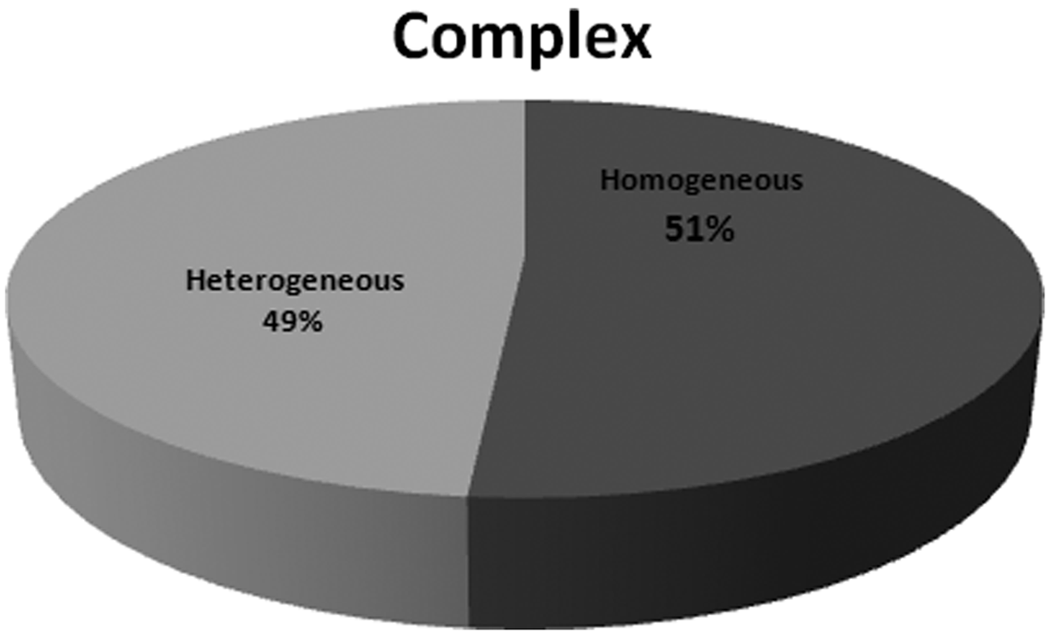
Complex messages.
In Figure 2, we can observe the%age of simple structures based on the processes of proximity, accompaniment, support and identification.

Simple messages.
In addition, in Figures 3 and 4, the different combinations of processes found in complex homogeneous and complex heterogeneous messages are shown respectively.
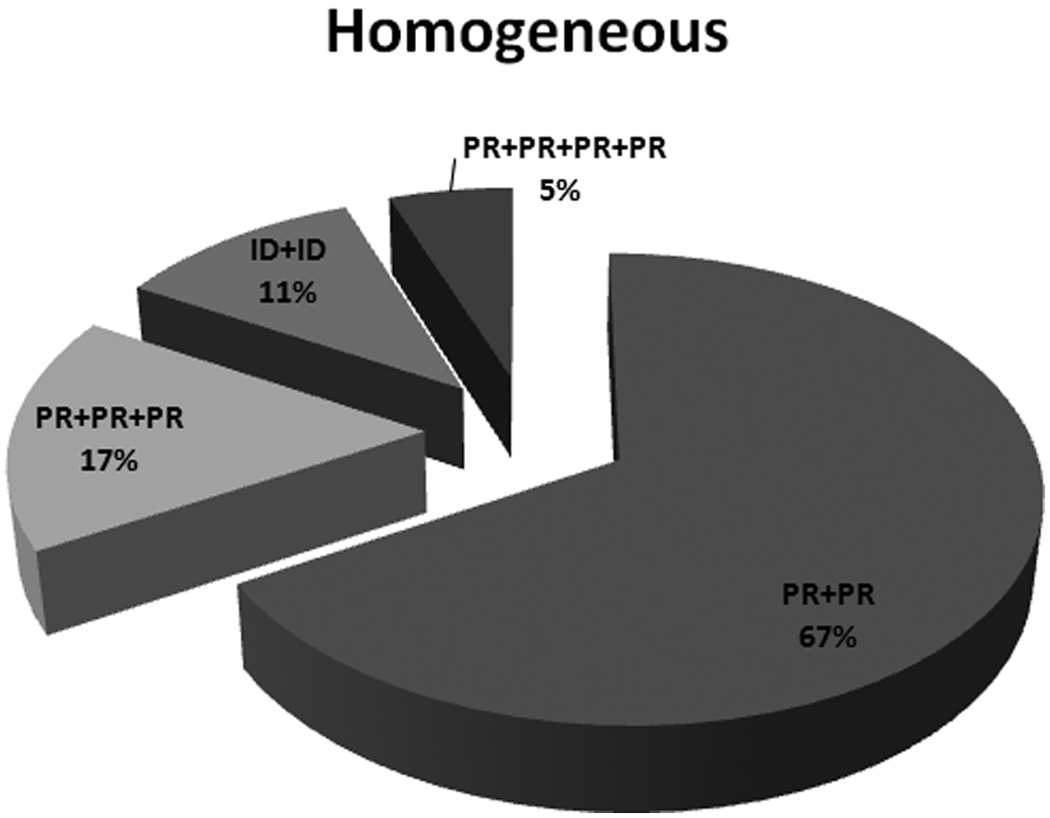
The processes in homogeneous messages.
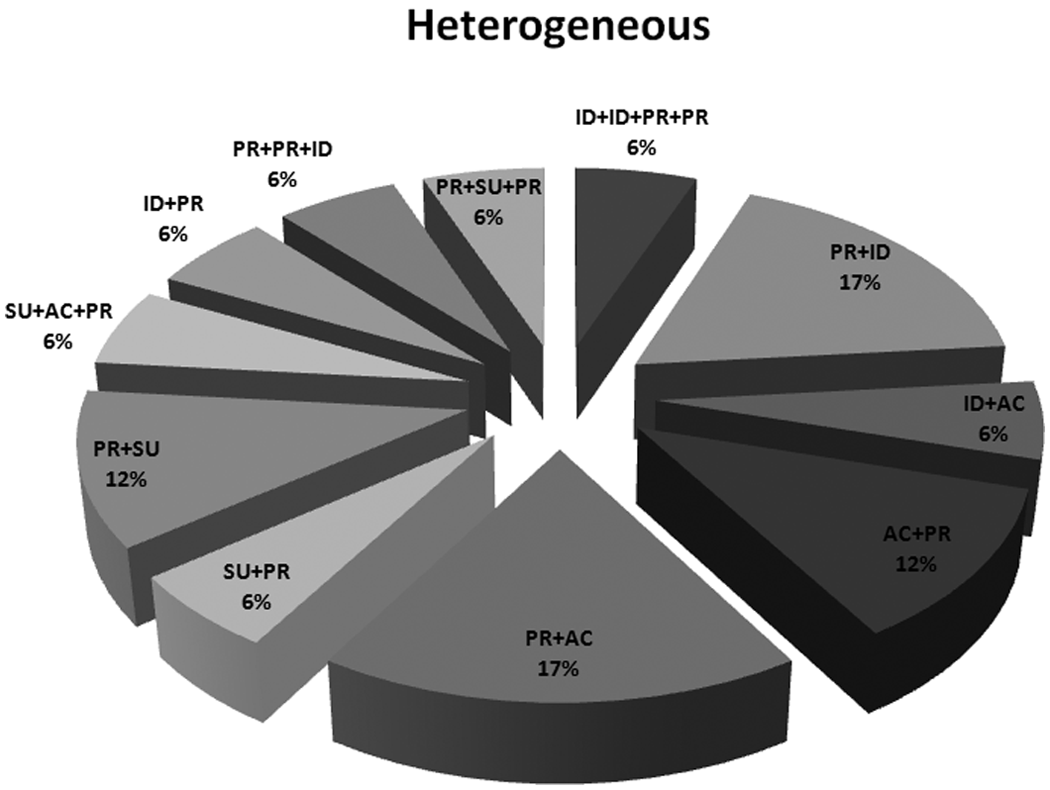
The processes in heterogeneous messages.
In Table 1, we show the figures with respect to the presence or non-presence of modifiers (terms of intensification and/or argumentative structures) in the selected messages.
Type of structure of the selected messages.

A detailed analysis of all these messages would need a far greater space than is available in an article of this type. Due to this, we will limit our research and the following sections to the analysis of those questions we consider most relevant in each of the types: messages with simple structures, messages with complex homogeneous structures and messages with complex heterogeneous structures.
Analysis of messages with simple structures (see Table 1)
As we said before, of 100 messages, 63 have a simple structure; of these only five show expressions of support and five identification. Eleven messages show accompaniment, the second minor degree of involvement, while 42 of them use expressions of proximity to the people in the sit-in. In addition, 32 messages appear with some terms of intensification and without argumentative structure. This is the discursive prototype mostly used by those who came to the sit-in and wrote something in the visitors’ book: messages of proximity with some terms of intensification but no argumentative structure. We would dare to say that, possibly, it also represents the most frequent degree of solidarity in the social debate on immigration in Spain. This is why it is not a coincidence that, in our corpus, we find a wide variety of expressions of proximity. The identity of the speaker or writer is protected this way and there is no suggestion that they feel too much responsibility or involvement. In this respect, we cannot ignore the fact that the use of terms of intensification is, on occasion, linked to the intensification of the writer’s solidarity face (Brown and Levinson, 1987; Van Dijk, 1998: 267). The absence of argumentative structures, on the other hand, would promote the interpretation according to which there is no interest in penetrating in a rational form the problems of the people in the sit-in.
Only 7 out of 63 messages appear without any type of terms of intensification (including argumentative structure). We refer to messages such as, No os desaniméis (Don’t lose heart) (m. 98), Que todo salga bien (Everything will go well) (m. 99) or Suerte (Good luck) (m. 63), in which, in effect, there is no assumption of responsibility or indication of future action. In addition, there are no formulae to intensify or arguments that explain the feeling of proximity. We also find, though in minor measure, examples of the discourse of accompaniment (Estoy [o Estamos] con vosotros [I am (or We are) on your side] [ms. 13, 19 and 27]), and of identification, too (Unidos [Close] [m. 12]). The majority trend with everything is to use boosters in the key expression.
In the corpus we found 32 simple messages with terms of intensification, but without argumentative structure. The same keyword receives different terms of intensification. This is what happens when the content of the message is the word ‘Ánimo’ (‘Cheer up’), but with the incorporation of exclamation marks in different formats (Ánimo! [Cheer up!] [m. 79], ¡Ánimo! [Cheer up!] [m. 29] or ¡¡Ánimo!! [Cheer up!!] [m. 26]), or written in capital letters (with or without exclamation marks equally added: ÁNIMO [CHEER UP] [m. 86], ¡ÁNIMO! [CHEER UP!] [ms. 15, 24 and 100]). The kinds of messages that only include the key expression in capital letters or with exclamation marks are almost exclusively of the proximity process, though we have also found an example of accompaniment in capital letters: ESTAMOS CON VOSOTROS (WE ARE ON YOUR SIDE) (m. 23). Another example of support was also written in capital letters: CONVIVIENDO CON USTEDES, TAN SÓLO UNA HORA, ME PARECE MENTIRA QUE LES QUIERAN ECHAR. NO CAMBIEN NUNCA, Y GRACIAS POR SER COMO SON (LIVING WITH YOU, EVEN FOR AN HOUR, I DON’T BELIEVE THEY WANT TO THROW YOU OUT. NEVER CHANGE AND THANK YOU FOR BEING AS YOU ARE) (m. 38). Together with graphical boosters (capital letters or exclamation marks), we also find messages with lexico-semantic or syntactic-semantic intensification (such as time markers [Contar siempre conmigo (Always count on us) (m. 14)]; a vocative [Ánimo, compañeros (Cheer up, friends) (m. 21)]; directive speech acts [TENED FUERZA (BE STRONG) (m. 33)] or generic quantifiers like ‘todos’ (‘all’) or ‘mucha’ (‘a lot’) [ÁNIMO A TODOS! (KEEP IT UP EVERYBODY!) (m. 81)].
We will now centre the analysis on the 24 simple messages accompanied by an argumentative structure or a particular term of intensification with an argumentative structure, with the aim of looking at the basic sources the visitors have used.
First, let us focus on the messages that refer to a universal discourse based on equality for everyone: porque todos somos iguales, personas (because we are all equal) (m. 11), todos somos iguales ante la ley (we are all equal under the law) (m. 41), todos somos ciudadanos del mundo (we are all the world’s citizens) (m. 43); no hay nadie diferente (nobody is different) (m. 59). Actually, these types of messages may have lost part of their meaning and become set phrases that do not convey any true involvement in the problems of immigrants. It is not a coincidence that the complete text of message 11 says: Deseamos que todo os vaya bien, ya sea aquí, allí o en cualquier lugar, como a todos, porque todos somos iguales, personas (We wish you well here, there and everywhere, like everyone else, because we are all equal). The incorporation of ‘aquí’ (‘here’) and ‘allí’ (‘there’) seems to refer to the fact that concern for their well-being is not only related to their staying in Spain, but also to the possibility that they may have to return to their countries, an eventuality that, at the time, was contrary to the demands of the people in the sit-in. The expression ‘como a todos’ (‘like everyone else’) lessens the degree of bonding with the specific group of immigrants. In this respect, the argumentative structure in the three messages would fit well with the process of proximity that characterizes all of them.
Other people prefer orientating their argumentative structure towards the exemplary value of the behaviour or attitudes of the immigrants: Sois como hormigas. Cogiendo migajas. El corazón muy grande (You are like ants collecting crumbs. The heart is very big) (m. 22); estáis dando una lección al Gobierno nacional (you are giving the government a lesson) (m. 58); porque nos hacéis mejores (because you make us better people) (m. 5); por vuestra forma de enseñarnos a vivir, desde la acogida y la justicia (because of the way you teach us to live, from acceptance to justice) (m. 57). The first example belongs to a message of accompaniment and the others to messages of proximity.
We have also verified, on one occasion, the appearance of argumentative structures related to religious discourse: Con vosotros está y os ayuda; es Jesús, y yo con mi oración (Jesus is with you and helps you as do I with my prayers) (m. 66). We have also verified references to love as an argumentative structure: Al final vencerá el amor (Love will conquer all) (m. 9); Con justicia y amor, todo es fácil (With justice and love, everything is easier) (m. 43). As a final example, we consider it relevant to emphasize allusions to the social or political fight, to the revolution and to the recovery of rights as an argumentative structure of the chosen key processes: Adelante por la reivindicación de vuestros derechos (Onward to reclaim your rights) (m. 17); ¡Hasta la victoria! (To victory!) (m. 25); TU ENEMIGO ES EL CAPITAL, LAS RAZAS NO NOS SEPARAN, NOS SEPARA LA CLASE SOCIAL, NI GUERRA ENTRE PUEBLOS, NI PAZ ENTRE CLASES (YOUR ENEMY IS MONEY, RACE DOES NOT SEPARATE US, ONLY SOCIAL CLASS, NOR WAR BETWEEN PEOPLE, NOR PEACE BETWEEN CLASSES) (m. 44); Sólo la presión conseguirá modificar las posiciones del Gobierno (Only pressure will get the government to change its position) (m. 53); La unidad hace al hombre fuerte para la lucha (Unity gives men the strength to fight) (m. 73); Sólo queda luchar (Fighting is the only thing left) (m. 93). In spite of the intensity of the words chosen in these types of argumentative structure, all the messages are of proximity.
We can see that, in general, there are few concrete references to the demands of the enclosed at the time of providing an argumentative structure. We have found two: Quiero que os legalicen (I want you to be legalized) (m. 64) and Adelante por la reivindicación de vuestros derechos (Onward to reclaim your rights) (m. 17). It is important to remember that the first message was based on proximity, while the second was offering a degree of major involvement: accompaniment.
Analysis of messages with complex structures (see Table 1)
Homogeneous
Of the messages in our corpus 35% offer a complex structure; that is to say, there are several processes of involvement in the same message. Of the 35, 18 are homogeneous; this means we are in the presence of the same process repeated on several occasions, though it could be with different key expressions. The most repeated combination in this category is PR+PR with up to 12 occasions, PR+PR+PR which appears three times and PR+PR+PR+PR which appears once. If we add these figures to the 42 occasions in which proximity appears in messages with simple structures, we come to a total of 58, which corroborates the preferential domain of this degree of involvement. We have found only one other combination of identical processes, ID+ID, which appears on two occasions. In the homogeneous messages, only two lack terms of intensification. The other nine appear only with terms of intensification and seven with terms of intensification and argumentative structure.
Messages 8 and 55 combine two processes of identification. The first one consists of the following two phrases: (a) JUNTOS, TENEMOS QUE INTENTARLO (TOGETHER WE MUST TRY) and (b) LLAMADME (CALL ME). The first uses the idea of ‘union’ (‘unity’), together with a structure that perfectly combines the boosters ‘tener que’ (‘have to’) and use of the first-person plural and a hedge indicating ‘intentar’ (‘trying’). The second phrase consolidates the process of maximum involvement, offering telephone contact to continue collaborating and to support them in the future, and selecting the imperative form of the verb ‘llamar’ (‘to call’). Message 55 also consists of two phrases: (a) Os consideramos como a nosotros (We feel at one with you) and (b) Nos sentimos unidos en vuestras reivindicaciones (We feel united with your demands). Note the strategic use of the comparison in the first phrase, or the appearance of the concept ‘unión’ (‘union’) and the allusion to the demands of the people in the sit-in in the second, as a preferential object of identification.
However, the combination of the processes of proximity is the most frequent structure when we speak about complex homogeneous messages. On occasion, the messages are simple, without argumentative structure. The only intensification that they provide, for example, is the expression of good wishes and the additive conjunction ‘y’ (and): Suerte y ánimo (Luck and cheer up) (m. 34). At other times, the model followed is slightly more complex. Taking as an example message number 54 (¡Ánimo y adelante! Sois un ejemplo de resistencia para muchos inmigrantes [Cheer up and go on! You are an example of resistance for many immigrants]), we can see that the person who writes this message places all of the responsibility for possible action on ‘vosotros’ (‘you’) and ‘ellos’ (‘they’). The function left for ‘nosotros’ (‘we’) is the function of harangue, of provocation to the actions of others. The argumentative structure is orientated towards the exemplary value of the people in the sit-in, and the terms of intensification that accompany this argumentative structure are the adjective ‘muchos’ (‘a lot’) and the use of the word ‘resistencia’ (‘resistance’). This is a syntactic-semantic structure that is often repeated. For example, in message 62 (Mucha suerte en vuestra lucha. Ánimo (Good luck in your fight. Cheer up), ‘vuestra’ (‘your’) again focuses the activity on others (the immigrants in the sit-in) and the resistance becomes ‘lucha’ (‘fight’). Message 78 (PR+PR+PR) also uses, in its final part, the possessive adjective to distance itself from the action and alludes equally to the fight, but with the verb in the imperative form (Luchad por vuestros derechos [Fight for your rights]). Message 68 supports the force of the harangue and of the call to action of the others, and now, instead of talking about fight or resistance, it underlines the word ‘victoria’ (‘victory’): ¡¡¡Ánimo!!! Adelante y a por la Victoria (Cheer up!!! Go on to get victory).
Heterogeneous
Of the 35 complex messages, 17 correspond to what we have called heterogeneous, that is, the combination of different processes in the same message. This means that different degrees of involvement appear. We have identified, as can be seen in Figure 4, 11 types of combination, in 10 of which the process of proximity was clearly the most prominent. This means that in the whole corpus, we found 67 messages in which expressions of proximity were the most numerous, that is, those showing a weaker involvement in relation to the people in the sit-in and their demands.
There are nine messages with an ascending structure (that is, from minor to major), distributed in the following way: PR+ID or PR+PR+ID (four messages), PR+AC (three messages), PR+SU (two messages). The starting point, then, is always, in these cases, the process of proximity. This also highlights that on four occasions, the extremes of proximity and identification are combined in the messages. This occurs in messages 20, 37, 67 and 90. Messages with a structure of proximity plus support have some importance, such as ‘Ánimo. Estamos con vosotros’ (‘Cheer up. We are on your side’), which has been chosen for the title of the present article. This occurs in messages 42, 47 and 50. The inverse process (ID+PR) with descending structures turns out to be in the majority, too. Of the six messages that we found, two of them show this type of combination: ID+PR or ID+ID+PR+PR (ms. 83 and 18, respectively), one shows ID+AC (m. 32), two AC+PR (ms. 36 and 87) and one SU+PR (m. 56).
Both in the ascending and descending structures, messages of proximity favour key expressions derived from the words ‘ánimo’ (‘cheer up’) and ‘adelante’ (‘go on’). As for messages of identification, the use of the first-person plural in verbs relating to the achievement of goals by means of ‘the fight’ is prominent; special attention is also merited by the complementary words surrounding these verbs: ‘lo conseguiremos’ (‘we will make it’) (m. 20); ‘lograremos el objetivo propuesto’ (‘we will get the proposed objective’) (m. 37); ‘venceremos’ (‘we will triumph’) (m. 67); and ‘les venceremos’ (‘we will beat them’ (m. 90). The use of the future, the absence of hedging and the fact that the last example refers to the development of a fight against someone are especially prominent elements.
Concluding remarks
Some authors think that the term ‘solidarity’ has partly lost its original sense (Richter, 2004: 86). Perhaps this is more evidence of the compassion fatigue referenced by Susan Moeller (1999). According to Retis, the media tend to extend semantically the concept of tolerance to coincide with commitment and solidarity (2007: 22). Others, nevertheless, are clear about what solidarity means in the archetypical sense. For them it involves taking a position, being interested in a particular matter and considering it their own issue (De Asís and Palacios, 2007: 34).
These reflections coincide with our idea of establishing different types and subtypes of solidarity messages and of identifying diverse degrees of solidarity involvement.
As previously stated, the discursive prototype mostly used by those who came to the sit-in and wrote something in the visitors’ book was messages of proximity with some terms of intensification but no argumentative structure. We would dare to say that, possibly, it represents the most frequent degree of solidarity in the social debate on immigration in Spain.
The intensity of the supportive communicative behaviour that we have observed in the visit to a group of locked-in immigrants is, in general, similar to the one exemplified by observing the suffering of people shown on television news, as indicated by Chouliaraki. Visitors to the sit-in were able to generate different degrees of approximation to the problem and empathize with those who were suffering, but found it difficult to take additional steps. Many of them would respond to the typical profile of the viewer ‘voyeur’. They place the responsibility on others or simply do not reflect on who is responsible for what happens, or about its causes or consequences. In any case, they are willing to express support in order to communicate a positive image of themselves showing a paternalistic approach that is not very thoughtful or decisive (Chouliaraki, 2010: 117).
Political discourse is also situated and often encourages people to place themselves; at this point, it also prevents them from reaching the root of the problem of lack of solidarity with immigrants (Martín Rojo, 2000a: 200, 2000b: 142–144). Clearly, this says a lot about the kind of society in which we live and shows the need to intensify the study and the promotion of solidarity discourse on different educational levels (García, 2011).
Footnotes
Appendix. The contents of the written messages
Acknowledgements
We are grateful to the Research Centre of Communication and Society (CySOC) located at the University of Almería. We are also indebted to Professor José María Jiménez Cano (University of Murcia) for giving us a copy of the original visitors’ book, and to Professor Luisa Martín Rojo for her helpful comments regarding the preparation of this article.
Funding
This research received no specific grant from any funding agency in the public, commercial or not-for-profit sectors.