



Abstract
Literature on modern racism identifies denial as one of its key features. This article examines the discourses of denial that feature in the talk of local anti-racism actors in Australia, and asks what drives these discourses. The research draws on qualitative interviews undertaken with participants involved in local anti-racism in two case study areas, one in South Australia and the other in New South Wales. This article explores the way local participants in the case study areas deployed four discourses to deny or minimise racism: temporal deflections; spatial deflections; deflections from the mainstream; and absence discourses. Place defending and the desire to protect one’s local area from being branded a racist space is discussed as a driver of those local denial discourses. Local denial of racism is also linked to national politics of racism and anti-racism. In particular, the Australian government’s retreat from multiculturalism, and the preference for ‘harmony’ rather than ‘anti-racism’ initiatives, was linked to the avoidance of the language of racism within participants’ responses. The way denial discourses narrow the range of possibilities for local anti-racism is discussed, as is the importance of acknowledgement of racism, particularly institutional and systemic racism. Public acknowledgement of these forms of racism will broaden the scope of local anti-racism.
Introduction
Denial of racism, in varied forms, is a key feature of modern racism. This article considers four discourses of denial – absence, temporal deflections, spatial deflections and deflections from the mainstream – and examines the implications of these varied forms of denial for local anti-racism. The article argues that denial of racism reduces the scope for local anti-racism, and that clear public acknowledgement of racism will facilitate a broader range of local anti-racism action.
In this article, I aim to track the denial discourses in two case study areas in Australia and to examine how and why they are used. In addition, the article draws out the implications of denial for local anti-racism action. I begin by examining the literature on denial and demonstrating that denial of racism spans individual language practices, personal deflections that may have a protective motivation, and broader institutional and political responses to instances of racism. The discussion informs the identification of four key discourses of denial. Having set out the conceptual background, the case study areas are introduced, and I present data on experiences of racism by those residing in the two areas. I outline the varied local recognition of racism, and illustrate the way that the four discourses of denial are used to avoid, minimise or defend local areas from being labelled as racist spaces. The implications of the discourses of denial for local anti-racism are discussed.
Denial of racism: A review of the literature
Denial of racism occurs at both an individual level as well as within institutional and political spheres. Previous literature has explored denial across these levels, and this section deals with each in turn. Looking first at the individual level, scholars working across a number of different national contexts, including Australia, Holland and New Zealand, have identified denial of racism as a pervasive feature of contemporary talk about race (Augoustinos and Every, 2007; Augoustinos et al., 1999; Van Dijk, 1992; Wetherell and Potter, 1992). In these varied contexts, the way this talk is organised to deny racism has been demonstrated. Van Dijk (1992) argued that talk about race is carefully structured to avoid a charge of racism, and identifies four types of self-denial (p. 92):
act-denial (‘I did not do/say that at all’) control-denial (‘I did not do/say that on purpose’) intention-denial (‘I did not mean that’) goal-denial (‘I did not do/say that, in order to …’).
Denial of racism across these four types allows a speaker to present the ‘Other’ in a negative light, while not damaging one’s own self-presentation (Van Dijk, 1992). Negative comments about ethnic groups are unacceptable, hence speakers manage them by using particular types of language, such as hedging or minimising, and other strategies, such as justifications, excuses and blaming the victim (Van Dijk, 1992: 93–94). Augoustinos and Every (2007) agree that racial views are carefully justified and constructed as balanced and rational. Presenting oneself as ‘even-handed’ and ‘balanced’ are important discursive tools to mitigate against accusations of racism, while simultaneously downplaying the extent of racism (Augoustinos et al., 1999).
Individual-level denial of racism is not only a strategy to protect oneself from an accusation of racism. Research on making attributions to racism suggests that individuals belonging to groups commonly targeted by racism may downplay or deny an instance of racism as a means of self-protection (Kaiser et al., 2006; Kaiser and Miller, 2001; Major et al., 2002; Stangor et al., 2003). The personal–group discrepancy is a robust social psychological phenomenon which finds that an individual will recognise that the group they belong to experiences racism, but feel that he or she personally does not (Taylor et al., 1990). It remains unclear precisely what drives this phenomenon, but there is evidence that making attributions to racism can be painful (Bennett et al., 2004; Schmitt and Branscombe, 2002) and socially disadvantageous or costly (Kaiser et al., 2006; Stangor et al., 2002, 2003).
The literature suggests there are barriers that prohibit or discourage individuals from making claims of racism. Essed (1991) argued that, in fact, ethnic minorities are highly skilled at recognising racism, yet there are prohibitions on making claims of racism. Accounts of racism have a specific structure based on a rational process of testing and argumentation, which Essed documents in her work Understanding Everyday Racism. As Essed (1991) argues, ‘Accounts are not just written or spoken versions of something that has happened but are only called for when reconstructing unanticipated behaviour or unexpected acts that cause difficulties’ (p. 121). She was critical of the way black women’s accounts of racism were often dismissed as ‘subjective’, and argued that this discourages women from making claims of racism. The link between public and personal denials of racism is also explored in an article by Dunn and Nelson (2011). An analysis of responses to a survey statement, ‘There is racial prejudice in Australia’, found that the acknowledgement of racism differed by language and birthplace groups. The rates of acknowledgement of racism were high overall, with only eight% of total respondents (12,398) disagreeing with the statement. However, the rates of denial of racism were elevated among those who spoke a language other than English at home or in their community (14%), as well as among respondents born in South Asia (23%) and the Middle East (31%). There is evidence that these groups experience racism at higher rates than the rest of the population (Dunn et al., 2009, 2011a; Pedersen et al., 2012), yet a significant minority denied the presence of racism in Australia when responding to the Challenging Racism Project’s survey. Dunn and Nelson (2011) suggest that the denial of racism among these groups can be explained, in part, by the regulatory framework, or ‘dominant discourses that attempt to proscribe and prescribe what is said about racism and privilege’ (p. 596). They argue that this regulatory framework prohibits and punishes claims of racism.
Denial of racism is not only an individual-level phenomenon; groups and organisations are also implicated and engage in strategies of denial (Van Dijk, 1992). In public life, institutional or systemic racism is commonly denied (Van Dijk, 1992). This serves an ideological function, making public debate about racism seemingly unnecessary, allowing problematic public opinion to continue unchallenged, and indicating there is no need to disrupt existing power relations (Essed, 1991). That is, denial of racism functions to protect and defend white privilege. Van Dijk (1992) documented public denial through an analysis of the British press and parliamentary debates. He has also asserted that elite racism is manifest with denial and mitigation (Van Dijk, 1993). Examples of political denial of racism in Australia can be found in federal government (Poynting, 2006) and media responses (Quayle and Sonn, 2009) to the Cronulla riots of 2005 and, more recently, in relation to the attacks on Indian students, which received significant media attention in mid-2009. Dunn et al. (2011b) examined media and political responses to the attacks on Indian students, and argued that denial of racism was the dominant political response. The attacks were labelled as ‘opportunistic’, and blaming the victim was a strategy used to deny racism (Van Dijk, 1992). The Deputy Commissioner of the Victorian Police was quoted as referring to Indian students as a ‘weak target’, ‘quiet and passive people, they travelled late at night, often alone and carried expensive gadgets’ (Dunn et al., 2011b: 76). On a visit to India, former Prime Minister Kevin Rudd denied racism was a factor in the attacks, arguing that the large number of Indian students in Australia meant that a certain number would inevitably be the target of criminal activity, again emphasising the opportunistic nature of the attacks. It was only when the income derived from the international education sector, Australia’s fourth largest national export, appeared under threat, that political responses shifted from denying racism to emphasising the government’s intolerance of racist violence and the strength of their response. Dunn et al. (2011b) contrasted the political denial with survey data where Indian- and Sri Lankan-born respondents reported elevated experiences of everyday racism compared to Australian-born respondents. They argue that although some acknowledgement of racism was eventually made, in the case of Indian students, political leaders oscillated back and forth between acknowledgement and denial.
Another example that elucidates some of the political drivers of denial can be found in Kobayashi’s (2009) analysis of the way an anti-racism rally precipitated a discursive crisis around whether racism was really a problem in Christchurch, New Zealand. Kobayashi argued that the public could be broadly divided into three groups: those who expressed outright denial; those who saw a small minority of individuals as responsible for racism; and those who acknowledged racism was a significant issue needing attention. A subtle form of denial that she observed involved shifting the campaign’s emphasis from everyday acts of racism, the desired focus of rally organisers, to more extreme forms of racism. While this form of denial acknowledges the presence of racism, it marginalises everyday forms of racism, therefore narrowing the scope of anti-racism. If the problem of racism is seen to reside only with those who commit violent racist acts, broad anti-racism efforts targeting structural and institutional forms of racism are unnecessary, as is anti-racism action against everyday incivilities. Locating the problem of racism in ordinary, non-elite, often socioeconomically disadvantaged, white people can also be considered a form of denial. Attributing racism to a small minority of individuals contributes to a ‘myth of tolerance’ (Essed, 1991) in many western countries, including Australia. The implication of shifting responsibility for racism onto this group is that white privilege broadly remains unquestioned and protected.
The preceding discussion has demonstrated that denial is a pervasive feature of modern racism. A typology of denial put forward by Van Dijk (1992) was provided above, but this typology was focused on self-denial. Twenty years on from Van Dijk’s research, it is necessary to revisit discourses of denial, particularly denial of racism on a societal scale. Nelson et al. (2011) argued that denial operates through a number of different discourses and tropes, and the current article builds on that work. One argument is that racism belongs to a colonial past, and that formal inequality based on ‘racial groups’ has been largely expunged (see Fozdar, 2008: 541–542; Wetherell and Potter, 1992). This was a persuasive rationale for those opposed to a formal government apology to Indigenous Australians for the practices of child removal that they suffered as part of cultural assimilation and genocide (Augoustinos et al., 2002; Bulbeck, 2004: 351–352). Related is the assertion that racism is a declining phenomenon in Australia, and is now associated mainly with older generations (Augoustinos et al., 1999). Another claim is that the high level of racism present within other nations, both western and non-western, makes the racism in Australia inconsequential by comparison. Following Wetherell and Potter (1992), Fozdar (2008) found this to be a strong denial discourse in New Zealand. From 22 in-depth interviews, on topics of racism and anti-racism, Fozdar found that this was one of four core discourses used by principally Pakeha (white) New Zealanders to deflect racism. This would manifest as statements that Maori had it much better than Indigenous people elsewhere in the world, including Australia, and that race relations were much better than in world trouble spots like the former Yugoslavia (Fozdar, 2008: 537–539). Penrose and Howard (2008) discuss the self-image of tolerance held by many Scots, as compared to their oppressive neighbours in England. The ‘myth of tolerance’ that Essed (1991) argues pervades public discourse in many western nations could be referred to as a spatial deflection at the national level. Australia as a tolerant nation is a spatial deflection used time and again by politicians and the media (Ang and Stratton, 1998; Castles and Vasta, 1996; Hage, 1998; Saxton, 2006). A third denial discourse positions racism as a deviancy associated with only a handful of ineffectual ‘old racists’ (Van Dijk, 2000), which some South African scholars have labelled as a ‘transfer’ discourse (De Wet, 2001: 106). The final denial discourse is one of absence, or the assertion that there is no racism. Lentin (2008) refers to this absence discourse as ‘post-anti-racism’ (p. 326), where anti-racism is not necessary because of the reduced magnitude of racism.
For the purposes of this article, societal-level denial discourses therefore include:
temporal deflection: minorities today experience less racism than in the past;
spatial deflection: racism is worse in other countries, including those where immigrants come from; or a more localised deflection, where racism is not a problem ‘around here’;
deflection from the mainstream: racism is not an overwhelming problem, just with a small cohort of individuals;
absence discourse: outright dismissal that there is racism.
While the first three denials admit there is some racism, and therefore some need for action, the absence discourse is a particularly powerful denial claim (Fozdar, 2008: 537), as it completely undermines anti-racism. The current research explored whether these denial discourses were present in interviews with individuals involved in local anti-racism in two case study areas in Australia, and investigated the implications of denial discourses for local anti-racism action.
The presence of racism in two Australian case study areas
The South Australian case study area encompassed Port Adelaide Enfield and Charles Sturt, bordering local government areas that spread out from 6 or 7 km north-west of Adelaide city. The New South Wales (NSW) case study area was the Parramatta local government area, located some 20 km west of Sydney’s central business district (CBD), in Central Western Sydney. While Port Adelaide Enfield and Charles Sturt are suburban areas, largely residential with some commercial precincts, Parramatta encompasses a substantial business district (Parramatta City Council, 2010), though it incorporates areas that are largely residential as well. As can be seen in Table 1, both of the case study areas were highly diverse in terms of immigrants, including first and subsequent generations. Both areas were more diverse than the surrounding city. The South Australian (SA) case study area is one of longstanding diversity, with a history of migration to the area from the post-Second World War period onwards, as well as a strong presence of Aboriginal and/or Torres Strait Islander residents in Port Adelaide Enfield in particular. As shown in Table 1, the level of cultural diversity in the South Australian case study area was relatively stable in the period between 2001 and 2006. Parramatta, in New South Wales, is highly diverse, with over 40% of residents born overseas and a similar proportion who speak a language other than English at home. Table 1 indicates that diversity in Parramatta is increasing at a rapid rate. The proportion of Indigenous residents in Parramatta is smaller than the South Australian case study area, with 0.8% of Parramatta residents identifying as Aboriginal and/or Torres Strait Islanders.
Diversity in case study areas, 2001 and 2006.
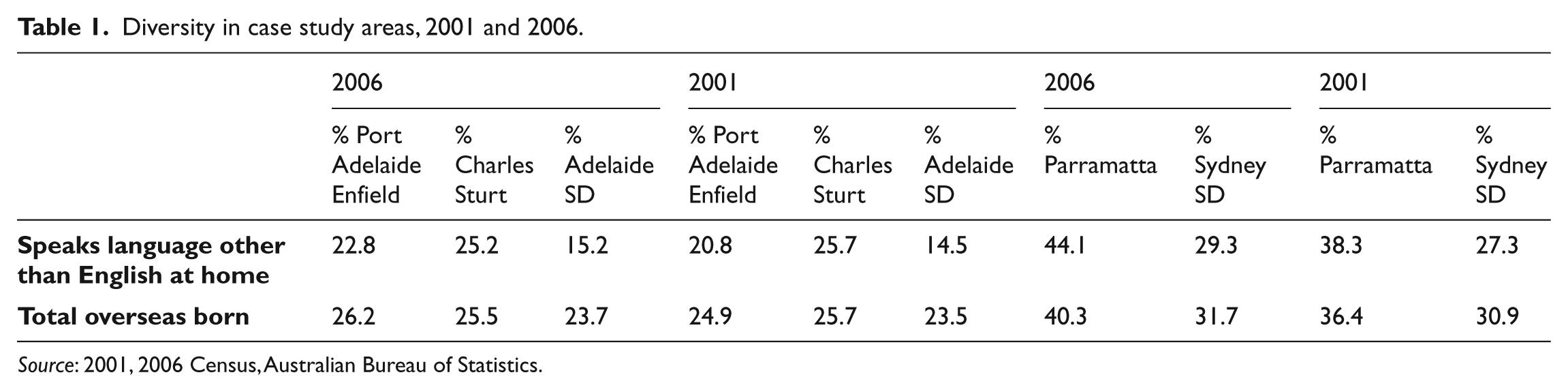
Source: 2001, 2006 Census, Australian Bureau of Statistics.
If we are to talk about denial of racism, it makes sense to first establish the presence of racism in the areas under study. The best available means are reports of experiences of racism collected in a national survey by the Challenging Racism Project. As outlined above, making attributions to discrimination is complex (Major et al., 2002), and self-reports of discrimination can both underestimate (minimisation bias) or overestimate (vigilance bias) discrimination, though existing research suggests under-reporting of experiences of racism is more common than the vigilance bias (Dunn and Nelson, 2011; Major et al., 2002; Stangor et al., 2003). The survey data is therefore considered to provide one indication of the presence of racism in the case study areas.
In the South Australian case study area (see Table 2), the rate of experience of racism in Northern Adelaide and Western Adelaide Statistical Subdivisions (SSDs) does not appear to differ dramatically from that of the Adelaide Statistical Division (SD) as a whole. In the workplace, just under 15% of survey respondents from across Adelaide reported having experienced this form of racism. A similar proportion (16%) said they had experienced racism in educational settings. One quarter of survey respondents in the Adelaide SD reported experiencing everyday incivilities (racist name calling, insults), and this proportion increased to 30% in the Northern Adelaide SSD. Turning now to Central Western Sydney, NSW, a broad examination of Table 3 suggests that reported experiences of racism were more prevalent in the Sydney SD than the Adelaide SD. For example, looking at the workplace, educational institutions and shops/restaurants, around 20% of Sydney respondents stated they had experienced racism in these settings. The equivalent rate of experience in Adelaide was about 15% for each setting. Experiences of racism appear to be even more common when looking specifically at the SSD of Central Western Sydney. This is particularly the case in the workplace, where 32% of Central Western Sydney respondents reported an experience of racism compared to 22% of those residing in the Sydney SD; and in shops and restaurants, 30% of those from Central Western Sydney reported experiences of racism compared to 23% of Sydney SD respondents. When examining educational settings, about one in five in both Central Western and broader Sydney reported experiencing this form of racism.
Experiences of racism in Northern Adelaide, Western Adelaide and Adelaide, 2007.
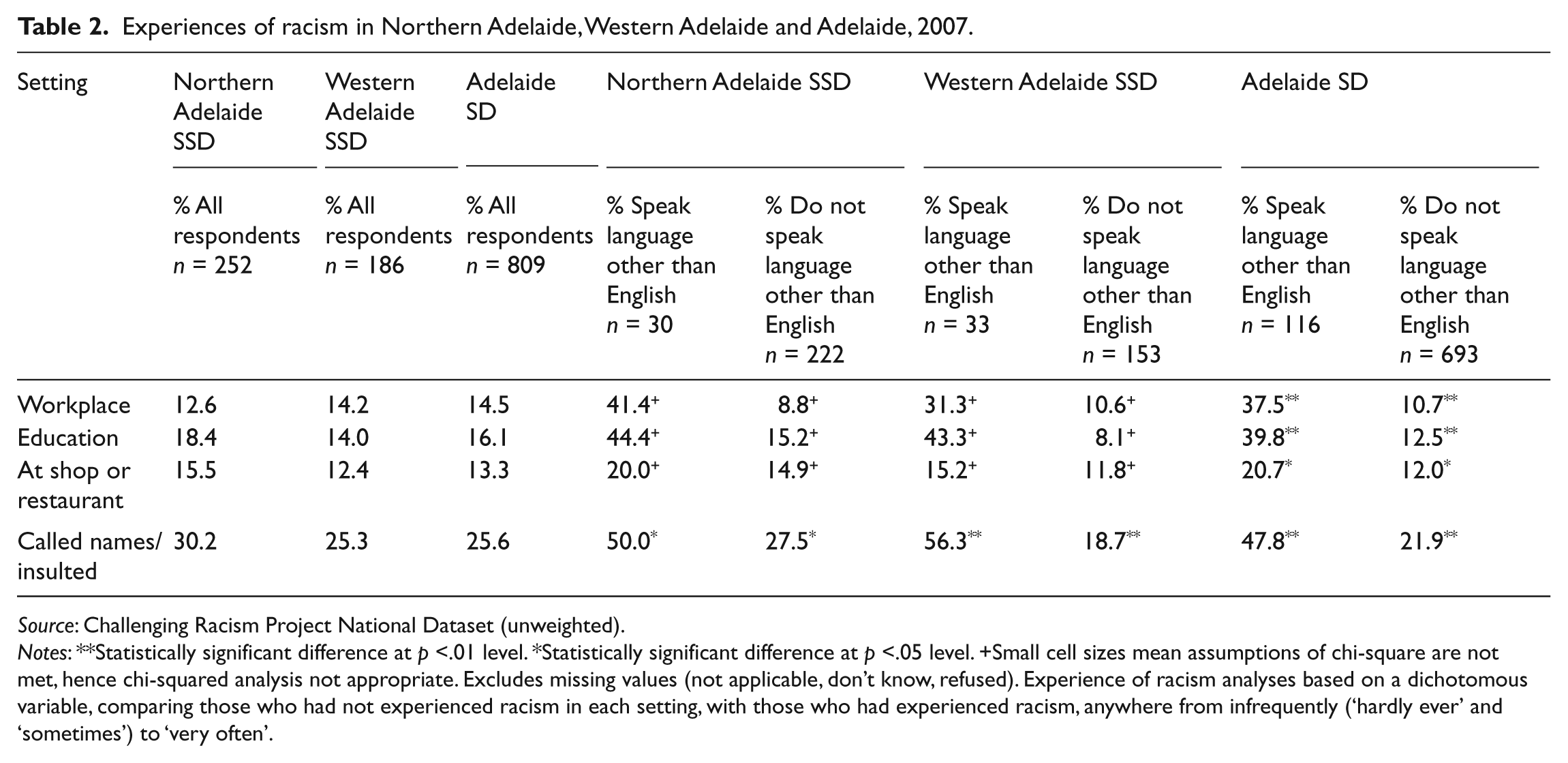
Source: Challenging Racism Project National Dataset (unweighted).
Notes: **Statistically significant difference at p <.01 level. *Statistically significant difference at p <.05 level +Small cell sizes mean assumptions of chi-square are not met, hence chi-squared analysis not appropriate. Excludes missing values (not applicable, don’t know, refused). Experience of racism analyses based on a dichotomous variable, comparing those who had not experienced racism in each setting, with those who had experienced racism, anywhere from infrequently (‘hardly ever’ and ‘sometimes’) to ‘very often’.
Experiences of racism in Central Western Sydney and Sydney, 2001.

Source: Challenging Racism Project National Dataset (unweighted).
Notes: **Statistically significant difference at p<.01 level. Excludes missing values (not applicable, don’t know, refused). Experience of racism analyses based on a dichotomous variable, comparing those who had not experienced racism in each setting with those who had experienced racism, anywhere from infrequently (‘hardly ever’ and ‘sometimes’) to ‘very often’.
Studies show that individuals from non-English speaking backgrounds are at higher risk of experiencing racism in Australia (Dunn et al., 2003, 2009). It is also the case that Aboriginal Australians experience racism at elevated rates (Larson et al., 2007; Mellor, 2003, 2004; Paradies and Cunningham, 2009; Pedersen et al., 2000), but the small sample of Indigenous respondents included in the survey meant it was not possible to look at experiences of this group in the case study areas. However, I examined experiences of racism by those who speak a language other than English at home or in their community. Experiences of racism were more common among this group across the Adelaide SD, and in a range of different settings (see Table 2). Looking at the Adelaide SD as a whole, respondents who spoke a language other than English at home or in their community were more than three times more likely than those who did not to report experiences of racism in institutional settings, that is in the workplace or in education provision. In addition, respondents who spoke a language other than English were about twice as likely to report experiencing everyday forms of racism in shops and restaurants or being called names or insulted. Respondents to the survey who spoke a language other than English at home or in their community fared particularly badly in Central Western Sydney in the context of the workplace. Table 3 reveals almost half of respondents who spoke a language other than English reported experiencing some form of workplace discrimination, compared to less than one-quarter of English-only speakers.
Discourses of denial in the case study areas
The findings reported here are primarily based on 22 interviews with individuals working in interethnic community relations at a local level. Interviewees were largely employees for whom anti-racism formed part of their employment, though a minority of interviewees were involved in the area in a voluntary or service-user capacity. Eleven in-depth interviews were undertaken in each study area. As part of the broader project, a further eight interviews were undertaken with individuals working on these issues at a state or federal level. This article has reported survey evidence on experiences of racism and in this section participant accounts are presented. Neither of these forms of data is considered objective or infallible. The goal of this article is not to undermine the subjective experience of participants, nor to spend large amounts of time critiquing the survey data. Instead, what is critical here is the space between subjective experience and survey reports of experience of racism in the area.
Even amongst the group of specialist employees interviewed for this research, there was varying recognition of the presence of racism in their local area. Five local interview participants were of the view that racism was not a problem in their local area. This was, at times, in spite of the fact that part of the interview process involved presenting the participant with statistics about reported experiences of racism in their local area. I refer to this as an
A particularly complex instance of an absence discourse was presented by Colin, an Aboriginal activist in the NSW case study area. When asked whether racism was a problem in his local area, he responded:
I don’t think it is. Not Parramatta.
Why do you think that is?
Well I don’t know. It’s just people seem to get on. There’s a lot done for the Asian communities in Parramatta, there’s a lot done for the Indian communities. We’ve got a Lebanese mayor; there’s a lot done for them. Parramatta do different things during the year for national days and for the different nationalities; Spanish, Vietnamese. So they do something for all the different communities. So not – I think that helps a lot.
Colin started cautiously, with modalized statements such as ‘I don’t know’, ‘people seem to get on’. Modality refers to the extent to which a speaker commits themselves to a statement or truth (Fairclough, 2003). The elaboration that followed was made up of assertive statements (‘There’s’, ‘We’ve got …’), which strengthened the initial modalized statements. That is, the initial opinion put forward is followed by evidence to support the deflection. Effective anti-racism was characterised by Colin as celebratory. The assumption was that acknowledging different community groups and ‘do[ing] something for all the different communities’ will prevent racism from occurring. Colin’s subjective experience must be respected as such. However, as was demonstrated in Table 3, experiences of racism across a range of different settings are elevated in Parramatta. It is therefore possible that there are factors that discouraged Colin, consciously or unconsciously, from recognising racism. Colin may have wanted to protect Parramatta from the stigma of racism, an assertion I return to below. He might have recognised racism as experienced by Indigenous Australians as a group, but felt that he personally did not experience racism, a phenomenon that has been termed the personal–group discrepancy (Taylor et al., 1990). The personal costs associated with making attributions to racism were outlined earlier in this article (Bennett et al., 2004; Kaiser and Miller, 2001; Kaiser et al., 2006; Schmitt and Branscombe, 2002; Stangor et al., 2002, 2003). Alternatively, Colin may have been resisting taking a position of ‘discriminated against Other’ (McLeod and Yates, 2003: 44).
When Camille, a participant in NSW, was asked about cross-cultural interaction in Parramatta, she reported that she had not experienced or heard about any problems. She then elaborates, referring to incidents that she anticipated could be conceived of as racist, but explained them as youth issues. In this excerpt, and other parts of the interview, Camille moves between the first-person singular, I, and the first-person plural, we. Using first-person plural allows her to take an organisational, rather than a personal, position. Below, she begins with the first-personal plural but then moves to first-personal singular in order to avoid making a claim of absence on behalf of the organisation. Camille used a temporal deflection to distance herself, or her local area, from these incidents. A
We didn’t have – we haven’t experienced, or I haven’t heard any kind of issues. With the young people though – with youth – there have been incidents in the past – not recently, maybe a couple of years or so. Incidents of, not racism, but kind of young people – there are gangs – Arabic or Lebanese gangs – in particular, Lebanese gangs, and also gangs of Pacific Islanders in Granville, Guildford . . . and these are the kind of gangs that clash. We haven’t been affected, but we know that there is anecdotal evidence of these types of things that have happened in the past – not recently.
Camille deployed the emotive language of (ethnic) gangs to explain the incidents (Karla (later) also mentioned the presence of gangs in the South Australian case study area). This is consistent with political and media discussions that commonly characterise groups of non-Anglo Australian young people from particular ethnic backgrounds as ‘gangs’ (Poynting, 2001; Poynting et al., 2001; White et al., 1999). This language serves to link non-Anglo Australian young people to criminal behaviour, when social connection, rather than criminal activity, is the most common rationale for these ethnic groupings (White et al., 1999). Camille talked about interethnic clashes as young people’s issues, but associated with an aberrant minority, a minority recognised as racialised by researchers. In terms of the denial discourses, Camille’s view could also be characterised as a ‘deflection from the mainstream’, where a racialised aberrant minority is responsible for interethnic conflict, when it has occurred.
When reflecting on the presence of racism in their local area, a strategy used by some participants was favourably comparing their area with other places. This is referred to as a
No, none that I’m aware of at the moment and I’ve only been here since April last year. And the two years before that I actually worked in Indonesia, so I think I’d identify if there was any. Doing the same sort of work throughout Indonesia um – and I haven’t seen any at all. (Robert, SA)
This excerpt begins with a statement of absence (spatial deflection), followed by supporting evidence based on personal experience. Reference to personal experience is a strategy commonly used in denial discourses, for as a form of evidence it is difficult to counter or refute (Barnes et al., 2001). Implicit in Robert’s statement is that racism, or interethnic conflict, is far more serious in Indonesia than Australia, and as a result of the time he has spent there, he has a heightened sensitivity to it: ‘I think I’d identify if there was any’. Robert positioned himself as having expertise based on his work in Indonesia and used this status to bolster his claim that racism is not a problem in Port Adelaide Enfield. Fozdar (2008) refers to this as credentialising.
Participants who expressed ambivalence were often willing to acknowledge ‘pockets’ of racist issues, but not structural or systemic racism. This can be characterised as
. . . I’m not sure that I should say this but I don’t think there are some major issues. Yes there are pockets of issues . . . Every now and again [we] have issues but whether it’s actually racist issues or whether it’s – many of the issues we’ve had around here have been over girls, so it’s not exactly racist but people perceive it to be racist because they see a couple of different kids fighting over the fact that it’s actually a girl. I suspect there’s a blatant amount of racism in most of the population but I don’t think it’s that overt here, no. (Karla, SA)
This quotation follows a similar structure to Colin’s above, starting cautiously with modalized statements – ‘I’m not sure that I should …’, ‘I don’t think’ – but moves into assertive statements aimed to support or prove the initial claim of absence. This process served to demonstrate the absence of ‘overt’ racism in the South Australian case study area. Karla constructed the situation in a way that deflected attention away from racism; claims to racism were constructed as misunderstandings. The data presented in the previous section on the experiences of racism in the two case study areas offer a different assessment of the presence of racism. Taking the example of experiences of racism in the workplace, in the Northern Adelaide SSD 41% of respondents who speak a language other than English at home or in their community reported experiencing racism in the workplace. This compared to nine% of those from English-speaking backgrounds. In the Western Adelaide SSD, 31% of those who speak a language other than English reported experiencing racism in the workplace, while just 11% of those from English-speaking backgrounds reported racism. In the NSW case study area, the picture was just as bleak. The elevated rates of experiences of racism for those from non-English speaking backgrounds suggest racism is not simply the problem of a handful of individuals, and that individuals from non-English-speaking backgrounds are routinely and systematically experiencing discrimination.
It was not only Anglo-Australians who were reluctant to acknowledge the presence of racism in their local areas. There was caution by some of the interview participants from diverse ethnic backgrounds to name racism and label experiences as racist.
Do you think that was an issue of racism?
I can’t say that because what happens is, see if I’ve been bashed and my cousin’s been bashed . . . my cousin’s cousin’s cousin’s been bashed . . . is it a coincidence or is it . . . So it’s a bit confusing . . . I don’t know the real facts . . . [Later] I can say that a few of my cousins have come across incidents. They have not been bashed, but they have been attacked verbally or harassed. But I don’t know. Is it because they’re Indian or is it because they are young and driving good cars? I don’t know but it’s happening.
In most of this quotation, Safiya’s language was highly modalized: she ‘can’t say’, ‘it’s a bit confusing’, ‘I don’t know’. Her level of commitment to making a claim of racism was very low. However, her final comment is significant. Both here and in her description of the incidents themselves, Safiya used assertive statements. This emphasises that in spite of her doubt, or reluctance to claim racism, the incidents remain actualities. The frequency of racist attacks Safiya described – if her ‘cousin’s cousin’s cousin’, her cousin and she herself were bashed – were so high, it would be unlikely they were simply coincidental or based on their youth. The literature on denial of racism supports this interpretation. Minority groups sometimes fail to recognise or report incidents of racism for various reasons, such as the negative interpersonal consequences of making a claim of racism (Kaiser et al., 2006; Stangor et al., 2003) or the detrimental effect on self-esteem (Kobrynowicz and Branscombe, 1997). Essed (1991) states that ethnic minorities are highly skilled at recognising racism, yet there are prohibitions on making claims of racism. Dunn and Nelson (2011) argue that in the current Australian context, claims of racism are punished, whether implicitly or explicitly, and contested, and this is linked to the lack of public acknowledgement of the presence of racism in Australian society. Prohibitions on claiming racism may have been operating in Safiya’s discussion above.
While the interview participants were geographically distant, the quotations included above were discursively linked. Minimising the presence of racism was a feature of discourse across participants in both case study areas. The four denial discourses – absence, spatial deflection, temporal deflection and deflection from the mainstream – were present in participant accounts. The strategies used by participants to manage these deflections, for example using a combination of modalized and assertive statements, drawing on personal experience and credentialising, have been discussed. Minimising the presence of racism had ideological effects. For example, looking at the way participants acknowledged ‘pockets’ of racism, this parallels Wetherell and Potter’s (1992) ‘prejudice problematic’, where the dominant group points to ‘racist’ people as the source of the problem. The issue of racism is projected away from the mainstream, allowing the discourses of the dominant to be seen as objective, neutral, unprejudiced and factual. The ideological implication of minimising racism in this way is that it serves to protect white privilege, and to defend the status quo of white dominance in Australia. Locating racism in ‘pockets’ of local areas, or Australian society more broadly, supports Essed’s (1991) ‘myth of tolerance’.
In this study, denial of racism appeared to be driven by both local and non-local factors. Minimising the presence of racism in participants’ local areas in particular may have been an ideological strategy to protect place. Participants may not have wanted their local area to be branded as a racist space; denial of racism may have played a place defending role. This was particularly the case in Parramatta, and broader Western Sydney, which is commonly targeted in public discourse (Powell, 1993). Perceptions of ‘westies’, or inhabitants of Western Sydney, was the topic of Gwyther’s (2008) article, Once were Westies. Morgan (2006) also talks about how ‘westies’ respond to the stigma that is attached to Western Sydney and those who live there. A peak body of community organisations in Western Sydney, the Western Sydney Community Forum, runs a programme called A Stronger Voice for Western Sydney, and one of their key goals is to promote a positive image of the area. In their submission to the National Urban Policy, Parramatta City Council (2011) cites ‘perception of Western Sydney culture and amenity’ (p. 1) as a challenge to productivity. Taken together, there is a lot of evidence to suggest Parramatta, or Central Western Sydney more broadly, and the people that live there are routinely negatively characterised as ‘westies’ and ‘bogans’. It is therefore possible that my participants adopted a position in the interviews to defend Parramatta against being characterised as unsophisticated, red-necked and racist.
However, a desire to avoid one’s local area being labelled a racist space may not fully account for why participants minimised the presence of racism. In addition to this explanation, it is likely that non-local factors were implicated in the minimisation of racism in some participant accounts. In Australia’s recent history, there has been a fundamental lack of acknowledgement of racism at the federal level. The federal government official retreat from multiculturalism from the mid-1990s until 2011 (Koleth, 2010), and avoidance of the term racism (Ho and Dreher, 2006), may have impacted upon the way local participants perceived racism and the need for anti-racism. Federal government (in)-action likely also reflects or responds to the feeling amongst the general public that racism was too horrible, contentious and difficult to address. Both of the processes described, place defensiveness and national political denial, likely contributed to local participants’ perceptions reported here.
Acknowledgement of racism in the case study areas
The discussion thus far has focused on talk that denied or minimised the existence of racism. Recognition of racism in some interviews, and in parts of other interviews, was very overt. Nine local interview participants strongly recognised the presence of racism in their local areas, and all of the state/federal participants acknowledged racism to be a problem (to varying degrees). The higher levels of acknowledgement of racism among state/federal participants could reflect a number of things. As these participants were not representing a local area, there was no need for them to defend a particular locality, hence place defending was mostly absent from our discussions. Second, the state/federal interviews took place shortly after a new federal multicultural policy was announced in Australia (Australian Government, 2011), whereas the local interviews were undertaken prior to the announcement. The previous multicultural policy had expired five years prior, and in the interim period the federal government had been silent on multiculturalism. The new policy was a significant departure from previous iterations as it explicitly acknowledged racism and outlined plans for the development of an anti-racism policy. This federal-level acknowledgement of racism may have fostered an environment whereby participants felt they could acknowledge racism, following the lead of federal politicians in this area.
The quotation cited earlier from Safiya, where she expressed uncertainty about whether an event could be described as racism, was an example of a non-Anglo Australian being cautious about making claims of racism. This was in contrast to other participants of diverse backgrounds who very readily recognised the presence of racism in their local area. For these participants, experiences of racism were a daily reality.
. . . these days it seems like the whole racism question hasn’t come up. People have just put that aside. For a while now. Nobody discusses it. It’s like Australia is multicultural. Just because you see people physically, they’re multicultural. You walk down the road, every second person is Chinese or Sudanese now. We are multicultural. Actually, that is not, to me, multicultural. So people have stopped talking about racism for a long time. It exists. It’s there on a daily basis. For people like us, it’s a daily occurrence. (Yasmin, SA)
Yasmin expressed frustration at the lack of acknowledgement of racism. In a similar way to Robert, Yasmin uses a series of assertive statements of fact (‘that is not . . . multicultural’, ‘It’s there’, it’s a daily occurrence’) that draw on her personal experiences as a young African migrant. Again, personal experience is used to bolster a claim, though in this case arguing for the presence of racism. The talk was also evaluative: Yasmin contested an argument it sounds as though she has heard many times before – that the mere presence of diversity is sufficient to claim an identity of multiculturalism. She communicates this argument using reported speech (‘It’s like Australia is multicultural’, ‘We are multicultural’), and provides a direct counter argument. Yasmin argued that Australia cannot claim multiculturalism without acknowledging and addressing the issue of racism. She was critical of the current silence around racism. The use of reported speech in anti-racist talk has also been reported by Benwell (2012).
Pejna recognised the varied forms that racism takes in Australia, from everyday attitudes to institutional, systemic forms of racism. Other participants, working at the local level, also recognised the complexity and diversity of racism (e.g. Kim (SA), Ivana (NSW), Nerida (NSW)).
It’s happening in little attitudes, very small things where you see it on the roads and things. And I think some systemic ones are happening in some other places especially based on terrorist acts like when you go – when you see transit officers checking people’s tickets and things, it’s very obvious they choose Muslim kind of people and, African especially, young people. They are chasing them. It’s the idea that those people are for sure doing something illegal . . . So unfortunately it’s still happening. It’s in the mind and it’s reflecting in their acts as well and it’s getting people really angry. It’s my appearance or it’s my name or it’s my colour – it’s happening. People can call it discrimination but it’s racism. It’s not just a little discrimination thing. It’s a little bit bigger than this. (Pejna, NSW)
Pejna was emphatic about the presence of racism in her local area. This is evidenced in the level of commitment throughout the quotation, which is made up of a series of assertive statements. Among interview participants, the recognition of structural, systemic racism was less common than recognition of ‘pockets’ of individuals with racist attitudes. In this quotation, Pejna was critical of the way Muslim and African young people are systematically targeted by transit officers when travelling on public transport. Once again, young people of Muslim and African backgrounds are linked to criminal behaviour; ‘It’s the idea that those people are for sure doing something illegal’. Acknowledgement of this type of systemic racism is significant as it recognises white privilege; it is non-white young people who are routinely subject to this scrutiny. Only a minority of interview participants discussed racism in a way that acknowledged systemic racism. Lorraine (state/federal) was unwilling to acknowledge institutional racism: ‘I don’t think it’s that a company or an organisation is racist, I think people just don’t always think.’ This reticence is consistent with recent social psychological research that documented white Americans’ preference to conceive of racism as an individual, rather than institutional, phenomenon (Unzueta and Lowery, 2008). Conceiving of racism in this way was part of maintaining a positive self-image, in this case a cultural self-image. It also protects white privilege. However, sociological approaches to racism stress the importance of acknowledging that racism can be structural and systemic. Like Essed (1991) and Wetherell and Potter (1992), I argue that acknowledging racism requires an awareness of how structures of power can both facilitate and inhibit racist practices.
This section has demonstrated that amongst some local interview participants the presence of racism was strongly acknowledged, with a minority highlighting the role of institutional, systemic forms of racism. In the final part of the article, I look at the implications of denial and acknowledgement for local anti-racism.
Concluding reflections: Implications for local anti-racism
Participants’ constructions of the presence of racism in their local areas had implications for their thinking around anti-racism, both in terms of the perceived need for anti-racism and the form anti-racism ought to take to be most effective. The implication of a discourse of absence was that remedial local anti-racism action was not necessary. Without racism, there is no case for anti-racism. Both the spatial and temporal deflections also undermined the need for anti-racism. In the spatial example, participants cited the relative lack of racism in their locality compared with other areas, in the localised deflection, or the lower levels of racism in Australia relative to other nations, in the national-level deflection. Where the temporal deflection was deployed, racism was positioned as something in the past that was no longer a problem. Deflections from the mainstream allowed for anti-racism; however where this type of deflection occurred, a narrow scope for anti-racism was envisaged. In this view, anti-racism projects need only target a ‘small cohort’ or ‘pocket’ of individuals.
Anti-racism projects in the case study areas were most commonly celebratory in orientation. Celebratory anti-racism includes activities such as community festivals and fun days, multicultural school concerts and cultural award programmes. This form of anti-racism has played an important role in redefining Australia’s national identity as culturally diverse. Celebrations of diversity have faced heavy critique in the literature, however, for stereotyping and commodifying otherness (Jordan and Weedon, 1995; Kymlicka, 2010; Mansouri et al., 2007; Poynting and Mason, 2008), as well as failing to address racism (Babacan and Hollinsworth, 2009; Rothenberg, 2000) and economic and political inequalities (Kymlicka, 2010; Marotta, 2006). While there are likely a number of explanations for the emphasis on celebrations in the case study areas, such as funding priorities of state and national governments, the way the problem of racism is constructed by those working in the area is an important factor. Where racism is denied or minimised, the problem of racism is contained to ‘pockets’ of society. In this view, a community event that brings people of varied ethnic backgrounds together in an enjoyable setting, or exposes Anglo-Australians to the culture of non-Anglo ‘others’ (Dunn et al., 2001), is seen as sufficient to address racism.
If denial or minimisation undermines or reduces the scope of local anti-racism, what role does acknowledgement play? This article discussed prohibitions on making claims of racism, particularly for those commonly targeted by racism. Public acknowledgement of racism may be an important counter to these prohibitions. Recognition of racism may affirm the citizenship and affective belonging of individuals like Yasmin, who expressed frustration at the silence around racism in Australia which she experienced as an everyday reality. In terms of acknowledgement amongst interview participants working on local anti-racism, it was significant that, in some cases, they recognised systemic racism. Interview participants who recognised that racism can be systemic and institutional were more likely to perceive a need for institutional and societal-level responses. Local anti-racism needs to encompass a broad range of activity, encompassing celebratory initiatives but also including preventative and educative programmes as well as regulatory anti-racism. Acknowledgement of racism by leaders at every level, from community groups and representatives of local government right through to leaders of national political parties, is an important first step, and one that shores up the case for broad-reach anti-racism.
Footnotes
Funding
This research was supported by a Linkage Grant from the Australian Research Council.