




Abstract
The present study explores the language of evaluation in a sub-genre of political discourse, pre-electoral debates, and its potential persuasive function for gaining voters via a contraposition of positive self-evaluation and negative evaluation of the other candidate. A further aim of this research is to check whether the candidate’s ideology has a bearing on the entities that get evaluated. After a brief examination of the characteristics of the sub-genre at hand, specifically in the Spanish context, we present the results of an evaluation analysis carried out in a corpus of 19,849 words, which is the extension of the most recent pre-electoral debate held in Spain between the candidates of the two main political parties. Taking into account Van Dijk’s critical discourse analysis (CDA) framework for parliamentary debates as global semantic strategies of positive self-presentation and negative other-presentation, Martin and White’s method was adopted as an analytical tool. The results showed that, although each candidate had different preferences in the choice of evaluative devices, they both used them as a strategy to win electoral votes while deprecating the opposing party and, therefore, minimizing their opponents’ chances of winning the elections. On the other hand, and despite their opposing ideology, they both seem to defend those policies that are more widely accepted in order not to risk losing voters: public services and egalitarian social policies.
Keywords
Introduction
For decades, discourse analysts (Eggins and Slade, 1997; Hood, 2004; Hunston, 2000; Martin, 2000; Martin and White, 2005) have attempted to explore the language of evaluation to find out how writers/speakers adopt attitudes towards their readers/listeners and the content they want to communicate. To do so, they have analysed oral (Grimes, 1975; Labov, 1972; Sinclair and Coulthard, 1975) and written (Hoey, 1983; Hunston and Thompson, 2000; Martin and White, 2005) discourses in an attempt to provide further insights integrating both perspectives into the evaluative uses of language. Current studies of evaluation have used appraisal theory in academic, journalistic, legal and political discourses (Cabrejas-Peñuelas and Díez-Prados, 2013; González Rodríguez, 2011; Hood, 2004; Martin, 2000, 2003; Martin and White, 2005; Miller, 2004; White, 2002, 2003; White and Verbosity Enterprises, 2005) to find out how evaluative items may change depending on genre, register or individual styles.
Both political discourse and political language seem well suited to express evaluation, as politicians need to sketch a positive image of themselves so as to persuade people to vote for them, while at the same time portraying the opponent in a negative light by reacting against his/her comments and by being ironic, in such a way that they discredit them (and the opposing party that they represent). They also depict themselves and others subjectively and evaluate things (e.g. the healthcare system, budgetary limits, the housing bubble) ‘to appeal not so much to reason but to the recipient’s expectations and emotions’ (Sornig, 1989: 109). Therefore, the purpose of political language ‘is not so much to inform as to make people believe, and in the end to act upon their beliefs, he/she who sounds like one of us is the one we most easily trust’ (1989: 109).
The evaluative uses of political language have been studied by a number of researchers (Becker, 2011; Harris, 1991; Simon-Vandenbergen, 1997, 2008; Wang, 2010) who, by analysing politicians’ use of evaluation markers, have attempted to find out how politicians use them to show lack of commitment in response to face-threatening questions while, at the same time, presenting an image of absolute certainty and intellectual power that serves to persuade their audience. Indeed, it seems that the public’s perception of politicians as evasive and indirect is based on linguistic facts, since less than 40% of their answers are direct (Harris, 1991: 92). However, since politicians should also aim to gain or retain intellectual power, they are persuasive by stating ‘the essential rightness of their claims’ (Simon-Vandenbergen, 1996: 408), which is often the case in political interviews; that is, politicians often claim the reliability and truth of their statements, doing so by using a wide range of lexical and grammatical devices indicating certainty. Such devices are treated within the notion of modality (Becker, 2011; Simon-Vandenbergen, 1996). These are expressions that emphasize cognitive certainty (e.g. we had very detailed scientific evidence, I have no evidence at all) and emotional and social commitment. Emotional commitment indicates that the politician has knowledge of and is personally involved in the issues s/he presents (e.g. I certainly think, I do believe). However, s/he is also socially committed, since s/he takes into account the principle of the majority of opinion (e.g. which commands the strong enthusiasm of the overwhelming majority) (Simon-Vandenbergen, 1996: 392–408). In this way, s/he ‘creates the image of a knowledgeable person who “knows what he or she is talking about” and who therefore deserves public trust and political power’ (Simon-Vandenbergen, 1996: 408).
In political speeches, politicians also make use of evaluative devices: positive attitude markers (e.g. hope), negative attitude markers for criticizing their adversaries (e.g. desperation, tears), judgement (e.g. people of good faith and good will, the government’s failure) and appreciation markers (e.g. universal and affordable, legalized discrimination) for praising or criticizing a person’s capacity and property, although there may be elements that are characteristic of a particular culture, such as references to historical figures, anecdotes and American history in American political speeches. Other differences between political speeches account for politicians’ individual style of speaking, even when they belong to the same party (Simon-Vandenbergen, 2008).
One type of political discourse where political language is implemented is in pre-election debates. These are face-to-face confrontations in front of an audience – television viewers, but on occasions also a stage audience – in which two political candidates spar in a dialogical duel. They are a subclass of political discourse included within the domain of agonal or conflict discourse (Vion, 1992: 92). Extrapolating Van Dijk’s definition of parliamentary debates, pre-election debates can be considered ‘a specific genre of political discourse’ (Van Dijk, 2005: 67). If, according to Van Dijk (2005: 67), parliamentary debates are ‘local manifestations of the global political acts of legislation, governing, and control of government’, pre-election debates can be defined as local manifestations of wanting to do – or continue doing, in the case of the same party being re-elected – the political acts of legislating, governing and controlling the government. Thus, pre-election debates are a political arena in which prospective candidates present themselves in a positive light (Van Dijk, 2005: 76) and the opposing party in a negative one. While political discourse such as political interviews, electoral meetings and speeches have been the object of extensive research (e.g. Bull and Fetzer, 2006; Nuolijärvi and Tiittula, 2011; Proctor and I-Wen Su, 2011; Simon-Vandenbergen, 1996, 1997, 2008), electoral television debates have been much less so, which is especially the case for Spanish electoral television debates, the exceptions being Blas-Arroyo (1999, 2000, 2003, 2009), Cantavella Blasco et al. (2008) and Téllez et al. (2010). However, to our knowledge, none have attempted to study how evaluation is used with a persuasive function, when it is essential that politicians appeal to the public and convince them, while simultaneously criticizing the opponent. Criticizing implies expressing a negative evaluation of the opponent, while, at the same time, presenting a positive self-image via positive evaluation. Thus, in the context of the genre of pre-election debates, the one we are focusing on in the present article, politicians’ speech triggers a load of political implicatures (Van Dijk, 2005: 66) that the audience should infer as positive or negative depending on the type of evaluation used. Following Van Dijk (2005: 66), political implicature is defined as specific political inferences that participants taking part in a political communicative situation may make based on the speech and context.
In this study, we attempt to fill that apparent gap of the persuasive function of evaluation by analysing how this is expressed in the Rajoy–Rubalcaba pre-election debate, which took place on 7 November 2011 in the period building up to the general elections on 20 November 2011. The following research questions will be addressed:
Which type(s) of evaluation device(s), found in Martin and White’s categorization of Affect, are used in the Rubalcaba–Rajoy debate and which is/are the preferred type(s) of each politician as measured by frequency of occurrence? What function do the evaluative devices used fulfil?
To what extent do the evaluation devices used reveal the ideology of each candidate?
We next look at the context of the communicative event. Following this, we present an overview of the concepts and relevant theoretical issues following Martin and White’s (2005) appraisal theory. We then consider the methodology for the data collection and coding process; afterwards, we address the results of the study and, finally, present the main conclusions from the study.
Pre-election political debates
The pre-election political debate is a type of communicative event that is relatively new in Spain, unlike in other countries such as France, the USA and the UK, where there is a long tradition of electoral debates. In 11 general elections, only three have been preceded by televised debates between the candidates for the Spanish presidency, 1 since political parties prefer to participate in mass meetings where the candidates’ political agendas are made public. Therefore, Spanish citizens do not usually have direct access to the ideas put forward by the different political parties before elections take place. The Spanish model of presidential debate is described as ‘eclectic’ (Marín, 2003: 233–234), since it combines elements of the American, French and German models. According to Cantavella Blasco et al. (2008: 84), these are:
Spectacularization of debates by using music to induce a duel, interviews with analysts, calculated arrival of the candidates so as not to coincide, cameras following their steps in the corridors, among other things. This is typical of American debates.
Face-to-face confrontation between politicians, as in French debates. The moderator suggests topics for discussion rather than posing questions.
Lack of a public audience, which eases concentration. This can also be found in French and German debates.
The contextual properties of this political genre are unique (Van Dijk, 2005: 68) and do not always coincide with those in the American, French and German models: there is pre-allocation of turns, with a strict limit of time per turn, a moderator whose function is to ensure there is neither free turn-taking nor violent interruptions and to present pre-established topics to deal with. In that sense, each participant’s intervention is rather like a monologue which may or may not be subsequently relevant to the previous speaker’s interventions. In fact, the speakers plan in advance what they are going to say and seldom respond to their interlocutors, not necessarily fulfilling their expectations. In that sense, Spanish debates are only marginally dialogical. Apart from the direct participants in the debate, there is an overhearing audience (television viewers), which is not present in the situational context of the event and, thus, has no possibility of visibly reacting to or intervening in the communicative event. The audience’s reactions are subsequently measured through polls and the illocutionary effect of the speech acts realized in the event is potentially reflected in the electoral results. The image, then, that each candidate presents of himself and his party can be decisive, since through evaluation they make themselves legitimate and devaluate the others.
The Rajoy–Rubalcaba debate has been used in the present article as an example of the sub-genre of pre-election debates in order to examine the use of evaluative devices in these communicative events. The debate between Mariano Rajoy and Alfredo Pérez Rubalcaba (most widely addressed as ‘Rubalcaba’) was held after a tough election campaign and followed the increasing feeling that the majority of Spaniards wanted a major political change. The context of the general elections was one of profound economic crisis, which was activated by the US subprime mortgage crisis, although its causes can also be found in problems not always dealt with properly in Spain: a housing bubble, a decrease in demand for souvenirs and cars worldwide, loss of productivity, inadequate energy and water policies, problems with the financial system, high rates of youth unemployment, expenditure policies that contributed to a rise in the budget deficit and the lack of a solid education system.
After an almost eight-year period of government by the Socialists, their leader, José Luis Rodríguez Zapatero, set the date of the general elections as 20 November 2011. Different opinion polls had predicted the victory of the Partido Popular (hereafter PP), although the gap between them and the Partido Socialista Obrero Español (hereafter PSOE) was getting smaller as the date for the general elections got closer (7.1 points in July 2011 vs 10 points in April 2011, according to the barometer of the Centro de Investigaciones Sociológicas 2 ). In this context, the parties discussed whether or not to hold a televised debate. Both parties had their reasons for taking part in it: the Socialists could see an opportunity to persuade a good number of undecided voters, whom they believed were not convinced by the policies carried out by the former leader, Rodríguez Zapatero, and were then more inclined toward other left-wing parties. In the PP camp, Rajoy’s advisors wanted to create an image of a moderate and responsible candidate.
In the end, both parties agreed to hold a single debate before 20 November on public television and radio channels: La 1, Canal 24 horas, Canal Internacional and RNE, and on the Internet site RTVE.es. The debate took place at the Palacio Municipal de Congresos in Madrid. It lasted for 90 minutes and was divided into three sections, moderated by Manuel Campo Vidal: a 40-minute section dealing with economy and employment, a 30-minute section about social policy and a 20-minute section on foreign policy and other topics. The debate started with Rajoy and closed with Rubalcaba. There was also a single 12-minute pause, when the presidential candidates could talk with their advisors. The debate sections were further structured into interventions by the two candidates (Table 1).
The structure of the debate sections.

The structure of the debate is important for the object of this study, since one might think that the choice of evaluation markers may vary from the introduction and concluding parts of the debate to the central interventions. For example, it would be logical to think that in those parts where there is more dialogic battle between the candidates, there would be more affect, judgement and appreciation markers.
Martin and White’s appraisal theory and its application to the political text
The purpose of this section is to provide an overview of the theoretical framework used for the analysis of evaluation in the present study – Martin and White’s (2005) appraisal theory. This theory seems particularly suitable when applied to the political context, since it is concerned with the linguistic resources that a language makes available for its users when expressing and negotiating their subjective positions (García Gómez, 2010), which are ultimately ideological.
The ongoing interest in the 1990s in how language is used to evaluate and how attitudes, judgements and emotions are expressed in text resulted in the development of Martin and White’s (2005) appraisal theory, which is used to analyse how the speaker/writer values the entities (people and things) within their texts. It distinguishes between Graduation (evaluation related to intensification), Engagement (evaluation related to the use of different voices) and Attitude (evaluation that is ‘concerned with our feelings, including emotional reactions, judgements of behaviour and evaluation of things’; Martin and White, 2005: 35). In the present article, we concentrate on the major category, Attitude, since our interest is focused on the expression of evaluation itself, rather than on the source (i.e. Engagement) or the intensification of the expression of evaluation (i.e. Graduation). The explanation that follows is devoted to explaining exclusively how this type of evaluation is implemented in texts.
Attitude is subdivided into three categories dealing with judgement and emotional responses: Affect, which covers the field of emotions; Judgement, which covers ethics; and Appreciation, which is associated with the field of aesthetics. Affect ‘deals with resources for construing emotional reactions’ (2005: 35) and is ‘concerned with registering positive and negative feelings’ (2005: 42). It may be expressed through verbs (e.g. hate/love, interest/bore, please/displease), adverbs (e.g. happily/unhappily, sadly, poorly), adjectives (e.g. happy, sad, worried, pleased) and certain nominalizations (e.g. joy, despair, fear). Thus, in order to analyse the Rajoy–Rubalcaba debate, Martin and White’s appraisal framework has been used and includes the following categories: 3
Affect: Evaluates an entity, process or state emotionally (e.g. That makes me happy, This building is boring):
Authorial evaluation: the author is the one ascribing affect. Non-authorial: a participant is the one evaluating the affect. Un/happiness:
Misery/cheer (e.g. down, sad, miserable versus jubilant, laugh, rejoice). Antipathy/affection (e.g. dislike, hate, abuse versus fond, loving, embrace). Dis/satisfaction:
Ennui/interest (flat, fidget, yawn, tuned out versus involved, absorbed, attentive). Dis/pleasure (cross, angry, furious, scold, castigate versus satisfied, compliment, reward). In/security:
Dis/quiet (uneasy, anxious, shaking versus confident, assured, poised). Dis/trust (astonished, suspicious versus commit, entrust). Dis/inclination (keen, long for, wish to versus wary, disinclined, unwanted).
Judgement: Evaluates human behaviour ethically (morally or legally); it consists of language which criticizes or praises, which condemns or applauds the behaviour (actions, deeds, sayings, beliefs, motivations, etc.) of human individuals and groups. It is subdivided into:
Normality: assessments of how special or (un)usual the behaviour or the person’s state is (natural, familiar, fashionable versus peculiar, eccentric, odd). Capacity: assessment of competence or ability (skilled, genius, brilliant versus stupid, ignorant, clumsy). Tenacity: assessment of psychological disposition or determination (brave, plucky, resolute, reliable, hard-working versus cowardly, reckless, hasty, impatient). Propriety: assessment of ethical or moral standing, that is, how far beyond reproach the behaviour or person’s state is (good, fair, just, generous, charitable, kind versus immoral, corrupt, arrogant, greedy). Veracity: assessments regarding the person’s truthfulness or honesty, dependent on social contextual values (credible, candid, direct, sincere versus deceitful, liar, manipulative, devious). Unclear: assessment of behaviour or persona where none of the subtypes of Judgement may apply (in our text, only 14 cases have been labelled as unclear, e.g. ‘nos jugamos mucho’ [there is a lot at stake], ‘(para que España) levante cabeza’ [so that Spain can get back on its feet – literally lifts/raises its head]. We tried to resort to this category only in extreme cases, where we felt that the utterance was loaded with evaluation but would not fit into the other categories).
Appreciation: Evaluates things, processes and states of affairs aesthetically or with the social value accorded to the object. It is subdivided into:
Reaction: values which make reference to, or are derived from, values of Affect, but where the emotional reaction has been detached from any human experiencing the emotion and has been attached to the evaluated entity as if it were an intrinsic propriety (e.g. a boring building). There are two subtypes:
Impact (i.e. how does it strike me?). Quality (i.e. do I like it?). Composition: how well the parts of the entity fit together (harmonious, well-formed, balanced, unified versus ill-formed, convoluted, confused, unbalanced). There are two subtypes:
Balance (i.e. did it hang together?). Complexity (i.e. was it hard or easy to follow?). Social valuation: whether something is socially valued for its usefulness, worthiness, efficaciousness or health-giving proprieties (related to Judgement: Propriety).
Explicitness:
Inscribed: the text contains a word or phrase which explicitly evaluates the behaviour (immoral, virtuous, just, sinful, lascivious). Invoked: the judgement is not explicit in a word or phrase, but is rather implied by the information given, for example Bush delivered his inaugural speech as the United States president who collected 537,000 fewer votes than his opponent.
Polarity:
Positive attitude. Negative attitude. Ambiguity (when it is not clear whether the attitude is positive or negative).
The expression of evaluation in pre-election debates is a means to an end, in the sense that, by evaluating the opponent in that speech battlefield, each candidate can win or lose the votes that will allow him/her to come into power or remain there. The one who wins will be able to realize the political functions of legislating, governing and controlling the government (Van Dijk, 2005: 67) for the following four years, and, therefore, there is a lot at stake. Furthermore, to fully interpret the force of evaluation in this type of verbal battle, the political implications derived from the use of evaluative devices should be taken into account. Following Van Dijk’s (2005: 68) critical discourse analysis framework for parliamentary debates, evaluation may be interpreted as a ‘global semantic strategy of positive presentation of Us and a negative other-presentation of Them’. Evaluation is thus a rhetorical device to depict a given political party as the best or the worst option.
Methodology
The transcription for analysis of the Rajoy–Rubalcaba debate (19,849 words, including the moderator’s interventions) was taken from the Spanish national radio and television broadcast (Radio y Televisión Española or RTVE) web page, 4 where the whole debate can be watched and the debate transcription followed while listening to the actual words of the participants. The transcription was copied and pasted in text format to be uploaded into a freeware program called UAM Corpus Tool, developed by Mick O’Donnell. 5 This software is, in fact, a set of tools to annotate the text(s), make searches in the corpus, and run descriptive and inferential statistics. In order to analyse the text, the researcher can either take one of the coding schemes already developed in the program or create their own scheme. In the case of the present study, we used the scheme for appraisal theory included in the program, whose categories have been explained above.
We decided to analyse Attitude in this study because we were interested in ‘mapping feelings’ (Martin and White, 2005: 42) as they were construed in the debate by both participants. We thought this Appraisal category could shed some light on the way the debaters condemn or praise, attack or defend and negatively or positively describe the policies of the opponent’s party (Van Dijk, 2005: 68). With that aim, we carried out a content analysis of the text, assigning labels corresponding to the appraisal schemes. In most cases, labels were attached to individual words (nouns, verbs, adjectives, adverbs), but in some cases, the unit of evaluation spanned phrases or even clauses or sentences. An example of the latter would be the following utterance by Rubalcaba: (1) Segundo, hay que hacer una ley para impedir que los conciertos sanitarios
In order to guarantee consistency in the analysis, only one of the two researchers analysed the whole debate; notwithstanding, to ensure inter-rater reliability, the other researcher analysed 30% of the debate. The two researchers coincided in 82.65% of the cases of the Attitude analysis. In those cases where there were discrepancies, the researchers discussed them until consensus was reached.
In the study, we also made two other methodological decisions: the first one concerns the use of percentages of any of the Attitude, Judgement and Appreciation types relative to the variable ‘overall number of evaluation devices’ to calculate relative frequencies, since it seemed the most enlightening way to interpret data meaningfully. Thus, the different types of evaluative devices are weighed against the total amount of evaluation in the text. We also calculated the frequencies of stance markers per number of words of text in each participant’s intervention to draw comparisons. However, it was felt that calculating proportions of attitude markers per 1000 words of text would not make much sense, since many of the attitude markers did not correspond to individual words, but to larger units: phrases, clauses and even sentences.
The second methodological decision refers to use of the chi-square test to examine whether the number of Attitude, Judgement and Appreciation markers used by each political speaker was due to a ‘real’ difference between the speakers or to sheer chance. Following the statistician’s advice (personal communication), the chi-square test was selected because the statistical data met certain requirements: (1) quantitative data; (2) one or more categories in the analysis; (3) the data evaluated represented a random sample comprising n independent observations (i.e. the Attitude devices were classified by types – Appreciation, Affect and Judgement – in each politician’s speech, which were independent of each other); (4) adequate sample size; (5) simple random sample (i.e. each Attitude type had the same probability of being chosen); (6) data in frequency form (not percentages, proportions or means); and (7) all observations could be used (i.e. each candidate’s use of Attitude markers could be compared to the other).
Results
This section has been divided into two parts in order to address each of the research questions posed in the introduction. We first present and discuss the quantitative results for evaluation in the Spanish debate and then explore the influence that ideology may have on the use of evaluation devices by each of the Spanish candidates.
Results from the analysis of evaluation
In this section, we present and discuss the main findings regarding the frequency of evaluation devices used by each participant in the debate, with the final aim of answering the first research question: Which type(s) of evaluation device(s) is/are most often used by each politician and what function do they fulfil? Of all the features analysed within the category of Attitude, seen in the section on Martin and White’s appraisal theory, we will only deal with those features that showed significant differences in use by the two debaters. First, we examine the results obtained from the debate as a whole (Table 2 6 ) and then focus on the different debate sections (Tables 3 to 7).
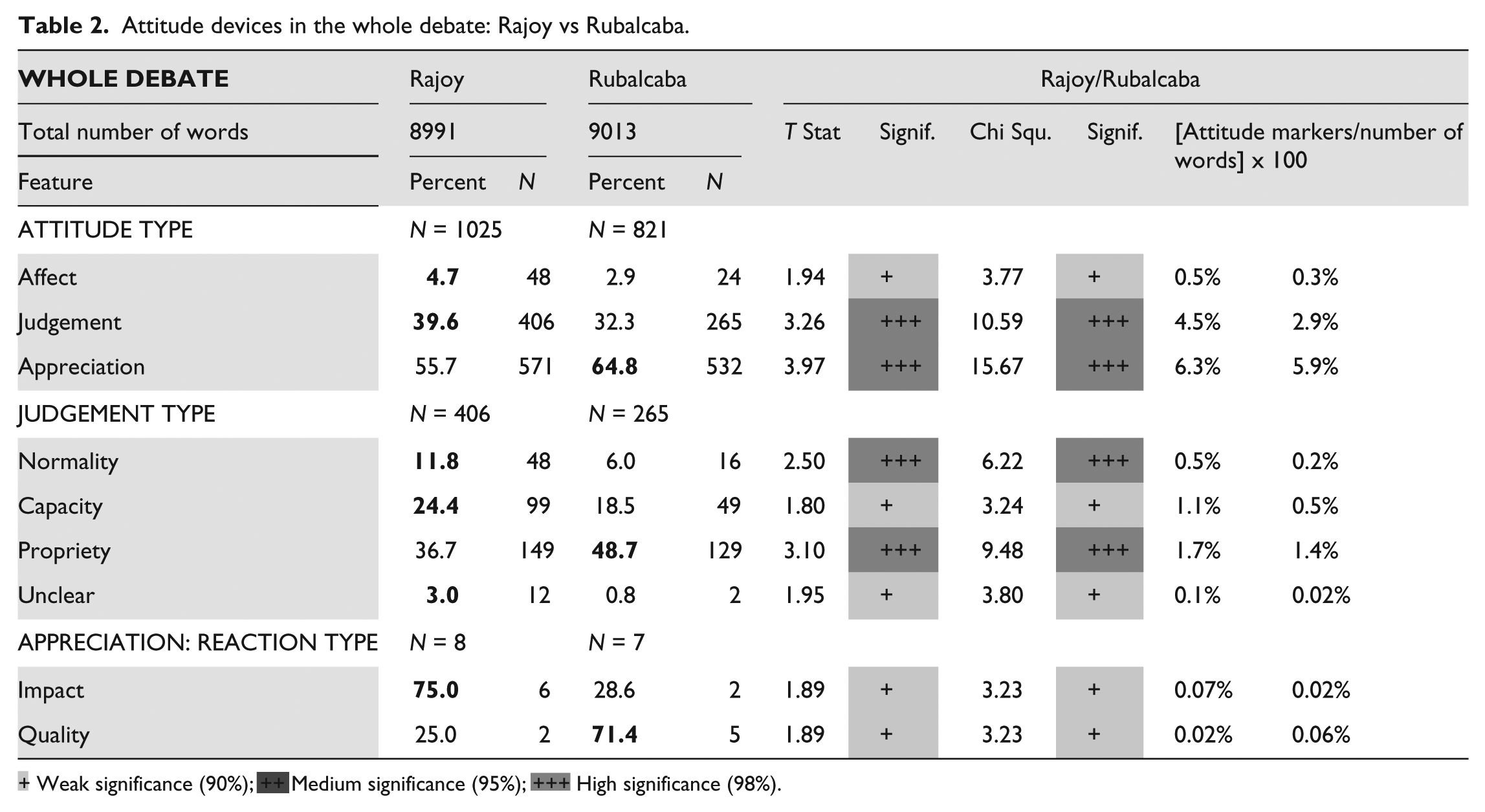
Attitude devices in the whole debate: Rajoy vs Rubalcaba.
Weak significance (90%); ++ Medium significance (95%); +++ High significance (98%).
Differences in attitude devices in the introduction section.

Differences in attitude devices in the economy and employment section.

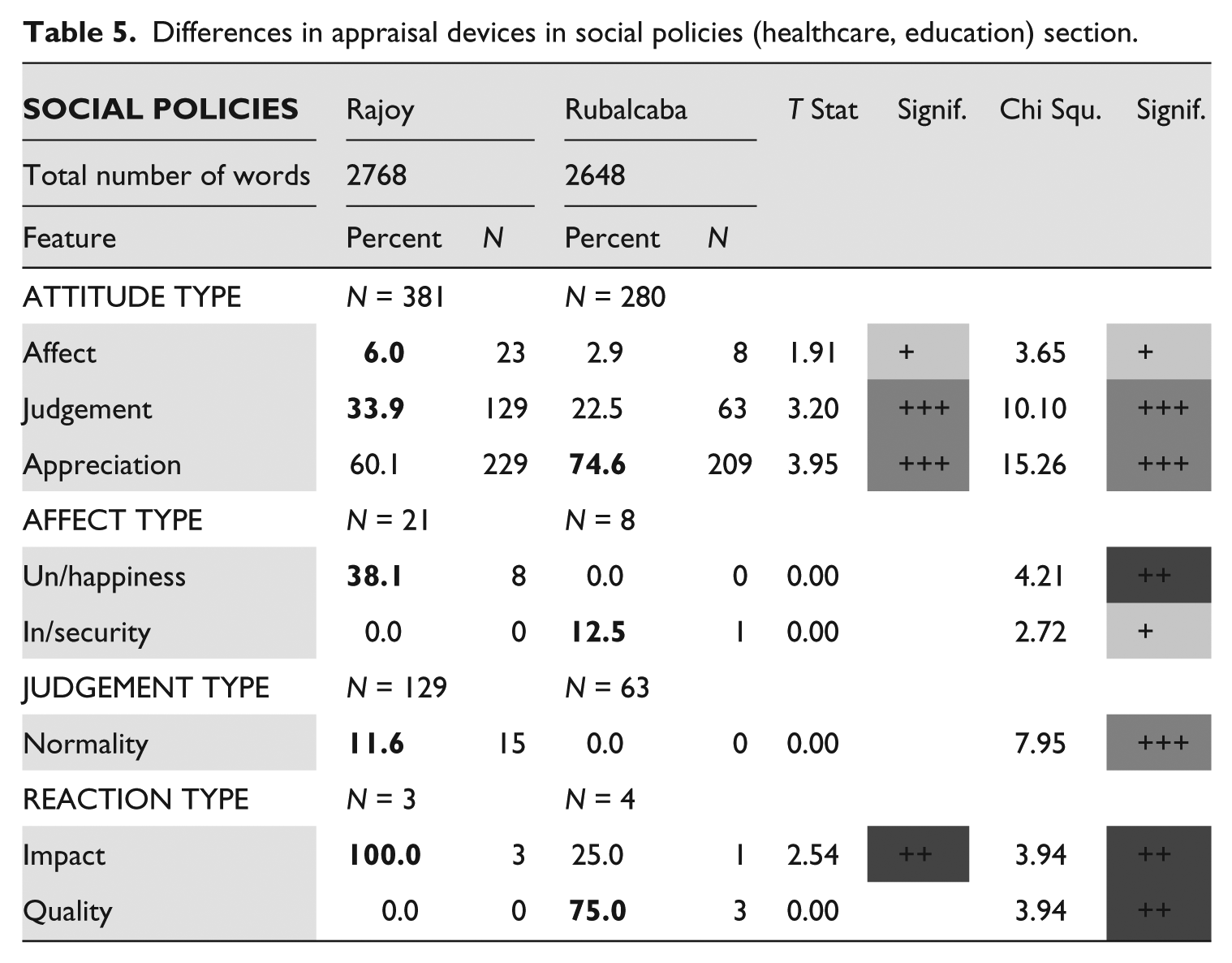
Differences in appraisal devices in social policies (healthcare, education) section.
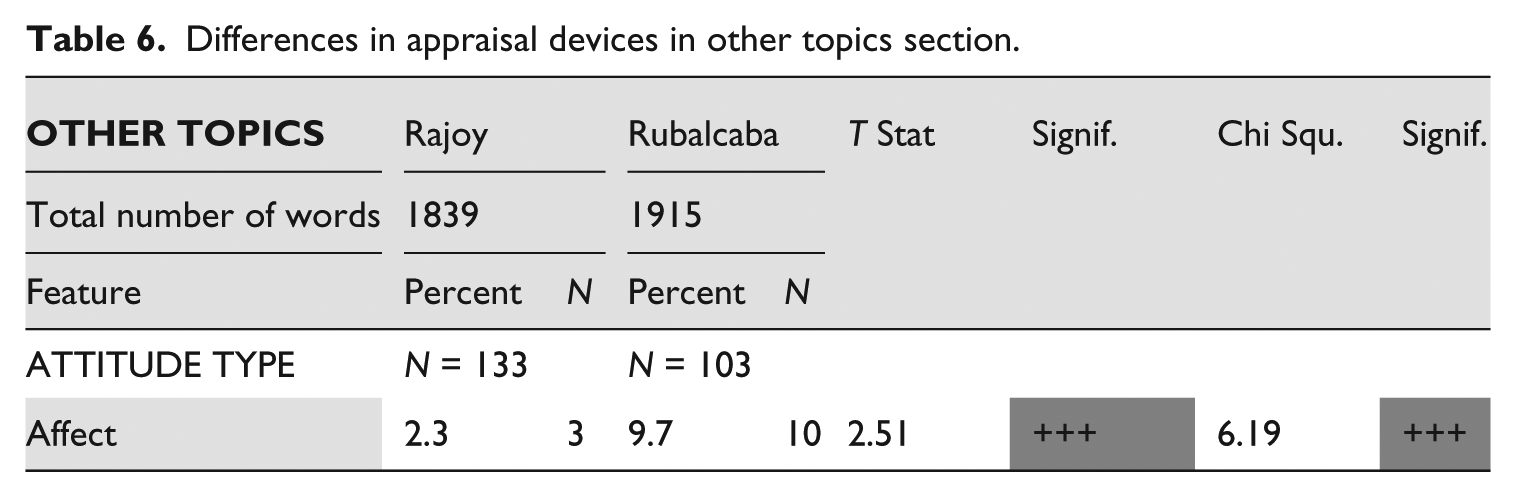
Differences in appraisal devices in other topics section.
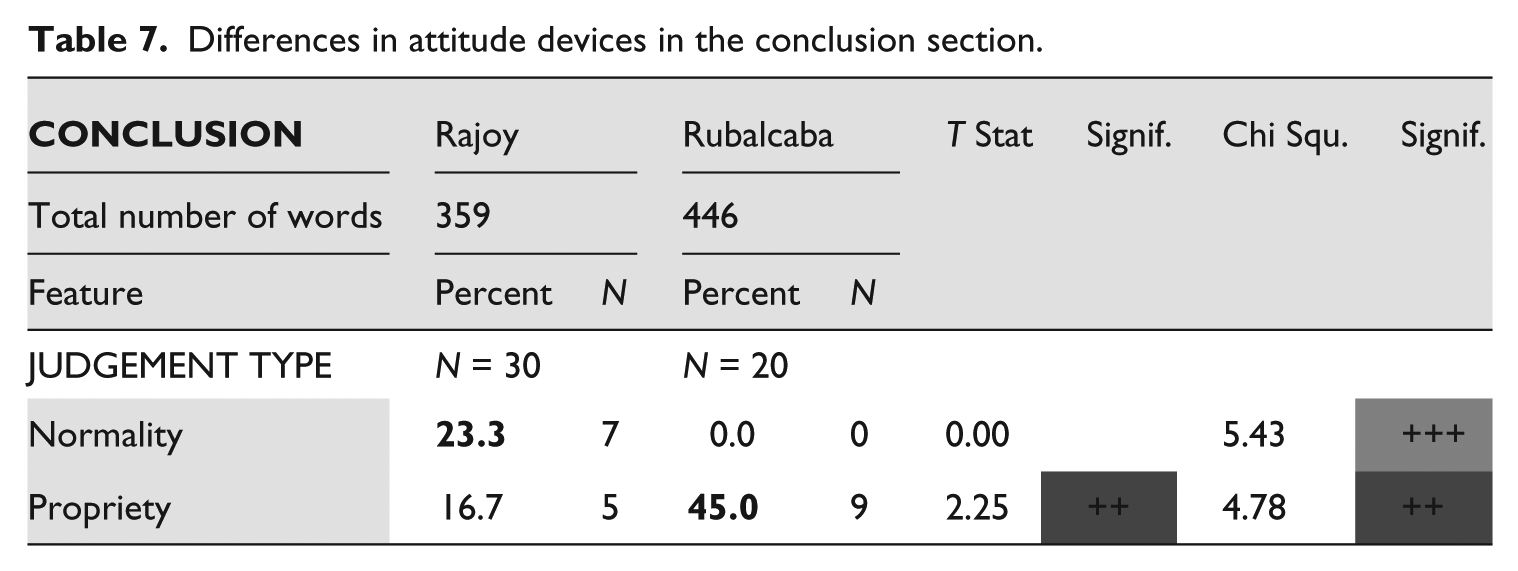
Differences in attitude devices in the conclusion section.
When contrasting the three types of Attitude, Appreciation 7 (i.e. the evaluation of things, processes or states of affairs aesthetically or with the social value the object is accorded) is the most frequently used by both politicians, and Affect (i.e. the evaluation of an entity, process or state emotionally) is the least used; Judgement (i.e. the evaluation of human behaviour from an ethical standpoint, criticizing or praising actions, deeds, sayings, beliefs, motivations, and so on) falls within the other two. Political debates are used to assess things, processes and human behaviour and less to express emotions, all of which explains such differences. However, significant differences are revealed when focusing on each Attitude type (see Table 2): Rajoy has a total of 1025 instances of using Attitude devices, while Rubalcaba has 821. This is the result of Rajoy using more attitudinal meaning than Rubalcaba in the same time allocated for their interventions. Further examination shows that Rajoy uses Affect (χ2 = 3.77, p < .10) and Judgement (χ2 = 10.59, p <. 02) more frequently than Rubalcaba, who prefers Appreciation over the other two devices (χ2 = 15.67, p <. 02), despite having a lower raw number of Appreciation markers than his opposing candidate. This is explained by the different totals of Attitude markers. The possibility remains, however, for listeners to feel that Rajoy uses more Appreciation than Rubalcaba in terms of raw numbers (n = 571 vs n = 532) and relative frequencies calculated per total number of words produced (6.3% for Rajoy and 5.9% for Rubalcaba). The listeners’ feeling that Rajoy is indeed using more Appreciation (and also more Judgement) may explain the reactions found in the aftermath of the debate: ‘Rajoy tenía una enorme ventaja: podía acudir a los desastrosos datos de la economía. Y lo hizo en todo momento, lanzándose contra el Gobierno’ (Cué, 2011) [Rajoy had an enormous advantage: he could resort to the disastrous data of the economy. And he did so at all times, pouncing on the government].
When focusing on Judgement, Rajoy mainly judges the Capacity (i.e. an assessment of the competence and/or ability of the appraised element) (χ2 = 3.24, p > .1) and Normality (i.e. how special/unusual the person’s behaviour or state is) of the Appraised elements (χ2 = 6.22, p <. 02), while Rubalcaba emphasizes the Propriety (i.e. an assessment of ethical or moral standing, or, in other words, how far beyond reproach somebody’s behaviour or state is) of the Appraised entities (χ2 = 9.48, p <. 02). Despite these results, the raw numbers (n = 149 vs n = 129) and relative frequencies calculated per total number of words produced (1.7% vs 1.4%) prove that Rajoy was really the one that favoured Property. This result may also lead the listener to feel that Rajoy assessed the opposing party’s moral standing more than Rubalcaba did, which is also proven by the AdQAT report Análisis del discurso del debate Rajoy-Rubalcaba [Discourse analysis of the Rajoy-Rubalcaba debate]: 8 Rajoy used more ‘juicios de valor’ (assessment) – 6% for Rajoy and 4.3% for Rubalcaba. The report also affirms that Rajoy ‘navega entre la opinión, el dato, el ataque y eventualmente la sorna’ [combines opinions, data, attacks and occasionally sarcasm]. It should be pointed out, however, that although Propriety is the most extensively used by both speakers throughout the debate (Rajoy, 36.7% and Rubalcaba, 48.7%), Rajoy makes a more balanced use of the different Judgement types than Rubalcaba, who clearly prefers Propriety over the rest of the Judgement types. This discrepancy in the results between those obtained when frequency is calculated as a proportion of total instances of evaluation and when it is calculated as a measure of the total words used, may lead to potentially different interpretations on the part of the audience (see Table 2). Thus, the linguistic analysis carried out in the present article has revealed an alternative interpretation of the attitudinal meanings expressed by each of the debaters that may not be apparent on first impression.
Within Appreciation, only the Reaction subtype (i.e. what strikes or makes you react somehow) shows significant differences and, specifically, between Impact (i.e. perceptual reaction) and Quality (i.e. emotional reaction), the former being appreciated by Rajoy and the latter by Rubalcaba. Nevertheless, the significance of both devices is weak (χ2 = 3.23, p <. 10). It should be taken into account that, to fully interpret the meaning of the frequency of such linguistic devices, we need to have a look at how those devices are used in order to present a positive image of oneself and a negative image of the other. With that aim in mind, we will examine each debate section in turn.
In the introduction to the debate, whose function – as announced by the moderator – is to make a general statement about the situation in Spain, each candidate sets out the principles that are going to guide their interventions in the debate. Rajoy first mentions the need to anticipate the call for a general election, due to the government’s incapacity to mend the situation, and then highlights the need for a change, thus making the present government’s incompetence obvious, with the change, he represents being his main communicative goals. On the other hand, Rubalcaba – whose party was in power, although Rodriguez Zapatero was the president at the time – cannot attack his own party and does not represent change, since the same party would govern if he wins; therefore, he needs to convince the audience of his candidacy by announcing other intentions. He offers a solution to overcome the crisis based on three compromises: agreements with the different political parties to solve unemployment (the most prevalent concern among Spaniards nowadays); the control of public expenses; and a guarantee of basic social rights, such as healthcare, education and pensions. These values are represented by 77.5% Appreciation (χ2 = 11.54, p <. 02), particularly the subtype of Social valuation with 96.8% (χ2 = 4.48, p <. 05), both of which are significant (see Table 3). The Appraisal results also reveal that Rajoy focuses on the negative policies (63% Negative Attitude, χ2 = 12.63, p <. 02) adopted by the government (50% Judgement, χ2 = 9.79, p <. 02) and the critical situation in Spain (40.9% Appreciation, χ2 = 11.54, p <. 02), while Rubalcaba tries to give a positive take on how he would solve the crisis in case his party is re-elected (72.5% Positive Attitude, χ2 = 11.00, p <. 02). All those differences are also significant.
All in all, it seems that both political candidates rely on different uses of the Attitude devices to build rather different public images: Rajoy negatively evaluates human behaviour (the current government’s behaviour) from an ethical point of view and evaluates issues and processes by making reference to a system of aesthetics that is Socially valued. Also, Rajoy contrasts evaluative devices in disjunctive syllogisms
9
that offer stark choices and, by doing this, he implies that they are the only choices and are mutually exclusive. This no doubt contributes to persuasion. In contrast, Rubalcaba cannot judge his party’s responsibility in Spain’s current situation, thus he mostly evaluates things and processes by referring to Socially valued aesthetics and does so using a Positive attitude. See the examples below: (2) RAJOY: Lo que vamos a debatir aquí esta noche es muy (3) RUBALCABA: Me quiero
The Economy and Employment section of the debate is the longest of all (40 minutes) and deals with the topics that opinion surveys show to be the most prevailing concerns of the Spanish population nowadays; therefore, this was likely to be a sensitive area that the presidential candidates had to treat accordingly. Examination of the candidates’ interventions reveal that, as they pursue their rhetorical goal of persuading the audience, both Rajoy and Rubalcaba build their personae by using different evaluative devices that vary depending on their position in the government: since Rajoy belongs to the main opposing party, he judges the current government’s incapacity to mend Spain’s critical economic and employment situation and offers a capable government if he wins (χ2 = 6.18, p <. 02, see Table 4), for example, ‘no se ha sabido gestionar bien la economía’ (the economy has not been well managed), ‘un cambio politico … con ministros que sepan de lo que hablan, que se conozcan bien los temas, se los estudien’ (a political change… with ministers that know what they are talking about, that know the topics well, that study them). Also, Rajoy expresses emotions by using Affect (e.g. ‘what matters to me’) four times, which adds a powerful final emphasis, to defend himself from Rubalcaba’s accusations that he does not care about social rights such as public health and education. In contrast, Rubalcaba, who belongs to the governing party and, therefore, cannot accuse them, uses negative property more often to blame the banks’ indebtedness, lack of credit, unemployment and economic stagnation (e.g. ‘los bancos no prestan’ [banks don’t give loans], ‘los bancos se endeudaron’ [banks got indebted]) and positive property to highlight his party’s adequate policies and proposals. Curiously enough, this is the only debate section where there are no significant differences in the use of Judgement or Appreciation on the part of the speakers, but Affect does show a difference (χ2 = 5.41, p <. 05) (see Table 4), despite being part of the Economy and Employment section of the debate and each candidate endorsing an opposing ideology.
The Social Policies section deals with hard-won social rights (i.e. healthcare, education and pensions) that are considered assets for Spanish society; therefore, regardless of the political party the candidates belong to, they should show their commitment to safeguarding and valuing these social rights. This, together with the candidates’ position in the government – member of the opposing party or member of the government – determines the candidates’ evaluative orientation: Judgement for Rajoy (33.9%, χ2 = 10.10, p <. 02) and Appreciation for Rubalcaba (74.6%, χ2 = 15.26, p <. 02). These are both positive and negative (see Table 5) and are used with the aim of deprecating the opposing candidate’s social policies and, therefore, damaging their social image, and praising their own. The results are in accordance with those of previous studies such as that of Van Dijk (2005), who mentions that politicians present themselves positively and their opponents negatively. For Atkinson (2011: 134), this is a frequent strategy in political discourse: ‘positive self-presentation of “us” and the negative other-presentation of “them”’.
What is most interesting in this debate section is that both politicians resort to the expression of emotion, despite the fact that Affect is only minimally present in debates (candidates do not talk much about their personal feelings or emotions): Rajoy focuses on Un/happiness (38.1%, χ2 = 4.21, p <. 05), mostly to positively depict himself by claiming that his intention is to maintain social rights if he wins and thus capture the audience’s sympathy, while Rubalcaba evaluates In/security to express his negative surprise at Rajoy’s silence about how to finance public healthcare in his agenda (12.5%, χ2 = 2.72, p <. 10) and, therefore, raise doubts about his opponent’s real intentions.
In the last section of the debate, the speakers discussed miscellanea of topics; each debater was allowed to choose what issue(s) to deal with. Despite the fact that a difference in the use of evaluation devices could be anticipated due to variety, the only significant difference found was in the realm of Affect (χ2 = 6.19, p <. 02) (see Table 6). As seen so far, this device was not prominent throughout the debate and, where slightly significant differences were found between the speakers, it was Rajoy who used it more frequently. In contrast, in this case, it is Rubalcaba who shows higher statistically significant frequencies (9.7% vs 2.3%). There is an exchange of Affect between the speakers that is worth mentioning here, since it is the only emotional reaction that can be considered personal: Rajoy expresses how a comment made by Rubalcaba hurt him and the latter mitigates the threat by using two downtowners: (4) RAJOY: Señor Pérez Rubalcaba, ha hablado de seguridad, pero claro, ha hablado de seguridad para darme un estacazo. RUBALCABA. Pequeñito, RAJOY. Pequeñito, pero, oiga, es que usted lo da, ‘RAJOY: Mr Pérez Rubalcaba, you’ve talked about security, but of course, you’ve talked about security to give me a blow. RUBALCABA. Tiny, RAJOY. Tiny, but, listen, the thing is that you give it (but) it hurts ME (equivalent to the emphatic ‘a mí’) [Affect].’
Although the concluding section is short (only one intervention per participant), it is most relevant, since it contains the final message each candidate wants to leave the audience with. In fact, the moderator points out that they can gaze at the camera if they want to, instead of looking at the opposing candidate as they did during the rest of the debate. In this part of the debate, the candidates brandish their main weapons against their opponents. Both of them do so through Judgement, although focusing on different evaluative devices: Normality for Rajoy (23.3%, χ2 = 5.43, p <. 02) and Propriety for Rubalcaba (45%, χ2 = 4.78, p <. 05) (see Table 7). Normality evaluative devices presented in disjunctive syllogisms serve Rajoy the purpose of presenting the dilemma that voters will face in the upcoming elections: continuing with the same policies or giving change a chance. Thus, continuing with the present party in power is considered as ‘the usual thing now’, while change represents ‘something special’. It may be inferred that ‘continuar igual’ (to continue in the same way) is negative, while change is positive: ‘si vamos a gestionar las cosas de otra manera’ (if we are going to manage things in a different way), ‘España necesita un cambio y lo necesita con urgencia’ (Spain needs a change and needs it urgently). Therefore, Rajoy finishes the debate as he started it: by offering a change; this is a common strategy used by politicians in political campaigns when they are not in power and the current government is facing problems.
On the other hand, Rubalcaba evaluates the Propriety (ethical or moral standing) of Spain to acknowledge the current difficulties and evaluates his own behaviour to present himself as a good candidate to solve them: ‘no soy pasivo’ (I’m not passive). However, his main weapon is reminding Spaniards that, if the opposing party wins, they may lose most of the benefits they have obtained throughout the years of socialist rule, although this is sometimes tacitly implied.
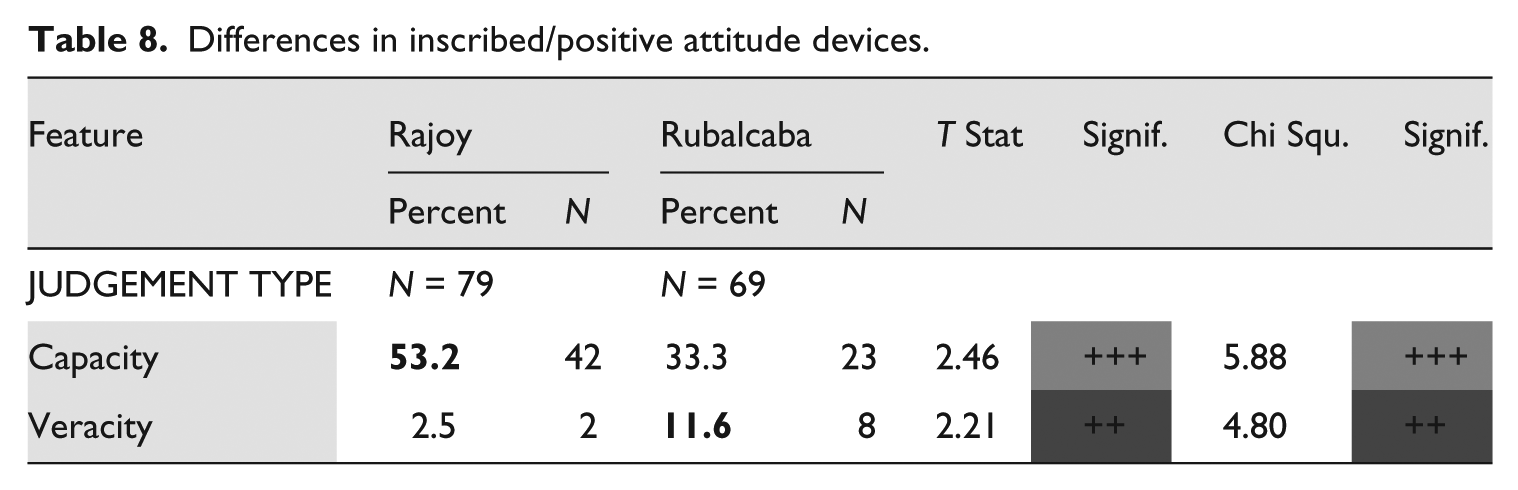
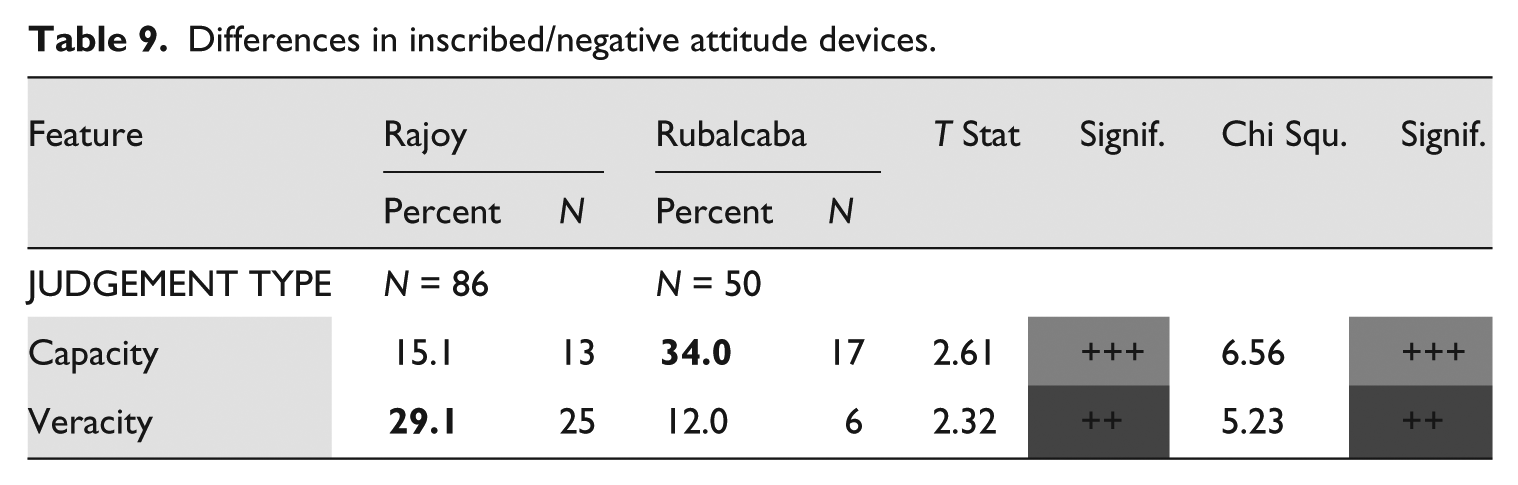
For the inscribed/invoked evaluative devices and positive/negative attitude of such devices, initial analyses showed that they were not statistically significant. However, closer examination reveals that, when combining them, there are indeed some interesting significant differences between the political candidates (see Tables 8 and 9): Rajoy shows a higher ratio of inscribed positive attitude markers indicating Capacity (53.2% versus a 33.3% in Rubalcaba (see Table 8)), which are mostly to claim his party’s capability to improve the country’s current situation (e.g. mejorar (la sanidad, la calidad de la educación) (improve [healthcare, the quality of education]). Rubalcaba, however, has a higher ratio of attitude markers (see Table 9) indicating Veracity (11.6% versus 2.5% in Rajoy), which are used to question the PP camp’s honesty (e.g. aclarar, compromises [make it clear, compromises]). For inscribed negative attitude markers, the opposite results are found: while Rubalcaba negatively evaluates his opponent’s inability to explain his real agenda (‘no ha sido capaz de aclarármelas’ [you haven’t been able to clarify them to me]), Rajoy negatively evaluates the lack of honesty in the opposing party (‘usted miente, engañaron a la gente’ [you lie, you deceived people]).
Differences in inscribed/positive attitude devices.
Differences in inscribed/negative attitude devices.
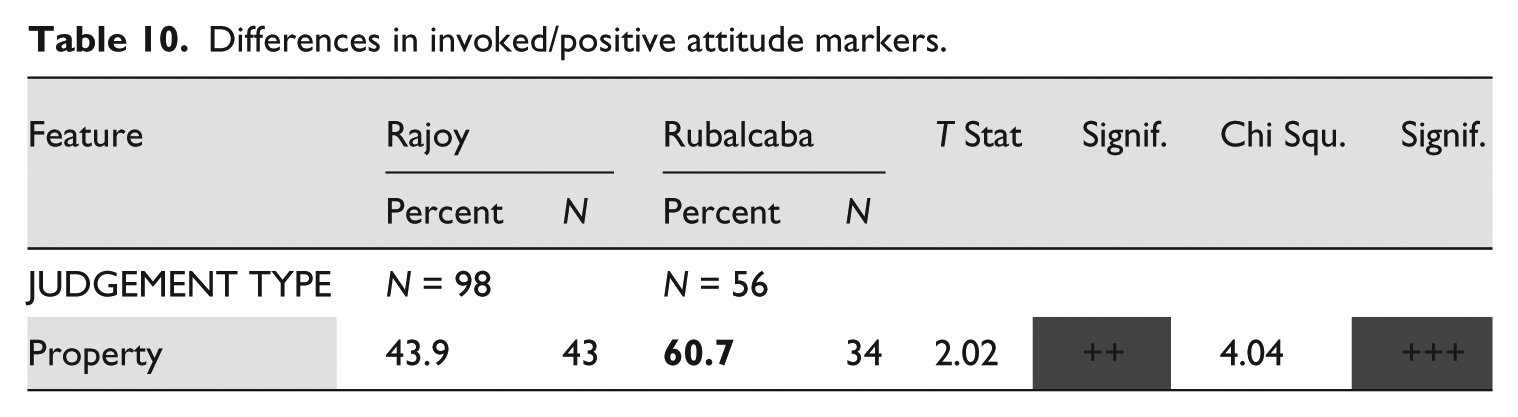
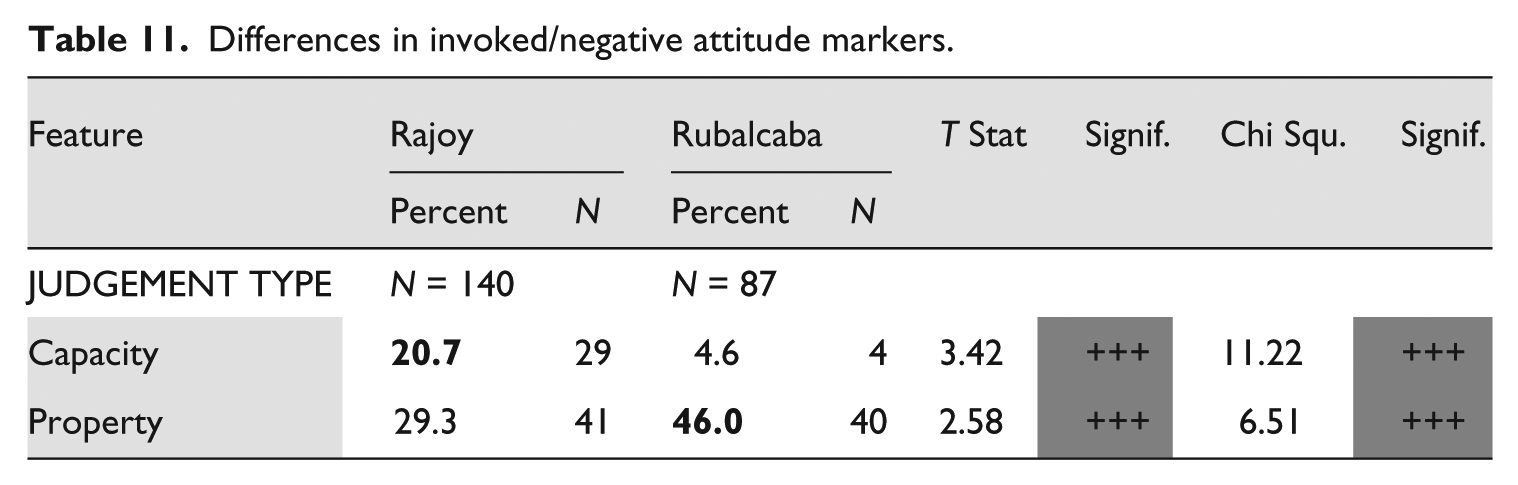
For the variables invoked/positive and invoked/negative, there are also significant differences between Rajoy and Rubalcaba (see Tables 10 and 11). For invoked/positive attitude (see Table 10), Rubalcaba uses a higher ratio of invoked attitude devices (60.7% versus 43.9%), referring to the current government’s ethical behaviour when implementing specific measures aimed at solving the country’s financial crisis: ‘financiar la sanidad, crear empleo, nos hemos preocupado’ (finance healthcare, create jobs, we have worried). Despite the ratio, the audience may indeed feel that Rajoy was really the one that judged positively some specific proposals for dealing with the crisis, since he made a higher raw number of property markers in his responses, because he already knows himself a president: ‘hemos de participar, crear empleo, cumplir la ley, aumentar las pensiones’ (we have to participate, create jobs, enforce the law, raise pensions), 10 For the variable invoked/negative (see Table 11), this serves Rajoy again in judging the government’s incapacity to fix the current economic situation and Rubalcaba in judging the lack of moral standing in the right-wing party.
Differences in invoked/positive attitude markers.
Differences in invoked/negative attitude markers.
When discussing the results, we mentioned who or what was positively or negatively evaluated; however, an exhaustive and systematic analysis of targets may have been missed. The UAM Corpus Tool does not provide a scheme for the analysis of targets and, therefore, such analysis was not initially carried out. However, when discussing the results for Appraisal, the need to take into account the appraised items (i.e. targets) seemed obvious. Thus, the whole discussion of results is accompanied by a qualitative description of the evaluation targets focused on in each section of the debate. A quantitative account of targets, although desirable, falls outside the scope of the present article, since it would imply to categorize all targets used, elaborate a new scheme for the UAM tool and tag the 19,849-word corpus with the corresponding labels, not to mention the considerable increase in results that would have to be dealt with. All of these things prevented us from accomplishing this task in the present study.
In the next section of the results, we will try to interpret the data in light of the second research question: To what extent do the evaluation devices used reveal the ideology of each candidate?
Evaluation as a reflection of ideology
In order to answer the question as to whether the evaluation devices used by each candidate reveal their ideological traits, we examine which entities and behaviours get evaluated and how. The notion of ideology is present throughout the entire debate, since both political parties have different ideological positions: while the Socialists are progressive and liberal, the PP party is known to be conservative. Indeed, Rubalcaba starts off the debate by announcing that he and his opponent have very different ideas and implying that ideology is the most important consideration when voting, since the way the country will be governed depends on which ideological principles rule. By stating that their ideas are ‘different’, he is insinuating that his opponent would not take care of the basic social needs that he himself proclaims to respect (see the Appraisal analysis above); he also blames the world crisis for being the root of the present problems in Spain, thus dodging in part his party’s responsibility for them.
The last section of the debate is the part where expressions of ideology are more clearly distinguished, since each candidate can choose what issue(s) to deal with. Rubalcaba selects as his topics of discussion democracy and some of the laws that were enacted by PSOE with the opposition of PP, and which demonstrate the PSOE’s liberal ideology, such as homosexual marriage, abortion, the post-coital pill and euthanasia. Thus, Rubalcaba positively evaluates these laws: ‘las leyes que han extendido los derechos en España’ (the laws that have spread rights in Spain), ‘la ley que permite morir dignamente’ (the law that enables one to die with dignity). In fact, this strategy of Rubalcaba’s in highlighting his opponent’s conservative ideology, with the potential threat of people losing these social rights if the opposing party wins, is used on several occasions throughout the debate. Rajoy, however, remains in the economic arena, stressing the need to come up with policies to increase employment (a topic which, in fact, belongs to the Economy and Employment section) and to reduce the deficit with austere policies and reforms.
In the last section, we also have the only examples in which both candidates seem to agree. The first is the need to advance the equality of men and women’s conciliation of work and family (women ‘conciliate more than men’, says Rubalcaba, to which Rajoy fully agrees) and the second is collaboration on terrorism threats. Not to show agreement on these issues would lead to loss of voters. In the analysis of Appraisal, fundamental social rights – which may vary depending on the ideological stance of the political party in power – such as the right to healthcare (‘sanidad’) and education, are considered as assets and thus they are positively evaluated by both speakers: they present themselves and their parties as defenders of these rights: (5) RUBALCABA: Lo más importante para los ciudadanos, creo en este momento, es su sanidad y su educación. Y le diría, fíjese, le diría más, yo creo que es más importante la sanidad. La sanidad pública que es, sin duda, una magnífica sanidad que hemos construido entre todos. Es una sanidad barata […] pero es una sanidad fantástica […]. ‘What is most important for citizens, I think, at this moment is healthcare and education. And I’d tell you, look, I’d tell you more, I think healthcare is more important. Public healthcare, which is, no doubt, a wonderful healthcare that we have all created. It is a cheap healthcare […] but it is a great healthcare […].’ (6) RAJOY: A mí también me preocupan las pensiones y mucho. Y me preocupa la dependencia, y me preocupa la desigualdad entre españoles, que cada vez es mayor. ‘I am also worried about pensions and very much. And I am worried about the dependents and I am worried about the inequality between Spaniards, which is every time greater.’
In other potential contexts, such basic human rights may not be loaded with an evaluative function, but in a political debate, in which each candidate is trying to persuade the audience of the appropriateness and value of their ideologies and manifestos, these terms are used in an evaluative fashion. Also, since the positive or negative weight of these terms is derived from the contextual characteristics of the exchange (i.e. the self-image each candidate presents to win voters), it seems that we are dealing with political implications rather than with semantic implications (Van Dijk, 2005: 69). For example, (i) the candidates care about citizens’ rights and, therefore, (ii) they are good candidates for the presidency, (iii) the opposing party’s critiques of them are wrong and possibly biased, and (iv) unlike the opposing party, they will do all they can to preserve and improve social policies. It is also true that the candidates attack each other (and the political party each represents) on fundamental social rights and they do so using negative evaluation in an attempt to discredit the other. For example, the candidate for the Socialist party frequently accuses the PP camp of holding hidden anti-social policies, since the PP ideological position favours a reduction in social policies: (7) RUBALCABA: […] Lo he leído, señor Rajoy, no hay ninguna mención a la financiación de la sanidad pública. […] Cuando hay que quitar ambulancias, camas, entonces sí, no tienen ningún problema. Cuando hay que privatizar, ningún problema. ‘[…] I have read, Mr Rajoy, there is no mention of the financing of public healthcare […] When ambulances are cut, then of course, you have no problem. When it is necessary to privatise, no problem.’
In the same vein, words such as ‘public’ and ‘private’, which are again linked to the candidates’ ideological positions (i.e. the Socialist party favours public institutions, while the PP camp advocates for privatization), could both be positively or negatively valued, depending on what they are referring to. In the present context, ‘privado’ (private) is tinged with negative appraisal, because it is considered unfair, unsupportive and unequal, while ‘público’ (public) is seen as positive, because it implies solidarity in its universal character. On several occasions, Rubalcaba accuses Rajoy’s party of defending private institutions (private healthcare and education) instead of public ones: (8) Es evidente que los hospitales
He is even sarcastic in tone: (9) Y realmente me gustaría saber si usted tiene alguna propuesta para financiar la sanidad pública más allá de esos
All in all, regarding the expression of ideology, it seems that both debaters say what the audience wants to hear, although Rubalcaba shows off his liberal and social ideas and Rajoy counter-attacks Rubalcaba whenever he accuses him of having a hidden anti-social agenda. Therefore, if we are to decide whether ideology has a direct bearing on the way evaluative devices are used (i.e. whether entities get positively or negatively evaluated), one may conclude that both candidates (seem to) defend what is acknowledged as a left-wing ideology: public services and egalitarian social policies. Whether this praising of the same social rights responds to their political ideas or to their wish to gain voters is there for anyone to decide. Thus, evaluation, rather than as an expression of ideology, is used as a loaded weapon for self-praise and belittlement of the other.
Conclusion
The present study has contributed to an understanding of the role of the evaluative devices used by two ideologically different politicians in a pre-electoral debate that raised a lot of expectation and interest among the Spanish people at the time. In this section, we recall the research questions addressed and provide conclusions drawn from the analysis in order to answer them:
(I) Which type(s) of evaluation device(s) is/are most often used by each politician and what function do they fulfil?
The Appraisal analysis reveals that Rajoy and Rubalcaba used the evaluative devices differently in the 20 November debate: while Rajoy expressed emotions and judged human behaviour from an ethical viewpoint, Rubalcaba evaluated things and processes aesthetically and expressed social value. They also judged differently: Rajoy focused on the incapacity (Judgement: (In)capacity) of the present government and the need to change (Judgement: Normality) the party in power, while Rubalcaba focused on the two parties’ ethical behaviours. Regarding Appreciation, Rajoy’s evaluations highlighted perceptual reactions (mainly the impact of the opponent’s policies) and Rubalcaba emotional reactions (positive ones to praise Spain and negative ones to accuse Rajoy of elitist policies). The variables inscribed/invoked and negative/positive were also used differently as a political strategy to win votes: both regarded their own party as capable of bringing stability to the country and the opposing party as incapable of doing so; they also both praised their own and questioned the other party’s honesty. Although each section of the debate presents some peculiarities regarding the use of evaluation devices, these preferences are observed throughout the debate.
(II) To what extent do the evaluation devices used reveal the ideology of each candidate?
Although it is certainly difficult to answer this question in an unbiased way, trying not to depict one of the two ideologies (right-wing or left-wing) as the preferred option, our aim is to observe, from an outside perspective, whether ideology influenced the way each candidate was evaluated in the debate. Rubalcaba’s main line of argument was his own ideological principles, sustained by two pillars: public services (specifically healthcare and education) and a liberal mentality (i.e. no prejudice regarding sexual preference and the personal right to decide on abortion or euthanasia). Of these two, Rajoy only pronounced his opinions on the need for public services, mainly to defend himself from Rubalcaba’s accusations of elitism. He also openly agreed with Rubalcaba on gender equality regarding work and family balance, and also on dealing with terrorism, as if they were universally acknowledged truths. Rajoy, rather than brandishing his own ideology, preferred to undermine Rubalcaba’s credibility. However, there were no ideological differences shown in the entities praised or criticized (i.e. both mainly praised public services and criticized privatization) by the candidates, in the interest of not losing voters by publicly announcing unpopular policies. They both preferred to discredit their opponent by criticizing each other’s ideas or deeds.
The press of the day following the debate presented Rajoy as the debate winner; this may be due to the negative evaluation he gave of the government, reproaching them for their poor policies and blaming them for the present crisis. However, it could also be the case that the debate was won and lost beforehand, since the audience was ready for change and listened to Rubalcaba’s accusation of Rajoy having a hidden agenda with scepticism, as an electoral manoeuvre. Thus, Rajoy’s negative evaluation of his opponent may have been more convincing than Rubalcaba’s because it was based on fact, while that of the latter was based on speculation, in warning the audience of the potential danger if the PP won the elections.
Future studies may carry out a quantitative study of who/what was being positively or negatively evaluated using Affect, who was being Judged and who/what was being Appreciated. This prospect analysis of the evaluation targets (i.e. appraised entities) may show interesting results as to the political speakers’ attitudinal orientations and as to which entities were being more frequently evaluated.
Footnotes
Funding
This research was financially supported by the FunDETT project, funded by the Spanish Ministry of Science and Innovation, Research Project Code FFI2009-07308-Subprograma FILO.