



Abstract
Governments’ policies and actions often precipitate public blame firestorms and mediated scandals targeted at individual or collective policy makers. In the face of losing credibility and resources, officeholders are tempted to apply strategies of blame avoidance which permeate administrative structures, operations and language use. Linguistic aspects of blame avoidance are yet to be studied by discourse analysts in great detail. In this article, I contribute to filling this gap in knowledge by proposing an improved heuristic for understanding typical macroconversational discursive practices adopted by officeholders in the circumstances of blame risk to achieve the goal of positive self-presentation. Based on a multidisciplinary review of scholarly literature, I show how personal and institutional risk aversion involves the application of certain strategies of argumentation, framing, denial, social actor and action representation, legitimation and manipulation. I use concrete textual examples from public statements of UK government officeholders to illustrate how blame avoidance works at the highest level of administration. I argue that to understand blame avoidance as a dominant recurring theme in public communication we should look beyond current linguistic approaches to conflict talk. This could lead to the application of new useful analytic tools within discourse studies and open new avenues of critical research into language use in politics and bureaucratic organisations.
Keywords
Introduction
The concept of blame has attracted a lot of academic attention (Coates and Tognazzini, 2013; McKenna, 2012; Malle et al., 2014; Scanlon, 2008; Sher, 2006; Tilly, 2008). Some scholars of politics, organisation and public administration have particularly emphasised the need to study the practices and implications of blame avoidance in institutional contexts and political life. For instance, Weaver (1986) notes that if politicians want to be re-elected they have to ‘be at least as interested in avoiding blame for (perceived or real) losses that they either imposed or acquiesced in as they are in “claiming credit” for benefits they have granted’ (p. 372). Weick and Sutcliffe (2007) assert that ‘an organisation is defined by how it handles blame and punishment’ (p. 131). Hood (2011) argues that regarding the ‘idea of blame avoidance as a political and bureaucratic imperative’ (p. 24) helps us make sense of organisations’ and officeholders’ behaviour.
It is well known that receiving blame may ruin personal or organisational reputation and result in the loss of power, finances and job security for particular officeholders (Allern and Pollack, 2012; Boin et al., 2005; Castells, 2009; Thompson, 2000). Policy makers are thus tempted to apply strategies of blame avoidance which permeate administrative structures, operations and language use (Hood, 2011; Weaver, 1986). Blame-related defensive practices by government insiders can, however, have broader societal implications. They may derail, obstruct or prevent public debates over certain policy issues, alter political agendas and alliances, legitimate some actors and disempower/delegitimise others. And certain ways of warding off blame may either encourage or discourage social learning, that is, the processes by which people both inside and outside of government make sense of each other’s perspectives and attitudes, gain moral insight and reproduce shared meaning.
Linguistic aspects of how governments avoid blame are yet to be studied in great detail. The main thrust of my argument in this article is that discourse analysts need a more sophisticated understanding of blame avoidance as a dominant and frequent (if only implicit) theme of executive government communication. Within the field of discourse studies, I am guided by and build upon the overall methodological framework of the discourse-historical approach which has been particularly designed for dissecting and demystifying power relations in political life in terms of discursive strategies of self- and other-presentation (see Reisigl and Wodak, 2001, 2009; Wodak, 2011).
I present my argument in three steps. I first briefly review some linguistic approaches and analytic tools which are useful for describing various aspects of blame avoidance in institutional settings: ways of arguing, framing, denying, representing social actors and actions, legitimising and manipulating (social) cognition. However, taken separately, these approaches may lack the interpretive power to account for the large variety of possible moves that characterise government-related blame games. Therefore, second, I summarise a more specific public administration approach to blame avoidance as proposed by Hood (2011). And finally, I synthesise all the previous approaches into a new, more comprehensive heuristic model – one that discourse analysts will be able to use to detect and interpret typical macroconversational practices adopted by officeholders in the circumstances of blame risk to achieve the goal of positive self-presentation.
I draw my examples mainly from texts produced by the government officeholders of the United Kingdom between 2008 and 2013. I use these to demonstrate how my framework could be applied to explicate discursive blame avoidance in several typical genres of governance: a newspaper article by a minister, a news release by a government office, a televised statement of a minister and a live ministerial press conference. All the examples are set against the historical backdrop of the financial crisis that developed in the United Kingdom since 2007. This backdrop is salient because blaming and blame avoidance are essential building blocks of public narratives about crises.
Linguistic approaches to blame avoidance
Several discourse analysts and cognitive linguists have explicated instances and means of blaming and blame avoidance in political and bureaucratic communication in particular. As a good general starting point, Wodak (2006a) provides a concise overview of linguistic/pragmatic approaches to blaming and its frequent complementary speech act, denying. Blaming as a constitutive feature of conflict talk can be analysed by using a variety of methodologies suitable to the particular genre and context. These approaches include, for instance, speech act theory, conversation analysis, discourse analysis, argumentation analysis and rhetoric.
In political debates and persuasive discourses, blaming and denying are strategically planned and serve positive self-presentation and negative other-presentation. Thus, this domain is of particular interest to discourse and argumentation analysts, who focus on strategies of blaming and denying and argumentative moves in conflict talk (see Wodak, 2006a: 59–61).
Ways of arguing
When faced with blame risk in a public debate situation, for instance, a televised interview or a parliamentary discussion, officeholders use particular ways of arguing designed to convince the audience that they should not be regarded as being blameworthy. Essentially, this involves making argumentative moves to manipulate (a) the perception of loss by proposing that there is little or no reason to blame anyone because little or no harm has been done and (b) the perception of agency by proposing that harm has been done unintentionally, unknowingly, involuntarily or by someone else.
The last mentioned move – shifting of responsibility and thus also blame – is particularly salient in political argumentation. This has been described by Wodak (2011) as one of the leitmotifs of ‘politics as usual’ in the context of the European Parliament, where parliamentarians use ‘the highlighting of mistakes and failures of the [European] Commission which are constructed as an obstacle to reasonable decision-making’ (p. 132). In a rather similar vein, in their analysis of the UK government’s argumentative discourse, Fairclough and Fairclough (2012) argue that ‘the past and current governments have been for some time now engaged in a “blame game”’ and that the present UK coalition ‘has exploited and reinforced the public perception of the previous government as being responsible for the crisis and for the spending cuts, in order to legitimise their own position and delegitimise that of the opposition’ (p. 172).
These blame-shifting argumentative moves can be evaluated in terms of reasonableness based on the pragma-dialectical approach (see, for example, Van Eemeren et al., 1996: 274–311). Attempts to shift blame may involve using pseudo-argumentative backing of claims or argumentative fallacies that neglect certain premises of rational discussion. 1 Such fallacies include, for instance, shifting of responsibility (trajectio in alium), attacking an opponent’s character to discredit her (argumentum ad hominem), misrepresenting an opponent’s position (‘straw man’), concluding that a proposition is true because many people believe so (argumentum ad populum), appealing to an audience’s feelings of compassion (argumentum ad misericordiam), providing false analogies, claiming that temporal sequence equals causality (post hoc, ergo propter hoc) and using unclear, ambiguous or unfamiliar language.
Moreover, blame deflecting argumentation is often characterised by the use of certain topic specific conclusion rules or topoi. Topoi are quasi-argumentative shortcuts, content-related warrants that connect argument(s) with the claim, but the plausibility of which can be relatively easily questioned (see Reisigl and Wodak, 2001: 74–80). In political communication, topoi are mostly applied to justify and legitimise positions by providing ‘common-places’, instead of substantial evidence (for example, ‘something is a burden, a threat, costs too much’, and so forth). In this way, other groups or positions are constructed as scapegoats; they are blamed for trouble or for causing potential failure or discontent (with politics, with the European Union, etc.). (Wodak, 2011: 43)
For example, officeholders often reject blame for causing certain harm by claiming that they ‘just followed the rules’ when the harm occurred. In doing so, they are applying the topos of law – that is, a conclusion rule that (implicitly) says that ‘if a law or otherwise codified norm prescribes or forbids a specific politico-administrative action, the action has to be performed or omitted’ (Reisigl and Wodak, 2001: 79). Put simply, public servants thus suggest that the harm in question has ‘happened’ involuntarily – and if someone should be held responsible for this harm at all, then these are the legislators who established those rules.
Paying due attention to argumentation strategies is vital for any analysis of executive officials’ attempts to avoid blame risk. However, for a more comprehensive understanding of blame games, one has to look beyond that.
Ways of framing
Cognitive linguist George Lakoff (2008) reminds us that our thinking is not universally rational: the human brain does not naturally produce conscious, universal, disembodied, logical, unemotional, value-neutral, interest-based and literal reasoning. 2 Thus, it is useful to analyse the discursive means of blame avoidance in executive government not only in terms of rational discussion and argumentation but also by giving due consideration to reflexive modes of reasoning and the related strategies of predominantly emotional persuasion.
People often attribute blame – as well as praise – in terms of a basic narrative frame that Lakoff (2008: 24) calls ‘Rescue narrative’. According to this narrative frame, an (inherently evil) Villain harms a (helpless and innocent) Victim, then an (inherently good) Hero struggles against and defeats the Villain, so consequently the Victim is rescued, the Villain is punished and the Hero is rewarded. Accordingly, avoiding blame means avoiding being depicted as a Villain in stories about (possible) harm or loss. That is why officeholders who confront a blame risk may promptly try to describe themselves as the Heroes, or the Helpers of a Hero, or perhaps even one of the Victims – only to escape being assigned the role of the Villain by someone else in their narrative account of the possibly blameworthy event or outcome.
Lakoff (2008: 163–167) also describes another frame which is typically used in politics and other institutional contexts to shift blame inside an organisation. He calls it ‘the Bad Apple frame’, as it is based on the proverb ‘One bad apple spoils the barrel’ which evokes a simple moral: get rid of a bad apple and the barrel will be saved. Lakoff (2008) argues that we interpret the proverb in terms of metaphors: apples are people, the barrel is an organisation (container) containing people, people in the organisation are good (moral) and one or a few bad (immoral) people in an otherwise fine organisation can make others go bad (or look bad) and spoil the good name of the organisation: There is a systematic practice in an organisation that is either illegal, immoral, or at least underhanded. If the practice were publicly recognised, it would greatly harm the reputation of the organisation and threaten the careers of high-level members of the organisation. There are two related uses of the Bad Apple frame: To protect the organisation and its mode of operation. The Bad Apple goes; the organisation is redeemed and keeps operating as before. To find a target in the organisation to blame so that everyone else in the organisation escapes the blame. (p. 164)
According to Lakoff, this frame works not only because we think in terms of conceptual metaphors like Morality is Purity and Immorality is (possibly contagious) Rottenness but also because it fits the Hero–Villain narrative where ‘the Villain is a person, not a system, an institution, or an ideology’ (Lakoff, 2008: 166). Thus, institutions frequently respond to accusations by convicting a person rather than by changing their dominant beliefs or their possibly flawed system of operation.
However, besides spelling out the use of certain persuasive argumentation schemes and frames, critical analysis of blame avoidance should specifically incorporate a sophisticated understanding of denial strategies.
Ways of denying
Conversation analysts regard rejection as the preferred mode of reaction to blaming (Pomerantz, 1978). Rejection of accusations may take various forms. Van Dijk (1992: 92) has proposed a useful general typology of denying as a part of a general ‘social defence’ strategy against the formation of negative self- or ingroup impressions. These types are as follows:
Act-denial (‘I did not do/say that at all’);
Control-denial (‘I did not do/say that on purpose’, ‘It was an accident’);
Intention-denial (‘I did not mean that’, ‘You got me wrong’);
Goal-denial (‘I did not do/say that, in order to …’);
Mitigations, downtoning, minimising or using euphemisms when describing one’s negative actions.
Van Dijk notes that besides ‘denial proper’ there are cognitive and social strategies which can be regarded as ‘stronger forms of denial’: blaming the victim and reversal. This kind of defensive reaction has also been described as ‘turning the tables’, for instance, in Wodak’s (1991) critical analysis of antisemitic language use.
Like some argumentative moves, all of these types of denying are aimed at altering the perception of the blame taker’s agency. In the complex and uncertain world of public administration, intention denials may be particularly effective, because in many cases it may seem almost impossible for accusers to provide actual evidence that certain people in the government had negative intentions.
But denying may not always be the best way of doing away with perceptions of loss. Officeholders may find it even more appealing to choose simply not to mention possibly problematic issues at all or, when compelled to talk about certain actors or actions, to make such lexical choices that effectively disguise them.
Ways of representing actors and actions
The network of social actor representation, devised by Van Leeuwen (1996, 2008), is yet another instrument for explicating instances of blame avoidance in text and talk. Such an approach is helpful because it leads analysts to focus their attention on exclusion, suppression or backgrounding (e.g. by impersonalisation or nominalisation) of victims and/or those actors who could possibly attract blame.
Obscured agency as a linguistic means of risk aversion is notoriously common in government texts. Just to mention one observation, in an analysis of news releases of a US government institution, Scollon (2008) concludes that in these texts ‘it is linguistically problematical to know who is taking responsibility for the statements being made’ as these ‘present a rather ambiguous array of writer/reader positions’ (p. 109).
Vagueness is also salient in policy papers, which are often designed by officeholders with an implicit goal of avoiding personal or institutional blame risks. Thus, they may choose not to refer to possibly threatening situations or actions or to refer to them obliquely or by euphemism, for instance, ‘pre-growth period’ instead of ‘economic recession’ or ‘workforce optimisation’ instead of ‘laying off people’.
Representations of social actors may be analysed in terms of how calculated ways of naming (referential or nominational strategies) are used for membership categorisation – that is, establishing ‘ingroups’ and ‘outgroups’ – and how calculated ways of attributing (predicational strategies) are used for portraying actors either as more positive or negative. Presumably, blame sticks more easily to those actors who are represented as ‘others’ and as possessing stereotypically negative attributes; and harm inflicted to actors who are represented as members of some negative (e.g. threatening) outgroup is less likely to generate blame.
Certain ways of talking and writing about actions may have an effect on limiting the perception of blameworthiness. Van Leeuwen (1995, 2008) usefully reminds us that actions can be deagentialised, that is, represented as if the possibly harmful action in question came about without human involvement (e.g. ‘the problem occurred’, ‘the incident happened’), as if this ‘simply exists’ (e.g. ‘there is a problem’) or as if this was a natural process (e.g. ‘concerns are growing’, ‘changes are coming’). Officeholders may choose to represent their actions at high levels of generality and abstractness so that it becomes less clear what they actually did or are doing (e.g. ‘we are tackling these issues’). And moreover, in an attempt to evade responsibility, officeholders may carefully avoid talking about their actions that have (possibly) material effects and instead switch to only describing their reactions – their mental processes that are invisible (e.g. ‘I am very concerned about this’, ‘I hope that things will get better’).
When officeholders hide or obfuscate blameworthy aspects in text and talk or when they use argumentation, framing and control-denial to reject responsibility for causing particular instances of perceived harm or failure, they (at least seem to) admit the occurrence of harm or failure. However, they may instead choose a rather different approach – taking full responsibility but trying to present events or circumstances in question in a more positive light by employing strategies of legitimation.
Ways of legitimising
Legitimation, that is, explanations and justifications of practices of specific institutions, can be characterised ‘as an answer to the spoken or unspoken “why” question’ (Van Leeuwen, 2007: 94). Obviously, this definition includes explanations and justifications of possibly blameworthy actions: why did (or should) we carry out these actions (in this way)?
Responses to blaming – as well as preemptive communication of potentially unwelcome conduct – often draw upon the following ‘pool’ of legitimations, which Van Leeuwen (2007: 92; based on Van Leeuwen and Wodak, 1999) has broadly divided into four categories: 3
Authority legitimation. Using personal references (to status and role), impersonal references (to rules), references to custom (tradition, conformity) or commendation (by expert or role model);
Moral evaluation legitimation. Using references to value systems (evaluation, abstraction, analogies);
Rationalisation legitimation. Using reference to the goals, uses and effects of institutionalised social action (instrumental rationalisation) or to a natural order of things (theoretical rationalisation);
Mythopoesis. Using narratives (e.g. moral tales, cautionary tales) in which legitimate actions are rewarded and non-legitimate actions are punished.
Although what is listed here may seem somewhat similar to argumentation strategies that I mentioned earlier, legitimations are more likely designed to end debates (e.g. by imposing some kind of authority without further justification) rather than to resolve differences of opinion via critical discussion. 4 And this recognition leads me to the question of manipulation.
Ways of manipulating
Linguistic strategies of deflecting blame may amount to discursive power abuse: communicative manipulation. Criticising someone’s linguistic behaviour as illegitimate manipulation rather than provision of legitimate excuses and justifications obviously requires an analyst to take an explicitly normative stance. Thus, the analyst’s ability to explain in considerable detail the societal consequences of a potentially manipulative communicative event is of utmost importance.
Van Dijk (2006) has proposed a threefold approach to understanding manipulation as a central notion in critical discourse analysis by bringing together its social, cognitive and discursive aspects. According to his framework, text and talk can be regarded as manipulative if these:
Are used by dominant groups (e.g. governments) to (re)produce their power and to hurt the interests of less powerful groups in society;
Are based on an explicit plan to impair or bias understanding of information (Short Term Memory-based manipulation) and formation of mental models in a way which is not in the best interest of the recipients (Episodic Memory and Social Cognition manipulation);
Make extensive use of discursive group polarisation (i.e. positive self-presentation and negative other-presentation) and other discursive strategies focused on potential vulnerabilities of recipients (e.g. their strong emotions or traumas, their lack of relevant knowledge, their lower status) which make the recipients less resistant to accepting beliefs and doing things they otherwise would not do. Manipulation typically involves violations of conversational maxims proposed by Grice (1975/1989).
This framework serves as a useful reminder that, when wishing to provide normative critique of any particular way public authorities try to influence public perceptions of blameworthiness, discourse analysts must decidedly look beyond its purely linguistic aspects. Therefore, I turn to insights about blame avoidance in government that have been accumulated within the discipline of public administration.
Public administration approach to blame avoidance
Hood (2011: 18) provides an insightful classification of ‘presentational’ blame avoidance strategies that are characteristic to public administration. 5 These involve using arguments for limiting blame (excuses) or turning blame into credit (justifications) and other methods of influencing public impressions. These strategies are based on the assumption that presentational activity will limit or deflect rather than exacerbate or attract blame. He lists the following strategies.
Winning the argument. Officeholders who choose to apply this strategy try to win an argument over culpability in its own terms by offering persuasive excuses and justifications. Officeholders may try to show there is no problem (problem denial) or, when admitting there is a problem, show that blame/agency lies elsewhere. Problem denial can take at least three forms (Hood, 2011: 50–52): total problem denial, partial problem denial, and problem denial accompanied by a counter-attack.
Drawing a line. Officeholders who choose to apply this strategy ‘come out with a preemptive apology calculated to disarm critics and attract sympathy’; ‘apologise early in a blame sequence’, try to ‘defuse blame by (apparently) picking it up’ (Hood, 2011: 54). Apologising can, in some circumstances, contribute to the positive self-presentation of an officeholder, but it can also be risky for the blame taker: apologies can be taken as confessions of guilt that invite dismissal by those higher in hierarchy, or they may lead to additional demands.
Changing the subject. Officeholders who choose to apply this strategy try to create or use ‘diversions to avoid the spotlight of blame and shift the public agenda onto other issues’ and to find ‘good times to bury bad news’ (Hood, 2011: 56). Hood (2011) observes that
times when public attention can be expected to be focussed on other things (such as big sports events or public holidays) can provide convenient moments for officeholders and organisations to sneak out potentially embarrassing announcements of U-turns or unpopular policies. (p. 56)
Keeping a low profile. This is a more passive strategy of dealing with blame by saying as little as possible. It may take several forms (Hood, 2011: 59–61): restricting information, ‘lying doggo’ (staying silent) and ‘working behind the scenes’ (using backdoor threats and inducements to fix the media agenda).
Importantly, Hood discusses the possible positive and negative societal effects of the use of presentational strategies by government institutions. He argues that the approaches based on avoiding public discussion could be seen normatively as detrimental: A key test of the positivity or otherwise of presentational blame-avoidance strategy is how far it serves to engage the citizenry in serious argument about the merits of policy or operational choices to be made by officeholders and organisations, and clarifies where fault lies after allegations of avoidable losses have been made … So on that criterion we can argue that winning-the-argument approaches are broadly positive, but changing-the-subject and low-profile approaches (such as diversion tactics, nonengagement, or backdoor pressures on media) are negative. (Hood, 2011: 174–175)
Hood also reminds us that there are other kinds of blame avoidance strategies beyond the ‘presentational’ ones listed above: officeholders may preemptively distribute formal responsibility among each other and/or choose particular operating routines that make it easier to shift blame or limit personal blame risk if something bad happens.
Embracing the blame avoidance framework
Hood’s blame avoidance typology, although not claiming comprehensiveness, seems to be useful for gaining a broader insight into risk aversion practices in executive government contexts. The analytic tools embedded in the discourse-historical approach, however, can be used to accomplish a more exhaustive explication of a variety of linguistic (or rhetorical or argumentative) means and micro-processes by which blame is framed, admitted, countered or shifted by government communicators.
For instance, after identifying linguistic evidence of hidden or backgrounded agency in a government-produced text and taking into account the specific context of situation, as well as the history of the text and the institution, an analyst can interpret the particular discursive choice in terms of whether or not it may function as a blame avoidance device in a public administration organisation – and in which ways.
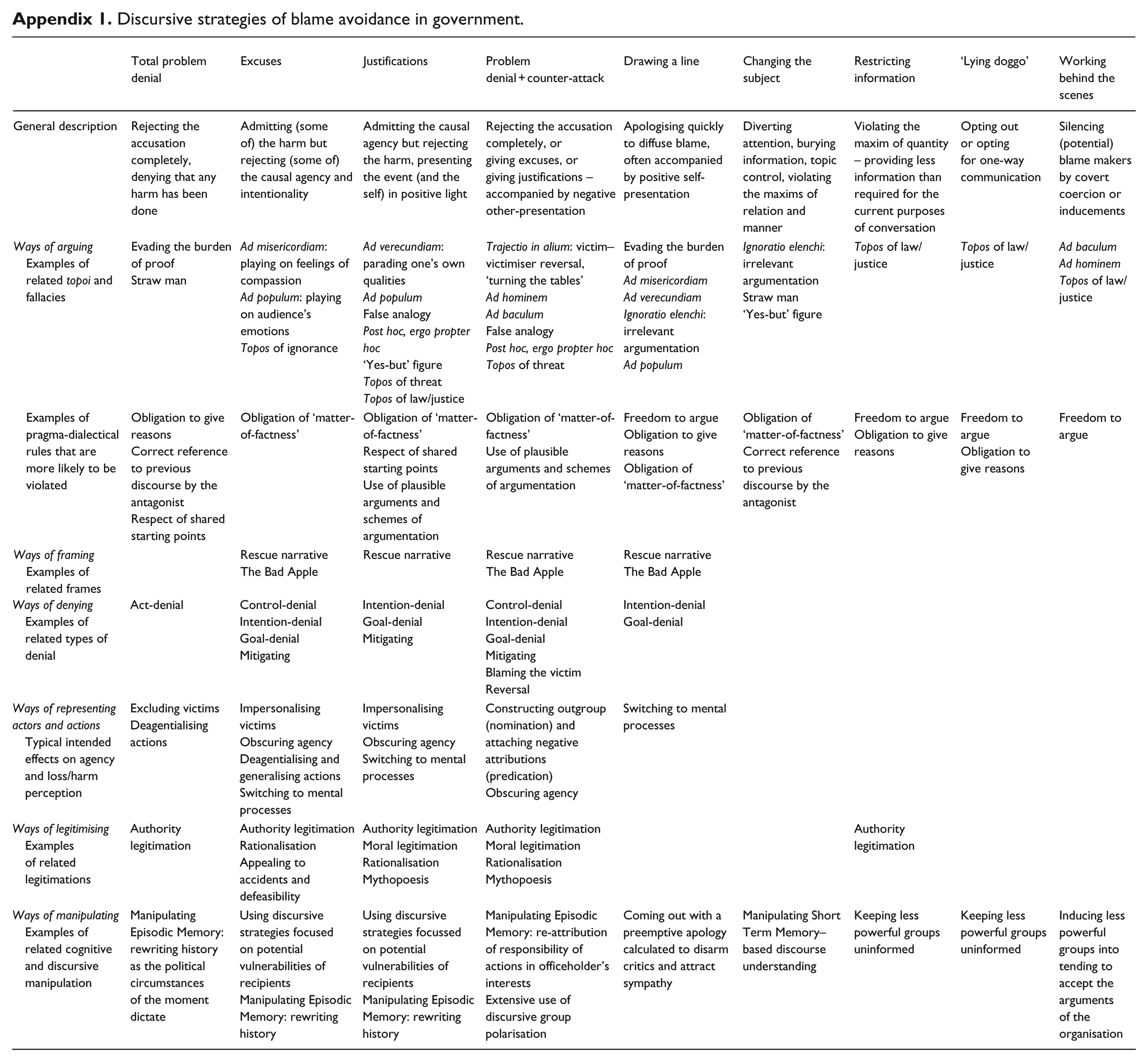
In what follows, I am working abductively towards bringing these two kinds of knowledge together into a single heuristic model: typical macro-level choices of administrative blame avoidance, on the one hand, and the corresponding argumentative moves (fallacies, topoi, violations of the pragma-dialectical rules), frames, types of denial, ways of representing actors and actions, typical legitimations and attempts of cognitive manipulation, on the other hand. I describe the linguistic characteristics of the general discursive choices of blame avoidance in turn together with concrete textual examples drawn mainly from my UK government communication data set. My overall heuristic model of interpreting discursive blame avoidance strategies in government is presented in the form of a matrix in Appendix 1.
Total problem denial is realised discursively as denying – ‘This has never happened’ or ‘We did not do it’ (act-denial). The possible blame taker may provide an inverted account of blame maker’s original accusation (e.g. ‘We helped X’ in response to ‘You failed to help X’). In addition, explanations may be given which involve distorting or disregarding opponents’ original claims (argumentative fallacy called ‘straw man’), giving an impression that there is nothing to discuss as everything is self-evident (evading the burden of proof), using unclear, ambiguous or unfamiliar language (fallacy of unclarity, fallacy of ambiguity) and attempts to rewrite history (manipulating Episodic Memory). Such a denial could be expected to exclude representations of victims and harmful acts and to use reference to the higher status of the blame taker as a guarantee of the truthfulness of the denial (authority legitimisation).
To illustrate how a relatively complex instance of total problem denial may be interpreted within my framework, I analyse an extract from the UK Cabinet Office’s (2012) news release in response to an investigative story on government overspending published in The Times on 9 January 2012. The story, entitled ‘Whitehall waste: the £31 billion cost of failure’, was significant because it constituted a well-grounded (based on the National Audit Office data) blame attack by a major newspaper on the government on an issue that was at the time at the core of its programme and thus also its collective identity. The story provoked the government to make an unusual move and issue a carefully crafted official response in the form of a Cabinet Office news release, entitled ‘Eradicating waste in Whitehall saves £3.75 billion’, on 11 January 2012. The news release contained a statement by Minister for the Cabinet Office Francis Maude. Here are the first three sentences from his statement: 1 When we arrived in government we pledged to be ruthless in hunting down and 2 eradicating waste in Whitehall and that is precisely what we have done. 3 Just in the first ten months to last March we saved £3.75 billion – equivalent to twice 4 the budget of the Foreign Office, or to funding 200,000 nurses. 5 This has not been easy; spending hours renegotiating contracts, tackling vested 6 interests and large suppliers and cutting back on spend on consultants and advertising 7 does not make for glamorous or headline grabbing work.
In lines 1–2, the Minister for the Cabinet Office uses the argumentative strategy of parading one’s own qualities (argumentum ad verecundiam) by claiming that the government has fulfilled its pledge. Importantly, this sentence also implies a total act-denial: the Minister states that the government has ‘eradicated waste’, that is, he and his colleagues have done the opposite of ‘wasting’. The Minister represents wasting not as an action carried out by his fellow officeholders but as a nominalised entity: ‘waste in Whitehall’. Moreover, he diffuses blame by portraying the government metaphorically as a ‘container’ (‘when we arrived in government …’) rather than a specific group of human actors who could be held responsible. He frames ‘waste’ as a Villain (or perhaps as some kind of a dangerous wild animal) and the government as a Hero (perhaps a gunman) who ‘hunts it down’ and ‘eradicates’ it.
In lines 3–4, the Minister backs up his claim by using a particular conclusion rule, topos of numbers, by suggesting that a given statistical figure (£3.75 billion allegedly saved in 10 months) serves as a proof that the government has not wasted money and should not be blamed. However, the Minister does not directly counter the central accusatory claim put forward by The Times that ‘more than £31 billion of taxpayers’ money has been wasted across government departments in the past two years’. Thus, he may be seen as committing a ‘straw man’ fallacy and violating a pragma-dialectical rule of reasonable discussion that requires the debater to use correct reference to previous discourse by the antagonist.
In lines 5–7, the Minister represents government’s activities at a high level of abstractness (‘renegotiating contracts’, ‘tackling vested interests’, ‘cutting back on spend’), thereby making it more difficult to understand the exact nature of the activities. This, in turn, may evoke a sense of mystery and awe among his audiences and therefore function as a kind of appeal to authority. In addition, he casts the government as a selfless Hero by claiming that the work of the government ‘has not been easy’ or ‘glamorous’.
Excuses involve admitting the harm or loss – at least partially – often accompanied by mitigation (‘We acknowledge that there seems to be a minor problem’) and giving possible reasons or explanations for the blameworthy situation. These explanations may play on the audience’s emotions, especially their feelings of compassion (argumentum ad populum, argumentum ad misericordiam), for instance, by claiming that ‘events were beyond our control’, or, that ‘these were unforeseeable circumstances’, or claiming ignorance and victim hood as someone suffering from an unfortunate lack of relevant information (‘no one told me …’), possibly evoking the Bad Apple frame.
While admitting that harm has been done, excuses may involve various types of denial: ‘It was an accident’ (control-denial), ‘You have misunderstood us’ (intention-denial), ‘We did not do that, in order to cause this …’ (goal-denial). Officeholders may attempt to obscure agency (‘It appears that some damage has been caused’) and impersonalise the victims (‘This country suffers from …’). Excuses do not involve explicit expressions of the acceptance of blame and are thus clearly distinct from apologies (for some characteristics of political apologies, see Harris et al., 2006).
To illustrate an analysis of an excuse, I use a short extract from a prominent newspaper article that came out at a time when the recent financial crisis in the United Kingdom became most acute. On 8 October 2008, the UK government announced a major package to support the banking sector, up to an aggregate total of £500 billion in loans and guarantees. Two days later, Prime Minister and Labour Party leader Gordon Brown published an article titled ‘We must lead the world to financial stability’ in The Times, where he justified the bank rescue plan of his government, but also argued that his government cannot take full responsibility for solving the crisis in the United Kingdom – and thus should not be blamed. Brown writes, 1 When I became Prime Minister I did not expect to make the decision, 2 along with Alistair Darling, 3 for the Government to offer to take stakes in our high street banks, 4 just as nobody could have anticipated the action taken in America.
Here, Brown’s argumentative shortcut to concluding that the UK government should not be blamed could be called topos of ignorance and explicated as follows: ‘If a threat is unforeseeable, then those who try to contain the threat with whatever means should not be held responsible’. Brown uses ad populum argumentation in line 4 by claiming that ‘nobody’ could have predicted the need to rescue high street banks in the United Kingdom and United States. He somewhat diffuses possible personal blame by mentioning one of the members of his Cabinet, Alistair Darling (line 2), who was responsible for economic and financial matters of his government, and referring to ‘America’ as another country where the government had supposedly taken similar actions. Brown thus realises his excuse mainly by representing the financial troubles in the United Kingdom as completely unforeseeable and beyond his complete control.
Justifications essentially involve positive self-presentation by trying to turn blame into credit: ‘What the media describes as a failure is actually a major victory’ or ‘We had to make some difficult decisions which will lead to gains in the future’. The related argumentation may be based on parading one’s own qualities (argumentum ad verecundiam), playing on the audience’s emotions (argumentum ad populum) and the use of inappropriate argumentation schemes or the incorrect application of argumentation schemes (e.g. false analogies; post hoc, ergo propter hoc fallacy). Moreover, possible blame takers may evoke a ‘Rescue narrative’ frame and cast themselves within that frame as Heroes or Helpers.
Justifications may include various types of denial, apparently with an exception of control-denial: the blame taker usually claims responsibility for the actions or events that are presented as positive. Still, the blame takers may attempt to obscure agency and to present the victims as winners (‘The economy cannot be fixed overnight but we will restore optimism and hope’). Justifications could also make use of the full range of legitimations, based on authority (‘We proceeded according to the law adopted by the Parliament’), moral evaluation (‘Our actions are based on Britain’s values’), rationalisation (‘This helps to get our economy back on its feet’) and mythopoesis (e.g. telling a cautionary story what could have happened if a particular decision had not been made).
To illustrate how justifications could be analysed within this blame avoidance framework, I use another extract from the same Prime Minister BGordon rown’s (2008) article (published in The Times on 10 October 2008) where he justified the bank rescue plan of his government. Here are the first three sentences from his article: 1 The banking system is fundamental to everything we do. 2 Every family and every business in Britain depends upon it. 3 That is why, when threatened by the global financial turmoil 4 that started in America and has now spread across the world, 5 we in Britain took action to secure our banks and financial system.
In terms of argumentation, Brown presents government’s decision to support banks as unquestionably necessary, using field-dependent warrants that are backed up by the presumedly common knowledge that ‘the banking system is fundamental to everything we do’ (line 1). I suggest that the specific warrants in use here may be called the topos of threat to the banks (‘if banks have problems, then it poses a threat to everybody and one should do something to secure the banks’) and the topos of global threat (‘if threats to everybody emerge, then the government should do something to protect the people against them’).
In terms of representation, Brown describes banks as influential agents that are central to and essentially ‘good’ for the society as a whole. He uses ‘banking’ as a general term; no distinction is made between banks acting within real economy (e.g. financial intermediation, insurance) and banks engaged in speculative/fictitious transactions. ‘Global financial turmoil’ is represented as an agent that threatens the United Kingdom (line 3). In terms of framing, such representation implies that the people and the banks in the United Kingdom should be seen as victims of that (abstract) turmoil. ‘America’ is referred to as the origin of the crisis, thus externalising the cause of the crisis (line 4). ‘Global’ and ‘spread across the world’ are used to suggest that the problems are universal and not specific to the United Kingdom. The use of ‘we in Britain’ (line 5) evokes a comparison or opposition between the United Kingdom and (supposedly) all the other countries in the world.
Thus, from the outset, Brown establishes a typical dramatic frame that implies that there is a Villain (global financial turmoil from America) who threatens the Victims (families, businesses, and banks in the United Kingdom) and a Hero (UK government) who takes action to defend the Victims. This frame (or dramatic plot) is clearly in service of the positive self-presentation of the government and used to mitigate possible blame for either causing or not sufficiently alleviating the financial crisis.
Problem denial + counter-attack may involve justifications or excuses (as described above) accompanied by negative other-presentation. The argumentation could be based on victim–victimiser reversal (trajectio in alium), discrediting the opponent (argumentum ad hominem), threatening the opponent (argumentum ad baculum) and symptomatic argumentation applied to shift blame (e.g. post hoc, ergo propter hoc fallacy). Blame takers could try to relativise and trivialise the problem through the use of (possibly fallacious) comparisons or equating strategies: ‘This is how all governments have dealt with the issue’ or ‘Yes, we made a mistake, but other institutions failed, too’. 6 Officeholders may try to cast themselves as Victims within a ‘Rescue narrative’ frame by claiming that their (possibly blameworthy) action serves the goal of self-defence and pointing a blaming finger at some outside actor as a Villain. Also, the Bad Apple frame may be evoked by referring to an alleged villain within the organisation.
All types of denial could be used, including the strongest forms: blaming the victim and victim–victimiser reversal. Nomination and predication are used strategically for constructing the blame makers as an outgroup and for attaching negative attributions to them (‘We are victims of the negatively biased media coverage’). Systematic re-attribution of responsibility of actions in officeholders’ interest can be interpreted as an attempt to manipulate an audience’s episodic memory.
To illustrate how to analyse instances where problem denial is put in action in conjunction with negative other-presentation, I examine another extract from the UK Cabinet Office’s news release in response to the article entitled ‘Whitehall waste: the £31 billion cost of failure’. In his statement, Minister for the Cabinet Office Francis Maude says, 1 And I am not alone in highlighting all the good work we have done so far; 2 the Public Accounts Committee recently recognised and welcomed 3 our transparent approach to savings. 4 Meanwhile other countries, especially in troubled Europe, 5 are now looking to us for how this is done.
In lines 1–3, the Minister uses ad populum argumentation and authority legitimation in service of positive self-presentation of the government. He supports the position that the government should be praised (or at least not blamed) for its financial conduct by claiming that a collective actor who apparently holds high status in society – a parliamentary committee – has given the government a positive evaluation. In terms of representation, Maude nominalises government’s action: ‘our transparent approach to savings’ (line 3). This nominalised construction is remarkable for its ambivalence. On the one hand, it presupposes that the government is acting transparently and is saving money – both of which are supposedly regarded as worthy of public praise rather than blame. On the other hand, it is sufficiently vague to permit an opposite interpretation: one could ‘have a transparent approach to savings’ but actually not save any money.
In lines 4–5, the Minister juxtaposes the actions of the UK government with those of the other countries, evoking an ‘Us versus Them’ opposition. The suggestion that other governments regard the United Kingdom as a positive example (or perhaps a mentor or a role model) is not supported by any data – it ultimately relies on a presumption that his audience is likely to agree with statements that reaffirm positive ingroup feelings. The perceived opposition is intensified by negative other-presentation: ‘troubled Europe’ (line 4) is a salient linguistic construction that is based upon a presumption that the audience regards ‘Europe’ as an outgroup (i.e. that the UK citizens do not belong to ‘Europe’) and also implies that the United Kingdom is not financially ‘troubled’ (problem denial). This kind of discursive triggering of group polarisation may be regarded as manipulative, if it is carried out systematically with the purpose of deflecting blame for possible financial misconduct of the government.
Drawing a line is realised as a quick acknowledgement of the problem (‘Mistakes have been made’) and a possibly preemptive apology, sometimes accompanied by more or less explicit positive self-presentation (‘Unlike many other leaders, I am willing to acknowledge my mistakes. I apologise’.).
By apologising quickly, the officeholder(s) may try to avoid further discussion, thus escaping the obligation to give reasons for their blameworthy action (the fallacy of evading the burden of proof). The arguments used in conjunction with the apology may be chosen to play on the audience’s emotions (argumentum ad populum) and contain claims which are irrelevant to the topic under discussion (ignoratio elenchi). This choice can be regarded as manipulative if it is calculated to give an appearance of moral superiority, honesty and sincerity, thus possibly disarming critics.
An attempt to draw a line may be illustrated by a recorded broadcast statement by Nick Clegg (2012), Deputy Prime Minister and Liberal Democrat Party leader, published on YouTube on 19 September 2012 and aired on television in the United Kingdom later that month. Clegg’s statement contained an apology for not keeping his party’s pre-2010 election promise to oppose increasing university tuition fees. This cannot be strictly regarded as apologising early or preemptively because the controversial decision to raise the maximum university tuition fees in England from £3375 to £9000 per year was backed by the members of the UK parliament (including Nick Clegg and 27 other Liberal Democrats) already in December 2010. However, the fees were actually increased from September 2012 and Clegg may have tried to use that occasion as an opportunity to symbolically ‘win back trust’ of some disappointed citizens by seemingly leaving his blameworthy deeds behind and moving on. Here is an extract from Clegg’s statement: 1 I shouldn’t have committed to a policy that was so expensive 2 when there was no money around. 3 Not least when the most likely way we’d end up in Government was in coalition 4 with Labour or the Conservatives, who were both committed to put fees up. 5 I know that we fought to get the best policy we could in those circumstances. 6 But I also realise that isn’t the point. There’s no easy way to say this: 7 we made a pledge, we didn’t stick to it – and for that I am sorry. 8 When you’ve made a mistake you should apologise. 9 But more importantly – most important of all – 10 you’ve got to learn from your mistakes. 11 And that’s what we will do. 12 I will never again make a pledge unless as a party we are absolutely clear 13 about how we can keep it.
In lines 1–4, Clegg first admits to a particular fault: he acknowledges that he should not have pledged to resist any raising of student tuition fees because (a) there was actually ‘no money around’ (line 2) to finance that policy, and (b) the possible coalition partners opposed that policy, so it was unlikely that the fees could be capped. This acknowledgement is ambivalent. On the one hand, it pertains to Clegg’s pre-election misjudgement, for which he actually gives no reasons – he merely says that he should have behaved otherwise. On the other hand, it can be also interpreted as an excuse for making his current policy choices in the government as he presents two reasons for raising the tuition fees. Second, Clegg frames himself as a Hero who ‘fought to get the best policy’ (line 5), thus in effect implying that the Conservatives, who resisted his policy in the coalition government, should be seen as Villains. Notably, however, Clegg does not refer to any Victims – for instance, the students who were forced to pay higher fees have been omitted from the statement. Hence an element that is often expected of a full apology – an expression of concern for all of those who suffered from the offence – is missing here.
In line 7, Clegg apologises by saying ‘I am sorry’. However, he limits his apology to a specific component of his offence: he apologises for not keeping a promise; he does not apologise for supporting the decision to raise tuition fees. He does not direct his apology to those people who may feel deterred from seeking higher education because going to a university has become much more costly. In terms of social actor representation, Clegg notably switches between using first person singular and plural pronouns ‘I’ and ‘we’, which seems to make blame less targeted as it is not really clear exactly to whom ‘we’ may refer.
In line 8, Clegg first recites an imperative (‘When you’ve made a mistake you should apologise’) that mainly seems to serve as an indication of his moral high ground. Second, he asserts that it is ‘most important of all’ to learn from one’s mistakes (lines 9–10) and then claims to perform this learning by promising to refrain from the particular kind of behaviour that he claims to regret – making pledges that cannot be easily kept – in the future. However, he does not offer any compensation for the possible harm that his wrongdoing may have caused to particular people. By emphasising the importance of ‘learning’ (that is relatively easy to do), he backgrounds the importance of compensation (which may be difficult and costly to provide). By focusing his talk on his future actions (using the future tense as in ‘that’s what we will do’ in line 11), he backgrounds his past wrongdoing. By seemingly claiming to have learned a lesson, he is appealing to his audience’s emotions and tries to give an appearance of a person with a good character and high moral standards – which ultimately is an act of positive self-presentation. Thus, this statement cannot be seen as a full apology, but merely an attempt to defuse some blame and attract sympathy.
Changing the subject is realised mainly in two ways: via topic control, which may involve violations of the maxim of relation, for instance, providing distracting information which is irrelevant to the accusations, or by a manipulative strategy of making use of recipients’ vulnerabilities – choosing such a time for communicating when the potential critics are most likely distracted by other actions, thus ‘burying’ information.
The fallacies may include provision of irrelevant arguments (ignoratio elenchi) and talking about unrelated problems raised by (possibly imaginary) opponents (straw man). From a cognitive point of view, changing the subject is based on manipulating Short Term Memory-based discourse understanding: the blame taker uses text and talk and imagery to draw the recipient’s attention to information X rather than possibly blameworthy information Y.
To illustrate the use of this blame avoidance strategy, I analyse an excerpt from a transcript of a press conference given by UK Prime Minister David Cameron and Deputy Prime Minister Nick Clegg on 7 January 2013 (UK Cabinet Office, 2013). This widely covered press conference was designed and performed by the government as part of launching its ‘mid-term review’ – an important self-assessment document comparing the commitments made in its programme 2.5 years earlier to the policies it had actually carried out to date. The press conference was a major proactive attempt at positive self-presentation of the Conservative–Liberal Democrat coalition. However, the format of a press conference provides the participating journalists with an opportunity to directly confront the Ministers with questions that draw attention to negative and possibly blameworthy phenomena instead. Here, I focus on three conversational turns that took place after both David Cameron and Nick Clegg had finished their short speeches: a journalist asks an inquisitorial question, the Deputy Prime Minister Nick Clegg replies and at some point the journalist interrupts to repeat his question. 1 ##Question 2 This is a very nice document. Thank you for giving it to us, but I think a lot of 3 people are going to wonder what the point of it is tonight. I can tell you the one 4 thing they do want to know, which is what’s going to happen to the economy this 5 year. Can you both give us a picture of where you think we are? Is a triple-dip 6 recession possible? Likely? Are you really both confident that the economy is going 7 to grow this year? If not, why not? Are you contemplating other measures if it 8 doesn’t come out the way you want? 9 10 ##Deputy Prime Minister 11 The first thing I’d say is that we’ve been very open with the British people about 12 the fact that the time needed to get the job done, that the time needed for the 13 economy to heal fully, is taking longer than frankly anyone expected. 14 We’ve been very open about that. 15 We’ve actually said that dealing with the structural deficit, balancing the books, is 16 going to take longer. 17 We couldn’t have been more open that it is going to take longer and it does mean that 18 the next parliament, the next government, will need to complete 19 the job that we have initiated, but we’ve made huge strides. The deficit is 25% lower. 20 Now, hang on; it’s important. 21 22 ##Question 23 My question was about are you confident, both of you, that we are on the track to 24 growth.
In his first turn (lines 2–8), the journalist uses mock politeness by delivering an obviously insincere compliment and an expression of gratitude: ‘This is a very nice document. Thank you for giving it to us’. He follows it up with a string of questions about the economic forecast for the country – an issue that, as he implies, the ministers had chosen to neglect in their presentation.
In response, Deputy Prime Minister Clegg starts to talk at length about how ‘open’ the government has been, instead of addressing the questions actually raised by the journalist. Clegg thus instantly tries to avoid blame in this conversational situation by committing an argumentative ‘straw man’ fallacy. It may be argued that the choice of this particular manoeuvre was encouraged by the fact that the journalist asked multiple questions at one go – the less focused is the question, the more space there seems to be for sidestepping a straightforward reply. The repeated (in lines 11, 14 and 17) use of the word ‘open’ (which tends to have a generally positive connotation in discourses about government) seems to indicate that the speaker is anxious to persuade the audience that he is talking honestly. Moreover, he attempts to shift at least some of the responsibility for the economic situation in the country away from the current government by stating that ‘the next parliament, the next government, will need to complete the job that we have initiated’ (lines 18–19), disregarding that the questions asked were about the current year.
Restricting information can be described pragmatically as a violation of the maxim of quantity: the officeholders choose not to provide certain information about issues which may attract blame (e.g. misuse of the public funds or misconduct of public service providers), and therefore, their contribution to public discussion may be seen as not as informative as required. When justifying these restrictions, officials often make use of the topos of law (for instance, ‘This information is classified under the Atomic Energy Act of 1954’), and the legitimations are mainly based on authority.
As an illustration of analysis, I use another excerpt from the transcript of the press conference by David Cameron and Nick Clegg on 7 January 2013. Here, a journalist has asked them whether they are both confident that the UK economy is ‘on the track to growth’. First, the Deputy Prime Minister Nick Clegg gives his answer and then the Prime Minister David Cameron has a turn: 1 ## Deputy Prime Minister 2 I don’t think anyone should start making foolish statistical predictions about 3 what’s going to happen to something as unpredictable as the global economy, 4 but we’re doing the right reforms and implementing the right changes 5 to ensure that healing process continues. 6 7 ## Prime Minister 8 I’ll just add – and I agree with every word of that – but I’ll just add to that point that 9 we don’t now make our own forecasts. 10 We’ve given that to the Office for Budget Responsibility. 11 They are forecasting growth this year, as are almost every other economic forecaster. 12 That’s what the forecasters say.
Here, Clegg first implies that economic forecasts should not be talked about by labelling anyone who would do this ‘foolish’ (line 2). He not only avoids giving a substantial reply to the journalist’s question but also, by implication of suggesting that answering the particular question would be ‘foolish’, could be seen as ridiculing both the question and the one who asked it. Clegg follows this up with some straightforward positive self-presentation in line 4 (‘we’re doing the right reforms’) that is not supported by any data.
Cameron then indicates that he and Clegg should not be expected to talk about the economic outlook for the United Kingdom, because the responsibility to make economic forecasts has been given by the government to a specific agency: the Office for Budget Responsibility (line 10). Both ministers apparently regard talking about economic forecasts as something that may attract blame – especially if their predictions later turn out to be wrong. Therefore, they have preemptively established a separate unit that they can conveniently use as a blame ‘lightning rod’: the ministers can choose not to provide possibly ‘inconvenient’ information themselves by claiming that officially this is a task for someone else (topos of law). Notably, Cameron represents the Office for Budget Responsibility as an ‘outgroup’ by using third person plural pronoun ‘they’ (‘they are forecasting growth’), thus further distancing himself from the forecast. Moreover, the name of the unit – Office for Budget Responsibility – is salient, because it implies that the unit takes responsibility for the budget, thereby seemingly removing (at least some of) the responsibility for financial outcomes from the rest of the government.
Admittedly, silence can be a difficult phenomenon to study and exemplify in linguistic terms as it seems to involve no text or talk. However, the strategic uses of silence in political communication can be sometimes interpreted by analysing metadiscourses about these silences, that is, what others say that they see as being absent from someone’s discourse (Schröter, 2013). Here is an example of such metadiscourse. On 21 June 2012, the BBC ran a story titled ‘Cameron ducks Gary Barlow tax avoidance question’ (BBC News, 2012). The article points out that when comedian Jimmy Carr and (Conservative Party supporting) musician Gary Barlow were both accused of using tax avoidance schemes, then Prime Minister David Cameron publicly criticised Carr but did not say anything about Barlow. Cameron opted out of discussing this topic simply by saying that he was not going to give a ‘running commentary’ on people’s tax affairs.
Working behind the scenes is most directly related to linguistic and non-linguistic forms of coercion and bribery and is often aimed at silencing the opponents. It may involve administering systematic personal attacks on potential blame makers (argumentum ad baculum, argumentum ad hominem), sometimes threatening them with legal sanctions (topos of law/justice) or with humiliation, that is, offending their positive face. This strategy is manipulative as its goal is to induce less powerful groups into tending to accept the arguments of a more powerful organisation.
It is very difficult to obtain concrete textual examples of such covert interactions. 7 However, compelling evidence of behind-the-scenes relationships between government officeholders and the press has emerged, for example, from a 2012 independent inquiry in the United Kingdom, commonly known as the Leveson Report. The report was commissioned by the UK Government to cover the culture, practices and ethics of the press in its relations with the public, the police and politicians. In the executive summary of the report, Lord Justice Leveson, who led the inquiry, concludes that over several decades the political parties and the government ‘have had or developed too close a relationship with the press in a way which has not been in the public interest’ and adds that ‘in part, it has been a matter of going too far in trying to control the supply of news and information to the public in return for the hope of favourable treatment by sections of the press’ (The Leveson Inquiry, 2012: 26). Therefore, an analyst of discursive strategies of blame avoidance in government should give due consideration to a possibility that some important moves in the blame game at hand may be unobservable and extra-linguistic.
Concluding remarks
In this article, I have sketched a new way of dissecting and interpreting communicative aspects of blame-avoiding behaviour in government in terms of specific discursive strategies. I have also demonstrated its usefulness by analysing concrete examples of text and talk by top government officeholders. At times, officeholders use intricate and creative ways of shifting blame, backgrounding blameworthy phenomena in their text and talk or making blame seem less targeted. My framework helps discourse analysts see certain linguistic features in government communication not only as constitutive elements of discursive strategies (ways of arguing, attributing, mitigating, etc.) but possibly also as elements of particular broader socio-political macro-strategies – ways of avoiding blame. I have laid the foundation for more systematic and rigorous discourse-analytic exploration of these macro-strategies.
Admittedly, my framework has at least two limitations. First, it is tentative and not necessarily comprehensive. Further empirical studies of text and talk patterns of executive government institutions or particular officeholders who try to avoid accusations of wrongdoing could point to specific discursive choices which may not fit under any of the proposed categories. Also, as my example analyses have proven, in real-life situations we should expect to observe simultaneous or mixed use (blending) of several discursive strategies of avoiding blame risk. Furthermore, some of the discursive strategies may be applied only together with non-discursive practices of blame avoidance (e.g. establishing the Office for Budget Responsibility and then using it as a ‘lightning rod’ for blame in public text and talk).
The second caveat or challenge is that the heuristic can only be effectively used in conjunction with additional systematic analysis of a concrete topic at hand and the particular context wherein the strategies are enacted. The topic of a blame game includes the subject matter of a blame event or a blame risk: the actors, the magnitude of harm caused or the seriousness of a violation and so forth. The context of a blame game may be operationalised by breaking it down into several layers of analysis (following Wodak, 2011). The context entails intertextual and interdiscursive relationships, for instance, capturing the dynamics of interaction and taking into consideration the many genres in which the described strategies may occur. It might be possible to reveal any typical sequences of discursive moves by different participants of the blame game in particular genres of executive governance, like face-to-face interactions, policy documents, official news releases, personal emails, speeches, blog posts, interviews and so on. 8 The context entails extra-linguistic institutional and situational variables, such as the preferred ways of sustaining domination within the blame taking institution, the formality/informality of the situation and – probably most saliently – whether the text and talk about blame are publicly mediated or remain solely in the backstage. It is also evident that some blame avoidance strategies are more overt and can be more easily detected by analysing micro-processes of discourse, while others are more hidden (e.g. behind-the-scenes work). Hence, additional attention should be given to coercion as a central strategic function of exercising administrative power. 9 The context of a blame game also entails its broader historical and socio-political backdrop, for instance, the financial crisis and austerity politics in the United Kingdom in my example analysis.
Despite these caveats, I hope to have demonstrated a plausible way of operationalising blame avoidance in discourse-analytic terms. Understanding blame avoidance as a leitmotif of government communication could lead to the application of new useful analytic tools within discourse studies and thus open new avenues of critical research into language use in politics and bureaucratic organisations.
Footnotes
Appendix
Discursive strategies of blame avoidance in government.
| Total problem denial | Excuses | Justifications | Problem denial + counter-attack | Drawing a line | Changing the subject | Restricting information | ‘Lying doggo’ | Working behind the scenes | |
|---|---|---|---|---|---|---|---|---|---|
| General description | Rejecting the accusation completely, denying that any harm has been done | Admitting (some of) the harm but rejecting (some of) the causal agency and intentionality | Admitting the causal agency but rejecting the harm, presenting the event (and the self) in positive light | Rejecting the accusation completely, or giving excuses, or giving justifications – accompanied by negative other-presentation | Apologising quickly to diffuse blame, often accompanied by positive self-presentation | Diverting attention, burying information, topic control, violating the maxims of relation and manner | Violating the maxim of quantity – providing less information than required for the current purposes of conversation | Opting out or opting for one-way communication | Silencing (potential) blame makers by covert coercion or inducements |
| Ways of arguing
Examples of related topoi and fallacies |
Evading the burden of proof Straw man |
Ad misericordiam: playing on feelings of compassion Ad populum: playing on audience’s emotions Topos of ignorance |
Ad verecundiam: parading one’s own qualities Ad populum False analogy Post hoc, ergo propter hoc ‘Yes-but’ figure Topos of threat Topos of law/justice |
Trajectio in alium: victim–victimiser reversal, ‘turning the tables’ Ad hominem Ad baculum False analogy Post hoc, ergo propter hoc Topos of threat |
Evading the burden of proof Ad misericordiam Ad verecundiam Ignoratio elenchi: irrelevant argumentation Ad populum |
Ignoratio elenchi: irrelevant argumentation Straw man ‘Yes-but’ figure |
Topos of law/justice | Topos of law/justice | Ad baculum
Ad hominem Topos of law/justice |
| Examples of pragma-dialectical rules that are more likely to be violated | Obligation to give reasons Correct reference to previous discourse by the antagonist Respect of shared starting points |
Obligation of ‘matter-of-factness’ | Obligation of ‘matter-of-factness’ Respect of shared starting points Use of plausible arguments and schemes of argumentation |
Obligation of ‘matter-of-factness’ Use of plausible arguments and schemes of argumentation |
Freedom to argue Obligation to give reasons Obligation of ‘matter-of-factness’ |
Obligation of ‘matter-of-factness’ Correct reference to previous discourse by the antagonist |
Freedom to argue Obligation to give reasons |
Freedom to argue Obligation to give reasons |
Freedom to argue |
| Ways of framing
Examples of related frames |
Rescue narrative |
Rescue narrative | Rescue narrative |
Rescue narrative |
|||||
| Ways of denying
|
Act-denial | Control-denial |
Intention-denial |
Control-denial |
Intention-denial |
||||
| Ways of representing actors and actions
|
Excluding victims |
Impersonalising victims |
Impersonalising victims |
Constructing outgroup (nomination) and attaching negative attributions (predication) |
Switching to mental processes | ||||
| Ways of legitimising
|
Authority legitimation | Authority legitimation |
Authority legitimation |
Authority legitimation |
Authority legitimation | ||||
| Ways of manipulating
|
Manipulating Episodic Memory: rewriting history as the political circumstances of the moment dictate | Using discursive strategies focused on potential vulnerabilities of recipients |
Using discursive strategies focussed on potential vulnerabilities of recipients |
Manipulating Episodic Memory: re-attribution of responsibility of actions in officeholder’s interests |
Coming out with a preemptive apology calculated to disarm critics and attract sympathy | Manipulating Short Term Memory–based discourse understanding | Keeping less powerful groups uninformed | Keeping less powerful groups uninformed | Inducing less powerful groups into tending to accept the arguments of the organisation |
Acknowledgements
I am grateful to Ruth Wodak for her helpful comments on earlier drafts, and I thank Theo van Leeuwen, Jonathan Culpeper and Greg Myers for useful suggestions.
Funding
This research received no specific grant from any funding agency in the public, commercial or not-for-profit sectors.