



Abstract
This article examines stories of personal experience of World War II in guided tours at a Japanese American museum and analyzes the positioning practices deployed in constructing identity within the story world and storytelling. In particular, it shows how older Japanese American docents tell we-focused stories in positioning themselves as part of a group of Japanese Americans and family who were relocated and incarcerated during the war, and I-focused stories in positioning themselves as individuals who acted in response to unexpected events linked to relationships and institutions. The analysis points out ways docents display stances toward past events and ways visitors participate in the telling such as by posing questions. It suggests that stories of personal experience are a vehicle for constructing identities that draw upon historical events, autobiographies, story structure, and interactional contingencies. The findings are related to stories as a tool of teaching and engaging museum visitors.
Keywords
Introduction
Stories of personal experience are a fundamental mode of interaction in various settings and thus have received a great deal of attention (e.g. Bamberg et al., 2007; Norrick, 2000; Ochs and Capps, 2001). In particular, studies have investigated how stories (narratives) are a vehicle for constructing social identity. For instance, in applying the notion of ‘positioning’ (Davies and Harré, 1990) to narrative analysis, Bamberg (1997) argues that identity is produced on both the story level (i.e. ways characters are designed and relate to others in the story) and the interactional level (i.e. ways tellers interact with their audience, and vice versa). He also posits a third level that is concerned with how tellers ‘position themselves to themselves’ (Bamberg, 1997: 337), which refers to the ‘more general and more enduring, “portable” aspects of self and identity, which transcend the ephemeral, local interactional moment and its action-related contingencies’ (Deppermann, 2013: 6). In line with post-modern views of identity across various fields (e.g. Antaki and Widdicombe, 1998; Bucholtz and Hall, 2005), recent research on storytelling considers identity not simply as given (biological) characteristics of individuals, but as social categories produced in situated interaction (e.g. Deppermann, 2013). In this respect, it proposes that persons have multiple identities, or a ‘repertoire of identity’ (Kroskrity, 1993), which are overlapping and shaped by self and others using language as a central resource. As Bucholtz and Hall (2005: 585) argue, ‘identities may be linguistically indexed through labels, implicatures, stances, styles, or linguistic structures and systems’ in both direct and indirect ways, by using identity category terms (or ‘membership categorization devices’, Sacks, 1992; see also Day and Kjaerbeck, 2013) (e.g. ‘Japanese American’, ‘prisoner’, ‘us/them’) or by employing speech styles that evoke particular settings, stances, relationships, and group membership (e.g. Wortham, 2000). As much of the literature focuses on ordinary conversation (i.e. between acquaintances and family members), what is less well understood is how stories are integral to identity construction in institutional settings (e.g. Fasulo and Zucchermaglio, 2008; Holmes, 2005). Although institutional interaction shares many features with ordinary interaction, it differs in a number of ways, such as vocabulary choice, turn shape, turn-taking rights, and the kinds of social actions associated with particular roles (e.g. interviewers ask questions) (Heritage, 2004). Also, as Heritage (2004) points out, institutional interaction ‘involves the participants in specific goal orientations that are tied to their institution-relevant identities’ (p. 106). Moreover, according to Haviland (2008), ‘[i]nstitutional settings filter narrative interpretations’ (p. 449) and thus influence the ways stories are interpreted and responded to by recipients. For these reasons, among others, more empirical studies are needed on ‘how storytelling practices are used in institutional settings’ (Mandelbaum, 2013: 507).
This study examines Japanese American stories of personal experience of World War II in guided tours at a museum and analyzes the kinds of positioning practices used in constructing identity in the story world and storytelling. In societies across the globe, museums are a key institution of education, leisure, and preservation (e.g. Bedford, 2001; Roberts, 1997). Bedford (2001) proposes that the ‘real work’ of museums is storytelling, or the ‘heart and soul’ of what museums do. It is believed that stories promote visitor engagement by encouraging visitors to take another perspective and supply their own interpretations and feelings (Roberts, 1997). While stories are told in various ways – such as with audio guides and written documents that may promote self-guided tours – human guided tours are a central activity of storytelling in some museums and encourage interaction and sense making with others (e.g. Burdelski et al., 2014). Recent studies have examined guided tours in an array of settings, such as museums and gardens (e.g. Mondada, 2012). This research views guided tours as a situated activity in which participants use talk, their bodies, and touch in a variety of ways. By focusing on stories of personal experience in guided tours, this study seeks to contribute to this growing body of literature and to offer an alternative perspective on Japanese American experiences of World War II as conveyed in institutional discourse.
Storytelling as social interaction
Prior research examines storytelling primarily in one of two ways: as a structured entity or as social interaction. The first approach, pioneered by Labov (e.g. Labov and Waletzky, 1967, in their analysis of sociolinguistic interviews), considers stories in relation to ‘what was said (and the way it was said) and works towards why it was said’ (Bamberg, 1997: 335). It views stories as having an internal structure, including identifiable properties (e.g. sequence of actions, point-of-view) and elements (i.e. abstract, orientation, complicating action, resolution, evaluation, and coda). The second approach, embraced by researchers in conversational analysis (e.g. Deppermann, 2013; Jefferson, 1978; Schegloff, 1997), narrative analysis (e.g. Bamberg et al., 2007; De Fina and Georgakopoulou, 2008), and linguistic anthropology (e.g. Bauman, 1986; Ochs and Capps, 2001), with variations in specific foci among them, views stories as a form of talk-in-interaction and places the analytical lens on the telling, including ‘how it [the story] was performed’ (Bamberg, 1997: 335). From a linguistic anthropological perspective, storytelling is viewed as shaping context and also shaped by context (cf. Goodwin and Duranti, 1992). For instance, in summarizing Bauman’s (1992) study of storytelling among the kraftaskáld (literally, ‘power poet’) of Iceland, Goodwin and Duranti (1992) state, ‘[t]alk within the story (the prose frame) creates context for other talk (the verse), while yet other speech creates an appropriate context for the story itself’ (p. 3). As a compatible perspective, conversation analysis is concerned with how stories are used to accomplish social actions, such as blaming, telling a joke, instructing, or providing an account (Mandelbaum, 2013; Schegloff, 1997). To varying degrees, all of these fields have regarded stories as a vehicle of identity construction. As in any social interaction, in storytelling tellers and recipients display various forms of ‘participation’ or ‘actions demonstrating forms of involvement performed by parties within evolving structures of talk’ (Goodwin and Goodwin, 2004: 222). Participation is a central means for enacting culturally meaningful realities, such as social identity and stance in storytelling.
Ochs (1993) considers social identity as the ‘social statuses, roles, positions, relationships, and institutional and other relevant community identities one may attempt to claim or assign in the course of social life’ (p. 288). In relation to stance, tellers relate settings and events and display their thoughts and attitudes toward happenings in the story world in doing relational work with recipients. Dubois (2007) defines stance as ‘a public act by a social actor achieved dialogically through overt communicative means, of simultaneously evaluating objects, positioning subjects (self and others), and aligning with other subjects, with respect to any salient dimension of the sociocultural field’. Ochs (1992b) categorizes two types of stance: ‘epistemic stance’ (i.e. ‘knowledge or belief vis-à-vis some focus of concern, including degrees of certainty of knowledge, degrees of commitment to truth of propositions, and sources of knowledge’ (p. 410)) and ‘affective stance’ (i.e. ‘mood, attitude, feeling, and disposition, as well as degrees of emotional intensity vis-à-vis some focus of concern’ (p. 410)). As also suggested by Bucholtz and Hall (2005) earlier, such stance are a resource for producing identity in interaction (Ochs, 1992a). While research on storytelling has examined both types of stance, affective stance has received a bit more treatment. For instance, Stivers (2008) observes that tellers often express their ‘affective treatment of the events’ (p. 37) they are recounting. Such stance is enacted using both verbal and non-verbal resources. For example, Selting (2010) shows how tellers produce facial expressions when evaluating happenings in the story world. Such displays of stance invite recipients to produce particular kinds of responses in the telling (e.g. laughter invites laughter; Jefferson, 1979).
Recipients of a telling also present their stance and in the process reveal their understanding of the story (e.g. Mandelbaum, 1989, 2013). Mandelbaum (1989) categorizes recipients on a continuum from ‘passive’ to ‘active’, which refers to the degree of constraining or shaping what the teller does next. For instance, more passive recipients provide minimal responses such as continuers (e.g. ‘Mm-hm’) that encourage the teller to proceed with the telling, whereas more active recipients pose questions that shape the telling by requiring tellers to respond with elaboration. Similarly, Stivers (2008) distinguishes between stances of ‘alignment’ and ‘affiliation’. Alignment refers to recipient actions that facilitate and support the telling in progress, and affiliation indicates that the ‘hearer displays support of or endorses the teller’s conveyed stance’ (Stivers, 2008: 35). Hence, stance is a dialogic achievement (in Dubois’ sense) between tellers and recipients, and contributes to the production of identity in the story world and the storytelling, which is the view taken up in this study.
Setting, participants, and methods
The setting of the study is a Japanese American museum located in a large US city. The main exhibit presents an overview of 130 years of Japanese American history (mid-1800s–1989) using objects, documents, photographs, media, and the like. In these data, many of these artifacts spark memories for docents and visitors alike, especially those who came of age during World War II. The exhibit is arranged chronologically and divided into three parts: (1) early immigration to pre-World War II (mid-1800s–1942), (2) World War II and the internment of Japanese Americans (1942–1945), and (3) post-World War II (1945–1989).
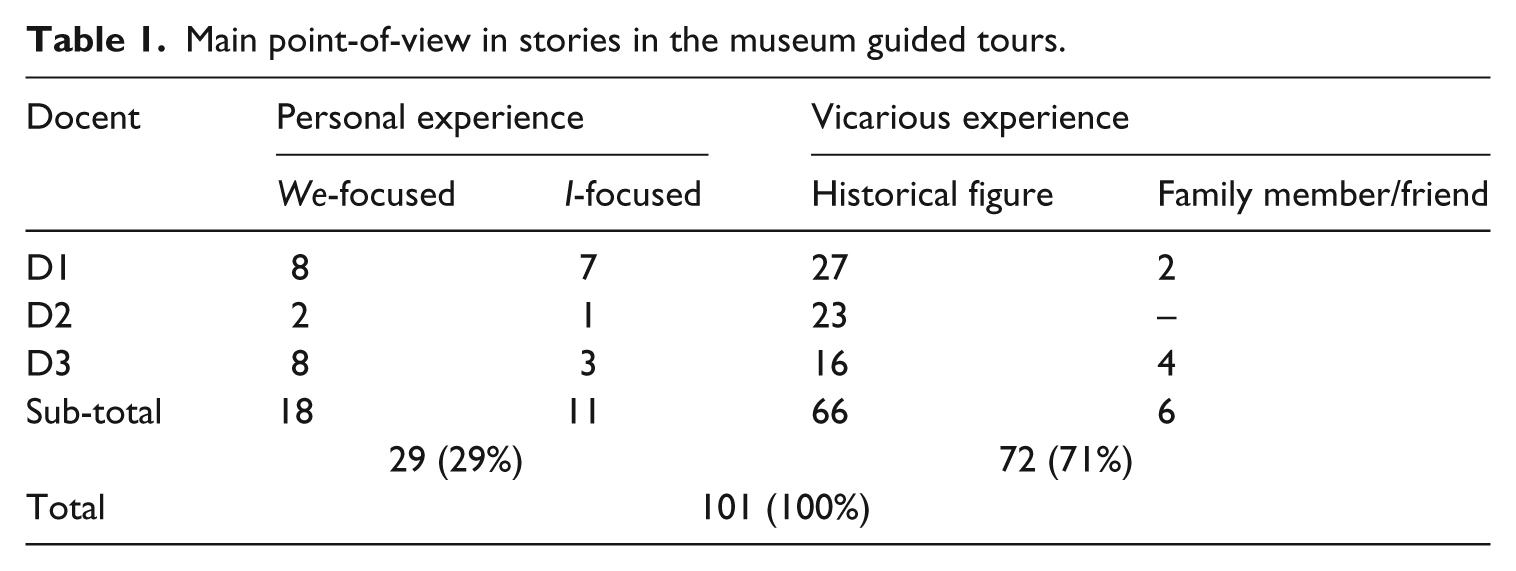
The analysis is based on seven hours of audiovisual recordings of English-speaking guided tours over three days. 1 These data are part of a larger project in museums and cultural centers investigating how people of Japanese heritage living in North America talk about (their) ethnic history. 2 The analysis draws upon tours from three older male Japanese Americans (Docent one (D1) and Docent 2 (D2), both 85 years of age; Docent 3 (D3), 75 years of age). These men were all born and raised in the United States and were either young adults (D1 and D2) or children (D3) during the war and spent from one (D1 and D2) to three years (D3) in the internment camps. 3 The analysis of specific interactions is taken from tours led by D1 and D3, who produced a good deal more stories of personal experience than D2 (Table 1). The visitors we recorded were either students, including college students (D2’s tour: around 20 years of age) and older students (D3’s tour: in their 30s to 40s), or adults not connected to a school group (D1’s tour: in their 40s to 60s). We received permission from the museum to conduct this research and recruited visitors for the study on each day of recording and obtained their written consent.
Main point-of-view in stories in the museum guided tours.
We-focused and I-focused stories of personal experience
In guiding visitors on the tours, docents organize much of their talk as stories situated in the distant past (19th and mid-20th centuries). As summarized in Table 1, there are a total of 101 stories. Among them, 72 stories (71%) are told from a third-person point-of-view (of a historical figure or family member), and 29 stories (29%) are told from a first-person point-of-view. That is, stories of vicarious experience are about three times as frequent as those of personal experience. The analysis targets stories of personal experience. Of these, 18 are we-focused stories, related to being part of a community, social group, or family, and 11 are I-focused stories, related to being an individual who is also part of a wider community. That is, when telling stories of personal experience, these docents slightly prefer telling we-focused stories more than I-focused stories. The boundaries between these types of stories, however, are in some cases blurred. For instance, I-focused stories may shift to a we-perspective, and vice versa. In this way, these categories can be considered a heuristic for analyzing stories in the guided stories, particularly in relation to positioning and identity construction.
We-focused stories: Japanese Americans, internment, and powerlessness
As in other studies of storytelling (e.g. De Fina, 2003; Dyer and Keller-Cohen, 2000), pronouns are an essential resource in constructing identity in the guided tours. In stories of personal experience, docents often use the subject pronoun we (or object pronoun us and possessive pronoun our) as a ‘collective self-reference term’ or device to refer to ‘collectives of which the speaker is a member’ (Lerner and Kitzinger, 2007: 526). Lerner and Kitzinger (2007) observe (based on Sacks, 1992; cf. Enfield, 2007) that pronouns are ‘intimately tied to the speaker’s situated identity because these terms reveal on whose behalf (or authority), or in what capacity, a participant speaks and thus what stance they are taking up towards the action implemented through their talk’ (p. 527). Docents often use the pronoun we to position themselves within a group of Japanese Americans (and other persons of Japanese ancestry) who were incarcerated during World War II and relatively powerless but largely endured their circumstances. In excerpt 1, D3 and a group of six visitors have entered the section of the exhibit on the internment of Japanese Americans. As he gestures toward a photograph of a desert landscape (within a collection of photos), D3 launches a we-focused story in relation to it. (Transcription conventions appear in Appendix 1.)
Excerpt 1 ‘We were surrounded by soldiers’ 01 D3: [((points at photo of a desert, makes circle with finger at photo)) 02 [Now here’s a picture (0.3.) .tch (1.3) that (.) [I can relate to 03 [((turns to visitors)) 04 because (0.4) when we were being 05 camps to the 06 ((gestures at photo)) .tch We didn’t know where we were 07 (0.3) ah::: but out in the 08 tch because there’s a long 09 three four days on the 10 ah:: (.) out there in the 11 they would 12 (0.3) kay? ((looks and points towards photo)) (0.9) 13 ((gazes towards visitors)) But when we got out of the 14 we were [sur 15 [ ((circular gesture five times)) ] 16 We were rea:l (0.4) ((empathic gesture)) y’know 17 and they were 18 (2.0) u::::m I remember that dis
In relating the setting of the story, D3 uses the pronoun we (and us) together with the passive voice (lines 04 and 14) and a let-causative (line 11). Across these data, the passive voice is a common syntactic structure in we-focused stories for locating the self as part of a group that was under the control of others (e.g. the US government). According to Bamberg (1997), tellers may position characters in the story world as ‘helplessly at the mercy of outside (quasi “natural”) forces’ (p. 337). Here, in using the passive voice, D3 portrays the group as being closely guarded by the US soldiers. In concert with this theme, D3 relates an ‘unexpected event’ or a ‘key event that disrupts the equilibrium of ordinary, expected circumstances’ (Ochs, 1997: 197; similar to a ‘complicating action’, Labov and Waletzky, 1967), which portrays a vivid picture of how the group was controlled (line 14: ‘we were sur
This excerpt also reveals ways in which docents perform, or position themselves in, the role of teller. In framing this we-focused story, D3 uses the first-person pronoun I with the verbs ‘relate to’ in launching the story, and ‘remember’ in bringing it to completion. The mental verb ‘remember’ has been described as a marker of ‘narrative authenticity’ (Ochs and Capps, 1997) or a resource that conveys the story is true and accurate. Here, in using this verb, D3 presents himself as a credible teller of events that occurred about 65 years in the past, when he was a school-aged child. As follows, in telling we-focused stories, docents construct an institutional identity both by providing a window into their private lives as Japanese Americans who were incarcerated during the war and by taking up attitudes toward the recounted happenings and characters in the story world. In many cases, these positioning practices implicitly invite recipients to respond. Here, the visitors are primarily attentive throughout the story, and thereby align with the story structure and content, and perform their roles as recipients. One visitor poses a question to D3 upon the completion of the story (see excerpt 2).
We-focused stories, family circumstances, and contrast
In addition to identifying as Japanese Americans who grew up during World War II and were incarcerated solely due to their ethnic heritage, these docents use we-focused stories to locate the self within relationships of family and friends. In particular, we-focused stories about family may be used to contrast one’s family circumstances with those of other Japanese families who were also forced to reside in internment camps during the war (following the attack by the Japanese on Pearl Harbor). In this regard, differentiating between self and others (even within the same ethnic group), or identifying sameness and difference, is a practice for positioning the self in storytelling (Bamberg, 2010). In excerpt 2 (a continuation of excerpt 1), D3’s we-focused story is produced in responding to a visitor’s question about a photograph in the exhibit of a man of Japanese heritage who appears to be closing down a store (line 20): Excerpt 2 ‘Now we were lucky’ (continuation of excerpt [1]) 19 D3: ((begins to walk towards another display of photographs 2.0)) 20 V7: What [happened to like all the (0.2) 21 D3: [((turns towards V7)) [You] 22 LOST it. (.) You 23 There’s a lotta things that you 24 you had no [place to 25 V7: [ ((nodding head)) ] 26 D3: >Now 27 was a citizen so we had our own [ 28 V7: [((nods head up to line 34)) 29 D3: we were able to 30 ah it was three ((holds up three fingers)) 31 we had a friend a Caucasian friend (0.6) ah::: (0.4) ah: rent it ou::t 32 an:: an we told’m (0.3) “ 33 house when we get back” 34 So that’s what we did (0.4) 35 Other people (0.4) since they could not 36 they hadda 37 V7: ((points to another photo)) So is he like closing up a restaurant 38 or something? ([ ) 39 D3: [Yeah uh (0.5) they- they had just close 40 down [or else ah: some other:: ah (0.4)] ah [people would-take it ] 41 V7: [ ((nodding)) ] [(persons would steal it/ 42 take it over)] 43 D3: ((turns towards another exhibit)) Yeah. °Yeah°
In answering the visitor’s question, D3 emphatically states, using loudness and repetition, that people lost their businesses during the internment (lines 21 and 22: ‘You lost it [.] You
We as ‘collective other-reference term’
While docents often use the pronoun we (and our and us) in stories of personal experience as a collective self-reference term, on occasion they also use we for what will be called a ‘collective other-reference term’, or here to refer to other Japanese Americans (or non-citizens of Japanese ancestry) who were also incarcerated during the war, but whose experiences differed somewhat from their own experiences due to age. Such use of the pronoun we indexes a tight bond and feeling of solidarity toward the referents as Japanese Americans, even when it does not include the self in the reference. In the first part of excerpt 3 (lines 01–11), D3 is telling a typical we-focused story in which he is included in the referent of we (‘When we were put into these camps … no one came to help us except the Excerpt 3 ‘We had to leave our colleges on the west coast’ (V7, V8 = female visitors) 01 D3: tch When we were put into these ca:mps 02 ah no- no 03 ah 04 ah what was happening to: (.) to American 05 tch ‘kay no one- (0.4) an a lot of time people didn’t wanna s- say 06 anything against the 07 because then (.) they’ll look like they’re unpatriotic at the time ah 08 wa:r (0.5) so no one came to help us except the 09 the Quakers were the 10 behalf (0.3) ah an’ (0.3) and ah (0.2) con 11 for- for their actions 12 (0.7) tch In fact they found a lo:t of (0.2) 13 (0.3) ah: 14 because (0.3) we had to leave our colleges ah on the west 15 (0.5) an’ 16 could not 17 V7: [(Mm [hm) ] 18 [((nodding head)) ] 19 D3: [because if they had] an 20 allow Japanese in there 21 (0.7) ‘kay, so the-.h the only schoo:ls that we would go- >able 22 to get into< was 23 V7: [((nodding)) [Where] 24 did you go to school? 25 D3((leans forward slightly towards V7)) 26 W- W’ll I was- I was in grade school yet so 27 V7: Oh but (0.4) an you 28 D3: [((coughs))] 29 V7: [you went to college] 30 D3: [>Oh w’ll- w’ll yeah] well when I was in- at< the Univ- University 31 of Cali 32 V7: [((nodding)) 33 D3: gonna go into< 34 Asians 35 V7: ah::[:: [::::] 36 V8: [oh: [:::::]::::: ] 37 [((V8 shakes head once)) 38 D3: [qu-] [quota on Asians ] 39 V7: [((nodding head))] 40 D3: ((I-focused story continues))
In responding to D3’s story, a visitor asks D3 a question about his personal experience (lines 23 and 24: ‘Where did you go to school?’). Similar to other studies of guided tours (Mondada, 2013), in asking this question the visitor displays an epistemic stance, or her understanding of D3’s talk, specifically that he was among the group of Japanese Americans who were displaced from their universities on the west coast. In response, D3 clarifies he was still in ‘grade school’ at the time of the war (line 26), which implies that he was too young to attend university at the time, and so is excluded from the reference of the pronoun we. As such, although D3’s use of we (us, our) in talking about college students (lines 14–22) was ostensibly heard by the visitor as a collective self-reference, by responding to the visitor’s question in this way D3 encourages V7 to update her understanding that the pronoun we in this case does not include him. Yet the use of we throughout the story (lines 01–22), both for self- and other-reference, creates a ‘tight sense of group identity’ (Pennebaker, 2011: 41) between D3 and the referents in the telling, as Japanese Americans who were relocated and incarcerated during the war, and endured ethnic discrimination. In these ways, docents on occasion use the pronoun we (us, our) as a positioning practice in stories of personal experience to display a sense of closeness and shared experience with other Japanese Americans who also experienced the social implications of US government policies during World War II.
I-focused stories: Self as individual agent in responding to events
In addition to we-focused stories, docents tell I-focused stories or stories in which the teller (docent) is the main protagonist. Such stories can also be examined for practices of positioning in identity construction, in ways that may overlap with we-focused stories. In I-focused stories, docents use the subject pronoun I (or object pronoun me) as an ‘individual self-reference term’ (Lerner and Kitzinger, 2007) to portray themselves as agents who responded to unexpected events in active ways. In excerpt 4, D1 is leading a group of four adults and had been recounting a we-focused story about how he and a friend reacted to a food shortage and lack of money during the war by both stealing bread from a bakery and buying stale donuts for a nickel (5 cents). This is one of the few we-focused stories of personal experience produced in the active voice (rather than the passive voice as previously reported). In concert with this, he then launches an I-focused story also in the active voice (beginning in line 1). This story is situated in 1944 (one year before the end of World War II), after having been released from the internment camp in order to complete his university education that was interrupted in 1942 due to incarceration (his parents, however, were interned until the war’s end): Excerpt 4 ‘I get a letter from the army’ (V1 = female visitor) 01 D1: But ah (0.6) in ah (0.9) 02 03 V1: ((nods)) (1.1) 04 D1: >then I thought< “(Well) my parents are in camp out there in Gila”
4
05 (0.5) ah (0.7) so I looked at him and says “Oh I’m graduating in 06 five weeks so (0.7) can you (get) deferred?” 07 an’ he said (0.8) “ 08 tch so [h h (0.6) ] I went to the dean and explained to him 09 V1: [((nodding))] 10 D1: y’know ah (.) ah (0.6) what [my situation was] (0.8) 11 V1: [ ((nodding)) ] 12 D1: He advised me against my taking the final exam, 13 [(just) ahead of time] (0.4) 14 V1: [ ((nodding)) ] 15 D1: because he says “If you fail it will be on your transcript” (0.4) 16 “Well” I says “Well, I don’t care” 17 “If I go to war and get killed it doesn’t matter anyway” ((smiles)) 18 V1: °h h [h h° ] 19 D1: [And so] (0.4) ah:: he says “Well with that understanding, go 20 ahead and try taking it.” 21 So, I remember (.) I spent three days straight (0.9) 22 ( ) went to take the exam, 23 the next morning I was in the army ((smiling)) h [h h.h 24 V1: [Ah::: 25 D1: Yeah it ah (0.6) it was ah (2.6) sort of a sad situation to be in 26 ((begins another I-focused story on deploying to Japan))
In launching this story, D1 bundles up a setting and an unexpected event into one utterance (lines 01 and 02). He then reveals his internal response to this event (line 04) and his attempt to deal with it in a pragmatic way (lines 05–22). In particular, he relates two dyadic conversations that he initiated with people of authority at different institutions: first, presumably a US army officer (referred to only as ‘he’ and ‘him’), and second a dean at his university (referred to as ‘the dean’). The first dialogue is presented as a single two-part exchange, or ‘adjacency pair’ (Sacks et al., 1974), in this case, a request and rejection. Specifically, upon posing a question to the officer that requests permission to be ‘deferred’ from serving in the army for the reason that he is ‘graduating in five weeks’ (lines 05 and 06), D1 relates how the officer abruptly replied to him (line 07: ‘
The second dialogue elucidates D1’s attempt to deal with the unsuccessful meeting with the army officer, and it is composed of a longer conversational exchange with a dean at his university. Upon relating how he went to the dean and ‘explained’ his ‘situation’ (lines 08 and 10), which implicitly included a request to take a final exam early so as to graduate before leaving for army service, D1 relates how the dean initially advised him not to take the exam ‘ahead of time’ (lines 12 and 13). This advice is accompanied by a reason that if he fails the exam, a failing grade will appear on his academic transcript (line 15). In contrast to the army officer’s response in the first dialogue that depicts the officer as heavy handed and rigid, this response portrays the dean as compassionate and empathetic by invoking a concern for D1’s grades and thus his future. Following this portrayal, D1 conveys how he appealed to the dean to grant his request. In particular, he uses a conditional clause to relate that the final exam grade would be meaningless if he were killed in the war (lines 16 and 17). This appeal, as articulated by D1, resulted in the dean eventually granting his request (lines 19 and 20). As such, by way of an extended dialogue using direct and indirect reported speech, D1 reveals how he attempted to deal with his circumstances in the face of rejection. His success, however, is framed as a pyrrhic victory by saying that after he took the final exam, ‘the next morning I was in the army’ (line 23), and concluding with a negative evaluation or ‘assessment’ (e.g. Goodwin and Goodwin, 1992) (line 25).
As also illustrated earlier, here D1 positions himself and his recipients in the telling by conveying stances toward past events. These are above all slightly ironic and humorous, and they garner heightened verbal responses from visitors. At several points during the story, D1 smiles (lines 07, 17, and 23) and slightly laughs (line 08), which index a wry attitude toward events and dialogue in the story world in relation to telling about them in the present. Similarly, Goodwin (2007) reveals how tellers provide commentary on (and within) the speech being quoted by smiling or laughing. Here, these paralinguistic features are produced mainly at (or toward) the end of utterances, including those that pertain to quoted dialogue of characters – both of the self (smile, in line 17) and others (smile and laughter, in lines 07 and 08) – and narrated discourse (smile and laugher, in line 23). Such displays invite recipients to participate in the telling in certain ways. For instance, in response to D1’s utterance and smile that conveys how he appealed to the dean to let him take the final exam early (lines 16 and 17: ‘Well, I don’t care. If I go to war and get killed it doesn’t matter anyway’), a visitor quietly laughs (line 18) as an affiliation toward this ironic stance. Also, when D1 brings the story to completion by smiling and laughing (line 23: ‘… the next morning I was in the army’), this leads to a verbal response from a visitor (line 24: ‘Ah:::’). In terms of epistemic stance, D1 reveals the internal thoughts of his own character in the story world (line 04: ‘then I thought …’). As such, in telling I-focused stories docents display affective and epistemic stances in activating various identities in the story world and storytelling in ways that encourage visitors to display involvement in the telling. They also use I-focused stories to provide a unique and individual perspective on Japanese American history surrounding World War II, by portraying themselves as actors who responded to events in trying to shape their outcome to varying degrees of success.
Conclusion
In examining stories of personal experience of World War II in guided tours at a Japanese American museum, this article has shed light on storytelling as a vehicle for identity construction in multiparty institutional interaction. In this regard, it has detailed verbal and non-verbal positioning practices deployed in the story world and the storytelling. It has shown how older Japanese American docents tell both we-focused and I-focused stories in positioning themselves as parts of collectivities and as individuals tied to social groups and relationships. They use we-focused stories to position the self as part of a group who were relocated and incarcerated during the war and was relatively powerless but endured their situation (excerpt 1), and to respond to visitors’ questions and to contrast their own (fortunate) circumstances with those of others of Japanese ancestry (excerpt 2). Not all we-focused stories encompass the self in the reference of the pronoun we (our, us); in some cases, docents shift the referent of we to other Japanese Americans (excerpt 3). Such stories, nevertheless, also do crucial identity work by indexing a solidary and relational closeness to the referents who similarly experienced relocation and internment during the war. It has also shown how docents use I-focused stories to position themselves as social actors who initiated courses of action in attempting to deal with their circumstances and shape events in their lives. Yet even in I-focused stories, docents imply that they were not completely in control of their circumstances, but were in a sense rendered powerless by their circumstances (excerpt 4).
Docents also engage in positioning and identity construction through the display of affective and epistemic stances toward events, dialogue, and characters in the social world. Affective stance, such as laughing and smiling in conjunction with talk, is a powerful resource for engaging visitors in storytelling by inviting them to respond in particular ways. Docents present themselves in stories of personal experience as having both individual and collective identities grounded in ethnic heritage, family, and friendships. They construct an institutional identity that is composed of multiple identities grounded in public history and private lives. In these ways, stories of personal experience are a significant means of constructing identity both in the story world and in the storytelling, and for enticing visitors’ participation in its co-construction and sense making.
Against this backdrop, docents use stories as a central means of carrying out and accomplishing the guided tours and as a pedagogical tool for teaching visitors about Japanese American history from a humanistic perspective. Hence, stories in guided tours encourage visitors’ participation in the tours and engagement with the museum, which may lead both to acquiring knowledge of history and to gaining an appreciation of the experiences of a particular group of people.
Footnotes
Appendix 1
The following transcription conventions are used:
Declaration of conflicting interests
The author(s) declared no potential conflicts of interest with respect to the research, authorship, and/or publication of this article.
Funding
The author(s) disclosed receipt of the following financial support for the research, authorship, and/or publication of this article: This research was supported with a Japan Society for the Promotion of Sciences Grant (Keiichi Yamazaki, primary investigator, Grant Nos. are 23252001 and 80191261).