



Abstract
For many decades, the Argentinean travesti (transvestite) community has suffered appalling life conditions due to discrimination, social exclusion and (until the enacting of the Gender Identity Law) official denial of their identities. Using qualitative methodology and from the frame of Critical Discourse Analysis (CDA), this article studies how some Argentinean television programmes from 1993 to 2010 constructed discursive representations about travestis. The analysis reveals two opposing combinations of linguistic resources (strategies) regarding the State abuses suffered by the travestis, their need for social inclusion and their collective fight for their human rights: while the travestis who participate in the programmes reinforce these aspects, the television presenters systematically mitigate them. The discursive representations thus built by the programmes tend to maintain a ‘postmodern’ status quo, which could explain why the Argentinean Gender Identity Law was not accompanied, in 2012, by a public debate as resounding as the one that accompanied same-sex marriage in 2010.
Keywords
Introduction 1
Argentinean travestis (transvestites) are a group that is socially defined (and at the same time excluded) on account of their gender identity. 2 They have historically faced a situation of dire social exclusion, which has slowly begun to change since the passing of the Gender Identity Law in 2012. This was the first time in history that a State acknowledged gender as a construction utterly independent of ‘biological sex’ and of social conventions related to personal appearance, while affirming the right to freely live and express one’s singular gender construction. Argentina was also the first State to not impose any medical, psychological or legal prerequisites for acknowledging transgender identity. Despite the State’s recent efforts in this direction, exclusion, discrimination and violation of basic human rights continue to be serious issues, for travestis in particular and for ‘trans’ people in general.
The media have also contributed to the exclusion of travestis and trans people by (re)producing intolerant and stigmatizing discourses about non-hegemonic gender identities (Área Queer, 2007; Soich, 2010, 2015; Vásquez Haro, 2012). In this regard, this article deals, from a linguistic perspective, with the problem of how some pre-Gender Identity Law Argentinean television discourses, although claiming benevolence and solidarity with the travestis’ situation of exclusion, actually constructed representations that sustain that very same exclusion (e.g. by presenting travestis as isolated individuals and not as a group that struggled for their rights).
The article is organized as follows. The next section briefly summarizes the Argentinean travestis’ social situation, their collective organization and their relationship with the media. After briefly explaining the analysis methods employed in the ‘Methodology and methods’ section, I then describe the corpus of television programmes analysed for this article. The ‘Linguistic analysis’ section presents and illustrates the most representative linguistic strategies that the programmes and the travestis featured in them use for constructing different discursive representations. Finally, the ‘Conclusion’ summarizes these strategies and representations, relating them to social exclusion and some cultural traits of postmodernity.
State of the art
The situation of Argentinean travestis concerning life conditions and basic human rights has been and continues to be highly alarming:
We trans people have suffered discrimination based on our gender identity almost as far back as we can remember. Many of us were expelled from our homes, rejected by our own family. Most of us could not complete school, not for lack of will but because the educational system expels us for being different. Even those of us who completed school got tired of looking and looking for a job, of seeing how doors were shut in our face. Most of us do not even have an identity card that states our name, and must suffer some of the media referring to us as ‘los [masculine article] travestis’. (Public statement of the Argentina Travestis, Transsexual and Transgender Association, quoted in http://diarioextra.info/identidad-de-genero-argumento-para-personas-trans/, accessed 16 September 2015, my translation)
As we can see, travestis face a complete chain of exclusions that configures something close to a civil and institutional death: during the political debate for the passing of the Gender Identity Law, travesti activists often called themselves las olvidadas de la democracia (‘those forgotten by democracy’) (Asociación Travestis Transexuales Transgéneros Argentinas (ATTTA), 2010). Their early expulsion from the familial core brings along expulsion from the first stages of the educational system, and this, together with the lack of an identity card that adequately reflects their identity, has a serious impact on their possibilities of accessing the public healthcare and justice systems. With very little chances of obtaining a formal job due to this precarious situation, a great majority find themselves forced to work as prostitutes to survive, which in turn makes them more vulnerable to sexually transmitted diseases and easy prey for police abuses. The mere fact of being travesti means being daily exposed to situations of discrimination as well as psychological and physical violence. In their most extreme degree, these situations can end up in hate crimes. The lack of acknowledgement of these gender identities and their social exclusion thus go hand in hand (Berkins, 2010: 93).
A research conducted by the Association for Fighting for Travesti and Transsexual Identity (Asociación de Lucha por la Identidad Travesti y Transexual (ALITT)) during 2005 and 2008 surveyed the life conditions of 559 travestis in different places in Argentina. Prostitution was the principal means of living for more than 70% of those interviewed in all places; the rest had informal jobs such as hairdressing, sewing and domestic service (Berkins, 2010: 94). Of the travestis interviewed in Buenos Aires City, Gran Buenos Aires 3 and Mar del Plata, 4 only 32% had completed secondary education and only 3% had higher education degrees. Only 23% owned the house they lived in, and among those who rented, only 37% had their names on the lease; the main causes for this situation were lack of a pay stub and lack of acknowledgement of their identity. In all, 91% of the interviewed had undergone some kind of violence (mockery, insults, physical aggression, discrimination, sexual harassment and abuse) and 86% had suffered police abuse (illegal detentions, beatings, insults, demanding bribes, sexual abuses and torture). The principal scenarios of these acts of violence were police stations, streets, schools and hospitals (Berkins and Fernández, 2005). As regards hate crimes, between 1999 and 2007 more than 40 cases of murdered trans people were counted in Argentina, and very few of these crimes could be clarified (Sacayán, 2009). 5 The conflation of all these – lack of official acknowledgement, lack of access to education, work, housing and healthcare, plus discrimination and transphobia – results in the brutal fact that the average lifespan of Argentinean travestis is only 35–40 years (ATTTA, 2010; Berkins, 2000). The implementation of the Gender Identity Law has slowly begun to reverse the consequences of decades and decades of this systematic exclusion (ATTTA and Fundación Huésped, 2014), but they go deep and are difficult to reverse.
The decade of the 1990s, during which Argentina experienced a devastating zenith of neoliberal economic policies, was also the time of the travestis’ organization for activism (Berkins, 2003: 127; Berkins and Fernández, 2005: 39). Their collective action began in 1993 with the creation of several organizations: United Travestis (TU), Argentina Republic Organization of Travestis and Transsexuals (OTTRA), Argentina Travestis Association (ATA, today Argentina Travestis, Transsexuals and Transgender Association, ATTTA) and the Association for Fighting for Travesti Identity (ALIT, today Association for Fighting for Travesti and Transsexual Identity, ALITT), among others. 6 These years also witnessed the travestis’ first appearances on television screens. Both their political organization and the increase in their media visibility revolved around the struggle for the derogation of the Codes of Contraventions in the Provinces and the police edicts in the City of Buenos Aires, 7 a struggle that became ‘a flag and a site of identity’ for all trans people (Salomón, 2009).
Back then, the relation between travestis and the media, particularly television, was ambivalent: cameras could be a tool for gaining visibility and protection during demonstrations, but also the agents of more symbolic mistreatment (Wayar, 2009). Since then, although the appearance of travestis and trans people in the media has become more frequent, their participation is still confined to certain types of programmes: news programmes, talk shows, interviews, reality shows and the so-called bizarre television, all of which have usually presented them as the object of morbid stares and questions focused on sex and genitalia (Naty Menstrual, 2009: 9–10). Two recent and notable exceptions are La Pelu (The Hair Salon) – an entertainment show that was broadcast at midday by one of the leader air channels and conducted by trans artist Florencia de la V, and La viuda de Rafael (Rafael’s widow) – a short piece of fiction consisting of 13 episodes, broadcast on public television, that reflected the lives of four transgender friends and was led by trans actress Camila Sosa Villada. Both programmes were produced after the passing of the Gender Identity Law.
Regarding the available literature, although there is a vast list of international and local texts dealing with gender issues in general and trans identities in particular – in many cases authored by lesbian, gay, bisexual, trans and intersex (LGBTI) activists from different life experiences and disciplines (to mention a few Argentinean works: Berkins, 2007; Cabral, 2009; Fernández, 2004; Maffía, 2003; Perlongher, 2008; Raíces Montero, 2010) – there is very little academic work dealing with gender identities and the media from a Critical Discourse Analysis (CDA) perspective. A complete search covering the last three decades in three important journals related to CDA (Discourse & Society, Discurso y Sociedad and Revista Latinoamericana de Estudios del Discurso) showed only two results dealing directly with transgender identities (Martínez-Guzmán and Íñiguez-Rueda, 2010; Speer and Parsons, 2006). Both deal specifically with the processes of pathologization of gender identity, but neither comes from Latin American authors. On the other hand, the few Argentinean works that focus on transgender identities and the media from a Discourse Analysis perspective realize content analysis, rather than concentrating on the linguistic forms (Di Biase, 2013; Vásquez Haro, 2012). I hope this work can serve as an initial step towards completing that vacant space that conflates Latin American CDA, media discourse and gender identity.
Methodology and methods
The methodology used in this work is qualitative and inscribed in the interpretivist paradigm (Guba and Lincoln, 1994). The theoretic framework is CDA (Fairclough, 1992; Van Dijk, 1999; Wodak, 2000) specifically in its Latin American branch (Montecino, 2010; Pardo, 2008a; Pardo Abril, 2007). This means I attempt to do discourse analysis from a critical perspective that focuses on how power inequalities are established, legitimized or opposed throughout the dialectical relation between social, discursive and textual practices (Fairclough, 1992).
As regards the theories and methods employed for the analysis of the textual practice, I used the theory of the hierarchical structuring of information and the theory of tonalization, which affirm that all languages handle information in a hierarchical order, both in the macro (the text) and in the micro (the utterance) level (Lavandera, 2014; Pardo, 2011); the theory of verbal processes, which allows us to analyse how speakers represent themselves and others through the choice of different types of processes associated with more or less agentive roles (Halliday and Mathiessen, 2004); the reformulation made by Pardo (2011) and Molina (2012) of Toulmin’s (1958) model for analysing the explicit and implicit forms of argumentation present in every text, especially regarding subjacent social beliefs; and finally, the theory of conceptual metaphor (Lakoff and Johnson, 2003) which allows us to classify different types of metaphors with which the speaker conceptualizes the world.
For the discursive practice, I selected some components of the SPEAKING model (particularly, the Participants, Act sequence, Norms of interaction and Key) (Hymes, 2002; Saville Troike, 2006) to observe the most relevant ethnographical aspects of the production and circulation of the analysed texts. Since Fairclough’s original model excludes other forms of semiosis from the textual practice, the analysis of multimodality (Kaltenbacher, 2007; Kress and Van Leeuwen, 1996) can be used to interpret some of the non-textual elements of the corpora as part of the discursive practice, that is, as part of the text’s production conditions. Thus, semiotic forms and techniques, such as camera angles and movements, subtitles, edited visual effects and music, can be conceived as integrating the audio-visual context (D’Angelo, 2007; D’Angelo et al., 2009) of the (in this case televisual) text.
Finally, for the interpretation of the social practice, I applied the linguistic method of synchronic–diachronic category analysis, which is both a theory about language and a method of linguistic analysis developed by Pardo (2011, 2015). In the different kinds of text to which it can be applied, this method distinguishes two types of categories: grammatical categories, which are mandatory (i.e. they appear in all languages and texts, regardless of their genre), and semantic-discursive categories, which are non-mandatory and text-specific, as they are closely related to the lexicon (Pardo and Lorenzo-Dus, 2010: 258). The grammatical categories include the Speaker-protagonist, corresponding to any pronominal person or nominal referent that assumes the speaker’s main argument; a Verb 1, through which the speaker-protagonist acts; one or more Actor(s) that assume arguments contrary or divergent to the speaker’s and act through corresponding Verbs 2, 3 and so on; the categories of Time and Place, fundamental to the orientation of any text; and the category of Pragmatic operator, which comprises lexical items with different functions (providing cohesion, giving keys for the interpretation or valorization of the whole utterance, appealing to the reader/hearer, etc.) (Pardo, 2011: 67–68). The semantic–discursive categories vary from text to text since they depend on the lexical choices and topics involved; thus, they have to be inductively reconstructed and named by the researcher. For example, some of the discursive–semantic categories that emerged from this investigation are Travesti Identity, Prostitution and Acceptance.
By using the Synchronic–Diachronic Analysis Method (henceforth SDAM), the researcher re-organizes the whole text into charts or tables headed by the different grammatical and semantic categories’ names (several concrete examples will be shown later in this article). The final result allows the researcher to scan both the synchronic unfolding of each utterance and the diachronic development of each category throughout the whole text (thus the method’s name). The following Figure illustrates these simultaneous readings enabled by SDAM (see Figure 1).

The Synchronic-Diachronic Method.
As already mentioned, the SDAM constitutes not only a method of linguistic analysis, but also a basic or grounded theory (Glaser and Strauss, 1967) that enables the researcher to reconstruct – in a text-based, inductive way – how the linguistic items and forms that appear in the textual practice constitute discursive representations. Discursive representations are a fundamental part of social representations (Raiter, 2002). Pardo (2011) defines a discursive representation as
a generic concept about a group of semantic-discursive and grammatical categories that appear effectively in the text […] [it] is a theoretical construct made by the researcher, classifying a series of semantic-discursive categories which, in turn, are instantiated in the texts by linguistic resources and strategies. (pp. 65–66)
By linguistic strategy we understand the co-occurrence of linguistic resources that have the same communicative goal (Menéndez, 2005; Pardo, 2011). Through the SDAM, we can analyse how different linguistic strategies are displayed throughout the semantic–discursive categories of a text. These semantic categories can be considered as the properties of a macro discursive (and therefore social) representation (Pardo, 2015: 41). In this way, the categories proposed by SDAM as a basic theory operate as a bridge that connects the textual practice (linguistic resources and strategies) with the social practice (social representations discursively materialized by those resources and strategies).
Corpus
The corpus was downloaded from different Internet sites: YouTube, television channels and civil organizations’ websites. It consists of programmes and fragments belonging to different genres: reality documentaries, interviews and special reports. The criterion for selection was not based on television genres, but rather on the explicit presence of transvestism or travesti identity as the main topics (the main search keywords were ‘travestis’ and ‘transvestism’). Despite the diversity of programmes, all share the trait of being non-fictional, that is, of pretending to ‘show the truth’ about a topic, and all of them feature the travestis solely as subjects of questioning and displaying (in contrast to later television productions where travestis had protagonist and producing roles, as La Pelu and La viuda de Rafael). Interestingly, the linguistic strategies and discursive representations that emerged from the analysis of this variety of programmes were the same.
The corpus comprehends an ample time lapse – the earliest programme was emitted in 1993 and the latest in 2010. Some significant changes in the treatment of these issues can be observed during this span, the most important being the explicit communicative aim of showing travestis as happy persons rather than only as suffering victims, and a greater respect for their gender identities. However, in light of the results of the linguistic analysis, in this article I am interested in stressing the continuity of linguistic strategies that, during this time, tended to maintain a status quo of social exclusion. 8
The following videos were used for the elaboration of this article:
‘Travestis: denuncian persecución’ (‘Travestis: they denounce persecution’). Fragments of an interview conducted by famous television presenter Susana Giménez with Kenny de Micheli, Sandy González and Gabriela Carrizo on the show Hola Susana. Broadcast on major air channel Telefé in 1993, this was the first television appearance of travestis denouncing police abuses. Downloaded from the YouTube channel of Argentina’s Society of Gay and Lesbian Integration (SIGLA). Duration: 10 minutes (henceforth referred to as HS, after the programme’s initials).
‘Tacones Cercanos. El travestismo en la Argentina’ (‘Close Heels. 9 Transvestism in Argentina’). Special report made by the programme Buenas y Malas (‘The good and the bad’). Probably broadcast in 2000 on cable Channel 26. 10 The report combines fragments of interviews with three travestis (Lohana Berkins, Sandy González and Alexia) and a psychologist (Débora Tajer), takes of a reporter speaking in front of the camera, an off-screen voice and several archive images. Downloaded from Sandy González’s YouTube channel. Duration: 30 minutes (henceforth referred to as BM).
‘Travesti amenazado de muerte: no puede accionar por faltarle abogado penalista’ (‘Travesti threatened with death: he can’t take action due to lack of penal lawyer’). Interview conducted by television presenter Anabela Ascar to Zulma Lobato on the show Hechos y Protagonistas (‘Facts and Protagonists’). Broadcast on cable news channel Crónica TV on April 2009. This was Zulma Lobato’s first television appearance. She went to the studio to denounce police abuses, but after this interview she became an icon of ‘bizarre’ television. Downloaded from Youtube (video later removed by user). Duration: 30 minutes (henceforth referred to as HP).
‘Muñeca trava’ (‘Trava doll’). 11 Section of the reality documentary Policías en Acción (‘Police Officers in Action’). Broadcast on major air channel El Trece on 10 August 2009. The programme’s cameras follow police officers as they patrol the streets of Gran Buenos Aires and Buenos Aires City at night, interviewing travestis who work as prostitutes. Downloaded from El Trece’s website. Duration: 12 minutes (henceforth referred to as PA).
‘Historias de travestis’ (‘Travestis’ stories’). Special report made by the reality documentary La Liga (‘The League’). Broadcast on major air channel Telefé on 29 July 2010. It shows fragments of interviews with three travestis, their parents and acquaintances. The report aims at showing the lives of travestis who do not work as prostitutes and have their families’ support. Directly taped from television into digital format. Time: 30 minutes (henceforth referred to as LL).
Linguistic analysis
The application of SDAM to the corpora allowed me to reconstruct the following semantic–discursive categories: Travesti Identity, Family, Society, State, Police, Prostitution, Sex, Acceptance and Work. The semantic categories Travesti Identity, Police, Family, Society and State usually become Actors through their association with a Verb.
In order to explain how some of these categories were elaborated in the corpora, we can distinguish two different groups of participants: on one hand, the travestis who are interviewed and/or appear in various edited video fragments, and on the other hand, the programmes’ presenters and editing teams. Depending on the participant, the semantic categories are treated differently, in some cases through the use of clearly opposing linguistic strategies. However, as regards Travesti Identity we can find one strategy that is sometimes shared by the travestis and the programmes alike. This strategy combines many different linguistic resources, all of which point to the same communicative aim. It could be called a ‘macro-strategy’, as it involves the following groups of resources:
High frequency of usage of metaphors that conceptualize travesti identity by emphasizing the visible quality of the body and clothing. These metaphors are usually found in the focus 12 of the utterance (Example 1).
Progressive ‘charging’ of the semantic category Travesti Identity and its associated Verb with lexical items related to the corporeal, the visible and clothing (indirect metaphorization strategy). When this happens, Travesti Identity also contains the focus of the utterance (Example 2).
High frequency of usage of metaphors that conceptualize travesti bodies as a workable, mouldable material and as an object of consumption. Almost all these metaphors are found in the focus of the utterance (Example 3).
Focalization of Travesti Identity when this semantic category contains lexical items associated with corporality, sexuality and genitalia (indirect metaphorization strategy) (Example 4):
Metaphor: TRAVESTI IDENTITY IS A VISIBLE APPEARANCE [Graciela y vos como mamá, ¿sentías que Marcela, tenía ganas de ser mujer,
[¿Y qué pensaste [Y con los tres, es como que es algo
[Acá hay travestis que a simple vista pensás ‘
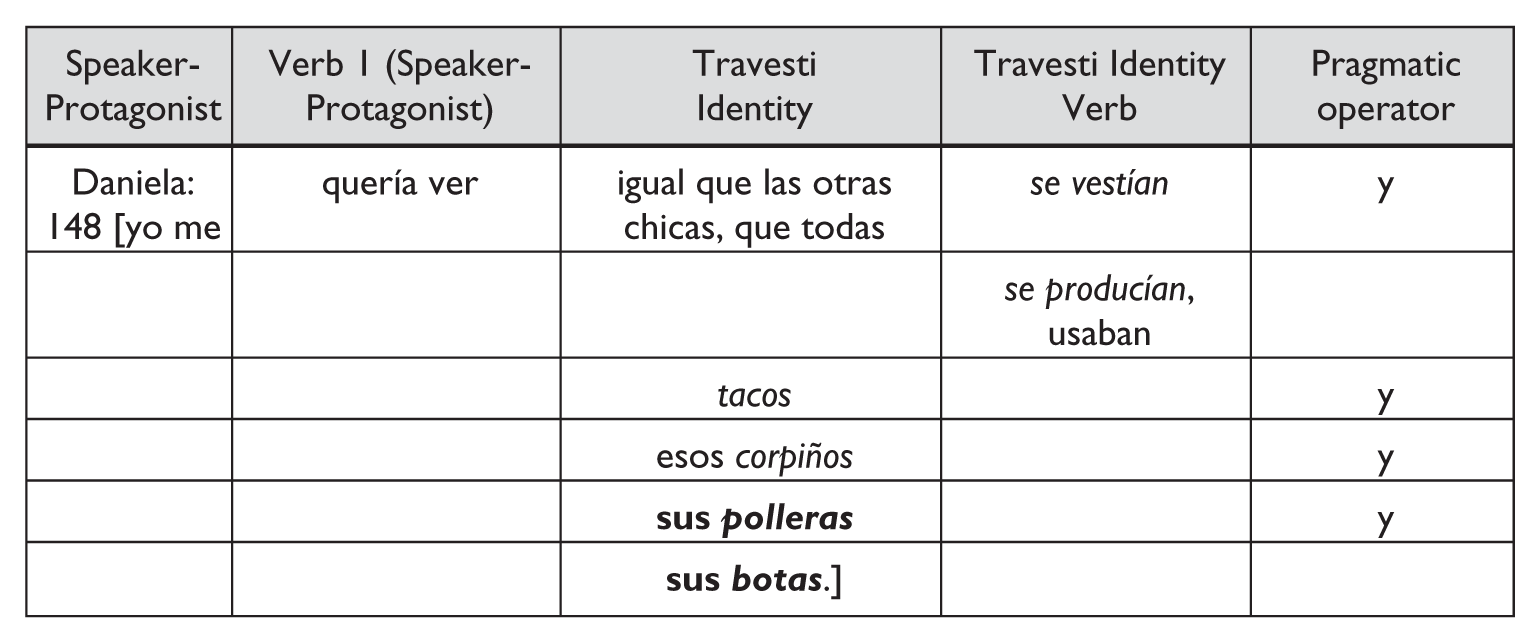
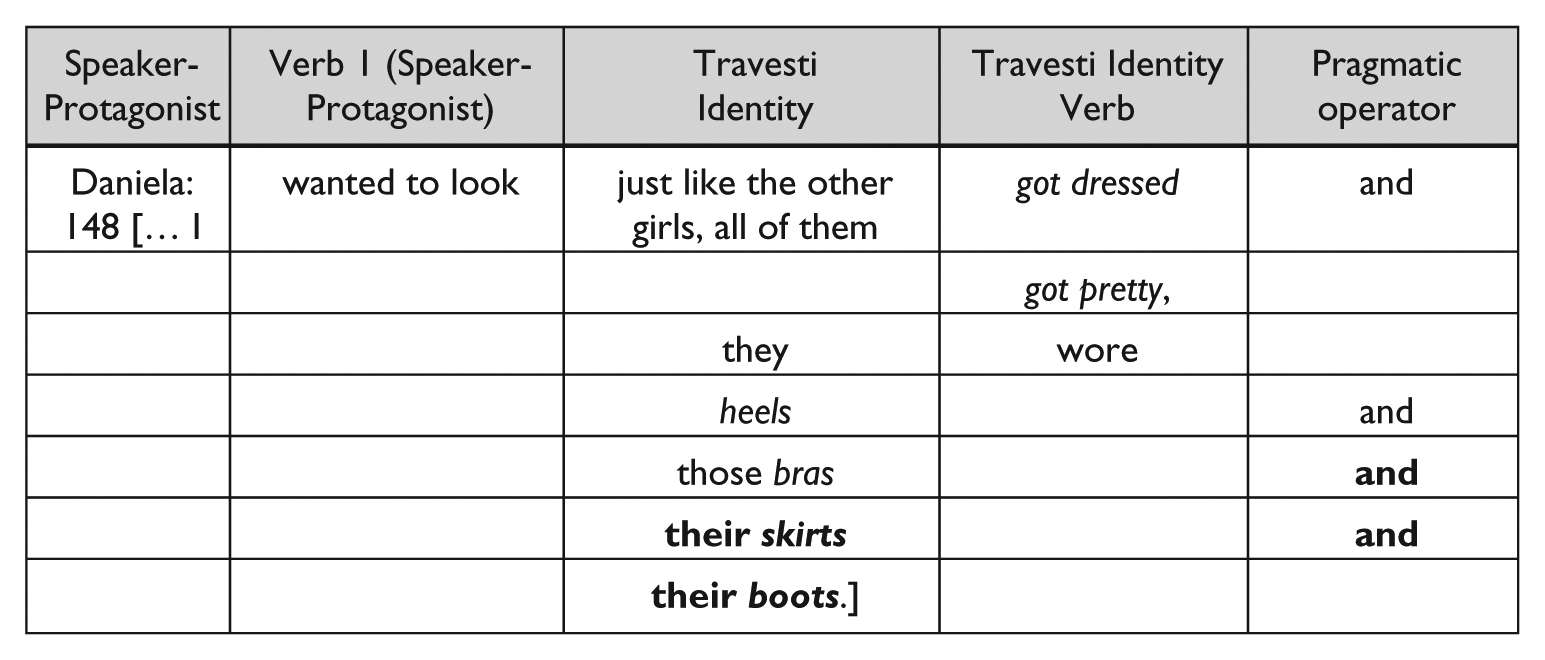
Metaphor: THE TRAVESTI BODY IS A WORKABLE/MOULDABLE MATERIAL [Lo que es rostro, [Para empezar, al cuerpo de un hombre,
[Tas re orgullosa ¿no? de
[Ojo que si tendría más plata
Metaphor: THE TRAVESTI BODY IS A POSSESSION/ADQUISITION [Yo gracias a los hombres tengo [Ahora tengo cintura, [¿Tendrá esto tu señora, [Yo tengo mucha plata
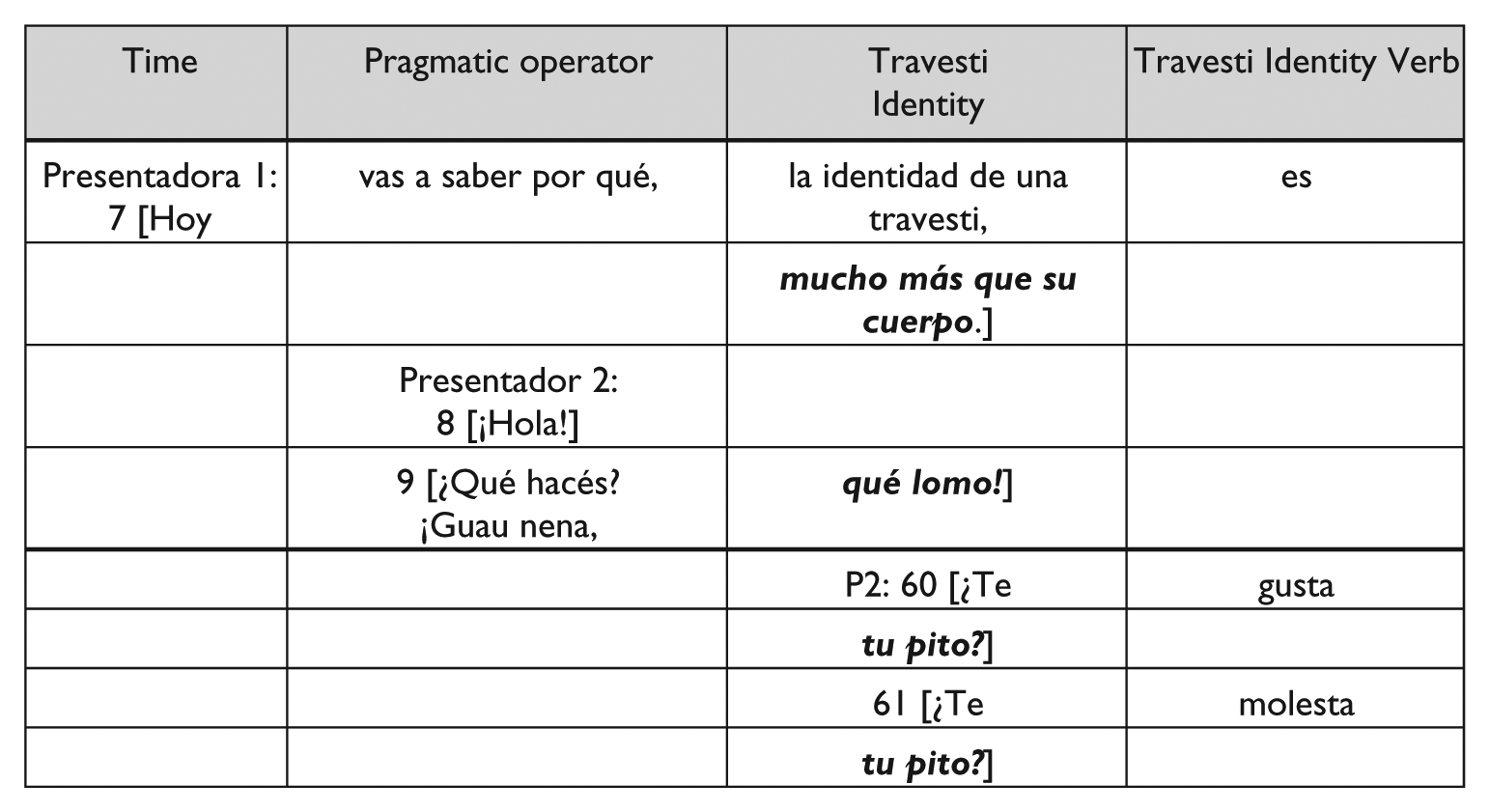
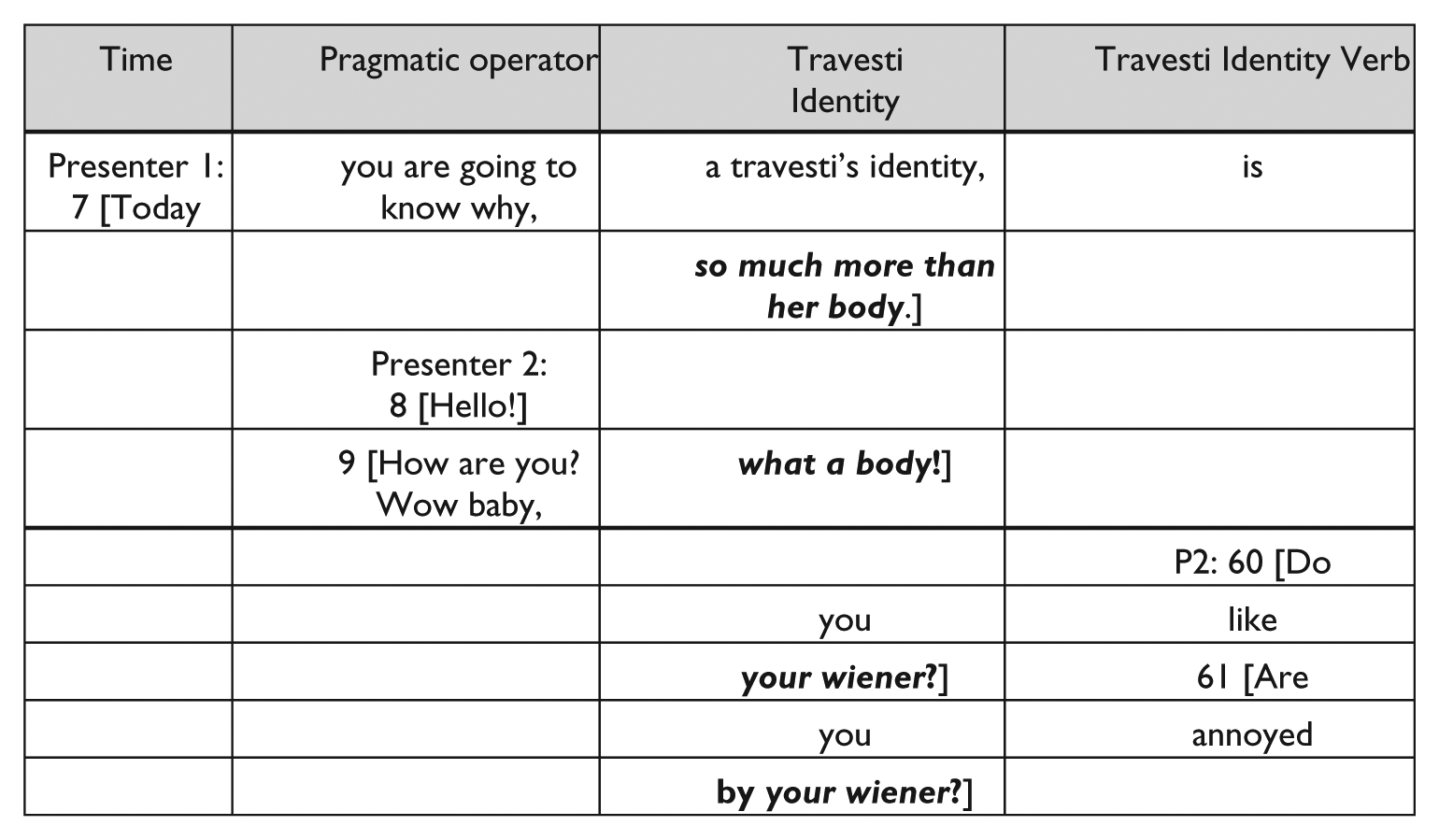
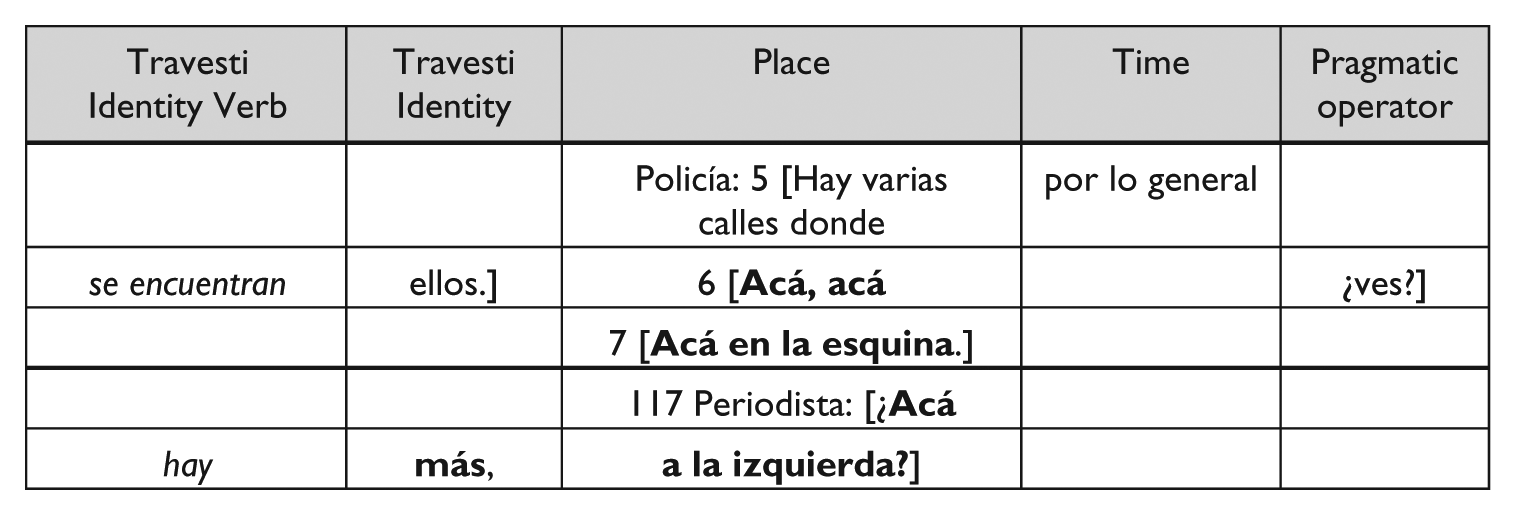
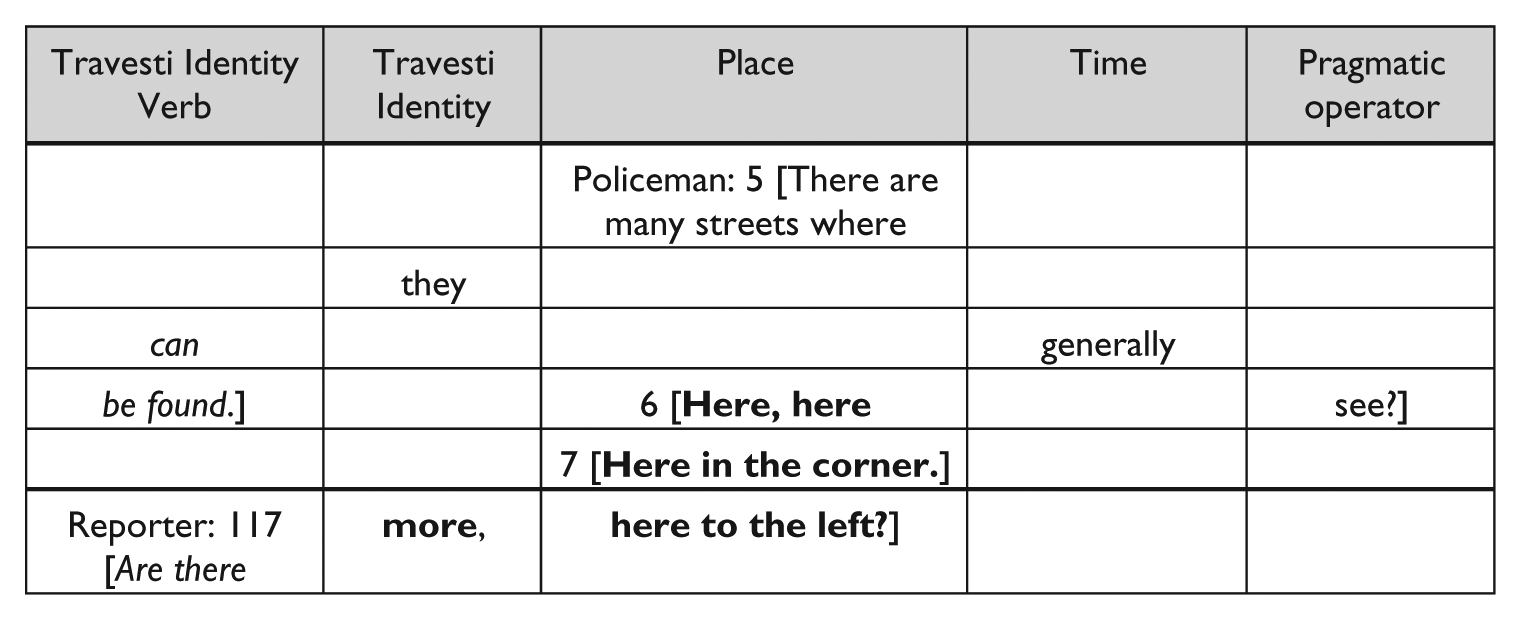
Another linguistic strategy involving metaphorization and the body appears most visibly in PA. Here, the travestis are categorized as quantifiable entities – what Lakoff and Johnson (2003: 25) call ontological metaphors – whose main characteristic consists in just occupying space. In the SDAM, this metaphor (which can be called TRAVESTI IDENTITY IS AN EXTENSIVE QUANTITY) is seen in the close association between the semantic category Travesti Identity and the grammatical category of Place, and by the relational and existential processes that indicate mere existence (Example 5):
The semantic categories Family and Society play a very important argumentative role in the travestis’ discourse. In relation to the category of Acceptance, both Family and Society are presented as sources of discrimination and at the same time as possible agents for resolving discrimination. The importance of the family as a (generally denied) supporting space is expressed in utterances that are highly reinforced
15
by the use of linguistic resources such as personal pronouns, the indicative mode and lexical items of positive connotation. In these utterances, besides, Family appears in the focus (Example 6):
[ Presentador: [¿Y una familia que te ayudó, no?] Marcela: [Sí, (Presenter: And a family that helped you, right? Marcela: Yes,
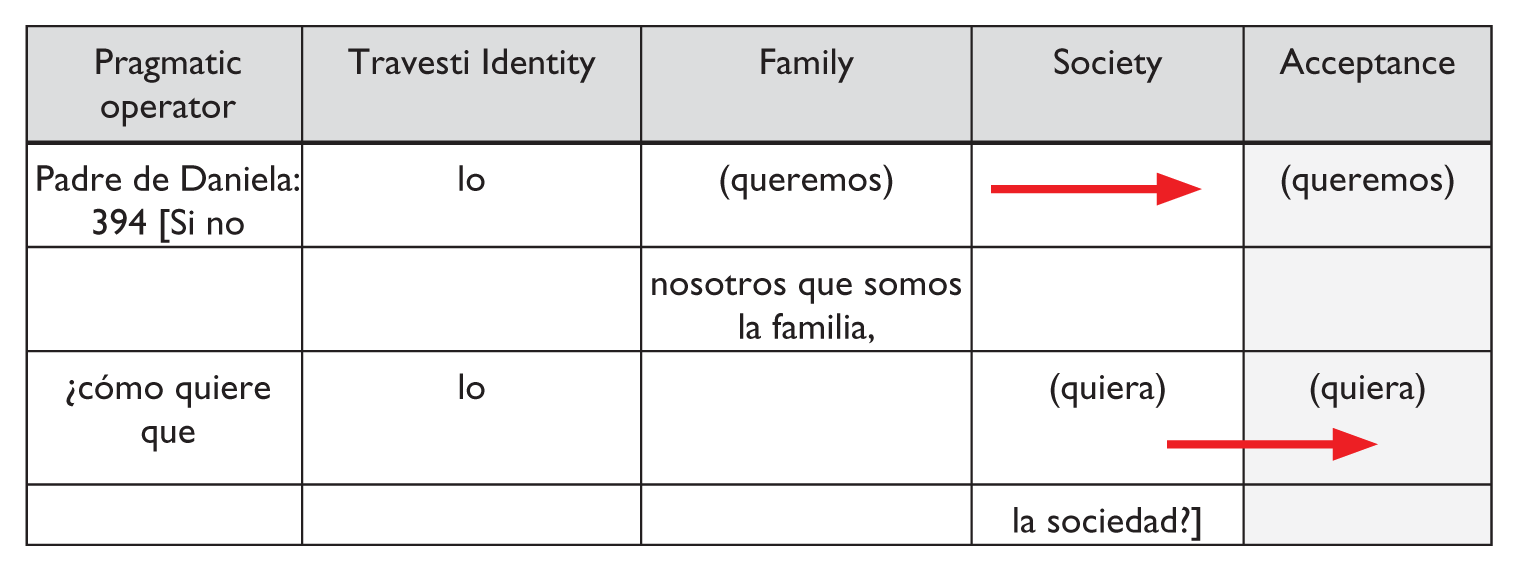
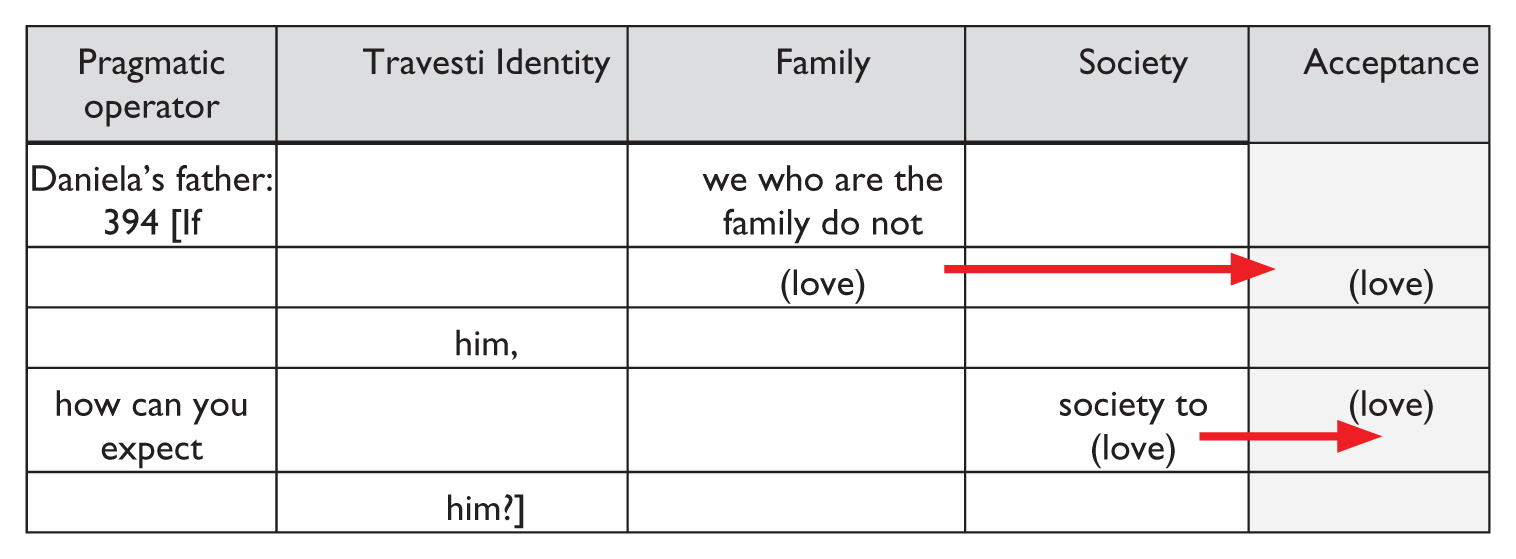
In the following examples, the family’s acceptance of travesti gender identity appears as a fundamental instance to achieve acceptance from society as a whole. The semantic category Acceptance operates then as a ‘converging point’ or ‘bridge’ between the categories of Society and Family (Example 7). In terms of Toulmin’s theory of argumentation, ‘A family must accept a travesti daughter’ can be considered as Grounds for the Claim ‘Society must accept travestis’, through the implicit, conventional Warrant that ‘Family is the base of society’. In the same sense, the category displacements observable in the SDAM show how lack of familial acceptance leads to early abandoning the home and entering prostitution as the only available means to survive (Example 8), a tale too often found in Argentinean travestis’ life stories (Berkins and Fernández, 2005; Duarte, 2009; Fernández, 2004):

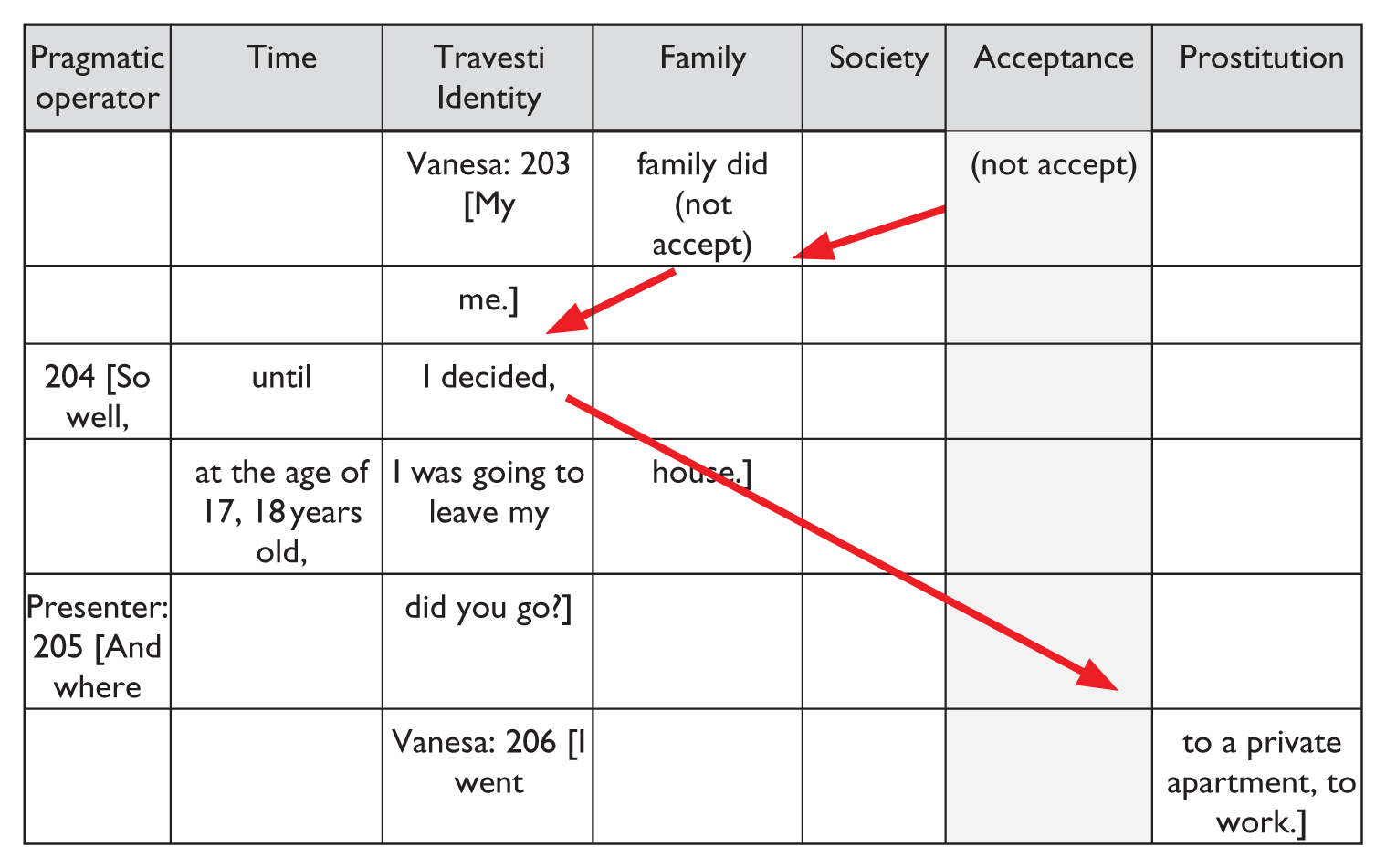
On the other hand, the programmes develop a linguistic strategy by means of which family and society are systematically mitigated in their responsibility for the travestis’ social exclusion. This strategy combines the use of nominalizations and generic words that make it possible to omit the agents of discriminatory actions (Example 9) and the erasure of the agent when conjugated verbs that denote discrimination do appear (Example 10):
[¿Ahora y en el barrio cómo es el tema de, Marcela y la discriminación?] (OK now, and how’s the thing with, Marcela and discrimination in the neighbourhood?) LL, 462 [¿Esta falta de aceptación provoca, eh, la desocupación y el caer en la prostitución para los travestis?] (Does this lack of acceptance cause, uh, unemployment and the fall into prostitution for the travestis?)
17
BM, 77 [¿Y no te pasó de que [¿
In this way, the programmes minimize the gravity of discriminatory actions by erasing those responsible for them. In the first part of Example 10, agency is explicitly and repeatedly stated when it concerns the travestis having to deal with discrimination, but is omitted as far as the responsibility for discriminatory acts is concerned. In the SDAM, these lexical items that mitigate discrimination fall under the semantic categories of Family and Society. In contrast, the travestis emphasize the Society and the State’s impact on the transgender collective by explicitly mentioning the agents of discrimination and persecution, especially those related to the State. This pointing occurs in reinforced utterances that contain material processes of negative value, or negated material processes of positive value. These processes appear as fully conjugated verbs or as mitigated, participial forms (Example 11):
[ [Hay 90 compañeras [… me gustaría el día de mañana caminar tranquila, o ir a un cine con mi madre y no estar
The semantic category Police usually appears in the SDAM as an Actor operating through a Verb. It deserves special consideration, as its construction shows very clearly – depending on who is speaking – the opposition between two strategies. The travestis focalize this category and reinforce the abuses by explicitly stating their agent and using material processes and lexical items of strong evaluative connotation (Example 12). The programmes, on the other hand, mitigate the abuses through the use of nominalizations and generic words, relational processes and by only focalizing the Police as the sayer of verbal processes. Thus, this semantic category only appears in the focus of the programme’s utterances when the repressive actions associated with it have been systematically mitigated (Example 13):
[Por tres causas, porque las [Aparte la policía me [Y uno de los agentes me MITIGATION OF THE AGENT THROUGH THE USE OF NOMINALIZATIONS: [Esto ES porque mueren muy rápidamente a causa de tres factores, la represión policial …] (This IS because they die very rapidly due to three factors, police repression …) BM, 206 MITIGATION OF POLICE ABUSES (WHEN FOCALIZED) THROUGH THE USE OF GENERIC WORDS AND RELATIONAL PROCESSES: [¿Pero qué, vos no habías pagado [la coima], FOCALIZATION OF THE POLICE AS THE SAYER OF VERBAL PROCESSES: [¿Y qué te DICEN, por qué, qué, [… nuestra cámara está dispuesta también para escuchar el otro lado de la campana, inclusive PUEDAN DISERTAR con ustedes
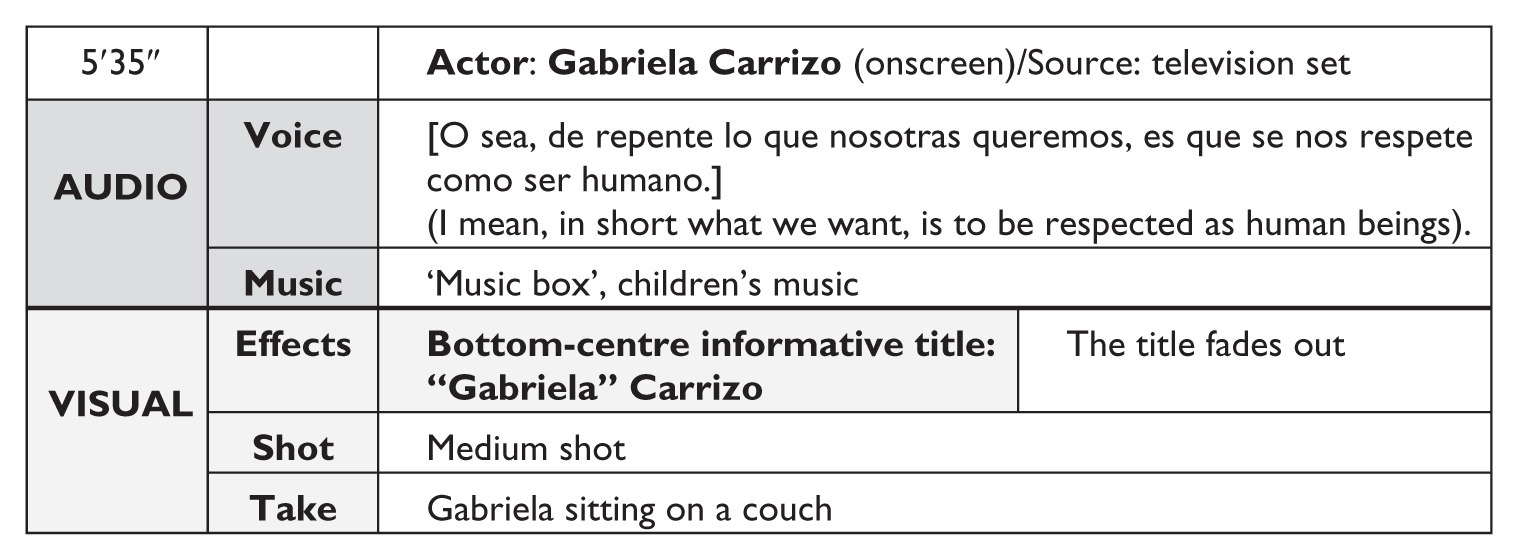
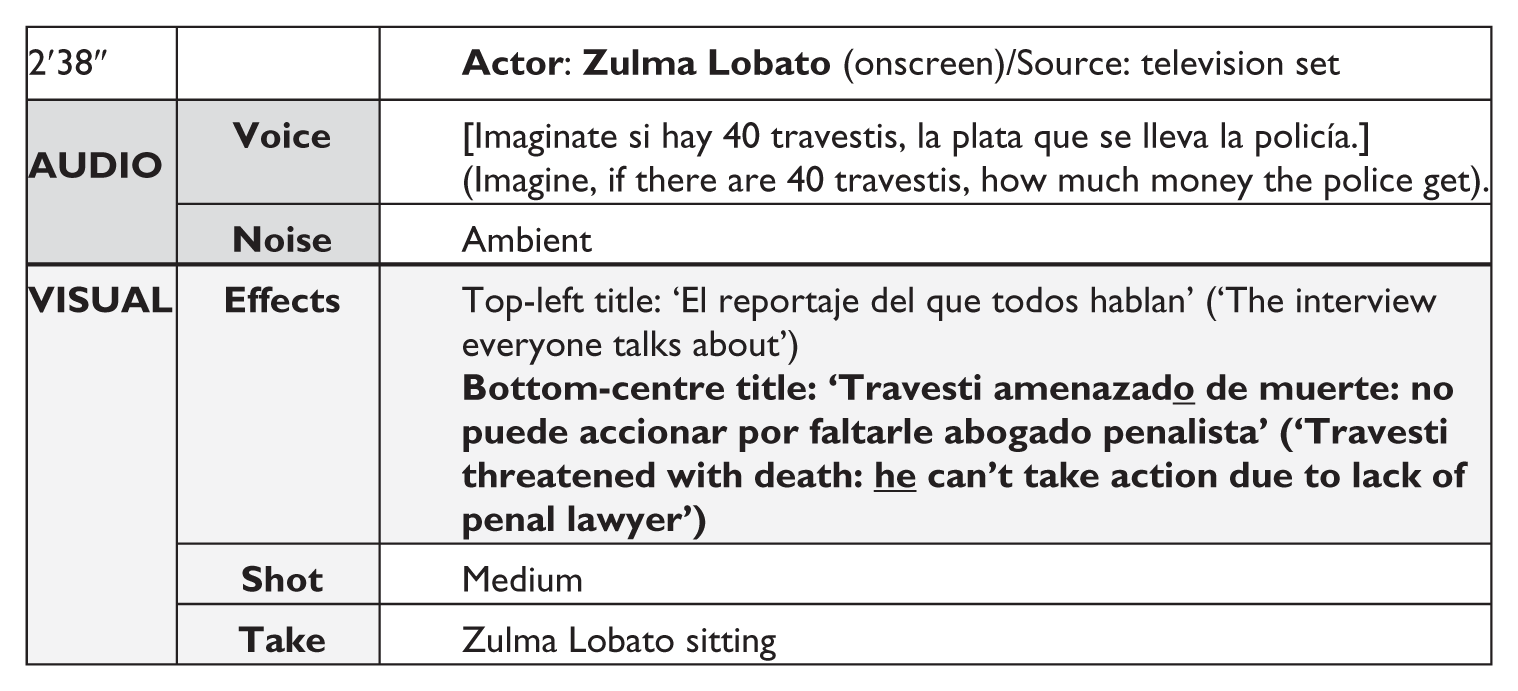
Concerning the analysis of multimodality, we find that both the processes of post-production and the live intervention of the programmes’ editing teams strengthen, on the audio-visual level, the same strategies of mitigation of travesti identity that appear in the textual level. Some examples of this are the display of videograph titles where the travestis’ names are placed within quotation marks (Example 14), or the differential treatment according to which some famous travestis get only their first name shown in the titles, while other not so famous participants get both their names and surnames displayed. Another case is the disrespect of travesti gender identity by displaying titles that refer to them in the masculine gender instead of the feminine (Example 15). All these resources mitigate travesti identity on the audio-visual level.
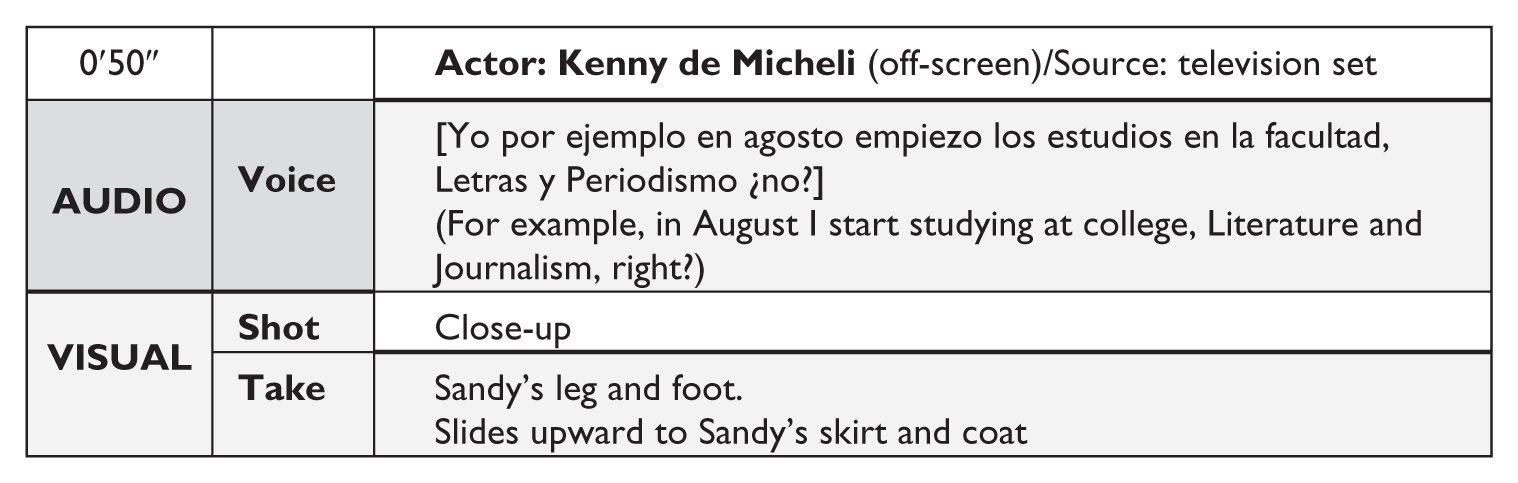
Finally, what the cameras show and how they do it, that is, the choice of takes and shots, can connote implicit meanings that operate against what is being said. For example, while someone is speaking of her wish to study, we are shown an extreme close-up of her companion’s legs, a take whose connotations reinforce the body as an object of consumption (Example 16):
Conclusion
The linguistic conclusions of the previous analysis can be summarized in the following points:
By conflating various linguistic resources (conceptual metaphor, category displacements, distribution of processes and their participants, focalization, etc.), as well as by handling audio-visual resources (shots and takes), the programmes create linguistic strategies that build a discursive representation of travesti identity metaphorically marked by the OUTSIDE. This is shown most noticeably in the emphasis on the visible and ‘mouldable’ facets of corporality, sexuality and clothing. This representation reduces travesti identity to the possession and construction of a more or less noticeable (feminine) appearance. At the same time, representations of travesti identity that do not follow this pattern (e.g. those that highlight feelings or internal experience) are mitigated on both the textual and audio-visual levels. I believe these strategies, especially those involving conceptual metaphor, have strong ideological implications, as they sustain social representations and beliefs about the travesti community that tend to sanction concrete attitudes and actions (Van Dijk, 1998) – for example, the attitude of considering them as mere objects of sexual consumption, devoid of personal rights and feelings.
In the travestis’ discourses, the semantic categories of Family, Society and State have the fundamental argumentative role of being the agents accountable not only for the social exclusion of trans people, but also for the reversal of such exclusion. The SDAM shows that it is precisely through the interaction of these semantic categories with Travesti Identity that the richest construction of discursive representations takes place. Two opposing strategies can be observed here: while the travestis – and also their families – reinforce the interaction among Travesti Identity, Family, Society and State (especially concerning society’s responsibility for their exclusion), the programmes systematically mitigate these relations, especially concerning the society and the State’s respective roles in discrimination and repression.
The coexistence of these two linguistic strategies, one reinforcing and the other mitigating, becomes most clear when it comes to the semantic category Police (the repressive arm of the State). Here we can see, in the discourses of the travestis and the programmes, strategies that involve clearly opposing linguistic resources: semantic reinforcements versus generic words; use of material processes (for describing the police actions) versus use of existential, relational and verbal processes; focalization of the abuses versus de-focalization; and so on. This can be illustrated by the image of the seesaw or teeterboard: what the travestis ‘raise’ by reinforcing (police abuses, discrimination and their need for social integration) is systematically ‘brought down’ by the programmes.
Some ethnographic elements of the corpora allow us to interpret these linguistic conclusions in the light of some typical features of postmodernity, described by Jameson (1991) as the cultural logic of late capitalism. Two of these features seem especially appropriate: the prevailing of space over time (Pardo, 2008b) and the exaltation of individual heroicity stripped of any context and/or collective project (Forster, 2002). The first is seen in the prevailing of corporality as a central element in the discursive representation of travesti identity and in the association of the semantic category Travesti Identity with the grammatical category of Place. The second trait is shown by the mitigated representation of the travestis as a collective subject of (the fight for) rights and by favouring representations where suffering, dreams and aspirations appear only as personal stories cut loose from a larger context. When the programmes highlight the personal achievement of having built a certain body image while at the same time reduce the travesti collective to mere occupants of urban spaces, both postmodern characteristics, the exaltation of the individual and of space, are obviously present.
Considering all this, I believe that the discursive representations created by these television programmes help to maintain the status quo since they reinforce stereotypes underlying discrimination; conceal the familial, social and State agents that generate exclusion; and disregard travestis as collective subjects entitled to rights. In the meantime, two major social and political events related to sexual diversity have taken place in Argentina: the modification of the Civil Code that extended the right to marriage to same-sex couples (Egalitarian Marriage Law) in 2010 and, two years later, the passing of the Gender Identity Law. In the case of the public debate that accompanied the proposal of same-sex marriage, the social change represented by the Law was accompanied by a gradual discursive change (D’Angelo, 2011). The (generally favourable) political climate towards the Gender Identity Law, however, was not accompanied at that time by a consistent discursive change in the Argentinean public opinion. I believe this contrast proves the media’s efficacy in mitigating and concealing the identities and the collective struggle of trans people for their rights. The specific discursive means employed in this obnoxious task have been the central object of exposition of this article.
In conclusion, not only the State but also the media have an impending debt with Argentina’s society and with trans people in particular. They have the ethical obligation of transforming and generating new discourses that may rise to the level of the present processes of social change, of contributing to an awareness and conceptualization of diversity that transcends the purely individual perspective, of showing trans people as collective subjects of rights and firmly denouncing the social and State agents and practices that have led to their historical exclusion; and of including their voices in the media, as producers and not only as witnesses, so that they can speak for themselves.
Footnotes
Acknowledgements
This work is part of the UBACYT research project no. 20020100100120, ‘The role of discourse in social change. Three fundamental problems for families living in a situation of urban poverty in Latin America’, directed by María Laura Pardo. I thank María Laura Pardo and all members of the Analysis of the Languages of the Mass Media ‘B’ chair at the University of Buenos Aires, for their constant guidance, support and affection.
Declaration of conflicting interests
The author(s) declared no potential conflicts of interest with respect to the research, authorship, and/or publication of this article.
Funding
The author(s) disclosed receipt of the following financial support for the research, authorship, and/or publication of this article: This work was supported by the National Council of Scientific and Technical Research (CONICET), Argentina (Resolution No. 4352, 7 December 2012).