




Abstract
This article presents an analysis of politicians’ laughter in broadcast news interviews and of mass media representations of Hillary Rodham Clinton’s laughter during her failed bid for the Democratic nomination for President of the United States in 2007–2008. It examines spoken, interactional data and written, representational data, each requiring different theoretical and methodological apparatus. The first component of the analysis employs the methodological framework of Conversation Analysis to examine the interactional work accomplished by Clinton’s laughter and other politicians in situ (i.e. in the interviews themselves). The second component employs an indexical approach to analyze the post-hoc recontextualization of Clinton’s laughter by mainstream media as a gendered representation, namely, as a ‘cackle’. Analyzing Clinton’s laughter in talk-in-interaction and its subsequent representation in talk-out-of-interaction reveals how communicative behavior that is not gendered by original participants may nevertheless become gendered by other participants. This article thus makes a distinctive contribution to a central question in discourse studies – when exogenous categories such as gender should be invoked as an explanatory category.
Keywords
Introduction
For scholars of discourse interested in studying language and gender, there has been a longstanding debate about the relationship between gender and discourse that gets played out on methodological terrain, specifically, about analytic procedure. The argument is summarized in the following key questions: Where, as analysts, should we look for the workings of gender and discourse? On what grounds is it legitimate to argue for the relevance of gender, and of power relations between gender groups, in analyzing a particular piece of data? (Cameron, 2005: 325).
This question of when gender is relevant, that is, when gender should be invoked as an explanatory category in the analysis of discourse, remains one of the most controversial and widely discussed in the literature. In large part, the debate began with the publication of an article in this very journal nearly 20 years ago entitled ‘Whose text? Whose context?’ (Schegloff, 1997).
Following Sacks (1984), Schegloff argued that analysts should not impose social categories such as ‘female’ or ‘male’ on their data, but should instead focus on participants’ orientations to such categories, that is, how participants display and invoke their own orientations to features of the interactional context. More specifically, he argued that analysts must attend to what is demonstrably relevant for participants in talk-in-interaction rather than what analysts may take to be relevant, say, because of their own politics, ideologies or theoretical dispositions (see also e.g. Schegloff, 1992). In considering the question of what counts as a participants’ orientation to gender, the most immediate or straightforward answer is instances in which a participant in interaction makes explicit mention of a gender reference or category (see e.g. Sacks, 1992 [1964–1972]; Schegloff, 1997; and on membership categorization analysis see Stokoe and Attenborough, 2014). However, as many scholars have pointed out, an explicit mention of gender is not necessary to establish participants’ orientations (see e.g. Frith, 1998; Kitzinger, 2000). That is, orientations to gender can be manifested without being explicitly named or mentioned.
1
As Kitzinger (2007) explains, gendered linguistic terms are neither a necessary (gender is imbricated into talk and interaction in general in numerous ways other than overt labeling) nor sufficient (membership categorization devices can be used without any specific orientation to gender per se and can be doing other interactional work) condition for establishing the relevance of gender to participants in talk-in-interaction. (p. 46)
Kitzinger has proposed focusing on what participants might be doing in using sex category terms other than ‘doing gender’ and on how participants orient to, negotiate, and manage gender in ways other than through the use of gendered category terms (for some recent examples, see e.g. Speer and Stokoe, 2011).
Some feminist language scholars maintain that gender has an overarching ‘relevance’ regardless of whether participants in interaction observably orient to it or not (e.g. Cameron, 2005; Weatherall, 2000). For those adopting critical, post-structuralist, and constructionist perspectives, for example, gender is a pervasive social category that is ‘part of the social fabric of meaning making that … is always already potentially relevant’ (Weatherall et al., 2010: 219). As a structural, organizing ‘fact’ of social life, such scholars contend, gender informs perceptions and interpretations of behavior such that we are always aware of ourselves and others as gendered beings, even in cases where it is not – or does not appear to be – explicitly at issue (Cameron, 2009). Invoking background knowledge and beliefs about gender, as critical researchers often do, necessarily involves ‘going beyond the data’. Given this, some scholars have questioned the conversation analytic notion of ‘relevance’ as ‘narrow’ and ‘restricted’ (e.g. Cameron, 2005; Wetherell, 1998), and others have suggested that the boundary for what counts as an orientation may require more flexibility than that which conversation analysis (CA)’s methodological requirements permit (see e.g. Cameron, 1998; Ehrlich, 2002).
In responding to Schegloff’s (1997) argument, some discourse scholars have also raised questions about who may count as a ‘participant’ in analysts’ claims about gender orientations. So, just as some have critiqued ‘narrow’ understandings of the term ‘orientation’, others have argued that CA’s ‘narrow’ view of participant limits precisely whose interpretations can be considered relevant to and consequential for interaction (e.g. Cameron, 2008; Ehrlich, 2007). For these discourse scholars, one of the principal problems with CA is that its view of context is restricted to what happens within specific communicative events. According to Blommaert (2005), much of what is made of interaction – by participants, not just analysts – in terms of the way meaning-attributing practices are ascribed to it, is based on ‘the post-hoc recontextualization of earlier bits of [talk] that were produced, of course, in a different contextualization process, at a different time, by different people, and for different purposes’ (p. 46). He explains: One of the fundamental features of communication in contemporary societies is the fact that it is often the object of complex trajectories: texts, discourses, images get shipped around in a process in which they are repeatedly decontextualized and recontextualized. In such processes, all kinds of transformations occur, often drastically different from the ones performed in the initial act of communication. Consequently, categories or other features that did not occur as salient in the initial act are often added to it in later phases. For instance, talk can be “gendered”, “raced” or “classed” afterwards, by someone who was not involved in the initial act of communication. (p. 76)
This raises the question of what to make of dimensions of talk and other conduct that are made relevant beyond the interactions themselves, and by other participants. In other words, what about talk-out-of-interaction (Blommaert, 2005)?
Ehrlich (2006, 2007) has addressed this question by showing how talk can subsequently produce gendered meanings in her work on courtroom trials. While trial talk generally proceeds on a dyadic basis (i.e. between lawyers and witnesses), she explains, ultimately it is designed for a third-party recipient (i.e. a judge and/or jury). Thus, participants who may not actively and directly participate in the interaction can still offer interpretations of it that are not only consequential for the participants involved, but can be in specifically gendered ways. So, for example, in an analysis of a Canadian criminal trial dealing with sexual assault, Ehrlich (2002) found that, despite the absence of any explicit orientations to gender in the trial itself, gender became a relevant feature of the context when considering the judge’s judgment. As a result, Ehrlich (2007) suggested expanding the notion of ‘participant’ in certain speech events in order to expand analysts’ access to the way that cultural norms regarding ‘the intelligibility of gendered meanings’ may regulate participants’ enactments of social identities, gendered or otherwise (p. 456).
In this article, I argue that mediated forms of public communication are other speech events that constitute particularly valuable sites for investigating the emergence of gendered meanings. Indeed, the ability of talk to be lifted out of its originating setting and to travel across discursive contexts is a hallmark of mediated forms of contemporary political communication. Take the 2016 U.S. presidential primary as an example. Political candidates engage in many forms of interaction – media interviews with journalists, political debates with opponents, and town hall meetings with engaged citizens, to name a few. At the same time, these interactions are subject to multiple forms of re-presentation in the form of press releases, traditional news reports and political commentary, discussions on social media, and so on. Scholars of political discourse can thus engage with a range of interactional and representational data, for example by investigating various dimensions of the originating interactions or subsequent re-presentations of those interactions. This makes the domain of politics a particularly rich site for exploring the methodological question of gender’s relevance.
To address this question, I present a case study of Hillary Rodham Clinton’s laughter in the context of her failed bid for the Democratic nomination for President of the United States in 2007–2008. In late September 2007, Clinton completed what is known as a ‘full Ginsberg’ by appearing on all five Sunday morning political talk shows on the same day: ABC’s This Week, CBS’s Face the Nation, CNN’s Late Edition, FOX’s Fox News Sunday and NBC’s Meet the Press. Around the time of these interviews, Clinton’s laughter became the subject of intense scrutiny by journalists, media commentators, and pundits in the mainstream media and was dubbed ‘The Clinton Cackle’. Below are some examples of newspaper headlines that adopted the ‘cackle’ characterization: Clinton (The Rush Limbaugh Show, 13 September 2007) That Clinton (The Boston Globe, 30 September 2007) Democratic frontrunner can (The Seattle Post, 2 October 2007) Hillary Clinton is trying to get the last laugh over her now-infamous (Daily News, 4 October 2007) The cold (The Washington Times, 5 October 2007) The candidate’s (The Toronto Star, 30 December 2007)
In order to understand more fully what may have motivated these responses to Clinton’s laughter, in the first component of the analysis I investigate her laughter in situ, that is, in the broadcast news interviews in which Clinton originally participated. Using the methodological framework of CA, I analyze her laughter and then compare it to the laughter of other politicians produced in similar contexts. One of the questions I attempt to answer in conducting such a comparison is the extent to which other politicians (and specifically men) deploy laughter in similar ways to Clinton and to similar ends. Following Blommaert (2005) and Ehrlich (2007), the second component of the analysis considers ‘other’ participant orientations to Clinton’s laughter, that is, the mainstream media – the unaddressed but targeted recipients of broadcast talk. Employing the theoretical lens of indexicality, this component of the analysis focuses on the post-hoc recontextualization of Clinton’s laughter by the mainstream media in a way that made gender relevant. In analyzing these two dimensions of Clinton’s laughter, that is, its deployment in talk-in-interaction, and its subsequent representation in talk-out-of-interaction, I ultimately show how communicative behavior that is not gendered by the ‘original’ participants (and that is typical of both women and men) may nonetheless become gendered in subsequent representations. Put somewhat differently, by illustrating the process by which a generic interactional practice becomes gendered, my analysis provides one answer to the question of the relevance of gender in discourse studies.
In what follows, I first present the findings of the interactional component of the analysis (i.e. comparing Clinton’s laughter to that of other politicians in news interviews), then I present the findings from the representational component (i.e. the ‘cackle’ re-presentation as gendered).
Data
The interactional component of my analysis is based on two collections of video recordings and transcripts 2 – the first collection includes interviews featuring Hillary Rodham Clinton, and the second includes interviews with other politicians as interviewees. The Clinton collection comprises 25 live interviews over a two-year period during and following her bid for the Democratic nomination (September 2007–September 2009), constituting over five hours of interaction. An effort was made to gather as many interviews as possible in which she participated during this period, including those from the five Sunday morning talk shows: the ‘Big Four’ U.S. commercial TV networks (ABC, CBS, FOX, NBC) and the national cable and satellite TV channel, CNN. The second collection of other politicians consists of 50 live interviews, broadcast predominantly during the 2007–2008 election campaign in the United States, on the same shows and networks, and covering the same two-year period. This amounted to just under 13 hours of interaction. Both collections only included interviews that were broadcast live and thus free of signs of post-production editing or cutting. For each, half of the interviews featured co-present participants and half occurred via satellite. The first collection contains interviews with Clinton by 20 different journalists (5 of whom were women). The second collection involves 30 other politicians (24 men and 6 women) interviewed by 18 journalists (3 of whom were women). So, although there were fewer women than men journalists in both collections, proportions corresponded roughly to women’s representation on network television, where women comprise less than one-quarter of total representations. As for the politicians interviewed in the second collection, the majority of interviewees were candidates for public office at the time of the interview (though a very small number of cases included elected officials), and in terms of their political orientation, the distribution of Democrats to Republicans was roughly equal (14 and 16, respectively).
To first understand the nature of Clinton’s laughter in broadcast news interviews (BNIs), I gathered all instances of both interviewer- and Clinton-initiated laughter across the first collection. Drawing on Glenn’s (2003) ‘keys’ – specifically addressing the nature of what is being laughed at, how the laughter is responded to and what happens following its occurrence – and in accordance with the principles of CA, the following discussion is based on a comprehensive analysis of all instances of laughter in both collections.
Laughter in broadcast news interviews
Laughter is a communicative activity that is often a vocal and embodied response. Despite popular (i.e. ‘lay’) understandings of laughter as spontaneous and disorganized, previous conversation analytic research has revealed it to be a socially and sequentially organized communicative action (see e.g. Glenn and Holt, 2013; Jefferson, 1979; Vöge and Wagner, 2010). As is the case in many forms of ordinary and institutional interaction, laughter in BNIs tends to occur in orderly environments. 3
Table 1 presents the distribution of Clinton-initiated laughter in the collection in terms of the sequential environments where laughter can occur during talk conducted within the BNI: either in relation to an interviewee’s (IE) own talk (i.e. in this case HRC) or during interviewer (IR) talk. For laughter in relation to IE talk, it can be further characterized as either occurring within speech (i.e. contiguously within one’s own turn-at-talk), or post-completion (i.e. at the completion of one’s own turn or turn constructional unit (TCU)). In the collection of interviews with Clinton, she produced laughter in the former environment approximately two-thirds of the time (11/17, 65%), and in the latter environment roughly one-third of the time (6/17, 35%). In addition to these environments, laughter may also be heard as responsive to the IR’s talk, and, in those cases, there are two possible sequential positions: laughter during the IR’s questioning turn (which accounts for approximately three-quarters of all instances; 28/36, 78%), and laughter at completion of the IR’s turn (which accounts for the remaining one-quarter of cases; 8/36, 22%). Crucially, these IR questions are not observably designed or keyed as ‘humorous’, but rather are designed as ‘serious’. As Holt (2010: 1514) has observed, ‘laughter can follow turns that are not designed as potential laughables’, a term that avoids assuming there is something necessarily humorous about the laughter’s referent (Glenn and Holt, 2013). In the context of BNIs, IR questions are predominantly designed as ‘serious’, thereby establishing the relevance of ‘serious’ answers. Comparing the two main sequential environments for Clinton’s laughter reported in Table 1, the results indicate that Clinton tends to produce more laughter in relation to IR talk than to her own – a finding consistent with O’Connell and Kowal’s (2004: 468) research on Clinton’s laughter in media interviews, where they found roughly two-thirds of her laughter overall was initiated in relation to IR talk (41/68, 60%).
Distribution of Clinton-initiated laughter by sequential position.
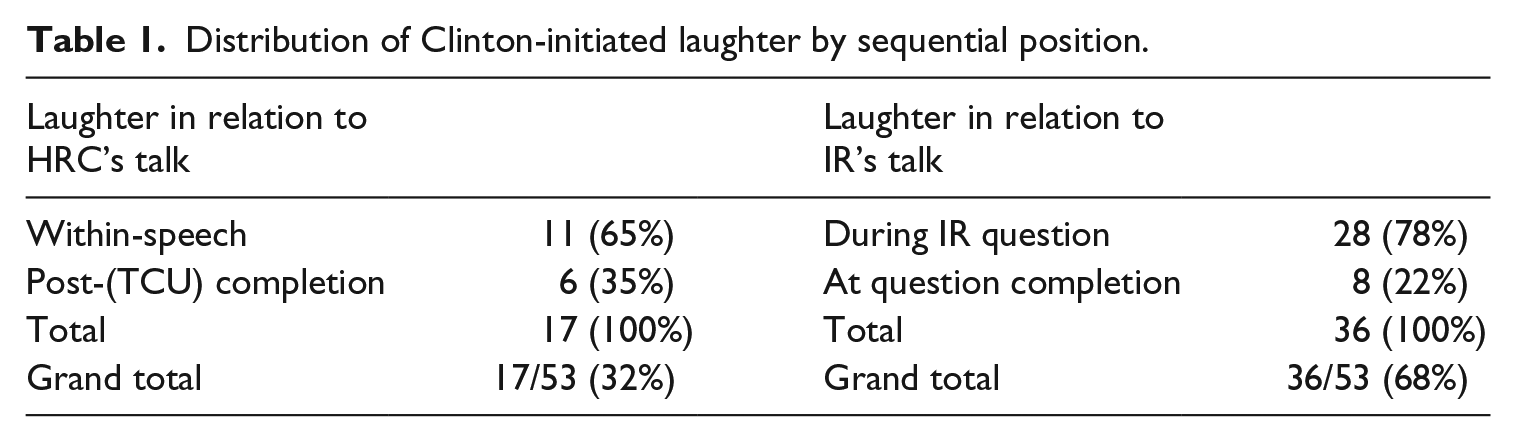
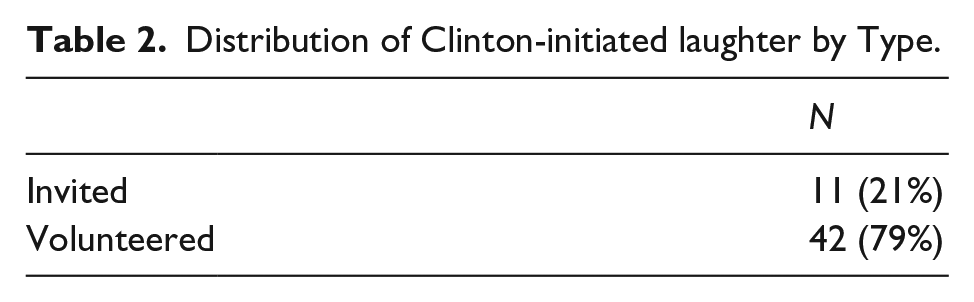
Finally, my analysis also focuses on cases of volunteered rather than invited laughter (in the Jeffersonian (1979) sense): that is, the practice of laughing I will describe occurs in environments where the IR is not constructing talk that is evidently ‘humorous,’ nor is the relevance of responsive laughter established via other common practices for constructing such talk as laughable (e.g. the IR laughing first, or producing other possible laugh-relevant items such as smiling, interpolated particles of aspiration (Potter and Hepburn, 2010), etc.). Table 2 reports the distribution of these practices within the total occurrences of Clinton’s laughter in the interviews examined.
Distribution of Clinton-initiated laughter by Type.
In previous work (Romaniuk, 2009, 2013b), I have reported on two of the sequential environments outlined above where IE laughter systematically occurs – at the completion of an IR’s question and prefatory to a verbal response, and during the IR’s questioning turn. In both environments, I have argued that volunteering laughter after a serious question has been delivered, or during its production, is a disaffiliative interactional move. Consistent with Clayman’s (1992) definition of disaffiliation, I view such laughter as disaffiliative in terms of its retrospective indexing of the prior action or action-in-progress as a proposition neither agreed with nor endorsed. In addition, I propose that such laughter disaffiliates from what is being proposed by the IR as a serious matter or inquiry while simultaneously projecting a disaffiliative verbal response, although I treat the two sequential positions as distinct, given the different contingencies to which they respond and the distinct affordances each provides. In what follows, I present a representative example of such laughter by Clinton as well as by another (male) politician; however, given space limitations, I focus only on one of the sequential environments, namely, in response to an IR question, prior to producing a verbal response (see Romaniuk, 2013a for additional cases). 4
Clinton’s laughter in broadcast news interviews
One example illustrative of Clinton’s laughter in response to an IR’s question comes from one of the five ‘Ginsberg’ interviews Clinton participated in back in the fall of 2007. Excerpt 1 begins following a brief segment in which the IR, Chris Wallace, introduced a short clip of an interview with Clinton’s husband and former President Bill Clinton from one year earlier. The footage showed Bill Clinton complaining about Wallace’s interview, questioning and accusing Wallace of doing ‘Fox’s bidding’ by doing his ‘nice little Conservative hit job’ on him. Following this clip, Wallace launches his first question of the interview, beginning at line 1.
(1) 2007Sep24-Fox News Sunday-Hyper-partisan IR: Chris Wallace; IE: Hillary Rodham Clinton 01 IR: Senator taw:lk about Conservative 02 conspiracies,= 03 04 (0.3)
5
05 IE: khe= 06 had uh walked even a 07 fifteen years I’m sure you’d understand.£ .hh 08 but y’know the 09 get beyo:nd uh partisanship. a:nd uh I’m £sure trying to 10 do my part.£ .hh because we’ve got a l 11 pr 12 this w
The IR’s evidently ‘serious’ accusatory question (‘Why do you …’) seeks an account for something that is presumed to be the case – that Clinton and her husband have a hyper-partisan view of politics. The question recycles Bill Clinton’s words (‘hit jobs’) and introduces Hillary Clinton’s (‘right wing conspiracies’), thus portraying them both as hyper-partisan. The irony, of course, lies in the fact that such a characterization comes from a journalist on the Fox News Channel, which, despite its slogan ‘Fair and balanced’, has been frequently accused of biased reporting. Thus, when Clinton initiates a response with laughter, it is hearable as treating the question-as-a-whole as laughable. Note how following her laughter she begins with the discourse marker ‘well’ (Schiffrin, 1987), which projects a non-straightforward response (Schegloff and Lerner, 2009), then adopts an informal person reference form (‘Chris’, line 5) that projects dispreferredness (Clayman, 2010). Although her subsequent response to some extent accepts the question’s presupposition, it is nevertheless produced through a smile voice articulation – a recurrent feature of sustaining a display of disaffiliation. Clinton then resists the IR’s characterization more overtly by refocusing the question in terms of the nation’s ‘real’ goals, namely, moving ‘beyond partisanship’ (lines 8–9). By prefacing her verbal response with laughter, Clinton retrospectively casts the question as inapposite and thus a laughable matter.
In cases like Excerpt 1, Clinton laughs in response to ‘serious’ questions, which are not formulated in an observably humorous way. In this environment, the laughter acts as an implicit commentary on the question, undercutting its legitimacy as worth taking seriously. In terms of its referent, the laughter operates on the propositional meaning of the IR’s question by retrospectively casting it as laughable. At the same time, the laughter may also project a further disaffiliative action (i.e. an explicit verbalization). Finally, by laughing in response to a question, Clinton also manages to effectively delay providing a verbal response of any kind.
This is just one example illustrative of a practice Clinton engaged in systematically in the broadcast news interviews – laughing at the completion of or during serious interviewer questions. As I have argued elsewhere (Romaniuk, 2013b), such laughter acts as a public display of disaffiliation in the sense that it expresses disagreement or dissociation from critical or otherwise problematic commentary animated by an interviewer. For a politician like Clinton, then, laughing in such contexts acts as a form of ‘damage control’; that is, the laughter treats the talk as laughable, and, in combination with other embodied stance displays (cf. Ford and Fox, 2010; Goodwin, 2000; Goodwin and Goodwin, 1987), it functions to mitigate the potential damaging effects of such talk on her or her campaign. A significant question, however, is whether this is in fact some idiosyncratic feature of Clinton’s interactional style, as media representations like ‘The Clinton Cackle’ would have us believe. To answer this question, I now turn to the findings from analyzing the second collection of news interviews with other politicians televised on the same networks and during the same time period.
Other politicians’ laughter in broadcast news interviews
The results reported in Table 3 present the distribution of IE-initiated laughter in terms of the same sequential environments described for Clinton (see Table 1). For laughter that occurred in relation to the IE’s own turn, IEs produced within-speech laughter approximately two-thirds of the time (48/73, 66%), and post-completion laughter one-third of the time (25/73, 34%). For laughter that occurred in relation to the IR’s turn, IEs produced laughter during IR questions approximately three-quarters of the time (52/72, 72%), and at question completion one-quarter of the time (20/72, 28%).
Distribution of other politician-initiated laughter by sequential position.
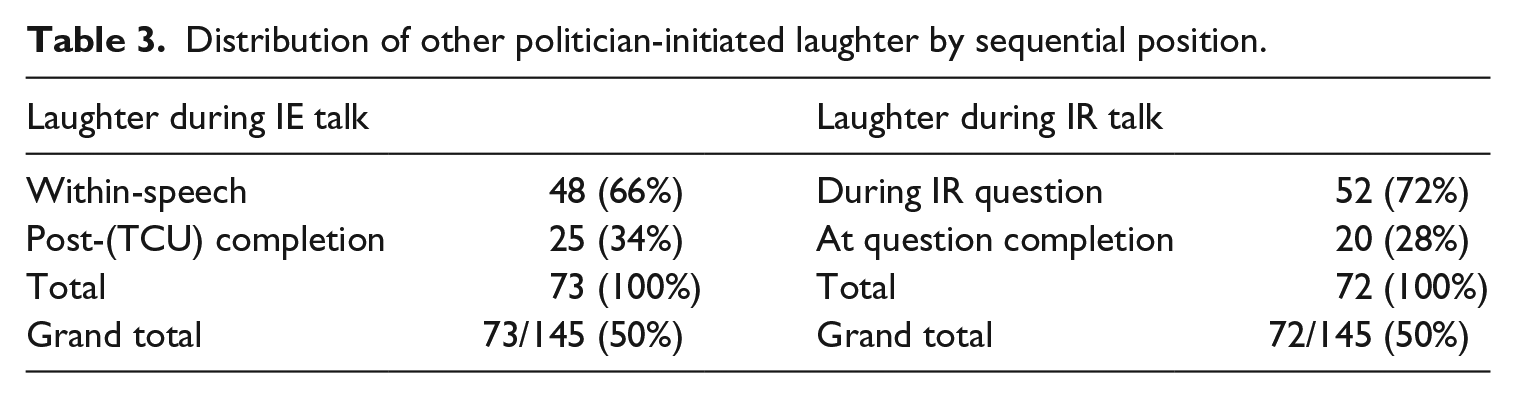
Table 4 reports the distribution of IE-initiated laughter in terms of whether it was in some way invited by the IR or produced on a voluntary basis (volunteered), as was also reported for Clinton (see Table 2).
Distribution of interviewee-initiated laughter.

What should be clear from examining each is that both Clinton and other interviewees produce the same types of laughter (i.e. invited vs volunteered) and in the same sequential positions. 6 Excerpt 2 below is representative of how other (male) politicians use laughter in responding to an IR’s serious question in a comparable way to Clinton (as exemplified in Excerpt 1).
This example features David Gregory interviewing New York Democratic Senator Chuck Schumer. Prior to where the transcript begins, Schumer had been asked to comment on Senator John McCain’s opposition to a proposed, formal investigation of alleged torture under the Bush administration (hence, a ‘serious’ matter). In responding, Schumer had indicated his support for the proposed investigation, and then stressed the importance of ‘looking forward’ (not shown). At that point, the IR follows up with his next question (line 11), which is responded to with laughter at line 12.
(2) 2009Jan12-MSNBC-MeetThePress-1: Sarah Palin IR: David Gregory; IE: Chuck Schumer 11 IR: Is Sarah Palin the future of the Republican Party, 12 IE: 13 judge and let them £f(h)ight among themselves.£ 14 15 IR: [What do] you think though.= 16 IE: =.h[h 17 IR: [D’you think she’s qualified to be president? 18 IE: .hh Well y’know, I- I- I think the: American people 19 saw her. (0.2) and they saw:, (.) 20 in terms of preparation and knowledge of things, 21 but y’know. uh: four years away is a lo- three and 22 a half years away is a long time away so I’m not 23 gonna make a judgment. [. . .]
Like Excerpt 1, the IR’s question at line 11 is delivered as serious – he does not ‘invite’ a laughing response in any hearable or visual way (e.g. he is not smiling and the talk is produced without any hearable Interpolated Particles of Aspiration (IPAs) 7 ) – and yet, it gets responded to with laughter (albeit across the production of the turn-initial ‘well’, which, again, projects dispreferredness). The question treats Schumer’s assessment as relevant, which he resists both through the laughter and his subsequent verbal response (lines 12–13). Similar to Clinton’s laughter and verbal response, Schumer’s response here works to undercut the question as legitimate for him, and thus avoids providing an explicit, type conforming answer (‘yes’ or ‘no’), even though the laughter in some sense projects one.
In these and other examples, although the IRs’ questions are formatted in such a way as to presume their relevance for their IEs, by prefacing their verbal responses with laughter, both Clinton and other (male) politicians provide an implicit commentary on those questions, challenging their legitimacy as ‘serious’. Moreover, rather than provide straightforward answers (e.g. ‘yes’ or ‘no’), laughing in turn-initial position often prefigures a dispreferred response, no only in avoiding offering an explicit ‘on record’ verbal response but also in delaying providing that response.
These two representative cases serve to illustrate that the practice of laughing in response to (or during the production of) IR’s designedly serious questions is not some idiosyncratic feature of Clinton’s discursive repertoire, but in fact a systematic, socially organized activity that many other politicians engage in the course of news interview interaction. Given that my analysis of these practices spanned 50 news interviews with 30 other politicians (both male and female), I argue that laughing in this way is a generic interactional practice, as opposed to one that only Clinton engages in. This point is crucial in considering the media representation of Clinton’s laughter as a ‘cackle’, to which I now turn.
From laughing to cackling: The ‘Cackle’ re-presentation as gendered
In general, media coverage of politics tends to construct ‘catchy’ phrases or sound bites to characterize select portions of politicians’ talk and other conduct (Talbot et al., 2003). While there was some range of media responses to Clinton’s laughter, the characterization that gained the status of an authoritative re-presentation – ‘The Clinton Cackle’ – was a decontextualized one. Specifically, her laughter was extracted from its originating contexts of occurrence in news interviews and recontextualized in media discourse in a way that imbued it with a particularly negative, gendered meaning (see Romaniuk, 2014, for elaboration of this process). But how did this gendered meaning come about?
Since the social construction of meaning is an ongoing process that occurs across multiple contexts, indexicality is a fundamental concept in understanding how linguistic forms come to be associated with social categories such as gender. Whereas early language and gender research assumed a one-to-one mapping of linguistic form onto the social category of gender, Ochs’ (1992) model of indexical relations demonstrates how the relation between language and gender ‘is mediated by and constituted through a web of socially organized pragmatic meanings’ (p. 341). The indexicality of gender, according to Ochs (1992), involves (at least) two semiotic processes: with respect to direct indexicality, linguistic forms ‘most immediately’ index particular social roles, activities, stances or acts, whereas in the process of indirect indexicality, these same linguistic forms become associated with particular social types and personas believed to embody those roles, engage in those activities or perform such stances and acts – types and personas that are culturally coded as gendered (Bucholtz, 2009: 148). It is at the level of indirect indexicality, as Bucholtz (2009) points out, where ideology comes to play a crucial role ‘since it is at this level that [the particular social roles, activities, stances or acts] acquire more enduring semiotic associations’ (p. 148). In media discourse, ideology can manifest itself through the use of lexical choices that convey a range of meanings beyond the strictly referential, denotational ones (McConnell-Ginet, 2014). So, what is the referential, denotative meaning of ‘cackle’ and how do speakers who perform the act of ‘cackling’ take on gendered meanings?
Consulting a dictionary (such as the Oxford English Dictionary) captures the term’s denotation, or what can be thought of as what ‘cackle’ directly indexes – the expressive act characteristic of hens. Perhaps unsurprisingly, however, neither this meaning nor the examples used to illustrate the term’s usage suggest ‘cackle’ is a negatively valenced term – one associated with a particularly negative, gendered persona, that of witches. Yet this association is overtly recognizable and recognized both in contemporary usage (as evidenced by drawing on insights from corpus linguistics) and in media re-presentations of Clinton’s laughter. First, these associations are illustrated in actual usage, then briefly in the actual media representations.
Corpus linguistics is particularly valuable in investigating the role lexical choice plays in constructing ideological representations of reality (Cotterill, 2001). As evidence for the negative valence of ‘cackle’ and the implicit and ideological meanings indexed by its use, consider the term’s semantic shape and patterns of collocation I discovered using the Corpus of Contemporary American English. 8 I found that the term’s principal active associations are narrow and restricted, and that ‘cackle’ indirectly indexes the laugh of an undesirable persona. More specifically, ‘cackle’s’ collocational profile, and the connotations associated with it, embody what is called a negative semantic prosody; that is, the strongest collocates are overwhelmingly negative or unpleasant (Stubbs, 1996). Indeed, the restricted set of meanings communicated via the term’s use is strongly associated with an undesirable gendered persona, namely, witches.
Comparing the strongest adjective collocates of the nouns ‘cackle’ and ‘laugh’ (the broader, and arguably more neutral term), for example, Table 5 reports the top 10 adjective collocates, their number of occurrences, and MI score, respectively. 9
Top 10 adjective collocates for cackle and laugh.

MI: mutual information.
While adjective collocates for the noun ‘laugh’ indicate a broad range of meaning potential including qualitative descriptions that range from positive (e.g. ‘good-natured’), to more neutral (e.g. ‘throaty’), to more negative (e.g. ‘maniacal’) terms, ‘cackle’ strongly collocates with evaluative adjectives with negative meanings or negative connotations (indicated in bold), three of which also connote gendered subjects (indicated by an asterisk). This greater range of collocates for ‘laugh’, of course, may be partly due to the fact that it occurs more frequently in the corpus. Clearly, however, the majority of adjectives that collocate strongly with ‘cackle’ have negative meanings.
The following selection of concordance lines for both ‘laugh’ (Table 6) and ‘cackle’ (Table 7) further highlights the negative semantic prosody of ‘cackle’ compared with the broader, and arguably, more neutral semantic prosody of ‘laugh’ in actual contexts of use. 10
Concordance of adjective collocates (in bold) for laugh.

Concordance of adjective collocates (in bold) for cackle.
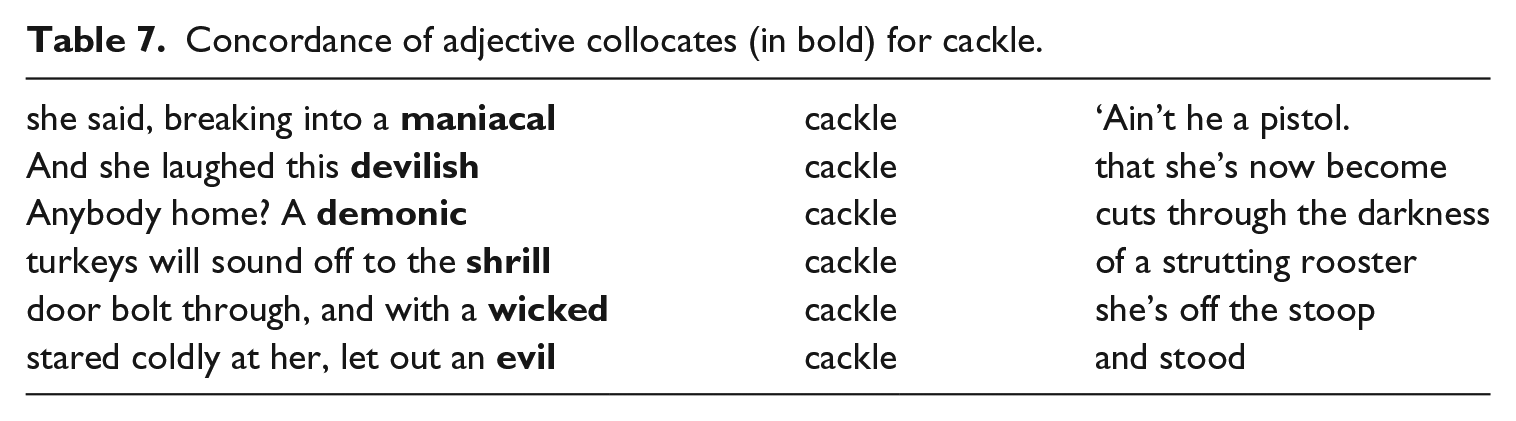
Notably, the negative adjective collocates of ‘cackle’, ‘wicked’ and ‘evil’ are also the two strongest adjective collocates for the noun ‘witch’ (MI scores of 9.13 and 5.01, respectively) – the persona I argue is indirectly indexed by the term ‘cackle’. In fact, both ‘witches’ and ‘hens’ are the strongest noun collocates of ‘cackle’ (7.08 and 8.88, respectively). While ‘hens’ are part of the denotative meaning of ‘cackle’ offered by dictionaries, ‘witches’ are not. This is consistent with the idea that ‘cackle’ directly indexes the act characteristic of hens, an act that has come to be associated with witches (via indirect indexicality), and which in turn has become gendered through a process of inference (since a very reasonable inference to draw is that witches are women).
Turning to the mass media representations of Clinton’s laughter, both the negative semantic prosody of the term ‘cackle’ and its indirect association with witches were simultaneously evoked by the term’s use.
11
For example, numerous representations alluded to or depicted Clinton as the Wicked Witch of the West (from The Wizard of Oz), a fictional character, but also a quintessential emblem of women politicians who occupy powerful leadership positions.
12
This association was often made explicit in television and print news coverage. Excerpt 3 stands as but one example. It entails commentary by conservative pundit and then-host of his own TV program, Glenn Beck: (3) Glenn Beck, 7 October 2007 America’s starting to pay attention to the real issues that America faces, namely Clinton’s laugh. I’ve never noticed it but critics have. They’ve called it, and I’m quoting ‘less of a laugh and more of a cackle’.
Beck reproduces a characterization of Clinton’s laugh as a ‘cackle’ in a way that draws attention to its indirect association with witches, while at the same time he purports not to be doing precisely that. That is, he suggests that likening Clinton’s laugh to the Wicked Witch of the West is ‘a little unfair’, but he then proceeds to make this association anyway (note the strategic use of self-initiated repair in introducing the clip of Clinton: ‘here’s the wick- uh the junior Senator from New York’). And, in re-playing a decontextualized clip of a single instance of Clinton laughing, immediately following a clip of the Wicked Witch of the West doing so, the indirect association between Clinton and this unflattering negative persona is made explicit.
This indirect process by which Clinton’s laughter took on the unflattering gendered meanings indexed by the term ‘cackle’ is vividly illustrated – and deconstructed – in the lead to an article appearing in The Boston Globe: ‘Hens cackle. So do witches. And so does the frontrunner in the Democratic presidential contest.’ In terms of the structure of news stories, while leads characteristically cover the central event of the story by introducing key information – on participants and/or setting – of the event in question (Bell, 1998), they may also do so with a particular ‘evaluative accent’ (Voloshinov, 1973). In this particular lead, the ‘event’ in question is offered with an evaluative orientation that speaks to the central issue involved in indexical processes of meaning making. ‘Hens cackle’ directly indexes the denotative meaning of the term. ‘So do witches’ extrapolates the indirect association that the term evokes, while ‘And so does the frontrunner in the Democratic presidential contest’ goes one step further by tying this association directly to Clinton, but in a way that also highlights her frontrunner status at the time. Thus, the mapping of this negative, gendered, social meaning onto linguistic form is brought to the fore in one fell swoop. Over time, as this ‘cackle’ characterization of Clinton’s laughter traveled across discursive contexts and was subject to processes of decontextualization and recontextualization (Romaniuk, 2014), the connection between ‘cackle’ and Clinton (and not just the indirect indexical ‘witches’) became so strong that, I argue, even that association came to be ideologically perceived as direct (cf. Bucholtz, 2009; Ochs, 1992).
To capture the strength of the association between Clinton and ‘cackle’, consider the images in Figure 1, which depict visual representations of ‘cackle’ appearing in Google’s search engine, nine years after the ‘original’ media coverage on the ‘Cackle’ occurred.

Visual representations of ‘Cackle’.
As Hill (2005) has argued, Google technology provides a powerful lens for exploring dimensions of indexicality, given that it can illustrate how non-linguistic semiotic elements of representations can co-occur with linguistic ones. The search result images clearly illustrate the indirect indexical association of ‘cackle’ with an undesirable, negative witch-like persona—the first and fifth images depict the iconic visual representations of witches, as well as the word ‘witch’ itself (sixth). Of greater significance is the fact that these images also communicate a strong semiotic association between the term and Clinton specifically. Indeed, the visual signifiers of ‘cackle’ to this day include Clinton, depicted in arguably unflattering ways, alongside images of (unflattering) witches.
According to Lim’s (2009) analysis of gendered metaphors of women in powerful positions, the Witch is ‘the most resented breed of Unruly Woman’ (p. 263). She writes, ‘the Witch is in open rebellion with society and God (the guardian of social norms). She is not just dehumanized and animalized like the Bitch is, but [also] demonized’ (p. 263). With each repetition of the ‘cackle’ re-presentation, the media thus contributed to the demonization of Clinton’s persona by recontextualizing her laughter in powerfully negative ways, consistent with dominant gendered ideologies. In many ways, Clinton was, and arguably still is, a woman in ‘open rebellion’ with a patriarchal government and society by virtue of seeking leadership in the White House – what feminist scholars contend remains a ‘bastion of masculinity’ (Anderson, 2002: 105). In doing so, Clinton defied gendered norms and expectations about ‘femininity’, and, consistent with research on gender bias and leadership (Eagly & Carli, 2003; Gordon and Miller, 2001), this opened her up to negative portrayals in the media. In terms of the ‘Cackle’ coverage, Clinton’s laughter was evaluated in terms of a dominant, cultural script for powerful, competent women vying for leadership positions steeped in masculine hegemony – a script in which women are damned no matter what they do. By way of characterizing Clinton’s laughter as ‘inappropriate’, the media re-presentations helped to reinforce the ideological belief that Clinton’s bid for the White House was also inappropriate. The implication of such a re-presentation is that a powerful woman (i.e. a witch) is more fitting in a fairy tale than in the real world of American presidential politics.
What this analysis reveals, then, is that, in spite of Clinton’s laughter being a generic interactional practice – one employed by other male politicians in broadcast news interviews – it was ultimately perceived and evaluated by others in gendered, and even sexist, ways in the media and public discourse more generally. This suggests that there may be a range of other implicit and indirect processes through which women are culturally coded as gendered subjects, even when the practices they engage in and the actions they produce have little or nothing to do with gender.
Conclusion
This case study began by comparing Hillary Rodham Clinton’s laughter with that of other politicians, and then it analyzed the media’s recontextualization of Clinton’s laughter as a gendered re-presentation in the context of her failed bid for the Democratic nomination in 2007–2008. It combined different approaches to investigating talk and text: first, I used the tools of CA to examine the interactional work accomplished by laughter in situ (i.e. in the broadcast news interviews in which Clinton and other politicians participated); I then employed an indexical approach to analyze the post-hoc recontextualization of Clinton’s laughter as a gendered re-presentation by the mainstream media. In analyzing these two dimensions of Clinton’s laughter – its deployment in talk-in-interaction and its subsequent representation in talk-out-of-interaction – this study makes a distinctive contribution to the ongoing methodological and theoretical debate introduced at the outset of this article: when it is relevant for analysts to make claims about social categories such as gender in their analyses of discourse. Specifically, with regards to the conversation analytic notion of ‘participants’ orientations’, this study contributes to this debate in at least two ways: first, in terms of who may count as a ‘participant’, and second, in terms of what may count as an ‘orientation’.
In terms of ‘Who may count as a participant?’, if we consider the nature of the interactional component of my analysis, broadcast news interviews are communicative events in which talk is produced as a public, enduring and consequential form of public discourse, ultimately designed for mass audiences as recipients. Given this distinct participation framework, I propose that members of that audience may constitute ‘other’ relevant participants (cf. Blommaert, 2005; Ehrlich, 2012). And, since media representations of broadcast news interviews are a significant source of information for these ‘other’ participants, such post-hoc accounts of talk-in-interaction are another form of discourse in which gender may be made relevant in consequential ways for ‘original’ participants. For analysts interested in how gender may become relevant in talk-out-of-interaction, then, the results of this study support earlier discourse analytic work that has suggested an ‘expanded notion of participant’ may be warranted in investigating certain forms of discourse data (Ehrlich, 2007).
In terms of ‘What may count as an orientation?’, although there seems to be consensus regarding gender’s relevance when it is oriented to explicitly in interaction, my work joins other feminist, critical, or discourse analytic scholarship in providing another account of how gender’s relevance can be accomplished indirectly. That is, in arguing that the gendered meanings associated with the term ‘cackle’ requires going beyond its conventional meaning, and taking into consideration the term’s indexical associations (associations which trigger gendered inferences), such an approach necessarily involves considering culturally available assumptions that become activated by a term’s use.
Finally, considering the nature of communicative acts and the fact that they can be turned into ‘texts’, such acts can move across contexts and may be decontextualized and recontextualized in that process. The transformations in meaning that may occur can be substantially different from what speakers intend, and may also be implicated in larger forms of social inequality (cf. Blommaert, 2005; Ehrlich, 2012). This is precisely what I have argued to be the case regarding the meaning of Clinton’s laughter, given that it was reshaped and reinterpreted in disturbing ways as it travelled across contexts (see also Romaniuk, 2014). While many scholars of discourse tend to focus on either talk-in-interaction or talk-out-of interaction, consider this divide in relation to the present study. That is, to look only at the media representations of Clinton’s laughter, we could see how her laughter was being represented in sexist terms (i.e. as a ‘cackle’, alongside other negative, gendered associations), but we would not know that it wasn’t an idiosyncratic feature of Clinton or that men and women politicians engage in this practice in similar ways. Similarly, to look only at the source interactions, we could identify the systematic and generic nature of the practice of laughing during or in response to serious questions in broadcast news interviews, but we would not see how the practice is coded as gendered when performed by a woman. It is by combining an interactional analysis of Clinton’s and others’ laughter in talk-in-interaction with an analysis of the representations of this laughter out-of interaction that we are able to see how negative, gendered meanings can be ascribed to practices that are not in and of themselves gendered. And this stands as but one example of the extent to which cultural norms and interpretations of gender have shaped – and continue to shape – women’s success (or lack thereof) in the public domain of politics. It remains for future research to continue to explore the complex, myriad ways in which gendered meanings arise from within and outside of contexts of interaction.
Footnotes
Acknowledgements
I would like to thank the audience members who offered their contributions when I presented portions of this work at the Center for Language, Interaction, and Culture (CLIC) Conference at the University of California, Los Angeles in 2012, the International Pragmatics Association (IPrA) Conference in Manchester in 2011, and the Laughter and Humor in Interaction International Conference in Boston in 2011. Thanks especially to Susan Ehrlich, Steve Clayman, Chuck Goodwin, Federico Rossano and Jack Sidnell who have all had a profound influence on this work at various stages, and to an anonymous reviewer for helpful comments on an earlier version of this manuscript.
Declaration of conflicting interests
The author(s) declared no potential conflicts of interest with respect to the research, authorship, and/or publication of this article.
Funding
The author(s) disclosed receipt of the following financial support for the research, authorship, and/or publication of this article: This work was supported by the Social Science and Humanities Research Council (Ref. 752-2009-2062).