




Abstract
Research has shown that immigrants tend to be negatively constructed in the discourse of the media. In the context of the European Union (EU), British newspapers reportedly offer largely negative or partial constructions of these individuals. These representations contribute to jeopardizing the integration of this group of people, as their social construction reflects and influences the attitudes of EU citizens and the immigration policies. Our research examines the collocational profile of the lemma ‘migrant’ in the UK legislation and UK Administration informative texts from 2007 to 2011. While our results show that the UK Administration avoids an explicit negative construction of immigrants coming to the United Kingdom, we have found that they are partially constructed as a homogeneous, well-categorized group through an extremely limited set of lexical items that tend to prime their adscription to tiers. We argue that the representation of immigrants in the legislation points to the fact that UK laws and official information during the period 2007–2011 were more focused on legitimating the control over this group of individuals than on creating the conditions for better integration policies.
Keywords
Immigration poses formidable challenges for most Western countries and particularly for the European Union (EU), where both national and non-EU nationals share a free-movement labour market. A 2013 report with the title Europe’s Societal Challenges: An analysis of global societal trends to 2030 and their impact on the EU 1 highlighted the fact that the integration of immigrants would work towards more cohesive societies as long as immigrants are not seen as a burden on welfare systems and a threat to the cultures of those countries that receive them. In this sense, the effective integration of immigrants is seen as key by the EU, which, among other measures, has launched an immigration portal 2 where it is stressed that EU rules aim to make it easier to come to the EU legally. This is manifestly part of a larger effort to prevent illegal immigration and its consequences. The European Website on Integration 3 reflects that the mandate to promote the integration of immigrants derives from the treaties of the European Union, the Charter of Fundamental Rights, the European Council multiannual programmes and the Europe 2020 strategy. It appears that the EU is sending a clear message that integration stems from high-level policy-making stakeholders and institutions.
Yet actual integration of immigrants presents enormous challenges. Given the current economic situation (Creighton et al., 2015) in the EU and the enduring effect of the economic crisis that started back in 2007, integration may be at risk. Additionally, political as well as attitudinal factors may have a negative impact on how actual integration of immigrants takes place. The Europe 2020 strategy, for example, sets out to implement targeted migration and integration policies that can facilitate the removal of barriers to occupational and geographical mobility of workers. In this strategy, legal migrants are specifically targeted as members of vulnerable groups entitled to specific market entry policies, equal pay and social benefits. However, governments may not be paying special attention to these policies.
In this context it is necessary to ponder how national worries are influenced by citizens’ perception of immigrants and their integration, as there is a growing concern over immigration across the EU and, in particular, in the United Kingdom. Research has shown that some groups of migrants are typically represented by tabloids and the regional press as a threat to the UK tax payer or as being responsible for unlawful behaviour in the case of Italy (Taylor, 2014). Are immigrants therefore perceived as a threat by EU citizens? If so, integration of immigrants may be at risk. The Eurobarometer poll data have tracked the percentage of respondents who have listed immigration as the most important problem facing their countries. In May 2015, 4 35% of the respondents in the UK said it was immigration, 28% said it was health and security, while 22% answered that the main problem facing the UK was unemployment. In the same Eurobarometer, immigration was perceived as the main problem facing their countries by 23% of the population of the EU-28, while 42% said unemployment was the main problem. In Spain, for example, only 6% of the population rated immigration as the main problem, while 74% believed it was unemployment. All in all, the mean percentage for the EU-27 from autumn 2005 to autumn 2012 remained relatively stable at 9%. However, in the spring 2006 poll data, 14% of EU-27 citizens said immigration was the most important problem in their countries. In the autumn poll that year, the number of people expressing that concern rose to 21%.
While the representation of immigrants in the UK press ‘paints a picture of media coverage as a plausible contributor to public opinion toward immigration’ (Blinder and Allen, 2016: 31), it remains to be seen whether the Administration and the national legislation contributes in any way to the citizens’ apparently negative attitudes towards immigrants and immigration. In this vein, Blinder and Allen (2016) stress that ‘media constructions may harm integration by alienating migrants and members of settled minority communities with social or psychological ties to migrant groups’ (p. 32). Research shows that this has already happened in the past. In the context of the immigration debate in California, Mehan (1997) argued that the state and the elites promote a ‘discourse of divisiveness’ (p. 268) that ultimately directs ‘our gaze inwards, constructing an economic enemy, one who lives among us, but is not part of us’ (p. 267). This author maintains that the Mexican immigrant was deliberately constructed by proponents of Proposition 187 as the enemy. We wonder then whether a ‘largely negative’ construction (Leudar et al., 2008: 188) is similarly found in legal and official texts produced by the UK Parliament and Administration.
This article examines how the UK Administration constructs immigrants across two different textual typologies: the legislation passed by Parliament on one hand, and the immigration-related informative texts produced and distributed by governmental agencies on the other. We have adopted here a broad view of the scope of the term Administration to include both the state legislative and executive powers. In doing so, we want to examine how immigrants are publicly depicted by two of the most important powers in the UK political system, that is, the Parliament and the government. In this context, the exploration of legal texts and the discourse of administration offer new opportunities (Shuy, 2003) to examine how the state deals with specific social issues.
Our analysis draws on the analytical procedures in Baker et al. (2008, 2013b: 255) using ‘corpus linguistics and discourse analysis to examine patterns of representation’ around the lemma ‘migrant’ in two corpora of UK immigration legislation and informative texts produced by the UK Administration in the period 2007–2011. By making use of a corpus-driven methodology, we set out to discuss how language patterning adds to the incremental effect of discourse (Baker, 2006). Looking at how the lemma migrant is profiled collocationally, we aim to uncover how it is primed in discourse, a finding that is not immediately apparent if corpora and corpus linguistics methods are not in place. The data used in our research include texts that were produced in a context where immigration was perceived by 40% of the UK citizens as the most important issue in their country in the September 2006 Eurobarometer. Our research questions can be put in the following terms: What does a collocational analysis reveal about the UK Administration’s construction of immigrants? Can these collocations be thematically categorized? By complementing this analysis with relevant critical discourse analysis (CDA) methods, we will be in a position to shed some light on how UK immigration laws and official texts construct the immigrant population in the UK.
In the next sections we will offer some context to the debate over immigration in the EU and discuss how immigrants have been represented in public discourse during this century. We will then explain our research methods and discuss our results and main findings.
The representation of immigrants in public discourse in the early years of the 21st century
In the following paragraphs we will offer some insight into both the current debate on immigration, especially in the context of the EU, and the analysis of the representation of immigrants in public discourse.
The context for the debate on immigration in the UK and EU in the second decade of the 21st century
In June 2010 the European Council recommended that the UK adopt better integration policies for legal migrants. Despite this recommendation, the UK did not expressly address the migrant question on the UK National Reform Programme 2015. 5 The UK is not alone in this. The Spanish National Reform Programme 2015 6 only mentions immigration in passing when providing figures that show the extent of the austerity measures implemented by the central government. In this particular case, the immigration issue was brought up because four regional governments had decided to get rid of their immigration observatories for the sake of budget restrictions, not because reforms were implemented so as to secure better integration policies. The previous lines may suggest that national governments are more concerned with internal political pressures, such as the economy, than with implementing EU transnational policies such as the ones in the 2020 strategy.
According to the EUROSTAT May 2015 report, 7 3.4 million people immigrated to one of the EU-28 member states during 2013. A total of 1.4 million were citizens of non-member countries, where 1.2 million were immigrants with citizenship of a different EU member state from the one to which they immigrated. Germany reported the largest number of immigrants (692,700) in 2013, followed by the UK (526,000), France (332,600), Italy (307,500) and Spain (280,800). The largest numbers of non-nationals living in the EU member states on 1 January 2014 were found in Germany (7.0 million persons), the UK (5.0 million), Italy (4.9 million), Spain (4.7 million) and France (4.2 million). In 2007 Spain had reached an immigration rate of 10% of the population. In the UK this rate was 8.1% that year and had already reached 320,000 non-EU citizens getting to the UK in 2005, according to the Office for National Statistics. 8
The Europe’s Societal Challenges report identified that increasing immigration pressure from African and Asian countries would necessarily call for better-crafted immigration laws that could eventually facilitate immigrant workers ‘right across the skill spectrum’ in gaining more flexibility – among other things, to change employers and location. This would ultimately contribute to scenarios where diversification is accepted and tensions are eradicated. However, different researchers have identified that immigrants are portrayed in ways that contribute to the creation of a climate of fear and rejection of these groups. This would be counterproductive for policy-makers, EU citizens and immigrants alike across the UK.
Representing immigrants in public discourse
Research in the last years of the 20th century dealt with the representation of immigrants in public discourse, mainly in the context of racist discourse (Van Dijk, 1992) and political speeches (Van der Valk, 2003). Santa Ana (1999), for example, found a conceptual correspondence between immigrants and animals in the context of the 1994 political debate and campaign in California over an anti-immigrant referendum, Proposition 187, already discussed in the introduction of this article. The author examined 107 articles dealing with undocumented immigrants published in the Los Angeles Times over a period of two years (1993–1994). Santa Ana found that her results were consistent with previous findings that unveiled the metaphorical use of language as an instrument of social control for institutions. A few years later, Charteris-Black (2006) explored the role of metaphors in the building of legitimacy of the right wing in the 2005 UK election campaign from a cognitive perspective. The author found that two concepts emerged: immigration as a natural disaster and Britain as a container. Both conceptualizations are related as they involve ‘a bounded area’ where ‘controlling immigration through maintaining the security of borders […] will ensure control over the rate of social change’ (p. 579). Charteris-Black (2006) highlights differences between far-right and centre-right discourses: while the former tends to see immigration as a disaster, the latter sees the immigration system as disastrous.
Flowerdew et al. (2002) examined the discriminatory discursive practices of 80 articles in the South China Morning Post, a Hong Kong newspaper, from 30 January 1999 to 19 August 2000, against Chinese mainlanders who claimed the ‘right of abode’ in Hong Kong. The authors developed a composite taxonomy integrated by four categories of discourse strategies typically used to represent this group of people, namely, negative other presentation, scare tactics, blaming the victim and delegitimation. Their findings highlight a tension between the news in the newspaper, which clearly exhibits discriminatory discourse, and the editorials, which tend to be more sympathetic with the mainland Chinese immigrants. According to the authors, ‘this raises the question as to whether it is the news stories or the editorials that represent the true institutional ideology of this influential Hong Kong newspaper’ (p. 24).
Baker et al. (2008) analysed the representation of asylum seekers, refugees, immigrants and migrants in the British press. The authors found that these four terms were used as near synonyms in their corpus. This finding is based on the evidence that there was a significant overlap of collocates between refugees/asylum seekers and immigrants/migrants. In their study, immigrants are associated with very few categories, such as entry and economic threat. Migrants are associated with transit, entry, residence, economic threat and legality. However, ‘migrants’ is identified with ‘an overall positive use’ (p. 288). Taylor (2014) used both corpus linguistics and discourse analysis methods to understand the representation of immigrants in both the Italian and the UK press. Some of the papers in Blinder and Allen (2016) under the mid-market label are here categorized as tabloids, specifically the Daily Mail and the Express. For the English subcorpus, the author used the following search terms: refugee, asylum seeker, immigrant and migrant. Taylor (2014) identified geographical nationalities that are foregrounded in the two corpora and used a moral panic frame to analyse these occurrences. In the UK broadsheets and the Italian national newspapers, those receiving media attention are mainly asylum seekers, whereas in the UK tabloids and the Italian regional papers ‘the foregrounded nationalities were more likely to be negatively represented’ (p. 395). It is noteworthy that in the case of the UK press the foregrounded immigration population was that of Afghans, whereas for the Italian press it was Nigerians who were most frequently represented in terms of unlawful behaviour.
Blinder and Allen (2016) investigated British news coverage of migration from 2010 to 2012 and ‘identified frequent patterns that emerged bottom-up from analysis of consistent collocations’ (p. 31). For these authors, the news media ‘construct the notion of immigration in selective and incomplete ways, and [that] public understandings of immigration then draw upon these partial constructions’ (p. 31). By examining noun phrases such as immigrants and asylum seekers, they were able to uncover particular language uses across a range of British newspapers from tabloids to mid-markets and broadsheets. The pre-modifier illegal was found to be the word that most frequently collocated with immigrants. In particular, the string illegal immigrants occurred 99 times in every 1000 occurrences of immigrants in mid-market papers, while this string occurred 50 times per 1000 occurrences in broadsheet papers. Blinder and Allen (2016) maintain that ‘by frequently describing immigrants as illegal, the British national press is constructing a particular conception of immigration that (1) highlights the issue of legal status and (2) depicts immigrants as law-violators’ (p. 16). As for asylum seekers, they are systematically depicted as failed, especially in mid-market newspapers and in the context of legal status and law enforcement. Interestingly, the authors confirm the findings of Gabrielatos and Baker (2008) that illegal emerged as a collocate of asylum seekers despite its absurdity. More shocking, perhaps, is to discover that this use is more frequent in broadsheets than in mid-market papers. Leudar et al. (2008: 187) use the term to describe those asylum seekers who have seen their application to become a refugee in the UK rejected. Apart from examining the construction of these people in the UK press, the authors interviewed local UK citizens as well as six refugees/asylum seekers in Manchester, UK, during 2003 and 2004. The environment is described by the authors as ‘mostly hostile’ (p. 204), as evidenced by the hostility themes foregrounded in the media. They believe that hostility and stigmatization of refugees/asylum seekers are ‘socially coordinated’ and mainly set off by the government (p. 215). Lynn and Lea (2003) examined the letters written to British national newspapers, both tabloid and broadsheets, by members of the public pertaining to the issue of asylum from March to December 2001. These letter writers were concerned with telling genuine from bogus asylum seekers and the differentiation of the other. The authors conclude that there is certainly a discourse that constructs asylum seekers and those who represent them as ‘threatening the rights and welfare of UK citizens’ (p. 446).
Other researchers have confirmed Lynn and Lea’s (2003) as well as Leudar et al.’s (2008) findings in different contexts: Kim’s (2012) subtle racial prejudice analysis in Korean media discourse, Burke and Goodman’s (2012) study of discussions about asylum seeking on Facebook, Lueck et al.’s (2015) representation of immigrants in Australian news media and Burroughs’ (2015) analysis in Irish newsprint media. However, negative constructions of immigrants are not only found in the discourse of media. In Italy, Perrino (2015) studied humour making in small circles and has found that ‘mocking migrants in Veneto dialect […] sharpens the ideological boundary between “us” and “them,” serving as one more defence against people constructed as neither Italian, nor citizens’. In the USA, Carter (2014) found that, in the context of a middle school in North Carolina, ‘the marginalization of minority immigrant students in “new” US Latino communities is already over determined by pre-existing social structures’ (p. 236).
For Khosravinik (2009), the negative representation of RASIM (refugees, asylum seekers and immigrants) in the British media ‘draws on […] common topoi including numbers, threat (threat to cultural identity, threat to community values) and danger’ (pp. 493–494) and highlights how these individuals are ‘systematically constructed as a homogeneous group, sharing similar characteristics, backgrounds, motivations and economic status through processes of aggregation, collectivization and functionalization’ (p. 494). The press, in this case the British press, apparently tends to construct minorities by selecting a very restricted set of lexis that focuses on some salient lexical-driven topoi. Baker and Levon (2015), using both corpus linguistics as well as CDA methods, found that Black men are represented most frequently as ‘suspected or actual criminals due to the presence of [certain] collocates’ (p. 8), while Asian men were constructed around sexual grooming.
In the next sections we will outline our research methodology and will try to shed some light on the nature of immigrants’ constructed identities by the UK Administration.
Data and methods
The data used in this article derive from a larger corpus of public domain texts produced by different public administrations during the period 2007–2011. This is part of a broader project on immigration and administrative language, LADEX, whose family of corpora was compiled to meet the aims of different researchers, from terminology analysis to discourse studies. LADEX encompasses four languages (English, French, Italian and Spanish) and their corresponding legal systems. LADEX, therefore, looks at the texts produced by different administrations in a context where immigration was beginning to be perceived as the main problem by an increasing number of people, which may prevent the opportunities for integration that were considered as key by the EU institutions.
Based on extensive work in Spanish administrative language, the LADEX team developed a textual taxonomy that was used as the benchmark for the compilation of the data for the four languages involved. Thus, every national LADEX corpus includes texts from five different broad domains: national immigration law (EN-1), instruments (letters, appointments, etc.) issued by the Administration and addressed to individual citizens (EN-2), informative texts produced by the Administration on immigration and immigration-related procedures (EN-3), documents produced by the Administration and submitted to administrative bodies and institutions (analyses of consultation responses, etc.; EN-4) and finally, documents submitted by the citizens to the administration (claim forms, application forms, etc.; EN-5). Table 1 shows the main features of the LADEX English corpus, including the total number of words, types (different words in the corpus) and number of texts in each corpus.
The LADEX English corpus (2007–2011).
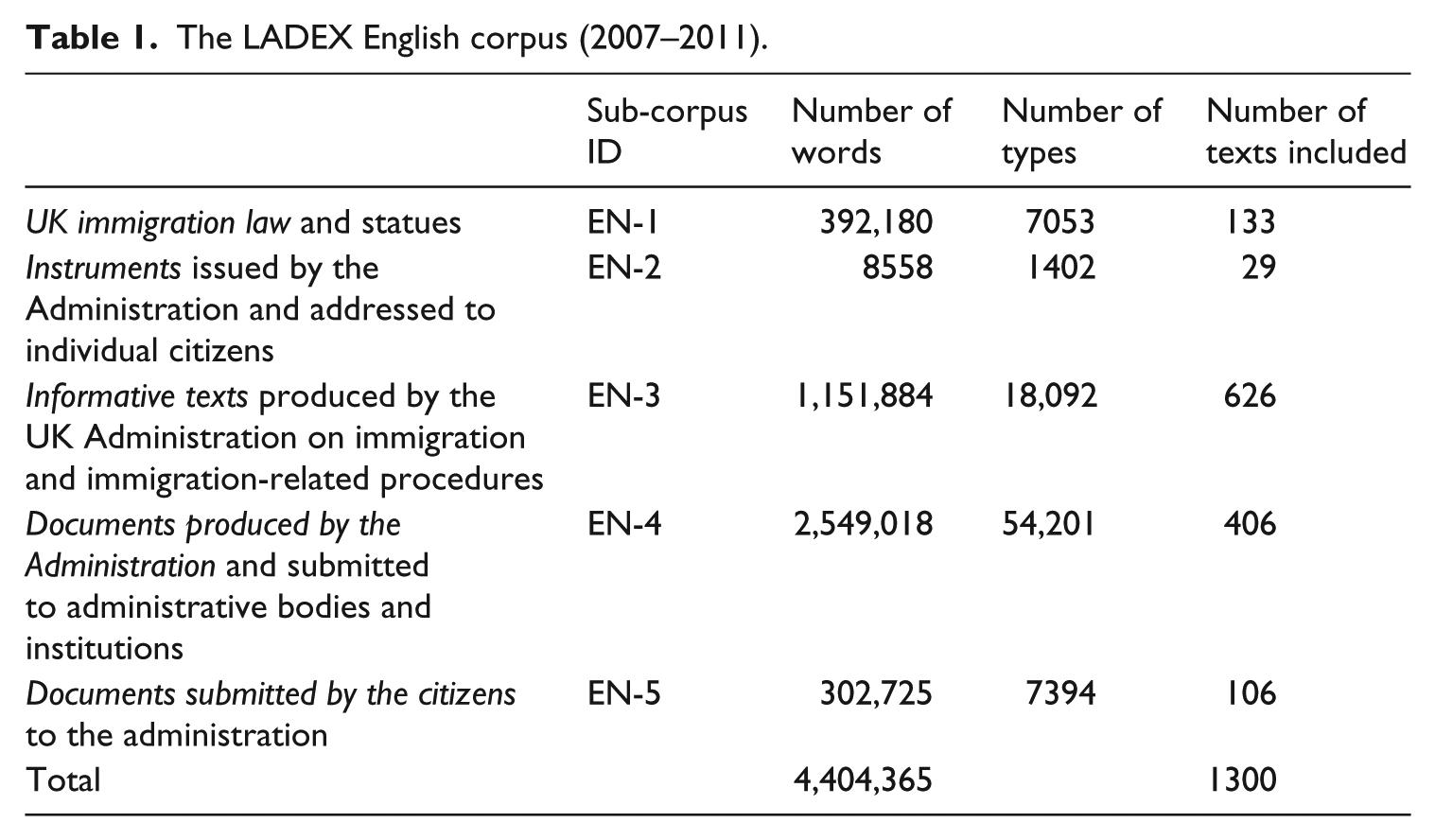
In our research we will examine the construction of the immigrant in the UK in two of the subcorpora above: immigration legislation (LADEX EN-1) and informative texts produced and published by the UK Administration (LADEX EN-3). The two data sets vary considerably in scope and size. LADEX EN-1 includes all the legislation on immigration passed by the UK Parliament from 2007 to 2011. LADEX EN-1 includes, for instance, the Criminal Justice and Immigration Act 2008, or statutory instruments such as The Immigration, Asylum and Nationality Act 2006 (Commencement No. 7) Order 2007 or The Immigration (Designation of Travel Bans; Amendment No.6) Order 2011. The latter was revoked by SI 2012/1663, Art 3, Sch 2, as from 3 July 2012, but it remains part of our corpus as the text in question meets the eligibility criteria for inclusion in this corpus. In total, LADEX EN-1 includes 133 different texts. LADEX EN-3 includes, for instance, electronic texts and leaflets published by the UK Borders Agency, and other UK bodies, on a wide range of matters concerning immigration, such as entry clearance for retired persons or instructions for port cases involving prosecution; guides on how to act in case of, for example, racial harassment; 2008 information factsheet for refugee parents; guides on work permits and guidance for employers; guidance leaflets to be used for applications made, for example, on or after 1 June 2009; or news published by the Office of the Immigration Services Commissioner. In total, LADEX EN-3 includes 626 different texts. These texts are representative of the information available on official websites of immigration-related agencies, although we cannot claim that all of the texts published by these bodies from 2007 to 2011 are part of our corpus. The texts were collected during the first semester of 2012, and those whose publication date could not be checked on the metadata were discarded. All things considered, 81% of the texts in LADEX EN-3 were produced and published by the UK Border Agency, while the rest were authored by, among others, the Refugee Council or the Ministry of Justice.
Research question and first data queries
Following Baker et al. (2008, 2013a, 2013b), who used the word ‘Muslim’ to research the representation of Muslims in the British press, we first used ‘immigrant(s)’ and ‘migrant(s)’ as the terms to query our corpus data. This approach can be described as corpus-driven as we did not select examples from the corpus to illustrate our claims; instead, we were driven by the way in which the repetitive occurrences of salient word associations, that is, collocates, provided evidence of ‘underlying hegemonic discourse’ practices (Baker, 2006: 13). This query soon revealed that in the context of the language used by the UK Administration, the lemma ‘immigrant’ is almost never used. It was not found on LADEX EN-1 at all, and it occurred only nine times in LADEX EN-3, mainly in the document Prevention of illegal working: Guidance for employers on the avoidance of illegal working and in some press releases of the Office of the Immigration Services Commissioner that reported advisers sentenced for providing advice to illegal immigrants. Half of these occurrences are connected with Pakistani immigrants. A keyness analysis 9 (Rayson, 2008, 2009) confirmed that ‘migrant’ is a salient lexical item in our data. ‘Migrant’ was overused in the UK immigration law migrant corpus (log-likelihood (LL): 8.05) when compared with the British English 2006 (BE06) corpus of 929,862 words from published general written British English. 10 This is statistically significant as 6.63 is the cut-off for 99% confidence of significance. ‘Migrants’ is similarly overused (LL: 5.91 11 ). ‘Migrant’ was overused in the UK Administration informative texts (LL: 8.03) when compared with British English 2006 (BE06). This is statistically significant. ‘Migrants’ is similarly overused (LL: 5.44), although it is not statistically significant.
The selection of the most relevant words used to construct a given set of people (Gabrielatos, 2007) facilitates answering the general research question in this article: What does a collocational analysis of the lemma ‘migrant’ reveal about the construction of this group? We have used a combination of corpus-driven and qualitative methods (Baker et al., 2008) to gain a better understanding of how immigrants are constructed in texts produced by the UK Administration. These qualitative methods include the examination of concordance lines and the identification of categorized collocates and topics. After an initial collocational analysis, we examined how the most frequent collocations of ‘migrant’ provide a strong indication regarding the main topics indexed by the use of this word (Baker et al., 2013b: 261). This analysis was used as the basis for the elaboration of the categories which allow for the representation of this group of people in our two data sets. We used Sketch Engine (Kilgarriff et al., 2014) for our preliminary collocation analysis and for the generation of the so-called word sketches. Following Baker et al. (2008), our study is interested in the ways in which other presentation is manifested through the use of linguistic indicators.
Results
In the following paragraphs we will report the collocational and grammatical profiles of the lemma ‘migrant’ in the UK legislation and the informative texts corpora.
Migrants in UK legislation (2007–2011)
Collocations of migrants in UK legislation
Table 2 shows the most frequent collocates of the lemma ‘migrant’ in the LADEX EN-1 corpus ordered according to the logDice 12 statistic. We have included here only those collocates with a logDice of 10 or above.
Most frequent collocates of the lemma ‘migrant’ in LADEX EN-1.

MI: Mutual Information Score.
‘Tier’ stands out as the word that collocates most strongly with migrants, such as in the following excerpt:

According to the UK Administration, 13 the Tier 1 (General) category is aimed at migrants who wish to engage in highly-skilled employment in the UK. Successful applicants are free to seek employment without having a sponsor or to take up self-employment/business opportunities in the UK. At the time of writing, this Tier is now closed to overseas applicants. Other words in the list of collocates like ‘general’, ‘temporary’, ‘worker’, ‘entrepreneur’, ‘system’ and ‘points-based’ are all connected with the classification of immigrants in Tiers:

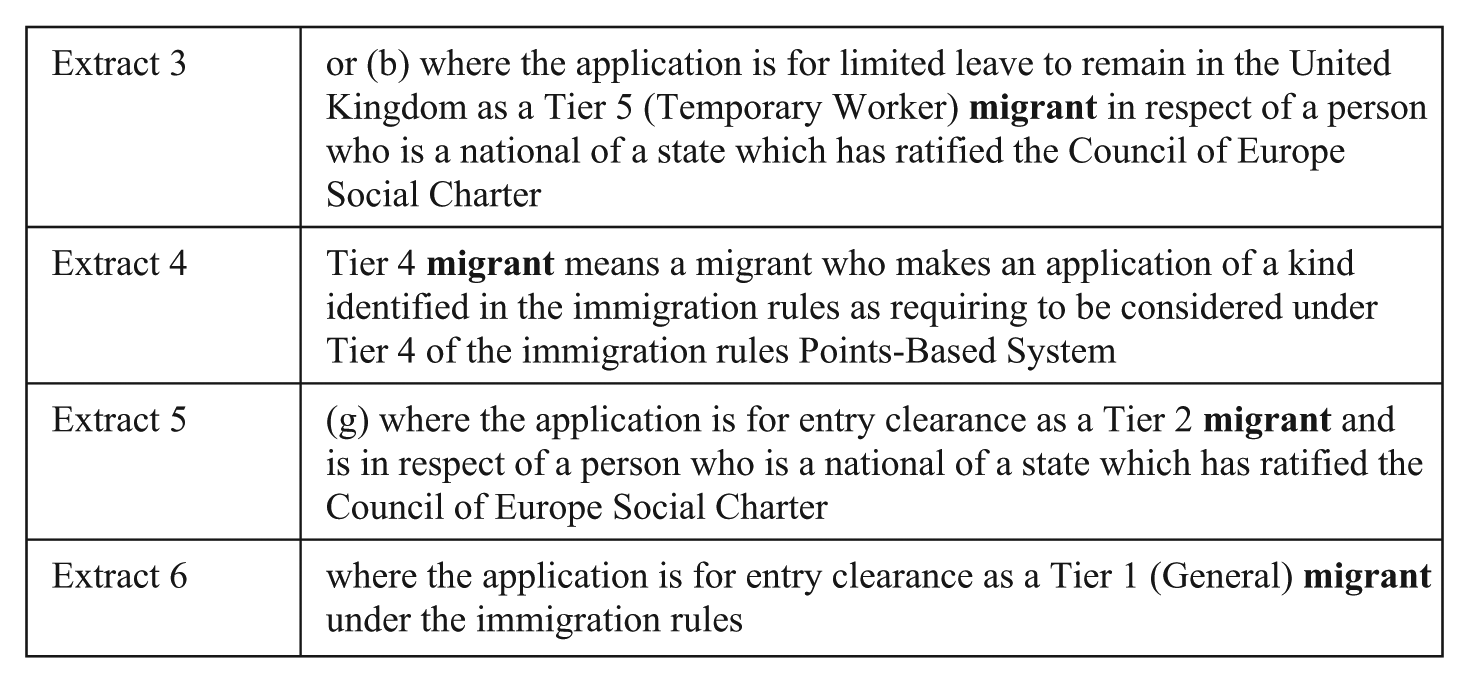
Even the numbers ‘5’, ‘4’, ‘2’ or ‘1’ are part of the pre-modification of migrants in the noun phrase as shown in the following extracts:
Word sketches of migrants in UK legislation
In the following paragraphs we will discuss how migrants are profiled in the two data sets analysed. We will use the Word Sketch function in Sketch Engine (Kilgarriff et al., 2014), which has already been used, for example in the profiling of Muslims in the British press (Baker et al., 2013b). A word sketch is, in short, a set of the grammatical relations of a given word or lemma which offers ordered lists of high-salience grammatical relations. By examining a word sketch, we can capture the complex web of grammatical relationships which a given word or lemma displays in a corpus.
In the UK legislation corpus, migrants are grammatical subjects of an extremely limited number of verbs, including ‘make’ (10.53), ‘refer’ (10.39) and ‘mean’ (10.3). In our data, when migrants are grammatical subjects in clauses, they only ‘make’ applications, are almost exclusively ‘referred to in regulation’ and ‘mean a migrant that makes an application’. When they are grammatical objects, in 95% of the concordance lines examined, the verb is ‘mean’ (10.61). In the remaining 5%, migrants are the objects of ‘remove’. Migrants are exclusively pre-modified by ‘skilled’ (13.99), typically in the string ‘a highly skilled migrant’, and post-modified by the prepositional phrase ‘under the immigration rules’ (under, 13.07). Migrants are followed by ‘respect’ (7.98) in the string ‘in respect of’ in contexts where the scope of a regulation is specified. Finally, when it comes to coordinated or adjacency structures, migrants tend to appear next to ‘Tier’ (13.42) in 60% of the concordance lines examined and next to ‘fee’ (11.81) in 38%.
Migrants in UK Administration informative texts (2007–2011)
Collocations of migrants in UK Administration informative texts
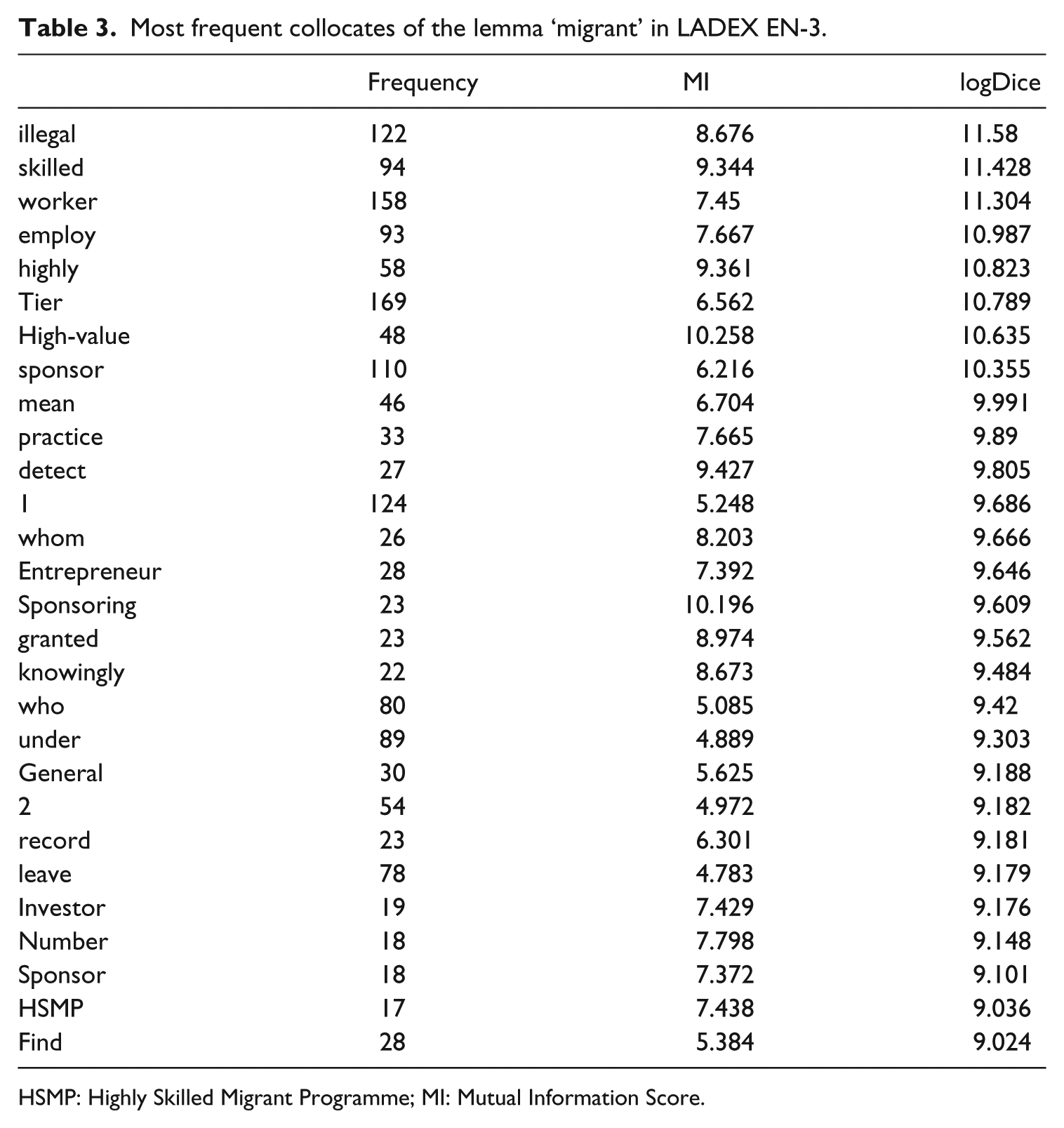
Table 3 shows the most frequent collocates of the lemma ‘migrant’ in the LADEX EN-3 corpus ordered according to the logDice statistic. We have included here only those collocates with a logDice of 9 or above.
Most frequent collocates of the lemma ‘migrant’ in LADEX EN-3.
HSMP: Highly Skilled Migrant Programme; MI: Mutual Information Score.
‘Illegal’ stands out as the word that collocates most strongly with migrants, such as in the following extract:

In 87% of the occurrences, ‘illegal migrant’ pre-modifies the lemma ‘worker’. In the rest, it is typically followed by an adverbial of time or place. ‘Skilled’ and ‘highly’ are strongly linked. When skilled migrants are pre-modified, it is the adverb ‘highly’ that tends to collocate with them. If the phrase ‘skilled migrant’ is not modified, it is very likely that this part of the leaflet or guide where the text has been extracted from, such as in the case of documents addressing codes of practice for skilled workers, which includes the whole range of skills available. ‘High-value’ collocates very strongly with migrants, as it appears that there is a need to group Tier 1 immigrants into a specifically relevant category of people. In 48% of the concordance lines in our data, this was found in the navigation structure of official information websites. ‘Tier’ and ‘entrepreneur’ both collocate very strongly with migrants. When ‘entrepreneur’ occurs, ‘tier’ is always part of the most immediate co-text, as in extract 8:

The cases of ‘general’ and ‘investor’ are similar. ‘General’ always occurs in this order, with ‘Tier 1, 4 or 2’ (only once), while ‘investor’ always occurs with ‘Tier 1’ as in extract 9:

‘Number’ is always complemented in our data by the prepositional phrase ‘of illegal migrant workers’ in the context of the Border and Immigration Agency’s efforts to enforce law. The case of ‘whom’ is interesting. Its use has been declining from the early years of the 20th century in British English, but it collocates strongly with migrants in our data. Extracts 10 and 11 exemplify the two contexts where ‘whom’ tends to occur:

The former is far more common as it occurs in 69% of the concordance lines analysed, while the latter occurs in 23%. These two cases show the complexity of the noun phrases where the headword ‘migrant’ tends to appear, with very heavy post-modification and multiple embedding.
Very few verbs appear in our list of strong collocates and ‘employ’ is one of them, the most significant from a statistical point of view. It always occurs in the frame [employ + (illegal) + migrants (workers)], and in particular, 63% of the concordance lines present the following exact wording in square brackets:

Other cases in the concordance lines examined imply some sort or illegality in the migrant’s working conditions:

The rest present a more neutral picture, for example:

The adverbial ‘Knowingly’ always modifies ‘employ’ in our data, and in 72% of the concordance lines examined, it is found together with ‘offence’. As for ‘detect’, it is always ‘illegal migrants’ that are detected and employers or ‘you’ that can be ‘found’ to be employing illegal immigrants:

‘Grant’ is always found post-modifying migrants as in ‘granted leave under paragraphs’. Of the 110 occurrences of ‘sponsor’ in the list of collocates, only 38 are verbs. They are almost exclusively used to describe the procedure to employ a migrant worker as in extract 16:

Finally, ‘HSMP’ stands for the Highly Skilled Migrant Programme and pre-modifies either ‘approval letter’ or ‘Forum Ltd Judgement’.
Word sketches of migrants in UK Administration informative texts
Migrants are grammatical subjects of some 25 verbs with a logDice score of 7 or higher. Migrants ‘arrive’ (10.14) ‘in the UK wishing to enter’ in 92% of the occurrences, ‘work’ (9.78) in the UK but seem to do so in the context of illegality in 54% of the concordance lines examined, they ‘wish’ (9.58) to do a lot, but, in particular, they ‘come’, ‘settle’ or ‘engage in highly skilled employment’. They ‘join’ (8.94) the HSMP in 80% of the occurrences of this verb and they ‘make’ (8.93) applications in 100% of the lines studied. When migrants ‘study’ (8.87), they do it to fulfil the prerequisites for entering the UK. Finally, when they ‘fail’ (8.49), they don’t turn up for work or commence work or study, and accordingly their leave will be curtailed.
When they are grammatical objects, the verb ‘mean’ (11.13) is used to add precision to the term in a legal/administrative context. The verb ‘sponsor’ (10.82) is used to specify the organization that supports their visa application. Alternatively, ‘sponsored migrants’ is frequently used in the context of organizations that wish to surrender their licences. ‘Employ’ (10.35) appears in the context of ‘illegal immigrants’ or ‘illegally’ in 68% of the lines analysed. If migrants are not ‘affected’ (9.80), this is by the HSPM Forum Ltd Judgment in 100% of the data, and new powers always ‘prevent’ (9.48) illegal migrants from working. In our data, migrants are always ‘granted’ (9.22) leave or clearance under certain paragraphs of some Rule, are ‘aged’ (9.12) under or over 16 years and exclusively ‘awarded’ (9.07) points for a visa letter.
Migrants are pre-modified by 16 items with a logDice score of 7 or above. ‘Skilled’ (12.62) typically occurs in the string ‘a highly skilled migrant’ and in 14% of the lines examined is post-modified by an alphanumeric sequence such as ‘135B’. ‘High-value’ (11.60) migrants and ‘illegal migrants’ (10.51) are very common patterns in our data. The former is used extensively in leaflets and in the structure of electronic documents, while the latter is found in 97% of the lines in the context of work. It is interesting that the only two foregrounded nationalities in pre-modification contexts are ‘Romanian and Bulgarian’ (9.48) migrants. More concretely, they tend to occur in the string ‘advice about Romanian and Bulgarian migrants’ in UK Border Agency guides and leaflets.
In coordinated or adjacency structures, migrants tend to appear next to work permit ‘holder’ (10.63), ‘tier’ (10.60) and ‘a self-employed lawyer’ (10.17). ‘Form’ (8.08) and ‘document’ (7.97) also occur adjacently:

What is of interest in the case of the UK Administration informative texts is the sheer number of work sketches – 30 in total – with a 0.15 minimum similarity between cluster items score, and 100 minimum frequency for multi-word word sketch links. Migrants are grammatically possessed by ‘sponsors’ (12.90), ‘employment’ (11.95), ‘pays’ (11.19), ‘applications’ (10.91) and ‘grants’ (10.71). They are typically complemented by prepositional phrases.
Categorized collocates of ‘Migrant’
A random sample of 500 concordance lines containing one of the collocates in 3.1 were examined and put in thematic categories following Baker et al. (2013b), 250 from the UK law corpus and 250 from the UK Administration informative texts. The Sketch Engine built-in random sample facility was used to generate the random sample of concordance lines (Kilgarriff et al., 2014).
Categorized collocates of ‘Migrant’ in UK legislation
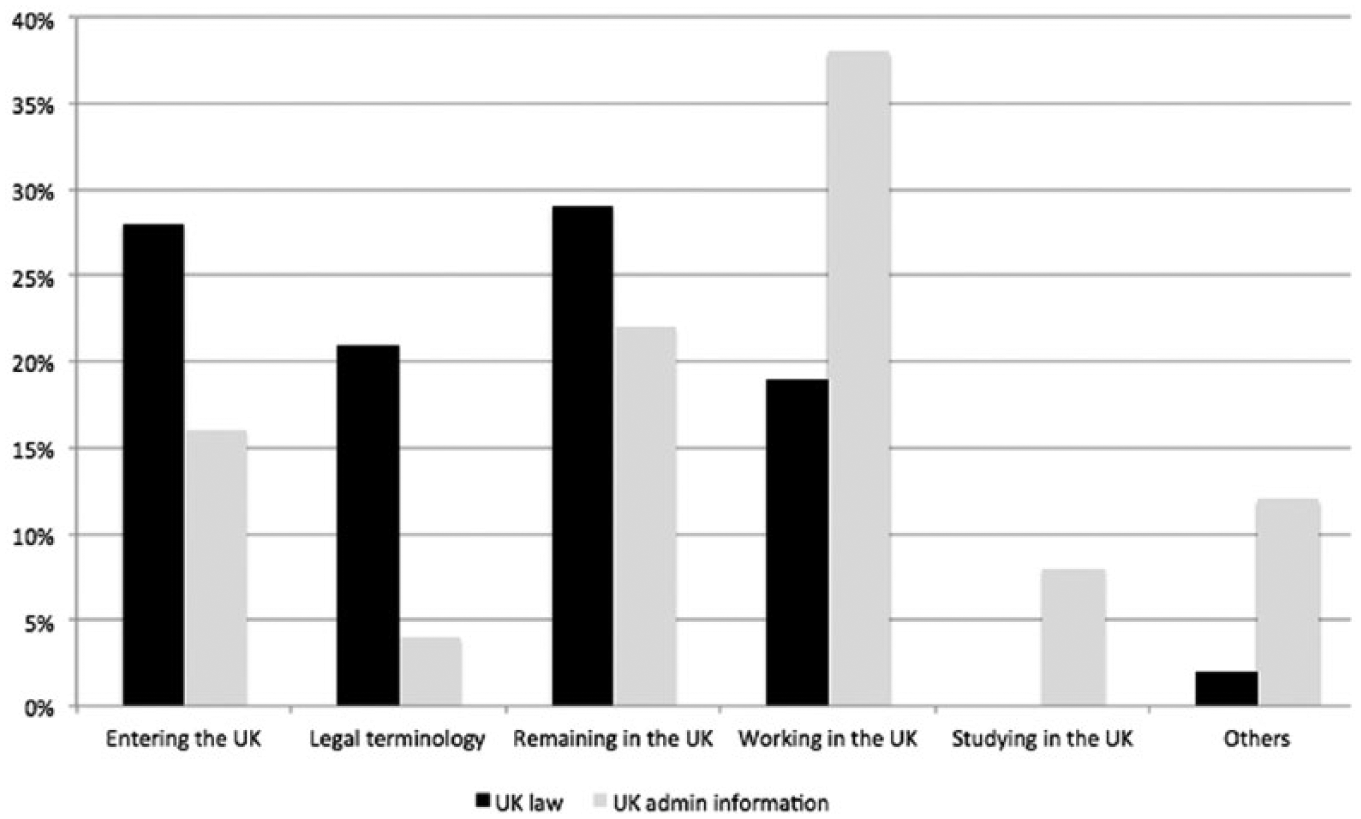
In our data we found that 29% of the concordance lines examined dealt with migrants’ procedures to remain in the UK, 28% with entering the UK, 21% involved the use of the lemma to explain legal terminology and 19% dealt with aspects concerning work in the UK. Figure 1 shows the results of the categorized collocates of the lemma migrant in the both data sets.
Categorized collocates of ‘Migrant’ in UK legislation and UK Administration informative texts.
Categorized collocates of ‘Migrant’ in UK Administration informative corpus
In our data we found that 38% of the concordance lines examined dealt with aspects concerning migrants’ work in the UK, 22% with procedures to remain in the UK, 16% with entering the UK, 8% with studying in the UK, while 4% involved the use of the lemma to explain legal terminology. The remaining 8% of the uses were categorized as miscellaneous.
Discussion
Immigrants, referred to almost exclusively as migrants in our data, are, in many ways, similarly portrayed in the two corpora analysed. Both in the legislation and in the informative texts corpora, immigrants are constructed as a largely homogeneous group of people through the use of extremely restricted vocabulary. This is particularly so in the legislation corpus, where the most frequent collocates are almost exclusively related to tiers and, accordingly, to the visa system in place in the UK. Extracts 1–6 exemplify how the most frequent uses of strong collocates in this corpus are extremely similar. It is of interest that ‘3’ does not qualify as a strong collocate in the legislation corpus. Tier 3 migrants are low-skilled workers filling specific labour shortages. The UK Administration has been reluctant in the past to allocate visas under this scheme, possibly due to the constant influx of workers to the UK in the last decade, which in October 2015 prompted the UK Home Secretary to claim before the Conservative Party Conference that there is ‘no case in the national interest for immigration of the scale experienced over the last decade’. However, the rest of the tiers, in particular 5 and 4 (extracts 3 and 4), collocate very strongly with the lemma ‘migrant’. Tier 5 immigrants are granted temporary visas to work and live in the UK. They are usually young people who stay during the holidays to work with non-governmental organizations (NGOs) and charities. Tier 4 immigrants are students outside the EU who wish to study in the UK and have already been accepted by an educational institution. In general, their salience in the corpus reinforces the idea that for these individuals to be granted leave to enter, remain and work in the UK, a set of strict requirements has to be met. This corroborates the finding that the UK legislation may play a somewhat veiled container role: ‘the container metaphor is persuasive in British political communication because […] [it] implies that controlling immigration through maintaining the security of borders […] will ensure control over the rate of social change’ (Charteris-Black, 2006: 579). Although this author finds that this more overt metaphor is particularly found in the discourse of right-wing parties, the accumulated representations of immigrants in the legislation as subject to classification seem to point to the fact that UK laws during 2007–2011 were more focused on legitimating (Charteris-Black, 2006) the control of this group of individuals than on creating the conditions for better integration policies. The fact that ‘£’ collocates so strongly with migrants in the string ‘the fee is’ may suggest that the control exercised by the state is administratively regulated and socially and legally legitimized. However, Europe is not alone here. In countries such as the United Arab Emirates, citizenship and employment policies are now more stringent (Jamal, 2015) despite official pro-globalization discourse.
In the informative texts corpus, however, we can find a less restrictive lexical set in the list of strong collocates. ‘Illegal’ is the strongest collocate in our results, which corroborates previous findings in analyses of British newspapers (Blinder and Allen, 2016). According to these authors, the string ‘illegal immigrants’ occurs in almost 10% of the concordance lines with the node ‘migrant’. In our case, the string ‘illegal migrant(s)’ (extracts 10, 12 or 15) occurs in 12.6% of the cases in the informative texts produced by the UK Administration, while no ‘illegal migrants’ were found in the UK legislation analysed. In this legislation corpus, we find instead ‘illegal entrants’, although this use is not statistically significant from a collocational perspective. In general terms, the lexical items that most strongly collocate with migrants are work-related and concerned with the UK visa system. This reinforces the idea that those reading the Administration’s information are dealing with individuals who are purportedly so homogeneous that they can be linguistically profiled in ways that stress their construction as members of a group whose main and only attribution is their adscription to an extremely limited set of tiers. Those falling outside the tiers are not part of the equation and the system simply ignores them or labels them as illegal. In this sense, the collocational profiles in both UK law and UK Administration informative texts seem to favour a representation of immigrants as individuals who need to adjust to extremely tight requirements in order to succeed in becoming legal immigrants. Those managing to go through the system will still need to face other challenges before they are integrated and accepted by their local communities (Lynn and Lea, 2003).
Our results seem to corroborate the notion that the UK Administration promotes the idea of ‘preferred immigrants’ (Hier and Greenberg, 2002, cited by Lynn and Lea, 2003: 429). Let us examine this idea in the light of the grammatical profiles of the collocates analysed in our study. Immigrants are deprived of agency in the texts examined in our analysis. In the legislation corpus, immigrants are portrayed as application makers and they, rather passively, ‘refer’ or ‘mean’ different tiers or categories in the context of immigration laws. Their actions are never a product of their own will, but rather requirements or prerequisites that will have to accommodate the Administration’s instructions. If there is an ideology here, we may argue that this is one that constructs a group of controllers against a set of individuals, namely others (Lynn and Lea, 2003), whose individual identities are of no importance and whose ‘partial constructions’ are incomplete (Blinder and Allen, 2016: 31) and largely negative (Leudar et al., 2008). In the informative texts corpus, immigrants are constructed in a more comprehensive way as they are depicted as agents of a wider range of actions that, despite their limited range, allows for their building of a minimal, neutral, sense of identity that goes beyond the strict controls of laws. Notwithstanding, the range of pre-modifiers is extremely limited and post-modification usually takes an alphanumeric value. Overall, the us/Administration versus them/immigrants (Morley and Taylor, 2012) imbalanced power relation (Van Dijk, 2003) permeates a partial or, we would be tempted to say, a lack of construction of migrants, as opposed to, for example, the media constructions of Black and Asian men in Baker and Levon (2015) where, albeit negatively, these groups are constructed in terms of their sexuality and violent behaviour. This awareness of immigrants as partially constructed individuals is shown in their categorization in both data sets (Figure 1). In the legislation corpus, 57% of the time migrants are constructed as individuals trying to be granted permission to remain in the UK or to enter the country (extract 9). Interestingly, 21% of the uses are concerned with legalese uses where the points-based visa system categories are explained. This is a feature of legal English where the repetition of certain words and structures is justified for the sake of terminological precision. In the UK Administration informative texts corpus, only 38% of the times migrants are constructed as individuals who seek permission to remain in the UK (22%) or to enter the country (16%), while an equal 38% of uses are work-related. Legalese uses drastically fall to 4% in this data set. All in all, we can find that the UK Administration here has widened the range of categorizations that are ascribed to immigrants. These results corroborate Baker et al.’s (2008) finding that refugees, asylum seekers, immigrants and migrants are associated with very few categories in the British press, including transit, entry, residence and legality. This extremely short list of thematic categories points to the presence of some subtle mechanism of discrimination as suggested by Fowler (2003), who considered categories as instruments of established power. On the other hand, overt negative representations are not abundant in our data other than as warnings to employers planning to contract illegal immigrants.
In our results we could not find foregrounded nationalities such as those in Taylor (2014), which suggests that the UK Administration was very careful when referring to the nationalities of immigrants. Similarly, we did not find either overt hostile themes (Leudar et al., 2008) in any of the data sets analysed or overt negative topoi, especially economic or cultural threats to UK citizens (Khosravinik, 2009). In this sense, our results show that the UK Administration avoids an explicit negative construction of immigrants coming to the UK. This finding is in line with Flowerdew et al.’s (2002) claim that editorials – that is, official top-down discourse practices – tend to avoid the sort of tension that is found in bottom-up news stories and readers’ letters. We may argue, however, that the restricted set of lexis used in both the legislation and the informative texts contributes to legitimizing not the immigrants’ right to come to the UK, as in Goodman and Speer (2007), but rather the Administration’s efforts to exercise firm political action by controlling immigration policies and, in particular and almost exclusively, controlling immigrants’ leave to enter or remain in the UK. Not surprisingly, Theresa May, then Home Secretary of the UK, addressed her fellow party members in October 2015 in a 4171-word speech where three lemmas stood out: high, reduce and control. All three were linked with immigration in the middle of a huge refugee crisis. The UK Home Secretary was downright explicit: ‘We will also need to have more control of immigration overall.’ 14 This is apparently contributing to what Strauss (2012: xv) has labelled as ready-made points in people’s conventional discourse. This seemingly socially coordinated (Leudar et al., 2008) effort involving politicians and the Administration may be having a negative effect on the integration of immigrants as the EU 2020 strategy is not part of the discourse of the Administration, at least in the two data sets analysed.
The aim of this article is to contribute to the debate on public discourse practices around immigrants and immigration and offer language-driven data on the role of the UK Administration in constructing immigrants. However, our findings need to be taken cautiously as the range of texts included in our corpus of informative texts is far from exhaustive and, accordingly, we cannot possibly claim that we have taken into stock every single text published by the UK Administration between 2007 and 2011.
In the context of the two corpora analysed in this article, we have examined some evidence that the incremental effect of official discourse may help the construction of a reality where immigrants are built as partial individuals whose primary agency lies in their compliance with administrative regulations. Using Morley and Partington’s (2009) words ‘repeated usage of an item in new environments will alter the priming instructions-suggestions of the item itself’ (p. 156). In the wider context of the EU, what our results seem to suggest is that for the UK Administration, the issue of immigrant integration is not part of how immigrants are constructed in the legislation and the information that the UK immigration agencies and authorities publish and distribute. This failure to mention integration issues in the legislation is not found in other legal systems such as in Italy, where Hernández González (2016) discovered a tension between inclusion/integration and exclusion/control in the same 2007–2011 period. The language-driven evidence provided in this study corroborates that the use of the lemma ‘migrant’ in the two corpora analysed calls for a partial construction of immigrants mainly as workers who need to be tightly controlled and classified into Tiers to prevent unlawful behaviour. In doing so, migrants, an alternative word for immigrants in our research context, acquires an extremely subtle negative prosody.
Footnotes
Declaration of conflicting interests
The author(s) declared no potential conflicts of interest with respect to the research, authorship, and/or publication of this article.
Funding
The author(s) disclosed receipt of the following financial support for the research, authorship, and/or publication of this article: This work was supported by the Spanish Ministry of Economy and Competitiveness (Grant FFI2011-30214: Lenguaje de la Administración Pública en el ámbito de la extranjería: estudio multilingüe e implicaciones culturales).