



Abstract
This article explores how we take responsibility for our past actions in language, using an ideational perspective. It focuses on the way we construe actions in transitive and ergative language patterns and from this develop a cline of responsibility, which has maximum responsibility at the one end and minimum responsibility at the other. The article examines a number of instances of language use from different genres and registers with this cline to determine the extent to which language users take responsibility (or not) for their actions through language.
Keywords
Introduction
Taking responsibility is a big issue across the course of one’s life; parents, teachers, partners, friends, the judiciary and media exhort us to take responsibility for our actions. Given that at least some part of taking responsibility happens through language, an investigation of the discursive construals of how we actually do (or don’t) take responsibility is useful for understanding this ubiquitous social phenomenon. It is argued here that one of the ways the extent to which people take responsibility for their past actions can be explored is ideationally through the system of voice and agency. Agency and its connections to responsibility have been explored by a number of Systemic Functional Linguistics (SFL) researchers studying language use. In their study of the language used to report war in the news, Lukin et al. (2004) examined the manipulation of agency as one of the strategies deployed to obfuscate blame of perpetrators of war. Dreyfus and Jones (2010) also examined agency in their exploration of the way a high-profile, award-winning Australian sportsman was portrayed in the news media when he was found to have broken the law numerous times through drug use. Both these studies concluded that the resources of the system of agency were used in particular ways by writers to minimise the attribution of responsibility to perpetrators around their negative actions.
The initial motivation for this research came from a conversation with my youngest son, who was about 3 years of age at the time. He had been playing in the back garden one summer’s day when I heard him come running inside calling ‘Mum, Mum, the pot broke!’. When I went outside to investigate, I found that one of my terracotta garden pots that had some herbs growing steadily in it had been tipped over and broken. As a linguist, I found it intriguing that at the tender age of 3 years, he already knew how to express the event of the pot breaking using a pattern of construal that made it sound like he had nothing to do with it. He could have said, ‘Mum, I broke the pot’ or even, ‘Mum, while I was playing, the pot got broken’, but he didn’t. He managed to say it as if it had happened all by itself, using what is called a middle clause (Halliday and Matthiessen, 2004/2014). Upon further gentle interrogation by me, it turned out that he had, in fact, broken the pot, although he chose initially not to present the events as such, for fear of me being angry with him.
Linguistically speaking, in thinking about taking responsibility in this way, I am referring to recounting past events in monoglossic terms, with no use of modality to hedge (e.g. I might have broken the pot) and no use of negation (e.g. I didn’t break the pot). In this article, the focus is on the types of clauses used by speakers and writers to construe past events that are about taking responsibility for actions.
Theoretical framework and review of literature
Taking responsibility in language is examined from the perspective of the ideational metafunction at the stratum of the lexicogrammar. Both the transitive and ergative perspectives are deployed, in conjunction with the system of voice. These are explained below, drawing on Halliday and Matthiessen (2004/2014) and Davidse (1992), and using my son’s breaking of the pot example where possible.
Regarding the system of transitivity, actions are typically construed in material processes, which can have the participants of Actor (the Doer), Goal (the Done-to), Scope (the participant over which the action is done but one that is not affected by the action) and Beneficiary (one who benefits from the action), as per the following examples:



All the above examples have the Actor at the beginning. This construes events with the Doer (or perpetrator of the action) as the point of departure, which is the starting point for the information being construed in the clause. It is the first and the third of these two examples that I am concerned with here, as these are effective clauses, where one participant has an effect upon another. In the first and third examples, the second participants, the pot and the cake, are affected by the first participant I; that is to say, the pot is broken and the cake is made. 1
From an ergative perspective, there are three types of participants: Agent, Medium and Range. The Agent is the instigator of the action. The Medium is the participant that is intimately connected to the Process. The Range is similar to Scope in transitivity – a participant that is connected to but not affected by the Process. In clauses where there are both Actor and Goal, Agent maps onto Actor:

In clauses where there is a Scope instead of a Goal, Medium maps onto Actor:

In an intransitive clause (one with only one participant, which is Actor) there is no feature of agency, and Medium again maps onto Actor:

Thus the nucleus of the clause in transitivity terms is Actor + Process, whereas in ergativity terms it is Medium + Process.
Davidse (1992) shows that the transitive and ergative models have not only different grammatical centres (Actor + Process vs Medium + Process) but also different directionalities (Figure 1). In the transitive model the clause moves from the nucleus (Actor + Process) to the right, to include an optional Goal, whereas in the ergative model the clause moves from its nucleus (Medium + Process) to the left, to include an instigator (Agent).
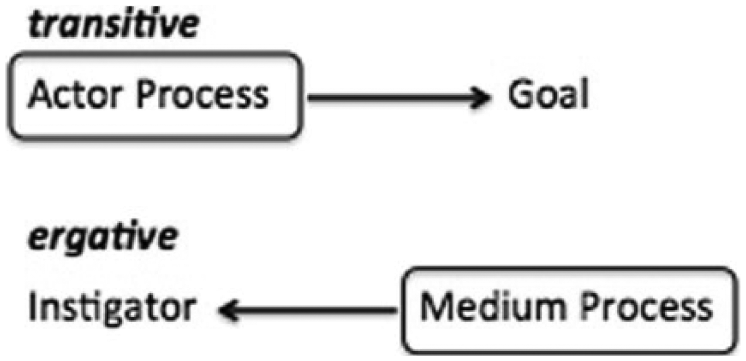
Directionality of transitive and ergative models of material clauses
These perspectives are brought together in this article in the examination of responsibility.
We can also map these representational choices as different kinds of clauses according to the system of voice. A clause with only one participant, such as ‘the pot broke’, is called a middle clause by Halliday and Matthiessen (2004/2014). Davidse (1992) names this type an ergative middle clause.
2
These types of clauses are non-ergative Actor Process ‘constellations’ (Davidse, 1992: 123) which do not extend to a Goal. Other examples include things such as She runs; he travels. Note that these clauses often have a circumstance (bolded): She runs

In contrast to middle clauses are effective clauses. Effective clauses are how we construe events in the world where one participant has an effect on another. These are the clauses with both Actor/Agent and Goal/Medium. What my son didn’t say, I broke the pot, is such a clause:
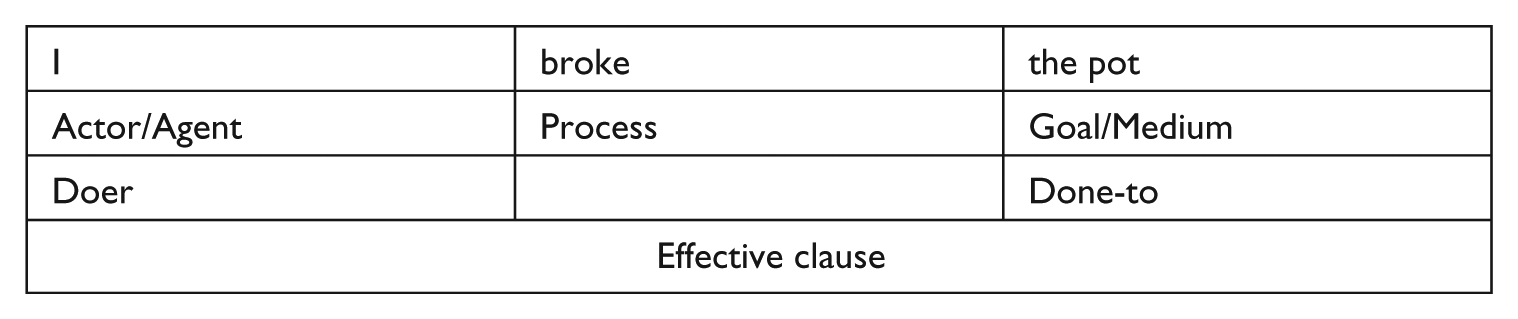
There are two types of effective clauses: active and passive. In active clauses both the Actor/Agent (Doer) and Goal/Medium (Done-to) are present in the clause, with the Doer in Theme position, as in the above example of I broke the pot.
It is argued here that construing events in active clauses (Doer + Process + Done-to) attributes maximum responsibility to the Doer, for the following reasons: we are told who did what to whom in that order. Thematically, the point of departure here is the Doer. That is to say, we begin with the Doer, then move to what they did, and finally who they did it to. Furthermore, Davidse (1992) states that transitive/effective clauses have a prototypical structure of features that cluster in ‘intentional goal-directed action’ (p. 111). It is this intentionality that ascribes responsibility because, as Nishimura (1989, in Davidse, 1992) puts it, in intentional transitive clauses an Actor consciously puts an action onto a Goal.
However, an effective clause can also be passive with the Agent/Actor/Doer at the end of the clause or with it left off altogether:

or

The first of these two passive clause examples, the pot was broken by me, presents events with the Doer present, although not at the front of the action. The Doer is not foregrounded at the front of the clause in Theme position and thereby is not the point of departure for the message. It is therefore argued here that construing events this way places less responsibility for the action on the Doer than when construed in an active clause. Similarly, the second passive clause, the pot was broken, which is an Agentless passive, construes events with even less responsibility on the Doer, as the Doer is not present in the clause at all – they are implied by the clause structure but elided from its instantiation. The focus is thus not on
My son’s four choices for telling me he had broken the pot can be depicted through the system of voice as shown in Figure 2.
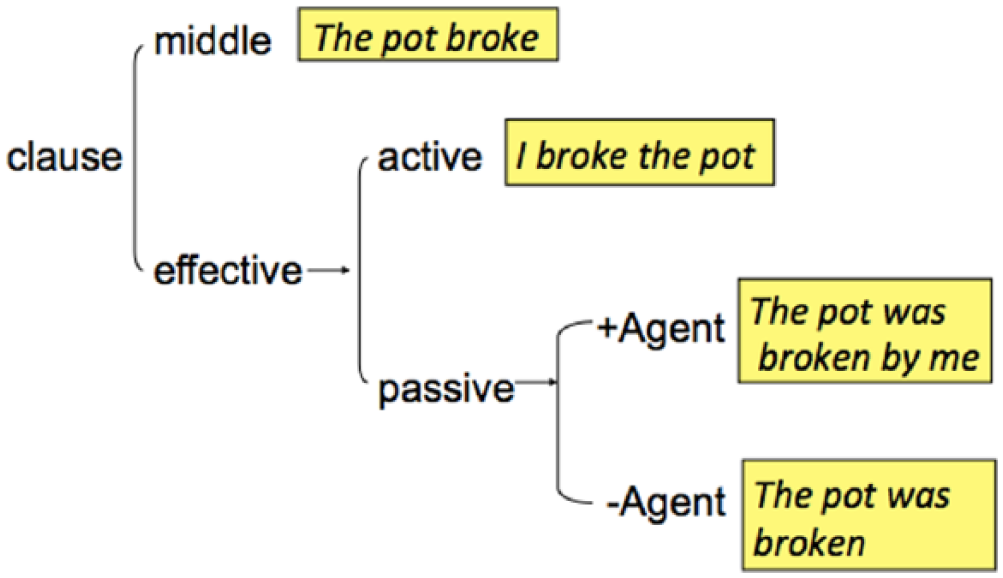
Material clauses as a simplified system of voice (after Halliday and Matthiessen, 2004/2014).
In sum, it is argued here that active material clauses construe events with the maximum responsibility being attributed to the Doer; passive clauses with an Agent construe events with some responsibility being attributed to the Doer because the Doer is present but not in the active position; Agentless passives construe events with little responsibility to the Doer as, while the Doer is implied, they are not mentioned; whereas middle clauses construe events with least or no responsibility being able to be attributed to the Doer because this kind of clause has no feature of agency – events are construed as if they just happen by themselves. These options are mapped topologically as a cline (or continuum of choices) in Figure 3.

Cline of responsibility.
Figure 3 depicts these options as choices along a cline of responsibility from the most responsible at the top left to the least responsible at the bottom right. This cline can be used to examine to what extent responsibility is attributed to a Doer and to what extent a Doer takes responsibility for their actions. We now apply this cline to a number of language samples from different registers and genres, including another conversation with my young son, a print media news item, two Australian Prime Ministerial speeches, and finally an advertisement from a local newspaper. Table 1 shows each of these instances and their genre and register (field, tenor and mode).
Language instances with genre and register identified.
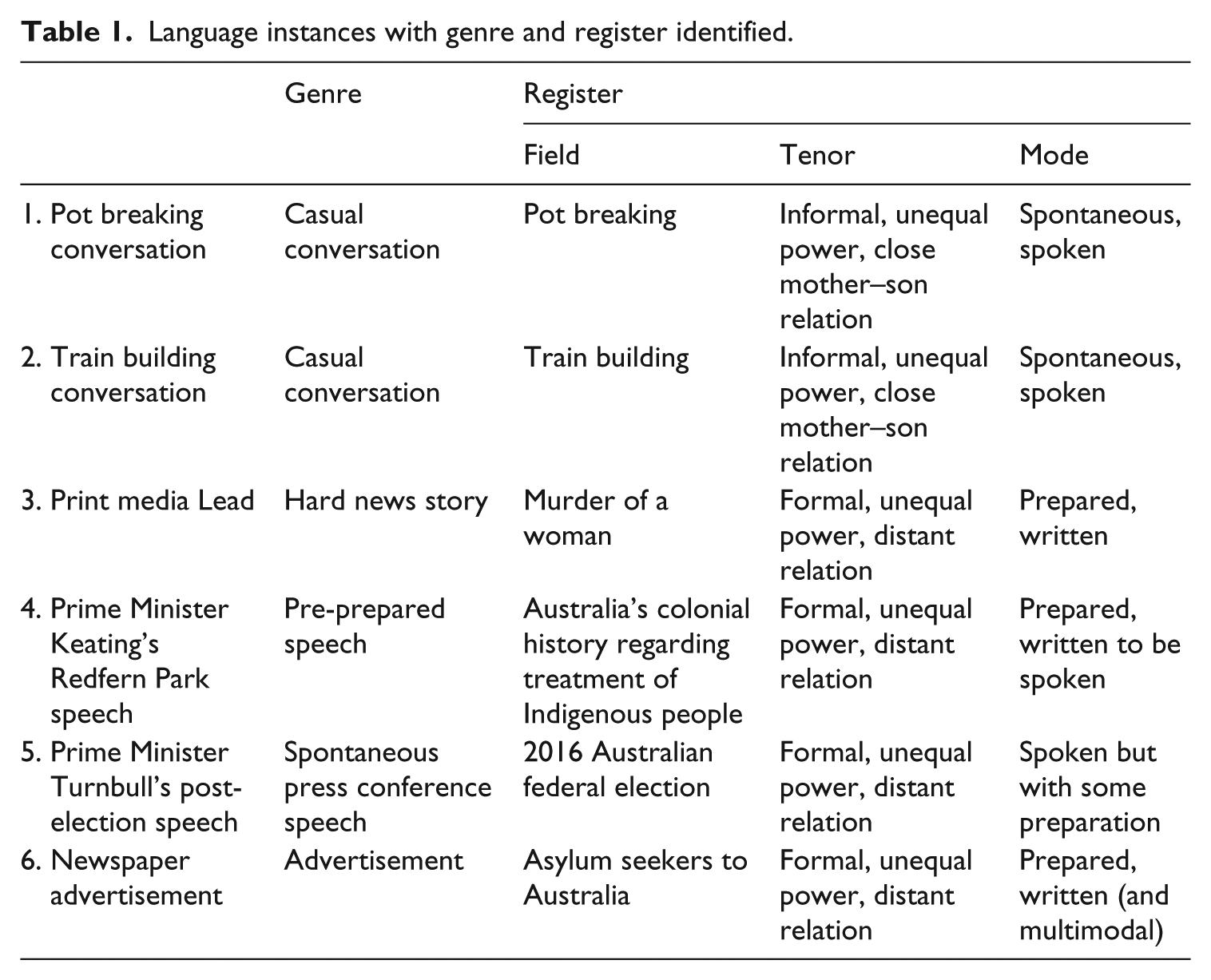
Table 1 shows that while some texts examined in this article share a genre and some similarities in the tenor and mode, each of them has different fields. It is important to emphasise that genres and registers affect the way meanings are construed; in some contexts, certain construals are unlikely or not even possible, as will be discussed in more detail in the following.
Analysis of language samples
Example 2: Train building conversation with my son
The second example from a conversation with my young son that is explored here is presented by way of contrast to the ‘pot breaking’ example. It is similar in genre and register to the first conversation except that the field is different: it involves my son telling me about a train he built out of the plastic chairs in our back garden. He had lined up the chairs one behind the other to make a ‘train’, then collected his stuffed toys and placed them on the seats. In contrast to his words about the pot, he came to me saying, ‘Look Mum, 3 I made a train’. Why did he not construe these events in the same way he reported the breakage of the pot, that is, in any of the other clause and voice choices that were possible to use? For example,
passive voice – A train was made by me
Agentless passive – A train was made
(Middle voice is not an option with the process made, as it is non-ergative – making something always involves an Agent. We cannot say A train made.)
I argue here that as my son was proud of his creation, he construed it in the active voice, as this attributes full responsibility of the making of the train to himself. Thus in both these situations – pot breaking and train making – there are choices for construal that involve attributing responsibility or minimising it, and the preferred construal of events means one is chosen over another.
Example 3: Print media Lead
The next example of the attribution of responsibility is the Lead stage (Feez et al., 2008) from a hard news story that came from an Australian daily broadsheet The Sydney Morning Herald (Kennedy, 2007). The Lead refers to the opening sentence or sentences of a news story, which come after the Headline and before the bulk of the news story. In this case, the Lead reports the death of a woman by stabbing:

In this middle clause, the point of departure and thus the focus of the information is the woman: not only is she the only participant in this non-ergative clause, she is in Theme position. There is an Agent implied, as someone had to do the stabbing, yet this person is all but elided from the clause and referenced only by implication in the abstraction in the circumstance of Manner, from multiple stab wounds. We are thus left wondering who did the stabbing. Further on in the circumstance is another embedded circumstance during an argument. Here there is an oblique indication that the person she was arguing with may have been the one who stabbed her, but this is not entirely clear at this point. Construing the events like this removes the focus from the perpetrator of the stabbing as they are not overtly included in this construal because the choice of non-ergative verb, died, and the abstracting of the stabbing to a circumstance, from multiple stab wounds, eliminate the presence of an Agent, Doer/perpetrator. There could be multiple reasons for construing the events in this way: the news is that a woman has died, and the perpetrator has not yet been identified and charged (although in the second and two later sentences, the article reports that a man was apprehended and charged in relation to the stabbing). Furthermore, Australian sub judice law prohibits the naming of people once they have been charged and so makes it unlikely that the alleged perpetrator could feature in Agent/Subject/Theme position. Nevertheless, the way it is construed in the Lead places very little responsibility on the Doer of the stabbing, even if there are legal reasons for this. These events could have been construed differently, however, using another voice choice such as the Agentless passive, which would still be in keeping with sub judice law:
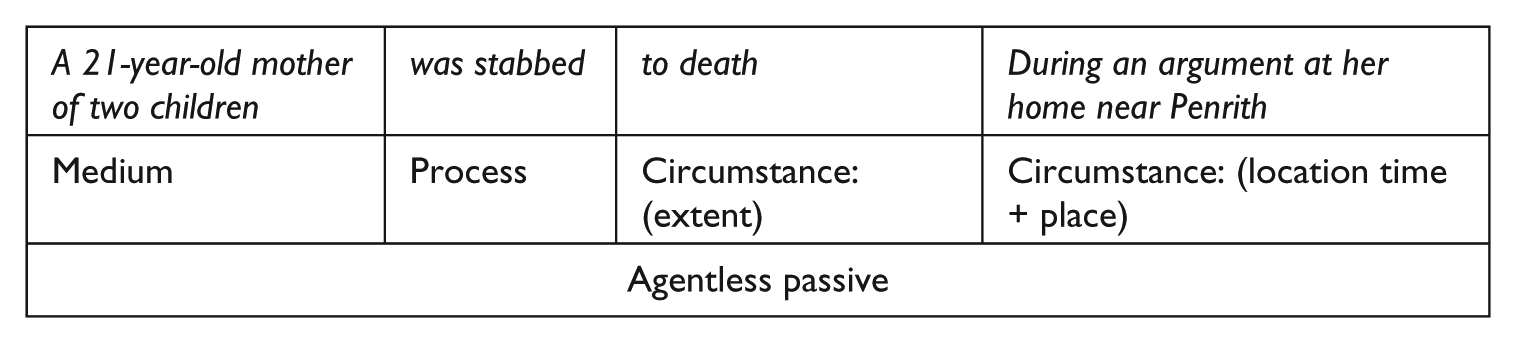
While again this construal elides the Agent/Doer/perpetrator, it is argued here that it has stronger links to the perpetrator because s/he is implied by the passive voice. Passive voice typically leaves us wondering who did the action (Davidse, 1992).
Going a step closer to attributing responsibility to the perpetrator would be a construal in passive voice with the Agent included:
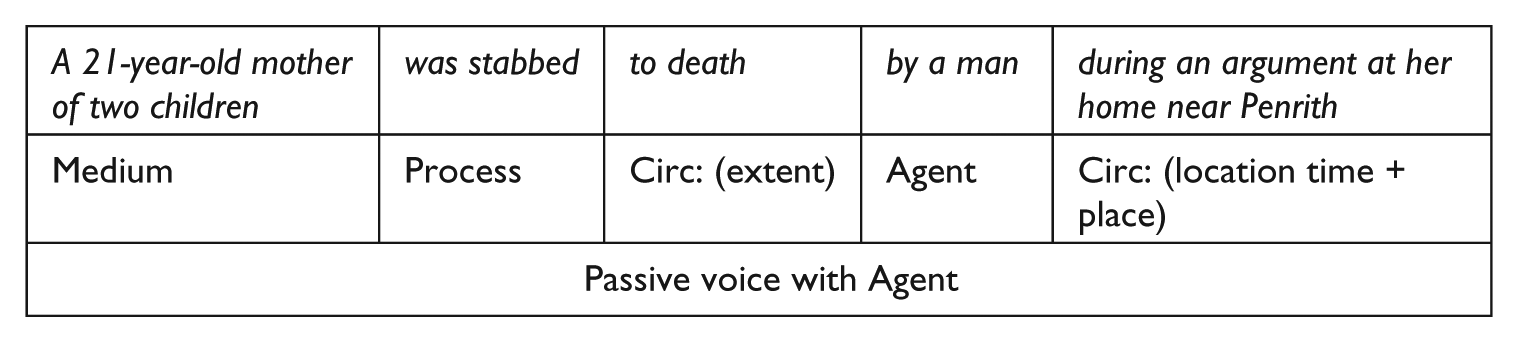
While this construal keeps the Theme constant and focused on the woman, the inclusion of the Agent/Doer means the reader neither has to look further than the Lead nor wonder who did the stabbing. It is argued here that by including the Agent, there is a higher degree of responsibility attributed to the Doer than in the Agentless passive or middle clause, although of course this is legally problematic.
Finally, the events could have been construed in the active voice with the Agent at the beginning, without entirely breaking sub judice law. This would attribute responsibility up front, although this is unlikely in the hard news context, where events have just unfolded and someone needs to be charged and convicted before conclusive claims can be made about who perpetrated the crime:

These choices can also be mapped along the cline of responsibility.
Figure 4 shows that in construing the stabbing and subsequent death as a middle clause in the Lead, the newspaper represents the events with the least amount of responsibility attributed to the perpetrator of the actions. This correlates with other studies of hard news articles of violence against women that found that linguistic choices that minimise blame of the male perpetrators are often used when reporting violence against women (see e.g. Clark, 1992; Gilmore, 2016; Greer, 2016).
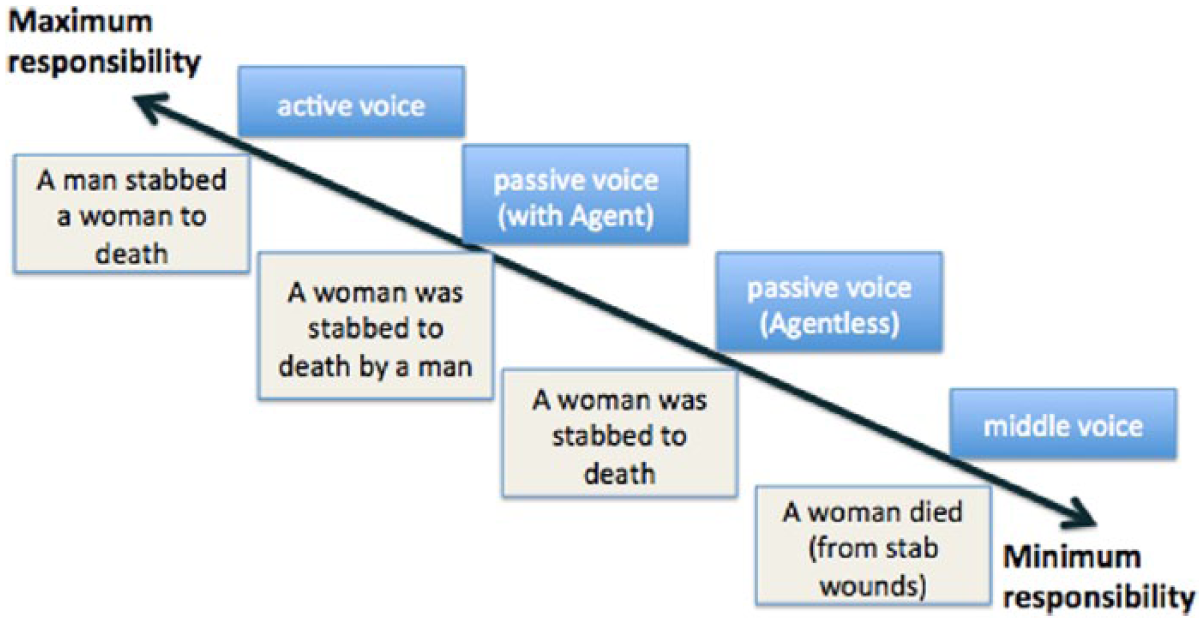
Choices for attributing responsibility for a woman’s death by stabbing as a cline.
Example 4: Prime Minister Keating’s Redfern Park speech
We now apply this analysis to a segment of a speech made in 1992 by one of Australia’s past Prime Ministers, Paul Keating, to launch the International Year of Indigenous Peoples Day in Redfern Park, which is the heart of the urban Aboriginal community in Sydney. 4 From a formal speech genre, and crafted by one of Australia’s most prominent speech writers, Don Watson, this segment shows how a person can use a speech to take responsibility for actions in a decisive way. The field at this point in the speech was Australia’s past history of colonialism from the late 1700s, where the British colonised what they considered was an empty land (calling it terra nullius). In this segment Prime Minister Keating speaks with the full responsibility of the active clause, and he does this repetitively, which builds the force of taking responsibility through the rhetorical strategy of repetition within the appraisal resource of graduation:
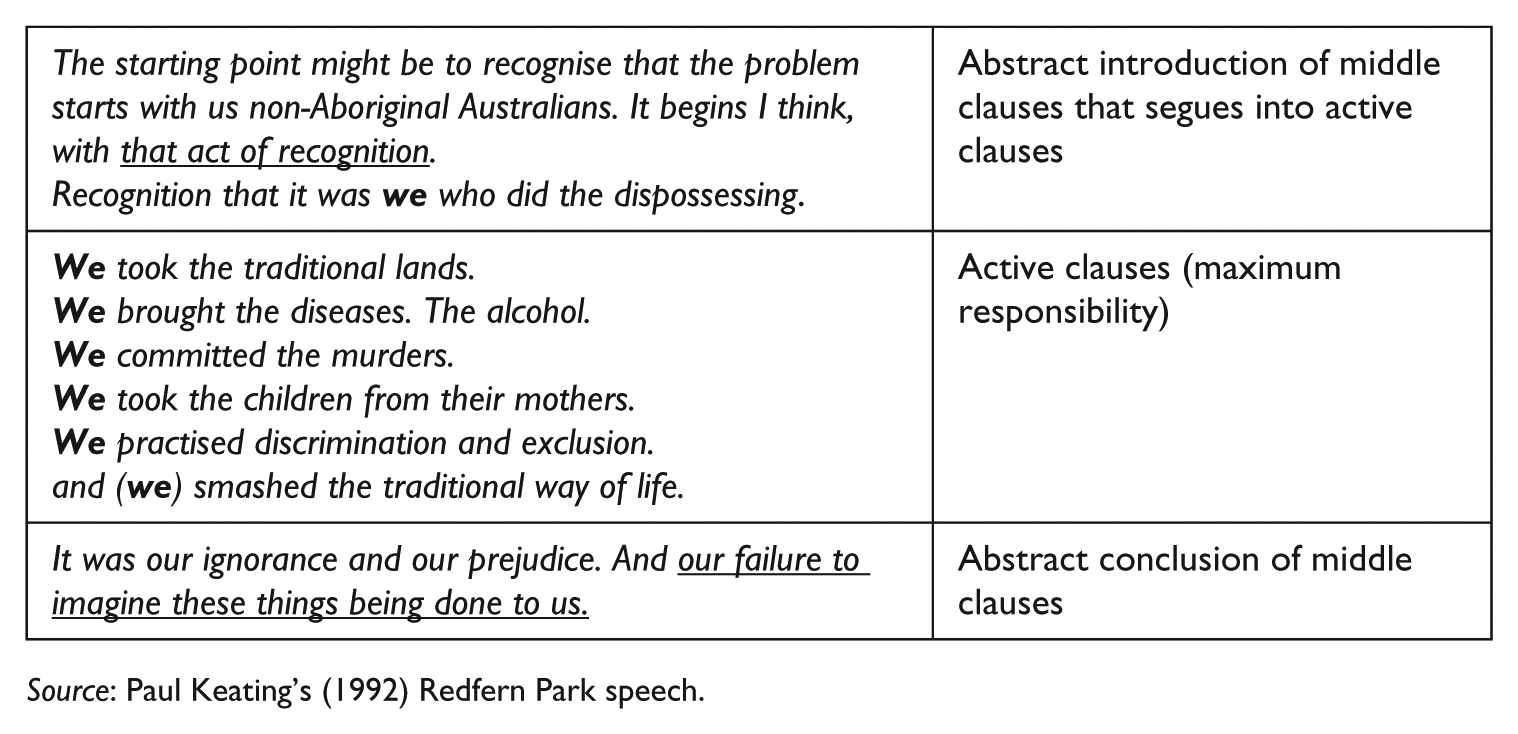
Source: Paul Keating’s (1992) Redfern Park speech.
After the two opening sentences in middle clauses that introduce the starting point for the issue as an abstraction the act of recognition, Keating’s speech moves straight to active clauses with Agents (bolded), listing the ways ‘we’ are responsible. The speech then wraps up these actions in three more abstractions (ignorance, prejudice and failure), which condense all the past actions. Thus Prime Minister Keating construed these past events in clauses that take full responsibility for these actions, where not only is there an Agent/Doer present but the Agent/Doer is the first person plural pronoun we in Theme position. The structure of this part of Keating’s speech, with its abstract and condensed beginning in middle clauses, followed by a series of active clauses, and culminating in an abstract and condensed ending, could represent a speech genre of taking responsibility. Sandwiched between the beginning and end abstractions in the relational clauses is a construal of events in active clauses that take full responsibility for the past actions. 5 This speech segment is unique because it shows that prime ministers can and even occasionally do take responsibility for actions they are not proud of, perhaps behaving more like statesmen than politicians, who typically tend to shift blame onto others for past transgressions in order to keep voters onside (Hood, 2014; McGraw, 1990).
Example 5: Prime Minister Turnbull’s post-election speech
We now examine the construal of responsibility in a second Prime Ministerial speech that occurred just after the most recent Australian federal election, which was held on Sunday, 2 July 2016. This speech (See Turnbull 2016) happened in a press meeting and was thus relatively spontaneous. It is not a crafted speech like Keating’s, which was specially designed for a major national event, and in that sense cannot be compared. Furthermore, it occurred at a time when Prime Minister Malcolm Turnbull was on the back foot because in the 2016 election, and under his leadership, the incumbent Liberal party performed rather badly, only just scraping together the numbers to form government. As the final votes were counted in the week following the election, the Prime Minister was called upon by his party, the public and the media to examine why the Liberal party had performed so badly. According to media reports, it was not until the third public appearance after the election that the Prime Minister took any responsibility for what had happened. Indeed, on the Thursday immediately after the Saturday election, the front page of The Sydney Morning Herald newspaper showed a contrite-looking Prime Minister Turnbull with the headline I take full responsibility stamped across it in large black letters. However, while the Prime Minister may have said that he takes full responsibility, an analysis of the speech finds he does no such thing, as can be seen in the following analysis. The speech is as follows:
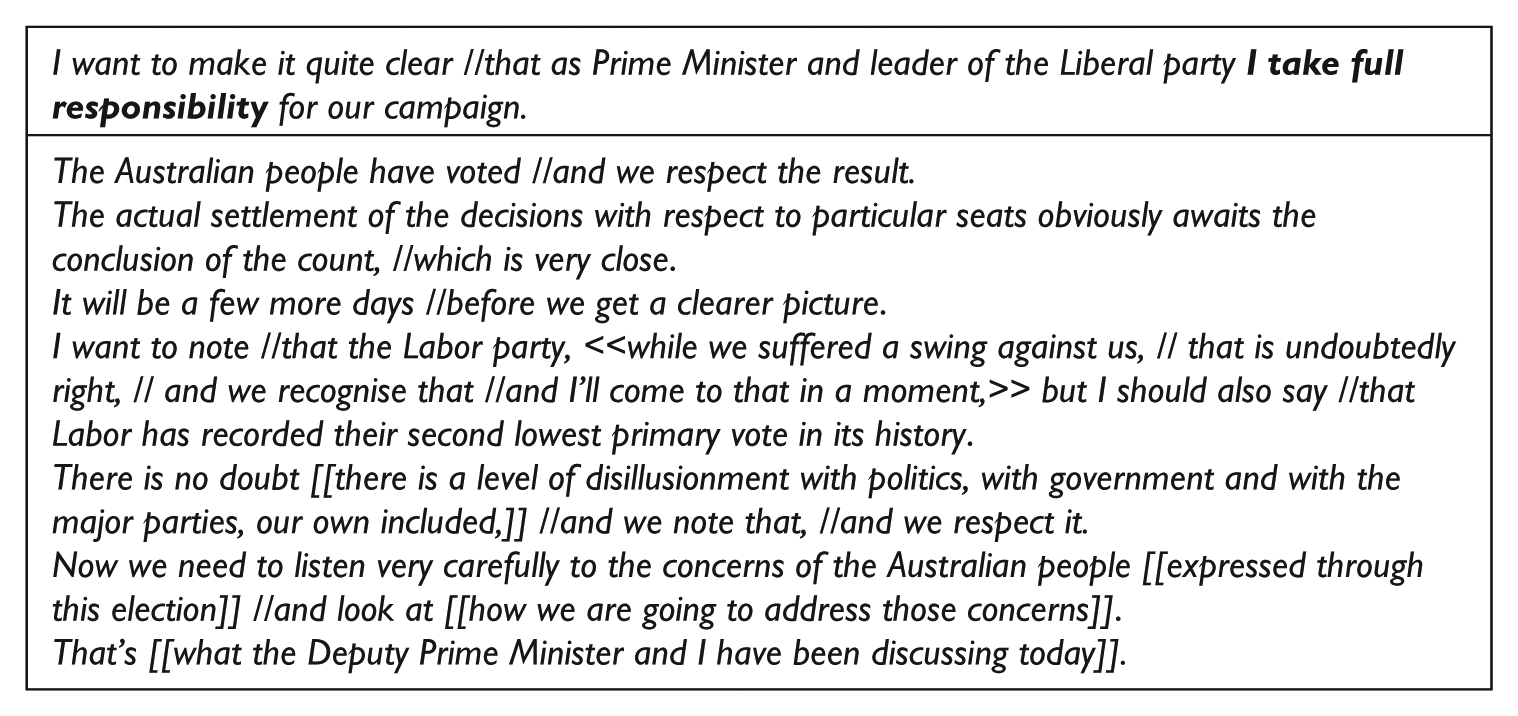
The first clause of Malcolm Turnbull’s speech, I take full responsibility, is an active clause with himself in Theme position. This is a pleasing start for a public that wants its politicians to take responsibility for their actions. This clause could be analysed in a number of ways: first, as a material clause with take being a material process and I being the Actor/Agent:

However, upon closer inspection we find that this may not be the case for three reasons: first, taking responsibility is a metaphor because really nothing is being actually taken. It is a turn of phrase construing that someone is responsible for something. Second, material processes take continuous present in typical cases (e.g. I am running a race), and the Prime Minister uses simple present tense, which is the form relational processes take in the typical case. Third, this clause is agnate to two other similar clauses that are possessive relational clauses: I have full responsibility and I assume full responsibility. Taking responsibility is thus a metaphorical taking that is grammatically construed as the relational phenomenon of being responsible:

It could be argued that turning being fully responsible into an abstract noun is an overarching way to announce the taking of responsibility, particularly as the Prime Minister puts himself in Theme position as the taker, and if we use Paul Keating’s speech as the model for taking responsibility, beginning with an abstraction conforms to this pattern. However, if we continue to follow Keating’s model, and Prime Minister Turnbull were to demonstrate that he took full responsibility, subsequent clauses would unpack this abstraction into active clauses with Turnbull (and his party) being in Theme position as Doers of concrete actions, as Keating’s speech did. In other words, he would then have to go on to construe events in active voice with himself as the Actor/Agent/Doer in those events.
While the newspaper headline says simply I take full responsibility, in the actual speech, Turnbull says he takes full responsibility for the campaign, as if the campaign and not the months and years leading up to it have any bearing on the outcome. Perhaps this is deliberate – perhaps he thinks he only has responsibility for the campaign and NOT for the months and years leading up to it, where the Australian people witnessed what they thought was a socially progressive leader abandon all his previous and publicly supported policies to do with issues such as climate change and same-sex marriage. Perhaps this was an oblique admission to the Australian people that he does not want to be held responsible for anything BUT the campaign.
Following on from this first sentence, however, there are no clauses with the Prime Minister and his party as Agents/Actors/Doers. Each sentence is laid out showing who/what is in Theme position and what they are doing, saying or being:
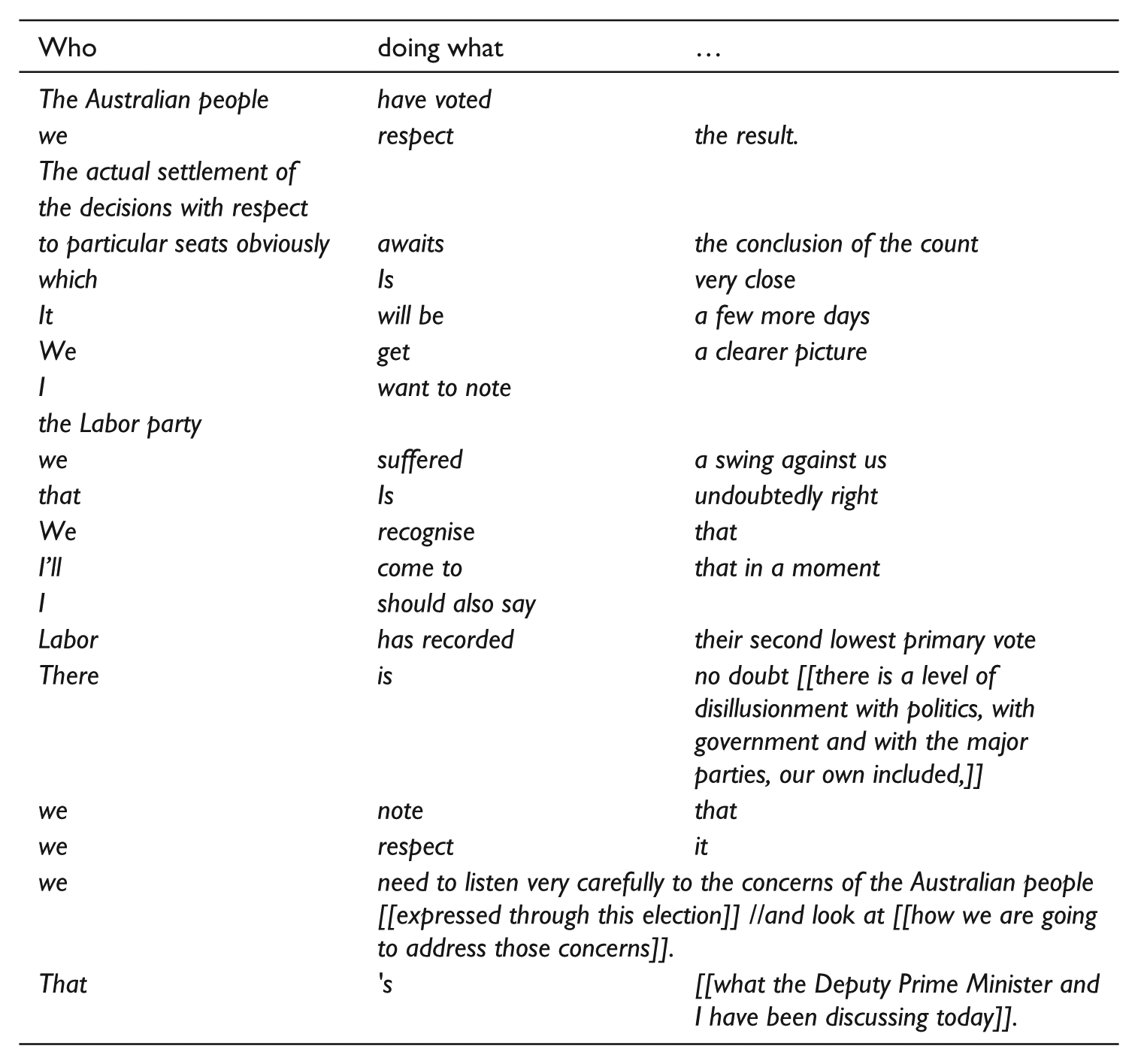
While many of these clauses have the Prime Minister or the Liberal party as the first participant, none of them are material clauses with Actors doing anything that expands the taking of responsibility. This is a good example of being able to ‘talk the talk’, without ‘walking the walk’. Prime Minister Turnbull says he takes responsibility (for the campaign), but he actually does not do so. The reasons for this most likely relate to the discourse of politics generally, where it is common for politicians to elide personal or party responsibility with a variety of strategies (Hood, 2014), participating in the ‘blame game’ when things don’t go as planned (Crant and Bateman, 1993; McGraw, 1990; Schlenker et al., 2001). A speech that actually did take responsibility might look something like this, however unlikely it might be:
I want to make it quite clear that as Prime Minister and leader of the liberal party I take full responsibility for our campaign.
I ran a bad campaign
I focused on the wrong things
I made bad decisions
I let the Australian people down
I misjudged them
and so on …
Example 6: Newspaper advertisement
The next text to be examined in terms of responsibility is an advertisement from The Sydney Morning Herald on 23 July 2013.

At the time of this advertisement, many people fleeing war-torn countries such as Afghanistan were attempting to come to Australia from Indonesia by boat in order to seek asylum. The boats were often overcrowded and did not always make the journey intact. Many people were rescued by the Australian navy and were taken to detention centres in Australia. The Australian government then decided it would no longer bring the asylum seekers to Australia and instead took them to purpose-built detention centres in certain countries surrounding Australia, such as Nauru and Papua New Guinea. This text is different in genre and register from the other texts explored thus far. While appearing as an advertisement in a daily broadsheet, its audience is unclear, as people attempting to come to Australia by boat to seek asylum wouldn’t be in Australia reading this newspaper. The tenor is unambiguous: unequal power in the hands of the government.
An analysis of the two clauses at the top of the advertisement If you come here by boat without a visa and you won’t be resettled in Australia shows that the first clause is a middle clause with no feature of agency. This is language/grammar both reflecting and construing life, in the sense that while coming is doing something, it is not a doing with any agency; the you in the clause is a Medium and the agency is abstracted to the circumstance by boat, which involves finding someone and paying money to get them to take you on a boat to Australia:

The second clause you won’t be resettled in Australia is an effective clause with Agentless passive voice:

This clause maintains the focus on you yet omits the Doer. We are left wondering
Conclusion
This article has introduced a new way viewing responsibility in language as a cline, based on understandings of agency in material clauses. While it does not add anything to the analysis of agency per se, its novelty is in the arrangement of different clause structures along a cline of responsibility from the least to the most responsible. In using this cline on a number of instances of naturally occurring language, albeit from different genres and different registers with different contextual pressures, the article has demonstrated that it can be used to examine clauses and texts for how responsibility is attributed to the Doer of actions. In the first example of my son breaking the pot, The pot broke, the middle voice is used, which has the effect of obscuring any involvement on his part and thus minimising his responsibility in the breakage. This sits in direct contrast to the second example from my son, I made a train, which is an effective active clause attributing maximum responsibility to himself. The next example, A 21-year-old New Zealand mother of two children has died from multiple stab wounds received during an argument at her home near Penrith, also uses middle voice mostly for legal pressures; however, the effect of this is to obfuscate and thus downplay the responsibility and involvement of the perpetrator. The fourth example, the excerpt from Prime Minister Paul Keating’s highly crafted speech, shows the construal of past events in active voice, attributing maximum responsibility to the perpetrators, whereas the fifth example of the more spontaneous speech by Prime Minister Malcolm Turnbull has no clauses that construe the past events in active voice, thus minimising responsibility for these actions. Finally, the government advertisement text If you come here by boat without a visa, you won’t be resettled in Australia depicts the actions of refugees in middle voice, depriving them of any agency over their lives, while simultaneously backgrounding the government’s own involvement in the actions of not resettling refugees in Australia, thus minimising the responsibility of the government in the inhumane and illegal process of rejecting asylum seekers. Each of these construals creates a particular version of events, skewing the meaning in one direction or another – either towards owning up and taking responsibility or away from it. The aim of this article has been to show that while there are generic and contextual pressures on language use, how one construes events is inherently ideological – we can take responsibility for our actions or avoid taking responsibility by construing our actions in different ways, and this can have serious consequences for life and our construals of it.
Footnotes
Declaration of conflicting interests
The author(s) declared no potential conflicts of interest with respect to the research, authorship, and/or publication of this article.
Funding
The author(s) disclosed receipt of the following financial support for the research, authorship, and/or publication of this article: This work was supported by the University of Sydney Quality Publication Incentive Scheme.