




Abstract
Since the establishment of the Islamic State, Da’esh has been extremely successful in producing English-language propaganda for the purposes of recruiting extremists and radicalizing the disenfranchised. This study utilizes Spier’s 500,000+ word corpus of Da’esh extremist periodicals and specifically examines the extent to which particular verses from Qur’anic scripture are utilized in the first 14 issues of Dabiq, which were published during a period of 22 months (July 2014 to April 2016). Almost three-quarters of the 624 quoted or referenced verses are cited only once or twice, and approximately 70% of these are unique. The six most frequently attested verses come from five books of the Qur’an (Al-Ma’idah, Al-Anfal, Al-Hashr, At-Tawbah and Al-Imran) and account for 8.17% of all the cited scripture. This study considers the translations and content of each verse and the manner in which they are included in the periodicals as reflective of their significance.
If one wants to get to know the program of the [Islamic] State, its politics, and its legal opinions, one ought to consult its leaders, its statements, its public addresses, its own sources (Abu Muhammad al-Adnani)
Introduction
As of the year 2010, Islam represented the religion of at least 1.5 billion people (Kettani, 2010; Lugo, 2009), making it the second largest religion in the world. Despite the fact that extremists exist across all religious groups, a recent study (Kohut et al., 2011) found that non-Muslims in the United States, Russia, France, Germany, Spain and England believed Muslims to be ‘fanatical’ (58% of respondents) and ‘violent’ (50% of respondents). Given the rise of the Islamic State (hereafter Da’esh) and the propagation of Salafi 1 beliefs throughout the Middle East, Central Asia and the African continent, this is not difficult to understand. In fact, members of Da’esh have written and published 22 periodicals in English, entitled Dabiq and Rumiyah, that purport to reinforce basic religious teachings, yet actually encourage and enlarge internal and external division. Nevertheless, one must be careful not to characterize the entirety of the religion and/or its adherents on the basis of negative publicity. Consequently, this study aims only to demonstrate how the invocation of Qur’anic scripture in publications by Da’esh characterizes the extremist group’s intentions and proliferated ideology. As such, this article is segmented into four additional sections: the second section engages the previous literature on Qur’anic scripture and corpus studies of extremist material. The third section briefly introduces the framework of critical discourse analysis (CDA) and discusses the data extracted for this study from the Corpus of Da’esh English-Language Periodicals (Spier, 2016), while the fourth engages the most frequently cited verses in the Dabiq and attempts to provide a brief analysis of the uses to which they are employed. Finally, the ultimate section brings to a conclusion the discussion by providing recommendations for understanding the appropriation of religious verses from their context by considering the relationship between this study and that of Halverson et al. (2012) and by identifying areas for future research with data from this corpus.
Literature review
The following sections consider the distinctions frequently made between Meccan and Medinan surahs 2 and also discuss the previous corpus studies of the use of scripture in extremist texts and political speeches.
The Qur’an, types of verses and tafsir
The Qur’an is the definitive religious text of Islam and was revealed to the Prophet Muhammad (hereafter Muhammad) over a period of 23 years beginning in 609 CE. According to Ali (2005: 15), adherents believe to be without fault and the highest realized form of divine revelation. Comprising approximately 6236 verses (Jaffer and Jaffer, 2009: 15), it is composed of 114 separate books (hereafter surahs), which are delineated into two eponymous categories: Meccan and Medinan. Although these are so named on the basis of their place of revelation, they were organized at the behest of Muhammad. Nonetheless, the actual content – and thematic organization – of the Qur’an has been of interest to scholars for quite some time.
For instance, Abdel-Haleem (2004: xvii) notes that the Meccan surahs tend to be short and poetic and are overwhelmingly concerned – in a time when Muslims were still greatly persecuted – with establishing the basic religious teachings of Islam, for example, the singular omnipotence of Allah, the prophethood of Muhammad, and the beginning and end of time. Moreover, the recognizable prophets from the previous Judeo-Christian tradition are referenced in these surahs. On the other hand, the Medinan surahs are longer in length and less poetic and were revealed after the religious community had been reasonably established and emphasize stricter regulations, that is, fiqh (Islamic jurisprudence); in- and out-group religious membership, 3 and scripture that speaks about retribution and self-defense, for example, the commonly cited ‘Sword Verse’. As such, any discussion about references to the Qur’an is incomplete without relating this oft-touted connection of violent acts and the call to arms of the Medinan surahs, especially given that each of the verses recognized here at of the Medinan variety.
Finally, it should also be noted that such a characterization of Qur’anic scripture is the result of a long tradition of tajwid and tafsir in Islam. The former refers to the act of reciting and the rules associated with recitation of the Qur’an, a task still undertaken frequently in Islamic schools. On the other hand, the latter specifically refers to Qur’anic epistemology; in particular, the interpretation and transmission of exegetical texts have retained such significance – since the initial revelation of the Qur’an to Muhammad – that entire volumes have been written by scholars from distinct sects whose opinions and interpretations differed on a variety of matters (Abdel-Haleem, 2004: 28ff). Nevertheless, both of these serve to demonstrate the overarching, everyday importance of memorizing, transmitting and interpreting Qur’anic scripture, a relevant point for this study.
Extremist publications
Despite many scholars considering issues related to extremist groups, few have focused specifically on the ways in which the scripture has been misappropriated – or ‘hijacked’ to use a more polemic term – by particular extremist groups in published texts. In fact, it has often been taken a priori that any invocation of scripture by Da’esh is either unequivocally Islamic or un-Islamic. Eschewing the issue of (in)accurate representation of the religious group as a whole, many scholars have focused on more pressing questions concerning Da’esh and specifically the Ministry of Media (Al-Hayat).
For instance, Colas (2017) considers the pragmatic reasons for the existence of such a publication, while also discretizing issues through content analysis, that is, by attributing to each issue the overwhelming theme such as pilgrimage or military engagements. Milton (2014) recognizes the complex communication network established by Da’esh and emphasizes the importance of this network in proliferating their message. Milton (2016) focuses on the actual means through which messages are released to the public, viz. through pictures, videos and social media. Kuznar (2017) not only reiterates the significant content of Da’esh-related media but also reflects upon the narrative structure – and effectiveness thereof – in the Dabiq. Additionally, Kuznar and Moon (2014) have demonstrated a marked shift in rhetorical strategies and style in the 14 speeches of al-Adnani and al-Baghdadi, the two former highest-ranking members of Da’esh.
Halverson et al. (2012), utilizing a corpus produced by the Center for Strategic Communication at Arizona State University, examine extremist groups’ ‘heavy use of the Qur’an […] in their strategic communication’ (p. 2). Their corpus contains over 2000 texts from extremists; however, it is unclear not only which texts are included but also which genres are consulted and how these are operationalized. For instance, one would expect to find a clear difference in the content contained within and the frequency of use of Qur’anic scripture among political speeches, khutbahs, 4 written articles and so on. Additionally, the reader also remains in the dark about the actual size of the corpus, as it is not readily accessible. Nonetheless, the authors present an analysis of these longitudinal texts 5 and identify the instances in which verses are referenced alongside their frequency, ultimately identifying 1511 invocations. Through the course of their study, they determined that the most frequently cited verses overwhelmingly originate in Medinan surahs that foreground ‘themes of victimization, dishonor, and retribution’, which, as mentioned in section ‘The Qur’an, Types of Verses, and Tafsir’, also tend to be greater in size (Table 1).
Most frequently occurring surahs.
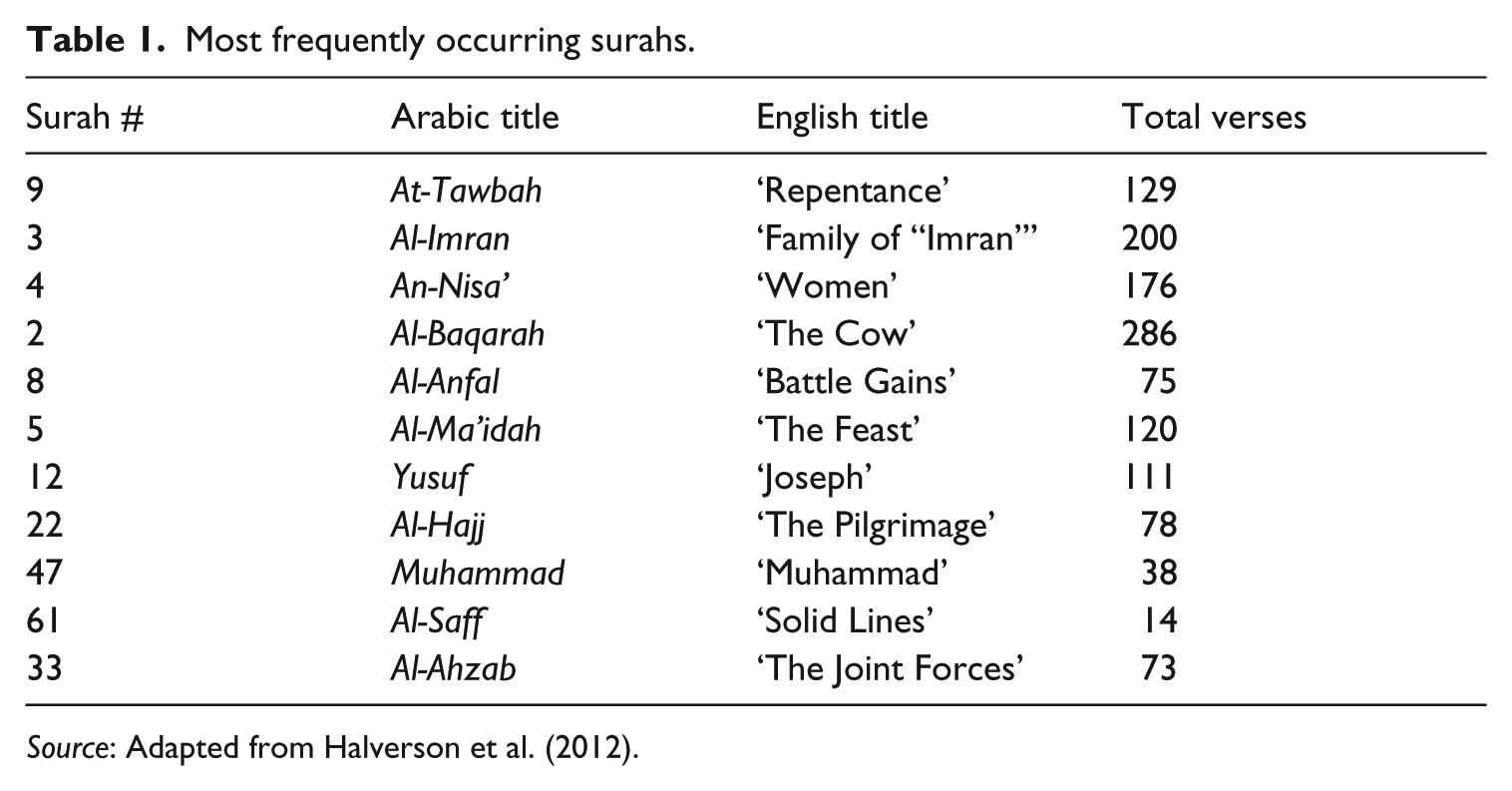
Source: Adapted from Halverson et al. (2012).
Methodology and data
The primary research methodology employed in this study is CDA (see e.g. Blommaert and Bulaen, 2000; Janks, 1997; Wodak, 1989; Wodak and Meyer, 2015). Describing the origins of CDA, Fairclough (2003) recognizes the interplay among social, discourse and text analysis by clarifying that ‘semiosis [is] an irreducible element of all material social processes’ (p. 205). As a result, CDA refers to a specific approach to discourse analysis that necessarily considers, according to Van Dijk (1993), the ‘relations between discourse, power, dominance, social inequality and the position of the discourse analyst in such social relationships’ (p. 249). In this sense, CDA attempts – as opposed to reifying any particular theoretical framework about discursive atoms – to make specific claims and/or recommendations about social, cultural and political issues.
In particular, Van Dijk (1993: 252) argues that scholars working within CDA must take a very clear position on the issue under discussion, that is, despite the political nature of such work, as the discourse analyst believes that this leads to or effects change. One way of doing this, for instance, is by defining and considering the role of ‘ideology’ in a given context. Van Dijk (1995, 1998, 2006) recognizes that ideologies – or fundamental, socially transmitted and reproduced systems of values and beliefs – contain social, cognitive and discursive components. Fairclough (1995) reinforces this notion by emphasizing the significance of textual analysis in discretizing the power relations and how these feed into ideologies. Consequently, the statements made in this article about the particular uses of each verse are necessarily influenced by each of these concepts, viz. through the ways in which a given verse identifies, contextualizes and reinforces opposing forces.
The data for this study come exclusively from the Corpus of Da’esh English-Language Periodicals (Spier, 2016), which contains over 515,000 words from two separate magazines produced and published electronically by the aforementioned extremist group, viz. fifteen issues of Dabiq and seven issues of Rumiyah. At the time at which the data were consulted for this study, the most recent (15th) issue of Dabiq had not yet been incorporated into the corpus. Consequently, the content of the first 14 issues is considered here, as indicated in parentheses in the table below, alongside other relevant basic statistical information for the entire corpus and both of the periodicals individually (Table 2).
Basic statistics of the corpus of Da’esh English-language periodicals.
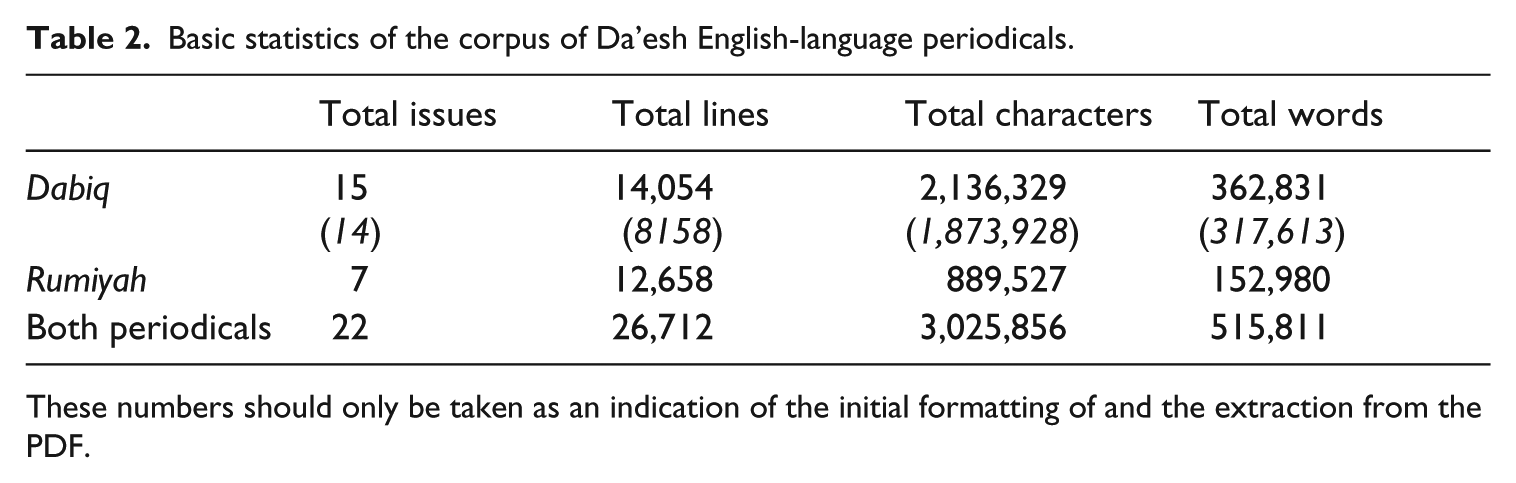
These numbers should only be taken as an indication of the initial formatting of and the extraction from the PDF.
Parenthetical citations to scripture or directly quoted verses in the Dabiq can appear sentence-initially, -medially or -finally. Furthermore, not all of the surahs are spelled in a consistent manner nor they are equivalent in structure, that is, while some titles are proper names or references to groups (e.g. Yunus, Nuh and Quraysh), others refer to specific events (e.g. Al-Hashr, Al-Haqqa and Al-Tawbah). The latter group complicates extraction of the data, as the underlying form of the definite article (al-) is oftentimes transliterated phonetically in the Dabiq, for example, the previously mentioned Al-Tawbah would be written as At-Tawbah. Moreover, Al-Nisa’ is realized as An-Nisa’; Al-Rahman, as Ar-Rahman; Al-Sajdah, As-Sajdah; and so on. What all of these references do have in common, however, is the relative positioning of the name of the book and the verse number.
Therefore, each of the 14 periodicals was loaded into AntConc (Anthony, 2014), after which point a regular expression was written to extract all instances in which any number of capitalized or lower-cased letters immediately preceded a colon, which itself was followed by any number of numbers. This regular expression accounted not only for the aforementioned grammatical and phonological differences but also for orthographic differences. For instance, (1) contains a range of verses, (2) represents the citation in square brackets and (3) represents the citation in parentheses.
(1) ‘[…] for them a painful punishment those who take disbelievers as allies instead of the believers. Do they seek with them honor [through might]? But indeed, honor belongs to Allah entirely} [ (2) ‘They forgot the command of the All-Powerful to His slave Muhammad (sallallahu alayhi wa sallam), {So declare what you are commanded} [ (3) ‘The above-mentioned ayah (
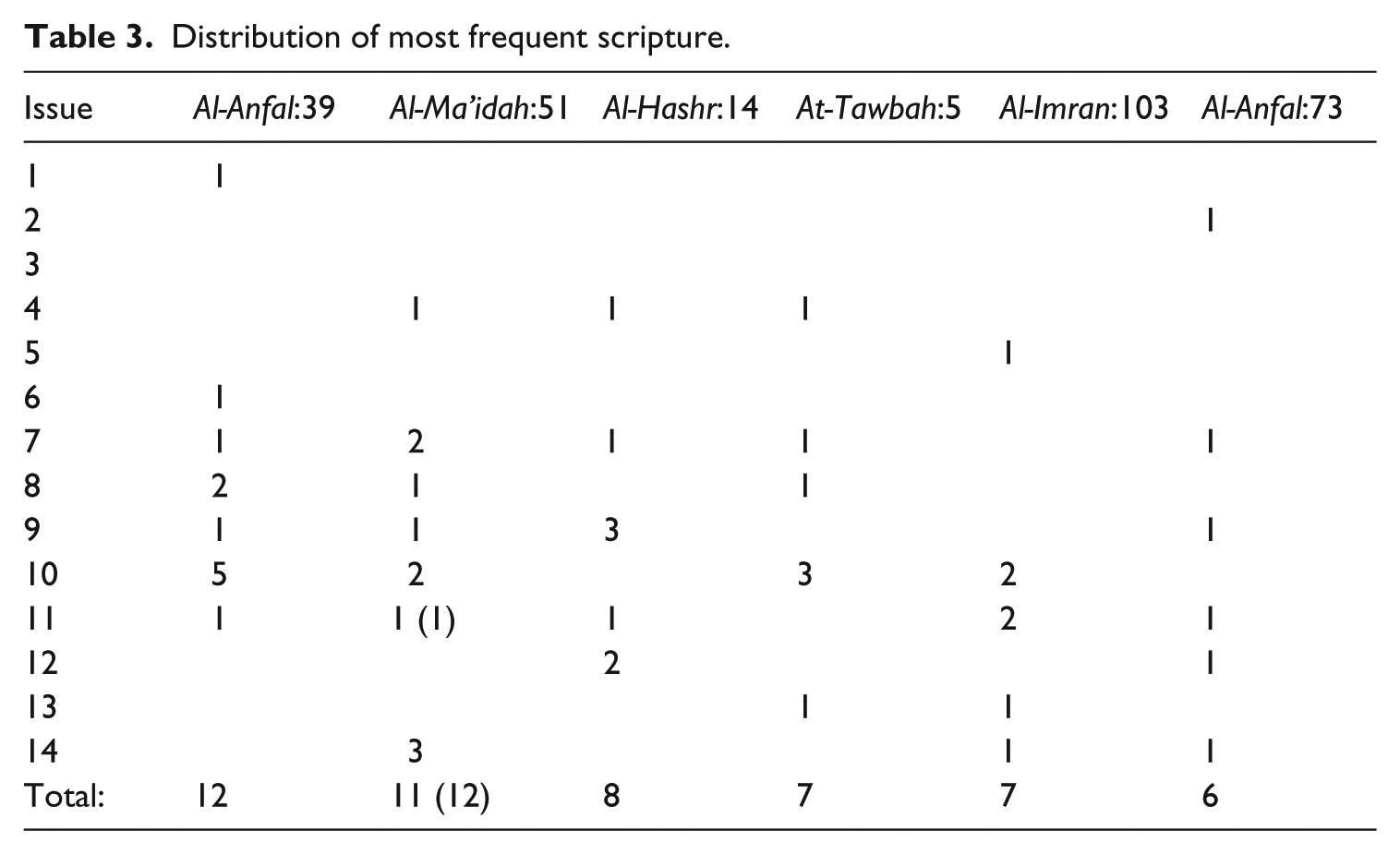
This ultimately yielded 624 verses, approximately 70% of which were unique. As exemplified in the table below, the majority of the quoted or referenced verses are cited three or fewer times; more significant, however, is the fact that 73% of these are cited only once or twice. The six most frequently attested verses are repeated a total of 51 times, accounting for 8.17% of all the cited scripture in these 14 issues, all six of which come from five books of the Qur’an: Al-Anfal (Surah 8), Al-Ma’idah (Surah 5), Al-Hashr (Surah 59), At-Tawbah (Surah 9) and Al-Imran (Surah 3). Additionally, each of the English verses comes from the Sahih International translation, albeit with modification in some of the publications (Table 3).
Distribution of most frequent scripture.
Analysis
Each of the following subsections will examine the contexts in which the six verses mentioned in section ‘Methodology and data’ occur. The complete verse is first listed, the content or events of the surah are mentioned, and then each token is examined briefly before the intended unifying theme or lesson is ultimately recognized.
Al-Anfal:39
And fight them until there is no fitnah and [until] the religion, all of it, is for Allah. And if they cease – then indeed, Allah is Seeing of what they do.
This verse belongs to the eighth surah of the Qur’an, which foregrounds issues related to the undertaking of military activities. Nonetheless, the immediately preceding verse emphasizes the requirement that Muslims assist one another in times of need and undertake hijrah (migration) as a way of enhancing their faith. At the same time, Muslims are told directly not to assist those who stand in the way of the religion. This surah contains a total of 75 verses.
This verse is referenced 12 times in seven separate issues of the Dabiq (1, 6, 7, 8, 9, 10, 11), with two tokens in issue 8, five tokens in issue 10 and one token in each of the other issues. Half of these are abridged, utilizing only the first sentence of the verse to reinforce the calamities that result from atheism and polytheism. Unsurprisingly, they are each employed as a call to take up arms. However, in contrast to the other most frequently used verses, this one is positioned alongside or strengthened by connection to other verses in five of the tokens, one of which comes from the ninth issue and four of which come from the tenth issue. Additionally, At-Tawbah:5 (see §4:4) is mentioned in three of these utterances.
Nonetheless, the reader finds that the usage of Al-Anfal:39 allows for the construction of a tripartite narrative. First, enemies exist as a result of polytheism (issues 7, 9, 10 and 11), the redrawing of borders in the Middle East through the Sykes–Picot Agreement (issue 8), the historical precedent of immoral behavior becoming widespread (issue 8) and the existence of towns and villages without Islamic law (issue 10). Second, the presence of enemies necessitates the use of violent force, first requiring psychological, religious and military training (issue 1). Third, this training leads to jihad by members of Da’esh in the West (issue 6) and the Middle East (issue 11), for example, through the participation of soldiers from Chechnya, Bosnia and Mali.
Given that the verse consistently advances this narrative and rarely deviates in the specificities of this message, it is less fruitful to engage the individual contexts, as opposed to subsequent verses discussed in this article. What is fruitful, however, comes through considering the prominence of history and political figures. For instance, Pharaoh is noted as one of many leaders who has encouraged nationalism and factionalism, in this instance ultimately slaughtering male babies and taking hostage females (issue 8). Furthermore, Abu Musab al-Zarqawi is quoted (issues 8 and 11) as a means of building solidarity, while Ibn Taymiyyah is quoted (issue 10) as a means of establishing theological credibility.
So O soldiers of the Islamic State, charge into the ranks of the murtaddin who forcefully resist the laws of the Shari’ah, and remember that Allah is higher and greater than the warplanes of the crusaders that these murtaddin rely upon and seek to be rescued by.
Al-Ma’idah:51
O you who have believed, do not take the Jews and the Christians as allies. They are [in fact] allies of one another. And whoever is an ally to them among you – then indeed, he is [one] of them. Indeed, Allah guides not the wrongdoing people.
This verse belongs to the fifth surah of the Qur’an, which fulfills two functions. First, it confers and reaffirms the exalted status of Musa and Isa, viz. the predecessors of Islam. Second, it establishes the basic teachings of the Islamic faith, for example, the recognition that certain foods are haram, the rules regarding the cleansing of the body (wudhu) prior to prayer, the divide between those who will dwell in the fire or in paradise after this world and the significance of the Ka’bah in undertaking the Hajj and ‘Umrah. This surah contains a total of 120 verses.
This verse is referenced 12 times in seven separate issues of Dabiq (4, 7, 8, 9, 10, 11, 14), with two tokens in issue 7, two tokens in issue 10, two tokens in issue 11, three tokens in issue 14 and one token in the other issues. It should be mentioned, however, that the second token in the 11th issue incorrectly cites this verse instead of quoting verbatim Al-Ma’idah:54.
Although this verse appears quite straightforwardly in opposition only to two specific religious groups, it is actually referenced generally in discussions of the harm inflicted by Western leaders, non-Muslims, hypocrites, and apostates. Moreover, one must be cautious of such individuals, because despite their communities uniting against Muslims, they are in reality disharmonious and divided. Such a characterization is found in the ninth issue, and another token in the seventh issue, while situated within five additional verses, provides a fuller description of these individuals’ attributes.
The fourth issue contains one token that is found in the transcript provided from a speech by Usamah Ibn Ladin in which he lambasts those who ‘[…] support whether by statements, spears, or speech’. This address is intended for Muslims and non-Muslims throughout the world. In fact, while the eighth issue specifically targets the Murji’ah and fighters of al-Nusra, the seventh issue describes an attack by Coptic Christians that resulted in the death of Muslims, and this verse is used in conjunction with Al-Hashr:14 (§4:3) and Al-Anfal:73 (§4:6). On the other hand, the 14th issue contains three tokens, two of which diminish the legitimacy of Islamic scholars from the West – specifically Hamza Yusuf, Bilal Philips and Pierre Vogel – by equating them with Jews and Christians. Finally, a clear statement is sent to the government of Turkey, a self-proclaimed Muslim majority country, for supporting the NATO Alliance, specifically the Americans’ military engagements in Afghanistan, Somalia, Iraq and Syria as attesting their lack of piety and respect for Islamic law: ‘The Turkish government is one that legislates, executes, and judges by manmade laws. Its army is assembled in defense of […] their crusader allies.’
The three remaining tokens present general statements on religious purity and association. For instance, the 10th issue recommends that one must spend limited time with Jews or Christians to avoid becoming one of them without realizing that such a transformation has taken place. On the other hand, the second token in this issue presupposes that some individuals claim Muslim identity for the purpose of becoming or remaining married, although this superficiality is condemning in itself. Perhaps oddly, this situation is discussed in an article written by a woman and for women. Finally, the last token in issue 14 states that although allying oneself with Jews or Christians can lead to a state of disbelief, it is made explicitly clear that this is still not nearly as damning as allying oneself with apostates, that is, those who have willingly left the faith as opposed to having been raised within a different faith.
Al-Hashr:14
They will not fight you all except within fortified cities or from behind walls. Their adversity among themselves is severe. You think they are together, but their hearts are diverse. That is because they are a people who do not reason.
This verse belongs to the 59th surah of the Qur’an, which foregrounds the distinction between the righteous and the wicked, in particular underscoring the losses suffered by the Banu an-Nadir and Banu Qaynuqa, two large Jewish tribes at the time of revelation. This surah contains a total of 24 verses.
This verse is referenced eight times in five separate issues of Dabiq (4, 7, 9, 11, 12), with three tokens in issue 9, two tokens in issue 12 and one token in each of the other issues. Only two of these tokens (4, 9) present the entirety of the verse, as the remaining six eschew either the very beginning or the very end for a functional purpose, that is, by underscoring that Western leaders ‘attack’ from the comfort of their own homes or by reiterating that the opponents of the Islamic State are not unified. Additionally, two tokens (9, 12) describe their opponents’ ‘violence’, as opposed to the ‘adversity’ found in the other tokens. In contrast to the calculated foregrounding or backgrounding of certain portions of the verse, it is likely that this is the result of different writers and different published translations of the Qur’an.
Nevertheless, three large functions are fulfilled by utilizing this verse. First, the writer identifies by name or denomination the groups that stand in opposition to Da’esh and recognizes their lack of unity. Second, the writer establishes that Western leaders feel comfortable engaging in military activities without having actually been to the battlefield. Third, the writer mentions that these opponents attempt to undermine the Caliphate by misrepresenting Islamic doctrine or by failing to recognize that their own internal division will bring about their end.
Five of these tokens emphasize opposing groups and call into question their ability to join forces. Interestingly, three of these eschew the first two lines (9, 9, 11) and two (7, 12) eschew the first line. This is contrasted strongly with other contexts in which the first two lines are integral in attributing a lack of bravery to Western leaders. Nonetheless, these five tokens are consistently used to introduce enemies of the Islamic State and to mitigate their real-world threat. Issue 7 specifically describes the Coptic Christians as divided. The first token in the ninth issue mentions that the Shamiyyah Front disintegrated – as a consequence of Da’esh military prowess – and resulted in the formation of separate groups that oppose one another, that is, which concretize internal division. The second token in the ninth issue relies upon binarity, albeit in a curious way, to identify opponents, for example, the Sunni apostates and those who reject the faith, the Free Syrian Army and the Islamic Front, al-Nusra and other Islamic paramilitaries and so on. Notable, in this context, is the use of quotation marks to signify that these groups are not truly perceived as Islamic. Similarly, the 12th issue continues the litany of enemies, while also citing Al-Anfal:73 as relevant (see § 4:6). Finally, the 11th issue contains one token in an interview with Abul-Mughirah al-Qahtani about the current military state of affairs in Libya. He responds that the situation changes daily on the basis of how many enemies are present, but the verse is used in this context to build solidarity and to encourage Muslims that these enemies are not as strong as perhaps initially perceived.
Two tokens address this second topic of military engagement. The fourth issue has one token in which the values and character of Barack Obama are impugned for having followed in the military footsteps of George W. Bush. In particular, the reader is made aware that Obama received the Nobel Peace Prize while simultaneously ordering attacks that resulted in the deaths of Muslims and also condemning attacks upon Americans as unjustified. Similarly, the foreword of the 12th issue has one token that declares that ‘[t]he divided crusaders of the East and West […] cowardly bombarded the Muslims of the Khilafah’ and have, as such, ‘undoubtedly destroyed their homes with their own hands through their hostilities towards Islam, the Muslims, and the Muslim body […]’.
Despite being present in three separate articles in the ninth issue, one of these tokens focuses upon the third topic and discusses Westerners who claim that Islamic beliefs are contradictory. Interestingly, it provides an exegetical explanation for inclusion of this verse in such a context:
[It] explains that the kuffār may appear united whereas their hearts are actually full of animosity and enmity for each other. And this hatred sometimes manifests itself in their deeds. How can extremely grand conspiracies be executed if its members are so divided?
As a result, its inclusion is meant to counter the belief that non-Muslims are actually a formidable force, as they cannot actually function as a cohesive opponent.
At-Tawbah:5
And when the sacred months have passed, then kill the [Mushrikin] wherever you find them and capture them and besiege them and sit in wait for them at every place of ambush. But if they should repent, establish prayer, and give zakah, let them [go] on their way. Indeed, Allah is Forgiving and Merciful.
This verse belongs to the ninth surah of the Qur’an, written around the time of the Expedition of Tabuk, emphasizing the punishment allotted to the disobedient, hypocritical and disbelieving – should they not engage in repentance. This surah contains a total of 129 verses.
This verse is referenced seven times in five separate issues of Dabiq (4, 7, 8, 10, 13), occurring three times in the 10th issue and once in all others. In all instances, excluding one of the three tokens in the 13th issue, the verse is used verbatim; moreover, it is consistently employed to reinforce the consequences of willful and ignorant disbelief.
The fourth issue has one token that is included in a reference to the Yazidis, a supposedly deviant religious sect of ‘pagan [worshippers]’. The reader is informed that the slave trade has been reestablished, and he is also warned that all Muslims will be questioned about their inaction in extinguishing such a threat during the last 1400 years, that is, since revelation. Similarly, the Murji’ah are presented in the eighth issue as an ignorant, rebellious sect of Islam that allows both minor and major sins to go unaddressed, claiming that these violations remain the concern strictly of the individual and his creator. Finally, despite the origin of Salafism, the 13th issue takes aim at the religious scholars of Saudi Arabia, ultimately calling them ‘Palace Scholars’. Nonetheless, these three tokens invoke a judicial or penal obligation of Muslims, made available to them through the (four divine) swords defined in the seventh issue’s feature, entitled ‘Islam is the Religion of the Sword, Not Pacifism’.
Not only do the three final tokens appear in the 10th issue, but they also appear within the same article. The first instance, which is the only abridged token of this verse, refers to the asymmetrical allocation of man-made and divine law, citing as particularly inferior those who adhere to legislation developed and implemented by humans. The second instance establishes the rights for those disbelievers who repent and follow the tenets of the faith, specifically stating, ‘If you do this then you are our brothers. You will have the same rights as we have and you will have the same responsibilities as we have. Your blood and wealth will be prohibited for us’. Thus, not only are these individuals no longer the enemies of Da’esh, but their worldly life and possessions cannot be seized and they become, at least in theory, equal with other believers. The final instance, on the contrary, establishes the punishment for those who do not follow such a course of action, explicitly mentioning that ‘[Da’esh] will rub the noses of the kuffar in [the] dirt, shed their blood, and take their wealth as ghanimah by the might and power of Allah’.
Al-Imran:103
And hold firmly to the rope of Allah all together and do not become divided. And remember the favor of Allah upon you – when you were enemies and He brought your hearts together and you became, by His favor, brothers. And you were on the edge of a pit of the Fire, and He saved you from it. Thus does Allah make clear to you His verses that you may be guided.
This verse belongs to the third surah of the Qur’an, which emphasizes two religious battles 6 undertaken by the early Muslims, clarifies the devout status and divine protection of Maryam, and recognizes the miraculous birth of Isa and his position as the Messiah. This surah contains a total of 200 verses.
In particular, this verse is used in each of the seven tokens consistently in a condensed form: ‘And hold firmly to the rope of Allah all together and do not become divided.’ It is referenced seven times in total in five separate issues of Dabiq (5, 10, 11, 13, 14), as issues 10 and 11 both contain two tokens, and it is accompanied in three of these instances (5, 10, 11) by alluding to a hadith in Sahih Muslim: ‘Whoever dies while not having bay’ah, dies a death of jāhiliyyah.’ Specifically, those who abstain from taking up arms or pledging allegiance to a leader deliberately remain ignorant of the will of their creator. Nonetheless, this allusion ultimately reinforces the overarching message illustrated by its inclusion, that is, that unity is necessary for the believers to be successful in any of their endeavors, in particular those that involve warfare.
The 11th issue contains two tokens, the first of which accents the obligation to institutionalize the Shari’ah by ‘[…] unit[ing] in one body, appoint[ing] a single leader, and hear[ing] and obey[ing] him’. The second reference comes from the second page of the same article and encourages Muslims to educate themselves, manifest positivity and avoid creating divisions among the Ummah. Interestingly, the 14th issue contains one token that simultaneously reiterates the aforementioned call for unity, yet also reminds the readers of the Salafi roots of Da’esh.
These Salafi roots, especially those that involve warfare, are exemplified in the remaining four tokens. The fifth issue contains a proclamation of loyalty to Abu Bakr al-Baghdadi by the mujahidin of the Middle East and Northern Africa, and the scripture is used to reinforce their commitment to the struggle and the soldiers’ willingness to remain united in that struggle. The 10th issue contains two references, the first of which reminds the reader that not allowing a religious leader 7 to exert control over everyday affairs results in a fall to ‘the sin of division and disagreement’. Similarly to the fifth issue, the second reference in the 10th issue is noted in a transcript of the official statement, declaring loyalty to Abu Bakr al-Baghdadi by the mujahidin of Chechnya, Dagestan, Ingushetia and Kabika.
Finally, issue 13 contains a single token from an interview with the Wālī of Khurāsān, which today includes parts of Afghanistan and Pakistan. When prompted to provide general advice to Muslims, he stated that Muslims need to unite against disbelief, apostasy and atheism in a similar way to their opponents who unite against them. He then cites the verse as encouragement that the ‘rope’ – or support – of Allah alone can help them remain united.
Al-Anfal:73
And those who disbelieved are allies of one another. If you do not do [the same], there will be fitnah on earth and great corruption.
This verse belongs to the eighth surah of the Qur’an, which foregrounds issues related to the undertaking of military activities. Nonetheless, the immediately preceding verse emphasizes the requirement that Muslims assist one another in times of need and undertake hijrah (migration) as a way of enhancing their faith. At the same time, Muslims are told directly not to assist those who stand in the way of the religion. This surah contains a total of 75 verses.
This verse is referenced six times in six separate issues of Dabiq (2, 7, 9, 11, 12, 14) and occurs in almost exactly the same form as that listed above. Only in the 12th issue does the reader find an abridgment, resulting in simply the first portion of the verse being cited: ‘[…] those who disbelieved are allies of one another.’ Still, the reader finds that Al-Anfal:73 is consistently invoked when the general intention is to unite Muslims against the disbelievers.
The second issue utilizes this verse to build solidarity and encourage Muslims to make explicit their loyalty to Khalīfah Ibrāhīm (The Caliphate of Abu Bakr al-Baghdadi). The 11th issue reinforces this notion by reinforcing the understanding that Islam does not discriminate along demographic lines, and that one’s faith is the only truly important – and determinative – factor.
In fact, it is this characteristic that determines whether one belongs to the class of disbelievers. The 12th issue outlines exactly who constitutes the class of disbelievers, viz. Christians (Catholics, Protestants and Orthodox), Jews (Orthodox, Conservative and Progressive), Buddhists, Hindus, Sikhs, capitalists, communists and fascists. Moving one step forward, the ninth issue, in a discussion about Shirk, 8 describes disbelievers as hostile, violent people whose fragile, superficial unity is only witnessed in opposition to the Caliphate. The scripture is used in both of these issues to reinforce the divide between the righteous and the wicked.
Finally, the remaining two invocations encourage unity in retributive justice against those who have caused harm to the Ummah. The 14th issue reminds Muslims – during an interview with the ‘Amīr of Bengal, which constitutes modern-day Bangladesh and part of India – that one of their religious obligations is to follow the teachings of Muhammad Ibn ‘Abd al-Wahhāb and return to true unity against disbelievers. In a report in the seventh issue, a crime is described to the reader that was committed by the Coptic Church that resulted in the torture and murder of ‘Kamilia Shehata, Wafa Constantine, and other sisters’. Two important Da’esh figures are credited with developing and executing a military plan from a distance that resulted in the capture of 21 enemy combatants; here, the scripture is used to reinforce the notion that fitnah and corruption are unacceptable.
Conclusion
This mixed-method study has demonstrated how a corpus of extremist propaganda, in particular Spier’s (2016) 500,000+ word Corpus of Da’esh English-Language Periodicals, can be used successfully to calculate the most commonly invoked scripture and to investigate qualitatively how these verses are used to promulgate the group’s message, that is, essentially unity through isolation and positional distancing from the Other. The six most frequently occurring verses come from five books of the Qur’an (Al-Anfal, Al-Ma’idah, Al-Hashr, At-Tawbah and Al-Imran) and constitute 8.17% of all the scripture (624 verses) cited across 14 published periodicals from a period of almost 2 years.
Furthermore, this study has challenged the results of Halverson et al. (2012) in two considerable ways: first, by presenting reliable, specific, verse-level results, and second – and perhaps more importantly – by utilizing a publicly accessible corpus of material from a single extremist group over a controlled period of time. While the other literature discussed (Colas, 2017; Kuznar and Moon, 2014; Milton, 2014, 2016) does engage the extremist propaganda of Da’esh, they do so from very different perspectives with separate goals (e.g. discussing the role of networking), tools (e.g. speeches by prominent leaders of Da’esh) and outcomes (e.g. describing the overarching theme of certain publications).
Nevertheless, while this article illustrates one way that useful data can be extracted from the Corpus of Da’esh English-Language Periodicals (Spier, 2016), there are a variety of directions in which research could proceed to reveal other interesting conclusions. For instance, given the role that the city of Dabiq plays with reference to Islamic eschatology, it might be worthwhile to pursue a micro-level analysis of the specific content and tone of the periodicals while correlating such changes to real-world referents, for example, the siege and retaking of Dabiq by opponents of Da’esh. On the other hand, more specifically linguistics-oriented studies could be undertaken to determine how Arabic continues to function within an English-language periodical, in particular by calculating and considering the types of Arabic lexical items used or by extracting and analyzing the use of trilateral roots, for example, in order to identify in- and out-group membership affiliation according to the use of derived lexemes of the triliteral root √KFR (Spier, 2017).
Footnotes
Acknowledgements
An early draft of this article was aided by the feedback of Dr Lawrence A. Kuznar of Indiana University-Purdue University Fort Wayne (IPFW) and anonymous reviewers at the Western Conference of Linguistics (WECOL) at Boise State University.
Declaration of conflicting interests
The author(s) declared no potential conflicts of interest with respect to the research, authorship, and/or publication of this article.
Funding
The author(s) received no financial support for the research, authorship and/or publication of this article.