



Abstract
Hosting the Rugby World Cup in 2011 offered a chance for New Zealand to showcase itself on the world stage, but also provided immigrants to the country an opening to assert their legitimate place in the nation. We present the particular case of Leslie, a Filipina migrant, and her Facebook activities during the tournament. Approaching these texts through the frameworks of liminality and timescale-differentiated identity construction along with Social Actor Network Analysis, we unravel the discourses of national belonging facilitated by the interaction of social media and a sporting mega-event. Our analysis shows that Facebook’s semiotic affordances, interconnectivity and ability to bridge time and distance allowed Leslie to be part of the collective by performing an emerging identity as a New Zealander. As a result, she transcended the identity of being an other in New Zealand to – at least for this period – take on one of national belonging.
Introduction
In rugby, the gain line refers to an imaginary line that divides the territories of the competing teams at any period in the game. It essentially marks the boundaries that must be crossed in order to gain partial advantageous positions. The value of the gain line is that it indicates where a team stands in the attempt to reach its target, the opposition’s goal line. Passing over the gain line means a team has gained an advantage and moved closer to the objective. Crossing the gain line is therefore a fitting metaphor in the case of Leslie, a Filipina migrant in New Zealand, to refer to her negotiation of national belonging as performed through her Rugby World Cup (RWC)-related Facebook discourse.
Leslie and her family (husband, Ken and children, Alex and Leah – all are pseudonyms) had already been in New Zealand as permanent residents for almost 3 years when the country hosted the RWC in 2011. Coming from the Philippines, where the sport of rugby is virtually unknown, it was curious to witness how they developed a fan sensibility at the height of the event, notwithstanding the fact that their participation was limited to following the games on television and expressing support for the national team on Facebook. When asked, Leslie explained their limited participation as being due to both practical reasons (having children) and financial reasons (ticket price).
This article draws on a larger study on diasporic identity construction in new media (Aguirre, 2014) that centres on the migrant experiences of Filipinos in New Zealand. As a wider objective, we aimed to unravel the discursive practices of some Filipinos in their sign-making activities on Internet-based platforms such as blogs, social media and websites, and our consequent interrogation of their identity as liminal persons attempting to make sense of their binary national belonging. In this particular article, however, we present the case of Leslie and her Facebook activities during the RWC to illustrate through a critical analysis of discourse how she was able to perform a transition from a detached identification with her current host nation to a definite claim to a national belonging through the discursive construction of what Lemke (2008) terms ‘identity-in-the-moment’ (as opposed to ‘identity-across-lifespan’). We model our understanding of identity on the approach of Krzyżanowski and Wodak (2008) which puts a premium on the notions of attachment and belonging in migrant self-understanding. The momentariness of identity work is central to the article since it highlights the ever-shifting character of one’s practices of attachment and sense of belonging. Leslie herself admitted when interviewed that their family really did not care about rugby until the RWC. At that time, however, they invested a noticeable amount of attention in it, due in no small part to their experience as migrants: ‘… we needed to cheer for New Zealand … We had to learn the rules of rugby because, that’s how it is, this is now our home’.
The focus on Leslie’s case, and within that on a small segment of her social media activities, is illustrative: it highlights the act of identity production carried out by an individual in opportune moments. We do not claim that her Facebook discourses on identity are necessarily representative of migrants, nor can these encapsulate the totality of her identity work as a migrant. Nevertheless, we submit that the rich insights gained from a single in-depth case study such as the one we present is important in the further understanding of the issues we address. This includes their ambiguities and, as far as actual personal experiences go, their resistance to complete schematisation (Ogburn and Goldenweiser, as cited in Jocher, 1928). Echoing Flyvbjerg (2006), we present a particular case which is not meant to generalise and summarise a phenomenon but to capture a rich and nuanced narrative that may ‘approach the complexities and contradictions in real life’ (p. 237). The interpretive stance that we employ is aimed at understanding the experience of identity negotiation from a subjective point of view in relation to the participant’s social context and personal history.
In order to fulfil our objectives, we put forward first a theoretical and methodological framework together with a brief explanation of the data featured in this article. Next, we present a background discussion of the RWC 2011 and its wider social and cultural entwinements. This is followed by a reading of the RWC-centred contents of Leslie’s Facebook profile, where we endeavour to demonstrate how a special (inter/national) event links with the semiotic affordances of the social networking site. Together, these give particular groups of people a chance to appropriate not just the communicative capabilities of new media platforms, but their ideational potential as well.
Liminality in discursive online construction of identity in timescales
We read Leslie’s discourses on Filipino migrant identity during an international sporting event within the practice of social media. Modern modes of communication and the versatility of new Internet-based media make keeping connections across vast distances both easier and necessary. Social network sites such as Facebook have become a means to defy time and distance. They enable, for instance, families to maintain constant interaction and feel a sense of closeness despite being separated by migration (Madianou and Miller, 2012; Miller, 2011; Pertierra, 2012). However, Facebook and other social media gain significance not just because they are pragmatic (De Zúñiga and Valenzuela, 2010). As with many other Internet-based platforms, social media not only provide ways to communicate, but also function as platforms of self-expression, representation and identity formation (Ellison, 2013; Hiller and Franz, 2004; Wandel and Beavers, 2010). Georgalou (2017), in particular, underscores Facebook’s provision of a more fluid platform for presenting and managing personal and social identity, but in the same breath issues a caveat about social media’s commercial concerns and interests.
The value of Leslie’s simultaneous engagement with Facebook and the RWC 2011 lies in its elucidative potential to demonstrate the intersections and contradictions of identity, sports and online media as examined through the concept of liminality. Turner (1982; see also earlier work by Van Gennep, 1960) explains liminality as the in-between condition of one who is undergoing a transitional process of moving from one status to another in, for instance, rites de passage. It is an ambiguous stage where structure is held in abeyance. Characterised by discourse and action ‘that transcend social structural limitations’ (Turner, 1982), liminality affords a person temporary freedom from the routine of everyday life structures, leading to an opportunity for ‘reclassifications of reality (or, at least, of social experience)’ (pp. 37, 52). In this article, we take Leslie’s migrant status as a situation of being in-between attachments to her former and her new home. This notion of being in-between has been problematised in the context of migrant experience by, among others, Fortier (2000) and Probyn (1996). In varying but complementary ways, they have referenced Turner’s elucidation of the liminal state, particularly in their characterisation of migrant status as a period of transition. In addition, they recognise the ambivalence and contradictions that define the challenge of establishing belonging and negotiating attachments in migrant life. The work of Krzyżanowski and Wodak (2008) is of special interest to our study because they examined self-identity formation through the discursive construction of attachment and belonging in migrants’ narratives. We take inspiration from this particular framing of identity, but focus our efforts on examining a very particular case of one migrant who is enacting negotiation of a sense of attachment and belonging on a specific online platform during a very specific event in the host nation’s recent history.
Turner (1982) further proposes that in post-industrial contexts, the liminal experience is approximated in individualistic cultural practices considered as ‘free time’ separated from work, such as literature, the arts, sports and leisure (p. 36). The Internet and social media, along with sports, have been considered as instances of appropriating the liminal phase in more contemporary contexts. Waskul (2005) considers the Internet as a natural setting to enact liminality because of the process of dislocation (extracting ‘space’ from physical ‘place’) and disembodiment (separating the physical body from the self) that is inherent in its use, encouraging a reconsideration of how we constitute self and society. On the other hand, sporting events are considered liminal as they become temporary moments of solidarity with others. Rowe (2008) asserts, in particular, that modern sports are truly liminal events since they are realised only through the premise of the collective: they emerge from the collective as opposed to being a product of one individual. They possess and profess the collective spirit of the community of their origin, and they attract the collective to them. As earlier proposed by Ingham and McDonald (2003), sport brings about communitas, or the experience of rising above normative structures that define everyday life, resulting in the unity of people across different statuses. We believe, then, that by being deeply rooted in the communal experience, the RWC 2011 served to become a cultural performance akin to a rite de passage in a post-industrial setting in which, aside from a sense of the collective, an episode of transition was also actualised on both an individual and national scale.
Along with making a transition in status, the liminal subject necessarily undergoes a transition in identity. In our particular case, we aim to demonstrate how Leslie was able to discursively construct this shift in identity on Facebook, not just as an environment that inherently allowed her a reconstitution of her identity, but also as a stage to display this transitory period. The idea of transition is premised on the experience of change in the passing of time. This temporal element of the liminal process and its implications for identity formation is best understood following Lemke (2000, 2008) and his proposition that identity is differentially time-bound.
It is important to consider identities across timescales because there is a fundamental difference between identity-in-practice (or identity-in-the-moment) and identity-across-events or identity-across-lifespan (Lemke, 2008). We summarise the distinction between these two timescale-differentiated identity formations by describing the interaction of contingency and permanence in the making of our identities. Structural or positional determination – pertaining to a relatively permanent identity – is more predominant in long timescales, while agency – implying individual action to influence or change one’s identity – is more predominant in short timescales (Lemke, 2008: 23–24). Evocative of Bourdieu’s concept of habitus and Giddens’ structuration theory, these two dimensions of identity exert mutual influence on each other. This dialectical relationship illustrates why identities are not static, although they may be perceived or interpreted as essential through being experienced as overpowering and unconscious predispositions over long periods.
In accordance with this framework, momentary makings of one’s identity are more open to change than are longer term enactments – it is in the former that an individual’s agency becomes more obvious (Lemke, 2008). Migrant identity can be framed similarly, as immigrants bring with them an identity or identification developed in the long term through repeated practices and sign making prior to their settlement in the new place. It is in tiny moments, however, that the elements that make their identity what it is become subject to possibly more radical shifts.
Krzyżanowski and Wodak (2008) were able to recognise various qualitative categories in their discursive analysis of ‘migrant voices’ as indexes of a sense of belonging and attachment, hence a mode of identification. Although we recognise the value of their design, we rely here on Social Actor Network Analysis as outlined by Van Leeuwen (2008) as our analytic framework, as was also the case for the larger project. This form of analysis depends on a socio-semantic schema that dissects the representation of social actors when their involvement in social practices is recontextualised in discourses about them. In short, what people actually do is different from the telling of what they do (Van Leeuwen, 2008). The politics of this process of recontextualisation of the actual doing lies in the kind of information that is concealed or activated in the service of a particular goal. Van Leeuwen provides an inventory to identify the discursive ways social actors are constructed in discourse events, such as differentiation (us vs them), assimilation (attachment to a group) and categorisation (shared identity). The application of the framework in this article is ‘multi-semiotic’ as we considered the different meaning-making resources that Leslie used in particular discursive moments on her Facebook profile. Specific socio-semantic categories are discussed in the following as they become relevant. We also note that many of the categories developed by Krzyżanowski and Wodak in their study complement Van Leeuwen’s, such as ‘self and other presentation’ and ‘metaphors’ of attachment and belonging.
The RWC: A small nation making big claims
Culture, power and identity are pervasive in the world of sport (Butterworth, 2014). Sport is of course characterised by competitiveness, which may appear contradictory to the spirit of communitas, as explained above. This refers to the competition that occurs not only between opposing teams, but also between fans or supporters who sport a competitive spirit as strong as, if not more so, as the competing teams themselves. It can be argued, however, that the idea of conflict or battle is what cements feelings of identification, allegiance and solidarity (Dolan and Connolly, 2016), thereby substantiating a sense of belonging and practices of attachment. However, we must acknowledge that sport is constructed and practised by and for various interests. Evident in the particular case of the RWC 2011 is the complex of institutional entanglements that make a global sporting event fertile ground for corporatist promotion, cultural consumption and appropriation of national attachment (Jackson, 2012) that at once make up and go beyond the actual games.
Rugby is not a widespread sport, but it is passionately played and followed in a score of countries, including South Africa, Wales and New Zealand, where it ranks as the national game. The ‘All Blacks’ are New Zealand’s national team and one of the top (often the top) teams in the world. The RWC was inaugurated in 1987 with a tournament held in New Zealand and Australia, and won by New Zealand. New Zealand hosted the cup again in 2011, with total attendance at matches close to 1.5 million.
New Zealand’s bid to host the RWC 2011 was won by the campaign ‘A stadium of 4 million’ (Bruce, 2013; Jackson and Scherer, 2013). We are immediately drawn to the cleverness of the pitch and the rhetorical manoeuvrings that it accomplishes. The 4 million represents the total population of New Zealand, and this aggregation seemingly makes those who consider themselves New Zealanders willing participants in the event. In recounting the saga of the RWC 2011 as the country’s most compelling and memorable venture in recent memory, the Chief Executive of the event, Martin Snedden, claims that the World Cup success is a New Zealand story made possible only by the ineluctable link between the sport of rugby and being ‘Kiwi’ (a New Zealander). He effectively argues that rugby is not only a significant aspect of New Zealand society but, more fundamentally, a major component of its very essence. Looking back, Snedden (2012) explains further: No other country has such a widespread and comprehensive love and awareness of rugby as do the people of New Zealand … rugby is part, a vital part, of our country’s DNA. The ‘stadium of four million’ concept, the embracement of the event by the whole country, is not possible anywhere else. (p. 283)
Framing the event as a ‘whole-country’ affair makes it virtually impossible to perceive that, huge as it was, the RWC was not treated as homogenously as Snedden had claimed. Not every New Zealander accedes to imagining rugby and the RWC as determinants of a natural national core, but to go against the grain is unlikely to be recognised as an equally legitimate expression of belonging to the nation. Bruce (2013) alleges that the fervent desire to depict New Zealand as the rightful location of the world’s biggest rugby event silenced dissenting voices and rendered ‘invisible’ perspectives that did not support the dominant discourse. In attempting to convince the world and the nation that the unity of New Zealanders is as organic as the unity of the RWC storyline, disruptions in the plot must be de-articulated. Only one great tale must be written.
As a sporting mega-event 1 that saw its realisation on New Zealand shores, RWC 2011 was a chance for this relatively small and isolated nation to show the world that it has ‘arrived’ on the global stage. But even in the thick of the event, there were sectors that continued to oppose the hegemonic vision of the RWC as an absolute good. Some had argued against it from an economic perspective, while others opted to question the cultural and symbolic integrity of the project, especially since it was tied to the heavily romanticised reliance of New Zealand’s sense of nationhood on the sport of rugby. A multiplicity of voices needed to be heard to get a more holistic picture of the experience, but this risked being aborted at the time by the almost ‘rabid’ sense of participation as a sign of being true Kiwi (Bruce, 2013).
Snedden (2012) pushes further the rhetoric of the RWC 2011 as a New Zealand story when he claims that ‘it was a story that crossed and broke down boundaries’ (p. 284). We are doubtful about that uniformity of purpose and action. The diversity of backgrounds and experiences of those who comprise New Zealand prevent the meaning of RWC 2011 from being narrowly constructed.
Performing the self on social media
Data
In the larger study, we looked at Leslie’s Facebook activities since she began accessing the social networking site in 2008 up to the end of the data-gathering period in 2011. 2 The focus was on the Timeline, the main Facebook profile that is available for others to see. Understanding of the data set was supplemented with a semi-structured interview (excerpted in succeeding sections in English from the original Filipino).
Table 1 shows Leslie’s status posts in 2011 September and October – the period of intense activities leading up to the finals of the RWC. Here, we show only her posts pertinent to the RWC (although during this time her Facebook content production did mostly concern the event). The right-most column shows the results of a Social Actor Network Analysis of the kind outlined earlier, and this will be discussed later.
Leslie’s relevant Facebook activities during the Rugby World Cup (September to October 2011).
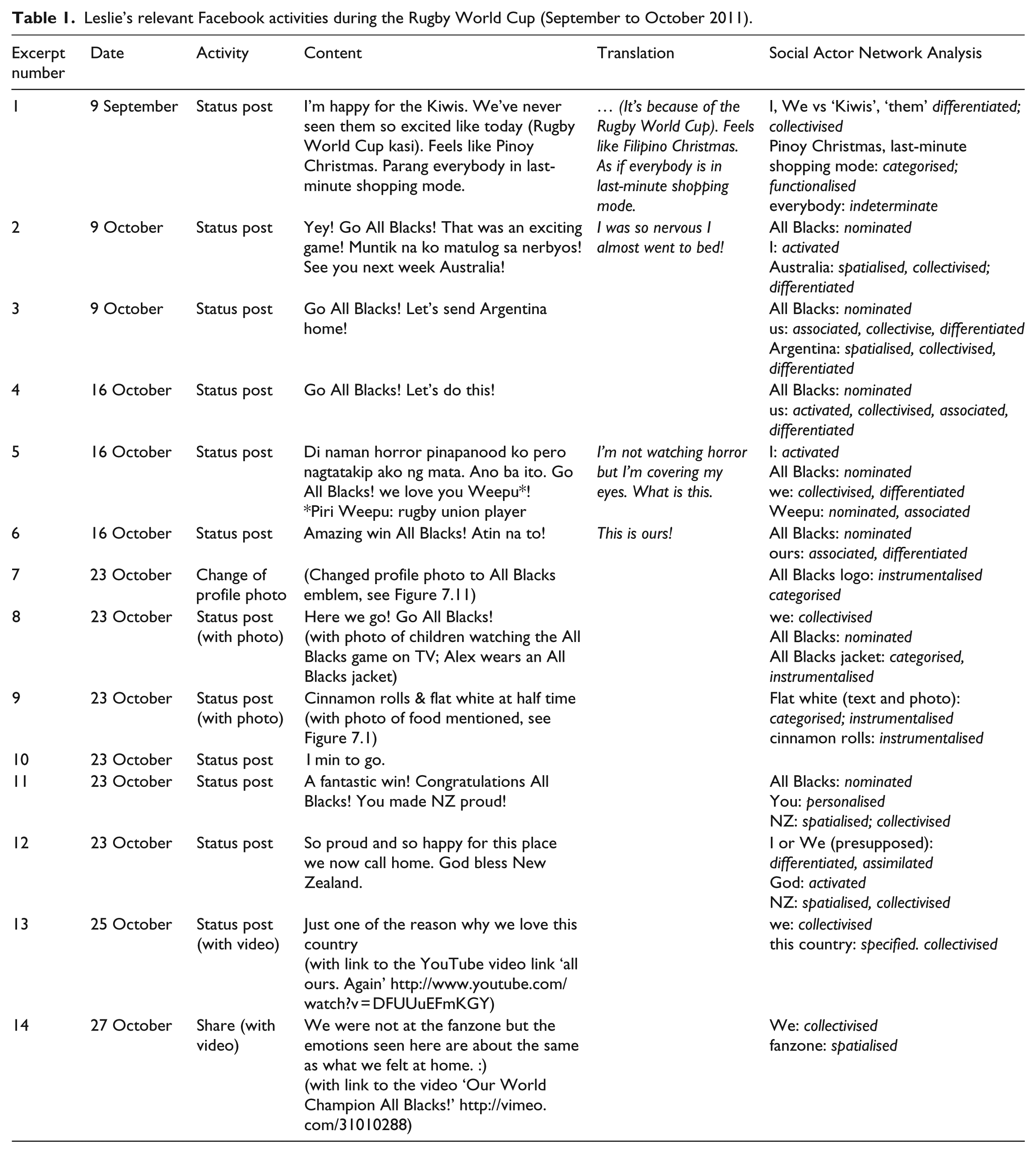
Most of these posts were status updates (i.e. textual commentary or statement) except for the change of profile photo on 23 October and the ‘sharing’ of a video (i.e. providing access to others) found on the video-sharing site Vimeo 3 on 27 October. Of the 14 posts, 9 were purely (verbal) status updates while 2 had accompanying photos and 1 had a linked video. 4 Our analysis focuses on Leslie’s own produced content. Although the two videos she chose to feature are significant in their own right, we will not be doing a close reading of them. We note, however, that linking external texts or items to the Facebook profile and the productive, distributive and semiotic dynamics of this networking function is a general characteristic of social media. In Leslie’s case, these activities are uniquely configured by the intersections of migrant experience, the liminality of the sporting event in which the collective becomes paramount, and the semiotic potential of Facebook as the means of identity production and the venue for identity performance.
Analysis
The migrant as passenger: Positioning the self within the collective
The subject who is in transition during a liminal period can be imagined as a ‘passenger’ (Turner, 2009). The liminal stage places people ‘in between distinctions’ (or in between the former and new status), thereby transforming them into ‘beings-in-transition’ (Rowe, 2008: 128).
Turner used the term communitas to refer to a sense of heightened togetherness, which people might feel with one another during a liminal period once the ‘superficial clothing of age, status, occupation, gender and other differences had been removed’ (Rapport and Overing, 2000: 233). It was the experience of communitas in the RWC that gave Leslie, and possibly others who are in a similar marginal status in New Zealand, a means to own and perform an identification that on ordinary days would have been more difficult to achieve. Here we call attention to her journey as a ‘passenger’ as revealed by her Facebook activities, to underscore the transition in her sense of belonging at particular discursive moments.
Happy for ‘Kiwis’: Discourses of detachment and bifocality
On 9 September 2011, Leslie made her first rugby-related post for the period (Table 1) at the time of the All Blacks’ first pool match, which was against Tonga. The pronominal choice (we, them) and use of classificational labels (Kiwi, Pinoy) reveal an ‘in-group vs out-group’ identification (Table 1, right-hand column). Leslie’s words immediately enact a sense of a specific belonging and acceptance, of being one with a particular collective or ‘being aligned alongside particular ideas’ (Machin and Mayr, 2012: 84). Using the labels ‘Kiwi’ and ‘Pinoy’ is an obvious representation of her own ethnic non/belonging. Both are in-group labels for the two respective nationalities, New Zealander and Filipino. Both position writer and reader of the post as within one of these collectives, and as sufficiently intimately related to the other to use this familiar form of reference.
In an instance of collectivisation, Leslie admits being ‘happy for the Kiwis’, lumping them together as a group with presumably homogeneous characteristics and attitudes relevant to the situation being represented. Coupled with the use of a third-person personal pronoun, them, she completely separates or differentiates herself from the particular ‘collective’ that she may feel happiness for but still considers different from her or her own belonging. What is more, the activation of herself (I) and her ‘group’ (We) in the first two sentences of the post suggests not only distance but a position of an outside observer. In an ambivalent positioning contrasting with the in-group labels just used, she identifies the other as subjects of interest and curious scrutiny (‘We’ve never seen them … like today’).
The act of distinguishing between what she is and what she is not, however, should not be considered as an antagonistic move or an expression of a denigratory othering. On the contrary, Leslie’s next statements reflect a bifocal perspective in the experience of another culture where one sees others against a background of oneself, and oneself against a background of others (Fischer, 1986). This bifocality is a necessary mode of ‘looking’ in today’s environment where transnational and transcultural mobility is the norm – where one constantly needs to confront objects, images, ideas and practices that were previously unfamiliar or, in some cases, unreal. Using the indeterminate ‘everybody’ – perhaps signifying a more generous level of ‘inclusivity’ – Leslie’s take on the ‘unusually ecstatic’ atmosphere during the RWC was coloured heavily by comparison with one of the most important festival occasions for Filipinos: ‘Feels like Pinoy christmas [sic]’. Christmas celebration, indeed, becomes the lens through which she attempts to comprehend the sporting event, not least in relation to the widespread consumerist exercise that goes with that season (‘… last minute-shopping mode’). Still, the sympathetic juxtaposition of two entirely different occasions in two entirely different contexts illustrates Leslie’s desire to bridge the gap – a gap that will only get smaller as her immersion in the games becomes more intense and her vision of an identity is reformatted.
From ‘them’ to ‘us’: Narrowing gaps and creating distances
Leslie made no posts about the All Blacks’ remaining three pool matches, all of which they won. Her second set of status posts (Table 1, Excerpts 2-3) refers to their quarter-final against Argentina, which came a month after her initial RWC commentary and marked the beginning of a revaluation of her position in her new country. Not only is there a remarkable intensification of emotion over an All Blacks’ game, there is also a noticeable shift in the manner with which she regards the team and, more importantly, herself in relation to the team as a carrier of national identity.
The ‘All Blacks’ are specifically named or nominated in all verbal status posts from 9 October up to 23 October, the day of the Final (Excerpts 2–6, 8, 11). This should be no surprise as Leslie expresses support for the national team. Its greater relevance, however, becomes more evident if coupled with her pronominal choice that, once more, is able to portray a sense of being part of a collective (see Excerpts 3–6, 8). For example, in her emphatic ‘Let’s send Argentina home!’ (Excerpt 3), the ‘Us vs Them’ dichotomy is once again referenced. However, this time it is an instance where Leslie finds (or presents) herself as associated with the All Blacks, the Kiwis, New Zealand as they are pitted against the ‘other’, that is, Argentina – the ‘them’. This status post, along with Excerpt 2, also illustrates a case of spatialisation, where the persons comprising the teams are not only collectivised but represented as the countries they play for. As a semantic move, this only strengthens Leslie’s claims of identifying with her own collective – the New Zealand team and the nation itself.
Leslie repeated this framing of her relationship with the team and nation with the use of an inclusive pronoun in other instances. On the day of the semi-final against Australia, 16 October, she writes ‘Let’s do this!’. And for the Final against France on 23 October, in Excerpt 8, ‘Here we go!’. In one case, this took on a possessive form expressed in Filipino: Atin na to! (16 October). ‘Atin’ (ah-teen) means ‘ours’, and this is a significant use of the non-New Zealand language to summon up identification with New Zealand. By this declaration, Leslie was associating herself with the final victory in claiming that the championship will be theirs – the All Blacks, New Zealand, Kiwis and herself included. At this point, what has become evident is the transformation of a sense of belonging from a bifurcated lens (by simultaneously citing Filipino and Kiwi realities in comprehending rugby), as expressed in the initial status post, to a unabashed claim of not just winning the championship but the fact of being part of the New Zealand nation.
The emergent character of this identity has a visual analogue in Leslie’s Facebook enactments. One of her status posts on 23 October – the day of the Final – signifies the change she is undergoing. Her status says, ‘Cinnamon rolls & flat white at half time’, and as with all photo statuses on the Timeline, the image follows immediately below the text. Figure 1 shows the photo. It could have been one of the many banal iterations of the same genre of vernacular images (e.g. food photos) that comprise Leslie’s Facebook, but the two items in it played a significant part in her World Cup spectatorship.
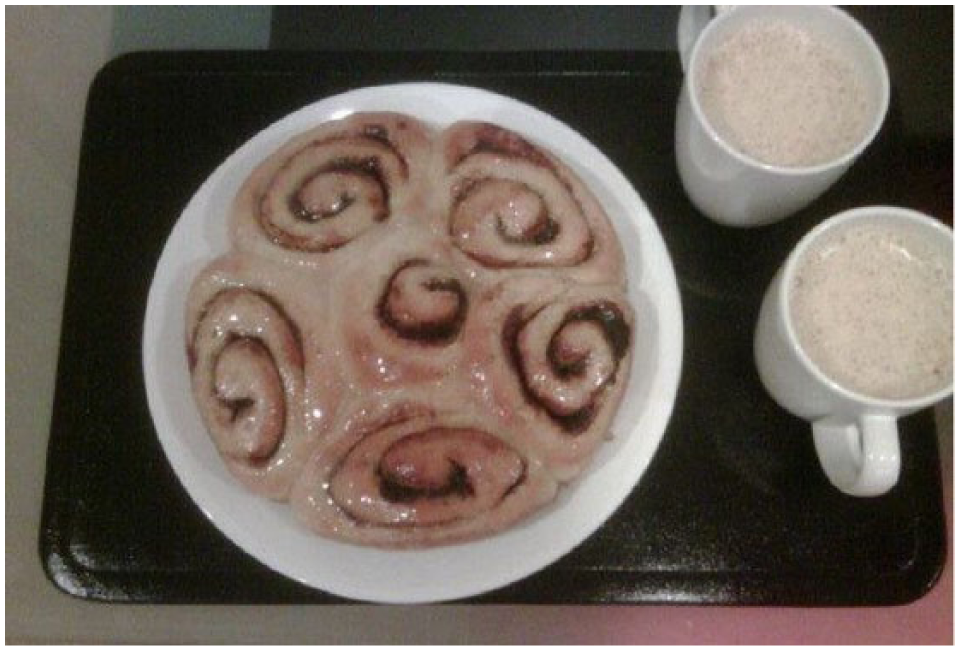
Image accompanying status post (Excerpt 9) on 23 October.
In her interview, Leslie explained that part of the family’s plan to enjoy the final game on television was to have lots of food as they sit and watch: ‘We seemed to have really prepared for it, so that the whole family could watch the finals (on television).’ Preparing also became her way to buffer against the anxiety of awaiting the result. Putting the photo on display on her Facebook profile is, however, another matter, as it was an act that had an entirely different performative effect. In showcasing the image, she was also referencing a distinctly Kiwi object. ‘Flat white’ (coffee) is locally recognised as a New Zealand creation/construction. Invoking its name and image facilitates an evocation of a particular attachment and identity. This is a case of objectivation or instrumentalisation – an impersonalising procedure that was able to achieve, in this instance, not a ‘de-humanisation’ of Leslie but a projection of the connotative meanings important to her, that is, ‘being Kiwi’.
While it was easy to realise the cultural significance of ‘flat white’, the other item, cinnamon rolls, is not redolent of Kiwiness. Although not iconically Filipino either, they are quite popular in the Philippines with multinational franchises making them available as an upmarket food item. This explains Leslie’s familiarity with them but, unlike ‘flat white’, they still do not call up immediate reference to a national identification or attachment. The relevance of the image is only revealed as one reads the short conversation that ensued between Leslie and another Facebook friend when the latter commented that she used to ‘hate’ cinnamon rolls, to which Leslie replied, ‘Parang rugby lang yan. From knowing nothing to a fan. Hehe’. The first phrase translates as ‘it’s just like rugby’, and with this we realise how a simple object gains new meaning when used as a sign in particular instances and with specific interests.
The image and the discussion of it demonstrate the idea of ‘experiential meaning potential’, which refers to how objects are utilised to signify meanings derived ‘from what it is we do when we articulate them, and from our ability to extend our practical experience metaphorically and turn action into knowledge’ (Kress and Van Leeuwen, 2001: 20–22). Cinnamon rolls, an unlikely metaphor, had become the carrier of Leslie’s transformation. The object, although bearing no obvious value as a recognisable cultural symbol in the particular way it was used, acted as an indicator of an emerging sensibility and identity. Just like her use of pronouns, this gives us a specific instance of her transition, of travelling from one point to another and eventually obtaining a change in herself. What she presents is a specifically acquired habit (e.g. watching rugby and drinking a flat white 5 ) that could be classified as normatively Kiwi. In the process, what she was able to display was a moment of assertion regarding her rightful place in New Zealand society as a culturally conformed one-time outsider.
The fan turns into a national subject: Shifting objects of belonging
The development in Leslie’s Facebook posts relating to the RWC exhibits an emotional investment in the team that is hard to miss. As shown by her re-enactment of what was transpiring while watching the games at home on television, her sentiments were reflected in her linguistic choices. Using the Filipino word atin (instead of the English ‘ours’), as discussed above, most likely signals her growing attachment not only to the games but also to the idea of becoming ‘one with the country’ on this occasion. Furthermore, this intersentential code-switching between English and Filipino also becomes more apparent in highly emotionally posts on Facebook during moments when she seemed to be utterly preoccupied with the games. Excerpt 2, Muntik na ko matulog sa nerbyos! (I was so nervous I almost went to bed!), and Excerpt 5, Di naman horror pinapanood ko pero nagtatakip ako ng mata (I’m not watching horror but I’m covering my eyes), illustrate this. Although the relationship between emotions and multilingualism plays out in different ways at different levels within different environments (Pavlenko, 2005), Leslie’s code-switching behaviour in the particular cited occurrences appears to exemplify the ‘emotional primacy of the first language’ (Pavlenko, 2004: 201) where one’s base language (Filipino, in her case) ultimately becomes the language of emotion since it is deemed more natural. Notice too that her status posts after 16 October are all in English, a code choice deviating from prior statements that were either solely in Filipino or code-switched with English. We do not claim that this linguistic enactment indicates Leslie’s full assimilation into a Kiwi identity; rather, we assert that this potentially demonstrates her capacity to shift attachments in a transitional – liminal – environment, where an identity-in-the moment is activated by the meaning-making opportunities on Facebook during an event that is national in scope and collective in spirit. In support of this argument, Leslie’s evolving sense of attachment and belonging is also evidenced by semiotic means other than language choice, such as the use of images (e.g. the case of the flat white and cinnamon rolls) in an iconographic fashion, that is, in signifying her becoming part of the sport, the community and the country.
Transposing love from rugby to nation
Leslie’s display of emotion in this particular case gains more significance in the light of her increasing participation in this national event. As her linguistic and semiotic choices clearly manifest a transition in terms of a sense of belonging, so too do the objects of her intense emotional discourses. In her 16 October status post (Excerpt 5), she blatantly declares her feelings, albeit as part of an indeterminate group, for a particular footballer after delivering a cheer for the whole team: Go All Blacks! we love you Weepu [sic]! This language is not at all uncommon in fanspeak: the parasocial interaction 6 fans or supporters of (in this case) sports generates other similar lines (e.g. Name of player, will you marry me?). The next time, however, she would use the word ‘love’ to express a sentiment concerning the games; she would be referencing a different object, one that is larger and more encompassing than just a single player or even the entire team.
On 25 October, on the heels of the All Blacks’ victory, Leslie professed her love for New Zealand through another status post: Just one of the reason why I love this country [sic]. This one links to the video ‘all ours. Again’ that acts, in a way, to specify the actual motivation for the statement. At the same time, this intensifies the emotional attachment to the country by saying that there are many other reasons that warrant her love of it. Her emotions have been transformed from being directed (inter)personally to possessing national import.
The transitory quality of the whole RWC experience appears to have spurred Leslie into generating Facebook posts that curiously follow a conventional dramatic structure. If her status posts indeed potentially signify a semblance of belonging to her new country, 23 October seems to be when the threshold of her identity transformation was crossed. It was the day of the Final and it was also when she enacted the most, and most varied, Facebook activities concerning the RWC. In this series of posts, Leslie expresses a more adamant internalisation and exhibition of her affinity with and commitment to New Zealand.
Looking closely at the set of Leslie’s Facebook activities during the entire RWC, we can identify two clear groupings that sum up a performance of shifting from one status to the next. The first half of her posts (9 September–16 October) concern the rugby matches, up to and including the semi-final. The second half, during and after the final (23 October–27 October), veer towards allusions to New Zealand as a nation. In this second half, she uses only English; Filipino drops out. Teasing out this grouping further (Figure 2), we see how the intersecting discourses of the self, the sport and the nation are distributed throughout Leslie’s RWC postings on Facebook. This spotlights the role of constructing words and images to finally lead to a concluding performance about where she belongs and her rightful attachments in the present. She began by locating herself in a binary position where being Filipino informed her understanding of Kiwi culture, then followed with identifying herself as being at one with the people. When the time came for the national team to grab their chance at ultimately proving their calibre, her semiotic and linguistic pronouncements also cemented a selfhood that dispels any doubts about her convictions of being a New Zealander. This is even manifested in her unusual indifference to what she has always considered her primary Facebook audience. She explained in the interview that she did not mind whether her friends and family in the Philippines would understand what the World Cup is about, as long as she could express her feelings for New Zealand during the games: It’s funny because most of my friends are Filipino so they don’t give a damn what that is, right? (laughs). So, it’s like, maybe those were one of those times I didn’t care if they don’t get it. So, I’m really going to say that I’m happy, I’m proud of this country. I’ll say for instance, ‘hey, one minute to go’, that ‘one minute to go’ didn’t even mean anything in the Philippines.

Progression of discourses of belonging and attachment as reflected in Leslie’s Facebook posts for the period September to October of the Rugby World Cup 2011.
Semiotics of the self as sign
Leslie’s RWC story, self-written on a social media platform, articulates a larger journey she is taking as a diasporic subject wanting to establish a firm place in her chosen nation. If her Facebook sign-making endeavour is any indication, her desire for a national belonging is coupled with a willingness to undergo change in her habits and practices, as these are actually where an identity is found (Billig, 1995). The weight of this desire and the value to Leslie of portraying a shared pursuit with the country is perhaps best evidenced by her decision, during the most crucial moment of the event, to fully inhabit a virtual persona signified by a particular familiar symbol (Figure 3). In the midst of viewing the Final, she changed her profile picture – the basic signifier of one’s identity and mechanism of physical identification on Facebook – and presented herself as an All Blacks’ emblem.
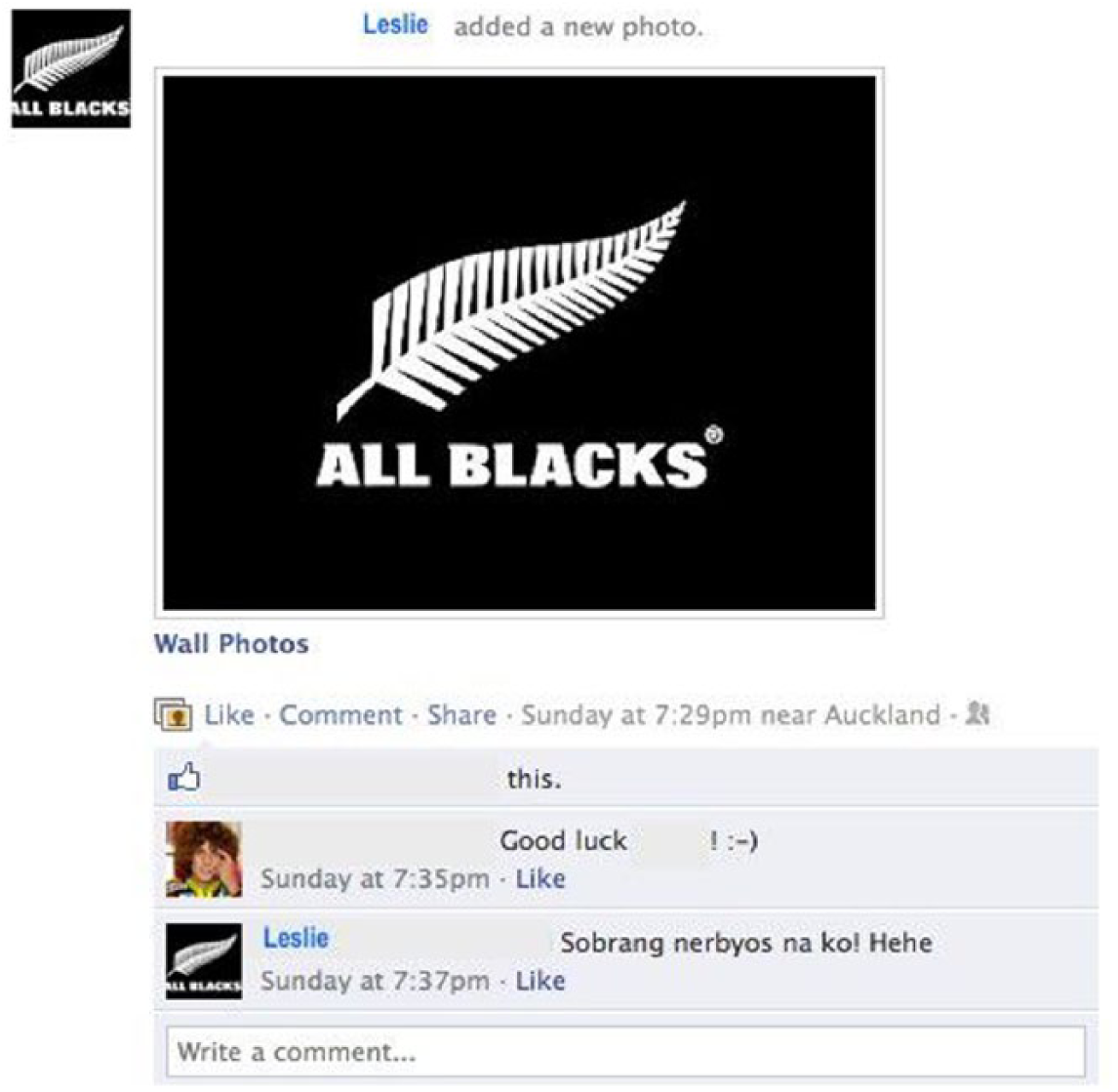
Screenshot of Leslie’s Facebook post with the All Blacks’ emblem as profile picture (thumbnail image on the upper-left corner).
Although profile photos are expected to be ‘iconic’, where the representation resembles the represented, Leslie opted to abstract herself in order to strongly impart the idea of her identification with the team and the nation. This act could be seen as wanting to fully integrate, an essentially twofold process: accommodating ‘foreign’ practices and meaning-making in her own repertoire of cultural habits that, in turn, could facilitate her integration in mainstream everyday culture. Spoonley et al. (2005) argue that having shared values and interaction lead to social cohesion, which results in migrants having access to resources and their associated advantage. If that is the case, then developing a taste for nationally sanctioned habits is tantamount to acquiring a cultural capital.
The multimodality of social media: Facebook as staging community
As a platform of representation, the semiotic affordances of Facebook supported the task of discursively crossing the bounds of ‘otherness’ in Leslie’s RWC participation. As a social networking site, Facebook provided two forms of communitas, that is, the kinds of collectives in which Leslie got involved during the games.
First, the specific functionality of attaching external materials to one’s Facebook Timeline proved to be an effective way for her to simulate a sense of being ‘physically’ together with other New Zealanders. Her post on 27 October, for instance, seems to be a fitting coda to the whole RWC saga as told from the point of view of one individual whose involvement and passion emphasised the link between collective emotions and national narratives (Sullivan, 2009). In citing a video that depicts the magnitude of New Zealanders’ attachment to the sport and the national team at their moment of triumph, Leslie had no qualms when she said the emotions seen here 7 are about the same as what we felt at home (Table 1, Excerpt 14). Although she and her family were not with the collective physically, she still managed to feel and enact a union with it through social media (i.e. Vimeo, a video-sharing site, and Facebook). This act goes beyond basking in reflected glory (BIRGing), in which pride in and affiliation to a successful source are easily proclaimed publicly to enhance, possibly, one’s self and social image (Cialdini et al., 1976). An individual spectator sharing in the success of the team also possibly explains how national pride, and not just an enhancement of self-image, is evoked in particular sporting events. The RWC was an opportune time for Leslie to not just share in and display victory but also define her place in the unfurling of a national narrative.
The role of Facebook in Leslie’s momentary, but nonetheless passionate, involvement with rugby was made clearer by this articulation of her selfhood. In general, the social networking site provided her a stage where she could fulfil her enactments as an All Blacks fan and perhaps as a legitimate New Zealander. It also gave her a chance to become part of, or feel she was part of, the team, the people and the nation. Notwithstanding the value of belonging to these collectives, she explains that her RWC Facebook posts were for her own satisfaction rather than for her relatives, who are her usual audience.
Performing her ‘part’ during the games was also done in ‘unity’ (nagkakaisa kami) with another community that she considers herself a part of, the second communitas. This refers to the set of New Zealand–based Filipino friends she has in her network: those who are going through the same experience of finding a rightful place in a new country that they have considered their own; those who occupy a simultaneous position of attachment to and detachment from the homeland. In Leslie’s words during interview, … there’s just a few, the (Filipino) friends here, we were one in having that mindset during that time, because we were watching the Rugby World Cup. So, like, it’s not really for the relatives in the Philippines like my other posts. But it’s more for us and the group of friends who are here in New Zealand.
Kress and Van Leeuwen (2001) explain that the idea of multimodality is not limited to the multiple semiotic resources available in the culture for sign-making practices. It is important to recognise that meanings are generated in all strata of textual creation: from the design of the discourse up to the production and distribution of signs, texts or objects (Kress and Van Leeuwen, 2001). Ellison and boyd (2013) see social media, such as Facebook, as a networked communication platform whose foundational characteristic is sharing of content to a defined group of users. Facebook indeed provided Leslie a sense of belonging to a network of New Zealanders, despite being virtual, and enabled her to share in similar sentiments and activities. At the same time, the network as Facebook’s raison d’etre served well Leslie’s display of solidarity with the national team over the RWC period. The social networking site, therefore, acted as a stage where she could experience and manifest a semblance of communitas and signify her dedication to the country in propitious moments of her discursive creativity.
Conclusion
As the process of self-presentation becomes more fluid in late modern societies, the appeal of social media is in their capacity to provide a stage, a social connection and signifying ‘props’ that enable an individual to negotiate the self against a complex configuration of social, political and cultural realities (Papacharissi, 2011: 304–305). As a venue for expression, the multimodal and multimedia affordances of the platform allowed Leslie access to a rich semiotic resource. This potential of the medium, however, is only realised in its interaction with the material social conditions of the user and her own creative capacities. Reading the RWC as a moment of national unity and collective identity, for example, was not the only meaning that was ‘publicly circulated for consumption’ (Jackson, 2012: 107) in the ‘contested terrain’ of the mega-event: it was also male-dominated, corporatist and consumption-driven (Jackson and Scherer, 2013).
Turner (1982) explains that in liminality, people ‘play’ with the elements of the familiar and defamiliarise them (p. 27), and this resonates with the attraction of social media. The RWC and Facebook opened up opportunities for Leslie to engage in and interrogate a momentary making of an identity – or, at least, a shift in it. The liminal attributes of both the RWC and Facebook presented her a chance to recast meanings in producing her identity-in-the-moment during her status as a ‘passenger in transit’. She harnessed the semiotic potential of language, images and the narrative structure itself as modes to express solidarity with the nation, and by so doing performed a becoming that more visibly displays a burgeoning national belonging in short-lived moments of discursive practice. The architecture of the medium also played a significant part in this self-presentation. Since what is paramount in the liminal performance of a ritual is the existence of the communal, Leslie’s use of Facebook allowed her to appropriate the collective without being physically present with the rest of the community.
Deliberate or otherwise, Leslie’s multi-semiotic pronouncements on Facebook during the RWC in 2011 asserted her sense of inclusion in the country (or a textualisation of it) as a legitimate New Zealander who appears to fulfil what is desired via a totalising discourse of nationhood undergirding the mega-event. However, in the same way that the hegemonic attachment of Kiwi identity to a single sport has been viewed as problematic, Leslie’s newly developed attachment to a Kiwi practice does not guarantee that her own identity questions will be put to rest.
Stuart Hall’s (1996) thesis remains relevant: identities are always a temporary attachment to positions of subjectivity. Identity seen across different timescales potentially provides information about what aspects of one’s identity are more malleable and thus open to revision. This, of course, does not necessarily translate to migrants (especially those in a vulnerable status) exercising their agency or power, but it gives an indication of the arenas where intervention, personal or structural, can be relevant in order to open up opportunities for participation, inclusion and, eventually, belonging (La Barbera, 2015).
Indeed, working out one’s identity is a process full of contradictions. Krzyżanowski and Wodak (2008) consider that migrants’ desire to belong and their discourses of belonging signal the fact that they do not truly belong in their host country. Leslie verifies this ambivalence when, in the interview, she admitted feeling that ‘Here (New Zealand), we did not have to start from the very bottom (referring to employment status) but at the same time, it seems we are still second-class citizens because we are Asians’. Since it is not easy for migrants to calibrate a status of belonging, locating oneself in the matrix of social relations proves complex and unstable. As a matter of achieving the goal of being completely and securely settled, Leslie’s case illustrates that for migrants, crossing the gain line entails a constant negotiation between what is on offer and what can be had – either in momentary chances or in the long term.
Footnotes
Acknowledgements
We thank Leslie and her family for generously sharing their story with us. We are also grateful to the reviewers whose comments and suggestions helped us in further refining the paper.
Declaration of conflicting interests
The author(s) declared no potential conflicts of interest with respect to the research, authorship, and/or publication of this article.
Funding
The author(s) disclosed receipt of the following financial support for the research, authorship, and/or publication of this article: The larger project was supported by the University of the Philippines International Faculty Fellowship Award (2010–2013), while Auckland University of Technology partly funded the writing of this article (PBRF/56).