



Abstract
Recent political trends in many countries have sparked renewed interest in populism. Despite general agreement that the affective/emotive aspects of political communication are particularly important in this, there is little recent analysis of how populists operationalise emotion or how they genuinely differ from mainstream parties in this sense. This article applies mixed methods to explore the ‘affective-discursive practices’ that characterise the discourses of two opposition parties in the United Kingdom: United Kingdom Independence Party (UKIP) and Labour. Comparison of the frequency of semantic subcategories related to emotion in corpora of press releases published by these parties on their websites is complemented by qualitative analysis of how specific emotional areas such as fear, anger and anxiety are invoked by the two parties. Different ‘affective-discursive practices’ underpin their discourses, since Labour characteristically frames reactions to social phenomena in terms of worry and concern, while UKIP legitimates fear and anger, but also projects more positive emotions.
Introduction
The flight from the centre among European voters over recent years has been widely documented, as trust in mainstream political parties has been undermined by their failure to deal satisfactorily with the financial crisis and its aftermath, by controversies over migration issues and by widespread perceptions of corruption. It is difficult to generalise about the new political movements that have arisen in this context: some can be described as right-wing (FIDESZ), some as left-wing (SYRIZA, Podemos), while others are hard to classify in these terms (Cinque Stelle); some are new (Alternative für Deutschland), whereas others have a long (Front National) or even very long (FPŐ) history, but most have gained considerable ground during the period of social and economic destabilisation since 2008 (Wodak et al., 2013; Mudde, 2016).
Such parties, and their policies, behaviour and self-presentation, are often grouped together rather vaguely by the media and others under the umbrella term ‘populist’. Their perceived importance on the contemporary political scene has sparked renewed interest in populism, leading to intensified debate about the nature of political populism on the one hand, and populist styles of communication on the other. In this, the use of the word ‘populism’ itself requires some clarification. Although some commentators see it principally as a descriptor for policies aimed at redistributing wealth among the population (Dornbusch and Edwards, 1990), it has increasingly come to be understood as something other than a set of substantive policies. It is variously understood as a political logic that challenges accepted norms, which is used to unite diverse interests within the population (Laclau, 2005) or as a political strategy organised around the figure of a charismatic leader (Weyland, 2001). Others see it as a ‘thin ideology’ (Mudde, 2007) or a blend of thin ideology with other ideologies of the right or left (Mudde and Rovira Kaltwasser, 2017: 5). Many recent studies concur that it is more helpful to categorise populism as a phenomenon primarily associated with the discursive sphere. Building on Laclau (2005) and Mudde (2007), Moffitt’s (2016) study of populist politicians identifies key features of their discourse, self-presentation and performance that cut across traditional political dividing lines. These come together in a specific way of presenting one’s claims (Jagers and Walgrave, 2007), which includes the strong identification with ‘the people’ (presented as an indivisible unity with homogeneous interests) that has traditionally been understood as the hallmark of populism (Taggart, 2000). Such parties try to appeal to disgruntled voters by indulging in strong in- and out-grouping to engage sentiments of ethnic or class loyalty, while stigmatising out-groups as threats. Moffitt also establishes that populist discourses involve strategies for widening the divide between the people and their enemies/adversaries, who are both denigrated and delegitimised (Moffitt and Tormey, 2014). As Wodak (2017) shows, although these ‘enemies’ may vary, ‘the people’ are generally set up discursively against current power holders, loosely conceptualised as ‘the establishment’ or ‘the elite’, ‘within a specific narrative of threat and betrayal’ (Wodak, 2017: 552). In this dynamic, Moffitt (2015) stresses the central importance of building up a sense of crisis, often through highly emotive discourses, and then perpetuating this crisis to maintain social tension and legitimise drastic action against the people’s ‘enemies’. For him, ‘crisis’ is not a pre-existing situation of failure that has somehow sparked a populist response; following Hay (1999), he takes the view that ‘crisis is a condition in which systemic failure has become politically and ideationally mediated’ (p. 324). This can be achieved through the consistent use of particular discourses, and through what Moffitt (2016) terms ‘populist performance’, by which prominent public figures convincingly embody the values, emotions and aspirations of the populist cause.
In all this, it is clear that one way of accessing the populist phenomenon is through the discourses that the parties and their prominent adherents use. My account starts from the basis that social and cultural movements in contemporary society exist as discourses, as well as in extra-discursive trends that run parallel to these (Fairclough and Chouliaraki, 2005: 4). Discourses are here understood as context-dependent semiotic practices which are both ‘socially constituted and socially constitutive’ (Reisigl and Wodak, 2009: 89), that is, they are conditioned by social structures and relations, but they also have an ongoing effect on the way these structures and relations are reconfigured. There is general agreement that the media have a key role in this process (Wodak, 2015), and in the case of new political movements there are suggestions that their performances are deliberately designed to attract maximum media attention (Wodak, 2015). Such performances tend to appeal largely through their non-representational content: their visceral appeal to basic emotions, often setting up ‘we’ on the ‘inside’ against threats from the outside, tends to override more rational considerations. As Chilton says, populism ‘works by activating emotion-laden and value-laden schematic concepts and concomitant emotions’ (2017: 592). By critically examining the discourses used by political parties in their media self-representations, we can reach a deeper understanding of the way ideological positions are generated and spread in broad sectors of society (Breeze, in press; Wodak, 2015: 50–54).
Some previous studies have focused on the use of charismatic personalities and striking discursive strategies to attract media attention and appeal to particular sectors of the population (Wheeler, 2011; Wodak et al., 2013). However, despite general agreement that political persuasion does not remain on the level of ideation or representation – but that precisely in the populist context, the affective/emotive aspects of communication take on particular importance – less attention so far has focused on the emotions evoked or on how populists actually differ from mainstream parties in this sense. Van Leeuwen (2014) identified some distinguishing traits, such as frequent use of absolutes and categorical statements likely to provoke an emotional response. Breeze (2017) examined populist political style in terms of gradability and the creation of emotionally charged dichotomies. These studies generally suggest that this would be a useful line to pursue, particularly since recent research into emotions in politics from outside discourse studies (e.g. Wagner, 2014; Weber, 2013) has underlined the importance of the affective/emotional dimension in conditioning people’s political choices.
The affective dimension in discourse
Although the importance of emotion in persuasive discourse has been recognised since ancient times, recent trends in discourse analysis have tended to foreground ideas and arguments over feelings, prioritising the unpacking of ideologies. As Wetherell (2012) has argued, discourse analysts have tended to separate affect (seen as an unruly and potentially dangerous element) from discourse proper (understood as ideology in language). This separation is problematic, not only because it is extremely difficult to abstract affective reactions from the ideas or objects that trigger them (Wetherell, 2015) but also because much ideological use of language becomes powerful precisely because it engages people’s feelings. Affect/emotion is a cultural-material hybrid, which cannot be understood without its discursive productions. Different cultures at different times seem to generate what have sometimes been termed different ‘emotional styles’ operating in communities in which people comply with the same norms for emotional expression and regulation – and ascribe the same values to different emotions (Gammerl, 2012). In this context, Wetherell et al. (2015) argue for an investigation of ‘affective-discursive practices’ exploring the relations between semiosis and feeling, to identify ‘patterned forms of human activity articulating, mobilising and organising affect and discourse as a central part of the practice’ (p. 57).
Within the community at large, political positions offer different sets of practices with a collective ‘we’. Parties and movements not only share ideas and ways of speaking about them (i.e. discourses), but also promote particular ways of feeling about these issues (Grande, 2000; Wetherell et al., 2015). Politicians who can embody and express feelings that resonate with large sectors of the electorate, or who know how to carry voters with them on an affective level, are often highly successful, particularly in the age of YouTube videos, short sound bites and tweets (Frame and Brachotte, 2016). The ‘affective-discursive practices’ of a party’s spokespeople are likely to reflect the practices of its supporters, and vice versa, so that they reinforce each other, leading to escalation effects.
In this article, I examine the emotions expressed in the press releases published by two UK political parties on their official websites. On the issue of emotions, two points need to be clarified. First, I follow Wetherell et al. (2015) in taking embodied meaning making as the object of my analysis, and in regarding affect and emotion as a single phenomenon for the purposes of analysis. Briefly, their argument (Wetherell et al., 2015) is that current psychological research on affect stresses ‘the simultaneity of the embodied registration of an event and meaning making’, which makes it hard to maintain a sharp distinction between affect (a kind of non-representational impact) and emotions (affect interpreted through culturally conventional categories with familiar labels). Emotion, in this view, is a manifestation of affect in real situations (p. 59). As Wetherell et al. (2015) say, ‘it is important to understand how emerging and assembling patterns of relations “engineer” human responses […] but this cannot work by black boxing distinctively human capacities for making meaning’ (p. 59). They therefore advocate a focus on ‘affective-discursive practices’, which ‘construct relations of proximity, distance, affiliation and detachment, and inclusion and exclusion’ (Wetherell et al., 2015: 58). My focus here is on the different range of ‘affective-discursive practices’ evidenced by different political parties, exploring how these organise their vision of society and endow their ideological positions with affective force. Second, I relate my findings to the concept of ‘feeling rules’ (Hochschild, 1979: 561), that is, socially accepted emotional responses. These are a mechanism for social control that works through encouraging ‘correct’ kinds of emotional behaviour for particular groups of people (Piwoni, 2018: 12), but these ‘rules’ can also change over time. When populist leaders publicly insist on particular emotions as a reaction to, say, migration or the European Union (EU), they are modelling and legitimising affective-discursive practices that were not previously mainstream in that culture, potentially changing the consensual feeling rules.
Texts and methodology
There are several methodological problems in conducting an investigation of affective/discursive practices in politics. One is that politicians across the spectrum make use of similar persuasive strategies to convince their audiences: they may all, on occasion, try to provoke emotional responses, activate group loyalties and enmities, whip up a sense of urgency and so on (Partington and Taylor, 2017). Furthermore, it is particularly important to note that all opposition parties are extremely likely to use negative strategies to discredit the governing party (Grande, 2000), which in emotional terms might involve indignation and anger, for example. Governing parties, by contrast, are likely to want to inspire confidence and trust, or encourage shared pride in their achievements. I therefore chose to focus on the affective/emotional discourses of two opposition parties in the same country, namely, the two main UK opposition parties in 2017, Labour and UKIP (in the 2015 general election, the ruling Conservative party received just over 11 million votes, Labour just over 9 million and UKIP nearly 4 million, while the traditional ‘third party’, the Liberal Democrats, had only 2.5 million). In general terms, UKIP can be broadly classified as a right-wing populist party, with high visibility, a deliberately shocking style and an outspoken anti-establishment stance (Goodwin and Milazzo, 2015; Hobolt, 2016). Labour under Corbyn adopts an intellectual approach to politics, avoiding sensationalism. Corbyn himself has been characterised as ‘a position politician in an era of valence and performance politics’ (Diamond, 2016: 21), committed to ‘honest politics’, who insists that ‘upholding moral principles outweighs attaining parliamentary power’ (Diamond, 2016: 17). Descriptions of Corbyn’s Labour as ‘populist’ seem mainly to be founded on radical policy proposals, rather than on his/its discursive self-presentation (Dean and Maiguashca, 2017: 56).
In terms of methodology, this article proposes an innovative approach to the study of affect/emotion in political discourse using a mixed (quantitative and qualitative) approach based on the principles of corpus-assisted discourse analysis (Partington and Marchi, 2015), in which a qualitative reading is complemented by quantitative data showing the frequency of terms indicative of particular affective-discursive patterns. My study focuses on the press releases published on the parties’ websites in the first 3 months of 2017. First, corpora were created using the official news sites of two UK opposition parties, Labour and UKIP, for the first 3 months of 2017. This was a particularly interesting period in British politics, with confusion over Brexit, two by-elections and a terrorist attack outside the Houses of Parliament. Two corpora were created for each party, one covering 1 January to 14 February, the other 15 February to 31 March 2017 (Labour: 91,900 words; UKIP: 37,300 words). The logic behind the use of two corpora from each party was to compensate for bias as a result of particular events, and to determine whether the frequency of emotional signifiers yielded stable but different patterns in the two parties over time. The UKIP and Labour news corpora were uploaded to Wmatrix3 (Rayson, 2008) for semantic tagging. This tags all the words in the text according to meaning, classifying them as belonging to 21 major semantic fields subdivided into up to 100 subcategories. Semantic areas related to emotions were identified (tagged ‘E’ in Wmatrix3), and normalised frequencies were obtained by taking occurrences of subsets of emotion-related words per 100 running words.
In its present form, this methodology can perhaps best be regarded as heuristic in nature, since it raises a number of questions. The most important of these is that the results are dependent on exactly what is detected by the semantic tagging tool used (which in the case of Wmatrix3 is based on McArthur, 1981). The sensitivity of the tool will influence the results obtained. Moreover, even an optimum tagset would be highly unlikely to detect implicit expressions of emotion (e.g. where irony or sarcasm is involved). The opposite problem also arises, which is that not all the tagged items may really have an emotional meaning in the given context, but this is arguably less serious because such items can easily be discarded manually. There is also a basic problem that besets any attempt to identify emotion in political texts, which is that politicians use many statements that would normally be regarded as simply factual in order to elicit emotions in their audiences. Unfortunately, this important question cannot be addressed using the present approach. Finally, it is important to state here that it is obviously not possible to address the fundamental interpersonal dimension of emotional discourse in a systematic way using semantic tagging; for example, such techniques tell us nothing about whether an emotion is being expressed by a writer/speaker, attributed to a third party or evoked/provoked in an audience. Qualitative analysis of contextualised uses of tagged items is currently the only way to shed light on this question, and in what follows, I will use this to bring out the different ways in which I consider that emotions are being expressed or elicited. On the other hand, the mixed methodology presented here offers the advantage of greater rigour and comparability than an exclusively qualitative approach, since exactly the same measures can be used on the different corpora. Following these principles, the most salient contrasts between the two parties were identified and then explored qualitatively using discourse analytical techniques.
Results and discussion
Overview
A quick overview was obtained of all items tagged as emotion-related in Wmatrix3 (see Appendix 1 for key to tags).
As Graph 1 shows, the emotional actions, states and processes detected by semantic tagging followed similar overall patterns in the four corpora, but there were interesting differences in degree. Taken overall, both UKIP corpora had a higher total incidence of emotion-related words (1.05 and 1.08 per 100 words in the UKIP corpora, 0.85 and 0.81 in the Labour corpora) (significant on Student’s t test, p < .05). Most strikingly, both UKIP corpora had far more items classed as E3– (violent/angry), while both Labour corpora had a higher incidence of items classed as E6– (worry). The UKIP corpora had slightly higher frequency of E4.1+ (happy) and E2+ (like).
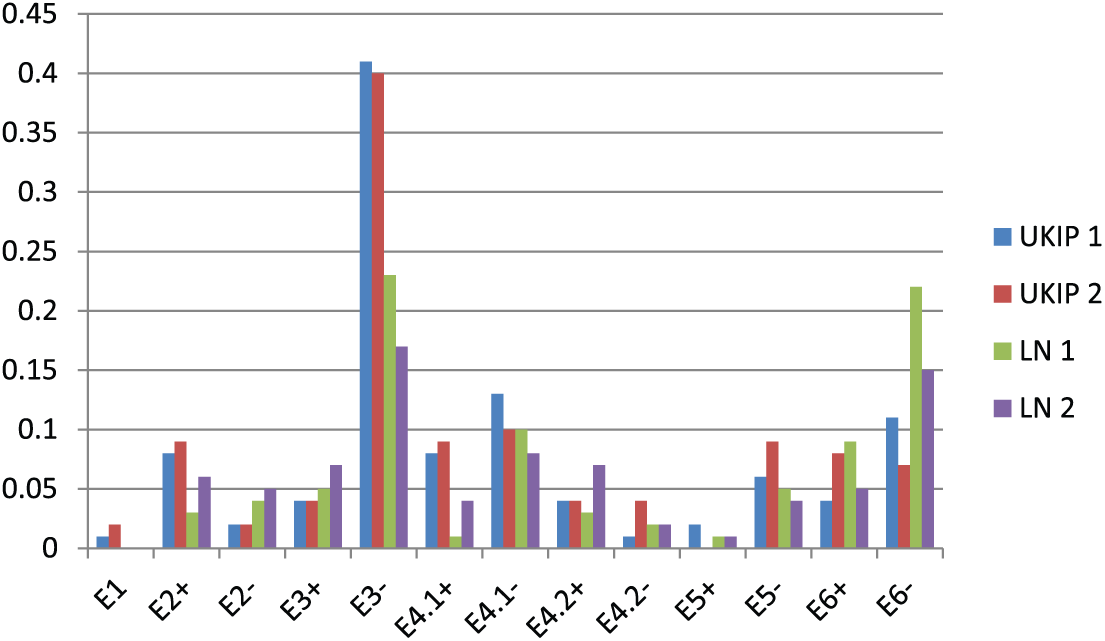
Emotional actions, states and processes in the four corpora (Frequency/100 words).
Violence and anger
The most striking difference in Graph 1 is the prominence given to the semantic area of violence and anger in both UKIP corpora. Table 1 shows the most frequent items occurring in E3– (violent/angry) in the four corpora, with their frequencies. It should be noted that in Wmatrix3, ‘attack’ and ‘threat’ are included in the semantic field of violent/angry, because this is their normal association (it would be difficult to imagine a situation of ‘attack’ or ‘threat’ that does not entail negative emotions on the part of the agent or victim). They do not describe the presence of emotion in the way that, say, ‘anger’ does, but they indicate the presence of violence directed at someone/something, implying emotionally motivated action leading to danger, which in turn may evoke a series of emotions (fear, anger, indignation, etc.) in those at the receiving end. Although experimental research has shown that the presence of words related to threat activates a response in subjects that can be understood as automatic (Isenberg et al., 1999), their specific function in these texts (i.e. whether these words are mainly being used to express anger or trigger fear, or both) needs to be explored through closer examination of examples. In what follows, I discuss the various ways in which these words were used in the discourses of the two parties to express or invoke fear.
Most frequent word types classified as E3– (violent/angry) in the four corpora (F/100 words).

The high frequency of items in this semantic category in UKIP news seems likely to point to one of the party’s more salient affective-discursive practices, namely, the triggering and manipulation of fear. This has been discussed elsewhere in the context of right-wing populist parties as a powerful force to mobilise voters and legitimise extreme policies (Wodak, 2015: 5). Altheide (2002) has amply discussed the propagation of fear as a dominant feature of contemporary culture: the media produce and reproduce fear, and, as Wodak (2015) notes, politicians of all types can channel this pre-existing tendency to serve their own ends. Importantly, populists are particularly adept at performing and perpetuating crises in order to convince voters that radical solutions are needed (Moffitt, 2016), and inspiring fear is an essential element in this strategy. Here, it is evident from the quantitative data that UKIP places more reliance on the rhetoric of fear and danger than Labour does. Moreover, UKIP also makes greater use of ‘anger’ than does Labour: as Wodak (2017: 562) has noted, the emotional subject position of right-wing populists is often coloured by resentment. In its more operative forms, resentment leads to anger and possibly violence (Wagner, 2014). In what follows, I consider first fear, then anger.
Invoking fear
Although both parties use words related to fear, qualitative analysis of the more typical examples found in the two corpora brings out interesting differences. An overview concerning ‘attack’, which ranks high in three of the four corpora, provides a quick insight into the different ways in which the two parties use one word. UKIP often uses ‘attack’ to refer to physical violence ((1) and (2)):
(1) spokesman condemns yesterday’s devastating attack on innocent passengers. (UKIP) (2) the UKIP leader has called for action following the Jihadist attack on Westminster. (UKIP)
Although most references to physical attacks are associated with (real or potential) terrorist activity, some are clearly anchored in the context of immigration ((3) and (4)), conveying the view that migrants are physically violent, and envisioning a more violent world to come. Notably, the ‘attacks’ associated with present and future immigration are presented using a plural form:
(3) She blames the scale and demographics of recent immigration into Europe for the continuing attacks. (UKIP) (4) It does not take a genius to understand that if you allow well over a million immigrants, mostly unaccompanied young men, into Europe there will be problems with harassment and attacks on women. (UKIP)
UKIP depicts a situation in which a military ‘attack’ is envisaged against Britain, thereby building a link between one of its recurrent discourses in favour of the armed forces (see above) and the notion of an external threat (5):
(5) We could not defend ourselves against an attack from a country like Russia. (UKIP)
UKIP also uses the same range of words to attribute violent and destructive action to the Conservative government (6) and other political parties (7):
(6) Philip Hammond has launched an unnecessary and foolish attack on enterprise. We could also avoid clobbering the self-employed with extra National Insurance as the Chancellor does today. (UKIP) (7) The SNP seem to wish to cause maximum disruption, uncertainty and overall mayhem. (UKIP)
Notably within this range, UKIP also tends to personify entities such as countries, placing them in situations of coercion and power abuse:
(8) Britain is not bluffing and will not be bullied over Brexit plans. (UKIP) (9) Britain is not a country that will be bullied easily by EU negotiators. (UKIP)
Labour, by contrast, uses ‘attack’ to refer to acts of terrorism or atrocities far away (e.g. in Syria). It also makes wider use of ‘attack’ in political contexts, where the ‘attacks’ are not related to physical violence, but the representation is less graphic than in (6) or (7):
(10) And everything that is done to attack the living standards of families who are struggling to get by, will disproportionately make things worse. (Labour) (11) And they continue to attack trade unions because they know that unity is strength. (Labour) (12) Many of our public services such as the NHS are being hit with cuts. (Labour)
Labour’s use of ‘attack’ also includes two examples that refer to threats (13) or to violence against migrants (14), in direct contrast to UKIP’s scenario of violent acts committed by migrants ((3) and (4)). Distinctions of this kind, which require a systematic analysis of agent roles, would provide a productive field for future research:
(13) Donald Trump should not be welcomed to Britain while he abuses our shared values with his shameful Muslim ban and attacks on refugees and women’s rights. (Labour) (14) Responding to reports of a brutal attack on a 17 year old asylum seeker yesterday evening. (Labour)
Similar patterns are observed with ‘threat’ and ‘threaten’. In UKIP, the sources of the threats are migrants, Russia, Islamic fundamentalism, the Conservative government and the EU. For example, UKIP alludes to:
(15) The threat posed by a minority of the migrants who rushed to Germany after the Chancellor threw the doors wide open. (UKIP) (16) That an EU national poses a specific tangible threat to the UK. (UKIP) (17) With the EU threatening to try to close down markets inside Europe. (UKIP)
Labour situates threats as ideological, emanating from the Conservative government (contrast with (6), which accuses the government of ‘clobbering the unemployed’):
(18) This week we heard the Prime Minister threaten to turn Britain into a tax haven. (Labour) or from Trump: (19) There can be no indulgence of the US President’s renewed threat to ban Muslims. (Labour)
Interestingly, ‘threatening’ in Labour news is an action performed by a concrete individual, while for UKIP the ‘threat’ is something vaguer (cf. examples earlier), which can be a speech act attributed to an institution (‘the EU’), or more vaguely still, a theoretical position attributed to ‘migrants’. These examples also suggest that while UKIP’s insistence on ‘threats’ and ‘attacks’ against the in-group seem primarily to provoke fear, there is also an undercurrent of indignation and resentment (Wodak, 2017) in the inscribed response to these unfair situations.
Expressing anger
The frequent expression of negative emotions is particularly characteristic of the UKIP site. For example, it is common for UKIP news to paint a dramatic picture of current events, imbuing a wide range of subjects with negative emotions such as anger to project a heightened vision of a society in crisis. These include rail travellers ((20) and (21)), tax payers (22) and voters in general. We can note that these vocalisations of anger are different from the examples using ‘attack’ or ‘threat’, earlier. While the ‘attack/threat’ is envisaged as something that puts us in danger, and therefore classically inspires fear, the subject position offered to readers in (20) to (22) is to identify with the ‘anger’. For example, excerpt (22) discursively ropes in readers as ‘British taxpayers’, primes them for bad news (‘will be intensely irritated to hear’) and then exacerbates this with ‘yet again’, thereby situating the news within the familiar UKIP narrative of ‘our money being wasted abroad’:
(20) The rail fare rises across the country which are hitting the low waged hardest are creating understandable anger. (UKIP) (21) It’s no surprise that rail travellers are voicing their anger. (UKIP) (22) British taxpayers, who disproportionately fund these well-meaning environmental schemes will be intensely irritated to hear that yet again their money is not being spent effectively abroad. (UKIP)
Even in (23), where ‘ferocity’ might seem rather closer to ‘attack’, we can note that the inscribed response is different: the ferocious response is being justified by the speaker because of the threat to ‘our democracy’:
(23) I cannot predict the ferocity of the response we might see if our democracy is subverted in this way. (UKIP)
There is also strong dramatisation of emotion either attributed to UKIP politicians (24) or used in direct quotations from these sources ((25) and (26)). Notably, (26) projects a situation in which the resentment at being ‘insulted and abused’ is associated with the past, contrasting with positive affect in the present:
(24) Bill Etheridge was livid as the European Union tried to pass off a further integration of military capacity as just a planning centre for non-executive missions. (UKIP) (25) This penny-pinching move to deprive our frontline troops of a morale boosting link to home, makes me bloody furious. (UKIP) (26) We have been ignored, dismissed, insulted and abused, but through determination and with good humour we fought on and we have succeeded. (UKIP)
We can distinguish here between metaphorical uses of emotional terminology to dramatise political actions that the speaker wishes to discredit (‘the Aid budget is being abused’) and projections of emotion with an explicit referent (‘Bill Etheridge was livid’, ‘it makes me bloody furious’). The latter, it seems, is particularly in line with the findings of other studies on populist discourse, in which leaders with a populist style opt for a more emotional, more hyperbolic turn of expression (Van Leeuwen, 2014), are more uninhibited (Ostiguy, 2009), and use coarse or popular language ‘to politicise social markers’ with a view to bonding with large social groupings envisaged as recognising and identifying with these codes (p. 7). These come together in their affective-discursive performance. On the UKIP party news site, direct statements by party representatives are conveyed verbatim, so that no emotive force is lost and readers are invited to share in the emotion expressed (here, indignation and anger):
(27) What is wrong with having a simple visa stamp in a passport to differentiate between those who have the right to live and work in the UK and those who don’t. It is a damn sight more cost effective and achievable than the biometric cards proposed a few years ago. (UKIP)
Although Labour sometimes makes use of graphic emotional descriptions, it does so less frequently and in a more conventionalised way. The following examples employ expressions that may trigger anger, but which are heavily conventionalised and therefore less likely to make an impact. Importantly, the affective/emotional focus is diffuse, so that the party itself is sometimes envisaged as committing acts of violence, as in (28), while in other cases responsibility is unclear, as in (29):
(28) It is just a shame that the Tories had to be forced here kicking and screaming by Labour. (Labour) (29) It is an outrage that chief executives have already earned more in 2017 than most people will earn all year. (Labour)
In short, UKIP discourses here tend to both project and invite anger (against the EU, migrants, the Conservative government for its policies on the economy, on migration and on the armed forces) and to invoke fear (of terrorism and external attack) in a consistent and strategic manner. In Labour discourses, violence and anger, though present – for example to invite anger against the Conservative government (for its social and integration policies) and to invoke fear (of cuts to social welfare, or racist attacks) – are less prominent and more diffuse.
Worry, concern and care
The category E6– (worry) is also noticeable, because, as Graph 1 shows, both Labour corpora have a much higher incidence of the items tagged as indicating ‘worry’.
In three of the four corpora, ‘concern’ is the single most frequent item tagged E6–. ‘Concern’ and ‘worry’ are associated with anxiety, which differs in psychological terms from anger because it involves low arousal, that is, it is essentially passive (Whissell, 2009), and there is so far no evidence that these words prompt a semi-automatic response of the kind associated with threats (see the ‘Violence and anger’ sub-section earlier) (Isenberg et al., 1999). However, there is a difference between the noun ‘concerns’ as meaning ‘problems, worries’, and ‘concern’ or ‘care’ meaning a state of being anxious. Arguably, both might imply the presence of a similar emotional state, but the latter involves a more direct expression of emotion. The analysis below follows this separation, beginning with the noun ‘concern’, which might invite an anxious response, then looking at direct expressions of concern.
Inviting concern
The use of ‘concern’ as a noun to mean ‘problem’ or ‘worrying issue’ is common in both parties’ press releases, but there are systematic differences in the way it is used. UKIP presents ‘concerns’ as items attributed to specific people (‘local people’ (30), ‘working people’ (31)), using the possessive or ‘of’.
(30) After record numbers at tonight’s protest, and years of campaigning by local residents, it’s a real shame that the council have chosen to disregard their concerns. (UKIP) (31) And the Labour Party is marching towards oblivion determinedly ignoring the concerns of the working men and women on whose support it was built. (UKIP)
In only one instance is ‘concern’ completely impersonal, and that is (32), where ‘concerns’ in the abstract is presented in a way that implies a degree of ironic distance:
(32) She called for better education, using the law in a more robust manner, better support networks and the message to be hammered home at schools, mosques, community centres and every other possible venue regardless of concerns about offending someone’s ‘culture’. (UKIP)
In Labour news, where ‘concern’ is much more frequent, the notion is used in the abstract, in conventional expressions like ‘a matter of concern’ or ‘is a concern’:
(33) The Governments silence on whether important EU environmental protection laws will be maintained is a matter of serious concern. (Labour) (34) Today’s research shows that keeping the lights on and machines running is the number one concern for SMEs. (Labour)
Moreover, the impersonal adjective ‘concerning’, generally rare in English as a synonym for ‘worrying’, is characteristically used here, either predicatively (35) or typically in an extraposition structure (36 and 37):
(35) This attack is deeply concerning. (Labour) (36) It’s hugely concerning to see the increase in the number of children killed or injured in road collisions. (Labour) (37) While we welcome today’s fall in unemployment, it’s concerning that jobs in this country are increasingly low paid and insecure. (Labour)
The ‘concern’ voiced by the Labour party is thus not attributed to specific individuals, but is rather abstract, projecting an anxious but vague vision that things are not as they should be. Indeed, in the case of institutional statements, the party itself is personified as feeling ‘concerned’.
A similar pattern emerges with ‘worry’. Table 2 shows that ‘worry’ does not seem to form part of UKIP’s active vocabulary. However, Labour frequently uses ‘worry/ing’ impersonally (38), sometimes with extraposition (‘it is worrying that’) (39) to qualify the proposition:
(38) This is a very worrying report which highlights what Labour have said all along. (Labour) (39) Particularly worrying is that the funding falls to zero within two years. (Labour)
Most frequent words tagged as E6– (worry) in UKIP and Labour (F/100 words).

Expressing concern
As I indicate above, there seems to be a difference between ideas mooted as ‘concerns’ and a more direct, personal statement in which someone is envisaged as being ‘concerned’. Sometimes UKIP spokespeople express ‘concern’ directly, in the first person (40):
(40) I am concerned that Civil Servants who run the system are turning a blind eye to some of these goings on. (UKIP)
Labour also occasionally adopts a more personal approach, in which the collective ‘we’ of the party statement potentially ropes in the readers/supporters (41):
(41) We welcome that the Prime Minister has listened to the case we’ve been making about the need for full tariff free access to the single market but are deeply concerned about her reckless approach to achieving it. (Labour)
But notably, UKIP makes greater use of the more emotive active verb ‘to care’ (42), and often explicitly attributes this feeling to the audience (43):
(42) Yes, we do care about EU citizens living in the UK but we also care about British citizens living abroad. (UKIP) (43) All of us who care about equal rights have a part to play. (UKIP)
Not caring is a value with peculiar emotive force here, where it is attributed to a personified institution, the ‘establishment elite’ (44), held up by UKIP (and tabloid, see Breeze, forthcoming; Conboy, 2006) discourses as responsible for most of what is wrong in British society:
(44) The establishment elite do not care about covering it all. (UKIP)
Thus, in UKIP’s discourses, the positive emotion ‘to care’ is contrasted with the theme of ‘not caring’, invoking a strong affective-discursive polarisation. This trend is not visible in Labour’s texts, which tend to evoke a sense of generalised ‘worry’ without any equivalent of the positive assertions found in UKIP’s texts.
Another interesting undercurrent running through UKIP’s discourses can be glimpsed among the findings for words in the category of ‘concern/worry’. Here (45), UKIP is presenting its view on existing anti-radicalisation programmes:
(45) There should be no more pussyfooting around agonising whether ‘Prevent’ strategies risk stigmatising people. (UKIP)
The party’s contempt for people who are worried about the effect of ‘Prevent’ strategies on minorities, conveyed through the use of ‘pussyfooting’ and ‘agonising’, sends a clear message about its attitude towards those who are concerned about racial integration. This example also brings out the pride that UKIP takes in being ‘outspoken’, a feature that is common to populist groups across the spectrum (Breeze, 2017; Krzyżanowski and Ledin, 2017; Mudde, 2007; Ostiguy, 2009; Wodak, 2017), and which has recently been documented in European right-wing populism (Wodak, 2015). Such discourses constitute a more or less explicit defiance of ‘political correctness’, with a view to engaging with large numbers of people who reject notions such as multiculturalism or feel left behind by recent social trends. By describing people who wish to treat racial minorities sensitively as ‘pussyfooting around’, UKIP violates the mainstream consensus in British politics that language should be moderated to preserve racial harmony (Layton-Henry and Rich, 1986), and strikes out on its own against ‘political correctness’, formulating new ‘feeling rules’ (Hochschild, 1979) in a direction that is familiar from the Dutch, Belgian or German right (Mudde, 2007; Wodak, 2015). Other examples from the UKIP news site flesh out this position (46):
(46) Nobody should be claiming anymore that this stuff has ‘nothing to do with Islam’. These acts are motivated by religious zealotry and are accurately described as Islamic extremism/terrorism. (UKIP)
Labour adopts a different approach, maintaining the respectful discursive tone familiar over the last few decades in British public life, holding up ‘our values’ of multiculturalism and offering reactions of worry and indignation when these are threatened.
Positive emotions
Notably, UKIP also has a significantly higher frequency of items classified as positive with the tag E4.1+ (happy), particularly ‘delighted’, ‘happy’, ‘relief’ and ‘celebrate’. UKIP also has a higher incidence of E2+ (like). Labour uses these categories less frequently, and when it does, the emotions are not expressed in personal terms.
For example, UKIP discursively includes the British people in positive emotion concerning links with the Commonwealth (47) and leaving the EU (48):
(47) Today, we celebrate the unique and historical bond which unites 53 nations that make up the Commonwealth. (UKIP) (48) Nine months after our vote the UK will formally inform the EU that we are leaving. UKIP is delighted that this is eventually happening. (UKIP)
Labour is more inclined to project positive emotions onto others – for example, specific stakeholders (49) – while UKIP expresses emotions in the name of the party or its spokesperson (50), as the following two reactions to problems on the rail network illustrate:
(49) Southern’s long suffering passengers will be delighted at this news, but equally they need to see the appalling standards of service, which they have endured for far too long, greatly improve, and do so quickly. (Labour) (50) Plans to simplify rail fares on cross-country train routes have been warmly welcomed by UKIPs [sic] Transport spokesman. (UKIP)
Although emotionally positive items were rare in all the corpora, it is interesting that UKIP used them more: in combination with the higher incidence of negative emotions, this reinforces the notion that UKIP presents a more emotionally charged vision of political affairs.
Conclusion
This study clearly brings out the different affective-discursive practices in which UKIP and Labour engage in their public self-representations. Starting from the notion that political positions probably offer different repertoires of affective-discursive practices, it uses mixed methods to examine differences in the way texts by these two opposition parties express and invoke feelings. The quantitative and qualitative evidence presented here suggests that UKIP suffuses its discourses with more affect than Labour generally does, and also that the kinds of emotion expressed and/or evoked are different. UKIP offers subject positions characterised by fear, and particularly anger, as ‘acceptable’ reactions to situations such as migration, while Labour operates within a more cautious emotional range. Some attention needs to be paid to the nature of the emotions associated with these differing affective-discursive practices. On standard psychological scales, aggression, fear and anger tend to be placed together in the area where ‘high arousal’ (activation) and ‘negative valence’ join, whereas anxiety is on the other side, classified with ‘low arousal’ (passivity) and ‘negative valence’ (Whissell, 2009). UKIP sustains the stronger emotions of anger (and invokes fear), indicating negativity with high arousal, while Labour’s characteristic emotional leitmotiv is worry/concern, which is a more passive emotion. Labour press releases induce a diffuse state of ‘concern’ about ‘threats’ and ‘attacks’ on various levels (cuts to the National Health Service or trade unions, attacks on minorities). On the positive side, UKIP’s texts are more vocal in indicating pleasure and pride, while positively tagged lexis is rare in Labour’s texts.
It is clear that affective-discursive practices are by no means ‘innocent’: shaped by social and cultural frameworks, emotions are made available to people socially, in accordance with socially consensual ‘feeling rules’ (Hochschild, 1979; Piwoni, 2018). In a recent study, Piwoni found that in the context of immigration debates in Germany, the main emotion attributed to ‘autochthonous Germans’ was fear, represented by the media as an appropriate and legitimate reaction. ‘Simply by noting and naming emotions […] discourse on emotion may either ascribe the responsibility to control an illegitimate emotion (such as xenophobia) or shift responsibility to alleviate the unpleasant state (such as Angst) onto others’ (Piwoni, 2018). When groups like UKIP explicitly promote a particular emotional reaction to, say, migration or the EU, they are violating the existing consensual ‘feeling rules’ and legitimising alternative affective-discursive practices (i.e. anger) with a view to building a new social consensus and gaining political influence.
This article began from theories of populism as a political style that exploits the classic division between ‘the people’ and their adversaries by promoting certain emotions, such as fear, resentment and anger. The analysis of the texts from these two parties’ news sites undoubtedly sheds light on different underlying discursive-affective practices among different political organisations. Some observers believe that the success of leaders such as Trump can be explained by their ability to mobilise mainstream identities to resort to a protest vote by making large sectors of the electorate believe that their identity, way of life and livelihood are under threat from lobbies and minority interest groups (Hawley, 2017). It is likely that people are persuaded to adopt such subject positions by emotional means, as fundamental human feelings are used to reinforce in-group identities (Chilton, 2017). UKIP’s discourses seem to embody this approach: they use expressions of extreme negative emotion with high activation to legitimise rage against out-groups, in the style of right-wing populist parties elsewhere (Wodak, 2015). Labour news, on the other hand, reflects the Labour party’s current more reflective attitude (Diamond, 2016), stressing the less inflammatory political emotion of ‘concern’. In terms of emotional valence, both are more negative than positive, but UKIP characteristically mobilises fear and especially anger, while Labour engages vague concern.
To conclude this point, it is worth considering the implications of these findings in the light of empirical research on voter behaviour. Although emotions are acknowledged to be instrumental in motivating political choices and voting behaviour (Weber, 2013), it has only recently been recognised that the fundamental difference between fear and anger has direct electoral consequences (Wagner, 2014). When faced with a negative scenario, voters who are afraid are more likely to opt for a conservative choice, that is, in Wagner’s (2014) words, apply ‘risk-averse behaviour’ and ‘stick with their standing decision’ (pp. 697–698). However, voters who believe that someone is to blame for the situation may well experience anger, often exacerbated by a sense of betrayal, and accordingly vote for a party promising radical change. As Wagner (2014) concludes,
citizens respond with anger when they hold an external actor responsible for the crisis. […] Individuals are more likely to get angry if they think the threat arose due to the actions of an agent who should have placed greater weight on their welfare. (p. 698)
Populists who can harness this anger are more likely to be able to get the electorate to vote for a party that promises radical solutions.
In methodological terms, the use of semantic tagging can be seen to be helpful for gaining an initial overview of a particular aspect within a large body of text. Despite the limitations suggested in the ‘Texts and methodology’ section, regarding the type of item detected by the tagging system, the coarse granularity of the categories available and the invisibility of non-explicit expressions of emotion in such systems, semantic tagging does offer a manageable, fair and relatively objective way of approaching larger volumes of text. However, we have also seen that this approach is greatly enhanced when it is triangulated by the use of qualitative analysis. As in more conventional corpus-assisted discourse analysis studies, the two approaches are complementary: discourse essentially calls for qualitative interpretation, but quantitative data are important in demonstrating the extent of a particular phenomenon or revealing patterns that are not immediately obvious to the observer. Although the present article does not entirely solve all the issues that could be raised in this complex area, it represents a preliminary attempt to explore the notion of affective-discursive practices in politics across a large body of text. Future studies could be designed to focus in more depth on just one of the emotions identified here or on specific emotional areas across a broader political spectrum.
Footnotes
Appendix 1
Declaration of conflicting interests
The author(s) declared no potential conflicts of interest with respect to the research, authorship, and/or publication of this article.
Funding
The author(s) disclosed receipt of the following financial support for the research, authorship, and/or publication of this article: The author wishes to acknowledge the support of the Spanish Ministry of Economy and Competitiveness (MINECO), through the research project DEMOS: Imagining the people in the new politics (Ref. FFI2015-65252-R).