



Abstract
This study investigates the representations of the Syrian refugee crisis in commentary articles published in two British newspapers with different political orientations, The Guardian and The Telegraph. The study draws on the appraisal model as a linguistic tool to analyse the attitudinal language of the articles indicative of the stances adopted by the newspapers. Such stances have the potential to position the readers to positively view the refugees and accept them into their homeland labelled as the welcoming stance, or otherwise reject them labelled as unwelcoming. The selected 20 articles belong to September 2015 and March 2016, the beginning and end of a 6-month period during which important policy changes were made by the leading countries in the wake of 2015 terrorist attacks. The findings indicate that the left-leaning The Guardian adopts a dominantly welcoming stance towards the Syrian refugees and consistently maintains this welcoming stance after 6 months of chaos across Europe. The right-leaning The Telegraph, however, shows a more unwelcoming stance and becomes even more unwelcoming after 6 months.
Keywords
Introduction
The recent Syrian refugee crisis has been very widely covered in the news media since it began in 2015. It has involved a large number of people, mainly from Syria and Iraq, fleeing warfare and chaos in their homeland and making the journey to Europe to seek asylum. Reports point to the European Union (EU) countries struggling to cope with the influx of an estimated 4.3 million people (European Commission, 2015). They form what the United Nations High Commissioner for Refugees (UNHCR) has described as one of the world’s largest refugee populations ever recorded (Eurostat, 2015).
Initially, the response of at least some European communities was welcoming. In 2015, both Austria and Germany declared their borders would be open to the refugees in order to avoid a humanitarian disaster. There appeared to be a wave of international sympathy and concern for the refugees triggered when media outlets around the world, in early September 2015, featured the image of the lifeless body of Aylan Kurdi, the 3-year-old Syrian boy, washed up on a beach on the Mediterranean Sea. Soon after, however, the media reported events which had the potential to change attitudes, including the terrorist attacks in Paris in November 2015, the alleged mass sexual assault on locals by refugee youths in Cologne on New Year’s Eve 2015, and the bombings of Brussels in March 2016. In this period, public attitudes seemed to harden, as indicated by opinion polls, as did the policies of a number of European governments. For example, Hungary, Croatia, and Slovenia closed their borders to refugees and in some cases erected fences to obstruct their movement. Obviously, this meant the risks being run by the refugees were now even greater, with the lives of the old and the young being particularly endangered.
As is always the case with the crises of this type, the world in general relies, to a large extent, on the reports of news media organizations with the information always involving particular representations, interpretations and assessments of those happenings. These interpretations, as has been widely observed in the critical discourse analysis (CDA) literature and media studies literature (see, for example, Abid et al., 2017; KhosraviNik, 2009, 2010), are typically value laden, involving representations by which readers/viewers are usually positioned to regard some of the news actors in a more positive light and some others in a more negative light. Thus, as Van Dijk (2001), for example, has argued, news media texts, through their particular language use, have the potential to influence readers’ attitudes towards those involved and naturalize particular underlying ideologies by which news actors are judged.
This article reports on the analysis of how commentary articles (editorials and opinion pieces) in two leading British newspapers (the left-leaning The Guardian and the right-leaning The Telegraph) represented the refugee crisis and positioned their readers to be supportive of, or otherwise opposed to, the idea that they should be given shelter in Europe. We were particularly interested in whether it would be possible to identify any changes in attitudes towards the refugees and refugee settlement policies in these articles which might be correlated with the apparent shift in public attitudes and governmental policies mentioned above – that is, a shift from being apparently more sympathetic to the plight of refugees to being less sympathetic. Accordingly, the articles we chose for analysis were drawn from September 2015 and March 2016, that is, the opposite ends of the period during which sympathy for refugees appeared to wax and wane.
The analyses on which we report, therefore, were directed first to determining the degree to which these articles positioned readers to view the plight of refugees sympathetically or unsympathetically and thereby to favour either ‘open door’ or ‘closed door’ refugee settlement policies. Then, by means of a comparison of the articles from 2015 with those from 2016, we sought to explore whether we might develop findings supportive of the proposition that there was, indeed, a correlation between the stances adopted in these articles and the apparent shift in community attitudes over this period. Towards this end, we developed some patterns of meanings to broadly characterize utterances specifically, and articles more broadly, as ‘welcoming’ towards the refugees or otherwise ‘unwelcoming’. On this basis, each newspaper might be said, as a communicative entity, to be adopting a particular stance on this issue.
Prior work on the linguistic analysis of newspaper texts
In general terms, we drew inspiration from the substantial body of work in journalistic discourse and particularly on editorials and opinion pieces (Healy, 2011; Izadi and Saghaye-Biria, 2007; Jegede, 2015; Khan and Safdar, 2010; Lawal, 2015). A common theme in the work is the issue of ideology–how journalistic treatments function to make particular characterisations and attitudes towards news actors and social groupings seem natural. Pertinent to the concerns of this article are the works which have sought to demonstrate the communicative mechanisms by which ‘us’ and ‘them’ groupings are constructed (see Van Dijk, 1998), with ‘us’ associated with positive assessments, and ‘them’ with negative assessment in a process termed ‘othering’ (see, for example, Healy, 2011). Also highly pertinent are the works, typically within a CDA framework, on the representations of refugees and asylum seekers (Baker et al., 2008; Behrman, 2014; Gilbert, 2013; KhosraviNik, 2009, 2010; Lynn and Lea, 2003; O’Doherty and Lecouteur, 2007; Parker, 2015; Van Dijk, 2015). Some more recent work has focused specifically on the representations of Syrian refugees (see, for example, Aarssen, 2017; Van Schaik, 2015; Yaylaci and Karakus, 2015). A common thread through these works is the portrayal of refugees as ‘unequal out-groups’ or ‘the Other’, not belonging to Europe or any areas involved.
Nature of the study
This article represents a departure from, or at least a development of, this prior work in an attempt to (1) focus specifically on journalistic commentary (as opposed to news reports) and (2) offer systematic insights into the evaluative and persuasive workings of these texts by applying analytical frameworks derived from the Systemic Functional Linguistics (SFL) (Halliday, 1994) literature, the associated Appraisal framework, as well as some insights from argumentation theory.
As indicated, the article is concerned with the media coverage of the Syrian refugee crisis and in particular with how two leading British newspapers have dealt with the issue in their opinion columns and editorials articles – the type of argumentative or persuasive articles typically brought together under the heading of journalistic commentary – drawn from The Guardian and The Telegraph. (For observations as to the political or ideological leanings of the British news media, see https://www.oxford-royale.co.uk/articles/a-guide-to-british-newspapers.html). We chose to focus on the commentary articles because, being explicitly subjective and evaluative, they could unproblematically be classified according to whether they were overtly sympathetic (or welcoming) to the refugees and advocated more open-door settlement policies or, alternatively, not sympathetic (or unwelcoming) and positioned readers to favour closed door or more restricted policies.
The editorials (also termed leading articles) typically appear on a dedicated page or online section where the main editor or editorial board expresses their opinions (Lamb, 1985). Van Dijk (1996) suggests that editorial articles are derived from social practices, rather than personal opinions of a single editor, and may have a role in the formation and change of public opinion, thereby potentially influencing social and political actions. Similarly, Martin (1992) notes that, within editorials, textual patterns used for persuasion highly depend on, and are thus shaped by, the socio-political trends and situational factors. Opinion columns, on the other hand, present the personal views and arguments of individual columnists who may well represent a diversity of views on a topic. They are usually more direct in their argumentation and express writer’s opinions in a much more personal, explicit way (Dafouz-Milne, 2008).
We selected texts from the online version of these two newspapers because, first, we wanted our data to be representative of different political leanings – hence the left-leaning The Guardian and the right-leaning The Telegraph. This would enable us to investigate whether these purported differences in political orientation were in fact reflected in the stances adopted by two newspapers in their commentary articles. We also chose these two publications because we wanted to deal with texts from high-brow or quality newspapers with relatively large circulations. We chose English language publications because this was the language shared by the research team and, moreover, these publications, through their online presence, are widely accessed and therefore may provide some input into current affairs discourses across Europe.
Deriving a global stance for a newspaper from the positions advanced in individual articles is potentially problematic, given that there is always the possibility that individual authors will advance different, potentially opposing, views on any subject. Our proposal, by way of a potential solution to this problem, was (1) to determine whether a majority of commentary articles in a given newspaper favoured a particular view and (2) by way of a more delicate analysis, to count the utterances across all the articles which could be seen as welcoming or unwelcoming. It should be stressed that this global stance needs to be viewed as an analytical construct, formulated for the specific purposes of our study.
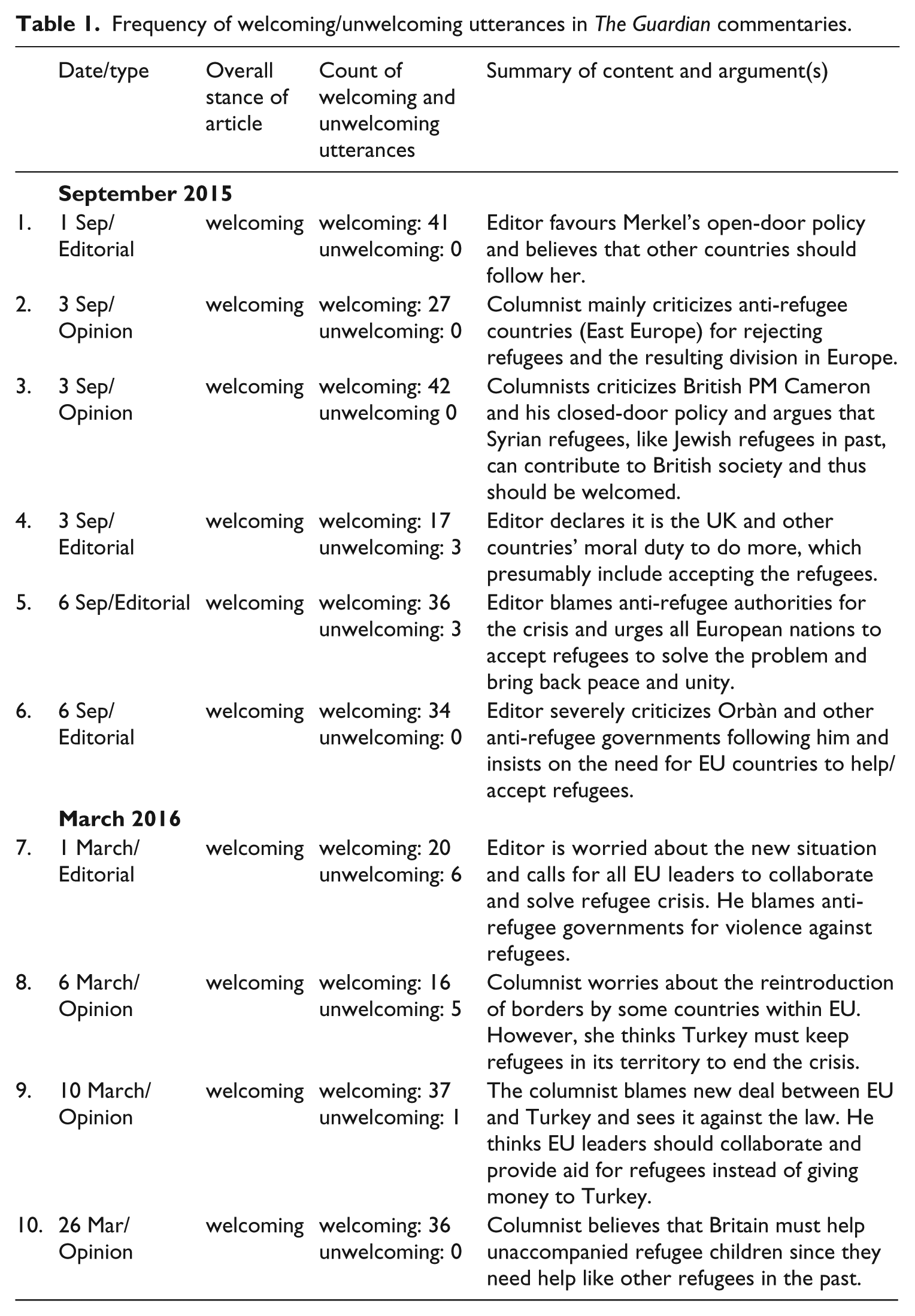
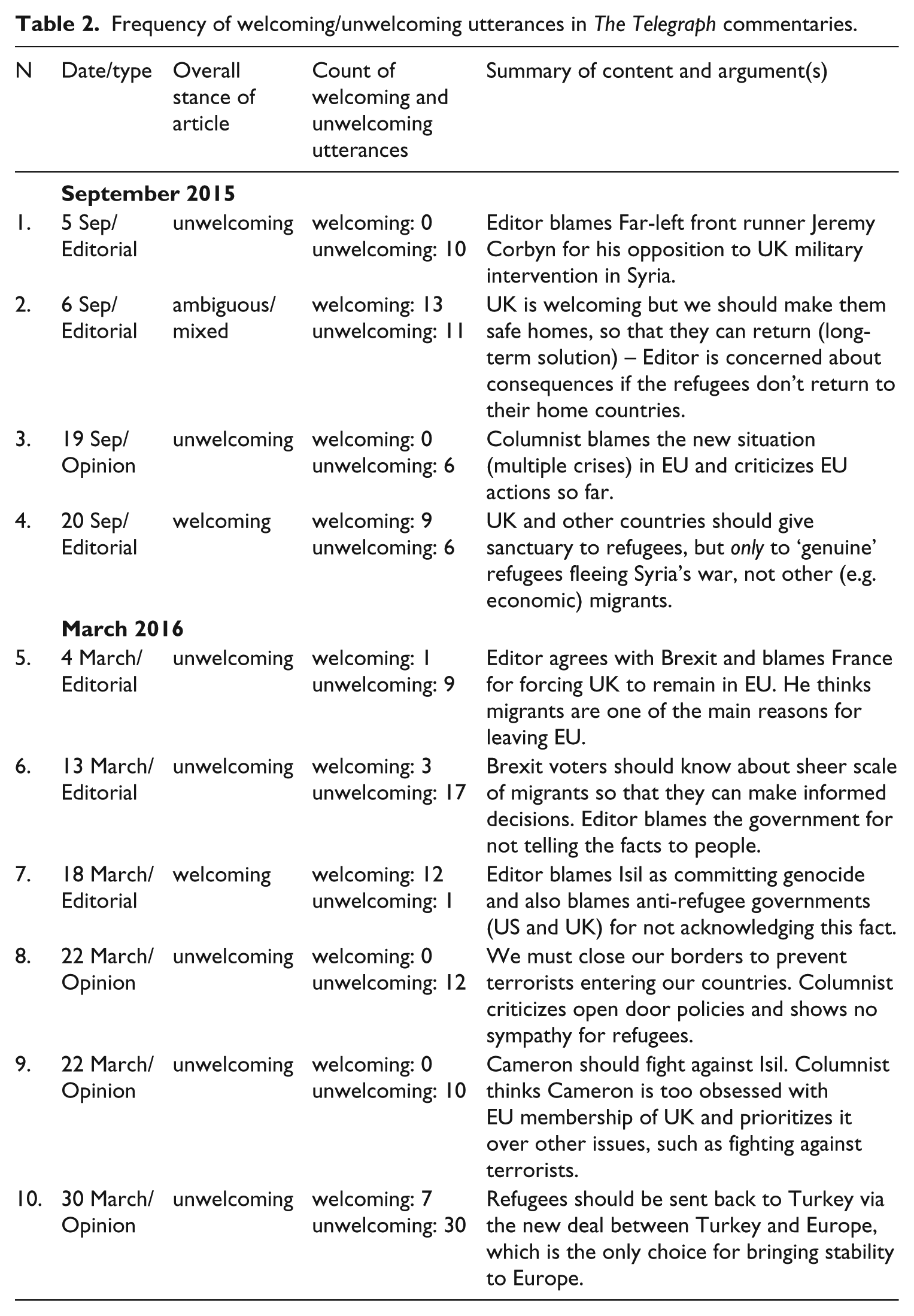
As indicated, we were interested in whether it was possible to identify tendencies in the attitudes advanced in these articles, first in 2015 and then again in 2016, which might provide the basis for assigning a global stance to a newspaper. Accordingly, we collected commentary articles which made reference to the issue of Syrian refugees in September 2015 and March 2016, resulting in a dataset of 20 articles with 10 articles from each newspaper. See Tables 1 and 2 for the frequency of the two types of commentary articles.
Frequency of welcoming/unwelcoming utterances in The Guardian commentaries.
Frequency of welcoming/unwelcoming utterances in The Telegraph commentaries.
Theoretical foundations and methodology
As indicated above, in order to investigate the global stance of the two newspapers, we proposed to characterize both utterances and articles as being broadly ‘welcoming’ or ‘unwelcoming’ of the refugees. We chose to operate with this broad, two-way characterization in order to be able to more readily generalize across different attitudinal assessments advanced in individual articles.
In order to avoid impressionistic decisions as to whether utterances were welcoming or unwelcoming, we primarily made use of the account of evaluative meaning provided by the Appraisal framework developed by Martin and White and their colleagues, details of which are provided below (Martin, 2000; Martin and White, 2005; White, 1998, 2002, 2008). We also made use of some of the basic insights from the argumentation theory (see Toulmin et al., 1979).
Obviously, the appraisal framework does not include the categories of welcoming/unwelcoming, designed as it is to categorize the general meaning making potential of English language. Nevertheless, the appraisal framework could provide us with the means to operationalize these characterizations in a linguistically principled manner in that it enabled us to specify which particular attitudinal assessments were indicative of either of these two stances. In some cases, specifying such assessments was a straightforward matter – for example, assessments which explicitly evaluated the refugees and their settlement policies in positive or negative terms. In other cases, the connection between the particular attitudinal assessment and the characterization as either welcoming or unwelcoming was more indirect and hence more problematic. In order to explain what is involved analytically in such cases, we first outline relevant aspects of the appraisal framework.
The appraisal framework identifies three key axes of variability in evaluative meaning making (Martin and White, 2005). These are variability in terms of positive or negative assessments which may be conveyed or activated by text (termed the Attitude system), variability in the intensity with which attitudes may be conveyed (termed the Graduation system), and variability in the dialogistic positioning the speaker/writer adopts vis-à-vis prior utterances on the current topic or potential responses to the current utterance (termed the Engagement system). Under the attitude system, the primary point of reference for our analysis, the expressions of positive/negative attitudes are further sub-classified according to the type of attitude – whether the attitude is conveyed as an emotional response (termed Affect), an assessment of human behaviour by reference to social norms (termed Judgement), or an assessment of entities, situations or happenings by reference to aesthetics or other systems of social value (termed Appreciation).
As well, of particular significance for how we operationalized the characterizations of welcoming/unwelcoming, the appraisal framework notes that attitudinal assessments can be conveyed, not only by explicitly attitudinal lexis (e.g. Angela Merkel’s brave stance; the short-sighted idiocy of the Prime Minister’s behaviour), but also indirectly via implication and association. The following exemplifies this: In 1940 this island [the UK] accepted nearly 10,000 Jewish children from Czechoslovakia on the Kinder transport trains. Today our stations are closed. (The Telegraph, 5 September)
In this example, there is no explicit negative assessment of the UK government for refusing entry of the refugees. Rather, this assessment is implied via the proposed contradiction between the past and present actions. The actual assessment is activated via the factual observation ‘Today our stations are closed [to the refugees]’. In this case, and as it is typically the case with such implied attitudes, whether or not the readers supply a given attitudinal inference may depend on their reading position/worldview – even while the co-text typically positions the readers to reach a particular attitudinal conclusion. In the Appraisal framework, utterances which activate attitudinal assessments in this way are termed ‘tokens’ of attitude and are said to invoke a given attitudinal assessment. Expressions which are explicitly attitudinal are termed ‘inscriptions’ of attitude.
It is noteworthy in this regard that reports of affectual responses frequently have the potential to act as tokens of other types of attitude, specifically to invoke assessments of human behaviour, that is, judgement. The following provides an obvious example: Its
In this case, the refugees’ sad condition of being ‘fearful’ and ‘dispossessed’ potentially invokes a negative judgement of those who made them dispossessed as well as those who would deny them aid.
Along similar lines, in what they term ‘double coding’, Martin and White (2005: 60–69) note that it is possible for an attitudinal assessment, which is most immediately directed at one evaluative target, to invoke a different, though related, assessment of another target, again involving a process of attitudinal inference. Thus, assessments of artefacts can very easily invoke assessments of their makers, for example, in ‘The Baghdad Railway Club by Andrew Martin has a truly ingenious plot twist’, the positive assessment of some aspect of the work may invoke a positive assessment of the capacity of its author. Thompson (2014) has termed this ‘the Russian doll effect’ on the basis that one attitudinal assessment, with its own evaluative target, may be enclosed in a higher level attitudinal assessment with a different evaluative target which may, at least potentially, invoke yet another higher level attitudinal assessment. One obvious case of this Russian doll effect, which we observed in our data, involved reports of the negative emotions of the refugees and strongly negative assessments of their circumstances which, in context, had the potential to invoke the negative judgements of those who were proposing that they should be refused entry and denied assistance.
With respect to our texts, some recurrent targets of evaluation were detected. Based on how these targets were treated by different authors, either positively or negatively, eight attitudinal arrangements or patterns emerged, which served as the basis for determining the (un)welcomeness of each utterance. Four patterns conveyed the welcoming stance while the other four arrangements contributed to the conveyance of the unwelcoming stance. Turning now to specifying particular attitudinal arrangements on which we based our characterizations, we begin by considering those which we treated as welcoming and then discuss those treated as unwelcoming.
Welcoming stance
Praising open door policies and their advocates
By praising those who have implemented open-door policies or commending such policies, articles obviously seek to position readers to hold a similar view of such policies. In this sense, they are welcoming of the refugees: The
In some cases, this positioning is achieved by linking the current situation with historically celebrated cases of United Kingdom accepting refugees, cases which have become touchstones of laudable behaviour: UK is
2. Criticizing/condemning closed door policies and their advocates
By criticizing the restricting of access for refugees or those who support such actions, texts obviously position readers to favour the counter view – that refugees should be admitted. In this sense, they are welcoming: The prime minister (Cameron) surely understands this. He is
The attitudinal workings of this extract perhaps require some unpacking. The then British Prime Minister David Cameron was associated with opposition to liberal/open door settlement policies for which he is being criticized here. He is said, in his opposition to liberal policies, to be ‘defensively parochial’, that is, to be too narrow in his view of the issue, presumably either a negative assessment of his capacity as a politician or of his psychological disposition. Interestingly, his current parochialism is said to be at odds with the compassion – of which he is believed to be capable, having presumably demonstrated this on prior occasions. There is thus the additional implication that in his current behaviour – opposing liberal settlement policies – he is lacking compassion, thus a negative Judgement of his ethical standing.
3. Praising either current refugees or prior historically notable refugee
Assessments which cast the refugees in a positive light have clearly the potential to position readers to favour more liberal settlement programmes, and hence can be interpreted as welcoming: But these refugees will Our history on refugees was never good: look back at our filthy press coverage of the Vietnamese ‘boat people’ or the Ugandan Asians – all now so easily absorbed into Britain as
4. Reporting the refugees’ affectual insecurities or negatively characterizing their past or present circumstances
We are dealing here with instances where, for example, the fear, distress, or desperation of the refugees are reported; or where the situation they are fleeing from, or they currently find themselves in, are represented as parlous in some way: Thousands of They should be taken directly from the camps, which cuts out the
These attitudinal arrangements operate somewhat indirectly. We observed that they typically occurred in texts which advocated open door policies. We chose to treat them as ultimately welcoming since they potentially invoke negative judgements of any who might be deemed responsible for refugees’ desperation or their parlous circumstances. In such texts, those potentially responsible are any who have been refusing the refugees’ entry and thus compelling them to continue to suffer. Therefore, there is at least the potential for anti-refugee policies and their advocates to be cast in a negative light, especially when the text elsewhere advances this position, and thereby for open door or more liberal settlement policies to be favoured.
To fully capture the workings of such assessments, we needed to go beyond the apparatus of the appraisal framework and to consider how such assessments might operate argumentatively. At least in texts which advance the proposition that doors should be opened to the refugees, such assessments can act as grounds for the argument that ‘it is right to accept the refugees because they are desperate, suffering and dying’. This is what theories of argumentation would term ‘appeals to emotion’. The attitudes being appealed to here are those of sympathy or pity and the underlying cultural assumption is that we are ethically required to alleviate the suffering and distress of others.
In some cases, the parlous circumstances, which justify the proposition that Europe should accept the refugees, are a matter of persecutions and threats which the refugees are fleeing back in their homelands: The West needs a proper plan in Libya, and labelling Isil as a
Again, in order to operationalize our classification of welcoming, it has been necessary to combine aspects of an attitudinal analysis with aspects of an argumentation analysis. In this case, it is the cruel, immoral behaviour of those formerly controlling the refugees (Syrian President Bashar al-Assad and the terrorist group of Isil), which arouses a feeling of sympathy and thus acts as persuasive grounds for the proposition that Europe should be offering them sanctuary: ‘It is right that we open our doors to the refugees because back home they face genocide at the hands of fanatics bent on ethnic cleansing’.
Unwelcoming stance
Criticizing/condemning the refugees
An obviously unwelcoming arrangement involved negative judgements of the refugees themselves, for example, associating them with criminality, asserting that they posed threats to Europe’s security or that they were, in fact, not ‘genuine’ refugees: Scenes of While an emotional reaction to this crisis is understandable, the solution lies in recognizing its complexity and acknowledging that
Such assessments clearly have the potential to position readers to question more liberal settlement policies and to be suspicious of, or anxious about, the refugees.
2. Negatively assessing the situation resulting from the influx of refugees
Related to the above are negative assessments, not directly of the refugees themselves, but of the situations which are said to have resulted from their arrival in Europe: The The EU really has no idea what to do about this
Even while these are what the appraisal framework terms instances of Appreciation (assessments of situations and entities rather than of human behaviour), they, nevertheless, do have some potential to invoke negative judgements of the refugees themselves for having caused, for example, ‘security challenges’ or ‘shambles’. They thus have a clear potential to position readers to be wary of the refugees, anxious about the risks they purportedly pose, and hence likely to support closed door or restricted settlement policies.
3. Criticizing/condemning open door policies and their advocates
Another relatively straightforward unwelcoming attitudinal arrangement is the one involving negative assessment of the open-door policies and/or those implementing or advocating them: It is important to measure the EU’s new hard-nosed approach against the Thanks to open borders within the EU, and
4. Commending/justifying closed door policies and their advocates
Another unwelcoming arrangement involves the positive assessments of the closed-door policies and those who advocate these policies, such as the Hungarian Prime Minister Victor Orbàn. By justifying or supporting such policies, the authors conveyed their unwelcoming attitudes towards the refugees: The first manifestation of this Calling for an end to Europe’s open border agreement, former President Sarkozy said: ‘If we don’t react rapidly in the coming years our social system will explode’.
A related arrangement involves what can be termed ‘responsibility shifting’, essentially a negative assessment of other countries for not accepting refugees and so abdicating the duty of giving refugees shelter (from the UK) to them: It is time, surely, to ask why other parts of the world do not take a larger share of Syrians. The US or Saudi Arabia
Such formulations are obviously only indirectly unwelcoming. We can see the negative assessment of other countries for not meeting their purported responsibilities. In fact, by criticizing other countries for not accepting more refugees, it is implied that the influx into Europe is too great and hence unwelcome. The refugees are indirectly construed as a ‘burden’, the weight of which is such that it needs to be shared more widely. See Figure 1 for a comparison of the percentage of all eight patterns in both time spans.

Percentage of welcoming/unwelcoming patterns in early and late periods.
In addition to tracking the above outlined attitudinal manoeuvres, we also tracked obvious declarations of support for more liberal settlement policies or, alternatively, obvious statements of opposition. These were utterances where the author issued directives which urged, commanded, or recommended actions with regard to the treatment of refugees. This was typically through the use of modals of obligation (‘deontic modality’) such as must, have to, should or related wordings such as it is necessary that. The following examples, which we characterized as welcoming, indicate a positive disposition towards the refugees and urge governments to come to their aid: The West Instead of giving Turkey billions of euros, this money
Our analyses were also complicated by the fact that it is common for commentary pieces to include quoted material by which views, demands and versions of events are attributed to external sources – experts, community leaders, eyewitnesses, and so on. Since this turned out to be the case with the items in our dataset, it was necessary to consider what position the journalistic author took vis-à-vis the attributed material, particularly when the attributed material contained positive or negative utterances about refugees and/or settlement policies. We needed to determine if the author was indicating alignment or disalignment with the attributed propositions since, for example, when an attributed unwelcoming utterance is repudiated in this way by the author, it must be regarded as separate from the stance being developed by the author herself/himself. For this analytical task, we drew on the work in the Appraisal literature on ‘Engagement’ more generally and on ‘attribution’ more specifically, in particular the approach developed by White (2012) by which the attributed material is classified as ‘favoured’ by the author (directly or indirectly characterized as plausible and well-founded), ‘disfavoured’ by the author (directly or indirectly characterized as unreliable or ill-founded), or ‘neutrally’ presented. In order to determine if the quoted material contributed to the overall stance of the article, it was necessary to track whether the quoted material was favoured or disfavoured. When the article’s author favoured the views of a quoted source, then these views were treated as contributing to the article’s overall stance. When, alternatively, the views advanced in the quoted material were disfavoured by the author, then these were not treated as views advanced by the article. In other words, having been undermined and questioned in this way, they did not contribute to the article’s stance. The following exemplifies a favoured attribution: All of this suggests that it was
The methodology employed was both quantitative and qualitative. It was quantitative in applying the above methodology. We identified and counted all utterances which were either welcoming or unwelcoming to refugees, while keeping track of (1) the newspaper in which they occurred, (2) whether the item was an editorial or an opinion column, and (3) whether it was published in the initial time span (September 2015) or the latter one (March 2016). It was qualitative in that it was always necessary to consider each instance of a potentially welcoming or unwelcoming utterance to determine its specific in-context communicative potential – specifically its potential to engender a sympathetic or unsympathetic view of the refugee’s plight.
With regard to the qualitative aspect of the study, our work was obviously influenced by theorists who advance a social theory of discourse. This includes scholars working in the SFL tradition as well as those working in the various traditions of CDA (Fairclough, 1995, 2013; Van Dijk, 1995, 2005). These scholars have been highly influential in advancing the view that there is a dialectic relationship between the linguistic features of texts and the institutions, social practices and social conditions in which the texts are embedded – practices and conditions which shape the linguistic features of texts and are in turn themselves shaped by texts. We were thus directed to relate the meanings conveyed by these journalistic authors to the institutional contexts in which they operate as well as the wider public discourses and associated social changes.
Results and discussion
In this section, the results of the appraisal analyses are discussed with respect to the welcoming/unwelcoming utterances in the early versus late periods and two articles, with a mixture of welcoming and unwelcoming utterances, are briefly reflected upon.
Welcoming and unwelcoming utterances across time
As indicated above, our methodology involved classifying these opinion columns and editorials as welcoming or unwelcoming towards the refugees and their efforts to find asylum in Europe. This did not rule out the possibility that the stance might be ambiguous – more or less evenly balanced between being sympathetic to the refugee’s plight in some ways and not so sympathetic in other ways.
The position being taken (sympathetic versus unsympathetic) was typically right from the outset of the article, as exemplified by this opening from an editorial in The Guardian: Britain cannot open its borders to everyone fleeing war anywhere in the world, but this does not excuse the government’s shameful determination to keep our borders closed to as many refugees as possible. Our international treaty obligations, as well as the promptings of our collective conscience, entail a duty to offer meaningful sanctuary when a humanitarian catastrophe unfolds before our eyes. (3 September)
But alongside this text-wide focus, we were also interested, at a more granular level, in individual utterances and the number of these in a given article which could be classified as welcoming/unwelcoming. Where an article contained both welcoming and unwelcoming utterances, we were interested in the ratio – that is, whether one or the other type was clearly preponderant. In almost all cases, the stance of the article was obvious when the frequency of utterances for one stance significantly outweighed the other. In a few cases, however, there were relatively equal numbers of welcoming and unwelcoming utterances, which was indicative of the author declining to take a clear-cut position. In such cases, we looked to the overall argumentative gist of the article to make a determination.
Our findings with respect to both frequencies of welcoming/unwelcoming utterances and overall stance of the articles are presented in Tables 1 and 2.
When viewing the data from this whole-text perspective, we can discern the following.
The Guardian’s coverage is consistently welcoming of the refugees and thereby supportive of more liberal settlement policies. Given this general and consistent positivity towards the refugees, it is necessary to note that this did not mean that all utterances related to the refugees were welcoming. That is to say, while all utterances referencing the refugees in five of The Guardian articles were welcoming, the other five included at least some unwelcoming utterances. The 1 March editorial, for instance, included six unwelcoming utterances beside its 20 welcoming utterances. This raises some interesting questions as it might be assumed that an article which seeks to position readers to welcome refugees and support open door policies might entirely avoid such negativity. Such questions and what is involved here in terms of attitudinal positioning and rhetorical effect will be discussed in a later section.
With respect to The Telegraph dataset, the findings provide some evidence of a shift of stance over this period from a mixed or ambivalent viewpoint in 2015 (e.g. one editorial welcoming, one editorial and one opinion piece unwelcoming, one editorial mixed) to a more unwelcoming stance in the latter period in 2016 (five out of six articles unwelcoming). Again, it is noteworthy that it is not the case that an article which is broadly unwelcoming will necessarily comprise universally unwelcoming utterances. Thus, for example, while the March 30 opinion piece had 30 unwelcoming utterances, it also contained seven utterances which we characterized as welcoming. We will return to this issue below, but first we report findings as to global frequencies of welcoming versus unwelcoming utterances, that is, calculated for the whole datasets rather than individual articles.
The Guardian: As already indicated, the welcoming utterances were significantly more frequent than the unwelcoming ones in both periods with a small shift towards less welcoming in the late period (early period: 97% welcoming and 3% unwelcoming; late period: 90% welcoming and 10% unwelcoming).
The Telegraph: Both periods showed a dominantly unwelcoming stance with the ratio of unwelcoming to welcoming utterances becoming even larger in the late period (early period: 40% welcoming and 60% unwelcoming; late period: 23% welcoming and 77% unwelcoming). For a comparison of the stances adopted by different newspapers as well as the stances each adopted at the beginning and end of the designated period, see Figure 2.
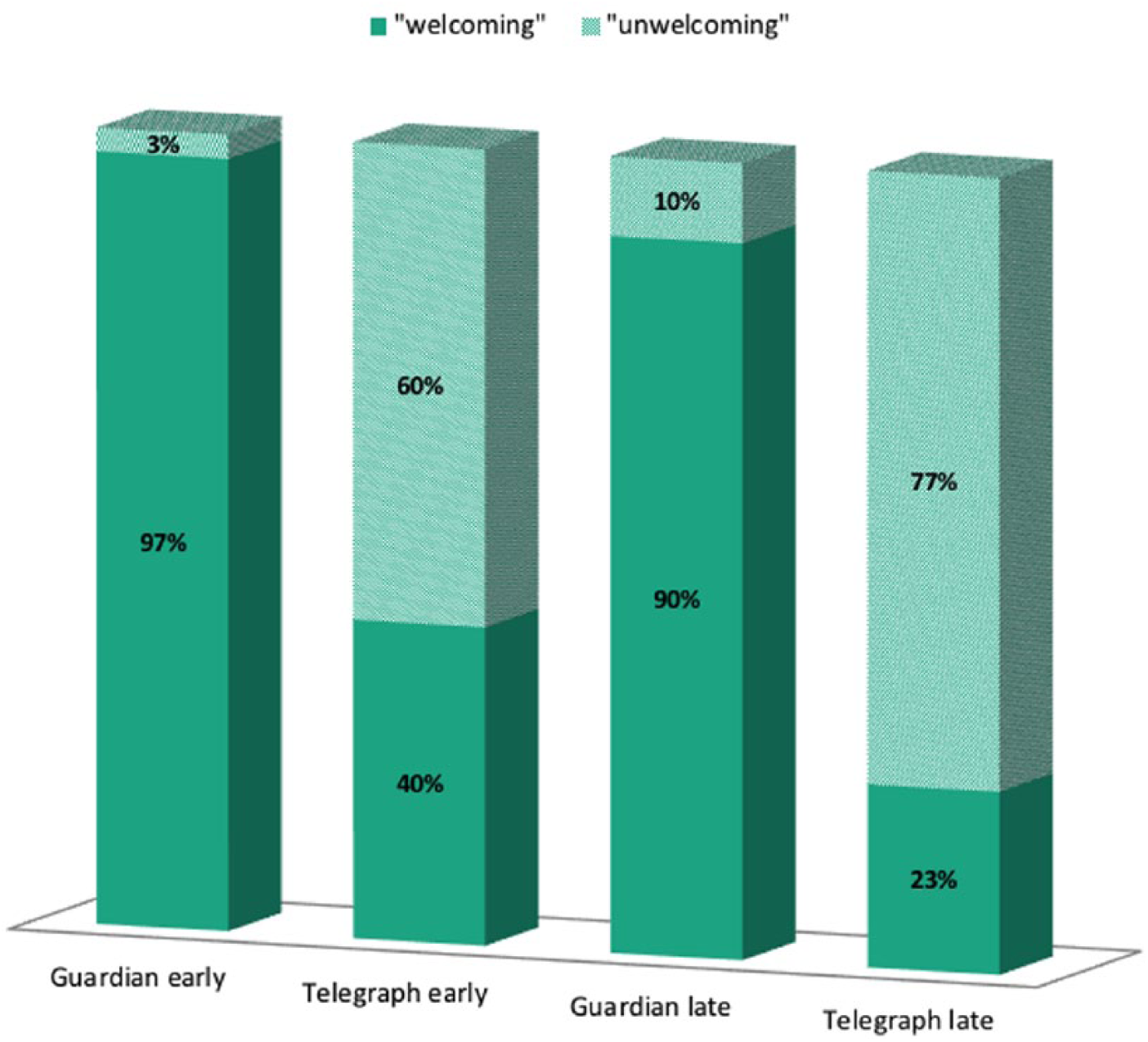
Ratio of welcoming to unwelcoming utterances in early and late periods in two newspapers.
These findings are of interest in that they reveal an interesting difference between The Guardian and The Telegraph when the early and late periods are compared. The Guardian is essentially stable, with welcoming utterances very much in the majority − 97% and 90% – in two time frames respectively. In contrast, The Telegraph is much less stable in that there is a noticeable increase in the proportionality of unwelcoming utterances in the late period. Thus, we can say that, its articles do reflect a hardening of attitude towards the refugees after 6 months.
Investigating attitudinal inconstancy – when articles contain a mixture of welcoming and unwelcoming utterances
A key point of interest here, as already mentioned, is the fact that, according to our taxonomy of welcoming/unwelcoming utterances, it is possible for a broadly welcoming article to include a number of unwelcoming utterances, and vice versa. This is why we found that, in both time periods, around 6% of refugee-related utterances in The Guardian dataset were unwelcoming, even while all its articles were broadly welcoming. It is also the reason why as many as 40% of refugee-related utterances in The Telegraph dataset in the early period were welcoming, even while only one of the articles in this period was found, in broad terms, to be similarly welcoming.
Space limitations prevent us from providing a detailed discussion of this. Broadly speaking, we can say that it results from the multifaceted nature of the debate around how European nations should respond to the refugees as they arrived in such large numbers. Thus, for example, it was possible for an article to be sympathetic, and hence welcoming, to the plight of refugees but then holding that the solution was not settlement in a country such as the United Kingdom, but in a place of refugee in, for example, Turkey or somewhere in the Middle East. Therefore, the initial potentially welcoming sympathy might be overwhelmed, so to speak, by this countering advocacy of a closed-door policy. Along similar lines, it was possible for an author to be broadly in support of more liberal settlement policies while warning that some of those seeking to settle were not genuine refugees. In this way, an article could be broadly welcoming while nevertheless including points which were unwelcoming.
To exemplify this possibility more specifically, we turn to a discussion of two indicative articles, one from each newspaper. They are indicative in the sense that, in the case of The Guardian, we deal with an article which, while broadly welcoming, contains a number of unwelcoming utterances and, in the case of The Telegraph, we deal with an article which is broadly unwelcoming but nevertheless includes a number of welcoming utterances.
The Guardian editorial of 1 March, which was dominantly welcoming, calls for Europe to come to the aid of the refugees and condemns those who advocate closing the door against them. Nevertheless, the author does raise questions about the bona fides of some of those seeking refuge, thus lending at least some potential support to those who would restrict their entry: ‘The increasingly large proportion of migrants who were not Syrians … complicated the problem’. This passing negativity did not, however, overwhelm the author’s call for all European leaders to collaborate and put an end to the crisis.
With regard to The Telegraph, an opinion column from 30 March has a global unwelcoming stance. It broadly argues in favour of a then recent agreement between the EU and Turkey by which Turkey would take back migrants from the Greek islands in exchange for cash and the promise of visa-free travel in Europe for Turkish citizens. The article is thus unwelcoming in that it supports the removal of refugees from Europe. Nevertheless, it is not entirely supportive of such closed-door policies in that it acknowledges the existing concerns that Turkey has a deteriorating record on human rights and by this signals some anxiety over the well-being of refugees relocated in this way.
Conclusion
The left-leaning newspaper The Guardian had 306 (94%) welcoming and only 18 (6%) unwelcoming utterances. Interestingly, this overall welcoming stance is maintained in both the early as well as the late period, when community attitudes appeared to harden vis-à-vis the refugees. Such a dominant welcoming stance could be expected from a left-leaning paper being usually supportive of migrants and critical of nationalistic policies. Of course, the dataset is far too small to enable any sort of generalized conclusions with respect to such media treatment and community attitudes. Nevertheless, it is of interest in that, if the same pattern were observable across a substantially larger and more representative dataset, it might be taken as evidence that The Guardian’s coverage was running counter to community, or at least governmental, sentiment–maintaining its consistently welcoming attitude. On the other hand, the right-leaning The Telegraph contained 45 (29%) welcoming and 112 (71%) unwelcoming utterances with respect to the refugees and their settlement policies. Again, we can say that if this pattern were found to operate in a larger, more representative dataset, we might take this as evidence of The Telegraph’s attitudinal shift matching the apparent hardening community attitudes across this time frame.
According to the social theory, discourses are the representations of how things are, should, or could be in the world (Fairclough, 2001). In this study, we aimed to see if the social changes were reflected in, as well as influenced, the media discourse of an involved country, that is, Britain, through examining any change in their stance taking towards the refugee crisis; whether or not they became more unwelcoming towards the refugees after the terrorist attacks mentioned above. As observed in the previous sections, the global stance of The Guardian did not change and consistently remained welcoming, while the overall stance of The Telegraph changed towards more unwelcoming after 6 months of chaos in Europe. It could be argued that the editors and opinion columnists in The Telegraph connected the terrorist attacks to the refugees and asylum seekers, most probably with the assumption that terrorists were among the refugees arriving in Europe on open borders and, therefore, the only remedy to stop the terrorist attacks would be to prevent all refugees from coming to Europe. This potential assumption was reflected in the journalists’ linguistic choices. Although our dataset was rather small, it was timely and presented a portrayal of the refugees and the crisis throughout critical moments in Europe. As a concluding remark, we believe that such findings are useful in providing insights into the global, institutional orientation of the newspapers.
Footnotes
Acknowledgements
The authors would like to thank Professor van Dijk, the editor of the journal of Discourse and Society, and two anonymous reviewers, who provided constructive feedback. We also thank participants of the Sixth Discourse Conference held in Auckland University of Technology in December 2017 for providing valuable feedback. Fatemeh Tavassoli is especially grateful to the School of the Arts and Media at the University of New South Wales, Sydney, for hosting her during part of her PhD studies and doing the present study.
Declaration of conflicting interests
The author(s) declared no potential conflicts of interest with respect to the research, authorship, and/or publication of this article.
Funding
The author(s) disclosed receipt of the following financial support for the research, authorship, and/or publication of this article: Fatemeh Tavassoli is really thankful to Shahid Chamran University of Ahvaz and the Office of International Relations for providing the funding for her stay in Sydney during a visiting period at the University of New South Wales.