




Abstract
Biafra secessionist agitations in Nigeria continue to generate varied conversations online and offline. This study applies critical discourse analysis and the appraisal framework in examining social actor representations in the ongoing Biafra agitations in Nigeria. It analyses posts produced by interlocutors, as they express variegated stances towards the agitations and its actors, within two vibrant Nigerian digital communities, Nairaland and Nigeria Village Square. This study identifies binary social actor positioning, revealing both negative valence and positive self-representation strategies towards the agitations and principal social actors in the agitations. Expressed within the appraisal resources of attitude, engagement and graduation, these valuations result in the distribution of socially and emotionally constructed identities for the principal social actors in the agitations. Such distribution is socio-cognitive, as there is the likelihood that the representations might evolve into the creation of new ideological orientations or the reinforcement of existing ideological leanings, whose consequences are potentially double-edged for tranquillity in the Nigerian polity.
Keywords
Introduction: Stance and representation
Language, a major communicative tool among humans, is a relational, emotional and cognitive phenomenon. Often, language users (speakers/writers) implicitly or explicitly express their respective opinions during communication. They make evaluative judgements, present respective points of view, project their values and thoughts or take positions when they interact with others. These expressions, referred to as stance, are either in relation to propositions in an ongoing communication activity or in relation to other social actors (in)directly involved in the communication.
Significantly, stance is a product of existing socially shared values and beliefs. It is taken through respective ideological and socio-cultural frames (Bednarek, 2006; Johnstone, 2009). Hence stance is not only expression, it is an act of representation. It is a social act that constitutes a type of meaning represented in discourse (Du Bois, 2007; Englebretson, 2007; Hunston, 2007). Stance does not exist in isolation, it expresses ‘the relation between the individual and a social matrix, including copresent others’ (Hanks, 2000: 9). Therefore, stances can build on each other on a dialogic cline, with a new expression of stance bearing close semblance to that taken by a prior speaker/writer (Du Bois, 2007).
Because language users are socio-cognitive beings, it is plausible that others’ acts of stance-taking can influence the perceptions, emotions, value-judgements, actions and reactions of co-participants in the discourse space. Since stance is a common denominator in discourse (Du Bois, 2007), this study analyses stance and representation in the discursive engagements (that take place in Nigerian digital communities) about Biafra secessionist agitations. It begins by providing an overview of online discourse in Nigeria and a background to Biafra agitations. It then explains the methodology and proceeds to the analysis and discussion of sampled data to reflect discursive representations (through stance-taking) of Biafra, Biafrans, non-Biafrans and the Nigerian government.
Online discourse in Nigeria
The Internet has birthed a significant change in the nature of citizens’ discourse about civic matters. A major hallmark of Internet discourse is its ability to resist control structures that are typically associated with other channels of human communication or other forms of discourse (Segaller, 1999). The Internet, together with the Web, is structured to ‘encourage open participation’ among users (Holt, 2004: 10). It promotes interconnectivity among users (through interactivity and features for sharing discourse across multiple websites/webpages), heterogeneity (diverse users) and participation (individuals can create or contribute to ongoing discourse). Clearly, a broadened public discourse terrain exists online (Rahimpour, 2014). This makes the Internet a viable and sophisticated tool for citizens’ engagement in public discourse.
Nigerians in Nigeria first gained access to the Internet in the 1990s. Over the years, they have readily joined the global cyber culture, so much so that as at December 2017, Nigerians, with over 93 million users, were the highest number of Internet users in Africa. This corresponds to about 50.2% and 22% of the Nigerian and African population, respectively. 1 With increasing access to the Internet, social and political events in Nigeria quickly influenced posts on microblogs, weblogs and the formation of virtual spaces (digital communities) like Nairaland (NL), Nigeria Village Square (NVS) and Naijapals. Notably, most of the interactions that take place within these platforms are forms of public discourse that are not merely discourse for discourse’s sake; rather, they are used to educate one another, and express evaluative judgements, experiences and feelings on the respective subject matters being discussed (Carpini et al., 2004; Chiluwa, 2015). Online platforms, which have become neo-public spheres, have therefore created avenues for Nigerian netizens to partake in discussions about the country’s socio-political and economic affairs (Ajiboye, 2013; Ifukor, 2011).
In some cases, online social media have been used for social activism and awareness creation, such as the #BringBackOurGirls movement on Twitter. There was the popular #OccupyNigeria socio-political protest against the federal government’s removal of fuel subsidy in Nigeria in 2012, a protest that moved offline, nationally and internationally, and stalled socio-economic activities in Nigeria while it lasted. In addition, during the 2011 and 2015 general elections in Nigeria, Nigerians massively engaged social media to campaign for or against candidates and publicly assess their credibility for political offices. Again, because they were conscious of the freedom that Internet expression offers to any democracy, with the #SayNoToSocialMediaBill hashtag, Nigerians at home and in diaspora were quick to protest against a controversial social media censorship law, which the Nigerian legislature proposed in December 2015. The bill was eventually withdrawn. Online platforms were also used for mobilising voters (#INECRegistration) and monitoring elections in 2011. In fact, an election monitoring social media tracking centre was set up in Abuja, and hashtags such as #NigeriaDecides were prominent across Nigerian cyberspace (Opeibi, 2016). These forms of engagement are not readily attainable via traditional mass media outlets, as online platforms promote a sense of community, foster perpetual individual and collective participation, and reinforce the need to belong in the scheme of things (Deluca et al., 2012).
Notably though, online interactions could be volatile, especially because of the presence of a ubiquity of voices, anonymity and the democratisation of discourse in these platforms. Also, sensitive topics like secessionist agitations can inform ideological and emotive stances that illuminate the public’s perception of the situation. Hence, this study examines Nigerians’ expressions of their stances about, and representation of social actors in, the Biafra secessionist agitations.
Biafra secessionist agitations
Biafra agitations in Nigeria are rooted in Nigeria’s 1914 amalgamation, when colonialists brought together distinct ethno-cultural regions within one central government. During Nigeria’s postcolonial years, the country’s constitutional provisions made the ethnic differentiations among the regions more apparent, as Nigeria practised the federal system of government; and since power was consolidated centrally, each region pushed for recognition, relevance and visibility at the national level. It was therefore almost inevitable that post-independent Nigeria would experience a spate of crises, often revealing pockets of ethnic undertones.
By the mid-1960s, the Eastern region (comprising mainly Igbos and smaller ethnic groups in the country’s current South-East and South-South geo-political regions respectively) was convinced that Nigeria’s federalism was flawed; hence, in order to discontinue perceived domination by the Northern region, it considered secession. This secession was to birth a new country, Biafra; however, Nigeria’s federal government fiercely resisted it, and this resulted in the Nigerian Civil War/ Biafra War (1967–1970). Consequently, they were re-integrated into Nigeria.
The secessionist agitations did not end with the war. There were disgruntled voices, which eventually came to the fore in the late 1990s and early 2000s with the emergence of Biafra activist groups such as Movement for the Actualization of the Sovereign State of Biafra (MASSOB). MASSOB claimed to work towards the peaceful disengagement of the Igbos (of the Old Eastern region) from the Federal Republic of Nigeria through a process of referendum and dialogue (Adekson, 2004; Onuoha, 2014). Despite the group’s self-professed preference for pacifism, MASSOB, on different occasions, clashed with the State Security Service (SSS). Eventually, the Nigerian government recognised them as a militant group. Retreating from the limelight, MASSOB operated mostly through online mobilisation and activism. Shortly after the Nigerian general elections in 2015, Biafran online mobilisation and activism became more pronounced through the popularisation of another Biafra separatist group, the Indigenous People of Biafra (IPOB). IPOB rapidly became actively involved in public discourse, distributing messages about and amassing support for the Biafran cause mainly through online radio broadcasts (Radio Biafra based in London and Biafra Voice International) and Internet-based publications. IPOB has, since its creation, organised rallies and seminars, engaged in diplomatic relations, and its ideology is becoming widespread among youths of the South-South and South-East regions. Because the Nigerian government considered IPOB’s broadcasts incendiary, the group’s leader, Nwannekaenyi Kenny Okwu-Kanu, popularly known as Nnamdi Kanu, was arrested and detained for 2 years until he was released on bail. As he flagrantly violated his bail conditions, military personnel raided Kanu’s country home in September 2017, and his whereabouts remained unknown until October 2018, when pictures of him praying in Jerusalem surfaced online. 2 His arrest, disappearance and re-appearance did not quieten Biafra agitations; instead they contributed to the proliferation of Biafra discourses in Nigeria.
As a subject of popular discourse in Nigeria, Biafra agitations attract considerable attention in Nigerian online platforms, which have become neo-public spheres. Even though Biafra secessionist agitations in Nigeria have been extensively examined from political, historical, economic and sociological perspectives, there has been insufficient linguistic research on the subject. Only a few studies, such as Chiluwa’s (2012) sociolinguistic critical discourse analysis (CDA) of online discourses of Biafra campaign groups, exist. This study therefore examines stance-taking as a resource for representation (of events/social actors) in online interactions about Biafra, especially as such representations could enhance the distribution of (un)favourable ideological perspectives of the agitations to heterogenous users of the Internet.
Methodology
Data for this study comprise 500 posts (numbered P1–P500) crawled from interactions about Biafra agitations within two vibrant Nigerian digital communities, NL and NVS. These posts were made between 2015 and 2017, during which there were heightened engagements among the Nigerian publics about the agitations. The purposively sampled posts reflect different social actor positioning towards the agitations. However, due to space constraints and overlaps in the holistic discursive content of some of the posts, only few posts are reproduced within the analysis. The provisions of CDA and the appraisal framework (AF) guide data analysis.
CDA is a discourse analytical approach whose findings are based on insights from social and political aspects of the real world (Van Dijk, 2001). It unravels complex systems of the production and reproduction of social and political inequalities woven into everyday text and talk. CDA examines the overall context of text and talk, as well as plausible mental representations (mental models) that the structures of text and talk may generate (Van Dijk, 2001). Importantly, discourse may be implicitly structured to cohere with preferred mental models (already established notions, beliefs and attitudes towards a group or subject) through elements like topic, rhetoric, argumentation, semantic disclaimers, lexical description/representation of the other, and so on. In such situations, discourse not only expresses social representation, it reinforces underlying mental models and social representation. In the present study, Van Dijk’s (2008, 2009) socio-cognitive CDA guides the interpretation of knowledge forms encoded within discourse and distributed to heterogeneous audiences in Nigerian digital communities.
Martin and White’s (2005) AF complements CDA to account for discourse resources that express implicit (inter)subjectivity in discourse. AF identifies these across three levels of meaning: attitude, engagement and graduation. While attitude accounts for the expression of feelings towards events or other social actors, engagement indicates intersubjective social actor positioning in texts towards either ongoing discourse or social practices outside the text. The third level, graduation, encompasses resources that speakers/writers engage to ‘graduate’ an utterance’s semantic values, thereby enhancing attitude or engagement meanings. The three levels are further delineated as indicated in Figure 1.
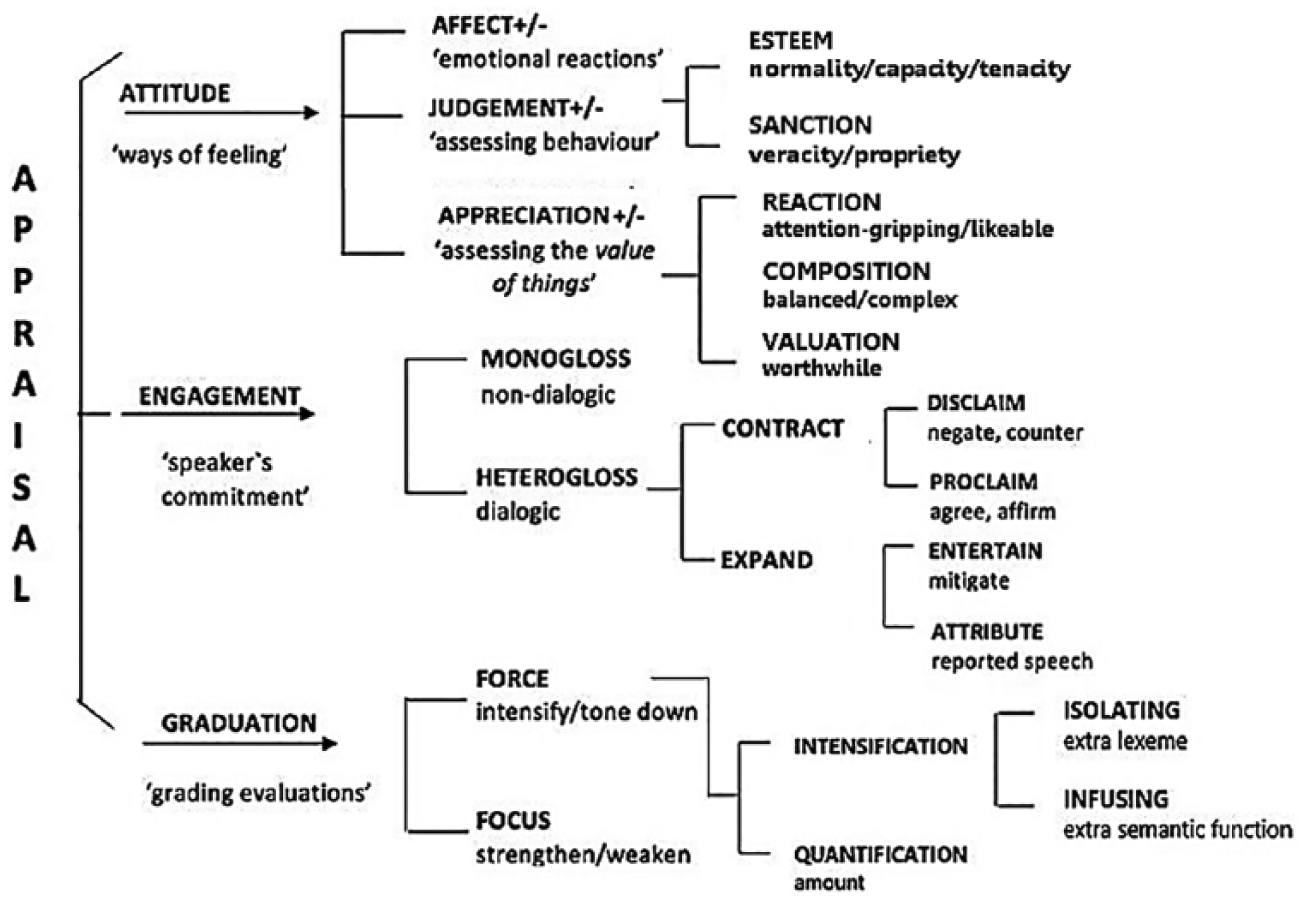
The appraisal system. 4
Analysis and discussion
Identity construction and representation of Biafra/Biafrans 3
Identity construction and representation of a person, a group or an entity is largely socio-cognitive; the cogniser and object or person(s) whose identity is being constructed or represented belong to a social space (context), and the formation of their identity is one that exists in the cogniser’s mind. Identity construction and representation are central to the analysis of stance in discourse. To simplify socio-cognitive expressions of stance in relation to the negotiation of identity in sampled data, this study refers to Du Bois’ (2007) definition of stance as a way of positioning oneself in relation to other participants or propositions in communication. Precisely, he notes that stance is an act that evaluates objects, positions subjects, and that is used to align with other subjects. Hence, within this analysis, identity construction and representation of Biafra and Biafrans are examined broadly along the lines of alignment and disalignment.
Expressing negative valence
Within sampled data, interactants, through their different stances, make attempts to socially, emotionally and cognitively construct the identities of Biafra/Biafrans negatively. Such negative valence is realised through strategies such as labelling, the use of intense adjectives, negative comparison, pseudo/rhetorical questions and threats. Biafran agitators are described with cognitive labels (referentials) that indicate affective and judgemental stances towards Biafrans. These labels express feelings of dislike, dissatisfaction and criticism towards Biafran activists, an outgroup, for instance ‘group of touts’ (P1), ‘amphibians’ (P19), ‘biafrauds’ (P19), ‘comedians’ (P33), ‘wailers’ (P62), ‘illiterates’ (P37, P43). Specifically, ‘group of touts’ (P1) is a judgement of sanction, which questions the propriety of the activists, as touts are usually disruptive groups with no specified positive mission. ‘Amphibians’ (P19) is a judgement of esteem that addresses the self-sustaining capacity of the Biafrans after secession, especially because they might be isolated from other regions since they are landlocked: ‘… I doubt if you amphibians can survive a year living in utter isolation and solitude. I really doubt it’ (P19). Though this does not appear to be a strong point to dissuade the Biafrans, it infuses engagement meanings into the interaction. It does this by opening up the dialogic space, as indicated by the use of a hedging verb, ‘doubt’, twice in the space of few lexemes. ‘Doubt’ suggests that the authorial stance about Biafra is open to contention, yet it co-exists within a categorical assertion that emphasises survival, isolation and solitude. In fact, there is an incorporation of graduation within this assertion: the adjective ‘utter’ is an infusing lexeme that expresses force, as it suggests absoluteness. This, together with the verb ‘survive’ and the nouns ‘isolation and solitude’ that occur within the post nullify the ‘doubt’ expressed, and thus presents a proposition that is intrinsically not up for debate. Therefore the statement, which depersonalises these social actors, primarily attempts to dissuade Biafrans from secession, and even scorn the agitations by belittling them and comparing them to mere ‘amphibians’.
Furthermore, the label ‘comedians’ in ‘Biafrans are comedians’ (P33), semantically echoed by another discourse participant – ‘… IPOB what a joke’ (P43), derides the Biafra struggle in its entirety, as it is another instance of a judgement of esteem, with emphasis on normality and tenacity. The writer’s authorial stance expressed in this declarative appears to provoke his/her audience to judge the wisdom in the agitations, especially as various pro-Biafra factions have emerged, for example MASSOB, IPOB, Reformed-IPOB and The Rebranded IPOB. Ironically, these groups, while claiming to champion the same cause (the realisation of Biafra), fundamentally disagree on the approaches to engage in for the actualisation of their vision. Moreover, these factions or groups are in rivalry with one another, which brings to the fore the unusualness of the activism/struggle (just like ‘Biafrauds’ (P19) – a wordplay of ‘Biafra’ – indicates, thereby highlighting a perceived fraudulent struggle for secession). Hence, by addressing Biafrans as comedians, the writer of the post intertextually draws the attention of other participants to emphasise that there is no real quest for Biafra, since there is apparent disunity among the various factions. It may then be inferred that the writer perceives that Biafran agitators are attention seekers or ‘wailers’ (P62) who are only screaming ‘foul’, yet do not have a real/strategic plan to actualise their ambition, and therefore lack tenacity. It is likely that this stance is re-echoed, as with intertextual texts, in the use of the label ‘illiterates’ (P37, P43), especially because the writers of these posts offer assessments of the agitators, and conclude that they are ‘dumb’ (judgement of capacity) and do not understand the full import of their activities, especially if these eventually materialise into secession:
Again, the author of P37, while expressing negative judgements of capacity towards the Igbo group, engages infusing lexemes ( ‘really’ and ‘so’) for intensification of scalar meanings (i.e. graduation) into the authorial stance expressed. In fact, these are further emphasised graphologically with the use of repeated letters in the words ‘so’ and ‘dumb’ as well as the multiple exclamation marks that end the clause: ‘Ibos are really sooooooo duuuummmbbb!!!’ (P37); further statements buttress that they (Biafrans) are on a ‘tragic path’ (P19), consumed by ‘internal rivalry’ (P52), and can only lay claims to a ‘landlocked enclave’ (P62) anyway. Another post notes that the agitations are ‘illegal’ and considered as ‘treason’, which is ‘punishable for life in prison or by capital death. or at least 10 years in prison’ (P87). In fact, Biafran activists are likened to the deadly terrorist group Boko Haram: ‘Boko Haram members also fall into this same class’ (P87). Although this appears to be an unequal comparison, it suggests that supporters of Biafra are potentially volatile. This comparison, then, might be to signal to other discourse participants within the digital community that the activists are dangerous, cruel and deadly, and should therefore be suppressed in the shortest time possible.
In some other anti-Biafra posts, readers are made to believe that embarking on another determined quest for secession is tantamount to the Biafrans’ ‘funeral’ (P124; cf. P179 in the following). Hence, with a judgement of normality, Biafrans are further attacked for their ‘typical’ hasty nature in deciding, ‘without consultation’, what is obtainable in their quest for secession: ‘typical Igbo behavior – Judge, Jury and Executioner’ (P62). This assessment is further projected through engagement as the poster leverages on intertextual historical evidence of the millions of Igbos killed during the Nigerian Civil War. With this, the authorial stance serves a distancing function, while simultaneously illuminating the portended negative attitude that the author has towards the Biafra cause. This heteroglossic intertextual backdrop is further complemented by a pseudo-question that seemingly leaves room for participation from the putative audience to contradict or affirm the expressed stance. In the AF, the term ‘pseudo-question’ refers to ‘rhetorical question’; however, the former emphasises the false sense of the question, since it attempts to present the writer’s stance as an option among many other plausible alternative perspectives in the context of the interaction. In fact, the question is inherently self-stanced, as the proposition sheds light on the futility of the Biafran quest. In alternative words, the pseudo-question, together with the preceding historical antecedent is used to ridicule and foreground the presupposed ‘senselessness’ of the struggle: ‘Even the foremost revolutionary from the South South by the name Adaka Boro fought on the Nigerian side. What does that tell a sensible person?’ (P62). This skewed historical reference is probably in a bid to emphasise that the people of South-South (the oil-rich deposits of Nigeria – oil is Nigeria’s economic mainstay), who were part of the Old Eastern region, are not in support of the Biafra secession. As such, the poster presents that the people of South-East are in a lone struggle, and they stand to gain virtually nothing from the war, since they would be shutting themselves in, as in isolation, from the outside world in their ‘landlocked enclave’ (P62): Kanu and others have committed treason under the laws of Nigeria. to be associated or to be a member of a group associated with Biafra movement is considered as treason under the Nigeria law. Secession is illegal under Nigeria law. Boko Haram members also fall into this same class, if prosecuted in court. (NL)
Some posts, such as P229, employ engagement strategies of evidential and pseudo-questions to dialogically expand an authorial stance that projects a divided quest. It foregrounds the lack of internal support by the Igbo Elders’ Council (the Ohaneze Ndigbo) and the South-South (where there are abundant oil deposits), and like other posts, it trivialises the agitations, making the activists appear like attention-seeking individuals (cf. P282: ‘Why are ppl giving this Biafra of a thing too much Attention?’). Significantly though, by keeping conversations ongoing about Biafra, the secession agenda is being popularised, and consequently distributed among a heterogenous audience. This audience, then, is enabled to filter through the respective stances expressed about the secession and to make ill-formed or well-formed judgements about it, ranging from advocacy for peace to rallying for violent protests/actions.
It is common knowledge that because of their enterprising nature, Igbo people have huge investments across Nigeria, and the average Igbo (wo)man jealously guards her/his finances; in fact, many Nigerians believe that s/he is acutely money-conscious/money-driven. P37 acts on this dialogic knowledge in a manipulative play on the cognition of the activists to attempt to dissuade Biafrans from embarking on secession moves, reminding them of the huge investments they have made in Nigeria, and indirectly suggesting that many of them would not want to part with these just in a bid to have their own independent country. The post therefore issues specific threats that every property owned in non-Biafra regions ceases to be theirs if they secede. Though this might just pass off as another negative comment, it directly attacks the ideology of the Igbo people. This reminder, therefore, probably awakens the selfish consciousness of what the Igbo people might stand to lose; hence, it is likely to dissuade the rich and influential from actively partaking in secession agitations: ‘When a small child is cutting a tree in the forest, the elders watch the possible directions the tree might fall’, that is a Yoruba proverb [Yorubas are supposedly the cowards and betrayers of Biafra] … I wish you guys the best of luck as you create Biafra … (NVS)
Primarily, these posts holistically place unfavourable/negative valuation (appreciation) on the agitations, and one can infer that the writers of the posts, through their respective stances, consciously and categorically discourage other participants from supporting the Biafra cause. To these posters, the Internet is a viable platform for them to contribute to the ongoing discourses about the agitations.
Positive self-representation
Social actor positioning or representation is binary. It is either stanced in alignment with the social actor or in non-alignment with the social actor within a larger semiotic system. Hence, while there are posts that express negative valence towards Biafra and Biafrans, some other posts positively construct the Biafran identity. These posts feature self-representation strategies that emphasise the strengths, potentials and abilities of the ‘we in-group’ and attempt to justify the Biafra quest for secession. These strategies include descriptive adjectives, nominal constructs, verbal constructs, argumentation, evidentiality and positive analogy through metaphors and similes.
In socially representing themselves as the ‘we in-group’, Biafrans describe themselves with descriptive adjectives such as ‘industrious’ and ‘innovative’; they claim to possess ‘the Midas touch’ (P291), and claim that ‘At the mention of biafra, every nigerian trembled’ (P303). These adjectival, nominal and verbal constructs are an expression of positive judgements of the capacity of Biafrans. The verb choice ‘trembled’ is a graduation strategy for stance meaning, as ‘fear’ is up-scaled with additional stanced semantic function to intensify the process being described, vis-a-vis that Nigerians are intimidated by Biafrans. In a similar intensification graduation stance, the strength of the ‘we in-group’ is further celebrated when P337 chooses the maximiser ‘completely’ in remarking that Nigeria is nothing without the Igbos; hence, if the ethnic group (which incidentally is the most dominant ethnic group in the region known as Biafra) secedes from Nigeria, Nigeria will ‘fall’. The poster then argues that this is the premise upon which the federal government represses secession: ‘They will fall completely the day they do’ (P337). Though seemingly hyperbolic, this statement indicates the high level of commitment that the poster has in the proposition, and because of this investment, it is easy to convince other interactants that what is expressed is valid, especially as it is ego-boosting to other activists and a motivation to non-committed Biafrans to join the activism.
These instantiations are closely related to Ojukwu’s famous 1969 Ahiara Declaration, where he unapologetically extolled the strengths of the Biafrans. This dialogic relation, a form of attributing engagement, features in many discourses about Biafra by Biafrans, as they (Biafrans) seemingly possess a superiority complex and a possibility mentality that with determination, they can excel at any venture they embark on. When this cognition is expressed publicly, especially in relation to the Biafra secession, it is probable that it reminds other interactants that the Biafra quest can be actualised, and only requires a strong move by Biafran activists. Hence, P374 strongly asserts using the negative modal ‘can never’ to emphasise the determination of the Biafrans to actualise secession, noting through an appreciation strategy (valuation) that the course is worthwhile because its ‘time has come’: ‘You can never prevent a project whose time has come’ (P374). Importantly, the use of ‘can never’ is an attempt to close the dialogic space (proclaiming dialogic contraction: pronouncement), thereby emphasising the authorial voice’s commitment to the proposition conveyed and thus inviting others to align with this stance.
The evaluations of the capacity of the Biafrans are further presented in P374 using multiple similes and metaphors. With these rhetorical resources, the poster appears to inherently issue a threat to those (‘stumbling block’) who oppose the Biafra cause. This negative attitudinal meaning of appreciation (reaction) serves as a backdrop to project capacity: these opposing parties will be crushed (‘bringing to its kneel’) with the force of a ‘hollican [sic] … tornado … storm … whirlwind’. Since the post assuredly (with the use of the modal ‘shall’ to emphasise certainty and determination) announces that Biafrans ‘shall come’ in the force of natural disasters, the poster appears to threaten the out-group that they, the in-group, will be irrepressible when they decide to fight for secession. More striking is that, as with natural disasters, this ‘coming’ might be with little or no notice. Again, by metaphorically ‘bringing’ every opposition ‘to its kneel’, the author claims that Biafrans will not only overpower everyone who gets in the way of the Biafran cause, but that they will bring all who oppose Biafra to a state of total submission, where the Biafrans would then lord over them. Hence there is a prediction of victory for Biafrans:
The positive self-representation of the Biafra we-ingroup is re-emphasised in P418. Here, the writer with an engagement stance disclaims himself from ‘Biafran argument threads’, while attempting to project an authorial stance that is presented as valid: ‘let me use this opportunity to correct the misconceptions in the minds of some people’, a strategy s/he uses to close off other stances, thereby contracting the dialogic space, as s/he hyperbolically enunciates ‘why Biafra will still be a 1000 ways better than Nigeria’. P418 proceeds to provide evidence for Biafra’s strengths, which lie mainly in the availability of natural resources, proximity and access to the sea (for international trade), and the people’s industriousness: ‘they’re not lazy’. This contradicts earlier stances in the dialogic space that Biafra is landlocked, and thus the people are only planning to stifle themselves in isolation. In another attempt to extol the positive attributes of the Biafra in-group, the poster self-represents them as saviours who will not allow neighbouring ethnic groups (those in the South-South), their ‘brothers’, to be ‘maltreated’ in Nigeria. Finally, in an almost dishonest attempt at dialogic expansion, the poster ends by employing a distance strategy: ‘I don’t hate anyone in Nigeria. But the truth remains that, our economy cannot carry our population anymore.’ This, however, does not appear to conceal the already expressed monoglossic stance that Biafra is ‘1000 ways better than Nigeria’: 7 states ( I propose): Anambra: Oil, Agriculture, coal and iron ore Imo: Oil, Agriculture, iron ore Enugu: limestone and Coal. Ebonyi: limestone and agriculture Abia: Oil, Agriculture and iron ore Ikwerre and Obigbo axis: Oil and agriculture Anioma: Oil and agriculture. These are the resources available to the Biafran that can be used to develop the region but one thing you forget about the igbos is that, they’re not lazy. Most of them have money without touching oil and gas for over 50years. They still live well and fine. So, you see what we’re talking about. Now, there’s a misconception that the east doesn’t have access to the sea, sorry, you’re wrong. Haven done research, I can confidently tell you that the igbos have access to the sea. The confluence river (blue river) connecting Azumiri and Imo river is deep and big. It is just 25miles from the atlantic ocean. This is closer than 3 other seaports in use in Nigeria at the moment. So, the igbos have access to the sea. We’ve not even talked about Obuaku river. They say the landmass cannot carry its people but I say its false. Lagos is the second smallest state in Nigeria but houses close to 15 to 20million people. Like you said, we’re just 35million people. So with adequate planning, everyone will stay in the easy without problems. Remember, the small size of Lagos, we still have the sea cutting through the different parts of Lagos and we still see new locations opening in Lagos with bare lands i.e ibeju lekki, ajah, epe, etc. Therefore, the east can accommodate the number of people it wants. I don’t hate anyone in Nigeria. But the truth remains that, our economy cannot carry our population anymore. No matter how hard you try, you’ll still need a ‘foreign investor’ to invest in your country. The foreign investor will not plan to stay forever but will carry all the nairas to his country. (NL)
Analysis in this section foregrounds the forms/functions of positive and negative identity construction/representation of Biafra and Biafrans. It is important to note that, whether wittingly or otherwise, the participants distribute these favourable and unfavourable identities/representations (whether created or real) about the principal social actors in the agitations to other consumers of the messages expressed within the digital communities.
Discursive representation of non-Biafrans and the Nigerian government
As already stated, the interactants in the sampled data are average Nigerians whose respective interactions reflect their ideological orientations towards the Biafra agitations. Pro-Biafran activists in the sampled Nigerian digital communities consciously and uninhibitedly frame other social actors in the out-group, that is, non-Biafrans and the Nigerian government, with discourse forms and strategies that reflect their stance towards the out-group. At the lexical level, this is realised through descriptive adjectives, intense adverbs, verbs and nouns of affect and coinages. Some of these include the following: ‘The Niger Deltans are lazy’; ‘We should NEVER let them be a part of us’; ‘I hate them with great animosity’ (P426). These, like many other posts, are polarising. Notably, the writer of P426 incorporates graduation into the proposition with the quantification force ‘great’ to demonstrate the magnitude of the animosity s/he possesses towards the people of the Niger Delta – the Niger Delta too was part of the Old Eastern region, but has not been very supportive of the current calls for secession mainly championed by the Igbo people. There is also emphasis on ‘never’ to lexically and graphologically maximise the stance expressed, since in online discourse, such capitalisation indicates an intensity of emotions.
At the clausal level, there are categorical declaratives that reveal polarised perspectives towards Niger Deltans, who are described as ‘brothers’ to the Yoruba people. Both groups are non-Biafrans, and therefore, as one of a kind, they are cognitively classed in the same group. There are other instances of these categorical derivatives, as exemplified in P426 and P497: The other dictator is the court of law that granted him bail (which he failed to meet the condition) Some people self (NL)
In another post, the Nigerian government is described as a zoo government (P439) and Nigeria is referred to as a ‘zoo’ and ‘rogue state’ (P447). The Nigerian president is referred to as ‘dullardinno’ (P469), a term coined from the English word, ‘dullard’, an affective label to diminish his leadership ability in the perspectives of other readers.
The rhetorical question in P439 ( ‘is it by force to b one ZOO call nigeria?’) appeals to the socio-cognitive sensibilities of other discourse participants by implicitly encoding the following propositions: Biafrans are being forced to remain in Nigeria; Nigeria’s operations are animal-like, and as such, void of high-level organised thinking, as expected of humans. Note that there is a graphological emphasis on the term, ‘zoo’. In addition to this, P439 highlights some dialogic expansion in its emphasis on the past dialogic events in Nigeria, especially with reference to the initial move for secession in 1967, which was fiercely resisted by the Nigerian government. Clearly, the recourse to history is still prevalent in Nigeria, several years after the Nigerian Civil War, as Biafran agitators have constantly been considered treasonable, and on several occasions the government’s security operatives have arrested key players in the agitations. Despite the government’s resistance/anti-secession moves, Biafran agitations continue within Nigeria and in diaspora. The unending agitations, therefore, send the message across to Nigerians and the international community that the peace agreement reached at the end of the Civil War is more likely to be regarded as a façade, as the Biafrans still perceive themselves as being in a forced union with Nigerians, and they believe this union is partly traceable to their large deposits of petroleum resources (cf. the dialogic expansion in P497 below). The unanswered question in P439 together with that in P497, then, is an effort to raise more questions in the cognition of readers, about the Nigerian government’s motives for resisting secession. It appears to stretch the elasticity of the minds of Biafran activists/supporters in order to motivate them to keep the agitations ongoing:
And evidently, as writers discursively represent non-Biafrans and the Nigerian government, there are intertextual references to the Nigerian society. The thoughts expressed in P439 are in angry reference to Nigeria’s continuous detainment of the IPOB leader, even after he had been granted bail. IPOB leader Nnamdi Kanu was arrested in October 2015 by the Nigerian government on allegations of treason. Even though the Nigerian government might have reasons for keeping him in detention, pro-Biafrans are infuriated at the seeming illogicality of the government’s actions. The writer in P439 is further angered that in a news report the Commissioner of Police had dismissed the existence of the IPOB: ‘there is nothing like Indigenous People of Biafra’. Hence, as a reprisal, while seemingly addressing the Commissioner, the post reminds other participants that such verdicts should be disregarded, especially since the Nigerian government itself is not a right-thinking one: ‘zoo government’.
These discursive representations are largely indicative of a dislike for and displeasure towards ‘the other’. As such, it is possible that they can inform or fuel negative attitudes and reactions towards groups perceived as the out-group. It is even possible that the demeaning representations of the Nigerian government can cause the expected regard that the citizens should have for the government and its institutions to gradually wear off. Hence, a situation of unrest can be birthed, especially since the subject of Biafra is an emotionally charged one.
Conclusion
This study posits that citizens’ voices in crisis situations can project/amplify salient opinions in relation to the situations. In this study, citizens’ posts in two popular Nigerian digital communities reflect the different perspectives that Nigerians have about Biafra secessionist calls. Through stance-taking mechanisms/resources, Nigerians online cognitively, emotionally and socially construct the agitations and negotiate identities for the social actors involved in the agitations. Analysis indicates that some Nigerians negatively construct Biafra agitations, as they suggest that Biafra is a baseless, short-sighted and dishonest struggle. They deride and discursively construct the activists as incapable, criminals, miscreants, ambitious, disunited and ill-informed. Conversely, other Nigerians (most of whom identify as Biafrans) support the agitations and discursively construct Biafrans as powerful, and capable of a secession and self-sustenance after a successful secession. With stance resources, they highlight that the actualisation of Biafra is imminent. While they extol their capabilities, they diminish Nigeria’s self-sustaining potential, should Biafrans secede from the country. Hence they represent Nigeria and her government as parasitic, greedy, cowardly and irrational (especially because of her continual refusal to grant referendum to Biafra).
The expressions of these representational and constructivist stances play ideological roles in Biafra discourse, as discourse participants draw on events within the intertextual/dialogic space of Nigeria’s social and political realities to shape the mental models of other participants about the agitations (cf. Van Dijk, 2001). By drawing upon external and/or present voices within different systems of Nigerian social structures, which other interactants may or may not be familiar with, the discourse participants (expressing their respective authorial voices) project stanced meanings. They contract or expand the dialogic space, hence distributing respective authorial stances to both putative addressee(s) in the ongoing interactions and other readers who might join the conversations asynchronically. Significantly, this distribution is rapid, as messages on most public Internet platforms are instantly accessible to a global audience. This study therefore acknowledges that representation and stance-taking in citizens’ online discourse about Biafra agitations is a mesh of interwoven social and cognitive practices, mostly exhibiting a resonance of dialogic voices. Such discourse acts trigger the activation and re-echoing of socio-cognitive relations about the agitations, the consequences of which could potentially be double-edged for Nigeria’s cohesive wellbeing.
Footnotes
Acknowledgements
Some parts of this research appear in an unpublished PhD thesis written by Esther Ajiboye at the School of Postgraduate Studies, Covenant University.
Funding
This work was supported by the African Humanities Programme of the American Council of Learned Societies.