




Abstract
The German Democratic Republic (GDR) State Security Service (Stasi) had to archive vast amounts of data about the everyday lives of GDR citizens. Simplifications and reductions are common features of record-keeping in every institution and there was considerable variation in how detailed the Stasi records of wiretapped phone conversations were. The special focus of this study is the detail that shapes phone records into powerful objects of knowledge among other documentary genres of the Stasi archive. The article describes, in the context of suspicion, how decisions were made about the level of detail in the records given the information overflow, and which communicative and institutional tasks were solved using the different levels of detail in the textualization. Records fulfilled the function of (subjective) information selection for the creation of such categories as ‘strange’, ‘dangerous’, ‘suspicious’ and ‘guilty’. Objectifying practices were necessary to legitimize the records as objective proof of suspicion. The ‘subjective–objective’ relationship turns from a dichotomy to a co-presence within one record and serves to legitimize the record as evidence.
Introduction: The historical context and a short description of the type of data
In the German Democratic Republic (GDR), the State Security Service (Stasi) was a power instrument of the Socialist Unity Party of Germany. In terms of internal politics the Stasi had a protective function for state organs and persons, being both the intelligence service and the secret police of the GDR. Stasi targeted people from inside and outside the GDR if there was suspicion of political resistance against the main party, espionage or a planned escape from the GDR.
This article studies the results of Stasi’s work as a well-organized system of a large number of personal files. After 1990, these Stasi files were collected and preserved for political, historical and scientific reasons at the Archive for Stasi documents in Berlin (BStU). They are accessible to researchers, can be viewed in the archive, and anonymized copies can be sent directly to the research institution.
The information about each observed person was kept as a collection of different genres of administrative prestructured records. The first several pages give biographical information, including the reasons for suspicion. The next part provides a justification for the necessity of the observation and steps for its implementation, discussed and approved by the responsible departments. Depending on the choice of observation, the personal file includes intercepted correspondence and other personal items, found or copied during searches of the apartment. It also contained reports about all the registered actions during the day, descriptions of persons who were in contact with the person under suspicion, and protocols of phone or face-to-face conversations, occurring in the private apartment or in the office.
The most detailed registration of observed events could be found in records of overheard conversations. The Stasi organized Department 26, whose staff were hired to prepare reports about the contents of the overheard telephone conversations 1 of those who were suspected of being opposed to the state ideology. This department was involved only in the observation of the ‘most dangerous’ cases. 2 The task of the department was the preparation and installation of wiretapping equipment, listening in to conversations and the preparation of the transcripts.
Transcripts of overheard phone conversations as local institutional solution
The preparation of transcripts is an institutional solution for record-keeping, because the usage of audiotapes was very expensive, time-consuming in investigations and could result in the disorganization of the whole institutional investigation process (Koristka, 1968: 82). This detailed textual record-keeping increases the information overflow in Stasi. An institutional solution is to select the relevant information, because only ‘operatively relevant phone conversations’ were textualized. As a result, the audiotapes were of secondary importance while the transcripts have come to be considered as the main information resource. The written transcripts were carefully stapled together and sent to the heads of the main departments who ordered them (e.g. to the Main Department 8 ‘Observation and Control’). Later, only selected reports were archived within the personal file and integrated into the general process of data collection and observation.
More or less detailed transcripts and brief analytical reports on these transcripts, found in files with the signature of Department 26, are the main data of analysis in this study. While the documentation of Stasi files appears overall to be precisely organized according to the institutional rules and prescriptions, the records of wiretapped phone conversations tell a different story. Among the appproximately 250 analyzed transcripts there were different types of discourse textualizations. Some are written like textual records, briefly summarizing the contents of the phone conversations. Some are summaries but include quotations of direct speech. Some even include the turn-takings of participants, outer noises and simultaneous voices, intonation and pauses, which, as a rule, are indicated through punctuation marks.
This variety of record-keeping has motivated the main questions of this study: What accounts for the various levels of detail in the Stasi records? Is there any order behind this variety? The goal of the analysis is to elucidate the rationality behind the varying levels of detail in Stasi records and to understand the role of these different levels of detail in Stasi records of wiretapped phone conversation to accomplish local administrative tasks and to solve institutional problems.
(Ethno)methodological background: Studies of professional record-keeping
The main questions of how members of a profession shape events in different formats of textual records and how the shaping process creates the objects of knowledge have been widely discussed in different ethnomethodological studies. On the basis of police interrogations, Cicourel (1967) demonstrated how ‘interpretive procedures’ – the methods people use to make meanings and to provide accounts – influence the administrative process of record production (pp. 139–141). Cicourel describes how police officers, driven by suspicion, designate an interviewee as a ‘bad’ guy and how these processes appear in the briefly written records of interrogation (p. 94). Different forms of police transcripts direct attention to illegal activity and create the categories of ‘suspect’, ‘dangerous’ and ‘criminal’. These received attention in later critical studies of police documentary practices. This creative character of records is particularly evident in police organizations, where institutional demands make accounting for acts a fundamental consideration (Pepinsky, 1976).
Atkinson and Drew (1979) study the use of transcriptions in court proceedings. The details missed in transcriptions can influence the understanding of the communicative processes in the court and can lead to misrepresentations. Meehan (1986) argued that there is a discrepancy between (1) ‘organizational career’ and the anticipated use of a record, which shapes its form and content in significant ways, and (2) the assumption of police officers that institutional records are non-problematic, objective accounts of events. For this reason, understanding the production and use of various records is important in order to recognize the real sense of the records.
Komter (2002, 2006) and Van Charldorp (2011) have also discussed this problem with written police records. Although these records are usually just reduced and approximate versions of spoken interactions, in further institutional work they replace the original statements of suspects or witnesses. Leaving out questions from records gives the impression that suspects volunteered all the information. Being written up in a monolog, the protocol reduces such important interactional units as, for example, emotional elaboration, self-corrections and simultaneous actions. As a result, the brief written protocol leaves more space for judgments and negative interpretation in a context of suspicion. Jönnson and Linell (1991) described a number of other important differences between the spoken and written narratives observed during interrogations. Apart from the difference in language varieties (conversational language vs police report prose), they found that monological texts have a more clearly elaborated narrative structure and a legally relevant perspective. In addition, the transformation from spoken dialogue to written text involves changes from vagueness to precision, from relative incoherence to coherence and a clear chronology, from emotionality to an objectively identified sequence of events and actions (p. 419).
Bucholtz (2009) describes similar processes in institutional text production as entextualization. She describes extracting discourse from its original context and reifying it as a bounded object. She argues that entextualization is an indispensable mechanism for the construction of institutional authority, which plays an especially important role in modern institutions, as the transfixing power of the written record endows the institution with an enormous advantage in presenting itself as an authoritative voice that can define, describe and discipline its subjects. An important part of this discursive mechanism is how agents of the institution use their power to represent subjects and their discourse (p. 485).
Suchman (2000) studied coding schemes for document production in a large law firm and shows that the everyday shaping of objects of knowledge is differentiated not only between members of distinctive professions, but among participants within a given site of professional practice (p. 30). Her study draws upon the distinction between subjective and objective coding used to describe such work. Goodwin (1994) has undertaken an analysis of visual record-production across many very different professional fields. He defines the practices of coding, highlighting, production and articulation of material representations as the transformation of ‘phenomena observed in a specific setting into the objects of knowledge that animate the discourse of a profession’. These practices constitute a ‘professional vision, which consists of socially organized ways of seeing and understanding events that are answerable to the distinctive interests of a particular social group’ (p. 606).
Although not all these papers worked with police record-keeping, they focus on local methods and discursive practices used by members of a profession to shape events in the domains of their professional scrutiny. Inspired from the ethnomethodological ‘documentary method of interpretation’ (Garfinkel, 1967; Goodwin, 1994), these studies focus on the accountable reproduction of social order, in and through ordinary activities in the fields of work, science and technology (Heath and Luff, 1996; Bogen/Lynsch, 1989, 1993).
The ethnomethodological ‘documentary method of interpretation’ as a kind of ‘non-judgmental reading of documents’ for their self-evident properties is also the main research frame of the data analysis in this article. This is a new frame in the analysis of Stasi practices of record-keeping. Previously, Stasi files have been used mainly as resource for historical studies of the everyday lives of GDR citizens. The discovery of a detailed transcript was considered a success, which was uncritically quoted as a meticulous copy of a ‘real conversation’.
The distinction between the notions of the ‘resource’ and the ‘topic’ of analysis was defined by Garfinkel and has become one of the main discussions in ethnomethodology. In comparison with traditional methods, ethnomethodology attempts to analyze everyday phenomena for their own sake, not only as a resource for understanding other ‘more important’ social facts, making everyday phenomena the main object of interest. Treated as a topic, conversations wiretapped by the Stasi should be regarded as social products of their own nature and within the context of their production. The consideration of data as the topic of analysis makes possible the reconstruction of institutional decisions and communicative processes and turns them into a resource for understanding organizational practices.
Data analyses: Different forms of detail in the documentary practices of Stasi
According to institution prescriptions (Koristka, 1968: 110) there are three possible ways to prepare records:
a less detailed textualization of the content (section ‘Brief summaries of call contents as mode of less detailed record-keeping’);
a very detailed word-for-word reproduction (section ‘Detail in word-for-word records’);
a mixed record, which is a combination of forms (1) and (2) (section ‘Detail in a mixed record’).
These forms of record-keeping are not considered ‘good’ or ‘bad’ records; rather, the different level of detail included in such records is analyzed to elucidate ‘good organizational reasons’ for the ‘necessary level of detail’ required for the institutional tasks of Stasi officials through detailed and less detailed textualization.
Brief summaries of call contents as mode of less detailed record-keeping
For the most part, Stasi records of wiretapped phone conversations are kept as textual summaries. This style of textualization reflects an expedient institutional decision with regard to record-keeping in the context of data overflow, because it aims to briefly outline any content that may be relevant to the investigation process (German: operativer Vorgang). An example of such a summary is given below: Record 1.
Translation: 1 2 today. At the beginning everything sounded terrible, because everything is too small here. But 3 some things were good. 4 C is going to endeavor to be in Leipzig again on Saturday. Early this morning, Wolf 5 Biermann was busy with the coal. So they could not continue to rehearse. B mentioned that 6 KGD has not cancelled yet. The AWA sent registration forms. B and Wolf Biermann are going to 7 lunch with D. Shortly before, E was there. B cannot recount everything over the phone – the pigs, the 8 anti-comrades, are listening in for sure.
The Stasi employee tapping Wolf Biermann’s phone line has concentrated on the sequences of actions, reported by B – the person visiting Biermann – to C. The Stasi transcriber and other Stasi officers who might have read this text later would have been able follow exactly what B and Biermann’s other guests experienced on that day in his flat: the visitors supported Biermann by recording his songs, and worked on improving the sound quality of the recordings. As a result, they managed to get really good recordings of some songs. They stopped the rehearsal for a while as Biermann had to ‘sort out the coal’. The preparation of the distribution of Biermann’s songs was going well, because the KGD (concert managers) and the guest performances in the GDR as well as the AWA (the Institution for the Protection of the Performance Rights and Copyright) were doing their jobs unimpeded. The names of the other persons were also noted, but without any details.
The conversation is documented here in the form of a third-person retelling. The speech utterances that were originally produced within the conversation are documented here as a description of events. A current speaker’s turn – which may consist of a word, phrase, sentence or number of sighs – does not necessarily design the next turn. Pauses, turn-taking and other details of the conversational order are disregarded in this text.
The person who prepared the transcript of the phone conversation has written down only those details that she or he deems relevant for the further investigation of the case. In this matter the text presents the end product, the selection of the contents which is relevant to the observation. Namely, the transcript selects and specifies the facts that elucidate the illegal activities of participants and legitimate the observation (e.g. networking with Biermann, who is the ‘criminal person’; the preparation and distribution of Biermann’s songs; criticism of the state). As result, the transcript creates evidence of guilt, which can play a role in later decision-making within the investigation, and in an active manner turns the participants into ‘criminals’.
As Jönnson and Linell (1991) indicated, selection is unavoidable in any attempt to transmit spoken interaction into a written statement. Record-keeping in the form of a briefly summarized written text is a way to focus on relevant information, to select it from unrelated content and to help officials to concentrate on the important facts in the context of information overflow and time restrictions. However, the transcript shows that detail does not handicap the time-saving function of the record, but contributes to additional sorting within the already selected relevant information. Some sentences in the text are recorded in detail as the exact utterances of the speaker, for example this one: ‘At the beginning everything sounded terrible, because everything is too small here. But some things were good.’ The construction ‘here’ signals that the reproduction is precise and is not just a rephrasing of the utterance; it lets the officials know the exact place in which Biermann’s colleagues conduct their illegal activity, namely, the recording of state-critical music.
The transcriber also gives all the information about the conversation participants in a very detailed manner. There are specifications of names and of the places from which the persons are talking to one another. This information is underlined in pen and is accompanied in the margin by BV (Bezirksverwaltung informieren – ‘to inform the district administration’). This highlighting means that the reader of the record should not treat it as a text that speaks for itself, but one that guides the reader to see within a complex perceptual field just those events that could be relevant for the ‘professional vision’ of Stasi, to organize disparate episodes into a common analytical framework of significant, documented detail (Goodwin, 1994: 610). Such highlighting and marginalia are methods to underline ‘operatively important information’, which prestructures the future actions of the observers and is necessary in the further investigation of the case. ‘When records have a projected external career, they will be primarily accountable to formal legal and organizational expectations and will be taken at face value. Indeed, they are designed to fulfill these expectations’ (Meehan, 1986: 88).
The main intended purpose of summarizing the discourse textualization seems to be not just to depict the relevant information, but to demonstrate that this depiction in no way distorts the objectivity of the information. Creating ‘objective’ documents is required to demonstrate the neutral, disinterested character of the records, in order to convince prospective readers of the usefulness of the records as evidence (Suchman, 2000). The last line in the example ‘… the pigs, the anti-comrades, are listening in for sure’ clearly illustrates this. This sentence seems more likely to be a reproduction of the direct speech rather than a mere summary. At first glance this sequence appears surprising, and the question arises of why the Stasi employee has actually put these sentences on paper, in so far as it shows a very short utterance that does not transmit any precise information, but only a single fact, that something could be ignored.
The first function of this sentence in the record is to provide an exact quote of the speech, that is, an utterance that has been expressed by some person in some other place and at some other time. Through such an exact reproduction, the authorship (and the responsibility) of the utterance is delegated by transcribers to the speaker and presented as an objective fact. The quote also reveals that the speaker knows that they are being listened to, because they directly address the Stasi listeners and even call them pigs. This is direct proof of their critical position with regard to the methods and ideology of the state. This appeal is inserted to provide an explanation for why not everything can be discussed on the telephone and that there is some content that must be left unsaid. The fact that the persons in question have a reason to hide something from the state points again to their critical attitude to the state ideology and to the possibility of illegal activities. The observer hears in the utterance a direct sign of resistance and, through the detailed word-for-word textualization, hears this utterance as objective evidence of possible guilt. This weighting out of the ‘subjective’ through the ‘objective’ makes the record a powerful object of knowledge in the process of evidence production by the Stasi.
Detail in word-for-word records
In internal communications, transcribers from Department 26 always complained about the excess of data, 3 the deficit of workers and the poor quality of the technical equipment. 4 Nevertheless, there are still quite a number of detailed transcripts in the Stasi archive that were found among less detailed records. The next record is one of a ‘very detailed transcript’.
In comparison to brief summaries, such detailed records allow us to reconstruct the whole order of the conversation and trace all the individual utterances to particular speakers. Such a record is usually explicitly described as a ‘word-for-word phone call record’ in the heading of the document. We can compare the transcript with the audiotape of the conversation, which was found with several others of everyday conversations of the family in the personal file, and can estimate that there are no gaps, mistakes or contradictions in the record: Record 2.
Translation. 1 A word-for-word transcription of the phone conversation, which took place on the 30.08.1986 between (M) from West Germany 2 and the owner of the phone line of Magdeburg eastern network, registered in 3033 3 Magdeburg. 4 … 5 M: Today I got my second gold ring from Offenbach – let’s make it smaller 6 D: Oh. 7 M: So, I have two of them on one finger. 8 D: Yes. 9 M: Who could ever have imagined that? 10 D: Ah. I see. 11 M: That it cost me nothing. 12 D: Oh well, that’s fine. 13 M: The millionaire does it for me. 14 D: Yes, Yes, these are peanuts. 15 M: Yes, Yes. 16 D: Peanuts for a big shot. 17 M: Well, everything costs money. This costs a lot of money. 18 D: Mummy, you are also doing so much. 19 M: Very much. 20 D: Well, I mean exactly this. 21 M: I cannot even tell you. 22 D: Yes. 23 M: Oh well, and apart from that, are the lilies of the valley still in flower. I don’t 24 understand it. D: Ha, ha. Have you asked yourself again why there are no tulips, or something? 25 M: Oh no, not that. ….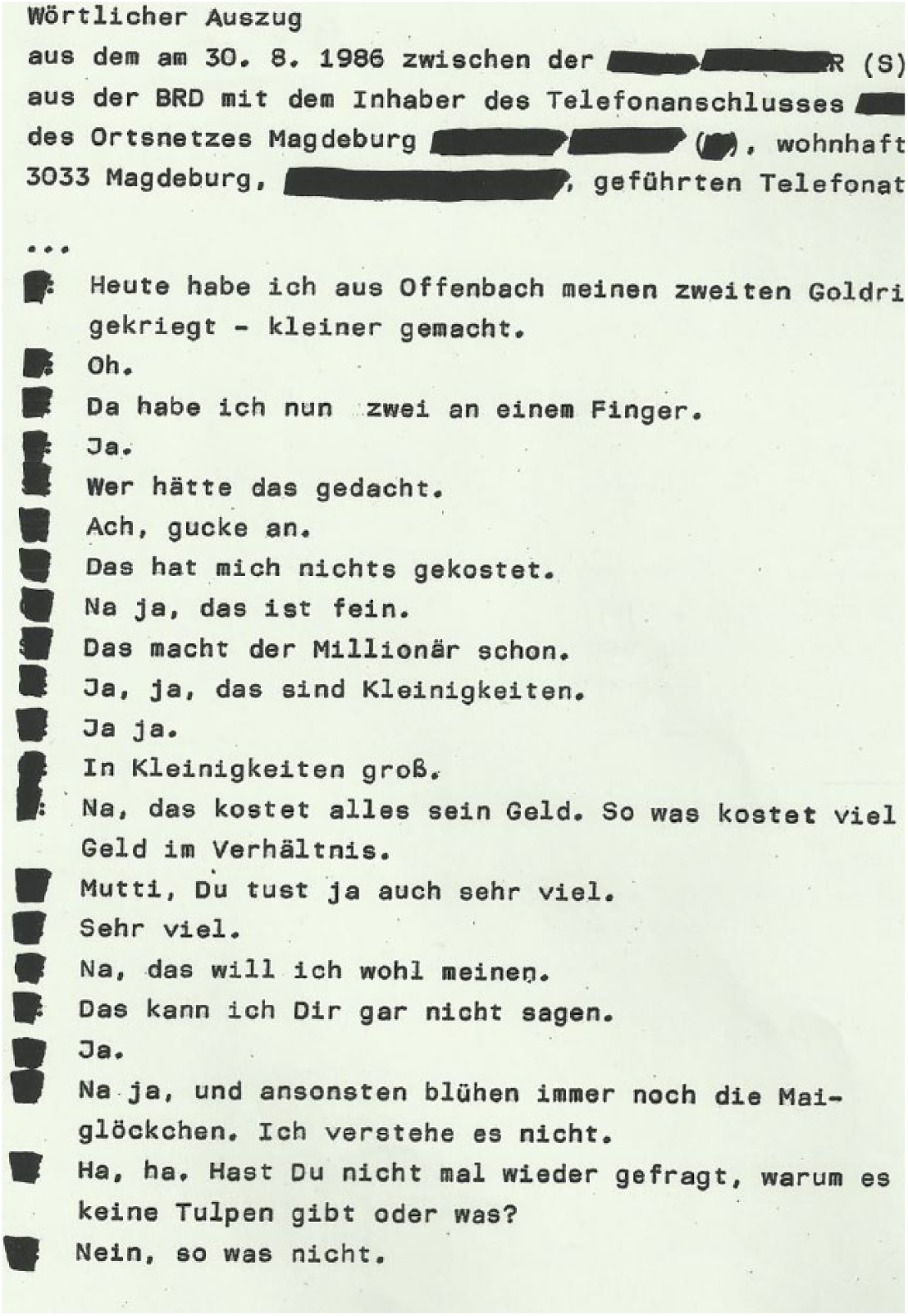
According to the Stasi report, this recording serves as evidence for planning the daughter’s illegal emigration to West Germany, because ‘the flowering of lilies of the valley’ might be a code to discuss the plan. How does the detail help Stasi to make this (unanticipated) conclusion accountable? Stasi bumps here into the following discrepancy: the participants of this phone call are talking about the flowering of lilies of the valley on 30 August but these flowers blossom in spring. In order to make this discrepancy comprehensible and accountable, Stasi officials turn the utterance into code for the preparation of some illegal activity. This interpretation provides the record with its ‘external career’. Namely, it is used in a court trial as evidence for espionage and an illegal escape. In this context the ‘word-for-word’ format fills the same functions as the previously analyzed in detail: the sorting of relevant details and ‘objectivizing’ the selection through quotation and the attribution of authorship to the participants.
Nevertheless, it is still surprising that other utterances are also documented word for word. In comparison with the previous example, this conversation is between persons who are in regular contact and in a very close relationship. One of the participants is the mother living in West Germany and the other is her daughter from the GDR. They have a good relationship, enjoying their conversation and discussing their everyday events. The mother’s second husband has recently died and she wears two rings on her finger as a reminder. One of the rings has recently been made smaller by the son of her good friend in return for her earlier help. From time to time they discuss the strangeness of the mother’s landlady, and purchases the mother makes for her daughter’s family.
Such conversations between close friends or relatives leave many things unspoken, not just because they explicitly try to hide something from an imagined eavesdropper, but because explanations and verbalizations are unnecessary. Different researchers have often underlined that observers of such interactions constantly and unavoidably deal with the problem of understanding all the content, because they have limited background information (Bergmann, 1982). Sacks (1972), Carlin (2003), Bucholtz (1999, 2009) and Vigouroux (2009) have demonstrated that such knowledge gaps can be especially dangerous and unpropitious for observed persons in the context of suspicion and negative categorization, because they give more room for misinterpretation and misrepresentation (Bucholtz, 2009).
In the context of surveillance, this high level of indexicality in everyday conversations can overwhelm the listener and it seems to be a professional problem for Stasi. The detail helps to solve this problem in two steps. (1) Being unable to reformulate indexical utterances, the listener has to be faithful to the details. The high level of detail in record production is the first practical solution for records with a high indexicality. (2) The detailed textualization is an ‘embedding practice’ (Clayman, 1990) to elucidate the whole conversational order, surrounding the key utterances about, here, the lilies of the valley. The topic of flowers comes out suddenly and without any of the presequences usually proceeding small talk. The participants themselves communicate fluently and do not express any irritation, surprise or self-correction, which would be a natural reaction to any misunderstanding or confusion surrounding a comment about lilies flowering in September. The very careful detail points to something expected but not there, and ‘enable[s] readers to see “for themselves” what happened, so that they become implicated in whatever analysis is made of the statement at hand’ (p. 98).
Detail in a mixed record
The next record-keeping mode in the Stasi files integrates some turn-taking sequences into third-person descriptions: Record 3
Translation. 1 Mrs. Y asks Mrs. X whether there is anything new. Mrs. X answers in the negative. 2 Mrs. Y: Nobody has called? 3 Mrs. X: No. 4 Mrs. Y: That’s weird. 5 Mrs. X: The lake is still quiet. 6 Mrs. Y: There were no visitors? 7 Mrs. X: I was not at my place at all. Why should I expect any visitors? 8 Mrs. Y: Oh no. You might know what I mean. 9 Mrs. X reports that she visited her grandma and granddad in Bohnsdorf. 10 Mrs. Y explains that Z will know what is going to happen with the house in Bohnsdorf. Mrs. X11 answers that she will get one of the two houses. 12 In the next part of the conversation Mrs. X points out that she was so stressed yesterday that her 13 nerves ran riot. But now they are better. Mrs. Y has calmed down as well. Mrs. X states that Q did 14 not hear about it. Mrs. Y asks if they will meet each other again next week. Mrs. X affirms this. 15 Mrs. X: S comes tomorrow. 16 Mrs. Y: Don’t forget. You know what, don’t you? 17 Mrs. X: I have no idea what you mean. 18 Mrs. Y: The last thing that you meant yesterday: ‘I hope I won’t forget it’. 19 Mrs. X: Tell me the initial letter. 20 Mrs. Y: ‘X’ and the last one is ‘F’ 21 I tell you just ‘the control’. 22 Mrs. X: Do I have to think of it tomorrow? 23 Mrs. Y: For sure. In case you go to the bird. 24 Mrs. X: It has finally hit me! I first thought of something different. But I haven’t found that 25 there. 26 Mrs. Y: Ah, have you searched everything on the— ? 27 Mrs. X: Hm. 28 Mrs. Y: Found anything? 29 Mrs. Y: Nothing. Of course I haven’t searched everywhere, but I mean, such a thing — 30 Mrs. Y: Have you managed to open the second one? 31 Mrs. X: Hm. 32 Mrs. Y: Where was the key then? 33 Mrs. X: This I do not know. My key fit well. 34 Mrs. Y: So what kind of gladdening thing was there? 35 Mrs. X: Absolutely nothing. 36 Mrs. Y: Nothing? 37 Mrs. X: Only junk. For such stuff, I would never add a thing for myself. It added more pressure 38 than anything else. 39 Mrs. Y stresses again, that control is most important, and from now on they will act in the same 40 way each time. Mrs. X is of the opinion, that the idea is not bad. (…)
In contrast to the previously analyzed record-keeping modes, this one combines different forms of textualization. Although the beginning, the middle and the end of the record are written as conclusions (01, 09–10, 39–40), more or less detailed turn-taking sequences are also included. The most detailed parts of the conversation are those in which the participants discuss something without expressing them explicitly and decode their talk in different ways. These parts are reproduced as the exact words and take the form of a dialog. The transcriber has included, with the help of the ordinary punctuation, phenomena such as questions (?), pauses (—), and tokens such as ‘hm’. These signs are used ‘to deliver additional objective information about the behavior of overheard persons’ (Koristka, 1968: 111). The use of such signs is often evidence of creating a record in a very good literary form (Karneeva et al., 1958), as if the officials wish to write a detective story.
In comparison to Record 1, this one presents a very different way of interaction: the participants here neither mention the reason behind their veiled way of talking, nor do they directly address the listener. Rather, they just practice the exclusion of the eavesdropper using codified communication, which is mainly reproduced in the record as a dialog. First, they use sayings such as ‘The lake is still quiet’, which is a common way to point something out without any explicit expression of the meaning. Second, the participants try to create a code so as to not mention things directly, as in line 19. Similar strategies of hiding the sense through encoding it in letters are common practice. If parents, for example, want to avoid letting their children know about dessert before they finish their dinner, they inform other adults by spelling it out. Another strategy of hiding information occurs in the conversation through questions (?), tokens such as ‘hm’ and pauses (—), which are inserted here instead of single words, as in line 26. These methods should be understood in this context less in the sense of ‘passive recipiency’ (Jefferson, 1984: 202) and more as a means to allow the interlocutor more time to complete the sentence without any interruptions (Bergmann, 1982).
The very detailed textualization of the unclear parts of the phone conversation seems to relieve the observer from the hard task of decoding and summarizing the discourse contents. The observer can simply document the unclear and irritating pieces of the conversation word for word, attributing the authorship to the participants and bridging the high indexicality of the utterances, as in the previously described record-keeping mode.
However, the mixed record-keeping mode seems to be trickier. These carefully documented and clearly visible ‘coded messages’ (see the German original) appear accented and visually distinguished from the rest of the text, and thereby as having somehow been sorted as the most important evidence of some illegal activities. This contrast between word-for-word textualization and reformulations from the third person fulfills two functions. (1) On the one hand, the word-for-word part highlights the codified communication, which becomes more relevant for the investigation of the case. (2) On the other hand, through the mixed mode of textualization the record visually organizes the contents in a hierarchy, in which some of the content seems to be more authentic but points to evidence for categorization. This codified communication is of operative importance, as it usually points to the fact that people know that they are being listened to by officials and have a reason to fear some punishment (Bucholtz, 2009).
Discussion: Ethnohistory of the professional constitution of deviance
The analysis of varying levels of detail in Stasi records allows us to underline two different communicative tasks which Stasi transcribers solve through preparing the transcription of wiretapped phone conversations. They first of all select the relevant information from the flow of the conversation. They then try to objectify this through the reproduction of some authentic features of the conversation. These practical solutions should be seen not as dichotomies (Suchman, 2000), but as being in a balancing relationship to each other. Selection can never be completely impartial and separated from the institutionally determined focus of the discourse textualization, but the attempt to objectify this selection seems to legitimize such categories as ‘strange’, ‘dangerous’, ‘suspicious’ and ‘guilty’. The higher the level of the detail, the more justified these categories seem to be. The balance between the subjective and objective through different levels of detail makes the phone call records the most powerful objects of knowledge in the Stasi archive. Through different levels of detail, Stasi has solved such practical tasks as selection, accentuation and hierarchy building, which accompany record production and the analysis of wiretapped phone conversations. Stasi has created from the conversations something new, which was not significant for the conversation participants themselves. As Meehan (1986) argues with the example of police officers, as competent organizational actors, they then routinely take care to shape these records in ways that will promote the evaluations of the performance that they desire. In this way, police officers orient as record keepers to the prospective uses of the documents they produce …. (p. 99)
The creation of significant meanings through institutional record-keeping should be taken seriously in regard to the use of Stasi files as historical resources about the GDR. The ethnomethodological framework is not only a ‘powerful analytical treatment for investigating the substantive production of history’ (Lynch, 2009: 89), but also a useful basis for a critical analysis of historical sources (Bogen/ Lynch,1989). In contrast to historians who try to reconstruct systematic and coherent temporal or organizational patterns, in order to represent cultural histories or to follow how such histories relate to an actual past, ethnomethodologists have an interest in how histories are assembled through concrete routines. Garfinkel’s documentary method of interpretation is a persuasive example for such a methodological approach. Rather than simply supplementing institutional records with other sources of data, or abandoning the study because the records were incomplete, it is analytically productive to pay attention to the institutional logic of their production and the organizational reasons for collecting them into files. Through such an analysis, ethnomethodology can focus on ‘the practical and interactional production, reading, and establishment of documentary details; an orientation that might be of thematic as well as practical interest to historians’ (p. 98).
This approach has two consequences for historical research. (1) History can overcome the consideration of historical documents simply as sources of knowledge and as a body of propositions existing prior to members of some (professional) community. Instead, it can deal with knowledge as being produced and reproduced through specific practices of everyday professional activities. (2) ‘Knowledge’ is never separated from ‘routine’. Instead, knowledge as practical reasoning and routine ways of ordering familiar materials and activities are co-present and rely upon each other in every form of human action.
Footnotes
Acknowledgements
The author expresses many thanks to Jörg Bergmann and Geoffrey Raymond for the support of this project with important input and suggestions.
Declaration of conflicting interests
The author(s) declared no potential conflicts of interest with respect to the research, authorship, and/or publication of this article.
Funding
The author(s) received no financial support for the research, authorship, and/or publication of this article.