




Abstract
This paper aims to cast light on contemporary migration rhetoric by integrating historical discourse analysis. I focus on continuity and change in conventionalised metaphorical framings of emigration and immigration in the UK-based Times newspaper from 1800 to 2018. The findings show that some metaphors persist throughout the 200-year time period (
Keywords
Introduction
In this paper, I take a historical perspective to investigating the conceptual metaphors which have been used to frame migration. While there has been extensive analysis of migration discourses in a contemporary time frame, we have relatively little understanding of how longstanding these discourse frames are, how they have developed over time, or what alternative framings might have been lost through time. This is where the kind of long-distance diachronic study made possible by combining corpus linguistics and (critical) discourse analysis can make a vital contribution to understanding contemporary language use. Drawing on a corpus covering a 200-year period, it is possible to track when metaphors become conventionalised and how they have developed. These findings can provide a background to contemporary research and enable insight regarding the extent to which our metaphoric framings are inherited and identification of what is absent from current public discourses of migration. I want to argue that taking a long-distance diachronic approach is not a niche interest but a way to understand the underpinnings of contemporary discourse (see, e.g. Musolff, 2010, 2014 on the
Furthermore, a major affordance of a long-distance view for discourse analysis is the ability to denaturalise the discourse in question and to approach it as a construct. As discourse analysts, when we examine contemporary discourses we are inevitably part of our own object of study and our readers are likely to be in the same position. Thus, it can be difficult to identify and communicate the ways in which discourse represent choices and that, as Fowler (1991: 4) so precisely put it: ‘there are always different ways of saying the same thing, and they are not accidental alternatives. Differences in expression carry ideological distinction (and thus differences in representation)’. When we incorporate historical analyses into a diachronic study, or when we shift entirely to a historical period, we are no longer fully proficient speakers of our texts and this distance can bring insights. We can uncover the ways in which our discourses have been shaped – as when Wilkinson (2019) traces the development of erasure in representation of bisexuality in the Times. We can empirically test claims about modern-day discourse, as in Taylor (2020) who reveals the nostalgic nature of government rhetoric about the UK’s history of welcoming migrants.
Analysing metaphor gives us a practical and theoretical means for operationalising these long-distance goals. In practical terms, metaphor analysis provides a response to the challenge of comparing texts published over 200 years apart which will vary considerably due to the nature of language change. In this context, the identification of comparable units becomes especially salient and we need to abstract out from a purely lexical level (see also Taylor and Del Fante, 2020 on this from a cross-linguistic perspective). For instance, by operating at a macro level, we can trace continuity in a
Metaphors of migration
The large number of metaphors in which migrants are the target discussed in previous research nearly always refer to immigration rather than emigration and so they also often interrelate with conceptual framings of the country which the ‘outgroup’ are living in or moving to. For instance,
As Arcimaviciene and Baglama (2018) also point out, these metaphors may function to enhance or suppress emotions, such as fear and empathy respectively. Indeed, a key point which is emphasised in this substantial body of work is that metaphor is an integral part of the discourse. Baider and Kopytowska (2017: 225) conclude that ‘metaphors can perform important social functions: they can be used to dehumanize the Other (in this case refugees and migrants), legitimize and delegitimize verbal and physical actions (e.g. verbal and physical violence against refugees, including hate speech and hate crime), as well as emotionalize (evoke both fear and anger) and desensitize the audience’.
As will have become clear, the vast majority of these studies find metaphor is used to negatively frame migrants. In part, this is likely to be that the focus of most research on migrants has actually been more restrictively concerned with immigrants and is often driven by the need to respond to societal challenges, such as discrimination or xenophobia. An important exception to the negative framing is Catalano’s (2016) work on self-representation by migrants which showed major discrepancies between migrant and media representations with migrants most likely to frame the process of immigration as either a
However, when making these classifications about positive or negative representation, we should be very clear about the difference between what is positive for the speaker and what is positive for the person being described. The intent of the speaker using ‘floods of’ to evoke news values (Bednarek and Caple, 2017) of urgency and superlativeness, does not mean that the problems for the individual subsumed in that metaphor are eliminated. They are still de-individualised, their agency is minimised, and for many, it simply does not reflect their experience of movement to a destination country. The same kind of argument can be made about metaphors which favourably construct migrants as an economic resource and may mask exploitation and erase other kinds of positive contribution made to society. An additional point here is that the speaker’s evaluative intent may not correspond to the reception of the metaphor either because different readers of media texts will have been primed by their previous textual exposures (as, for instance, in ‘dog-whistle’ journalism and politics).
We also need to exert caution in assuming that each speaker using a metaphor has the same intent, or indeed any conscious intent. The point about metaphor, like discourse, is that it is cumulative and pervasive. For a lexical item to have a particular connotation or discourse prosody, it is not the case that every utterance must conform to that evaluative positioning. Nor will all speakers be using language with the same degree of awareness and deliberateness at all times. Drawing on a discourse which surrounds us, especially if naturalised in the society which we inhabit, cannot be simplistically equated with a conscious averral of the ideology which the discourse reflects and construes. If that were the case, we could never, as linguists and discourse analysts, achieve impact in society by raising awareness of the discourse histories and connotations of language we use. This tension around intention may help account for resistance to critiques of language – drawing on their personal experience, individuals may recall times when they have used an expression without conscious intent, or may recall a single counter-example, which means that they reject the thesis about implications at a discoursal level – and this is where empirical work may be able to influence receptive audiences. These challenging concepts of intent and deliberateness have, of course, received ample attention within metaphor studies as well as discourse studies more generally. Notably, Steen (2008) distinguishes deliberate and non-deliberate metaphors from the perspective of the addressee so that deliberate use implies a change of ‘the addressee’s perspective on the referent or topic that is the target of the metaphor, by making the addressee look at it from a different conceptual domain or space’ while non-deliberate metaphors ‘do not draw addressees’ conscious attention to other conceptual domains’ (Steen, 2008: 226). Much of what is covered in this paper is non-deliberate in this sense, because it examines conventionalised expressions. While novel and deliberate use is striking, it is also less insidious because it is more likely to be noted than the banal, conventionalised metaphor.
Methodology
The methodological framework used here combines corpus linguistics and (critical) discourse studies (e.g. Baker, 2006; Mautner, 2016; Partington et al., 2013) and follows McEnery and Baker (2017a, 2017b) in the application of this combination to historical corpora.
The main corpus used in this study was the Times Online. This corpus was created at Lancaster University, using the OCR (optical character recognition) files made available by the British Library. The corpus covers the period 1785–2011 and the current size is c. 10.5 billion words. It was analysed through Lancaster’s CQPWeb interface (Hardie, 2012). The scanned articles are also available to view as images through the Times Digital Archive to enable reading within a wider context. It was supplemented by a search-term corpus covering the period 2012–2018 which was compiled from the Times archive on the Nexis database (c.19 million words). The former was analysed using CQPWeb (Hardie, 2012) and the latter using AntConc (Anthony, 2019).
In any metaphor study, the principle challenges are identification and retrieval of metaphor. The Pragglejaz Group (2007) set out a systematic and replicable process of Metaphor Identification Procedure in which an expression may be classified as a metaphor when ‘(a) its “contextual meaning” contrasts with a “basic meaning” that is more physical and concrete (although not necessarily more frequent), and (b) where the contextual meaning can be understood via comparison with the basic meaning’ (Semino et al., 2018: 5). Regarding retrieval, as I was interested in everyday public discourses of migration, I chose to look for metaphor candidates in collocates. Collocates are understood here as items which have a strong connection with a node (for instance immigrant and wave) where strength is a statistically salient value. By identifying lexical items which occur as collocates, we can assume that there is a degree of conventionalisation indicating that the metaphor was indeed part of the discourse. The process followed was the following:
(a) Collocates were calculated for node items (aliens, asylum seekers, boat people, colonists, emigres, emigrants, evacuees, exiles, expats, expatriates, immigrants, migrants, refugees, settlers) in each decade of the corpus using the statistical measure loglikelihood and a five-word left/right span. The choice of node items was intentionally broad to ensure that I was not replicating the highly problematic socio-political trend of only considering immigration to be salient to discussion of migration. They are all terms that foreground the migrant status of the people (rather than national, ethnic or religious labels, for instance) and this is to increase confidence that all metaphors identified are metaphors of migration.
(b) The collocates were searched for metaphor candidates. This was a triangulated and iterative process which involved both scanning the collocate lists and searching them for possible candidates identified by compiling lists from previous research, using contemporary and historical thesauruses, and reading sample concordance lines.
(c) Sample concordance lines for each metaphor candidate for each time period were then read and checked for metaphor use and coded according to the lexicalisation of the metaphor and evaluation of speaker.
(d) The final stage addressed the problem of interpretation raised by the analysis of culturally distant texts. Once a metaphor had been identified, the collocate (e.g. wave) was moved to node position and I searched, per decade, for its collocates. In this way, the corpus provides a means of re-contextualising the lexical items by showing the company it kept (Firth, 1957) at different points in time.
Findings
Overview of patterns
In determining whether a metaphor was conventionalised, I determined that there should be at least two lexicalisations (e.g. wave and flood) per metaphor category per decade because different lexicalisations could signal a degree of metaphorical ‘animacy’ and exclude a metaphorical expression which had reached the end of its ‘life cycle’ (Croft and Cruse, 2004) and was now bleached or fossilised. The criteria of two different lexicalisations is perhaps low but this is offset by the fact that each lexicalisation must be sufficiently conventionalised to appear as a collocate. Figure 1 visually displays for which decades the metaphors were conventionalised according to this operationalisation. From this, we can see which metaphors have been consistent (
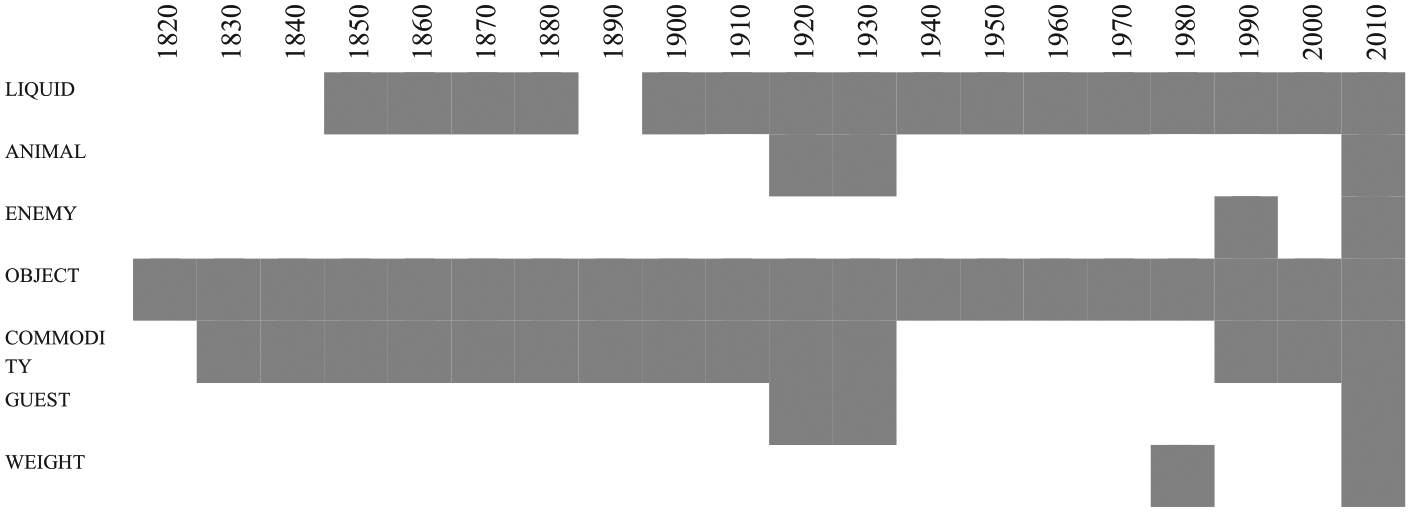
Distribution of conventionalised metaphors.
Figure 2 illustrates the number of lexicalisations for each decade which can tell us about the ‘liveness’ or ‘productivity’ of the metaphor (not relative frequency).
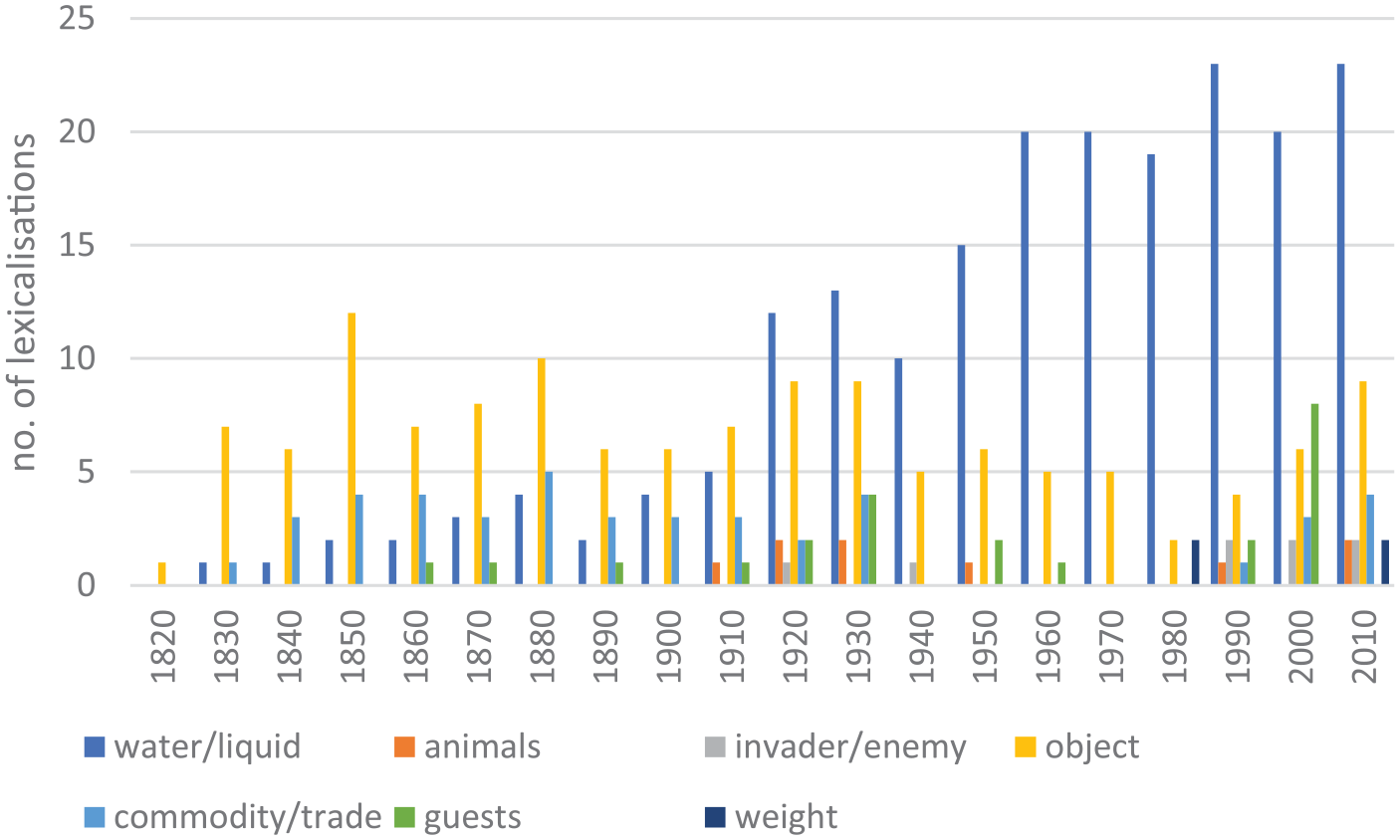
Variation in lexicalisation of metaphors over time.
The findings displayed in Figures 1 and 2 are discussed in the following sub-sections.
Liquid/water
The
In the Times data investigated here, the
However, we cannot assume that continuity in the presence of the metaphor indicates continuity in framing or evaluation and nor can we rely on contemporary associations between metaphor and persuasive function to interpret historical data. In order to explore the framings that would be triggered by the metaphor, I took six of the most frequent lexicalisations and used the corpus to re-contextualise their usage by examining what collocated with each term in each decade. The findings are summarised in Table 1 (see Taylor, forthcoming for more detail).
Semantic associations for lexicalisations of

Table 1 indicates that the words used to describe people in terms of {liquid}, were also often associated with the semantic field of {money} suggesting a relationship between the two framings. An exception here is wave which is a newer lexicalisation of the
If we consider the evaluations which accompany these frames, we can anticipate that those clustering around wave are more likely to be negative from the speaker’s perspective than those which might also co-occur with money which may be evaluated more variedly, as illustrated in examples (1) and (2) from the Times 1850s. In (1), the speaker uses the
(1) If the victorious party should follow up vigorously its successes and press the vanquished, these islands may be inundated with refugees to an (2) It was
The evaluation expressed by the speaker was coded in three decades in which there was a peak of discussion of migration. As Figure 3 shows, the evaluation changed over the three time periods with the earliest time period showing the greatest number of favourable evaluations and the most recent time period showing the lowest number of favourable evaluations.
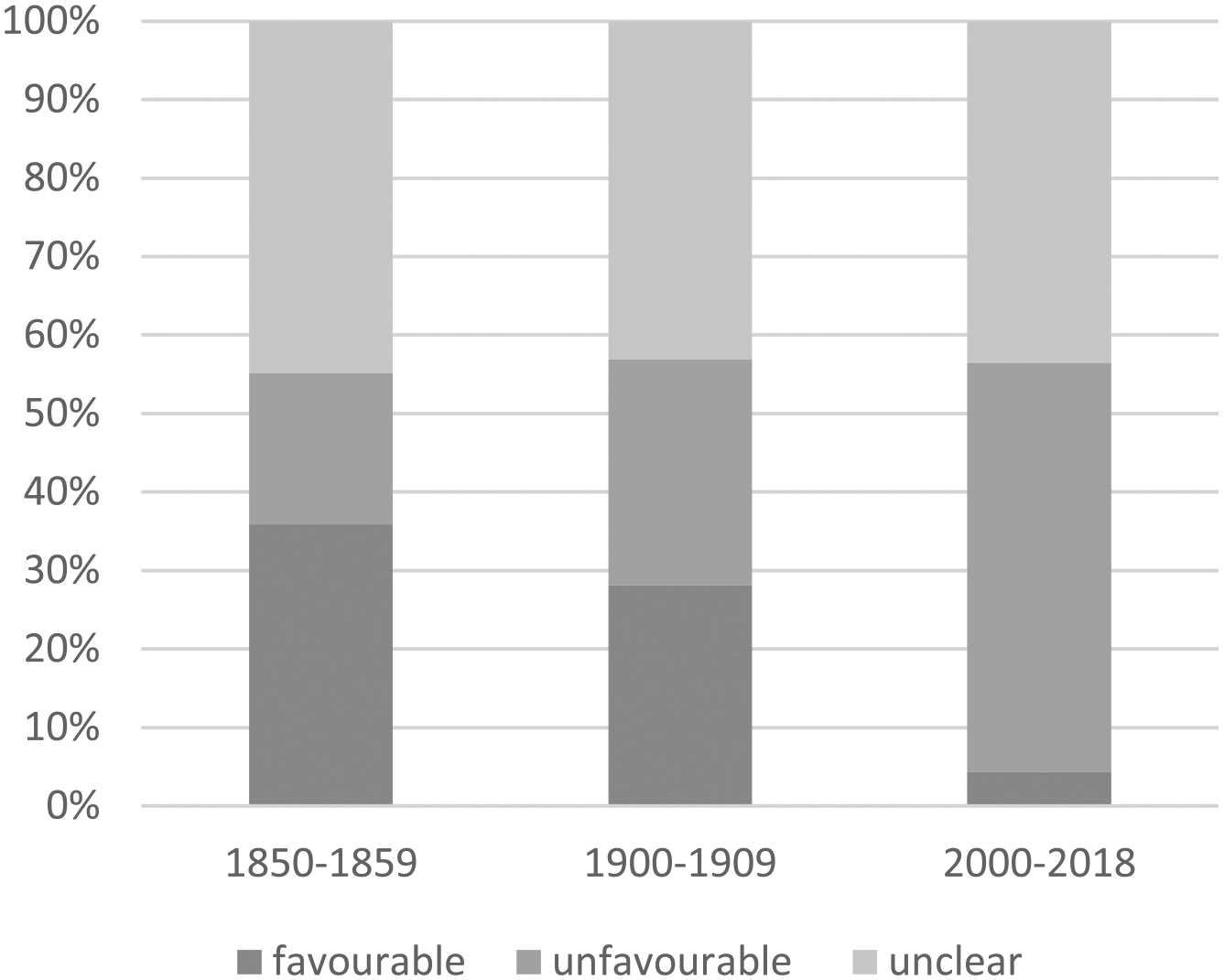
Summary of evaluation in concordance lines of
What this shows is that we cannot retrospectively assign interpretation to metaphors based on current framings because
Object/commodity
The dominant metaphor in terms of continuity is
The
The explicit
(3) For agricultural labour, however, and for single female immigrants the demand, they say, is practically (4) The warning about Albanian
In these framings, there is a dehumanisation of the people involved and the resonance with enslavement is evident, as in (5).
(5) with the avowed purpose of loading, on account of a notorious
Indeed, we can hypothesise that the language used to describe forced movement of enslaved people is part of early discourses of migration. If we examine the collocates of slaves in the first decade of the nineteenth century, the top ten lexical collocates are: Negro, importation, number, Colonies, treatment, Indian, board, cargo, Africa, Cattle. Dehumanisation is evident in both the commodity frame and association with animals, and the reference to colonies illustrates the centrality of slavery to empire building. However, as seen in (3) and (6), it should be clear that these
(6) The Earl of DONOUGHMORE pointed out that a valuable supply of emigrants might be selected from the Irish unions, where there were numbers of young lads, orphans, for whom the guardians had taken care to promote certain knowledge of agricultural occupations; over such emigrants the colonists might have control (Times 1852).
Animals
The
In the Times data analysed here, the animal metaphors were found in conventionalised form in the 1920 (swarms, flocking), 1930 (flocked, flocking) and 2010 (flocked, swarm) subcorpora. Thus, it was a minor pattern in this data which is quite limited in lexicalisation. However, that is not to underestimate the emotional impact for both readers and those described in these terms or the potential for these uses to resonate with readers who are exposed to these metaphors in more varied forms elsewhere. The evaluation which accompanies these metaphors is largely negative, as shown in (7) where the last sentence underlines the consequences. It also accompanied a sympathetic stance, as in (8) in which the speaker underlines their plight (sick and shoeless) and critiques the treatment of migrants as animals – ironically, while framing them as such (herd).
(7) THE BRITISH AT SHANGHAI The Municipal Council here is virtually a government, responsible for peace and order in an area which is solely under foreign control, but which includes 1,000,000 Chinese, an exceptionally large criminal element, and which swarms with political refugees. This necessitates the maintenance of a highly-organized police force (Times 1920). (8) After riding in one of the lorries with the refugees – many of them sick and shoeless after being herded from the mountainside border camp at Isikveren – Mr Howell said: “Everywhere that you look these people are being treated like animals (Times 1991).
Strikingly, the
Enemy
The
Hordes also occurs as a collocate in 1920 and 1940. This lexical item is so highly conventionalised it is somewhat debatable as a metaphor candidate and the contemporary usage is often light-hearted (e.g. the ten most significant collocates of 2010s include tourists, passengers, fans). However, if we look at the collocates at the time this becomes associated with migrant-names, the subjects are far more threatening (e.g. in the 1910s: German, barbarians, Kaiser, invading, Germanic, savages and in the 1920s: starving, savage, troops, soldiers, armed, German) so there is a clear priming for the
Guests
The
Collocates pointing to this metaphor first occur in 1860 and 1870 (invited) then 1890 and 1910 (welcome). There are two collocates (a potential sign of conventionalisation) from 1920 (welcome, invited), 1930 (guest, reception, welcome, invited), 1950 (welcome, invited) and then a break to 2000 (welcome, invited) and renewed activity with richer lexicalisation in the 2010s (host, hosting, overstay, reception, welcome, welcomed, welcoming, invited). In the earlier period it collocates with settler, while in the later period it collocates with migrants and asylum seekers. The data from the earlier periods shows that for those doing the welcoming, the migrants are favourably evaluated. However, as seen in (9) it may not be so for the people themselves, a familiar pattern by now, and the welcome is often explicitly tied to economic worth, as in example (10) reflecting a theme activated in the
(9) They kept from him information which they bad, which showed that the golden prospects were nothing, but a sham and a fraud, and that settlers were being invited out to a place where the prospects were nothing or worse than nothing (1930). (10) David Blunkett is adamant that we need working migrants and must welcome them to boost the economy (2004).
In terms of more recent patterns, example (11) illustrates a broadening of the metaphor to
(11) [the Prime Minister] also refused further demands to streamline the British visa system unless he agreed that India should do more to take back more migrants who overstay their welcome in the UK (Times 2016).
An additional pattern in the contemporary data is the use of the
Concordance lines of welcom* and history/tradition in discussion of migration.

Note: Welcom* indicates the search included welcome/welcomed/welcomes/welcoming.
Weight
The
Other recurring frames
There were two recurring semantic patterns which were not captured or accounted for through this level of metaphor analysis. The first is a semantic preference relating to lack of volition in migrants (also discussed in Taylor, 2014) which was evident in collocates of migrant-names from the mid-nineteenth century onwards, as illustrated in (12) and (13).
(12) Cherbourg is thought to be a magnet not only for illegal immigrants but also criminal gangs trafficking people into Britain who will be forced into prostitution and slave labour (Times 2007). (13) The authorities identified 12 nationalities among the dead, several of them legal or illegal immigrants from Latin America drawn by the booming economy (Times 2005).
This pattern was lexicalised through items such as attract, drawn, magnet, and pull which point to the use of
The second pattern is a strong semantic preference for quantification (e.g. number, proportion, amount) which has been noted as a feature of migration discourse previously (e.g. Baker, 2006; Van Dijk, 1988). This pattern, which was consistently conventionalised from 1830 onwards, almost certainly plays into the
Conclusions
The long-distance view of the metaphors showed that migration metaphors are historically rooted and conventionalised. Some of these are found to be very long-standing (
The evidence from this investigation provides support for a theory of contemporary migration metaphor based on inherited frames. There is continuity visible in the metaphor use (especially
The implications of this are varied. In terms of metaphor study, the patterns observed here did not fit the ‘life-cycle’ models of metaphor (e.g. Croft and Cruse, 2004) in which we might expect a progressive narrowing of lexicalisation and fading of metaphoricity (see also Musolff, 2010 for further challenge to this). In terms of migration discourse, the study shows how historical data can help us understand contemporary metaphor use. What we can reveal is that patterns of language used in the current day are not a basic ‘common-sense’ response to specific features of the group being described. Further research may also cast light on the extent to which the shifting evaluations and discourse frames associated with the same metaphor (e.g.
Footnotes
Acknowledgements
I would like to acknowledge the help and generosity of the Centre for Corpus Approaches to Social Sciences (CASS) at Lancaster University for allowing me access to the Times Online Corpus through the CQPWeb interface. I would also like to thank Dario del Fante for his help in compiling the contemporary Times corpus while working as a research assistant at University of Sussex and Jonathan Charteris-Black for wonderfully helpful comments on an earlier version of this paper.
Declaration of conflicting interests
The author(s) declared no potential conflicts of interest with respect to the research, authorship, and/or publication of this article.
Funding
The author(s) received no financial support for the research, authorship, and/or publication of this article.