




Abstract
This paper investigates digital discursive practices of hostility against women in UK politics through quantitative and qualitative analysis of a corpus of Twitter data retrieved across the 3 weeks preceding the UK General Elections in December 2019. A mixed-methods approach was designed. First, we used quantitative semantic analysis to compare the large datasets of tweets about female and male MPs, with a view to detecting possible gendered patterns. We then triangulated our quantitative findings with an in-depth critical discursive analysis of the tweets mentioning female MPs. Rather than showing gendered patterns across the board, the results from the quantitative analysis brought out large inter-individual differences. Some female MPs received comments containing more lexis related to appearance, sexual history and violence, as well as more emotional or extreme language. Critical analysis of the hostile and abusive messages targeting women reveals them to be deeply embedded in a social perception of women’s political activity as breaching the rules of gender performativity.
Keywords
Introduction
The political history of women in the UK is somewhat paradoxical. On the one hand, the country was a pioneer in advancing women’s rights, and is known for landmarks such as Mary Wollstonecraft’s seminal ‘A Vindication of the Rights of Woman’ (1792) or the establishment of the Women’s Social and Political Union (WSPU) in 1903, more commonly known as the ‘Suffragettes’. On the other hand, progress has been painfully slow, and 100 years after the election of Viscountess Astor as the first woman MP in 1919, women represented just one third of the Westminster Parliament (32%) in 2019 (House of Commons Library, 2020).
Not only do British MPs remain overwhelmingly male, but women still elbow for political representation while being faced with a culture of intimidation and abuse. Prior to the December 2019 general election, in fact, a large number of UK women MPs announced that they were going to step down because of the sheer amount of (verbal, physical or other) abuse they had received (Oppenheim, 2019). Although some extreme cases of violence and hate directed at female MPs have drawn public attention (Gorrell et al., 2020), such as the homicide of MP Jo Cox during the 2016 Brexit campaign, little is known about the everyday practices that reproduce and perpetuate sexism and gender-based discrimination in British political life.
Against this backdrop, the new affordances of digital and social media play a central role as established sites for the (re-)formation and consumption of information, values and worldviews. With ordinary users being empowered to the level of ‘prosumers’ (Ritzer and Jurgenson, 2010) in the context of ‘democratised’ and loosely censored digital environments (Yus, 2019), digital and social media platforms provide unlimited opportunities, both for citizens to air their vitriolic opinions and prejudices in public, and for social scientists to engage in the critical investigation of such bottom-up discourse formations and practices (KhosraviNik and Esposito, 2018).
In this paper, we investigate digital discursive practices of hostility against women in UK politics by collecting and analysing a corpus of Twitter data retrieved across the 3 weeks preceding the UK General Elections in December 2019. The corpus includes tweets mentioning male and female politicians of different ethnicities and from both the Labour and Conservative Parties. We hypothesised: (1) that there would be quantitative differences between the frequency of specific semantic fields in the datasets of tweets mentioning male and female MPs; and (2) that further analysis of the tweets about women would bring to light specific gendered categories of online hostility.
An innovative mixed-methods approach was designed to handle the large datasets obtained. We aimed to assess the potential of automated semantic analysis to detect gendered patterns, and to triangulate any quantitative findings with qualitative, in-depth discursive analysis. To this end, we first analysed the datasets of tweets about male and female MPs, using Wmatrix4 for lexical processing and semantic tagging, in order to identify patterns (Breeze, 2020; Rayson, 2008). The first stage of our study was thus essentially comparative. After the quantitative analysis we then engaged in purposeful sampling (Patton, 2002) specifically of the tweets mentioning women, explored discursive strategies of violence, harassment and abuse, and problematised them from a critical and intersectional perspective (KhosraviNik, 2017; KhosraviNik and Esposito, 2018). Although a similar in-depth study of the tweets mentioning men would doubtless also be revealing, this falls beyond the scope of the present study.
Gender and politics in a digitalised world
Digital technologies have given rise to a host of new ways for people to communicate, manage social relationships and get things done. We are witnessing myriad interdependent, contextualised digital communities evolving in a scenario of ‘constant connectivity’ (Keipi et al., 2017), which challenge how we perceive aspects of our identity and life-worlds and most importantly, which have been contributing to a growing digital materialisation of public spaces.
Although the cybersphere has been enthusiastically celebrated as offering new affordances for self-expression and social interaction, it is increasingly acknowledged that it also tends to reproduce the very same structural inequalities that condition social life in the ‘offline’ world (KhosraviNik and Esposito, 2018). With a multifaceted digital divide emerging along the lines of previously existing social divides and exacerbating them, one of the enduring technological inequalities most relevant to our study is the gender divide (Dixon et al., 2014). Across digital affordances, in fact, women are twice as likely as men to be subjected to sexist abuse online, and are more likely to perceive online abuse as a serious problem in their lives (Pew Research Center, 2017). Mediated visibility, especially for women with a public life like athletes, journalists or politicians, amounts to a ‘double-edged sword’ by providing once-restricted information and imagery to the masses while also subjecting public figures to intensified scrutiny (Thompson, 2005: 41).
For example, statistics show that digital forms of violence, hate and abuse target women in politics disproportionately in comparison to their male counterparts (Atalanta, 2018). Women in politics are regularly subjected to a range of different types of violence and harassment, ranging from actual physical violence to semiotic harassment through dissemination of degrading images and sexist language. Although it is undeniable that male politicians are also often attacked or insulted, data disaggregation allows us to perceive the phenomenon as profoundly gender differentiated (Bardall, 2018), and there is compelling evidence to suggest that a serious bias against women’s active participation in political affairs still exists in many countries with ostensibly high levels of gender equality (Krook, 2020; Krook and Mackay, 2010).
This broad pattern also applies to the direct context of UK politics. While abuse of all kinds seems to have increased in step with a general polarisation of the political atmosphere since before the Brexit referendum, a significant proportion of the abuse received by politicians in this period was related to gender, ethnicity and other identity factors (Gorrell et al., 2019). In the run-up to the 2019 election, for example, social media researchers found that women politicians in the UK were more likely to be the targets of sexist abuse than their male counterparts, an effect that was particularly intense in the case of women with ethnic minority backgrounds (Gorrell et al., 2019).
Social and psychological analyses have suggested that this phenomenon can be understood as a backlash against agentive women, related to deeply embedded conceptual structures that bolster pre-existing stereotypes and reward perpetrators psychologically by increasing their self-esteem (Rudman and Fairchild, 2004). In line with this interpretation, Rheault et al. (2019) tracked how abuse against women in politics increased in proportion to their visibility, a trend that they explained in terms of the violation of received gender norms. Since women’s active participation in the public sphere entails a non-compliance with the social norms of gender ideology (Butler, 2009), violence can be interpreted as an attempt to restore the status quo as well as an effective measure to punish the ‘trespassers’ (see also Esposito, 2021).
This paper contributes to the current debate by offering a multi-methods semantic and discursive perspective on ‘semiotic violence’ in the cybersphere, an umbrella-term recently introduced by Krook (2020) to refer to the forms of gender-based violence which mobilise semiotic resources to injure, discipline and subjugate women. As part of a broader continuum with other forms of (physical, sexual, psychological and economic) violence, the proliferation of semiotic violence contributes to the delegitimisation of women’s political actions and their ultimate exclusion from the political arena. Since this is one of the most widespread and trivialised forms of violence against women in politics, it should be critically investigated as fostering a broader and transversal reinforcement of gender stereotypes and gendered social roles which affect women as a whole.
Research design
Ten politicians were selected for inclusion in the study: three women from each of the main parties, Labour and Conservative, and two men from each party for the purposes of quantitative comparison. The sample was designed to include politicians of different ethnicities from both parties (see Table 1). The MPs were chosen on the grounds that they were not party leaders, but were prominent during the pre-election period, with positions as ministers or as members of the opposition front bench, and received a large amount of attention in Twitter. Various Cabinet reshuffles after the election mean that several of these figures only briefly occupied prominent positions.
Number of tweets and tokens obtained for each MP included in the study.
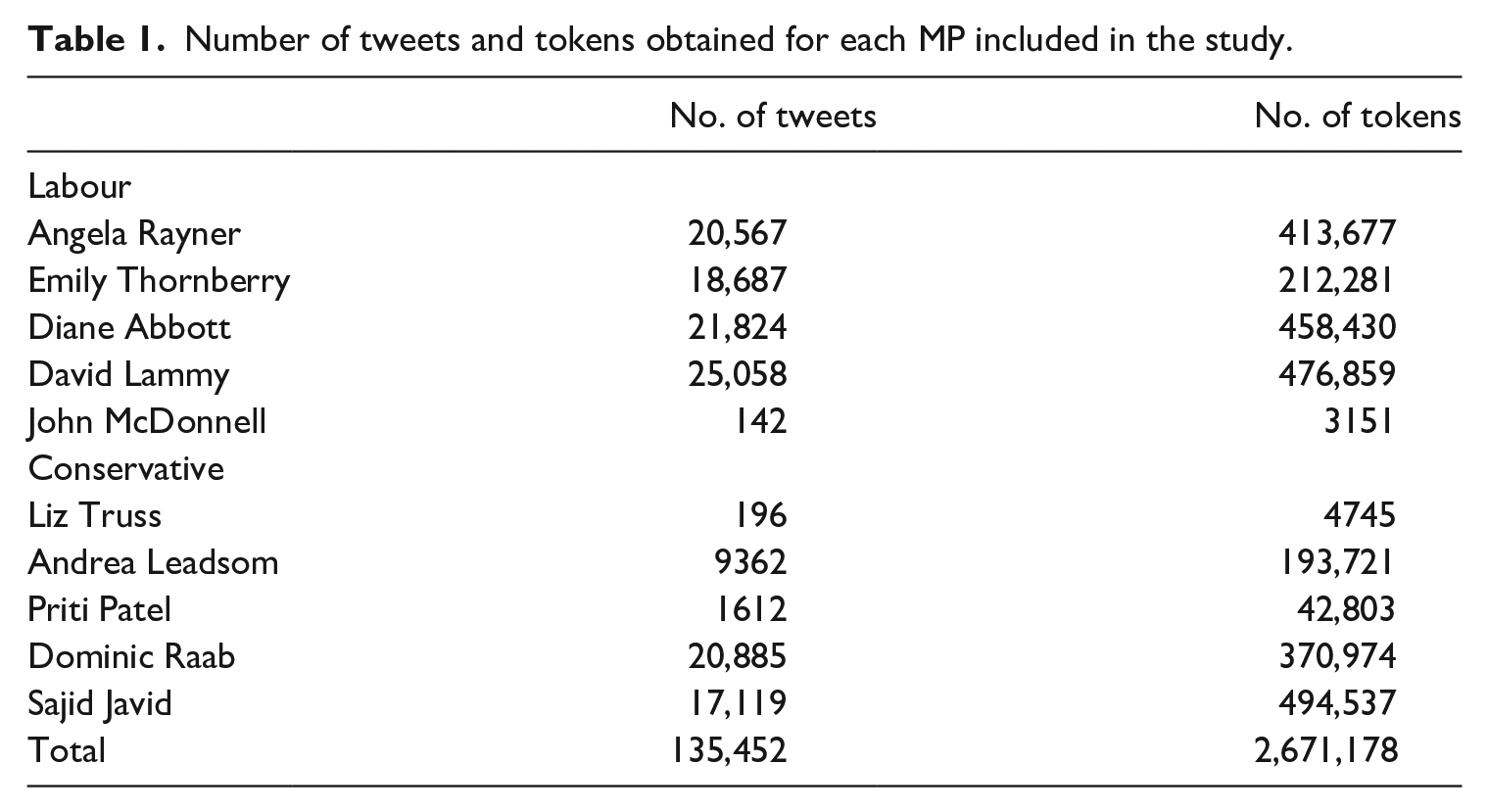
Tweets in which these politicians were mentioned by name were collected using searchTwitter function in the TwitterR package in R, and cleaned to avoid duplication. The tweets were then saved as text files and uploaded to Wmatrix4 for lexical and semantic processing. Our dataset contains all Twitter data including mentions of the front-bench politicians listed above, retrieved from 20 November to 11 December 2019, that is, immediately before the General Election of 12 December 2019. This comprised a total of 2,671,178 words/135,452 tweets. The number of tweets and tokens harvested for each MP is shown in Table 1.
For the automated analysis, the datasets were uploaded to Wmatrix4 (Rayson, 2008). Wmatrix4 annotates all the words in the corpus using the USAS tagger, which was originally loosely based on McArthur’s Longman Lexicon of Contemporary English (McArthur, 1981). This means that all identifiable words in the text are classified within a multi-tier structure with 21 major semantic fields subdivided into subcategories to obtain a more fine-grained classification. For example, field ‘E’, covering words related to the emotions, has 22 subdivisions indicating the type, valence (positive or negative) and intensity of the emotion in question. The advantage of using a dictionary-based semantic tagger rather than an automatic sentiment analysis tool (such as Syuzhet) or a machine learning approach is that the results are fully transparent (i.e. concordances for each tag can easily be obtained and analysed qualitatively). However, further processing, such as detection of grammatical negatives, has to be conducted manually (see also Breeze, 2020).
After numerous trials involving scrutiny of the tags associated with a number of areas of possible relevance to our research questions, we identified as potentially relevant the semantic fields related to Emotion and Intensity, on the one hand, and subcategories related to Intelligence, Clothes, Anatomy and Sexual relations, on the other. Within these, we conducted a large number of searches, focussing on subcategories of each semantic field and specific lexical items occurring there. The presence of subcategories and items was quantified, and concordances that were consensually deemed to be relevant were obtained for further qualitative analysis.
In what follows, we first present an overview of the relevant themes in our quantitative data (Section 4.1) comparing women and men to identify any potentially gendered patterns that might emerge, with a specific focus on:
(a) The semantic area of Emotions in general, and markers of anger/violence in particular, as an indication of the type of affect found in each corpus. More specifically, we focussed on the area of Intensity, centring on the use of what Wmatrix4 terms ‘maximisers’ (all, absolutely, most), ‘boosters’ (more, very, so) and ‘exclusivisers/particularisers’ (just, only, especially) as an index of the tone and intensity of the discourse adopted when tweeting about the politicians concerned;
(b) The general semantic areas of Intelligence and Appearance, and within these, the specific subcategories of Clothes, Anatomy and Sexual relations, which appeared to shed special light on gendered representations.
Following this, we focus on a qualitative analysis of purposefully sampled (Patton, 2002) tweets directed at the women MPs in the corpus (Section 4.2), showing how the above phenomena mesh with previously identified patterns of digital misogyny (Esposito and Zollo, 2021). For its qualitative analysis, this work draws on recent contributions within the domain of Social Media Critical Discourse Studies (SM-CDS), an emerging theoretical and methodological framework combining tenets from Critical Discourse Studies with scholarship in Digital Media and Technology (KhosraviNik and Esposito, 2018). The critical discursive analysis of the user-generated comments was aimed at identifying specific topics of digital misogyny, their related discursive strategies and their means of realisation. While the examples are by no means a complete taxonomy of the numerous strategies found, they map the most relevant and recurring ones.
The qualitative analysis is further complemented by a brief in-depth focus on two cases of event-specific misogynist discourse (Section 4.3), involving the two women associated with the highest proportion of emotion-related lexis (namely Diane Abbott and Angela Rayner) to illustrate the way in which specific facts and rumours about women MPs’ private lives are often capitalised upon in instances of misogynous violence.
Results
Quantitative differences in semantic content
Presence of emotion
Although we hypothesised that the amount of emotional lexis might differ in the tweets about male and female politicians, in fact the differences were not large. Overall, the women seemed to prompt slightly more emotion-related content than the men, but these differences did not attain statistical significance using Student’s t-test. However, the differences between individual men and women were much greater than the average difference between men and women (overall mean: 0.95%, range 0.53–1.29, mean/men 1, mean/women 1.09, range 0.84–1.29) (see Figure 1). The MPs with the highest scores on emotion-related content were Diane Abbott and Angela Rayner.
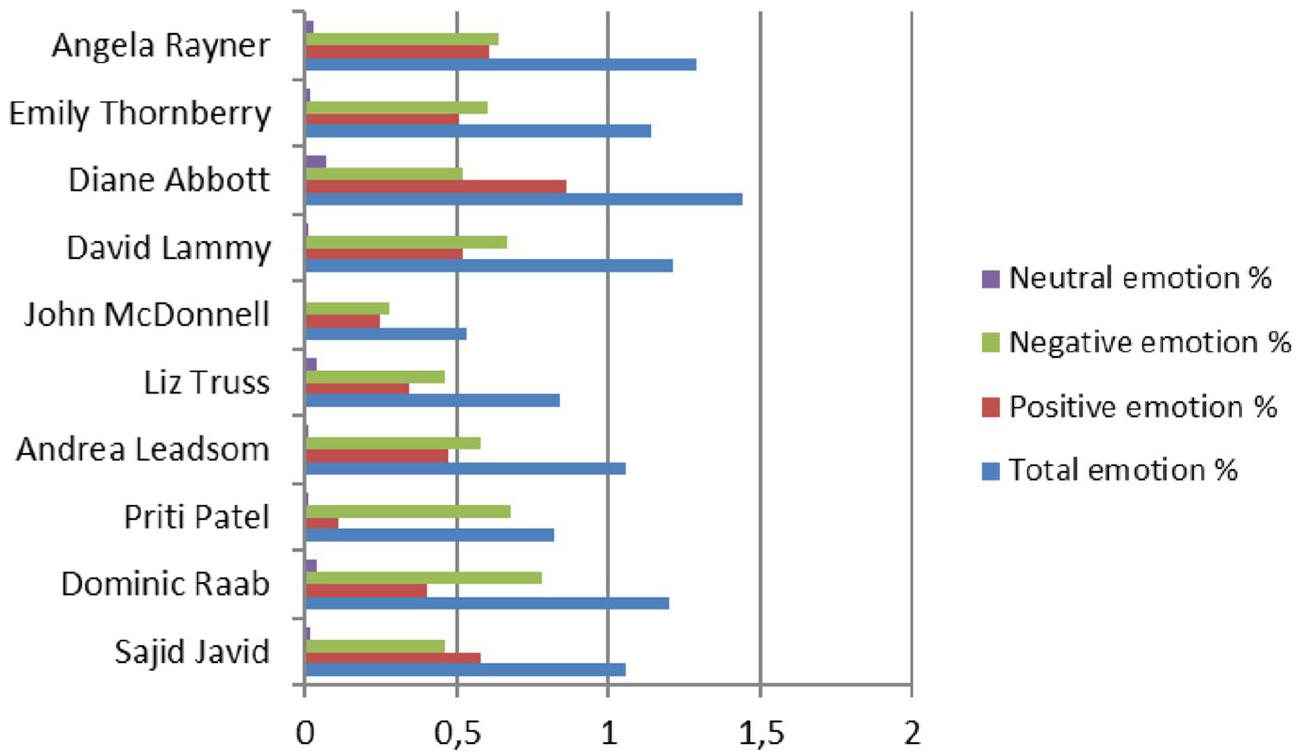
Lexical items tagged in Wmatrix4 as emotion-related (F as % of all lexical items).
Within this, lexical items in the specific category E3- (angry, violent) (e.g. attack, threat, abuse, rage, anger, kick, vicious) were slightly more frequent in tweets mentioning the female MPs (mean/men 0.15, mean/women 0.19), with Diane Abbott again receiving the highest score, although these differences were not statistically significant on Student’s t-test. The results are displayed in Figure 2.

Lexical items tagged as ‘angry/violent’ in tweets (F as % of all lexical items).
Intensity
To obtain information about the discursive tone, we took the percentages of exclusivisers (only, especially, purely), boosters (really, very, extremely) and maximisers (absolutely, total, outright) as measures of the intensity of the discourse surrounding these politicians. Figure 3 illustrates the frequency of exclusivisers, boosters and maximisers in each corpus, as a percentage of total lexis. Here, particularly tweets referring to Labour women seemed to contain a slightly greater amount of boosting than those about their Conservative counterparts, although these differences were not statistically significant on Student’s t-test. Tweets mentioning the women overall were slightly more strongly associated with boosting than those about the men, and overall three women (Rayner, Abbott and Leadsom) had the highest frequencies of boosters (the first two) and exclusivisers (the last).
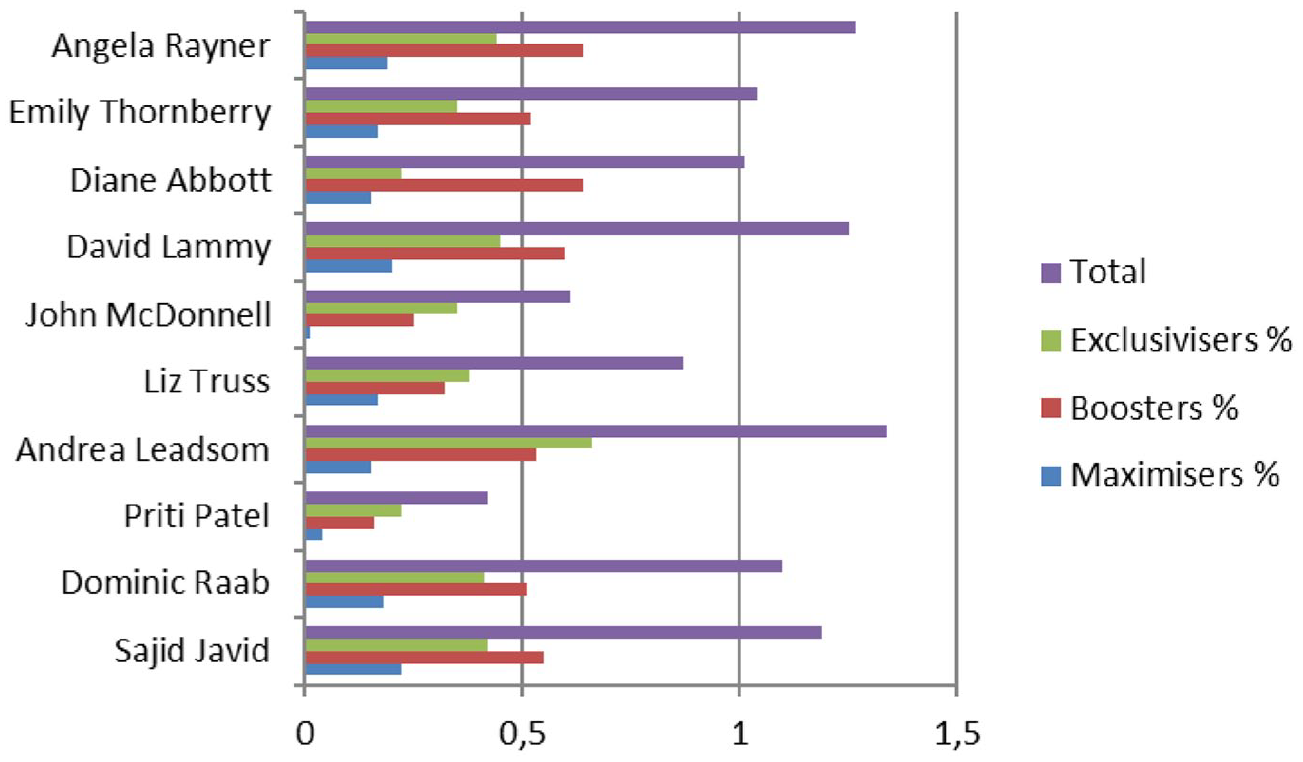
Intensity of discourse used in tweets: exclusivisers, boosters and maximisers (F as % of all lexical items).
Appearance and intelligence
Appearance and intelligence were also two areas in which gender-related differences in discourse were hypothesised. These areas are always at stake for politicians in general, but women in politics seem to be targeted more than men in terms of physical appearance (Campus, 2013; Haraldsson and Wängnerud, 2019; Van der Pas and Aaldering, 2020). Figure 4 below shows that in the present sample, both male and female politicians received more comments about appearance than about intelligence, with the exception of Liz Truss. The three MPs with the highest scores for lexis referring to appearance were all women (Leadsom, Rayner and Thornberry). However, none of the differences between the men and the women were statistically significant on Student’s t-test.
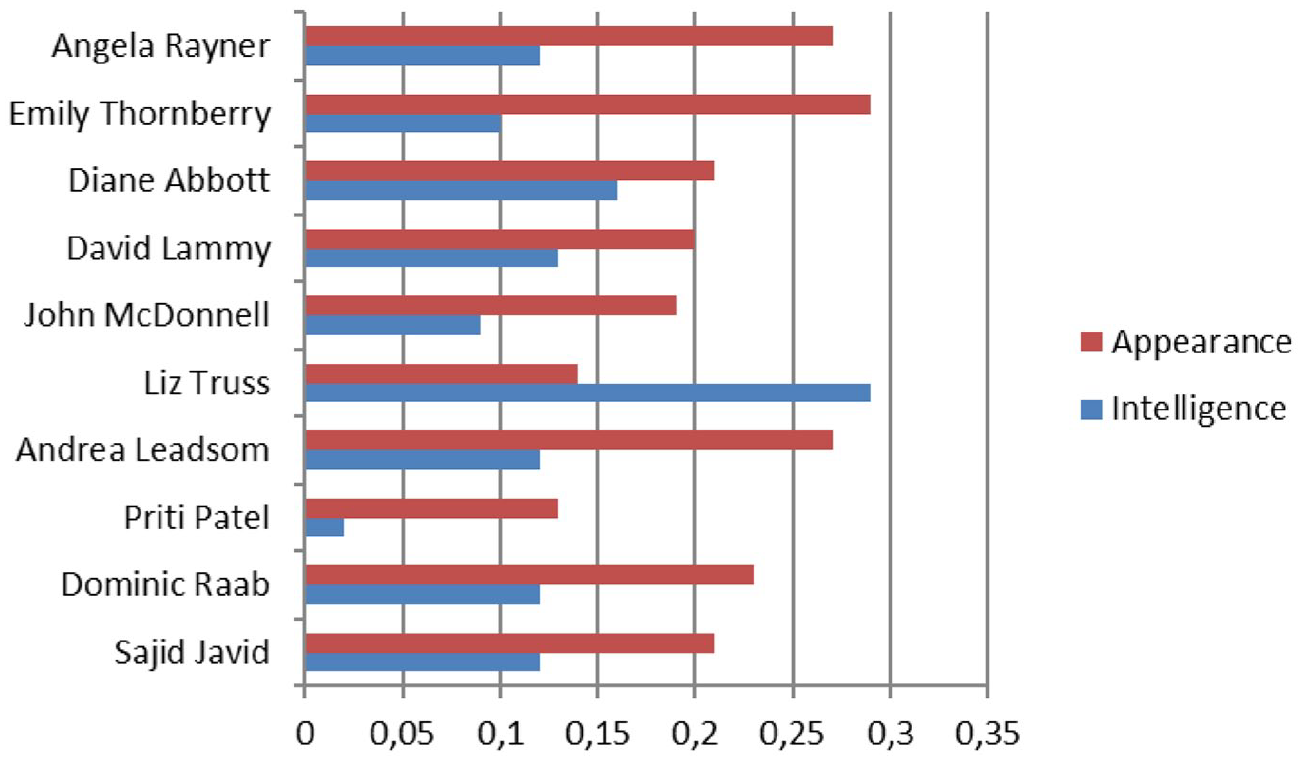
Lexical items tagged for physical appearance and intelligence (F as % of all lexical items).
When this was broken down in terms of positive/negative comments, the results appeared to show a high degree of balance between positive and negative lexis in all cases except that of Liz Truss, who received an overwhelmingly negative assessment in terms of intelligence (see Figure 5).

Lexical items tagged for intelligent/unintelligent (F as % of all lexical items).
Regarding appearance, the balance swayed in favour of ‘bad’ appearance in eight out of the ten cases, as shown in Figure 6.
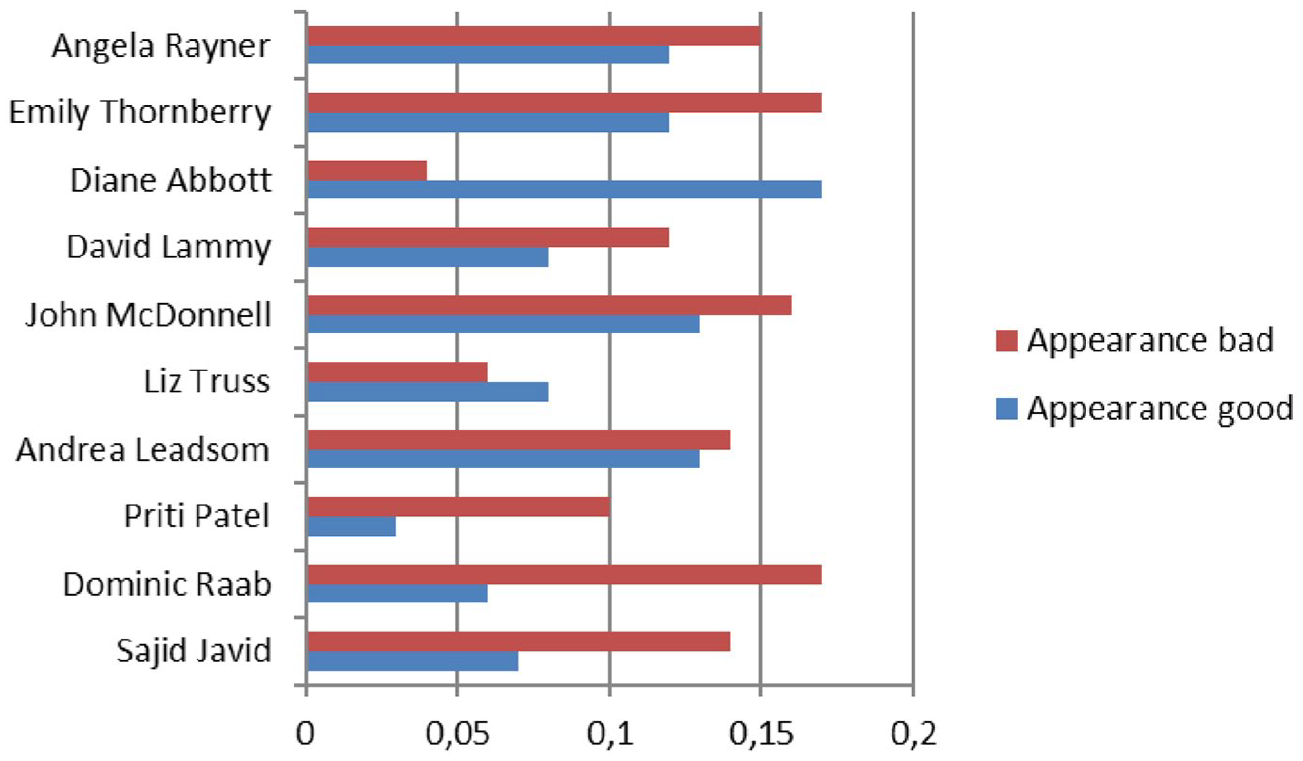
Lexical items tagged for Appearance bad/good (F as % of all lexical items).
Clothes, anatomy and sexual relations
Since the overall comparison of items tagged as aspects of appearance did not prove conclusive, we then moved on to consider certain semantic subcategories where differences were expected to occur in the treatment of men and women on the grounds of our literature review. These were the subcategories: clothes, anatomy and sexual relations (see Figure 7).
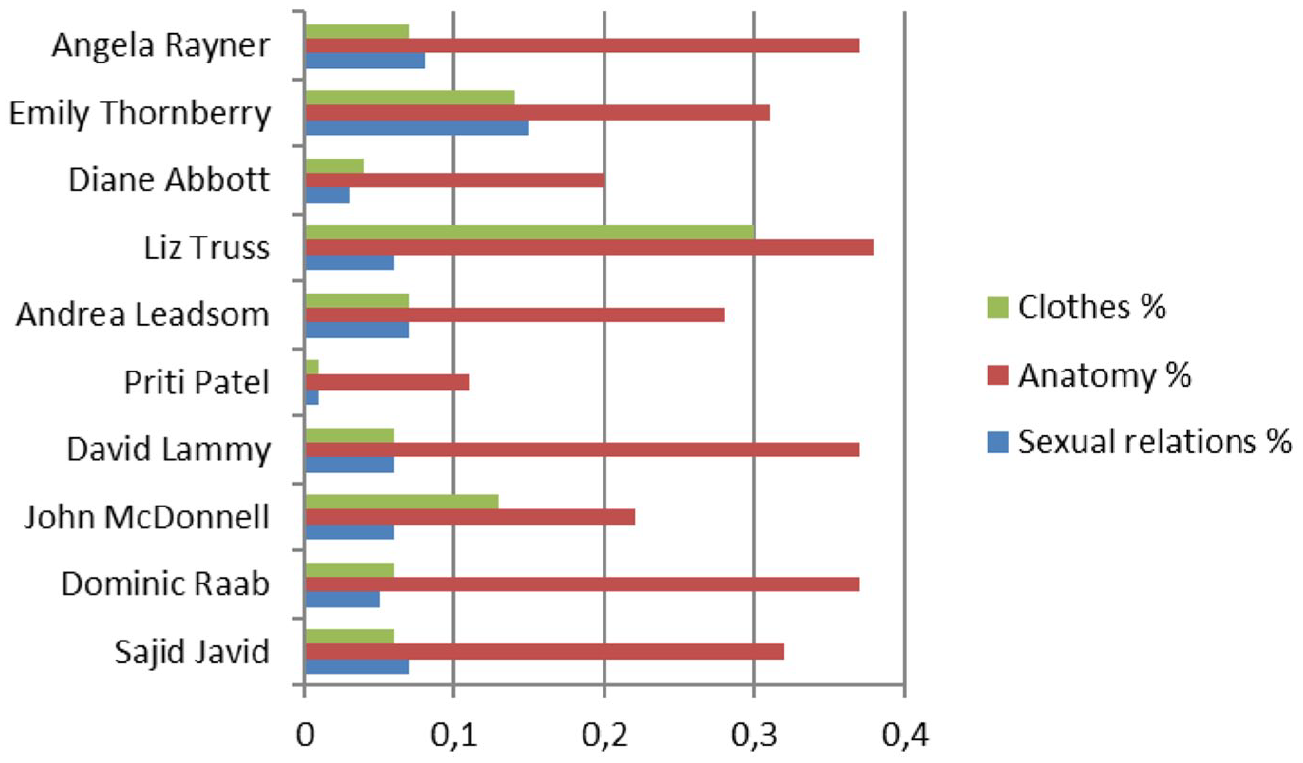
Lexis from semantic areas of clothes, anatomy and sexual relations (F as % of all lexical items).
The differences in proportions between the men and women are small and not statistically significant: clothes appear most in tweets about/for Liz Truss and Emily Thornberry, while Priti Patel has strikingly fewer tweets containing any of these categories. Regarding references to anatomy, men and women would appear to be equally targeted, although the interindividual differences in each group are striking.
Overview of quantitative results
Overall, there were no statistically significant differences between tweets referring to male and female politicians as far as the frequencies of lexical items from these semantic areas were concerned. The overall frequencies were small, and the figures for the different categories and subcategories selected here do not follow a fully consistent pattern. At most, they allow us to glimpse some different trends in the tweets mentioning the men and women in this study. A pattern emerges in which certain women in this sample (notably Abbott (angry/violent, boosters, emotion), but also Rayner and Thornberry (appearance, emotion), and on other occasions Leadsom (appearance, exclusivisers) and Truss (intelligence)), emerge as occasional outliers. These women attract somewhat more extreme discourse, characterised by frequent use of maximisers and exclusivisers, emotional language, as well as attention concerning their appearance, and more references to anger and violence. The patterns found with the women are further explored in the qualitative analysis in sections 4.2 and 4.3.
Discursive strategies of gender-based violence
For our qualitative analysis we then looked at the concordances for the semantic categories identified above, with a view to establishing how these differences might point to underlying gendered patterns of representation. In what follows, we apply the general scheme developed in Esposito and Zollo (2021) to categorise the different strategies of digital violence, namely: (1) body shaming; (2) assertions of moral degradation; (3) direct threatening and abuse; (4) gender stereotyping/gatekeeping. Comments are anonymised but not censored and they include graphic content (as well as spelling and grammar mistakes which are to be attributed to their authors). Emphasis in the quoted examples is always ours, unless specified.
Body shaming
As shown in Figure 6, references to physical appearance are frequent in the tweets about women. Some instances might be considered simply insulting, rather than specifically sexist:
(1) #PritiPatel is a fucking danger to society. Outrageous comments from her once more with that
(2) Why does #PritiPatel always have that
(3) Just looked up at the TV and saw what I 1st thought was
However, a large number of tweets about aspects of appearance have strongly sexist undertones. Making reference to women MPs’ age, bodily shape or size, in fact, represents a core strategy of body shaming in the data. Grounded in widespread and transversal practices of sexual objectification, women MPs are often insulted on the basis of the fact that their appearance does not necessarily conform to beauty ideals of an appropriately ‘gendered self’ (Bailey et al., 2013) and is not considered feminine enough:
(4) @DaniRowley @EmilyThornberry The bingo call is
(5) @EmilyThornberry I estimate if
(6) Do you think our @EmilyThornberry the multi millionaire landlord will be kicked out as well our Kev. Is this the reason the
(7) @andrealeadsom You
Hair, in particular, is a common topic for abusive statements directed at the female MPs. However, when directed to Diane Abbott, the misogynist dimension (women are ‘expected’ to have elegant hairstyles) intersects with an openly racist one. When targeting a Black British woman of Jamaican heritage like Abbott, negative comments on hair are grounded in the history of black hair culture and related racist discrimination and shaming (see Banks, 2000; Dabiri, 2020):
(8) @AngelaRayner The only ‘change’ you are offering is a change for the worst . . . . . and
(9) David Blunkett is Diane Abbotts hair stylist
(10) Is Abbott a Trend setter for
(11) @HackneyAbbott what do you wash your
(12) Abbott wearing a
Importantly, many of the negative judgements about these women are explicitly concerned with sexual desirability or the lack of it:
(13) @DaniRowley @EmilyThornberry My god. What a couple of
(14) @DaniRowley @EmilyThornberry There is absolutely
(15) @EmilyThornberry
(16) @EmilyThornberry About as
(17) Jezzas idea of
Women’s MPs physical unattractiveness is also associated with various sinister motifs such as their nature as ‘witch’ or ‘crazy lady’ (see Breeze, 2022). These comments are grounded in a misogynous conception of women as inherently deceptive and wicked, whose alleged emotional instability and lack of intellectual abilities disqualifies them from being apt for the political career:
(18) These
(19) Constant patronising smile but
(20) Vile, opinionated, self righteous horror. #angelarayner - One hairy mole away from being the
Negative comments related to appearance are much more frequent in the case of the women than the men in this dataset. Although male ugliness, obesity or baldness are also a target (see comments on Figure 5, above), comments mentioning these explicitly are more unusual:
(21) He [Javid] used to have hair? Thought he were born like that.
Interestingly, the occasional positive judgements of female appearance are sometimes linked to a negative evaluation, pointing to the persistence of patriarchal stereotypes and sexual objectification (attractive women are usually expected to be stupid), again aimed at excluding them based on their alleged lack of intellectual and political abilities (Krook and Restrepo Sanín, 2020). An example of this is the following comment on Angela Rayner:
(22) She could do really well being a model for a hair products company then she wldnt have the painful business of engaging brain before opening mouth
Moral degradation
Gendered insults and disloyalty tropes
Although men are also referred to using a range of opprobrious terms, various conventional gendered derogatory terms (bitch, cow, etc.) appear in attacks on female targets. This is in line with existing studies showing how negative gendered language is used to delegitimise female politicians and their actions (Krook, 2020). However, these examples also show how women in politics are likely to be distrusted and their loyalty to the nation to be put in question (especially when they belong to an ethnic or religious minority, see Kuperberg, 2021).
(23) That
(24) The massive
(25) Who could fail to remember @EmilyThornberry sneering at the St George’s flag? Her & her type despise our nation, not just England, but the United Kingdom & what it stands for. Yet she wraps herself in the colours of the EU like an
Allusions to (non-normative) sexual behaviour
Many comments are grounded in overarching sexist and ageist conceptions of women’s value and women’s sexuality. Andrea Leadsom, for example, is portrayed as a ‘cougar’, an animal metaphor usually employed to refer to a sexually assertive woman who actively seeks out younger men. As she is purportedly deviating from some of the major pillars of the traditional heterosexual dating script for women (such as age-hypergamy and passivity), she is shamed and attacked:
(26) @andrealeadsom @Conservatives You certainly know a lot of
(27) Andrea, you do
(28) Why does @andrealeadsom always look like a
(29) @andrealeadsom youre starting to look a little bit like a
(30) @andrealeadsom Oh Andrea where are the
Direct threats
Compared to YouTube results in Esposito and Zollo (2021), the collected corpora on Twitter contained very few direct threats of violence. With Twitter being a relatively moderated cyberspace compared to YouTube, it is possible that such comments were signalled as offensive content and subsequently deleted, especially in the delicate pre-election context. Interestingly, the majority of the tweets that may have escaped Twitter’s moderation and contain messages under the semantic category ‘anger/violence’ are related to slapping. ‘A good slap’ is what misbehaving children are usually ‘in need of’, a parallel that mainstreams and normalises violence against women MPs:
(32) Will someone please just
(33) @andrealeadsom A face just begging for a
(34) Look at Thornberry’s face
Gender stereotypes and gatekeeping
Implications of (gender-determined) social incompetence
Politicians are often accused of stupidity, and the sample here is no exception. It is clear that highlighting lack of intellectual ability does not necessarily imply a gendered dimension. In this dataset, we found that most of the remarks mentioning Liz Truss, the outlier on the category ‘unintelligent’, could equally be used to discuss a male MP:
(35) Just wondering when mince became the go-to measure of
(36) Competing with #LizTruss for the
However, many derogatory comments levelled at the women in this sample are more than simple jibes about their lack of brainpower. In fact, they are complex messages characterised by linguistic creativity and irony, which contributes to the mainstreaming of such discourse as episodes of ‘hate-play’ or ‘recreational nastiness’ (Jane, 2014: 531–532). On the one hand, these comments have a humorous aspect, while on the other, there is an underlying patriarchal implication that the woman’s main role is to be a housewife rather than a politician, and she is supposed to take care of her kitchen efficiently and provide her family with food:
(37) #PritiPatel’s
(38) It would appear that not only can’t she count, or hold an informed conversation on any topic, but apparently @HackneyAbbott
The instances of this strategy are interesting in that they exemplify the indirectness and complexity of gendered attacks. The claims of social incompetence suggested here begin by undermining these women’s capability as mothers and housewives, but then build an association between such ‘incompetence’ at basic tasks and unsuitability for public office. Although a larger sample might be needed to prove this definitively, it is notable that none of the men in this sample were judged ‘incompetent’ because of their inability to clean and cook, or because of their children’s behaviour.
The motif of ‘social incompetence’ permeates many attacks on these women’s performance in debates or media interviews, shedding doubt on their ‘fitness’ to hold office:
(39) I can’t believe there are people out there who think #angelarayner is in any way fit to be included in any kind of debate. She’s a
The following sequence of tweets is interesting, in that it starts from the position that Angela Rayner is not capable of communicating on a suitably formal level because she uses ‘inappropriate’ vocabulary. The same tweeter then defends their position with reference to Angela’s particularly prominent position as Education Spokesperson, a position which, it is assumed, should be held by someone who has a high educational level. This then gives rise to a flurry of tweets debating whether Angela’s lack of formal qualifications should disqualify her from a position of responsibility in Education, a role that is understood to be reserved for members of the social élite:
(40) @AngelaRayner Since when did
(41) @AngelaRayner I’m not offended by the word crap. I’m offended by the person who’s claiming to be the
(42) @AngelaRayner I would say you were qualified to know but I just remembered
(43) @AngelaRayner To be fair,
In this context, the misspellings and grammatical mistakes that are commonly present in the Twitter corpus, can also be interpreted as intentional mocking messages that supposedly reflect Angela’s own command of English, thus engaging the intersectional aspect of class, which still surfaces frequently in British political invective:
(44) @AngelaRayner yeahbut is
(45) @AngelaRayner You
(46) @AngelaRayner I wasn’t aware that
These examples also occasionally bring up the implication that women in politics are often regarded as tokens of policies of gender equality, rather than legitimate residents of the political arena on the same level as men. They are seen as being assigned political roles only thanks to gender quotas or for the sake of representativity, but thought not to have the competence to actually do their job as politicians.
(47) I suppose they’ve given
(48) When u have such sharp minds as #DianeAbbott in extraordinary positions of power, one must really doubt the intelligence of Labour.
In particular, some comments blame the feminist movement for having led to women occupying roles that are far beyond their true capacity. The following tweet, for example, voices this explicitly, suggesting that women merely ‘use’ the notion of prejudice in order to excuse their unfair behaviour and weak reasoning capacity:
(49) @AngelaRayner Most of you
(50) @andrealeadsom @Conservatives Youre appeasing nobody by pandering to SJW
Discursive constructions of precarity: Abbott and Raynard as ‘women with a past’
By the time a woman manages to carve out a space in politics, she has inevitably come to realise the exceptional and precarious nature of her very presence. Precarity, here understood in the Butlerian sense (Butler, 2009), not only designates those politically induced conditions by which women in politics are often not able to count on social and economic support networks on the same level as men, but it also refers to a differential exposure to violence and social judgement that puts women at a clear disadvantage.
Mediatised gossiping revolves around public figures’ mishaps like their sexual escapades, divorces or drug use, capitalising on the human itch for seeing celebrities (usually richer, more famous and more powerful than us) in deep water. However, the constant attention for the ‘past life’ of women politicians, and the related discursive construction of their identity as ‘women with a past’, is also instrumental to evaluating and questioning their (sexual) morality and, as a result, their fitness for a political role. Two clear instances of this are found in the present corpora, both of which relate to incidents in the distant past of the two politicians’ life: Diane Abbott’s long-forgotten affair with Jeremy Corbyn, and Angela Rayner’s teenage pregnancy.
Diane Abbott’s relationship with Jeremy Corbyn
Many of the tweets about/directed at Diane Abbott seem to revolve around her relationship with former Labour leader Jeremy Corbyn, when they both were early-career politicians in the 1970s. In fact, the circumstances of their affair were set out in a high-profile article in the Daily Express (2019) just before the general election. As expected, there is an abundance of bodyshaming (see also 4.1) aimed at highlighting her ‘ugliness’ and questioning how Corbyn could have possibly engaged in a sexual relation with her.
(51) @jeremycorbyn did you really
(52) ‘Treating women with respect’. You mean like
Other comments draw on the discursive construction of her inability to lead and stupidity (53), hint at a transactional sexual exchange and lack of morality of the two (54), or fall into the category of graphic and violent attacks (55).
(53) just found out that #jeremycorby had a thing with #dianeabbott. its all making sense now ! ! He literally
(54) Brought his mate round to view a young
(55) @jeremycorbyn Stuff my foreskin with wasps and
Angela Rayner’s teenage pregnancy
Angela Rayner’s past is also given considerable attention in the public arena in these Twitter exchanges. Many of the tweets use aspects of her pregnancy, interrupted education and perceived working-class status to discredit her. Her morality is questioned, not only for engaging in what is referred to as ‘underage sex’ but also for relying on benefits as a teenage mother, in line with a broader negative stereotypical representation of the underclass in British media and culture (Jones, 2020):
(56) @AngelaRayner what have you got in your mouth? Remember when you were
(57) @AngelaRayner Forgetting your
(58) To be fair give us a lot better than you at everything. You left school with
As Rayner left school at 16, pregnant and without qualifications, her lack of formal qualifications is particularly emphasised because she is Shadow Education Secretary and potentially, during election times, with a chance of becoming Education Minister.
(59) @AngelaRayner There was a time when all MP’s from all parties seemed well educated but now it’s just anyone off the street with
(60) I mean, who better to run the UKs entire education system than someone with
(61) @AngelaRayner
(62) @AngelaRayner Says the woman who got
However, it is important to note that the discussion of Angela Rayner is lively on both sides of the argument. She also finds a large number of supporters who read her situation in a positive light: @AngelaRayner Has
Concluding discussion
We set out from the expectation that there would be quantitative differences between the tweets mentioning female and male MPs, and that the tweets about women would contain specific gendered categories of online hostility. Concerning the first of our hypotheses, our data analysis did not reveal major differences in semantic content between tweets mentioning female and male MPs. In fact, both men and women are discussed in denigratory terms, with negative content on aspects such as appearance and intelligence. In this, the nature of the dataset may have played a role, since we chose to use ‘mentions’ as our search criterion, rather than ‘addressee’. Previous studies (Gorrell et al., 2019; Rheault et al., 2019) were based on social media messages directly sent to men or women in politics, rather than discussions of them in the cybersphere. One of the issues that became apparent as we conducted our analysis was that tweets that mentioned a female MP often also included an attack on someone else (e.g. the Prime Minister, who is a man), and the fluid and interactive nature of communicative exchanges in Twitter actually makes it extremely difficult to distinguish between tweets ‘about’ one person or another. A more sophisticated search algorithm would be needed to identify tweets (or parts of tweets) that are truly targeting one politician or another.
Nonetheless, our quantitative analysis brought out large inter-individual differences, with certain female MPs receiving comments containing disproportionately more lexis related to appearance and sexual relations, as well as more emotional language and vocabulary associated with violence. As seen in section 4.3, this raises the important point that gender bias is activated by some women more than others, and is perhaps related to gate-keeping norms that are intersectional in nature, linked also to race and class rather than to gender alone. As a result, the presence of Diane Abbott or Angela Rayner in the political sphere poses a greater symbolic threat to the male hegemony than that of women with more socially-accepted and conventional backgrounds for a politician (i.e. white, upper-class, highly educated).
Concerning the second hypothesis, in fact, further analysis of tweets about female politicians did actually bring to light specific gendered categories of online hostility. In our qualitative critical discursive analysis, we show that women in politics do indeed receive elaborate and emotional online attacks, encompassing a range of grounds for doubt about their competence, character and accomplishments. The evidence from our dataset shows the multifacetedness of semiotic violence, including several types of insult against women’s appearance, intellectual capacity and integrity, threats of harm, and stereotyping. These results are fully in line with in the findings of Esposito and Zollo (2021) as well as other studies (e.g. Anderson and Cermele, 2016; Powell and Henry, 2017).
The content and arguments in these hostile and abusive messages seem to be deeply embedded in a social perception of women’s political activity as breaching the rules of gender performativity. This is in line with a broader social perception of women in politics as ‘trespassers to be prosecuted’, often subject to double standards, harsher judgements and a general ‘moral suspicion’ (Manne, 2017: 271), and shows how certain stereotypes concerning appropriate female behaviour are still operative in 21st century UK politics.
Two final aspects need to be mentioned. First, quantitative methodology based on dictionary-based semantic analysis, though useful as a way of identifying potential patterns across large datasets, doubtless lacks sensitivity when dealing with the lexically and pragmatically complex area of social media discourse. In view of the rise of automated text processing tools, further mixed methods studies are needed to define where the limits of such methodologies lie. Second, our study was designed to examine misogynous discourses about women in politics, yielding results that are richer in the qualitative than the quantitative dimension, and pointing to the deep-seated intersectionality of much delegitimatory discourse. Further research is needed to explore the way other groups are delegitimised in social media, and to uncover the insidious patterns that contribute to perpetuating intersectional patterns of social inequality in the political sphere.
Footnotes
Declaration of conflicting interests
The author(s) declared no potential conflicts of interest with respect to the research, authorship, and/or publication of this article.
Funding
The author(s) disclosed receipt of the following financial support for the research, authorship, and/or publication of this article: Eleonora Esposito’s work was generously supported by the Marie Skłodowska-Curie actions (H2020-MSCA-IF-2017 – Grant Agreement ID: 795937).