




Abstract
This article explores different realizations of modality meanings in Spanish written language and their contribution to dialogic positionings in the field of the historical explanations provided in The National Commission for Truth and Reconciliation Report (1991) regarding human rights violations during Pinochet’s dictatorship in Chile (1973–1990). From an ideological, socio-semiotic perspective anchored in the theoretical framework provided by Systemic Functional Linguistics, the analysis focuses on congruent and metaphorical expressions of modality in the text and their contribution to authors’ positionings as organized in the system of engagement, considering, at the lexicogrammatical level, the place of modality in the interpersonal, ideational, and logical structure of the clause. The analysis shows the productive role of a range of realizations of modality meanings in the discourse to construe an interpretation of a conflicting, traumatic recent past and to present and validate the authorial voice regarding its mission and actions. An outline of grammatical interpersonal metaphors of modality for Spanish written language is also presented.
Introduction
This article explores how modality resources collaborate in the report of human rights violations perpetrated during the dictatorship in Chile (1973–1990) as presented in the first official document elaborated during the transition to democracy (The National Commission for Truth and Reconciliation Report, also known as Rettig Report; Government of Chile, 1991). In particular, the study focuses on congruent and metaphorical realizations of modality and their contribution to the authors’ discursive positionings in the presentation of their objectives and historical interpretations of the events that led to the coup d’état in 1973. By means of this analysis, we attempt to present a preliminary description of the modality resources available in Chilean Spanish to construct historical interpretations regarding contested events and processes of the recent past, along with their contribution to the dialogic negotiation of meanings in the text.
As was the case in many countries in Latin America, the civil-military dictatorship in Chile (1973–1990), led by General Augusto Pinochet, started with a violent coup d’état orchestrated by the Armed Forces and conservative sectors of civil society. The dictatorship was characterized by a state of terror headed by repression and intelligence organizations with the collaboration of the United States’ CIA. Different collective memories of the causes of the coup event and the subsequent dictatorship, including severe human rights violations committed during the period, are disputed in Chilean society until today (Harmer, 2011; Lira, 2013; Stern, 2013). Official versions presented through documents, history textbooks, and other channels have played an important role in influencing those memories (Oteíza, 2006, in press). In this article, we focus on the first one of these official documents presented by the Chilean State, as an initial attempt to inform and seek reparation for the traumatic period signaled by the dictatorship.
The National Commission for Truth and Reconciliation Report (1991), created by a commission designated by President Patricio Aylwin, dealt with human rights violations resulting in deaths or disappearances. The goals established for the Commission were to create ‘as complete a picture as possible of the most serious human rights violations’ (Rettig Report; Government of Chile, 1991: xv) through a list of victims, as well as to recommend reparations to victims’ families and legal and administrative measures of prevention. Nevertheless, authors also provide a historical interpretation of the events and processes that led to the human violations reported and, in doing so, refer to the different social actors involved. In this article, we are interested in the way the Commission justifies and presents such a historic interpretation making use of different resources of modality and their realizations.
From an ideological, socio-semiotic perspective on language and context (Halliday and Matthiessen, 2014; Martin, 2013; Oteíza and Pinuer, 2019) we present an analysis that considers how the meanings negotiated in the Report regarding the events previous to the coup and the role of the authors in this presentation are construed by means of a range of lexicogrammatical resources. This exploration focuses on the way specific selections of resources contribute to the constructions of ideological positionings in relation to this recent past. We pay special attention to the negotiation of interpersonal meanings and the phenomenon of interpersonal grammatical metaphors as a form to construct non-congruent realizations of modality (Halliday and Matthiessen, 2014; Pinuer et al., 2019; Taverniers, 2017, 2018) as well as their participation in the delimitation of more open or closed dialogic spaces in the system of engagement (Martin, 2019; Martin and Rose, 2007; Martin and White, 2005). In describing these resources, we pay attention to the way different degrees of congruency in the realization of modalized meanings contribute with the setting of subjective or objective positionings in the presentation of conflicting interpretations concerning a traumatic past and the space the authorial voice takes in this regard.
Several studies have addressed the historicization and recontextualization of memories regarding a traumatic past of dictatorships and human rights violations in Latin America through official documents such as textbooks (Achugar, 2008, 2016; Oteíza, 2006, 2009a; Oteíza and Achugar, 2018; Oteíza and Castro, 2019) and official state reports (de Cock and Maturana, 2018; Oteíza, 2009b, 2016; Oteíza et al., 2021; Oteíza and Pinuer, 2010). These studies have considered diverse aspects of the construction of the past, taking into account the negotiation of ideational and interpersonal meanings in texts and their expression in different resources in the lexicogrammar. Nevertheless, the potential of modality meanings and their different realizational patterns have received relatively little attention in this field. In this study, therefore, we attempt to explore their participation in the construction of a certain interpretation of the past presented in the Rettig Report, particularly in relation to the authorial positionings as proposed in the system of engagement, and in doing so, we aim to provide a preliminary description of grammatical interpersonal metaphors of modality in written Spanish language.
In the next section, we present the theoretical and analytical tools used in this study, which comprise modality meanings and grammatical metaphors of modality, the interpersonal structure of the Spanish clause as a criterion for congruent or metaphorical realization of modality, and a brief review of the system of appraisal and the subsystem of engagement in particular. The results section explores how different realizations of modality collaborate in the dialogic positionings negotiated in the Report. Finally, we propose some conclusions regarding the potential of modality meanings to construe historical explanations of a contested past.
Theoretical framework
In the analysis of the historical explanation provided in the Rettig Report, it is important to identify the reasons or factors that the authors attribute to the outcome of the coup in 1973 and how they establish complex causal relationships across social, political, and economic domains. Causation, along with evidentiality, plays a key role in construing historical explanations that address how social actors are involved in events and processes in the spatial and temporal dimensions (Oteíza, 2019; Oteíza and Pinuer, 2019).
The analytical focus of this article is on the way modality meanings participate in the construction of historical explanations and how that contribution reflects on the authors’ positionings organized in the system of engagement, so next we briefly present the theoretical fundamentals as they are conceptualized in the Systemic Functional Linguistics framework.
Modality meanings
The interpersonal system of modality, which operates at the lexicogrammatical stratum, has been described as the speaker’s judgment about the status of the meanings negotiated in the interaction (Halliday and Matthiessen, 2014). There are four basic types of modality according to the nature of the ‘commodity’ exchanged: interactants’ judgments about the probability or usuality of the propositions exchanged are part of the domain of modalization, while assessment of the obligation or readiness (which includes inclination and ability) of the proposals negotiated concern the area of modulation (Halliday and Matthiessen, 2014).
Following Halliday and Matthiessen (2014), we describe modality resources in the corpus considering two features: value and orientation. Modality values can be high, median, or low, and the orientation comprises two criteria: subjective or objective nature of the meaning and implicit or explicit form of expression. While the subjective-objective nature of modality depends on the degree to which the modal judgment is linked with the speaker, and therefore, the extent to which the validity of the proposition lies on the speaker’s judgment, the implicit-explicit criterion has to do with the realization patterns of the modality meanings exchanged. An implicit realization conveys the meaning of both, modality and the proposition or proposal modalized, as part of the same clause, while an explicit realization expresses the modality as a projecting clause or as a relational clause with a modal Complement or Attribute; that is to say, the modality is realized as a clause on its own. This difference constitutes the basis for identifying different degrees of congruency in the expression of modality in the lexicogrammar, namely, for dealing with the phenomenon of grammatical metaphors in these particular interpersonal meanings.
Grammatical metaphors: Ideational and interpersonal
The concept of grammatical metaphor accounts for variation in the expression of meaning in language, from more typical or congruent, to alternative or metaphorical ways (Taverniers, 2017). It is conceived as an interstratal tension (Martin, 1997) between the meaning in the discourse semantics stratum and its wording or realization in lexicogrammar. This flexible and dynamic relation among strata allows us to expand the meaning potential of language, as there is not a one-to-one relation between both strata, but meanings that are realized in a range of resources in the lexicogrammar (Taverniers, 2017).
There are two main types of grammatical metaphors identified in SFL: ideational and interpersonal (Halliday and Matthiessen, 2014). Ideational metaphors have received considerable attention, particularly in relation to the construction of scientific knowledge (for example, Halliday and Martin, 1993; Hao, 2020; Martin, 2008). On the other hand, research concerning interpersonal metaphors is much less frequent and, as Taverniers (2017) states, this probably has to do with the inherent indeterminacy of these kinds of meaning: as a great diversity of lexicogrammatical structures can express them, it is more difficult to identify a clear continuum from more to less congruent ways of expression, and therefore to identify recurrent patterns of shifts between the two extremes.
Interpersonal metaphors expand the meaning potential in terms of mood and modality. Metaphors of mood provide non-congruent alternatives to realize selections of the discourse-semantic system of speech function in the lexicogrammatical system of mood idem. 1 Interpersonal metaphors of modality, on the other hand, expand the range of realization of modal meanings beyond their congruent or typical realization within the mood element, that is, the part of the clause where its ‘negotiability’ lies.
The Mood element in English and Spanish
In English, the overall interpersonal structure of the clause has been described as containing Mood element and Residue. The Mood element includes a Finite operator, a Subject, and optional Modal Adjuncts (Halliday and Matthiessen, 2014). The Finite expresses polarity, and also circumscribes or ‘grounds’ the clause to its context in the speech event in order to make it arguable, either in terms of time or modality. The Subject makes the clause negotiable providing a responsible for the validity of the proposition, in other words, a reference by which the proposition can be affirmed or denied (Halliday and Matthiessen, 2014). Finally, a Mood element in English can also contain Modal Adjuncts, which carry meanings in terms of polarity, temporality, intensity, or counter expectation (Martin et al., 2010). The system of modality in English language is congruently realized, therefore, within the Mood element, as part of the Finite or by Modal adjuncts.
By contrast, Quiroz (2013, 2015, 2017) identifies a different interpersonal structure in the Spanish clause, in which the elements that convey its arguability operate at group rank. This structure is the Negotiator, which contains minimally a Predicator, realized as a finite verbal group, and can also include Negation particles, secondary participants as Clitics, and Modal Adjuncts (Quiroz, 2013). The main difference from English is that in Spanish, both the modal responsibility and the ‘finiteness’ of the clause are not expressed in separate functions (as the English Subject and Finite, respectively), but are contained in the verbal morphology of the finite verbal group. In this scenario, modality meanings are congruently realized within the Negotiator as modal verbs, Modal adjuncts and/or selections at word rank. 2 In this study, we rely on this description of the mood structure in Spanish language to analyze modality, taking their realization within the Negotiator as a minimal criterion to identify congruent expressions of these interpersonal meanings at the lexicogrammatical level. 3
Authors’ positionings in the system of engagement
To finish this section, we will briefly refer to the area of meaning concerning the different dialogic positionings that the authorial voice can assume in their discourse, as well as the source identified for the evaluations expressed, as they are organized in the system of engagement within the discourse-semantic system of appraisal.
The basic distinction between heteroglossic and monoglossic orientation based on whether discourses acknowledge other voices apart from the authorial one is rather expanded as options inside each category, as can be seen in next Figure 1, which shows the model of Martin and White (2005):
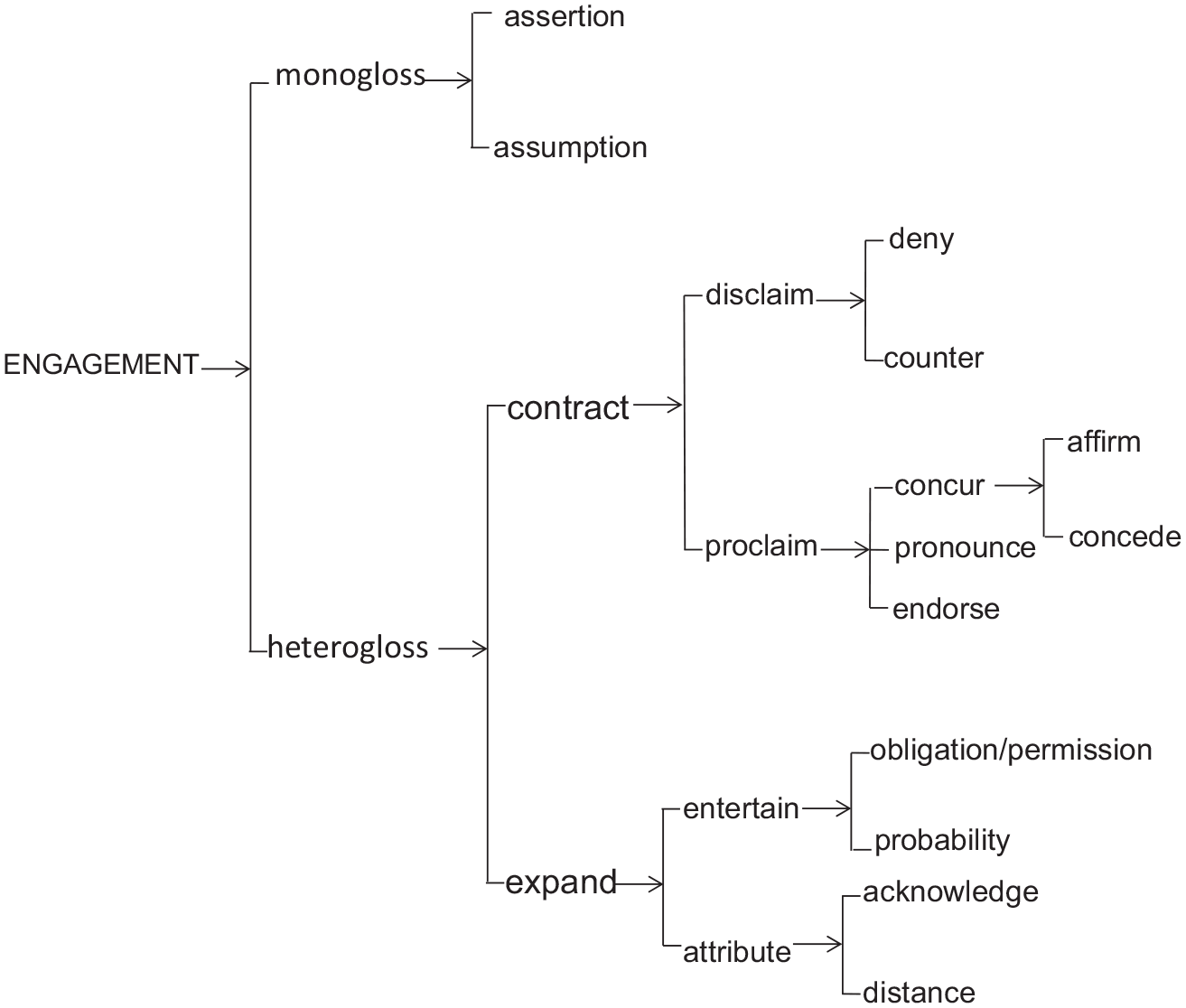
System of engagement (Martin and White, 2005).
In this work we also consider the elaborations of Oteíza (2021) with regard to the dialogic expansion as Attribute and the type of source implicated, presented in Figure 2.
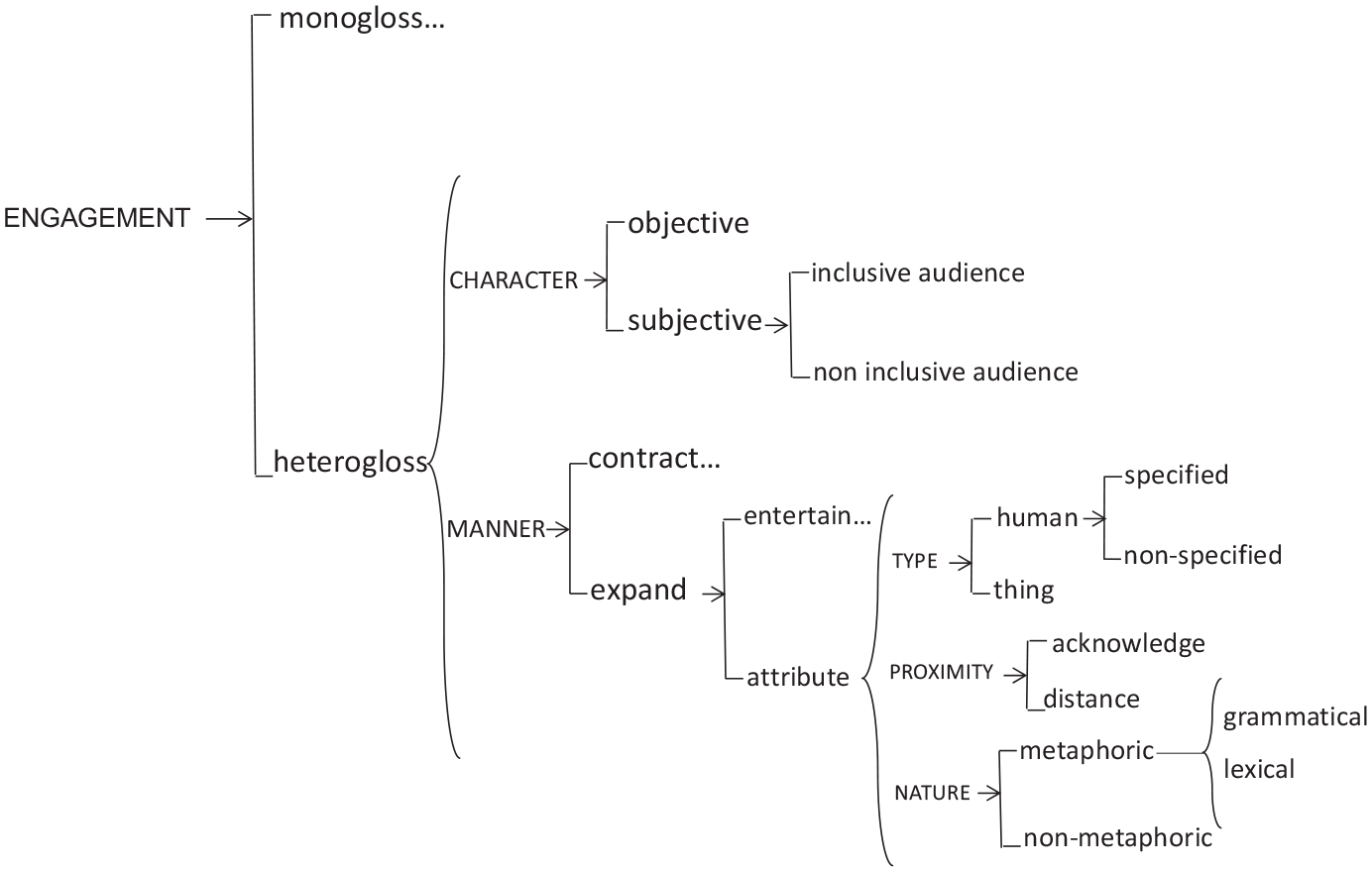
System of engagement: heterogloss: expand: attribute (Martin and White, 2005; with further elaborations of Oteíza, 2021).
The description of the resources of engagement involved in the discourse will allow us to identify the authors’ positionings regarding the historical explanation presented in the report. As in these explanations authors present their evaluation about events, processes, and social actors, we will also make use of the categories available in the system of attitude (Martin and Rose, 2007; Martin and White, 2005; Oteíza and Pinuer, 2019) in concert with resources to graduate the evaluations presented in the text (Hood, 2010, 2019; Martin, 2019), all of which contribute to the generation of evaluative prosodies throughout the discourse.
In applying the analytical tools described in this section, we also follow SFL’s top-down analytical approach, which considers higher levels of meanings as the starting point and the analysis of their realization in the lexicogrammar, under the premises that the relationship between these two strata is dynamically tensioned by resources such as grammatical metaphors, and that lexicogrammatical selections are discursively motivated, according to the specific genre and field in which the semiotic process is taking place. As discourse analysts interested in the representation of processes, events, and social actors involved in historical explanations about a problematic past in Chilean society (Oteíza, 2018, in press; Oteíza et al., 2021; Oteíza and Castro, 2019; Oteíza and Castro, in press; Oteíza and Pinuer, 2019), we aim to demonstrate that lexicogrammatical selections such as modality, ranging from congruent to more metaphoric realizations, actively participate in the positionings negotiated in the text regarding the validity of the historical interpretations proposed and the authors’ role as a voice that legitimizes itself through a variety of prosodically interconnected resources.
The analysis performed considers, therefore, instances in which modality resources collaborate in the construction of dialogical positionings in the engagement system and their participation in the construction of historical explanations provided by authors. The tables presented display an analysis focused on lexicogrammar in relation to the modality resources activated in each fragment and consider the systems of taxis and logico-semantic type, transitivity, and mood. The first two systems, which concern the relationships at the rank of clause complex, are considered since the realization of modality as one or more clauses is a fundamental aspect of its congruent or metaphorical expression. Transitivity elements are taken into account as a way to identify how the experience is constructed in the text through types of processes and their participants, since certain processes will typically realize particular types of modality. 4 Finally, the analysis of the mood structure of each clause will also make it possible to discriminate among degrees of congruent or metaphoric realizations, in relation to whether the modality is conveyed within the limits of the Negotiator.
Contextualizing human rights violations: Historical explanations provided in the Rettig Report
In this section we address the historical explanations offered by authors of the Rettig Report in relation to three main aspects: the reasons provided to present such explanations (presented in the report as ‘Contextualization’), the construction of the events, processes, and actors involved in the period preceding the coup, and finally the role of the National Commission for Truth and Reconciliation regarding the contents presented in the Report. As we will see, in addressing these aspects, the members of the Commission construct their authorial voice in ways that seek to justify and legitimize their labor and results.
Justifying the explanations
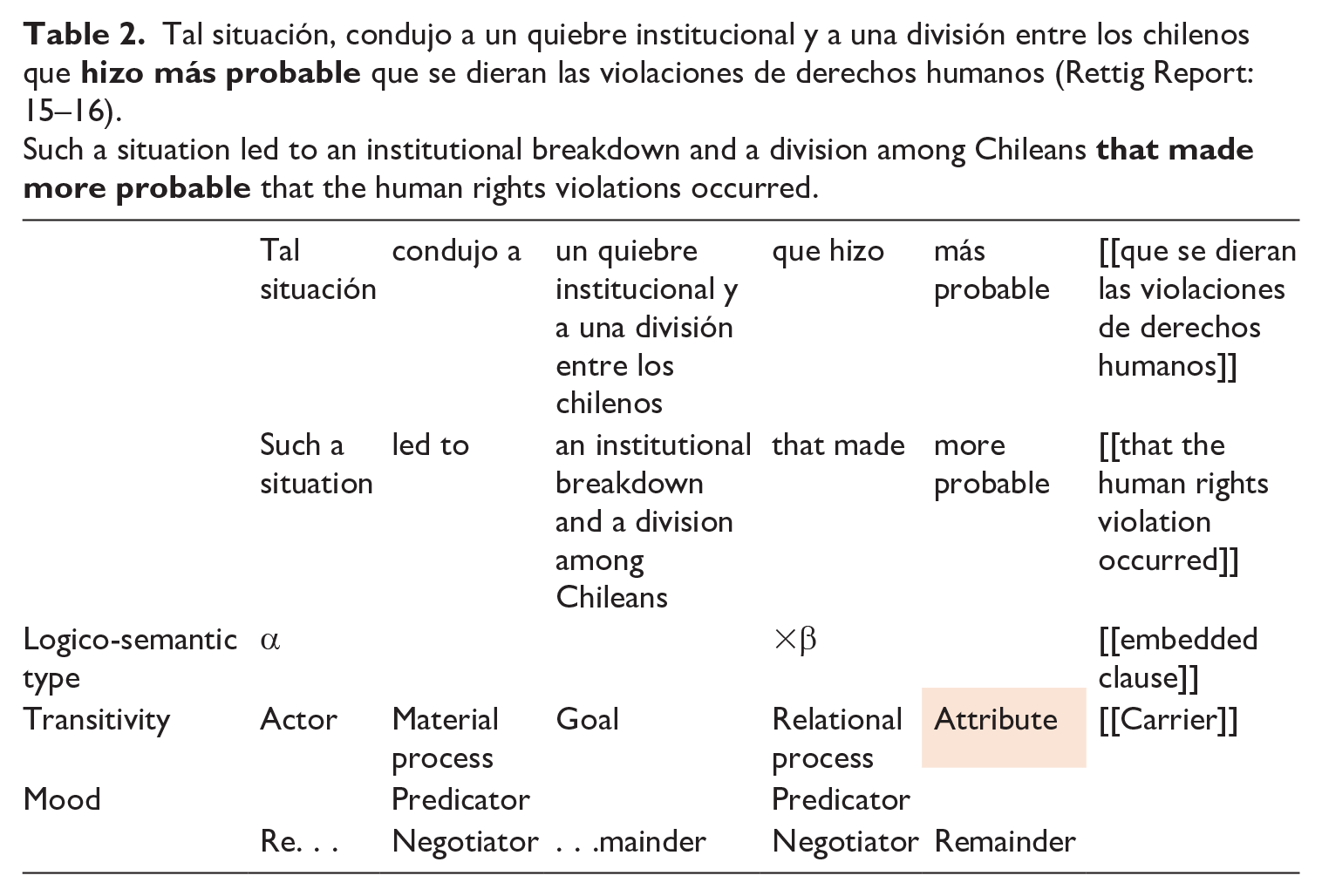
Tables 1–5 present the analysis of a fragment of the Report in which the Commission justifies the contextualization presented regarding the historical and sociopolitical situation in Chile before the coup in 1973 and establishes a probability relation between such situation and the perpetration of human rights violations. In doing so, the authors carry out a series of modality moves resorting to different realization patterns along the axes objective-subjective and congruent-metaphoric.
Sin embargo,
Nevertheless,

Tal situación, condujo a un quiebre institucional y a una división entre los chilenos que
Such a situation led to an institutional breakdown and a division among Chileans
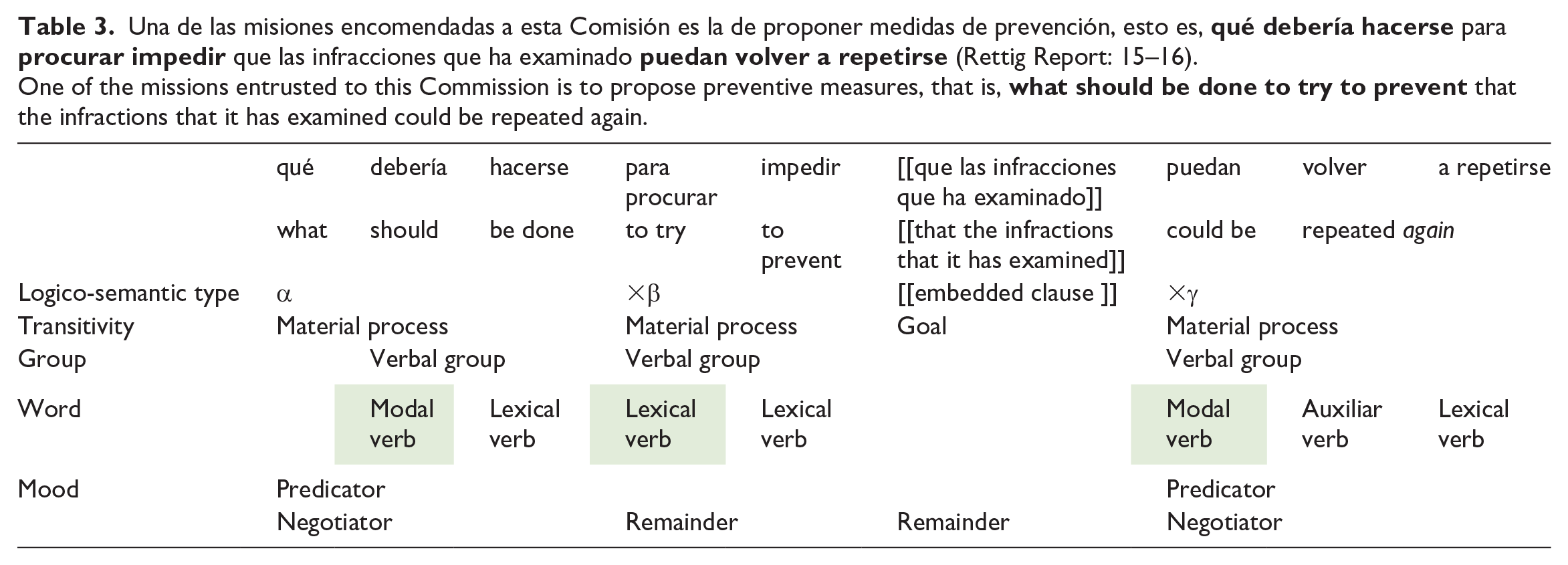
Una de las misiones encomendadas a esta Comisión es la de proponer medidas de prevención, esto es,
One of the missions entrusted to this Commission is to propose preventive measures, that is,
Por ello,
Therefore, it is
Sin embargo, la Comisión
However, the Commission
After restating their mission, the Commission introduces the contextualization provided in the report through a resource of Contract: counter (Nevertheless), which sets it as unexpected -as exceeds the mission- and hence, as needing an explanation. Then the need for such contextualization is introduced from a subjective, expansive dialogic stance, explicitly including the authorial voice as a Senser of a Mental process (ha creído/has deemed it), with a projected idea clause as Phenomenon. The Mental process, realized as a finite verbal group, operates as Negotiator in the primary clause.
The projected idea clause is realized, in turn, by an elided Relational process that connects an Attribute (indispensable) with a Carrier realized as an embedded clause (to refer to the situation in the country that preceded September 11, 1973). This structure allows the authorial voice to present the meaning of obligation from an objective orientation, as a quality. As the fact modalized is realized as a proposition on its own -rather than as part of a single proposition- this instance of modality can be described as metaphorical or explicit. 5 By means of these resources, the authorial voice opens the dialogic space through the mental process in the primary clause, and then immediately closes it via an obligation objectively expressed as an attribute. As we will see, this shift from subjective to objective dialogic stances allows the Commission to manage its modal responsibility regarding the complex matters addressed by the report. The need for contextualization is followed in the discourse by the probability nexus established, again objectively, between the situation described and the human rights violations, displayed in Table 2:
By means of a material process (condujo a/led to) and from a monoglossic stance, the Commission establishes as a fact a causal relationship between the situation in Chile prior to the coup and a climate of political and social instability. This primary clause is in turn enhanced by a secondary one, which metaphorically expresses modality as a quality: an embedded proposition is modalized objectively in terms of high probability by a modal Attribute that is at the same time intensified in the system of graduation (más probable/more probable). Notice that, even though the excerpt conveys modalized meanings, the authorial positioning is still monoglossic, in that the modality is assigned to a Carrier by a relational process in past tense, modalizing events that already happened. 6 In other words, rather than assessing the probability of the proposition or some possible event, the modality is reinforcing the meaning of inevitability of the human rights violations already perpetrated that are described in the report.
Table 3 presents a second move in this fragment, which again alternates between obligation and probability, this time using congruent realizations of modality.
The mission is presented once again in the text, this time displaying an expanding dialogic stance through a non-specified attribution (Oteíza, 2021). That is to say, the authors bring an external voice to the discourse, the one that ‘entrusted’ them their mission, although this source is not specified in the fragment but inferred by the co-text (President Aylwin and the decree instituted for the creation of the Commission). A reformulation of this definition is then proposed through a second movement in terms of modalized meanings, as explained below:
First, an obligation is established by means of a modalized verbal group (debería hacerse/should be done). At word rank, the selection of the conditional verb mood in the modal verb signals both a non-actual situation and a lesser degree of obligation. 7 This modalized meaning expresses the moral duty assigned to the Commission, namely, to prevent the possibility of a repetition of the human rights violations perpetrated during Pinochet’s dictatorship, however, the use of the impersonal form allows authors to imply that this moral duty concerns all Chilean society rather than any specific social actor.
Secondly, the next two clauses realize this moral duty first in terms of inclination, through a verbal group conveying the lexical meaning of taking action to fulfill a desire (procurar impedir/to try to prevent), and then via a modalized verbal group expressing probability. What the modal verb is modifying in this latter clause is a verbal periphrasis of repetition (puedan volver a repetirse/could be repeated again). This, along with the lexical meaning of the verb (repetir/repeat) contributes to reinforcing the meaning expressed in terms of frequency, in the system of graduation. 8 In clauses α and γ the modality is congruently expressed as verbal groups that operate inside the Negotiator. In clause β, on the other hand, the modality is part of a non-finite clause (procurar impedir), and, therefore, operates as part of the Remainder of the primary clause. In addition, all these instances of modality are presented objectively, as there is no explicit link between the authorial voice and the assessment.
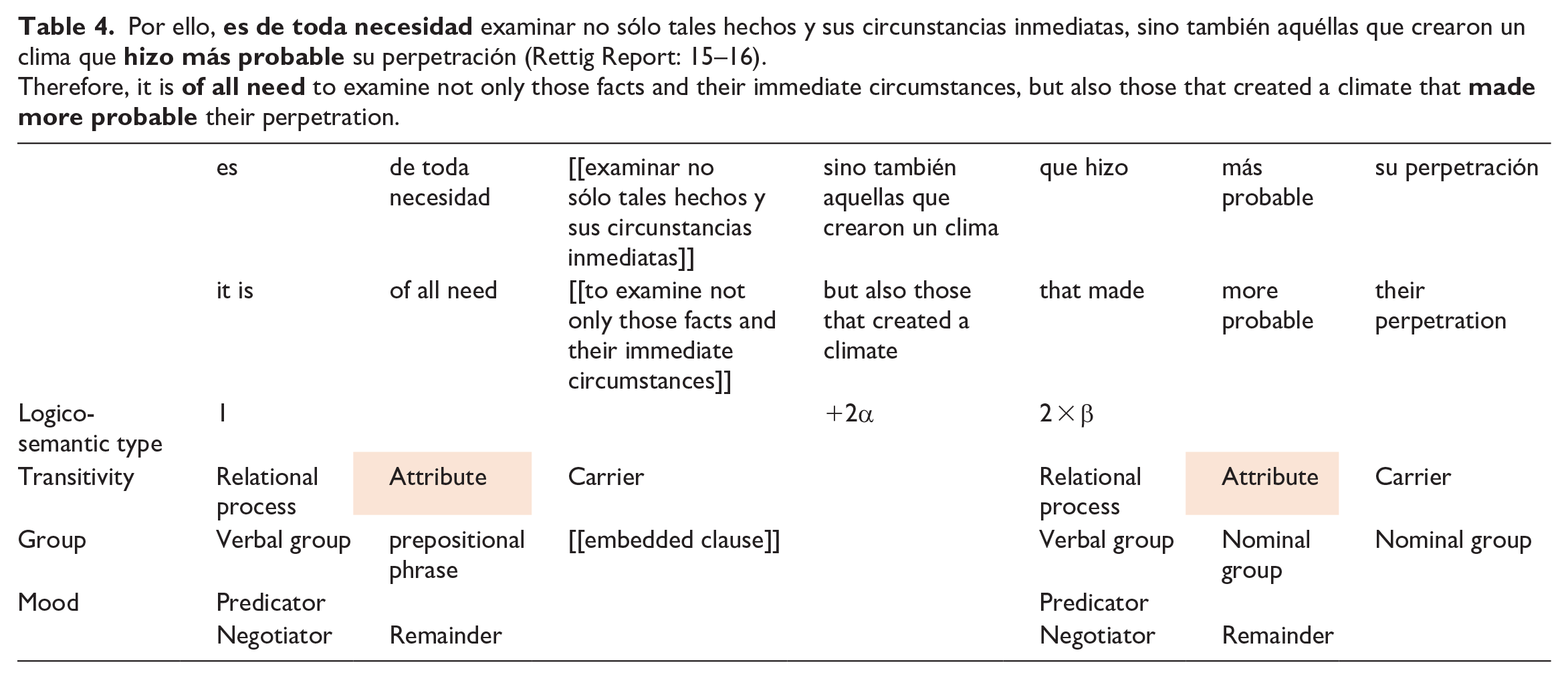
In the next modality move of this fragment, the Commission resumes the contextualization and presents it as a consequence of the mission just stated (Por ello/Therefore). The contextualization is realized this time resorting to resources of obligation and probability. Table 4 shows those resources.
The obligation assigned to the contextualization in this fragment is objectively expressed through a relational process whose Attribute is a prepositional phrase, sharpened as Focus: fulfilment in the system of graduation (de toda necesidad/of all need). Halliday and Matthiessen consider these as ‘intermediate cases’ in the cline implicit–explicit, due to the halfway status of prepositional phrases between clausal and non-clausal (Halliday and Matthiessen, 2014: 688).
Then a high probability meaning is established between ‘the climate’ (the situation addressed in the contextualization) and the human rights violations, objectively codified as a quality through a relational process. The Attribute is graduated by intensification (más probable/more probable) in the system of graduation and the Carrier is instantiated as a nominalization (su perpetración/their perpetration). As the meaning modalized correspond to past events, the high probability is expressing the inevitability of such events. 9
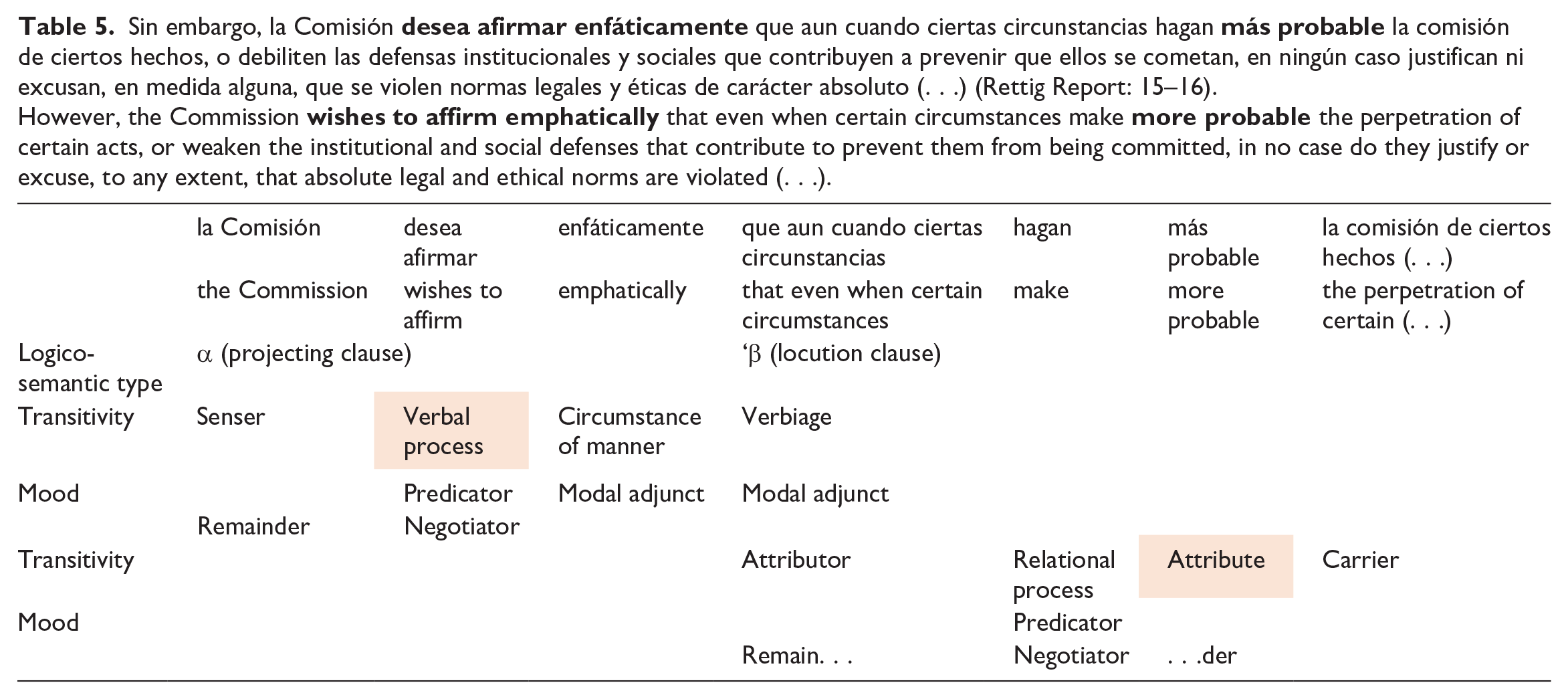
The final move in this modality sequence sets a contracting dialogic stance of counter-expectation: the probability nexus established between ‘certain circumstances’ and ‘the perpetration of certain acts’ does not imply the justification of the latter by the Commission. Table 5 displays the realization of resources of modality here involved.
First authors resume a subjective positioning through a modalized verbal clause (desea afirmar/wishes to affirm) graduated as intensification through a Modal Adjunct (enfáticamente/emphatically). The lexical verb desear/to wish conveys the meaning of subjective, metaphorical inclination, since the modalized proposition is realized as a projected locution clause. This projected clause, in turn, expresses probability as a quality that, as in previous examples, is graduated by intensification (más probable/more probable). The circumstances described by the commission in their contextualization serve as Attributor to this Relational Process, namely, a participant responsible for the attribution instantiated.
In the fragment analyzed in Tables 1–5, we can see that the Commission construes its argument about the relationship between the Chilean situation previous to the coup and the human rights violations mainly through objectively modalized meanings of obligation and probability, realized congruently and metaphorically. The authorial voice is explicitly presented in two occasions, in both cases as part of counter-expectation constructions, to justify a contextualization that is not part of the Commission’s mission, and to clarify that the probability nexus established does not justify the perpetration of human rights violations.
In the first one of these interventions (Table 1) the dialogical opening achieved by a resource of Entertain in the system of engagement (la comisión ha creído/the Commission has deemed) is immediately closed by the modality meaning of obligation objectively expressed as an Attribute (indispensable). This shift from dialogic expansion to contraction and from subjective to objective positionings, together with the counter meaning of the fragment, exemplifies the tensions surrounding the elaboration of the report: the search for a sensitive equilibrium between the presence of authors in their text and the need to legitimize the contents, presenting them as objective and external to the authorial voice. In the fragment as a whole, the modality resources analyzed play an essential role in the presentation of a contextualization that explains but does not justify the human rights violations perpetrated during Pinochet’s dictatorship.
In the next section, examples are analyzed showing how the authors address the contextualization provided in the report, especially in relation to the social actors involved.
Explaining the past: Polarization and crisis
Tables 6–9 hereunder present the analysis of the modality meanings involved in the description of the Chilean situation before the coup, particularly the polarization of the Chilean society as part of a general social crisis and the reasons that motivated the participation of the Armed Forces in the coup.
La crisis de 1973, en general,
The crisis of 1973, in general,
Ninguno de estos bandos logró (
Neither of these sides managed (
Tales tendencias se daban tanto en la que
Such tendencies occurred both in what
Es muy probable que, amén de estas causas, empujara también a las Fuerzas Armadas y de Orden -en la dirección de asumir el poder- la corriente ideológica que existía en su seno (Rettig Report: 32).
It is very likely that, in addition to these causes, it also pushed the Armed and Law Enforcement Forces – in the direction of assuming power – the ideological current that existed within it.

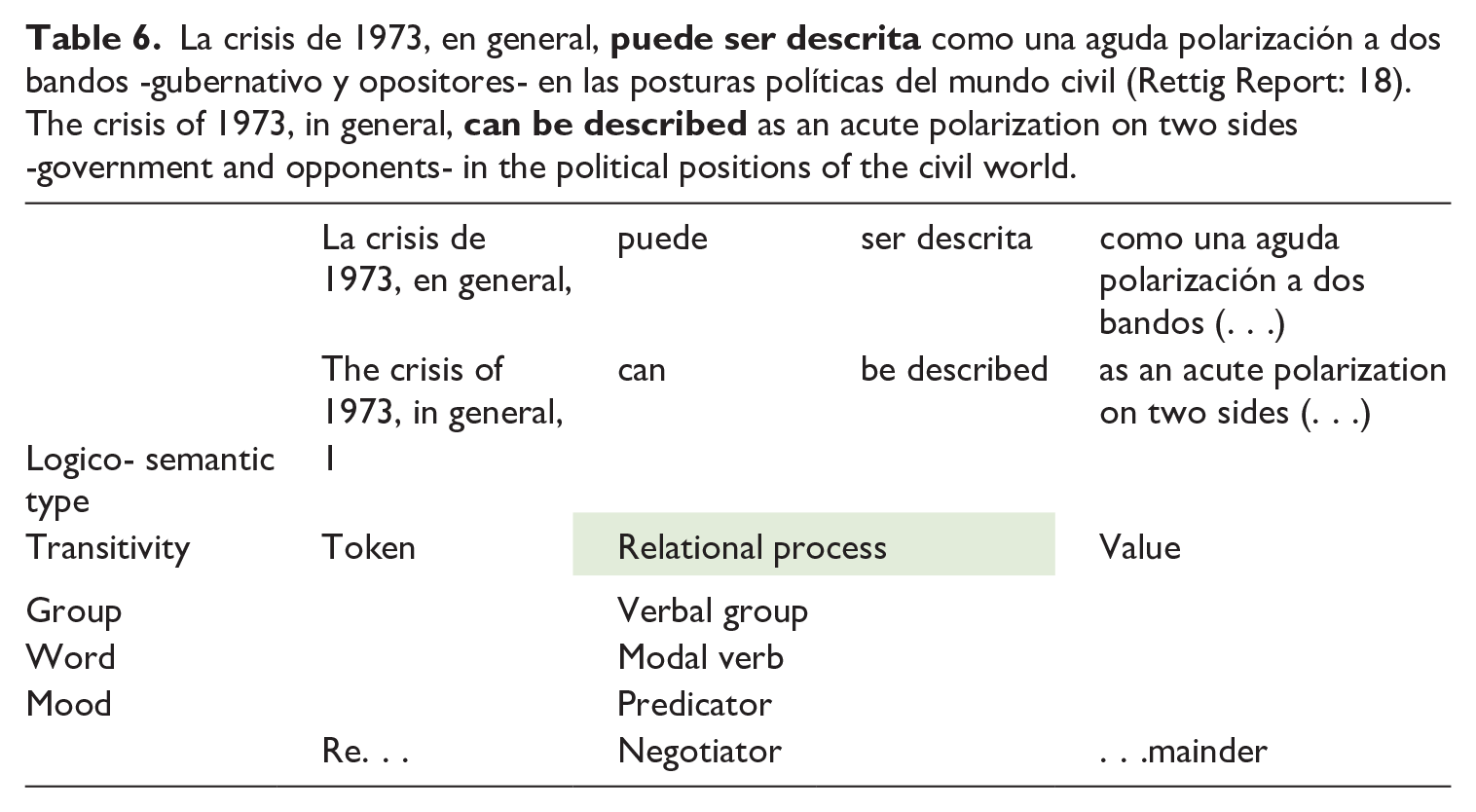
Table 6 shows the modality resources displayed by the Commission when addressing the ‘division among Chileans’ as part of the situation described.
In describing the ‘crisis of 1973’ the authorial voice chooses a passive construction 10 making use of the modal verb poder (can). The modalized meaning in this clause is an identifying relational process that symbolically relates a Token (‘the crisis’) with a Value (‘an acute polarization’). The meaning achieved by this instance of objective modality expresses ability, considered the lowest extreme in a continuum that groups ability and inclination, denominated as readiness by Halliday and Matthiessen (2014: 696). 11
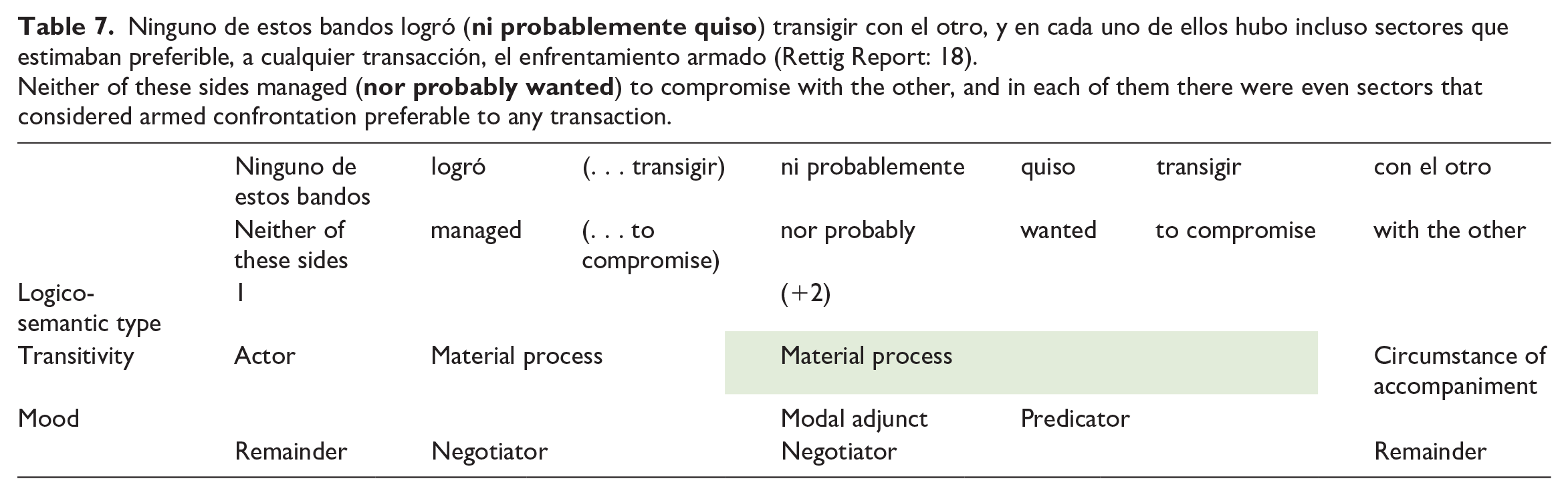
Table 7 below shows the modalized meanings being part of the rest of the description regarding the groups confronted in the polarization presented.
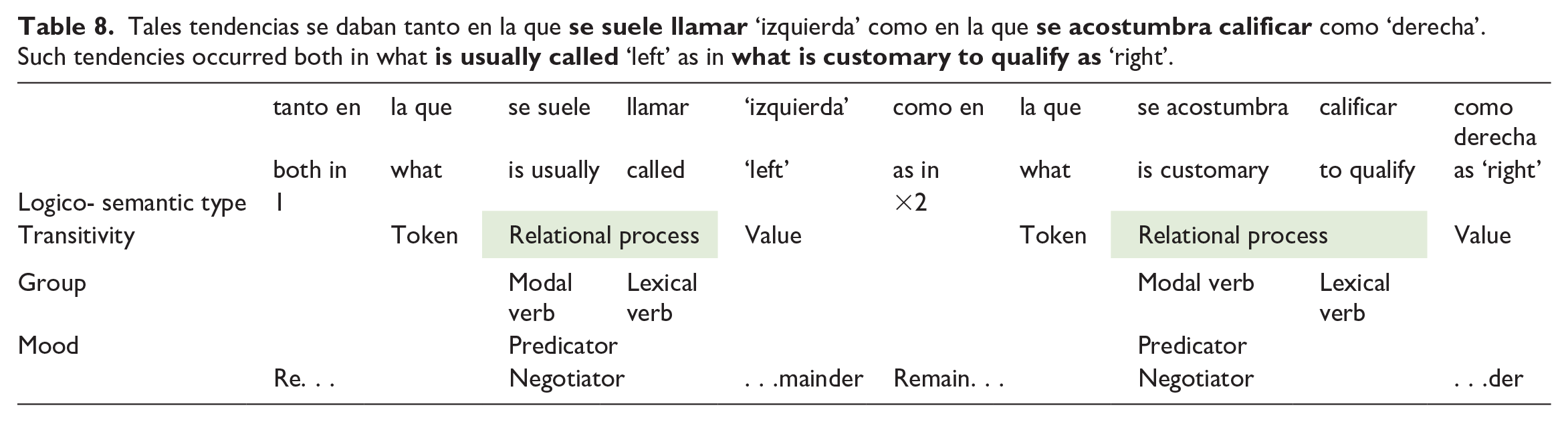
Both clauses express material processes (manage to compromise and wanted to compromise) with each side of the polarization as Actor. The second clause is congruently modalized in terms of probability by means of a Modal adjunct (probablemente/probably). As the modalized meaning concerns the lack of disposition of these social actors to reach an agreement, and in fact, the preference of some ‘sectors’ for the direct, armed confrontation, the authorial voice is establishing a negative evaluation of these participants, activating the attitude system as a negative judgment. The objectively presented meaning of low probability, along with the use of parentheses, contribute to reducing the force of this negative assessment.
Later in the discourse, the authors denominate the social groups being part of the polarization described. Table 8 below presents the analysis of the modalized relational processes involved in this part of the report.
The Commission presents the ‘tendencies’ previously mentioned (i.e. a preference for an armed confrontation and a general disregard for democratic procedures) as existing in both sectors being part of the polarity described (supporters and detractors of Allende’s government) by means of an existential process (se daban/occurred). As part of a Circumstance of extent, two embedded clauses in a paratactic relation of enhancement label these groups as ‘left’ and ‘right’, relying on Identifying relational processes (llamar/to call and calificar/to qualify). Both of these processes are congruently modalized in terms of usuality by the use of modal verbs soler and acostumbrar, 12 which intensify the processes as high frequency in the system of graduation.
As the identifying relational processes in this fragment are presented using the impersonal form, their Assigner, that is, the one who denominates these groups using the mentioned labels, can be traced to the Chilean society at the time of the Report’s publication. This form of non-specified Attribute in the system of engagement, together with the modalized meaning of usuality, allow the Commission to manage the responsibility concerning this labeling: it is not the Commission itself, but the Chilean society that denominates these sectors that way.
Tables 9 and 10 examine examples of the discourse in which the Commission connects the crisis previously illustrated with the participation of the Armed Forces in the coup d’état. Table 9 below shows how the crisis (expressed in the discourse as ‘these causes’) and an ‘ideological current’ inside the institution are presented as the main reasons for such participation.
Y las circunstancias de la crisis favorecían a los uniformados de esa doctrina, y desfavorecían al sector,
And the circumstances of the crisis favored the uniformed members of that doctrine, and disadvantaged the sector,
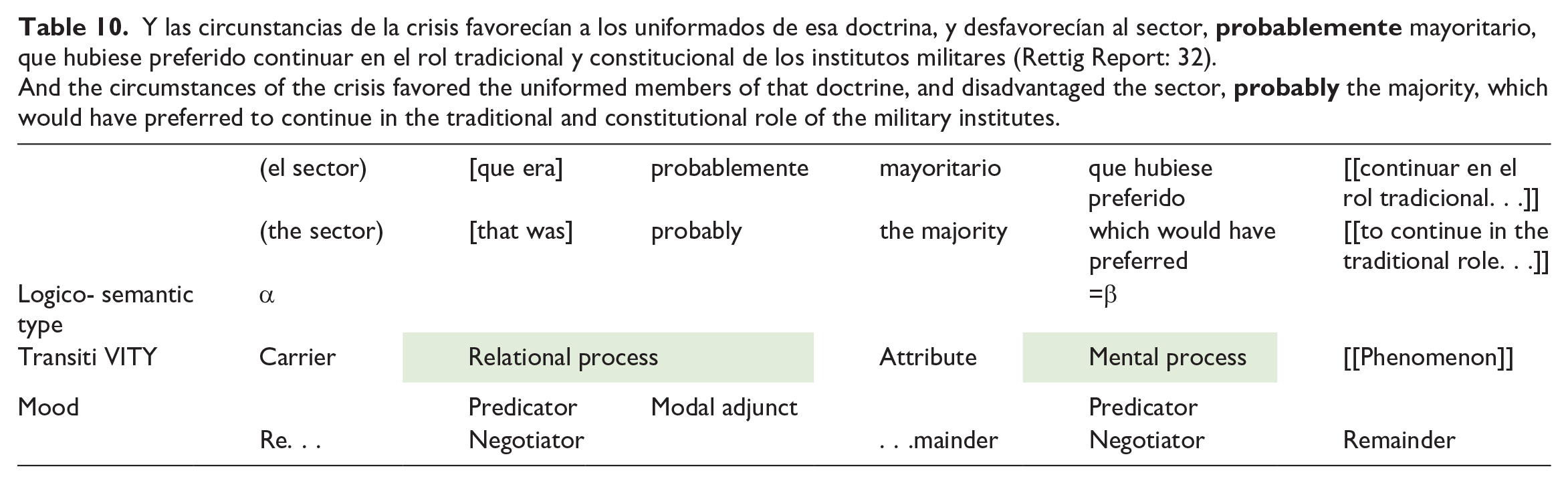
An objective, metaphorical high probability meaning is construed using a Relational Process that connects an intensified Attribute (muy probable/very likely) with a secondary elaborating clause as a Carrier. In this clause, both the ‘causes’ and the ‘ideological current’ that sought to establish an authoritarian regime 13 are presented as Actors in a Material Process (empujar/to push). As the ‘causes’ are realized as a Circumstance of accompaniment, their influence in the actions of the Armed Forces is presented as a given. The lexical meaning of the verb empujar (to push), together with the probability meaning assigned to the proposition, contributes to the presentation of this social actor with a reduced agency: it was the crisis and a certain ideological trend which led the army to an action that otherwise would have been avoided. This interpretation is further developed next in the discourse, as shown in Table 10 below.
A meaning of congruent, high probability is achieved as part of a Relational process that reinforce, in the system of graduation, the extension of the sector within the Armed Forces that did not follow the ‘ideological current’ previously mentioned. This same social actor operates as Senser of the Mental Process preferir (prefer) in a secondary, elaborating clause. The lexical meaning of this verb expresses inclination, subjectively presented, as it is attributed to members of the Armed Forces, and congruently realized, since the modalized meaning is conveyed by the Predicator being part of the Negotiator. Both, the inclination toward the ‘traditional and constitutional role’ of the Armed Forces and the high quantification regarding the extension of this group contribute to its positive evaluation in the discourse.
From the analysis presented in Tables 6–10, we could see that the Commission uses resources to modalize its interpretation of the events previous to the coup, in terms of probability, ability, and inclination. In dealing with the social actors involved in ‘the crisis’, the authorial voice equates the responsibility assigned to the sectors participating in the polarization and presents modalized negative evaluations of both sides identified. Nevertheless, the Armed Forces appear with positive evaluations concerning the desire of its members to participate in the coup: the agency for such intervention is assigned to a reduced group inside the institution, and resources of probability and inclination serve this purpose.
Authors also make use of usuality meanings to identify the social actors, other than the Armed Forces, that participated in a situation branded as a crisis. All of these resources are deployed in a historical explanation of a conflicting recent past (especially considering the date of publication of the report, the second year of Patricio Aylwin’s transitional government) and express the Commission’s attempt to demonstrate impartiality while at the same time communicate the ideological positioning of its members.
Justifying the mission: The voice of the Commission
To conclude the analysis, we would like to examine some modality resources deployed in the way the Commission defines and justifies its mission. Table 11 shows one of the formulations authors use to refer to their mission, in this particular case, using a noun to metaphorically establish an obligation.
Al asumir sus funciones, esta Comisión estimó su
Upon assuming its functions, this Commission considered its primary
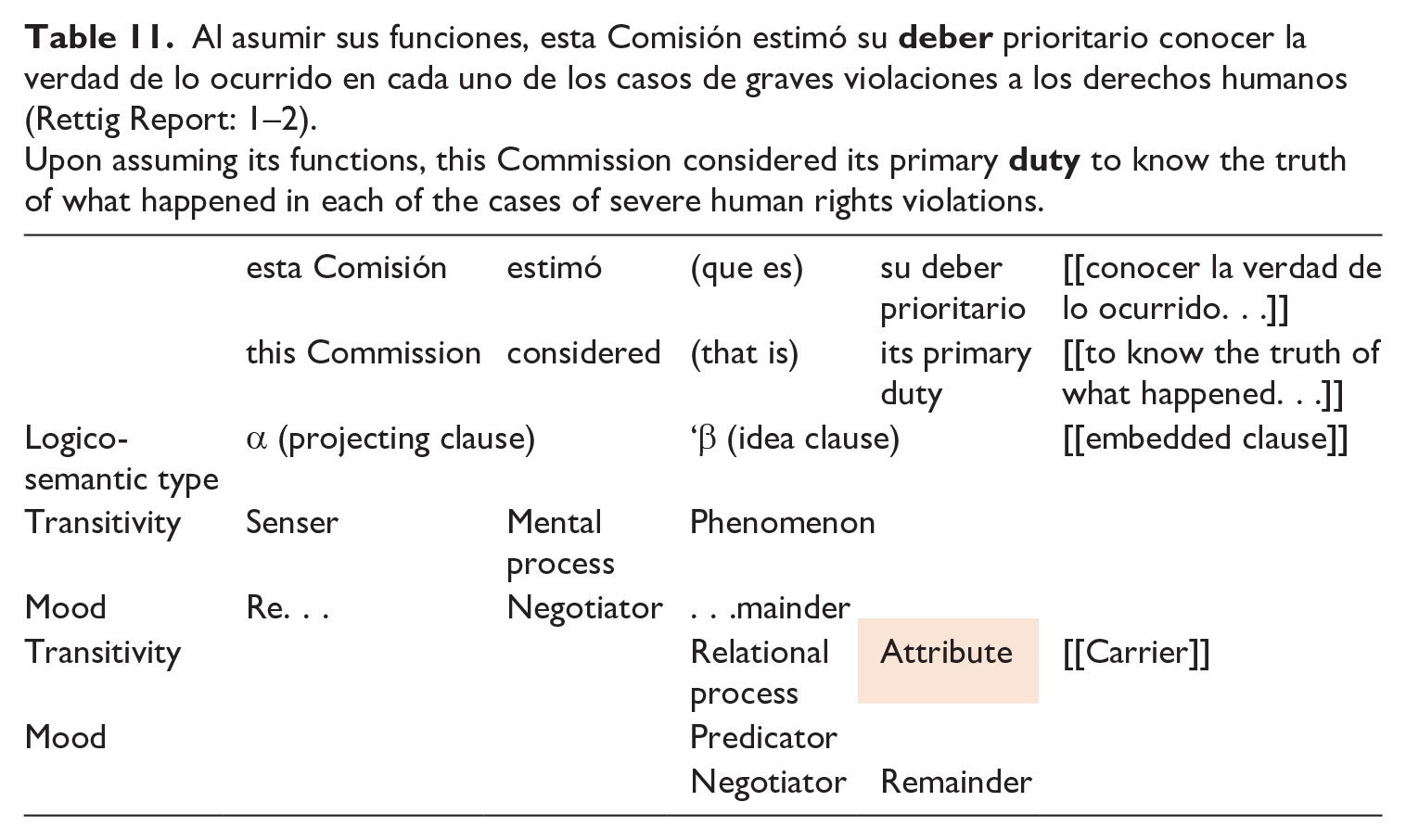
From an expansive, subjective dialogic stance, the Commission states its mission as a Phenomenon of a Mental process that involves it as Senser. In the idea clause, a meaning of obligation is presented metaphorically as an Attribute in an elided Relational Process, reinforced as intensification in the system of graduation: deber prioritario/primary duty. As in Table 1 above, the dialogic opening signaled by the mental process is immediately closed by a modality meaning realized objectively as an Attribute. The presence of the authorial voice in this example contributes to its positive evaluation in terms of judgment, in that the mission is not only externally assigned to, but also embraced by the Commission, as can be seen in the selection of a mental process of cognition that restores agency to authors in the task delegated. The selection of a Thing as a form of objective, metaphorical obligation, on the other hand, serves the purpose of presenting the mission as incontestable.
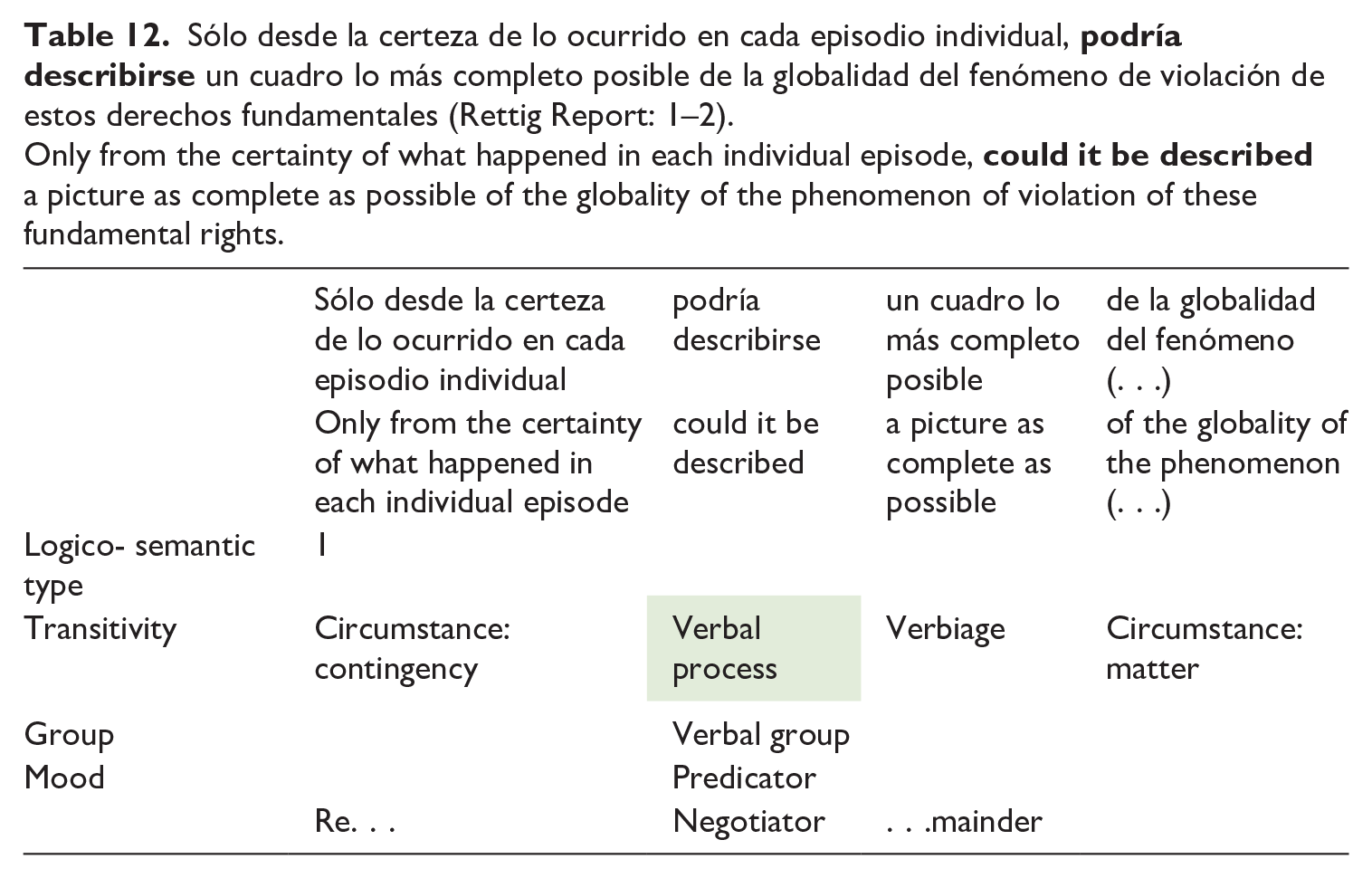
Next in the text, the authors refer to the importance of their mission. Tables 12 and 13 present the modality resources involved:
Sólo desde la certeza de lo ocurrido en cada episodio individual,
Only from the certainty of what happened in each individual episode,
El conocimiento de esa verdad particular
Knowledge of this particular truth
Using a resource of Counter in the engagement system (Sólo desde. . ./Only from. . .) that dialogically excludes other possible interpretations, authors address why it is important to report on the human rights violations, stating that such a report (la certeza de lo ocurrido/the certainty of what happened) could make it possible for the Commission to give an accurate depiction of ‘the globality of the phenomenon. . .’. This meaning of ability is congruently achieved by a modal verb (poder/can) that modifies a verbal process (describir/to describe). As the modal verb is in conditional verb mood, the feasibility of the description carried out by the Commission is presented as a possibility, combining, therefore the meanings of ability and probability. 14 The use of the impersonal form indicates an objective modality, not connected with the authorial voice as the producer of the description provided in the report.
Notice also that the meaning of probability is expressed as well in the qualifier of the nominal group that constitutes the Verbiage (lo más completo posible/as complete as possible) that graduates the modalized process in terms of focus as fulfilment in the system of graduation. In other words, the Commission is expressing that its goal (to give a comprehensive picture of the human rights violations) is constrained by the possibilities that such a complex task imposes. Finally, a Circumstance of Matter collaborates with a prosody of reinforced meanings regarding the extent of the issue handled by the Commission (la globalidad del fenómeno/the globality of the phenomenon).
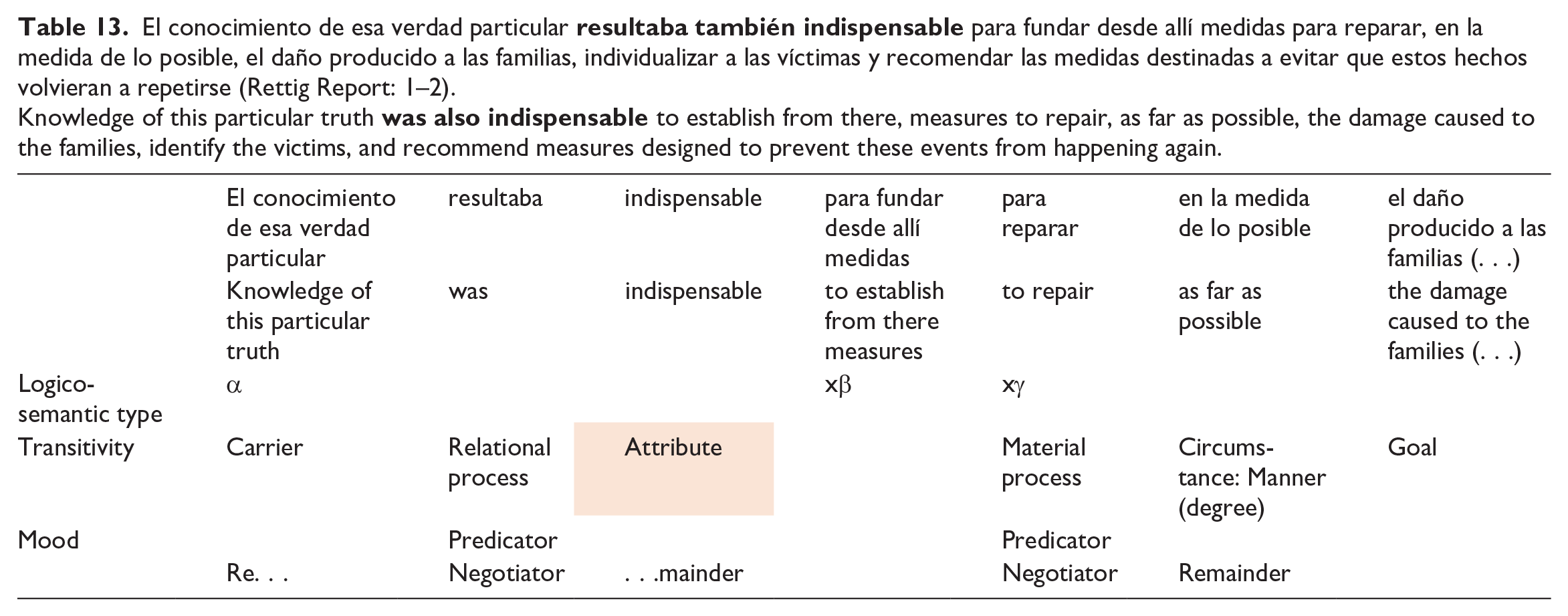
Table 13 displays yet another aspect about the importance of the mission, that is, reparation to victims and prevention.
As in previous examples, the Commission resort to an Attribute (indispensable) to establish an objective, metaphorical meaning of obligation, in this case regarding knowing the facts dealt with in the report (El conocimiento de esa verdad particular/Knowledge of this particular truth). Further enhancing paratactic clauses refer to reparation to the victim’s families, in which the material process reparar/to repair is graduated as fulfilment by a Circumstance of Manner.
The analysis presented in Tables 11–13 showed the modality meanings involved in the way the Commission presents its mission and circumscribes its actions. While the mission is presented objectively as an obligation, its consequences (i.e. the actions carried out by the Commission) are construed as modalized meaning of ability and probability. In examples 12 and 13, Circumstances of Manner are used to delimitate, in terms of possibility, the scope of the Commission’s actions as stated by the mission: to report the human rights violations accurately and comprehensively, to contribute to the reparation to victims and families and to recommend measures to prevent similar events in the future. In concert with other modality resources, congruently and metaphorically realized, these Circumstances collaborate to give shape to a prosody of modalized meanings regarding the Commission’s performance. The display of these resources in the fragments analyzed can be interpreted as a form to exempt the Commission from a full responsibility in the fulfilment of its mission, in that these inherently complex duties pose limitations that the Commission could not have overcome.
Final remarks
In this article we examined the role of modality meanings in the historical explanations presented in the Rettig report concerning the events and processes that led to the coup d’état in 1973 in Chile and the human rights violations perpetrated during Pinochet’s dictatorship. In particular, we examined how congruent and non-congruent realizations of modality collaborate with the authors’ interpersonal positionings in the system of engagement, in relation to the contents presented as well as their own role and responsibility regarding these contents. The analysis described modality resources at the lexicogrammatical level taking into account type, value, and orientation. The logical, experiential, and interpersonal organization of the clauses analyzed were also considered.
In providing and justifying the historical explanation to the events reported in the document, authors rely mainly on objective expressions of modality, using a range of resources along an axis from congruent to metaphorical. Figure 3 below shows an overview of these resources with examples found in the report.
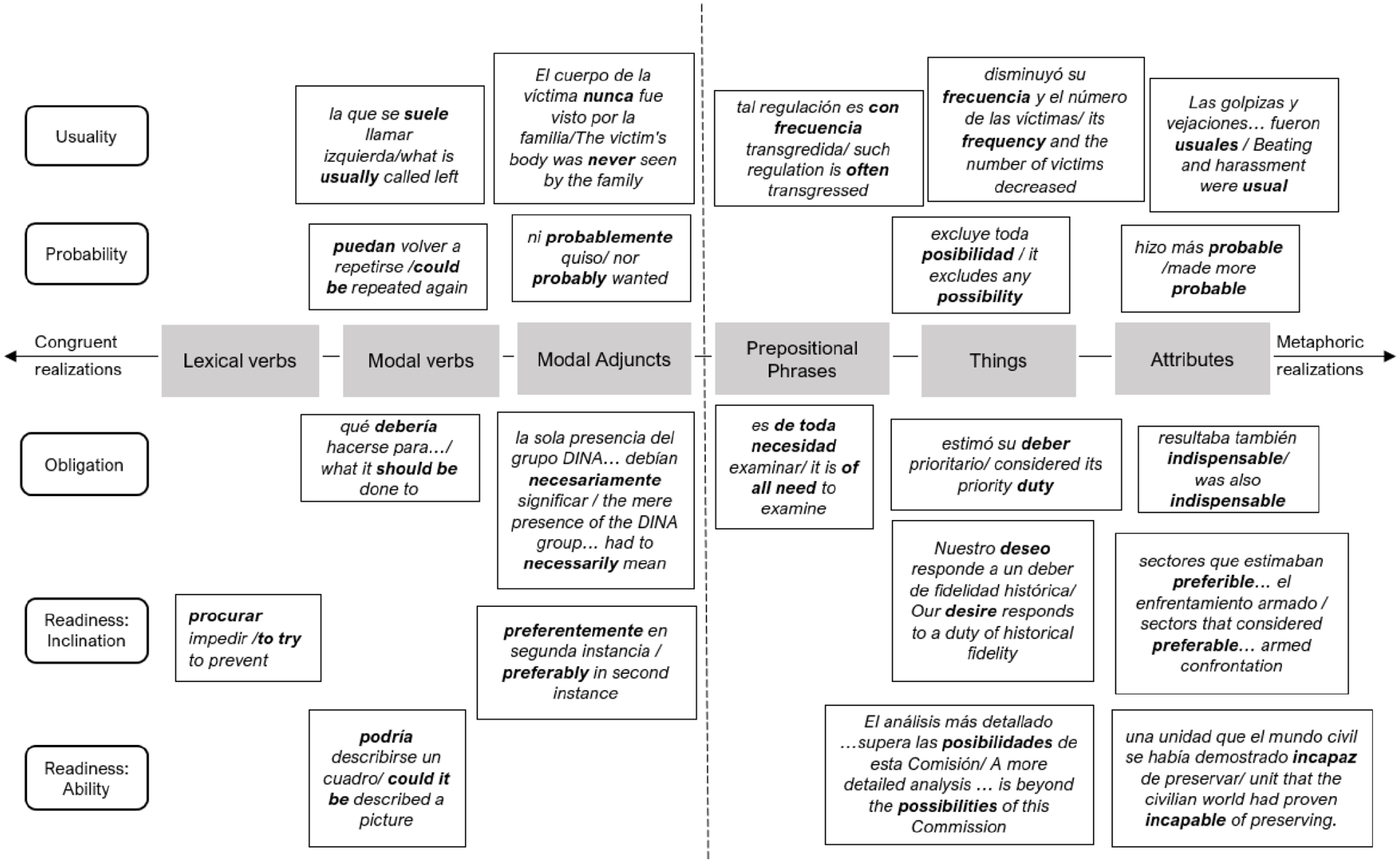
Modality resources implicated in objective modality in the Rettig Report.1
As can be appreciated in Figure 3, lexical and modal verbs are considered the most congruent forms of objective modality realization, as they are part of the Predicator inside the Negotiator. Modal Adjuncts also constitute congruent expressions of modality, being part of the Negotiator and therefore expressed as part of the same clause. Prepositional phrases are closer to the metaphorical end of the continuum, as they realize modality as part of the same clause but outside the limits of the Negotiator. Relational processes with modal Attributes are the most metaphorical way analyzed to construe objective modality in the corpus since they upgrade the modality from group rank to clause rank (Halliday and Matthiessen, 2014: 687). Finally, modality as Things is also considered metaphoric since the modality is conveyed outside the Negotiator but usually as part of the same clause.
This range of modality resources, as discussed above, play a fundamental role in the negotiation of meanings in the Report concerning the justification for the explanations provided, the experience construed in such explanations, and the authors’ mission and results.
The Commission relies on objective expressions of obligation that allow them to construe the ‘contextualization’ presented as a necessity and a duty externally assigned to them, instead of the will or desires of its members. The objective, metaphoric modality resources contribute to close the dialogic space from a subjective stance that involves the authors’ voice to an objectively expressed obligation that legitimizes it in addressing such a complex matter as the human rights violations and their preceding context. On the other hand, high probability meanings metaphorically expressed are used to establish a causal relationship between the described crisis preceding the coup and the human rights violations perpetrated during the dictatorship. This ‘weaker’ way to express causality allows the Commission to distance itself from a discourse that can be interpreted as a justification of the human rights violations, a position that the Commission itself recognizes and actively denies (see Table 5 above).
Modality meanings of inclination and probability are used to portray the social actors involved in the historical explanation provided, regarding their willingness to participate in an armed confrontation and the extent of each position inside groups. Accordingly, a prosody of negative evaluation in terms of judgment is construed regarding the actors that are part of the civil society, in contrast to the positive evaluation of the armed forces. Authors also resort to usuality meanings to distance themselves from the labeling used to describe these groups, which confers them a sense of impartiality that further validates their discourse.
Finally, the scope of the Commission’s labor results is circumscribed in terms of probability and ability, which, in concert with circumstances of Manner, contribute to limit the responsibility of its members and to evoke a positive judgment of their tenacity, considering the inherent difficulties of the actions carried out.
Through this exploration of the different realizations of modality meanings in Spanish language and their contribution to dialogic positionings negotiated in the presentation of historical interpretations of a recent, traumatic past, we were able to outline the range of their meaning potential, particularly in objectively presented meanings. Further investigations could shed light on the modality meanings involved in subjective dialogic stances in other fields in Spanish language.
Footnotes
Declaration of conflicting interests
The author(s) declared no potential conflicts of interest with respect to the research, authorship, and/or publication of this article.
Funding
The author(s) disclosed receipt of the following financial support for the research, authorship, and/or publication of this article: FONDECYT 1220347 research grant (National Funds for Science and Technology Development, Chile).