




Abstract
In response to the threat of COVID-19, China initiated a nationwide campaign. Ideological work such as explaining the implemented policies and persuading the public always took a central role in mobilization, and it has been emphasized by Chinese government during Covid-19 as well. The legitimation discourse used in the campaign is the focus of the current study. The investigation takes into consideration the political logic of the relationship between the central and local governments as well as their working mechanism. More specifically, a total of 84 open letters written by the local governments to mobilize residents during the COVID-19 pandemic were analyzed. The study integrated the CDA perspective, legitimation theory, and campaign-style governance and examined what ideological discourses are constructed in the open letters, what type of authority is constructed for legitimation, and what is the main communication style used. In addition, the study paid attention to the patterns among the different local government ranks. The findings revealed that moral appeal and political authority were the key elements of legitimation discourse, but governments with lower ranks exhibited a trend of de-ideologization. Meanwhile, impersonal politeness and direct bold command contradictorily co-existed in open letters of basic level local governments. These finding reveal that despite the top government’s centralized power, realization of ideological work in a national campaign is confined by the divergent and complicated realities of local governments.
Introduction
The worldwide pandemic has not only transformed the way people live their lives, but also exposed the essential differences among the political models of various countries. The major ways of coping with COVID-19 are often defined by the framework of an authoritarian order or constitutional order (Chang, 2020), and the Chinese way of coping with the pandemic has often been broadly classified by researchers into an authoritarian type. The governance during the pandemic that is considered uniquely Chinese in style is, ‘embedded in the country’s authoritarian system and socio-economic context’ (He et al., 2020), and is characterized as a ‘strong and determined central government that is playing a key intervening role to handle the pandemic’ (Chang, 2020). In fact, the central government does not exert its power by directly mobilizing the citizens, but by mobilizing the hundreds and thousands of local governments in China to take actions and mobilize citizens efficiently and coherently. The dynamic relationship between the central and local governments and their working mechanism is considered to be the basic logic of Chinese political power (Zhou, 2017). Nonetheless, one of the significant problems in this structure is that because of the formidable scale of governance in China, the centralization of authority inevitably leads to separation between policymaking at the center and policy implementation at the local levels, sometimes represented as problems in the functioning of the local governments such as lack of autonomy and shunning of responsibility (Zhou, 2017). Weeks before the outbreak of COVID-19, Wuhan’s failure to respond and create a high alert for the new virus was perceived to be a manifestation of such a problem. Xueguang Zhou points out that this problem has been ‘built into the Chinese bureaucracy for years’ and the pandemic crisis has ‘exposed the cracks in the system’ (Ronkin, 2020). To cope with this urgent crisis, the Communist Party of China (CPC) initiated a large-scale mobilization of the whole nation, to efficiently control and prevent the pandemic. In this process, the problems and mistakes of local governments that could have been barriers against the campaign were resolutely corrected or rectified by the central government.
While COVID-19 studies under a campaign framework mainly focus on the crucial question of the effective government strategies to realize large-scale mobilization (e.g. Cai et al., 2022; Mei, 2020), the ways to explain and justify those actions have not received sufficient attention. In the series of meetings held by President Xi during the pandemic, public opinion and ideological work have always been treated as paramount as the concrete pandemic control measurements. This study attempts to investigate the patterns of mobilization discourse in the context of the COVID-19 pandemic. While previous studies often paid attention to the mobilization discourse conducted by the central government, the current study believes that the importance of legitimation work is equally salient in the process through which local governments mobilize their residents as well. It is interesting to note that the countryside mobilization discourse posted on the internet in 2020 such as cadres persuading villagers to follow the pandemic control measures through songs, opera, or even clapper talk has attracted much attention of the public. A combination of mobilization and popular art is reminiscent of the old mobilization discourse during the times of the revolution. It also reveals the underlying logic of utilizing a more traditional political power for this nationwide campaign. That said, compared with daily broadcasted political communication such as press conferences or experts’ interviews, research emphasis on the communication by local officials such as that of village cadres may better reveal the discursive construction of the political logic in the context of the pandemic where an extremely challenging task was to persuade the local residents to give up certain freedoms for the collective well-being. China’s traditional political communication also prefers a face-to-face style: in the early phase of new China (founded in 1949), this task was accomplished by the publicity team with numbers large enough to cover the whole nation; with development of a communication network in bureaucracy and through mass media, the task has been transferred to the local political elites (Townsend and Womack, 2003: 156). Nonetheless, the mobilization conducted by village cadres mentioned above cannot address hundreds of cities in China. This study, therefore, chooses the political communication by local officials (cities, towns, villages, and districts) in the form of ‘open letters’ as data. These letters were made an administrative requirement by the central government after the outbreak of COVID-19. An open letter is normally perceived to be an announcement made for an influential issue, in which an explanation or persuasion is required (Shu, 2016). One of the most widely discussed official open letters in China has been the one about the one child policy in 1980. However, no academic work has focused on the genre of the open letter as a political discourse. Only some guideline books about this type of political writing in the government exist, or some scattered information can be found in studies on political communication or organizational sociology. Also, it is unusual for the central government to send an explicit administrative requirement to the local governments to write open letters. This emphasis on the political communication at the local level demonstrates the urgency and importance of legitimation and ideological work in a context where the central government was determined to control the pandemic and keep people healthy. It was an ‘overwhelming’ task that required undertaking certain challenging and controversial strategies such as social distancing and quarantine.
This study aimed to examine the legitimation pattern of the mobilization discourse by raising three questions: (1) What ideological discourse is constructed in the open letters to explain the pandemic control measures and persuade the residents? (2) What type of authority is commonly constructed for legitimation? (3) What is the main communication style used in the open letters? The investigation of these questions falls under the framework of ‘the inner workings of the Chinese bureaucracy’ (Zhou, 2017). That is, the analysis includes locating patterns among different ranks of local governments. To answer these questions, the study adopted campaign-style governance as a theoretical framework. Campaign-style governance refers to the top-down mobilization initiated by the government to cope with emergencies or other challenging problems that seriously affect society; the mobilization often breaks the routine political order in a violent but organized way (Feng, 2007, 2011; Shan, 2008; Zhou, 2017). In addition, to explore the way non-routine political activity is explained and justified, the CDA framework and legitimation theory (Rojo and van Dijk, 1997; Van Dijk, 1998; Van Leeuwen, 2007) were utilized.
Campaign-style governance
Zhou (2017) argues that the entire logic of Chinese governance is based on the deep-rooted contradiction between a unitary system and effective governance, manifested in the relationship between the administrative powers of the central and local governments. For example, too tight a control will lead to loss of energy in local development, but loose governance may cause the problem of inefficient implementation of the central government’s policy or power abuse by local officials. Although such a contradiction is difficult to eradicate, an effective method to deal with the problems derived by such system is campaign-style governance (Zhou, 2017). Mobilization in fact is not a strange concept for Chinese people: during the period between 1949 and 1979, there were a total of 68 campaigns; some of the most famous ones are the Rectification Campaign and the Great Leap Forward (Zhang, 2000).
Though Chinese mobilization has long been a topic that attracts Western researchers’ interest, the concept of ‘campaign-style governance’ is mainly adopted by local researchers. One representative researcher is Feng (2011), who sees the mobilization from a perspective of a ‘revolution-edification regime’: the regime has a strong will to transform the society, and meanwhile, the transformation capability is considered as a fundamental basis of ruling legitimacy. Feng sees the mobilizations as continuous with those before 1978s open door policy, as they share some common characteristics such as being non-specialized, non-institutionalized, and non-routinized; however, some other researchers tend to view mobilizations before and after 1978 as different types, namely, the political movements and the governance strategies (e.g. Shan, 2008; Tang, 2007). Researchers have also observed institutional changes during such top-down mobilizations: usual organizational relationships are often broken, the conventions formed in routine administrative practice are sometimes challenged, and most often, various temporary organizations are constructed parallel with or above those in the original vertical hierarchy (Cai et al., 2022; Feng, 2011). In Zhou’s (2017) opinion, in fact, campaigns are often initiated to correct problems when the routine mechanism gradually solidifies the boundary between administration practice, but might weaken the stability and efficiency of bureaucratic organizations. Furthermore, the mobilization might cause problems such as high institutional costs or redistribution of institutional legitimacy (Cai et al., 2022).
During the COVID-19, the question of how the Chinese government realizes its unprecedented social control such as strict community lockdown has attracted research interest. The city of Wuhan was the first to declare a lockdown on January 23, 2020, followed by all other cities in Hubei Province. In total, 22 provinces and autonomous regions successively launched the level-1 emergency response. During the strictest period, residents were not allowed to leave their houses, and food supplies were delivered by community workers and voluntarists. Research on the ways this scale of mobilization is realized focuses on the coordination between the central and local governments, facilitated by mechanisms such as social media (Li et al., 2020) and grid system (e.g. He et al., 2020). Cai et al. (2022) study the realization of effective crisis governance during COVID-19 under a framework of campaign-style crisis governance. Mei (2020) find that the strict community lockdowns were made possible by the traditional strategies compatible with China’s policy style that features ‘centralized leadership, bureaucratic mobilization and collective memories of the right policy of previous crises’.
The top-down chain during the COVID-19 is also manifested in the institutional structural change and non-routine administrative measures. During the pandemic, the Center for Disease Control did not take an authoritative position mainly because of its relatively low administrative level and power. Instead, the Central Leading Group – set up on January 25, 2021 – makes the decision for epidemic prevention and control. The Central Leading Group works under the leadership of the Central Politburo Standing Committee of the CPC and sends commands directly to the subordinate departments and local governments. This command-control chain further includes hundreds of headquarters set up in local governments throughout the country (Cai et al., 2022). Furthermore, unusual measures are adopted to guarantee the effectiveness of top-down campaign, such as the removal of provincial leaders in Hubei Province and Wuhan City, and the large number of officials sent from upper-level governments to communities (Mei, 2020).
Political communication in mobilization
Political communication during mobilization has been a noticeable strength or symbol of the CPC: early during war time, a publicity team was set up in each troop of the red army, publicity organization set up in each hierarchical level of government in anti-Japanese base area; both routine activity and military activity were integrated with propaganda discourse; there were various forms of media such as announcements, pamphlets, slogans, wall newspapers, and journals (Jiang, 2011: 60). Some of the procedures and discourse structures have been retained after the establishment of new China. The process of top-down mobilization in contemporary China was inferred as follows: First, an official document is released by the central committee or the state council or in the form of an editorial or commentator’s article in People’s Daily (China’s official newspaper); second, the information is transmitted hierarchically inside the bureaucratic system; the third step is to transfer the information or requirement mostly from the local cadres to the ordinary people; the last step is to set up certain good examples or role models effectively carrying out the policy (Wang, 2006). In such a process, the communication inside the bureaucratic system is characterized as that the policies are made after careful consideration by the top government, and then required to be efficiently transformed and rigidly carried out; the communication between government and the public is characterized as emphasizing and reinforcing the importance of certain argument and ways to realize the goal (Jiang, 2011: 172–173). To achieve the goal and customize the information for the populations with relatively low levels education, the communication style is generally explicitly informal one with a conversational tone, such as the simplification of principles into catchy phrases and numbers so that they can be memorized by the public (Jiang, 2011; Townsend and Womack, 2003: 152).
Nonetheless, under the new ruling idea of governance in China, and especially with the development of online media and a population with a much higher levels education than before, the communication strategies of the government have shifted (Liu, 2021: 16). A change widely discussed in literature is the popularity of electronic communication. Until 2014, 6564 governmental organizations had used WeChat and weblog (Chen and Pan, 2014). According to the report on e-government by United Nations in 2020, China’s index of e-government ranked 45th in the world. Some studies identify the change in style to be the party’s attempt to improve ‘political communication’ under a governance framework (Jing, 2014: 263). Correspondingly, a large-scale campaign has been rare in recent years – most of them have been integrated into the regular bureaucratic mechanism and have been normalized and made more professional (Jia and Wang, 2020). However, during the period of COVID-19, we witnessed a return to the classical type of national campaign and an old-fashioned mobilization discourse. For instance, the frequent use of war metaphors, the top-down transformation of certain principles or arguments, the glorification of medical teams, as well as role models set up in the publicity discourse (Xian and Sun, 2021). Just as Feng (2011) points out, although governance is most likely back to the institutionalization track, after a while, in certain particular contexts, the national campaign will reappear, mainly because the crucial conditions for a national campaign still exist: as a developing country, the government still has a strong will to transform the society; the current bureaucratic structure still requires the nation to gather power from all administrative levels to achieve certain goal at some points of time; though the power of the nation is restricted due to the development of law and democracy, the fundamental ideology has not changed. The current study will explore the return of mobilization discourse in a new context.
Methodology
Data
On January 24, 2020, the document ‘Announcement on strengthening prevention and controlling COVID-19 in communities’ (No.5 [2020] of the Covid Mechanism) was released by a provisional organization in China, named the Joint Prevention and Control Mechanism of the State Council. Subsequently, many open letters were quickly released by local governments or departments; some were sent directly to citizens as text messages on cell phones, while others were posted in community buildings or posted online. The full texts of these open letters were reported by many local online media institutions, which were important data sources for the current study. Such an administrative requirement is new in the pandemic context as well: During the period of severe acute respiratory syndrome (SARS), the requirement for ideological work in document was commonly summarized vaguely as ‘to realize effective publicity work’.
The data in the current study comprised 84 letters containing 57,680 Chinese characters. They were collected from the internet, in which the whole texts are posted by local media. To demonstrate the choices of discourse by different ranks of local governments, the data were selected based on the hierarchy: 28 letters are written by municipal government, 28 by district government or county or town government, and 28 by the institution in subdistrict or neighborhood. In the first two categories, the signed organizations were either the government or the provisional organizations for pandemic control in local governments, such as leading groups or headquarters for pandemic control. In the third category, it was either the provisional organizations or subdistrict office or neighborhood committee. The letters contained certain structural elements such as the signature or date, as well as the festival blessings, which were not part of the analysis. This analysis instead focused on the central part of the letter – the instructions for residents to do or not do certain things, as well as the ways such requirements are legitimized.
Analytical categories
Taking into account the challenge of implementing pandemic control measures as well as the uncertainty of people’s reaction, the legitimation process is particularly important in moments of crisis (Van Dijk, 1998: 257). This could also explain the central government’s special order to the local governments to write open letters. The study mainly adopts Van Leeuwen’s (2007) framework of legitimation strategies, more specifically, the categories of authorization (reference to authority figures or tradition) and moral evaluation (reference to a value systems) (Van Leeuwen, 2007: 92). Meanwhile, differing from the Western democratic ideologies that ‘provide the basis for judgements about the legitimacy of democratic action’ (Van Dijk, 1998: 257), ideologies being used as the fundamental component of legitimation by the Chinese regime should also be considered. In the campaign-style governance framework, the logic of legitimation used by the Chinese regime is called revolution-edification (Feng, 2011). Under this concept, the regime that has the legitimacy to lead the people is expected to exhibit extraordinary political achievements and talents, as well as morality. Such a regime is endowed with the power to educate and transform the people’s ideas and cognition. More specifically, it can make people understand the development law of history better, and thus, willingly give up some of their personal interests for the bigger picture or collective interests (Feng, 2011). This type of power is also called the ‘parental’ regime style (Kornai, 1992). A recent example of this relationship between personal and collective interests is the strict measure of lockdown and social distancing implemented during the COVID-19 pandemic, due to which residents’ freedom was limited but countless lives were ultimately saved. According to Feng (2011), the nature of such a regime is determined by the Chinese revolution history and the pressures from the outside world, and understanding the logic of this regime would help us better understand the campaign in contemporary China.
Furthermore, to investigate the discourse transformation from the central government’s administrative requirement to local governments’ communicative open letters, this study adopted the recontextualization theory (Fairclough, 1995, 2003, 2006; Wodak, 2001). Systemic functional grammar (Halliday and Matthiessen, 2004) and metaphor analysis were also adopted to analyze the interpersonal and ideological meanings in the data.
Analysis
Discourse patterns of mobilization discourse by local governments were analyzed in this study. The first section examines the construction of the ideological discourse in the open letters, under which the moral legitimation and the war metaphor were analyzed in detail. The second section investigates the authority constructed in the open letters for legitimation that placed political authority in a central role. The third section discusses the styles of open letter writing, such as politeness/impoliteness and directness/indirectness. The three sections also pay attention to the different patterns among the different ranks of the local government.
Ideological discourse constructed in open letters
Moral legitimation
Moral evaluation is categorized as a way of legitimation by reference to value systems (Van Leeuwen, 2007). References to moral values were prevalent in the data analyzed. Moral evaluation with citizens as the subjects, not the government, is discussed here. Among the value descriptions for citizens in the open letters, four major types of values were identified and summarized based on the rank of the local government, as shown in Table 1.
Value legitimation by the local government.

The first value widely mentioned in the open letters is a positive state of mind. As Table 1 demonstrates, there were 36 results in total, in which a number of keywords (expressions excluding adjectival descriptions) representing citizens’ state of mind such as ‘attitude’, ‘mental state’, ‘awareness’, and ‘thought’ were present. Subsequently, adjectives, which accomplish most of the evaluation in moral legitimation (Van Leeuwen, 2007), were examined. Most of the adjectives were positive evaluations, referring to what type of mental state citizens should have. Some of the most frequently appearing expressions were ‘sunny’, ‘scientific’, ‘rational’, ‘healthy’, and ‘optimistic’. A few expressions were negative, such as ‘fatigued’ and ‘overestimated’, which citizens were recommended to try to avoid.
The second value was closely related to persuasion to restrain activity during the pandemic. This persuasion was also one of the most challenging tasks among all the pandemic control measures as well as the legitimation discourse in open letters. Almost all the open letters included the point about the requirement to stay at home or practice social distancing, in which the usage of the constraint expression ‘don’t’ was very common. Meanwhile, various expressions were adopted to describe the state of staying at home. Some of them were creative: ‘zhai’ (indoorsy), a web expression popularized in sub-culture among youngsters, was adopted by local governments in letters. Additionally, reduced agency or activity in grammatical structure was found, especially in descriptions regarding expectations from citizens’ behavior. Example (1) demonstrates the contrast between people’s activity and state of quietness, in which both of the states are constructed as a causal link to the pandemic situation. Here, the social activity outside of home is metaphorized as ‘flow’, which is cognitively consistent with the flow of the virus in the air.
Example (1) 希望广大市民多宅在家里,居家不外出,无事不出门,最大限度“安静下来”减少流动。(保定市) Citizens are expected to possible to Example (2) . . .大家宅家安守、忍耐奉献,默默支持着全市的疫情防控。 (合肥市) Everyone
A common pattern in the data, as shown in Example (2), is the construction of limited activity as a choice, and the choice is further embedded with certain moral values such as endurance and dedication. Moral quality descriptions of this type are counted in Table 1.
The third value was realized through the frequent usage of expressions ‘understanding’, ‘support’, and ‘cooperation’. Such expressions appear to be common in political communication with citizens. Behind the phenomenon is a process of abstraction, through which the described practices are distilled a quality that links to the discourse of moral values (Van Leeuwen, 2007). In the data, they were often positioned as the object of the government’s appreciation such as ‘thanks for your . . .’ or as a general requirement in an expectation sentence such as ‘hope you can . . .’ In such sentence structures, the citizens were generalized with an impersonal ‘you’ and the government whose agency in the practices of expecting a certain action, or benefiting from certain actions, is often invisible. Through the process of abstraction of various concrete practices that residents participate in, some behaviors were constructed as the social normal, and those that did not fit into criteria of ‘cooperation’ and ‘support’ were marginalized.
The fourth value was responsibility. The number of expressions referring to ‘responsibility’ are summarized in Table 1. The commonest objects that citizens were made responsible for were the individuals themselves, family, friends, neighborhoods, and the whole society.
Example (3) 不出门,不走动,不流动,不聚集,做好个人防护,最大限度减少交叉感染的机会,把疫情传播风险降到最低,这既是对自己负责,也是对他人负责,更是对社会负责。(保定市) Don’t go out, don’t move, don’t flow, don’t gather. Protect yourself. Try to decrease the possibility of being infected and the risk of transmitting the disease as much as possible. This is not only being responsible for yourself, but also
As Example (3) demonstrates, the state of staying at home was constructed as ‘taking responsibility’, behind which is the argument that certain activity or choice will affect many others in the pandemic context.
As Table 1 demonstrates, local governments with higher ranks generally adopted more moral legitimation in the open letters. The more balanced strength of value legitimation among local governments lay in the second value related to persuasion to retrain activity, which may be attributed to the great pressure on the government or institutions in the subdistrict or neighborhood to convince citizens to stay at home. Furthermore, a crucial question here is why these values instead of others were commonly chosen in the open letters, or what is ‘the moral discourse that underlie’ these values (Van Leeuwen, 2007). It can be tentatively concluded that, except the first value of positive state of mind, the other three revealed a broader and deep-rooted cultural system of collectiveness. In fact, expressions related to the ideology of collectiveness were very commonly observed in the data, such as the number representing people’s power ‘million’, and ‘thousands of’ or idioms referring to the united power of people’s strength and efforts. Furthermore, in the revolution-edification model mentioned in the methodology section, people were expected to voluntarily serve the public and collective interest, and such a quality was considered the goal of education and idea transformation. Subsequent to education or idea transformation, it is expected that people can overcome a certain amount of selfishness and give up some personal interest, if necessary, for the benefit of group or society, as a result of learning to look at the big picture or understanding the law of history (Feng, 2011; Kornai, 1992: 48). In fact, the word ‘big picture’, in Chinese character ‘daju’ or ‘dati’, appeared in the data 15 times, and ‘zijue’ (voluntarily) appeared in the data 57 times. This reveals the government’s moral expectations from citizens in such a value system.
War metaphor
With the increasing urgency of the pandemic situation, prevention and control measures are categorized as a political task by the central government, and further defined as a people’s war. In such contexts, the war narrative is ‘not merely used as social rhetoric or metaphor by political leaders, but practically penetrated into the entire society’ (He et al., 2020). However, in studies on legitimation discourse, war narrative is rarely the strategy for legitimation, but something that needs to be justified. In fact, military metaphors have been criticized widely, and the most famous charges come from Sontag (1979, 1989) who suggested that the metaphor may cause stigmatization of the ill. Similarly, in the pandemic context, the ideas behind community-mobilizing war metaphors are considered fundamentally at odds with liberal democratic systems (Larson et al., 2005). On the contrary, Baehr (2006) points out that the disease-as-war language expresses something ‘real’ but not illusory. He noted that this usage is a double-edged sword that ‘threatened to ensnare as much as fortify officials who used it’ since ‘to lose a war is to bleed authority’ (Baehr, 2006). Further, it is found that war metaphors were more prominent where the threat of disease was immediate (Wallis and Nerlich, 2005). Similarly, in the data of the current study, letters conceptualizing the emergent war narrative generally came from Hubei province, which suffered the most from the pandemic during that time. Furthermore, under a framework of campaign style governance, the war narrative is considered to take a key element of revolutionary mobilization discourse. After all, the mobilization discourse was created and developed during war time, whose major pattern and strategies were retained after the war (Jiang, 2011).
This narrative is prevalent in open letters as well. A search of the keyword ‘zhan’ (war) in the data showed 98 results in open letters by municipal governments, 29 results by town and district governments, and 22 results by subdistrict and neighborhood organizations. The trend was also found in the previous section that local governments with lower ranks generally adopt less moral discourse. From a recontextualization perspective, the war metaphor facilitates the top-down mobilization system by including the residents to be the final link of the process. In fact, the official documents providing information on pandemic prevention community work rarely use war metaphors, which indicates a difference in the significance of the war narrative between the mobilization discourse to the public and administrative discourse inside bureaucratic system. Thus, a shift in residents’ identities and responsibilities from those in the central government’s documents can be noticed in the open letters. To identify such differences in identity construction, it is necessary to first consider the official documents related to the community control of the epidemic, as Examples (4) and (5) illustrate.
Example (4) 充分发挥社区动员能力,实施网格化、地毯式管理,群防群控,稳防稳控 <关于加强新型冠状病毒感染的肺炎疫情社区防控工作的通知> Give full play to the (Notice on Strengthening Community-based Prevention and Control of the Covid-19 Epidemic), 25 January, 2020, Example (5) 充分发挥居(村)民自治组织体系的组织动员能力,做到全员上阵、责任到人、联系到户,动员全体社区居民共同参与社区防控工作<民政部、国家卫生健康委关于进一步动员城乡社区组织开展新型冠状病毒感染的肺炎疫情防控工作的紧急通知> Give full play to (Emergency Notice of the Ministry of Civil Affairs and the National Health Commission on Further Mobilizing Urban and Rural Communities to Organize and Carry out Prevention and Control of the COVID-19 Epidemic), 30 January, 2020
As Examples (4) and (5) demonstrate, the readers of the documents are the local authorities – the executors of the instructions mentioned in documents. The main actors in the mobilization are the local village and community organizations, which are placed as the object of the verb ‘give full play’ in imperative sentences; the residents are the agentless third party here, the object of the mobilization. A major change in the open letters is to reconstruct the identity of the residents into the protagonist while keeping coherent with the mobilization discourse in the news reports and documents from the central government.
Example (6) 这场和疾病的残酷战争,和我们每个人、每个家庭都息息相关——我们都是参战者,谁都不是旁观者!有一种责任是守护,让我们一起守护全市人民的生命(营口市) This cruel Yingkou (City), January 24, 2020 Example (7) 社区是我家,防控靠大家,广大市民是疫情防控的“硬核”力量。面对肆虐的病毒,没有局外人,没有旁观者,我们每一个人都是抗“疫”战士,千万武汉市民是命运共同体、责任共同体。 (武汉市) Community is Example (8) 没有局外人和旁观者,我们每一个人都是宣传员、执行员、监督员、战斗员!我们相信,有您的参与和支持,就一定能打赢这场疫情防控阻击战。(平原区) There is no
As demonstrated in the above three examples, through the conceptual war metaphor, residents are constructed as a major part of the army, as soldiers or combatants. Such importance is also represented by descriptions such as ‘hardcore force’ in Example (7), or ‘main force’ in some other open letters. In Example (8), the mapped role in metaphorical conceptualization is more specific: propagandist, executor, inspector, and combatant, which correspond with specific and different responsibilities of the residents in epidemic prevention work. The mobilization is further accomplished by the construction of in-group and out-group – combatant and bystander. A typical case in the examples is the frequently used pronoun ‘we’.
Another finding regarding the military conceptualization is the integration of war and home metaphors, as represented in Examples (6) and (7), as well as Example (9).
Example (9) 关爱自己就是关爱他人!待在家里就是对家园最好的守护!让我们从自己做起,万众一心,众志成城,坚决打赢这场疫情防控阻击战!(市中区) Caring for yourself means caring for others!
As demonstrated in the above examples, the image of fighters in a war is integrated with the image of the homeland’s guardian. Meanwhile, through the integration of war metaphors and home metaphors, a we versus them dichotomy is implicitly constructed, with the bystander as the outsider, which is a powerful strategy in mobilization, which is also a common strategy in moral legitimation.
Political authority in legitimation
The authority of an expert, which is extensively adopted as a legitimation strategy in studies on political discourse, was very rare in the open letters. Instead, the authorization legitimation was mainly accomplished through political authority and role models. Role models in the open letters mainly included the community workers, party members, or medical workers, whose dedication and hard work was praised. Reference to political authority will be the focus of this section because of its much greater salience in the data. Five major types of political authority were identified: President Xi Jinping, the central government/state council, provincial government, municipal government, and the district, town, or county government, as shown in Table 2.
Reference to political authority in the open letters.
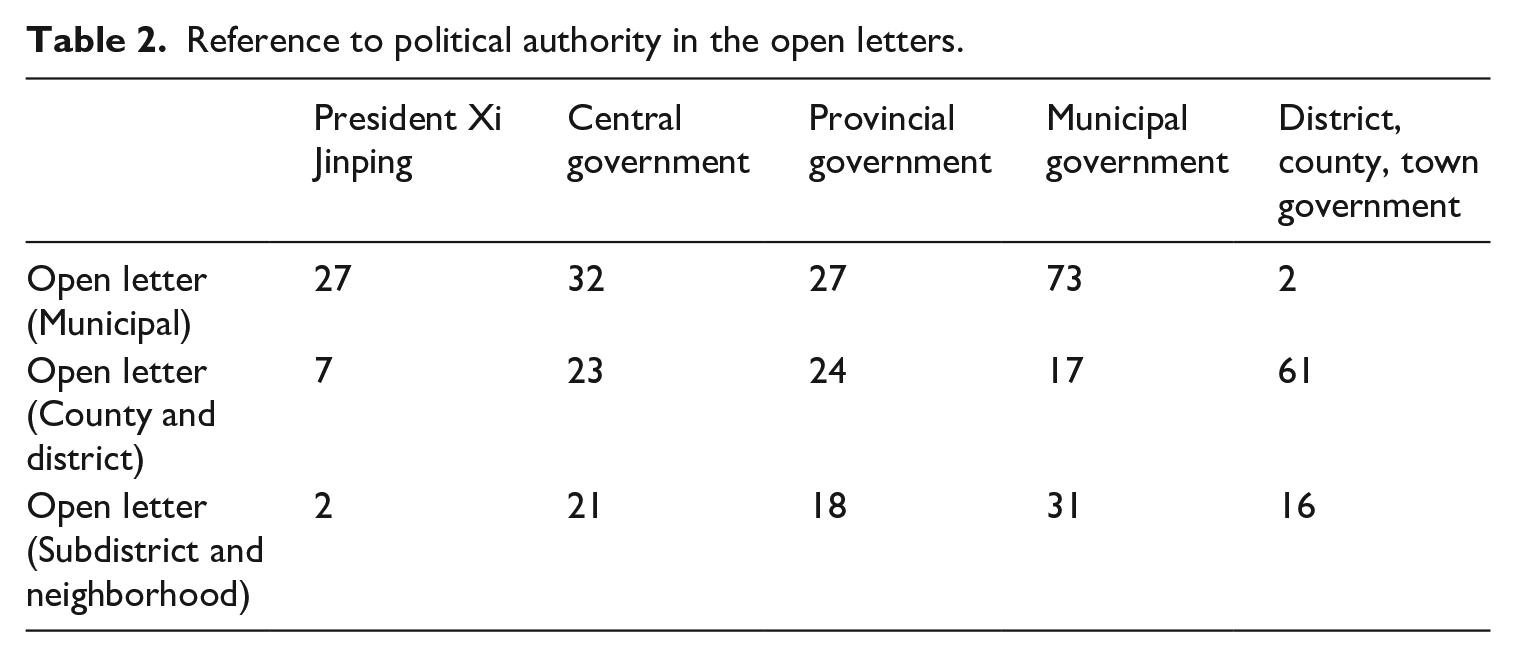
In previous studies, personal authority legitimation often took the form of verbal process clause, and direct and indirect speech was easy to identify (Halliday and Matthiessen, 2004; Reyes, 2011; Van Leeuwen, 2007). However, in the current study, reported speech was not common in descriptions of political authority. Concrete policy or words from political leaders were rarely stated; instead, what the authorities had said or done was often nominalized into ‘point’, ‘content’, or ‘spirit’, as Example (10) demonstrates.
Example (10) 疫情发生以来,市委、市政府高度重视,坚决落实习近平总书记重要指示和李克强总理批示精神,以及省委省政府的决策部署. . . (岳阳市) Ever since the pandemic,
As the example shows, arguments of the political leaders in the central government were abstracted into ‘instructions’, and the provincial government’s discussion was abstracted into ‘arrangement’ for the subordinate government to ‘guancheluoshi’ (carry out). In such descriptions, the subject of the local government with lower ranks was often projected with a mental clause, such as ‘think highly of’. In addition, local governments’ efforts were represented as ‘quanli’ (with all strength), measures were described as ‘powerful’, and adjectives such as ‘all’ and ‘full’ were frequently used. Most noticeably, whenever the central authorities appeared in the letters, a hierarchical relationship was often constructed, mainly accomplished by stating the sequence of the organizations, such as the central government, provincial government, municipal, town, and so on. In addition, the central authorities were rarely mentioned at the beginning of the sentence, or as the performer of the action, but mostly as the object. The reference to political authority shown in the above example emphasizes the local governments’ implementation of instructions from the central government, which was commonly found in the beginning section of the letters. Another substantial appeal to political authority was observed in the final part of a letter encouraging citizens to fight the war against the pandemic, as shown in Example (11).
Example (11) 我们坚信,在党中央国务院、省委省政府、市委市政府和区委区政府坚强领导下,以及社会各界的共同努力下,我们万众一心、众志成城、群防群控,一定能够打嬴这场疫情防控战!(奎文区) We firmly believe that under the strong leadership of
As Examples (11) shows, once again, the actors are organized in the hierarchical sequence of the central government, provincial government, municipal government, and town, placed as the theme of the sentences. Here, the central and local authorities are not the actors but the legitimizing authority which lies in the subordinate position of the sentence, with the residents – the mobilized object – as the real actor in the main clause.
These findings reveal that political authority is a crucial strategy that was used to legitimize the mobilization discourse during the pandemic. Although, as demonstrated in Table 2, governments with higher ranks generally refer to political authorities more frequently than subordinate ones in open letters, the trend was not a progressive decline: the differences in the number of references was implicit in several categories, and the trend was reversed in two categories. Such a trend of frequent reference to political authority in open letters by not only municipal governments but also the more local ones, reveals the pressure and power transmitted inside the bureaucratic system. This pattern may be particularly observed in the open letters issued during the pandemic, whose legitimation strategies were more typical in a non-routine large-scale campaign. Furthermore, there is another type of legitimation authority that can be found in the open letters, the impersonal authority of laws, rules, and regulations (Van Leeuwen, 2007). A common linguistic pattern in the strategy is the presence of nouns such as ‘regulation’, ‘law’ or their cognate adjectives and adverbs such as ‘compulsory’ or ‘mandatory’ (Van Leeuwen, 2007). In the data, legal punishment with coercive discourse was found, but only in the form of appeals in the open letters by governments of county and district, and subdistrict, none by the municipal governments. This shows the stress of implementation for the lower ranking local authorities with very limited political power.
Style in open letters
The most prominent style found in data is directness/indirectness and politeness/impoliteness. Compared with the document of the National Health Commission with direct local governments as readers, whose commands are generally bold without softening the power or hierarchical distance, the directives in open letters are generally mitigated. Nonetheless, the degree of mitigation displays a different trend based on ranks of governments, as shown in Table 3.
Politeness and indirectness in open letters.
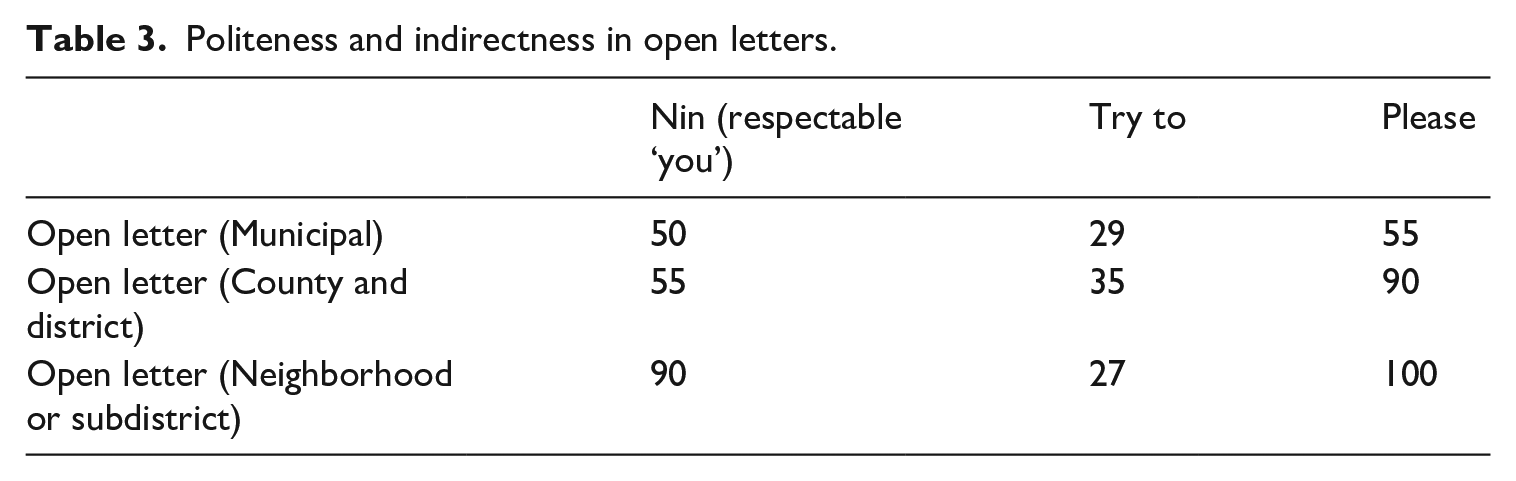
As the table shows, three typical expressions include the respectable second personal pronoun ‘nin’, the politeness interjection ‘please’, and the mental process ‘try to’ that commonly soften a compulsory sense. Example (12) demonstrates this style in open letters.
Example (12) 三、请尽量避免参加聚会和集体活动。 四、如必需参加外出活动,建议戴口罩。(伊春市) III. IV.
Yinchun (City), January 25, 2020
As demonstrated above, instructions are realized as imperative sentences, which is also referred to as a bald command (Brown and Levinson, 1988: 94). The directive tone and hierarchical power is mitigated by ‘please’, which is common in most open letters. The compulsory sense is softened by the projected mental process ‘try to’, the conditional clause ‘if it is necessary to. . .’, and the power of choosing not to do certain things is shifted to the readers by expressions such as ‘avoid’. Moreover, the instruction to wear a mask follows the clause ‘it is recommended that’. As the table shows, such impersonalized politeness is very common in open letters, and more importantly, grass-root government shows a more frequent use than those with higher ranks. This is a reverse trend with the use of legitimation discourse discussed in the previous sections. What is more complicated is that in the letters of basic level local governments, instructions related to social distancing and quarantine or wearing masks often mix the impersonalized polite form with the personalized directness forms. As shown in the following two examples, repetition and exclamatory sentences are the most remarkable linguistic features, through which the demanding tone is strengthened to a particularly high level. In Example (13), the sentence ‘wear a mask when going out’ is repeated three times. The verb ‘persuade’ is repeated five times with different objects referring to different groups of people who are assumed to be intimate with the readers.
Example (13) 出门戴口罩!出门戴口罩!出门戴口罩!重要的事情说三遍!希望大家谨记以上三点,子女劝父母、父母劝子女、邻居劝邻居、亲戚劝亲戚、朋友劝朋友!(景泰县) Example (14) 在此郑重呼吁:为了您和家人的身体健康和生命安全,不出门、不上街、不遛弯!家中有粮,绝不出门!重要的事情说三遍:请不要出门,不要出门,不要出门! (市中区) We hereby solemnly announce: For the health and safety of
Shizhong (District), February 1, 020
In Example (14), the demand is represented by seven repeated negative imperatives. Exclamatory sentences are also pervasive. However, in Example (14), it should be noted that politeness coexists with the explicit demanding tone. Before the repetition of the instruction, there is a brief illustration of the purpose, using a respectable form of ‘you’ in Chinese to refer to the reader. Among the repetition of ‘don’t go out’, there is also the politeness form ‘please’. However, these linguistic choices do not diminish the strength of the demanding tone, or soften the power hierarchy. It seems that the coexistence of two styles here, and in other open letters, is an unresolvable discourse contradiction. Behind such discursive contradiction is the contradiction between the more traditional campaign-style administration and modern governance, especially in an urgent situation such as the pandemic, where measures are necessary to constrain people’s freedom of movement in the interest of safety.
Conclusions
The current study demonstrated how ideological mobilization was carried out by local governments from a discourse perspective during the COVID-19 pandemic. The legitimation discourse was interpreted under a revolution-edification model, which is considered to be the underlying logic of the CPC’s campaign and revolutionary process. The value system was also related to the reality of the pandemic: certain personal inconveniences or freedoms were required to be given up for the sake of the larger group’s safety and health. One of the most significant findings of the current study was identifying the patterns present in the political communication used in a campaign by various local governments. While many studies on mobilization demonstrate in detail the mechanism through which a large-scale campaign is realized in China, only a few of them have paid attention to the ideological discourse constructed by the central government, and fewer have focused on the discourse constructed by local governments. In fact, though the ideology construction has been repeatedly emphasized by the central government and has often been assigned as a task in a top-down bureaucratic system, its realization at the local scale may be more challenging than other administrative tasks. In conclusion, the findings reveal that municipal governments have a higher ability to construct an ideological discourse and adopt a more democratic communication style with residents.
The general tendencies of legitimation discourse according to the different ranks of local governments are summarized here. (1) In the open letter from the municipal to more basic level governments, there is a general trend of de-ideologization: municipal governments adopt more legitimation strategies, especially moral legitimation, than those with lower ranks. This may be explained by the administrative operation and structure in the basic level local governments: while ideology is crucial and fundamental for mobilization, especially for a political campaign initiated by the central government, it is not as important for the basic local level governments to implement the policy, whose efficiency is dependent more on the system of performance assessment (Ouyang, 2014). (2) The choices of legitimation in the open letters reveal the pressure and power inside the bureaucratic system during a top-down campaign: all the ranks of local governments refer to political authority frequently, which is quite different from the routine open letters issued by the local governments. (3) A contradiction between politeness and boldness or even coerciveness is prominent in the letters of the lower rank governments. This may be explained by the higher pressure but limited power of basic level local governments: in a top-down campaign, the political tasks required by the central government are accomplished by local authorities based on a logic called ‘frequently enhanced’ (Jiang, 2011; Zhou, 2017), and thus local governments face more challenges and higher pressures during the process of enforcing the policy transmitted by the central government, while the political power is limited in grass-root institutions (e.g. Jiang, 2011). This restricted power does not only impact implementation but is also symbolic: basic level local governments lack charisma in legitimation, and even the identification from citizens is relatively lower (Ouyang, 2014).
As discussed above, the policy implementation by local governments has further complicated the realization of ideology construction during campaign which itself is already a challenging task in pandemic context. While the policy or ideology construction could be strictly followed and implemented by local governments without any questions, the ways to realize them is divergent. Moreover, the problems of a central-local government system discussed in previous studies also exist in the process of ideology construction, such as the stubborn problems of lack of autonomy. A typical example is the relationship or contradiction between a democratic communication and the coercive ways of asking residents to follow the policy: since the requirements related to ideology construction are much more vague compared with the regular administrative tasks, discourse representation of such problem depend on the local officials’ or letter writers’ judgments or interpretations of the requirements. However, it was observed that in the current bureaucratic structure, the management of contradiction or vagueness is entirely dependent on explicit instructions from the top-level government, and without such instructions, local governments often take an attitude of ignorance or ambiguity (Townsend and Womack, 2003; Zhou, 2017).
Another major finding of the current study was the pattern evident in the open letters used as political communication. However, due to a lack of related literature, it was neither possible to compare the pattern of routine open letters by local governments and the ones issued during the COVID-19 pandemic, nor compare the legitimation of mobilization discourse in the past and now.
Up until now, the pandemic is still not over, and some cities or districts in China are still in the state of lockdown, now and then. But from what we can observe, citizens in China have exhibited a highly collective spirit, and this psychology may be the fundamental basis for such a national campaign as well as the ideology construction undertaken in the first place.
Footnotes
Declaration of conflicting interests
The author declared no potential conflicts of interest with respect to the research, authorship, and/or publication of this article.
Funding
The author(s) disclosed receipt of the following financial support for the research, authorship, and/or publication of this article: This study was supported by a Guangdong Social Sciences Planning Project (No. GD21WZX01-13).