




Abstract
Recently there has been renewed interest in the intersection of identity and epistemics in social interaction, yet epistemics has still rarely been analyzed in political identity construction. This paper combines research on identity from a sociocultural linguistic perspective with epistemics using Conversation Analysis. The focus here is on understanding how a small group of student activists construct their shared political identities through epistemic stances towards their academic majors and career goals. Through a discourse analytic study of conversational data among these activists, I demonstrate the validity of the relationality principle of identity in accounting for how identities are constructed as related to one another. Furthermore, I examine the relational process of authentication in epistemic stances to legitimate claims to knowledge regarding political and academic identities, as well as alignment of stances in building group solidarity and shared political identity.
Introduction
There is a significant body of research on the discursive construction of social identities, including political identities (e.g., Bassiouney, 2012; De Fina, 1995; Gordon, 2004; Josey, 2010; Koike and Graham, 2006; Lempert, 2009; Nguyen, 2021; Sclafani, 2015; Shrikant and Musselwhite, 2019). Recently, within the field of Conversation Analysis (CA), there has been a resurgence of interest in the intersection of identity construction and epistemics, or how we establish our rights to knowledge in social interactions (Sierra, 2016, 2021; 2022; Raymond, 2014; Raymond and Cashman, 2021; Raymond and Heritage, 2006; Takei and Burdelski, 2018). Despite this, the role of epistemics in the construction of political identities has not been extensively studied (cf. Lempert, 2009), with a few studies hinting at its relevance (e.g., Bassiouney, 2012; Nguyen, 2021).
In this paper, I explore the relevance of epistemics in the construction of political identities through the lens of the relationality principle of identity (Bucholtz and Hall, 2005), which posits that identities are constructed as sets of relations. Specifically, I focus on the relational process that Bucholtz and Hall (2005) call authentication, or the construction of identities as genuine and authentic. Using a case study of a small group of student activists, I examine how these individuals construct their political identities in relation to their academic identities and their career interests. I also show how these student activists express their political beliefs as epistemics stances, while simultaneously authenticating their multiple identities as related, coherent, and genuinely overlapping. They also align with one another’s epistemic stances to build group solidarity and a shared political identity. I argue that epistemics can play a crucial role in relational identity processes and show how the two are intertwined, with a specific focus here on political identity.
Theoretical framework
Social identity construction
Bucholtz and Hall (2005) present a theoretical framework for identity construction that offers a comprehensive model for understanding and analyzing identity. They propose a framework based on five principles: emergence, positionality, indexicality, partialness, and relationality. The emergence principle states that identity is not just an internal psychological phenomenon, but it emerges in interaction with others and is therefore a social and cultural phenomenon. The positionality principle states that identities consist not only of macro-level demographic categories, but they also include local and temporary roles. The third principle, indexicality, provides the ways through which indexical processes, such as code-switching or stance taking, are used to construct identity positions. Other indexical processes that may occur are overt mention of identity categories and labels, implicatures and presuppositions regarding identity, evaluative and epistemic stances, interactional footings and participant roles, and the use of linguistic structures that are associated with specific personas and groups. Next, the partialness principle states that identity is constantly shifting both as interaction unfolds and across discourse contexts, and therefore will always be partial.
The relationality principle is described as the “heart of the model,” and is the focus of the current paper. This principle captures how identities can never be isolated on their own because they are always related to other identities. Furthermore, the relationality principle states that identities are “intersubjectively constructed through several, often overlapping, complementary relations” (Bucholtz and Hall, 2005: 589). One of the relations described by Bucholtz and Hall (2005) is authentication/denaturalization, which are “the processes by which speakers make claims to realness and artifice, respectively” (p. 601). Authentication is the focus of the present paper, and to put it another way, this is a process in which identities are discursively constructed to be authentic and genuine. Bucholtz and Hall (2005) example how authentication is accomplished through a re-analysis of Bauman’s (1992) analysis of a storyteller narrating an Icelandic legend. They show how the storyteller authenticates both the legend and himself as the appropriate teller of the legend at the beginning and end of the story.
Authentication has also been studied in several contexts outside of narrative (e.g., Bucholtz, 2003; Goebel, 2008; Gokgoz-Kurt, 2017; Kelleher, 2019; Lopez and Bucholtz, 2017; Weninger and Williams, 2017). Additionally, Bucholtz and Hall (2004) observe that authentication is exemplified in studies on sexuality (e.g., Boellstorff, 2004; Hall, 1995, 2005; Jones, 2016; Lucas, 1997; Manalansan, 1995; Sauntson, 2018). Notably, there seems to be little published research on the role of authentication in this sense in the construction of political identities (cf. Cabrejas-Peñuelas and Díez-Prados, 2020). In this paper, I apply the relationality principle and the concept of authentication to show how student activists draw on their academic identities to construct and authenticate these as related to their political identities.
Identity and stance
In the present study, I show how student activists authenticate related social identities in interaction by taking stances. In this section, I outline some of the prior relevant work on stance and identity construction, specifically. A stance refers to a speaker’s expression of their epistemic and affective attitudes, such as their level of certainty or uncertainty about something, and the intensity or type of emotion they express about a particular referent or proposition (Ochs, 1993: 288). Ochs (1993) demonstrates how speakers use stances to establish their own and others’ social identities. Ochs (1993) highlights that there is no strict mapping of certain acts and stances into certain identities, and that people may use different kinds of acts and stances to construct themselves variably within some particular social status or social relationship (p. 289). Ochs (1993) encourages a social constructivist approach to identity, and suggests that researchers should ask, “What kind of social identity is a person attempting to construct in performing this kind of verbal act or in verbally expressing this kind of stance?,” which is a question also posed by Gumperz (1982). Ochs (1993) also stresses that “in all situations, even the most institutionalized and ritualized, people are agents in the production of their own and others’ social selves” (p. 186) and that “social identities evolve in the course of social interaction, transformed in response to the acts and stances of other interlocutors as well as to fluctuations in how a speaker decides to participate in the activity at hand” (p. 198). This intersubjectivity of social identities is apparent in the data I analyze in this paper, where speakers clearly respond to and build on the epistemic stances that one another takes.
This transformation and fluctuation of social behavior and identities in interaction has influenced many scholars to take up the study of stance and social identities. Indeed, stance, as originally described by Biber and Finegan (1989), has been one of the most productive approaches to examining how people enact their assessments in interaction. Biber (2004) points out that as such, stance has been conducted under many other labels. For instance, Hunston and Thompson (2000) explore stance as “evaluation” in linguistics; for them, “evaluation is the broad cover term for the expression of the speaker or writer’s attitude or stance toward, viewpoint on, or feelings about the entities or propositions that he or she is talking about. That attitude may be related to certainty or obligation or desirability or any of a number of other sets of values” (Hunston and Thompson, 2000: 5). Stance has also been examined within systemic functional linguistics in the appraisal framework (Martin, 2000; Martin and White, 2005), designed to provide a systematic way of identifying options for expressing stance and evaluation in discourse. Within this framework, appraisal consists of three interacting domains: attitude, engagement, and graduation.
Jaffe (2009: 24) further develops this idea in her proposal for a “sociolinguistics of stance,” which focuses on the social processes and consequences of stance taking and the ways in which sociolinguistic indexicalities are both resources for and targets of stance. Jaffe (2009) argues that stances can be used to index both singular and/or multiple social selves in the process of identity construction. This relates to the point I will make in this paper (also made by Sclafani, 2015; Shrikant and Musselwhite, 2019) that these student’s stances often index both their political selves and their academic/career-oriented selves.
Du Bois (2007) proposes the “Stance Triangle,” stance as:
a public act by a social actor, achieved dialogically through overt communicative means (language, gesture, and other symbolic forms), through which social actors simultaneously evaluate objects, position subjects (themselves and others), and align with other subjects, with respect to any salient dimension of value in the sociocultural field. (Du Bois, 2007: 169)
In the Stance Triangle, the stancetaker (1) evaluates an object, (2) positions a subject (usually the self), and (3) aligns with other subjects (Du Bois, 2007: 169). Like Ochs (1993), Du Bois focuses on two types of stance: affective (regarding emotion) and epistemic (regarding knowledge).
Epistemic stance
I build on Hachimi’s (2013) study of authentication, which emphasizes the importance of understanding how speakers use stance-taking to authenticate their identities. I argue that epistemic stance-taking specifically is an important way that individuals can authenticate their identities. CA scholars have recently explored the role of epistemics, or knowledge claims, in social interactions (Heritage and Raymond, 2005; Raymond and Heritage, 2006). Heritage (2013: 370) summarizes that the study of epistemics involves examining “the knowledge claims that interactants assert, contest, and defend in and through turns-at-talk and sequences of interaction.” Raymond and Heritage (2006: 678) further specify the role of epistemics in identity construction by defining the “epistemics of social relations” as “methods for managing rights to identity-bound knowledge in self-other relations.” Through the example of two friends negotiating epistemic claims around one of the friend’s grandchildren, Raymond and Heritage (2006) demonstrate how epistemic claims are central to the management of social identities.
While Raymond and Heritage (2006) define epistemic stances as sequences of action in which participants offer assessments (or evaluations) of states of affairs or beliefs, some researchers have gone on to make distinctions between epistemic claims and epistemic displays (e.g., Kääntä, 2014; Koole, 2010; Mondada, 2013) as perhaps a more fine-grained way of analyzing epistemic stance. For instance, Mondada (2013) writes that epistemic claims are “manifested by the sequential position of actions” and that epistemic displays are “manifested by turn formats” (p. 620). In other words, epistemic claims refer to minimal attempts to claim relative knowledge or lack thereof, such as “yes,” “I don’t know,” “oh,” and so on that appear sequentially in response to either requests of understanding or other displays of knowledge. On the other hand, epistemic displays are more contentful expressions of epistemic status that truly “display” knowledge. In any case, both epistemic claims and epistemic displays have the potential to construct social identities, and I examine both in this paper.
While epistemics is often examined without a focus on identity, there seems to be a renewal of interest in identity and epistemics with the recent publication of a few key studies. These studies build on Raymond and Heritage (2006) to show that epistemic management shapes various social identities in a range of contexts, including medical interpretation (Raymond, 2014), sports commentary (Raymond and Cashman, 2021), and everyday family conversations (Takei and Burdelski). Sierra (2016, 2021) has additionally examined how friends manage epistemics by making conversational references to video games and other media. Finally, Sierra (2022) has examined how place, ethnic/religious and occupational identities are navigated through epistemic stance-taking, and how this process is intertwined with the relational identity processes of authentication and denaturalization (Bucholtz & Hall 2005).These papers contribute to our understanding of how epistemic management constructs a range of social identities.
In this study, I aim to further our understanding of the relationship between epistemics and identity by examining how epistemics can shape the construction of political identities through the process of authentication. To do this, I bring together the study of epistemics with Bucholtz and Hall’s (2005) sociocultural model of identity construction, and specifically their relationality principle. By merging these two approaches, I hope to provide insight into the ways in which epistemic management can play a crucial role in the authentication of political identities.
Epistemic stance and political identity construction
Political identity construction has been widely studied in institutional contexts and in the media (e.g., Al Zidjaly, 2014, 2017; Beck, 1996; Clayman, 2001; De Fina, 1995; Gadavanij, 2020; Gordon, 2004; Josey, 2010; Koike and Graham, 2006; Lempert and Silverstein, 2012; Radsch, 2016; Sclafani, 2015; Shrikant and Musselwhite, 2019; Sinatora, 2019) but only a few studies have acknowledged how speakers specifically display knowledge in constructing such identities. Lempert’s (2009) study is the primary work that explicitly focuses on epistemics in political identity construction, demonstrating how 2008 Democratic presidential candidate John Kerry responded to accusations of “flip-flopping” by counter-branding himself as a candidate of “conviction” through repetition and parallelism across epistemic stances. A couple other studies have hinted at the importance of epistemics in other ways. For instance, Nguyen (2021) examines how certain Asian American Pacific Islander (AAPI) political organizers establish in-group membership through using specific referring expressions and intertextual references to construct an online community that transcends ethnic and regional boundaries. Additionally, Bassiouney (2012) examines different forms of Egyptian television discourse that took place during the 2011 Egyptian Revolution, finding that during the process of stance-taking speakers code-switch among different languages and varieties, drawing upon linguistic associations and indexes that appeal to different ideologies and identities. In these studies, the use of epistemic stances, intertextual processes, and various indexical codes relying on shared knowledge stand out as an important part of political identity construction.
While these studies acknowledge the role that knowledge can play in political identity construction, the role of epistemics has still rarely been studied in political discourse, and has not yet been examined in the intersubjective construction of shared group political identity. In this paper, I highlight the crucial role that epistemics can play in interactional political identity construction. This study aims to contribute to the recent resurgence of interest in the intersection of epistemics and identity by combining the former with Bucholtz and Hall’s (2005) sociocultural model for analyzing identity construction. I illustrate the vital role epistemics can play in the authentication and construction of shared political identities.
Methods and data
Working within the methodological tradition of interactional sociolinguistics (e.g., Hamilton, 1994; Schiffrin, 1987; Tannen, 1984/2005), I audio-recorded informal conversations amongst some activist friends and myself, and I analyze one of the conversations here. We were all undergraduate university student activists at the time of the recording (2007). This conversation was originally recorded as part of my work for an undergraduate seminar in discourse analysis, and I later secured an exemption from the Institutional Review Board for research on human subjects. To find participants for my study, I considered the student activist network that I knew at the University of Mary Washington, the small, public, liberal arts university I attended in Fredericksburg, Virginia, a small city in the southern United States. I sent an e-mail telling these students that I would be researching the political identities of student activists and told them the time and place I would be doing the recording. The conversation amongst three of my close friends and me took place in the living room at my shared house on Wednesday, November 7th, 2007, and occurred in American English. All the participants have been given pseudonyms. Two of the students, Grace and Ryan (a couple), were seniors at the university and had been politically active since their junior year at college, participating in the campus Labor Rights Club (LRC), an umbrella campus group called Student Organizations United for Progress (SOUP), and in the peace movement more broadly. Grace was a biology major hoping to become a high school biology teacher. Her partner Ryan barely speaks during the excerpts I examine here. Ben and I were both juniors at the time of recording and we were housemates; we had been politically active since our freshman year. Both of us were members of the LRC, SOUP, and the campus the Anarchist Social Theory Club (ASTC). Ben was a Computer Science major, and I was a Linguistics and Spanish language special major. The four of us knew each other well and all identified politically as socialists (Grace and Ryan) or anarchists (Ben and I). All the participants were white Americans and spoke American English, which was relatively representative of the student organizing body at this time in these particular groups on this southern U.S. campus (Rouhani, 2012). The participants were slightly hesitant to talk freely at first due to the presence of a tape recorder, but within about 10 minutes they seemed to adjust to the fact that they were being recorded. After I prompted the discussion by asking how we all became involved in politics, we ended up talking for about 80 minutes.
For the present analysis, Bucholtz and Hall’s (2005) relationality principle, specifically the relational identity process of authentication, will be applied to the data. In the first place, the relationality principle illuminates how these student activists construct their academic and political identities as related to one another. On another level, authentication more specifically shows how they construct their political identities to be an authentic piece of their personal identities by connecting to their academic identities. I utilize this framework for analyzing identity construction and combine it with a focus on epistemics to show how authentication and epistemic stances work together in the data. I follow Raymond and Heritage’s (2006) definition of epistemic stances as evaluations or assessments about beliefs or states of affairs, while also drawing on distinctions made by scholars like Mondada (2013) between epistemic claims and epistemic displays. Epistemic maneuvers ultimately can construct speakers as knowledgeable, whether by assertion or inference (Du Bois, 2007). This knowledge is drawn upon in turn to construct the speakers’ identities as genuine, based on multiple epistemic orientations. By merging the relationality principle and epistemics, I aim to shed light on the ways in which these student activists take epistemic stances to authenticate their political identities in relation to their academic identities.
Data analysis
In my analysis, I demonstrate how a small group of college student activists relate other social identities (academic majors, career ambitions) to their political identities, specifically by taking epistemic stances which in turn craft their political identities as authentic. In the first example, Ben, a third-year student majoring in computer science, relates his political identity to his interest in science. In this example, Ben constructs his two intertwined identities by making epistemic displays based on external reality and knowledge of external facts regarding the scientific method, the definition of the word “radical,” and political systems, thereby authenticating his political identity by relating it to his identity as a scientist. In this excerpt, Ben is taking his turn after Grace, who had just finished talking about how she developed a better understanding of leftist politics through interaction with other students when she went to college. The conversation is transcribed in intonation units, representing relatively small bursts of speech (Chafe, 1994), and which Kärkkäinen (2003) argues are especially relevant to the encoding of epistemic stance, with “I think” occurring most frequently at the beginning of intonation units.
(1)
Ben authenticates his identity as a radical leftist by making references to science as he speaks about his political identity, and by taking epistemic stances merging both. He marks the epistemic nature of this stretch of speech with the epistemic marker “I think” (line 37), thus claiming knowledge. In lines 45–47, he begins to relate his developing political identity to “questioning” by saying “I had never been taught to question political systems from a radical point of view.” This initial mention of questioning sets the stage for his following epistemic displays where he asserts that scientists “question,” “examine” (line 53), and look at root causes (lines 53, 59). Next, in lines 49–67, he takes epistemic stances displaying his knowledge of the meaning of the word “radical” by relating it directly to his identity as an aspiring scientist. First, he states, “And by ‘radical’, I mean the way any scientist would, which is to examine the root cause of something, which is the definition of ‘radical’” (48–55). His epistemic evaluation that “any scientist would” (51) use a radical point of view functions to validate his own radical political identity and its authenticity, as scientists are generally viewed as rational thinkers who base their ideas on logic and empirical investigation. This epistemic stance also constructs and validates his identity as a scientist, relating to Ben’s identity as a computer science major, who also took classes in biology, chemistry, physics, and math. Ben then goes on to expand on the definition of “radical,” furthering his epistemic display by saying that it means “to examine the root cause of something . . . which means to sort of look at what are the causes of . . . the evolution of political systems. What reasons do we accept them for” (53–66). His choice of words—“root cause,” “causes,” “evolution,” and “reasons”—all index a scientific perspective, again reinforcing his identity as a scientist who uses logic and scientific theory not only to display his academic identity, but also to simultaneously authenticate his political identity. Ryan, Grace, and I all align with Ben’s authenticating epistemic displays through his talk here with affirmative minimal responses “yeah,” “mhmm,” and “right” (lines 52, 56, 67), constructing group solidarity (see also Nguyen, 2021) and a sense of shared political identity, while also respecting Ben’s autonomy in holding the floor.
In the second example, Grace, a senior and a biology major planning on teaching high school biology, relates her political identity to her identity as an aspiring teacher. This excerpt of conversation occurred after I had been discussing the importance of “critical thinking,” and how it seemed to me that critical thinking skills should be developed and practiced from a young age. In this excerpt, Grace intersubjectively builds on my point to take assertive but broad epistemic stances (rather than epistemic displays based on external facts, like Ben) about progress in society and to simultaneously authenticate her identities as a teacher and as a leftist who wants to teach critical thinking skills.
(2)
Here Grace relates her identity as an aspiring teacher to her political vision. Grace starts her turn by building on my speech, commenting in lines 204–210 that “point that you bring up” (the importance of critical thinking at a young age), is “the main reason” that “I wanna be a teacher.” This displays the intersubjectivity of identities between Grace and me as she takes my stance on critical thinking as a jumping-off point to relate her views on the subject as well as tie it to her rationale for becoming a teacher, which I affirm with “mhmm” (line 211). Then, in lines 215–222, she takes the epistemic stance “I have a strong personal belief that progress is never gonna be achieved until people can think for themselves. And think critically.” Ben aligns with Grace’s stance with “mhm” in line 223. Next, Grace further merges this epistemic stance about progress and critical thinking with her interest in teaching, thus relating and authenticating her identities as a political activist and as an aspiring teacher.
(3)
Referring to her “strong personal belief” about the importance of critical thinking, Grace builds on her prior epistemic stances to now take the moral stance, “that has to be like, instilled at an earlier age, and somebody’s gotta do it” (227–229). Here she is referring to teaching children how to think critically, which she clarifies in lines 230–233 when she takes another moral stance that “somebody has to teach that.” The modals “has to” and “gotta” in these utterances (227, 229, 231) express a deontic function, that is, they express what one (“somebody,” 229, 231) should do as a future course of action with respect to her moral values (Stevanovic and Peräkylä, 2012; Stevanovic and Svennevig, 2015). This ultimately supports moral stance-taking here. Furthermore, the use of the generic subject “somebody” in these moral stances makes them generalizations, which refer to a broader class of people and function here to authenticate Grace’s opinions (Scheibman, 2007). Scheibman (2007) also describes how generalizations index commonly held beliefs, thus highlighting the collaborative and interactive aspects of stance-taking, and often constructing solidarity among speakers. Thus, while listening, I respond to Grace’s moral generalizations with “yeah” (232) aligning and constructing solidarity with Grace’s stances. When she says in lines 234–236, “I wanna be someone who can teach that,” she is taking on the subject role of the prior generalization of “somebody” (229, 231), making an explicit statement about the kinds of identities she is constructing—a political activist who wants to teach critical thinking skills to children in order to bring about change in society. Thus, both her educational goals and career aspirations as well as her political beliefs are being related to one another through moral stances and thereby constructed as genuine intertwined parts of her identity in this excerpt of talk. Next, Grace authenticates even more emphatically and clearly her related identities as a political activist and an aspiring teacher.
(4)
Here Grace uses the epistemic marker “I think” (line 237), before pausing and then stating emphatically, “I want the world to change” (238–240). She again uses “I think” (line 241) in claiming that “in order for the world to change, like, people have to be able to think critically” (241–244). She finally concludes by making a clear connection between her two identities as an aspiring teacher and a political activist when she expresses her epistemic claim that, “I view my . . . wanting to teach as like, a way to kind of enact something I wanna see happen” (246–254), which I align with in line 252 with “mhmm.” Grace constructs her identity as a teacher as closely related to her political identity and her desire for the world to change. She uses assertive affective and epistemic stances throughout her speech to express her goal as a teacher as also being her goals as a political activist. Grace’s display of how interconnected these two aspects of her identity are authenticates her identities as a political activist and as a future teacher, by expressing how she believes that she can achieve her political aims through her future career as a teacher. As Grace speaks, Ben and I align with her authenticating epistemic stances via our affirmative minimal responses, which contribute to a sense of shared political identity and group solidarity, while also respecting Grace’s autonomy as the speaker holding the floor.
Following this example, I further authenticate and build on Grace’s articulation of her political vision. I start out by confirming her prior utterances, and then make my own statements regarding a guest speaker that we were about to host from the Zapatista Army of National Liberation (Ejército Zapatista de Liberación Nacional, EZLN), to speak about “La Otra Campaña,” or “The Other Campaign”; a political program by the EZLN for the recognition and protection of indigenous rights and autonomy in Mexico. Here I construct my own alignment with this group and their political vision as authentic by code-switching and referencing this campaign in the original Spanish, simultaneously displaying my epistemic stance as knowledgeable about both Spanish (part of my “special major” in linguistics and Spanish language) and this particular campaign. By referencing this group and the event of their visit, my epistemic stance more closely parallel Ben’s earlier epistemic displays regarding outside knowledge.
(5)
I align with Grace’s authenticating epistemic stances in line 255 with the minimal response “yeah.” Grace then uses the discourse marker “you know” (line 256), which here acts as a marker of a consensual truth regarding the general description of Grace’s beliefs (Schiffrin, 1987). In line 259, Grace concludes with one final epistemic stance, “I think it’s important.” I then intersubjectively connect her vision of teaching critical thinking to the upcoming visit from La Otra Campaña. After a couple of false starts (257, 260), I state, “That’s why the guy from . . . La Otra Campaña is coming tomorrow, you know?” (lines 257–264). There is perhaps a conscious choice made here to say “La Otra Campaña” rather than “The Other Campaign,” which is evidenced in the brief pause before producing the Spanish language title. Hill (1995) refers to this as an “intonational breakthrough,” which signals that a speaker is being somewhat mindful and intentional about their choice of language (see also Josey, 2010). This use of Spanish in an otherwise exclusively English conversation is marked, and as such it simultaneously shows an epistemic orientation to the Spanish language and to this campaign, which authenticate my own identity as a Spanish major and my political identity as someone aligned with the work of this campaign. As Bassiouney (2012) finds, here epistemic stance-taking depends on code-switching as a mechanism that lays claim to different indexes and thus appeals to different ideologies and facets of identity.
In line 264 I also repeat Grace’s earlier “you know” (line 256), a discourse marker which here seeks affirmation of information reception, and which can also function in shifting the participation framework (Schiffrin, 1987), which is what happens when Grace initially uses it. But when I use it in line 264, I do so with rising question intonation, which solicits hearer recognition about a particular piece of information and might indicate less certainty about shared knowledge of this specific intertextual reference (Schiffrin, 1987). In other words, I might be checking here specifically that Grace both understood my use of Spanish and its referent. Grace responds to my solicitation of recognition in line 265 with “mhm!” This once again authenticates a sense of shared group political identity and solidarity, via knowledge about a shared referring expression.
In sum, I have used this case study to show how this small group of student activists intersubjectively relate and authenticate their political identities and academic identities as an aspiring scientist, an aspiring teacher, and a Spanish student, respectively. By using the notion of the relationality principle and the process of authentication, I have shown how multiple identities can be evoked, related, and authenticated in discourse. I have also shown how these identities are constructed through the use of epistemic stances and alignment with these stances, which ultimately play a crucial role in the authentication of identities and the construction of a shared group political identity.
Conclusion and discussion
The examples presented in this paper provide us with additional evidence that political identity is highly relational—that is, it is constantly developed in relation to other surrounding identity positions. We have seen in this data how student activists discursively construct their political identities by epistemically relating them to other academic identities, and in this process, they authenticate these multiple identities. By effectively constructing their political identities and authenticating them with epistemic stances in their discourse, these students show that they have a strong sense of their political beliefs, which, based on the conversation, likely developed throughout college, through participation in various political clubs and the interactions they have had with others during this time. Through interaction, these students construct a strong group identity as rational political actors that is also coherent with their related academic and career identities. In addition to creating intersubjectivity with their epistemic stances one after the next, these students also use affirmative minimal responses to align with speaker’s stances and express group solidarity while also respecting the autonomy of the individual holding the floor. In sum, this study fleshes out the epistemic dimension of political identity, and it can help us in understanding the co-construction of identity of political actors.
While this study provides evidence of how Bucholtz and Hall’s relationality principle functions in interaction, and adds to our knowledge about the authentication of political identity in particular, there still is a need for more research. From a theoretical perspective, this is a close examination of only one of the five principles of identity proposed by Bucholtz and Hall (2005), but the other dimensions of identity are equally important and should also be studied. In addition, longitudinal research on the formation of identity in political actors over time would be helpful in understanding how these individuals form networks, develop their ideas, and come to conclusions that they feel compelled to act upon in their communities and in the broader political system. Finally, this study included only a small case study amount of data from the radical left side of the political spectrum, but it will continue to be interesting to see research on the identities of other, different kinds of political actors and groups who influence the society that we live in.
As described at the outset of this paper, there has been a growing interest in the intersection of epistemics and social relations in recent years. In the present study, I have explored how the interplay of epistemics, social relations, and identity construction in discourse is a complex process. I hope to have contributed to this ongoing effort to better understand the mechanisms involved in this process, by demonstrating the ways in which epistemic management and the process of authenticating identities may be fundamentally intertwined, particularly in the construction of political identities.
Footnotes
Appendix
Appendix: Transcription conventions
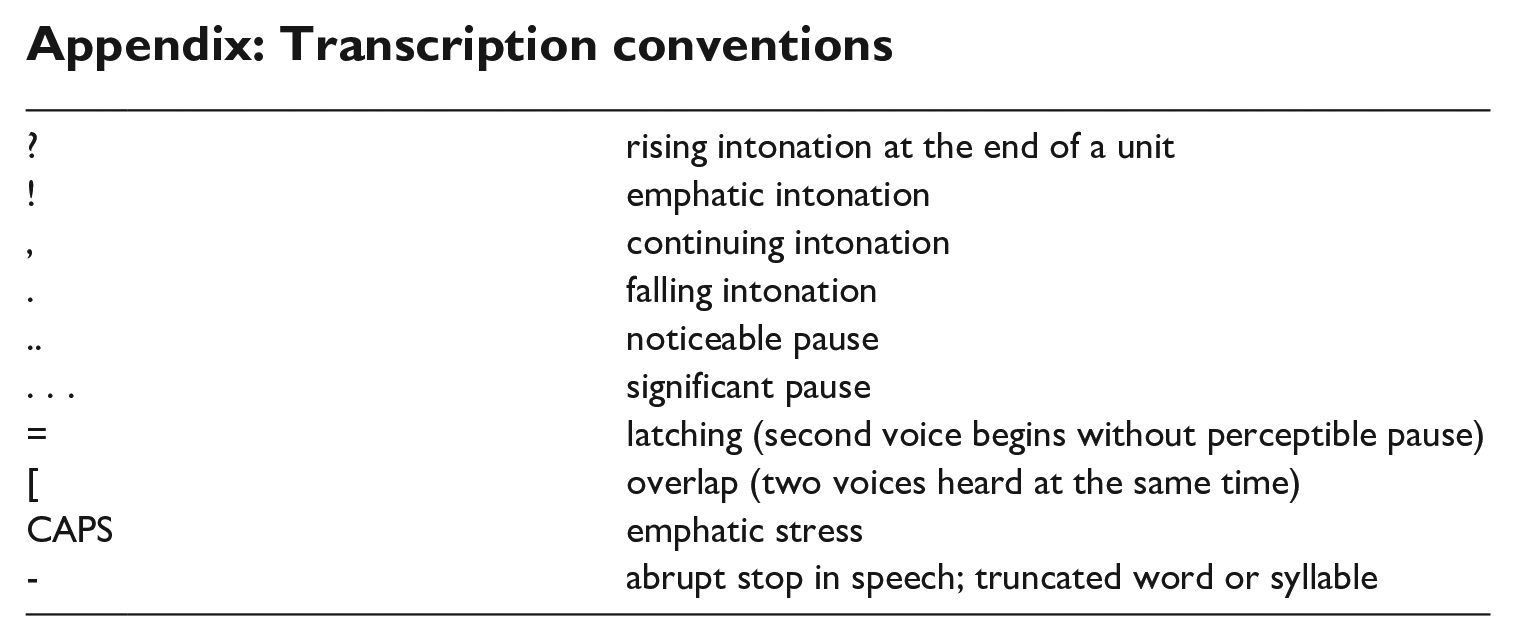
| ? | rising intonation at the end of a unit |
| ! | emphatic intonation |
| , | continuing intonation |
| . | falling intonation |
| .. | noticeable pause |
| . . . | significant pause |
| = | latching (second voice begins without perceptible pause) |
| [ | overlap (two voices heard at the same time) |
| CAPS | emphatic stress |
| - | abrupt stop in speech; truncated word or syllable |
Declaration of conflicting interests
The author declared no potential conflicts of interest with respect to the research, authorship, and/or publication of this article.
Funding
The author received no financial support for the research, authorship, and/or publication of this article.