




Abstract
L’écriture inclusive sparked major language debates in the French Press. I use critical discourse analysis to examine how l’écriture inclusive is discussed, the contexts in which the term is evoked and its indexical field in a corpus of opinion pieces from Le Figaro, Le Monde, and Libération from 2017–2021. After establishing that l’écriture inclusive is a formula—heterogeneously employed and inherently polemical—my thematic analysis explores parallels between recent debates on l’écriture inclusive and earlier transnational non-sexist language debates and French-specific moral panics, demonstrating that l’écriture inclusive not only stands in for social insecurities but becomes the crucible through which older debates are extended and transformed. Close readings of selected excerpts establish the expansion of the (meta)semiotic field of l’écriture inclusive to index not only feminist language practices, but progressive ideologies generally, in which case l’écriture inclusive is linked with political correctness, islamogauchisme, gender ideology, and other salient boogeymen in contemporary French politics.
Introduction
L’écriture inclusive (EI) became a periodic flash point for French politicians, intellectuals, and language bodies beginning in 2017, with the media serving as the filter through which language debates are presented to the public. Many of the key players in these debates address the French public directly in opinion pieces discussing l’écriture inclusive. Using the lens of critical discourse analysis (CDA) and framing l’écriture inclusive as a formula—a polysemous expression crystallizing political and social issues—this study uses a corpus analysis of opinion pieces published in three major French newspapers to examine the discursive space of debates over l’écriture inclusive and the kinds of ideologies the term is bundled with. Especially as a language ideological debate (Blommaert, 1999) develops around l’écriture inclusive and there is heightened awareness around the term itself and its usage, it is critical to examine the exact discourses and ideologies with which it is associated.
Écriture inclusive (inclusive writing) is a written form of inclusive French. Inclusive French encompasses many strategies, including non-binary French, feminized titles, epicene forms, and strategies for syntactic avoidance of gendered forms. 1 Following the 2017 publication of a language manual employing the middot (·), l’écriture inclusive—and the middot in particular—became the center of a French ‘culture war’ (Hunter, 1991) buoyed by national anxieties around shifting gender norms (Dubslaff, 2017: 165; Perreau, 2016), increasing populations of immigrants from former French colonies (Scrinzi, 2017: 128), and the diminishing role of France and French in an age of globalization dominated politically and culturally by the United States (Ager, 1999; Perreau, 2016).
The agenda-setting capacity of news media and the historical role the press has played in language debates in France (Coady, 2018) makes the French press an ideal site of inquiry for examining ideologies around l’écriture inclusive. While a handful of studies have examined discourses around inclusive writing in the French press (Coady, 2018, 2020, 2024), there have to date been no studies specifically examining discourses around l’écriture inclusive within the news opinion genre. Opinion pieces are an important site for unpacking language ideologies around l’écriture inclusive because the news opinion genre gives the most direct access to authors’ language attitudes, which further reveal the agendas a given newspaper is promoting. Opinion pieces represent more than any other newswriting an ideal site for examining media power relations as authors directly attempt to persuade readers through shaping ‘mental models of social events through the use of specific discourse structures’ (van Dijk, 1996: 85). This is especially true for opinion writing in elite newspapers, which through their institutionalization, imbrication with social elites, and large subscriber bases hold social power to legitimize relations of social dominance to and for the public.
Context: Inclusive French writing
The earliest studies of l’écriture inclusive examined the frequency of different types of inclusive language practices across leftist materials (e.g., Abbou, 2011, 2017). This vein of inquiry has expanded to include frequency analyses of forms appearing in diverse media, including university pamphlets (Burnett and Pozniak, 2021), newspapers (Jungers, 2022; Kamblé-Bagal and Tatossian, 2022; Simon and Vanhal, 2022), and social media (Diaz, 2021; Dupuy, 2022; Flesch and de Beaumont, 2023). The last few years have seen emerging inquiry into debates around inclusive language in francophone presses (Abbou, 2023; Abbou et al., 2018; Elchacar and Rheault, 2021; Loison et al., 2020) and on social media (Johnson, 2024; Zsombok and Tarjanyi, 2023), as well as inquiry into language attitudes and ideologies surrounding usage of metalinguistic terms such as l’écriture inclusive, français inclusif, and féminisation (Coady, 2018, 2020; Johnson, 2024; Tristram, 2024).
Given that l’écriture inclusive has no singular definition, a small but growing subset of studies has examined use of different inclusive language strategies. Inclusive French usage has increased over time (Abbou, 2017: 55; Kamblé-Bagal and Tatossian, 2022: 8), as has the usage of the term l’écriture inclusive itself (Jungers, 2022). More importantly, use (or disuse) of inclusive writing itself and associated metalinguistic terms have political connotations (Burnett and Pozniak, 2021: 812), as does the use of specific orthographic signs in inclusive formulations (e.g., parentheses vs. middots) (Abbou, 2011, 2017: 65; Viennot, 2018: 103). The precise meanings conveyed by inclusive writing depend on the kinds of forms employed, their frequencies, and the contexts in which they are used (Pozniak et al., 2024: 290).
Coady’s (2018, 2020) studies are the most in-depth CDA investigations of inclusive language in the French press. Commenting on the degree of alacrity with which inclusive language is treated therein, Coady (2020: IV) argues that ‘it is not resistance [to linguistic feminization] itself that distinguishes France’ from other francophone contexts, but ‘rather the scale or force of the resistance.’
Data and methods
In the vein of Le (2006) and Coady (2018, 2020), I examine opinion pieces in the French press for three reasons: Firstly, opinion pieces give the most direct access to the ideologies underlying authors’ persuasive rhetoric; secondly, they directly address the reader and are designed to influence the public’s cognitive conceptions of social issues; thirdly, they have historically been a site for French language debates. CDA studies of the French press have focused on language used in Le Figaro, Le Monde and—with slightly lower frequency—Libération (Abdeslam, 2019; Choi, 2006), with authors often justifying their choices based on these newspapers’ statuses as major French dailies. However, the vast majority of these studies focus solely on news articles (e.g., Abdeslam, 2019; Choi, 2006), or audience reaction to news articles (e.g., Vicari, 2021). The comparative lack of attention to French opinion articles may be part of opinion writing’s status as a ‘neglected genre’ within news text studies more broadly (Belmonte, 2007: 1). Le (2002, 2009) is among the few to explicitly examine the language of editorials in the French dailies from a CDA viewpoint. Her work underscores how opinion pieces reveal the imbrication of journals with systems of power, characterizing Le Monde as a ‘a social actor in its own name’ based on its engagement with powerful social actors (Le, 2009: 1741).
Opinion pieces have no singular definition. While Ansary and Babaii (2005) narrowly define editorial as ‘an article in a newspaper that gives the opinion of
The corpus contains all opinion pieces published from January 1, 2017—November 15, 2021 with the keyphrase l’écriture inclusive in the body of the text from three of the most widely-circulated and prestigious national French newspapers: Le Figaro, Le Monde, and Libération. These three papers were selected for their differing ideological backgrounds. Le Figaro is a conservative-leaning paper, with a majority right-wing or center-right subscriber base (Ifop, 2014); Le Monde’s readership is left-leaning, with a significant minority being conservative (Ifop, 2014); Libération has a majority left-leaning readership (Ifop, 2014).
The chosen timeframe encompasses recent news cycles involving l’écriture inclusive. The first news cycle occurred in Fall 2017, after the right-wing French press caught wind of the publication of a textbook using the middot (Burnett and Pozniak, 2021: 810; Omer, 2020: 15). The second occurred after education minister Jean-Michel Blanquer issued a circulaire banning use of the middot in schools on May 6th, 2021 (Le Monde, 2021). The third news cycle began with Le Robert’s November 16th, 2021 announcement regarding the addition of iel to their online dictionary and is excluded from my current corpus analysis.
Opinion pieces were collected in two phases. First, a search using the keyphrase l’écriture inclusive was conducted on the databases Factiva and LexisNexis within the collections for Le Figaro, Le Monde, and Libération, manually selecting all opinion pieces (tagged as édito, éditorial, opinion or tribune) and discarding search results where l’écriture inclusive did not appear in the body of the text (e.g., in a link). The data base search results were cross-checked against each of the three newspapers’ web archives. The resulting corpus comprised 91 opinion pieces; two le Figaro opinion pieces from 2017 were excluded from analysis as they were not publicly accessibly, leading to the final corpus comprising 89 opinion pieces and 97,387 words, outlined in Table 1. It is noteworthy that a majority of opinion pieces were published in Le Figaro (61.8%), meaning that my analysis necessarily incorporates a large amount of its authors’ rhetoric. While this skews the rhetoric in my corpus to be more negative and, often, vitriolic, that is an intentional move on Le Figaro’s end. I’d argue that Le Figaro is exploiting its agenda-setting capacity to have the ‘loudest voice’ on debates around EI, allowing the newspaper to set the tone and dominate the polemic by sheer numbers in an attempt to shape how the French public, broadly speaking, views the writing practice.
All opinion pieces with the keyphrase l’écriture inclusive.
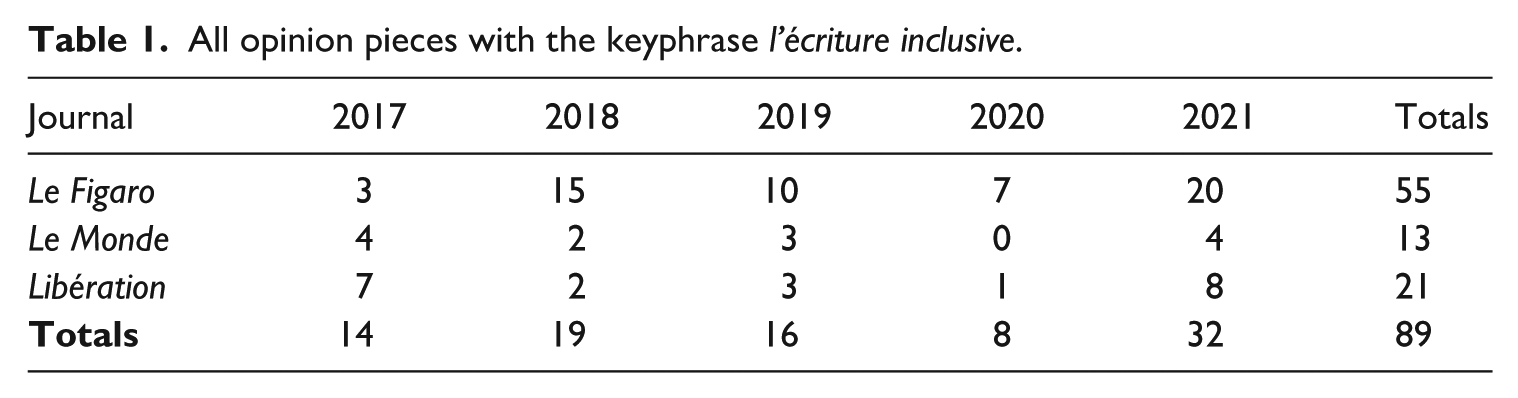
Having extracted all opinion pieces containing the keyphrase, the corpus was cleaned and uploaded into SketchEngine, which allowed for extraction of keylemmas, or lemmas that appear more frequently in the focus corpus than in a larger reference corpus. For my reference corpus, I selected French Web 2023 (frTenTen230), which consists of internet texts and totals 23.8 billion words; a reference corpus of this magnitude can reasonably approximate word frequencies in written French.
L’écriture inclusive as a formula
The keyphrase l’écriture inclusive operates as a formula within the French press. As Krieg-Planque (2009: 7) explains, a formula is ‘a collection of formulations which, from the fact of their employment during a given moment and a given public space, crystallize the political and social issues that these expressions simultaneously contribute to and construct.’ 2 A formula has four key characteristics: Its fixedness, and its discursive, polemical, and social qualities. L’écriture inclusive is fixed: It is a stable syntagm, appearing as a set phrase (Krieg-Planque, 2009: 64). It is discursive: As Abbou (2023) has demonstrated, l’écriture inclusive has become a formula through its invocation in public discourse, being the subject of increasingly iterative commentary and metalinguistic debate. It is polemical: it holds status as a social referent, pointing to a range of sociopolitical issues depending on a given author’s political orientation. Finally, it has a social character: known by all—in fact, with growing usage over time (Abbou, 2017: 55; Kamblé-Bagal and Tatossian, 2022: 8)—its notoriety (Krieg-Planque, 2009: 96) comes with heterogenous and even contradictory attributions, which will be addressed in my analysis.
Keylemmas and discursive themes
In debates around l’écriture inclusive, themes emerge as transversal frames, around which opinion writers take a stance; as such, l’écriture inclusive is discussed in terms of its negative, positive, or neutral effects on particular sociopolitical issues. In labelling themes running through the corpus, I identify topoi around which authors employ argumentation strategies to justify their positions (Baker et al., 2008: 282), with particular attention to their employment of linguistic ideologies, here defined as ‘beliefs or ideas about language or about social and linguistic relationships, which are used to justify particular language uses’ (Walsh, 2016: 1).
Themes were labelled in two phases, following Coady (2024: 65–66): A qualitative hand-coding phase and the quantitative generation of key lemmas. First I read through my entire corpus and began coding apparent keylemmas by hand, following Baker (2004: 355). This initial qualitative, impressionistic analysis was followed by conducting quantitative tests (Hardt-Mautner, 1995), identifying recurring lemmas that were then assigned to key word lists grouped by semantic categories (Coady, 2020: VIII; Le, 2002: 379). I then used SketchEngine to generate a list of key lemmas (‘WordList’) which further assisted in creating my thematic groupings (Supplemental Material). Following Coady (2018: 107), I made the following modifications to Sketch Engine’s default WordList settings in generating my key lemmas list: (1) Using lemma_lc (‘lemma lowercase’) instead of word, (2) selecting ‘1’ as the minimum frequency, and (3) under View options, choosing ARF (average reduced frequency) in order to identify lemmas spread across the corpus. Simultaneous to this semantic-coding process, I assigned authorial stances towards the keyphrase values of negative, positive, or neutral to derive patterns in the frequency with which a given theme contains arguments for or against l’écriture inclusive. 3
Although I identified multiple discourses throughout my corpus (see Kaplan 2023 for details), four themes are presented for analysis here: Freedom of Expression, French Cultural Values, Gender Inclusion, and Communication, selected because they exemplify the way perennial French purist rhetoric and arguments from previous debates over non-sexist language are not only being recycled around l’écriture inclusive, but built upon to incorporate ideologies absent from these earlier metalinguistic debates. Each theme functions as a transversal frame for argumentation, which compels authors to take up stances regarding the effects—positive, negative, or neutral—that l’écriture inclusive has on the topic at hand. These themes connect back to l’écriture inclusive’s status as a formula. As Krieg-Planque (2009: 79) points out, formula of the syntactic type noun + denominal adjective invite debate over the precise relationship of the denominal adjective to the noun from which it derives—in this case, triggering arguments around a variety of topoi centering inclusion as a paradigm.
Freedom of Expression emerges from questions of whether l’écriture inclusive is inclusive of different political ideologies, evoking earlier language debates around the formula political correctness, and most often is used among authors taking a stance against l’écriture inclusive (and political correctness) as censorial devices. Gender Inclusivity denotes all mentions of sex-based equality, with authors taking stances as to whether l’écriture inclusive helps, hinders, or does not affect it. Communication encompasses rhetoric around readability and accessibility, especially questions of which French readers are included (or excluded) when documents are written in l’écriture inclusive. The theme French Cultural Values includes opinion pieces centering l’écriture inclusive’s ramifications for French cultural symbols, especially language, frequently metonymical for French culture; opinion pieces under this theme often use extended metaphors as framing devices (Baker et al., 2008), with the most frequent metaphors involving French national symbols or French is France rhetoric (Ager, 1999: 12). Authors employing argumentation strategies under this theme primarily organize their arguments according to their stances on what counts as (French) writing, with argumentation around inclusion incorporating philosophical debates around French Republican ideals. A list of the themes and their associated key lemmas is provided in Table 2 below.
Key lemmas classed into main themes.
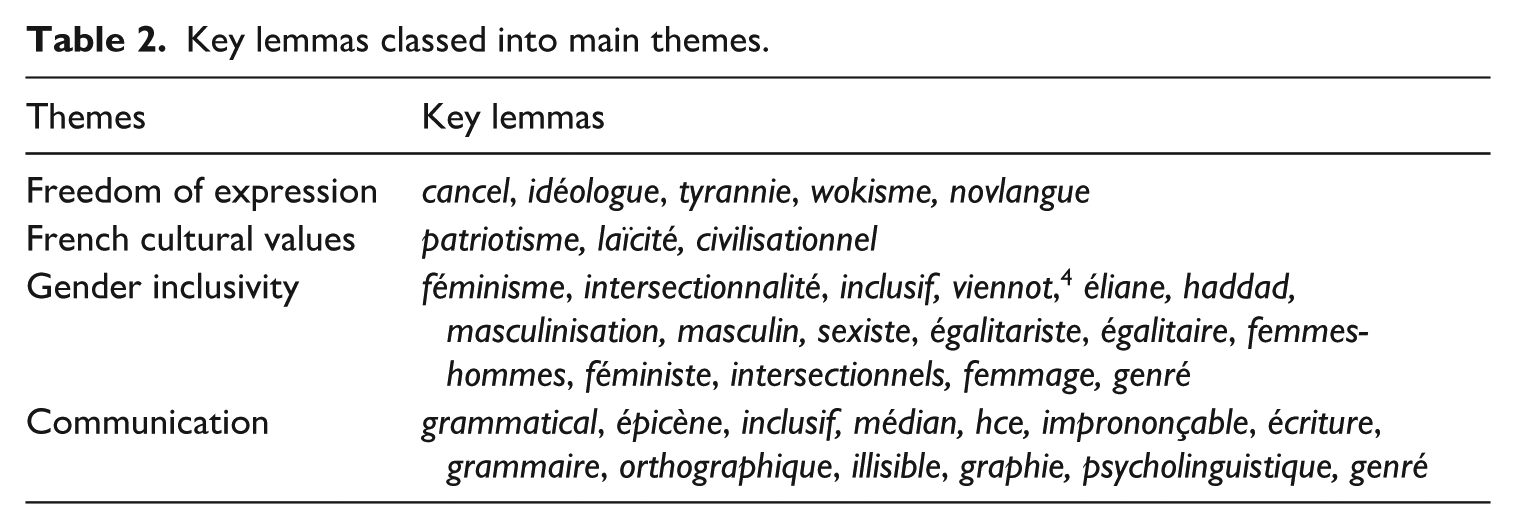
Discursive themes
Freedom of expression
At stake within the Freedom of Expression theme is whether or not EI is inclusive of different political ideologies, with authors incorporating this thematic rhetoric predominantly taking a negative stance (21 of 37 opinion pieces), overwhelmingly so in the Le Figaro subcorpus (20 of 28 Le Figaro opinion pieces; 0 of 28 took positive stances toward EI). The name of this theme, Freedom of Expression, while encompassing notions of liberty and democratic values, simultaneously encompasses exclusion—the silencing of others; in this sense, the rhetoric employed to deride EI parallels that used against the formula wokisme (Mahoudeau, 2023). One of the primary rhetorical moves by authors taking the stance that l’écriture inclusive curtails freedom of expression involves framing it as an ideological tool for reshaping the world—a means of linguistically enforcing a counter-factual reality. This is highlighted in the following passages: (1) Et à tous ces alignements (2)
These arguments thematically (and literally) invoke earlier debates about politically correct language (‘le politiquement correct’ [1]) and the capacity of both EI and political correctness to, in some of their opponents’ conceptions, destabilize ‘the relationship between language and reality’ (Cameron, 1995: 149). L’écriture inclusive, then, takes up the ‘naming-revisionism’ function that political correctness served in the France of the early 2000s (Toolan, 2003: 70).
In a pattern that traverses themes, authors contest who, exactly, EI includes—and its implied exclusions. Opponents pinpoint l’écriture inclusive as a sign of reverse discrimination—discrimination directed at historically dominant groups (see also Johnson, 2024: 88). Bock-Côté embodies this rhetoric, combining the tropes of reverse victimization and l’écriture inclusive as counterfactual: (3) Fondamentalement, nous sommes
As in (1) and (2), Bock-Côté frames l’écriture inclusive as reshaping reality to adopt the ‘mission’ of politically-correct ‘adeptes’ to reverse the poles of power, yanking it from anyone ‘trop blanc, trop masculin, trop occidental’ and handing it to all groups ‘historiquement marginalisés.’ He obliquely evokes deconstructivism, another favorite target of self-styled opponents of ‘gender ideology’ (Kuhar and Paternotte, 2017: 5), playing on the double-sense of deconstruct whereby deconstruction is ultimately destruction (‘ou même de l’anéantir’). 8 For the author, the White, Western, male will be destroyed should the ideology underlying inclusive writing prevail.
Leitmotifs of victimization and true victim rhetoric (e.g. Dubslaff, 2017: 170) are a trope across a variety of French social debates, whether it be the construction of ‘White French victims’ of antiracist activists (Zia-Ebrahimi, 2023: 252), the tactics adopted by opponents of gay marriage (Perreau, 2016: 41), or the populist constructions of ‘“the people”, the enemy and the elite’ (Kuhar and Paternotte, 2017: 15). While ‘‘political correctness’’ or ‘‘wokeness’’ are commonly blamed for threatening freedom of speech (Marlière, 2023: 239) and the position of White men in society, the invocation of l’écriture inclusive to this same effect—as well as its co-occurrence with the keylemma wokisme and the phrase politiquement correct—indicates its indexical field has been broadened to associate it with these concepts. 9
In fact, authors arguing that l’écriture inclusive is censorious of particular political ideologies frame the writing practice as a shibboleth of political correctness, thereby blurring the boundaries between the two formulae. Some authors stake this position very directly (‘Alain Finkielkraut déclara récemment: «Une des formes graphiques du politiquement correct, c’est
What is striking here is the almost unanimous negative stance towards l’écriture inclusive taken up by authors debating its stakes for freedom of expression. Keywords circulating throughout this theme, with their callbacks to dystopian fiction (e.g., tyrannie, novlangue), although increasingly popular with French conservative pundits, are not unilaterally used in service of conservative ideologies; for example, Olivesi and Kergomard (2020: 120) have noted uptake of novlangue in critique of neoliberal discourses. This meta-discourse is utilized by two authors writing for Libération, who make metalinguistic arguments about how rhetoric around freedom of expression is used by far-right social actors against what they critique. Pranchère writes that cries of ‘censorship’ are a political tool: (4)
Adopting the voice of ‘[l]’extrême droite,’ he writes that ‘le danger principal serait dans
Blin makes a similar critique, equating the polemic against ‘wokisme’ and ‘cancel culture’—under which l’écriture inclusive is subsumed—with the earlier polemic against ‘islamo-gauchisme.’ Pointing to the function of all these phrases as formula, he highlights their operationalization in service of (re-)stoking public debate: (5) La démarche s’inscrit dans la lignée d’une autre avant elle, celle censée s’attaquer à l’«
While neither Pranchère nor Blin make direct claims regarding their own views on l’écriture inclusive, their rhetoric reveals awareness of the polemical way l’écriture inclusive is deployed as a rhetorical device among far-right actors, as a shorthand for not only the curtailing of freedom of expression writ large but progressive movements that are claimed to ‘censure’ the far-right, herein anti-racism, feminism, and victims’ rights movements (4). Thus, through the arguments of opponents who view EI as curtailing freedom of expression, and the meta-arguments of authors pointing to the uptake of l’écriture inclusive alongside other formulae, we see EI taken as a facet of political correctness, islamogauchisme and wokisme, each of which is capacious enough to encompass whatever movements a given author wishes to take a stance against. L’écriture inclusive has taken on a metonymic quality—a rhetorical cudgel encompassing progressive movements, so-called leftist ideologies, and beyond, and thus has a meta-coalition-building function, summoning together opponents of political correctness, wokisme, islamogauchisme, and novlangue, each of which has a coalition-building function in its own right. 17
French cultural values
Arguments around French Cultural Values concern language as a national symbol, addressing not only whether l’écriture inclusive can be part of French culture, but negotiating its relationship with Republican universalism: Not just who can be included, but whether inclusion is conceptually compatible with the French political model. 18 The metaphor ‘French language is French culture’ is adapted by proponents to argue that the linguistic practice bolsters French values (especially metalinguistic awareness), while opponents argue that to attack French is to attack France, pointing to the interrelationship of these arguments in a larger metaphorical network (see also Coady, 2024: 69).
Throughout the corpus, numerous authors make the connection between French language and French identity or culture: (6) (. . .) (7)
In each of the above examples, there is an appeal to collectivity: ‘notre (première) identité’ (6; 7), ‘notre langue’ (7), ‘notre culture,’ each subscribing to the ideology that ‘‘French is France,’ whereby the language is the fundamental component of French identity’ (Ager, 1999: 11). While authors in (6) and (7) ultimately take a negative stance towards EI, this rhetoric is also used to argue for uptake of l’écriture inclusive: (8) La langue est
The ‘ciment’ of French culture is not just language but the metalinguistic capacity for linguistic negotiation, here situated within language as glue of the nation discourse (Coady, 2018: 214). Loison-Leruste, Pasquier, and Perrier similarly frame language debates as core components of French national culture, arguing that cultivating metalinguistic awareness forms good citizens: ‘En historicisant la langue et ses usages, en les interrogeant à l’aune des valeurs qu’elle entend porter, l’école leur montre que. . . la langue constitue un «trésor précieux»’ 22 —and through this historicization and linguistic negotiation itself, schools prepare students ‘à jouer leur futur rôle de citoyens et citoyennes’ 23 (Libération.5.Loison-Leruste.Pasquier.Perrier).
Elsewhere, the links between French language, French nation, and French cultural values are extended to claim that attacking the French language means attacking French culture. Redeker exemplifies this argument. He emphasizes the connection that French people have to the French language and its importance in forging both individual identity (as a French person) and national identity (as a French people). His rhetoric is rife with war metaphors—a common trope of purist discourse (Ager, 1999: 9; Walsh, 2016: 117)—which present language as under attack by l’écriture inclusive: (9) Il arrive à notre pays (. . .)
That Redeker’s employment of ‘langue’ encompasses more than orthographic practices is evident when he cites l’écriture inclusive as a spiritual failing ‘qui blesse [notre pays] dans son âme’—wounding the soul of the nation, a soul he insists is connected to language (‘est littéraire’). Such wounding plunges the nation into anomie and separatism, thereby rebuking the French value of national unity (Ager, 1999: 118). At issue here is the conceptualization of inclusion. Redeker’s framing of Republican universalism fundamentally rejects the existence of distinct groups and thus cannot conceptualize the need to ‘include’ or ‘exclude’ any given sect; inclusion, then, is not only inconceivable beyond integration into the existing national project—indeed, this was the end result of 1990s feminist advocacy for political gender parity (Abbou, 2023: 160)—but anti-French. Per Redeker, to suggest otherwise is to upend the entire French political model. Under this line of reasoning l’écriture inclusive is an existential threat to not just the French language, but all which language may stand in for: French history, French culture, and the very core of Republican universalist values—’la nature du fait d’être français.’
This opposition between inclusivity and the French value of integration is made even clearer in the following excerpt from Le Figaro, where the title ‘de
When language is constituted as a threat, it’s also a catch-all for other things threatening a community (Manatou, 2017: 85)—here, continuing pressures on gender balance, including within language (it cannot be overlooked that Redeker uses the generic masculine when emphasizing how ‘La langue est cette réalité qui rapporte
Gender inclusivity
Gender Inclusivity rhetoric contests what gender-based linguistic inclusion means, with authors staking claims regarding whether visibilizing the feminine in language is a viable feminist strategy and what impact (if any) linguistic inclusion has on social inclusion. Authors taking a positive stance in this regard are often quite explicit, framing EI as an important step for equality: (10) ‘ (11) ‘
EI is also claimed to elevate the visibilization of women (‘la féminisation du français et
Such positive stances toward l’écriture inclusive point to the keyphrase itself as diverging from other metalinguistic terms at the center of French cultural polemics: While the term political correctness became so contaminated by the stigma wrought by conservative opponents that ‘no progressivist’ would lay claim to acting ‘in its name’ (Toolan, 2003: 71), proponents continue to lay claim to l’écriture inclusive. That the term has both positive and negative activist connotations even while its semantic field appears to be expanding to encompass an ever-wider range of associated ideological movements underscores the flexibility of the formula.
Authors more skeptical of the impacts that language has on society frequently weaponized this stance against the practice of inclusive writing, arguing that linguistic interventions are unnecessary—or even harmful—given their inability to change social realities relating to sexism: (12) Sur le plan socio-politique,
For Szlamowicz, EI threatens to discredit other feminist causes (‘injustices’) that he views as legitimate, such as ‘la misogynie réelle.’ In this last phrase, as well as elsewhere where he refers to ‘pseudo-féminisme’ (four tokens), Szlamowicz polices the boundaries of what counts as feminism in a manner not unlike the Vatican’s rhetorical differentiation between legitimate (i.e., equity feminism) and illegitimate (i.e., gender feminism) feminist movements (Corredor, 2019: 626)—echoing the anti-gender register that Borba (2022: 73) identifies emerging through metasemiotic processes uniting coalitions against so-called gender ideology. Such definitional dilemmas once again have their parallel in debates around political correctness, wherein ‘deployment or non-deployment’ of a term under contention ‘has been an important rhetorical strategy,’ especially among opponents to the term under contention (Cameron, 1995: 122). Further, the feminist cause Szlamowicz chooses as the exemplar of ‘la misogynie réelle’ is Muslim women wearing veils (‘le voile islamique’), incorporating the islamophobia characteristic of another reactionary conservative discourse—that of islamogauchisme (e.g., Dawes, 2023: 229; Marlière, 2023: 235); in a femonationalist turn, Szlamowicz justifies his islamophobia in the name of protecting women, entangling arguments around gender inclusivity with French Cultural Values.
An additional contention around the inclusive aspect of l’écriture inclusive emerges among opponents to the practice, who argue that it is in fact exclusive. Much as with inclusive, exclusivity is probed from a variety of angles, with EI framed as exclusive in its ahistoricism (‘ (13) Certes
Within Bucco’s rhetoric, l’écriture inclusive is exclusive in two senses: Firstly, it is jargon, filled with aspects ‘alambiquées’ (‘overly complicated’), overlapping with arguments surfacing in Communication rhetoric; secondly, it promotes a singular ‘idéologie,’ here left undefined but imbued with a sense of menace and imposition, presented as a singular, coherent, ‘systematic’ feminist agenda, which serves to ‘gommer’ (‘erase’) aspects of reality, in turn tying this rhetoric to the Freedom of Expression theme. 35
Authors staked positions on either side of the argument regarding whether inclusive language advances (social) gender inclusivity; paralleling other themes, authors taking the stance that l’écriture inclusive does not advance gender inclusivity describe l’écriture inclusive in rhetoric overlapping with polemics around islamogauchisme, gender ideology, and political correctness.
Communication
The Communication theme contained many opinion pieces focusing on readability and accessibility, linked to questions of which readers are included in l’écriture inclusive. Its name derives from rhetoric around communication (e.g., key lemmas grammatical, écriture, and orthographique). Of the 33 opinion pieces with this theme, 19 took a negative stance towards EI, with many arguing that EI is not inclusive of most French readers. What’s more, pedagogical concerns around the teachability (and learnability) of this language are linked to the framing of the education system as a battleground for the future of France.
One of the most common characterizations of EI is that it is unreadable, overly complicated, or weighs down text, as in the below examples: (14) Il est de fait que (15) En effet, (16) Or il est vrai que
Elsewhere, authors describe EI as ‘lourde’ (‘cumbersome’) [Figaro.2020.7.Chazaud] or as ‘un obstacle’ [Figaro.2021.5.Louis]. These claims about EI complexifying French are entwined with Standard Language Ideology and the long-held myth of the exceptional logic and clarity of the French language (Lodge, 1993: 185).
While heavily implicated in linguistic purism, discourse around communication once again entangles linguistic ideologies alongside social and political ideologies. This is especially evident where arguments about readability extend to broader pedagogical concerns, particularly concerning literacy rates (Loison et al., 2020: XVII): (17) La «querelle inclusive» semble une paranoïa aux fondements légers et elle réclame une correction
In the above extract, l’écriture inclusive becomes an additional obstacle to teaching French. The focus on pedagogical concerns in EI debates is connected to larger ideological and metasemiotic processes, not least because the educational sphere is conceived as the place where future citizens—and by extension, the future of French society—are forged (Fassin, 1994: 35): Burnett and Pozniak (2021: 826) argue that left-wing and right-wing actors are competing to set the agenda on EI order to influence students’ political ideologies, and Loison et al. (2020: XVIII) argue that pedagogical rhetoric has allowed the anti-non-sexist language coalition to grow ‘beyond those that traditionally campaign against feminist demands.’
While coalition-building is certainly one of the effects of this kind of language, framing children as the victims of inclusive language ideology additionally aligns this rhetoric with that employed by anti-gender activists concerned with gender ideology. The ‘‘child in danger’’ is an important figure for anti-gender activists, drawing concerned parents into their coalition (Kováts, 2017: 177), as has been invoked repeatedly by the Manif pour Tous (Paternotte, 2018: 163). The place where children are said to be most in danger to indoctrination is the school (Kuhar and Paternotte, 2017: 6), as is stated even more directly in the following excerpt: (18) La vérité est que
L’écriture inclusive, then, represents a double-threat to France: Firstly, in harming children, it threatens the future of the French nation (the family, after all, has long been an important symbol of the hexagon [Scrinzi, 2017: 134]), and secondly, by disrupting children’s access to the French language, it disrupts their access to French culture, playing back into discourses of French Cultural Values wherein French language
Conclusions
This paper has examined a corpus of opinion pieces to explore the rhetorical contexts in which l’écriture inclusive surfaces and its entanglement with prior and ongoing polemics in the French Press. My analysis of journalistic opinion discourse around l’écriture inclusive captures linguistic attitudes and ideologies emerging in metalinguistic discussion of a change in progress—that is, use of inclusive French writing—and the broader social issues that inclusive writing itself has come to symbolize. The reproduction of these linguistic and social ideologies in elite French daily newspapers demonstrates how news opinion writers both serve to reinforce the power of social elites and attempt to legitimize these ideologies for the public through persuasive rhetoric.
Turning to four collocational themes within which l’écriture inclusive is used, we see that longstanding rhetoric in French metalinguistic texts—such as the equation of French language with French culture—remains salient in debates about modern linguistic phenomena. Alongside these older rhetorical strands, new ones emerge, most saliently the framing of l’écriture inclusive as an ideological threat to core French values.
Within the most polemical pieces l’écriture inclusive is evoked as a keystone of other formulae, including islamogauchisme, gender ideology, and wokisme, but especially political correctness. Through these co-occurrences l’écriture inclusive has semiotically expanded to index not just writing, but broader progressive ideologies, operating like these other formulae to stand in for whatever progressive movements or theory a given author is taking a stance on—most commonly, a stance
Supplemental Material
sj-docx-1-das-10.1177_09579265261421958 – Supplemental material for Between prescriptivism and polemic: L’écriture inclusive in the opinion pieces of Le Monde, Le Figaro, and Libération
Supplemental material, sj-docx-1-das-10.1177_09579265261421958 for Between prescriptivism and polemic: L’écriture inclusive in the opinion pieces of Le Monde, Le Figaro, and Libération by Jennifer M. Kaplan in Discourse & Society
Footnotes
Acknowledgements
I would like to thank the participants at the Gender-Neutral/Fair/Inclusive/Nonbinary/Non-sexist Languages and their Dis/contents seminar for their feedback on an early version of this project. I would also like to thank Mairi McLaughlin, who taught the course that inspired this paper and offered much invaluable feedback, as well as the reviewers for their thorough comments.
(Correction April 2026):
The article has been updated to correct minor bibliographic and formatting errors, including the reference details of Walsh (2016) in the reference list.

Ethical considerations
Ethical approval was not required for this study.
Funding
The author received no financial support for the research, authorship, and/or publication of this article.
Declaration of conflicting interests
The author declared no potential conflicts of interest with respect to the research, authorship, and/or publication of this article.
Data availability statement
All data, including the full corpus used, is available upon request.
Supplemental material
Supplemental material for this article is available online.
Notes
Author biography
References
Supplementary Material
Please find the following supplemental material available below.
For Open Access articles published under a Creative Commons License, all supplemental material carries the same license as the article it is associated with.
For non-Open Access articles published, all supplemental material carries a non-exclusive license, and permission requests for re-use of supplemental material or any part of supplemental material shall be sent directly to the copyright owner as specified in the copyright notice associated with the article.
