



Abstract
Biodiesel can be used as an alternative fuel in diesel engines due to environmental and energy concerns. Considering the existing resources in Iran, interests on expansion of biodiesel production and application have been sped up by the Iranian government. So, in this study the effect of biodiesel from waste cooking oil and diesel fuel blends (B0, B20, B50, B80 and B100) on the performance characteristics (brake power, brake torque, BSFC and brake thermal efficiency) of a diesel power generator model CAT3412 was investigated. The experiments were conducted at rated engine speed 1530 r/min and various engine loads (25%, 50%, 75% and 100%). The results of the study showed an increase in brake power, brake torque and brake thermal efficiency and a reduction trend in brake-specific fuel consumption at higher engine loads for all the biodiesel-diesel blends. In addition, the research results indicated that B20 and B50 fuel blends in terms of performance characteristics could be recognised as the potential candidates to be certificated for usage in the diesel power generator.
Introduction
Today, usage of biofuels such as biodiesel has been suggested intensively for diesel engines due to energy and environmental problems.1–7 According to Ghobadian study 8 “There is no doubt that the end of the oil era for Iran is estimated to be slightly more than the double of the average estimation for world taken as a whole, but it is important to note that Iran is also part of the world’s society and moreover an importer of the a oil derivatives such as diesel and gasoline fuels”.
Also other studies9–12 show that “Considering the existing resources such as land and water body areas in Iran, interests on expansion of biofuels production and application could be speeded up through mandates and financial incentives by Iranian government similar to the other countries”. Beside, research interest in biofuels has grown strongly due to the steep climb in fossil fuel oil prices and import of petroleum derivatives such as diesel and gasoline fuels during recent years. 8
In addition, Safieddin Ardebili et al. 13 reported that “The growth of Iran's economy has been the cause of increase in energy consumption and despite the growth of domestic energy production; demand has grown even faster especially in the fossil fuels sector. If this increasing trend continues, it will be clear that in future, Iran shifts from being a minor exporter to being a major importer. The major rise in energy import has come from the increased gasoline and diesel fuels consumption in transportation. Also Iranian energy demand is expected to grow over the next couple of decades. Another concern is about the environmental pollution which is growing due to the increase of the use fossil fuels. One of the good scenarios for decreasing of fuels consumption is planning to produce and consume biofuels. The use of renewable energy, especially biofuels will make Iran stand for a better chance to have share of energy from non-fossil energy sources, and it will surely decrease the fossil fuel consumption. On the other hand using biodiesel and diesel fuel mixture can be an optimum alternative fuel for CI engines”.
Additionally, it was presented in 13 that “Primary energy demand in Iran is predicted to increase at an average annual rate of 2.6% in 2003–2030. This assumes that the progressive removal of energy subsidies, now equivalent to a staggering 10% of GDP (gross domestic product). Iran's oil reserves are the second largest in the Middle East, after Saudi Arabia. Oil production is projected to grow from 481.13 ml/d (million liters per day) in 2004 to 528.07 ml/d in 2010 and to 798 ml/d in 2030. Iran holds the second largest natural gas reserves in the world. Gas production is expected to grow to 110 bcm (billion cubic meters) in 2010 and to 240 bcm in 2030”.
Also according to Ghobadian et al. 14 “In Iran, Electricity generation is estimated to be increased from 153 TWh (terra watt hour) in 2003 to 359 TWh in 2030, requiring 54 GW of new generating capacity and total investment in power infrastructure of$92 billion”.
It should be noted that there is a great potential to produce biofuels based on agricultural materials to improve energy services in Iran. 15 For example, utilization of oil seeds has a considerable potential in order to produce biodiesel. 13
Also based on the Gobadian research 8 “Iran's diversity of terrain and climate enables cultivation of a variety of energy crops suitable for liquid biofuels production. Moreover Iran has 7% of its area covered with forest products which are suitable sources for liquid biofuels such as biodiesel. Iran also has a long tradition of fishing in Caspian Sea and Persian Gulf and on inland rivers. Out of 1.5 million tons of edible cooking oil consumed in Iran annually, about 20% of it can be considered as waste, which is suitable biodiesel feedstock”. In addition, the producing biodiesel from the edible oil seeds can ideally replace approximate 2% of total diesel fuel consumption and reduce the import of diesel fuel in Iran. 13
As mentioned above, biodiesel can be used in electric power generation as an alternative for diesel fuel in places where the generators supply the power by using petroleum diesel oil.
Biodiesel fuel has many effects on diesel engine performance. There has been a lot of research on the regulated performance characteristics of diesel engines with biodiesel/diesel blends.
There is much literature to study the effect of pure biodiesel on engine power, and most of them agreed that, with biodiesel (especially with pure biodiesel), engine power will drop.5,16–21 Hansen et al. 22 observed that the brake torque loss was 9.1% for B100 biodiesel relative to D2 diesel at 1900 r/min. Of course, it was reported that there were surprising increases in power or torque of engine for pure biodiesel.23,24 Song and Zhang 23 observed that the engine brake power and torque increased with the increase in biodiesel percentage in the blends.
For brake-specific fuel consumption (BSFC), much research compared the blends with different content biodiesel. Most research5,20,25–30 agreed that the fuel consumption of an engine fueled with biodiesel becomes higher. In the literature5,27,31–33 authors believed that, with increasing the content of biodiesel, engine fuel consumption will increase. On the contrary, it was reported in the literature23,34–36 that fuel consumption was decreased for biodiesel compared to diesel.
Many authors18,37–46 indicated that the specific consumption of the diesel engine increases by using biodiesel from soybean oil, palm oil or residual frying oil when compared to diesel fuel. But according to the papers40,42,43,46,47 the decrease of BSFC was due to the use of biodiesel. On the contrary, some researchers37,38,41–44,46 showed that the increase of the biodiesel percentage in the blend increases the specific fuel consumption.
About using biodiesel from soybean oil, in some studies,18,38,40–43,45 it has been reported that “The use of biodiesel in a diesel engine increases the specific fuel consumption”. The same conclusion was reached by for biodiesel made from palm oil.18,37,40–42,44 Also, the authors18,37–40,42,43,46 indicated that “The biodiesel from waste frying oil feedstock increases the BSFC”. According to Xue 46 study, “The specific fuel consumption will drop with the increase of engine speed by using waste palm frying oil”. Another repot from the same paper 46 indicated that “the lowest specific consumption value was observed at the electrical load of 50 kW when the same biodiesel is used. Also, it was shown in another research 47 that the specific fuel consumption decreases by use of waste frying oil, when using residual palm frying oil. Also, another study from the same paper indicates that the lowest specific consumption value was observed at the electrical load of 50 kW, when using the same biodiesel. According to D'Agosto et al. 48 evaluation “The specific fuel consumption of biodiesel blends (B20 and B50) produced from soybean oil, palm oil and residual frying oil at different power levels, for electric power generation. The results evidence that the 20% blend of biodiesel from soybean oil has the closest performance to the reference fuel and also the proportion of biodiesel has affected more significantly the performance of the blend tested than the type of raw material to the specific consumption for all power levels”.
Finally, most of the studies do not indicate the biodiesel test conditions against nine studies that indicate these characteristics.38,40,42,43,46,47 Enweremadu and Rutto, 43 reported that “By increasing the percentage of biodiesel from waste frying oil in fuel mixture, the specific fuel consumption of pure biodiesel is slightly higher than that for diesel, under loaded condition”. Another study, which is indicated by Enweremadu and Rutto, 43 shows that minimum values of specific fuel consumption are obtained at 1750 r/min. The biodiesel from residual frying oil presents 258.66 g/kWh of specific fuel consumption, against 229.59 g/kWh for diesel.
Banapurmath et al. 49 compared the effect of three injection timings and the different injection of pressure (IOP) on the brake thermal efficiency (BTE) for Honge oil methyl ester (HOME). They found that there was an improvement in the BTE for biodiesel by retarding injection timing, and that the highest BTE occurred at 260 bar among all the IOPs tested because atomisation, spray characteristics and mixture with air were better with higher injection, which result in improved combustion. Also, Sharma et al. 50 concluded that the difference of BTE between biodiesel and pure diesel tended to increase with the increase of fuel injection pressure. Carraretto et al. 51 observed that power and torque were increased up to almost pure diesel levels by reducing injection advance because it was possible to optimise combustion, and by improving performances especially at low and medium speed with respect to nominal injection advance operation.52
In the comparative study, combustion characteristics and BTE of a diesel engine fueled with diesel and biodiesel (FAME100%) were conducted. The results of the research showed a decrease of about 0.6% in BTE of the engine by fuelling the heavy-duty diesel engine with biodiesel. Meanwhile, increases of approximately 2%, 17% and 11% in BSEC, BSFC and volumetric BSFC were observed.
In addition, Ferreira et al. 53 presented an analysis of additional ethanol injection on performance and emissions of a diesel engine powered with a blend of diesel-biodiesel. The tests were made in an engine at 1800 r/min, connected to an electric generator. In this research, the energy analysis showed a decrease in engine efficiency with the addition of ethanol. And it was also proven that the ethanol addition can be an important method to reduce the amount of NOx in the exhaust gases of diesel engines.
The impacts on fuel consumption and exhaust emissions of a diesel power generator operating with biodiesel were investigated by Valente et al. 54 They found that “Fuel consumption increases with higher biodiesel concentration in the fuel. Also, soybean biodiesel blends showed lower fuel consumption than castor biodiesel blends at a given concentration.
In this study, the performance characteristics of biodiesel blended with diesel fuel No. 2 in ratios of 0% (B0), 20% (B20), 50% (B50), 80% (B80) and 100% (B100) were investigated for a diesel generator engine under four engine loads (25%, 50%, 75% and 100%) at the rated engine speed of 1530 rev/min. In this research, the full load was applied to the diesel engine generator according to local consuming electrical power.
Materials and methods
Biodiesel preparation and fuel properties
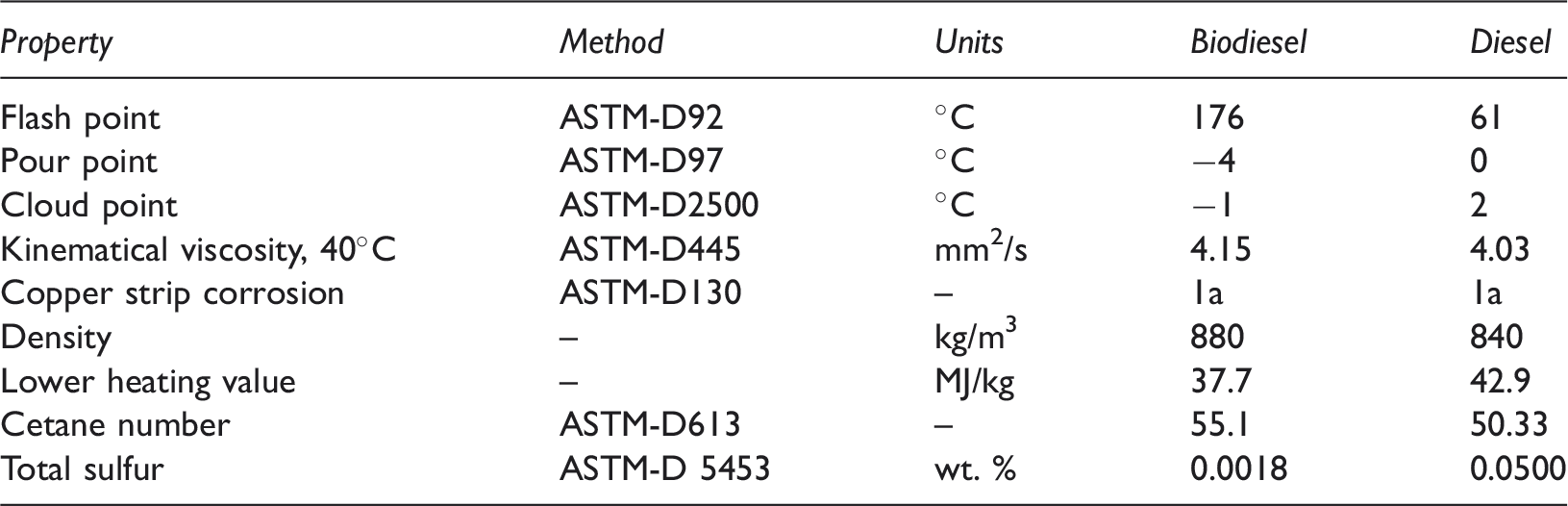
Since biodiesel from waste vegetable cooking oil is a more economical source of the fuel in the present investigation, in this research, biodiesel was produced from this source.4,55 The source of waste cooking oil included was from sunflower oil and soybean oil.
Properties of diesel and biodiesel fuels used for the present investigation.
Test engine experimental setup, procedure and performance characteristics calculation
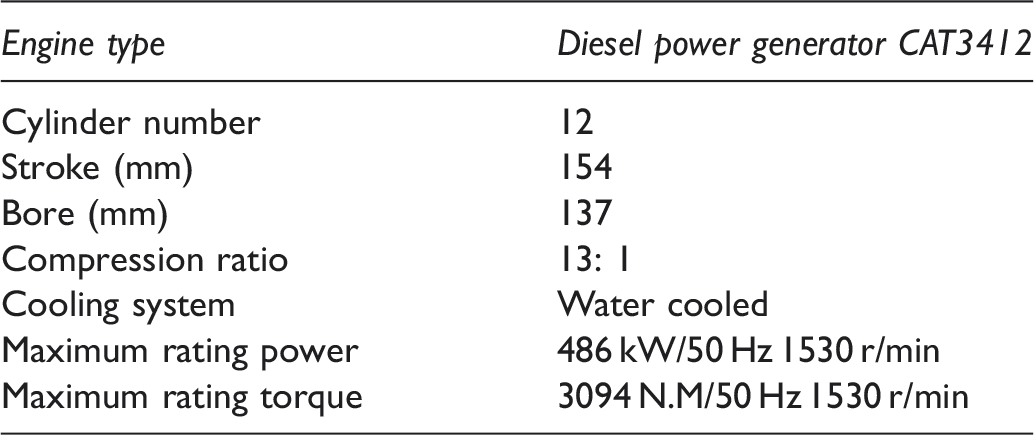
In this study, the engine tests were carried out on diesel power generator model CAT3412 consisting of a four-stroke, supercharged diesel engine coupled to an instrumented generator to evaluate the engine performance characteristics. The generator was equipped with a central processing system and a control panel to record the data. A system with scale method was also used to for determination of engine fuel consumption. The major specifications of the internal combustion engine are shown in Table 2. The characteristics of the generator are: maximum power, 330 kVA; voltage, 380 V; three-phase; rotation, 15300 r/min; armature rotor resistance, 0.1 Ω; and stator resistance, 0.15 Ω. Also, the power factor of 0.90 was used. Figure 1 shows the diesel power generator.
The engine test setup. Specifications of the test engine.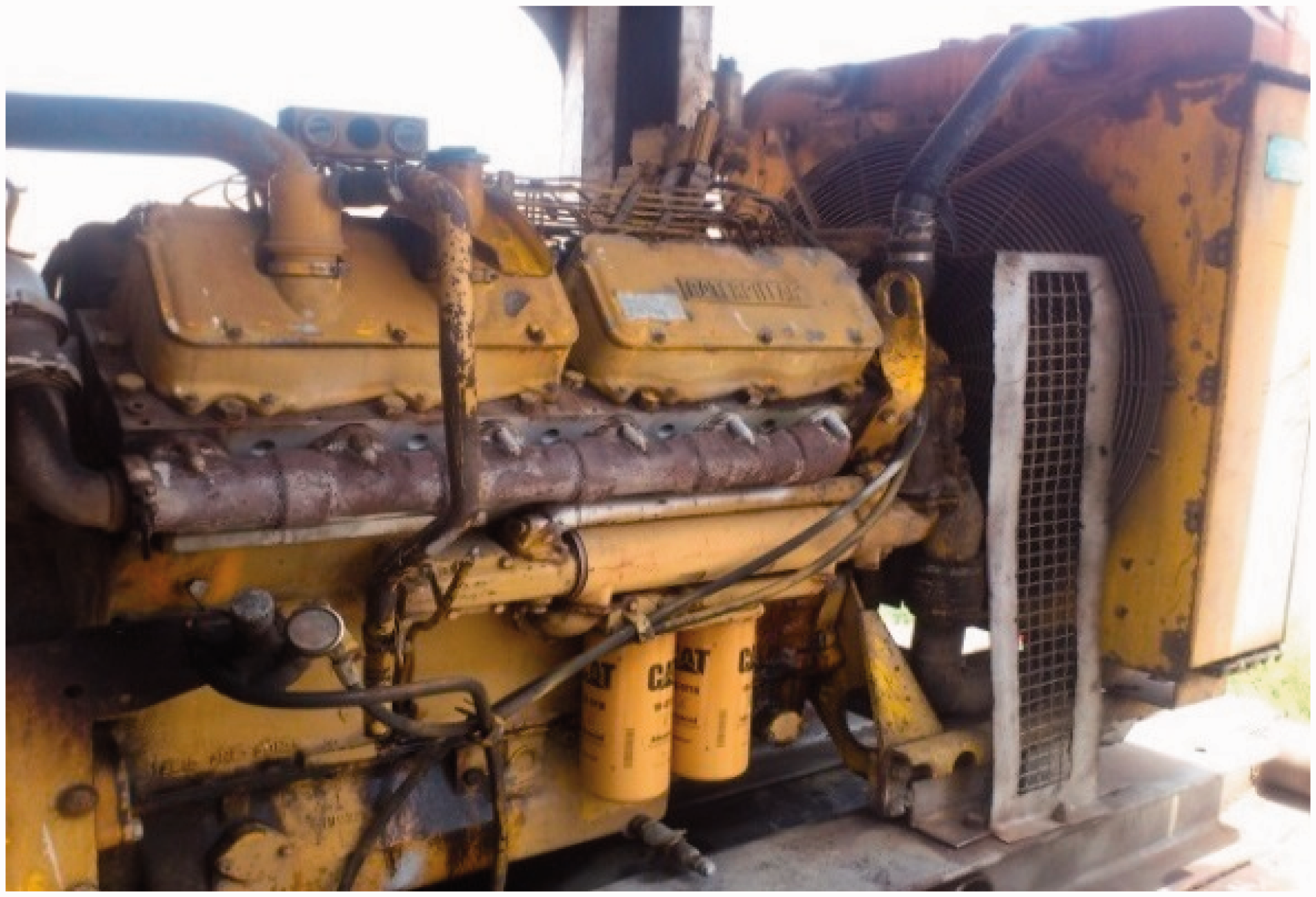
The diesel engine was fuelled with blends of biodiesel and No. 2 diesel fuel. The fuel blends were used at a constant engine speed and different electrical load. The engine was allowed to run a few times until the exhaust gas temperature, the cooling water temperature and the lubricating oil temperature attained steady-state values and then the data were recorded. In this research, armature rotor resistance and stator resistance were considered to calculate of engine brake power. Based on the engine brake power, the engine speed and the mass consumption rate of the fuel, the brake torque, the BSFC and the BTE were calculated.
Results and discussion
Brake power
The brake power amounts for different fuel blends are shown in Figure 2. As Figure 2 shows, the maximum brake power is 130 kW for the fuel blend including 50% biodiesel at full engine. Also, the minimum brake power (24.8 kW) occurs at 25% engine load for B100.
Effect of fuel blends on brake power at various engine loads.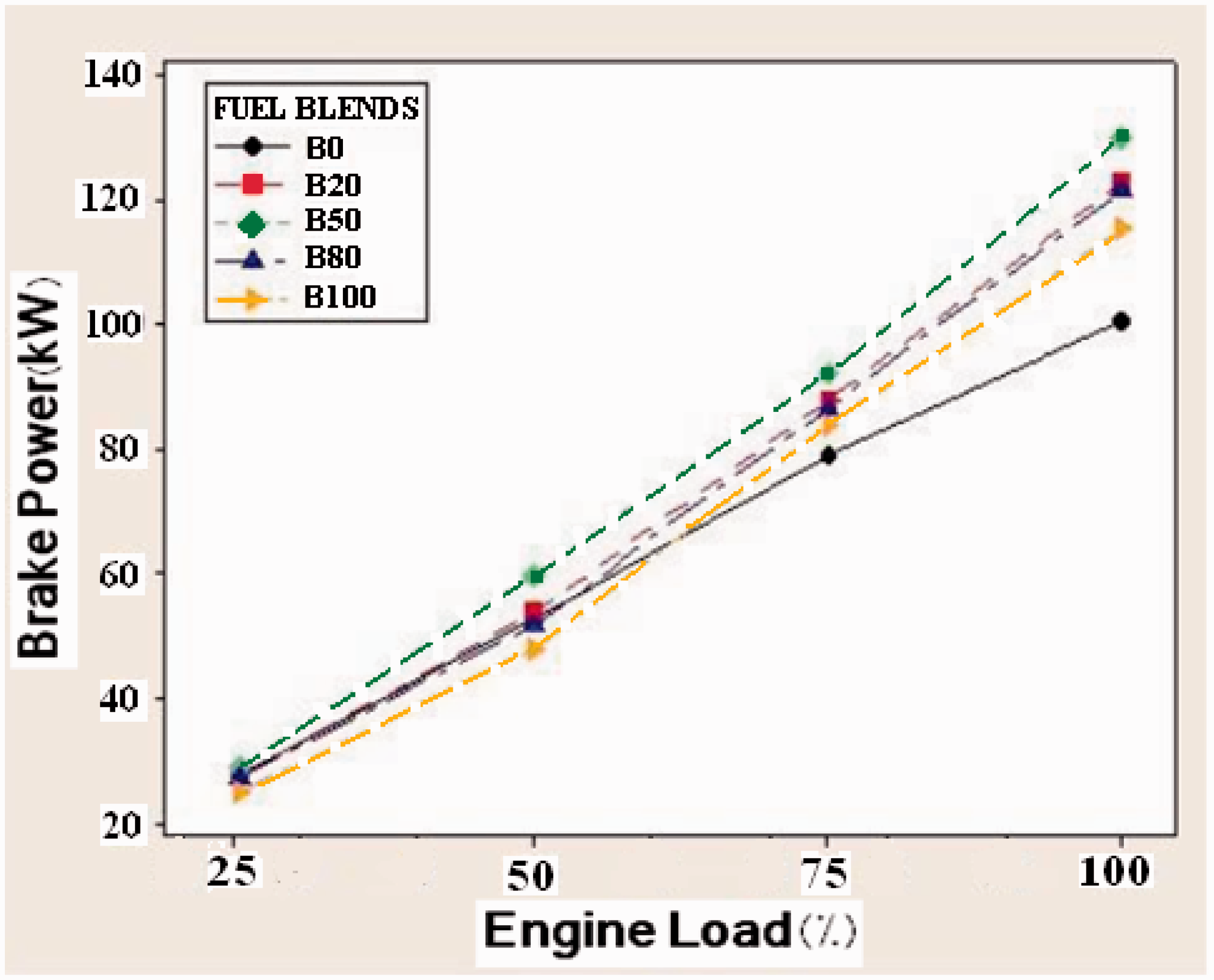
As shown in Figure 3, the brake power decreases with increasing the amount of biodiesel in fuel mixture for B80 and B100. It is probable that the main reason for the higher brake power amounts of diesel fuel No. 2 than that of B80 and B100 in lower engine loads could be due to the lower heating value of biodiesel.4–6,16–18,20,21,57 The fuel flow problems as higher density and higher viscosity of biodiesel and decreasing combustion efficiency as bad fuel injection atomise than diesel fuel also have certain effects on decreasing brake power.5,67,16,20
Effect of fuel blends on brake torque at various engine loads.
On the other hand, it can be understood from the percentages that the brake power level increased with the proportion of biodiesel for B20 and B50. Also, the value of the brake power for pure diesel is less than that of other blends in higher loads. These results are due to the higher oxygen content of biodiesel in the combustion region that provided more complete combustion. 58 This means that biodiesel in the fuel mixture increases the oxygen content of the blend which causes higher combustion efficiency especially in higher loads and compensates the loss of heating value of biodiesel for these fuel blends.58,59 In addition, the engine delivers fuel on a volumetric basis and the biodiesel density is higher than that of diesel, which supplies more biodiesel to compensate the lower heating value. 60
As shown in Figure 2, the brake power of the engine is relatively high at higher engine loads, because the increase in combustion temperature leads to more complete combustion during the higher load. 18 Also, at higher engine load, a beneficial effect of biodiesel as an oxygenated fuel was seen to generate more complete combustion, which means increased brake power. This indicates that the addition of oxygenated fuel is most effective in rich combustions.5,61
Brake torque
Figure 3 shows the effects of biodiesel percentage and engine load on the brake torque of the engine at constant engine speed. As Figure 3 shows, the maximum brake torque is 812 N.m for the fuel blend that included 50% biodiesel at full load. Also, the minimum brake torque (155 N.m) happens at 25% engine load for B100.
The values for the brake torque tend to decrease by increasing biodiesel proportion in fuel mixture for B80 and B100. These decreases are understandable, since the heat content of the fuel blend decreases with the increasing amount of biodiesel compared to that of diesel fuel No. 2.4–6,17,20–22,57,62
On the other hand, the brake torque level increased with the proportion of biodiesel for B20 and B50 due to high lubricity and the higher oxygen content of biodiesel. As shown in Figure 4, the value of the brake torque for pure diesel is less than that of other blends in higher loads. These properties might result in reduced friction loss and more complete combustion, and thus especially improve the brake effective torque in higher loads and compensate the loss of heating value of biodiesel.
26
Effect of fuel blends on BSFC at various engine loads.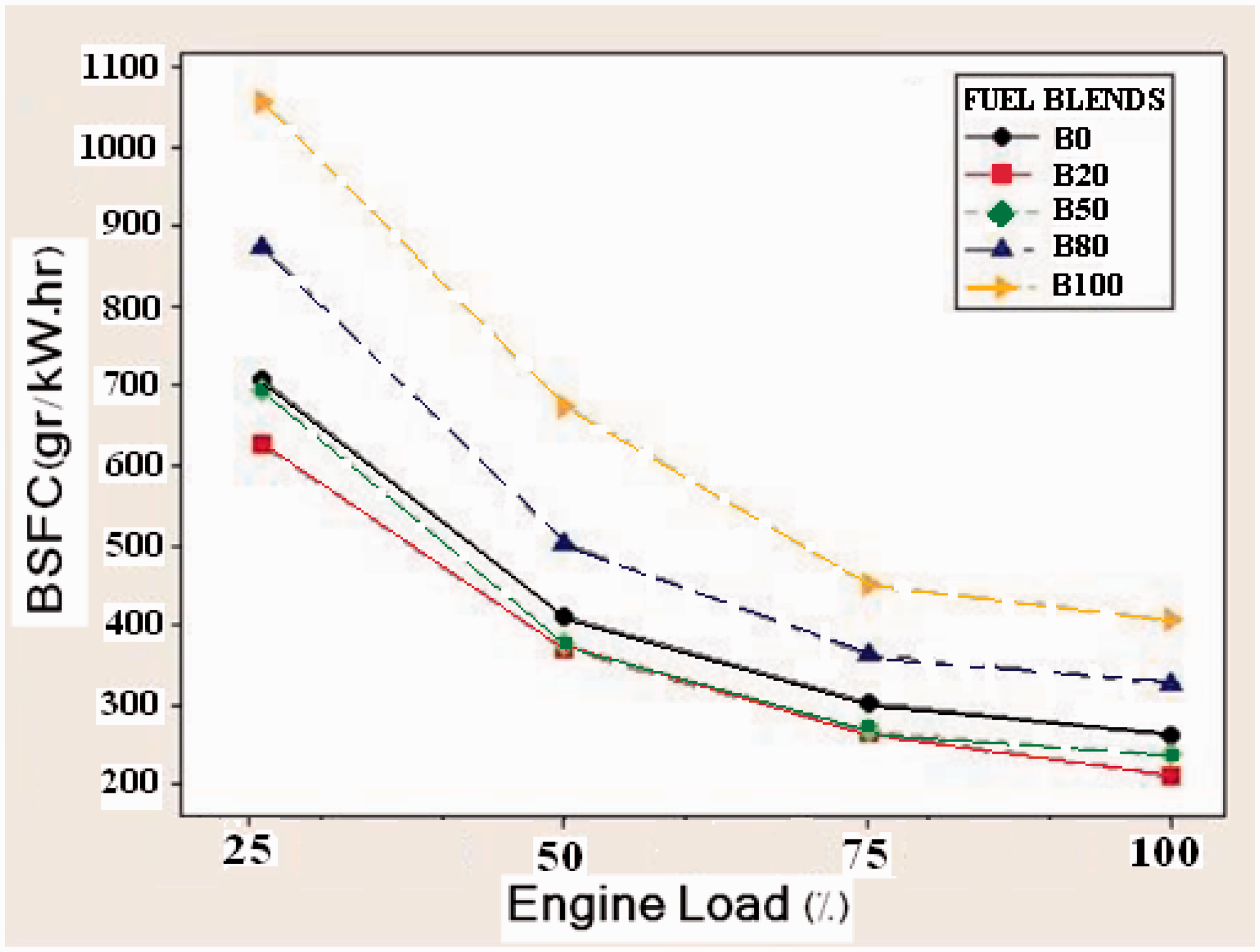
Figure 3 also shows the brake torque increases with increasing engine load, because the increase in combustion temperature leads to more complete combustion during the higher load. 18
Brake-specific fuel consumption
Figure 4 shows the effects of biodiesel percentage and engine load on the BSFC of the engine at engine speed of 1530 r/min. As Figure 4 shows, the maximum BSFC is 1057 (g/kW.h) for the fuel blend B100 at 25% engine load. Also, the minimum BSFC (210 (g/kW.h)) occurs at full engine load for the fuel blend that includes 20% biodiesel.
The values for the BSFC increase with the increasing amount of biodiesel in the fuel blends B80 and B100. The heating value of the biodiesel is lower than that of diesel fuel No. 2. Therefore, if the engine was fueled with biodiesel or its blends, the BSFC will increase due to the produced lower brake power caused by the lower energy content of the biodiesel.5,6,17,20,26,57,58,63 At the same time, for the same volume, more biodiesel fuel based on the mass flow was injected into the combustion chamber than diesel fuel No. 2 due to its higher density.56 In addition to these parameters, viscosity, the atomisation ratio and injection pressure should be considered since they have some effects on the BSFC and brake power values.23,59 On the other hand, the BSFC of B20 and B50 is less than B0 because of the higher oxygen content of biodiesel that improves the brake power and compensates the loss of heating value of biodiesel.5,6,26,58
As Figure 4 shows, with the increase in load, the BSFC of biodiesel decreases. One possible explanation for this trend could be the higher percentage of increase in brake power with load as compared to fuel consumption.4–6,26–30,64
Brake thermal efficiency
BTE of a diesel engine is the efficiency in which the chemical energy of a fuel is turned into useful work.
65
It can be determined by dividing the useful work by the lower heating value of the fuel. This can be simplified and given in equation (1)

The BTE of the engine fuelled with diesel, B20, B50, B80 and B100 fuels is shown in Figure 5. B20 gives the best BTE of engine with the value 40.4% at full engine load. Also, the minimum BTE (8.1%) occurs for B100 at 25% engine load. As seen in equation (1), thermal efficiency has an inverse relationship with the BSFC and lower heating value (HLHV). Therefore, the primary reason for the decrease in BTE of the fuel blends included 80% and 100% biodiesel than other blends is the higher BSFC in spite of lower energy content of biodiesels.
Effect of fuel blends on thermal efficiency at various engine loads.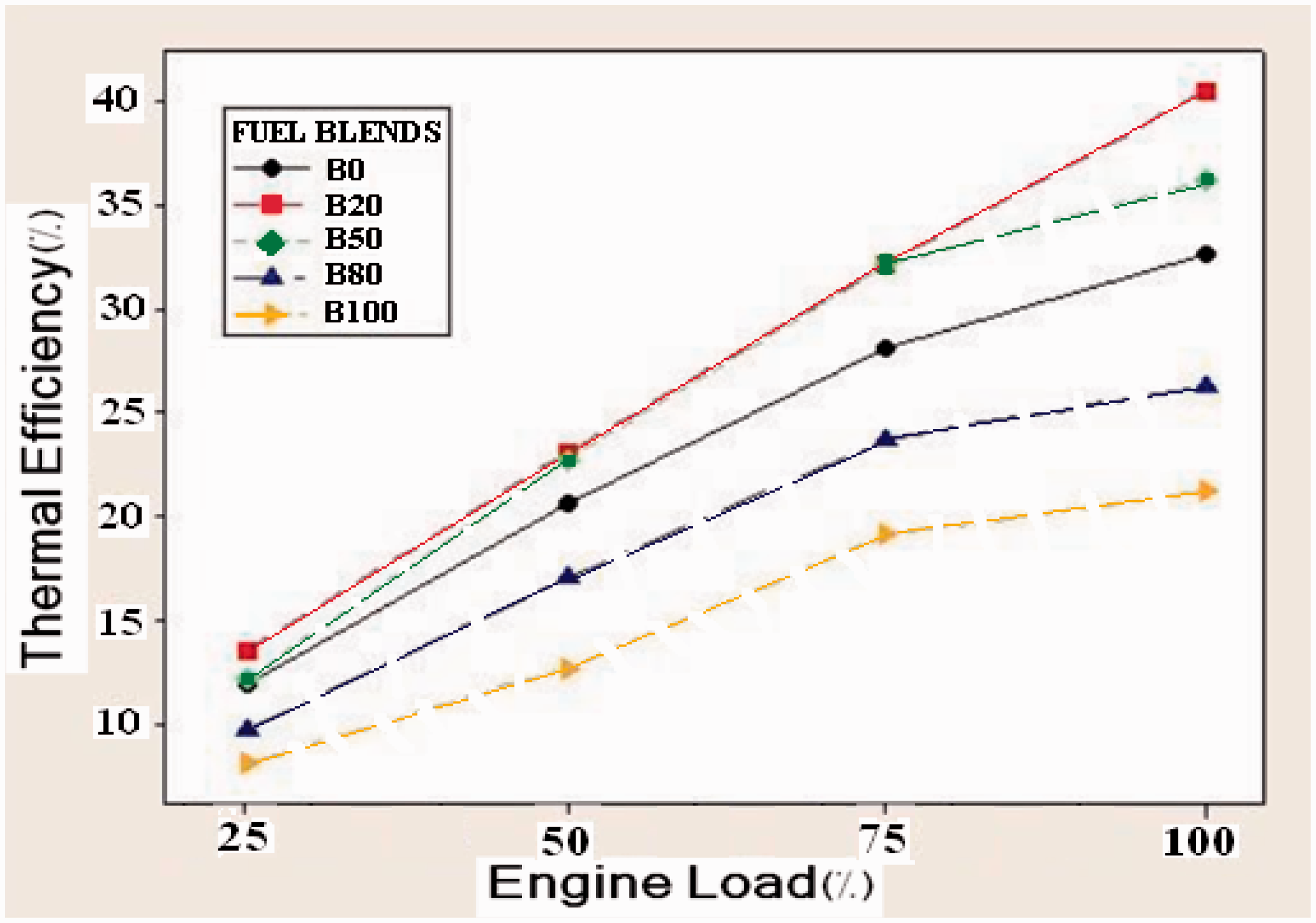
According to Figure 5, it can be shown that the BTE of the engine is higher for B20 and B50 than that of B0. This improved efficiency was explained by some authors with more effective combustion and increased lubricity of these blends as compared to diesel fuel.26,58 In all cases, BTE has the tendency to increase with increase in applied load. This is due to the reduction in heat loss and increase in power developed with increase in load. 26
Conclusion
Because of increase in energy consumption especially in the fossil fuels sector and concerning about the environmental pollution due to the increase of the use fossil fuels, Iran government needs to prepare its biofuel development plan and serious supporting policies. The great potential to produce biofuels in Iran will also make Iran stand for a better chance to have share of energy from non-fossil energy sources, and it will certainly decrease the fossil fuel consumption. Since there is no major engine modification required to use biodiesel, diesel-biodiesel blends can be an optimum alternative fuel for diesel power generators in Iran. It is strongly recommended to produce and consume biofuels in Iran; hence the import of diesel fuel will be reduced. Between all of the fuel mixtures, B20 gives the best brake thermal efficiency of the diesel power generator at full engine load. Also the results of the study show that an increase in brake power, brake torque and brake thermal efficiency and a reduction trend in BSFC at higher engine loads for all the biodiesel-diesel blends. The test results indicated that the fuel mixtures contained 20% and 50% biodiesel (particularly B20) in terms of performance characteristics could be recognized as the potential candidates to be certificated for usage in the diesel power generator.
Footnotes
Acknowledgement
The authors wish to express their deep thanks to the National Iranian Drilling Company for the laboratory facilities to carry out the engine tests of the research.
Declaration of conflicting interests
The author(s) declared no potential conflicts of interest with respect to the research, authorship, and/or publication of this article.
Funding
The author(s) received no financial support for the research, authorship, and/or publication of this article.