




Abstract
The water produced at the Amal oil field in Libya is directly stored for evaporation in in-ground-pits. As there are a large number of oil production wells, there is a risk of environmental pollution because of the waste water’s eventual penetration into subsoil and surface waterways. From a technical point of view, the existing system of reservoir water disposal into storage pits will not be adequate to meet the increasing water production. Besides, the discharge of produced water without previous treatment is ecologically unacceptable. In this paper, a modern concept of produced water preparation is proposed, and the method of its disposal defined, applying an integrated approach to solving this problem, including technological, economic and environmental aspects. Produced water preparation in an oil field in Libya was chosen for the proposed implementation of an option with the lowest operating costs (storage tanks and liquid hydrophobic filter tank).
Introduction
Water is very often a by-product of the crude oil production process. This water is considered to be industrial waste and therefore requires certain treatment before disposal. Most produced water contains some or all of the following components: dissolved inorganic salts, organic compounds and gases, dispersed oil droplets (oil-in-water emulsion) and solid particles, as well as chemical additives used in treatment and naturally occurring radioactive material.
After appropriate treatment, this waste water can be discharged into waterways, evaporative in-ground pits or re-injected into geological formations. Re-injection into layers requires additional water preparation in order to separate suspended solids and to separate oil, as well as chemical and bio-treatment.1–4
The treatment of waste water primarily involves separation of dispersed oil. Standards and regulations regarding the permitted maximum concentration of dispersed oil differ from country to country. In the U.S., the maximum concentration of dispersed oil should not exceed 15–58 mg/l. 5
At present, the water produced at the Amal oil field in Libya is separated from oil in separators at gathering stations and by additional separation in oil dehydrator. After that, the remaining oil, in the form of finely dispersed droplets, amounts to approximately 750 mg/l. Environmental regulations in Libya on characterization of dispersed oil concentrations are in accordance with API standard. 6
In the northern part of the field, waste water is re-injected into subsurface layers, while in the southern part, water is directly stored for evaporation in in-ground pits. As there are a large number of oil production wells, there is a potential risk of environmental pollution because of the waste water’s eventual penetration into subsoil and surface waterways. Furthermore, water production is expected to increase in the Amal oil field. From a technical point of view, the existing system of reservoir water disposal into storage pits will not be adequate to meet the increasing water production. Waste water stored for evaporation in in-ground pits contains a 10-fold increase in dispersed oil concentration comparing to its maximum allowed value. Besides, the discharge of produced water without previous treatment is ecologically unacceptable.
It is therefore necessary to design an efficient system for the treatment of waste water in order to prevent pollution. In this paper, a modern concept of produced water treatment is proposed, and the method of its disposal defined, applying an integrated approach to solving this problem, including technological, economic and environmental aspects.
Basic characteristics of the Amal oil field
The Amal oil field is located in the Sirte basin, eastern Libya, covering an area of more than 100,000 ha. The current daily production is approximately 6039 m3 crude oil, which is almost 3% of the total daily oil production in Libya.
The field was discovered in 1959, and the estimated oil reserves are about 667 million m3. To date, 226 wells have been drilled, 122 of which are productive, although 58 work only periodically. Approximately 104 wells are not in use, due to their very low production. Figure 1 shows the location of these wells together with oil and gas gathering stations.6–8
Location of wells and gathering stations at the Amal oil field.
The crude oil produced at Amal is generally of rather high quality (i.e. low specific gravity and low sulphur content). API gravity of crude oil ranges between 36 and 38°, kinematic viscosity is 0.109 mPas, paraffin content is 20% and sulfur content is 0.07%. Pour point is from 22℃ to 24℃. The salt content of crude oil consists of 75% sodium chloride, 15% magnesium chloride and 10% calcium chloride. 6
It is therefore easier to process, has a higher selling price, and is particularly attractive to foreign investors.
The main problem of oil production at the Amal oil field, and in Libya as a whole, is obsolete production equipment, which produces a significantly lower volume of oil than is possible. For that reason, the procurement of modern equipment has already started in order to improve oil production capacity and refining, and new development programs with a focus on infill well drilling are being implemented to enhance oil production.
A new development model for waste water preparation and disposal
The design of water treatment processes depends on the region, the petroleum company business strategy, and the specific system in use. Engineers have to compromise in order to meet regulations, regulate capital costs, schedule demands, and cope with space limitations. Current technologies mostly use hydrocyclones, horizontal multistage production, and compact vertical floatation. Hydrocyclones are mainly used in the North Sea, whereas floatation units are usually applied in North Africa. 9
Coalescers are also commonly used in petroleum industry. Most of them that are firmly packed for greater efficiency would rapidly become polluted. The other coalescers that do not need significant maintenance are unable to fulfill mandatory discharge requirements. The multipack coalescer designed with flat, removable and adjustable parallel-plate modules and non-turbulence chambers “Chimney Zones” for solids removal, and oil extraction has overcome abovementioned lacks. 10
An efficient and cost-effective process for the preparation of waste water for treating and disposal at the Amal oil field has been designed on the basis of existing solutions and studies,11,12 those applied in other oil fields,13–18 as well as newer equipment and technology.19–25 A scheme for the proposed preparation process is provided in Figure 2.
A scheme for the proposed preparation process of waste water disposal.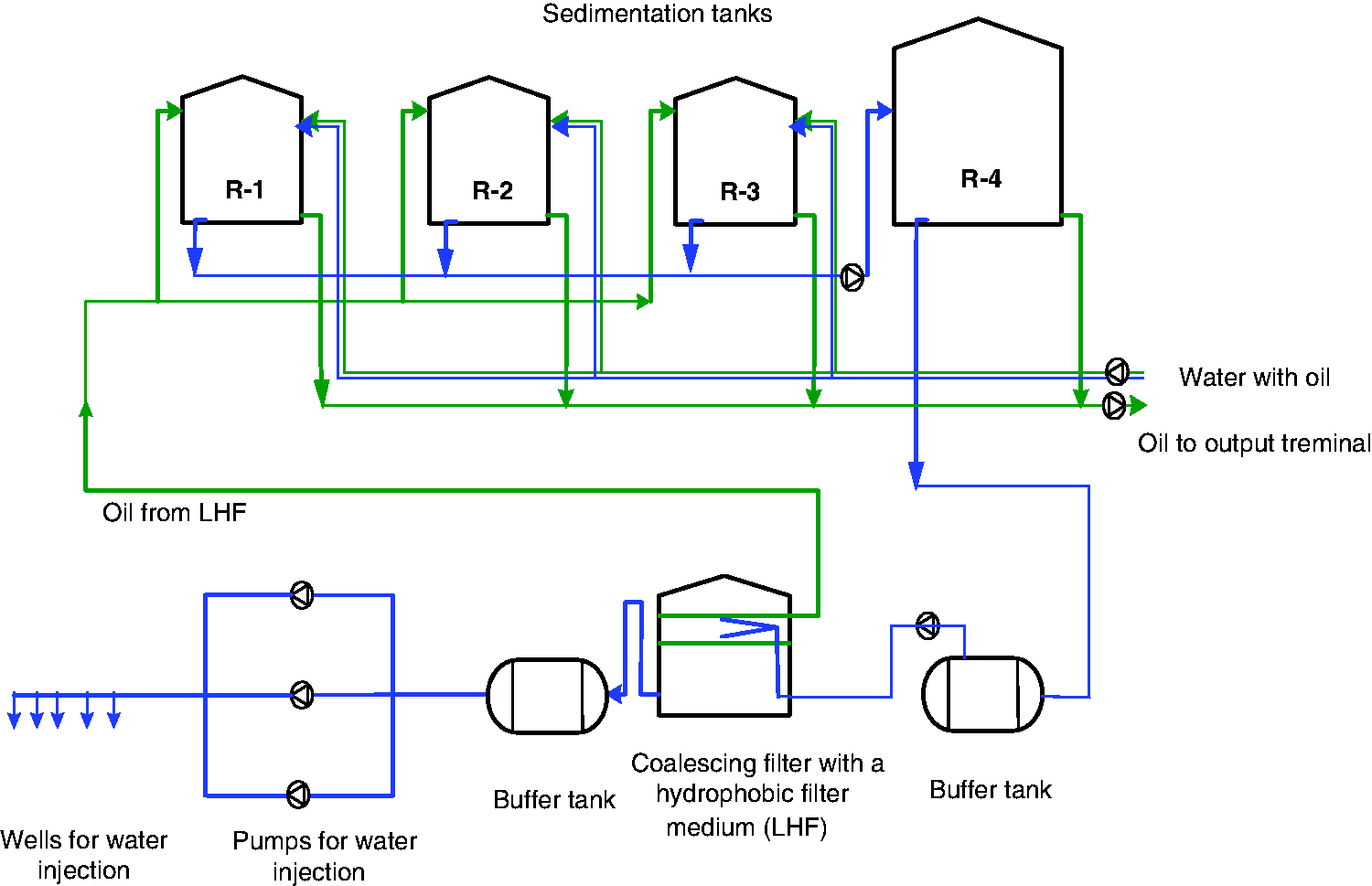
Re-injection of water into geological formations has been chosen as a method for waste water disposal, primarily to maintain pressure and possibly increase oil recovery. This procedure of water flooding is the most acceptable method for managing produced water economically from an environmental point of view.26–29 The design strategy supports the present system of waste water disposal into storage pits, but with a key difference in that the disposed water will no longer be environmentally harmful. In this way, the oil field will have two independent systems for waste water removal, providing additional work safety. If produced water cannot be re-injected through the well for any reason, its disposal can be diverted to in-ground evaporation pits.
Implementation of the proposed method
After the separation process, the remaining oil in the water, in the form of dispersed oil droplets, is removed from it in vertical sedimentation tanks 1000 m3 in volume, R-1, R-2 and R-3, Figure 3.
A scheme for the proposed process of reservoir water injection.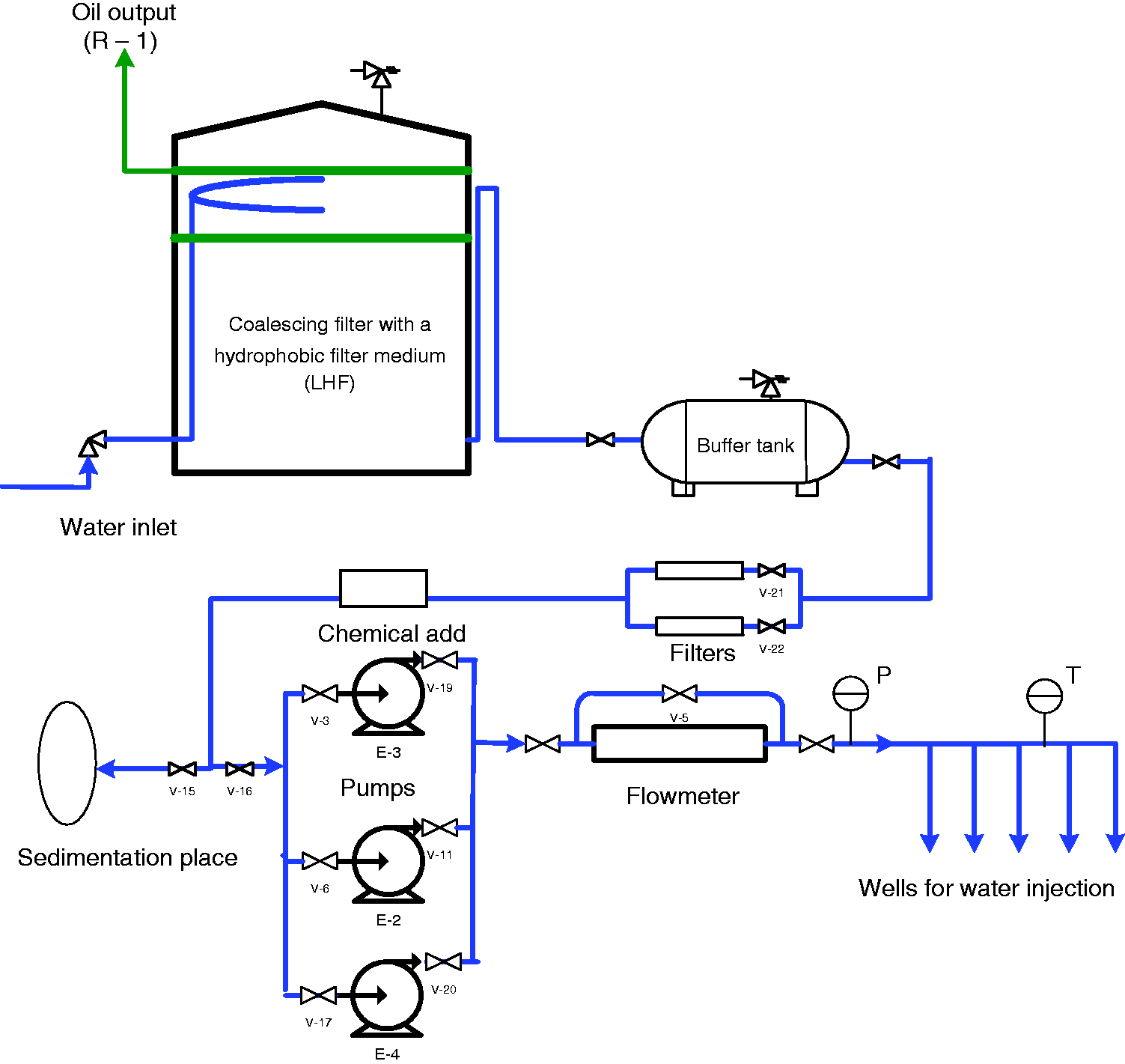
As the crude oil has unfavourable rheological properties (high kinematic viscosity, paraffin content 20% and a pour point of 28℃), the oil is heated to 45℃. In addition to maintaining the temperature, oil and water separation is performed by gravitational sedimentation followed by produced water treating. Demulsifiers are added to improve the oil-in-water separation process.
Produced water from sedimentation tanks R-1, R-2 and R-3 is pumped to storage tank R-4, 1000 m3 in volume, where additional gravitational sedimentation is carried out, but with a much smaller volume of produced water.
The reservoir water from storage tank R-4 is routed through a buffer tank to coalescing filter with a hydrophobic medium. Treatment of waste water is done in the separator, using hydrophobic filtration and gravitational sedimentation with a liquid hydrophobic coalescing medium (LHF),
25
see Figure 3. The fluid flow orientation is vertical, with a separator volume of 500 m3, and it is equipped with a distributor for the produced water at the entrance of the hydrophobic layer. The separated oil overflows from the top of the hydrophobic layer, returning to the tank (R-1, R-2 or R-3), while the separated water falls to the bottom of the tank and is discharged through a siphon tube. The water quality at the outlet of the coalescing filter with hydrophobic medium is measured as:
content of organic matter – dispersed oil: 60 to 80 mg/l content of suspended solids: 130 to 145 mg/l.
When it is determined that the oil in the hydrophobic filter is saturated (based on sampling) so that filtering can no longer be performed, the oil should be replaced with a new filter medium. The treated produced water from the coalescing filter with a hydrophobic filter medium (LHF) passes through a buffer tank of 100 m3 capacity and then to pumps which re-inject it into the geological formation (Figure 3). The buffer tank ensures uniform water flow from the LHF filter to the injection pumps. The buffer’s maximum operating pressure is 2 bar, working at atmospheric conditions. The buffer tank is automatically charged with free falling water, due to the height difference between the LHF and buffer tanks.
Two filters are installed to remove suspended particles larger than 0.45 m, which can plug the pore formation. While one filter is in operation, the other acts as a spare, so replacement can take place without interrupting re-injection. The presence of bacteria in the waste water could be solved by using certain biocides, while the problem of limescale deposits can be solved with carefully monitored chemical dosage.
The pumps for water injection are installed at a collection station near sedimentation tanks R-1, R-2 and R-3. One of these pumps serves as bypass up the event of an operating pump failure or the need for repairs. A pump protection strainer could be fitted on the upstream of the pump in addition to a flow meter to measure the volume of the injected produced water.
The treated reservoir water will be re-injected through wells which are no longer producing oil, and are still in contact with an aquifer. In the initial phase, injection of water through B-32, B-31, B-60 and B-63 wells is planned. With the increase of produced water, it will be necessary to consider other wells for injection.
In the case of a pump, flow meter, or injection well failure, the treated produced water can be diverted for the evaporation of in-ground pits. This second option of water disposal provides a high degree of process reliability.
The benefits of implementing a new model to enhance waste water disposal at the Amal oil field in Libya
The proposed concept of produced water preparation for disposal at the Amal oil field primarily solves the problems of environmental pollution. After treatment, waste water can be discharged into in-ground pits with dispersed oil concentration of 80 mg/l, that is, within the limits on the permissible amount. In this way, the penetration of dispersed oil into the desert soil and its pollution through in-ground pits is prevented.
From a technical point of view, the proposed concept of produced water preparation at the Amal oil field enables its disposal in in-ground pits or re-injection into geological formation. Besides, it is very important from the economic point of view considering current low crude oil price, as well as bad Libya’s economy. In this moment, disposal of treated waste water into in-ground pits represents the lowest cost solution. Since the crude oil price will not rise significantly soon, the proposed solution enables most cost-effective production for the time being, thus providing the means for future investment in waste water re-injection.
The re-injection of the produced water into the geological formation maintains reservoir pressure and increased oil production due to enhanced oil reservoir recovery. This part of process requires water treatment, as shown, with procurement of injection equipment (tanks, injection pumps, etc.). Optimal waste water re-injection process should be designed by reservoir numerical simulation study.
Implementation of the proposed formation of water preparation concept at the Amal oil field can be carried out in two phases, where the first phase would be preparation for disposal into in-ground pits, and the other would refer to the later applied, more expensive preparation for re-injection.
Conclusion
Produced water treating system in an Amal oil field in Libya was chosen for the proposed implementation of an option with the lowest operating costs (storage tanks, separators, and coalescing filter with a hydrophobic filter medium). The disposal of waste water by re-injection into the geological formation was considered as the most economically and environmentally appropriate solution. The adopted concept is based on the existing systems for the disposal of waste water into ground pits, ensuring the existence of two independent systems for waste water removal and providing additional working safety. If the produced water could not be re-injected for any reason through wells, its disposal can be drained into risk-free ground pits.
The benefits of the new concept of waste water preparation and disposal are:
Disposal of waste water, taking into account environmental impacts. Enabling further disposal of water into geological formations or ground pits in an environmentally safe manner. Maintaining pressure and displacing crude oil in the reservoir. Being environmentally acceptable. Being economically advantageous. Meeting new regulations. Contributing to a possible increase in reservoir recovery and oil production.
Footnotes
Declaration of conflicting interests
The author(s) declared no potential conflicts of interest with respect to the research, authorship, and/or publication of this article.
Funding
The author(s) received no financial support for the research, authorship, and/or publication of this article.