




Abstract
Nuclear Energy is the key solution for China to address its efforts on Climate change. However, the current nuclear energy technology also brings the corresponding high radioactive waste. How to dispose this kind of dangerous material in an appropriate way has become a critical issue for this country. This article attempts to analyse the current legal context of high radioactive waste disposal in China and explores the potential further improvement options concerning this topic.
Keywords
Introduction
Nuclear energy is a strategic choice of China energy policy
Although concerning the theory of climate change, there is still controversy in the relevant scientific and policy field, China has already chosen nuclear power as one key solution to its future energy needs. Because it could help the country reach the targets for reductions in the carbon emissions that China’s central government has promised, also to reach the target for the elimination of the environmental pollution from traditional energy.
According to the latest document that China submitted to the Secretariat of the United Nations Framework Convention on Climate Change (UNFCCC), China stated that it will increase the share of non-fossil fuels in primary energy consumption to approximately 20% by 2030. 1
In practice, China’s energy consumption has been transforming according to the orientation of national policies. The energy consumption data in 2014 showed that China’s nuclear power generation capacity has increased 18.8%, hydropower generation capacity has increased 15.7% since the end of 2013. Although traditional coal consumption still constitutes 66.0% of all energy consumption, hydropower, wind power, nuclear power, natural gas and similar sources of clean energy now constitute 16.9% of all energy consumption. 2
China will play a more important role in world’s nuclear industry
As of 12 February 2015, China had 23 nuclear power plants (NPPs) in commercial operation, with a total installed capacity of 21,395 MWe.
3
As China National Energy Bureau officially expressed that China’s nuclear power industry has now entered a safer, and more reliable and orderly phase, such that China will gradually become the global centre of the nuclear industry (Figure 1).
4
The proportion of nuclear power in China’s total national power generation.
5
NPC: National People’s Congress; NPCSC: National People’s Congress Standing Committee.
According to data from IAEA Power Reactor Information System (PRIS), China also has the largest number of NPPs under construction 6 (26 new units). 7
However, nuclear energy is not without drawbacks: nuclear waste has increased yearly, and the concomitant environmental risk has increased gradually as well. Thus, China needs to manage nuclear fuel recycling carefully, like all of the other countries that currently operate NPPs.
High level radioactive waste (HLW) disposal in China
There are two primary methods used to handle the spent fuel from NPPs: one time use direct without any processing thereafter that is “One Time Use Circle” (OTC), or recycling that is “Closed Fuel Circle” (CFC). China has chosen the CFC model and the spent fuel from NPPs is reprocessed. 8 Approximately 96% of the spent fuel can be recycled and used after reprocessing, while the remainder includes approximately 3% waste products, and 1% plutonium (Pu). Reprocessing separates uranium and plutonium from waste products and this enables recycling of the uranium and plutonium into fresh fuel. 9
The safe disposal of HLW has been an issue of considerable concern to many countries and to international society. IAEA has issued the “Joint Convention on the Safety of Spent Fuel Management and on the Safety of Radioactive Waste Management” 10 to specify the international legal requirements for its member countries.
HLW
HLW refers primarily to the high radioactive liquid and solid waste from the reprocessing of spent fuel. In China, the disposal of HLW also includes alpha active waste “αwaste.” 11 Further, with the OTC method, the HLW includes spent fuel as well.
Sources of HLW in China
HLW from NPP spent fuel reprocessing; HLW that has been produced by national military nuclear research, development and production; Certain spent fuel that China may not be able to reprocess.
12
Broadly speaking, the safe disposal of HLW is an important aspect of nuclear safety. With the rapid development of nuclear power in China, the treatment and disposal of HLW has thus become a critical issue. To date, the China National Nuclear Corporation (CNNC) is the primary and largest operator for the treatment and disposal of radioactive waste, including HLW, in China. 13
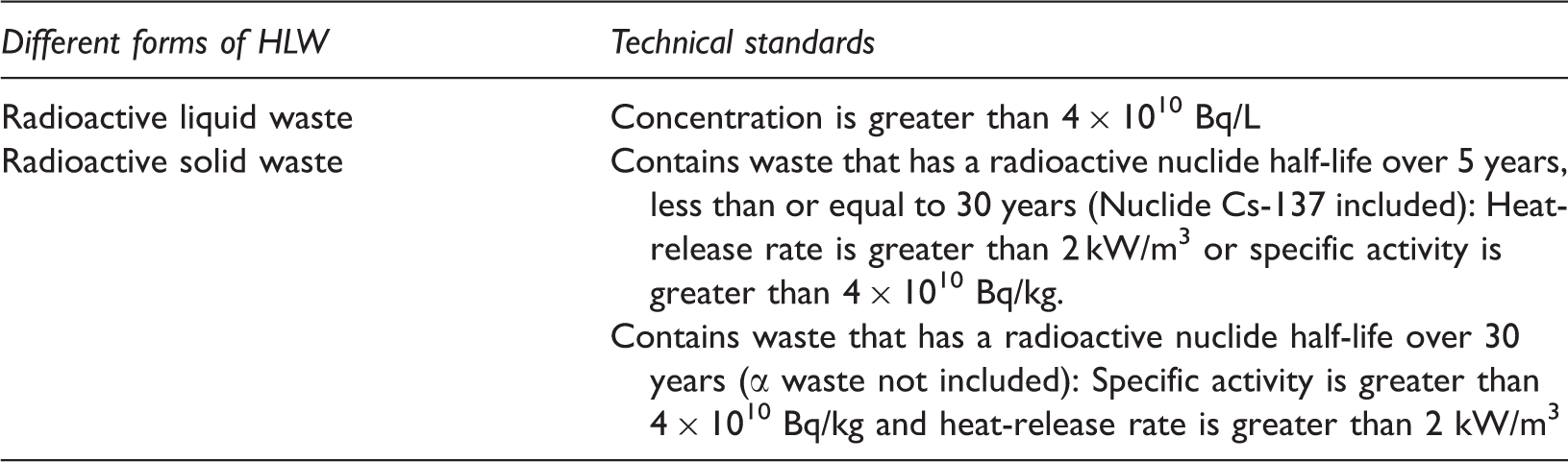
Needs for HLW disposal
Spent fuel
Normally, each gigawatt level NPP of electricity can produce about 25 tons of spent fuel, such that 70 NPPs could produce 1750 tons of spent fuel annually. With the previous deposits of spent fuel, there will be over 10,000 tons of spent fuel in China by 2020. 15
It is obvious that the rapid development of China’s nuclear industry has made the safe and proper treatment and disposal of this huge amount of spent fuel an urgent issue to address. Based on this situation, how to treat and dispose of this spent fuel has become a serious topic of concern in China’s nuclear industry.
NPP spent fuel treatment and disposal
In China, the spent fuel from commercial NPPs normally is kept in a water pool near the NPP for 10 to 20 years. After this period, the spent fuel is transported over long distances by road 16 to the CNNC No. 404 Company’s water pool. This is called “In Plant Deposit.” Alternatively, it may be collected separately and managed elsewhere; this is referred to as “Leave Plant Deposit.” 17
HLW geological permanent disposal
According to the relevant law published in 2003, Geological Permanent Disposal of HLW has been China’s choice for the proper disposal of its HLW.
Research on HLW geological permanent disposal began in the mid-1980s. Since then, China has made steady preparations for this disposal strategy through site selection, site feasibility studies, radionuclide migration, disposal engineering, safety assessment and so on.
According to a report on China’s HLW geological disposal research, the Bei Shan area in Gan Su province in Northwest China has been selected as the priority research site for China’s HLW geological permanent disposal. 18
In response to increasingly urgent requests from nuclear industry development, China has begun to launch the plans for its HLW geological disposal.
In 2003, China published the “Radioactive Pollution Prevention Law, People’s Republic of China.” 19 The 43rd article of this law has clearly regulated the “Centralized deep geological disposal of high level radioactive solid waste” and mandated geological disposal as its national strategy.
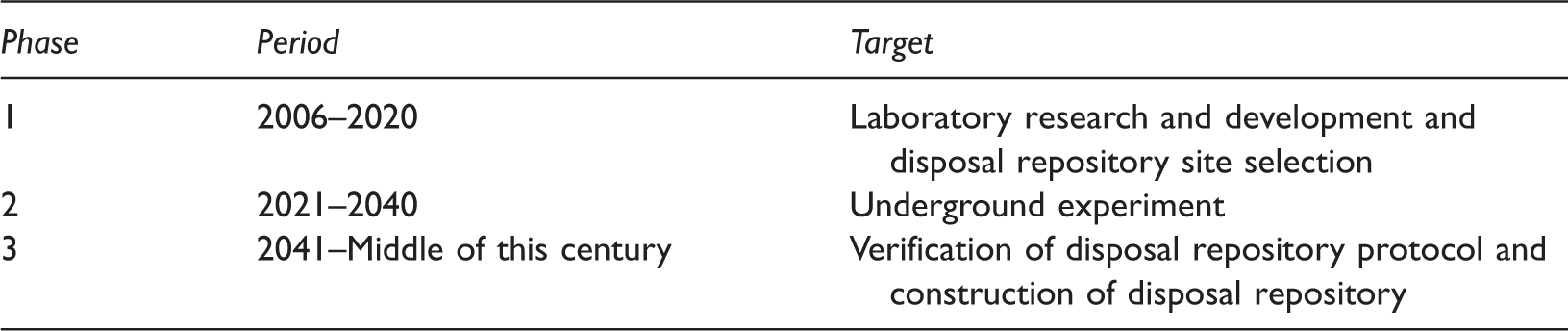
In 2006, the China State Administration of Science, Technology and Industry for National Defence—previously the China State Commission of Science, Technology and Industry for National Defence—the Ministry of Science and Technology, and the Ministry of Environmental Protection—previously the General Bureau of Environmental Protection—released jointly the “Geological Disposal of High Level Radioactive Waste Research and Development Planning Guidelines.” 19 This document clarified the principal technical route of deep geological disposal and the general concept of its development.
In 2007, the China state council approved the “Nuclear Power Middle and Long Term Development Planning (2005-2020),” which proposed that China should complete the construction of the HLW geological disposal underground laboratory, to advance HLW geological disposal to the next stage. 20
Legal context of HLW disposal in China
National policies on HLW disposal
The initial specific target of China’s HLW geological disposal project in different phases.
Laws and regulations on radioactive waste management
Domestic nuclear laws and regulations
China’s nuclear safety legal system is composed of laws, administrative regulations, department rules, guidelines and technical documents (Figure 2).
Structure of domestic nuclear laws and regulations in China.
21

The laws and regulations list related to radioactive waste management are as follows:
Laws
“Radioactive Pollution Prevention Law, People’s Republic of China” “Solid Waste Pollution Prevention Law, People’s Republic of China” “Radioactive Waste Safety Management Regulation” “Radioactive Solid Waste Storage and Disposal Licence Management Approach” “Radioactive Waste Safety Supervision Management Regulation” (HAF401-1997) “Radioactive Waste Classification Standard” (GB9133-1995) “Low and Intermediate Level Solid Radioactive Waste Temporarily Stored Provisions” (GB11928-1989) The related guidelines for radioactive waste management are shown in Table 3. Guidelines for radioactive waste management.
Administrative regulations
National standards
Related gu
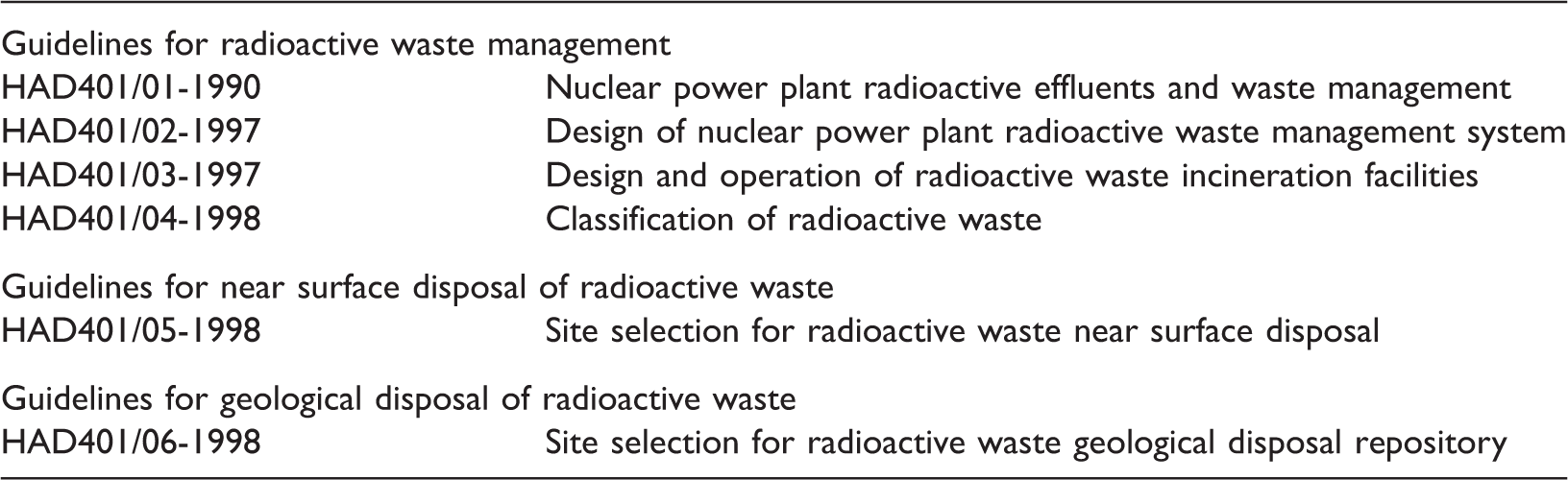
‘HAF’: ‘He–Anquan-Fagui’
‘HAF’ is the abbreviation for the ‘Nuclear Safety Law and Regulation’ in Chinese Pinyin. It was issued by the National Nuclear Safety Bureau, which is under the PRC Environmental Protection Ministry, and represents the department’s rules for nuclear safety. HAF regulation is compulsory.
To date, ‘HAF’ has 11 clusters of rules: (0) General Cluster; (1) Nuclear Power Plant Cluster; (2) Research Reactor Cluster; (3) Non-Reactor Nuclear Fuel Recycling Facilities Cluster; (4) Radioactive Waste Management Cluster; (5) Nuclear Fuel Control Cluster; (6) Civil Use Nuclear Safety Supervision Management Cluster; (7) Radioactive Materials Transportation Management Cluster; (8) Isotope and Radiation Devices Regulatory Cluster; (9) Electromagnetic Radiation Pollution Control Cluster and (10) Environmental Radiation Monitoring Cluster.
‘HAD’: ‘He–Anquan-Daoze’
‘HAD’ is the abbreviation for the ‘Nuclear Safety Guidelines’ in Chinese Pinyin. HAD consists of recommendations, but it provides strong guidance.
In addition to ‘HAF’ and ‘HAD’, there are also several documents the codes for which begin with “HAF.J” or “HAB.” These include expert opinions and suggestions, or the translation of IAEA’s technical reports.
The other domestic laws and regulations related to radioactive waste are as follows:
Laws
“Environmental Protection Law, People’s Republic of China” “Environmental Impact Assessment, People’s Republic of China” “Protecting Against and Mitigating Earthquake Disasters, People’s Republic of China” “Air Pollution Prevention Law, People’s Republic of China” “Water Pollution Prevention Law, People’s Republic of China” “Marine Environment Protection Law, People’s Republic of China” “Solid Waste Pollution Prevention Law, People’s Republic of China” “Production Safety Law, People’s Republic of China”
Administrative regulations
“Civil Use Nuclear Safety Supervision and Management Regulations” “Nuclear Power Plants Nuclear Emergency Management Regulations” “Nuclear Material Control Regulations” “Radioactive Materials Transportation Safety Regulations”
International legal context for radioactive waste management
International convention, international standard and other guidance documents from the radioactive relevant organization are all the factors of international legal context for China in a broad sense.
The relevant international legal document for radioactive waste management in China includes:
“Convention on Nuclear Safety” “Joint Convention on the Safety of Spent Fuel Management and on the Safety of Radioactive Waste Management” “Convention on Early Notification of a Nuclear Accident” “Convention on the Physical Protection of Nuclear Material”
International Commission on Radiological Protection (ICRP Publication) has also published:
22
“Principles for the Disposal of Solid Radioactive Waste” (ICRP Publication 46) “Radiological Protection Policy for the Disposal of Radioactive Waste” (ICRP Publication 77) “Radiation Protection Recommendations as Applied to the Disposal of Long-lived Solid Radioactive Waste” (ICRP Publication 81) “Radiological Protection in Geological Disposal of Long-lived Solid Radioactive Waste”(ICRP Publication 122)
In addition, there are also a series of non-mandatory standards of radioactive waste safety from IAEA (RAWASS), such as “Geological disposal of radioactive waste” (WS-R-4). 23
Government authorities of HLW disposal
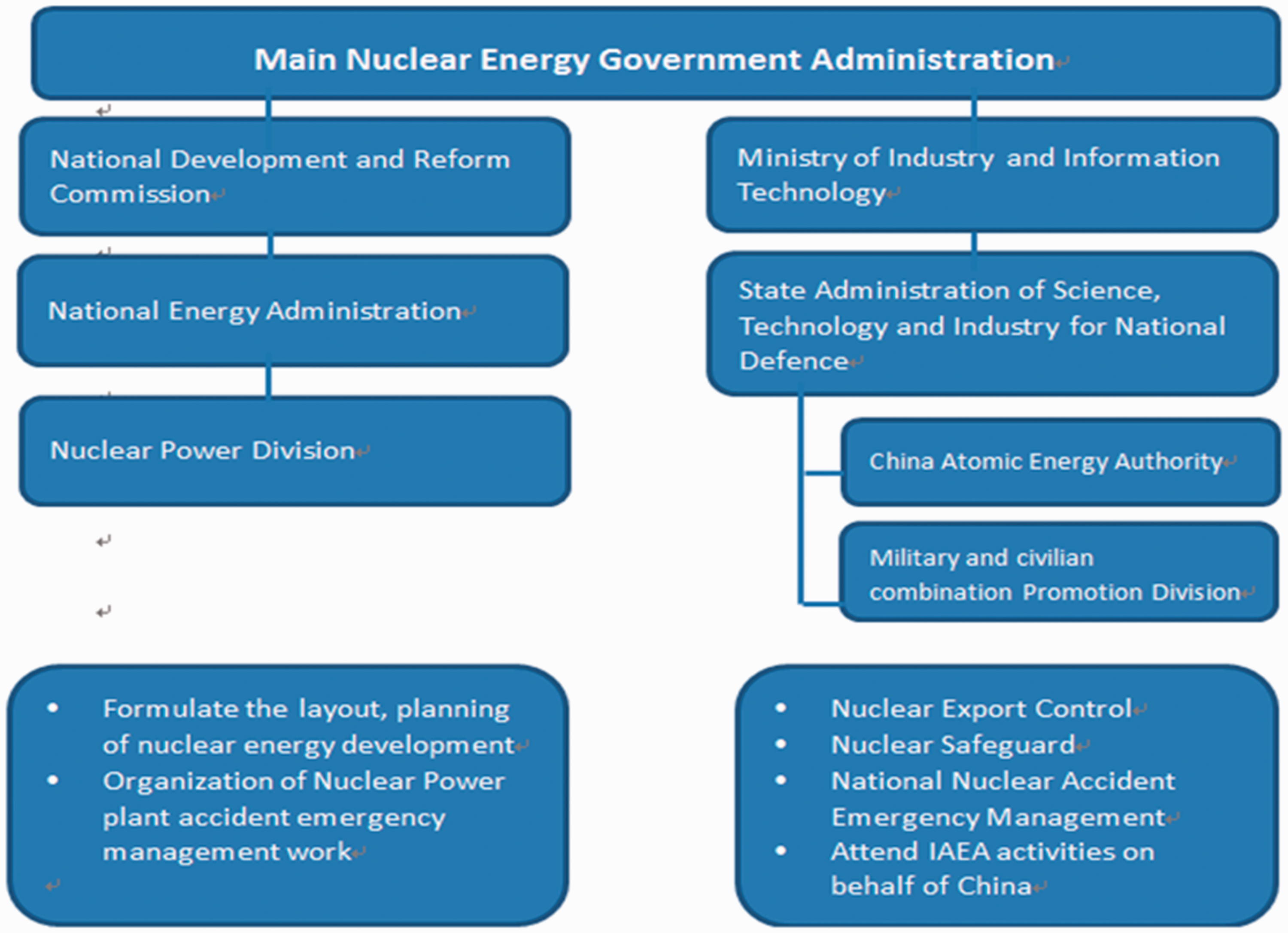
Main nuclear energy management government departments (since 2008) (Figures 3 and 4)
Current radioactive waste management authority and supervision system
State Administration of Science, Technology and Industry for National Defence/China atomic energy agency
The State Administration of Science, Technology and Industry for National Defence is the industry department for radioactive waste management within the China central government. As regulated in Article 22, paragraph 2 of the “Radioactive Waste Safety Management Regulation,” the state council industry department in the State Administration of Science, Technology and Industry for National Defence is responsible for the organization of the entire HLW geological disposal project.
Main nuclear energy management government departments in China.
24
Main nuclear energy management government departments in China.
24

China Nuclear Safety Authority (ASN) under the Ministry of Environmental Protection
The China ASN regulates the safe management of radioactive waste. According to “Radioactive Waste Safety Supervision Management Regulation” (HAF401-1997), this organization is responsible for the development of regulations and guidelines, or technical documents, also the evaluation of the radioactive waste treatment and disposal facilities for compliance with the relevant regulations and standards. 25
Regional Local Environmental Protection Department
In addition to the above-mentioned organizations, based on relevant regulation, there are also regional local environmental protection departments that are responsible for independent Environmental Monitoring and are involved in local supervision of radioactive waste.
Summary of the current legal context of HLW disposal
In general, the government’s orientation towards HLW disposal in China is highly favourable within the legal context of HLW disposal in China. To date, the Chinese government authorities have mandated relevant laws and regulations, supervised appropriate activities and executed and coordinated the implementation of this project.
From the legislative point of view, although several important laws and regulations have been issued, there is still much to develop for a clearer logic or hierarchy in the legislative structure. At present, the legislation is primarily basic, and deals with such issues as administrative regulations and technical standards. However, without an overarching legal structure, it will be difficult to institute a uniform legal system for HLW disposal. Moreover, while there are indeed several technical standards concerning radioactive waste, the specification of more technical standards for HLW disposal must be issued as well.
At the same time, with respect to the implementation of such a large and specialized project, a reasonable funding system is essential in order to facilitate appropriate research, construction and maintenance in the middle and long terms. However, in the current legal context, this system is still being developed.
From the point of view of supervision, more powerful laws and regulations are needed to provide a solid basis for legal enforcement and a clear reference for relevant supervision activities.
Conclusion
Since the middle of the 1980s, China has clearly achieved much in the implementation of its HLW disposal project. However, based on the current development of the project and the successful reference to other countries, such as Finland, the legal protection for China’s HLW disposal nonetheless includes scope for further improvement.
Legislative framework needs further refinements
It appears that China needs to continue to improve the current legal framework for the management and supervision of the long-term governmental aspects of the project; the country lacks a top end legal structure concerning nuclear power management and supervision.
With respect to current nuclear safety laws and regulations, strictly speaking, only the “Radioactive Pollution Prevention Law, People’s Republic of China,” and the “Solid Waste Pollution Prevention Law, People’s Republic of China,” are laws. The remaining legal documents listed above are administrative regulations or departmental rules that are not mandatory and thus have relatively little regulatory force. China’s “HAF” includes 11 legal documents pertaining to nuclear safety supervision. This shows that there is a complete list from the technical standpoint. However, by comparison to the practices in many countries, China still needs to design a top-end legal structure to cover the relevant issues from a general point of view, such as the “Atomic Energy Act of 1954, As Amended” 26 in the US or the “Nuclear Energy Act” 27 in Finland. As reported in the news recently, the legislative activities pertaining to China’s “Atomic Energy Law” are in process in the relevant legislative department. The draft of this law has been forwarded to the China State Council for deliberation. Once agreed upon by the Council, it will be submitted to the China national people’s congress standing committee for further deliberation. An optimistic estimate for the ratification of this basic law on nuclear energy would be 2016. 28
The participants in China’s HLW disposal should be clarified further: Executive unit, administrative authority and regulatory body
Without clear instruction from laws or regulations, it remains unclear who the participants are in China’s HLW disposal. Because of the rounds of reform in China’s central government since the “Reform and Opening up,” the government, which is in charge, tacitly, of the nuclear industry, has changed several times. There are still some conflicts or points of duplication/overlap in the division of the duties of various departments, such as nuclear materials management. According to the “Nuclear Materials Control Regulation” (1987), the Ministry of Nuclear Industry still manages nuclear materials for the entire country; however, the Ministry of Nuclear Industry in fact withdrew from such management in 1988. 29 These dilemmas must be resolved in the legal context of HLW disposal as well. Thus, the participants in China’s HLW disposal require further clarification.
There also should be independent units for implementation and supervision of the HLW project.
HLW disposal project executive unit
As a key project for the national energy supply, HLW disposal should be governed overall by China’s central government. However, it still requires a specific legal entity to carry out the detailed implementation of this critical work, such as Posiva Oy, which is a company in Finland, or the Department of Energy (DOE), a government department in the US.
According to the “Radioactive Solid Waste Storage and Disposal Licence Management Approach,” there are some confirmed basic requirements for a unit that would like to apply for a licence for HLW and α solid waste disposal in China. The requirements include the amount of registration capital, experts’ term, proper organization structure, facilities and so on, which could show a qualification for this licence. Further, this licence should be submitted to the Ministry of Environmental Protection.
Considering that the CNNC has spent many years on research and the development of HLW disposal, China should set up a special HLW disposal company under the CNNC to maintain the continuity of this work.
Specific Government Department for administration of HLW disposal
According to Article 22, paragraph 2 of the “Radioactive Waste Safety Management Regulation,” the State Administration of Science, Technology and Industry for National Defence is the industry department for radioactive waste management in China’s central government. This means that this government department will be responsible for the organization of the entire HLW geological disposal project.
However, for such a critical project, the setting in the regulation is not clarified or sufficiently practical to constitute the best arrangement. The State Administration of Science, Technology and Industry for National Defence is an enormous organization for China’s national defence science and technology, as well as the transformation and combination of military and civil technology, which includes many purviews, such as aerospace technology and electronic information technology. Therefore, it would be better to establish a separate “Radioactive Management Division” within that Administration. This separate division would facilitate the general planning and management of China’s HLW disposal project.
Independent regulator of HLW disposal
Many countries include nuclear regulatory bodies in their authority systems, such as the Nuclear Regulatory Commission (NRC) in the US, the Radiation and ASN (STUK) in Finland, and the ASN in France.
China also has its own ASN, the China Nuclear Safety Authority.
According to Article 3.1 of the “Radioactive Waste Safety Supervision Management Regulation” (HAF401-1997), this organization regulates the management of China’s radioactive waste; therefore, any unit that would like to operate a radioactive waste disposal project must apply to this organization for a licence. For HLW disposal, which is a special and highly sensitive operation, China’s nuclear safety regulator should have a more independent identity and greater administrative power to supervise every detail of the project from beginning to end.
HLW disposal is an enormous undertaking in every sense, and one that could pose significant regulatory challenges. The regulator of this type of project needs to be very well prepared in order to achieve effective internal institutionalized control, supervision and documentation, as well as a suitable system for submission of documents.
In summary, clear laws and regulations should define and dictate the division of duties among the authorities involved in the different stages of spent fuel and radioactive waste management.
Key mechanism of HLW project management needs further improvement
In China, HLW disposal is a huge, nationwide systematic project that will involve many sectors, including the energy, industrial, environmental protection and healthcare departments, disposal site governance at the community level and so on. The management of this project will require proper legal guarantees to ensure that relevant mechanisms are in place in every sector. The primary relevant mechanisms include:
Legislative guarantee for decision making
There should be clear legal or regulatory instructions that indicate which organization(s) will be responsible for making decisions in the Chinese HLW disposal project.
The decision-making process must be defined clearly and accurately and should include the following key points:
Site selection approval—candidate sites and final decision of site Approval of HWL disposal repository construction licence Development of basic environmental standards Implementation of practical HLW disposal.
12
The descriptions of the systems in other countries show that, normally, the government makes decisions and submits them to parliament for final confirmation. In China, the State Administration of Science, Technology and Industry for National Defence, which should be responsible for the organization and coordination of the HLW disposal project, could make the decision and send its draft report to the State Council for final approval.
Legislative guarantee of funding
Methods to collect and manage funding are key to financing the HLW disposal project. One of the important reasons that Finland was able to implement its HLW disposal project so smoothly was that they had created a very stable and reasonable model to fund the project.
According to Finland’s “Nuclear Energy Act,” Section 38—National Nuclear Waste Management Fund: For purposes of implementing the financial provision, there shall be a National Nuclear Waste Management Fund, independent of the State budget, but controlled and administered by the Ministry of Trade and Industry. 30
This fund was established in 1988 under the Ministry of Trade and Industry in the early stages of Finland’s HLW project, and was not included in the government’s overall budget. “The purpose of this fund is to collect, store and reliably invest the funds that are going to be needed to take care of nuclear waste in the future.” The Ministry of Trade and Industry was reformed and changed to the Ministry of Employment and Economy (TEM). Currently, Finland’s nuclear waste management fund is under TEM, and includes approximately 2.1 billion Euros. 31
China also has its own earlier reference for fund management, the “Nuclear Power Plant Spent Fuel Treatment and Disposal Fund Project Management Regulation,” 32 issued in March 2014. This document includes instructions for collecting funds, budgeting confirmation, fund management and so forth. China could compare and combine the practices from international references and the domestic reference to form its own funding regulations for the HLW disposal project.
Legislative guarantee for HLW disposal project technical support
There is no doubt that the implementation of HLW disposal requires systematic, interdisciplinary, long-term, joint technical support from the relevant research institutes and experts. The technical support addressed here includes not only the research and development activities related to HLW disposal itself but also the advice and opinions of experts in Geology, Hydrogeology, Radiochemistry, Mechanics, Engineering Science, Materials science, Mineralogy, Thermodynamics, Physics, Radiation protection, Computer Science, Social sciences and Economic science, as related to HLW disposal. 12
To ensure efficient support for the HLW project in China, the country must implement effective laws and regulations, and establish a positive atmosphere to advance the research and development of the HLW disposal project. To do so, the relevant experts in the fields mentioned above should be encouraged to become involved actively in this project as technical advisors, or even focused fully on research concerning the HLW project.
Legal guarantee for public participation in the HLW project
One very important factor required to ensure that the HLW project is understood and accepted by society is the establishment of a system that will allow the public to participate in this project. The public here refers to local residents, local government, as well as other people or organizations in China that are concerned about the project. Without the support of local residents, and without support from the local government, it will be a huge challenge to implement this project as planned. Therefore, it is necessary to provide a channel for the public to obtain information, not only from government but also from the unit(s) responsible for implementing the HLW project. At the same time, this channel should be bi-directional, such that it allows members of the public to express their opinions to the relevant government authorities.
For this purpose, any laws or regulations must be able to guarantee this right of the relevant public communities via transparent, detailed and practical mechanisms.
The proper handling of HLW disposal addresses the sustainable development of China’s nuclear industry, as well as the need to protect China’s environment, the health of the Chinese people, and the safety of our future generations. Considering the importance of this project, a mature and complete legal context would ensure that the HLW disposal project in China will be developed and implemented as planned. Further, according to its status at present, China’s legislative system still needs to invest more effort in refining the legal context of this topic.
Footnotes
Declaration of conflicting interests
The author(s) declared no potential conflicts of interest with respect to the research, authorship, and/or publication of this article.
Funding
The author(s) received no financial support for the research, authorship, and/or publication of this article.