



Abstract
This paper aims to empirically investigate consumers’ preference structures and their willingness to pay for key features of future residential electric power services that they have not experienced in the regulated market. Using a choice experiment based on conjoint survey and applying a mixed logit model, we quantitatively estimate individual utility functions for certain important attributes such as type of service-providing company, installation of smart meter devices, introduction of E-prosumer groups, relaxation of progressive electricity billing system, and share of renewable energy in the generation mix. The analysis reveals that households prefer installation of smart meter devices and introduction of E-prosumer groups, and are willing to pay 10,044 KRW/year (USD 8.97/year) and 5,222 KRW/year (USD 4.66/year), respectively, for these services. However, households dislike the participation of privately-owned companies under the competitive market structure, owing to the possibility of a rise in the electricity price.
Keywords
Introduction
Due to the technological advance of microgeneration, changes in consumers’ attitudes toward the generation mix, and governments’ efforts to stimulate meaningful competition in the electric power generation sector, the electric power industry has been gradually experiencing reforms of its structure for the past few decades. Previously, the electric power industry was considered a typical example of utility industries, where the government or its agencies managed all functions from maintaining secure and economic operations of the power transmission network to managing the distribution network to provide household end-users with electric power services. However, privatization in the electric power industry has become a global trend since the late 1990s, which has led to government agencies losing their monopolistic power in the market. 1 Basically, regulation and centralization were the keywords to describe the electricity sector in the past, while liberalization and deregulation are the keywords in the present scenario. In this context, evolution stages of electric power industry can be summarized as in Table 1. The categorization in Table 1 is based on the 10-year implementation plan established in 1999 for restructuring of Korea electric power industry (Park, 2001).2 In the 1st stage (monopoly), Korea Electric Power Corporation (KEPCO) was a vertically integrated public company with generation, transmission, system operation, distribution and retail department. After 2001, in the 2nd stage (generation competition), KEPCO’s generation part was divided into five fossil-fuel generation companies and one nuclear generation company and Korea Power Exchange (KPX) was established for an independent system and market operation. Generation companies are still subsidiaries of KEPCO until now and incompletely compete with each other as independent power plants in cost-based pool of KPX. According to the authority’s plan, the 3rd stage is for introducing wholesale competition on the demand-side of the wholesale electricity market with multiple bundled distribution and retail companies, and the 4th stage is intended for implementing free-choice for end-users through the unbundling of distribution and retail companies. However, the 3rd and 4th restructuring stage was not implemented in Korea because of several political conflicts. For this reason, Korea electric power industry still remains in the generation competition stage. In 2016, unbundling of retail sector became a hot issue in Korea to promote privately led energy businesses such as demand response aggregator, electric vehicle charging service provider, and private retail business bundled with telecommunication business. However, this agenda died down with the impeachment of the former President Park. Meanwhile, electric power industries of Western countries are mostly in retail competition stage. Some jurisdictions in United States and Japan are also in the 4th stage.
Stages of evolution of the electric power industry.

Considering the present situation, electric power services in many developed countries including Korea are gradually evolving. Although retail customers, including residential users, must still obtain their electric power services through vertically integrated power companies, which are owned and operated by regulated monopolies, it is technically feasible for them to obtain a variety of services including special billing plans and generation mix, which could be provided by several privately owned or state-owned companies. 2 Thus, the prices and terms of residential electric power services do not have to be determined by regulatory processes, and can be decided by market mechanism.
As a good example, the Japanese government undertook the power industry reform in April 2016. 3 They carried out the power industry reform in three phases. The step by step reforming process is as follows: (i) the establishment of Organization for Cross-regional Coordination of Transmission Operators, Japan (OCCTO) and the Electricity Market Surveillance Commission (EMSC) in the first phase, (ii) the full liberalization of entry into electricity retail business in the second phase, and (iii) the legal separation of transmission and distribution sector and the full liberalization of the electricity retail rates. The main objective of this reform was to stimulate active participation of business operators from other fields into the retail electricity market and accordingly expand customer choice. 4 In fact, new service packages and business models were created for residential users in the retail electricity market. Consequently, it can be stated that Japanese retail services became more efficient by bundling with other products such as mobile, Internet, gas, and fuel bills.
As the paradigm of residential electric power services shifts rapidly from monopoly to competition, detailed terms and programs of their services can be differentiated based on the combination of important features and functions that companies provide although all consumers use physically identical electric power services. For instance, certain consumers may prefer to observe their electricity usage in real time, in order to save electricity by avoiding excessive consumption during certain times, such as peak hours during summer. 5 Considering these consumers, a service provider can install a smart meter, which is a device that provides consumers with real-time feedback on their consumption by combining automated usage readings with accessible displays in their houses, in exchange for charging an installation fee. In addition, in recent years, the end-users’ interest in the generation mix has significantly increased in the wake of the Fukushima nuclear disaster in Japan. 6 Consumers were repulsed by the high proportion of nuclear generation in the generation mix and have pursued green electricity. However, putting emphasis on renewable energy sources in the generation mix could be followed with a change in the cost of electricity generation, and accordingly increasing the retail price. These relationships not only show an increase in the share of renewable energy in the generation mix but also correspond to an increase in the retail price. Accordingly, both factors influence consumers’ decision making. In this context, it is uncertain whether all consumers consider smart meters and share of renewable energy in the generation mix as equally valuable. As such, desirable electric power services should be based on consumers’ preference and their choice in the market.
Many agree that the liberalization of the residential electricity sector is part of an inevitable trend and new service models emerge owing to technological innovation and the deregulation drive. Given this, understanding the future residential electric power services sector associated with liberalization and deregulation in a smart grid era is not merely an option but a necessary task for policymakers as well as business managers. Despite the growing interest in the evolution of the residential electric power service sector and its market structure, there is limited analytical research on future electric power services.7,8 In particular, little research has examined the interdependencies between the new features of future electric power services and consumer preferences. Given that the evolution of the residential electric power service sector cannot be easily expected by end-users who have heterogeneous needs and preferences, it is crucial to identify the elements that will shape consumer demand and evaluate their impact.
Another reason why we pay attention to consumer preference in reforming process of electric power service market is because of the difficulty to promote deregulation policies without public acceptance. According to the demand-side innovation policy, despite its obvious convenience and usefulness, a new innovation may be confronted with public resistance, which can result in a social cost caused by delayed adoption of innovation policy and accompanying new technologies.9–11 In order to cope with such potential resistance, each country makes nationwide efforts to increase the social acceptance of new policies. Many policies have caused social controversy and were adopted or rejected depending on public choice. This proves that public acceptance is indeed one of the critical factors deciding the fate of a new policy. Thus, liberlization of residential power service market cannot be achieved without social acceptance, and it is very important to examine the social acceptance of a new technology, policy, and service.12,13
Therefore, the main purpose of this study is to quantitatively analyze public preference for residential electric power services by focusing on key features and characteristics, such as changes in the generation mix, changes in the electricity rate regulation, installation of smart meter devices, and introduction of the E-prosumer program that allows generating electricity in their house by installing microgeneration system and selling the surplus to others. Furthermore, this research measures consumers’ willingness to pay for the new attributes of the evolving residential electric power services that add value to the basic electric power service.
Paradigm shift in the electric power service sector
Moving towards green electricity
Considering consumers’ perspectives, one of the remarkable changes in electric power services is the dramatic increase in interest on green electricity.14,15 Until few years ago, people did not seriously consider the importance of green electricity, though many industrialized countries have moved to renewable energy sources as a source of electricity. In fact, governments of various countries attempted to move to renewable energy to meet their goal of greenhouse gas mitigation, and substantially invested in green electricity and actively promoted it to the public. For instance, in the late 1990s, residential electricity suppliers in the United States of America (the United States) provided customers with information concerning their generation mix and its environmental impact, and tapped consumers' willingness to pay higher prices for electricity with fewer environmental impacts. 16
A change in the generation mix in a manner that significantly give weight to green electricity require changes in the composition of power generation facilities, which is likely to impact the cost of electric power generation. 8 As a result, this leads to a higher price of residential electric power services and increase in price could burden the end-users. Therefore, it is necessary for service companies to plan an optimal future generation mix, either based on consumers’ willingness to pay for this in the deregulated market, or on a social consensus in a regulated market. Considering this background, several empirical studies have examined the extent to which people are willing to pay a premium price for green electricity, and have found a substantial potential market.16–21
In the initial stages of research on consumers’ attitude and willingness to pay for green electricity, Roe et al. 16 studied consumers' demand for environmental attributes of deregulated residential electric power services in the United States, using a survey designed to elicit consumers' willingness to pay and using a hedonic analysis of the actual price premiums charged for green electricity in several deregulated markets. They found that several features provide explanations for the real price premiums, including the electricity mix from newly created renewable energy generation capacity, green-e certification, the brand name, and the state. This finding partly supported expansion policy of green electricity in the United States. Clark et al. 22 analyzed customers’ pro-environmental participation in a premium-priced green electricity program by integrating themes from psychology and economics, and found that both factors significantly influenced customers’ participation in the green electricity program.
Sundt and Rehdanz 23 also conducted meta-regression analysis on green electricity and their result revealed that a number of important factors explain the differences in the values of willingness to pay for renewable energy. Such factors were the country, kinds of renewable energy, the amount of energy consumed, and the basis of measurement of the willingness to pay (whether per month, per household, or per Kilowatt-hour: kWh).
A remarkable tipping point in the consumers’ attitude on green electricity is the Fukushima nuclear disaster in Japan.6,24 The disaster significantly changed public attitude towards nuclear energy and increased their interest in green electricity. Since the Fukushima nuclear disaster in 2011, several countries were significantly concerned about achieving an optimal generation mix in the long term, as people were afraid of nuclear power generation as a source for generation mix due to the catastrophe caused by the nuclear power plant accident. Kim et al. 6 empirically found that the operational experience of nuclear power generation has become considerably negative after the Fukushima disaster. Siegrist et al. 25 used a sample data that consisted of 561 respondents from the German- and French-speaking regions of Switzerland, and revealed that the nuclear accident in Fukushima and the subsequent discussions on nuclear power influenced public acceptance of green technology. In addition, they argued that people perceived more risks and fewer benefits from nuclear power after the Fukushima accident.
Presently, microgeneration is receiving attention as a way to pursue green electricity. Given that electricity used in the residential sectors accounted for 31.3% of the OECD countries’ total electricity consumption in 2014, 26 it is necessary to encourage the residential sectors to use more renewable energy. In order to do so, globally, governments are actively enforcing policies and carrying out programs that stimulate household adoption of renewable energy-based microgeneration systems. For instance, microgeneration adoption programs of Korean government have been successful considering the fact that more than 160,000 microgeneration systems were installed in the period between 2004 and 2012. The programs are the solar roof program in 2004, the one million green homes project in 2009, and the solar home project in 2011. Jeong 27 empirically estimated the effect of government support on the adoption of microgeneration and found that subsidies and warranties were effective, and played an important role in the expansion of installation of microgeneration systems as it reduced the uncertainty that comes with system problems that could occur after installation.
The potential of diffusing microgeneration is through the emergence of the E-prosumer group. Those who install microgeneration can be major stakeholders in future electric power services operation, being a part of the E-prosumer group, as they can generate electricity in their house and sell the surplus to others. Though governments have not institutionally and technically implemented the resale of surplus electricity by individuals who install microgeneration, enabling policies like compensation for surplus production, transparent interconnection rules, and improvement of distribution networks will enable E-prosumer commitment in the near future, which is more likely to create new businesses in the electric power service market, and carry economic, social, and environmental benefits to all consumers.
Deregulation and service innovation
As we pointed out in the introduction, most electricity sectors worldwide have evolved with vertically integrated monopolies that were either state-owned or privately-owned. In the monopoly stage, retail electricity tariffs were subject to the official prices and entry regulations were set by the governments. 28 In other words, the traditional electric power industry whose primary components were generation, transmission, distribution, and retail supply were fully controlled by government policies. However, since 2001, retail electricity markets have progressively opened up to competition, in order to provide consumers with more options to manage their energy cost by creating workable competition in the market.7,29 Instead of buying electricity at the regulated tariff, it is now technically possible for end-users to buy electricity from retailers under customized price plans or from the wholesale electricity market at prices that fluctuate every half hour.
Korea is also moving in the direction of deregulation of electric power service market. 30 Although the Korean residential electricity market has not yet been fully liberalized, the government is credited with a milestone in this direction. For example, the state-owned electric power service company, KEPCO, applied a progressive electricity billing mechanism in tariffs of residential electric power services, in order to curb excessive consumption of electricity, and this was not applied to industries that account for over half of the country's electricity consumption. However, in the middle of 2016, the Korean government decided to relieve tariff regulations in a manner where the extant six steps of progressive electricity billing systems were reduced to three steps. This signaled a policy direction, which implied that the Korean government pursued deregulation of residential electric power services.
It appeared that deregulation of Japan’s electricity market also influenced the Korean government’s policy design. 31 Like Japan, it is feasible that new entrants could provide residential end-users with value-added service by bundling their original business and electric power services in Korea. In this situation, it is not sure whether KEPCO could still take a dominant position in the competitive market where privately owned companies from other industries are able to freely participate in the residential electricity market. Due to this, the Korean government and KEPCO are paying close attention to market structure changes caused by deregulation of Japan’s electricity market.
As mentioned previously, in the deregulated market structure, new functionalities, services, and business models can be created. To restate, without deregulation of the electric power service market, it is hard to expect the emergence of innovative electric power service models. Previous literature narrowed down these issues and addressed new key functionalities of the residential electric power service. For instance, Gans et al. 32 analyzed the effect of installing smart meters for residential electricity consumption in Northern Ireland. They found that the provision of information is associated with a decline in electricity consumption between 11% and 17% and argued that advanced metering programs reasonably delivered cost-effective reductions in price and carbon dioxide emissions. Similarly, Pepermans 33 assessed the extent to which consumers were willing to utilize the features and capabilities offered by smart meters. Using the choice experiment, they analyzed consumers’ preference for the characteristics of smart meters described by six attributes, which include impact on the comfort and privacy level, functionality, visibility, cost savings, and the investment outlay.
As a result of deregulation new service and functionalities in residential electric power services have escalated in several developed countries such as Japan and the United Kingdom. But, potential for such changes in other countries including Korea has not been fully assessed. Thus, we evaluate the effectiveness of deregulation policies by estimating the residential end-user’s preference structure and their willingness to pay for new value-added services. Liberalization and deregulation policies are not able to achieve success without social consensus or individual adoption. Therefore, we focus on consumers’ preference structure and their behavior towards deregulation policies in the residential retail electricity market.
Method
Model
This study applies a random coefficient logit model, so called mixed logit model, which is one of the discrete choice models based on random utility framework that efficiently accommodates the heterogeneity of consumer preferences. Generally, simple multinomial logit models presume unrealistic substitution patterns over alternatives and posit that all consumers have the same preference structure for a certain alternative. In order to solve this problem, some studies suggest discrete point masses,34,35 which is a well-known latent class approach. Latent class logit models allow separate subgroups or classes, each with its own set of coefficients, where all respondents in the same class are assumed to have the same preference structure, which is also an unrealistic assumption. However, the mixed logit model that we apply in this study rather successfully recovers the heterogeneity of consumer preferences by estimating the utility function on an individual level.
Considering the model specification, we set a discrete choice model based on random utility theory to analyze consumer preferences.
36
A discrete choice model assumes that each consumer i has its own utility function for each product j in the choice set t. This utility function can be described as equation (1).

In equation (1), a random utility model is divided into two parts: the deterministic part (
There are two approaches to estimate the mixed logit model: the classical maximum likelihood methodology and the Bayesian estimation methodology. Although it is theoretically possible to estimate a mixed logit model using a GHK simulator, the Bayesian approach has a few advantages over the classical maximum likelihood approach. First, the Bayesian approach avoids the complicated integration of the density function. Second, it efficiently overcomes the initial point problem as it does not require maximization of any function. Third, the result of the Bayesian estimation can be converted into a classical estimation result.
Due to the above-mentioned advantages of the Bayesian methodology, we estimate a mixed logit model using the Bayesian tradition, based on Gibbs sampling. Based on the model specification of the utility function, assumption of error distribution, and an individual level coefficient of the attributes, the full posterior as a multiplication of likelihood, and the prior distribution can be represented as follows

The steps used for Gibbs sampling in order to estimate the mixed logit model is as follows: (1) Draw
The estimated coefficients for the above model provide information on consumer preferences for a given attribute at individual level, based on the random utility theory. In addition, we provide the marginal willingness to pay (MWTP) and the relative importance of each attribute of future residential electric power services, which has an economic meaning. The median MWTP can be calculated using equation (3) by applying compensating variation theory.

Moreover, each attribute has a different impact when choosing an alternative, which is known as relative importance (RI). The average RI of attribute 
Finally, consumers’ adoption rate of residential electric power services is basically derived from the estimated coefficients
Conjoint survey and data
Using a choice experiment based on conjoint survey, we collected research data to analyze consumer preferences for residential electric power services in the competitive market. In February 2017, the survey to collect data was conducted by a specialized research company on 724 individuals, who consisted of heads of households or their spouses. The sample was chosen using the purposive quota sampling method for each region, age, and income level. Table 2 shows the socio-demographics of the respondents.
Demographic characteristics of the sample.

Note: “KRW” refers to the South Korean won. According to the Bank of Korea (http://www.bok.or.kr), USD 1 equaled 1119.50 KRW as of May 2017
Based on the random utility theory, the consumer utility function that we specify is shown as the following equation (5)

Description of attributes and their levels in the conjoint survey.
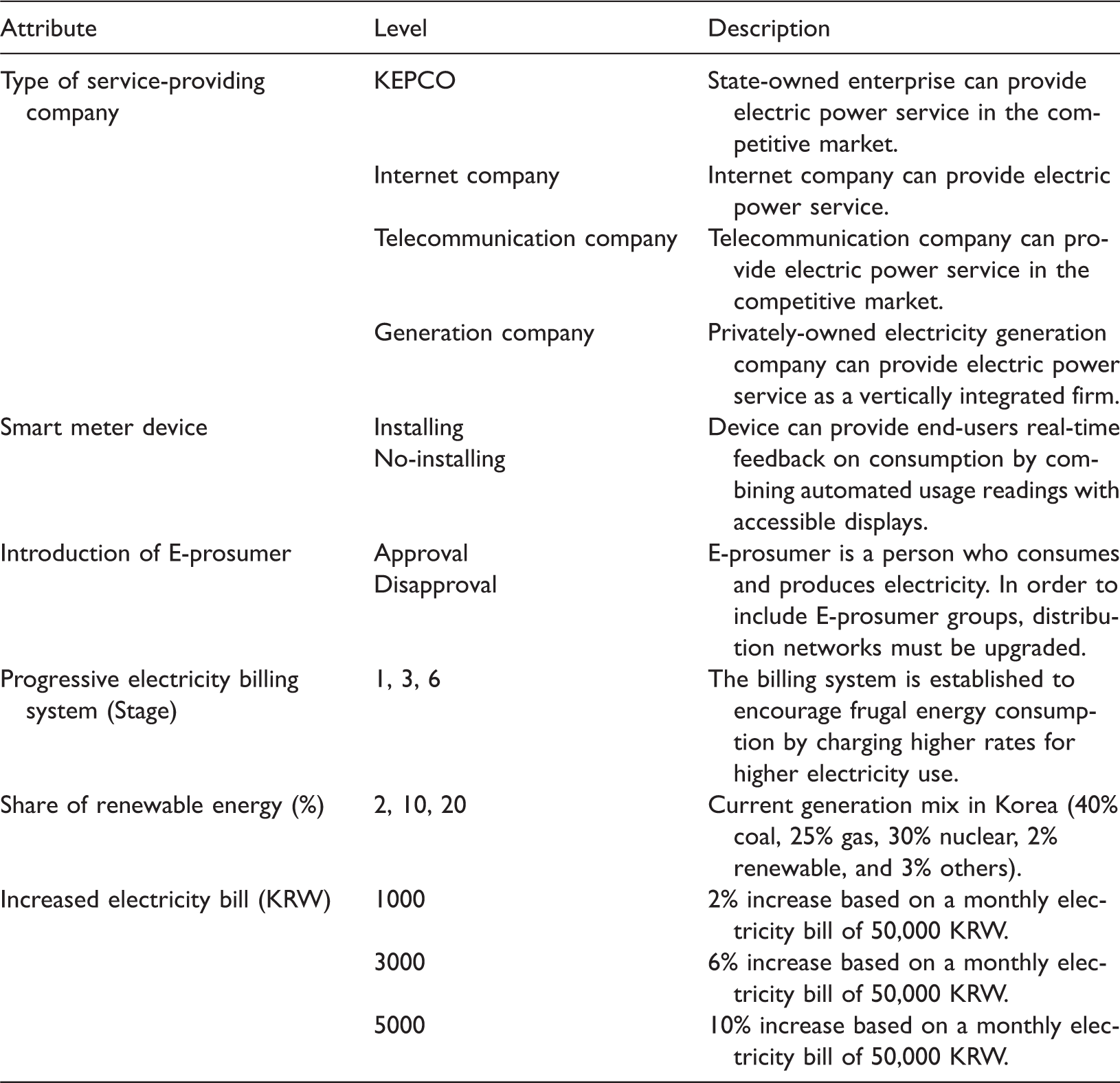
KEPCO: Korea electric power corporation
Modeling showed that the coefficients of some variables are presumed to follow a log-normal distribution or a negative lognormal distribution in cases where all the consumers are expected to prefer or not prefer, respectively, a level of increase in an attribute. For instance, all consumers dislike an increase in electricity bill. To reflect these tendencies, we impose a negative lognormal distribution assumption for increased electricity bill on utility specification, whereas other variables are presumed to follow a normal distribution as one cannot prejudge consumer preferences.
Empirical analysis and result
For estimation, a total of 20,000 draws were generated using Gibbs sampling. To exclude initial point effects, we discard the first 10,000 draws considered to be in the burn-in period, and used the remaining 10,000 draws for parameter estimation and inference. Table 4 shows the estimation results of
Results of empirical analysis.

Note: In the second and third columns, ‘( )’ indicates standard deviation of the parameter and ‘[ ]’ indicates lower 5% and upper 95% of the parameter.
KEPCO: Korea electric power corporation; MWTP: marginal willingness to pay; RI: relative importance.
In terms of the
The results related to the service providing company show that consumers prefer the current state-owned monopolist, KEPCO, when compared to companies from other industries. This result implies that consumers trust KEPCO as a public goods provider and are apprehensive about the situation where privately owned companies increase the electricity price in the competitive market through their profit-maximizing behavior. However, one should not overlook the fact that the preference for the Internet company is so heterogeneous that some customers may prefer electric power services sold by the Internet company and choose this option in a competitive market. This could be linked to the fact that in the last few years, Internet companies in Korea have successfully launched new business models in other industries.
The estimated parameter of the smart meter (
The estimated parameter of E-prosumer (
The estimated parameter of the progressive electricity billing system (
Finally, the estimated parameter of renewable energy
Conclusion
Discussion and implication
Globally, the retail electricity industry has been gradually experiencing deregulation and liberalization drive for the last two decades. Recently, complete liberalization of entry into the retail electricity business and retail electricity rates were approved in Japan in order to create workable competition. In particular, this reform in the electric power industry was intended to bring vitality to the competition in the retail sector, and accelerate the spread of clean technologies for renewable energy and the microgeneration. As a result, this policy promoted competition and create value-added innovative services in the retail sector.
In the wake of these changes, the Korean market is also outlining the terms and conditions for the new electric power services. Considering this situation, an accurate understanding of customers’ needs and preferences is required to provide service packages that could satisfy customers. Therefore, this paper explored future residential electric power services from consumers’ perspective, which directed towards the key attributes mentioned in the context of deregulation, liberalization, and green electricity. Specifically, we quantitatively estimated the consumers’ preference structure and their willingness to pay for key factors of electric power services by applying a choice experiment based on a conjoint survey. According to the results, electricity bills and the progressive electricity billing system were the two most important factors that influence decision making among consumers. Given that the progressive electricity billing system was one of the typical examples showing that government regulated electricity tariffs, the Korean government’s decision to lower households burden of high electricity bills, could be stated as the first step towards deregulating the electric power service market. In addition, we found that the customers evidently prefer to install smart meter devices and include a new type of participation in the form of E-prosumers in the market. These results show that customers expect an entirely new business model that is totally different from the existing centralized model of the residential electric power services.
The empirical results of this study suggest some meaningful guidelines for the government’s policy implementation. Firstly, we found that customers generally do not prefer privately owned company in the competitive market structure, though they undoubtedly favor new functions and services, which could emerge in the future market. One of possible interpretations of this result is that people are anxious about the likelihood of a rise in the electricity price caused by liberalization. In fact, some examples including the deregulation of Ohio’s retail electricity sector has caused this issue for households. From 2004 to 2011 in the United States, electricity prices in deregulated states have risen significantly since 2004, and increased by 3.1 cents per kWh over the entire seven-year period. In comparison, rates in regulated states rose by 2.3 cents per kWh during the same period. Due to this, it is resonable to infer that customers prefer government-owned corporations in the competitive market. From private firms’ perspective, the firms must overcome customers’ resistance, in order to run their business in a liberalized electric power service market. We suggest that one of the best strategies to bridge the gap is to maintain a price at current level in the competitive market until potential customers trust them. Alternatively, introduction of dynamic electricity pricing could keep the electricity price lower then the cost to attract customers, assuming that it is allowed by the government.
Second, though customers show a strong preference for installing smart meters, it is challenging to achieve a significant success by solely installing smart meter devices. Without demand management solutions or billing mechanism improvements such as applications using real-time prices, few customers actively observe their smart meter devices and adapt their behaviors. In fact, the United Kingdom government expect energy suppliers to install smart meters in every house by 2020, and this was the biggest national infrastructure project to enable a more energy efficient system. However, three years before the deadline, only 4.9 million smart meters have been installed, out of a total of 53 million smart meters. Those, who installed smart meters in the United Kingdom, reported challenges in switching between service providers and technological incompleteness of the device. In addition, consumers were exhausted reading the smart meter every hour, in order to adapt their usage pattern. This implies that interoperability between service providers, technological improvement of devices, and automatic demand management solutions could attract potential customers of smart meters.
Third, governments need to take a step towards green electricity. According to the result of this study, customers generally prefer to increase the share of renewable energy in the generation mix, even though their willingness to pay is moderate (288 KRW/year for 1% increase in the renewable energy portion). Furthermore, customers prefer changing the market rule in a manner that enables E-prosumers, who installed microgeneration based on photovoltaic system in their house, to transact in the retail electricity market. Consequently, market reforming processes, including the E-prosumer system, could provide profits to individuals, who install microgeneration, as well as create a low carbon society by increasing the share of renewable energy in household electricity consumption. In addition, distribution networks need to be upgraded, in order to involve E-prosumer groups in the current distribution network. Considering this, the estimated customers’ willingness to pay for the introduction of E-prosumer (5,222 KRW/year) could be taken into account for development and maintenance costs for allowing E-prosumers to participate in the upgraded distribution network.
Limitation and further research
This study has some limitations. Most significantly, the detailed structure of each country’s retail electricity sector is different. In other words, there is a distinction between countries in the degree of liberalization and the level of deregulation in the residential electricity sector. Thus, it is difficult to identically apply the suggestions of this study to all countries. Second, the number of attributes is limited to six, in order to avoid disruptions to the respondents during the experiment. However, the six attributes may not cover all the properties of the future residential electric power services. For example, companies from other industries, such as Internet or telecommunication companies, are able to provide convergence services that combine their own business with electricity. In this regard, future research could include convergence services such as the Internet, telecommunication, and transportation among others, as attributes in a conjoint survey.
Despite these limitations, this study contributes to the extant literature by quantitatively analyzing customers’ preference structures and their willingness to pay for their preferred services. In addition, this study offers several suggestions to improve the existing residential electric power services and to meet customers’ expectations. Moreover, diffusion of smart meter installation, the share of renewable energy in the generation mix, and the introduction of E-prosumer based on microgeneration are important topics globally, regardless of the country. In this context, we believe that the empirical results of this study suggest meaningful managerial implications in a long-term perspective to other industrialized countries, and developing countries.
Footnotes
Declaration of conflicting interests
The author(s) declared no potential conflicts of interest with respect to the research, authorship, and/or publication of this article.
Funding
The author(s) disclosed receipt of the following financial support for the research, authorship, and/or publication of this article: This work was supported by the Seoul National University Research Grant in 2016.