



Abstract
Improvements to industrial economic efficiency are important in coordinating China’s economic development and its environmental protections; furthermore, an effective environmental regulation system is a crucial driver of both industrial economic efficiency and technological innovation. Using panel data pertaining to China’s 12 characteristic industries over the 2008–2015 period, this study divides environmental regulations into two types – namely, cost-oriented environmental regulations (ER1) and investment-oriented environmental regulations (ER2). This study employs a slacks-based method to calculate the economic efficiency of different groups of industries, and it applies a regression model to test the effects of these two types of environmental regulations on economic efficiency and technological innovation among China’s 12 key industries. Our research results offer three distinct findings. (1) These two types of environmental regulations have opposite effects on industrial efficiency and technological innovation: ER1 have significant and positive effects on economic efficiency and technological innovation, but ER2 have negative effects on them. (2) The results with respect to various groups of industries differ widely, with low-efficiency industries sustaining a more positive influence from environmental regulations and technological innovation than high-efficiency ones. (3) Technological innovation effectively promotes the economic efficiency of industries and tends to have a more significant impact on relatively low-efficiency industries. These findings indicate that the effects of different types of environmental regulations differ across industries. Finally, to optimize and adjust these environmental regulation tools, this study makes policy recommendations for various industries.
Introduction
In recent decades, China has entered a new period of transformation, following reforms and a general ‘opening up’ of its economy. However, China’s economic growth has come at the expense of environmental pollution and the excessive consumption of resources. In China in 2015, investments in environmental governance totalled about 88 billion RMB, of which industrial pollution control constituted a large proportion. In 2014, only 16 cities in China had urban air quality values that were deemed acceptable as per national air quality standards. The excessive pollution emissions from and energy consumption of industrial production are obvious, and there was a steep increase in the total amount of energy consumed between 1978 and 2011, from 571.44 million to 3480.02 million tons of coal. Clearly, it is a vast undertaking to create a society within China that is sensitive to conserving resources and being ecologically friendly.
Confronted with problems stemming from the excessive consumption of resources and environmental damage incurred by economic development,1–3 China has put forward a set of environmental protection policies, in which environmental regulation is the main measure proposed to constrain industrial pollution emissions.4,5 Environmental regulations have been regarded as effective ways to reduce the impact of economic activities on the environment. Due to the importance of environmental regulations, governments try to establish a mature environmental governance system, such as the effects of environmental regulation on technological innovation, on competitive advantages, on productivity and financial performance. The main purpose of government is to reduce the negative environmental impact and improve the environmental quality. However, according to the world environmental performance ranking, China is ranking 105th among 149 countries in 2008, as of 2014, China’s ranking slipped to 118th among 178 countries and regions. This reflects that the limited effectiveness of China’s environmental regulation, so, the main question of this paper is: Is China environmental regulation effective in reducing environmental pollution and improving economic efficiency? What are the effectiveness of different types of environmental regulation on economic development and environmental protection?
For the effect of environmental regulation, there are few studies focusing on the verification of the relationship among different types of environmental regulation and economic efficiency. Much more literatures focus on how to achieve economic development, ignoring the internal relations of environmental government and economic development such as foreign direct investment (FDI), outsourcing and the industrial scale on economic efficiency evaluation, and the impact of these factors on economic growth. Environmental regulations is a set of tools that aimed at different industrial impact on the natural environment and creating a context where different industries will engage in environmental cleaner production. Due to the importance of environmental governance in sustainable development, many governments engage to establish a mature environmental governance system to ease the contradiction between environmental regulation and economic development.
The importance of environmental governance also has attracted many scholars to investigate the different types of environmental on innovation or productivity. Moreover, a few researches also divide environmental regulation into different types. On one hand, environmental regulations can be divided into three types of regional economic measurement: command-and-control, market-based regulations, and informal regulations that depend on public awareness. 1 On the other hand, environmental regulations can be alternatively categorized in terms of industrial production, in which cost-oriented and investment-oriented environmental regulations are widely applied.6–9 Among previous studies, environmental regulation has been found to be an important measure in reducing the negative effects of economic production on the natural environment. 9 Environmental regulations are defined as a set of environmental measures by which firms engage in environmental protection.3
However, despite aforementioned research, a comprehensive survey of the literature shows that there is no study that has looked at the direct (linear) and more complex (such as non-linear) links between different types of environmental regulations and economic development. Therefore, to verify the internal relationships between environmental protection and economic development, this study uses slacks-based method(SBM) and regression models to estimate the economic efficiency and technological innovation across 12 different industries, using panel data collected in China over the 2008–2015 period. Here, the principle of data selection is that each of the 12 industries offers good representation of China’s economic development, and they include agriculture, manufacturing, food industry, heavy industry and the culture and entertainment industry, inter alia. In the estimation phase, the proposed approach uses the SBM model to measure the economic efficiency of each industry during the study period. In the second estimation phase, the proposed approach uses the regression model to establish the theoretical hypothesis of the effects of two types of environmental regulations – namely, cost-oriented and investment-oriented environmental regulations. In the current study, economic efficiency and technological innovation are used as dependent variables, to examine the effects of the two types of environmental regulations on them. Based on the perspectives of cost-oriented and investment-oriented environmental regulations in production, estimations of the main factors that affect technological innovation and economic efficiency allow us to propose the ways to improve the efficiency of cleaner means of production.
In sum, the aims of our study are to investigate whether there exists different relationship between different types of environmental regulation and economic efficiency, and the time lag of environmental regulation on these relationships in China different industries. We have comprehensively addressed two types of environmental regulation and focus on potential relationship of industry production, it is one of the few study to investigate time lags and focusing on different industry of developing country.
The remainder of this paper is organized as follows. The literature is reviewed in the following section. The third section introduces the basic methodologies, including the SBM and regression models used herein. The fourth section proposes the two types of environmental regulations, as well as the theoretical hypotheses of this study. The fifth section presents the empirical framework, and the sixth section describes the execution of the empirical study. The final section offers conclusions and policy implications.
Literature review and contributions
In recent decades, multiple studies have investigated the ways of more effectively assessing economic efficiency and technological innovation. This section reviews the literature regarding those factors that affect economic efficiency and technical progress, to delineate their research emphases. Additionally, a literature review of various environmental regulations vis-à-vis industrial production is also undertaken to provide some background information on the two types of environmental regulations. Finally, the contribution of the current study is highlighted by considering the limitations of previous studies.
Economic efficiency considerations
Given the current controversy surrounding the potential effects of environmental regulations on economic efficiency, many attempts have been made to investigate the diversification of environmental regulation measures, the effects of regional economic disparities, and the various research methods to assess economic efficiency, but these studies merely reflect economic development but fail to involve environmental desirable and undesirable output. Thus, in the recent researches, many existing literature pay more attention to the environmental regulation of green economic efficiency. For example, Mandal 10 used data from India to analyse the relationship between environmental regulations and industry energy efficiency, and found that the former can significantly improve the economic efficiency of industry. However, this study may ignore the negative effect of environmental regulation on economic development. Wang et al. 11 employed data from the papermaking industry to find ways of enhancing environmental regulations. Their results suggest that the efficiency of industry pollution treatment has clearly improved, and that there has been great developmental progress in the technology involved. They also additionally found that economic efficiency is significantly improved by the presence of environmental regulations, but the role of environmental regulation in promoting economic development is mainly reflected in a single industry, and it cannot represent the impact of environmental regulation on the overall economic development.
Long et al. 12 evaluated the environmental performance of industries in a variety of countries, and they suggest that the effects of factors that affect industrial efficiency, when plotted, take a ‘U’ shape. Van Caneghem et al. 13 also indicate that the influence of environmental regulations is completely decoupled from economic efficiency. More recently, some researchers systematically summarized the previous research efforts of data envelopment analysis (DEA) environmental assessment, they found that DEA method has been receiving increasing attention due to its ability to solve efficiency evaluation. Some researchers argue that industrial productivity will decrease under the auspices of stringent environmental regulations 7 and that the influence of environmental regulations on industry competitiveness will depend mainly on the types of technological innovation involved.14,15 It is noteworthy that these aforementioned approaches to economic efficiency evaluation mainly focus on the various environmental factors that affect industrial production, the internal relationship between environmental regulation and economic efficiency has not been analysed. However, many studies have shown that the importance of environmental indicators cannot be neglected.16,17 A number of previous studies overvalue economic efficiency in many industries, and once environmental indicators were added, significant fluctuation was found to be unavoidable when measuring industrial efficiency. Given their differences in terms of research methods and objectives, these empirical studies have failed to provide conclusive results regarding the relationship between environmental regulations and economic efficiency.18,19 From the perspective of economic development, industries cannot change their modes of production and reduce resource consumption within a short time frame, thus, there is a reliance on government environmental regulations to impose compulsory pollution control measures.
Technological innovation considerations
IT industry has maintained a rapid growth in recent decades. Innovation, especially technological innovation is a key process in socio-technical change, which determines the sustainability production of the industry. The effects of environmental regulations on industry productivity mainly reflect in technological innovation – that is, the ‘forced mechanism’ of the Porter hypothesis.20 In recent years, some scholars have questioned the Porter hypothesis, mainly because the cost of technological innovation is too high, resulting in low short-term return of technological innovation on economic growth. Despite the wide application of environmental regulations, there is also controversy as to whether they can truly give rise to improvements in industrial technology. Previous studies have argued that the environmental regulations can promote innovation in pollution control technology,21–24 but these studies also showed that the costs of technological innovation and new equipment operation tend to far exceed the profits generated by new products;25–27 for this reason, the cost of technological innovation is not conducive to improving production efficiency. Conversely, some scholars have found that an increase in the number of new products would promote an industry’s production capacity, and that on the basis of technological innovation, new product markets could be developed.28,29 These studies mainly focus on the discussion of production in a single industry. The impact of technological progress on the whole market remains to be studied. Therefore, both economic development and the promotion of new industrialization require technological progress that would also promote environmental protection. However, there is a lack of quantitative research on how technological innovation affects industrial production and environmental governance, the way it works and its impact on production.
The success of technology innovation means the cleaner technology has not only been developed, but also been applied successfully in market. Research on the economic development has expanded rapidly to increase the understanding of the means by which new technologies have to enable the social sustainability. Meanwhile, a considerable number of researchers have argued that environmental regulations play an important role in improving technologies, and that these improvements primarily manifest in industrial scale and productivity.27,30 Furthermore, technological innovation is seen as a process of mutual investment that is affected by infrastructure, capital investment, and government policy. Under the constraint of environmental regulations, these factors may also change the direction and extent of technological innovation, and this may in turn indirectly impose a negative influence of environmental regulations on technological innovation.25,26,31 Clearly, there is no consensus, as there has always been a diverse range of findings vis-à-vis the effect of environmental regulations on technological innovation. Moreover, the boundaries of different environmental regulations in the field of industrial production are not clear enough, and the impact of different types of environmental regulations on economic production is lack of summary and classification.
Environmental regulation considerations
Climate change over the last few decades is evidence of environmental degradation caused by humans pursuing economic development. Chinese government has made some active efforts to reduce pollutant emission and protect the environment. Previous studies point out that environmental regulations constitute a tool to resolve environmental problems, and so they must be effective in improving environmental quality and minimizing the cost of pollution treatment.32,33 However, the literature indicates that different kinds of environmental regulations may have different effects on environmental problems. Kathuria 34 analysed data from Indian enterprises and found that environmental regulations for controlling pollutant discharges had positive effects on industry pollution control, but there is a lack of analysis on the side effects of environmental regulation. Most studies found that market-based regulations have a positive effect on efficiency improvements and technological innovation.8,35,36 Nonetheless, research on market-based environmental regulations has lacked more detailed analysis: certain issues – such as investigations of cost-oriented and investment-oriented environmental regulations, whether there are differences in environmental regulations applicable to different industries, and the impact of current environmental regulation methods on various industries – have not been studied in-depth.32,37,38 There is an argument that strict environmental regulations may harm the economic growth. One important reason is that the stricter environmental regulation may weaken the attraction of FDI. The other reason is that it may increase the cost of pollution control in various industries and increase the production pressure.
Environmental regulations tend to invoke the pull–push effect of government environmental protection policies.
38
In measuring economic efficiency and environmental protection at the regional level, many researchers have tended to divide environmental regulations into three types: command-and-control regulations, market-based regulations and voluntary regulations.
1
However, these three types of environmental regulations may not be appropriate for measuring these matters in industrial production processes, for the following three reasons.
Although the existing types of environmental regulations have strong representation, they may not be fully adaptable to the aims of the current study, including the establishment of public participation in environmental protection measures
38
arising from the internal production of various industries. When measuring the environmental regulation of industrial production, index selection can be quite different from, and is not limited to, the three existing types of environmental regulation tools.33,39 There are certain differences in the selection of specific indicators for the three types of environmental regulations. For example, the scope of administration-based environmental regulations differs very much from the other forms, and it may not be suitable for environmental regulations in industries with different production scales. Administrative-based environmental regulations mainly involve government intervention in environmental protection, through the formulation of relevant laws and regulations and through the imposition of environmental standards;
1
these circumstances can make it difficult to evaluate the effective relationship between these environmental regulations and within-industry production efficiency. Industrial environmental regulations involve corporate environmental strategies that address the various stages of industrial production so as to mitigate throughout the entire production process any negative environmental impact on productivity.38 This approach demands greater producer responsibility with regards to industrial environmental protection measures. Indeed, there is a relative dearth of literature relating to the relationships among environmental regulations, environmental strategies and corporate performance in the industrial production system, though a few studies exist;
39
therefore, the types of environmental regulations that this study investigates are based mainly on the coordinated development of industrial production systems and environmental governance.
Contribution of our study
There is no consensus in the literature with regards to study findings; in fact, there is significant divergence among those studies’ conclusions, given differences in the regions and industries investigated therein. Different environmental regulations may address different environmental problems. The major difference of our studies compared to previous studies is as follows: (1) different from the previous studies, this paper analyses the impact of two types of environmental regulation on economic efficiency mainly based on the internal processes of industrial production, which are related to industrial production, industrial pollution discharge and industrial pollution treatment in different industries, and discusses two types of environmental regulators in this production process. (2) Moreover, this study is no longer confined to the internal relationship between environmental regulation and economic efficiency in a single industry. (3) The innovative combination of efficiency evaluation model and regression analysis method is helpful to discuss whether the economic efficiency of various industries is affected by different environmental regulations considering the undesirable output, and is more in line with the actual industrial production system process to ensure the applicability of the research results.
Hence, the detailed contributions of this study can be further explained as follows:
The effective mechanisms of diversified environmental regulation tools differ. Under such circumstances, environmental regulations can be classified into one of two types – namely, cost-oriented and investment-oriented environmental regulations. Previous studies have paid greater attention to the impact of environmental regulations on industrial development and environmental regulation compliance, with the associated costs of production investment resulting in the squeezing out effect. The direct conclusion made here is that this approach reduces the competitiveness of industry. Different types of environmental regulations may have contrasting effects on economic efficiency and environment protection. Other studies have investigated the effects in China of stricter environmental regulations; however, some of these studies focus on external policy factors.25,26,31 Further steps, beyond what these studies offer, must be taken to investigate whether different types of environmental regulations during industrial internal production can affect economic efficiency (by increasing production costs) or improve production technology in response to environmental pressures. In spite of the systematic research on the effects of environmental regulations, the heterogeneity of the industries studied therein has not been taken into account, and these studies tend to provide only general, overarching conclusions. Under the constraints of industries with different economic efficiencies, environmental regulations will affect not only the establishment of new industries, but also the employment and wages; ultimately, they can also impact industrial scale and structural composition. Research within the literature has not yet opened the ‘black box’ of environmental regulation across different industries, and this lends credence to an investigation into optimal combinations of environmental regulatory tools for various target groups of industries. Thus, we divided China’s 12 key industries into two groups, to analyse how environmental regulations differentially affect their economic efficiency and technological innovation. Since there is a time lag before environmental regulation policies can take full effect, this study employs a one-phase lag of environmental regulation; we do so to facilitate an examination of the dynamic effect of environmental regulations on industrial eco-efficiency, and thus help make conditions conducive to sounder industrial management in China, ultimately to revise environmental policies in line with the regulatory period of the different environmental regulation tools available. In fact, industrial pollution and the costs of pollution treatment have increased substantially in the previous decade. This raises some immediate questions in terms of industrial production. Do pollution disposal costs and pollution control investment costs affect industrial production, or is there a forced mechanism for industrial production? To date, few scholars have attempted to answer these questions in an in-depth manner.30
Basic methodology
To address the linkages between economic development and environmental protection, and to propose a new approach to environmental regulations, this study makes use of the SBM and regression models. The following discusses the finer points of these basic methodologies, in turn.
The SBM model
The logic that underpins DEA models relates to reducing inputs and increasing outputs, both as much as possible. However, real production processes often generate certain undesirable outputs, such as waste water, waste gases and solid waste. DEA models cannot automatically manage undesirable outputs; thus, determining how best to work with such undesirable outputs is key to evaluating economic efficiency.
There are several categories of methods to address undesirable outputs. Those in the first category treat the undesirable outputs as inputs;3 however, this approach is not consistent with real-world industrial production processes. Methods within the second category translate undesirable outputs into desirable ones by using a data transformation function;39 while this method is easy to use, the function is random and the choice of maximum values is subjective. Those within the third category, meanwhile, evaluate efficiency and use a DEA framework with undesirable outputs; examples include the SBM model of An et al. (2015), which is based on the previous work of Chung et al. 40 The directional distance function has been used by many researchers to address the problem; it simultaneously credits reductions in ‘bad’ and increases in ‘good’ outputs. Fukuyama and Weber 41 found that the directional distance function tends to underestimate the economic inefficiency; therefore, Wang et al. 42 applied the directional SBM model to estimate the production frontier. An SBM model can accurately reflect the structural characteristic of decision-making units (DMUs) and is more accurate in calculating economic efficiency.
The SBM model was first proposed by Tone 43 and has been widely used to consider undesirable production outputs. The SBM model can solve input–output slack problems, and assist in precluding the influence of radial and oriented choices. Thus, the SBM model has become the most powerful (and popular) tool among evaluators of efficiency. 44 Since environmental pollutants are generally considered undesirable outputs – or ‘negative externalities’ – the SBM model can successfully evaluate both desirable and undesirable outputs in industrial productivity; hence, the SBM model has been applied widely in undertaking industry efficiency evaluations.
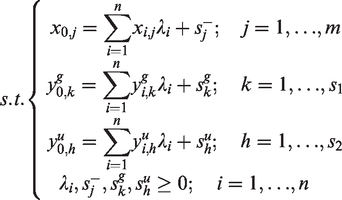
Suppose there are n DMUs, in which the input of the ith (i = 1,…, n) DMU is denoted as

To distinguish the difference among various efficiency evaluation models, we calculated the economic efficiency of 12 industries in 2015 (Figure 1 and Table 1). In Figure 1, we compare the efficiency of the SBM model with the traditional CCR model. It can be found that the efficiency based on SBM is more stable, and the fluctuation of efficiency is smaller in different industries. The efficiency calculated by SBM is higher than that of the traditional CCR model. The main reasons are as follows: (1) the SBM model considers the undesirable output, while the traditional CCR model cannot deal with the undesirable output in efficiency evaluation, so when the undesirable output is too high, it is easy to cause input shortage and lead to inefficiency. (2) SBM model does not need to consider the disposability of pollutants, but if the traditional CCR model neglects the disposability of pollutants, it will easily lead to errors in efficiency evaluation.
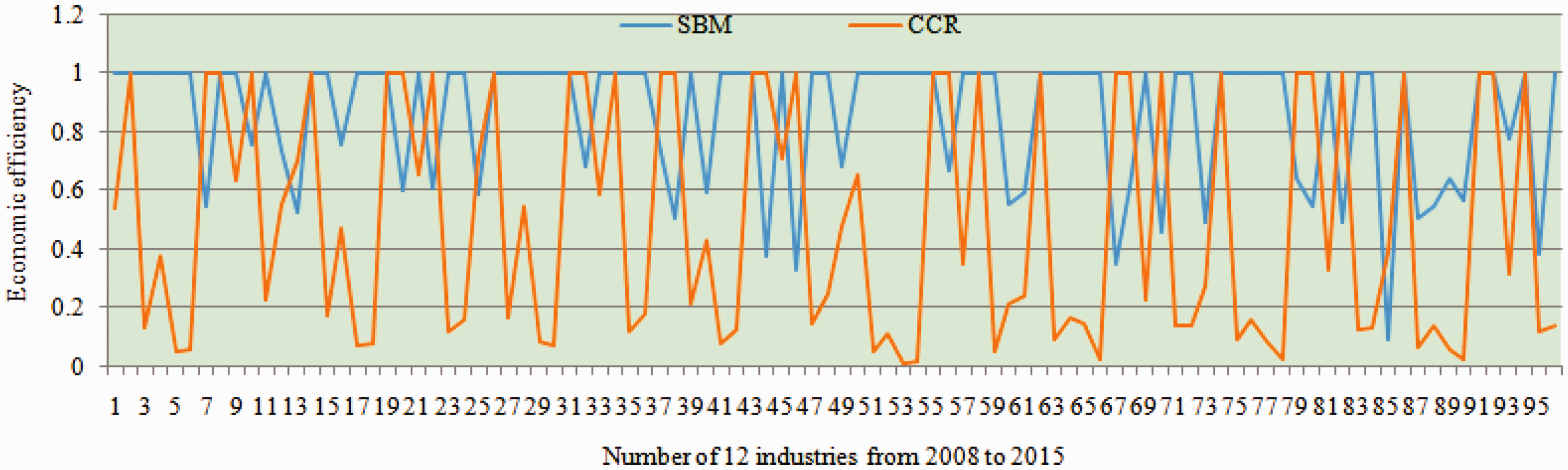
The difference between SBM model and CCR model in efficiency evaluation.
The performance of different models in economic efficiency evaluation.

To further prove the superiority of the SMB model mentioned in this paper, we compared and analysed the results of various efficiency evaluation methods in Table 1. The BCC, CCR and super-DEA models cannot deal with the undesirable output in efficiency evaluation, so it is easy to lead to the minimum or overestimation of the efficiency value. At the same time, because super-DEA is mainly used to rank different DMUs, it needs to be converted when the efficiency is applied in further calculation. Strong disposability model is a classical model in the evaluation of unexpected output efficiency. Its principle is to convert all the unexpected outputs into expected outputs and calculate them. However, in the actual evaluation of environmental control efficiency, it is unreasonable for the strong disposability of pollution, because the disposability of different pollutants is different, not all pollutants can be comprehensively utilized under the support of certain technologies. As a result, it is easy to appear inefficient or overestimated.
Regression model
The regression model is an important mathematical tool that includes a set of statistical processes to estimate the relationships among the variables. The logarithmic regression model can be written as follows

Additionally, the fixed-effects model is a kind of variable method appropriate for use with spatial panel data that change with the individual, but do not change with time. The relevant model can be written as follows

Theoretical hypotheses and framework
Definitions of the two types of environmental regulations
Environmental regulations do not have a single, integrated mode of government participation, nor do they possess independent regulatory tools;32,38,45 therefore, in line with various research methods within the literature, there have been some differences with respect to the selection of environmental regulation indicators. 38 The key challenge inherent in the current study is how to measure the stringency level of applied environmental regulations. Researchers have developed many sets of indicators to address environmental regulations, including pollution abatement cost, 1 the emission of pollutants45,46 and improving production technology through capital investment to achieve cleaner production.46,47 These are the regulatory environmental measures commonly used to assess the industrial productivity. Wherever environmental regulations can identify cases in which an increase in production cost can be overcompensated by net income, the tool of environmental regulations is deemed effective.47
Today, economics-based environmental regulations are increasingly becoming the norm with respect to development, given their inherent advantages vis-à-vis cost and efficiency measurement in industrial production systems.19,39 Therefore, in line with Aiken and Pasurk (2003) and Huang et al.,
45
and given the considerations in ‘Environmental regulation considerations’ subsection, we applied a double set of environmental regulation tools to measure the effect of environmental regulations on economic efficiency and technological innovation in the current study context.
1
The following points explain the selection of these two types of environmental regulations.
Today, many researchers are focusing on ‘green investment’. For example, Xu et al. (2017) used panel data from five industry sectors in China to test the determinants of green investment, and they suggest that investment in cleaner and green production is economically undesirable. Thus, analysis of the impact of environmental investment on industrial production must be based on discrimination among the different types of environmental regulations, so as to effectively improve the investment efficiency of cleaner industrial production. The literature generally considers that the impact of environmental regulations on economic efficiency and technological innovation has dual effects – namely, a positive incentive effect and a negative crowding-out effect.
48
Cost-oriented environmental regulations have generally produced a crowding-out effect on economic efficiency and technological innovation. First, cost-based environmental regulations are equivalent to the firm-level purchase of pollution emission rights – a mechanism that increases both industries’ production costs and, ultimately, their product prices.9,17 Under the premise of constant consumption demand, it is essential to reduce industries’ profits and reduce the energy and capital inputs of technological innovation. Second, industries need to use existing funds to buy pollution emission rights; in cases where there are insufficient funds, industries may misappropriate funds originally earmarked for technological innovation, to pay (for example) sewage charges. This can create a squeezing out effect on those industries’ technological innovation. The cost of environmental protection is believed to increase industry-level production cost; at the same time, this kind of regulation cannot push industries to carry out technological innovation, and it eventually hinders output growth.6,7 Finally, as a system, the levying of sewage charges can lead to policy failure,7,9, which in turn inhibits the otherwise positive role of cost-oriented environmental regulations. Investment-oriented environment regulations offer not only economic benefits in terms of general industrial production, but they also offer environmental protection benefits and social benefits. First, in the long run, the payment of pollution charges cannot fundamentally resolve the problem of pollution;
39
industries will also eventually choose to increase their respective investments in technological innovation and improve their production processes, all with an eye to improving productivity. In general, after an industry makes a one-time environmental protection investment, its pollution emissions will satisfy national and local environmental standards; at that point, the industry will be declared exempt from certain economic penalties (e.g. the charge for exceeding the standard discharge) and various fines, and this will no doubt be beneficial in reducing its economic burden.
49
Second, a perfect environmental regulation policy would provide clearer direction for industrial innovation, and it would improve the ability of industries to innovate.35,36 Finally, investment in environmental pollution control gives industries incentives to take advantage of such initiatives. Industries can protect their interests by applying for patents – or by preventing other industries from entering or using patents – so as to consolidate and even expand their market share and enhance their competitiveness. Therefore, in the long run, investment-oriented environmental regulations have an incentive effect on enterprise-level technological innovation.6,8
Thus, based on the methodologies introduced in the third section, we propose two types of environmental regulations with respect to industry production in this section. One is recommended from the perspective of cost-oriented environmental regulations, and it takes the cost of pollution treatment as a form of environmental regulation. 9 The other takes the perspective of investment-oriented environmental regulations in industry production, and takes as a measure of environmental regulation the ratio of environmental investment to industrial output value. 4 Each of these two types of environmental regulations is discussed in more detail below.
Theoretical hypotheses
Type 1: Cost-oriented environmental regulations
Type 1 environmental regulation – which is to say, cost-oriented environmental regulations – speak to the influence of environmental regulations on industry production, from the perspective of pollutant cost restriction.7,9 Since industries must clean up pollutants to meet environmental standards, the cost of pollution treatment becomes an important element of cleaner production in any given industry.
The theoretical hypothesis pertaining to the effect of cost-oriented environmental regulations on economic efficiency and technological innovation is as follows. Suppose that
Type 2: Investment-oriented environmental regulations
Environmental investment comprises type 2 environmental regulations with respect to industrial production, from the perspective of production-level resource inputs.8,35,36 We offer the following theoretical analysis to explain the positive influence of environmental regulations on economic efficiency.
The theoretical hypothesis pertaining to the effect of investment-oriented environmental regulations on economic efficiency and technological innovation is as follows. Suppose g denotes a new production technology that can create new goods;
Theoretical framework
Based on the theoretical hypotheses on the effects of the two types of environmental regulations, we offer the theoretical framework of our study (Figure 2).
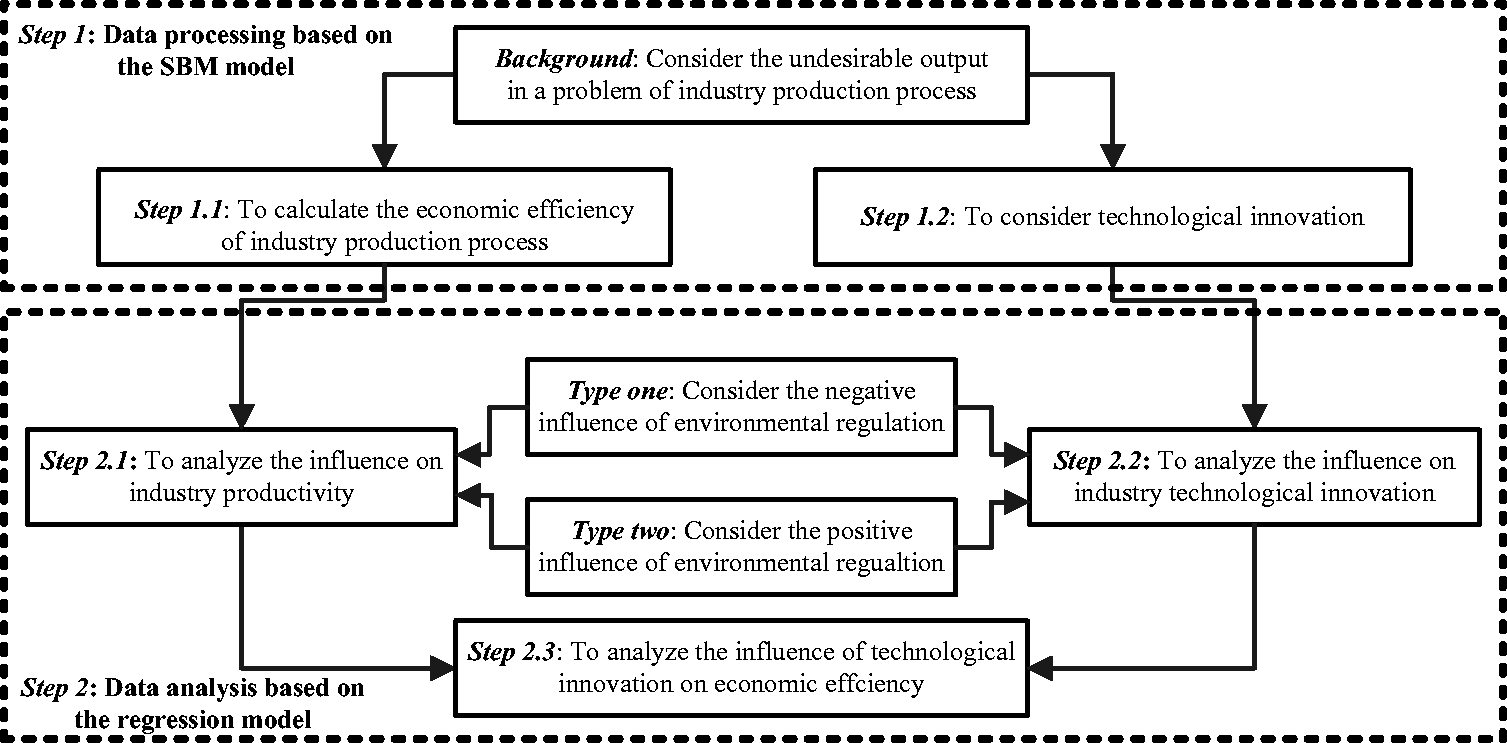
Theoretical framework for two types of environmental regulations.
Figure 2 shows that the SBM model is used to calculate the economic efficiency of industrial production processes, while the regression model is used to study the negative or positive influences of the two types of environmental regulations on industrial production processes. The detailed steps of the proposed theoretical framework are as follows.
Step 1: process the data using the SBM model.
Step 1.1: calculate the economic efficiency of the industrial production process. Suppose there are n industries with m inputs, s1 are good outputs and s2 are undesirable outputs. Based on the SBM model introduced in ‘The SBM model’ subsection, n DMUs can be constructed to calculate the economic efficiency
Step 1.2: consider the technological innovation. Revenue derived from new products each year is selected as the innovation capability of industries, denoted as
Step 2: undertake data analysis using the regression model. Based on the Hausman method, we test whether the regression model exists endogenously; if there is an endogeneity problem, we consider using the two-stage least squares (2SLS) model based on one lagged phase of environmental regulation to help resolve it. If there is no endogeneity, the ordinary least squares (OLS) model is used. Whenever the explanatory and error terms correlate, autocorrelation and endogeneity problems that occur during the panel regression process can be resolved by enlarging the sample size and introducing functional variables. In specific analyses within previous studies, the functional variable of choice is the lag term of the weak exogenous variable. By leveraging the first-order difference of the weak exogenous variable, we can eliminate the individual effect of the variable and obtain consistent estimation results.
Step 2.1: analyse the influence on industry productivity. After calculating the economic efficiency of the industrial production process, we should consider the two types of environmental regulations as follows.
For type 1 environmental regulations, we use the following regression model (which is extended from equation (2)) to discuss the adverse effect on the industry production process

For type 2 environmental regulations, we use the following regression model (which is extended from equation (2)) to discuss the positive effect of investment on the industry production process

Step 2.2: analyse the effect on industry technological innovation. After selecting sales of new goods as being representative of technological innovation, type 2 environmental regulations should be considered as follows.
For type 1 environmental regulations, we use the following regression model (which is extended from equation (2)) to discuss the adverse effect on technological innovation

For type 2 environmental regulations, we use the following regression model (which is extended from equation (2)) to discuss the positive effect on technological innovation

Step 2.3: analyse the effect of technological innovation on economic efficiencies. According to equation (3), the influence of technological innovation on economic efficiency can be written as follows

Data source and definitions of variables
This section presents the variable settings of the two proposed types of environmental regulations used to carry out the data analysis and empirical study discussed in ‘Results and discussion’ section. The next subsection introduces the specific index selection of the SBM model with respect to step 1, while subsequent subsection defines the variables and discusses the treatment in the regression model with respect to step 2.
Variable measurement through the SBM model
The practical data used in the present study were obtained from the Chinese statistical yearbooks on environmental and industrial economics, for the 2008–2015 period. In line with sample-data availability and following the criteria selection protocols of previous studies, we introduce the specific index selection of the SBM model as follows.
According to the inputs selected in previous studies,50,51 among industrial inputs, labour and production costs are the two most important inputs. Therefore, as Table 2 shows, for the SBM model we set the average annual employment (labour) and the main business cost (cost) as inputs for each industry. Production profit is the ultimate goal of industries, and so we set the total annual profit of an industry (total profit) as a ‘good output’. On the other hand, ‘bad outputs’ comprise the main pollutants generated during industrial production – namely, the waste water emissions per unit profit (waste water), the solid waste per unit profit (solid waste) and the sulphur dioxide emissions per unit profit (exhaust gas). All these measures were selected following the literature review.12,45,52
Definition of inputs and outputs in the SBM model.

Variable measurement through the regression model
Table 3 defines the dependent and independent variables in the regression model: the economic efficiency (Pi*) of various industries constitutes the main dependent variable in the regression model of equation (8), with economic efficiency (calculated as per the SBM model) serving as an important index for measuring industrial production capacity. This method aligns with that of Zhao et al. 4
Definition of variables in the economic regression model.

T* is the dependent variable in the regression model of equation (9), and both Pi* and T* are key variables in the regression model of equation (10). Although many indicators can be used to measure the industrial innovation capability, the research and development and sales of new products undoubtedly reflect an industry’s innovation ability.1,9
Additionally, the control variables shown in equations (8) to (10) include the management cost, the non-‘share of experience’ enterprises in total assets (marketization), FDI, and the total output sale value in industries; this selection of variables is also seen in various other studies.4,33,38 Meanwhile, we defined the cost of pollution treatment as the first type of environmental regulation (ER1 for short) in industry production, and took the ratio of environmental investment to industrial value as the other environmental regulation (ER2 for short). ER1 and ER2 are the key variables in equations (8) and (9), based on the literature (outlined in ‘Environmental regulation considerations’ subsection) and the definitions of different types of environmental regulations (outlined in ‘Definitions of the two types of environmental regulations’ subsection).
Data processing and analysis
According to the economic efficiency values derived with the SBM model, China’s 12 characteristic industries can be divided into high-efficiency and low-efficiency groups (Table 4). Most of the industries (including education and furniture manufacturing) are in the high-efficiency group, while heavy industry (including smelting and the petroleum industry) is in the low-efficiency group.
Industry categories.

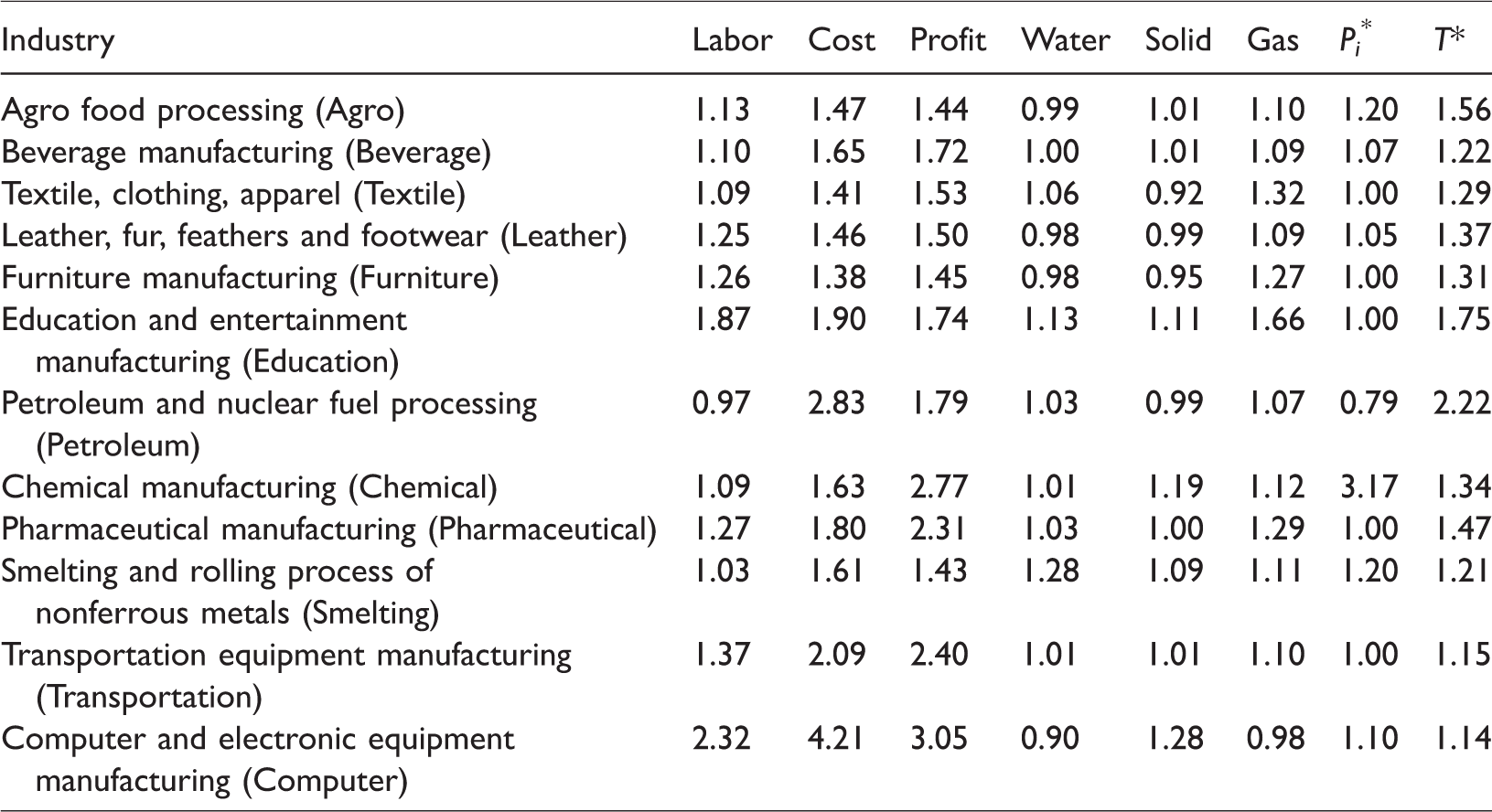
Based on the economic efficiency and technological efficiency values calculated by the SBM model, we can obtain the changes in input and output data with regards to industrial production, as well as efficiency, from the 2008–2015 period (Table 5). It is clear from Table 4 that inputs increased rapidly in various industries – especially in the computer industry, which has seen a two- to three-fold growth rate each year – while education and transportation are second among all the industries in terms of inputs. The profits of all industries remarkably improved, but – as mentioned – the growth in industrial production results in undesirable outputs. In particular, the undesirable outputs of the education, chemical and smelting industries have all increased significantly. It is worth noting that the labour investment of the petroleum industry has decreased, even as the cost of petroleum has substantially grown; this can be attributed to the growth rates of technological innovation in the petroleum industry. On account of technological innovation, machine operations have gradually supplanted manual work in heavy-industry production, and this has led to an increase in technical operating costs and a reduced labour supply. Thus, increased technical costs constitute the main reason for the decreasing economic efficiency of the petroleum industry.
Average annual growth rates of outputs, inputs, economic efficiency and technological innovation of different industries (2008–2015) (%).
Results and discussion
This section mainly discusses the influence of different factors on economic efficiency and technological innovation. The first four subsections discuss the results of our empirical studies based on the regression model.
The two types of environmental regulations in various industries
To distinguish the environmental regulations across various industries, we analysed the distributions of two types of environmental regulations in various industries in 2015 (Figures 3 and 4). In 2015, the highest ER1 value belonged to the chemical industry, while the lowest ER1 value was that of the furniture industry. Compared to those of the chemical industry, the cost-oriented environmental regulations of most industries were weak (Figure 3), being less than 4000 × 104 RMB. Thus, we find that compared to the education and textile industries, the cost of controlling pollution in pollution-intensive industries (e.g. petroleum, smelting, and pharmaceuticals) was not high; overall, in terms of environmental regulations, the intensity of cost-oriented environmental regulations is relatively low. The possible reason is that most industries in China are mainly secondary industries, less high-tech entrepreneurship, and industry pollution control awareness is weak. At the same time, there are some industries in pursuit of profit as the goal, sacrificing the environment for economic benefits. At present, the main body of implementing environmental regulation is the government. The appeal of environmental regulation on economic market is weak, and the public participation in environmental governance is not high.

ER1 in different industries.

ER2 in different industries.
From Figure 4, we see that most industries were weak in terms of investment-oriented environmental regulations. Among these, the environmental regulations of the transportation, agriculture and textile industries were obviously weaker; the reason for this is that the pollution levels of these industries were relatively low, mainly being found in the handicraft industry. However, the environmental regulations of heavy industry (e.g. petroleum, chemical, and pharmaceuticals) were more vigorous: these are mainly pollution-intensive industries that generate more pollution emissions, and the government pays more attention to how these industries manage pollution emission standards. The main characteristics of investment-oriented environmental regulation are the large differences in industries. First of all, this is related to the industrial output value of the industry. The scale of environmental investment is closely related to the profits and profits of the industry. With the rapid development of China's economy, the industry first guarantees the stability of economic income, and then carries out environmental governance and investment. Secondly, agriculture and most of the light industries are developing at a slower rate than heavy industries in China, while agriculture and light industries are less polluted, so investment in environmental governance is much less than that in heavy industries. In summary, environmental regulations play an important role in promoting production technology, but only when most industries take into consideration environmental influences during the production process. Additionally, to verify further the role of environmental regulations, the effect of environmental regulations on the economic efficiency and technological innovation of these industries will be studied in the following subsections.
Regression results of economic efficiency and technological innovation
Instrumental variable measurements in endogenous treatment
The results of previous studies indicate that environmental regulations and industry productivity may bear two-way causality, as shown in equations (6) to (9). To overcome the endogeneity problem within the regression model, the lagged environmental regulation53,54 is used to present the instrumental variables, based on the consideration that environmental regulations have a lagged effect on economic efficiency and on the management system. 12 Thus, the two types of environmental regulations are chosen from 2009 to 2015, and the other variables are chosen from 2008 to 2014. In the current study, Kleibergen-Paap rk LM statistics and Kleibergen-Paap rk Wald F statistics were used to test the correlations between instrumental variables and endogenous variables, and test whether there exists weak instrumental-variable identification.
The Hausman test of 2SLS and instrument variables test
In the current study, we applied the OLS method to calculate the basic results between two types of environmental regulations and economic efficiency. Table 5 shows that ER1 has a negative impact on economic efficiency and technological innovation, while ER2 has a positive impact on economic efficiency and technological innovation. These findings align with our propositions in the fourth section.
However, environmental regulations and each of industry economic efficiency and technological innovation may bear two-way causality. The original hypothesis of the Hausman test is that all explanatory variables are exogenous. If they are rejected, it is considered that there is an endogenous explanatory variable, and we must use the 2SLS method with instrumental variables; conversely, if accepted, there is no endogenous explanatory variable, and OLS should be used. According to the Hausman test between the two types of environmental regulations and economic efficiency, and the two types of environmental regulations and technological innovation, the original hypothesis is rejected with confidence (p < 0.05). This indicates endogeneity between environmental regulations and each of economic efficiency and technological innovation, and that the OLS-derived results may not be reliable. Thus, we chose to use the 2SLS approach with instrumental variables, to evaluate the relationship between the two types of environmental regulations and economic efficiency.
Table 5 presents the estimation results from using lagged items of environmental regulation indicators as instrumental variables in the 2SLS model. Kleibergen-Paap rk LM statistics are used to examine the correlation between instrumental variables and endogenous variables; if the null hypothesis is rejected, the selected instrumental variables are considered reasonable. Kleibergen-Paap rk Wald F statistics, on the other hand, are used to test whether the instrumental variables have weak identification, if the null hypothesis is rejected, and whether the selected instrumental variables are reasonable. The results in Tables 5 and 6 show that the original hypothesis of ‘insufficient instrumental variables’ and ‘weak identification of instrumental variables’ is rejected at the 1% significance level. Therefore, the instrumental variables selected in this study are reasonable. To preclude the influence of endogeneity on research results, we adopted and determined the fixed-effect model, in line with the Hausman test results; we then rejected the original hypothesis with p < 0.05 and used the fixed-effect model (Table 7).
Influence of environmental regulation on economic efficiency and technological innovation.

*, **, *** denote statistical significance levels at 10%, 5% and 1%, respectively; the data in [ ] represent the p value of the corresponding statistics; the data in { } represent the critical value of the Stock-Yogo test at the 10% level.
Influence of environmental regulation on different industrial efficiencies (2SLS).

*, **, *** denote statistical significance levels at 10%, 5% and 1%, respectively; the data in [ ] represent the p value of the corresponding statistics; the data in { } represent the critical value of the Stock-Yogo test at the 10% level.
Regression results based on 2SLS
The 2SLS approach is used to test the regression model with endogenous variables, as the 2SLS model can be effectively used to analyse implicit interactions among variables and there is no restriction on the distribution of variables. Additionally, variables can either be normalized or nonnormalized. This advantage makes the 2SLS method more important in analysing interactions among hidden variables. The application of the present method means that the original data can be used directly; it is not necessary to convert the original data, or to fit the measurement of the cross-product indicator as a path. More importantly, 2SLS can be implemented on almost all statistical software packages, and 2SLS is also suitable for use with large sample sizes.
Since the 2SLS results are more accurate than those of OLS, the 2SLS results are the analytical objects of the following estimations. Results with respect to the influence of environmental regulations on each of economic efficiency and technological innovation are presented in Table 5; in particular, the coefficients of ER1 and ER2 were found to be −0.0066 and 0.1988, respectively. Although the influence on economic efficiency is not statistically significant, the result indicates that ER2 has a positive effect on economic efficiency, and significant and positive effects on industrial technological innovation at the 5% significance level. However, ER1 has negative effects on economic efficiency and technological innovation, and this indicates that the negative influence of environmental regulations on economic efficiency mainly manifests in the cost of pollution treatment; meanwhile, the driving force of environmental regulations for technological innovation is mainly obtained from ER2, in environmental investment in production processes. These findings are consistent with the analysis in ‘Theoretical hypotheses’ and ‘Theoretical framework’ subsections. The main purpose of cost-based environmental regulation is to deal with pollutants after production, while investment-based environmental regulation may run through the whole process of production, including technological innovation and green production. Therefore, from the results of the study, the cost of large-scale treatment of pollutants does affect the economic efficiency. However, industrial production needs to be more concerned about the realization of clean production in the production process, reducing pollutant emissions and subsequent pollution treatment difficulty, which is to achieve economic efficiency in the case of considering pollution emissions.
From the perspective of industry management (Table 6), although the management cost reduces economic efficiency, industry management is still beneficial for technological innovation. This is because the management cost is an important part of the production process, which in turn directly affects the amount of input in industrial production. The higher management cost inevitably increases the input cost within the production process, and thus affects the improvements in economic efficiency. However, increases in management costs can help promote mechanized inputs in the production process, and push an industry to continuously upgrade its technological level to reduce costs and increase production. The higher an industry’s market level is, the lower its economic efficiency; this reverse effect of marketization on economic efficiency suggests that many industries lack the capacity to capture market information – in which, they need to change their traditional operating system and production mode. Although the degree of marketization is not statistically significant, it still has a positive effect on technological innovation.
An improvement in market level often leads to intensified competition in different industries; thus, those industries must enhance their competitiveness from the perspective of technological innovation. However, as one can see from the results in Table 6, the competitiveness and the level of market information communication among these 12 industries in China still need improvement. FDI has a negative influence on both the economic efficiency and technological innovation of these industries, at the 1% confidence level. An increase in foreign capital investment will easily lead to production pressure on local industry, taking up the production resources of domestic industry and the space of capital appreciation and thus hindering the efficiency of the industrial economy. The FDI results also show that in these 12 industries, a decrease in foreign investment may be of benefit to technological innovation, and the updating of domestic production technology and the perfection of capital operation market are the key factors to improve the economic efficiency. More consistently, the industry scale has positive effects on both economic efficiency and technological innovation, at the 1% confidence level. The larger the scale of industrial production is, the more the specialization and mechanization of production processes will occur. The industry has higher requirements for upgrades vis-à-vis technological innovation and production capacity. Meanwhile, larger-scale industrial production processes can also promote upgrades to industrial production capacity and innovation in production.
Regression results of various industry groups
To effectively distinguish the effect of environmental regulations on various industries, China’s 12 key industries were divided into two groups comprising low- and high-efficiency industries (Table 7). In comparing the groups, we found that the two types of environmental regulations have adverse effects on the high-efficiency industries, but not in a statistically significant manner. One possible reason for this is that pollution controls and equipment investment are more prevalent in high-efficiency industries; additionally, the government is also more concerned about high-efficiency industries when implementing environmental policy, which means that those industries have stricter pollution emission controls applied to them. On the other hand, China’s high-efficiency industries consider costs associated with environmental issues as expenses that ultimately benefit the economy. Once the government applies pollution emission standards more strictly, production levels among these industries will be inevitably affected. Therefore, in the future of environmental pollution control, we should pay more attention to the prevention and control of pollution emission in high-income industries. Because these industries may account for a larger proportion of the market's sources for pollution treatment, cleaner technology improvements and environmental regulation in these industries are even more important. At the same time, high economic efficiency industries also grasp the trend of technological innovation in the market, which needs these industries to take the lead in starting R&D innovation in the production process.
However, the two types of environmental regulations are beneficial in terms of improving the economic efficiency of low-efficiency industries, at the 1% confidence level (Table 7). In the current study, two components can affect economic efficiency – namely, desirable and undesirable outputs. This finding can be attributed to the fact that low-efficiency industries require high levels of energy consumption and tend to produce high levels of pollution, in pursuit of low added value, combining with the high-efficiency group when the intensities of ER1 and ER2 are increasing. Under the pressure of environmental policy, these industries should try to reduce environmental management costs and improve productivity.
ER2 has positive effects on the technological innovation of both low- and high-efficiency industries, at the 1% and 5% confidence levels, respectively. Correspondingly, ER1 has negative effects on technological innovation in these two groups of industries, but not in a statistically significant manner. These findings are consistent with the theoretical analysis in ‘Definitions of the two types of environmental regulations’ and ‘Theoretical hypotheses’ subsections, and so no specific description is provided here. Overall, the positive effect of environmental regulations on low-efficiency industries is significantly higher than that on high-efficiency industries.
Table 6 also shows that the management costs have a positive effect on the economic efficiency and technological innovation of high-efficiency industries; for low-efficiency industries, they serve as significant impediments to economic efficiency and technological innovation. Many low-efficiency industries have low added value, and in such circumstances, higher management costs will result in lower industrial profits; in this way, management costs can have a negative effect on low-efficiency industries. However, high-efficiency industries attach more importance to management specialization, and increases in management costs will be more conducive to increasing both industrial outputs and economic efficiency.
High-efficiency industries tend to pay more attention to talent management, so human resource inputs will have positive effects on management efficiencies. Meanwhile, low-efficiency industries often allocate human resources ineffectively, and this can naturally lead to lower levels of economic efficiency. Market level has a significant and negative effect on the high-efficiency industries, because high-efficiency industries generally focus on the management of centralized assets. Although marketization is not conducive to the centralized operation of these industries, the positive effect of marketization on industry technologies is remarkable. By sharing market information and technologies, industry creativity can be effectively stimulated.
FDI has positive effects on industries with high economic efficiency – albeit not in a statistically significant manner – while the negative effects of FDI on low-efficiency industries are obvious, both at the 1% confidence level. Similarly, FDI is not conducive to technological innovation in all industries: for some high-efficiency industries, FDI can promote efficiency only in the short term, and the effect will not be significant. In the long term, FDI will inevitably crowd out economic development and innovation in China, which can in turn result in reduced economic efficiency and technological innovation capability.
Regression results of technological innovation on economic efficiency
For various industries, making technological progress is the key to changing production modes and improving economic efficiency. This section examined the relationship between industrial economic efficiency and technological innovation by using the fixed-effect model with data pertaining to low- and high-efficiency industries. The detailed results of our examinations (Table 8) show that, at the 1% confidence level, technological innovation has statistically positive effects on the economic efficiency of industries. Based on the results in Table 8, the coefficients of technological innovation in low-efficiency industries is 0.6266 (at the 1% confidence level), indicating that the effect of technological innovation on low-efficiency industries is significantly higher than that in high-efficiency industries.
Influence of technological innovation on economic efficiency.

* denotes p < 0.1, ** denotes p < 0.05, and *** denotes p < 0.01; p < 0.05 represents that the Hausman test rejected the null hypothesis and adopted the fixed effect model.
The results suggest that no matter how rigorous the environmental regulations are, the investment in technological innovation will be significantly improved when industry pay great costs for environmental government. Again, undertaking technological innovation is the key factor in improving an industry’s economic efficiency. By increasing its level of technological innovation, an industry can effectively reduce production costs and increase added value. Among low-productivity industries, technological innovation is even more important: too much investment in labour, energy and capital often results in low cost-utilization efficiency. Technological innovation can lead to the enhanced allocation of resources, which in turn can increase the cost utilization and enhance economic efficiency.
Robustness analysis
The target of environmental regulation stipulates the expected effect of environmental regulation, which in fact reflects the desire of the subject according to the expected effect of environmental regulation. How can environmental regulation achieve the goal of environmental governance through regulatory tools? It involves the choice of a regulatory tool, which also reflects the trade-off between the subjective initiative and environmental objectivity of environmental policymakers, executives and governance objects. This makes it significant to investigate the difference of environmental governance effect between different regulatory tools. Therefore, it is imperative to further improve the environmental regulation system by optimizing the combination of regulatory tools.
This paper puts forward the difference between cost-based environmental regulation and investment-based environmental regulation on economic efficiency. Therefore, in order to further verify the stability of the research results, considering the source and availability of data, this paper selects the cost input of air pollution control as the cost-based environmental regulation, and the operating capacity of air pollution equipment as the investment-based environmental regulation. The specific results are shown in Table 9. The impact of cost-based environmental regulation and investment-based environmental regulation on economic efficiency is still consistent with the results of this paper. Although the impact of air pollution control cost on economic efficiency is not statistically significant, the impact direction is negative, that is, cost-based environmental regulation is not conducive to economic efficiency. The impact of air pollution equipment input on economic efficiency is consistent with the conclusions of this paper, the impact direction is positive, and significant at the 10% statistical level. The impact of these two types of environmental regulation on technological innovation is also consistent with our studies. Although it is not statistically significant, the results still show that cost-based environmental regulation is mainly negative to technological progress, while investment-based environmental regulation is mainly positive. Therefore, it can be shown that the two types of environmental regulation have a more stable impact on economic efficiency and technological innovation.
Robustness analysis of two types of environmental regulations.
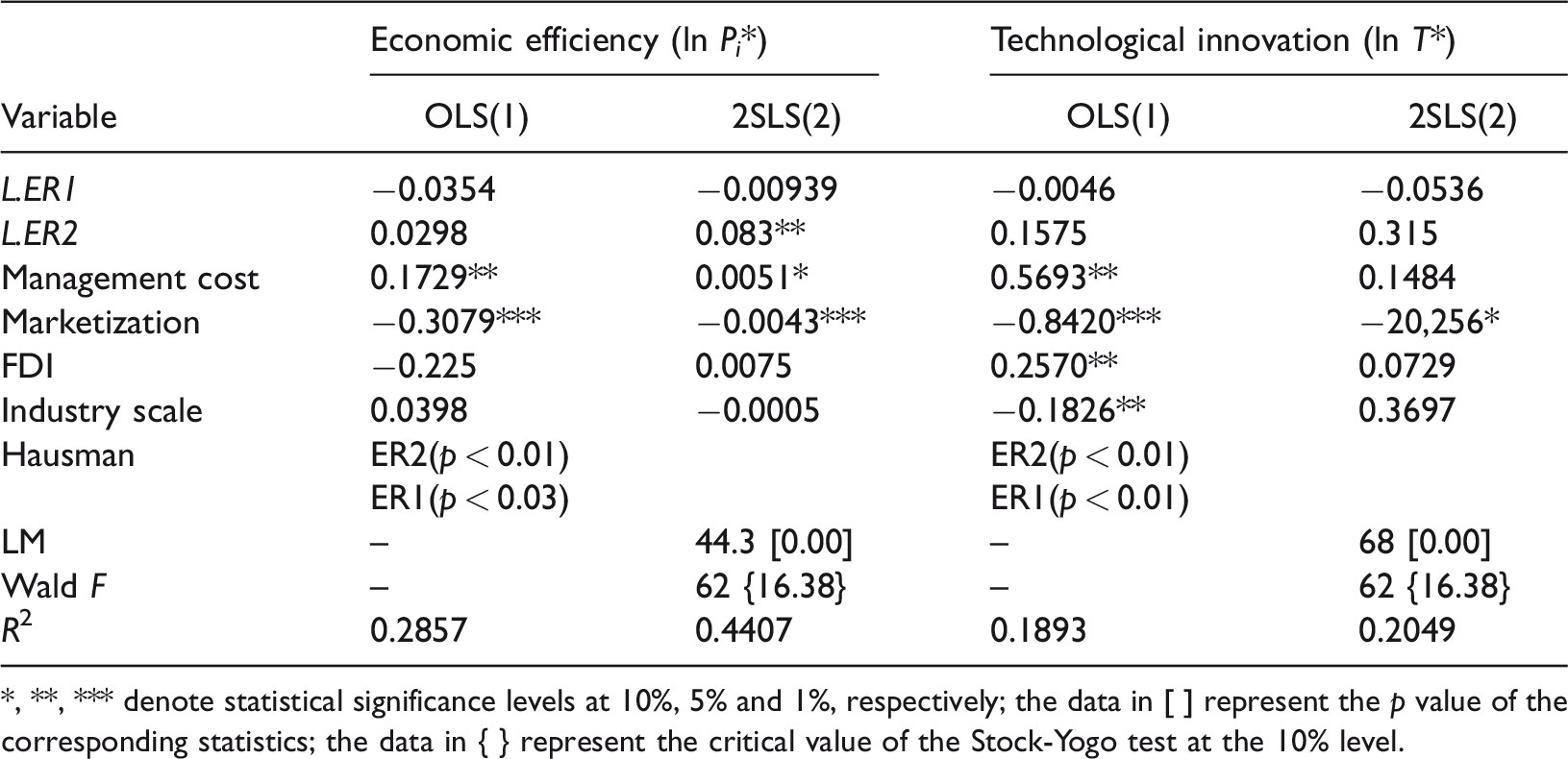
*, **, *** denote statistical significance levels at 10%, 5% and 1%, respectively; the data in [ ] represent the p value of the corresponding statistics; the data in { } represent the critical value of the Stock-Yogo test at the 10% level.
In the previous studies, pollutant emission and pollutant treatment were two important environmental regulation tools.45,48 Therefore, in order to enrich the research content of this paper, based on the data source of environmental government in different industries, we chose the wastewater discharge, wastewater treatment rate and solid waste emission as environmental regulation tools to discuss the relationship between different environmental regulations and economic efficiency (Table 10). From the results of this study, the impact of wastewater emission and solid waste emission on economic efficiency is negative, while the impact of wastewater treatment on economic efficiency is positive. That is, the more waste pollution emission, the lower the economic efficiency, and the higher the pollution treatment rate, the higher the economic efficiency. Although they are not statistically significant, they can still reflect that the current economic production of various industries still need to strengthen the treatment of pollutants, economic development at the cost of sacrificing the environment does not play a role in improving the overall economic efficiency.
Relationship between different environmental regulations and economic efficiency.
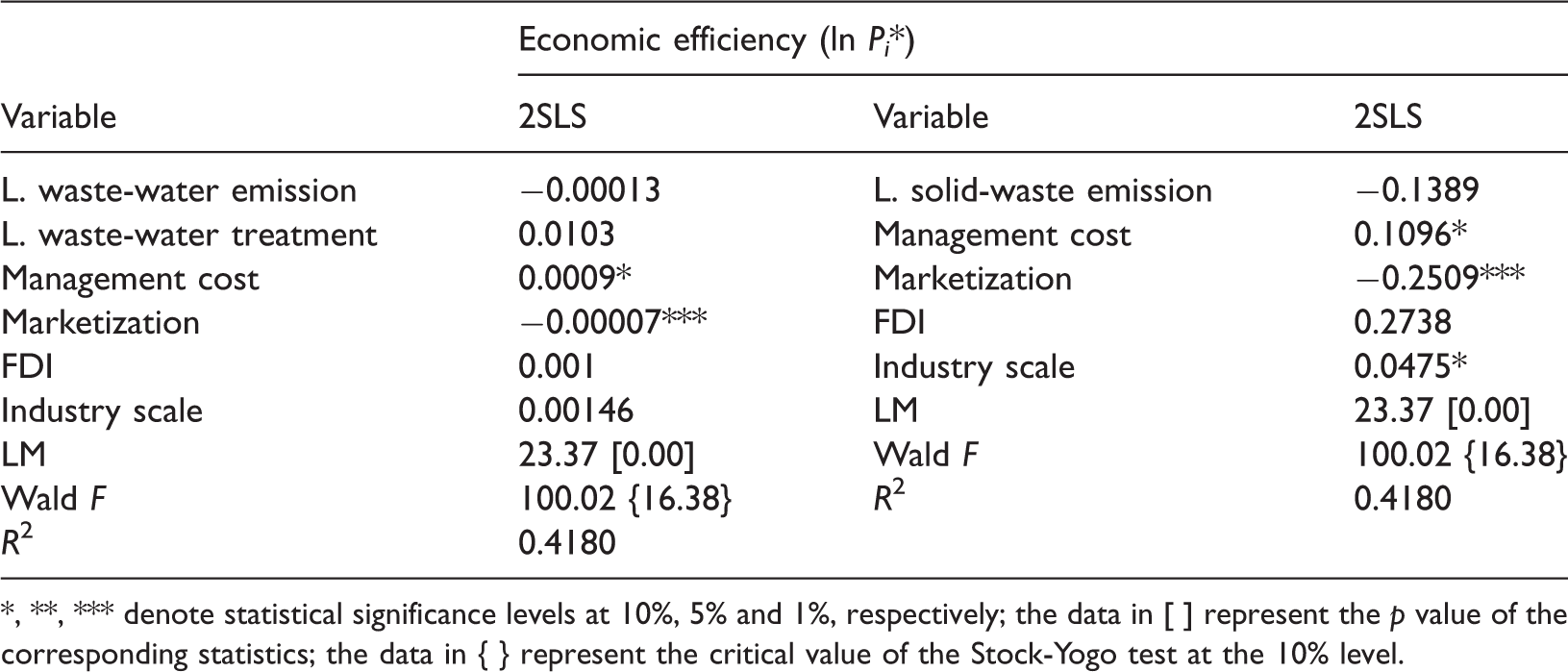
*, **, *** denote statistical significance levels at 10%, 5% and 1%, respectively; the data in [ ] represent the p value of the corresponding statistics; the data in { } represent the critical value of the Stock-Yogo test at the 10% level.
Conclusions and policy implications
Conclusions
The relationship between environmental regulation and economic development is always a controversial topic in academic. Based on the theoretical analysis of two types environmental regulation, this paper shows that cost-oriented and investment-oriented environmental regulation have diverse impact on industry economic. The SBM model was used here to calculate the economic efficiency of the proposed theoretical framework, while the regression model was used to undertake data analysis of two types of environmental regulations and their effects on economic efficiency. The influence of environmental regulations on economic efficiency and technological innovation was estimated, based on data from Chinese industries from the 2008–2015 period. We also take the time lag effects of environmental regulation into consideration and investigate whether different time lag effects of environmental regulation on economic efficiency or not. The contribution of this paper is to provide more empirical evidence from China. Our detailed results can be summarized as follows.
Although economic efficiency among China’s 12 key industries improved significantly between 2008 and 2015, the undesirable outputs of many industries also showed a growth trend. Meanwhile, various environmental regulations were found to have deeply divergent effects on industry economic efficiency and technological innovation: investment-oriented environmental regulations (ER2) were found to have significant and positive influences on the productivity and innovation of an industry, but the environmental constraint was negative in terms of controlling cost-oriented environmental regulations (ER1). Therefore, purely pursuing economic growth and ignoring pollution emission restriction and cleaner production in industrial production not only endanger environmental quality, but also hinder the transformation of the industry itself and the further improvement of production level. The high cost of pollution treatment and decreases in industries’ economic efficiency can be best explained by the fact that there were too many undesirable outputs. In the long run, once the government begins to pay more attention to pollution control in industries, and government takes high-polluting tax on pollution emission, these industries that based on the expense of the environment to productivity will inevitably face the risk of being eliminated by the market. The two types of environmental regulations have negative effects on the productivity of high-efficiency industries, but have significant and positive effects on that of low-efficiency industries. The unbalanced development of industries is a major problem in the development of the market for a long time. Among low-productivity industries, environmental regulations can effectively promote technological innovation and the specialization of production processes; however, among high-efficiency industries, they tend to increase the production pressure and costs. For high-efficiency industries, these findings closely relate to both government attention and the scale of production. The effects of marketization, FDI and management cost also vary across the two groups of industries. How to give full play to the productivity and appeal of small-scale industries and activate market diversification is a problem that many developing countries need to face. For example, high-efficiency industries tend to pay more attention to management costs, and this will necessarily have a positive effect on their economic efficiency. In comparison, low-efficiency industries often allocate human resources ineffectively, and this can lead to lower levels of economic efficiency. But as a developing country like China, industrial development is still the most effective way to maintain economic growth. Therefore, low production efficiency is not only related to the industry's own management capacity and production capacity, but also related to the policy environment of the market. From the viewpoint of technological innovation, ER2 can effectively promote technological progress in both groups of industries (at the 1% confidence level). However, in all the industries studied, ER1 relate negatively to technological innovation. The reason for this is that ER1 are mainly concerned with the cost of waste disposal: industries tend to pay more attention to the disposal of waste at the end of industrial production, rather than to applying clean technology during the production process. ER2 are more concerned with the input of environmental governance in the industry as a whole, and so they will involve some technological innovation. Technological innovation is the eternal topic of social development and economic growth. The relationship between technological innovation and industry economic efficiency also shows that technological innovation has positive effects on industry productivity, especially among low-efficiency industries. Thus, improving technological innovation capability is the most important measure by which an industry can enhance its production capacity and environmental governance effect. However, the key to technological innovation is still how to effectively invest in technological innovation funds and effectively use the achievements of technological innovation.
Policy recommendations
Based on our analytical results, two important policy implications can be further summarized, as follows.
Enhanced environmental regulations used in tandem with technological innovation will improve industry productivity. We should not only attach importance to various constraints, but also avoid single regulatory measures that result in low-efficiency levels. When industries are at different production scales, the environmental regulations applied to production will not be homogenous; therefore, the environmental regulations of various industries will need to be fine-tuned in line with their production scales. For example, while industries with low economic efficiency should increase their intensity of environmental regulation, those with high economic efficiency can control their undesirable outputs and hence reduce the cost of pollution treatment. Expansions in production scale and the promotion of management specialization are essential to improve the industries’ economic efficiency and technological innovation. Among high-efficiency industries, the proportion of state-owned capital should be increased, and the proportion of marketization reduced. Correspondingly, low-efficiency industries should improve their market level and strengthen their exchange of market information. From the perspective of promoting the competitiveness of domestic industries, both increasing domestic-capital investments and reducing the proportion of FDI in industrial production are important in achieving progress in domestic production competitiveness. In undertaking industrial environmental governance, the use of cleaner technology is a key to enhancing the positive effects of environmental regulations. Technological innovation is not only conducive to improving economic efficiency: it also benefits the specialized production and competitiveness of various industries. Additionally, the government’s support of industry-level technological innovation will also be conducive to sound environmental governance and pollution control. By facilitating the exchange of market information and the introduction of high-level talent in the areas of technological research and innovation, the high-pollution production model can be altered, and relevant industries will be able to achieve the coordinated and concurrent development of environmental governance and economic growth.
This study provides a novel perspective regarding the relationship between cost-based environmental regulation and investment-based environmental regulation on economic efficiency, which can effectively provide thinking for future research on the relationship between environmental governance and economic growth, and can also make further empirical tests based on the conclusions of this study. In the relationship between technological innovation and economic efficiency, although the results of this study are mainly from the perspective of technological innovation advantages, future research can add technological progress factors into the efficiency evaluation model, so as to consider the changes of economic efficiency under technological innovation.
Footnotes
Declaration of conflicting interests
The authors declared no potential conflicts of interest with respect to the research, authorship, and/or publication of this article.
Funding
The authors disclosed receipt of the following financial support for the research, authorship, and/or publication of this article: This research is supported by the National Natural Science Foundation of China (Nos. 61773123, 71371053, 71701050, 71801050 and 71501047), the Humanities and Social Science Foundation of the Ministry of Education under Grant (No. 14YJC630056), the Natural Science Foundation of Fujian Province, China (No. 2015J01248) and the Social Science Foundation of Fujian Province, China (No. FJ2018C014).