




Abstract
With the depletion of fossil energy and the rise of global temperature, it is urgent to use renewable energy to solve environmental problems. By studying the heterogeneous relationship between CO2 emissions and renewable energy technology innovation in different countries, we can find out the gap and something helpful to energy development. In the empirical test, we use the negative binomial regression model with fixed effects to study the impact of CO2 emissions on renewable energy technology innovation from 1997 to 2016. The research shows that impact is positive in oil-importing countries, but this relationship is not established in oil-exporting countries. In both oil importers and oil exporters, CO2 emissions have a positive effect on the solar energy technological innovation, however, the influence on the technology innovation of solar energy in oil exporters is more significant than that of renewable energy. Whether for oil importers or oil exporters, it can be more reasonable and effective to develop renewable energy by clarifying the impact of CO2 emissions on domestic renewable energy technology innovation.
Introduction
Paris climate change conference signed the Paris Agreement on 12 December 2015, which aims to limit the increase of global average temperature in this century to no more than 2°C and to limit the increase of global temperature to no more than 1.5°C above the preindustrial level. Most scientists recognize greenhouse gases as the main cause of climate change, 1 and carbon dioxide (CO2) are by far the highest emissions of greenhouse gases in the world, so countries must give priority to reducing CO2 emissions to cope with climate change. The development and utilization of various renewable energy is one of the important means to control CO2 emissions.
The intergovernmental panel on climate change (IPCC) has concluded that CO2 is the main component of greenhouse gases, with over 90% of anthropogenic CO2 emissions coming from fossil fuel consumption. With the development of the economy, people’s demand for energy is increasing, furthermore, coal and oil still dominate the world’s energy consumption structure. As a major global energy source, fossil fuels release a large amount of CO2 when burned, while the use of renewable energy can replace fossil fuel, then indirectly reduce CO2 emissions and mitigate climate change. 2 Renewable energy technology innovation (RETI) promotes the development of renewable energy. Under different energy structures, the influence relationship between RETI and CO2 emissions may be different. 3 The development and utilization of various renewable energy is an important means to control CO2 emissions.
The importance of renewable energy has been reinforced because of global climate change and the depletion of traditional fossil energy. Global energy transformation is speeding up, and countries have planned a series of renewable energy targets and plans. South Korea took the lead in the promulgation of the “Green Growth Basic Law” to promote the national green growth strategy, which is now regarded as the national priority. 4 Germany has been committed to the development of “ecological modernization.” 5 The Chinese government has also implemented a series of national strategies to promote green development, such as the pilot projects of the circular economy, pilot projects of low-carbon cities, and environment-friendly societies. Because of the differences in national conditions, economic development and other aspects, countries will have different responses to climate change. Some oil exporters depend on oil for their economic growth, and oil has a cost advantage over renewable energy. So these factors can interfere with some oil exporters, such as Saudi Arabia, in making energy-related decisions. While some oil importers, such as China, could develop renewable energy to get rid of the dependence on oil imports and enhance national energy security.
Forecasts from the international energy agency suggest that supported by economics and environmental policies, global oil demand could peak between 2020 and 2040. The economies of oil exporters depend on oil exports very much so that demand peak is a big threat to them. Instead of being passive bystanders, oil exporters are likely to respond to the threat of demand peak and climate change, such as developing renewable energy. Oil exporters can affect important issues such as climate policy, oil prices, and energy security for importers, so it is important to understand their possible responses. We put oil importers and oil exporters together to study to make the research more comprehensive and comparative.
This study has two contributions to the existing literature. First, oil exports have boosted the economies of oil exporters because of their abundant oil resources and high domestic consumption of oil. Facing the serious situation of climate change, the attitude of oil exporters to adopt renewable energy is also important. However, there is very little literature on oil importers and exporters. This study provides materials for relevant researches. Second, many scholars have studied the heterogeneity impact of CO2 on RETI in different regions, while others have studied the heterogeneity impact between developed and developing countries. To the best of our knowledge, we are the first to study the heterogeneity impact of CO2 on RETI between oil importers and oil exporters. This paper divides the research objects into oil importers and oil exporters, providing a new idea for the heterogeneous research on CO2 emissions and renewable energy.
This paper studies the heterogeneity by analyzing the impact of CO2 emissions on RETI between major oil importers and oil exporters from 1997 to 2016. Our research can help the government know whether its response to CO2 is sufficient, whether it actively develops renewable energy, whether it can effectively use certain advantages of its renewable energy, understand the development status and priorities, and then plan correct and effective development strategies. There are two innovation points in this paper. On the one hand, according to the different dependence on fossil energy of each country, we divide the research objects into oil importers and exporters. On the other hand, we not only compare oil importers and oil exporters but also compare the different types of renewable energy in certain countries. The rest of the paper is structured as follows: the second section introduces the theoretical background, the third section proposes hypotheses, the fourth section explains the sources and methods of data, the fifth section conducts empirical analysis, and the sixth section summarizes conclusions.
Literature review
CO2 emissions and economic growth
There is a very close relationship between economic growth and CO2 emissions. Economic growth has a direct positive impact on emission levels. 6 Holtz and Selden 7 find that global CO2 emissions will continue to grow at a rate of 1.8% a year for the foreseeable future, but the marginal propensity to emit CO2 is decreasing as gross domestic product (GDP) per capita rises. Through the regression of international panel data from 1980 to 2010, scholars find that there is an “inverted U” relationship between GDP and CO2 emissions. 8 If reducing CO2 emissions means sacrificing economic development, many governments will hesitate to take active emission reduction measures. To better deal with the relationship between CO2 emissions and economic growth, we need to have a comprehensive understanding of the decoupling between economic growth and carbon emissions. At the global level, Wang and Su 9 find that the decoupling of economic growth and carbon emissions in developed countries from 2000 to 2014 is mostly concentrated in the stable weak decoupling, and tends to strong decoupling, while most developing countries show no significant decoupling. And energy intensity has proved to be the biggest factor in promoting the decoupling process. At the multinational level, Wang and Jiang 10 study the decoupling state between economic growth and CO2 emissions in five representative emerging economies from the perspective of labor and investment effects. At the national level, Wang and Jiang 11 find the energy structure effect, energy intensity effect, and technology state effect could promote the decoupling state by studying the decoupling state of China’s economic growth and CO2 emissions. And they suggest the Chinese government to reduce coal consumption, develop renewable energy, and low-carbon technology. At the city level, Wang et al. 12 first study the comparison between Beijing, China and Shanghai, China in terms of the decoupling trends of economic output from CO2 emissions. Besides, they also study the main determinants of the decoupling process between Beijing and Shanghai in different industries.
Renewable energy and economic growth
Through a study of the transport and energy sectors in Kazakhstan, Onyusheva et al. 13 find that to achieve sustainable eco-economic development, it is important to improve the activities of the transport and energy sectors and reduce CO2 emissions. For Norway, economic growth has a positive and significant impact on renewable energy. 14 To get more specific conclusions in the short and long term, Kahia et al. 15 use the panel cointegration method to find unidirectional causality running from economic growth to renewable energy consumption in the short term, and a bidirectional causality across the Middle East and North Africa’s noneconomic communities in the long term. Using annual data from 1990 to 2012, Kutan et al. 16 investigate the impact of renewable energy consumption on CO2 emissions and economic output in Brazil, China, India, and South Africa. The results suggest that renewable energy consumption helps to slow down the growth of CO2 emissions and promote economic development.
RETI and CO2 emissions
Using renewable energy can not only promote economic growth but also mitigate climate change. According to the study of Wang and Zhang 17 about the BRICS countries, carbon emissions will decrease by 0.8122% when renewable energy consumption increase by 1%. The increase in innovation capacity will serve renewable energy better. Kutan et al. 16 find a bidirectional causality between renewable and nonrenewable energy consumption, and the substitutability of the two sources of energy. We can switch from fossil energy to renewable energy to ease environmental problems. There has been a lot of researches on the relationship between CO2 emissions and RETI. Lin and Zhu 18 confirm that the RETI has a significant negative effect on CO2 emissions. Besides, with the growing proportion of renewable energy generation, the effect of RETI on curbing CO2 emissions increases. Su and Moaniba 19 discover that CO2 emissions will influence a country’s propensity to innovate in climate technology. Through studying the provincial data of China, it is found that CO2 emissions and RETI levels have a bidirectional relationship. 18 Nguyen and Kakinaka 20 find a positive correlation between renewable energy consumption and carbon emissions in low-income countries and a negative correlation in high-income countries. In the short run, existing low-cost fossil fuels may inhibit technological advances in relatively expensive renewables. In the long run, the growing environmental problems caused by traditional fossil fuels will drive technological advances in renewable energy. 18 Much literature has explained the effect of CO2 emissions on renewable energy, but there is no relevant research on whether there will be the same effect in oil importers and oil exporters which have a high correlation with fossil fuels, and the research in this paper just fills this gap.
Renewable energy and energy security
Dyer and Trombetta 21 consider energy security is the continuous access to various forms of energy in sufficient quantities and at affordable prices. Renewable energy plays an important role in national energy security. 22 A strong and sustainable renewable energy policy will contribute to China’s sustainable energy development and there will be strong synergies between renewable energy and energy security. 23
Hypothesis
Energy security is an important driving force for oil importers to develop renewable energy actively. To get rid of the influence of oil prices on domestic energy and solve the problem of climate change, oil importers actively take part in the construction and development of renewable energy.
The EU 2020 package sets three main targets: to reduce greenhouse gas emissions by 20% by 2020 compared with 1990, to generate 20% of EU energy from renewable sources by 2020, and to increase energy efficiency by 20% by 2020. 24 The European Union has set up an emissions trading system (EU ETS) to help itself control carbon emissions.
In December 2009, at the Kyoto summit in Copenhagen (COP 15), South Korea announced that its greenhouse gas emissions reduction target would be 30% lower than BAU by 2020. South Korea has enacted a “green growth basic law” to seek sustainable growth by reducing greenhouse gas emissions, providing a guarantee for the development of renewable energy. 4
China has also implemented a series of national strategies to contribute to emissions reduction, such as the construction of ecological industrial parks, pilot projects of low-carbon cities, and pilot projects of the circular economy. 25
Oil exporters have abundant oil reserves and relatively stable energy security. With the development of the economy, domestic energy consumption gradually increases. Many oil exporters face the dilemma of supplying low-cost oil products in the domestic market while maintaining or expanding the current export. Thus, dependence on oil may be unsustainable or not in the best long-term interests of the region. And with climate change in mind, oil exporters need to adjust their energy structure, improve energy diversification, and carry out research and development of renewable energy technologies.
Many oil exporters already have policies and projects related to renewable energy. Kuwait plans to generate 5% of its electricity from renewable sources by 2020, while Saudi Arabia has set a target of 10%. 26 Algeria became the first country in Africa to adopt feed-in tariffs in 2004 and adopted a renewable energy and energy efficiency development plan in 2011. 27 In 2011, Saudi Electricity Company put into operation a pilot solar power plant with 500 kW in farazan islands. In 2012, a solar thermal power plant with an area of about 36,300 m2 expanded from 3.5 MW to 5.3 MW. All Gulf countries have signed or passed the International Renewable Energy Statute to increase the share of renewable energy in their energy grids.
Energy consumption in many oil exporters is growing faster than the region’s economy, and it has failed to unpick economic growth and energy demand in the past few years. Subsidies for fossil fuels may be the main factor. The oil exporters have abundant oil reserves, and they also subsidize the use of domestic oil. The domestic oil prices are relatively low, and the market highly depends on oil. Because of heavy subsidies, the price advantage of traditional energy poses a threat to the development of renewable energy. When making energy choices, power suppliers may take the cost into account and choose traditional fossil energy with lower prices, thus refusing to develop expensive renewable energy. It also hinders the development of renewable energy. Oil export is an important economic source for oil exporters, so it is difficult for oil exporters to develop renewable energy as actively as oil importers.
Therefore, we propose Hypothesis 1: The influence of CO2 emissions on the RETI is more significant in oil importers than in oil exporters.
Solar energy has grown rapidly in recent years, with photovoltaic systems installed on the roofs of many homes and commercial buildings. Wind and solar power have led the way in renewable energy. According to the data in 2018, China installed 20.59 million kW of wind power and 44.26 million kW of solar power, which account for 85.3% of the total installed capacity of renewable energy. Malaysia’s third industrial master plan 2006–2020 identifies solar energy as a new growth area. 28 Developed countries such as Japan and the United States control the technical barriers to raw materials needed by solar companies. Germany, Japan, and the United States have begun mass marketing of “million roofs.” In addition to the above countries, China is also doing well in solar energy. China’s solar thermal utilization has accounted for 76% of the world’s total, and the production and penetration rate ranks first in the world.
Many oil exporters are concentrated in the Gulf Cooperation Council (GCC) region. The GCC region is one area that has the highest solar energy potential in the world in terms of annual sunshine exposure. And over 90% of the GCC area is desert, where people can take advantage of undeveloped, well-lit, and cheap desert land to harness solar energy. 29 Solar resources are the most prominent renewable resources of KSA. 30 Zubair et al. 31 discuss Saudi Arabia’s prospects for solar energy exports to potential customers such as China, South Korea, as well as countries in the Middle East and North Africa’s prospects for solar energy exports to Europe. Many oil exporters are located in the solar belt where solar radiation is high (over 6 kWh/m 2/day), with over 80% of the year’s clear skies. The annual average temperature shall not be lower than 26°C. 32 In 2010, Saudi Arabia established two solar power plants in Al-Khafji and Al-Oyainah. The Solar testing facility at the Qatar Science and Technology Park (QSTP) aims to study solar, air-conditioning, and lighting technologies suitable for Qatar’s buildings and climate. Oil exporters have great solar energy potential and good development prospects. Besides, most of them are actively building solar energy projects.
So, we propose Hypothesis 2a: The influence of CO2 emissions on the technological innovation of solar energy is greater in oil exporters than in oil importers.
Hypothesis 2b: The influence of CO2 emissions on the technology innovation of solar energy in oil exporters is more significant than that of renewable energy.
Methodology and data
Methodology
The samples for this article comprise major oil-importing countries and oil-exporting countries, and we base the selection criteria of samples on Kilian et al. 33 Regarding Wang et al., 34 we add China, South Korea, and India as major importers to adjust the samples. Then we exclude some samples with missing data. Besides, the number of patents of some oil exporters from 1997 to 2016 is zero or almost zero, which we exclude from the sample. Our final sample includes 11 oil importers (Germany, China, Japan, US, India, Korea, France, Italy, Netherlands, Spain, UK) and 6 oil exporters (Saudi Arabia, Kazakhstan, Russian Federation, Norway, Colombia, Belarus).
Both the number of patents and the number of R&D personnel can measure the level of innovation. The number of patents is more focused on the outcome, while the number of R&D personnel is more focused on the input level. Therefore, it is a good choice to measure the level of innovation by the number of patents. The renewable energy patent data are from the world intellectual property organization’s database, spanning from 1997 to 2016. And we refer to the “IPC Green Inventory” developed by the IPC Committee of Experts to select the patents related to renewable energy. Since there is a delay in the publication of patent applications, patent applications are more representative of the intensity of patent activity and the impact of R&D investment. Therefore, we choose patent applications instead of granted patents to measure the number of patent. 35
Through the data, we find that renewable energy patents have the characteristics of discrete data, and in line with the characteristics of a negative binomial distribution. Therefore, in this paper, we construct the fixed effects negative binomial regression model to do empirical tests

Among them, patenti,t refers to the number of patents related to renewable energy got by country i in year t. And (CO2)i,t−1 refers to the country’s CO2 emissions in the previous year. In the study of Su and Moaniba 19 and others, the explanatory variables (CO2) were not lagged to reduce endogeneity. Because the level of renewable energy patents in the previous year will affect the CO2 emissions in the next year, to avoid endogeneity, we lag a stage in the treatment of CO2. Zi,t is the control variable vector. αi, γt, and εi,t, respectively represent individual fixed effect, time fixed effect, and error term.
In the empirical section, we regress the impacts of CO2 emissions on renewable energy technologies and solar energy technologies in oil importers and oil exporters. Then we analyze the significant differences in the impacts of CO2 emissions on certain energy between oil importers and oil exporters and the significant differences in the impacts of CO2 emissions on the different energy in the same type of countries.
Data
In the control variable vector, we use the international crude oil prices to represent the oil prices, the proportion of R&D investment in GDP to measure the level of R&D investment, 36 and GDP per capita to show a country’s strength and economic condition. In most countries, the electricity market is not as competitive as other markets, and the government and powerful private companies enjoy a natural monopoly over some electricity markets. 37 Natural monopolies were considered one flaw in the U.S. electricity market in 2000–2003. 38 The failure of the energy market makes the development of renewable energy have no competitive advantage. So, we choose monopoly power which comprises the number of state-owned enterprises and the proportion of government investment in the total enterprise to present the substitution variable of monopoly power. Generally speaking, the higher the property rights protection, the better the completeness of the legal system, and the more incentive organizations and individuals will have to innovate. So, we add property rights in our control variables.
CO2 data and fossil energy prices are from BP energy statistical yearbook, GDP per capita and R&D investment data are from the World Bank, and monopoly power and property rights are from 《Index of Economic Freedom》, a publication of The Heritage Foundation. By summarizing the above, the variable definition Table 1 is as follows.
Variable definition.

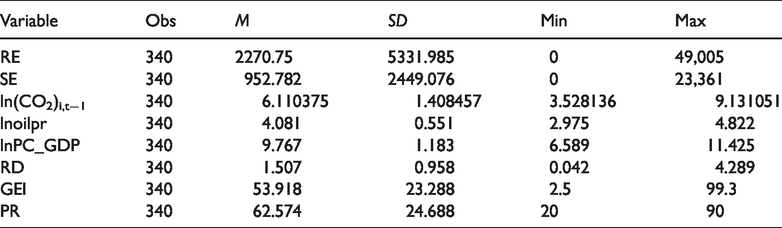
Then, Table 2 shows the descriptive statistics for each variable.
Descriptive statistics of each variable.
Empirical results and discussion
First, we conduct regression studies on the impact of CO2 emissions on the RETI in oil importers and oil exporters, respectively. Table 3 shows the regression results. We can see it that the CO2 coefficient of oil importers is positive at the significance level of 0.01, while that of oil exporters is not significant. Therefore, we know that CO2 emissions have no significant effect on RETI in oil exporters. And increasing CO2 emissions in oil importers have promoted the level of technological innovation related to renewable energy. The above results verify hypothesis 1.
Renewable energy in oil importers and oil exporters.

Note: The superscripts ***, **, and * denote the significance at 1%, 5%, and 10% level, respectively.
On the one hand, the use of renewable energy can help mitigate climate change. At the same time, climate change will stimulate countries to develop renewable energy to deal with climate change, which is consistent with our expectations for CO2. On the other hand, with the gradual depletion of fossil energy, the use of renewable energy can improve domestic energy security and get rid of the oil restrictions of oil exporters. In conclusion, the development of renewable energy is beneficial to oil importers, therefore, with the increase of CO2 emissions, oil importers are willing to develop renewable energy actively to deal with climate change.
No matter from the angle of energy or economic growth, oil exporters have a great dependence on oil. Because of high domestic subsidies for fossil fuels and other preferential policies, many people will choose the low-cost fossil fuels. The development cost of renewable energy is higher, and the initial stage is more expensive. Compared with cheap fossil energy, renewable energy has no obvious competitive advantage. For oil exporters, oil export is the lifeline of their economy. If they give up the profitable oil and develop renewable energy at high cost, it will impact their economy to some extent. So even though many oil exporters have set renewable energy targets, we don’t rule out that many of them are just to meet the requirements of the Paris Agreement, and many substantial projects are still on paper. With CO2 emissions rising, oil exporters are not actively pursuing renewable energy to combat climate change, which is consistent with our expectations for oil exporters.
The results of Table 3 show that the increase in oil prices will affect the oil demand of oil importers, and they will turn to renewable energy. The higher the share of GDP spent on R&D for oil importers, the higher the level of patents related to renewable energy. GDP per capita objectively reflects the social development level of a certain country and promotes the RETI. The significance direction of Government Intervention in the Economy (GEI) and Property Rights (PR) is also consistent with our assumptions. In the power industry, the more serious the government monopoly is, the worse the innovation of renewable energy technology will be. The higher the level of protection of property rights, the better the technological innovation of renewable energy.
Besides, we choose solar energy patent as the explained variable separately, and respectively study the influence of CO2 emissions on solar energy-related patents in oil importers and oil exporters by regression. Table 4 shows the results. We can see it that the CO2 coefficient of oil importers is positive at the significance level of 0.01, while that of oil exporters is positive at the significance level of 0.05. Therefore, we know that in oil importers and oil exporters, the increase of CO2 emissions promotes the level of solar-related technology innovation.
Solar energy in oil importers and oil exporters.

Note: The superscripts ***, **, and * denote the significance at 1%, 5%, and 10% level, respectively.
The coefficient of model 3 is significant, showing that if we only consider solar energy, the increase of CO2 emissions will promote the level of technological innovation related to solar energy in oil importers. Oil importers are doing well not only in overall renewable energy but also in solar energy. Compared with model 4, CO2 emissions have a greater effect on solar energy in oil exporters than in oil importers. It verifies hypothesis 2a. Oil exporters have abundant solar resources and solar energy accounts for a large share of their renewable energy, while oil importers have different geographical characteristics and the main energy source is not always solar, so CO2 emissions have a bigger impact on solar power in oil exporters.
Comparing model 2 with model 4, we can find the coefficient of model 2 is not significant and the model 4 coefficient is significant. The comparison shows that the influence of CO2 emissions on the technological innovation level of solar energy in oil exporters is greater than that of renewable energy. With the increase of CO2 emissions, oil exporters have not well used renewable energy to develop their energy and cope with climate change, but they have well used their dominant energy, such as solar energy. It verifies Hypothesis 2b. Facing the increase in CO2 emissions, oil exporters have promoted solar energy technology significantly. Countries develop solar energy technology to solve some environmental problems, indicating the important role of solar energy in renewable energy in oil exporters.
Conclusion
This study first investigates the heterogeneous effect of CO2 emissions on the RETI between oil importers and oil exporters. Then, we separately study the influence of CO2 emissions on the level of technological innovation related to solar energy, and compare it with the influence of CO2 emissions on overall renewable energy. The number of renewable energy patents represents the level of innovation in renewable energy. Because the patent data is discrete, we use the negative binomial regression of fixed effect to study.
The empirical results show that CO2 emissions have a significant promoting influence on the innovation level of renewable energy in oil importers, but the relationship is not established in oil exporters. In both oil importers and oil exporters, CO2 emissions have contributed significantly to solar technology innovation. Because of the dependence of oil exporters on oil, it is difficult to develop renewable energy. However, solar energy resources of oil exporters have strong advantages, and CO2 emissions have a greater impact on solar technology innovation in oil exporters than on renewable energy.
Through the research, we find that as CO2 emissions increase, some RETI response is strong. Therefore, governments and enterprises should focus more on developing technologies related to renewable energy. As total CO2 emissions decrease, so will the number of patents on renewable energy technologies, and governments must adopt incentives to encourage RETI. The comparison between oil importers and oil exporters shows that oil importers can consider increasing investment in renewable energy, not just solar energy, based on the development of their advantages, to make the energy structure more reasonable and balanced. The oil exporters should continue to take full advantage of solar energy, reform their energy structure, cope with climate change and energy exhaustion, and develop diversified energy sources to improve energy efficiency. Tackling climate change is our common responsibility and mission. RETI is an important solution to harmonize climate change and economic development. Because of different national conditions, the development of renewable energy in different countries and regions is quite different, so different countries and regions should plan renewable energy policies according to their conditions. Besides, we should strengthen technical cooperation to protect our environment together.
Countries should increase investment in R&D and personnel allocation for RETI and provide basic financial and technical support for innovation. For oil exporters, they should also solve the difficulties in the development of renewable energy caused by domestic subsidies for fossil energy. They can also try carbon policies of some EU countries, such as feed-in tariff and carbon tax, to limit carbon emissions and encourage the use of renewable energy. All countries should make efforts in legislation to set carbon emissions quotas and emissions standards, which can lay a solid legal foundation for addressing climate change. At the same time, countries should also make efforts to solve the problem of domestic energy monopoly and provide a healthy environment for the development of renewable energy.
Footnotes
Declaration of conflicting interests
The authors declared no potential conflicts of interest with respect to the research, authorship, and/or publication of this article.
Funding
The authors disclosed receipt of the following financial support for the research, authorship, and/or publication of this article: This work is supported by the National Social Science Foundation of China under Grant No. 18BJY232.
