




Abstract
Renewable energy has been actively researched and developed in many countries to replace the conventional energy resources that come from fossil fuels. As social and environmental awareness of the renewable energy has grown, it is essential to address both quantitative factors and qualitative factors in determination of the optimal renewable energy portfolio. This paper proposes a novel approach to integrate a financial model and a fuzzy model to analyze both quantitative and qualitative factors. The financial model is utilized to calculate the quantitative factors, thereby assisting experts make judgments more accurately in the fuzzy model. The fuzzy model is utilized to evaluate the qualitative factors based on the expert judgements. Moreover, this paper proposes multi-segment judgment model that analyzes the evaluation of different groups, including government, investor and user groups. The results show that each group has different priority order. For example, the highest-priority factor of Government, Investor and User is environmental (with a score of 0.665), economic (with a score of 0.854), and technological criteria (with a score of 0.771), respectively. The results also indicated that small-scale onshore wind energy, large-scale onshore wind energy and solar energy is the best option for Government, Investor and User, respectively.
Keywords
Introduction
One of the biggest challenges of planning energy portfolio is a guarantee of energy demand and resolving environmental problems such as greenhouse gas emissions. Electricity generation from conventional energy resources accounted for 65% of worldwide gross electricity production. However, conventional energy resources have the highest carbon dioxide emissions per kW of generated electricity as well as high levels of other pollutants. 1 Moreover, the environmental and social problems cannot be solved completely with conventional energy resources. Renewable energy resources (also known as nonconventional energy resources) have several advantages, such as reduced dependence on fossil fuel resources and in greenhouse gas emissions to the atmosphere. Therefore, renewable energy resources are considered as the best solution for resolving the above problems. In addition, because awareness of human-induced climate change has grown rapidly, exploiting renewable energy resources has become inevitable. Although the future of renewable energy appears promising with rapid technological development, several key barriers, such as financial risks and intermittency of renewable energy sources, hinder its development. 2 To address the rapidly growing energy demands and environmental protection challenges, developing a methodology to assist decision-makers in determining an optimal renewable energy portfolio under uncertain conditions and in unpredictable environments is critical.
Literature review
To improve the effectiveness of renewable energy portfolio selection, many studies have focused on developing energy models to explore the relationship between energy and economics.3–5 For example, Chung et al. 6 proposed an approach to evaluate the economic feasibility of renewable energy investment and optimize renewable energy system design in microgrid, off-grid, and on-grid cases. The results demonstrated that integrating multiple energy system sources can effectively increase energy system sustainability. Simon et al. 7 developed a decision support model based on opportunity cost analysis between repowering a current wind farm and using the latest technologies. The results revealed that the repowering alternative is significantly attractive and has a positive effect on the environment and economy. Ocon and Bertheau 8 developed a model to evaluate the energy transition from a conventional energy system to a renewable energy system and its technological–economic feasibility for developing sustainable energy systems. Jongh et al. 9 proposed an approach to identify barriers to renewable energy investment from the investors’ perspective. The paper revealed a significant effect of government policy on investor decision-making. Other studies have also developed models to evaluate the effect of government policy on renewable energy investment.10–16 In general, many studies propose single-criterion decision-making (SCDM) approaches that focus on evaluation of one particular aspect while assuming that the other aspects do not change. For example, some studies only focus on the technical aspect,17–20 economic aspect,21–33 or the government subsidies aspect.13,34,35 The SCDM approaches usually rely on data provided by manufacturers and theoretical assumptions regarding weather conditions and other uncertain parameters. However, assumptions based on theoretical data are typically incorrect and deviate drastically from practical values. As a result, the evaluations based on theoretical assumptions are usually considered as inaccurate and unreliable evaluations for a real life renewably energy projects. Moreover, the SCDM approaches mainly aim to either maximize or minimize a particular aspect. The SCDM approaches typically fail to address the qualitative factors that reflect environmental and social problems and awareness of human-induced climate change. Therefore, as complexity and multiplicity increase in renewable energy portfolio selection, making a decision based on a single criterion is insufficient. To solve such complex problems concerning energy planning, a multiple criterion decision-making (MCDM) approach is among the most accurate for renewable energy portfolio selection.
Some studies propose a multiple criterion decision-making (MCDM) approach that evaluate renewable energy portfolio with more than one aspects. Yasir et al. 36 integrated Delpi-AHP and fuzzy Topsis approach to rank the renewable energy plants in Pakistan. Their results revealed wind energy is the most feasible renewable energy resource, followed by hydropower, solar, and biomass energy. Yazdani et al. 37 integrated Shannon Entropy and EDAS model to rank renewable energy sources. The ranking results revealed wind power is the best alternative, followed by solar energy. Sengul et al. 38 utilized the fuzzy Topsis method for the selection of renewable energy systems. Their result showed that hydro power is the most preferred renewable energy system in Turkey. Sitorus and Parada 39 integrated constrained Fuzzy Shannon Entropy method to obtain criteria weight of renewable energy technologies under uncertain input data. Razi and Ali 40 selected the renewable energy sources by employing fuzzy Vikor and Topsis methods. The results showed that the solar energy is the best option. Troldborg et al. 41 evaluated some criteria such as technology maturity, GHG emissions and area requirements to assess the renewable energy sustainability technologies. They concluded that it is important for future studies to address the uncertain of ranking results due to the uncertain input information. Kuleli et al. 42 evaluate the social acceptance and environmental impacts to assess the development of renewable energy. Their results showed that the hydro power is the best alternative, followed by wind power. However, the ranking results may change according to criteria weights. Lee and Chang, 43 Kumar et al., 44 Abbas et al. 45 and Meng et al. 46 reviewed studies using MCDM methods for evaluating energy options. They found that different energy sources emphasis different criteria, however, some the most common selection method is based on the literature surveys and expert opinions. In general, various MCDM approaches (such as AHP, Promethee, Electre, Vikor, TOPSIS, and goal programming) have been applied to solve problems related to energy portfolios. Numerous criteria (such as social, economic, technical, and political issues, as well as environmental protection and resource conservation) are addressed in the literatures. However, the literatures merely use the subjective judgments of experts through surveys as qualitative factors. Because subjective expert judgments may conflict and differ widely from each other, a decision-making process based on expert judgments may be inaccurate and unreliable. In brief, the MCDM approach in literature studies has mainly assessed economic, technological, social, ecological, and environmental constraints based on qualitative factors. However, qualitative factors cannot reflect the influence of quantitative factors on renewable energy portfolio selection. Moreover, the models developed in the studies aim to help governments evaluate energy-sector plans and policies. However, energy policy feasibility depends on the decision-making of investors and users. Investors and users typically evaluate energy resources differently than governments do. Therefore, evaluating energy portfolios with different segments of decision-makers is necessary. To the best of our knowledge, no study has considered multi-segment judgment for renewable energy portfolio selection.
Objective and novelty
This paper attempts to resolve the deficiencies of the SCDM and MCDM approaches in the literatures by integrating a financial model and a fuzzy model (interval-valued neutrosophic set [NS]) to analyze both quantitative and qualitative factors for evaluating renewable energy portfolios. The financial model is designed to calculate the quantitative factors, thereby assisting the experts to make judgments more accurately. The fuzzy model is designed to reflect the influence of qualitative factors that cannot be calculated by the financial model. Therefore, the fuzzy model compensates for the deficiencies of the financial model, and the financial model compensates for those of the fuzzy model. The novel integration of the fuzzy and financial models provides a comprehensive model that solves the issues in the existing SCDM and MCDM approaches in determination of optimal renewable energy portfolio.
In addition, this paper applies a novel multi-segment judgment model that analyzes the decisions of several groups (government, investor, and user groups) to provide a comprehensive view of the renewable energy portfolio. Energy policy feasibility depends on the decision-making of investors and users. Investors and users typically evaluate energy resources differently than governments do. Therefore, evaluating energy portfolios with different segments of decision-makers is necessary. Because the decision of one group may influence that of the others, the comprehensive view may help a group make a more comprehensive and correct investment decision. To the best of our knowledge, no study has considered multi-segment judgment for renewable energy portfolio selection.
This paper is organized as follows: the first section reviews the state of research and provides an introduction. ‘Proposed methodology’ section describes the proposed methodology. Then, the numerical results of the proposed methodology are presented. The penultimate section provides the discussion and policy implications. In the final section, the conclusion of this paper is derived.
Proposed methodology
Because of the peculiarities of each renewable energy project in different locations, traditional evaluation methods based on expert judgments are inappropriate. Therefore, this paper establishes a mathematical model that analyzes the qualitative and quantitative factors of different aspects (economy, technology, environment, and society) to assist decision-makers in determining the optimal renewable energy portfolio (as presented in Figure 1).
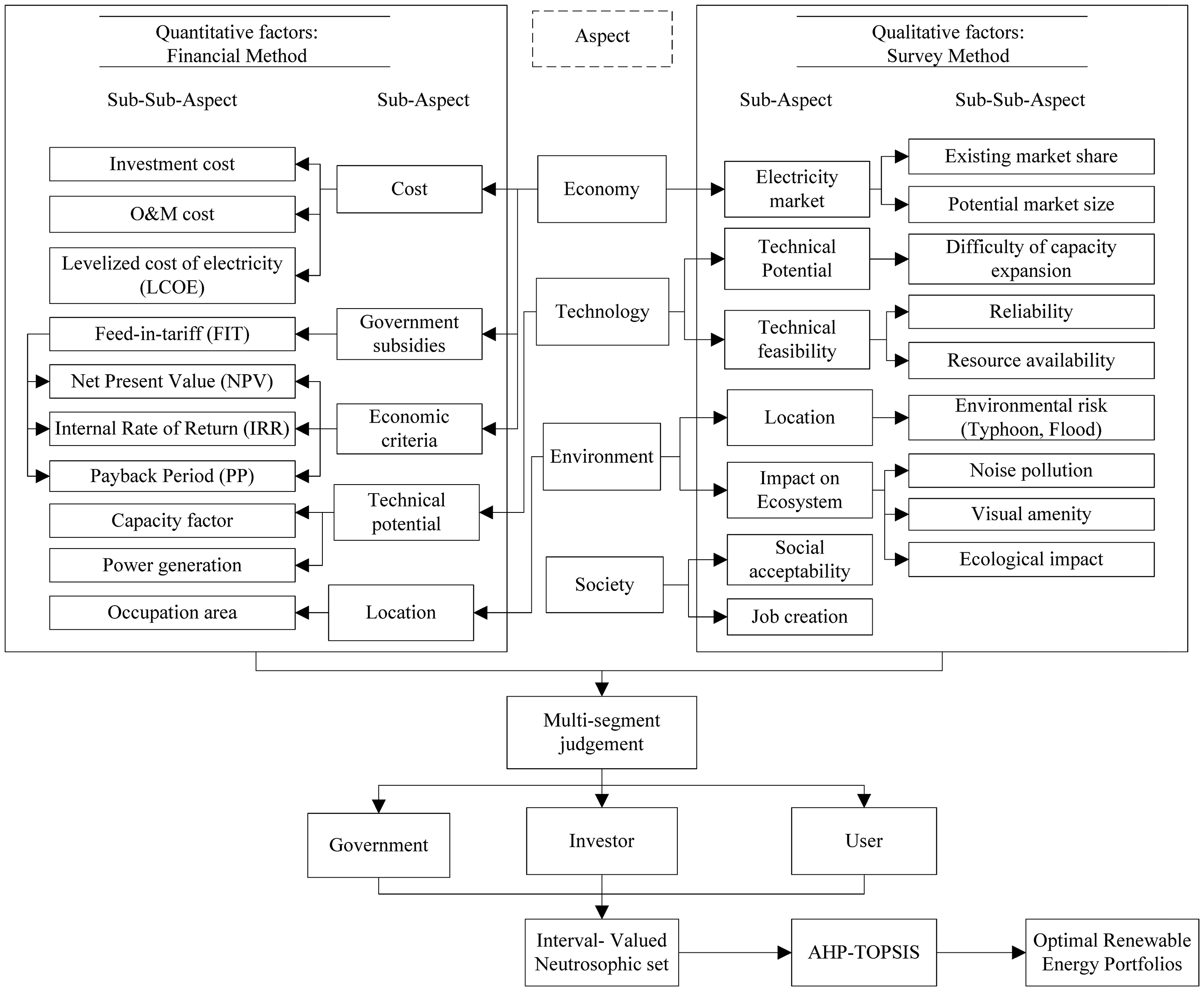
Research framework.
Figure 1 includes economic, technological, environmental, and social aspects. Each aspect may have some quantitative and qualitative factors. For example, the quantitative factors of the economic aspect include economic indicators (net present value [NPV], payback period [PP], internal rate of return [IRR]), costs (investment cost, levelized cost of electricity [LCOE], operation and maintenance [O&M] cost), and benefits under the effects of government subsidies (Feed-in tariffs [FITs]). Qualitative factors of the economic aspect include existing market share and potential market size.
Quantitative factors can be calculated using the financial model, whereas the qualitative factors cannot and must be evaluated on the basis of expert judgments. Quantitative factors that are calculated using the financial model are then presented to experts to help them judge the renewable energy portfolio. The experts include those in different groups (government, investor, and user groups). The judgments of experts in each group are used to generate the interval-valued NS, and AHP-TOPSIS is used to determine the optimal renewable energy portfolio based on the interval-valued NS. The AHP-TOPSIS is used as an example for the fuzzy model, any kinds of fuzzy models may be applied as well. For example, the type-2 fuzzy models proposed by Tavoosi47–49 may be applied to evaluate the renewable energy portfolio as well.
Financial model to evaluate quantitative factors
Cost model of renewable energy projects
The costs of a renewable energy project are a summation of investment cost, O&M cost, and LCOE. The investment cost (

The O&M cost (

Improving life cycle cost analysis necessitates using an LCOE to define a similar reference for the value of money at different stages of the power project.
51
The similar reference value is obtained by discounting the costs to the present. The LCOE is equal to the discounted lifetime costs divided by the discounted lifetime energy production (
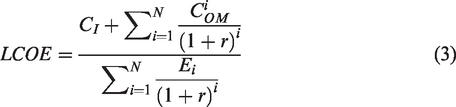
In equation (3), r is the discount factor that reflects the market value of both equity and debt and is referred to as the weighted average cost of capital. The discount factor is calculated using equation (4).
53

Benefit model under effect of government subsidies
Currently, each country has a set of policies for encouraging renewable energy development. Consequently, numerous policy instruments have been proposed and applied. As summarized in Chou et al., 5 major policies include FIT, renewable energy portfolio standards, tax abatement, net metering, value-added tax (VAT) reduction, pricing laws, quota requirements, trading systems, and regional aids. The FIT subsidy, a globally popular government instrument, is used to enhance the installed capacity of renewable energy. The government establishes a tariff at a reasonable level, guarantees a price for a designated period, and offers a reasonable return on investment.
Considering the effect of government subsidies (FIT) on the benefit of a renewable energy project is necessary. The benefit of a renewable energy project is derived from the generated electricity value (


Economic indicators of renewable energy projects
Economic indicators represent the efficiency of renewable energy projects by estimating the relationship between benefits and costs of a renewable energy project to determine its feasibility. Three economic indicators are used in this paper:



Power generation model of renewable energy project
Generated electricity (

In equation (10),


Capacity factor model of renewable energy projects
The capacity factor is a unitless ratio of the actual electricity output within a period to the maximum electricity output that can be produced under ideal conditions within the period. The capacity factor is calculated in accordance with the technological parameters of the power generator and environmental parameters of the power generator’s location. The capacity factor varies for different power generator locations and technologies. In this paper, the capacity factor (

Quantitative factors of environmental aspect
The quantitative factor of the environmental aspect is occupation area. Occupation area includes total land occupied by the energy system (

Basic concepts of interval-valued NS
This section provides a brief overview of interval-valued NSs. An NS is a powerful general formal framework introduced by Smarandache
57
to express and manage incomplete, indeterminate, and inconsistent information that exists in real situations. On the basis of fuzzy sets, Smarandache
57
added an indeterminacy membership function to NS with the truth and falsity membership functions of intuitionistic fuzzy sets to manage incomplete, indeterminate, and inconsistent information in real life.
58
In an NS, indeterminacy is quantified explicitly, and truth membership, indeterminacy membership, and falsity membership are independent.
59
An interval-valued NS is a subclass of an NS and a generalization of an interval-valued intuitionistic fuzzy set. On the basis of Smarandache,
57
let On the basis of Wang,
61
an interval-valued NS
60
The deneutrosophication function of an interval-valued neutrosophic number On the basis of Wang,
61
Zhang et al.
62
and Karasan,
63
let
On the basis of Chi,
64
the Hamming distance between











Interval-valued neutrosophic AHP-TOPSIS
In this section, interval-valued neutrosophic AHP (IVN-AHP) and interval-valued neutrosophic TOPSIS (IVN-TOPSIS) are integrated to evaluate energy project priority. As shown in Figure 2, IVN-AHP is used to calculate the weights for decision criteria by constructing pairwise comparisons for a set of criteria to judge the relative importance of one criterion to another or one subcriterion to the others by using linguistic variables. There are several theoretical and practical approaches to determining the weight of criteria such as ordinal ranking approach, direct weight determination and pairwise comparison approach. In ordinal raking approach and direct weight determination approach, every criterion must be weighted with respect to every other criterion simultaneously. Based on the psychological observation, the “cognitive overload” easily happens when human brain compares the criteria all at a time. Therefore, it is hard to determine the precise importance among criteria by ordinal ranking approach and direct weight determination. The IVN-AHP method that uses the pairwise comparison approach to determine the weight of criteria is easier for evaluators to compare the criteria in pairs. This approach is to ask the evaluators for their opinion over the pairs of criteria, and to derive the weight of criteria based on the acquired information over the pairs. The main advantage of this approach is to allows a concentration on the comparison of criteria in pairs rather than all at a time. Therefore, this paper proposes modifying the classical TOPSIS weighting procedure by using interval-valued neutrosophic pairwise comparison matrices.
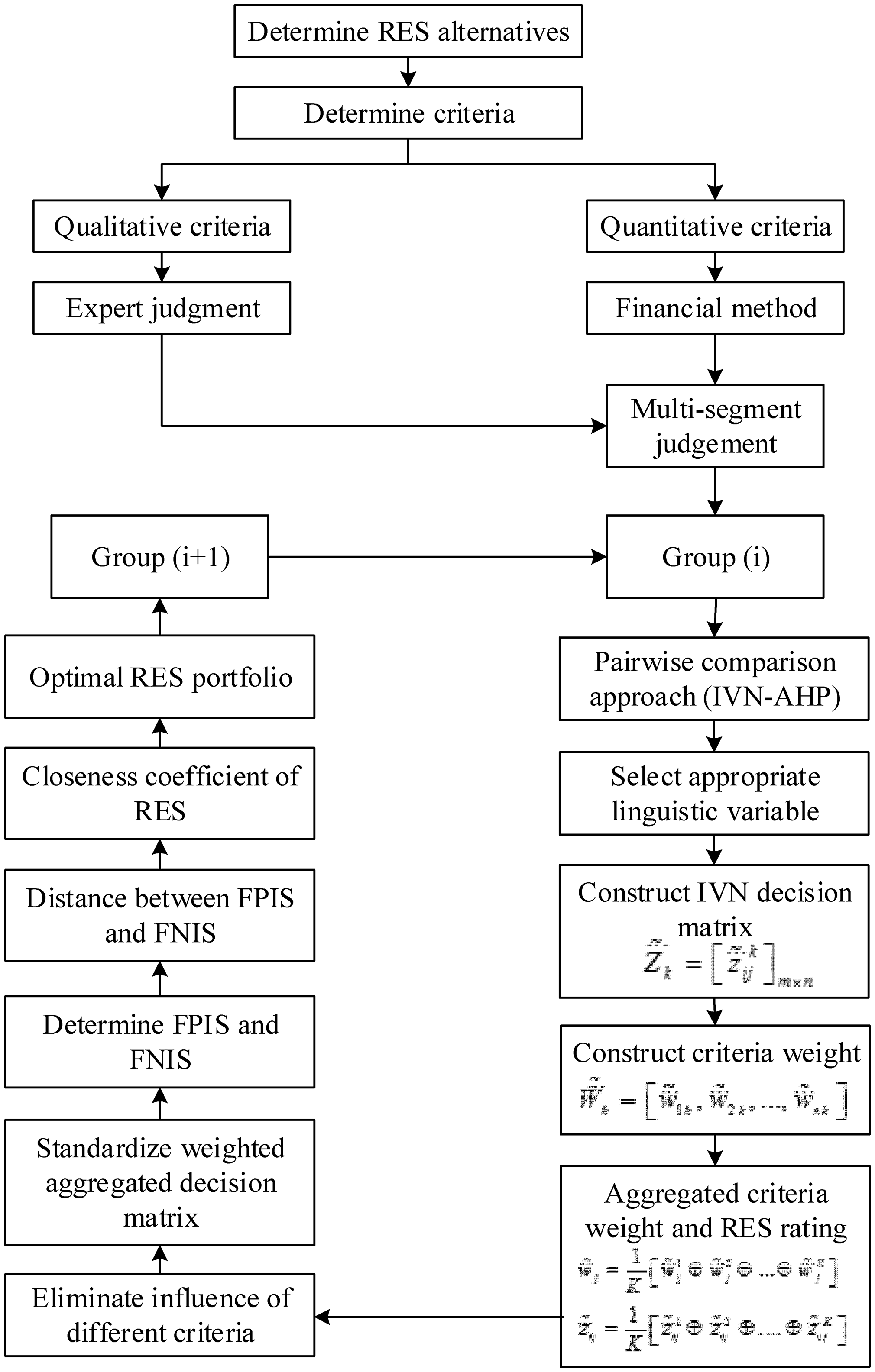
Flowchart of determining optimal RES portfolio.
The stages of this approach are summarized as follows: Let


The weight vector is obtained using IVN-AHP in equations (24) and (25), then IVN-TOPSIS is implemented to determine the optimal energy project. This technique evaluates energy projects according to their distance values to the ideal solution (positive ideal solution [PIS] and negative ideal solution [NIS]). The basic principle of TOPSIS is that the optimal energy project should have the shortest distance to the PIS and the farthest distance from the NIS.
Let
Because of the K evaluators, the aggregated weight of criteria


Generally, two types of criteria are involved, namely benefit and cost criteria. Larger benefit criteria and smaller cost criteria are preferred. To eliminate the influence of different criteria, the cost criteria must be transformed into benefit criteria. Suppose the standardized matrix is expressed as

The standardized weighted aggregated decision matrix


The interval-valued neutrosophic positive ideal solution (PIS) (


The distance between each energy project


The closeness coefficient of each energy project determines the priority of all energy projects and is calculated as equation (37).
65
A higher closeness coefficient indicates that the energy project is closer to the PIS and farther from the NIS. The higher the closeness coefficient is, the better the energy project is.

Applications and results
The proposed approach is applied to Taiwan as a case study. Because of Taiwan’s explosive economic and industrial development, energy security and environmental protection challenges have emerged for Taiwan’s government. Specifically, according to the Taiwan energy statistical handbook published by the Bureau of Energy, imported energy increased from 97.69% in 2001 to 98.15% in 2007 and remained high (97.95%) in 2016. In addition, total carbon dioxide (CO2) emissions increased significantly from 1.76.65 × 108 tons to 2.76.23 × 108 tons from 1996 to 2016. 67 The annual growth rate of CO2 emissions in Taiwan was more than 5% over the past 20 years, ranking 23rd globally and 6th in Asia and Oceania in 2018. 68
The requirement of reducing CO2 emissions and ensuring energy security have driven the Taiwan government to promote renewable energy development. By relying on the benefits of solar PV and wind energy systems as well as Taiwan’s geographical location in a low-latitude zone, the Taiwan government has established a target of 20% renewable energy by 2025, of which wind energy will contribute 3 GW (4.46%), and solar PV energy will contribute 2.5 GW (3.72%).
67
However, meeting the targets necessitates consideration of the effect of multicriteria including economic, technological, social, and environmental factors in the decision-making process. After preliminary screening, five energy projects are used in this paper: the large-scale onshore wind system (
In this paper, we have divided the renewable energy market into three groups including the government group, investor group and user group, because these three groups have the most influence on the development of renewable energy and the renewable energy market. There is a tight relationship between the decision of these three groups. The government plays an important role in orienting the market. The government can impact on decision of investors and users through adopting solutions and policies that create positive effects on the feasibility renewable energy systems. Based on the orientation of government on the appropriate renewable energy portfolio, government sets a target of renewable energy installation capacity. To meet the target, government will consider to develop a set of policies that affect the behavior of investors and users. However, the feasibility of energy policies depends on the decision-making of investor group and user group. Therefore, it is very necessary to know the optimal renewable energy portfolio by each group point of view. We invited four decision-makers in each group with different expertise and backgrounds to evaluate the renewable energy portfolio.
Quantitative factor results
This paper calculates the quantitative factors of five renewable energy projects. For evaluation accuracy, the five renewable energy projects should have the same lifetime. The NREL, which is the primary national laboratory for renewable energy and energy efficiency research and development of the US Department of Energy, provided the lifetime of some renewable energy systems. The lifetime of a solar PV system is 25–40 years and that of a wind system is approximately 20 years. 69 However, although wind turbines are generally designed for a service life of 20 years, most can continue to operate for longer than their originally designed lifespan. For example, approximately 5150 wind turbines in Germany, Spain, and Denmark had exceeded 20 years in 2016. 70 Therefore, 25 years is selected as the lifetime of the energy projects investigated here. Currently, renewable energy systems are commercial, and the installation price is obtained from manufacturers and distributors.
The O&M costs of wind energy [including large-scale onshore wind system (
Figure 3 presents the investment and O&M costs of the five energy projects. Offshore wind systems are typically positioned in an open space far from the coastline. Because of its remote location, the investment and O&M costs of the offshore wind system are large. For example, the large-scale offshore wind energy system has the highest investment (US$4150/kW) and O&M costs (US$42.66/kW/year).
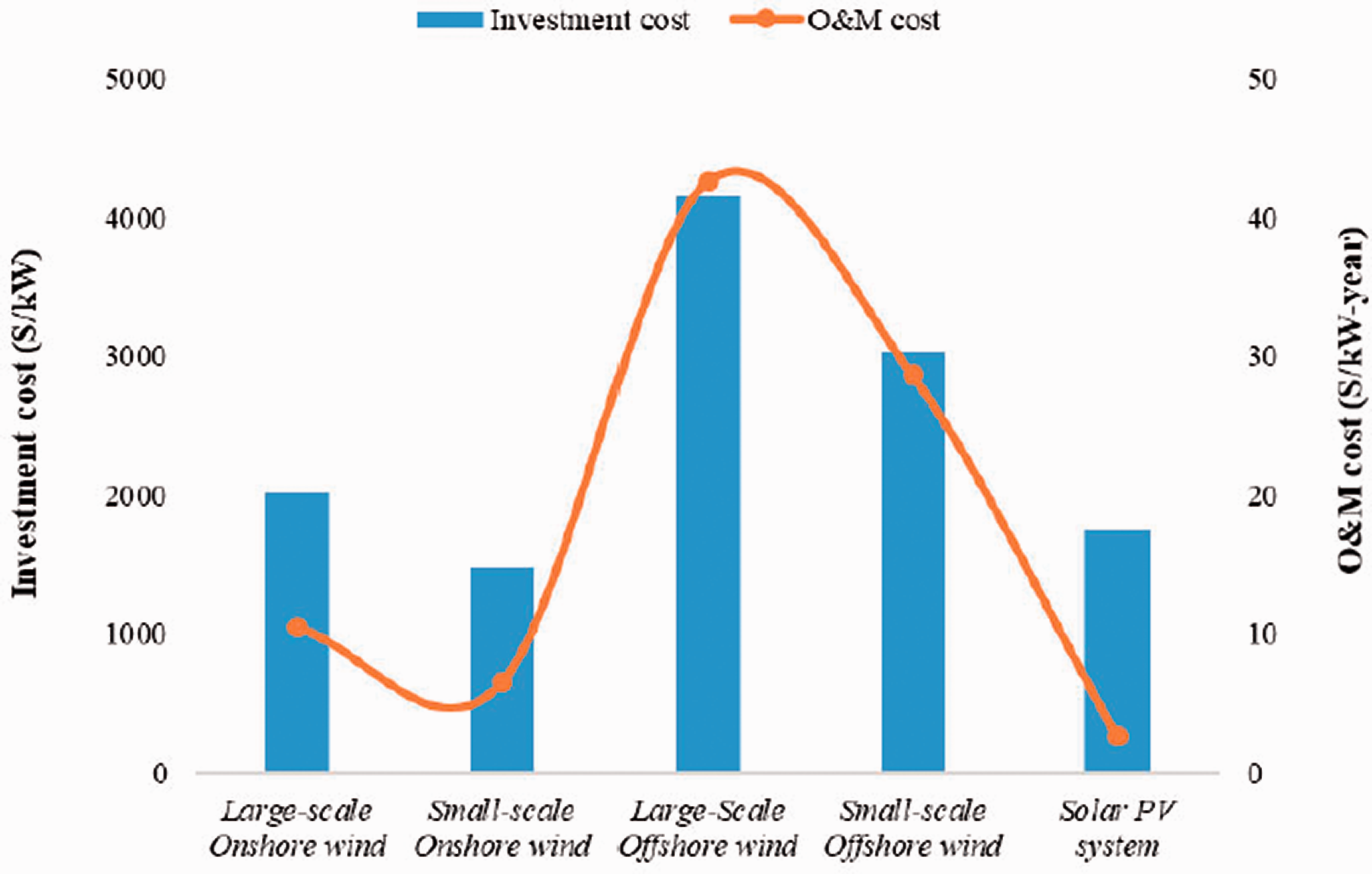
Investment and O&M costs.
In this paper, a Vestas wind turbine system is investigated because it is lightweight and designed for high portability and low foundation costs. A Vestas V90-3MW is considered a large-scale wind turbine, whereas a Vestas V20-100kW is considered a small-scale wind turbine. In the solar PV system, mono-crystalline silicon cells are used for calculation because they have highly uniform results with higher energy conversion efficiency.
The generated electricity of the five energy systems is calculated on the basis of the collected environmental data and typical parameters of the investigated energy systems by using the generated electricity model in ‘Power generation model of renewable energy project’ section. Offshore wind energy has the most generated electricity because offshore wind speed is significantly high. The generated electricity of the large-scale offshore wind turbine, large-scale onshore wind turbine, small-scale offshore wind turbine, small-scale onshore wind turbine, and solar PV system is 11,885, 9048, 1590, 841, and 267 MWh, respectively. Accordingly, the capacity factors of the large-scale offshore wind turbine, large-scale onshore wind turbine, small-scale offshore wind turbine, small-scale onshore wind turbine, and solar PV system are 42%, 28%, 33%, 20%, and 19%, respectively.
In 2019, the Taiwan government announced an FIT to subsidize electricity generation from renewable energy systems. The subsidy levels for the large-scale offshore wind turbine, large-scale onshore wind turbine, small-scale offshore wind turbine, small-scale onshore wind turbine, and the solar PV system are NT$5.516/kWh, NT$2.7315/kWh, NT$5.516/kWh, NT$7.8759/kWh, and NT$5.7983/kWh, respectively. Figure 4 presents the IRR and PP of the five investigated energy projects with government subsidies. The large-scale onshore wind system has the highest IRR (13%) with a PP of 10 years, whereas the solar PV system has the lowest IRR (8%) with a PP of 12 years.
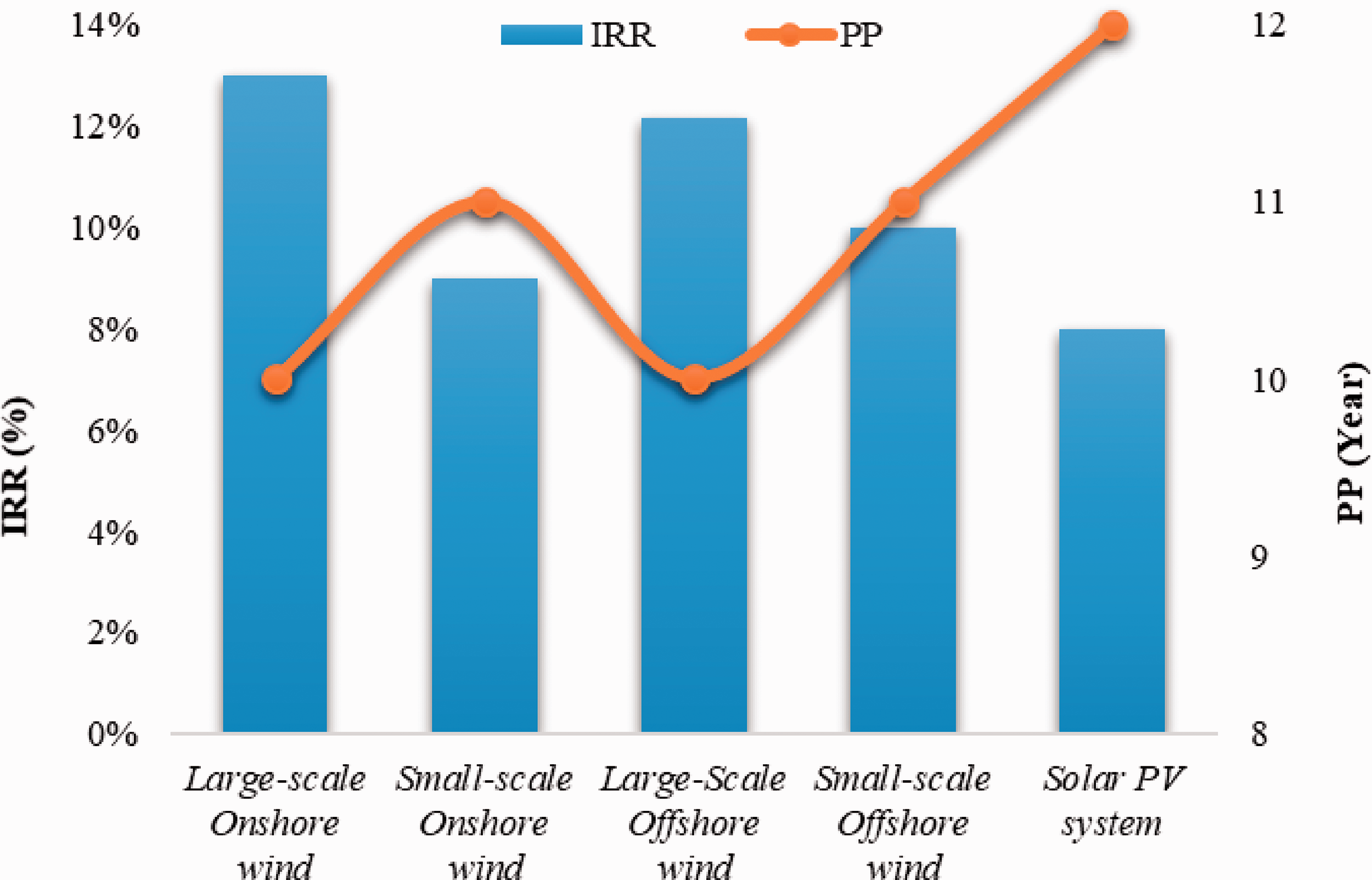
Economic criteria of investigated energy projects.
Optimal renewable energy portfolio results
The evaluation method is based on integrated financial method and fuzzy method to determine the optimal renewable energy projects considering the comprehensive effects of quantitative and qualitative factors. After selection of the renewable energy projects and the most appropriate criteria, subcriteria, and sub-subcriteria, IVN-AHP is used to calculate the weights for decision criteria by constructing pairwise comparisons for a set of criteria to judge the relative importance of criteria and subcriteria to the others by using linguistic variables. A pairwise comparison matrix in the AHP is a suitable means of determining criteria weights. Therefore, this paper proposes a modification to the classical weighting procedure in TOPSIS by using interval-valued neutrosophic pairwise comparison matrices. The decision-makers in each group are asked to determine the level of importance of each criteria.
Priority order of criteria determined by government group.

Priority order of criteria determined by investor group.

Priority order of criteria determined by user group.

By using the quantitative factor data, qualitative factor evaluations, and equations (24) to (37), the distance of each energy project from the interval-valued neutrosophic PIS and NIS of each decision-making group are derived in Table 4.
Distance measurement of each decision-making group.

Table 5 presents the closeness coefficient [calculated using equation (37)] and ranking order of each energy project in each decision-making group. The optimal renewable energy portfolio differs by decision-making group. For example, with the largest closeness coefficient value, the small-scale onshore wind system is the optimal energy project for the government group. The order of the five energy projects evaluated by the government group is
Closeness coefficient and priority order of energy projects in each decision-making group.

Comparative analysis
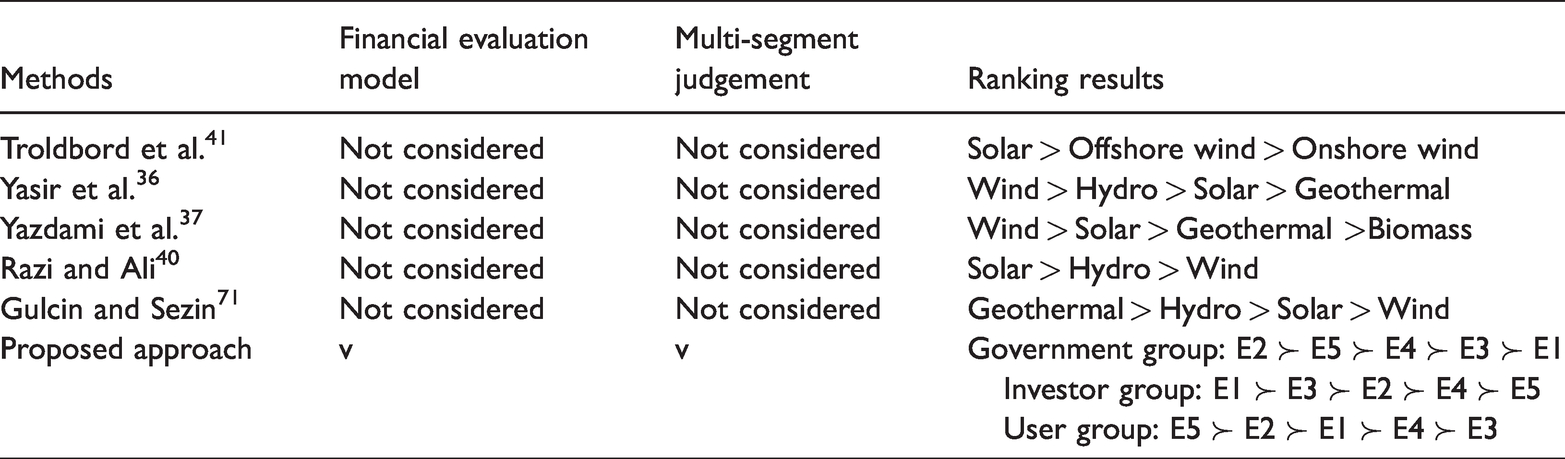
This session aims to establish a comparative study of the proposed approach and the existing literature through comparison of the proposed approach with SCDM approaches and MCDM approaches in the existing literature. Table 6 shows the comparison of the proposed approach with SCDM approaches in literatures. The main difference between the proposed approach and the SCDM approaches in the existing literatures is that the SCDM approaches in the existing literatures focus on analysis the renewable energy resource through evaluating of one particular aspect. For example, Chung et al., 6 Simon et al., 7 Jongh et al., 8 are only focus on the economic aspect to evaluate the feasibility of one particular renewable energy resource. Meanwhile, some other literatures focus on technological aspect to improve the feasibility of renewable energy resources (Such as Alobaid et al., 22 Ciulla et al., 23 Herrando et al. 24 ) As shown in Table 6, the environmental and social aspects are failed to address in the SCDM approaches in the literatures. The preferred renewable energy resource is different when considering multiple aspects. For example, Simon et al. 7 concluded that the large-scale renewable energy resources with the support of repower support system will be more feasible than other renewable energy resources. However, the results of the proposed approach show that when environmental aspects and social aspects are considered, the large-scale renewable energy resources are not preferred than other renewable energy resources. Therefore, making a decision in selecting renewable energy portfolio based on a SCDM is insufficient. The proposed approach has deal with multiple aspect including economic aspect, technological aspect, environmental aspect and social aspect. The fuzzy model in the proposed approach is designed to deal with the qualitative factors such as environmental factor and social factor which is failed to address in the existing SCDM approaches.
Comparison of the proposed approach with SCDM in literatures.

Table 7 shows the comparison of the proposed approach with MCDM approaches in literatures. As shown in Table 7, although numerous criteria are addressed in the MCDM approaches in literatures, the literatures merely use the subjective judgments of experts through surveys as qualitative factors, and quantitative factors are not estimated by financial model in the literatures. Moreover, the MCDM approaches developed in the literatures have not considered multi-segment judgment. The ranking result in literatures is general ranking result (mainly focus on the evaluation of policy-maker), and did not ranking for particular groups. Solar energy and wind energy are evaluated as the best alternatives in the literatures. The proposed approach in this paper have analyzed the decisions of several groups to provide a comprehensive view of the renewable energy portfolio. The results of the proposed approach demonstrate that there is a different priority between different groups. Therefore, the ranking results in literature do not indicate thoroughly. Moreover, there is no model in literatures evaluated for large-scale renewable energy and small-scale renewable energy as the proposed approach.
Comparison of the proposed approach with MCDM in literatures.
Discussion and policy implications
According to the result data shown in Table 6, the SCDM approach in literatures does not consider the qualitative factors such as social and environmental awareness in evaluation of renewable energy portfolio. According to the result data shown in Table 7, the MCDM approach in the literatures do not consider evaluation of the financial model in the fuzzy model. As such, the fuzzy model is based solely on the subjective judgments of the experts. The proposed approach in this paper considers multiple aspects including economic aspect, technological aspect, environmental aspect and social aspect in evaluation the renewable energy portfolio (Table 6). In addition, the proposed approach in this paper also utilizes the financial evaluation model to calculate exact financial criteria that assist the experts in the making the evaluation in the fuzzy model. In this way, the result data of the proposed model in this paper is more reliable than the literatures.
As shown in Table 7, the literatures do not consider analysis according to the characteristics of different decision-making groups. Therefore, their results are general ranking result (mainly focus on the evaluation of policy-maker), and do not perform ranking for particular groups. For example, Yasir et al. 36 found that the wind energy is the best options among other kinds of renewably energy regardless of the decision-making groups. Razi and Ali 40 found solar energy is the best option, and Gulcin and Sezin 71 revealed Geothermal energy is the best resource regardless of the decision-making groups. Troldbord et al. 41 indicated solar energy is the best alternative. The proposed approach in this paper recognizes that the priority of criteria and renewable energy resources is different between decision-groups. This study reinforces the impetus to use a multi-segment judgment model to analyze the evaluation of different decision-making groups in the consideration the optimal renewable energy portfolio. Analysis according to the characteristics of decision-making groups indicate some notable findings. Based on the findings represented in Table 5 of this paper, energy users are more likely than investors to support a solar PV energy system, whereas the government is most likely to the support small-scale onshore wind and solar PV energy systems. Moreover, according to the findings represented in Tables 1 to 3, the priority order of each main criterion differs among the decision-making groups. For example, the highest priority for the government is the environmental criteria. However, the highest priorities for investors and users are economic and technological criteria, respectively.
The findings of this paper further shows that the priority and concerns of each decision-making groups are different. Even investors have begun to consider environmental and social criteria in investment analysis, economic criteria are prioritized (Table 2) for investor group. As shown in Tables 4 and 5, the ability to generate electricity is advantageous and investment potential is large, larger-scale onshore and offshore wind energy systems are more attractive than other renewable energy projects are to investor group. However, the large-scale onshore wind energy system is less attractive to the government group (Tables 4 and 5) because it has the largest effect on environment criteria such as the effect on ecosystems, noise pollution, and visual unattractiveness (Table 1). For energy user group, system reliability and resource availability are the largest concern. Therefore, technical criteria are their highest priority (Table 3). Because users have available space on the roof of their buildings, solar PV energy, which is a reliable noise-free system, is preferred over other investigated energy projects (Tables 4 and 5).
The findings of this paper indicate that energy project evaluations of investors and users typically differ from those of governments. The feasibility of energy policies depends on the decision-making of investors and users. Therefore, governments should balance the benefits and priorities of each group to design and select the most effective policy. Besides the financial subsidies for renewable energy, the technical efficiency should be improved. Because the technical aspect is the most important criteria for user group, the innovation of renewable energy will attract the user group in installing renewable energy system. Integration of the upstream, middle and downstream industrial chain of renewable energy system to enhance the technical advantages and reduce the investment cost. Reducing the investment cost and increasing the efficiency of renewable energy system is important for investor group (as the finding result in this paper). Moreover, as renewable energy increases in market share, the proposed approach helps investors and users evaluate optimal energy projects on the market. Future energy resource development necessitates an understanding of energy projects in different conditions. Therefore, estimating not only qualitative factors but also quantitative factors to assist decision-makers is necessary to provide sufficient information for evaluating energy projects.
Conclusions
As awareness of human-induced climate change has grown recently, renewable energy resources have become inevitable for gradually replacing the conventional energy resources such as coal, oil, natural gas, biofuels, and waste. It is challenged to expand the renewable energy resources because of difficulties in many different aspects with high level of uncertainty. This paper proposes an approach that considers both quantitative and qualitative factors for evaluating renewable energy portfolio and considers evaluation of different decision-making groups, thereby determining the optimal energy portfolio under high levels of uncertainty and conflicting factors.
This paper attempts to resolve the deficiencies of the SCDM and MCDM approaches in the literatures by integrating a financial model and a fuzzy model (interval-valued neutrosophic set [NS]) for evaluating renewable energy portfolios. The financial model is designed to calculate the quantitative factors, thereby assisting the experts to make judgments more accurately. The fuzzy model is designed to analyze the qualitative factors based on judgement of the experts. In this way, the results of the proposed approach are more reliable and prehensive than the SCDM and DCDM approaches in the literature.
Moreover, this paper proposes a multi-segment judgment to analyze the evaluations of decision-making groups for determining the optimal renewable energy portfolio. The results indicate that the decisions for the same renewable energy portfolio of different decision-making groups varies significantly. One of the reasons for distinct decisions of decision-making groups is that each decision-making group has different priority to evaluate the renewable energy portfolio. This paper suggests that the government should balance the benefits and priorities of each group to make or adjust the most effective policy, so as to achieve renewable energy installation target. The proposed approach in this paper provides information that plays a critical role in supporting decisions of investors, users, and policymakers.
This study applied multi-segment judgment, quantitative and qualitative analysis to realize how different decision making groups decide the renewable energy portfolio. Accordingly, the proposed approach in this paper enables policy-makers to recognize the suitable renewable energy resource under different policy that could be a reference for the development of renewable energy. The proposed approach in this paper also assists the government to realize the views of investors and users when making or adjusting the policy of renewable energy, so as to achieve the renewable energy target. The work in this paper may also assist the investors or companies and users to have a comprehensive analysis before making decision of investment in renewable energy. The proposed approach in this paper may be applied globally in any countries with suitable set of data.
However, the fuzzy model used in this study is AHP-Topsis which is used as an example for the fuzzy model. In the future, the proposed approach should be tested with other fuzzy models (such as Vikor, Promethe, Electre) and compare the results with different fuzzy models to determine the most suitable fuzzy model for the purpose of evaluating renewable energy portfolio.
Footnotes
Declaration of conflicting interests
The author(s) declared no potential conflicts of interest with respect to the research, authorship, and/or publication of this article.
Funding
This study was financially supported by the Taiwan Building Technology Center from the Featured Areas Research Center Program within the framework of the Higher Education Sprout Project by the Ministry of Education in Taiwan under Project No. 107P011. It was also supported by the Department of Industrial Management of National Taiwan University of Science and Technology.
