



Abstract
The emergence of technology to produce nanoparticles (1 nm – 100 nm in size) has drawn significant researchers’ interests. Nanoparticles can boost the antimicrobial, catalytic, optical, and electrical conductivity properties, which cannot be achieved by their corresponding bulk. Among other noble metal nanoparticles, silver nanoparticles (AgNPs) have attained a special emphasis in the industry due to their superior physical, chemical, and biological properties, closely linked to their shapes, sizes, and morphologies. Proper knowledge of these NPs is essential to maximise the potential of biosynthesised AgNPs in various applications while mitigating risks to humans and the environment. This paper aims to critically review the global consumption of AgNPs and compare the AgNPs synthesis between conventional methods (physical and chemical) and current trend method (biological). Related work, advantages, and drawbacks are also highlighted. Pertinently, this review extensively discusses the current application of AgNPs in various fields. Lastly, the challenges and prospects of biosynthesised AgNPs, including application safety, oxidation, and stability, commercialisation, and sustainability of resources towards a green environment, were discussed.
Introduction
The term “Nanotechnology” was first proposed by Nario Taniguchi at the International Conference on Industrial Production in Tokyo in 1974. 1 Since then, many companies, organisations, and institutions have been established worldwide to promote nanoscience as well as to explore what nanotechnology holds for the future. To date, nanotechnology integration is gaining ground in physics, chemistry, biology, materials science, and medicine. Nanotechnology is the new technology development by inventing, exploring, and applying materials in sizes ranging from 1 to 100 nm. 2 Nanoparticles (NPs) are gaining spotlights as crucial building blocks for many inventions and environmental challenges. These particles are of great scientific interest owing to their conclusively outstanding and unique physical, chemical, and biological properties compared to their corresponding bulk. 2
NPs can be derived from materials of diverse chemical natures. Metals such as gold (Au), silver (Ag), copper (Cu), titanium oxide (TiO2), magnesium oxide (MgO), and zinc oxide (ZnO) are primarily used for the synthesis of NPs. 3 These metal nanoparticles are preferably used in various applications due to their well-documented properties. Some NPs, such as AuNPs, AgNPs, and CuNPs, exhibit strong antimicrobial properties, beneficial in medicine and the environmental field.4–6 However, AgNPs and, especially, CuNPs were readily oxidised in the presence of oxygen and quite unstable relative to AuNPs, restricting their maximum applications.7,8 In life sciences, some NPs exhibited preferential properties which allow them to attach to biological entities without changing their functions, enabling drugs to target viruses, tumours, and cancerous cells.9–11 Recently, Alfaro et al. 11 reported that MgONPs improved the clinical application of anticancer drug 2-methoxyestradiol (2ME) by serving as a nanocarrier for drug delivery. In addition, AuNPs and AgNPs are also potential drug transporters owing to their ability to specifically target tumour tissues without damaging normal healthy cells/tissues.12,13 In electronics and computation, the large surface area of some NPs, such as AuNPs and AgNPs, increases the electrical conductivity and makes it possible to construct atomic-level circuits.14,15 AuNPs are extremely stable relative to AgNPs, 16 however, the remarkable properties of AgNPs make them more preferably in the industry. In the environmental field, some NPs hold a great deal of potential as effective pollution control. 17 The fundamental concept of pollution control revolves around the isolation of specific elements and molecules from a mixture of molecular-level atoms and molecules. 18 TiO2NPs and ZnONPs, a photocatalyst, and anti-algae are ideally used as self-cleaning agents to prevent water pollution and the algae growth on the surfaces, for example, pools, aquariums, and ceramics.19,20
None other than AgNPs, among metal nanoparticles, has been one of the most investigated and explored nanoparticle. Silver is more cost-effective and marginally harder than gold, even though very ductile and malleable. Among other metals, silver has the highest electrical and thermal conductivity but the lowest contact resistance. 21 AgNPs are tremendously demanded by the industry thanks to their unique physical, chemical, and biological properties, on top of high-sensitivity biomolecule detection, diagnostics and therapeutics, antimicrobial activity, and high electrical and thermal conductivity, catalysis, and many more (Figure 1).22–25 In order to fulfil the high demand for AgNPs, various methods have been adopted to synthesis AgNPs, either conventional physical or chemical methods. Simple protocol, eco-friendly, rapid synthesis, cost-effectiveness, and abundant resources of reducing and stabilising agents, nevertheless, successfully place the biological approach in its own class and gain much interest from industry players. 26 The comparison of these methods will be explained further in this review.
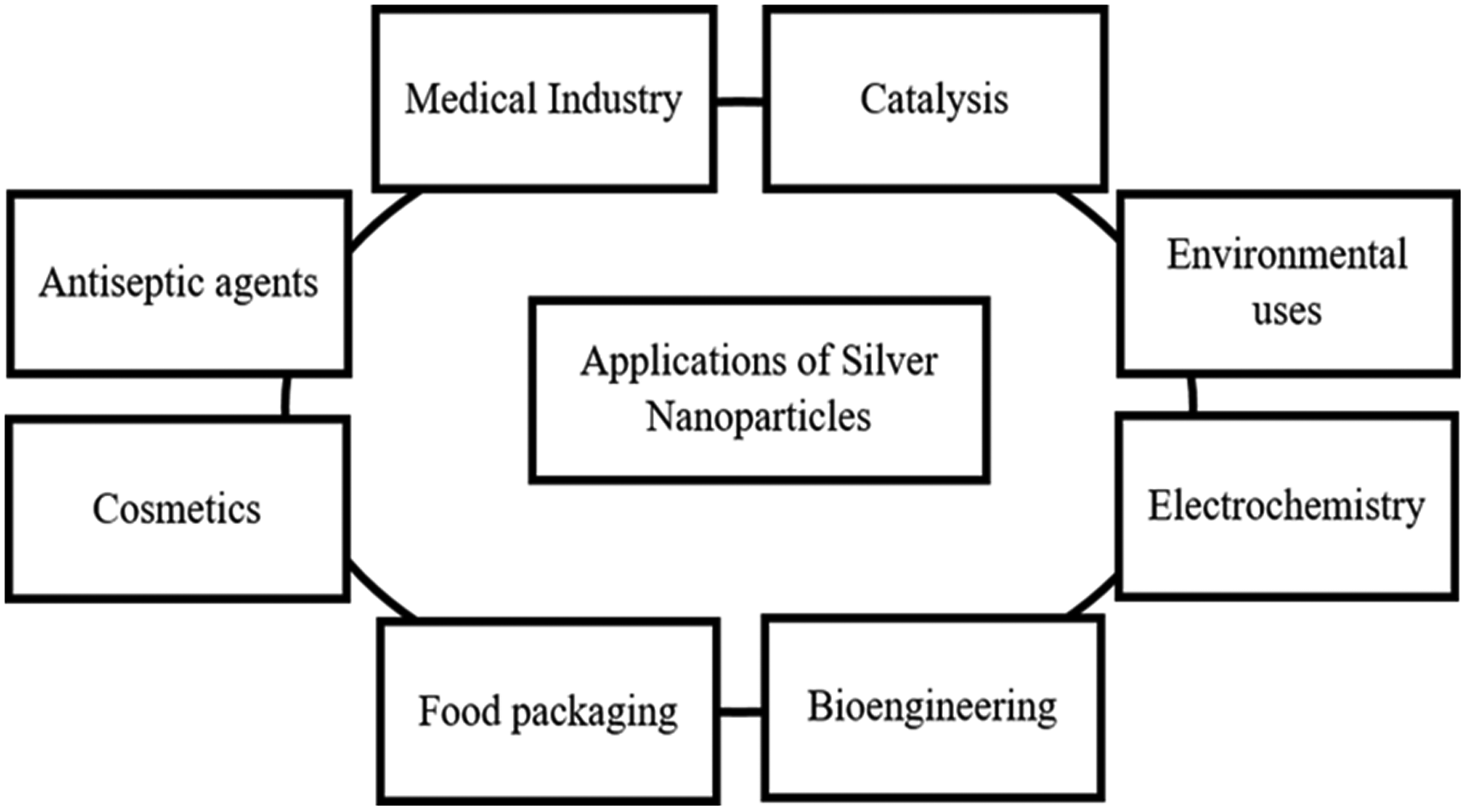
Various applications of silver nanoparticles (AgNPs).
The physical, chemical and biological properties of AgNPs are strongly linked to their shapes, sizes, and surface morphologies. 27 The modification of surface morphology during synthesis appears to be essential for the determination of the physical properties of AgNPs.28,29 With regards to size and morphology affecting the bio-applications, AgNPs usefulness has been proven in many biological applications. Kumari et al. 30 and Qing et al. 31 reported the shape-dependent antimicrobial properties of synthesised AgNPs against pathogenic bacteria. The antimicrobial effect of AgNPs is believed to be dependent on particle morphology and surface characteristics. Tiny spherical AgNPs were found to have better antimicrobial activity due to wide surface area, providing larger contact areas with microbes compared to other shapes.30,31 AgNPs have generally been designed in size greater than 100 nm to accommodate the transported drug amount in drug delivery. 16 Further applications of AgNPs will be explained later in this review.
The optimisation of AgNPs synthesis has generally been performed to modify the physicochemical properties applicable to particular applications. Commonly, pH and temperature are two factors that affect the morphology of AgNPs. Many studies have confirmed that alkaline pH reduced the AgNPs size, while high temperature increased the AgNPs synthesis rate.32,33 The ability to modify the biomolecules’ surface charges, which could alter their ability to reduce and cap around AgNPs during synthesis, is the significant impact of pH. 34 According to Wei et al., 35 the size of AgNPs decreases as pH rises to pH 10. The increased bioavailability of functional groups favours the production of AgNPs at a high pH level, leading to a faster nucleation rate in smaller sized AgNPs. Nair et al. 36 also described that high pH favoured the complete reduction of Ag+ into AgNPs by providing more electrons. In addition, Ag+ is consumed faster at high temperatures due to increased kinetic energy, resulting in a faster synthesis rate. 37 Phanjom and Ahmed 38 reported that sizes of biosynthesised AgNPs had decreased, became uniform, and almost spherical with an increase in reaction temperatures.
This review, therefore, aims at presenting an overview of the global AgNPs consumption and highlighting the contrast of AgNPs syntheses between conventional methods and the current biological method. While many studies have been performed on AgNPs synthesis, this review presents an updated discussion of their physical, chemical, and current biological approaches. Additionally, the review discusses the current AgNPs applications in various fields, including antimicrobial, diagnostic and therapeutic, conductive, and optical applications. Finally, the challenges and prospects of biosynthesised AgNPs in terms of toxicity and emission into the environment, oxidation, and stability, as well as commercialisation and sustainability of resources, are also presented in-depth.
Global consumption of AgNPs
The world has witnessed tremendous growth in nanotechnology applications over the past a few decades, contributing to a significant advancement in the production of new nanomaterials. Such expansions in the research and development (R&D) in AgNPs applications would benefit the public and stimulate economic growth and industrial capacity. Vance et al. 39 indicated that AgNPs have a more excellent marketing value than other NPs because they are widely advertised in consumer products. According to Temizel-Sekeryan and Hicks, 40 AgNPs production is projected to exceed 800 tonnes per year by 2026. The global market demand for AgNPs worth around $1 billion in 2015; it is anticipated to reach $3 billion by 2024. The prominence of AgNPs is attributed to their well-documented properties, such as antimicrobials, high electrical and thermal conductivities, catalytic activities, and many more, promoting a variety of new products and scientific applications.5,24,25 By 2024, healthcare applications such as medicine and life sciences are estimated to be worth more than $1 billion, followed by textile applications, which are anticipated to surpass $750 million, and food and beverages forecasted to hit more than $300 million.40,41
Healthcare undoubtedly is the fastest-growing trend and the most prominent market among all industries. Increasing demands for antimicrobial products lead to the rapid growth of AgNPs in the healthcare field. Furthermore, increased demands for textiles are induced by escalating applications in sportswear and military clothes to prevent body odour caused by bacteria. In medical textiles, AgNPs protect healthcare workers from microbial infections, as textiles of all types used in hospitals are vulnerable to bacterial growth. The usage of antimicrobial textiles in healthcare facilities could limit the spread of diseases and protect patients and medical professionals from infection and cross-infection. Global healthcare workers are now experiencing the most dangerous situation regarding the novel severe acute respiratory syndrome called coronavirus 2 (SARS-CoV-2), which is the source of the COVID-19 pandemic. 42 This pandemic is anticipated to increase the demand for AgNPs in medical textiles due to their notable antimicrobial and antiviral properties. 43
Development in the food and beverage industry is primarily attributed to the increasing demand for food preservation. Microbial contamination is one of the main concerns in the food industry. Waste of spoiled products is detrimental to public health as a consequence of foodborne diseases. Thus, antimicrobial in food packaging materials will offer potential solutions to improve product quality and prevent products from spoiling due to microbial action. 44 AgNPs have been introduced in food packaging with more significant benefits because they are resistant to most extreme processing conditions, such as exposure to high temperatures. 44 Conventional food packaging materials such as organic acids and enzymes are usually unable to withstand high temperatures. As a consequence of the incorporation of AgNPs in the food and beverage industry, food will stay fresh, safe, and nutritious for a more extended period.
Conventional methods of AgNPs synthesis
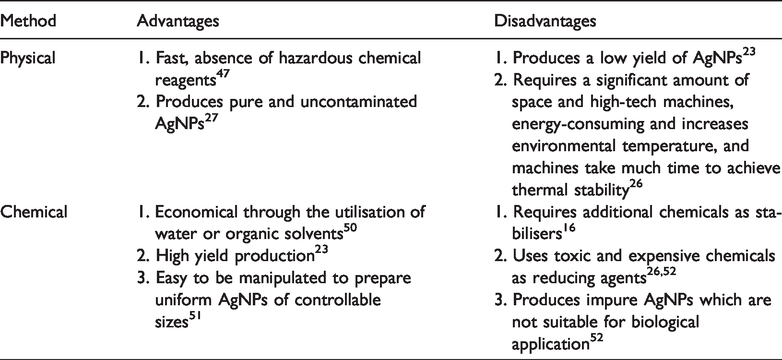
The physical method is characterised as a top-down approach involving the breakdown of bulk material into nano-sized particles. This method generally employs evaporation-condensation and laser ablation techniques.16,45 In the evaporation-condensation method, AgNPs are typically synthesised in a tube furnace maintained at atmospheric pressure. 16 In laser ablation, a high-power pulsed laser is integrated with an ablation chamber. The target temperature is elevated due to the absorption of the high-powered laser beam, which causes atoms to be vaporised from the target’s surface to the laser plume. 45 The vaporised atoms may be condensed as clusters and particles without any chemical reaction or react in a vaporised state to yield new materials. 46 Significant advantages of this technique compared to other methods for producing AgNPs are speed, radiation used as a reducing agent, and the absence of hazardous chemical reagents in solutions. 47 Therefore, pure and uncontaminated AgNPs can be obtained for more applications through this technique. 27 The top-down approach, however, has several drawbacks. It takes a significant amount of space, requires high-tech machines which consume high energy, and takes a long time to achieve a thermal stability state, to produce only a low yield of AgNPs.23,26 In brief, the physical method consumes much energy and is, therefore, costly.
Unlike the physical method, the chemical method is regarded as a bottom-up approach. The bottom-up (self-assembly) approach refers to either atom-by-atom, molecule-by-molecule, or cluster-by-cluster material build-up from the bottom. 48 The chemical method requires three main elements: precursor (AgNO3), reducing agent, and stabilising or capping agent. 49 In the chemical method, the reducing agent reduces AgNO3 to AgNPs by supplying electrons, followed by the stabilising agent capping around AgNPs to stabilise them. Compared to the physical method, this method is considered to be more affordable by researchers as it requires water or organic solvents. 50 The significant advantage of chemical methods is a higher yield of production compared to physical methods. 23 Moreover, AgNPs synthesised by this method can be easily manipulated, allowing the preparation of uniform and size-controllable AgNPs. 51 However, it is challenging to prepare AgNPs with a well-defined size as AgNPs synthesised from this method tend to aggregate. 16 Hence, it is crucial to find an effective stabiliser for the prevention of particle aggregation. Furthermore, a certain amount of toxic material residue may be produced. Some extremely harmful, toxic, and hazardous organic solvents are utilised in this method as reducing agents such as borohydride, citrate, ascorbate, thioglycerol, and 2–mercaptoethanol.26,52 As a result, significant amounts of surfactant and organic solvents incorporated into the system must be isolated and discarded from the final product as toxic wastes. In view of all issues mentioned above, the chemical method employed in AgNPs fabrication is expensive and dangerous. Apart from these drawbacks, the resultant particles are not of expected purity, as their surfaces have been found to be sedimented with chemicals. 52 Table 1 summarizes the advantages and disadvantages of AgNPs synthesised by the physical and chemical methods.
Summary of advantages and disadvantages of AgNPs synthesised by physical and chemical methods.
A current trend in AgNPs synthesis (biological method)
Various approaches, including chemical and physical methods, can be employed to synthesise AgNPs. However, these techniques are relatively expensive, complicated, and potentially produce toxic wastes and by-products to the environment. 26 These shortcomings have prompted the researchers to adopt a cost-effective alternative method. Similarly to the chemical method, the biological method is regarded as the bottom-up approach. Ideally, AgNPs biosynthesis can yield more or equivalent amount of AgNPs compared to conventional methods, and at the same time minimising environmental impacts. 53 Current trend (biological synthesis) offers advancement over chemical and physical methods as any sophisticated instrumentation is not required that simplifies the synthesis process. 54 Furthermore, biological synthesis utilises environmentally friendly, cost-effective, and more efficient natural reagents as reducing and stabilising agents. In the biological approach, functional groups presented in biomolecules of biological resources serve as a reducing agent to reduce Ag+ into AgNPs of various shapes and sizes. 55 At the same time, biomolecules also serve as a stabilising agent capped around biosynthesised AgNPs to stabilise them. 56 Biological approach employs naturally occurring reducing agents such as microbes, plants, and marine organisms. Figure 2 displays the schematic representation of the process for the biosynthesis of AgNPs utilising different biological entities. The details are discussed in the following sections.
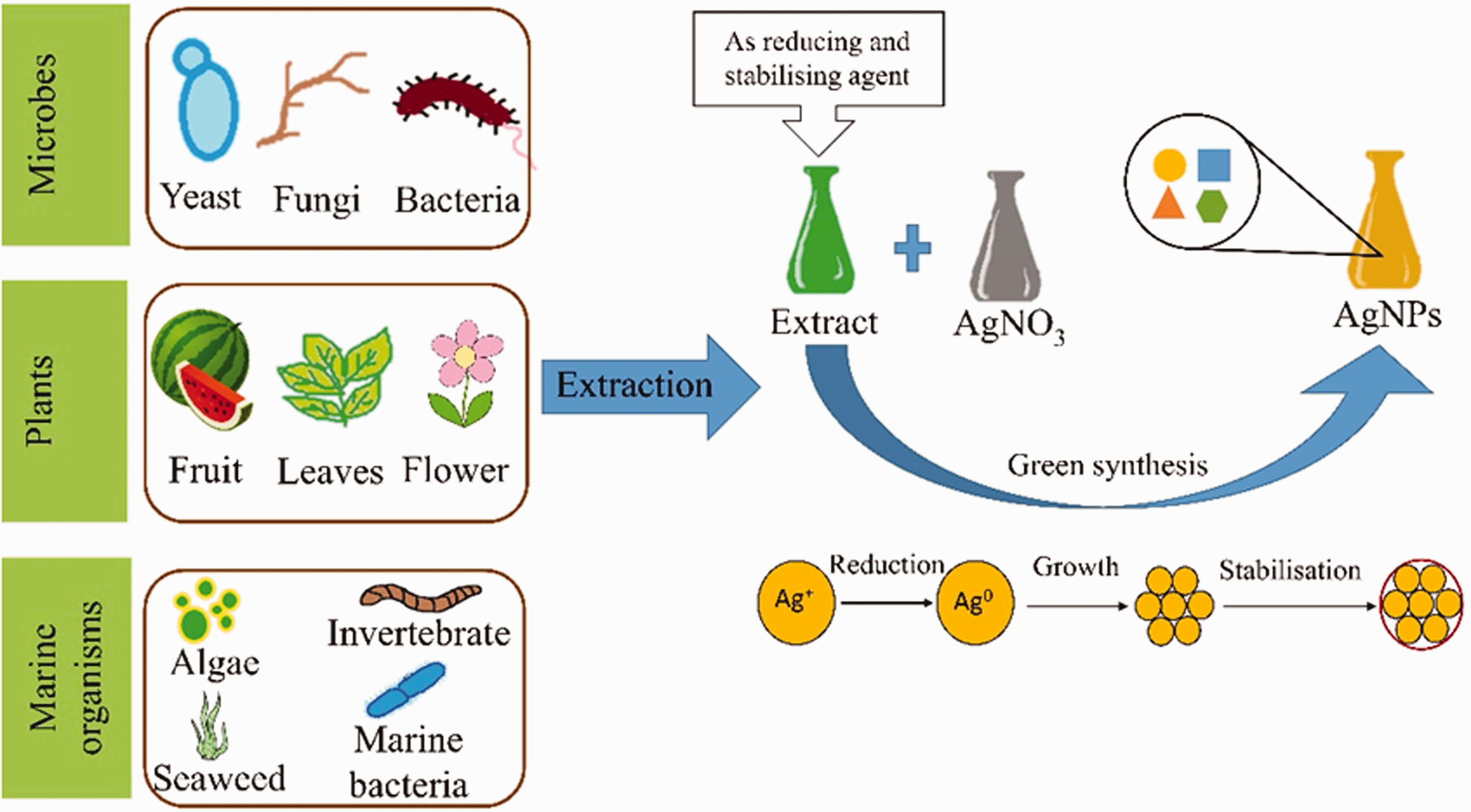
Schematic representation of the AgNPs biosynthesis procedures utilising various natural resources.
AgNPs biosynthesis utilising microbes
Many researchers are highly interested in microbes due to the fact that they can be used as reducing agents in AgNPs synthesis (Table 2). Bacteria, fungi, and yeast are regarded as potential alternatives for sustainable AgNPs development. They are ideal for AgNPs synthesis as they are abundant in the environment, can adjust to extreme conditions, fast-growing, and inexpensive cultivation. 57 Nevertheless, microorganism culturing is time-consuming and prone to contamination. 58 Moreover, it is challenging to manipulate the size and shape of synthesised AgNPs as microbes are sensitive to pH and temperature.59,60
Examples of AgNPs biosynthesis utilising microbes extract.
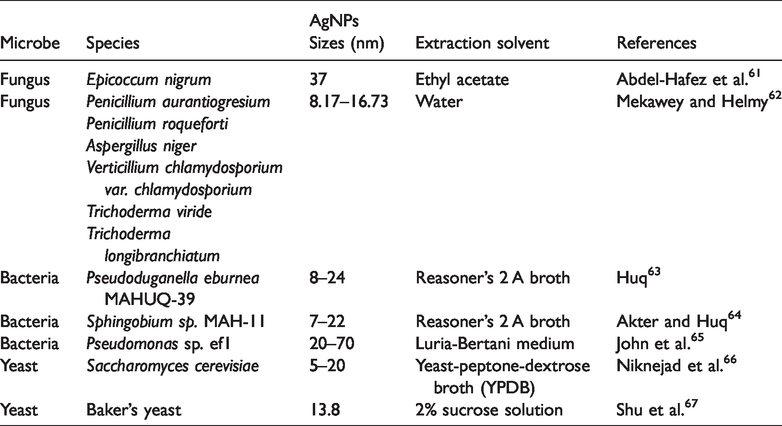
A straightforward new approach to the AgNPs synthesis utilising the antioxidant compound curvularin extracted from the fungus Epicoccum nigrum demonstrated the production of AgNPs with an average size of 37 nm. 61 In this study, curvularin not only served as a reducing agent but also as a stabiliser. The study found that hydroxyl and carbonyl in curvularin account for the reduction and stabilisation of the Ag+. Biosynthesised AgNPs exhibit a robust antifungal effect against the phytopathogenic fungus Alternaria solani compared to curvularin. Furthermore, Mekawey and Helmy 62 carried out an optimisation process of AgNPs in vitro psychosynthesis by various fungi. The experimental condition was optimised to accomplish better control of the size and polydispersity of AgNPs. The results revealed that the size of AgNPs for all fungi tested varied from 8.97 nm – 16.73 nm with variable shapes (mostly in spherical). The optimal conditions for AgNPs synthesis were found to be at 37°C, pH 6.0, and to use 2 mM of AgNO3 with 24 h of incubation in the dark condition.
The potential of AgNPs biosynthesis utilising bacteria has been realised in recent years. The supernatant derived from bacterial culture contains various enzymes, including reductase responsible for nanoparticle synthesis. Huq 63 reported a facile, rapid, and eco-friendly AgNPs synthesis utilising Pseudoduganella eburnea MAHUQ-39. Spherical AgNPs of 8 nm – 24 nm showed significant antimicrobial activity against antibiotic-resistant pathogenic strains of Escherichia coli, Staphylococcus aureus, and Pseudomonas aeruginosa by destroying the membrane integrity and inducing morphological changes in P. aeruginosa and S. aureus. Akter and Huq 64 reported a similar approach in synthesising AgNPs using bacteria supernatant. In this study, an introduction of Sphingobium sp. MAH-11 supernatant caused AgNPs synthesis of sizes ranged between 7 nm and 22 nm. Biosynthesised AgNPs interfere with cell replication by destroying the cell wall and membrane integrity of strains E. coli and S. aureus, leading to cell death. In a different study, John et al. 65 reported an efficient, rapid synthesis of stable spherical AgNPs (50 nm) with a high antimicrobial activity using a new Pseudomonas strain, Pseudomonas sp. ef1. The study also revealed the presence of a high amount of AgNP-stabilising proteins and other secondary metabolites. Biosynthesised AgNPs also demonstrated antimicrobial activity against E. coli, S. aureus, and Candida albicans.
Other than fungi and bacteria, yeast has also been documented as potential microbes for AgNPs synthesis. Niknejad et al. 66 reported that AgNPs synthesised by supernatant of Saccharomyces cerevisiae, commonly known as baker’s yeast, produced an average diameter size between 5 nm and 20 nm. These AgNPs have demonstrated antifungal activity against fluconazole-susceptible and fluconazole-resistant, C. albicans. The antimicrobial effect of AgNPs is believed to depend on the morphology and surface characteristics. Shu et al. 67 also conducted a similar synthesis of AgNPs by utilising baker’s yeast. AgNPs demonstrated superior antibacterial efficacy in combination therapy with ampicillin compared to ampicillin alone against ampicillin-resistant E. coli (E. coli-Amp+). Besides, these stable AgNPs demonstrated low cytotoxicity but excellent biocompatibility to Cos-7 cell lines.
Microorganisms have recently been identified as potential eco-friendly nano-factories. Biomolecules, such as enzymes, proteins, amino acids, polysaccharides, and vitamins derived from the microorganism, may play an essential role in the synthesis of AgNPs as reducing and capping agents. 68 They may immobilise AgNPs by supplying a viscous medium that prevents AgNPs from aggregating. 69 Biosynthesis of AgNPs utilising microorganisms is not only cost-effective and chemical-free but often allows a shorter time for synthesis to complete the process compared to conventional techniques. 70
AgNPs biosynthesis utilising plants
AgNPs biosynthesis utilising plant biomass and extracts has several advantages, including easy handling procedures, scalability, and ideal for large scale productions under non-aseptic environments. 71 However, several plants produce a low yield of secreted proteins, limiting the rate of synthesis. 72 The studies, as listed in Table 3 below, highlighted the capacity of several plants used to synthesise AgNPs.
Examples of AgNPs biosynthesis using plants extract.
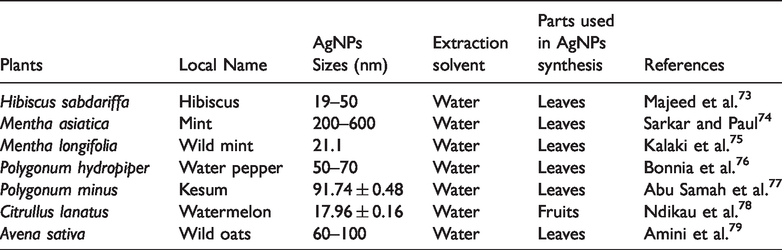
AgNPs are noteworthy for their antimicrobial activity, as has already been mentioned. Several studies have assessed the efficacy of plants with antibacterial properties in synthesising AgNPs. Majeed et al. 73 reported that AgNPs (19 nm – 50 nm) synthesised utilising leaf extract of Hibiscus sabdariffa plant (Malvaceae) exhibited antimicrobial activity against Salmonella enterica, E. coli, Bacillus cereus, and S. aureus. Notably, plant-synthesised AgNPs perform better in a combination of levofloxacin and amikacin, which have enhanced antibiotic efficacy. AgNPs can penetrate and trigger cell damage by inactivating essential enzymes, thus, inducing cell death by creating free radicals that play an active antibacterial effect.
Nevertheless, different plant species will have different AgNPs synthesis capabilities and antimicrobial activities, even though they come from the same genus. For example, AgNPs synthesised from Mentha asiatica with particle sizes ranging from 200 nm to 600 nm showed antimicrobial activity against E. coli, P. aeruginosa, B. subtilis, and S. aureus. 74 However, AgNPs synthesised from Mentha longifolia produced a far smaller average size of 21 nm, which showed maximum inhibition of Streptococcus pneumoniae, followed by Enterobacter aerogenes, Staphylococcus epidermidis and S. enterica. 75
Another example is the AgNPs synthesised from the leaf extracts of Polygonum hydropiper and Polygonum minus. AgNPs synthesised from P. hydropiper, with an average diameter size of 60 nm, demonstrated efficiency as a catalyst for the degradation of hazardous dyes by sodium borohydride (NaBH4). 76 On the other hand, the leaf extract of P. minus can synthesis the AgNPs with an average diameter of 91.74 ± 0.48 nm and have exhibited potential as an alternative antimicrobial agent for S. aureus and E. coli. 76
One of the advantages of plant-synthesised AgNPs is that the experiment’s condition can be conveniently manipulated to produce stable AgNPs. AgNPs synthesised from Citrullus lanatus produced stable yields of spherical AgNPs with an average diameter of 17.96 ± 0.16 nm. 78 Moreover, it is suggested that the optimal synthesis conditions were 80°C, pH 10, and the reactant ratio of 4:5 (0.001 M AgNO3 to 250 g/L crude extract). The reduction rate of AgNPs is optimum at 80°C. The size of AgNPs also becomes smaller, with an increase in the pH value. At alkaline pH, a large number of functional reducing agents facilitating a higher number of Ag+ ions to bind and then form a large number of AgNPs with smaller diameters. In another study utilising Avena sativa leaf extract, researchers indicated that by increasing the temperature (optimum temperature was 90 °C), the size of synthesised AgNPs had decreased. 79 Furthermore, increased concentrations of AgNO3 (from 1 to 4 mM) had increased the amount of AgNPs with the sizes remained in a similar range. AgNPs in this study appeared to be spherical, with smooth surfaces and ranged in sizes from 60 to 100 nm.
Plants have long been acknowledged to have the potential to reduce Ag+. Biomolecules found in plant extracts, including terpenoids, polyphenols, sugars, alkaloids, phenolic acids, enzymes, proteins, amino acids, vitamins, and polysaccharides, are capable of reducing metal ions. 5 Anthocyanins, isoflavonoids, flavonols, chalcones, flavones, and flavanones in the flavonoid group can actively chelate and convert Ag+ into AgNPs. 69 It is worth noticing that the sugar in plants can also be used for the synthesis of AgNPs. 56 Monosaccharides, such as glucose, have a free aldehyde group that can serve as reducing agents. However, it is sensible to note that the reducing activity of disaccharides and polysaccharides relies heavily on the form and concentration of individual monosaccharide component. 69
AgNPs biosynthesis utilising marine organism
A variety of prokaryotic and eukaryotic marine organisms, such as microalgae, macroalgae, marine bacteria, polychaete, fish scale, and crab, have been investigated for their potentials to synthesise AgNPs (Table 4). Marine ecosystem conditions are radically distinct from those of the terrestrial ecosystem. These marine organisms are continually adapting to all kinds of harsh chemical and extreme physical environmental conditions. Thus, the marine organism might produce different natures of bioactive compounds compared to the terrestrial ecosystem. In comparison to other green resources, there is a scarcity of information accessible in regards to the AgNPs synthesised from the marine organism. Moreover, marine organisms are vulnerable to chemical contamination; a variety of marine organisms like polychaete, bacteria, and marine algae are used as indicators for heavy metal contaminations.80–82 Reducing agents produced in marine organisms are, therefore, prone to sea conditions.
Examples of AgNPs biosynthesis utilising marine organisms.
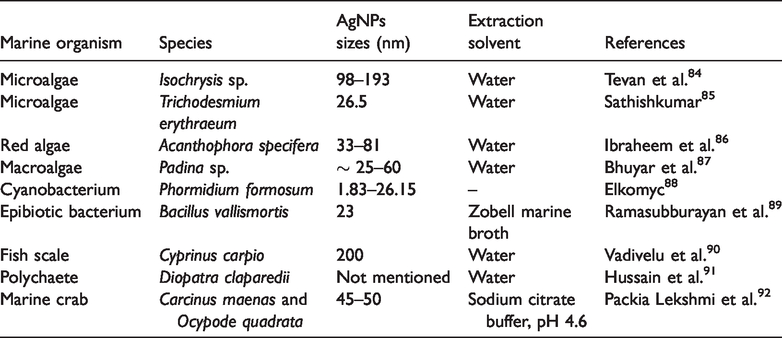
Algal rich with biologically active compounds, such as polysaccharides (alginate, laminaran, fucoidan), polyphenols, carotenoids, fibre, protein, vitamins, and minerals, serve as effective reducing and capping agents for a robust synthesis. 83 Tevan et al. reported a green synthesis of AgNPs utilising the extract of marine microalgae Isochrysis sp. 84 The results obtained from characterisations indicated that the AgNPs have majorly attained spherical shapes of differing sizes between 98 nm and 193 nm. The study revealed that Isochrysis sp. reduced AgNPs can inhibit the growth of S. aureus and E. coli. Another species of macroalgae, Trichodesmium erythraeum, can also be used to synthesise AgNPs. 85 The AgNPs have been successfully synthesised with an average size of 26.5 nm and have significant potential as antioxidant, antibacterial, and anticancer agents. Biosynthesised AgNPs demonstrated an excellent radical scavenging activity and significantly inhibited clinical bacterial and drug-resistant strains. More concentrated biosynthesised AgNPs have decreased the viability of cancerous cells, indicating that they could be utilised in cancer cell therapy. Furthermore, marine macroalgae were also prominent for AgNPs synthesis. Ibraheem et al. 86 utilised marine red algae (Acanthophora specifera) extract to synthesise AgNPs between 33 nm and 81 nm in size. Antimicrobial activities against Gram-positive S. aureus and B. subtillis, Gram-negative Salmonella sp. and E. coli and yeast strain C. albicans were confirmed. Another macroalgae species, Padina sp., was used to synthesise AgNPs with antimicrobial properties. 87 The AgNPs with ∼ 25 nm – 60 nm in size were reported to be highly potent against Staphylococcus aureus and Pseudomonas aeruginosa.
Marine microbes have existed in the sea for millions of years, reducing a massive amount of inorganic elements deep in the sea. As a consequence, various marine organisms have been extensively studied in relation to the biosynthesis of AgNPs. Elkomyc 88 recently reported the synthesis of small-size AgNPs (1.83 nm – 26.15 nm) utilising cyanobacterium Phormidium formosum with bactericidal activity against various Gram-positive and Gram-negative bacteria. Biosynthesised AgNPs have also been reported to have potent antifungal activity against Candida albicans. Ramasubburayan et al. 89 studied the extracellular synthesis of AgNPs by the silver resistant novel marine epibiotic bacterium Bacillus vallisomortis. The study indicated that biosynthesised AgNPs from B. vallismortis were spherical, narrowly polydispersed, and had an average particle size of 23 nm. Biosynthesised AgNPs were non-toxic to mussel Perna indica and potentially used as antibacterial, antibiofilm, antimicroalgal, and anti-crustacean.
Recent studies in the AgNPs synthesis utilising fishes, marine invertebrate, and crustaceans have been improperly published as the focus was on marine plants and bacteria. Despite that, a few studies have reported the synthesis of AgNPs utilising marine organisms such as fish, polychaete, and crab. Vadivelu et al. 90 reported in the recent study the utilisation of fish scales to synthesise AgNPs. Biosynthesised AgNPs with size of 200 nm have been found to exhibit excellent photocatalytic activity against dye molecules and were suggested for utilisation in water purification systems and dye effluent treatments. A species of polychaete, Diopatra claparedii, was reported capable of synthesising AgNPs. 91 However, this study found that AgNPs have low antibacterial activity against S. aureus and E. coli. The researchers proposed that the results might be attributed to the aggregation of AgNPs. Further studies are, therefore, required to improve the AgNPs stability to enhance their antibacterial activity. Other than polychaete, the haemolymph of marine crabs (Carcinus maenas and Ocypode quadrata) was also utilised to synthesise AgNPs. 92 The result showed that synthesised AgNPs had an average diameter size between 45 nm and 50 nm. The studies also demonstrated the potential of AgNPs as an antimicrobial agent against various microbes.
In recent years, the marine ecosystem has gained a great deal of interest, as it holds valuable resources that need to be explored extensively. Nanoparticles synthesis utilising marine resources fulfils the need for safe, stable, and environmentally friendly particles as it involves a variety of readily available marine ecosystems. As a matter of fact, this biological synthesis does not require toxic chemicals, hence reduces the cost of synthesis.
Summary of AgNPs biosynthesis
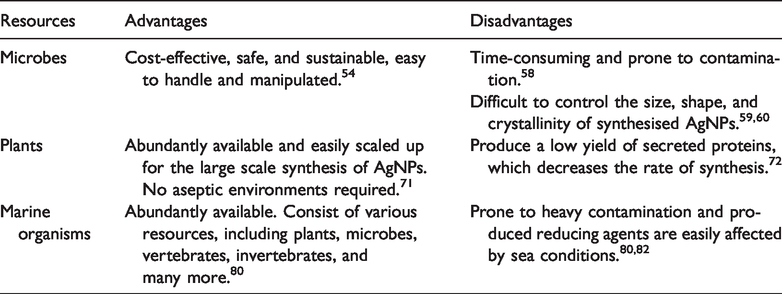
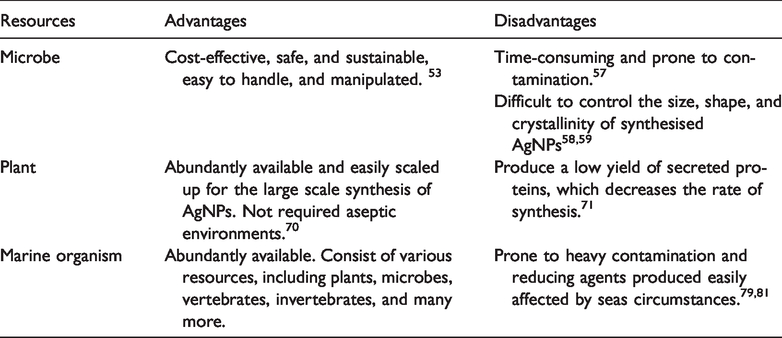
AgNPs synthesis by the biological method offers many advantages compared to the chemical and physical methods. However, all biological resources come with advantages and disadvantages. Table 5 summarises the advantages and disadvantages of plants, microbes, and marine organisms in the mediated synthesis of AgNPs. Mini but mighty microbes are creatures living in the environment but too small to be seen by naked eyes. Many studies have documented the advantage of microbes in the AgNPs synthesis. Affordable, safe, sustainable, easy to handle, and manipulated are among the reasons that make microbes widely preferred as reducing and stabilising agents in AgNPs synthesis. 54 Nevertheless, some researchers prefer to utilise other types of biological resources because some microbe cultures are time-consuming (media preparation, dilution, plating, incubation, counting, isolation, and characterisation). 58 Some microbes, such as bacteria, are easy to grow and take less than 24 h, but some slow-growing microbes mostly require more than a week to grow. Besides, microbe cultures require sterile apparatus, glassware, media, and workspace as they are vulnerable to contamination. 58 Lastly, it is challenging to control the characteristics of microbe-biosynthesised AgNPs because most of the microbes are sensitive to pH and temperatures.59,60 In order to solve some of the problems, the researchers diverted from microbes to plant, taking into consideration abundantly available plants in the environment that have made it easier to scale up. 71 Besides, relative to microbes, plants disregard the aseptic techniques. However, several researchers reported that some plants produced low yields of secreted protein that led to a slow rate of AgNPs synthesis. 72 Researchers were keen to explore a new field of AgNPs synthesis utilising marine organisms since a few years ago. As marine organisms are abundantly available and survive in extreme conditions, the properties of their bioactive compounds might be different from those of the terrestrial ecosystem, making them the best option for AgNPs synthesis. However, heavy metal contamination from the earth’s surface is the primary concern in the marine organism synthesis of AgNPs.80,82 Natural processes such as weather and erosion wash and transport heavy metals from the ground to the oceans.
Comparison between plants, microbes, and marine organisms in the mediated biosynthesis of AgNPs.
Comparison between plant, microbe and marine organism in the mediated biosynthesisof AgNPs.
Application of silver nanoparticles
Exponential growth in nanoscience and nanotechnology research has contributed to advancements in the global growth of new nanomaterial productions. 27 As mentioned earlier, AgNPs have been incorporated in a significant number of applications. Many of these properties are absent in macro-scaled particles. The nano-sized AgNPs are beneficial for surface coating owing to the fact that the surface area rises several million times. Among all applications, AgNPs have received a great deal of emphasis on four primary applications; antimicrobial, diagnostic and therapeutic, conductive, and optical applications.
Antimicrobial application of AgNPs
AgNPs are notable for their antimicrobial properties. 5 Bacterial and fungal infections have been increasingly prevalent in immunocompromised patients. Although most bacterial infections can be treated with antibiotics, certain infections are easily transmitted, extremely contagious, and virulent. They can induce mortality of immunocompromised individuals who have already endured severe illness. 93 The long-term application of antibiotics promotes the evolution of antibiotic-resistance bacteria. 94 Hence, many researchers are now focused on the prospect of utilising AgNPs to eliminate pathogens because microbes are not capable of developing resistance against AgNPs. 95 Outstandingly, AgNPs show higher lethality to microorganisms but lower toxicity to mammalian cells. 96 According to Murphy et al., 97 Ag has been used as an alternative antimicrobial agent prior to the introduction of AgNPs. AgNPs are mainly incorporated into various wound treatment creams. Both Ag+ and AgNPs exhibit microbiostatic and microbicidal activities on different microbial species. Nevertheless, the development of Ag+ complexes is restricted, and the effect is somehow limited for a brief period. 98 This downside has been overcome with the usage of intact AgNPs with advanced antimicrobial properties. The high productivity of AgNPs is mainly attributed to the availability of a larger surface area to volume proportion, enabling the penetration of AgNPs into the bacterial cells to disrupt them, compared to Ag+. 23 Although antifungal drug resistance does not seem to be of concern as much as antibacterial resistance in bacteria, one of the long-term issues is that the number of antifungal agents available for treatment remains extremely limited. The search for new antimicrobial agents is, thus, exceptionally urgent today.
Diagnostic and therapeutic application
AgNPs have been used in various diagnostic and therapeutic applications in recent years owing to higher detection sensitivity. AgNPs can be used for bio-diagnosis in which the size, shape, and dielectric medium surrounding AgNPs have strongly affected their plasma properties. AgNPs can influence the function of the intracellular system due to their capability to adsorb to cytosolic proteins, which may influence the gene expression and pro-inflammatory cytokines. 11 According to Ghojavand et al., 99 AgNPs may alter the function of metallothionein, heat shock protein, and histone families genes. A few decades ago, AgNPs were developed to diagnose, treat, and prevent cancer utilising photo-based therapeutic methods because of their ability to distinguish cancer cells from non-cancerous cells and destroy them at low irradiation power density. 100 In cancer treatment, AgNPs can be used as nanocarriers for drug delivery. 13 However, limitations, such as physiological barriers, limited carrying capacity, the variability of AgNPs, regulatory, and manufacturing issues that could affect the utilisation of AgNPs in cancer therapy, need to be addressed.
Conductive applications
In addition to medical applications, AgNPs are also used in the engineering field. AgNPs exhibit excellent electrical and thermal conductivity, along with other characteristics that make AgNPs one of the most promising materials in electronic products. It can be used in conductive inks and incorporated into composites to boost thermal and electrical conductivity.101,102 In the field of printing technologies, concentrated AgNPs are already well-recognised with high potential due to their excellent electrical conductivity and oxidation resistance. 25 Ag is also widely used as a conductor in circuits. Hence, modification of Ag into nanowire will improve the physical performance of relatively low contact resistance with higher conductivity. 25
Optical applications
Moreover, the size, shape, and dispersion state of AgNPs make them an ideal alternative for electronic sensor areas such as biomolecular detection and labelling. Therefore, there is a surge of interest in utilising the beneficial optical properties of AgNPs in various products and sensors. 103 The optical properties of AgNPs rely primarily on their surface Plasmon resonance (SPR). Plasmon refers to the continuous oscillation of free electrons inside AgNPs. Such oscillation results in extreme scattering and absorption effects. Powerful interaction between AgNPs and light occurs due to the behaviour of electrons on the surface of AgNPs, which experience continuous oscillation due to light excitation at a specific wavelength. 74 Due to their powerful optical properties, AgNPs have been used as a metal-enhanced fluorescence (MEF) substrate for enhancing the sensitivity of microarrays such as DNA and protein microarrays.22,104 Badshah et al. 22 reported that highly sensitive vertical Ag nanorods enhanced the fluorescence signal approximately 36 times better than commercially available Amine substrates. Recently, a highly sensitive multiplex detection system for identifying human semen and vaginal fluid utilising AgNPs (Ag nanorods) has been developed. 104 Limited and invaluable samples (body fluid) from the crime scenes play a vital role in the criminal justice system through a provision of scientific information and evidence. This study showed that the fabricated protein microarray chip with Ag nanorods as the metal-enhanced fluorescence (MEF) substrate only required a small number of samples (body fluid), highly sensitive, and ten times better than the commercially available rapid stain identification (RSID) semen kit.
Challenges and prospects
Safety and effectiveness
Despite the promising economic gain from the utilisation of AgNPs in general, there are issues linked to their use. Growing applications of AgNPs in consumer products increase the release of AgNPs in the environment. Consumers are potentially exposed to this metal through dermal, oral, and inhalation pathways. 73 Colloidal AgNPs in the oral, eye, and skin are non-toxic and relatively safe. 105 Wan et al. 96 reported that AgNPs were less toxic to human cells compared to microbes. However, continuous, direct exposure to a high dose of AgNPs can trigger AgNPs accumulation in the human body, leading to toxicity. Long-term exposure to Ag has contributed to irreversible conditions like argyria, in which the skin turned bluish as a reaction to Ag deposition in tissues. 106 AgNPs can be absorbed by inhalation (lungs), dietary intake (intestine), and through the skin (blood circulation) and can, therefore, penetrate organs such as the liver, kidneys, spleen, brain, and heart.106,107 Thus, a toxicity study of biosynthesised AgNPs on human cells is necessary to investigate the safe and effective application doses. AgNPs are potentially accumulated in the environment, possibly emitted from various commercial products. Even though the biosynthesis of AgNPs eliminates the use of toxic chemicals compared to the chemical method, nano dimensions and physiochemical surfaces such as size, shape, surface charge, and chemical composition render them highly reactive and potentially hazardous to humans and the environment. 108 In order to address these challenging circumstances, further research should concentrate on realistic evaluations of the acute toxicity and chronic toxicity of biosynthesised AgNPs to the environment, health, and safety in the coming years.
Oxidation and stability of AgNPs
The other challenges of biosynthesis of AgNPs are related to their loss of long-term stability that reduces the efficacy of their properties. Changes in the properties of AgNPs may increase their oxidation and aggregation rate, which may affect bioavailability, leading to discrepancies in the dosage administered versus the dosage delivered. 109 AgNPs are likely to change their properties as time progresses, even in optimised synthesisation.50,110 In biological synthesis, the synthesis, properties, and stability of AgNPs can be improved by altering some critical parameters such as AgNO3 concentration. Qasim Nasar et al. 111 reported that the higher concentration of AgNPs resulted in the aggregation of AgNPs. According to the redox reaction theory, precipitates formed beyond optimal concentration were due to an inadequate amount of electron, carried by reducing agent, to reduce the excess Ag+ in the concentrated solution. 112 Consequently, the crude extract did not completely reduce AgNO3, resulting in the generation of aggregated AgNPs with unreacted AgNO3. 113 In addition, the stability of AgNPs is likely to rely not only on improved synthesis but also on storage conditions to preserve the functionality of the capping agent used to stabilise them. A study reported that AgNPs were sensitive to light and susceptible to oxidation. 62 Biosynthesised AgNPs stored in a dark place showed better stability than those exposed to light. Velgosova et al. 110 also demonstrated that the AgNPs stored in the dark at 5 °C exhibited the best long-term stability compared to those stored at room temperature. The stability loss was the most significant under daylight at room temperature. AgNPs stored in the dark at 5°C remained spherical, have a narrow size distribution, and stable (no agglomeration) even after six months. Velgosova et al. 110 suggested that the stability of AgNPs was mainly dependent on the electrical charge on the surface of AgNPs. The loss of these charges indicates the loss of AgNPs’ stability. In order to address this problem, proper studies on AgNPs synthesis and storage conditions should be carried out to long-term preserve the properties of AgNPs.
The commercialisation of biosynthesised AgNPs
Many AgNPs available in the market are currently synthesised utilising physical and chemical methods (85%) rather than the biological method. 41 Studies on the chemical and physical approaches for the production of AgNPs on a large scale have been thoroughly documented since the evaluation of AgNPs production. 27 With regards to the growing interest in the development of eco-friendly AgNPs, the emphasis on AgNPs synthesis has shifted from physical and chemical approaches towards ‘green’ chemistry. However, one of the major concerns in the research development of biosynthesised AgNPs is how they can be commercialised on a large scale. Expanding the production of biosynthesised AgNPs from laboratory to industrial scale is challenging. Risks which scale up the production of biosynthesised AgNPs need to be addressed carefully. Firstly, consideration should be given to the cost, reliability of biological resources as reducing and stabilising agents, potential application, and safety in the development of AgNPs. Secondly, the properties of biosynthesised AgNPs can change and reduce when scaled up, particularly when dealing with large-scale productions. Thus, further study is required to investigate the optimal experimental condition for large-scale synthesis of AgNPs to preserve the stability and characteristic of biosynthesised AgNPs. Thirdly, the availability of biological resources as reducing and stabilising agents is critical to ensure the continued production of biosynthesised AgNPs on an industrial scale. All the considerations outlined should not be taken for granted for the large scale commercialisation of biosynthesised AgNPs.
Sustainability of resources
The growing interest in biosynthesis leads to an acceleration in the exploration of biological resources for AgNPs biosynthesis. Although these biological resources are abundantly available, uncontrolled overexploitation of natural resources can have detrimental effects on the ecosystem. For microbe-synthesised AgNPs, this problem is not significant because they are fast-growing and easy to control. 58 However, for AgNPs synthesised from limited and slow-growing plants and marine organisms, destructive harvesting can result in resource depletion and species extinction. Thus, the conservation and sustainable use of natural resources must be extensively studied. Controllable measures are required to ensure the sustainability of a species used for the AgNPs synthesis. Various recommendations are proposed with respect to their conservation. Firstly, optimising the AgNPs biosynthesis could reduce the waste of biological resources. Secondly, the construction of a special hatchery/farm for biological resources with excellent reducing and stabilising activities in AgNPs synthesis is encouraged. In the case of limited biological resources, a centralised hatchery/farm will provide ready resources without reaching or disturbing the wild in the natural ecosystem, contributing to sustainable production and resource conservation concepts. Banasiuk et al. 114 utilised endangered species of carnivorous plants to synthesise AgNPs with broad-spectrum antimicrobial activity. However, the plants were grown through in vitro vegetative reproduction cultures. This fascinating approach is an excellent example of controlling the sustainability of biological resources. Hence, it is imperative to have a good plan for further exploration of potential biosynthesised AgNPs in the industry while at the same time maintaining the sustainability of biological resources in the ecosystem.
Conclusion
This review comprehensively addressed global consumption, conventional approaches, emerging trend, applications, challenges, and the future of AgNPs. Generally, AgNPs are synthesised by physical, chemical, and biological methods. Conventional methods (physical and chemical methods) have several drawbacks, such as large space requirement, costly, energy-consuming, toxicity, limiting their applications, and prompting severe concerns. Awareness towards the sustainability of green technology and utilisation of safer alternative resources for the synthesis of AgNPs leads to a drive to develop environment-friendly techniques. The benefits of AgNPs synthesis utilising various plants, microbes, and marine organisms are economical, energy-efficient, cost-effective, and safer for humans and the environment. Ideally, the physical, chemical, biological, optical, thermal, electrical, and catalytic properties of AgNPs are the potential to be exploited in a variety of applications. Even though many studies have been performed on green AgNPs synthesis, they are not applicable in daily applications due to a lack of safety information. Besides, the oxidation of AgNPs reduces their properties, consequently affecting applications. Thus, these issues need to be addressed and highlighted. The prospect for large scale commercialisation of biosynthesised AgNPs should also be recognised and adequately planned. Finally, in the sense of biological synthesis, a controllable measure to ensure the sustainability of biological resources is vital to avoid over-exploitation and extinction of species.
Footnotes
Declaration of conflicting interests
The authors declared no potential conflicts of interest with respect to the research, authorship, and/or publication of this article.
Funding
The authors disclosed receipt of the following financial support for the research, authorship, and/or publication of this article: The authors thank the Ministry of Higher Education, Malaysia, and Universiti Malaysia Terengganu for the funding and generous support (FRGS/1/2016/WAB09/UMT/02/2).
