



Abstract
Nuclear energy has sparked international attention as one of the most important strategies for reducing emissions thanks to its ability to provide low-carbon power. Based on this interesting fact, the current research explores the effect of nuclear energy on CO2 emissions in the leading countries by nuclear power consumption using a quarterly dataset from 1990 to 2019. The study employs the quantile-on-quantile (QQ) estimator, which accounts for both non-parametric and conventional analyses and enhances the provision of unbiased and consistent estimates. In addition, the Granger causality in quantiles approach is adopted to assess the causality in quantiles between the variables of investigation. The outcomes from the QQ estimator reveals that in the majority of the quantiles, nuclear energy contributes to decreased degradation of the environment in the USA, France, Russia, South Korea, Canada, Ukraine, Germany, and Sweden. Contrawise, the feedbacks from Spain and China expose that Nuclear Energy Consumption (NUC) contributes to the deterioration of the environment. Moreover, the outcomes of the causality test disclose that nuclear energy and CO2 emissions can predict each other in the majority of the quantiles. The findings above provide profound ramifications for policymakers planning nuclear energy and CO2-emission policies towards achieving sustainable environment in the sample countries and beyond..
Introduction
The global economy is resolute toward resolving the pervasive threats of global warming on the ecosystem and peaceful human coexistence. This resolution is not only premeditated but also inevitable because inactions to address the rising levels of global greenhouse gas (GHG) emissions could result in an unimaginable catastrophe for the present and future generations. 1 Consequently, nations across the globe are not hesitant to key into initiatives and treaties geared toward significantly moderating global GHG emissions.2,3 Recently, the 2021 Conference of the Parties (COP26) addressed significant global warming issues and provided directions on actions to achieve unprecedented feats in the drive towards a sustainable environment. Specifically, COP26 established new dimensions for reaching net-zero global warming by 2050. For instance, the conference recorded commitments to cover nearly 85% of global GDP within the net-zero agreement. Additionally, approximately 153 countries bought into the idea of taking practical actions on the Nationally Determined Contributions (NDCs), which are responsible for almost 80% of the global GHG emissions, with plans to achieve a substantial reduction by 2030. To achieve the new or modified commitments, the Glasgow Climate Pact (COP26) emphasized a massive reduction in coal power, an end to deforestation, fast-tracking the transition to electric vehicles, and phasing down methane emissions. In addition, COP26 advocated for the indispensable need to reduce fossil fuel subsidies (estimated at around $5.9 trillion in 2020), contributing not less than 89% to global carbon emissions. 4
From the theoretical and empirical viewpoints, numerous efforts have been exerted along with significant policy implications believed to help accomplish the agreements on environmental-related issues. Despite the persistent efforts, environmental challenges emanating from global warming caused by the consistent surge in carbon emissions have remained unresolved and may cause more future threats,5.6 This unresolved issue can be associated with at least three factors. First, despite the global support for shifting from fossil fuel to renewable energy sources, the world's productive capacities remain primarily dependent on fossil fuels. One plausible argument for this continued fossil fuel consumption despite its role in increasing global GHG emissions is the lack of attention to adequate alternative energy sources, particularly nuclear energy. Second, the massive focus on renewable energy is yet to fully yield the expected results because of its limited accessibility and affordability. Hence, in the current transition stage, a clean alternative energy source is necessary. Third, nuclear energy remains the closest alternative to fossil fuels in terms of being a cheap, accessible, and affordable energy source. In addition, nuclear energy is a low carbon-intensive energy source capable of enhancing the smooth transition to clean energy consumption. Supporting this view, international energy agency (IEA) 7 stated that the operation of nuclear reactors does not contribute to air pollution or carbon dioxide. In another study, it was suggested that nuclear energy is low-carbon that is available on a large scale for providing electricity at a marginal rate of insignificant carbon emissions equivalent to those produced by wind and solar (World Nuclear Energy Association. 8 The fundamental role of nuclear energy in achieving the ongoing goal of carbon neutrality by 2050 is evident in its ability to reduce emissions unevenly, corresponding to a one-third decrease in transport-induced emissions globally. 8
Based on the above narratives, it is essential to note that despite the critical need to replace fossil fuels with nuclear energy on the one hand and complement renewable energy in the drive towards the decarbonization of the global economy, on the other hand, minimal attention has been paid to it on the policy front. This can largely be attributed to the scarcity of empirical evidence supporting the adoption of nuclear energy. Consequently, there is a significant need to promote and propagate the pertinence of adopting nuclear energy from theoretical and empirical standpoints. Against this backdrop, this study primarily seeks to investigate the functional nexus between nuclear energy and carbon emissions in the top nuclear power-consuming countries. The sample countries include the top ten nuclear power consumption countries comprising the United States, China, France, Russia, South Korea, Canada, Ukraine, Germany, Spain, and Sweden. The economies mentioned above are highly ranked among the thirty-two operating nuclear power plants globally (International Atomic Energy Agency. 9 These countries account for 84.4% of the global nuclear power plants, with the United States topping the list. 9
The present study provides at least five novelties to the literature. First, this study is the first deliberate empirical effort to investigate the functional nexus between Nuclear Energy Consumption (NUC) and carbon emissions, specifically focusing on the top nuclear power-consuming countries. A study of this type is highly pertinent when the world is on a global mission to neutralize carbon emissions in the environment. Second, the study focuses on the top ten nuclear power-consuming economies comprising the United States, China, France, Russia, South Korea, Canada, Ukraine, Germany, Spain, and Sweden. An investigation of this type is logical because policy implications that emanate from the empirical analyses of these countries will constitute a sufficient sample valuable size for effectively utilizing nuclear energy in offsetting the environmental effects of carbon emissions. Specifically, the motivations for focusing on the top ten economies are anchored on their notable roles and contributions to the composition of global nuclear power and GHG emissions. For instance, available statistics reveal that these countries consume 84.5% of global nuclear power energy. 10 Furthermore, the countries operate 71% of the global nuclear reactors, equating to 321 of the functional 448 reactors. When it comes to contributions to global GHG emissions, six of these countries (China, the United States, Russia, Germany, and Canada) are ranked among the top ten emitters. Consequently, evaluating the direction of causality between nuclear energy and carbon emissions can be best understood within the context of these countries. Third, from a methodological perspective, the employment of the quantile-on-quantile (QQ) estimator is worth lauding on four grounds. First, the QQ estimator accounts for both non-parametric and conventional quantile analyses, enhancing the provision of unbiased and consistent estimates. Second, the approach dissects the effects of nuclear energy on carbon emissions into three value points comprising the lower, middle, and upper quantiles, enabling policymakers to differentiate the environmental effects of low, moderate, and high consumption of nuclear power. Third, the NUC-carbon emissions association is estimated from both panel and time series perspectives. This enhances the recommendation of practical policies that will address environmental issues in the panel of ten countries and the individual economies. Other conventional estimators do not offer this novelty provided by the QQ estimator. Fourth, the study expands the body of knowledge in the nuclear energy-environment debates by conducting the Troster 11 Granger causality test, which allows for simultaneous assessment of the median as well as the tails of the distribution.
The remainder of this paper is structured as follows. Section two reviews the relevant studies, section three focuses on the methods, section four presents and explains the empirical results, and section five concludes with policy implications.
Literature review
The emerging drive towards halting the pervasive impacts of carbon emissions has attracted unprecedented attention from scholars towards promoting a sustainable environment globally. Consequently, there has been evolving support for the necessary transition from traditional energies to clean and green energy (renewable & nuclear energy). Therefore, this study reviews previous studies on the nexus between clean energy and environmental indicators.
Starting from the most recent order, Kartal 12 evaluate the effects of disintegrated fossil fuel energy (oil, gas, and oil), nuclear energy, and renewable energy on carbon emissions in five top carbon-emitting economic countries from 1965 to 2019. The study relies on multivariate adaptive regression to estimate the empirical model, and the following outcomes are evident. Findings from empirical analyses show that the three energy sources (fossil fuel, nuclear, and renewable energy) are crucial to influencing the variations in carbon emissions. Fell et al. 13 probe the role of nuclear energy in mitigating the surging trends in global warming with a specific assessment of the 442 functional nuclear power reactors. The study reveals that an unrestrained surge in greenhouse gases exacerbates the global climate. Besides, it finds empirical support to advance that nuclear power plants contribute less to the global GHG emissions. Akram et al. 14 investigate the impacts of nuclear energy, renewable energy, energy efficiency, and economic growth on carbon emissions in a panel of four countries comprising Mexico, Indonesia, Nigeria, and Turkey (MINT) based on yearly data covering 1990 to 2014 subjected to estimation within the ARDL method. The empirical outcomes show that renewable energy, nuclear energy, and energy efficiency significantly reduce carbon emissions. Rehman et al. 15 assess the nexuses among renewable energy, nuclear energy, fossil fuel energy, carbon emissions, economic growth, and carbon emissions in Pakistan from 1975 to 2019. The empirical evidence relies on the ARDL estimator to explore the long-run and short-run estimates in the empirical model. The results reveal that energy consumption from fossil fuel, nuclear energy, and renewable energy significantly hinder Pakistan's real growth.
Furthermore, Ozcan and Ulucak 16 have examined the extent to which nuclear energy moderates the level of environmental pollution in India by utilizing time series data stretching from 1971-to 2018. The results uncover a declining trend in carbon emissions based on the moderation of nuclear energy. A similar Indian study conducted from 1978 to 2019 by Bandyopadhyay and Rej 17 shows that nuclear energy significantly mitigates carbon emissions. The empirical outcomes from a quantile egression conducted in Emerging Seven economies (E7) from 1990 to 2016 by Gyamfi et al. 18 show that nuclear energy reduces carbon emissions. In contrast, Azam et al. 19 probed the interlock between nuclear energy and CO2 in top emitter economies from 2000 to 2016 by relying on panel fixed effects, random effects, and pooled OLS regression estimators. The empirical outcomes reveal that nuclear energy escalates the surge in carbon emissions. That notwithstanding, the empirical study on Pakistan's economy by Mahmood et al. 20 from 1993 to 2017 unveils the contributions of nuclear energy to promoting environmental quality. With a specific focus on the OECD economies from 1995 to 2015, Lau et al. 21 utilize the dual estimators comprising the generalized method of moments (GMM) and fully modified OLS (FMOLS) to justify the submission that nuclear energy promotes environmental quality. Luqman et al. 22 evaluated the nexus between nuclear energy and environmental quality in Pakistan from 1990 to 2016, and they find an asymmetric effect between NEC and environmental quality.
The debate on the choice of energy between nuclear and renewable energy in resolving the continued environmental issues motivates the research interest of Jin and Kim 23 in a panel of selected 30 economies from 1990 to 2014. The empirical evidence relies on panel cointegration technique and Granger causality analysis. Findings from the study confirm longrun association between nuclear energy, carbon emissions, and renewable energy. Besides, the longrun results show that nuclear energy is insufficient to moderate the surge in carbon emissions, whereas renewable energy significantly mediates it. However, the empirical outcomes in Dong et al. 24 establish the dual roles of per capita nuclear energy and per capita renewable energy in mitigating carbon emissions in China based on an analysis spanning 1993 to 2016. In contrast, the study finds per capita fossil fuels and per capita GDP as positive predictors of carbon emissions, confirming their inducing role in China's environmental problem. Baek 25 examines the functional effects of nuclear energy and income on carbon emissions in top twelve nuclear-generating countries using the panel cointegration approach. The empirical analyses reveal that nuclear energy substantially moderates carbon emissions. Further, the EKC hypothesis is not validated for the nuclear-producing countries due to the inverse relationship between income and carbon emissions. However, the findings in Al-Mulali 26 reveal that nuclear energy fails to influence the variation in carbon emissions of 30 nuclear energy-consuming countries from 1990 to 2010.
The reviewed extant studies reveal the existence of substantial nexus between nuclear energy and carbon emissions from the empirical and theoretical viewpoints. However, some notables lacunas worth mentioning are as follows. First, despite the long-standing empirical verifications of the nuclear energy-carbon emissions nexus across the global and regional economies, no study has considered the most recently ranked ten consuming economies of nuclear power. This is surprising despite the ten countries consuming over 84% of global nuclear energy. Second, few existing studies have explored the novelties of the QA regression as in this study. Third, assessing the environmental effects of nuclear energy in the top nuclear power economies is scarce in the literature, thus allowing the present research to address the cavity. Other noteworthy gaps have been elucidated in the introductory section.
Data and method
The current study explores two subsections in explicating the methodological approach to gauging the functional nexus between nuclear energy and carbon emissions. The first involves empirical modelling of the relationship followed by the econometric procedures. Figure 1 presents the research flow. First, we evaluate the stationarity attributes of series in each nation. Since both the Jarque-Bera (JB) and BDS test suggest nonlinearity of the variables, we proceed to use nonlinear approaches. This is followed by assessing the quantile cointegration (QC) since using the linear cointegration tests such as the ARDL bounds test and Johansson cointegration does not consider the variables’ nonlinearity features. In the next phase, we assess the effect of nuclear energy on CO2 emissions in each quantile. Lastly, we used the Troster 11 quantile causality test, which allows simultaneous assessment of the median as well as the tails of the distribution.
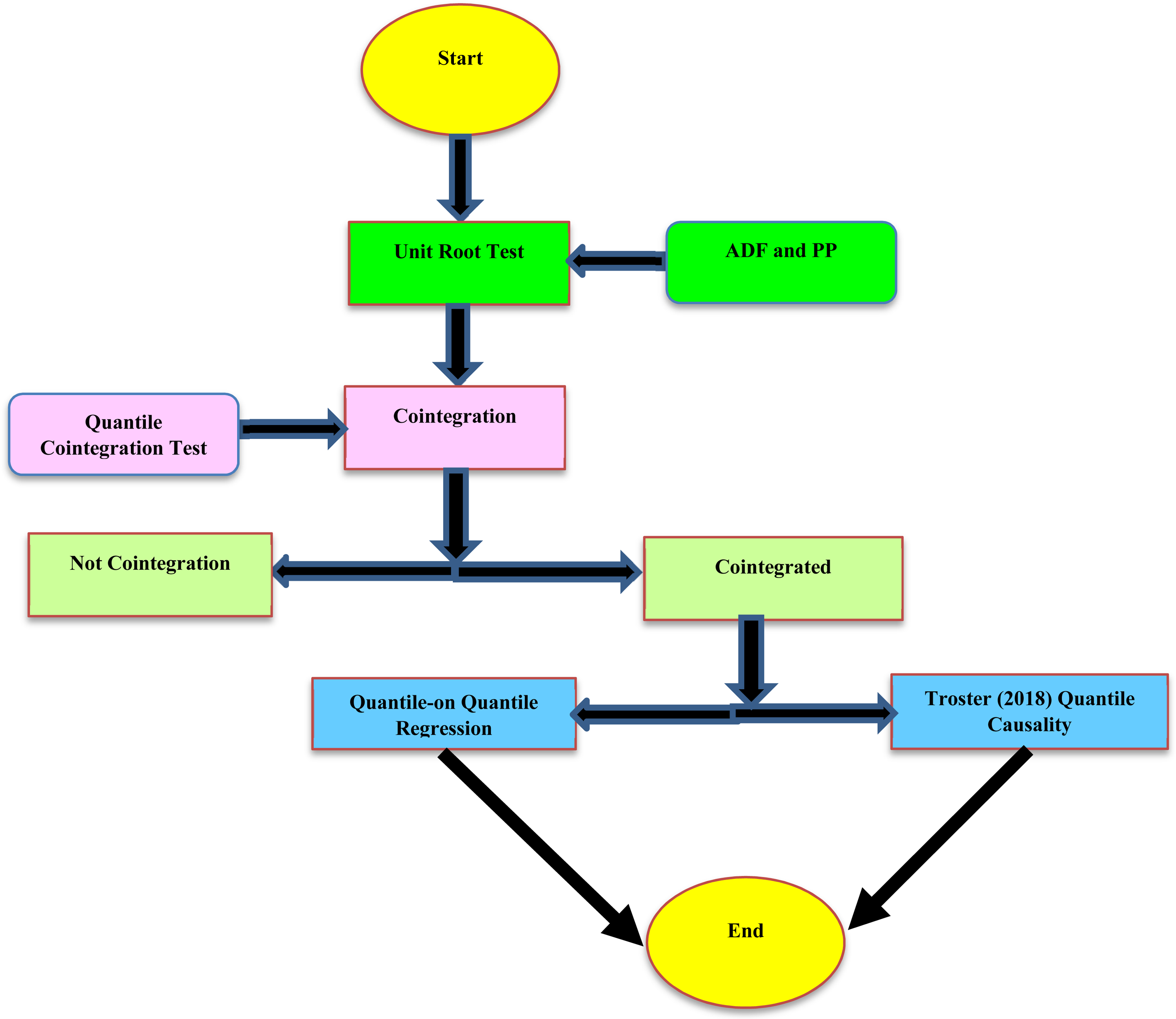
Flow chart on empirical procedures.
Model specification
To estimate the relationship between nuclear energy and carbon emissions in a panel of 10 top consuming countries, this study adopts a single linear panel model as thus:

Variable source and measurement.

Econometric strategies
Quantile cointegration test
This study extends the frontier of knowledge in the environment literature by employing advanced quantile techniques to probe the functional effects of nuclear energy on carbon emissions in the top ten nuclear-consuming countries. Drawing from Mishra et al.,
37
this study utilizes the QC test credited to Xiao,
38
which is an extended version of the traditional Engle and Granger
39
test The supremacy of the QC on the traditional approach lies in its ability to disentangle the error terms of the cointegration model into pure lead-lag terms and invention terms. The model elaborating the QC is stated below.


Quantile-on-Quantile regression
We explore the Sim and Zhou
40
QQ approach in the current study to estimate the association between nuclear energy and carbon emissions in the sample economies. Among many other points, the Sim & Zhou
40
QQ approach can combine non-parametric, and Quantile regression (QR) approaches such that a given indicator is estimated against the quantile of another indicator. Employing the QR technique involves two steps as thus. Firstly, the conventional method is employed to obtain the average impacts of the regressors on varying quantiles of the outcome variables. Unlike the OLS estimator, the QR approach is usually employed to ascertain the impacts of the explanatory variables at the tail and centre points of the outcome variable. Secondly, Cleveland
41
and Stone
42
local linear regression (LLR) is employed to evaluate the spatial effect of each of the regressors on the outcome variable. The LLR accounts for the “curse of dimensionality” issue of strictly non-parametric techniques. Combining these two phases enhances the employment of the nexus between outcome and explanatory variables, which provides robust outcomes. Summarily, the QQ technique is perceived to be high in examining the effect of the X quantiles on Y quantiles. Following Equation (1), the QQ technique is rooted in the QR model:
More so, the QR model does not support the assumption that X shocks are likely to stimulate the nexus between Y and X. drawing from this, the outcomes of substantial positive X shocks, for example, can change from those of small positive X shocks. Likewise, positive and negative X volatility may stimulate asymmetric variation in Y.
Therefore, to examine the relationship between 



The Gaussian kernel is usually symmetric around. More so, it provides weight lower observations that are further out. These weights are in reverse proportionate to the distance between the function of the analytical distribution of
Granger causality in quantiles
One of the main novelties of the present study is the application of the novel Granger causality in quantiles propounded by Troster.
11
Drawing from the conventional Granger causality, the case of no causality is determined when Xi does not predict Zi. Hypothesizing that the vector 


Findings and discussion
Pre-Estimation outcomes
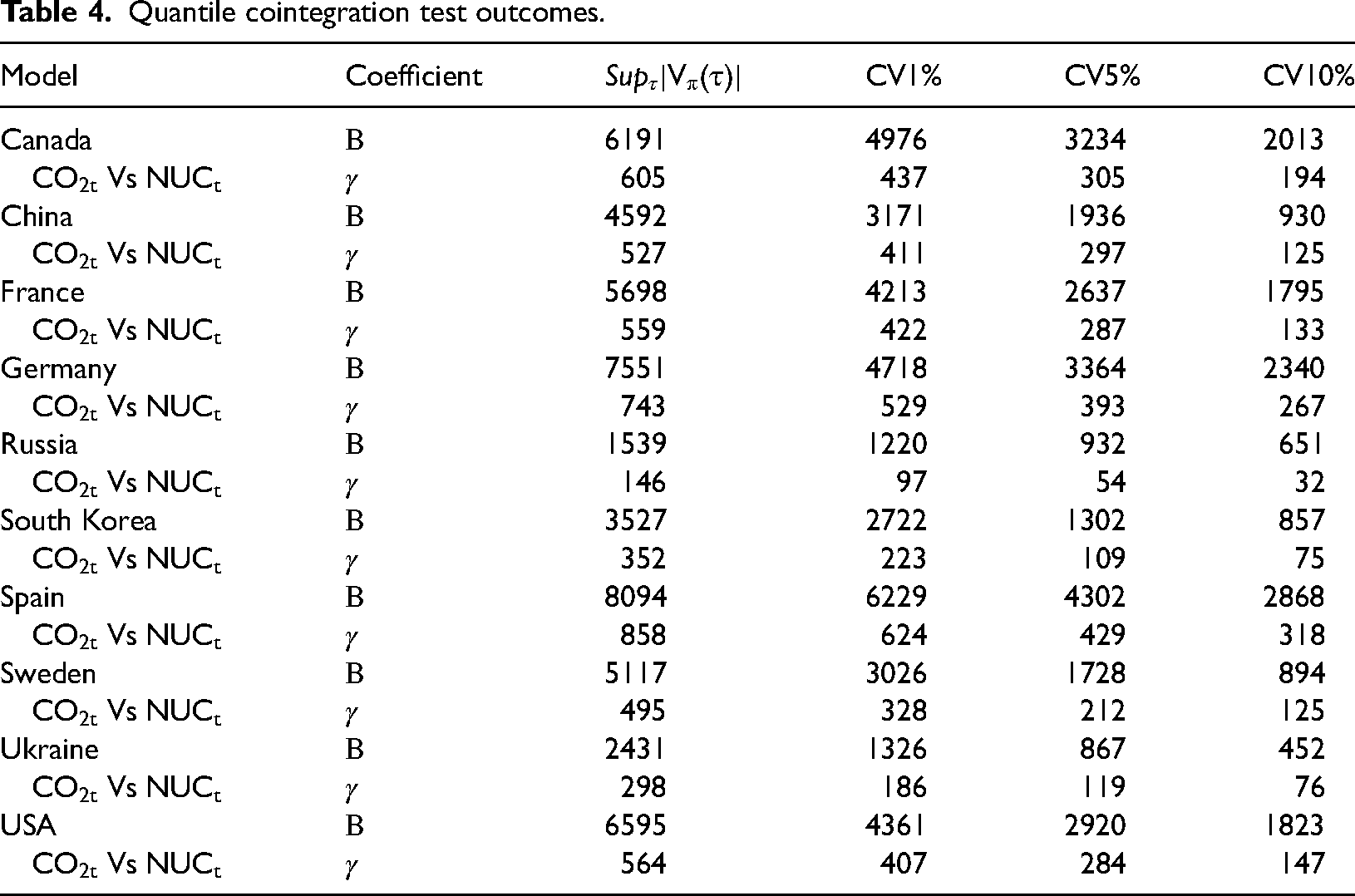
The current empirical analysis commenced by presenting brief information on each nation's variables (nuclear energy and CO2 emission). Table 2 shows descriptive statistics of the data. Based on the results presented, Ukraine contributes the most to CO2 emissions per capita, with 5.09% among the top nuclear power-consuming countries. Next to Ukraine are the USA (1.57%), Canada (1.44%), Russia (1.09%), and Germany (1.02%). The least contributor to CO2 emissions per capita is China with −0.01%, followed by Sweden (0.38%), Spain (0.46%), France (0.48%), and South Korea (0.77%). Regarding the share of nuclear power, the USA ranks highest with 6.19%, followed by France (5.55%) and China (4.83). The least contributor is Spain with 3.61%. Normality test is conducted using values provided by Skewness, Kurtosis, and Jarque-Bera. The outcomes reveal the series are not normally distributed, suggesting that the variables of investigation in each country, using a linear approach, will produce misleading results. Therefore, the current study applied nonlinear methods (non-parametric causality and QQ regression approaches) to capture the effect of nuclear energy on CO2 emissions in the leading countries by nuclear power consumption. Furthermore, the stationarity properties of the variables are checked using the ADF and PP unit root tests. The PP and ADF outcomes in Table 3 show that all the variables (nuclear energy and CO2 emission) in each nation are I(1) variables. The BDS outcomes are presented in Table 3. The outcomes of the BDS reveal the nonlinear attributes of the variables for each nation. This is reflected in the significant level of each variable across the ten selected countries. Consequently, we can models leading to the investigation of the relationship between carbon emissions and nuclear power consumption are nonlinear. This submission is supported by the outcomes presented in Table 2 based on the values of the normality tests confirmed by the Jarque-Bera findings. Furthermore, we assess the cointegration between nuclear energy and CO2 emission in each nation utilizing the QC test proposed by Xiao. 38 Table 4 reports the cointegration outcomes. This table shows the β and γ coefficients and supremum norm values, as well as their critical values (CV1, CV5, and CV10), with levels of significance of 1%, 5%, and 10%, respectively. The research results demonstrate that the coefficients β and γ are above all CV at the 1% significance level, indicating that nuclear energy and CO2 emissions have a long-term cointegration. These findings suggest that nuclear energy and CO2 emissions have a nonlinear connection for all the selected nations.
Descriptive statistics and unit root outcomes.

BDS test outcomes.

Quantile cointegration test outcomes.
Quantile-on-Quantile outcomes
The influence of nuclear energy on CO2 emissions in the leading countries by nuclear power consumption is investigated using the QQR approach. In Figure 2, the state-wise 3D graphs are demonstrated using the QQR slope estimates

Effect of nuclear energy on CO2 emissions. a. USA. b. China. c. France. d. Russia. e. South Korea. f. Canada. g. Ukraine. h. Germany. i. Spain. j. Sweden.
Figure 2(a) presents the effect of nuclear energy (NUE) on the CO2 emissions level in the
For
For
Figure 2(g) presents the effect of nuclear energy (NUE) on
Figure 2(i) presents the effect of nuclear energy (NUE) on
Granger quantile causality outcomes
Equation (11) is used in the present paper to apply Granger causality in quantiles. Table 5 shows the outcomes of Granger causality in quantiles, including the DT test value of significance for log series. We use the DT test to an eleven-quantile equivalent grid, i.e. (0.05–0.95).
Troster 11 quantile causality test outcomes.
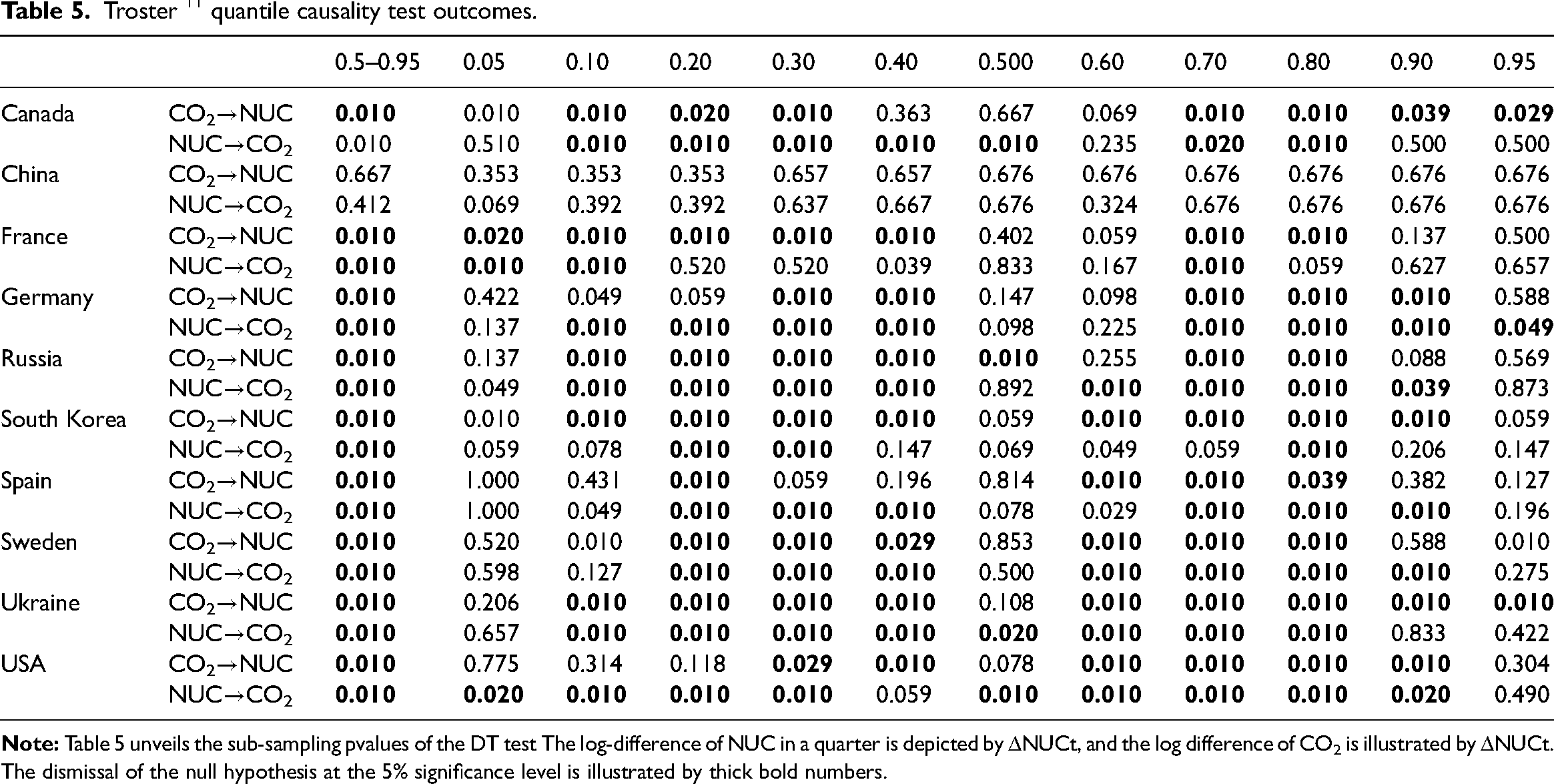
For
For
Likewise, for
Moreover, at 5% significance, bidirectional causality between nuclear energy and CO2 emissions is evident for
Discussion of results
This section of the study presents a summary of the findings obtained above. In most of the quantiles, the present research outcomes revealed that nuclear energy impacts CO2 emissions negatively in the USA, France, Russia, South Korea, Canada, Ukraine, Germany, and Sweden. By implication, we can infer that the impacts of nuclear energy on carbon emissions are not homogeneously determined but rather heterogeneous across the different phases of quantiles and countries. This demonstrates that using nuclear energy contributes to environmental quality in the USA, France, Russia, South Korea, Canada, Ukraine, Germany, and Sweden. These findings are unsurprising, considering that nuclear energy results in a significant reduction in CO2 emissions. As a result, it may be a viable substitute for traditional energy sources for improving the quality of the environment. 16 Consequently, transitioning to clean energy sources such as nuclear power for electricity generation is also critical for lowering GHG emissions. Furthermore, nuclear energy has the potential to help designated countries upgrade their energy sectors. Nuclear energy will minimize the reliance on imported energy and fossil fuel use. As a result, CO2 emissions can be eliminated using this strategy.
Consequently, the empirical results of this study support the notion that nuclear energy is required to prevent the harmful effects of CO2 emissions that cause climate change and global warming and that it can be a better alternative source of energy in the USA, France, Russia, South Korea, Canada, Ukraine, Germany, and Sweden because nuclear energy growth and use are both environmentally and economically advantageous. This suggests that nuclear energy should have a greater quantitative share in these countries’ energy mix. The study outcomes comply with the studies of Azam et al. 35 and Danish et al. 36 , Bandyopadhyay and Rej, 17 and Nathaniel et al. 43 When the energy sector transitions from fossil fuels to nuclear power, the outcomes undoubtedly verify the advantage that nuclear plant operation does not cause CO2 emissions, which might aid in reducing GHG emissions. Furthermore, while nuclear energy decreases carbon emissions, nuclear power facilities always pose significant hazards due to broad cross-country economic, political, and social changes. This can be found in the cases of China and Spain, as revealed by the study outcomes indicating that NUC contributes to the degradation of the environment. This outcome is in line with the studies of Dong et al. 24 and Sarkodie and Adams 44 for South Africa. This implies that nuclear power contributes to contamination for various reasons, including management practices and inappropriate nuclear waste disposal. Similarly, nuclear energy's role in inducing carbon emissions is evident in China and Spain, which is consistent with Anser et al. 45
While a significant relationship between two or more interacting variables does not imply causal effects, the outcomes from the Granger causality suggest the existence of feedback effects between nuclear energy and carbon emissions for most countries. In contrast, bidirectional and no causal impacts are evident in a few economies. Conclusively, we can claim that policy measures implemented to promote nuclear energy would significantly reduce the level of carbon emissions. In contrast, policy measures implemented toward reducing carbon emissions could enhance the promotion of nuclear energy, which is believed to be environmentally friendly. Moreover, the results indicate that besides renewable energy, the path to zero emissions could be achieved through conscientious efforts geared towards promoting NUC.
Conclusion and policy insights
Conclusion
Nuclear energy has sparked international attention as one of the essential strategies for reducing emissions, thanks to its ability to provide low-carbon power. 17 Since 1990, nuclear power plants have prevented 1.5–2 billion tonnes of GHG emissions yearly (IEA, 2020). Furthermore, the IEA (2020) predicted that total energy-related and electricity generation emissions would have been approximately 6% and 20% higher without nuclear power between 1971 and 2018, respectively. 16 Based on these interesting facts about the role of nuclear energy in reaching the carbon neutrality target, the current research explores the effect of nuclear energy on CO2 emissions in the leading countries by nuclear power consumption using a quarterly dataset from 1990 to 2019.
We applied the QA estimator, which is worth lauding on four grounds. First, the QQ estimator accounts for both non-parametric and conventional quantile analyses, enhancing the provision of unbiased and consistent estimates. Second, the approach dissects the effects of nuclear energy on carbon emissions into three value points comprising the lower, middle, and upper quantiles, enabling policymakers to differentiate the environmental effects of low, moderate, and high consumption of nuclear power. Third, the NUC-carbon emissions association is estimated from both panel and time series perspectives. This facilitates the recommendation of practical policies that will address environmental issues in the panel of ten countries and the individual economies. This novelty provided by the QQ estimator is not available in other conventional estimators. Fourth, the study extended the frontier of knowledge in the nuclear energy-environment debates by conducting the Troster 11 Granger causality test, which allows for instantaneous assessment of the median as well as the tails of the distribution. The outcomes from the QQ estimator revealed that in the majority of the quantiles, nuclear energy contributes to a decrease in the degradation of the environment in the USA, France, Russia, South Korea, Canada, Ukraine, Germany, and Sweden, while in Spain and China, NUC contributes to the deterioration of the environment. Moreover, the outcomes of the causality test disclosed that nuclear energy and CO2 emissions could predict each other in most of the quantiles.
Policy insights
The findings above may have profound ramifications for policymakers planning nuclear energy and CO2-emission policies in the leading countries by nuclear power consumption. Policy analysts should consider the influence of nuclear energy on carbon emissions. It is apparent that nuclear energy plays a positive role in reducing emissions. Therefore, policymakers in the selected nations should focus on generating as much power as possible from nuclear energy sources as it can enhance the quality of the environment. Nuclear energy is a greener energy source that can assist with meeting growing energy needs while reducing reliance on imported energy. Furthermore, nuclear energy has the potential to aid in the achievement of SDGs and the creation of enhanced ecological strategies. Moreover, the leading nations in terms of NUC require additional reforms and investment in nuclear energy. Nuclear energy-associated technologies will undoubtedly preserve the nations’ prestige while promoting economic progress and environmental and social betterment. Nuclear power generation provides lower prices, ensuring energy security and reducing traditional energy production emissions. Furthermore, these nations and other nations should promote foreign and local investments in nuclear energy supply while taking safety and security precautions into account. Furthermore, nuclear power-generated electricity will assist in minimizing the reliance on imported energy. Policymakers in these nations should emphasize globalization since it amplifies nuclear energy's positive influences in reducing carbon emissions. They can boost the proportion of nuclear energy mix due to globalization and enhance foreign direct investment, international trade, knowledge transfer, and ecological consciousness.
Limitations of the study
This research has certain drawbacks. Firstly, the nuclear energy-emissions nexus was investigated for the leading countries by nuclear power consumption. This opens up the possibility for future research on other emerging and developed economies, using both time series and panel data. Secondly, this study uses CO2 emissions as an indicator of environmental deterioration. As a result, other environmental indicators such as ecological footprint and load capacity factors should be considered in future studies. Lastly, bivariate analytical approaches were used to assess the effect of nuclear energy on CO2 emissions, which may be limited due to the magnitude of the issue being tackled.
Footnotes
Declaration of conflicting interests
The author(s) declared no potential conflicts of interest with respect to the research, authorship, and/or publication of this article.
Funding
The author(s) received no financial support for the research, authorship, and/or publication of this article.
Data availability
The data for the analysis in this study is available upon request
