



Abstract
To compensate the oil demand and pollution, scientists explore biodiesel as a pollution free alternate energy. But depending on one particular species of feedstock will lead to its extinction like diesel. For this intent, this research proposes a novelty on blending of binary non-edible high oil yielding species. As biodiesel is a natural constituent with elevated oxygen content, a stability analysis has to be performed to diminish its rapid decay. For stabilizing fuel properties synthetic antioxidants have been involved as inhibitors. Previous studies have been performed on the stability analysis individually as oxidation, thermal and storage stability without analyzing them mutually. This research fills the key gap by deeper mutual stability analysis, as the output parameters of these three stabilities are interrelated. Few samples have shown best stability output parameters which challenges in narrowing the best blend. To face this task, a multi objective optimization study has been done. NOx emission has been reduced with the aid of antioxidants as a twin reward. Two novel assessment tools for validating are, i) FTIR, by which the impact of molecular arrangements on stability variation has been evaluated and ii) Using Infrared Imaging Technique, by which the NOX has been analyzed visually correlating the emission level and engine combustion temperature.
Introduction
Nowadays researchers are dedicated in bringing out the best alternate fuel instead of fossil fuel for the transportation sector, as fossil fuel were in the stage of extinction. Not only in transportation sector, but also in industries, power generators, agriculture, domestic and other commercial sectors. They use fossil fuel in superior quantity for power generation. The current hike in the price range of petrol and diesel could be a proof for the above statement. It has been increasing because of the deficiency in fossil fuel but it cannot be avoided due to its high demand in energy. It also strikes the price of all other commercial products to bump up. Eventhough electric powered vehicle is found to be a best alternate source for transportation, producing electricity is possible only through burning out coal which is one of the fossil fuels. The fact behind the vast usage of diesel fuel from tiny to monster vehicles is for its better efficiency. But it also generates other harmful emissions like NOx and particulate matter, which leads to global warming. 1 Regarding the current environmental stats, various agencies like Natural gas and Biofuels, and National Agency of Petroleum were urging the world to execute the resolution NO. 45/ 2014 ANP to reduce the usage of fossil fuels. 2 A forecasting study in Russia suggested that, if the diesel fuel is still being used without an alternate fuel, by 2050, the diesel fuel will decrease to 12% which is 5.4 times when compared to 2015. 3 The only preference for the researchers to obtain an alternate fuel for diesel is the fuel from naturally available feedstock known as biodiesel which has been used in this study.
Many pieces of research on alternate fuels were being performed on waste cooking oil. 4 The waste cooking oil while disposing contains 20% more fatty acid (wt%) than pre-usage which is the most important factor for biodiesel yield. The amount of fatty acid determines the production cost of biodiesel which could be a drawback when the concentration is lower or higher. Higher the biodiesel diesel yields lower the cost of biodiesel production. Around 1%, 13%, 84% of biodiesel have been extracted from palm, sunflower, rapeseed oil respectively and only 2% from non edible feedstock like Poison nut and various non edible feedstock. 5 If the biodiesel extraction from edible products gets a government grant the opposition among corporate sectors and existing demand on food crops will hike to a greater extent further. To avoid all these troubles, there is another preference for extracting biodiesel which is from non-edible products. Previous research proved that the extraction of biodiesel from non-edible seeds like Styrax officinalis L is 89.23% and 20% of bio oil from Citrullus colocynthis which are larger in amount when compared to edible products.6,7 Not only because of the future argument between ‘Fuel versus edible feedstock’, but also the biodiesel extracted from non-edible feedstock also shows similar characteristics in oil yield as well as in engine behaviours. Non-edible feedstock like Pongamia pinnata possesses longer series saturated structure of fatty acid which is helpful to obtain higher biodiesel yield reducing the production cost. 8 Although there are wide varieties of modern non edible biodiesel feedstock, the biodiesel has not been commercialized successfully.
The key issue for preventing biodiesel commercialization as an alternate fuel is the presence of tremendous oxygen molecules in Poison nut and Karanja biodiesel, making a boulevard for the rapid oxidation reaction leading to the degradation of biodiesel properties which is recently being paid much attention by previous researchers.9,10 Though there are many studies on stabilizing the oxidation reaction of various biodiesel feedstock, there are only very few studies on mutual analysis of oxidation, storage and thermal stability properties as they are interrelated to each other. Also an attempt has been made to analyze the mutual stability characteristics of high oil yielding biodiesel feedstock like Alexandrian laurel and Poison nut by blending at equal proportions.
This study involves multiple biodiesel stability attributes like oxidation, storage and thermal stability, among which various output criteria have to be analyzed. But while investigating the stability attributes experimentally, each samples show best result in different attributes without presenting a single best sample leading to confused conclusion. For consolidating obtained experimental results, the multi objective statistical optimization techniques like Evaluation based on Distance from Average Solution (EDAS) and Technique for Order Preference by Similarity to Ideal Solution (TOPSIS) have been performed mathematically in this study.
The primary novelty of this research is the analysis of biodiesel stability parameters like oxidation, storage, and thermal stability for Alexandrian laurel and Poison nut dual biodiesel blend making this study distinctive form all other current biodiesel studies. Using standard equipment like Rancimat, TGA and FTIR, stability analysis for samples blended with TBHQ and PY antioxidants have been performed. With the help of CRITIC weightage evaluation technique and optimization techniques like EDAS and TOPSIS, the best biodiesel blend has been proposed from the standard equipment experimental results. From the optimized biodiesel blend with antioxidant, 20% of the biodiesel has been blended with TBHQ antioxidant and the emission characteristics have been analyzed for diesel, B20, and B20T3 in which all the test samples can be utilized for the commercial diesel engine without any changes in engine design or parameters.
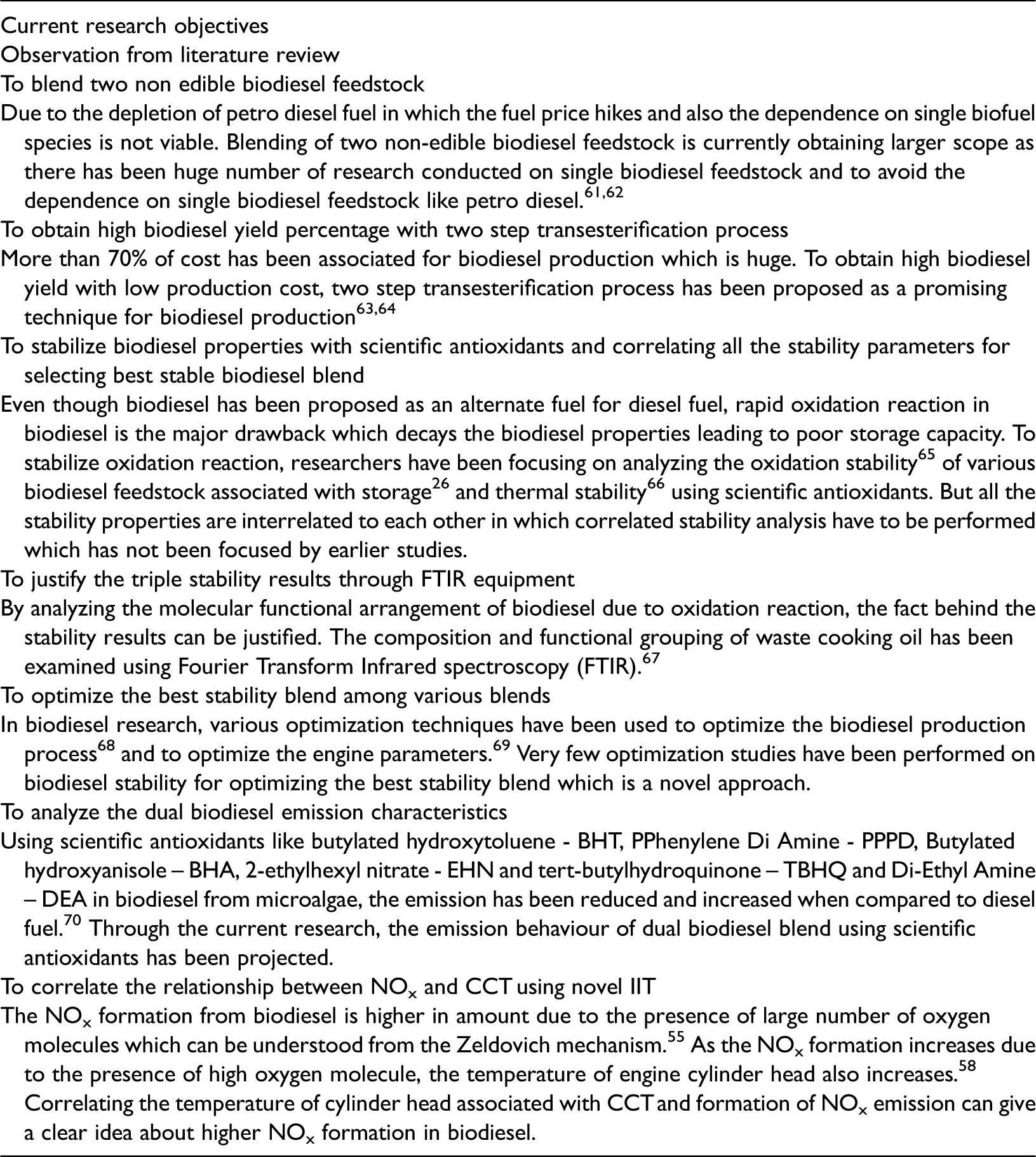
Through this intensive study, it (i) rectifies the less availability of biodiesel feedstock by introducing a novel blending of two high oil yielding non edible species (ii) rectifies the drawback of biodiesel poor stability character by analyzing the three important individual stability characters as oxidation, storage and thermal stability along with addition of synthetic antioxidants (iii) rectifies the downside of higher NOx emission from biodiesel with antioxidant dosage analyzed by novel IIT revealing the connection between combustion chamber temperature (CCT) and NOx emission making this study special from previous studies.
Materials and methodology
Feedstock involved
Among all other non-edible biodiesel feedstock, traditional feedstock like Alexandrian laurel and Poison nut shows higher bio-oil yield, Indian origin and resistance to drought conditions.11,12 Alexandrian laurel is known for its elevated characteristics in combustion and proved their ability to represent superior stability in oxidation reaction from previous works. 13 Alexandrian laurel biodiesel (25%) when blended with diesel (75%) showed lower NOx emission and CO, HC and smoke emissions were observed comparable to diesel whereas BTE also showed closer behaviour to diesel. 14 Performance, emission and combustion study have been performed using ternary mixtures like diesel, n-hexanol and Alexandrian laurel in which hexanol at 40% concentration, Alexandrian laurel at 10% concentration and diesel at 50% concentration blend suppresses emission characteristics like smoke, HC and CO with improved combustion characteristics like Heat Release Rate (HRR) and incylinder pressure and performance characteristics like higher BSFC and lower BTE showing Alexandrian laurel flexibility with multiple mixture blend. 15 Another study uses synthetic BHT and ethanol antioxidant in Alexdandrian laurel for analyzing its engine performance and emission characteristics and observed considerable lessening in Brake Thermal Efficiency (BTE), Brake Specific Fuel Consumption (BSFC) and NOx emission at 500 ppm and 1000 ppm. 16 This is named due to its better emission reduction of harmful greenhouse gas to environment reducing the global warming which is a greater threat nowadays.
By using Poison nut bio-diesel in Malaysia there occur multiple benefits like reduction in crude oil importing by substituting Poison nut biodiesel, improved livelihood of locals, and similar engine performance to diesel fuel. 17 A low and high viscosity biodiesel like turpentine and Jatropha biodiesel extracted through transesterification process has been mixed at equal proportion (50–50) and engine study has been performed without exhaust gas recirculation mode. At full load condition, dual biodiesel blend shows performance drop of 29.16% BTE and emission drop of 42.5%, 4.56%, 4.72% and 2.9% in smoke, carbon monoxide, hydrocarbon and NOx respectively but 10.7% hike in carbon dioxide. 18 Another study has been performed using Castor and Poison nut as dual biodiesel for analyzing the emission, performance and combustion characteristics. Various ratios of water, surfactants and hydrophilic-lipophylic balance have been used in 10% Poison nut biodiesel + 10% Castor biodiesel + 80% diesel in which water concentration – 5%, surfactants – 2% and hydrophilic-lipophylic – 5.3% shows better engine characteristics. 19 Also, Poison nut biodiesel shows reduction of NOx and CO to 5 to 10% and 10 to 40% respectively when tested in diesel engine at higher load. 20 Considering all the characteristics of Alexandrian laurel and Poison nut biodiesel, this research uses the blending of above said feedstock at equal proportions which has not been focused by any other studies.
Transesterification process for biodiesel extraction
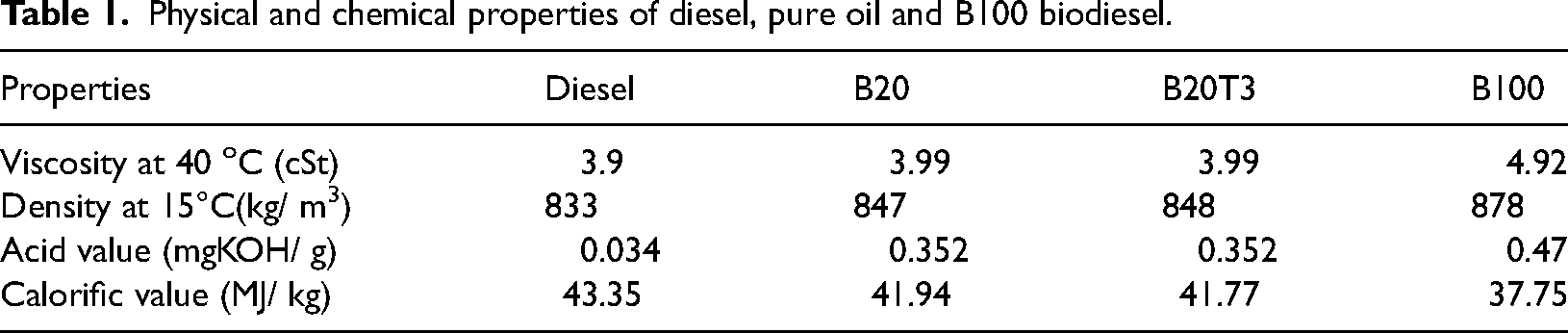
Table 1 represents the physical and chemical properties of diesel, pure oil, and B100 biodiesel and Table 2 represents the fatty acid compositions in weight % (wt%) for Alexandrian laurel and Poison nut oil obtained from gas chromatography which are near to that of previous studies data. When compared to other biodiesel non edible feedstock, Poison nut possess 41% of free fatty acid. By using 2 steps transesterification process the free fatty acid can be converted to fatty acid methyl ester which can be used as an alternate fuel in diesel engine. 21 After collecting both feedstock seeds, they are kept undisturbed underneath sunlight and permitted to dry for 2 weeks. The dried seeds are then kept in a separate polythene bag and thrashed until it reaches the stage of small particles. This process is performed to obtain higher yield of bio-oil. The small particles are then crushed through mechanical oil extractor and the oil has been extracted individually from each feedstock. By blending two highly acidic bio-oil, the acid value has been raised to massive level which can be reduced using two step transesterification process to obtain biodiesel as done by earlier studies.22,23 The steps involved in two step transesterification process taken place separately for both feedstock is shown below:
Physical and chemical properties of diesel, pure oil and B100 biodiesel.
Fatty acid compositions in wt% for alexandrian laurel and poison nut oil.

Step 1: For removing the water content in pure bio-oil, under 90OC the oil has been heated and tends to undergo rotary motion using rotary evaporator for one hour.
Step 2: Acid treatment
Sulphuric acid (H2SO4) at 1% volume per volume oil and methanol (CH3OH) at 55% volume per volume oil have been added to the moisture free pure bio-oil and stirred at 60OC for 2.5 h. By adding two catalysts and stirring process, there occur double layers which are esterified oil (lower layer) and H2SO4 + CH3OH (Upper layer). The bio-oil has been heated additionally at 90OC for one hour, removing excess CH3OH and H2O contents. The process has been continued until the pure bio-oil acid value has to be reduced under 0.50 mg KOH/g according to ASTM and EN standards.22,23
Step 3: Base treatment
Sodium hydroxide (NaOH) at 1% weight by weight oil and Methanol (CH3OH) at 25% volume per volume oil has been added to esterified oil and heated at 70OC for two hours. NaOH and CH3OH convert the triglycerides in esterified oil to methyl ester (biodiesel) and glycerol (by product). The catalyst added oil is left uninterrupted for one day to let the separation of glycerol and methyl ester. After visualizing the pure oil from the uninterrupted setup, the oil has been drained out and sprayed distilled water at 55% volume per volume oil on upper surface along with slow stirring at 65OC. Finally, 84.2% and 74.6% of pure biodiesel yield has been obtained respectively from Alexandrian laurel and Poison nut transesterification process. Each biodiesel extracted from the transesterification process has been mixed at equal proportion and named as B100 which is 50% Alexandrian laurel biodiesel and 50% Poison nut biodiesel.
Mutual stability analysis of Alexandrian laurel and poison nut biodiesel mixture
As the biodiesel is a naturally obtained product, prolonged storage will increase the viscosity which is another barrier for healthy diesel engine indicators. Due to high viscosity, there will be slow travel of biodiesel inside the fuel route and filters which causes deprived fuel atomization and little volatility paving the way for sever deposition of gums and sediments on piston and choking of fuel injectors with partial combustion. 26 In association with the oxidation and storage stability fences of Alexandrian laurel biodiesel, there is one more obstacle known as thermal stability. Thermal stability is defined as the ability of the sample to act against the oxidation reaction at high temperature. 27 When the high temperature fuel recirculates from fuel tube to the fuel tank, the physiochemical properties of biodiesel tend to degrade. 24 By observing various literatures it is visible that, oxidation reaction plays a very important role in stabilizing the biodiesel properties and other parameters like storage and thermal stability. Hence, this study concentrates chiefly on mutual stability analysis for the novel biodiesel mixture makes the research unique from other studies.
Synthetic antioxidants for stabilizing oxidation reaction of biodiesel
The synthetic antioxidants are the chemicals that react with peroxide radicals and break the chain reaction of the oxidation process. In addition to that when compared to biodiesel, antioxidants consist of a huge number of preoccupied hydrogen molecular arrangements. From the reaction of peroxide radicals and antioxidants, free radicals are formed which are responsible for the production of stabilized products instead of engaging in an oxidation reaction. Synthetic antioxidants like tert-butylhydroquinone (TBHQ), butylated hydroxyanisole (BHA), butylated hydroxytoluene (BHT) and 2-tert butyl- 4 methoxy phenols are the additives which stabilize the biodiesel properties and increases biodiesel production as the synthetic antioxidants are derived from petroleum products. 28 Among various synthetic antioxidants, TBHQ and Pyrogallol (PY) shows elevated stability characteristics. TBHQ dosage upto 1000 ppm for Alexandrian laurel shows 94.65% oxidation, 14.46% elevated storage, and 37.26% thermal stability above which the breakage of structural arrangements of antioxidants takes place. 29 PY antioxidant possess triple energetic electron giving hydroxyl clusters in its quinone state of oxidation which discharges large proton numbers effectually to Poison nut biodiesel, avoiding self-oxidation and elevating oxidation stability. 30 One more major problem with biodiesel is metal corrosion which has been analyzed using various synthetic antioxidants and found that the efficiency level of improving sustainability of material has been observed in the following order of PG < BHT < PY < TBA < BTA by stabilizing the properties of fuel and the composition of palm biodiesel. 31
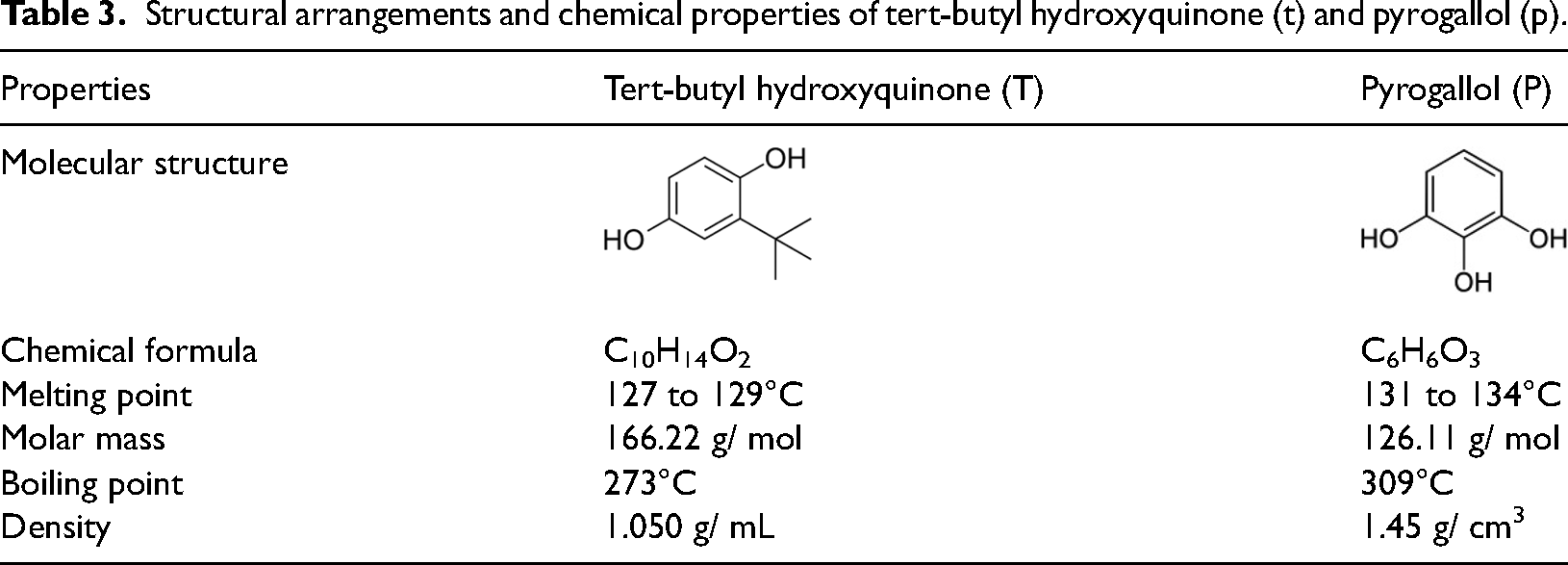
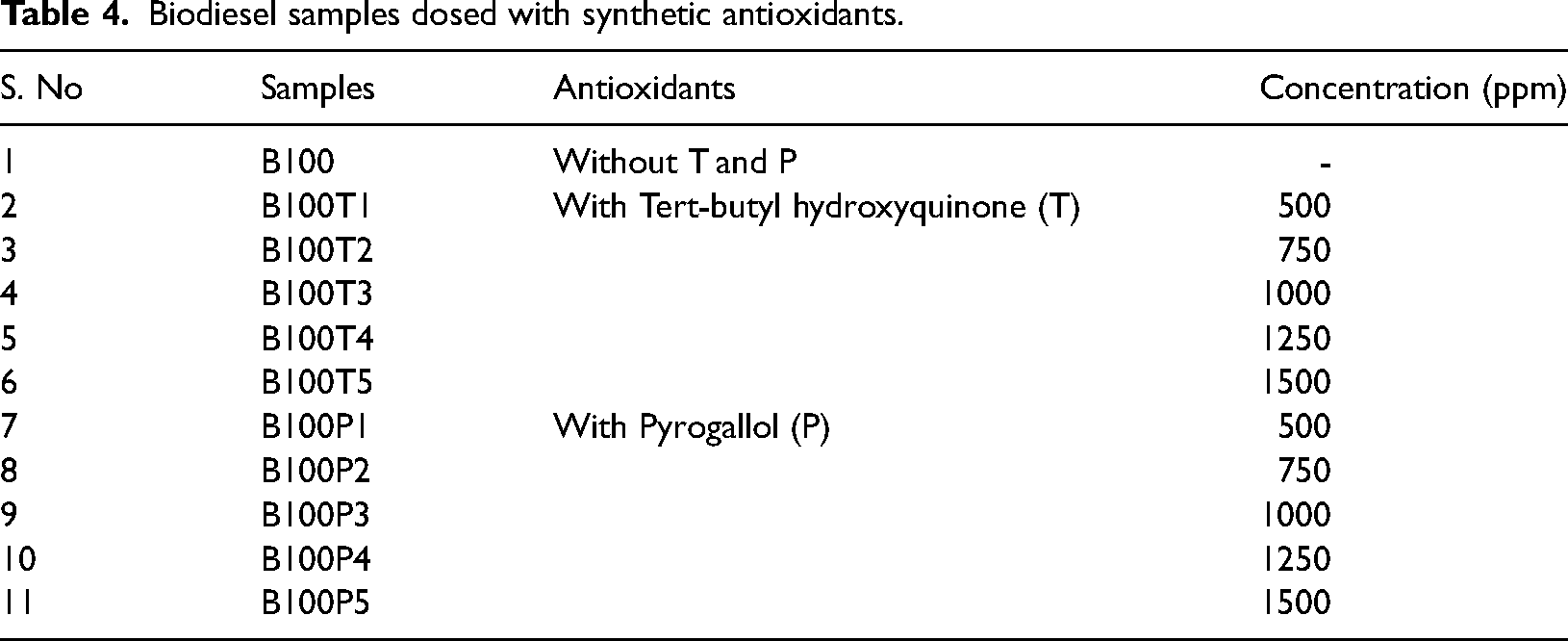
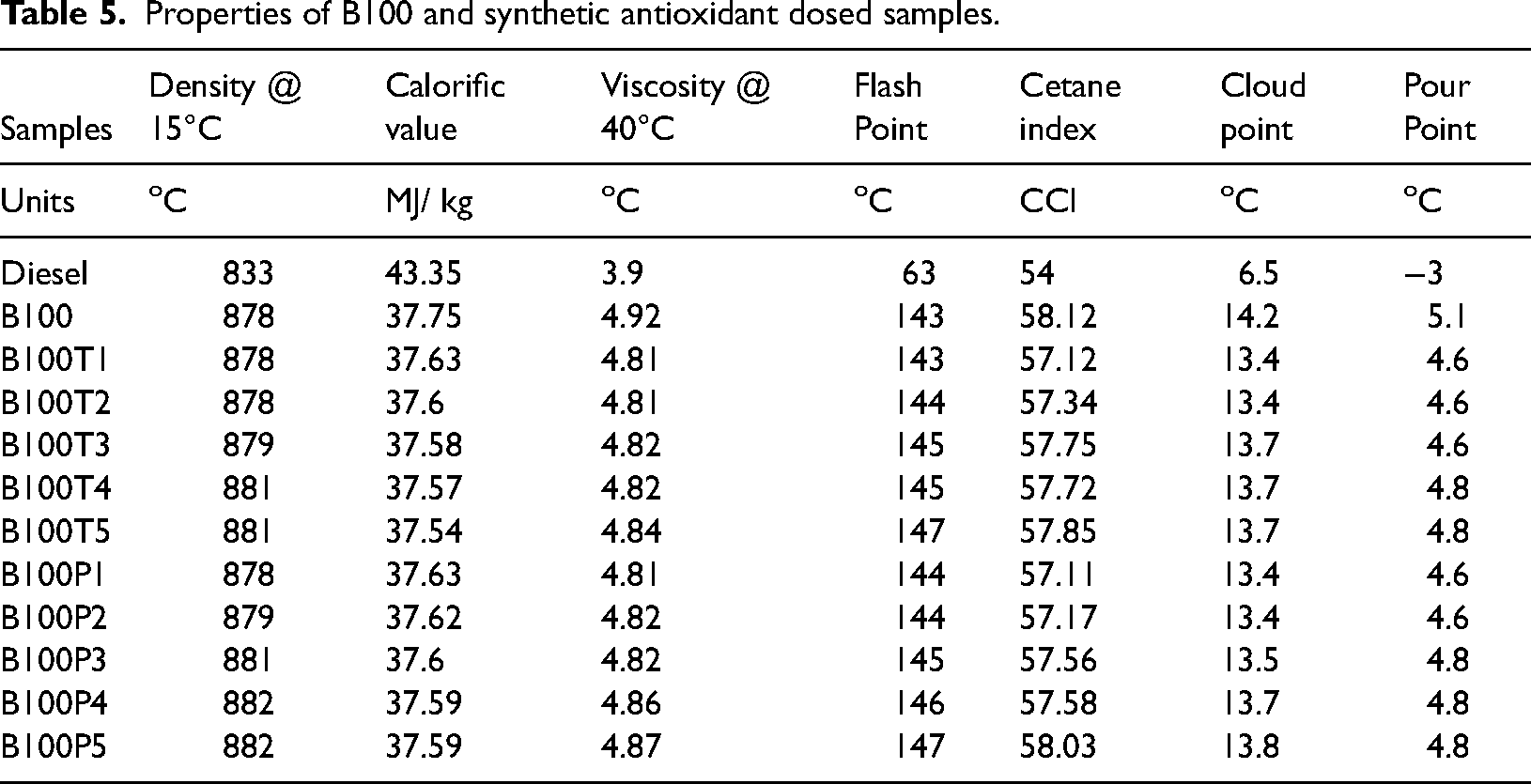
Considering all the above study, this research utilizes two synthetic antioxidants namely Tert-butyl hydroxyquinone (TBHQ) and Pyrogallol (PY) at five equal concentrations analyzing the triple stability criteria mutually for Alexandrian laurel and Poison nut biodiesel blend which has not been performed in earlier studies. This research involves two kinds to antioxidants called Pyrogallol (P) and Tert-butyl hydroxyquinone (T) at concentrations like 500, 750, 1000, 1250, and 1500 ppm measured using microbalance. Table 3 represents the structural arrangements and chemical properties of Tert-butyl hydroxyquinone (T) and Pyrogallol (P). Table 4 represents the biodiesel samples dosed with synthetic antioxidants. Table 5 represents the properties of B100 and synthetic antioxidant dosed samples.
Structural arrangements and chemical properties of tert-butyl hydroxyquinone (t) and pyrogallol (p).
Biodiesel samples dosed with synthetic antioxidants.
Properties of B100 and synthetic antioxidant dosed samples.
Stability analysis using standard equipment
The phrase “fuel stability” represents the conflict against the vigorous oxidation reaction by biodiesel which leads to deprivation in biodiesel properties. The biodiesel can be degraded by stability parameters like oxidation, storage and thermal stability in which vigorous oxidation reaction due to elevated presence of dual bond free fatty acid, unstable physio chemical properties on long term storage due to sunlight exposure, humidity in fuel tanks or lines etc., unbalanced physio-chemical biodiesel properties on exposure to high engine temperature results in asphaltenes deposition which blocks the fuel filters. 32 Considering the above parameters, three stability criteria like oxidation, storage, and thermal stability have been analyzed mutually.
According to EN14214 standard, biodiesel should satisfy the standard induction period of more than 6 h at 110OC for analyzing the oxidation stability which has been followed in stabilizing the oxidation reaction of rapeseed biodiesel with tetra ethylene pentamine antioxidant using rancimat equipment. 33 Using ASTM D675 standard, the Alexandrian laurel biodiesel has satisfied the standard induction period of more than three hours at 110OC. 24 For evaluating the conductivity of B100 samples in the case of oxidation stability in this research, Metrohm 873 Rancimat apparatus has been used, as it gives the best and exact results for previous studies. The KV and AV should be lower for higher performance of the diesel engine when using Poison nut and Madhuca indica biodiesel. 34 Storage stability involves both the kinematic viscosity (KV) and acid value (AV) evaluation for obtaining the elevated storage stability results for B100 samples in this research. TGA has been proved to be the best technique for analyzing the weight changes in physio-chemical properties of biodiesel extracted from waste cooking oil when exposed to higher temperature. 35 Recycling of waste cooking oil, spent coffee grounds and analyzing the quality of binary as well as ternary molecules for thermal stability has been performed by using TGA equipment. The TGA shows that, higher the onset temperature higher the thermal stability. 36 For analyzing the Onset temperature (TON) in the case of thermal stability, the Thermogravimetric analyzer TGA Q500 has been implemented in this study.
To obtain more crystal-clear details about the stability experimental outcomes, FTIR instrument can be used as a validating tool which monitors the oxidation deprivation reaction due to carbonyl ester cluster. 37 A study of stabilizing the waste cooking oil using FTIR and DSC techniques found that TBHQ enhances stability when compared to butylated hydroxytoluene (TBHQ) and Pyrogallol (PY) antioxidants at varying concentrations like 375, 750, 1000, 1125, 1500 ppm. 38 FTIR has given an attractive understanding of cleaner production of Spirulina platensis biodiesel process parameters in which an elevated yield of 92.1% has been obtained. 39 Another study involves usage of FTIR and attenuated total reflectance (ATR) as a determining tool for evaluating the presence of various fatty acid alkyl esters in sunflower biodiesel blends in the range of 4000 cm−1 to 650 cm−1. 40 Heterogeneous catalyst like ZnO-SiO2 and ZnO are blended with waste cooking oil in which the FAME conversion has been characterized using FTIR equipment and obtained stronger chemical bonded particles. 41 The characterization of waste ostrich bones as a catalyst for the production of biodiesel from waste cooking oil has been analyzed by FTIR which shows O-P-O bond vibrations, discharge of CO3−2 ions and the decaying of CaCO3 particles. 42 Similarly, the process of analyzing the molecular arrangements of B100 biodiesel samples and correlating the stability results, playing a major role in stabilizing the B100 samples with antioxidants has been performed with Fourier Transform Infrared Spectroscopy (FTIR).
Working of standard equipment
The working principle of standard equipment used in this research for analyzing the oxidation, storage and thermal stability have been discussed below.
Oxidation stability analysis
Oxidation stability test has been performed to analyze how long the synthetic antioxidant helps dual biodiesel to resist against vigorous oxidation reaction. Initially for reference, pure biodiesel and diesel samples have been tested under EN14214 standard in 873 Rancimat biodiesel equipment. The working of the equipment involves exposing the samples to rich oxygen at high temperature and testing the time it takes to lose its chemical properties. The setup involves two glass tubes, one is the sample holder and the other is filled with distilled water. Both the glass tubes are connected with passage for the vapor particles of the samples to travel to the other side of the glass tube with water while heating. The reference samples like B100 and diesel fuel have been taken initially and samples dosed with P and T antioxidants were taken later. When the sample is kept inside the sample holder glass tube, the sample vapor travels to the distilled water. Automated graph will be generated based on how much amount of vaporfrom sample has been settled in distilled water. The graph will start to show in ascending range until all the components in the sample get transferred to water. Finally, a dive in the graph occurs representing that the sample has degraded and reached its maximum induction period. Following the process, all the samples have been tested for obtaining the induction period readings and a sample graph is shown in Figure 1.

I.P of B100T3 at 110°C.
Storage stability analysis
Storage stability test has been performed to analyze how longthe synthetic antioxidant supports the dual biodiesel storage for a longer period without increasing in the ranges of KV and AV. According to ASTM D4625 standard, the samples have been placed inside incubator at 30OC in aluminium containers for hundred days and tested at equal interval of ten days. For reference, the diesel and B100 sample have been stored for which the readings have been taken through KV and AV tests. It has been observed that, with an increase in storage days, the samples have been exposed to more oxygen inside an incubator, leading to the formation of more oxidation products from peroxide and hydro peroxide oxidation reaction in B100 sample when compared to diesel sample. As the result, the AV and KV of B100 sample hikes to larger amount.
Thermal stability analysis
Thermal stability tests help to understand the confrontation of dual biodiesel against rapid oxidation reaction. Using Q500 TGA equipment, the thermal stability analysis has been performed initially for diesel and B100 sample for reference. The working of the equipment involves exposing the sample placed in a mini sample holder hanging inside to large amount of oxygen. Along with oxygen flow, the sample is heated for the removal of secondary products responsible for oxidation reaction. As the products tend to vapor out, the sample loses its weight and the difference in the sample holder is showed in the form of graph. Similar procedure has been followed for all the antioxidant dosed samples.
Analyzing uncertainty and accuracy
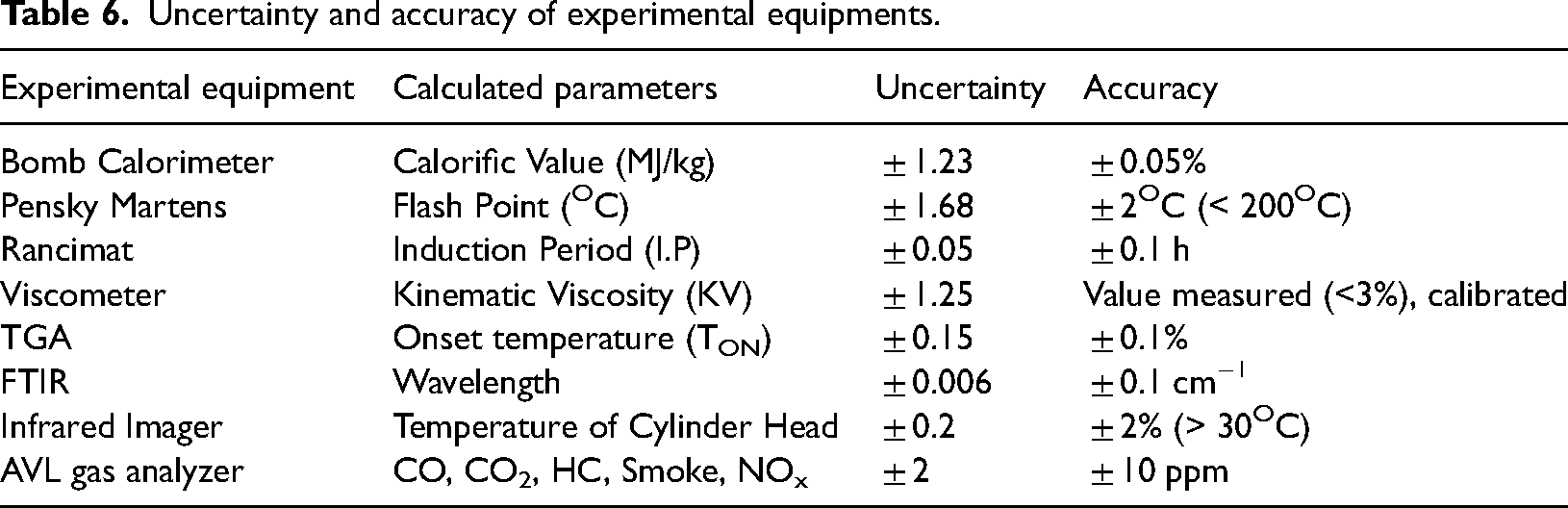
Uncertainty is defined as the refinement of suspicious results that is gained from any standard equipment. By skipping this refinement process, the appropriate results cannot be obtained from measurement. In order to obtain appropriate result, the variables calculated should be accurate for both the uncertainty analysis and equipment. Uncertainty analysis has been followed in previous studies at 95% confidence level by calculating differences among the obtained mean experimental score. 43 To ensure the reliability of the obtained result, triplicates procedure have been followed for all experiments and the outcomes are arranged. Table 6 represents the uncertainty and accuracy of equipment implemented in this study.
Uncertainty and accuracy of experimental equipments.
Weightage and optimization techniques
Statistical optimization is defined as the process of reanalyzing the obtained multiple best results mathematically and gaining the optimum result. Statistical optimization in multiple objective researches brought out the best outcome in previous studies. 44 Among steam sterilization, incineration, landfill disposal, and microwave waste disposal methods, steam sterilization obtained the highest appraisal score and proposed as the best health care waste disposal method by EDAS technique. 45 For selecting the high-performance smartphones among seven alternatives, Asus Zenfone selfie pro has been proposed as the best alternatives by the EDAS technique in which the threat of expert influence over the best alternative has been eliminated. 46 With the help of the TOPSIS method, comprehension evaluation of electric supply, consumption, level of electrification and emission of carbon have been analyzed among 11 countries and the ranking of typical countries has been established. 47
Due to the user-friendly nature and tougher skill to resolve one dimensional issue of TOPSIS optimization and CRITIC weightage technique, it has been used to rank the best oil yielding non-edible feedstock, including 12 physio-chemical properties as input parameters for ranking. 48 During the year 2012 to 2016, the rise and fall in City Innovation Capability of twelve cities in China have been ranked using TOPSIS. 49 Since very small amount of study on biodiesel fuel stability using optimization techniques have been listened carefully, CRITIC weightage evaluation technique, EDAS and TOPSIS optimization techniques have been proposed as a novel approach for ranking the best stable biodiesel blend.
Criteria importance through intercriteria correlation (CRITIC)
CRITIC is another Multi-Criterion Decision Making (MCDM) technique that has been used for evaluating the weightage of the alternative criteria. In the CRITIC technique, the weightage has been evaluated directly from the experimental values of biodiesel blend parameters like I.P, KV, AV, TON, O-H, and C-H which has been given as input without fixing or assuming any critters. By using direct data from the biodiesel parameters, the results can be obtained in a precise manner. This makes the CRITIC technique unique from other weightage evaluation techniques. CRITIC technique is considered as another novel weightage evaluating technique as the usage of CRITIC for evaluating the weightage of biodiesel research is very few in previous studies. The steps involved in CRITIC for evaluating the weightage of biodiesel parameters are as follows. 50
Step 1:
To normalize the decision matrix (
The first and foremost step is to normalize the decision matrix which is the experimental results of biodiesel parameters. The normalization has been performed by using the below-mentioned formula (1).
From formula (1) it has been observed that, the worst (
Step 2:
To evaluate the standard deviation (
After solving the normalized decision matrix, the standard deviation (
Were,
Standard deviation is nothing but the variation that exists in an average result. Low standard deviation represents that the data points tend to be very close to the mean whereas high standard deviation represents that the data points are spread out over a very large range of values. The standard deviation is calculated by working out the simple average of each criterion column (Mean) and subtracts the values of each number in the column by the respective mean value. After subtracting, the result is squared and another mean has been taken for squared differences. Finally, by taking the square root of squared differences to mean, the standard deviation has been obtained for each criterion.
Step 3: Determining the symmetric matrix (n × n matrix)
The symmetric matrix is nothing but the n × n matrix between two criteria in which the upper diagonal matrix will be the same as the lower diagonal matrix calculated by using the linear correlation method. In this research, there are seven criteria in which the symmetric matrix has been performed for 7 × 7 matrices. After preparing the 7 × 7 matrices, the linear correlation has been evaluated by comparing one criterion in the column with other criteria in rows and the same procedure for all criteria in the column to rows. By comparing one criterion with the same criteria, the linear correlation obtained as one and so all the diagonal values have been obtained as one. Finally, the symmetric matrix has been evaluated by using the linear correlation formula (3).
Step 4: Resolving the measure of conflict formed by criterion J to decision situation defined by other criteria
To minimize the bulk amount of data breeding to the confusion of data, the measure of conflict formed by criterion J concerning decision situation defined by other criteria has been resolved by using the below mentioned formula (4). Each value in the symmetric matrix is represented as 
The amount of information with each criterion has been evaluated by using the formula (5). By multiplying the standard deviation values to the measure of conflict values, the quantity of information has been obtained.
Were,
Step 6:
Determining objective weights (
With the help of objective weights formula (6), the weightage for each criterion has been evaluated by dividing the sum of 
EDAS - evaluation based on distance from the average solution
EDAS or Evaluation Based on Distance from the Average Solution is a multi-criterion decision-making method that calculates the distance of each alternative from the average solution and uses this information to select the best alternative. The development of renewable energy sources in developing countries has been blocked by existential barriers in which critical analysis of 23 barriers have been analyzed under 6 headings and ranked using EDAS methodology in a precise manner. 51 As the experimental outcomes in this study have not been obtained in a stable state to select the best biodiesel blend, this research includes EDAS as a novel optimization approach for selecting the best biodiesel blend with antioxidants by ranking various biodiesel stability attributes. The steps involved in EDAS are shown below.
Step 1: Instead of normalizing the decision matrix as in other MCDM methods, the first step is to take the average of all the biodiesel stability attributes with the help of equation (7).
Step 2: This step involves calculating the positive distance from the average solution of step 1 by two separate equations (8 and 9). Equation (8) is for calculating beneficial stability attributes like Induction Period (IP), Onset Temperature (TON), and FTIR result of O-H @ 3400 cm−1. On the other hand, equation (9) is for the calculation of non-beneficial stability attributes like Acid value (AV),Kinematic Viscosity (KV) and FTIR results namely C-H @ 2825.37 cm−1 and C-H @ 2860.29 cm−1. In equation (8), the maximum between zero and the difference between each data 

Were,
Step 3: Calculating the negative distance from the average solution is similar to that of calculating the positive distance from the average solution as of equation (10 and 11). The only variation in this step is the attributes of beneficial stability takes the equation of non-beneficial stability attributes in step 2 and for calculating the non-beneficial stability attributes in this step takes the equation of beneficial stability attributes in step 2.

Were,
Step 4: Each data in the PDA matrix gets multiplied individually as of equation (12) by weightage 
Were,
Step 5: Each data in the NDA matrix gets multiplied individually as of equation (13) by weightage 
Step 6: To normalize the values obtained from 

Step 7: Appraisal score has been calculated by taking the average of normalized values of NSPi and NSNi as shown in equation (16). Based on the decrease in appraisal score, the alternative has been ranked from best to the worst alternative.
Technique for order preference by similarity to ideal solution (TOPSIS)
A situation of selecting the best biodiesel blend out of eleven samples dosed with various antioxidants based on biodiesel stability parameters like I.P, KV and AV, TON, O-H, and C-H can be identified by a well-known optimization method called TOPSIS. Among six hundred test results, twelve criteria and fifty alternatives, the biodiesel samples have been ranked like B100 < B0 < B50 < B20 < B5 using TOPSIS based on emission and performance characteristics. 52 For selecting the best biodiesel blend from fish oil, hybrid MCDM techniques called Multi-criteria Optimization and Compromise Solution – VIKOR (pronunciation) and Technique for Order Performance by Similarity to Ideal Solution – TOPSIS has been used with Analytical Network Process - ANP weightage technique. Among 20%, 40%, 60%, 80% and 100% biodiesel samples, 20% biodiesel sample is selected as the best blend showing elevated engine characteristics by comparing both MCDM technique. 53 With the help of TOPSIS, the shortest distance (i.e. Euclidean distance) of the best alternative from the ideal solution has been identified and the best blends have been given performance score. From previous studies, it is observed that very few experimental researches have been performed in stabilizing the fuel properties and optimizing the obtained best biodiesel blend with the help of TOPSIS. So, TOPSIS has been considered as a novel optimization technique for evaluating the best stability biodiesel blend from obtained experimental results. The steps involved in the TOPSIS method are shown below. 54
Step 1:
Finding vector normalization from the decision matrix (
Initially, the vector normalization has been performed for the decision matrix with the help of formula (19). For calculating the denominator 
Step 2: Calculating the weighed normalized decision matrix
After evaluating the normalized decision matrix, with the help of formula (18) each performance value in each criterion gets multiplied by the respective weightage value for each criterion obtained from the CRITIC method. After multiplying the weightage values to the normalized decision matrix, the obtained results are known as a weighed normalized decision matrix.
Step 3: Finding Euclidean distance from Ideal best and ideal worst value
The evaluation of Euclidean distance from Ideal best (

Were,
Before finding the value of Euclidean distance from Ideal best and ideal worst, it is necessary to find the ideal best (
For calculating the Euclidean distance from ideal best value (
Step 4:
Finding the performance score (
Finally, after evaluating the Euclidean distance from Ideal best (
Dividing each ideal worst value (
Infrared imaging technique (IIT) for combustion analysis
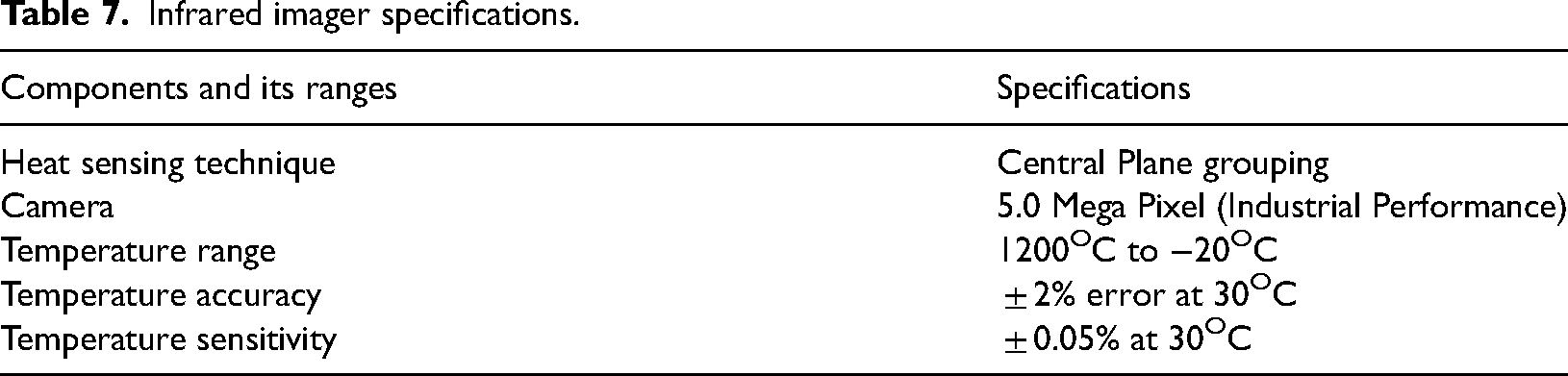
Figure 2 represents the Infrared Imager and Table 7 represents the specifications of the equipment involved in this research. The fuels used in IC engine possess nitrogen compound and atmospheric oxygen plays an important role for burning the fuel.

Fluke Ti400 infrared imager.
Infrared imager specifications.

Preceding research shows that blending synthetic antioxidants like butylated hydroxyl toluene (BHT), Butylated hydroxyl anisole (BHA), tert butyl hydroquinone (TBHQ) and 2-ethyl hexylnitrate (EHN) with canola oil results in reduced NOx as well as increased oxidation stability with no changes in diesel engine parameters and design. 56 In another study, pig fat and waste cooking oil were mixed together and through transesterification process, bio mix methyl ester has been extracted. It has been observed that, if the temperature within the combustion chamber raises so does the amount of NOx emission. 57 To visualize the antioxidant influence on reducing the NOx emission, Infrared Imaging Technique (IIT) is a novel approach for locating the CCT and exhaust gas temperature (EGT), as the NOx emission and CCT characteristics are simultaneous to one another. As stated before, temperature of diesel engine cylinder head is the main factor for hike or drop in NOx emission level. 58 For determining the cylinder head temperature; conventional vehicle engines are equipped with sophisticated sensing devices. Since the sensing devices are feasible and works with high accuracy output, much significance is provided for sensing devices rather than IIT. The main disadvantage of sensing devices is its inability to monitor the combustion chamber hotspot. Only the total temperature of combustion chamber will be measured. This can be avoided by using IIT with two benefits in which, it precisely identifies the hotspot as well as reducing NOx emissions using antioxidants. Depending on the infrared radiations from combustion chamber, the equipment depicts the images. The Imager depicts the Infrared radiations and computes the predictable value of temperature on particular area. By focusing the laser pointer from the IIT equipment, the CCT has been measured for all the test samples. By doing so, the readings were stored in the IIT equipment memory as image for future analysis. The current study involves IIT to analyze the combustion chamber hotspot, EGT and their connection with NOx emission for biodiesel blends with various synthetic antioxidant and concentrations.
Antioxidants effect on diesel engine characteristics
With the aid of an AVL gas analyzer and varying compression ratio diesel engine as shown in the Figure 3, the emission characteristics have been analyzed. From previous studies, it has been observed that the emission level of a diesel engine using non edible and edible biodiesel feedstock can be reduced with and without any operating parameters changes in the diesel engine. 59 In Moringa oleifera biodiesel, the cetane number and NOx emission has been decreased by blending Pyrogallol antioxidant while testing in diesel engine at standard operating conditions. 60 As the antioxidant alters the physical properties of biodiesel, the cold flow property which is the major problem for a diesel engine can be reduced.

AVL gas analyzer and varying compression ratio diesel engine.
Objectives of this study
Results and discussion
Fuel stability – oxidation stability analysis
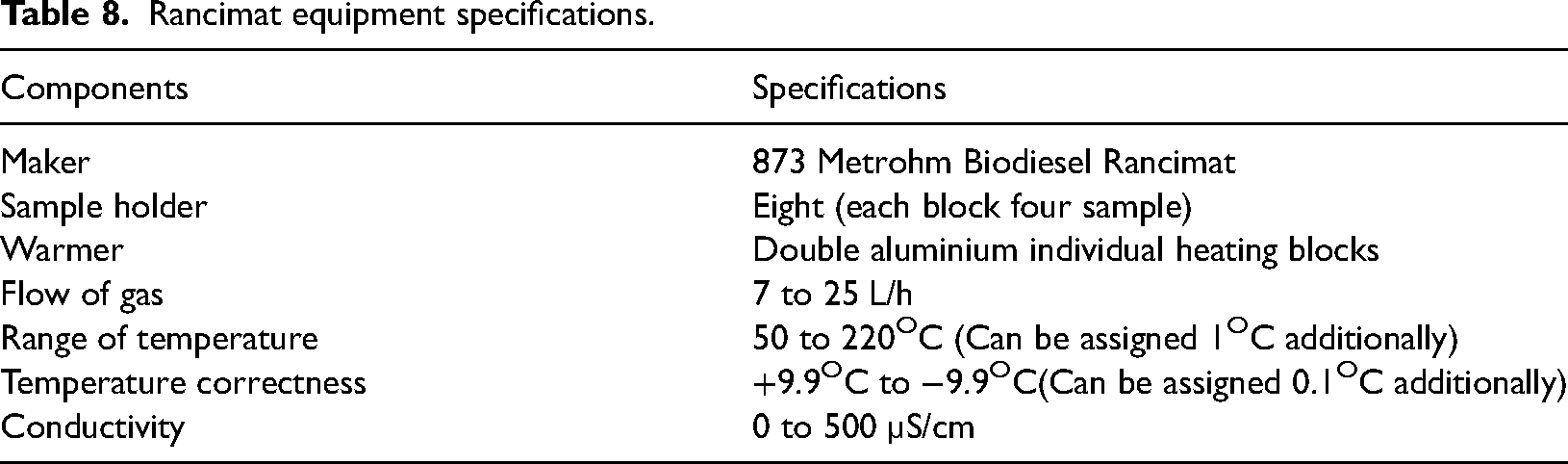
Figure 1 represents the induction period of B100T3 sample obtained from the computerized rancimat software. Table 8 represents the rancimat equipment specifications used for analyzing the European standard (EN14214) of meeting biodiesel induction period at 110OC for more than 6 h. As the biodiesel blend in this research is a novel mixture, the stability tests have been performed initially for pure biodiesel without diesel mixing.
Rancimat equipment specifications.
The assurance has been obtained for all antioxidant dosed B100 samples by satisfying the EN14214 standard induction period of 6 h at 110°C. At 110°C among all antioxidant dosed samples, B100T3 represents an elevated induction period of 48.26 h. The measured I.Ps at 110°C in terms of hour is in the order of B100 (8.15 h) < B100P1 (10.8 h) < B100P2 (19.13 h) < B100T1 (19.46 h) < B100P5 (21.4 h) < B100P4 (27.44 h) < B100T2 (28.04 h) < B100T5 (34.07 h) < B100P3 (35.85 h) < B100T4 (36.5 h) < B100T3 (48.26 h).
Figures 4 and 5 represents the extrapolated I.P in hours for B100 samples dosed with T and P antioxidants at various concentrations. By testing at four equal temperatures as 140°C to 155°C, the variations in I.P of Alexandrian laurel and Poison nut (B100) biodiesel and the effect of T and P dosage with B100 have been investigated. T and P dosed B100 samples show an average of 69.64% and 62.72% of higher stability respectively than the B100 sample without antioxidants. Figure 6 represents the extrapolated I.P in hours at 30OC for B100 and antioxidant dosed samples. It is observed that up to B100P3 and B100T3 samples (i.e at 1000 ppm) I.P shows ascend in their range and beyond B100P3 and B100T3 samples, the I.P descend in their range. The increase in oxidation stability by adding antioxidant is due to the supply of hydrogen atoms from its phenolic hydroxyl group to peroxyl radical, interrupting the formation of oxygen molecules chain reaction avoiding the production of additional free radical which propagates further oxidation reaction. 71 For both antioxidant dosed samples there occurs declination in oxidation stability beyond 1000 ppm due to the breakage of hydrophilic and hydrophobic chemical structure, exposing the sample to more oxidation reaction.

Rancimat extrapolated testing temperatures of t dosed samples.

Rancimat extrapolated testing temperatures of p dosed samples.

Extrapolated induction periods for test samples.
While comparing T and P dosed B100 samples, Tert-butyl hydroxyquinone shows an average of about 9.93% elevated oxidation stability than Pyrogallol dosed B100 samples. The higher action of TBHQ than PY antioxidant is due to the liberation of TBHQ products while reacting to biodiesel, which is more acidic and same as that of TBHQ antioxidant activity preventing the oxidation reaction. 72 This characterization can be seen evidently for Tert-butyl hydroxyquinone from the FTIR spectrum by the transmittance percentage (%T) of O-H and C-H bonds (Figure 10).
Fuel stability - storage stability analysis
The biodiesel sample has been stored for hundred days in aluminium containers and storage stability tests have been conducted for 10 days’ time interval. The comparison graphs for KV and AV on the hundredth day for B100 and B100 samples with T and P have been shown in Figure 7 and 8.

Kv of antioxidant dosed samples.

Av of antioxidant dosed samples.
The pure biodiesel (B100) and B100 samples dosed by T and P with respective concentrations shows constant peak in the range of kinematic viscosity (KV) and acid value (AV). Though, the redwood antioxidants have been tested for an identical period of 10 days, it has been observed that on the hundredth day, KV ranges of T dosed samples shows 49.79%, 50.20%, 51.21%, 50.30%, and 49.79% for B100T1, B100T2, B100T3, B100T4, and B100T5 whereas an average of 50.25% lower KV have been observed while AV ranges of T dosed samples shows 42.30%, 45.38%, 56.92%, 48.46% and 42.30% for B100T1, B100T2, B100T3, B100T4 and B100T5 also an average of 47.07% lower AV range has been observed. The lengthier the biodiesel storage period, the KV increases due to development of additional polar, oxygen comprising particles and polymeric oxidized molecules which leads to production of deposits and latexes obstructing the fuel injectors. 73 The AV also increases due to the chemical reaction which produces fatty acid from fatty acid methyl ester. 74
On the hundredth day, KV ranges of P dosed samples shows 50.20%, 50.60%, 50.60%, 50.40%, and 49.59% for B100P1, B100P2, B100P3, B100P4, and B100P5 while an average of 50.27% lower KV range have been observed and AV ranges of P dosed samples shows 43.33%, 50.01%, 54.35%, 48.46% and 40.76% for B100P1, B100P2, B100P3, B100P4 and B100P5 and an average of 47.38% lower AV range has also been observed. Among the ten antioxidants dosed samples, B100P3shows 50.60% and 54.35% lower KV and AV, whereas B100T3shows 51.21% and 56.92% lower KV and AV. Taking as a whole, B100T3 shows 1.19% and 4.51% lower KV and AV than B100P3 which proved their superior storage stability. Similar to oxidation stability outcomes, the storage stability test also shows decrement beyond 1000 ppm due to superior chemical structure of synthetic antioxidants. The higher storage stability characteristics of TBHQ antioxidant are the development of shielding layer around copper molecules from fuel tank due to corrosion which is the main source for increase in AV and KV of biodiesel. 75
Fuel stability - Thermal stability analysis
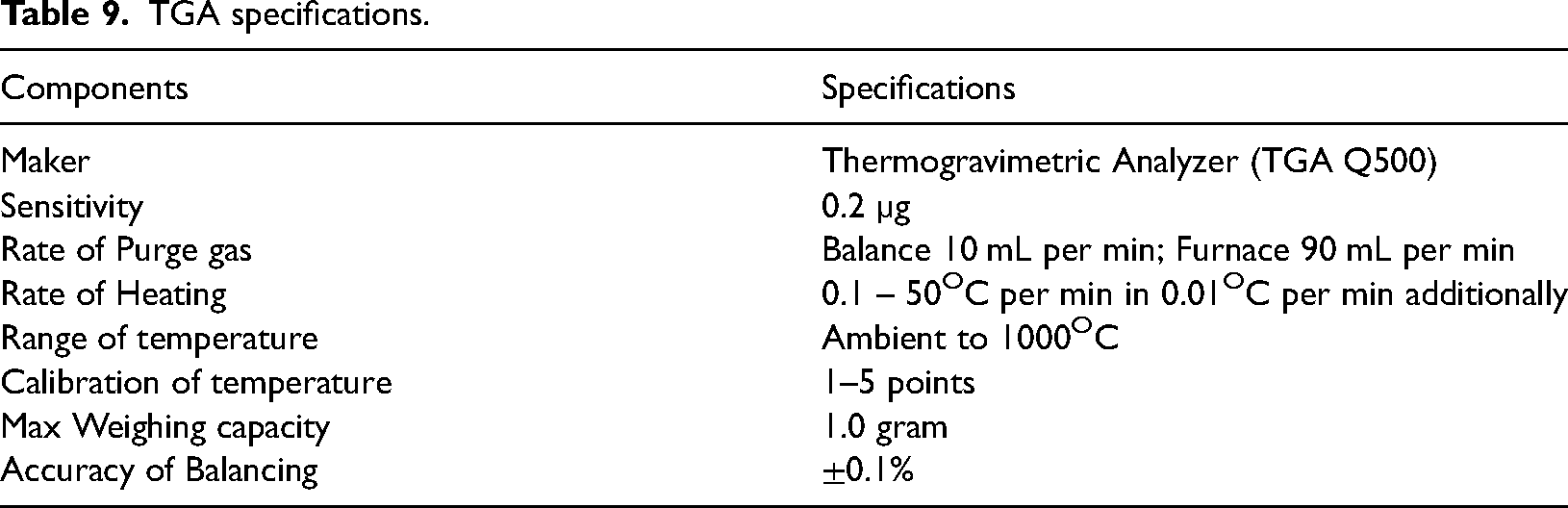
Figure 9 represents the graphical illustration of diesel and biodiesel samples onset temperature from TGA Q500 Thermo-gravimetric analyzer. Table 9 represents TGA specifications in which the variation in thermal properties of B100 samples has been analyzed. The major composition of non-edible oil is the oleic and linoleic fatty acid which can be observed from Table 2. The weight loss on biodiesel is due to the combustion/evaporation of oleic and linoleic fatty acids which are higher in number in both Alexandrian laurel and Poison nut biodiesel.25,76 The elevated thermal stability can be justified only if the testing sample shows a higher TON. 77 At higher temperature, the polymer molecules are produced due to Diels Alder reaction which increases the viscosity of biodiesel. 78 Another study proves that with increase in oxidation temperature the oil stability index decreases. 79 As the degradation of biodiesel takes place due to thermal reaction, AV value also increases which increases viscosity. All these characteristics take place due to oxidation reaction in biodiesel.

TON for t and p dosed samples.
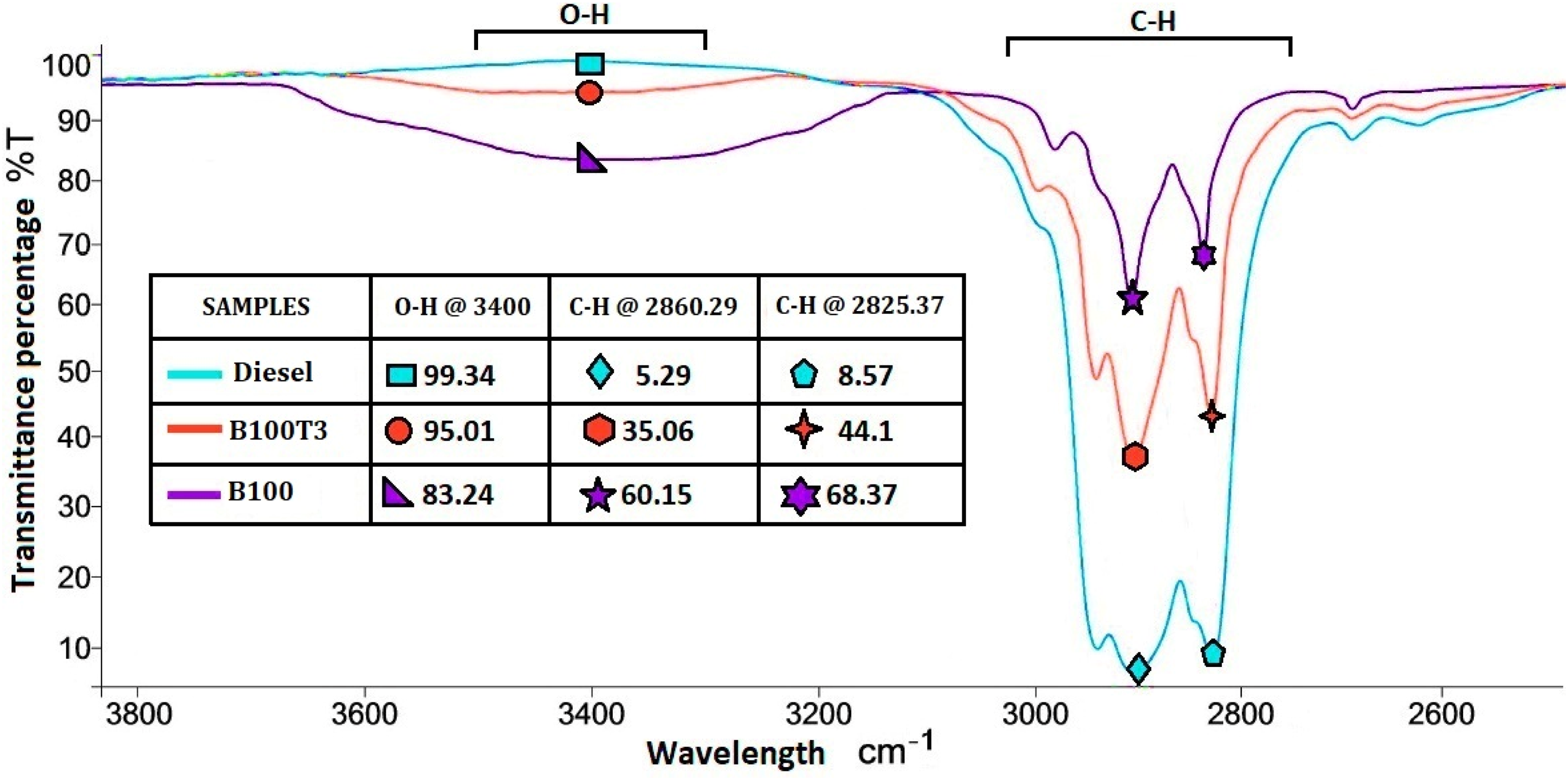
FTIR spectrums of test samples.
TGA specifications.
An extremely small quantity of samples and no pretreatment is necessary for testing in TGA equipment. There are three divisions involved in automated TGA graphs which are onset temperature, max degradation and offset temperature. Onset temperature division represents the time period in which the sample faces around 1% weight drop at the range of 100OC. Max degradation division represents the rapid weight drop at the range of 200OC after 30 min. Offset temperature division represents the temperature at which the sample loses its entire properties at the range of 280OC, beyond where there is no sample conversion occurs. The onset temperature (TON) of B100 shows 117.47°C which is 60.60% lower than commercial diesel fuel. B100 samples dosed with T shows 12.68%, 21.40%, 38.36%, 38.55%, and 37.73% for B100T1, B100T2, B100T3, B100T4 and B100T5 and an average of 29.74% elevated (TON) thermal stability than pure biodiesel. B100 samples dosed with P shows 7.24%, 17.70%, 33.06%, 32.91%, and 20.09% TON for B100P1, B100P2, B100P3, B100P4, and B100P5, and an average of 22.2% higher (TON) thermal stability than pure biodiesel (B100). While comparing higher TON of T and P dosed B100 samples, Tert-butyl hydroxyquinone sample shows 25.35% higher thermal stability than Pyrogallol dosed B100 samples which is because of the presence of more attachments of OH groups on aromatic ring, providing supplementary positions of complex between antioxidant and free radical for ester chain stabilization. 80
FTIR – Correlating tool of stability outcome
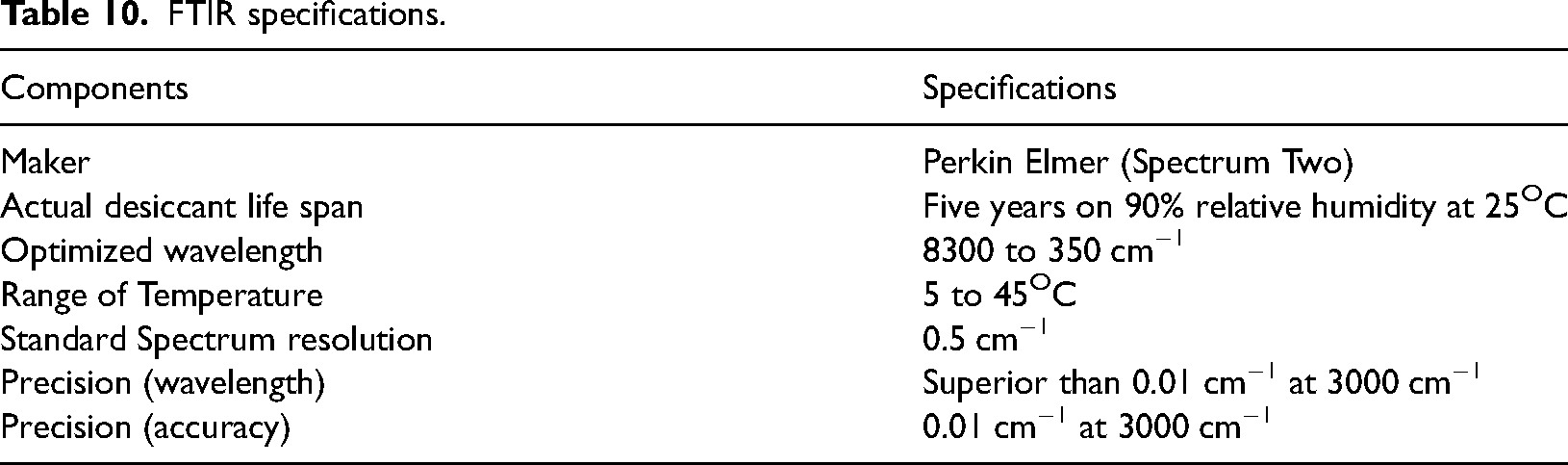
Table 10 represents FTIR equipment specifications, a novel correlation tool which shows the molecular arrangements and transmittance percentage (%T) for molecules like O-H and C-H in biodiesel samples responsible for longer fuel stability, and from the FTIR results, the stability results can be correlated. The wavelength frequency of 2400 to 4000 cm−1 has been implemented in this study. Depending on the fatty acid concentration of biodiesel in earlier studies, the presence of O-H and C-H molecules which is responsible for biodiesel stability have been obtained in the wavelength between 4000 cm−1 to 300 cm−1.81,82
FTIR specifications.
The occurrence of O-H molecule representing the moisture content which augments the oxidation reaction and C-H represents the occurrence of carbon molecule. Figure 10 shows the incidence of variations in C-H and O-H transmittance percentage for diesel, B100T3 and B100 samples. Initially, for commercial diesel, the FTIR spectrum has been analyzed and shows %T of 99.34% for O-H at 3400 cm−1 wavelengths, 5.29% for C-H at 2860.29 cm−1 wavelength, and 8.57% for C-H at 2825.37 cm−1 wavelength. As the presence of carbon in diesel fuel is a natural entity, the carbon molecules consume the oxygen molecules and converts into carbon dioxide paving the way for longer storage days without degradation which can be visualized through FTIR. Secondly, for B100, the FTIR spectrum has been analyzed and shows %T of 82.24% for O-H at 3400 cm−1 wavelength, 60.15% for C-H at 2860.29 cm−1 wavelength, and 68.37% for C-H at 2825.37 cm−1 wavelength. When compared to carbon, oxygen molecule is more electronegative which draws additional oxygen molecules leading to production of hydro-peroxide and peroxide is responsible for further oxidation reaction. 83 The diesel spectrum indirectly represents that; %T of diesel contains 0.66% O-H at 3400 cm−1, 94.71% C-H at 2860.29 cm−1 and 91.43% C-H at 2825.37 cm−1. The B100 spectrum indirectly represents that; %T of B100 contains 16.76% O-H at 3400 cm−1, 39.85% for C-H at 2860.29 cm−1and 31.63% for C-H at 2825.37 cm−1. The crowning which occurs between the wavelength of 3000 cm−1 to 2800 cm−1 suggests the presence of methylene or methyl groups in B100 ester chain. 84 By evaluating diesel and B100 spectrum it is observed that B100 contains an average of 96.04% higher O-H at 3400 cm−1, 57.92% lower C-H at 2860.29 cm−1, and 65.40% lesser C-H at 2825.37 cm−1. To reduce the O-H molecules and to increase the C-H molecules in pure biodiesel, B100 samples with T and P, at respective concentrations have been analyzed. By blending T and P, at respective concentrations it has been observed that Tert-butyl hydroxyquinone sample shows %T of 95.28% O-H at 3400 cm−1, 35.06% C-H at 2860.29 cm−1, and 43.97% C-H at 2825.37 cm−1 when compared to P dosed B100 samples.
As T antioxidant possess elongated carbon chain structure, there happens a sturdy C-H bonding between antioxidant and biodiesel. This C-H bonding encircles the O-H bonding, preventing the free radical strike. Since the O-H molecules are encircled by C-H molecules, it takes supplementary period for free radicals to assault the O-H molecules leading to longer storage period of biodiesel. When the TBHQ is added in a huge amount (i.e above 1000 ppm), the biodiesel stability has been disturbed due to weakening of formed hydro-peroxide and peroxide by upsetting the alignment of band which exposes the O-H molecules to free radical reaction. 83
Core motive for implementing optimization techniques
As of the experimental results, it is observed that better stability results have been obtained in the order as follows. For oxidation and storage stability, B100T3 has been obtained as preeminent whereas, for thermal stability, B100T4 has been obtained as a preeminent result. Similarly, in the FTIR spectrum, for O-H at 3400 cm−1 and C-H at 2825.37 cm−1 sample called B100T4 and for C-H at 2860.29 cm−1 sample called B100T3 has been obtained as a preeminent result. Best performance should be given only by one sample among (n) number of samples. To obtain the best result, the optimization techniques like EDAS and TOPSIS assisted with the weightage calculation method called CRITIC have been implemented in this research as a novel approach.
Weightage evaluation techniques
CRITIC technique
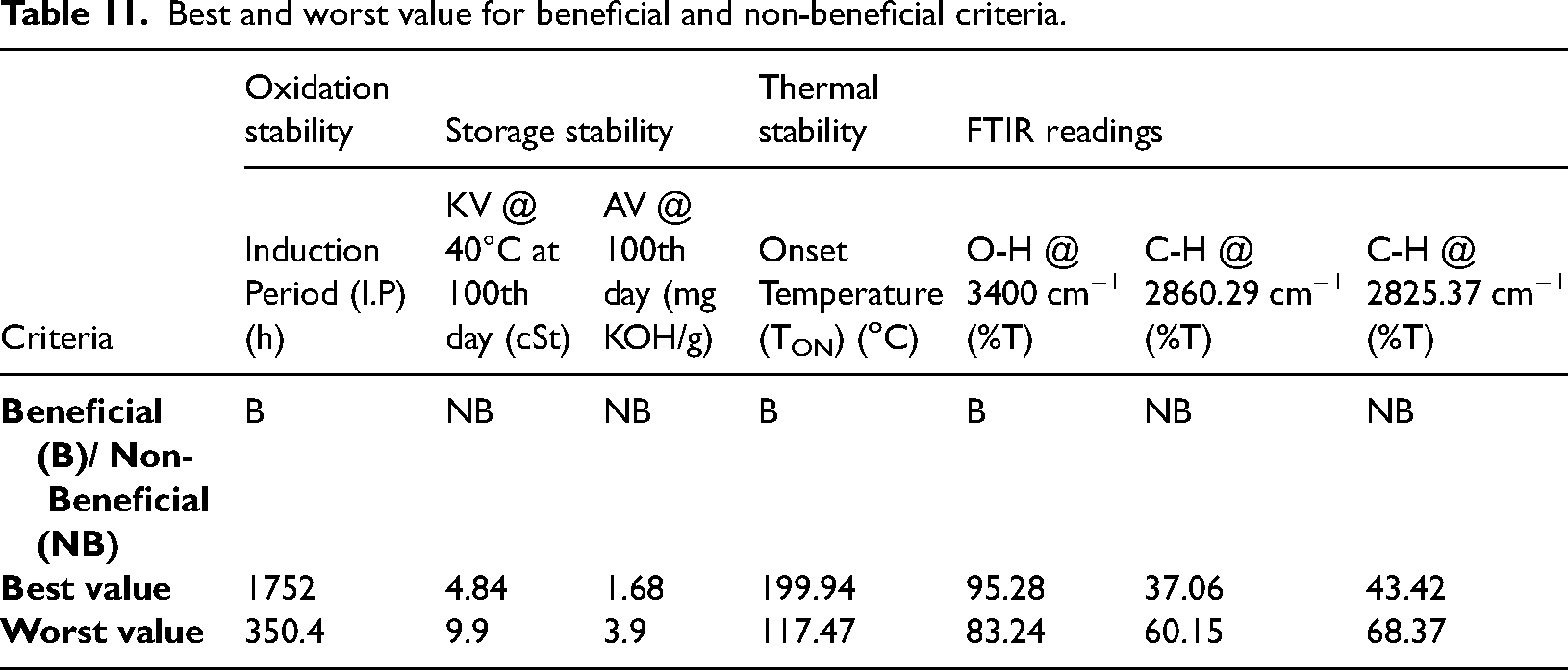
Following the CRITIC technique, the weightage of biodiesel stability parameters has been obtained by manual calculations as follows. For normalizing the decision matrix which is the experimental results using formula (1), the initial step of fixing the beneficial and non-beneficial criteria has been fixed from biodiesel blend according to step 1. Table 11 represents the best and worst value for beneficial and non-beneficial criteria. After setting up the best and worst value, the decision matrix has been normalized using the formula (1) and the normalized decision matrix results for antioxidant added samples were evaluated. From the normalized decision matrix results, the standard deviation for antioxidant dosed samples has been evaluated using formula (2) and it is shown in Table 12. After evaluating the standard deviation results, the symmetric matrix for normalized decision matrix has been evaluated using linear correlation formula (
Best and worst value for beneficial and non-beneficial criteria.
Standard deviation (

Symmetric matrix for the normalized decision matrix.
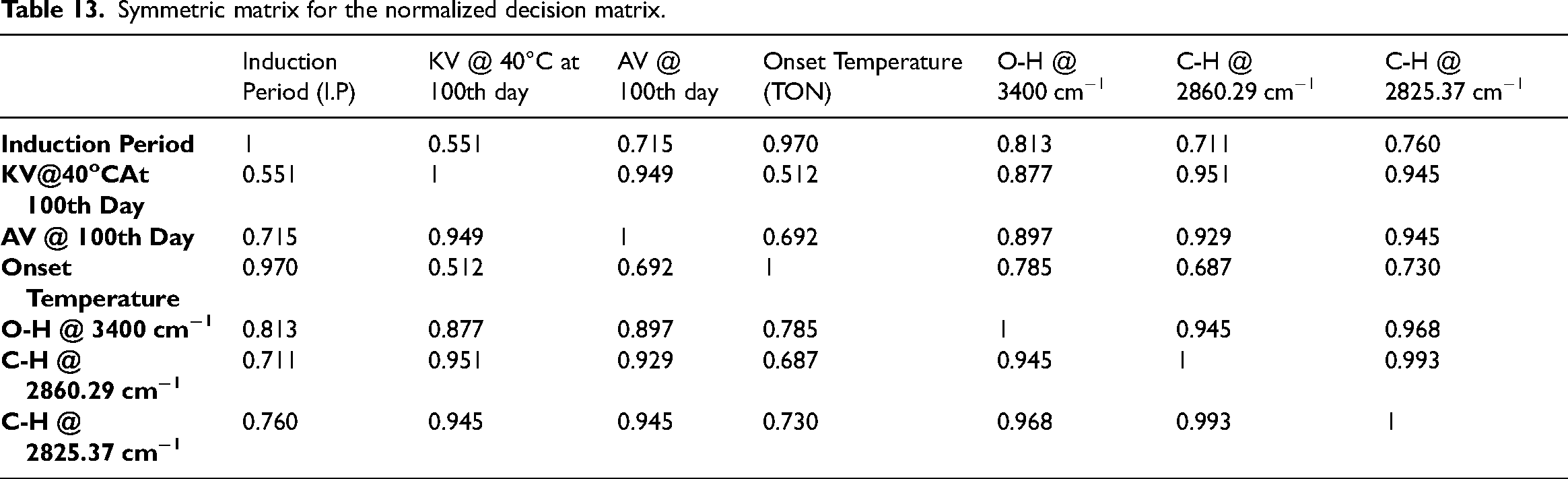
By using the formula (4), the bulk amount of data from the symmetric matrix has been reduced by subtracting the values of
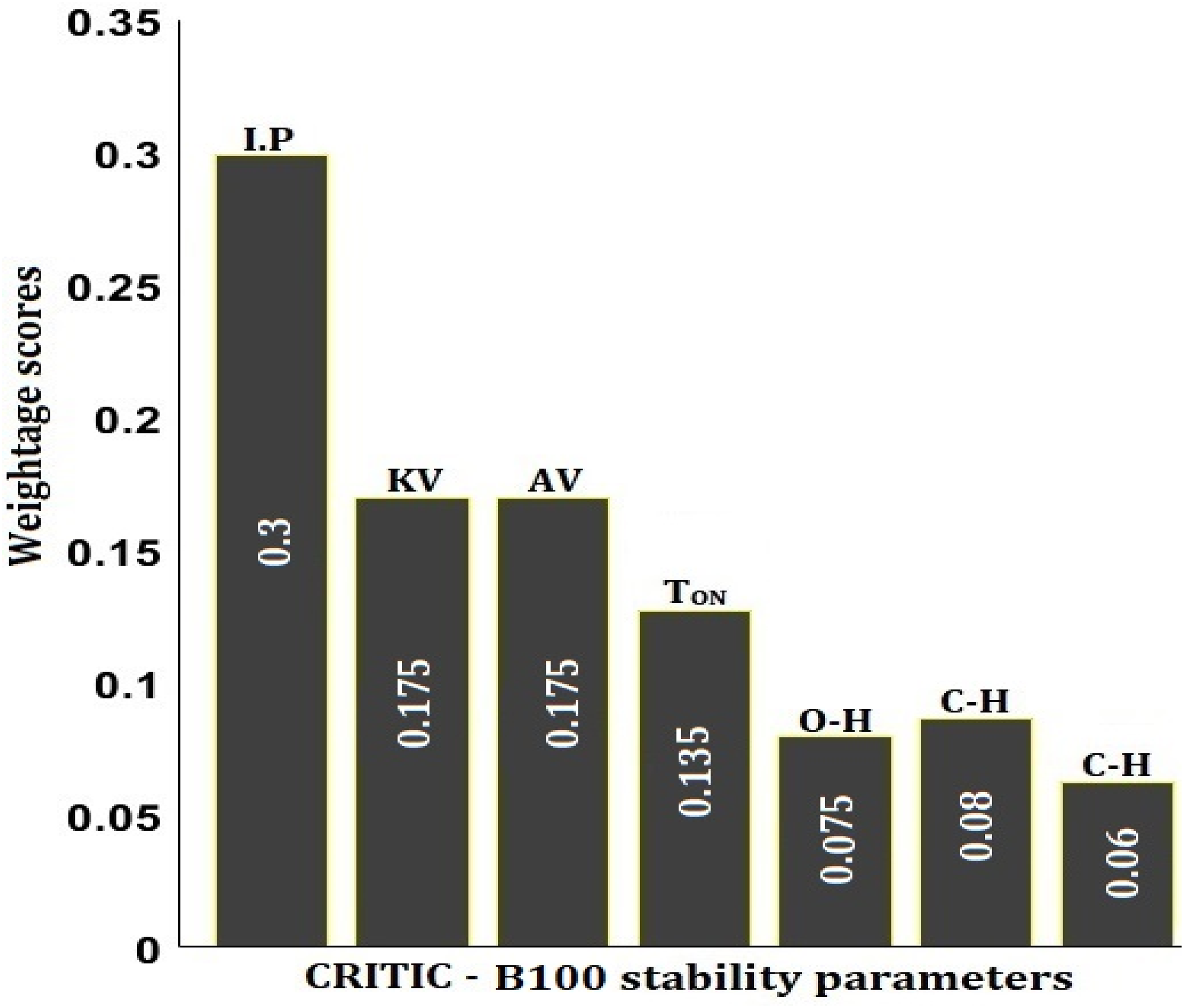
Final weightage score of CRITIC technique.
Calculated weights of each criterion.

Optimization evaluation techniques
EDAS technique
As of EDAS optimization procedure, the average solution
Average solution of biodiesel stability attributes.

Weighted sum
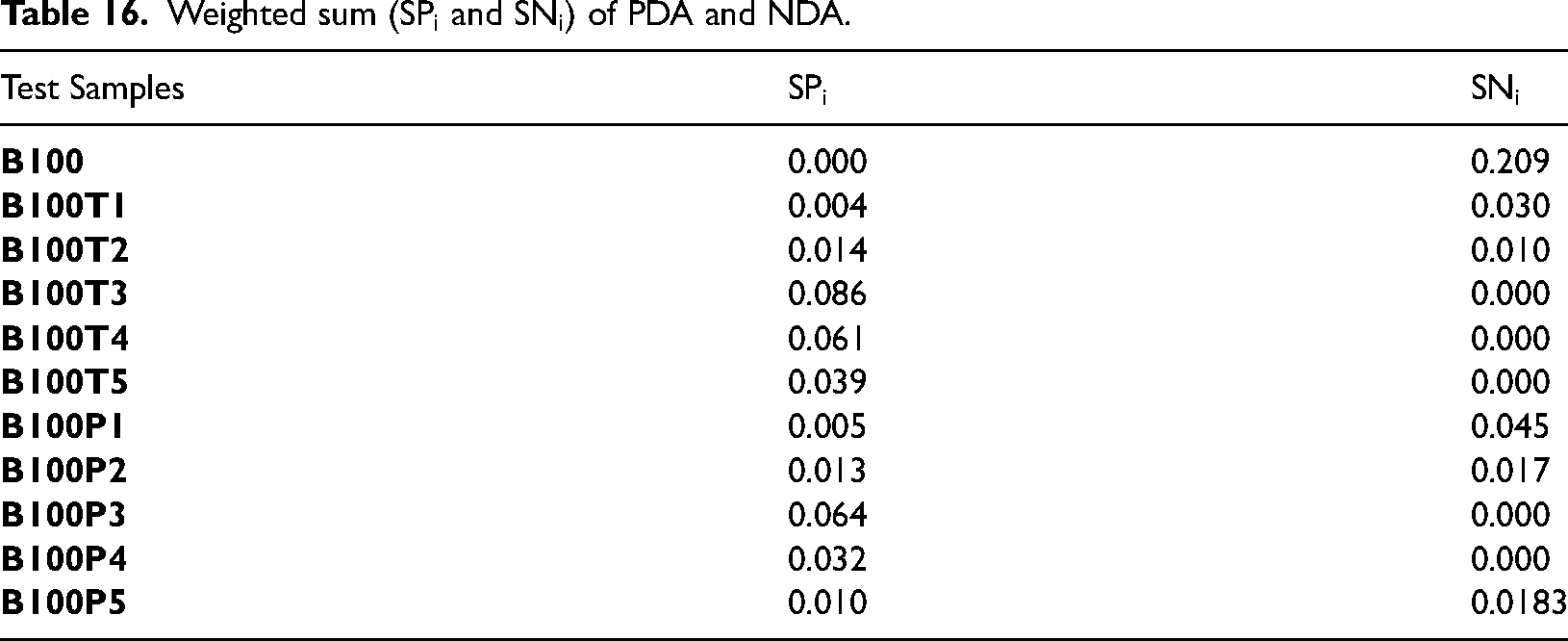
Normalized values (NSPi and NSNi) of
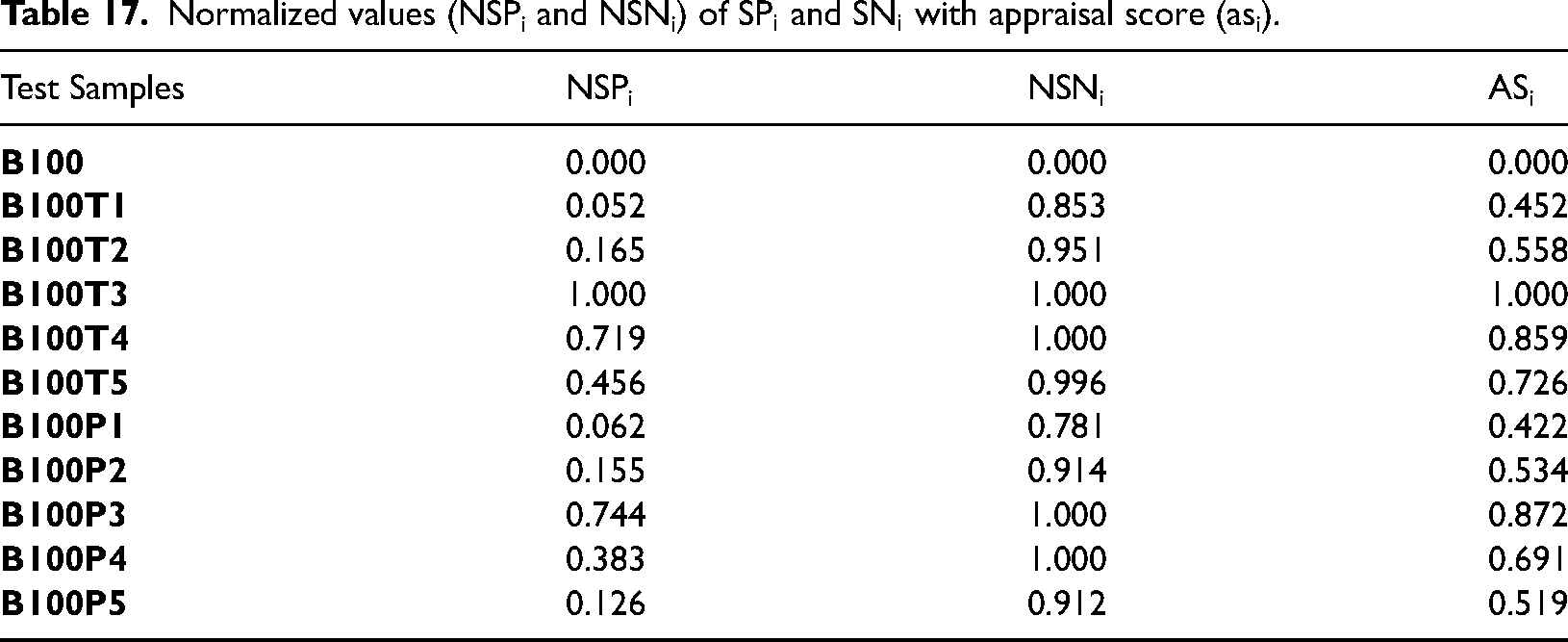
By observing the appraisal score of the EDAS method, B100T3 at 1000 ppm obtains the highest appraisal score when compared to other biodiesel blending with various quantities of T and P dosage which shows 7.05% eminent fuel stability when compared to B100P3. The higher score in the EDAS method for PA100T3 is due to the suppressing action of T over the hydrophobic and hydrophilic arrangement, leading to a vigorous oxidation reaction that takes place in pure biodiesel (B100) when compared to P antioxidant dosed samples.
TOPSIS technique
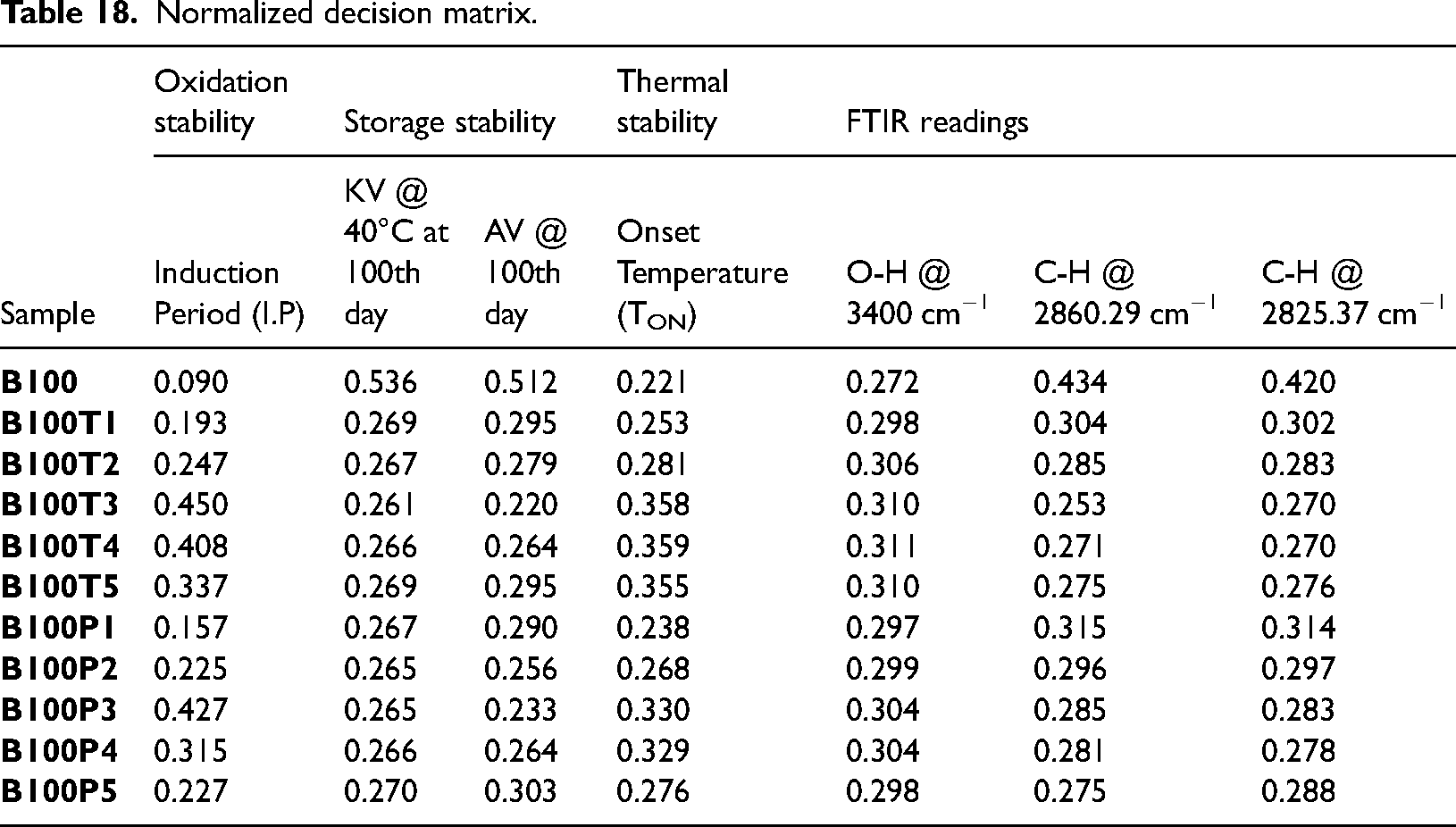
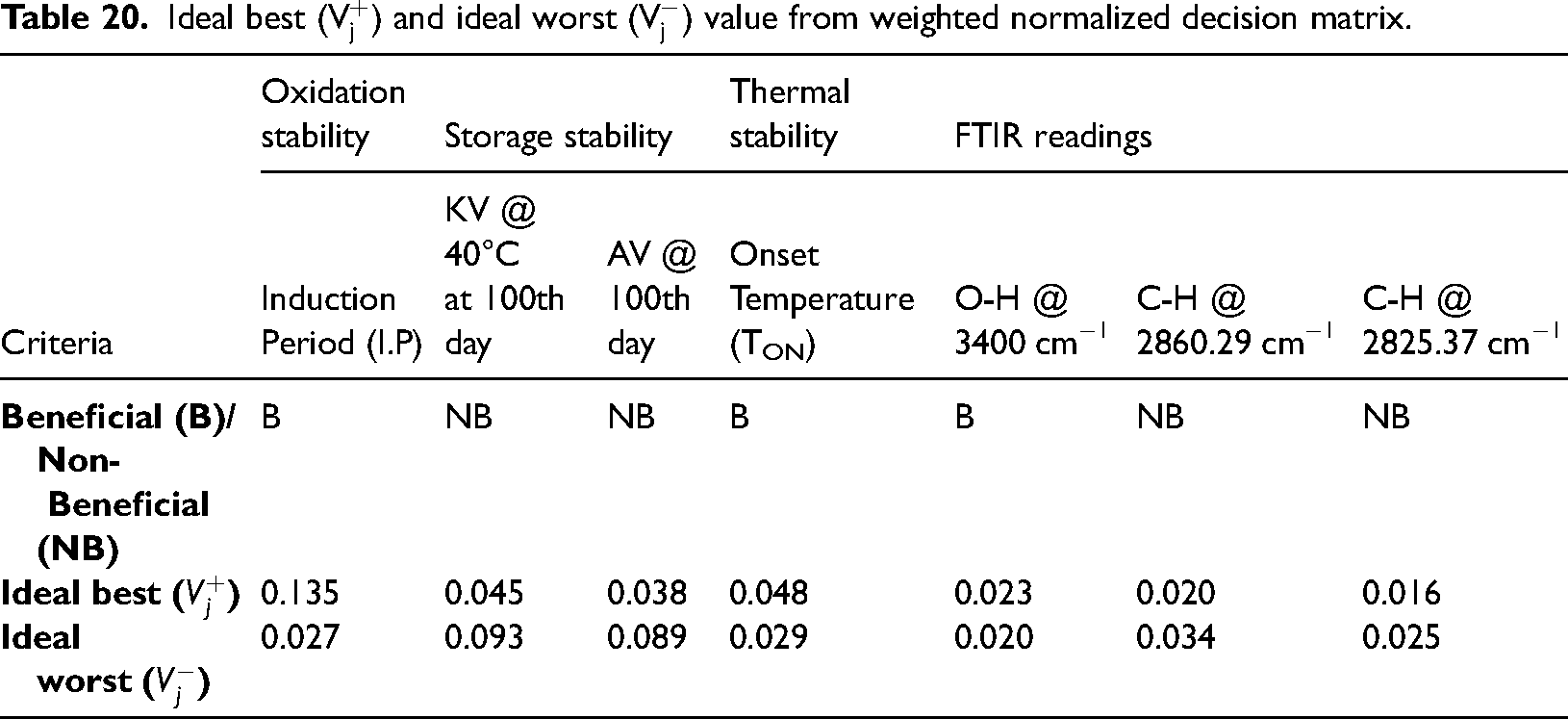
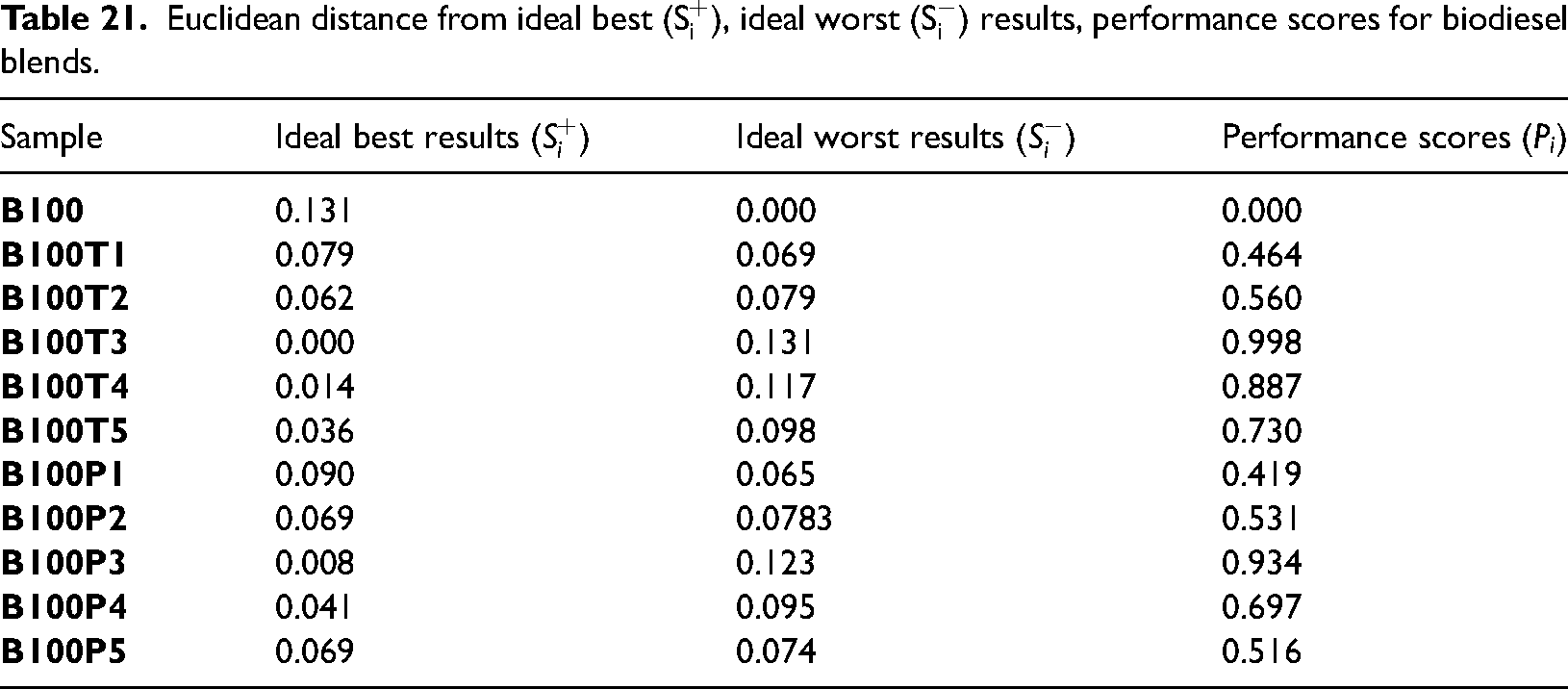
From the methodology of Technique for Order Preference by Similarity to Ideal Solution (TOPSIS), the preference scores for biodiesel blend dosed without and with antioxidants like Tert-butyl hydroxyquinone (T) and Pyrogallol (P) at five equal concentrations like 500, 750, 1000, 1250, and 1500 in ppm has been obtained. Initially from the decision matrix (i.e. experimental results of stability parameters), the normalized decision matrix has been obtained with the help of formula (17) and shown in Table 18. From the normalized decision matrix, the weighed normalized decision matrix has been evaluated manually with the help of formula (18) and shown in Table 19. After evaluating the weighted normalized decision matrix, the Euclidean distance from ideal best (
Normalized decision matrix.
Weighted normalized decision matrix.

Ideal best (
The Euclidean distance from ideal best (
Euclidean distance from ideal best (
Focalization of EDAS and TOPSIS results
Table 22 represents the appraisal scores (ASi) of EDAS technique and performance scores (
Appraisal scores (asi) of EDAS technique and performance scores (

While comparing B100T3 and B100P3 samples in the EDAS technique, the T dosed biodiesel sample (i.e.B100T3) shows a superior preference score as the T antioxidant release the chemicals during oxidation reaction which are more effective than TBHQ for stabilizing the biodiesel properties.85,86 On the whole, B100T3 has been the first rank and B100P3 as the second rank whereas B100 is the pure biodiesel without antioxidant dosage gets the poor rank of eleven. The remaining ranks have been given to biodiesel samples according to the appraisal score of the EDAS technique.
The input data given for the EDAS optimization technique has been given similarly for the TOPSIS optimization technique and the preference score(
Nox emission and IIT assessment
The NOx emission reduction from biodiesel is a greater mechanical challenge met by the automobile industries, since there has been strict regulation on emission control from commercial diesel engine. 87 The NOx emission affects the ecosystem which disturbs animals and plants that depend on water and land. It also affects the livelihood of human whodepends on those plants and animals. Even for diesel fuel, the hike in injection timing raises the temperature of combustion process which increases the NOx emission. Whereas, hike in injection pressure raises the density of fuel and reduces the duration of injection, automatically advances the spray of fuel and combustion process. These changes also lead to increase in NOx emission.
A study done with Roselle and Karanja biodiesel tested on four stroke diesel engines at standard operating procedure of compression ratio 17.5 and injection timing of 23.5ObTDC also showed better engine characteristics. 88 Another study of analyzing the performance characteristics like BTE, BSFC and EGT and emission characteristics like NOx, HC, smoke and CO of pure lemon grass biodiesel using synthetic antioxidants in direct injection diesel engine operated at standard operating condition shows better result. 89 By going through various other literatures, this research implements standard engine operating condition for analyzing the emission level of Alexandrian laurel and Poison nut biodiesel using synthetic antioxidants. This research also bridges a gap of rapid and active analysis of how combustion process plays a chief role in higher or lower NOx emission of biodiesel dosed with synthetic antioxidants using IIT.
Antioxidant effect on neat biodiesel Nox emission
Figure 12 shows the NOx emission of B100 and antioxidant dosed samples tested using AVL Ditest Gas Analyzer. 80% engine load has been assigned for analyzing the emission of NOx as 80% load condition showed better engine characteristics. 90 It has been observed from Figure 16 that at 80% engine load, B100 shows 68.82% higher NOx emission when compared to diesel. Higher NOx emission in B100 is due to the existence of oxygen molecules in elevated amount results in complete combustion which increases the in-cylinder temperature generating more oxygen rich area. 91 Another factor for hike in in-cylinder temperature is the transmission of low soot heat energy as the usage of biodiesel reduces the particle matter also promoting NOx emission. 92 The NOx emission has been lowered using B100 which has been performed using synthetic antioxidants.
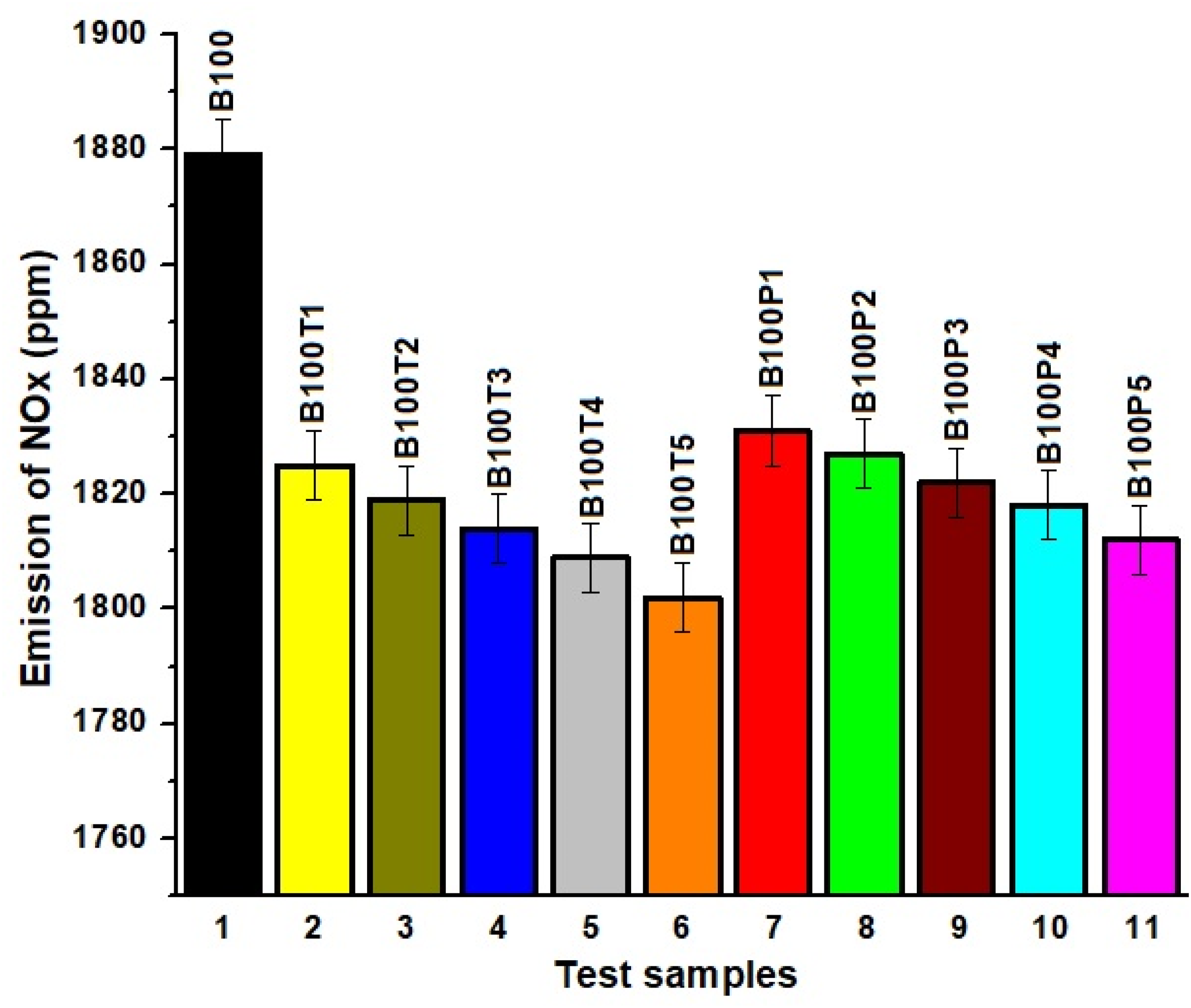
Nox emission of B100, P and T dosed B100 samples.
The synthetic antioxidants have been blended with B100 sample at varying concentrations. From Figure 16 it has been observed that, by adding P antioxidant, it shows 2.55%, 2.76%, 3.03%, 3.24% and 3.56% with lower NOx emission for B100P1, B100P2, B100P3, B100P4 and B100P5. With increase in antioxidant concentration, the NOx emission level has been decreased averagely to 3.02% when compared to pure biodiesel (B100). From Figure 16 it has been observed that, by blending T antioxidant, it shows 2.87%, 3.19%, 3.45%, 3.72% and 4.09% with lower NOx emission for B100T1, B100T2, B100T3, B100T4 and B100T5. With increase in antioxidant concentration, the NOx emission level has been decreased averagely to 3.46% when compared to pure biodiesel (B100). It has been observed that, by adding synthetic antioxidant to biodiesel blend, the NOx emission level can be reduced. While comparing both the antioxidant effect on reducing the NOx emission, T dosed samples shows more action with an average hike of 14.56% when compared to P dosed samples. Hydrocarbon radicals like C2, C, CH2, CH and C2H gets reacted with nitrogen particles in fuel is the fact behind elevated NOx emission. Due to elevated NOx emission, the free radicals like HCN, N and NO also increases. By adding synthetic antioxidants, the formation of free radical is slowed down leading to lower NOx emission when compared to pure biodiesel. 93 A similar characteristic has been observed in various studies as mentioned below.
The key factor for NOx formation in C division and SUV diesel engine light duty vehicle is due to the chemical reaction between nitrogen and free radicals of hydrocarbons. 94 The synthetic antioxidants play as an interrupter in palm oil biodiesel which interrupts the grouping of free radicals and so, the NOx emission level decreases. 95 Due to the molecular structural arrangement of tert butyl hydroquinone, the by-products produced from the TBHQ increases the oxidation stability of Poison nut when compared to Neem and Karanja biodiesel which acts as a free radical formation interrupter. 96 This is the fact behind the improved performance of T when compared to P dosed samples.
Infrared imaging technique (IIT)
Figure 13 represents the CCT and EGT IIT images for diesel and B100 samples. Figure 14 represents the CCT and EGT IIT images for P antioxidant dosed samples and Figure 15 represents the CCT and EGT IIT images for T antioxidant dosed samples. High oxygen molecule in biodiesel enhances the chemical reaction between nitrogen and oxygen molecules inside the combustion chamber which obliquely indicates that inside the cylinder the temperature plays a key role in NOx formation. For this purpose, this research involves the IIT as a novel non-contact testing method to evaluate how the CCT plays an important role in NOx emission.
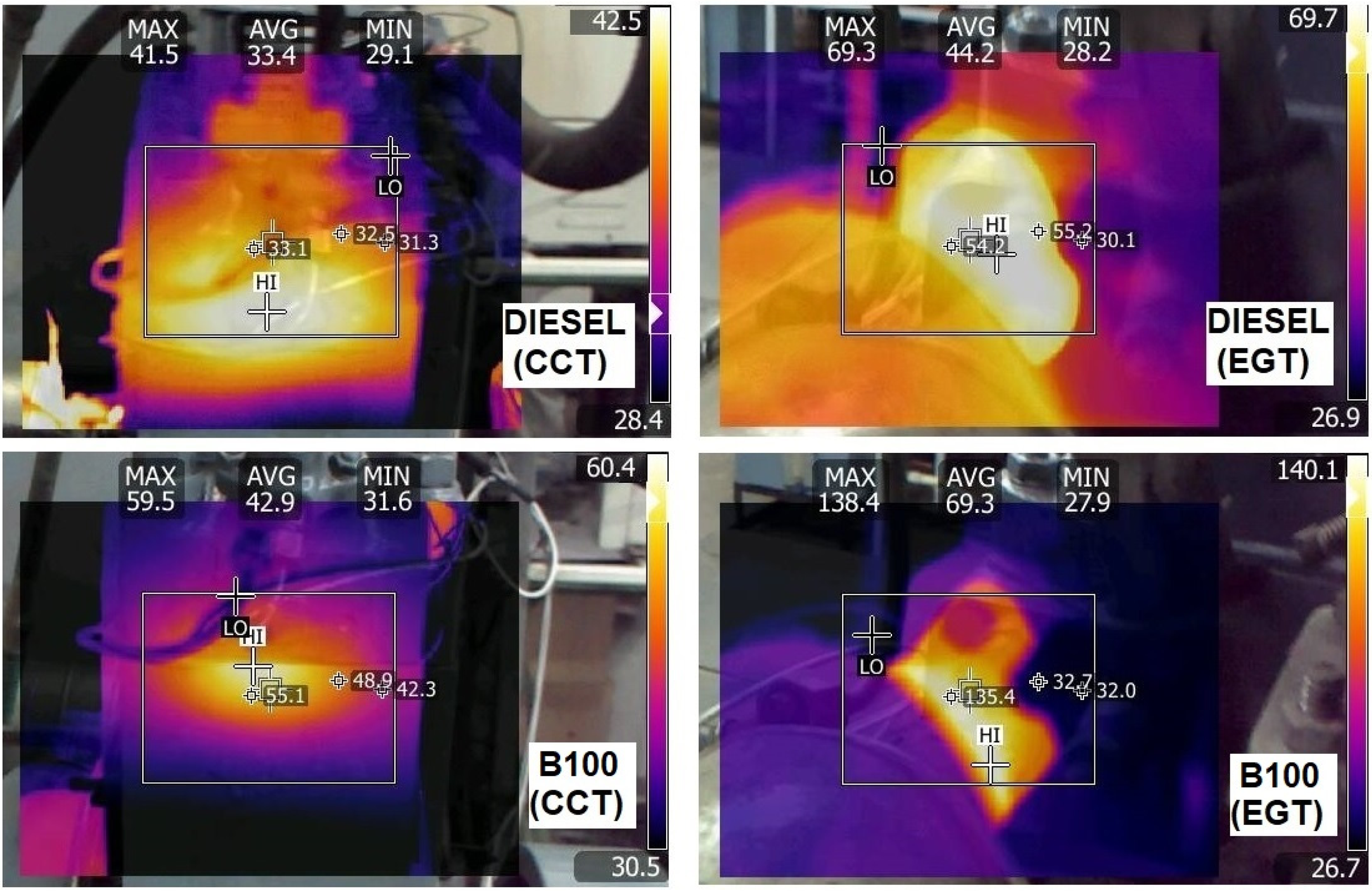
IIT images for diesel and B100 samples.
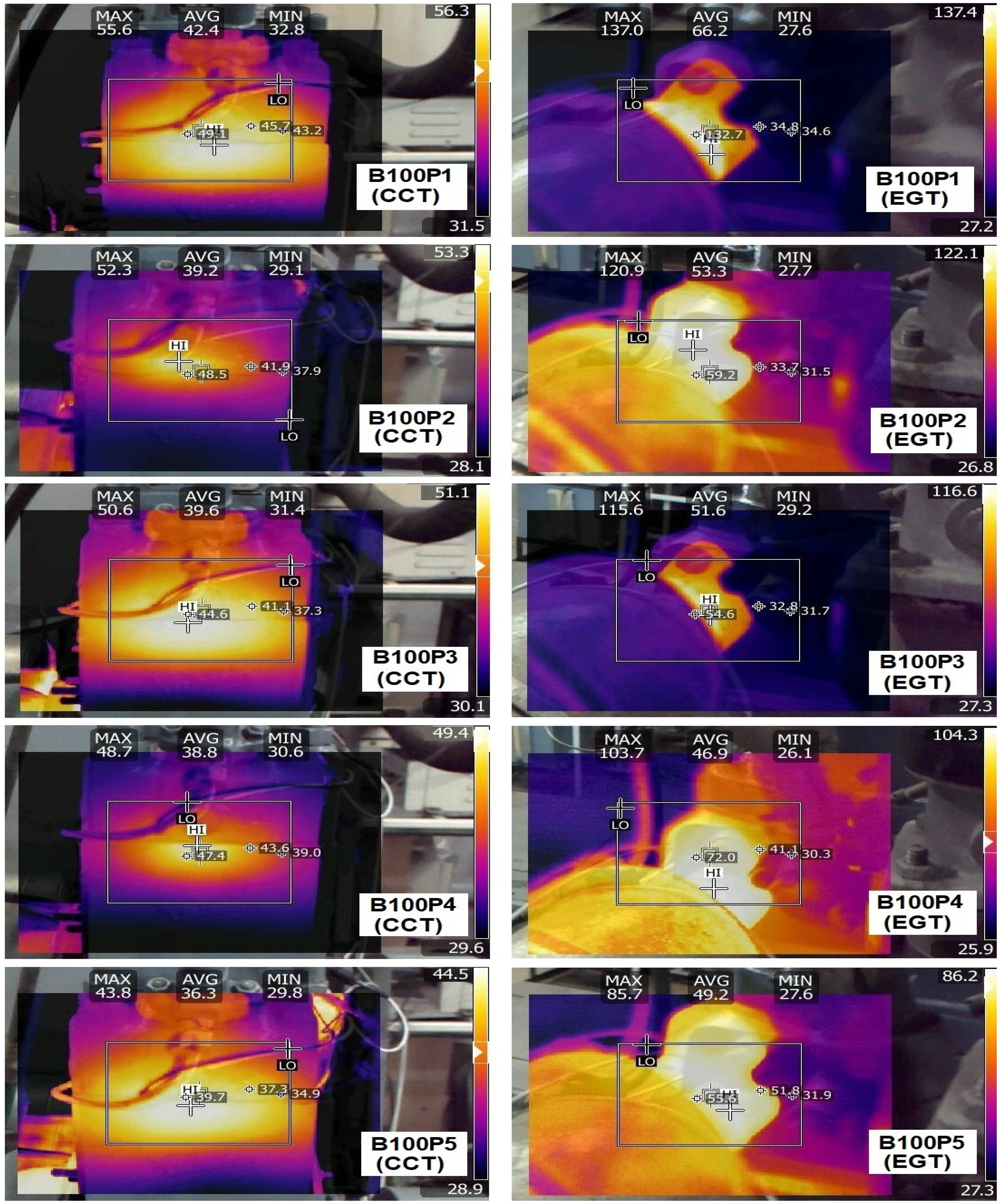
IIT images for p antioxidant dosed samples.
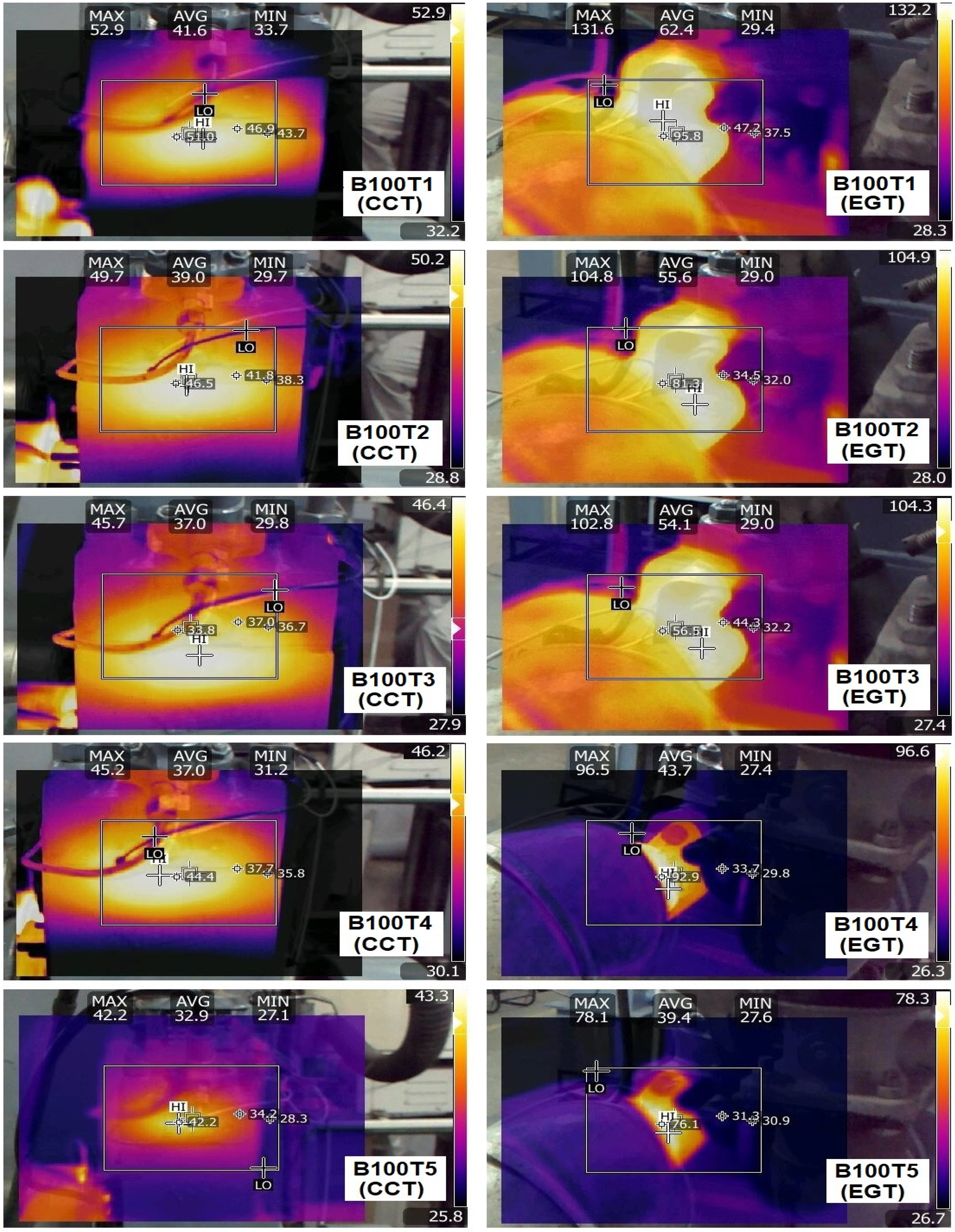
IIT images of t antioxidant dosed samples.
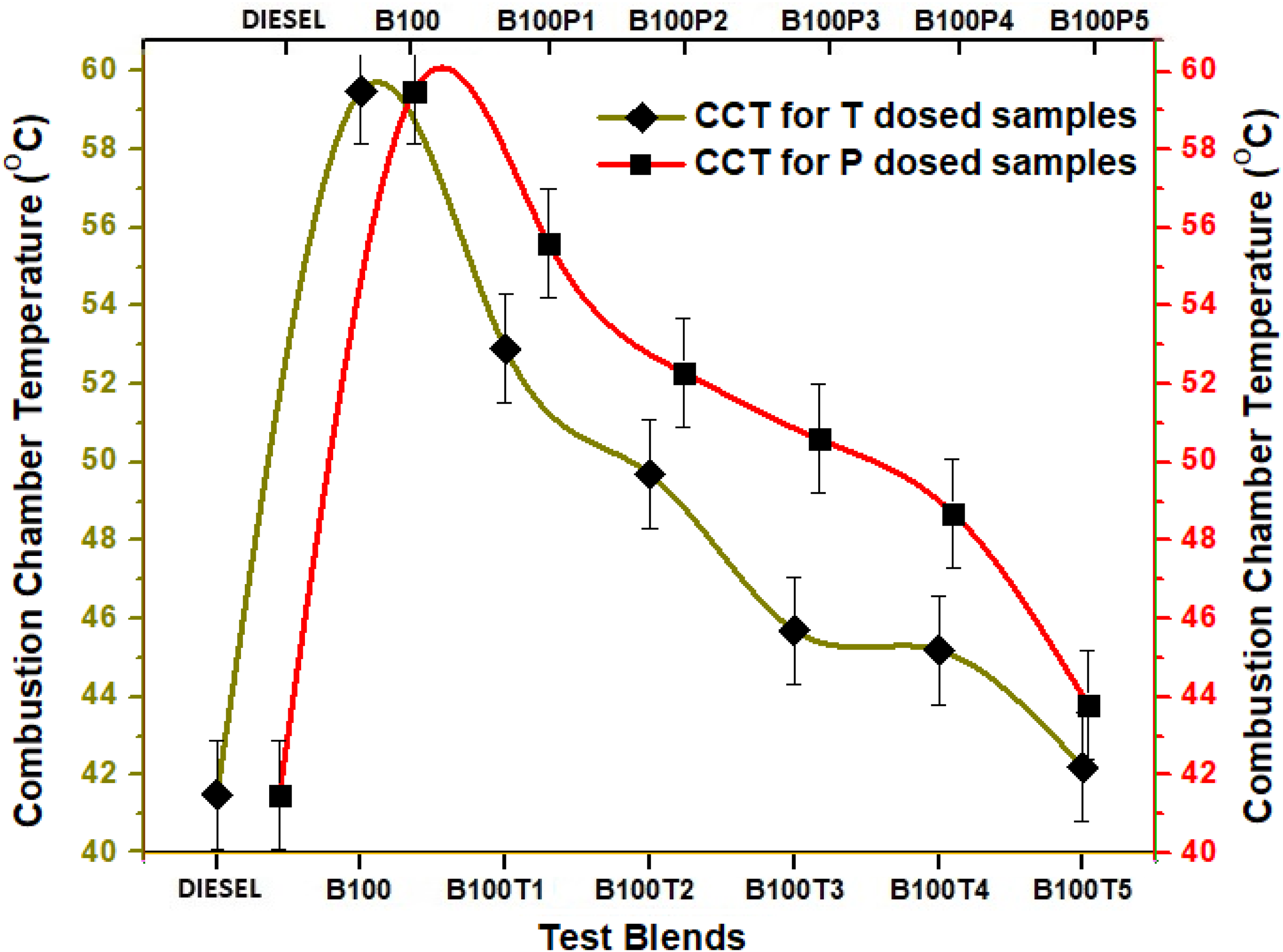
CCT for p and t dosed samples.
From Figure 13 it has been observed that B100 shows 43.37% elevated CCT when compared to diesel fuel due to the presence of rich amount of oxygen. All the outputs from IIT image have been arranged and shown schematically in Figure 16 for easy readability. From Figure 16 it is visible that, when CCT increases NOx also increases for all samples. While analyzing CCT for P antioxidant dosed B100 samples, it shows 6.55%, 12.10%, 14.95%, 18.15%, and 26.38% lower CCT for B100P1, B100P2, B100P3, B100P4 and B100P5 when compared to neat B100 sample. On an average, by blending P to pure B100 sample, it shows 15.62% lower CCT. While analyzing CCT for T dosed B100 samples, it shows 11.09%, 16.47%, 23.19%, 24.03% and 29.07% lower CCT for B100T1, B100T2, B100T3, B100T4 and B100T5 when compared to pure B100 sample.
Averagely, T dosed B100 sample shows 20.77% lower CCT. The trend happened in CCT and NOx emissions are similar, in which by adding synthetic antioxidant reduces the CCT. Comparing P and T dosed samples; T dosed samples shows 32.97% elevated performance in reducing the CCT. The theoretical fact of CCT which plays an important role in NOx emission has been visualized using IIT and proved the fact practically in a novel way. The results obtained from IIT images (Figure 16) is same as that of NOx emission results (Figure 12) which indicates that with increase in synthetic antioxidant concentration, the CCT can be reduced as the NOx emission is reduced.
Figure 17 represents the EGT for P and T dosed samples. Similar to the temperature variations in CCT, all the test blend shows parallel output in EGT too. When compared to B100 without P antioxidant, the samples B100P1, B100P2, B100P3, B100P4 and B100P5 shows 1.01%, 12.64%, 16.47%, 25.07% and 38.07% lower EGT. Whereas for T dosed samples, it shows 4.91%, 24.27%, 25.72%, 30.27% and 43.56% lower EGT for B100T1, B100T2, B100T3, B100T4 and B100T5 while comparing pure B100. Comparing P and T dosed samples, T dosed samples shows 37.55% more impact than P dosed samples. With increase in synthetic antioxidant concentration, the EGT decreases which also connects the link between CCT and NOx.

EGT for p and t dosed samples.
The CCT, EGT and NOx emission decreases with increase in synthetic antioxidant concentrations. The fuel stability also shows positive result upto 1000 ppm only. Samples blended beyond 1000 ppm shows degradation in fuel properties, beyond which it starts to degrade. The results obtained from the EGT (Figure 17) are same as that of NOx emission (Figure 12) and CCT (Figure 16) results due to the increase in antioxidant concentration. Surveying various literatures for presenting enhanced understanding about the combustion process of biodiesel, this research proposes IIT tool as a simple, effective and novel visual correlation tool for analyzing the correlation between CCT and NOx emission. Therefore, this research proposes B100T3 as the best blend with higher fuel stability and lower NOx emission.
Emission characteristics - impact of diesel blending to biodiesel with and without antioxidants
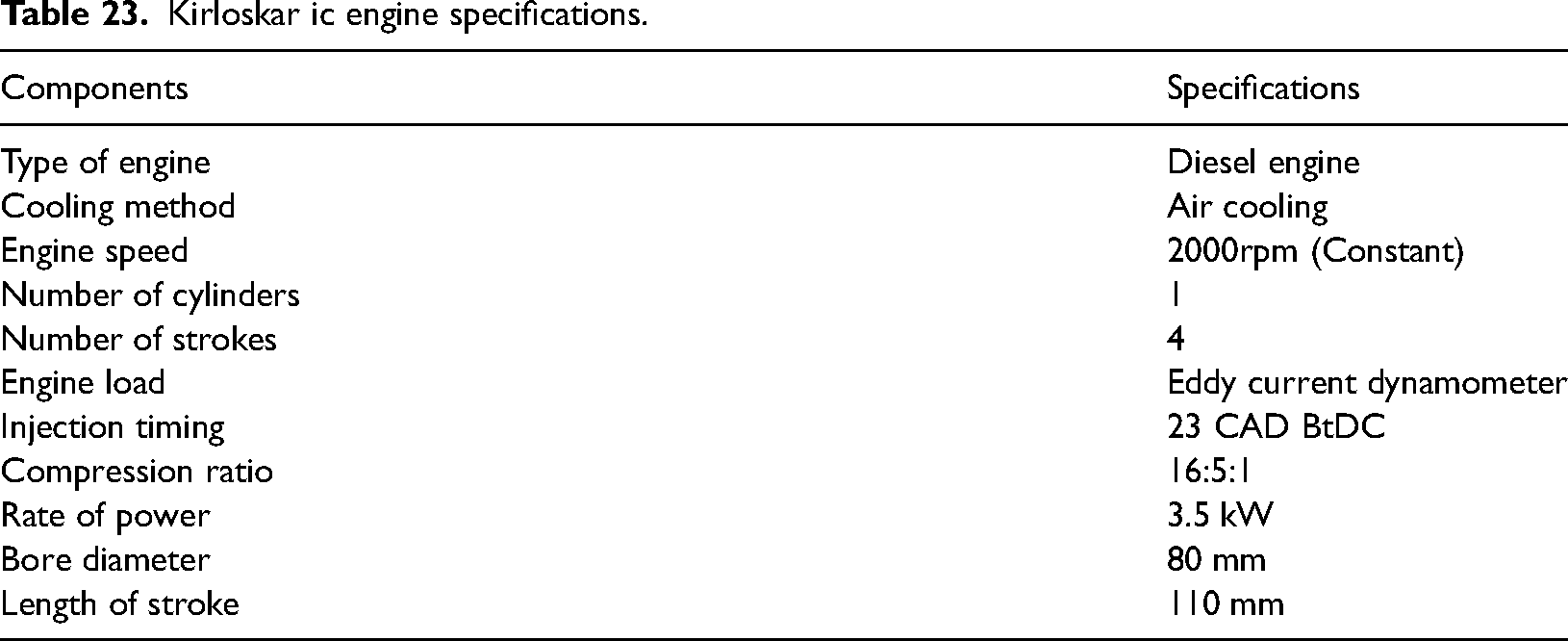
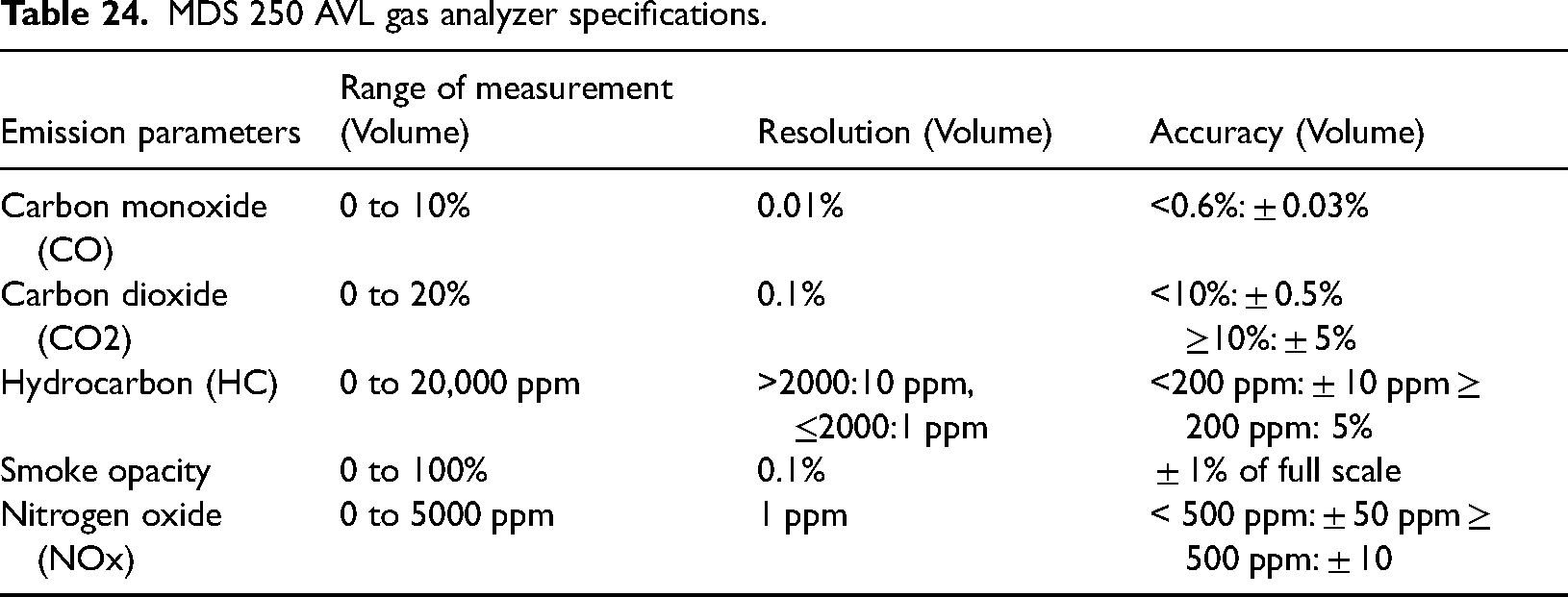
The pure biodiesel sample, without any addition of diesel denoted as B100 have been analyzed for fuel stability with addition of antioxidants for the reason of storing the same as a biofuel producer concern for prolonged days and it has been depicted that B100T3 has better stability. But this sample could not be used in diesel engine directly due to its high viscosity. A study includes analyzing the comparison of various engine characteristics for five types of vegetable oil like Sunflower, Canola, Corn, Soybean and Hazelnut at 20%, 50% and 100% fuel ratio. Among which Hazelnut at20% ratio shows better engine characteristics. 97 Using Alexandrian laurel biodiesel in the ratio of 10%, 20% and 30%, the smoke opacity has been reduced upto 20% when compared to diesel fuel at low engine load. 98 The goal of this research is to condense the usage of diesel fuel to prevent its extinction. So, 80% of diesel has been blended with 20% of B100 biodiesel with and without antioxidants which are denoted as B20 and B20T3 which has been prepared as a suitable blending ratio and fueled in diesel engine to study its emission individualities as follows. Using programmed Kirloskar IC engine united with AVL gas analyzer (specifications shown in Tables 23 and 24), the emission level for biodiesel blends have been assessed.
Kirloskar ic engine specifications.
MDS 250 AVL gas analyzer specifications.
Carbon monoxide (CO) emission analysis
Figure 18 represents the variations of CO emission for diesel, B20 and B20T3with increase in engine load. CO is an odorless and colorless poisonous gas. From Figure 18, it has been observed that, with an increase in engine load, the CO emission level also increases for all test samples. CO emission from the diesel engine is generally low due to the lower content of oxygen and the wealthy air-fuel mixture united with partial combustion. 99 Comparing the emitted CO level, B20 and B20T3, an average hike of 26.47% and 23.52% have been observed when compared to diesel.

Co emission levels for diesel, B20 and B20T3.
This effect is due to the higher oxygen content in biodiesel chemical structure which sustains complete combustion. 100 But while comparing the CO level of B20T3 to B20, B20T3 shows an average decrement of 4%. This behaviour has been observed by the addition of TBHQ antioxidant in which OH radicals in antioxidant reduces the conversion process of carbon monoxide to carbon dioxide. 56
Carbon dioxide (CO2) emission analysis
Figure 19 represents the CO2 emission level for diesel, B20 and B20T3 with increase in engine load. Always, the CO2 emission is in reverse to CO. This is due to the oxidation of CO by oxygen molecule in the fuel which converts into CO2.

Co2 emission levels for diesel, B20 and B20T3.
From the Figure 19, it has been observed that the CO2 emission level increases for all test samples with an increase in engine load. When compared to the diesel, biodiesel emits more CO2 emission levels due to the presence of lower carbon molecule and higher oxygen which is responsible for complete combustion. 101 Average hikes of 39.39% and 31.77% have been observed for B20 and B20T3 when compared to diesel. But while comparing B20T3 CO2 level to B20 level, B20T3 shows an average drop of 5.63%. As the oxygen providing catalyst in TBHQ is the prime factor for the combustion process, the CO2 emission level decreases when compared to the B20 level. 102 Eventhough the addition of T hikes the emission of CO2 for biodiesel blend; it’s not a major threat to the environment. As the function of plant is to absorb CO2 and emit oxygen, the higher the CO2 level the more worthy for human to inhale healthier oxygen.
Hydrocarbon (Hc) emission analysis
Variations in the HC emission level are shown in the Figure 20 for diesel, B20 and B20T3 with increase in engine load. HC is emitted due to the unburned fuel. Previous studies proved that using biodiesel instead of diesel fuel reduces the HC emission level.103,104 Complete combustion takes place due to elevated oxygen content in biodiesel and reduced delay in burning biodiesel due to higher cetane number which leads to lower unburned hydrocarbon. 94 The HC emission level increases with an increase in engine load for all test samples that have been observed from the Figure 20. B20 shows an average drop of 20.70% and B20T3 shows an average drop of 16.84% when compared to diesel. Due to the 20% blending of biodiesel to diesel fuel, the ignition delay has been reduced due to higher oxygen molecules which result in a premature start in the injection of fuel inside the combustion chamber and enhancing the combustion process. An increase of 4.86% in the HC level for B20T3 has been observed when compared to B20. By blending TBHQ antioxidant, the action of converting hydrocarbon into the water and carbon dioxide and carbon monoxide to carbon dioxide has been distressed due to the reduction of hydrogen peroxides and peroxides in biodiesel which hikes the quantity of hydrocarbons. 105
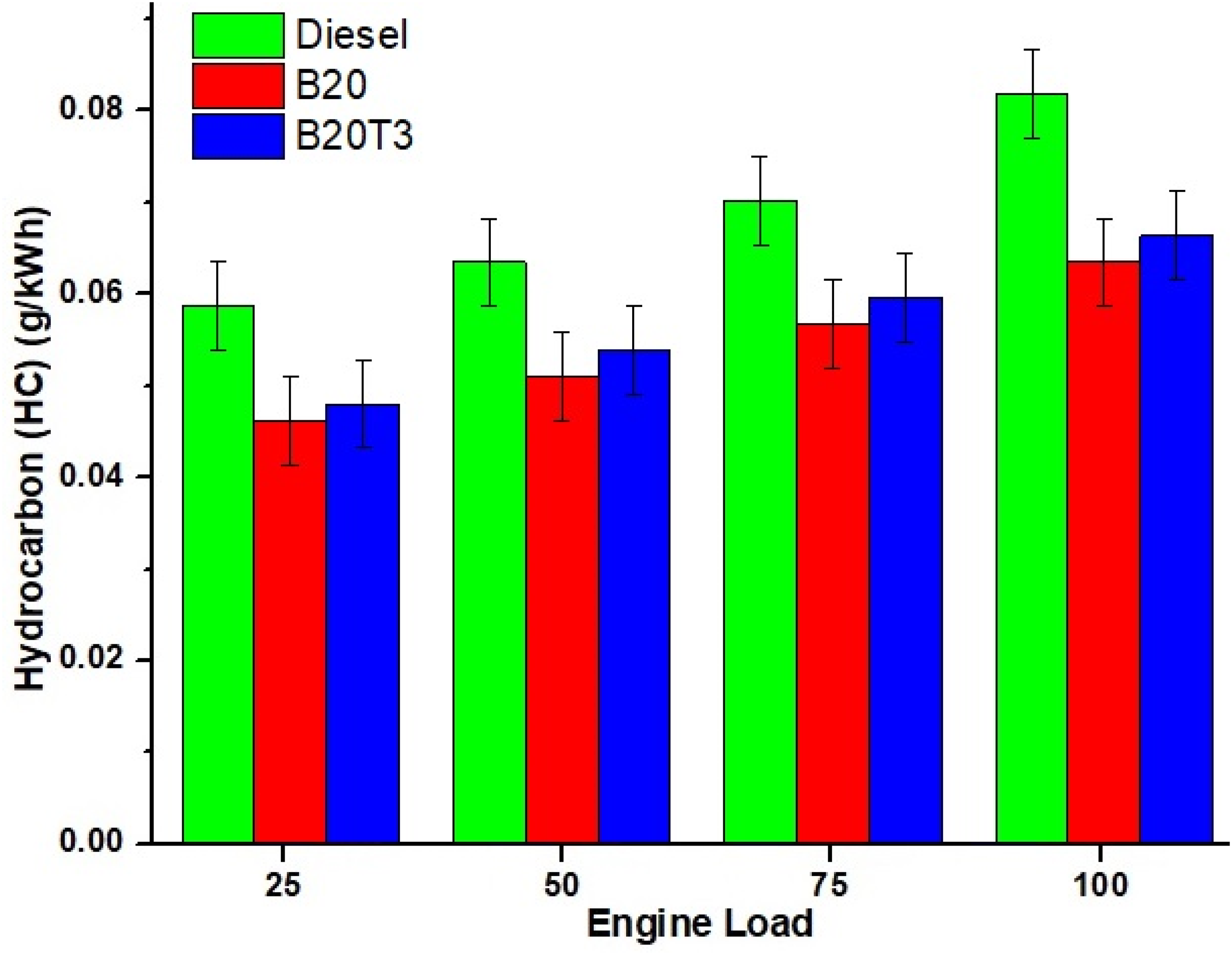
Hc emission levels for diesel, B20 and B20T3.
Smoke opacity emission analysis
Figure 21 represents the smoke opacity emission level for diesel, B20 and B20T3 with increase in engine load. All the test samples show an increase in smoke with an increase in engine load. As the diesel fuel possesses lower cetane number incomplete combustion takes place in which the smoke opacity increases with an increase in engine load. 106 Due to the complete burning of biodiesel using rich oxygen molecules, reduction of smoke takes place. But when the engine load increases, the injection of biodiesel inside the combustion chamber also increases reducing the air fuel ratio resulting in elevated smoke. 95 When compared to diesel, B20 and B20T3 show an average diminish of 14.93% and 10.7% in smoke emission level. The drop in B20 blend, when compared to diesel, is due to the blending of the oxygen molecule in diesel, leading to better combustion. 107 While comparing B20 and B20T3 blend, B20T3 shows a hike of 4.97% in smoke emission level due to the addition of TBHQ antioxidant which diminishes the formation of oxidation chain radical leading to lower combustion. 100
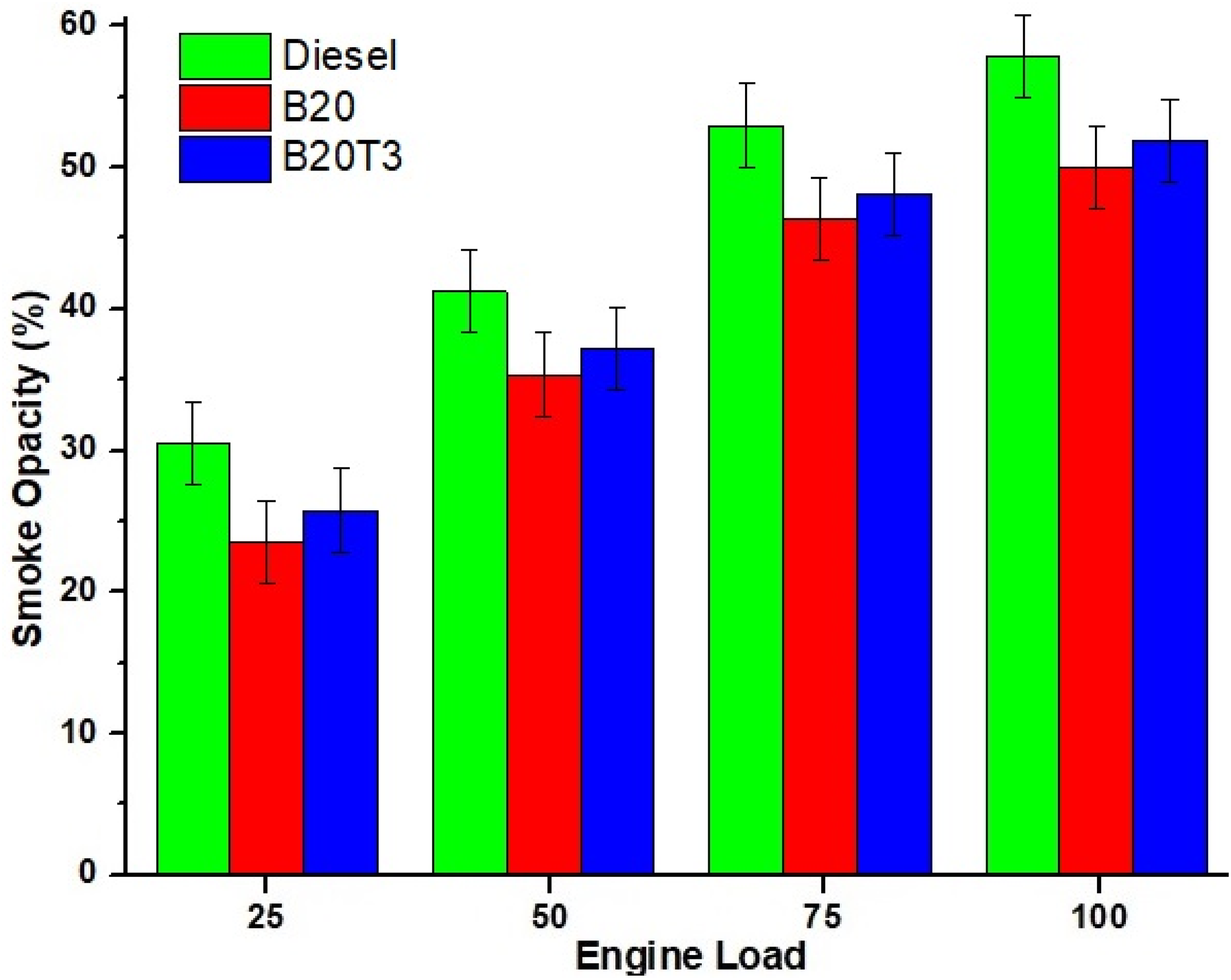
Smoke opacity levels for diesel, B20 and B20T3.
Nitrogen oxide (NOx) emission analysis
The emission of NOx for diesel, B20, and B20T3 with hike in engine load is shown in the Figure 22. For all test samples, the NOx emission level increases for an increase in engine load. NOx formation in a diesel engine is generally due to the elevated oxygen molecules, elevated combustion temperature, and elevated combustion period. The NOx emission level of B20 and B20T3 shows a hike of 25.56% and 13.61% when compared to diesel. As the diesel fuel gets rich oxygen by blending 20% of biodiesel, there occurs premature combustion and belated ignition time leading to climbing of NOx emission in B20 when compared to diesel.96,108 While adding an antioxidant, B20T3 shows an average decrease of 9.51% when compared to B20. By blending antioxidants, the temperature of combustion is lowered and combustion response time is improved leading to lower NOx emission levels when compared to B20. 85
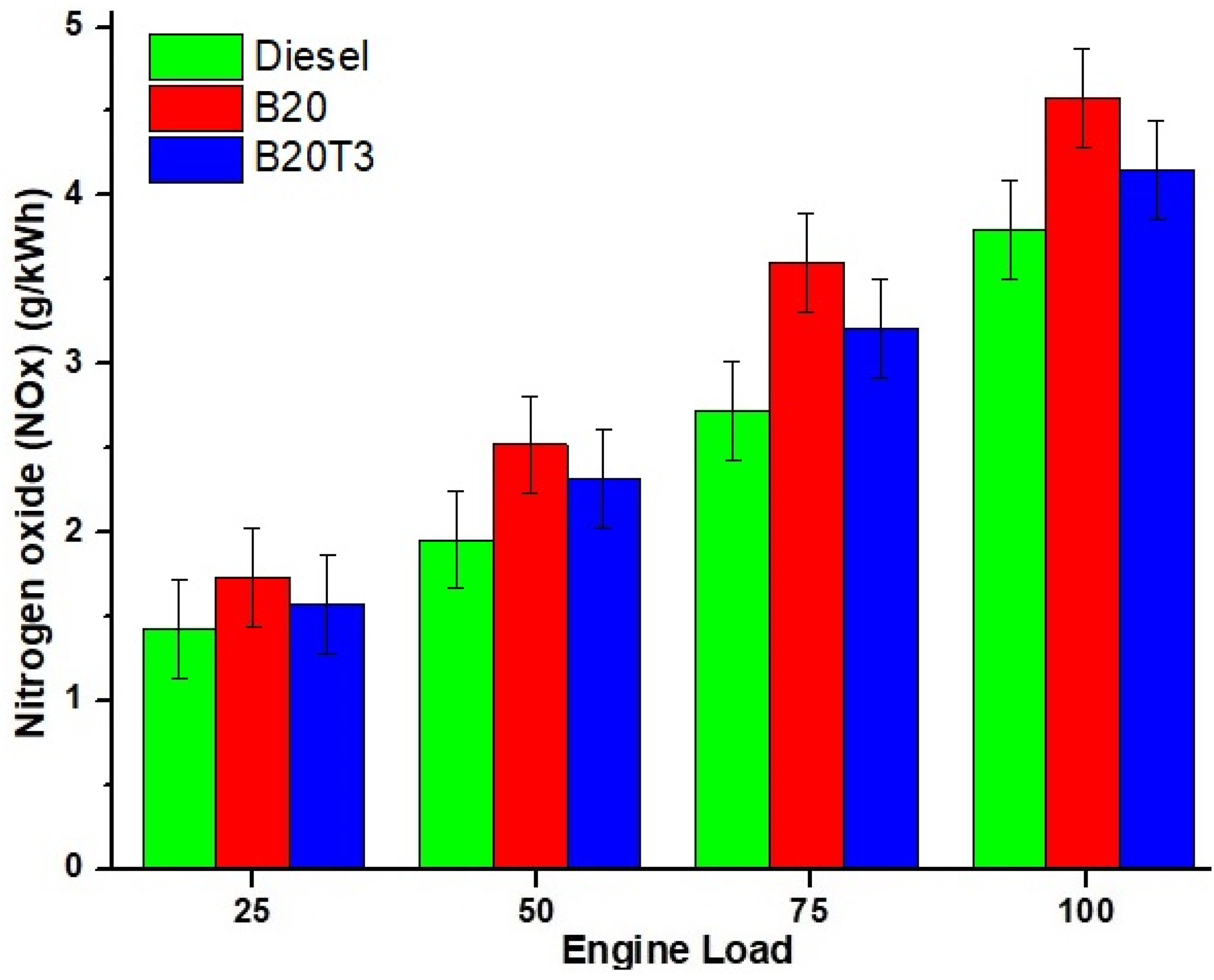
Nox emission levels for diesel, B20 and B20T3.
Global fuel market cost analysis
According to India’s best biodiesel production protocol, the complete cost analyses from Alexandrian laurel and Poison nut feedstock collection to biodiesel blend with TBHQ has been shown in Table 25. Table 26 shows that at 30°C, the samples B100, BP20, and B20T3 could be kept for 0.04, 0.23 and 0.48 years respectively.
Cost of biodiesel production and blend preparation (as per may 2021).
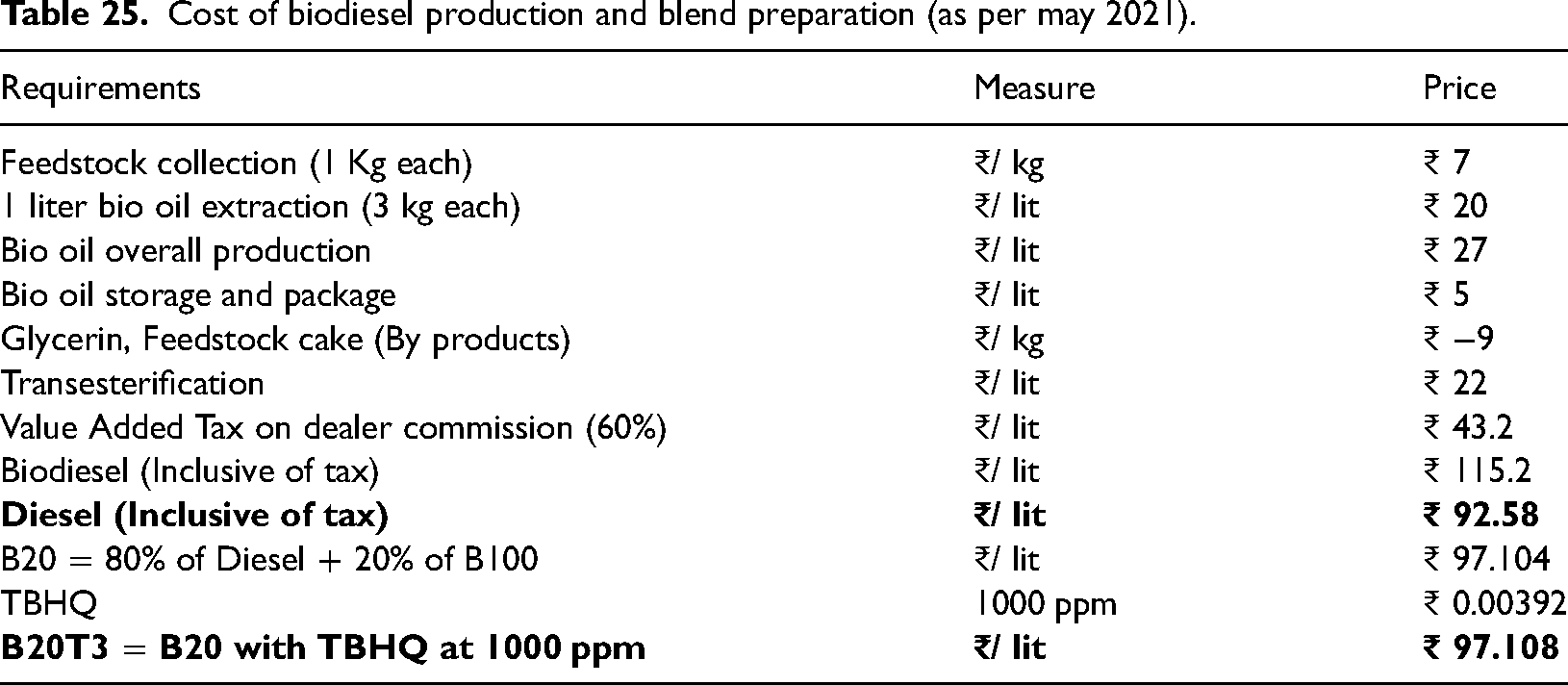
Global fuel market cost analysis for storage.
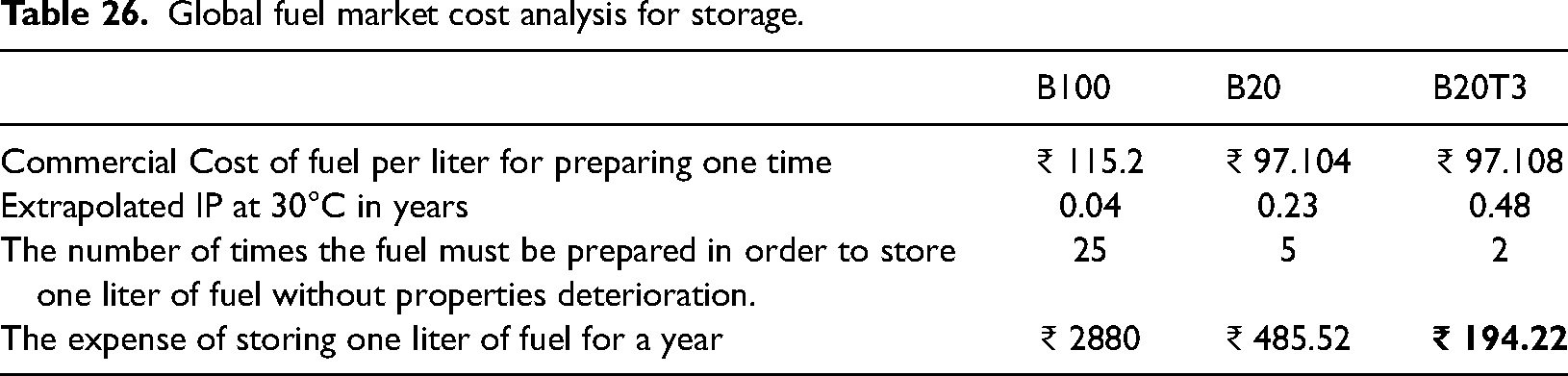
The storage cost of B20 and B20T3 is ₹ 485.52 and ₹ 194.22 respectively for sustaining one liter of fuel for a year, which shows that the addition of scientific antioxidants reduces the storage cost The tax included cost of dual biodiesel with antioxidants (B20T3) is just around 5% higher than diesel which improves the economic viability for implementing the proposed bio fuel in the global fuel market.
Uniqueness of current study
The following Table 27 represents the uniqueness of current research when compared to other biodiesel studies.
Uniqueness of current study.

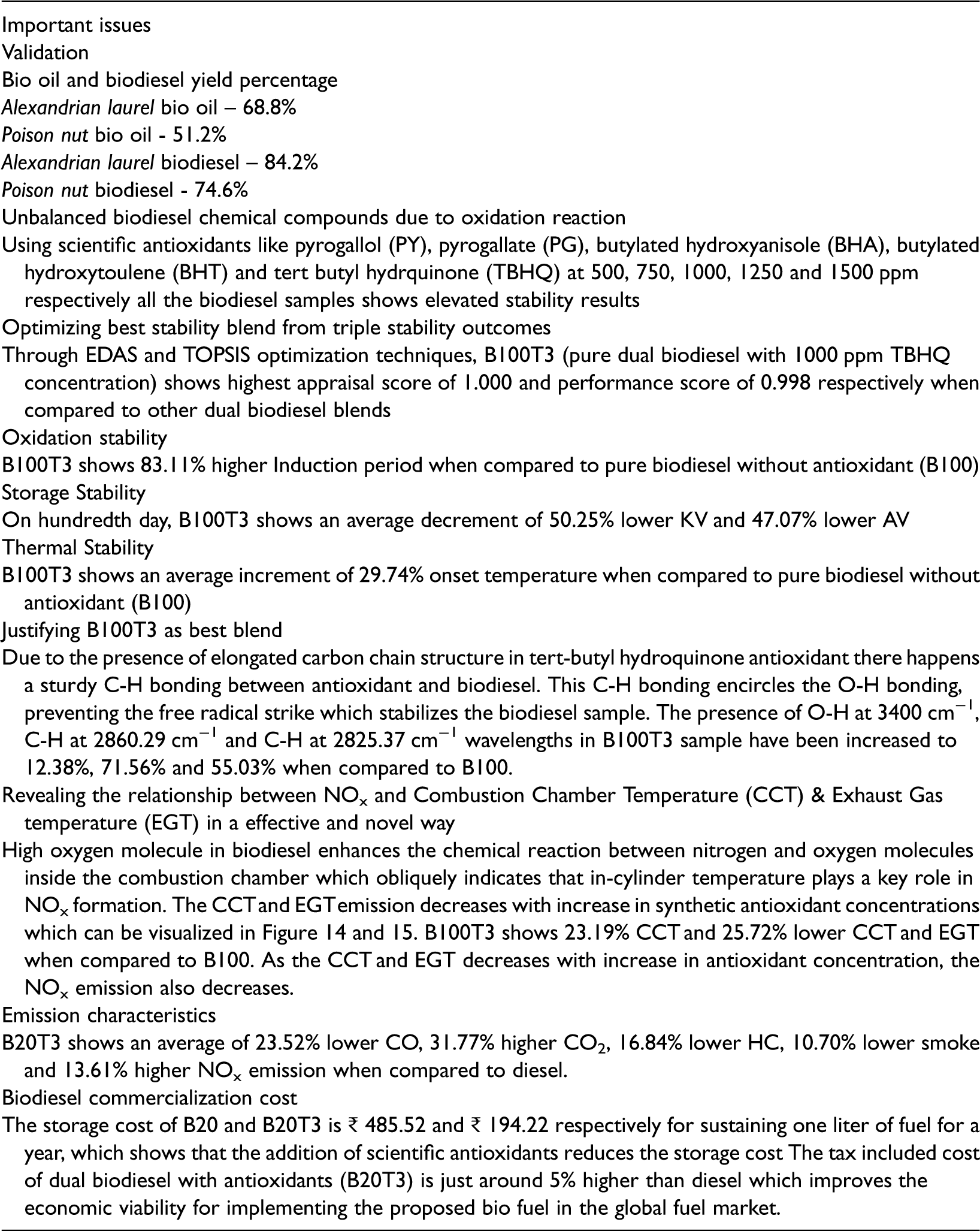
Validation of objective accomplishment
Conclusion
This research proposed novel biodiesel blend using two step transesterification process from feedstock combination called Alexandrian laurel and Poison nut. The reason behind the selection of dual feedstock is to avoid dependence on one feedstock which may leads to extinction stage like crude oil. By blending dual feedstock, encouraging result has been obtained on significant physiochemical properties. As the study involves dual novel biodiesel blend, unstable oxidation, storage and thermal properties has been obtained for pure biodiesel (B100) when analyzed using Rancimat, viscometer, TGA and FTIR equipment while comparing with diesel. To stabilize the biodiesel properties, synthetic antioxidants like pyrogallol (P) and tert butyl hydroquinone (T) have been blended at five concentration ratios.
As this research involves the analysis of three stability criteria mutually, each criterion shows best results in each sample parameters which stretches the output as multiple results. For selecting the best stability blend, the multi objective optimization techniques have been involved. Through the optimization techniques, T at 1000 ppm sample (B100T3) has been obtained as the best stability blend from various blends. By using Infrared Imaging Technique, a novel visual imaging analysis of antioxidant effect on reducing the NOx emission and combustion chamber temperature has been proposed in this study. High noxious emissions from automobile engines have been a great threat to the environment. For this purpose, using Infrared Imaging Technique (IIT) a novel visual imaging analysis of antioxidant effect on reducing the NOx emission and combustion chamber temperature has been proposed in this study. Pure biodiesel with T dosed samples has shown more action with an average hike of 14.56% when compared with P antioxidant dosed samples in reducing the NOx emission of pure biodiesel.
As pure biodiesel cannot be used directly in diesel engines, the blending of 20% biodiesel with diesel has been prepared and emission characteristics like CO, CO2, HC, Smoke opacity and NOx have been analyzed for diesel, B20, and B20T3. By adding T antioxidant, the levels of CO, HC, and smoke opacity have been reduced to an average of 23.52%, 16.85%, and 10.7% when compared with diesel. Meanwhile, an average increase of about 31.51% and 13.72% for CO2 and NOx emission level respectively when compared with diesel has been observed. Moreover B20T3 has shown its capability to get commercially viable in global fuel market. On the whole, by adding antioxidants, the emission level of biodiesel has been reduced when compared to biodiesel without antioxidants. Based on the future energy need and eco-friendly environment, the cleaner energy has been produced by blending a novel binary biodiesel with synthetic antioxidant and proposing B100T3 as the best stabilized green energy source.
Footnotes
Acknowledgements
The authors would like to convey their gratitude to the Centre of Excellence for Environmental Studies (COE-Es), Government College of Technology, Coimbatore- 641013, Tamil Nadu state, India and Government College of Engineering, Tirunelveli- 627007, Tamil Nadu state, India for the successful completion of this research with their support.
Declaration of conflicting interests
The author(s) declared no potential conflicts of interest with respect to the research, authorship, and/or publication of this article.
Funding
The author(s) received no financial support for the research, authorship, and/or publication of this article.
