



Abstract
Oil shale kerogen is a kind of composite nature of fossil energy polymer. Kerogen pyrolysis is a feasible and alternative strategy to produce fossil fuels from shales. However, the disadvantages including the high energy consumption, the high cost, and the low hydrocarbon conversion, significantly hinder the development and utilization of unconventional hydrocarbon resources. Herein, the hexagonal crystal structural layered double hydroxides (LDHs) with the Ni/Fe ratio of 5.64:2.36 is proposed as pyrolysis catalyst to improve the catalytic efficiency, the selectivity of target hydrocarbons, and lower the temperature for the process of kerogen pyrolysis. As a result, needle-like nanoscale NiFe-LDHs are prepared successfully to perform the fast thermal upgrading of Balikun oil shale kerogen. The catalytic pyrolysis performance has been observed that the temperature for maximum conversion (Tmax) is 401.18 °C, presenting a Tmax reduction of 37.84 °C, the yield of shale oil is increased by 7.83 wt%. And during 350°C– 400°C, a progressive increment of 147.67%, 230.86%, and 310.61% is obtained corresponding to the content of C1-C5, C6-C14, and C14 + hydrocarbons, respectively. This finding enriches the catalyst candidates for kerogen pyrolysis and provides new insights into industrial applications of in-situ pyrolysis technology for oil shale recovery processes.
Introduction
Energy is a significant material foundation for the existence and development of human society. The imminent facts, such as the significantly increase of global energy consumption and demand, and the rapid depletion of conventional petroleum resources, have led to the urgent demand for new and alternative energy sources. 1 Oil shale, as an important unconventional resource composite nature of fossil energy polymer rich in hydrocarbon, has attracted much attention due to its extensive distribution and abundant storage. 2 Kerogen, a kind of composite nature of fossil energy polymer in oil shale, can be upgraded to natural petroleum-like organic matter and gas by pyrolysis or distillation. 3 At present, of particular interest is the in-situ pyrolytic conversion. 4 And the product distribution and the composition can be significantly controlled by pyrolysis reaction conditions, such as temperature, heating rate, pressure and retention time.5–7 However, the high energy consumption as well as the low hydrocarbon conversion of kerogen pyrolysis are urgent problems to be solved.
Previous reports presented that the thermochemical conversion assisted by suitable catalysts has a significant impact on the pyrolysis efficiency and the composition of oil and gas products.8–10 And there are four kinds of catalysts, including clay minerals, 11 natural ores (montmorillonite, gypsum, pyrite, etc.), 12 inorganic compounds (metal oxides, metal sulfides and metal salts, etc.), 13 molecular sieves and metal supported catalysts. 14 But, the conversion is still less than 70%, and the optimal pyrolysis temperature is still higher than 420 °C. Also, many factors such as the high cost and non-reusability of catalysts seriously restrict the development of efficient pyrolysis technology. Thus, it is of great theoretical value and practical significance to explore a low-cost, high-efficiency, and easily prepared catalyst to promote the conversion of shale oil and regulate the quality of oil and gas products.
Layered double hydroxides (LDHs) are a class of metal hydroxides composed of two or more metal elements. 15 The structure of LDHs is composed of positively charged (M1, M2)(OH)6 octahedron main layers and the overlapping of interlayer anions and water molecules. 16 The metal ions are completely exposed outside. The types and proportions of metal ions are easily controlled, as well as tuned the layer number and layer spacing. Functional designed LDHs can be prepared with pyrolysis-catalyzed active sites to improve electron transport capacity, catalytic activity, limiting effect, and topological transformation, resulting in a wide range of applications, especially in photocatalysis and electrocatalysis. Recently, it is increasingly convinced that LDHs can play a vital role on the catalytic pyrolysis performance. The aromatic compounds, heavy oil, 13 and biomass can be catalytically decomposed by transition metal elements(Fe, Co, Ni, Cu, and Mn) based LDHs.17–19 These reports demonstrate that LDHs might be the potential candidates to achieve and overcome the puzzle reactions such as aromatic ring cracking, heavy oil reforming, and biomass degradation and carbonization.
Iron and nickel based LDHs are cost-effective catalysts because of their relatively high activity, natural abundance, and environmental friendliness. As such, the Fe atom is considered the active site. The Fe-O-Fe motifs in LDHs are responsible for the redox behaviors, owing to their optimal adsorption energies, Fe-O bond distances, and M-O coordination. And it is intriguing to introduce Ni to form double sites of Ni-O-Fe motifs of LDH matrix, achieving high energy density, intrinsic activity, and good cycle stability. However, little is known about the catalytic pyrolysis of oil shale by LDHs. And the conversion of kerogen, the catalytic efficiency, and the regulation ability for hydrocarbon products of LDHs is still unclear.
Herein, a novel nano-scale needle-like NiFe-LDHs was synthesized by a one-pot hydrothermal method, exhibiting high catalytic efficiency and hydrocarbon regulation abilities. The Ni-O-Fe motifs were constructed by Ni/Fe ratio that could tune the positions of Ni and Fe. As the expectation, the results of Balikun oil shale kerogen (BLK) pyrolysis catalyzed by NiFe-LDHs present a remarkable improvement of kerogen conversion, a decrease in the pyrolysis temperature, and high selectivity of medium-low hydrocarbons. This finding enriches the understanding of the thermolysis process of kerogen, provides support for the thermal transformation of oil shale and a potential application in unconventional oil and gas resources.
Materials and methods
Preparation of NiFe-LDHs: The NiFe-LDHs was prepared by a simple hydrothermal method via co-precipitation process. Nickel dichloride hexahydrate (0.7131 g), ferric trichloride hexahydrate (0.1442 g) and urea (0.54 g) were dissolved into 60 ml deionized water to form a homogeneous solution. After stirring at room temperature for 2 h, the solution was transferred to a stainless steel reactor. An oven was preheated to 160 °C, and the stainless steel reactor was placed in the oven reacting for 10 h and then cooling naturally, which was updated from our previous work. 20 The solids were generated and collected by centrifugation with water to remove the excess soluble ions, washed three times with ethanol to remove the water that adsorbed on the solids’ surface, and then dried at 50 °C for 12 h. All the chemicals (nickel dichloride hexahydrate (AR), ferric trichloride hexahydrate (AR), and urea (AR)) were purchased from Aladdin Reagent Co., Ltd (Shanghai, China), which were used for the synthesis of NiFe-LDHs without further treatment. Deionized water was made in our laboratory.
Kerogen Properties: The source kerogens labeled as BLK were separated and purified from the oil shale in the Balikun basin located in Xinjiang province, China. The properties of the BLK kerogen are shown in Table 1.
Properties of the BLK kerogen for pyrolysis.
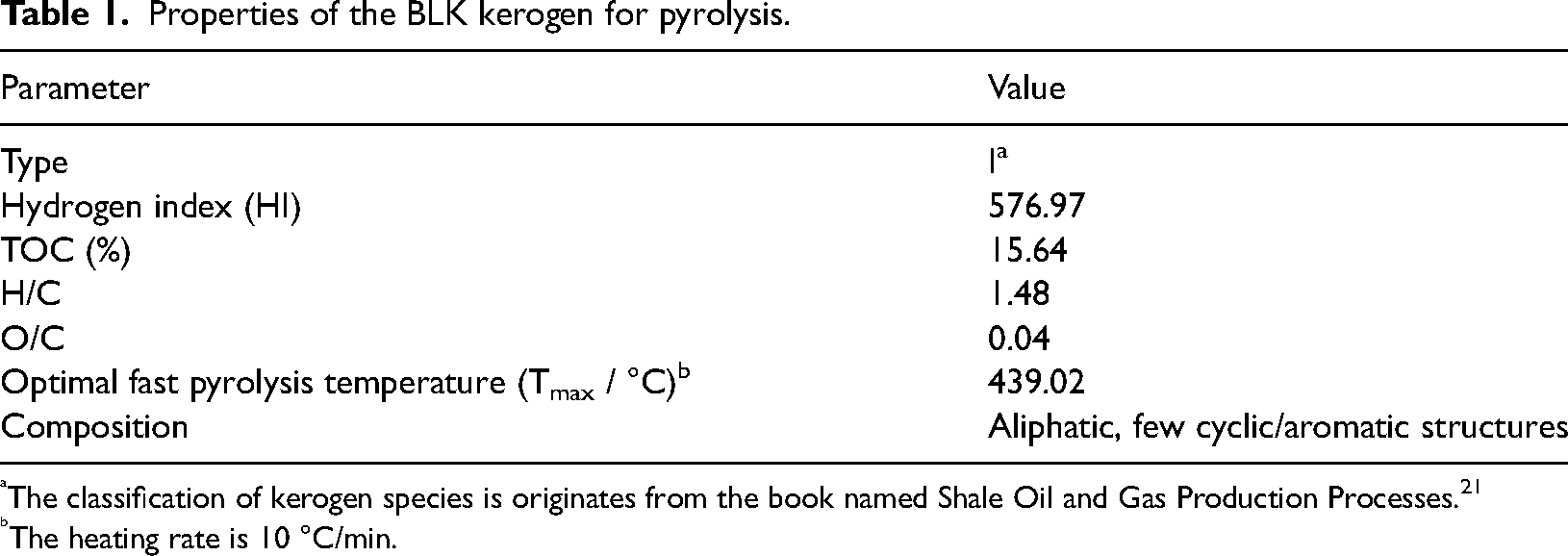
The classification of kerogen species is originates from the book named Shale Oil and Gas Production Processes. 21
The heating rate is 10 °C/min.
Fast Pyrolysis Experiments: The fast pyrolysis experiment was performed on thermogravimetric analyses (TG) and pyrolysis with in-situ gas chromatography (Py-GC, EGA/PY-3030D, Japan) to investigate the conversion and distribution of hydrocarbon products of the BLK kerogen. The mixture of BLK and NiFe-LDHs with the mass percentage of 10:1 was about 5 mg loaded in TG and Py-GC, respectively. All the experiments were performed under the N2 atmosphere. The mixture was then heated with a speed of 10 °C/min from room temperature to 700 °C in TG and 10 °C /min of 25 °C— 600 °C in Py-GC, respectively. Each experiment was performed twice to ensure the accuracy of the data.
Dry distilled experiments were carried out in a 0.5 L stainless steel autoclave at different temperatures (375, 400, 425, and 450 °C), with heating rate of 10 °C /min and held for 120 min at the terminal temperature (Table S1). And a separate dry distilled experiment was conducted in a continuous temperature range from 25 to 500 °C at a rate of 10 °C /min (Figure S1). The mixture of BLK and NiFe-LDHs with the mass percentage of 10:1 was about 5 g loaded in autoclave with the nitrogen protection. Kerogen generated five group products: shale oil (purification with cyclohexane, petroleum ether, and acetone), Shale gas: C1-C5 hydrocarbons (distilling separation), dry distillation gas and loss (quality subtraction), solid carbon residue (secondary purification and extraction), and water (centrifugation).
Characterization: Powder X-ray diffraction patterns (pXRD) were measured using a D/max 2200PC diffractometer (Rigaku, Japan) at 40 kV and 20 mA, employing a step size of 10°/min with 2θ range of 10– 80°. Fourier transform infrared (FT-IR) spectra were collected using KBr pellets on Tensor27 spectrometer (Germany). Thermogravimetric measurements were performed on a thermogravimetric analyzer (TG, NETZSCH STA449F5 Jupiter, Germany) with a heating rate of 10 °C /min in N2 atmosphere (flow rate: 60 ml /min). The morphology of the sample were analyzed by a transmission electron microscope (TEM) (Tecnai G2 F20 S-Twin, FEI, America) at an accelerating voltage of 200 kV, and a scanning electron microscope (SEM, Zeiss ΣIGMA, Gemany) with an acceleration voltage of 10 kV. The elemental analysis was performed using an energy dispersive X-ray analyzer (EDX, model 7573, England). The instrument GC (Shimadzu, GC-14B, Japan) is equipped with a flame ionization detector (FID). Nitrogen was used as the carrier gas at a constant flow rate of 1.0 mL/min. The oven was initially held at 25 °C, then ramped to 600 °C at 3 °C/min. Analytes were separated by an HP-5 column (60 m × 0.25 mm, 0.25 μm). The inlet was operated in split mode, and the temperature was maintained at 300 °C. The obtained hydrocarbons were identified from C1 to C30 organics, including aliphatic hydrocarbon, aromatic hydrocarbon, heterocyclic hydrocarbon, and heteroatomic hydrocarbon. 22 The FID peak areas of n-alkane, and isomers with the same carbon number were integrated and then normalized by weight and total organic carbon (TOC) content.
Results and Discussion
The needle-like NiFe-LDHs with nano-scale was prepared successfully by co-precipitation method in a hydrothermal reactor. The pXRD patterns in Figure 1(a) highlights the various reflections corresponding to the crystal lattice that matched NiFe-LDHs (PDF #51-0463), and its practical Ni/Fe molar ratio is 5.64:2.36. The three-strong characteristic peaks at 2θ = 11.52°, 23.28°, 34.56°, and the two-weak peaks around 59°corresponding to the lattice planes (003), (006), (012), (110), and (113), respectively, are the hexagonal crystal configurations of Ni5.64Fe2.36 (OH)16 (CO3)1.18 • 7.52H2O. The overall peak distribution of this prepared NiFe-LDHs reflects an ordering of the layered clay-like structure. However, a slight 2θ shift occurs in the XRD patterns, which can be attributed to the Fe3+ doping and CO32− substitution. The pXRD patterns also show two broad characteristics (110) and (211) reflections at 15° and 24° that are consistent with Ni(HCO3)2 (PDF# 15-0782). It indicates that parts of Ni2+ are consumed by urea and converted into Ni(HCO3)2. Thus, the final molar ratio of Ni/Fe in this work is lower than 3:1. In the meanwhile, FT-IR spectra confirm the basic framework of LDHs are the vibration of Ni-O and Fe-O, at the characteristic absorption peak of 483 cm−1 and 677 cm−1, respectively, 23 and the anion CO32− at 1383 cm−1 and 1049 cm−1. 24 The adsorption band at 1558 cm−1 is proved to be O-C-O stretching vibration. 15 The stretching vibrations of hydroxyl structure in lattice water and LDHs interlayer are around 3447 cm−1, and the bending vibration of the interlayer water molecules is at 1600 cm−1. 25 Notably, the vibration at 2209 cm−1 improves that the ‒NCO‒ group decomposed from urea is present in the LDHs structure, which may form a NiNCO + structure, supported in the previous work (Figure 1(b)). 20 Therefore, urea plays an important role in regulating anion intercalation and controlling Ni/Fe ratio in the preparation of LDHs. As shown in Figure 1(c) and 1(d), the hexagonal structural NiFe-LDHs presents needle shapes with a length range from 50 to 300 nm. This special structure can help to enhance the catalytic efficiency by nano-size effect. 26 And the presence of nickel (0.9, 7.5, 8.3 keV), iron (0.7, 6.4, 7.0 keV), carbon (0.3 keV), and oxide (0.5 keV) in the form of needle-like aggregates are further confirmed by EDX (Figure 1(d)), indicating the element distributions of the obtained NiFe-LDHs and Ni(HCO3)2, which is consistent with design objectives (Figure S2).

The characterization of NiFe-LDHs (a) XRD, (b)FT-IR, (c) TEM, and (d) EDX.
To investigate the conversion, oil yields, and distribution of hydrocarbon products of the BLK kerogen, the pyrolysis experiment was performed on TG, dry distillation device, and Py-GC equipment. Thermogravimetric analyses were performed to gain information on the conversion of the BLK kerogen and the temperature control effect of the NiFe-LDHs catalyst. As shown in Figure 2, the TGA curves of BLK kerogen and BLK + NiFe-LDHs exhibited three-step weight loss during 25– 550 °C. Step ONE: The weight loss of free and surface adsorbed water of kerogen is 0.75% during 25– 250 °C. Two major weight losses between 250–550 °C are 93.95%, which is caused by pyrolysis in step TWO and step THREE, supported by DTG data. And the weight losses between 250–350 °C are 19.46%, which is attributed to the thermal physical release of the medium and low carbon hydrocarbons in kerogen itself, supported by the barely different weight loss between BLK kerogen and BLK + NiFe-LDHs. As the thermal chemical pyrolysis process can be regulated by catalysis, the total weight losses of BLK kerogen and BLK + NiFe-LDH are different, being 74.49% and 83.24% during 350– 550 °C, respectively. And the DTG curves present that the optimal fast pyrolysis reaction temperature (Tmax) of BLK + NiFe-LDHs was 401.18 °C, and that of BLK kerogen was 439.02 °C, reducing the temperature by 37.84 °C (Figure 2(a)). Meanwhile, Figure 2(b) clearly demonstrates that an increasing tendency of the conversions of kerogen catalyzed by NiFe-LDHs in the temperature of 250– 550 °C. The maximum increase in conversion rate was 21.58% at 421.48 °C, as well as a 16.50% increase value at the Tmax of BLK + NiFe-LDHs (401.18 °C), and 17.35% at the Tmax of BLK kerogen. And the maximum decrease in pyrolysis reaction temperature was 26.87 °C at the conversion rate of 66% with NiFe-LDHs; the overall decrease value of temperature being higher than 20 °C in the conversion range of 32– 87%. Figure S3 shows that in the optimal fast pyrolysis temperature range of kerogen (400– 450°C), the mass loss of NiFe-LDHs is less than 0.54% (the mass percentage of kerogen and NiFe-LDHs is 10:1), while the kerogen is 22%. Thus the effect of LDH is very slight and can be ignored. Also, the crystal structure was not destroyed, and the catalytic active site is unchanged.27,28 These observations suggest that nanostructured NiFe-LDHs has high catalytic activity for kerogen pyrolysis; exhibiting a higher conversion rate at the same temperature and a lower pyrolysis reaction temperature at the same conversion rate.

(a) Tg/DTG curves and (b) conversion curves for the BLK kerogen and BLK + NiFe-LDH.
To investigate the composition of kerogen thermal decomposition, dry distilled experiments were carried out in the temperature range of 25– 500 °C. Table S1 shows that kerogen generated five group products: shale oil, shale gas, dry distillation gas and loss, solid carbon residue, and water. And the yield of shale oil gradually elevated with the increase of temperature, and that of solid carbon residue presented an opposite tendency. It also indicated that NiFe-LDHs had a catalytic effect on the kerogen, resulting in a promotion on the yield of shale oil. Chen 13 and Guo 29 have reported that transition metal catalysts could effectively promote the cleavage of C-S bonds in heavy oil or carbon heteroatom bonds in oil shale. In oil shale kerogen, bitumen in carbocoal may be a pyrolytic intermediate and further decomposed via the cleavage of C-O, C-S, or C-N bonds, finally generating shale oil and shale gas. 30 The variation trends of the yield of shale oil and solid carbon residue are generally in agreement with earlier research. And the total yield of shale oil was 21.18 wt% and 13.35 wt% with or without the NiFe-LDHs, respectively, indicating again that NiFe-LDHs could increase the oil production (7.83 wt%) by catalytic action during the pyrolysis process (Figure S1). Thus, the max limit of hydrocarbon generation capacity is 19.8% at 425 °C for BLK kerogen, and 22.78% at 400 °C for BLK + NiFe-LDHs, which is under the reaction time of 120 mins and the secondary purification for solid residue. While, the absolute oil yields are 13.35% and 21.18% corresponding to BLK kerogen and BLK + NiFe-LDHs, respectively, at 400–450 °C by fast pyrolysis Py-GC experiment. Also, from the reaction temperature of 300 °C at 60 min to 430 °C at 86 mins, shale oil yield increases with NiFe-LDHs, illustrating that NiFe-LDHs could shorten the reaction time and reduce the reaction temperature, which reveals that the Tmax of kerogen pyrolysis would be lower than 430 °C compared to pure BLK. Thus, further pyrolysis experiments should be done to improve the catalytic efficiency and the ability to regulate hydrocarbon distributions of NiFe-LDHs.
Based on the above results of thermogravimetric and distillation experiments, hydrocarbon distribution experiments were emphatically studied from 250 °C to 450 °C. Py-GC hydrocarbons were divided into three parts according to their basic properties: light hydrocarbons including gas hydrocarbons (C1-C5) and volatile liquid hydrocarbons (C6-C14), and medium liquid hydrocarbons (C14 + : C15-C30) (Figure 3 and Figure S4, and Table S2). 20 From Figure 3, it can be observed that the contents of different hydrocarbons present an increasing trend with NiFe-LDHs (relative increment): 0.06% to 4.91% for C1-C5 hydrocarbons, 0.16% to 7.94% for C6-C14 hydrocarbons from 250 °C to 400 °C, 0.28% to 8.70% for C14 + hydrocarbons from 300 °C to 400 °C, and 0.22% to 19.64% for total hydrocarbons from 250 °C to 400 °C. And there is little difference in hydrocarbons distribution from 400 °C to 450 °C. These observations suggest that NiFe-LDHs does trigger the pyrolysis reaction of kerogen, increasing the selectivity of medium and light hydrocarbons and decreasing the reaction temperature. And Figure 3(c) documents a progressive relative absolute increment of 147.67%, 230.86%, and 310.61% for C1-C5, C6-C14, and C14 + hydrocarbons, respectively, owing to the cleavage of heteroatom bonds in kerogen caused by NiFe-LDHs during 350°C– 400°C. 31 It is evident from Figure S2 and Figure 3 that the present results are consistent with the decrease of pyrolysis temperature by NiFe-LDHs. However, these Py-GC results illustrate that the optimal fast temperature for efficient pyrolysis catalysis is lower than 400 °C, while the DTG data indicate that the maximum fast pyrolysis temperature is 401.18 °C. This temperature difference may be caused by the changed chemical structure of LDHs when temperature higher than 350 °C. Hobbs and Lei had reported that the NiFe-LDHs could transform into nickel–iron-layered double oxides (NiFe-LDO) at 400 °C (Figure S3). The crystal structure is not destroyed, and it still maintains the double-layered property.27,28 During the transformation, although the interlayer water was released, the adsorption capacity was enhanced; the particle size was grown larger, reducing the size effect. Such a study may be helpful to gain a better understanding of the effect of minor amounts of released H2O on the detailed catalytic pyrolysis relations of NiFe-LDHs.

Hydrocarbon distributions of BLK kerogen and BLK + NiFe-LDH at different pyrolysis temperature: (a) 250– 300 °C, (b) 300– 350 °C, (c) 350– 400 °C and (d) 400– 450 °C.
The results of the Py-GC studies on BLK pyrolysis at the extended temperature of 25– 600°C with NiFe-LDHs and NiFe-LDO are summarized in Figures 4 and Figure S5. These two catalysts had a similar ability to improve the distribution of the medium and low carbon hydrocarbons (Figure 4(a),4(b), and 4(c)), along with a decrease of ∼50°C in the pyrolysis reaction temperature. The present relative content of light hydrocarbons increased from 250 °C to 450 °C compared with the pure BLK, including 0.06%–4.93% for C1-C5 hydrocarbons, 0.16%–8.03% for C6-C14 hydrocarbons with NiFe-LDHs, and 0.02%–4.33% for C1-C5 hydrocarbons, 0.03%–7.97% for C6-C14 hydrocarbons with NiFe-LDO (Figure 4(d) and 4(e)). And it presents a progressive absolute increment of 148.96%, 233.38%, and 300.1% for C1-C5, C6-C14, and C14 + hydrocarbons at 350– 400 °C, respectively. There are different ranges of temperature decreases for the pyrolysis products, such as ∼120 °C descent for C1-C5 hydrocarbons, ∼100 °C descent for C6-C14 hydrocarbons, and ∼70 °C descent for C14 + hydrocarbons.

Hydrocarbon distributions tendency at the full temperature range of 25– 600°C for (a) BLK, (b) BLK + NiFe-LDH, (c) BLK + NiFe LDO, and comparison of BLK, BLK + NiFe-LDH and BLK + NiFe LDO for (d) C1-C5, (e) C6-C14 and (f) C14 + .
Moreover, there is a difference in catalytic efficiency for the light and medium hydrocarbons between NiFe-LDHs and NiFe-LDO. The catalytic pyrolysis capacity of NiFe-LDHs for both C1-C5 and C6-C14 hydrocarbons is higher than that of NiFe-LDO, but a lower content of C14 + hydrocarbons is obtained with NiFe-LDHs or NiFe-LDO at 400– 450 °C (Figure 4(f)). These observations suggest that the part of thermal energy is taken away by interlayer water during the transformation of NiFe-LDHs, reducing the catalytic efficiency. Owing to the low dosage of NiFe-LDHs, energy loss is not significant, resulting in a little improves of Tmax for pyrolysis, which is consistent with the DTG and fast Py-GC results.
As a result, the cleavages of the heteroatom bonds in kerogen were remarkably promoted by NiFe-LDHs, leading to an increase yield of shale oil (C6-C14 hydrocarbons) and shale gas (C1-C5 hydrocarbons). Waterhouse and Hu conclude that the catalytic ability was activated by the metal (NiFe)OOH active sites in the basal planes of the NiFe-LDHs. 32 Thanks to the strengthened binding energy between metal cations (Ni2+ and Fe3+) and oxygen, the medium and low carbon hydrocarbons are generated via chain breaking from cyclic hydrocarbons. In NiFe-LDHs, both the Ni and Fe cations are formally octahedrally coordinated by oxygen atoms, stronger Fe3d-O2p hybridization is induced by more electron transfer from O to Fe. Thus, lower energy of chemical bonds, including C-O, C-S, and C-N in kerogen, could break, leading to electron transfer to enhance the binding energy, thus performing catalytic pyrolysis. Thereby, NiFe-LDHs might promote the secondary cracking of bitumen or the transportation of solid carbon residue, generating the regulation distribution of shale oil and shale gas.
However, in situ simulation of the kerogen pyrolysis process in the oil shale also cannot be fully realized, and the mechanism of catalytic pyrolysis of NiFe-LDHs and dynamic information remains to be explained. At the same time, the current costs of electric heating and water steam pyrolysis are very high, and the pyrolysis efficiency is low. Thus, more cutting-edge strategies, such as microwave pyrolysis and laser-heated pyrolysis, could be a potential solution owing to their fast heating rate, short processing time, and efficient heat transfer. 33 And renewable and sustainable resources including waste sludge and waste biomass should be reused for the synthesis of oil shale pyrolysis catalyst to reduce the shale oil exploitation cost. 34
Conclusion
In order to explore the possibility of hydrocarbon regulation and lower temperature catalysis for kerogen pyrolysis, needle-like nano-scale NiFe-LDHs was prepared successfully, exhibiting high catalytic efficiency and hydrocarbon regulation abilities. And few literatures are reported that NiFe-LDHs is an excellent catalysis to investigate the kerogen or oil shale pyrolysis. As a result, NiFe-LDHs presents remarkable abilities: improvement of kerogen conversion, decrease in the pyrolysis temperature, and high selectivity of medium-low hydrocarbons. The binding energy between the Fe3+ active site in LDHs and the oxygen produced by the cleavage of the C-O bond in kerogen is enhanced, which leads to the formation of middle and low carbon hydrocarbons from cyclic hydrocarbons through chain scission. These results suggest that NiFe-LDHs could improve the profitability of the kerogen upgrading process, and provide a potential application prospect in the development and utilization of unconventional shale resources.
Supplemental Material
sj-docx-1-eae-10.1177_0958305X221133263 - Supplemental material for Hydrocarbon regulation and lower temperature pyrolysis of balikun oil shale kerogen
Supplemental material, sj-docx-1-eae-10.1177_0958305X221133263 for Hydrocarbon regulation and lower temperature pyrolysis of balikun oil shale kerogen by Fei Liu, Weiguang Shi, Tianbao Liu, Wei Li, Liang Sun, Xiangbin Liu, Changming Zhao, Benxian Li, Sunhua Deng, Zhaohui Dong, Chengwu Xu, Xiaofei Fu and Xiuling Yan in Energy & Environment
Footnotes
Acknowledgements
This work was financial supported by Outstanding Talent Cultivation Foundation of Northeast Petroleum University (#SJQHB202004), National Natural Science Foundation of China (#42172163) and Key Laboratory Opening Project Foundation of Yili Normal University (#2020YSHXZD03). We are grateful to the group of Xiaoyang Liu (State Key Laboratory of Inorganic Synthesis and Preparative Chemistry, College of Chemistry, Jilin University) and microscopic test center of the Northeast Petroleum University for characterization.
Declaration of conflicting interests
The author(s) declared no potential conflicts of interest with respect to the research, authorship, and/or publication of this article.
Funding
The author(s) disclosed receipt of the following financial support for the research, authorship, and/or publication of this article: This work was supported by the Outstanding Talent Cultivation Foundation of Northeast Petroleum University, National Natural Science Foundation of China (grant number SJQHB202004, 42172163) and Key Laboratory Opening Project Foundation of Yili Normal University (#2020YSHXZD03).

Supplemental material
Supplemental material for this article is available online.
References
Supplementary Material
Please find the following supplemental material available below.
For Open Access articles published under a Creative Commons License, all supplemental material carries the same license as the article it is associated with.
For non-Open Access articles published, all supplemental material carries a non-exclusive license, and permission requests for re-use of supplemental material or any part of supplemental material shall be sent directly to the copyright owner as specified in the copyright notice associated with the article.
