



Abstract
This study aims to investigate the impacts of information, communication, and technology (ICT) factors and economic growth on the hydropower output in the European Union (EU) states from 1990 to 2021. Adopting the autoregressive distributed lag, findings from this study revealed that there could be a significant increase in the hydropower industry growth in EU14 emerging economies using ICT factors than in EU13 emerging economies. It was also discovered that economic growth makes more of a significant contribution to hydropower growth in EU13 emerging economies than in EU14 emerging economies. Findings from this study further revealed that there could be a significant decrease in the carbon dioxide emissions among the EU14 emerged economies using hydropower output than in EU13 emerging economies. This points to the fact that hydropower growth in EU region countries could significantly be enhanced by increasing the level of ICT determinants to achieve Energy Union aims by 2030. This will as well be effective in minimizing or reducing the risk effect of climate change and environmental pollution. Using the pooled mean group, mean group, and dynamic fixed effect methods, the projected calculations are observed to be valid and this study recommended that EU nations should intensify the use of ICT in achieving sustainable environmental and societal goals. The sustainability and security of hydropower production could also be enhanced through legislation. Lawmakers should become active in the green ICT aspects.
Introduction
The role of hydropower (HP) in energy production cannot be over-emphasized, it constitutes an important means in the process of energy transition and curtailing global warming. HP energy supply is at three-quarters of the world's renewable energy with increasing growth potential. 1 The HP industry will be a potent tool to explore in a bid to decarbonize electric power generation systems and it will continue to play a fundamental role in the economic development of regions across the world. It is indubitable that the benefit of HP cannot be overemphasized, however, it is very important to establish that the growth of the industry is being hampered by some challenges which need to be addressed for the full potential of the industry to be harnessed. The obstacles and challenges being faced by the industry are borne out of concerns over the potential impacts of the industry on the environment and society. 1
Climate change remains at the forefront of the burning issues in the energy sectors of the world. According to the report of the International Energy Agency (IEA)'s flagship Net-Zero by 2050 report, published in May 2021, the reports emphasized that world would be in demand of 2600 GW of HP capacity by mid-century to have the capacity of maintaining global temperature below 1.5°C. 2 It was further reported that it will pose more challenges or will be more demanding for us to achieve limiting temperature rises to 1.5°C and according to the IEA's Net-Zero by 2050 report, it was estimated that by 2050, an average of 1300 GW of new HP capacity will be needed. 2 For these demanding targets to be met, there will be a need for at least a 2.3% increase in HP production if the world starts production at this rate from now. 2 From the late 19th century in Europe, HP has been developed as one energy that is a safe, reliable, and affordable energy source. It is estimated that about 12% of the European net electricity generation is from HP and it constitutes 36% of electricity from renewable resources in Europe. 3
It is germane to supply the market with affordable, cost-effective, and resource-efficient information, communication, and technology (ICT) as a way to mitigate the carbon emissions from the HP system. This should be made sustainable to have a secured energy supply and renewable energy internal market. It is estimated that around €5931 million has been earmarked for research on renewable energy between the periods 2014 and 2020 (Khawas, 2021). A fraction of more than €200 million is allotted to support the European Institute of Innovation and Technology activities out of this budget (see Figure 1 in the Appendix). The sustainability of the HP industry, therefore, remains a key challenge notable of attention. Addressing these challenges will require the deployment of technologies that are affordable with a high level of user adaptability, especially in areas of green ICT.
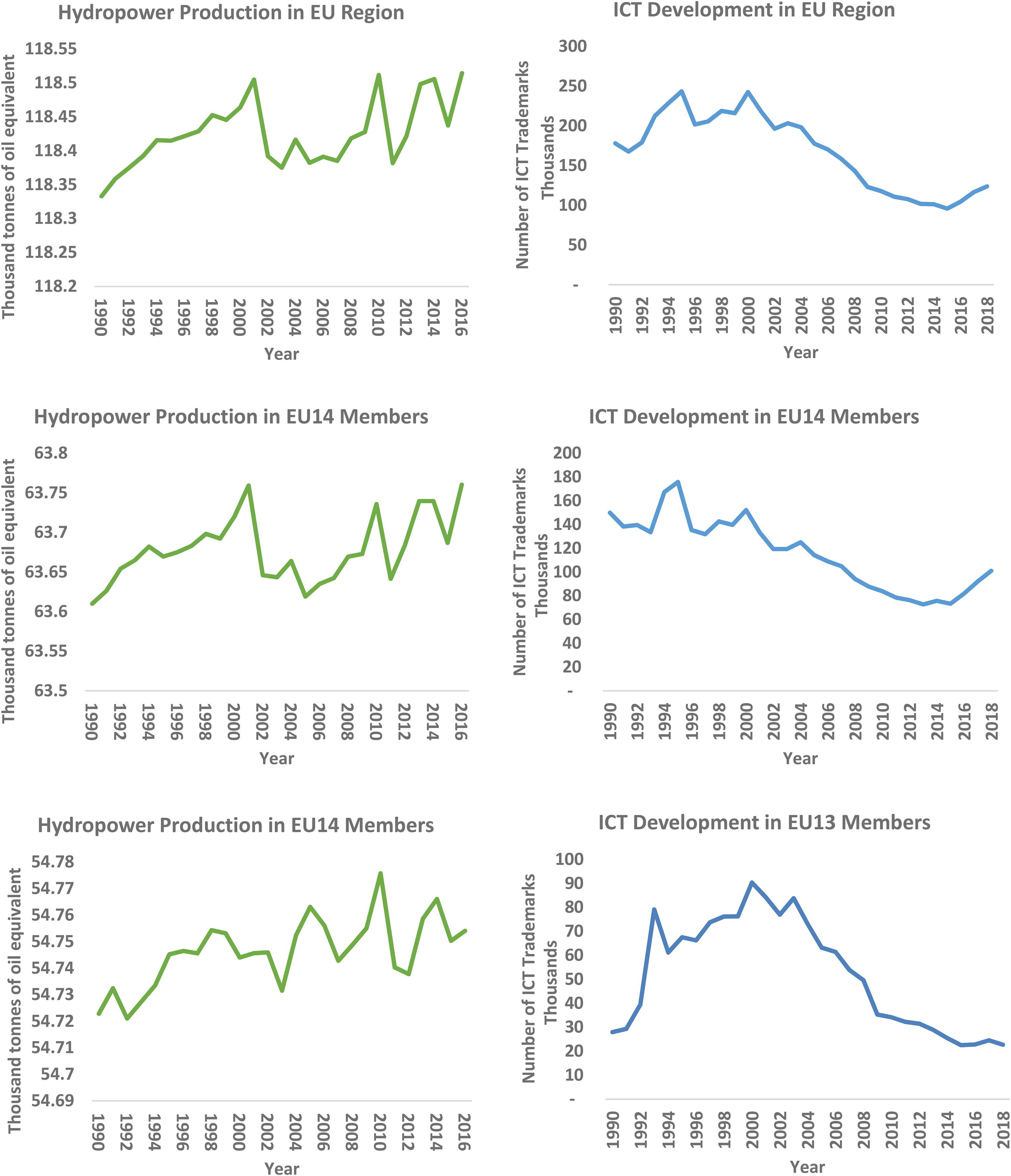
Hydropower industry output and ICT development in the EU region.
Achieving success using this approach requires a concerted or integrated approach in terms of deep research and commitment to advanced ICT solutions and their deployment. This portends high market values for smart city technologies as there will be a need for them on a commercial scale (Khawas, 2021).
It should, however, be noted that the flexible use of HP could trigger problems with electromechanical equipment because many HP plants are not programmed to provide balancing power continuously,4,5 A few of the biggest challenges are non-intermittent starts and stops, as well as mechanical and temperature-related stress they put on the stator winding insulation. 6 Furthermore, unregulated voltage due to the frequency converter could also affect the generator winding insulation.
As there continues to be an influx in the world of digital technologies, there continue to be challenges as well, especially in the implementation of digital processes in HP plants. The maintenance of HP plant assets such as servicing or refurbishing is as well becoming challenging. 7 The level of quality in the assets of these HP plants determines their level of productivity. Keeping good maintenance culture and reducing outage time are two key challenges to all HP plants. This is very important, especially to HP plants that deliver balancing power due to related dynamic operations, dynamic loads, and continuous wearing and tearing of assets. A key among the challenges facing old earthen hydraulic structures is the inability to put in a place an upgrade system that will minimize cases of erosions. 8
Assessing the environmental purview, HP cannot be classified as a polluting agent, however, do have environmental impacts. 9 The effect of HP plants could affect land use, homes, and natural habitats in the dam area. For example, reservoirs may erode people's homes, important natural areas, agricultural land, and archaeological sites. 8 The reservoir itself is drying up and the construction of surface reservoirs has been experiencing a slow pace in recent years. 10 Construction of a dam and reservoir to boost hydroelectric power requires a lot of financial commitment, time, and viable locations where hydro plants could be cited have already been taken. 10 The cost for the construction of HP could be very capital intensive no matter the type of structure to be put in place. This is also very common in hydroelectric power plants. 10 Challenges in logistics make the construction of hydroelectric power plants to be very expensive. The powering of hydroelectricity relies on hydrology. The system depends on water precipitation levels which fluctuate year in and year out, thereby leading to instability. 10 The effect of hydroelectric power plants on water inhabitants such as fish is also notable, fish could be entrapped and their passages could be modified or restricted. 10 This could also affect the flow of the reservoir and change the quality of water. It could affect water temperature levels and the flow of the river could be restricted. This has been affecting the natural ecosystem of native plants on the land and animals in the sea. 11 Even though, HP does not generate/produce greenhouse gas (GHG) emissions during operations, emissions such as methane (CH4) from reservoirs could be very hazardous under certain conditions and this calls for the need for proper assessment of the net change in GHG emissions which are caused by the construction of such reservoirs. 11 There could still not be a conclusion on assessment in the area of ecological impacts. This has made it difficult to have a mitigating approach with a wide level of acceptance among stakeholders, especially in a multi-stressed environment where solutions could still not be ascertained. 11
The main research questions raised for this study are:
In what ways have ICT factors improved the growth of the HP industry among the European nations within the time frame 1990 to 2021? Which of the European Union (EU) members could be said to be more vulnerable to the effects of HP industry growth caused by ICT factors? In what ways have ICT pointers could sustain hydroelectricity and the EU27 nations?
Taking into consideration the importance of a renewed source of energy, in addition to the continuous changes in climatic conditions, it becomes imperative for EU countries to explore the nexus between the HP industry and ICT indicators.
Therefore, the primary objectives of this article are as follows:
To elaborate on the effect of ICT on HP growth among the EU countries within the time frame 1990 to 2021? To present a detailed literature review on HP industry impacts of ICT determinants between emerging countries and emerged nations in the European region with a time frame of 1990 to 2021.
This research has to exhibit knowledge by providing a background on how ICT measures could promote economic growth and development among the European nations and use research to establish a connection between ICT and economic growth. The findings of this study could assist the government of EU countries in combatting environmental degradations which cut across land, air, and water, by examining how ICT could be used to sustain hydroelectricity. Furthermore, since the hydroelectricity sector is considered a clean source of power generation, this research tests HP and ICT indicators to know if they fulfill conditions that could promote the sustainability of standard guidelines which could further the adoption of HP. This article further takes into consideration, the implementation of ICT among the European nations, by adopting additional controller measures and makes classification of them into the following categories: institutional quality (IQ), human capital (HC), economic growth, and carbon dioxide (CO2). Due to its capability to address socio-environmental and economic problems, ICT factors are expected to boost the growth of HP industries in EU14 and EU13 countries. This study will establish the nexus between ICT factors and the sustainability of the HP industry. This article will also attempt to establish in what ways technology could be used to accelerate the pace of growth and development among the EU countries and minimize the cost of policymaking on HP among EU27 countries. There has been extant literature on the relationship between ICT and the sustainability of HP. These studies were carried out in different countries using different methodologies, and modeling and the findings of these studies are as well different. Just a few studies have attempted to establish what relationship exists between HP consumption and ICT in European countries.
There is no harmony in the findings and conclusions of this study. This current study will therefore attempt to add to existing knowledge by investigating how ICT factors could influence HP industry growth in the EU region, EU-emerged countries, and EU emerging during the period between 1990 and 2021. To the best of the author's knowledge, this study simultaneously investigates the effects of ICT determinants on HP sustainable growth using the auto-regressive distributed lag (ARDL) regression and also examines the relationship between socioeconomic determinants and environmental factors by emphasizing the growth hypotheses. In this current article, the model adopted has been improved upon especially on the representation of HP growth at the regional and sub-regional levels. The study focusing on the EU estimates of application-specific long-term economic HP potentials has been updated to fit into the present and future needs, based on subsurface temperature data from the model developed by Naqvi and Rehm 12 and Alsaleh et al. 13 This has been the upgrade over the previous version which is of rudimentary version. In three key ways, the findings of this study will therefore be a novel contribution to existing knowledge in the area of the potentialities of HP, their environmental applications, and their geographical focus. The outline of the article is structured as follows: section “Literature review” presented a deep review of the existing literature in the area of ICT and HP production. Section “Material and method” presents the research methodology, including model specification and the estimation strategy. The empirical results and discussion are reported in the “Presentation of results and discussion” section. Finally, the conclusion to the article and implications were discussed in “Conclusion and implications.”
Literature review
ICT could be leveraged by every member of the EU27 Sustainable Development Goals toward minimizing the effect of climate change and ensuring good sustainability in the energy supply chain for cities and communities. To cite an instance, a study conducted by Joyce et al. 1 examined the influence of changes in the ICT consumption patterns for Sweden and the EU on renewable energy development, the author suggested that government policies on minimizing energy spending are likely to have a higher level of environmental impacts than putting in place measures to reduce consumer spending on ICT. In a study conducted by Strielkowski et al., 2 the primary objective of the study was to explore the role of ICT solutions in renewable energy management efficiency in selected EU countries. The study showed that the adoption of ICT in ensuring renewable energy balance is gaining a wide level of acceptance and this has been efficient in making available modern and smart high-renewables grids. This explains that developed greener ICTs could be used to develop smart grids which are more efficient and devoid of carbon emissions. In a similar study conducted by Rai and Khawas 14 in India, the objective of the study was to explore the relationship between climate change and HP development in India. The study revealed that areas with increasing HP development are prone to geological and hydro-climatic hazards which portends multiple environmental and technological risks to lives. This submission is in agreement with previous studies such as Wei et al., 6 Ibrahim and Waziri, 8 Bordin et al., 10 and Xayyasith et al. 11
HP remains a renewable and eco-friendly source of energy. It is responsible for 16% of the world's generated electricity and 78% of renewable electricity generation. As established by literature, HP is no doubt friendly to the ecosystem, HP prevents greenhouse emissions and reduces the risk effect of global warming. In a study conducted by Berga, 15 it was established that there could be technical issues arising from HP dams as it impacts the environment, however, the cost-effectiveness of HP is notable and its safety on the economy and the environment. A related study carried out by Lehner et al., 16 the study explored the impact of global change on the HP potential of European countries, the study concluded that global warming and climate change can reduce by 25% if HP is adopted in European countries. Similarly, Prakasam and Saravanan, 17 explored the environmental flow and mitigation of HP projects using a geographic information system. The findings of the study concluded that HP energy is regarded as prominent among the most reasonable and non-contaminants sources of energy. These findings align with submissions of previous studies such as Ting et al., 18 Li et al., 19 Lei et al., 20 and Guangliang et al. 21
Also, some studies explored the relationship between hydroelectricity and environmental destruction such as Gracey and Verones 22 and Scherer and Pfister. 23 In a similar study conducted by Kuriqi et al., 24 the primary objective of the study was to investigate the water–energy–ecosystem nexus through balancing competing interests at a run-of-river HP plant coupling a hydrologic–ecohydraulic approach. The study pointed out that combined and dynamic environmental flow methods facilitate a good level of HP production with <50% habitat loss and less alteration in the river flow. In another related study, Filipe et al. 25 analyzed the effects of the operation of an HP plant on downstream habitat availability, the study established that HP production could hurt the lives of fish which could lead to a situation called hydropeaking. This conclusion is in line with the findings of studies such as Boavida et al. 26 and Person. 27 Similarly, Frolova 28 and Frolova et al. 29 investigated the effects of HP dams on the landscape in Europe and found that rapid technological advances in HP production are causing the degradation of landscape quality.
Infrastructure plays a key role in the installation of hydroelectricity. This study considers nonlinearities that are often not given consideration when coming up with policies on hydro energy by policymakers. Related previous studies such as the ones conducted by Thiago and Julian, 30 Lili and Araz, 31 Klippel et al., 32 and Sarah, 33 explained the effect of hydro energy policies on the functioning of water reservoirs. Aslani et al. 34 examined what effect will policies on renewed energy sources have on the energy supply of Finland. The study acknowledged that the energy policy plays a fundamental in Finland's energy dependency. Simone et al. 35 investigated how policies influence hydroelectricity in the Amazon. They suggested that improving policies and instruments will proffer solutions to the gross impacts of small HP in the Amazon.
Empirical works such as the ones conducted by Ohler and Fetters 36 and Apergis and Payne37,38 examined the relationship between renewable energy and economic growth and development. These studies also established the relationship between renewable energy and gross domestic product (GDP). The findings have been that HP and renewable energy do make a significant increase in the GDP of a country. In a similar study conducted by Bildirici and Gökmenoğlu, 39 the primary focus of the study was to establish what relationship exists between environmental pollution, HP energy consumption, and economic growth in Group 7 countries. The study found that HP consumption could be leveraged to boost the economic outgrowth of a country significantly. Notable are studies conducted by Solarin and Ozturk 40 and Solarin et al., 41 who investigated the causal dynamics between hydroelectricity consumption and economic growth in Latin American countries and Italy. The authors established that HP for fossil fuels has the potential of ensuring sustainable electricity generation and boosting the economic growth and development of countries.
Several studies examined what influence HC has on hydroelectricity. Emily et al. examined how social factors influence the planning of hydro energy. The study found that the HP industry has immense positive impacts on HC. Similarly, Novikova et al. 42 examined the conditions for the sustainable development of HP and HC. The authors established that HC development could make a significant contribution to the sustainability of HP in Russia. Also, Fujimoto and Kagohashi 43 examined the relationship between community development and micro-HP growth in Japan. The study established that social enterprises set up by indigents or residents and farmers may serve boost to the development of community-based HP energy significantly.
From all the literature reviewed, the general observation that cut across them all is that there exist significant positive relationships between HP consumption, ICT, and economic growth even though, the results of these studies cannot be said to be conclusive. This is so because many of these studies are criticized based on the validity of the estimated coefficients and their elasticity because the tests used are not based on an appropriate quantitative framework. It could further be seen that many of these studies fail to take into consideration the diagnostic statistics and specification tests that are necessary to obtain unbiased and consistent regression results. These among others are the gaps that this current study intends to fill.
The gap between this article and the ones reviewed is in so many ways. First, this current study estimates the long-run impacts of ICT factors on HP industry growth in EU emerging countries and EU emerged countries during the period between 1990 and 2021 simultaneously.
In addition, this current study investigates the relationship between socioeconomic factors and HP consumption using the growth hypothesis, this has not been previously performed for the EU region level during the period between 1990 and 2021. Furthermore, this study controls for the results of the diagnostic and specification tests, which were hardly taken into consideration in previous studies. In conclusion, it makes use of recent panel data techniques that allow the analysis of heterogeneous unobserved parameters and cross-sectional dependence.
Material and method
This study adopts HP consumption as a proxy to test environmental safety and renewable energy,
44
in the study, ICT is referred to as technology by Talbi,
45
and a GDP is referred to as the ‘A’ in the acronym, which means affluence, IQ as a proxy for governance, and HC input as a proxy for the population and community development. The mathematical representation (1) model can be collapsed into mathematical representation (2). The methodology adopted for the study was pane data analysis. The data used for the study are extracted from Eurostat and the World Bank. In analyzing the data, different statistical tools were used. The likes of panel root rest, panel integrations, mean group (MG), and dynamic fixed effect (DFE). All measures are captured to reflect on the log form (see Table 1). The model serving as a baseline has been similarly used in studies such as Yeh and Liao,
46
and Alsaleh and Abdul-Rahim
47
. The variables are explained as follows:
HP represents hydropower inland consumption (Terajoule) EG represents the GDP, it measures the GDP annual growth rate in %. HC represents the number of human capital inputs. IQ is measured with indicators such as the worldwide governance indicator. CO2 represents emissions coming from carbon dioxide which is gauged in metrics per ton. ICT is represented using application trademarks that come with innovations.
Summary of variables.

GDP: gross domestic product.
Several extant studies used the Impact, Population, Affluence, and lastly Technology (IPAT) model to examine the influence of technology on renewable energy sources.
12
The model makes it simple to comprehend the factors affecting renewable energy. Therefore, this study is as well adopting the model to examine the impact of ICT as it affects GDPs and renewable energy. This is transformed into a mathematical representation as shown below:

Results from analysis using panel root tests
This test was painstakingly carried out in predicting the outcomes of all variables captured for this study. The importance of this statistical tool is that it prevents false or factitious regression and it was further adopted to solve power problems that could arise if Augmented Dickey-Fuller (ADF) was adopted. However, Campbell and Perron 48 and Ramirez 49 queried the reliability of certain estimations especially when time-series studies are below 50. This is where the reliability of the root test comes in as the test can take care of this problem. It, therefore, means that the test can be relied upon as being accurate for what it is being used for in this study. The efficacy of this test was confirmed by Levin et al. 50 and Im et al. 51 It has an advantage over the time series unit root test when compared. The efficacy of these methods has been confirmed in previous studies widely on energy consumption where they have been used. 52
Estimation of panel
Pooled MG (PMG) estimation regression was adopted because it shows a high level of efficiency in predicting long-term relationships among variables. It could as well make estimations in the short run. Although, this will include intercepts, adjustment speed, and variance error for it to be heterogeneous. In using this estimator, the value of the error correction term must be <2 and must as well be negative. Consistency is also needed in the estimation and this could lack serial correlation in the correction model of residual error, thereby leading to inhomogeneity. Once the time lag is appropriately incorporated into both the dependent and the independent variable. However, before it could be used successfully, there must be an increased level of T&N, which also means that the T must be greater than N. N itself is the number of countries and according to Pesaran et al.,
53
N measures around 20 to 30 countries. Another estimator used in this study is the MG, which caters to separate regressions for each of the countries and caters to their coefficient differences (heterogeneity) in both the long run and the short run. It was introduced by Pesaran and Smith.
54
This creates the difference between this estimator and the PMG, as this is not confined to the steps for estimators
55
DFE is similar to the PMG. What makes the similarity is that the vector co-integration value is limited and the adjustment speed is as well limited. It is the last estimator used in this study and it was used because it makes both the short- and the long-run coefficients the same across the board. The mathematical representation for the MG, in the long run, is shown in equation (3):

i stands for countries (numbering up to 27).
t represents the year taken into consideration for this study (1990–2021).
j is referring to the time lag in this study, and
Error correction models to depict short-run relationship is shown below:
Analysis based on the Hausman test
The test emphasized the need to select between the PMG or MG and PMG or the DFE. 56 The interpretation using this approach is that between the PMG and the MG, when the null hypothesis is accepted, the PMG takes preference over the MG as being more effective and if the null hypothesis is rejected, the conclusion will be that the MG is chosen PMG. Also, looking at the PMG and the MG, if the null hypothesis is accepted, then it is concluded that PMG is better than the DFE and when the null hypothesis is rejected, then the DFE is better than the PMG according to Shaari et al. 57
Presentation of results and discussion
This study employed the use of estimators (PMG, MG, and DFE) to examine the influence of ICT factors on HP growth in EU region countries based on their economic development level, the countries used in this study were divided into two groups (Tables 2 and 3); EU14 emerged economies (Austria, Belgium, Denmark, Finland, France, Germany, Greece, Ireland, Italy, Luxemburg, Netherland, Portugal, Spain, and Sweeten) and EU13 emerging economies such as Bulgaria, Croatia, Cyprus, Czech, Estonia, Hungry, Latvia, Lithuania, Malta, Poland, Romania, Slovakia, and Slovenia. Unit root tests based on Levin, Lin, and Chu (LLC), I’m, Pesaran, and Shin (IPS) were carried out in ascertaining the stationarity of data for all the variables captured (lnHP, lnICT, lnHC, lnEG, lnIQ, and lnCO2).
Panel unit root test results for the EU region in 1990–2021.

Note. LLC: Levin, Lin & Chu test; and IPS: Im, Pesaran, and Shin.; HP: hydropower; ICT, information, communication, and technology; HC, human capital; EG: gross domestic product; IQ: institutional quality; CO2: carbon oxide. *** refer to importance at the 1%, scale.
Regression analysis.

Note. VIF, variance inflation factor; ICT, information, communication, and technology; HC, human capital; EG: gross domestic product; IQ: institutional quality; CO2: carbon oxide. ***, **, and * indicate significance at the 1%, 5%, and 10% levels, respectively.
The estimation process starts with preliminary tests. The summary statistics are presented in Table 7 in the Appendix. Normal distribution among variables is seen and the results are further presented in Table 8 in the Appendix. In determining the correlation among the independent variables, a measure of multicollinearity called the variation inflation factor was adopted.58,59 This was done to avoid false regression and the variance inflation factor (VIF) adopted, was done in conjunction with linear regression analysis. And the results as shown in the table reveals no multicollinearity. The decision rule is that in a situation where the VIF is <5, 55 the interpretation is that there is no multicollinearity. In other words, all the variables are not correlated with each other.
Results in Table 4 show the effects of ICT factors on HP sustainable growth to ascertain the level of this effect; this study adopted PMG, MG, and DFE estimators. As seen in the table, the Hausman test is fundamental to selecting either PMG or MG and then after PMG/MG or DFE. Results from the Hausman test analysis conducted between the PMG and MG revealed that the null hypothesis formulated for this study is accepted and therefore, the PMG estimator takes precedence over the MG. Furthermore, results between the PMG and DFE showed the decision of accepting the null hypothesis formulated, this means that the PMG estimator is selected over the DFE. Results from the three estimators were revealed in Table 4. Panel PMG framework was then estimated and Table 4 revealed this result with MG as well as the DFE which serves as a comprehensive check.
Summary of panel regression for the EU region from 1990 to 2021.

Note. PMG: pooled mean group; MG: mean group; DFE: dynamic fixed effect; ICT, information, communication, and technology; HC, human capital; EG: gross domestic product; IQ: institutional quality; CO2: carbon oxide. ***, **, and * indicate significance at the 1%, 5%, and 10% levels, respectively. Bold values indicate significance at the 1%, %5, and 10%.
In Model 1 as revealed in Table 4, ICT shows a significant impact of 1% on the HP industry. The interpretation of this is that growth in ICT by 1% will transform into 0.194% in HP production. These findings support the findings of studies such as Xayyasith et al., 11 Joyce et al., 1 Ibrahim and Waziri, 8 Bordin et al., 10 Strielkowski et al., 2 Rai and Khawas, 14 and Wei et al. 6 These studies concluded that green ICT development should be explored to maximize its benefits in a bid to achieve significant influence on economic growth and a clean environment through HP growth and sustainability. That is, further investment in ICT will accelerate HP production in the EU region. The HP industry sustainability being yearned for by the EU region members can be comparatively carried out or achieved by prioritizing further investment in ICT smart grid supports, and increased level of efficiency and productivity which promote the growth of locally made content materials and services.
Besides, HC input yields a positive-significant value at a 1% level in long run. That is, a 1% increase in HC leads to a 1.472% increase in the HP industry growth. This means that investment in HC resources will bring about growth in the hydro energy industry. This result conforms to the findings of Lipscomb et al. 60 and Annys et al. 61 Further, it is also in conformity with the study of Novikova et al. 42 and Fujimoto and Kagohashi. 43 An increased level of investment in HC will increase the production of HP in the EU regions.
Also, analysis shows that IQ produces a positive-significant value at a 1% level in long run, and this shows that an increase in IQ by 1% results in an incline in HP supply by 2.030%. This finding corroborates the findings of Aslani et al., 34 Andreas and Audun, 62 Simone et al., 35 Klippel et al., 32 and Sarah. 33 All these studies are in uniform with the findings of this study. Also, the finding of this study conforms to the works of Ghimire et al. 63 Further studies such as Thiago and Julian, 30 as well as Lili and Araz, 31 are also in conformity with the findings of this work. It can therefore be deduced from this finding that institutional factors are potent in improving HP generation in Europe. That is the level of HP production desired by these countries could be attained by prioritizing the different parts of an environment such as the indoor, outdoor, and emotional parts.
Furthermore, the coefficient on CO2 emissions is found to be negative but statistically significant at a 1% statistical level, in the long run, this suggests that there is a negative relationship between HP output and CO2 emissions in the EU region. An increased level of HP consumption could minimize CO2 emissions in the EU region. That is, a 1% increased level of consumption in HP consumption could bring about a 2.947% decline in CO2 emissions.
This corroborates the findings of Li et al., 19 Lei et al., 20 Ting et al., 18 Guangliang et al., 21 and Prakasam and Saravanan. 17 It, therefore, suggests that EU region members could have the capacity of achieving pollution mitigation and environmental sustainability targets by increasing the amount of HP consumed. The level of CO2 emissions from these European countries could be reduced by increasing their level of HP use in production processes.
To estimate the effects of ICT factors on the HP sustainable growth in EU14 emerged countries, this research employs three estimators and they are the PMG, the MG, and the dynamic fixed estimator. In Table 5, using the Hausman test the following conclusions were arrived at:
The PMG is preferred over the MG since the null hypothesis formulated is rejected. The PMG is selected over the DFE since the null hypothesis formulated is accepted.
Summary of panel regression for EU14 emerged countries from 1990–2021.

Note. PMG: pooled mean group; MG: mean group; DFE: dynamic fixed effect; ICT, information, communication, and technology; HC, human capital; EG: gross domestic product; IQ: institutional quality; CO2: carbon oxide. ***, **, and * indicate significance at the 1%, 5%, and 10% levels respectively. Bold values indicate significance at the 1%, %5, and 10%.
Looking at Model 2, as displayed in Table 5, ICT has a 1% impact level on the HP industry. This result interprets that the growth in the ICT by 1% helps HP production by 0.321%. These findings corroborate the earlier works of Ibrahim and Waziri, 8 Bordin et al., 10 Strielkowski et al., 2 Rai and Khawas, 14 and Wei et al. 6 These studies suggest that green ICT development could be explored to achieve the potential benefits of significant economic growth and a clean environment through HP growth and sustainability. This means that HP being developed by ICT could be explored to achieve a sustainable environment by the EU countries. It, therefore, means prioritizing the growth of ICT among the EU countries will as well improve their level of HP development. The sustainability in the HP industry being yearned for by the EU14 countries could be attained by increasing the ICT that provides smart grids, higher efficiency, and productivity, with a considerable level of development on infrastructures. This will assist local entrepreneurs in the production of local goods and services. By doing this, the GDP of these countries will increase.
Furthermore, HC input has a positive and significant coefficient at a 1% level in long run. In interpretation, a 1% increase in HC will lead to an 8.050% increase in the HP industry growth. It, therefore, means that sustainability in the HP industry being yearned for by the EU14 members could be attained by increasing the investment level of HC. These findings support the view of Lipscomb et al. 60 Furthermore, it is also in conformity with extant studies such as Annys et al., 61 Emily et al. (2019), Novikova et al., 42 and Fujimoto and Kagohashi. 43 By implication, it, therefore, means that sustainability in the HP industries could be attained by the EU14 countries when there is an increased level of HC development among the EU countries.
IQ as one of the variables captured in this study has a positive and significant coefficient at a 5% level in long run, the implication of this is that an increase in IQ by 1% results will an increase in the level of HP supply by 2.079%. This finding corroborates the findings of Klippel et al. 32 and Sarah. 33 It also supports previous works such as Ghimire et al. 63 It also supports the findings of Thiago and Julian 30 as well as Lili and Araz. 31 This means that the level of HP development in the EU countries will rise when there is an improvement in the level of institutional development.
The level of sustainability being craved by the EU countries could be attained by pushing for the expansion of an enabling environment in emotional, indoor, and outdoor forms.
In addition, the coefficient obtained on CO2 emissions is found negative but statistically significant at a 1% statistical level, in the long run, and this portends a negative relationship between HP output and CO2 emissions in the EU14 members. This suggests that an increase in the level of HP usage by the EU countries will reduce their level of CO2 emissions. The precise interpretation of this is that a 1% increase in HP consumption will lead to a 3.311% decline in CO2 emissions. These findings support the views of Li et al., 19 Lei et al., 20 Ting et al., 18 Guangliang et al., 21 and Prakasam and Saravanan. 17 This means that pollution mitigation and environmental sustainability could be achieved in the EU countries when they increase their level of HP consumption. When the level of HP consumption is increased, this will reduce the level of CO2 emissions among these European countries.
To determine the effects of ICT factors on the HP sustainable growth in EU13 emerging countries, the research adopts three estimators (PMG, MG, and DFE). As revealed in Table 6, the Hausman test is adopted as a viable tool to make decisions among the estimators. A summary of the analysis shows that PMG is selected over the MG, and PMG is selected over the DFE. This makes this work robust in findings.
Summary of panel regression for emerging countries from 1990–2021.

Note. PMG: pooled mean group; MG: mean group; DFE: dynamic fixed effect; ICT, information, communication, and technology; HC, human capital; EG: gross domestic product; IQ: institutional quality; CO2: carbon oxide. ***, **, and * indicate significance at the 1%, 5%, and 10% levels respectively. Bold values indicate significance at the 1%, %5, and 10%.
In Model 3 as revealed in Table 6, ICT has a 5% level of impact on the hydro industry. These results indicate boosting ICT by 1% will have a 0.024% on HP. This result is in line with studies by Ibrahim and Waziri, 8 Bordin et al., 10 Strielkowski et al., 2 Rai and Khawas, 14 and Wei et al. 6 These studies suggest that green ICT development will be a boost to HP production which will, in turn, promote economic growth and sustainability of a clean environment. The E13 countries could therefore leverage ICT to increase their level of HP production. ICT enhances smart grids which promote a higher level of efficiency and effectiveness in the production process. Also, it supports putting in place infrastructures that will the production of local goods and services among local entrepreneurs.
Further analysis revealed that HC input yields a positive and significant coefficient at a 1% level in long run. The interpretation of this is that a 1% increase in HC will lead to a 0.127% increase in the HP industry growth. The implication of this is that the EU13 countries could attain or increase their level of sustainability in HP production by investing more in their HC. This corroborates the work of Lipscomb et al. 60 It also supports Annys et al. 61 as well as Emily et al. (2019). This finding also supports the views of Novikova et al. 42 and Fujimoto and Kagohashi. 43 By increasing their level of HC development, the level of HP production could as well be increased.
In addition to all these, the coefficient on economic growth output is found positive but statistically significant at a 1% statistical level, in the long run, these results suggest a positive relationship between economic growth output and HP industry development in the EU13 nations. This means that the economic growth of the EU 13 countries could be accelerated by leveraging on an increased level of HP production. A 1% increase in economic growth will lead to a 0.090% incline in the HP industry development. This interprets that an increase in economic growth will boost the level of HP production. This corroborates the findings of Nicholas et al. 64 This finding is also showing consistency with studies such as Solarin and Ozturk, 40 Apergis et al., 65 Bildirici and Gökmenoğlu, 39 and Solarin et al. 41 The EU countries could therefore achieve their objectives on renewable energy and HP production by increasing their level of economic activities.
It is also revealed that the coefficient on CO2 emissions is found negative but statistically significant at a 1% statistical level, in the long run, suggesting a negative relationship between HP output and CO2 emissions in the EU13 members. This finding interprets that when the level of HP consumption is increased, there will be a reduction in the level of CO2 emissions among the EU13 countries. To be precise, a 1% increase in HP consumption will lead to a 4.202% decline in CO2 emissions. This finding supports the submission of Li et al., 19 Lei et al., 20 Ting et al., 18 Guangliang et al., 21 and Prakasam and Saravanan. 17 The E13 countries could therefore employ the production of HP to minimize environmental pollution and achieve environmental sustainability. When there is an increased level of HP production among the EU13 countries, this will reduce the level of CO2 emission which will eventually reduce the level of environmental pollution.
Discussion
In this study, a theoretical framework was adopted for the regional grouping of the EU countries according to the level of economic, development, economic activities, and sustainable development. 66 The framework could be employed to categorize the European countries according to the extent to which they are influenced by supply-side (producer) and demand-side (consumer) responses to their specific bundle of economic and environmental attributes. 67 What makes the classification useful is that it provides information about the relative attractiveness to producers and consumers of the combination of economic and environmental attributes indigenous to each group.67 This proves its relevance to the regional and environmental policies of the EU region (Aslaleh and Abdul-Rahim, 2021). The grouping was done based on some shared similar attributes among these countries (emerged countries and emerging countries) and the appropriate mix of environmental and regional policies for each one of them (Aslaleh and Abdul-Rahim, 2021). To ascertain the effect of ICT factors on HP output in EU countries, based on their level of economic buoyancy, the nations were divided into a binary category—14 emerged nations and 13 emerging nations. The EU14 emerged nations in the EU states are France, Germany, Italy, Poland, Spain, United Kingdom, Austria, Belgium, Denmark, Finland, Greece, Ireland, Luxemburg, Netherlands, Portugal, and Sweden. While the EU 13 emerging nations in the EU states are Bulgaria, Croatia, Cyprus, Czech, Estonia, Hungry, Latvia, Lithuania, Malta, Poland, Romania, Slovakia, and Slovenia.
The adoption of the use of the three estimators was to measure the short-run effect in this study. The results are detailed in Tables 9 to 11 in the Appendix. The results breakdown of the estimators could be found in Tables 9 to 11 in the Appendix. The values of error correct term (ECT) are significant in all three estimators at a 1% level which confirms the existence of a long-term nexus. Model 1 as revealed in Table 4 revealed the estimated result on the impact of ICT factors on HP industry growth in the EU region members for the period 1990–2021.
In Model 2 as revealed in Table 5, the table shows the result of the estimated impact of ICT factors on HP production in the EU14 economies in the time frame 1990–2021. Also, Model 3 as shown in Table 6, presents the result of the estimated impact of ICT factors on the growth of hydro energy in the EU13 economies in the time frame 1990–2021.
Going by the results presented in Tables 5 and 6, the results revealed that ICT factors have a significant positive effect on HP growth and that ICT could be leveraged to boost hydro energy production in European countries. Furthermore, the results showed that EU14 has more prospects than EU13 in terms of hydro capacity. This is shown in the values 0.321 and 0.024 for EU14 developed countries and EU13 underdeveloped countries, respectively. EU14 countries are therefore at the advantage of developing hydro energy over EU13 countries. Also, with values of 8.050 and 0.127 for EU14 developed countries and EU13 underdeveloped nations, respectively. It can therefore be concluded that EU14 countries are at the advantage of benefitting more from hydro energy, using HC as a boost than EU 13 countries. Furthermore, results from the analysis also show that IQ on HP sector growth is more viable in EU 14 countries than in EU 13 countries. This is shown in the values 2.079 and 0.003 for EU14 and EU13 countries, respectively. The study also revealed that economic growth activities could be better used in developing hydro energy in EU14 countries than in EU13 countries. This is seen in the values 0.090 and 0.003 for EU14 and EU13, respectively. Again, the relationship between CO2 emission and HP production reveals a significant positive effect of HP sector growth on CO2. This is more pronounced in EU14 than in EU13 countries. This is reflected in the values −3.311 and −4.202 for EU14 developed countries and EU13 developing nations, respectively.
Conclusion and implications
The primary objective of this study was to investigate the relationships between ICT, HC, economic growth, IQ, and CO2 emissions with HP growth in the context of the EU region. In carrying out this study, the methodology adopted was the ARDL model for data spanning from 1990 to 2021 for the EU region. The study expatiates that HP is found to be a clean energy source that might help decarbonize the EU's economy, which will serve as a solution to pollution and enhancement of environmental sustainability. Findings from the study reveal a stronger positive effect of ICT input on HP growth in EU14 emerging economies than in EU13 emerging economies. Also, the study shows a stronger positive influence of HC resources and IQ on the HP industry in EU14 emerging economies than in EU13 emerging economies. Findings from the study also established that there is a stronger positive effect of economic outgrowth on the HP industry in EU14 emerging economies than in EU13 emerging economies. The study further reveals a stronger negative effect of HP growth on CO2 emission in EU14 emerging economies than in EU13 emerging economies.
This study is therefore recommending that the government of these European countries should work tirelessly toward achieving growth sustained by hydro energy. Also, there should be more focus on tightening the level of their IQ factors such as accountability, political stability, government effectiveness, regulatory quality, rule of law, and control of corruption as all of these will improve the level of efficiency and effectiveness in their HP sector by the EU13 countries. The government of these respective countries should also not relent in initiating policies that will mitigate pollution levels. If these could be achieved, it will attract foreign investors which will be a form of foreign direct investment into the HP sector of the EU13 countries. This will strengthen their capacity in the area of HP production. On the side of the government of the EU14 developed countries, they should further prioritize economic activities and development of the HP industry such as enabling irrigation agriculture and open facilities for public activities (swimming, fishing, and boating). These among others will increase the level of GDP which no doubt will have a significant positive effect on HP production in the countries.
Also, it is recommended that more financial allocations to HC development in these countries such as expertise and adequate pieces of training will assist in developing renewable energy sources, especially in the EU13 countries. This will foster achieving their targets on Energy Union by 2030. The physical environment should be well managed and made attractive to foreign direct investment. Pieces of training should be organized where necessary to facilitate efficient use of ICT factors to increase the level of economic activities by leveraging on better use of HP output. When ICT is deployed, cases of pollution and other environmental degradation could be avoided as there will now be decreased levels of human activities that often result in pollution. Finally, green ICT factors will no doubt have the capacity to reduce cases of environmental degradation and increased the level of productivity in the area of renewable energy. This if achieved, will increase the level of economic activities in a country and such a country will be secure energy-wise. It is also very important to note that in the course of improving the level of HP development, the ecosystem should not be abandoned since water is the bases of HP production and if improperly managed, there could be degradation, insecurity, and destruction of the natural state of the environment.
Just like other evidence-based research, this research is also with limitations, the level at which it could be generalized in the area of its findings is limited in scope, and there is a limitation arising from the small data sample which warrants using some econometric analytical style to test the hypothesis formulated for this study. Overall, study limitations, delimitations, and assumptions should be put in the context of the entire article. In this respect, the authors will tend to present a proposition as an opinion rather than a fact. Thus, researchers will be exposing the possible uncertainties of the study and the readership will decide more easily if the findings are supporting weak or definitive conclusions or if further studies are definitely needed before empirical practice can be informed accordingly. This article itself has its limitations as it was designed as a critical analysis rather than an extensive literature review whereby HP literature would have been scrutinized for individual limitations. For example, a detailed assessment of all relevant papers (in the region of the EU) would have revealed all recorded limitations within the selected papers referring for example to aspects of internal validity which could distort the results. Delimitations of this article include the lack of depth when statistical techniques were discussed and presented in the text. Assumptions of this article include the basic premise that all aspects of the notions of Limitations–Delimitations–Assumptions have been adequately covered and thoroughly discussed.
This research could be leveraged to carry out future studies on open platforms, for the exit of the United Kingdom from the EU in 2020. This should be taken into account when analyzing the 2020–2021 data in future studies. Also, what kind of reflection of this situation when giving the analysis results for developed countries and the EU region overall. Moreover, future studies on smart grids and how these smart grids could be factored into the control of the geothermal energy industry. It is paramount for the financial side of it to be examined about how the platform will be financed and what the expected level of returns looks like. Aside from this, the requirements for the successful implementation of the platform foregrounded in the study could be further researched to ascertain if these requirements are adequate or if there will be a need for adjustment to have a successful implementation. This study operationalizes business as the end-users of this platform, the future scope could look at it from the angle of regulators and common households as this will widen the convenience and usefulness of the open platform toward the sustainability of the geothermal energy field. Studies in the nearest future could look at this research to have a background and carry out similar research on the sustainability of mechanisms that could be used for monitoring in some other high-rating sectors away from the geothermal industry.
Footnotes
Authors’ contribution
Both authors contributed to the writing, estimation, analysis, and revision of the paper equally
Mohd Alsaleh, is currently affiliated with Sunwah International Business School, Liaoning University, Liaoning, China.
Xiaohui Wang, is currently affiliated with Sunwah International Business School, Liaoning University, Liaoning, China.
Data availability
Data is available upon reasonable request.
Declaration of conflicting interests
The authors declared no potential conflicts of interest with respect to the research, authorship, and/or publication of this article.
Funding
The authors disclosed receipt of the following financial support for the research, authorship, and/or publication of this article: This work was supported by Shenyang Social Science Project in 2022 (Project Number SYSK2022-01-086).
