



Abstract
Despite the diversity of theoretical studies, natural resources’ moderating role between governance indicators and environmental quality remains a controversial issue. The purpose of this paper is therefore to clarify the nature of this role in the Middle East and North Africa (MENA) countries from 1996 to 2017 relying on the generalized method of moments system estimators. The empirical results reveal that corruption control, political stability, rule of law, voice and accountability, and government effectiveness increase CO2 emissions, while regulation quality does not affect CO2 emissions. Our findings also show that FDI and GDP increase CO2 emissions. However, natural resources moderate the governance indicators to reduce CO2 emissions. Therefore, policy-makers should increase public awareness of the best use of natural resources. Thus, improving governments’ institutional framework will generally contribute to reducing the greenhouse gas emission levels in the MENA countries.
Introduction
The realization of environmental problems (the acidification of air, soil, and water, the accumulation of solid waste, and thermal pollution) during the 1960s and 1970s did not unduly worry economists who had a conceptual framework and analytical tools ready to study these problems: neoclassical economics, in particular welfare economics, with the resulting public policies consisting of regulatory or market instruments. 1 Indeed, the industrial development model has functioned for two centuries on the belief that natural resources are inexhaustible. When this belief collapsed, neoclassical economists tried to integrate the environment into the Walrasian general equilibrium model. The classics gave natural resources a prominent place in their theory of production, since they explicitly recognized their driving role both in industry and in agriculture.
In recent decades, developing as well as developed countries have been concerned with the preservation of environmental quality. Indeed, a clean natural environment is considered an essential element in improving the human life quality in societies. 2 Faced with this concern, governments and political decision-makers focused their attention on a proper natural resources management in order to preserve the ecosystem. Thus, the exploitation of natural resources has contradictory effects. The first attempts consider that natural resources are the main source of growth and economic development since they are key inputs for production. 3 Thus, according to Balassa, 4 natural resources contribute to industrial development because they represent the funds needed to form physical capital and increase the demand for industrial goods. Moreover, Deaton (1999), showed that resources rents represent a potential source of funds for physical capital accumulation. The author also showed that temporary price spikes offer windfalls that can enhance future growth. Indeed, Shahbaz et al. 5 argued that natural resources contribute to financial development and economic growth. However, the second attempts predict that these resources’ massive exploitation—particularly fossil fuels—contributes to almost all CO2 emissions and hence slow down economic growth.
Recently, this relationship between natural resources, growth, and environmental quality has been reinforced given the emergence of the resource curse concept. 6 Indeed, the countries abundant in natural resources, oil in particular, have lower growth levels compared to those of the naturally oil-poor countries. A negative relationship seems to exist between the proportion of natural resources exports in gross domestic product and a country's growth rate. 7 Faced with this ambiguity, new avenues of research showed that the so-called relationship between natural resources and development depends on other factors including primarily governance. However, despite the multiplicity of papers that have addressed the relationship between natural resources and growth on the one hand, and natural resources and environmental quality on the other, few studies have analyzed the moderating effect of natural resources between governance and the environment for a panel of 16 Middle East and North Africa (MENA) countries over the1996–2016 period.
The question to raise here is: why did we choose the MENA countries? Well, investigating the impact of the moderating role of natural resources between institutional quality and CO2 emissions in the MENA countries is very crucial because these countries represent the weakest contributor to global carbon emissions. However, carbon emissions in this region have been increasing. For instance, carbon emissions increased from 864 million tons in 1990 to 2463 million tons in 2015 and further to about 2556 million tons in 2019. 8 Therefore, it is crucial to understand the fundamental forces that are driving the increase in carbon emissions in the MENA countries in order to formulate adequate policies to mitigate this increase before it gets worse. Additionally, the MENA countries seem generally endowed with resources such as productive land, renewable natural wealth such as water and forests, and nonrenewable natural wealth such as gas, oil, and other minerals. These natural resources dominate the economy in many MENA countries and represent an important means of livelihood for the population living in rural areas. However, the sheer size of Africa's natural resources, which have been exploited for several decades, has not allowed the continent to experience real development. The abundance of natural resources has not translated into improved welfare for the people.
On the other hand, several studies argue that MENA countries have failed to harness the potential of their natural resources to drive industrialization, economic growth, poverty reduction, and sustainable development.9–12 As a result, the MENA countries should make better use of their natural resources for their own development. It seems essential to implement strategies that can put the management of the MENA countries’ natural resources at the service of growth and the fight against poverty. Indeed, the exploitation of these natural resources must take into account the possible damage that could affect nature. The active involvement of stakeholders must be observed for the proper management of the wealth that natural resources provide to the MENA countries. Thus, the main actors—namely governments, businesses, civil society organizations, and local populations—must work together to ensure that this wealth leads to large-scale socioeconomic development and that future generations find a land in good condition.
Given the motivation for the study, this article contributes to the literature in several ways. First, this study not only presents the direct effect of governance indicators and natural resources on carbon emissions, but also investigates the indirect impact of natural resources on carbon emissions. Second, this study also shows the indirect channels through which natural resources impact carbon emissions. Thus, unlike previous studies, this paper extends the literature by examining the moderating effect between governance indicators, economic growth, and natural resources on carbon emissions. Third, the majority of existing empirical studies have used a single natural resource indicator to conclude the impact of natural resources on carbon emissions. It can be argued that using a single natural resource indicator could lead to biased results and wrong conclusions. Given this argument, this study uses two (2) natural resource indicators to examine their respective effect on carbon emissions. Finally, this study applies a two-stage dynamic system of generalized moment methods (GMM system) on a panel dataset to examine the impact of natural resources on carbon emissions. The GMM dynamic system helps to control the possible endogeneity and also helps to model short- and long-term impacts.
The remainder of our paper is organized as follows. The second section deals with a brief review of the literature. The third section presents the methodology we used. The fourth section presents the data and empirical results. Finally, the fifth section provides the main conclusions and policy implications.
Literature review
The relationship between governance indicators, growth, natural resources, and environmental quality was well presented in the literature. Several studies examined this relationship with reference to different countries and methodologies. This literature will be subdivided into subheadings to distinguish between direct and indirect effects and subsequently explain the relationships between governance, financial development, natural resources, and environmental quality. Thus, we will attempt to analyze the following hypotheses :
H1: how does governance affect environmental quality?
H2: how does financial development affect environmental quality?
H3: do natural resources moderate the relationship between governance and environmental quality?
H1: how does the quality of governance affect the quality of the environment?
Despite the importance of governance indicators (i.e. corruption control, law enforcement, political stability, and bureaucracy quality), these indicators are largely neglected in accounting for environmental quality degradation.13,14 However, poor governance can lead to a degradation in the environmental quality in the sense that almost all the companies that exploit natural resources (e.g. the mining sector) form a monopoly that is very sensitive to the quality of the institutions. This finding can be confirmed with reference to the Transparency International 16 report, where out of a total of 32 major mining countries, 23 countries admit to a (Consumer Price Index [CPI]) score below 5. Empirically, Apergis and Ozturk 15 conducted a study on a group of 14 countries over the 1990–2011 period relying on four institutional quality indicators (political stability and lack of violence, government efficiency, quality of regulations, and fight against corruption). The authors concluded that the four indicators they used have significant effects on environmental quality. In the same sense and based on a group of countries in Sub-Saharan Africa, Abid 17 studied the impact of the institutional framework on CO2 emissions over the 1996 to 2010 period. The author found controversial results. He concludes that political stability, government effectiveness, democracy, and corruption control contribute to improved environmental quality, while quality of regulations and rule of law lead to environmental degradation. Additionally, to examine the impact of corruption on CO2 emissions, Sekrafi et al. 18 used quantile regression for a group of 18 African countries from 1992 to 2013. The authors noted that every time the corruption variable value moves away from zero (i.e. a lower corruption level), there is a lower negative direct effect of corruption on environmental quality. In addition, the authors found that corruption has a total positive effect on the environment quality, but each time we move from one quantile to another this effect decreases.
Introducing the informal sector, on a group of 100 countries over the period 1999–2005, Biswas et al. 19 found that the impact of the informal economy on CO2 emissions depends on the level of corruption, as it was less destructive for lower levels of corruption. In contrast, Danish et al. 20 analyzed the moderating effect of corruption on the growth–environment quality relationship for the Brazil, Russia, India, China, and South Africa (BRICS) countries over the period 1996–2016. The authors found that corruption reduces the economic growth–CO2 emissions strong relationship. Thus, they came to the conclusion that controlling corruption leads to lower air pollution. Similarly, for a group of MENA countries, Sekrafi and Sghaier 18 examined the effect of controlling corruption on the quality of the environment based on the GMM method. The authors calculated the direct and indirect effect of governance on the environment and concluded that corruption control positively and significantly affects environmental quality. In addition, corruption control affects environmental quality via the growth channel. Thus, the authors concluded that corruption control has a total positive effect on the quality of the environment.
H2: how does financial development affect governance?
A large empirical literature5,21–24 addressed the theoretical relationship between financial development and environmental quality. This literature can be presented in two different lines of thought. The first line of research addresses the existence of a relationship between financial development and the number of pollutants released into the atmosphere. Indeed, according to this approach, financial development is an important tool for attracting green and advanced technologies that lead to efficient energy use.25,26 In this perspective, Tamazian et al. 24 relied on data for a panel of Brazil, Russia, India, and China (BRIC) countries over the 1992–2004 period to analyze the relationship between economic growth, financial development, and environmental degradation. The estimation results confirmed the important role of economic growth and financial development in reducing environmental degradation. In a study on the Chinese economy, the positive link between financial development and CO2 emissions was confirmed by Zhao and Yang. 27 The researchers also confirmed that financial development represents a catalyst in creating green innovations since it entails environmentally-friendly technologies and improves businesses’ financial accessibility.
Based on an autoregressive distributed lag (ARDL) model, the impact of economic and financial development on carbon emissions in Pakistan was analyzed by Abbasi and Riaz 28 over two different time spans: from 1971 to 2011 for the first, and from 1988 to 2011 for the second. The results showed that financial variables only played a role in mitigating emissions in the latter period when a higher degree of financial sector liberalization and development occurred. For the case of China, Zhang 29 investigated the relationship between CO2 emissions and financial development relying on tests of cointegration, causality, and variance decomposition. The author drew several findings: (1) China's financial development represents an important driver that increases carbon emissions. (2) The influence of financial intermediation scale on carbon emissions is greater than that of other financial development indicators. (3) Carbon emissions are affected by stock market scale. (4) FDI has a weak effect on changing carbon emissions.
The second line of literature advocates the absence of any relationship between financial development and environmental quality. With this in mind, Omri et al. 30 verified the absence of any relationship between financial development and CO2 emissions for a panel of 12 MENA countries from 1990 to 2011. The authors relied on the private sector credit to GDP ratio as a proxy for financial development using the GMM method. Moreover, Jamel et al. 31 used a sample of 40 European countries over the 1985–2014 period. They relied on the domestic credit index given by banks to the private sector to measure financial development. The authors relied on OLS regression and causality tests to examine the relationship between financial development and the quality of the environment. The absence of any causal relationship between the two variables is validated by the empirical analysis results. The latter corroborates the findings of Dogan and Turkekul 32 for the case of the USA through an ARDL model.
H3: do natural resources moderate the relationship between governance and environmental quality?
A major debate in environmental economics concerns the impact of natural resources on CO2 emissions.33–37 Indeed, no consensus seems to be emerging on the actual effect of natural resources abundance on CO2 emissions.17,38 Nevertheless, a vast literature has tried to find the different channels that can account for the effect (positive or negative) of natural resources on CO2 emissions (i.e. corruption, insufficient public spending, lack of investment, diversion of productive forces to sectors with the lowest returns to scale). Among the various factors proposed, countries’ institutions and constitutional system represent a key element of natural resource management and determine the negative effect they can have on CO2 emissions. 39
A major element to grasp the effect of natural resources abundance on a country's environmental quality is the latter's influence on the incentives to build quality institutions. So, what is the effect of natural resources on institutions? Nevertheless, the effect of natural resources on the evolution of governance indicators is ambiguous. Indeed, Robinson and Torvik 40 showed that natural resources have no impact on governance indicators in parliamentary systems, while natural resources have a nonlinear (inverted U curve) effect on governance indicators in presidential systems. Beyond a certain level of resources rents, the positive effect of rents becomes negative. Beyond this threshold, therefore, there is a deterioration in these indicators.
Added to the conditionality role played by governance indicators, many authors have shown that, depending on the natural resource, highly dependent countries have weak governance indicators.41–43 Nevertheless, Couttenier 44 showed that natural resources have a nonlinear effect (inverted U curve) on governance indicators. In fact, he demonstrates that the rent from natural resources is an incentive for the establishment of institutions geared to maximizing rent extraction. However, this incentive is opposed to the initial institutional and legal framework. Indeed, governance indicators, if they are of sufficient quality, can provide superior incentives that differ from those provided by natural resources. For example, natural resources do not systematically degrade national institutions. The rent from natural resources abundance may even positively affect governance indicators.
Given the inconsistency in the literature coupled with the knowledge gaps, this study contributes to the literature by using different natural resources indicators (two indicators) to investigate their direct and indirect effect on carbon emissions for a panel of 16 MENA countries over the period 1996–2016 using a dynamic system—GMM.
Methodology
The present paper's objective is to examine the direct as well as the indirect impact of governance on CO2 emissions. We relied on the dynamic panel estimation technique to examine the natural resources’ moderating effect between governance indicators and CO2 emissions in MENA countries. Our dynamic panel estimation technique is the system GMM approach. To meet our objective, the empirical model we tested is given as follows:

After that, the interaction term of governance indicators and natural resources (governance indicators [GI] × natural resources [NR]) was introduced to study the indirect effect of governance on environmental deterioration. Hence, the indirect effect of governance on environmental degradation is given in model (2).

Indeed, estimating the dynamic panel data models by the OLS method yields potentially biased results. 45 There are several problems in such models, namely the environmental regression ones. First of all, since the explanatory variables are likely to be endogenous, they can be measured with errors, especially in a short time span. 46 Second, a biased estimation can be given by the omitted variables. For these problems to be addressed, Arellano and Bond 47 came up with a dynamic panel data model that relies on the GMM model. This model includes an explanatory variable, which is the lagged endogenous variable. Based on Arellano and Bond's estimation strategy, it is important to have a first difference equation to overcome the country-specific effect.
The lagged dependent variable is correlated with the error term; consequently, the “within” estimator is also biased. According to Blundell and Bond, 48 the first difference GMM estimators can have a poor performance with persistent time series and shorter periods. This can be explained by the fact that the series’ lagged levels provide only weak instruments for the differentiated equations. A further limitation of the difference estimator is that the differentiation process to remove the country-specific effect also requires discarding any data about the variation in levels between countries. It is for this reason that we opted for an instrumental variable approach in our paper by finding the appropriate instruments to be correlated with the endogenous explanatory variables but not correlated with the dependent variable. Therefore, we rely on the GMM in a two-step system, proposed by Arellano and Bovier, 49 Blundell and Bond, 48 Bond et al. 50 and introduced by Roodman, 51 since it is a more reliable approach. This is a common approach that allows us to avoid the aforementioned limitations, mainly for the empirical environmental regressions. Indeed, the system-based GMM estimator's contribution is its use of moment conditions based on level equations, added to the usual Arellano and Bond (1991) conditions of orthogonality. Nevertheless, the most important advantage of this estimator is that it does not need any external instrument to deal with endogeneity; instead, its instruments are the lagged values and the differences between the two time periods of the endogenous explanatory variables. There are two main assumptions for the GMM estimator's consistency in a system. The first requires the validity of the instrumental variables, that is, they have to be uncorrelated with the error terms. We test this assumption with the Sargan and Hansen test for restrictions of identification. The second assumption requires verifying the absence of second-order autocorrelation (AR(2)) in the residuals, while a negative first-order autocorrelation (AR(1)) can be detected. We test this assumption with the Arellano-Bond tests for AR(1) and AR(2).
Data and empirical analysis
Data
In the present paper, we studied a group of 16 MENA countries over the 1996–2016 period to examine the moderating impact of natural resources on the relationship between governance and environmental quality. We used CO2 emissions measured in metric tons per capita as a proxy for environmental quality. We used two indicators to measure natural resources rents. The first indicator measures total natural resources rents as a percentage of GDP (NR). The second indicator is petroleum rents as a percentage of GDP (PR). To measure economic activity, we used GDP per capita, and the measure of financial development is approximated by the ratio of domestic credit to the private sector to GDP. Finally, to measure the governance indicators, we used Kaufman's six indicators, namely government effectiveness (GE), political stability and absence of violence (PS), regulation quality (RQ), rule of law (RL), voice and accountability (VA), and corruption control (CC). The governance indicators are presented in scores between −2.5 and 2.5. The closer the score to 2.5, the better the governance quality; but the closer to −2.5, the worse the governance quality. We extracted our variables from the World Bank database. We display the full list of countries in Table A, in the Appendix.
In Table 1 hereunder, we present the correlation between the different variables used in our empirical analysis. It can clearly be seen that the correlation coefficients between each of the two endogenous variables (RN and PR) and those of the exogenous variables are all below the critical threshold of 0.7 used by Kennedy. 52 This confirms the absence of any correlation problem between the variables. However, the results show that the correlation coefficients between the different governance indicators are above the threshold of 0.7. To solve this problem, we managed to introduce the indicators separately, that is, we used individual models for each indicator.
Correlation matrix.

We present the variables’ descriptive statistics in Table 2. The first finding is that the value of the total rent is very close to the value of the oil products’ rent. This confirms that the MENA countries are characterized by a dominance in the exploitation of oil to the detriment of other natural resources. Moreover, if we look at the governance indicators, we see that they are very low on average compared to the upper bound of 2.5. This confirms these countries’ poor governance. We also notice that some countries have very close scores to the lower bound of −2.5 (i.e. they have very poor governance) such as Libya, Iraq, Yemen, and the Syrian Arab Republic. This is due to internal wars and the Arab Spring Revolution.
Descriptive statistics.

Empirical analysis
After giving an overview of our variables, we used a dynamic model (system GMM). This model allowed us to address the endogeneity problem between some independent variables. In addition, we used the lagged independent variables as instruments with reference to the literature.53–54 This suggests that taking the lag of endogenous variables as instruments is the simplest method to deal with the problem of endogeneity.
We present the results of the estimates in the absence of interaction factors in Table 3, that is, we summarize the direct effects between our model's variables. Table 4 shows the estimates in the presence of interaction variables between natural resources rents and governance indicators. This interaction accounts for the moderating effect, that is, the indirect transmission channels that transmit the effect of governance indicators on environmental quality. The results show that the CO2 variable delayed by one period positively and significantly affects current emissions at the 1% threshold. In addition, our results show that the natural resources rent positively and significantly affects CO2 emissions in all models. Moreover, our results confirm that natural resources are the main contributor to the increase in CO2 emissions in the MENA countries. Indeed, a 1% rise in natural resources rents contributes to a 0.3% drop in CO2 emissions. We can account for this observation by the fact that any increase in natural resources rents requires the massive extraction of the resources. This leads to the destruction of the reserves and the transformation of these products, which represents one of the most polluting industries. In other words, mismanagement and high abundance of natural resources rents are not environmentally friendly and therefore damage the global environment. 56 Hence, countries rich in natural resources are confronted with the problem of the “resource curse” that leads to environmental problems. These results are confirmed in the works of Gerelmaa and Kotani 57 and Shao and Yang. 58
System-GMM results for CO2 emissions (without interaction).
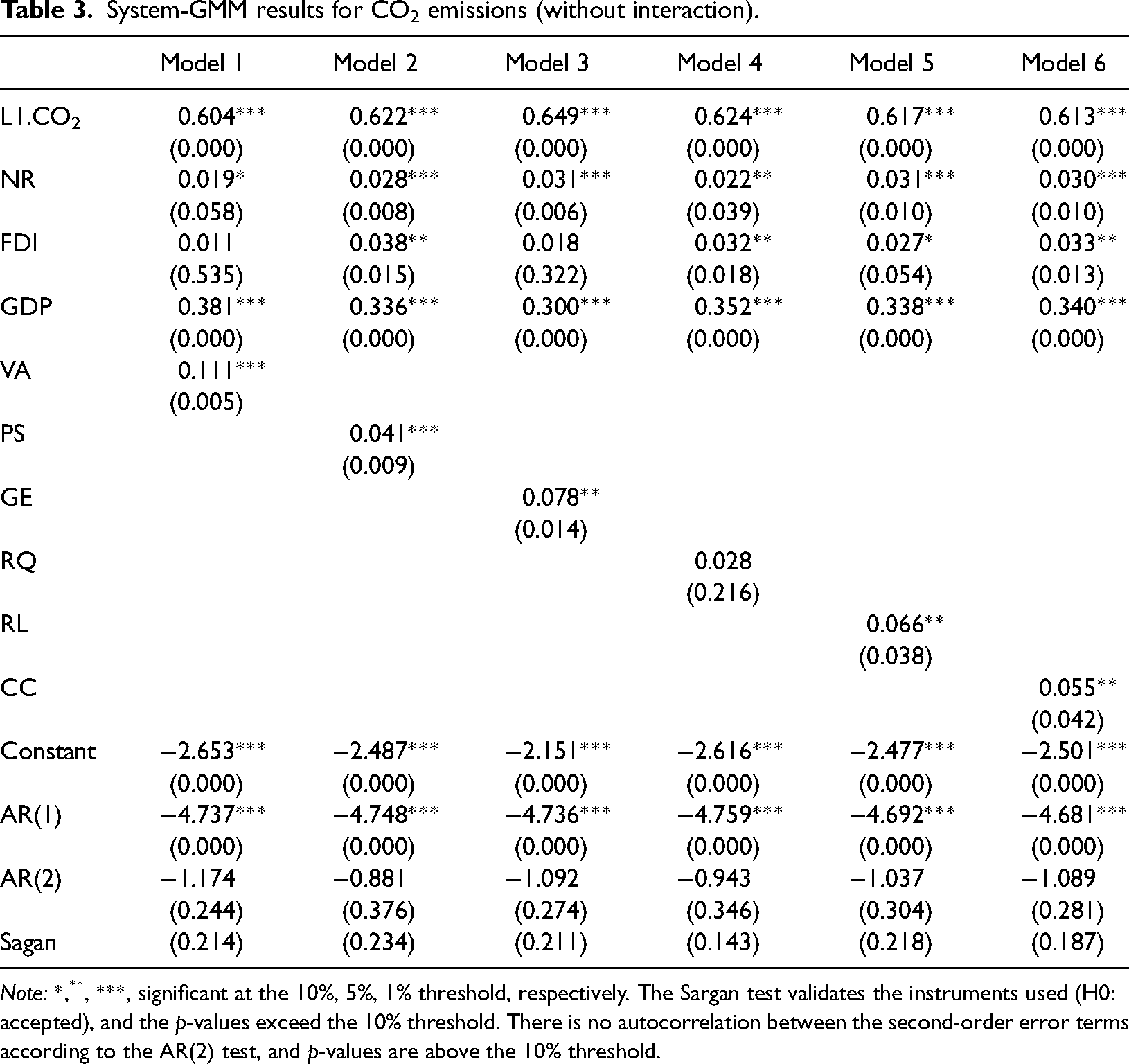
Note: *,**, ***, significant at the 10%, 5%, 1% threshold, respectively. The Sargan test validates the instruments used (H0: accepted), and the p-values exceed the 10% threshold. There is no autocorrelation between the second-order error terms according to the AR(2) test, and p-values are above the 10% threshold.
System-GMM results for CO2 emissions (with interaction).

Note: *, **, ***, significant at the 10%, 5%, 1% threshold respectively. The Sargan test validates the instruments used (H0: accepted), and p-values exceed the 10% threshold. There is no autocorrelation between the second-order error terms according to the AR(2) test, and p-values are above the 10% threshold.
The negative effect of natural resources rents leads us to conclude that States are called upon to give more importance to this factor through good regulation that will allow for better control of natural resources extraction. Also, decision-makers must encourage the exploitation of sustainable natural resources such as the sun and the wind in order to substitute fossil fuels with renewable energies.
For the GDP variable, which is the proxy for economic growth, its coefficient is positive and significant at the 1% threshold. Indeed, a 1% rise in the GDP level contributes to a 0.38% rise in CO2 emissions into the atmosphere. The MENA countries are still in their first phase where any increase in GDP is accompanied by an increase in pollutants. These results are well confirmed by Muhammad et al. 59 who concluded that economic evolution pushes industrial companies to consume more natural resources; which urges the extinction of these resources. Moreover, the financial development variable positively and significantly affects CO2 emissions. Indeed, a 1% rise in the level of financial development generates a 0.3% rise in CO2 emissions. We can account for this outcome by the fact that almost all investments are in the field of petroleum products extraction and processing. This represents a source of pollution and degradation of the environmental quality. The works of Acheampong, 60 Acheampong et al., 61 and Avom et al. 62 confirm the positive effect of financial development. However, our findings do not meet those of Jalil and Feridun 22 for China; Shahbaz et al. 5 for Indonesia; Zafar et al. 63 for the OECD countries; and Zaidi et al. 64 for the organization of the petroleum exporting countries (OPEC) countries which proved a negative relationship. This disparity in the results obtained can be explained by differences in the approximation of financial development, the sampling, and the estimation approach.
As for the institutional quality indicators, we note that they all have positive and significant coefficients. Indeed, the poor governance indicators that characterize most MENA countries contribute to a large extent to the degradation of environmental quality in these countries. Taking the CC indicator as an example, any increase in corruption levels will have adverse effects on environmental quality through the evasion of polluting companies to pay taxes on their emissions. Also, the bribes given to decision-makers will allow the installation of polluting industries in these countries. These results are well confirmed by Sekrafi and Sghaier 18 who examined the relationship between corruption, economic growth, environmental degradation, and energy consumption for the 13 MENA countries over the period 1984–2012. The authors showed that increased corruption directly affects economic growth, environmental quality, and energy consumption. However, corruption has an indirect effect on environmental quality via economic growth.
Thus, good governance can turn the natural resource curse into a blessing. As Subramanian and Sala-I-Martin 7 point out, the natural resource curse is a purely institutional phenomenon. If institutions are of good quality (favorable to productive activities), natural resources promote growth. On the other hand, the presence of institutions favorable to predatory activities contributes to turning natural resources into a curse.
Mavragani et al. 65 examined the relationship between governance indicators and carbon emissions in a sample of 75 countries. They came to the conclusion that the index of environmental performance has a positive correlation with each governance indicator.
We present the analysis of the indirect effects in Table 4 using the interaction variables. The estimation results show that the interaction of natural resources with the different governance indicators improves environmental quality. Indeed, a 1% increase in the interaction term (NR*GI) contributes to a reduction in CO2 emissions of (0.063, 0.024, 0.32, 0.046, 0.033, and 0.038%) for (VA, PS, GE, RQ, RL, and CC), respectively. In a good governance situation, natural resources rents will be more efficiently exploited; which contributes to increased investment in renewable energy production. Also, the control of the extractive industries encourages the installation of filters and the efficient exploitation of resources. Thus, the moderating role played by governance indicators between natural resources and environmental quality seems to be essential. For the impact of natural resources on environmental quality to be curbed, the MENA countries need to further improve their governance by increasing the level of CC, law enforcement, and good governance and fostering a stable political environment.
Robustness tests
Tables 5 and 6 illustrate the robustness of our estimates. Indeed, and given that the MENA countries’ natural resources rent is dominated by the oil rent, we used the oil rent as a proxy for the natural resources rent in what follows. The results show that the governance indicators kept their positive and significant effects on CO2 emissions. Indeed, the MENA countries’ poor institutional quality contributes to the degradation of their environmental quality. In addition, the natural resources rent variable keeps its positive and significant sign. The MENA countries, despite their important natural resources rents volume, poorly exploit these rents given their political instability and high corruption levels. Natural resources rents are used in some countries to finance terrorism (Libya, Iraq) and also used by policy-makers to maintain their power.
System-GMM results for CO2 emissions (without interaction).
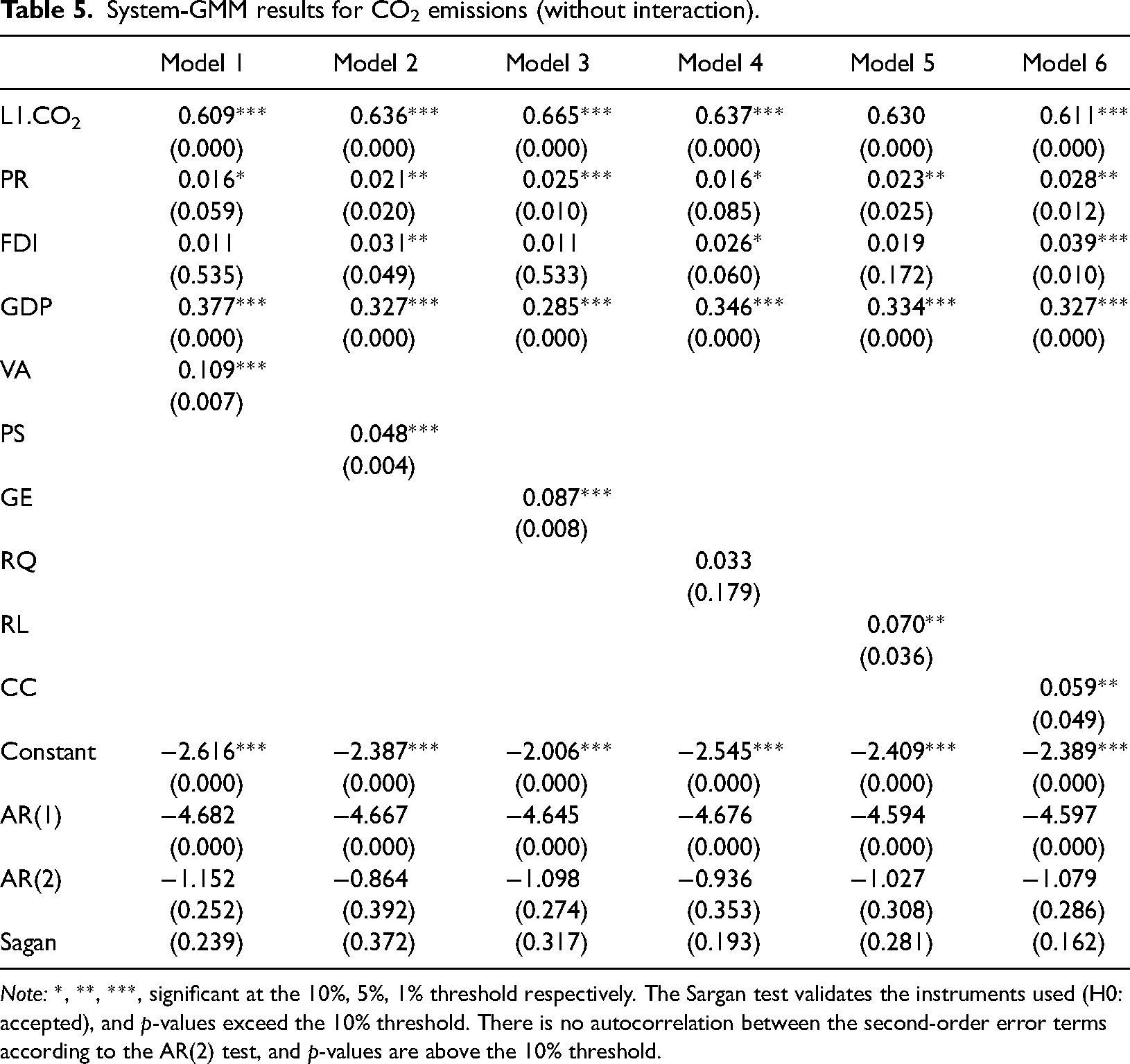
Note: *, **, ***, significant at the 10%, 5%, 1% threshold respectively. The Sargan test validates the instruments used (H0: accepted), and p-values exceed the 10% threshold. There is no autocorrelation between the second-order error terms according to the AR(2) test, and p-values are above the 10% threshold.
System-GMM results for CO2 emissions (with interaction).

Note: *, **, ***, significant at the 10%, 5%, 1% threshold respectively. The Sargan test validates the instruments used (H0: accepted), and p-values exceed the 10% threshold. There is no autocorrelation between the second-order error terms according to the AR(2) test, and p-values are above the 10% threshold.
For the moderating effect, we note that it also keeps its negative impact. Thus, to boost environmental quality and reduce the amount of CO2 emissions released into the atmosphere, the MENA countries need to further improve their governance indicators through enhanced control, law enforcement, and political stability.
Conclusions and policy implications
The issue of the effect of governance indicators on environmental degradation has raised much debate among economists in recent years, particularly after the emergence of the Dutch Disease theory and the Governance Curse theory. Researchers are trying to investigate the channel through which this curse occurs, by comparing different resource-rich countries that achieved different emissions levels. Many recent studies confirmed that the abundant natural resources represent the channel, which determines whether governance indicators are a blessing or a curse for countries’ environmental quality. The present paper examines the moderating effect of natural resources between governance indicators and CO2 emissions in the MENA countries from 1996 to 2016 while checking the effect of economic growth and financial development. For the impact of governance indicators on CO2 emissions to be properly investigated, we used six governance variables (i.e. VA, GE, RQ, RL, and CC) to study the effect of governance on CO2 emissions. Relying on the system generalized method of moments (GMM), we present our findings as follows:
First, our findings prove that economic growth, natural resources, and financial development have positive and statistically significant signs. Regarding governance variables specifically, our findings indicate that governance—which is measured using VA, political governance, GE, RL, and corruption control—increases CO2 emissions while RQ does not significantly affect CO2 emissions in the MENA countries. Although not all measures of governance indicators affect environmental quality, it is obvious that these indicators degrade it. The main argument in this work is that the governance indicators’ degrading effect is assimilated to the market economy where group interests are put forward and which do not necessarily go in the direction of the search for a better environment. Indeed, Fredriksson and Svensson 66 showed that the RL alone cannot lead to an improvement in the environment quality because investors will make choices about their production methods and the use of resources only in accordance with their private interests.
Second, our findings show that natural resources moderate governance indicators to influence CO2 emissions. We find that natural resources moderate GI to curb CO2 emissions. Thus, GIs enable the transfer and allocation of green technologies to environmentally-friendly economic sectors, and hence reduce CO2 emissions. Similarly, the moderating effect (GI*NR) on environmental degradation suggests that the MENA governments provide efficient resources (capital) allocation to companies and other economic sectors that rely on or consume a lot of nonrenewable energy, thus contributing to the reduction of CO2 emissions. What is implied is that governance indicators increase carbon emissions directly, but also decrease carbon emissions indirectly through the natural resources channel. Third, we also tested the robustness of the natural resources moderating effect between the governance indicators and environmental degradation. We substituted our natural resources moderator (NR) with the petroleum rent moderator (PR). The results are, for the most part, significant and consistent with those obtained in the previous specifications.
Finally, this study not only adds to the existing literature that presents the moderating role of natural resources between governance and environmental quality, but also has quite important implications for policy-makers. Indeed, our findings imply that omitting natural resources from environmental degradation models will result in unsustainable carbon mitigation strategies. Our paper recommends that although natural resources hinder environmental quality, governance should encourage industries or companies to invest in environmentally-friendly projects. Thus, policy-makers must find ways to take into account the true value of natural resources in their decisions and thus allow better management of these resources. Learning to value and set a price for ecosystem services and natural resources will reduce pressure on the environment. In addition, future environmental policies should require companies as well as industries to disclose their environmental performance. It is also advisable that environmental policy-makers rely on other policy instruments like emission-trading schemes or carbon taxes to mitigate polluting emissions. As natural resources moderate governance indicators to decrease carbon emissions, policy-makers should increase public awareness about the best use of natural resources. Thus, strengthening the freedom of expression would allow citizens and the civil society to calmly denounce attitudes and activities that could harm their environment. In addition, these countries could develop cleaner institutional arrangements by improving their anti-corruption mechanisms, regulatory compliance, and GE. They should also encourage all that would remove the deficiencies that limit law implementation and the respect of companies’ and citizens’ commitments in the fight against pollution. Thus, good governance has a double effect on the quality of the environment; the first through the control of polluting industries and the second through the improvement of growth, and hence the increase in income levels which will have a positive effect on the quality of the environment.
These policy implications apply not only to the MENA countries, but can also be extended to developing countries. Therefore, future researchers should be more cautious when drawing conclusions about the effect of governance on CO2 emissions, since different governance indicators could lead to a different impact (positive, negative, or insignificant) on polluting emissions. Further research avenues could extend this paper by examining the nonlinear relationship between governance indicators and natural resources. This is because the nonlinear effect of natural resources on governance depends on the nature of the country's system (i.e. parliamentary or presidential).
Acknowledgements
The authors extend their appreciation to the Deanship of Scientific Research at Jouf University for funding this work through research grant No ( DSR-2021-04-0113).
Footnotes
Declaration of conflicting interests
The author(s) declared no potential conflicts of interest with respect to the research, authorship, and/or publication of this article.
Funding
The author(s) received no financial support for the research, authorship, and/or publication of this article.

Appendix
List of countries

| Algeria, Bahrain, Egypt, Jordan, Kuwait, Lebanon, Morocco, Oman, Saudi Arabia, Tunisia, United Arab Emirates, Qatar, Syrian Arab Republic, Yemen, Iraq, Libya. |