



Abstract
Small-scale photovoltaic (PV) power systems have been proven to be successful in generating electricity, conserving fossil fuels, and reducing greenhouse gas emissions in the residential sector, which is one of the largest consumers of energy. In Algeria, to reduce energy consumption in this sector, the authorities are considering implementing a policy that would encourage grid-connected residential PV systems. This paper presents a techno-economic assessment of grid-connected residential PV systems in four climate zones in Algeria. This work was performed using HOMER software for two different PV system configurations, grid/PV and grid/PV/battery. The technical performances of the considered systems were evaluated through the assessment of the self-consumption and self-sufficiency, while the net present value (NPV), internal rate of return (IRR), profitability index (PI), and discounted payback period (DPBP) were used to determine their feasibility. A sensitivity analysis was carried out to evaluate the effects of feed-in tariff (FiT), battery costs, and PV array capacity on the profitability of the systems. The results revealed that the grid/PV systems are technically and economically feasible in all of the four climate zones. For the grid/PV/battery systems, the grant of battery costs and the development of a regional FiT system are recommended. This article provides a tool for policymakers to assess the technical and financial performance of residential solar PV systems to develop adequate policy supports and tariff structures for Algeria.
Introduction
Ever-increasing energy demands, depletion of fossil fuels, and global warming due to greenhouse gas (GHG) emissions have prompted the international community to diversify its energy sources to meet humanity's energy needs. In this new energy era, renewable energies (RE) seem to be one of the most suitable options to pave the way to the energy transition. 1
Algeria, like many other nations around the world, signed the Paris Agreement in 2015 2 and committed to reducing its GHG emissions to keep global temperature rise below 2 °C. It is also about ensuring energy for future generations.
The energy diagnosis based on statistics shows that residential is one of the most energy-intensive sectors in Algeria. It thus accounted for 46.7% of final energy consumption 3 and 36% of GHG emissions 4 in 2019. On the other hand, it has been observed that electricity consumption is increasing year by year, with the largest peaks occurring in summer. This is primarily due to the extensive use of air conditioners during this season. In July 2019, demand reached a record of 15,044 MW in terms of power from the national grid, an increase of nearly 10% as compared to the previous year's summer peak. 5
According to the national energy balance report edited by the Ministry of Energy in July 2020, Algeria's total installed capacity and the production of electrical energy at the end of 2019 were 21,000 MW and 81,526 GWh, respectively. 3 It is to note that 98% of the total national electricity is produced from natural gas, while renewable energy accounts for only 0.7%. 6 To increase the share of RE, grid-connected photovoltaic (PV) solar systems appear to be the most viable and suitable.
Despite previous efforts made by Algeria to diversify its energy sources by setting up PV power plants, it has been noticed that PV systems have not been widely utilized in the building or tertiary sectors. As evidenced by experiences in Germany, Italy, Japan, Australia, and China, small grid-connected PV plants in the residential sector have been found to provide more opportunities for harnessing the solar potential in urban areas than large-scale PV plants as they induce a reduction in the energy transport and distribution costs. 7
To promote residential PV systems, the German government first launched the “1000 rooftop program” which was followed then by the “100,000 rooftop program”, as a result, more than 1.5 million residential PV systems were installed up to 2018. It should be noted that rooftop installations accounted for 70% of the total PV capacity mounted in 2017.8,9 On the other hand, Italy launched in 2000 the “Photovoltaic roofs” program exclusively for rooftop PVs targeting 27 MW with a subsidy of 75% of the initial investment costs, followed by the “Conto Energia” program in 2010, which includes a premium for self-consumed electricity. 10 In Japan, the “Sunshine program” was launched to develop RE. 11 Australian government implemented the so-called “Renewable Energy Target” that allowed the promotion of residential PV systems in over 30% of residences thanks to the establishment of an initial investment cost subsidizing mechanism. 12 China, on its side, has implemented several policies and initiatives, including the “Golden Sun Projects” to boost the development of rooftop PV installations, which represents 41% of the total PV installed capacity in 2019. 13
The dramatic price reduction of PV technology is a result of the strong competition that the solar PV industry has known in addition to the numerous incentive mechanisms, regulations, and policies approved by governments, including capital subsidies, the FIT rate, taxes credits, and net-metering. All of these factors have played a major and essential role in boosting the growth of PV installations worldwide. 14
Over the last decade, it appears that the rate of PV system installations has increased globally, with a noticed high tendency for small-scale grid-connected rooftop PV applications. 15 Consequently, assessment of the technical and economic feasibility of this type of solar system has become crucial to determine its suitability for different geographical areas. Thus, many scientific works have been exploring the technical feasibility and economic viability of small-scale PV plants as presented in the following brief literature review.
Lee et al. 16 evaluated the profitability of residential PV systems and the impact of government financial incentives at 51 locations in the United States using net present value (NPV), IP, and PBP economic indicators. The results indicated that solar incentives significantly improve the profitability level of residential solar systems. Rodrigues et al. 17 investigated the feasibility of small-scale PV systems (1 and 5 kWp) in different countries using various consumption scenarios. It has been found that the viability of the systems depends on the incentive schemes used in the examined countries. Lau et al. 18 examined the effect of component costs, FiTs and carbon taxes on the development of grid-connected residential PV systems in Malaysia. They showed that the residential grid-connected PV system remains the optimal system as long as the PV generator cost is below $4000/kW. Emmanuel et al. 19 assessed the viability of a 10-kWp grid-connected PV system installed at the Maungaraki School in Wellington, New Zealand, and found that the studied system reduced both the annual energy imported from the grid by 32% and the electricity bill by 45%. Tomar. V and Tiwari. G.N 20 analyzed the techno-economic feasibility of grid-connected PV systems in New Delhi, India. HOMER software was used and the results were evaluated in terms of energy cost (COE) and net present cost (NPC). This study concluded that grid-connected systems without battery storage are technically and economically viable in New Delhi. Li. C et al. 21 examined the techno-economic evaluation of grid-connected rooftop PV systems for five climate zones in China. The analysis was performed using HOMER software and concluded that the proposed PV system was better suited to the mild climate. Lopez Prol. 22 conducted a comparative analysis to evaluate the profitability of grid-connected PV systems in Germany and Spain based on the evolution of FiTs. The study revealed that in Germany, successful adjustment of subsidy levels to changing PV costs led to widespread adoption of PV, but in Spain, the abrupt changes in energy regulations led to the collapse of the financial support mechanism. Li et al. 23 completed a performance analysis of a 5 kWp grid-connected residential PV system with battery in Kyushu, Japan. Obtained results showed that batteries can reduce peak load by 1.1% and a battery cost subsidy would make the system more attractive. Abdoulaye et al. 24 presented a comparative analysis, based on the discount cash flow method, for residential PV systems in Canadian provinces for the years 2013 and 2016. The results showed that 13 out of 14 projects in 2016 were viable and profitable due to the low initial investment costs. Ayodele et al. 25 conducted simulation studies on the power generation reliability of a hybrid mini-grid system (HMS) for the Nigerian rural community using the HOMER software. The results based on the levelized cost of electricity (LCOE) as an economic indicator, showed that the HMS system was highly economic than the diesel system when optimally designed. In Turkey, Duman and Onder 26 presented an economic analysis of 5 kWp rooftop PV systems in three climate zones using HOMER software and FiT scheme. The authors suggested setting up different FiT rates for different customer categories and updating the FiT rate regularly. Esan et al. 27 investigated the optimal size for a hybrid system (gasoline generators/PV/wind/battery) in a rural residential area in Kwara State, Nigeria using HOMER software. The NPC and COE analysis showed that the proposed hybrid system was economically interesting. Cristea et al. 28 conducted an economic assessment of grid-connected residential PV systems considering six PV systems of different capacities in Romania. The PVSOL software was used for conducting the simulations and the recent legislation on energy production in Romania was introduced. The authors conclude that PV systems can be economically competitive when subsidies are available, especially for small-capacity PV systems. Ana et al. 29 presented a techno-economic study considering different configurations of PV system with and without batteries in Portugal when different electricity tariffs applied. The study has concluded that PV systems with batteries can only be profitable if a good energy management strategy is implemented. Jinwoo et al. 30 conducted a comparative analysis of the economic feasibility of nanogrids and microgrids on Jeju Island, South Korea using NPC and COE economic indicators. The authors concluded that the nanogrid scenario is more economical than the microgrid scenario. Suparwoko and Qamar 31 presented a techno-economic analysis of rooftop solar power plants (RSPP) considering energy prices and regulation of RSPP under four alternative policy scenarios implemented in Indonesia. Based on the negative NPV of the system, they have shown that rooftop PV systems are not financially viable in Indonesia. Ryan and Tim 32 analyzed the costs and advantages of redirecting feed-in tariff (FiT) payments towards residential battery storage in Australia. The authors concluded that distributed batteries can increase the penetration of residential solar PV and lower the network costs only if a reduction in total system costs is applied.
Other relevant studies have used metaheuristic algorithms to examine the technical-economic feasibility of optimal design of renewable microgrid systems, due to their accuracy compared to traditional methods. 33 Sweta et al. 34 presented the optimal sizing for grid-connected PV/battery system to minimize the LCOE and maximize the reliability index (RI) using a modified multi-strategy fusion artificial bee colony algorithm. Yuelin et al. 35 treated the case of a rural building in China to determine the optimal PV/battery system by using a metaheuristic tabu search algorithm focusing on the total life cycle cost (TLCC) and the reliability index. Huaihai and Xingang 36 proposed a hybrid approach based on a metaheuristic algorithm for the optimization of the PV/storage system to minimize the annual system cost through the loss of load supply probability (LLSP). This study found that the obtained optimal size is techno-economically more cost-effective. Jiaming 37 used a genetic algorithm with a time series simulation to a size residential grid-connected PV/battery system. The authors came to the conclusion that the optimal PV/battery system obtained can significantly reduce the cost of electricity for households.
According to the above literature review, it appears that many research groups have been interested in the assessment of the feasibility of different types of PV systems. However, in none of the examined works, was treated at the same time the feasibility of grid-connected residential rooftop PV systems as related to the FiT rate, subsidy rate, PV capacity, and climatic conditions considering both grid/PV and grid/PV/battery configurations.
In the Algerian context, only a few studies have been reported discussing the viability of rooftop PV systems. Existing works have treated the feasibility of PV systems considering one specific region only, which does not represent the viability across the entire country, which is essential data for policymakers. Missoum et al. 38 assessed the energy efficiency and economic feasibility of a grid-connected PV system combined with a solar heating system mounted on a bioclimatic house in northern Algeria. It was found that the payback period was quite long due to the high cost of the solar energy components. Laib et al. 39 presented an energy performance analysis of a grid-connected residential PV system in northern Algeria. It has been concluded that the PV/grid system supplies 67.6% of the energy required by the examined house and a positive annual energy balance of 2 kWh/day was also observed. Sahouan et al. 40 analyzed the performance of a 28 kWp rooftop PV system in Adrar, southern Algeria. The impact of meteorological parameters and energy losses was investigated. Bouacha et al. 41 studied the performance of a 9.5-kWp grid-connected PV system installed on the roof of the laboratory of the Renewable Energy Development Institute in northern Algeria and showed that a performance rate (PR) of 70% was achieved after 14 years of operation. Bencherk et al. 42 used HOMER to analyze the techno-economic viability of a 30-kWp grid-connected PV plant for an administrative building in EL-Attaf, northwest of Algeria. The energy produced by the system was estimated to be 47,872 kWh/year, a saving in natural gas consumption for electricity production was evaluated to 454 m3/year and the resulting reduction in CO2 emissions was estimated to be 549 kg/year. Among all of the research works that were carried out in Algeria on residential PV installations, no one has addressed, in a comprehensive and detailed manner, the feasibility and viability of grid-connected residential PV systems for the different climatic regions of the country. Table 1 lists the detailed information of the cited previous research articles along with the main remarks and findings.
Summary of previous studies presented on literature review focusing on small-scale PV systems.

NS: not specified.
The main objective of this study is to carry out a complete techno-economic analysis of small-scale rooftop PV systems for two configurations, with and without batteries, applied to the residential sector in Algeria by identifying the most economical configuration and the adequate FiT rate for each configuration considering the solar potential particularities of each climate region. In addition to that, the present study aims to determine the required financial incentives to boost the adoption of small-scale rooftop grid-connected PV systems in Algeria.
Renewable energy policies in Algeria
Algeria has launched, since 2011, the “National Program for the Development of Renewable Energies and Energy Efficiency” (NPDREEF) to maximize the efficient use of existing natural energy resources, actively contribute to the reduction of environmental impacts, in particular by mitigating CO2 emissions and additionally to reduce the country's high dependence on fossil fuels. This program, which was amended in 2015, targeted the realization of 22,000 MW for the energy needs of the national market over the period 2015–2030. This ambitious initiative, which is mainly based on PV plants to achieve, by 2030, a share of nearly 27% of renewable in the national electricity generation balance sheet. 43 Indeed, out of all the projects planned for the first phase (2015–2020) of the program (NPDREEF) with a total capacity of 3000 MW, only a total capacity of 354.1 MWp was installed at the end of 2020. 44
To boost the (NPDREEF) and accelerate the deployment of Renewable Energy systems in the country, the Algerian authorities created the Ministry of Energy Transition and Renewable Energies in 2020. One of its missions is to ensure the installation of a 15,000-MW renewable energy total capacity by 2035. The financial incentives and the FiT schemes with the self-consumption practice for the generation of renewable electricity in urban areas are still under development. Thus, no FiT mechanism or financial incentives related to small-scale PV systems exist yet. Additionally, Algerian authorities have not yet approved the injection of electricity into the grid for rooftop PV applications. At the moment, the only available base rate of FiT for renewables energies is that which was introduced in law number 23 and dated April 23, 2014, for solar PV installations with capacities comprised between 1 and 10 MWp, set at €0.10/kWh. 45
Solar potential and climate zones in Algeria
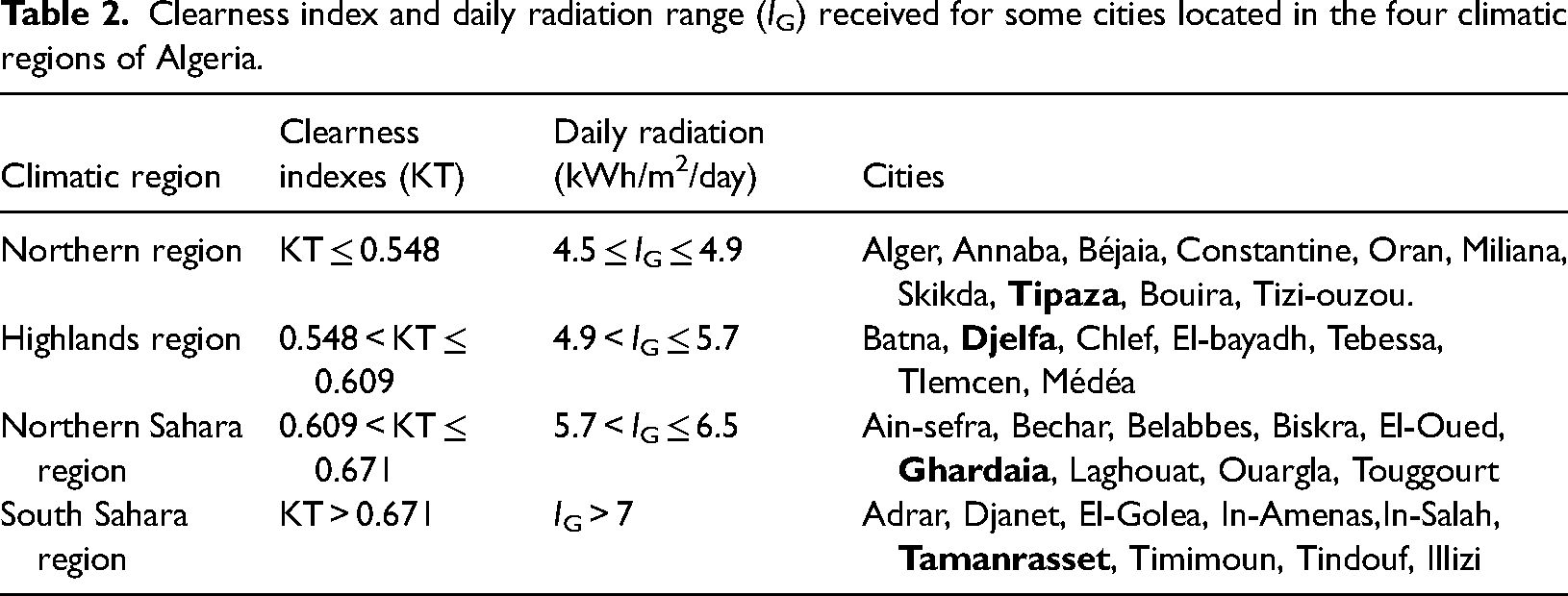
Algeria is a vast country that covers an area of 2.3 million km2. The climatic conditions vary greatly from north to south across the highlands. According to Ref., 46 Algeria can be subdivided into four climate zones. As shown in Table 2, each zone is defined by its average monthly clearness index (KT). In addition, solar radiation in the country has one of the largest solar potentials in the world. The duration of solar radiation in most Algerian cities exceeds 3000 hours per year and can reach up to 3900 hours in the highlands and the Sahara. 47 The average energy received on a horizontal surface is about 1700 kWh/m2/year for the north and 2263 kWh/m2/year for the south of the country. 48 Figure 1 shows the country's solar potential.

Global horizontal irradiation in Algeria. 49
Clearness index and daily radiation range (IG) received for some cities located in the four climatic regions of Algeria.
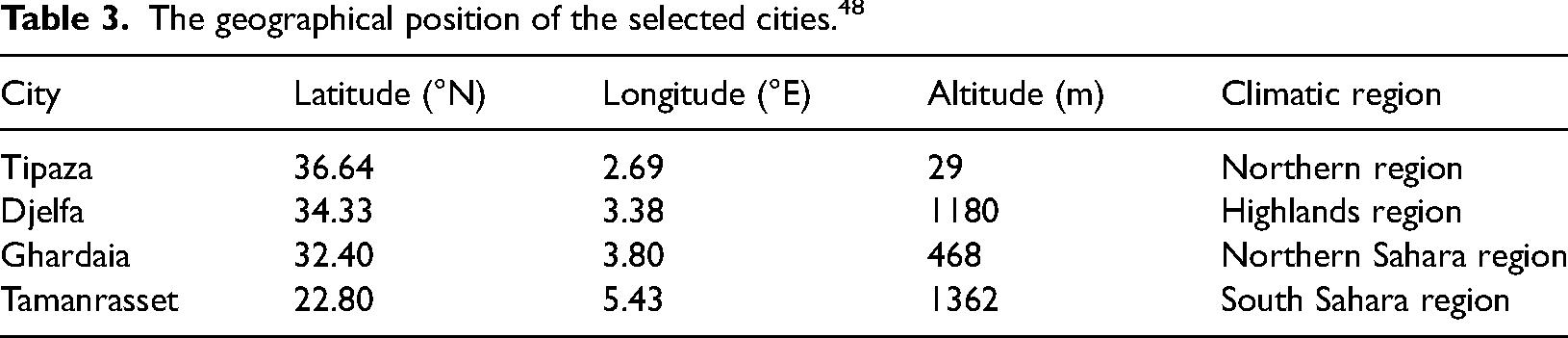
For this study, four representative cities, one for each climate zone were chosen: Tipaza in the north of the country, which has a Mediterranean climate characterized by mild and wet winters and hot and dry summers. Djelfa is in the highlands with a dry semi-arid climate. Ghardaia in the northern Sahara, called the southern middle, is characterized by an arid climate. Tamanrasset is in the southern Sahara region which has a desert climate, with very hot summers and mild winters. The locations of the cities are shown in Table 3.
The geographical position of the selected cities. 48
Simulation: tools and data
Simulation tools
The technical and economic performance of each of the different residential grid-connected PV systems considered was examined using HOMER software. 50 HOMER simulates different system configurations and selects the optimal one among the system constraints, such as demand charge reduction, self-consumption, and battery charging and discharging control. 51 In this study, a rated capacity of 3 kWp for the PV plant was chosen to evaluate the technical and economic performance of PV systems, due to the restricted roof area of houses in Algeria, which are multifamily buildings with many floors in most cities. The 10-kWh battery bank is used to store the excess PV energy for later use. This corresponds to approximately one day of autonomy. The methodology used in the study under HOMER follows the flow chart shown in Figure 2.

Flowchart of the proposed methodology used in the study under HOMER software.
Input data
Irradiation and temperature
The solar irradiance and ambient temperature data used in this study were obtained from the National Meteorological Office (ONM). 52 Figures 3 and 4 respectively show the monthly global insolation data and the corresponding daily ambient temperatures for the locations considered. The intensity of solar radiation in the four selected cities increases significantly from north to south. The average value of irradiation in Tipaza (northern region) varies between 4.2 and 4.6 kWh/m2/day, Djelfa (highlands region) between 4.6 and 5.4 kWh/m2/day, Ghardaia (northern Sahara region) between 5.4 and 6.2 kWh/m2/day and for Tamanrasset (South Sahara) solar irradiation is greater than 6.4 kWh/m2/day. The daily averages of the minimum and maximum ambient temperature for Tipaza, Djelfa, Ghardaia, and Tamanrasset are respectively 8 °C, 1 °C, 7 °C, and 1 °C for January and February and 29 °C, 32 °C, 34 °C, and 38 °C in July.

Monthly global horizontal radiation for the considered cities.

Daily ambient temperature over the year for the considered cities.
Demand profile
The household load profile is a very important variable for the design of PV systems. The household electricity load depends on the habits of the users, but also the climatic conditions of the housing site. The daily load profile of household customers from Algeria for each season is given in Figure 5. However, it should be noted that electricity consumption of Algerian families peaks in the summer in all regions, with 11.92 kWh/day in the northern region, 13.85 kWh/day in the highlands region, 16.18 kWh/day in the northern Sahara region and 16.63 kWh/day in southern Sahara region. 53

Daily seasonal load profile for the considered cities.
Economic data
The economic analysis for this study has been carried out based on the Algerian market expenses. Thus, the polycrystalline PV module price with (0.34 €/W), the batteries (0.293 €/W), the inverter (0.12 €/W), the replacement (18 €/W/year), the maintenance (1.8 €/W/year) and the additional costs such as electrical accessories, installation, and labor were assumed to be 0.7 €/W. The yields of the PV module and inverters used are 17% and 96%, respectively. The lifespan of the system is set at 25 years and that of the inverter and batteries at 10 years. In the end, the real interest rate was set at 4%.
Furthermore, current energy regulations in Algeria do not provide any subsidies, financial incentives, or FiT for electricity generation from small-scale residential solar PV systems. For this reason, the existing basic purchase tariff for systems with a capacity between 1 and 10 MWp was used as a benchmark tariff in this analysis to examine whether it is suitable for small residential installations. The purchase price for electricity from the grid is approximately 0.05 €/kWh. 54 The main contribution of the study is to identify the most suitable FiT for small-scale residential PV systems, which are suitable for both grid/PV and grid /PV/battery configurations are provided, taking into account regional variations in solar potential.
Technical and economic indicators definitions
Technical indicators
The technical analysis was carried out using two energy indicators of PV systems, namely the self-consumption rate and the degree of self-sufficiency. Self-consumption is defined as the ratio of the PV energy consumed by households to the total PV generation. Self-sufficiency indicates the degree of satisfaction with household needs through local PV production.
55
The expressions for the self-consumption factor and the degree of self-sufficiency are given below:

Economic indicators
The four economic indicators used for conducting the economic analysis, namely, discounted payback period, NPV, internal rate of return, and profitability index (PI) are defined in the following paragraphs.
The DPBP represents the time required to recoup the system's initial investment. It is commonly used to assess the level of risk in long-term investments.
56
A DPBP of less than the lifetime of the project indicates that the investment is favorable. DPBP is calculated as follows:
The NPV is used to analyze the profitability assessment of long-term projects. The higher the NPV value, the more economical the investment.
57
The NPV is the difference between the present value of all cash inflows and the present value of all cash outflows over the lifetime of the investment project.
58
The NPV for the residential PV systems with and without battery was calculated according to Equations (4) and (5) respectively.

The IRR is a financial parameter used to assess the attractiveness of an investment opportunity. It can be calculated by setting the NPV of the total investment to zero in Equations (4) and (5), it should be greater than the discount rate for an investment to be viable. IRR is useful when comparing projects with the same initial investment costs.
59
Equation (6) shows the IRR formula.

PI is known as the benefit–cost ratio, used to analyze the viability of the project. PI is the ratio between the present value of an investment's cash flows and the present value of its estimated cash outflows. PI greater than 1 indicates that the project generates positive value, else the project's costs outweigh the benefits it should be rejected.
61
PI is determined as follows:
Results and analysis
Technical analysis
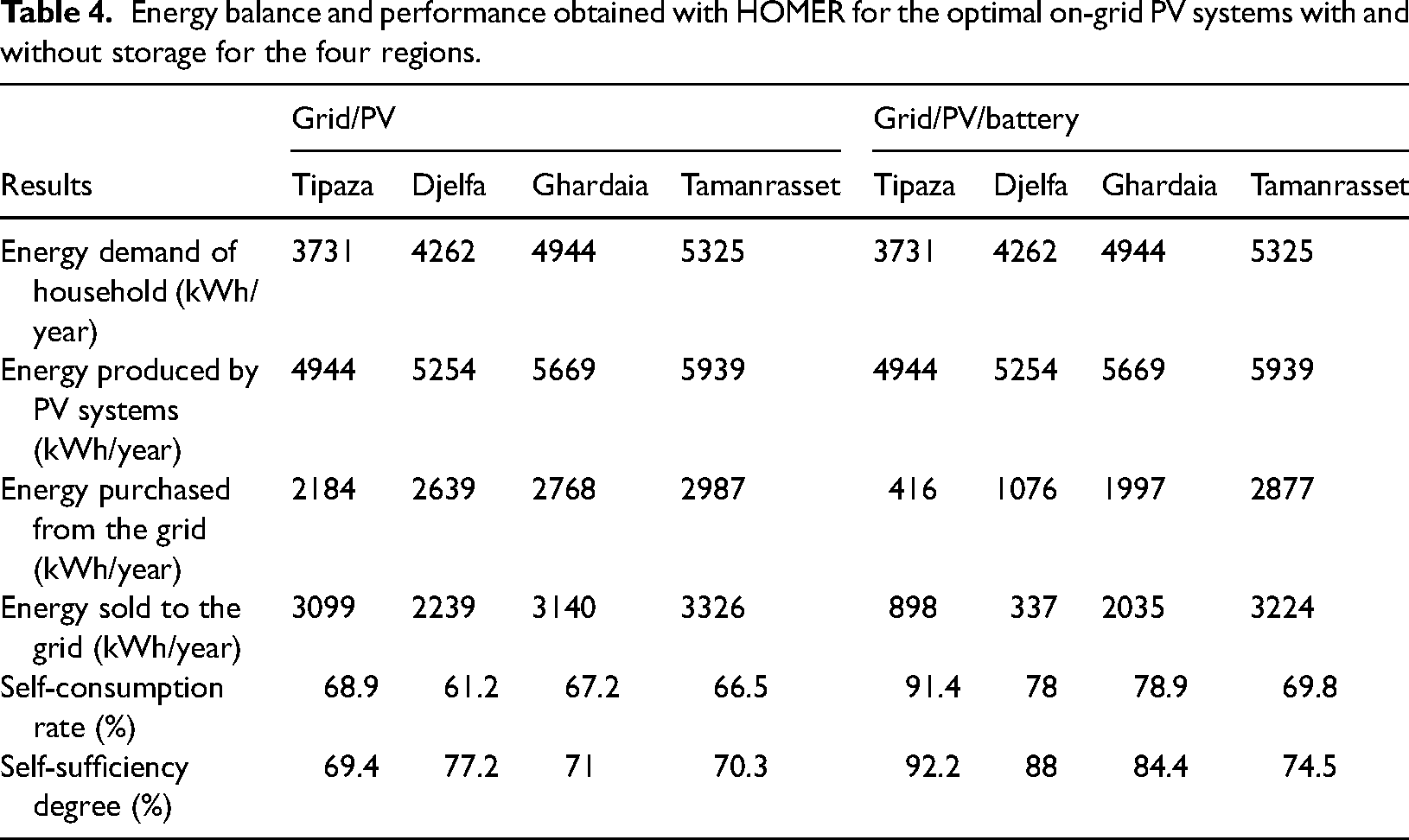
The simulation results obtained by HOMER for grid-connected residential PV systems for the studied cities are given in Table 4. The PV production data, the energy withdrawn from or fed into the grid, and the energy stored in the batteries were used to calculate the energy performance parameters.
Energy balance and performance obtained with HOMER for the optimal on-grid PV systems with and without storage for the four regions.
The average daily PV production and residential load consumption for each month and each region are shown in Figure 6. For the 3-kWp PV generator, the PV production is higher in the two Saharan regions compared to the north of the country. Indeed, it varies between 11.85 and 18.19 kWh/day for Ghardaia, and between 13.08 and 20.16 kWh/day for Tamanrasset. For Tipaza and Djelfa, the PV generation reaches its maximum production capacity in July and August, respectively, 13.76 kWh/day for Tipaza (August) and 15.80 kWh/day for Djelfa (July).

Monthly average PV production (full histogram) and electricity consumption (hatched histogram) for the considered cities.
For all the studied regions, annual PV production is higher than annual consumption. At first glance, PV energy in the regions studied could meet household energy demands. The values of household electricity consumption show variations from one city to another due to different climatic conditions. In addition, consumption is relatively higher in summer for the four regions and this is mainly related to the use of air conditioning.
The monthly energy exchange with the grid for the grid-connected residential PV systems with and without batteries for the four regions is given in Figure 7. For the case of grid/PV systems (Figure 7(a)), the most relevant result concerns the high amounts of energy exchanged with the grid. More than half of the production was fed into the grid for most months. For example, in the city of Tipaza, the PV electricity generated by the PV system and not consumed by the loads accounts for about 42% to 53% depending on the season. The same applies to the other climatic regions, but in different proportions. It could be noticed that for the grid/PV/battery systems (Figure 7(b)), there is less energy exchanged with the grid. The most significant result is the decrease in energy withdrawn from the grid in summer by (84.12%) for Tipaza and (89.48%) for Djelfa despite the strong demand caused by the intensive use of air conditioning. In contrast, the reduction of energy fed into the grid is higher in Tipaza (80.96%) among the four regions, which means for the grid/PV/battery configuration from a technical point of view, the (3 kWp, 10 kWh) PV/battery system is the most suitable PV system for the city of Tipaza.

Monthly energy withdrawn and injected into the households in the studied cities.
Regarding the cities of Ghardaia and Tamanrasset, it can be seen that the energy exchange with the grid shows relatively higher values since the capacity of the battery bank (10 kWh) is not enough to store the excess PV production for these two cities.
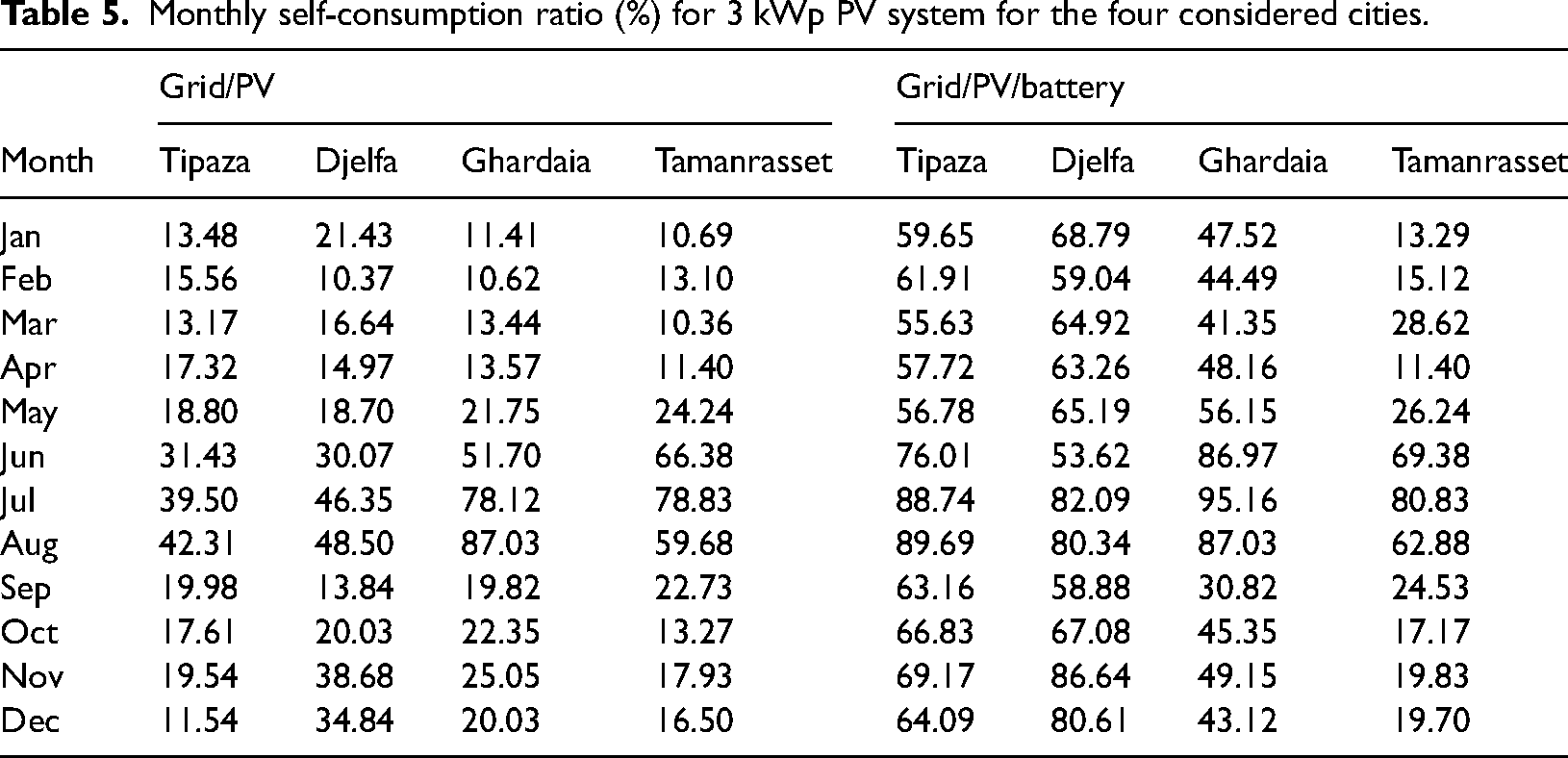
Self-consumption naturally increases with higher battery capacities as the excess PV production can be stored for later use, but this would also incur additional costs for the initial investment. Table 5 shows the detailed self-consumption rates over one year of the grid/PV and grid/PV/battery systems. The minimum and maximum self-consumption levels for the grid/PV configuration in the regions studied are, respectively, 11.54% and 42.31% for Tipaza, 10.37% and 48.50% for Djelfa, 10.62% and 87.03% for Ghardaia, and 10.36% and 78.83% for Tamanrasset. The self-consumption rate reaches relatively high values during the summer season. The self-consumed energy increases obviously by using the batteries during the winter season, from 13.53% to 61.88% for Tipaza, from 22.21% to 69.48% for Djelfa, from 13.68 to 38.37% for the Ghardaia, and from 13.43% to 15.37% for Tamanrasset.
Monthly self-consumption ratio (%) for 3 kWp PV system for the four considered cities.
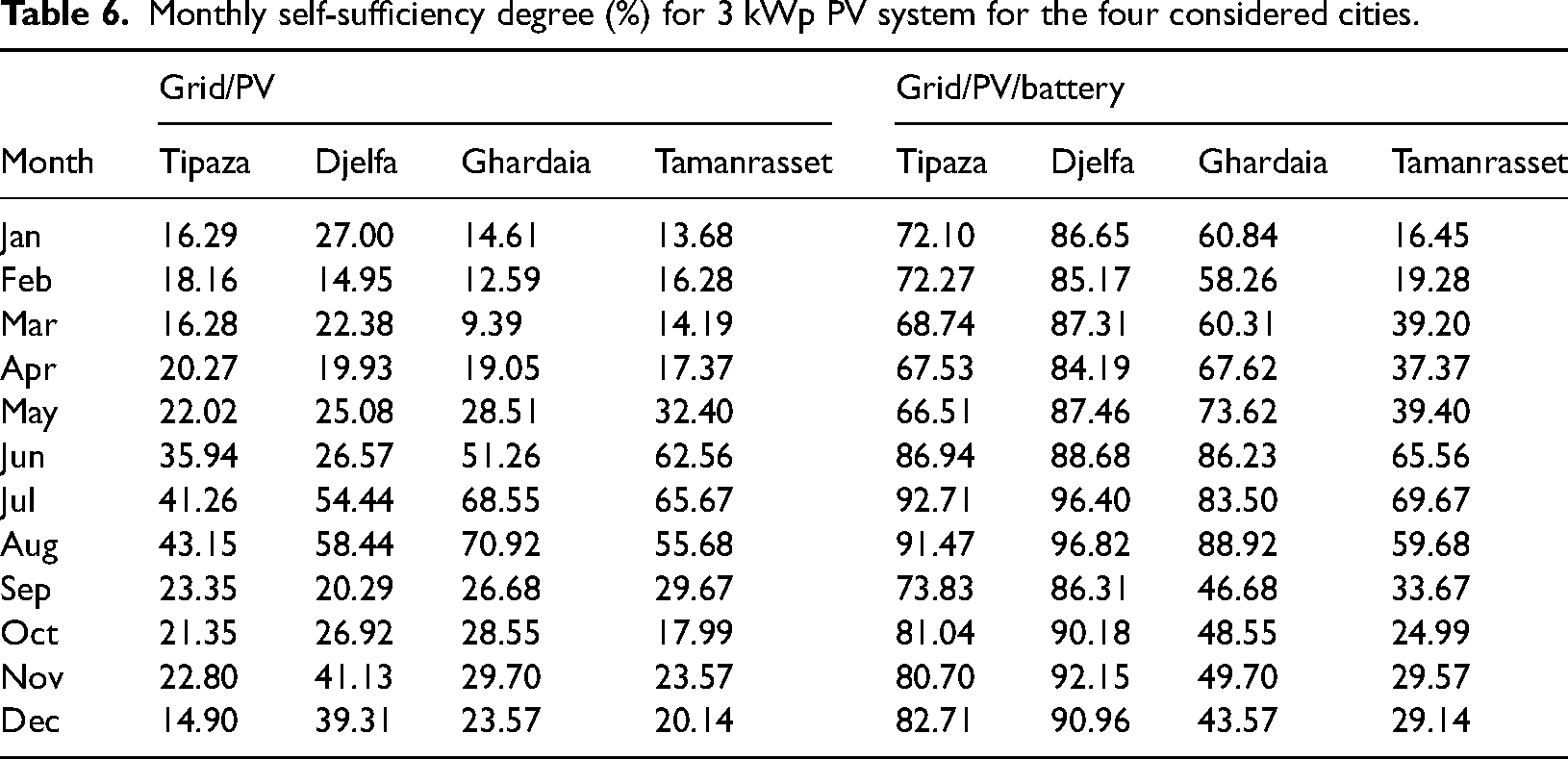
Although the annual electricity production of the PV systems is greater than the annual consumption of households (see Table 4), the self-sufficiency values (see Table 6) for the case of the grid/PV system remain low due to the shift between the period of the maximum PV generation and peak consumption of the households and then a large part of the PV generation is fed into the grid. To better consume PV production, meet household electricity needs and help reduce grid demand peaks, the addition of a storage system is highly recommended.
Monthly self-sufficiency degree (%) for 3 kWp PV system for the four considered cities.
Economic analysis
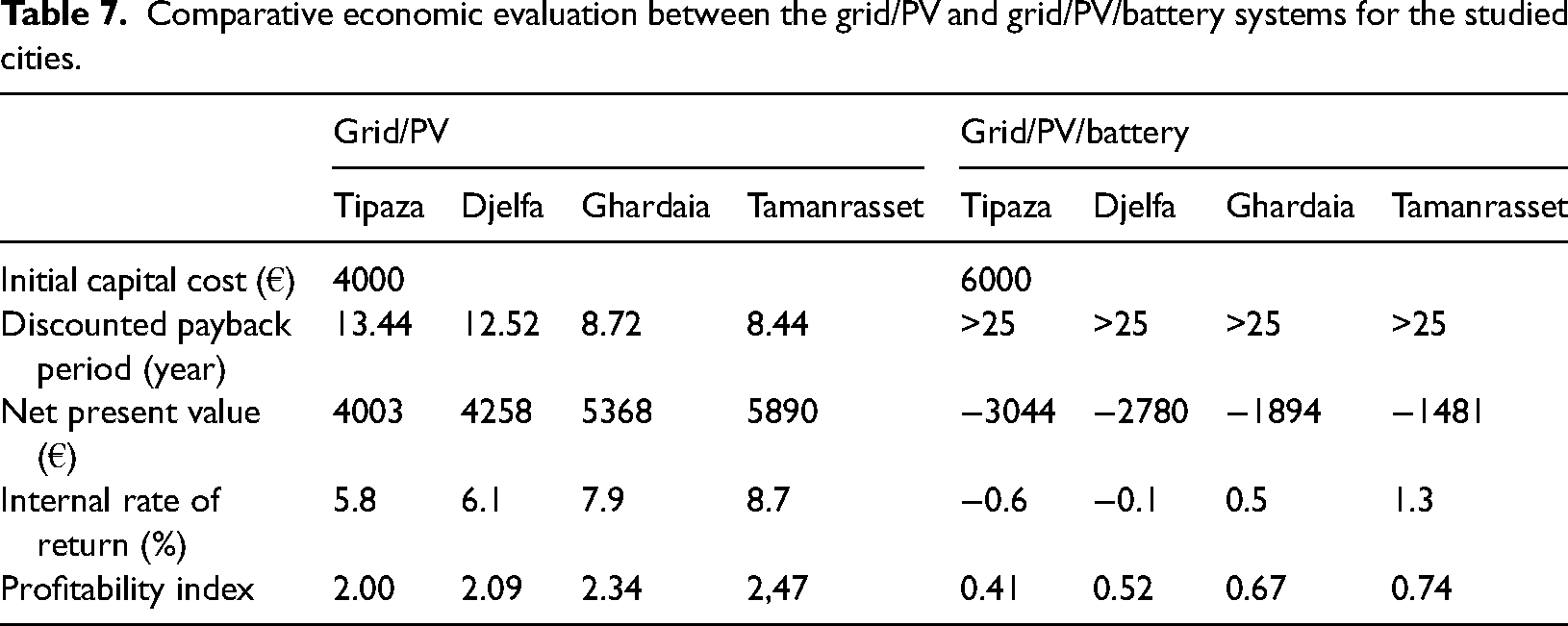
The economic analysis is carried out to evaluate the feasibility of residential PV systems. It is conducted for two configurations (grid/PV and grid/PV/battery) with 3 kWp PV capacity and 10 kWh battery storage. The financial viability was analyzed through the NPV, DPBP, IRR, and PI in the four climate zones. PV systems with a positive NPV over the lifetime, DPBP below the investment lifetime horizon, IRR above the discount rate (4%) and PI higher than 1 are considered feasible. 62 The obtained results using HOMER software are presented in Table 7.
Comparative economic evaluation between the grid/PV and grid/PV/battery systems for the studied cities.
The main findings of Table 7 are presented in the following paragraphs.
Regarding NPV, to decide whether to invest in either of the two considered PV system configurations, the grid/PV configuration seems to be the most profitable in all the selected cities. However, this configuration is more advantageous for the cities of Tamanrasset (5890€) and Ghardaia (5368€) than for Djelfa (4258€) and Tipaza (4003€). Adding a battery is economically unviable in all the studied cities, as shown by the negative NPV obtained for all the studied cities.
When comparing the NPV obtained for the grid/PV configuration in this study with other results for similar systems (small-scale residential rooftop PV systems connected to the grid) using FiT schemes, installed in different locations around the world, the four grid/PV systems considered have greater NPV values than the cases studied in Australia (1300$), 63 Portugal (2224–3265$), 29 and Morocco (2000€). 64
DPBP: As a general remark, the payback period for the grid/PV configuration is shorter than the life cycle of the project. The DPBP for Tamanrasset, Ghardaia, Djelfa, and Tipaza is 8.44 years, 8.72 years, 12.52 years, and 13.44 years, respectively. With the FiT rate considered, the grid/PV/battery configuration requires a longer DPBP than the project life cycle in all the studied cities. This is mainly due to a low amount of excess electricity being fed into the grid, which leads to lower revenues.
Comparing the DPBP obtained for the grid/PV configuration with similar studies, it can be seen that the DPBP of the four grid/PV systems under study is lower than that of several other systems worldwide. For example, in South Africa, the DPBP of a 3 kWp rooftop PV system is 19 years, 65 while the estimated payback period of a 3-kWp rooftop PV system in Spain is 27 years, 66 in Ireland the DPBP for 3 kWp systems using FiT schemes is in the range of 16–19 years. 62
IRR: The obtained results show that the IRR value is higher than the considered discount rate in all investigated cities. It can be noted that Tamanrasset and Ghardaia have the highest IRR for grid/PV configuration, this is due to the fact that they have higher PV electricity generation than Tipaza and Djelfa, hence it is more profitable to invest in the PV installations in the Southern part of the country.
PI: In terms of profitability, Tamanrasset ranked first with the highest PI, followed by Ghardaia, Djelfa, and Tipaza. Looking at their PIs, which range between (2–2.47) and (0.41–0.74), respectively, the grid/PV system appears more advantageous than the grid/PV/battery.
From a financial standpoint, grid/PV systems appear to be the most profitable solution for the four considered cities. The obtained results show that grid/PV systems remain more lucrative than grid/PV/battery systems under the FiT schemes used in the present study, which is due to the higher excess generation that increases future cash flows. This demonstrates that the FiT schemes are higher effective for grid/PV systems. For the grid/PV/battery configuration, the FiT scheme has a modest impact. This is due to the higher investment costs and very low future cash flows. It is suggested that either battery cost subsidies or higher FiT rates are needed to make grid/PV/battery systems more attractive. That is, the authorities can apply the same tariff for grid-connected PV systems whose capacity is between 1 and 10 MW to promote the grid/PV installations in the residential sector. When the PV penetration rate reaches the desired target in terms of installed capacity, the FiT must be reduced, as is the case in several countries around the world such as Australia, Germany, and China.67,68 However, it should be noted that a high self-consumption rate is more difficult to achieve in grid/PV systems, to do so it is necessary to adapt the consumption profile of households to that of PV electricity production, which is referred to as demand management. 69
Grid/PV/battery systems certainly make it possible to increase the self-consumption rate, reduce demand peaks, avoid grid instability problems, minimize energy losses during grid exchange, and reduce additional transport costs. However, they are less economically viable due to the very high battery cost. Financial incentives are then imperative to encourage investment in grid/PV/battery systems.
Sensitivity analysis
To promote investment in residential PV systems, a preliminary sensitivity analysis of the effects of different variables affecting the economic parameters of PV systems is crucial. These variables include changes in electricity tariffs, component costs and subsidies, and solar radiation. 70 The grid/PV/battery configuration was chosen as the case study for the sensitivity analysis because it shows the most unfavorable results for all the economic criteria.
NPV sensitivity
The results of the NPV sensitivity analysis in the case of grid/PV/battery systems to FiT variations for different battery cost subsidies are presented in Figure 8. It appears that the profitability of grid/PV/battery systems could be improved significantly with a decrease of around 20% in the price of batteries in the cities of Tamanrasset and Ghardaia even if the FiT drops by 20%. As can be observed in Figure 8, the NPV of the cities of Tipaza and Djelfa could change from −3000€ to 1000€ and from −2860€ to 1100€, respectively, if a 40% battery price subsidy is applied and grid/PV/battery systems would be then profitable. Indeed, a decrease in battery costs improves NPV values at the four sites studied. This can be offset by lowering the FiT rate.

Effects of FiT rate and initial battery cost on NPV of grid/PV/battery system for the considered cities.
DPBP sensitivity
The DPBP sensitivity analysis of the grid/PV/battery systems to the FiT and the battery cost subsidy rate is shown in Figure 9. As the FiT increases, the payback period decreases, but at a somewhat long pace. For example, a 20% increase in FiT and a 20% subsidy on battery costs leads to a reduction in the payback period of around 10% for Tipaza and Djelfa and 30% for Ghardaia and Tamanrasset. On the other hand, a 40% subsidy on battery costs could significantly improve the profitability of grid/PV/battery systems even if the FiT rate decreases by 60%. As can be seen from Figure 9, with a 40% reduction in battery costs, the payback period could change from 30 to 18 years for Tipaza, from 27 to 17 years for Djelfa, and from 25 to 16 years for Ghardaia and Tamanrasset for a significant decrease of 60% in the FiT rate. The DPBP becomes less than 25 years investment life horizon, and the grid/PV/battery systems could be viable in all studied cities.

Effects of the FiT rate and the initial battery cost on DPBP of grid/PV/battery systems for the considered cities.
IRR sensitivity
Figure 10 shows IRR sensitivity based on different FiT rates and battery cost variations for grid/PV/battery systems. For the cities of Tamanrasset and Ghardaïa, a 20% reduction in battery costs makes the IRR higher than the considered discount rate, even if the FiT rate is reduced by 20%. While for the cities of Tipaza and Djelfa, at least a 20% battery cost subsidy and/or an increase in the FiT rate must be applied for the grid/PV/battery systems to be profitable.

Effects of the FiT rate and the initial battery cost on the IRR of grid/PV/battery systems for the considered.
PI sensitivity
As previously mentioned, the PI indicates whether an investment makes a profit during its lifetime (25 years in this study). In this case, if the present value of the investment is greater than the initial investment, the value of the PI is greater than 1, which means that the investment is profitable. Figure 11. shows the sensitivity of PI depending on different FiT rates and battery cost variations for grid/PV/battery systems. As can be seen, if a moderate subsidy of 20% in the battery costs is applied, the PI increases respectively from 0.41 to 1.05 for Tipaza, from 0.52 to 1.07 for Djelfa, from 0.67 to 1.22 for Ghardia and from 0.74 to 1.26 for Tamanrasset, indicating that the project has broken even and the investment in grid/PV/battery systems is then profitable in all the considered cities. It is worth noting that the 40% battery cost subsidy makes the PI viable even if the FiT drops by 10% for the cities of Tamanrasset and Ghardaia in the south of the country.

Effects of the FiT rate and subsidy on the battery cost on PI of grid/PV/battery systems for the considered cities.
The results showed that, if the FiT rate of (0.1 €/KWh) is applied in the residential PV systems, the 3 kWp grid-connected PV systems can meet the economic viability without any grants or incentives for all the investigated cities, while for the grid/PV/battery systems, the economic viability could be met only if a subsidy on battery price is allocated and this is valid for all the considered cities.
It is therefore clear that to widespread the grid/PV/battery installations in the residential sector, mechanisms to subsidize battery costs and/or financial support for the price of self-consumed energy are being proposed, as is the case in many countries.71,72
Effects of the PV array capacity on economic viability
The study was conducted for 3 kWp PV systems, which are suitable for the limited area in most Algerian houses. However, if the PV system owners have enough space, they can also enhance the capacity of the PV generator. Additional analysis was carried out to determine the PV capacities required in each city, for both grid/PV and grid/PV/battery configurations. The capacity of the PV generator was varied from 4 to 8 kWp with a step of 1 kWp and then the economic parameters were discussed.
Case of grid/PV systems
The obtained results for the grid/PV systems show, as expected, that with a larger installed PV capacity, the PV systems become more profitable as the savings from the sale of the excess PV production increase. For every 1 kWp increase in the installed PV capacity, the NPV increases in the range of 1200 to 2600 depending on the city considered. With an installed PV of 8 kWp, the NPV increases by less than 1000 € for all cities. For the DPBP, if the installed PV capacity is increased from 3 to 4 kWp, the payback period decreases by 4.1 years and 4.35 years for Tipaza and Djelfa, respectively, due to the low household electricity consumption in these two cities (3731 kWh/year for Tipaza and 4262 kWh/year for Djelfa) compared to those located in the Sahara. Beyond 5 kWp the DPBP decrease becomes slow and gradual due to the very high investment costs.
Furthermore, with increasing PV capacity, the IRR significantly exceeds the assumed discount rate of 4%. The corresponding IRR values are 8.9%, 10.1%, 11.2%, and 12.2% for the cities of Tipaza, Djelfa, Ghardaia, and Tamanrasset, respectively, when the PV capacity is increased to 5 kWp. Above 5 kWp, the IRR becomes almost constant for all cities, except for Tipaza in the north of the country, where the IRR increases continuously when the capacity of the PV system increases to 6 kWp. The highest PI was achieved for the 5-kWp capacity for Ghardaia and Tamanrasset, it is in the range of 3 and 3.2, respectively. For Tipaza and Djelfa, the most favorable PI is for a nominal PV system capacity of 6 kWp. According to the results of the economic parameters for grid/PV systems, the required PV power capacity for each city is 5 kWp for Tamanrasset and Ghardaia and 6 kWp for Tipaza and Djelfa. The results are shown in Figure 12 below.

Effect of PV capacity on NPV, DPBP, IRR and PI for a grid/PV system.
Case of grid/PV/battery systems
Figure 13 shows the effects of the installed PV capacity on the economic parameters of the grid/PV/battery system configuration. Increasing the installed PV capacity from 3 to 4 kWp produces an improvement in NPV of 96% for Tipaza, 82.9% for Djelfa and only 34.6% for Ghardaia, and 31.9% for Tamanrasset. The NPV results for the installed PV capacity of 6 kWp in the cities of Ghardaia and Tamanrasset (4323€, 5259€) are better than those recorded in the cities of Tipaza and Djelfa (2648€, 3075€). The DPBP is positively influenced by the increase in the capacity of the PV generator, which leads to a reduction in the payback period. For the cities of Ghardaia and Tamanrasset, a DPBP of only 15 years is achieved for an installed PV capacity of 6 kWp, while for Tipaza and Djelfa, the payback period decreases by 12 and 10 years, respectively, as the installed PV system increases from 3 to 5 kWp.

Effect of PV capacity on NPV, DPBP, IRR, and PI of grid/PV/battery systems.
The IRR increases with increasing PV capacity. Djelfa, Ghardaia, and Tamanrasset have an IRR greater than the fixed discount rate for installed PV systems with a capacity greater than 5 kWp. For the PI parameter, the benefits increase as the PV production surplus increases, even if none of the cities manages to double the investment for the various proposed PV capacities. Beyond 6 kWp, increasing installed PV capacity has a low impact on economic indicators due to very high initial investment and unsuitable solar electricity sales price estimated at 0.1 €/kWh to grid/PV/battery systems. The required PV capacity for a grid/PV/battery system is 6 kWp in all cities.
Conclusion and policy implications
Despite the country's vast solar potential and the Algerian government's goal to reduce the country's dependence on fossil fuels for electricity generation, solar energy development remains limited. The legislative and regulatory framework for electricity generation from residential rooftop PV systems has not yet been established. Moreover, there is a lack of studies in the literature that deals intensively with the profitability of grid-connected rooftop PV systems in Algeria. Therefore, this study presents a comprehensive technical and economic assessment of the feasibility of grid-connected rooftop PV systems for residential buildings by considering two solar PV configurations, grid/PV and grid/PV/battery, in the four climate zones of Algeria. This analysis aims to provide decision-makers with relevant information on small residential grid-connected PV systems, so that they know under what conditions it is profitable to invest in PV systems with or without batteries in the residential sector in Algeria. The techno-economic feasibility of a grid-connected 3 kWp rooftop PV system in the four climate regions was evaluated using the HOMER software. Technical analysis was carried out using two performance indicators, namely the self-consumption rate and the degree of self-sufficiency. For the economic analysis, four economic indicators were examined, namely NPV, DPBP, IRR, and PI.
From a technical point of view, grid/PV/battery systems have been shown to have the best energetic performance. The use of the battery significantly increases self-consumption rates and degree of self-sufficiency by about 50%, while the energy exchange with the grid is reduced by around 70%, making the grid/PV/battery system as a whole technically attractive.
The results of the economic indicators reveal that the grid/PV configuration with a rated capacity of 3 kWp is feasible in all cities without financial support, even if the FiT rate for PV installations greater than 1MW is applied. Grid/PV/battery systems are not viable, owing to the high battery costs. A sensitivity analysis was performed to examine the impact of some variables such as battery cost, FiT rate, and solar potential on economic indicators, to evaluate the policy implications for grid/PV/battery configuration.
The economic sensitivity analysis conducted revealed the effect of the battery costs and the price for the excess PV production fed into the grid on the feasibility of grid/PV/battery systems. The results of the sensitivity analysis show that a 40% battery cost subsidy makes the investment in the grid/PV/battery systems viable in the different cities, mainly in the southern part of the country, which can meet the economic criteria even if the FiT drops by 30%.
The results also show that the subsidy on battery costs is more effective than the FiT rate on the viability of grid/PV/battery systems. It is recommended to set up a subsidy policy for the installation of PV systems with storage to motivate homeowners to invest in solar systems. The subsidy value can be recovered by raising the FiT rate, taking into account the regional differences in solar radiation.
Due to the small area of most Algerian households, the analysis was performed with 3 kWp PV systems in each city. For homeowners who would have more space, increasing PV capacity has been shown to significantly improve economic feasibility for both grid/PV and grid/PV/battery systems. For the grid/PV configuration, the recommended PV capacities for the PV field are 5 kWp for the north and highlands and 6 kWp for the southern part. In the case of grid/PV/battery configuration, the increase in installed PV power to up to 6 kWp has a positive effect on their economic efficiency in all considered cities.
On the consumer side, grid/PV systems are more profitable in terms of recovering the investment and realizing the profits from the sale of excess production, especially in areas with higher solar radiation.
In regions with medium solar potential, such as the north of the country where 78% of Algeria's total population is concentrated, financial incentives and the introduction of a FiT law for residential users could lead to an increased deployment of grid/PV/battery systems, which will offer an effective solution in terms of reducing peaks in demand, especially during the summer season.
Based on the findings, decision-makers who want to promote the adoption of grid-connected residential PV systems in Algeria should consider financial incentives as well as the FiT program for each configuration of PV systems depending on the regions of the country as they can bring benefits to the owner by reducing the payback period and allow them to make more money by selling electricity to the grid.
To summarize the findings, (i) different FiT rates should be set for different PV system configurations and for different climate regions in Algeria. (ii) To encourage the uptake of grid/PV/battery systems in the residential sector, policymakers should consider subsidizing battery costs so that they may afford homeowners the same financial benefits as grid/PV systems. (iii) A national awareness campaign on the benefits of installing residential solar systems for the conservation of natural resources and the reduction of pollutant emissions, accompanied by a strong government engagement, can contribute to the promotion of rooftop PV systems in Algeria. Additional analysis could be done by examining the implications of alternative tariff structures, such as the net metering program, on the economic viability of grid-connected residential rooftop PV systems in Algeria.
The findings of this study are expected to help policymakers to develop policies that will allow for a successful deployment of small-scale PV systems in the residential sector in Algeria and achieve the objective of reaching 27% of electricity generation from renewable sources by 2030.
Footnotes
Declaration of conflicting interests
The author(s) declared no potential conflicts of interest with respect to the research, authorship, and/or publication of this article.
Funding
The author(s) received no financial support for the research, authorship, and/or publication of this article.
