



Abstract
A complete understanding of the interplay between environmental regulations and fiscal decentralization for the realization of health outcomes is crucial for policy formulation and decision-making. The aim of the study is to investigate both policy variables’ separate and combined impacts using data on four BRICS economies from 2000 to 2020. The study has employed the novel method of moments quantile regression to quantify the effect. The findings of the study show (i) a significant impact of regulations on health outcomes in higher quantiles. Environmental regulations have a strong positive impact on all three-health proxies, that is, health expenditures, life expectancy, and the number of infant deaths. Total revenue and expenditure decentralization affect health outcomes positively, while tax revenue decentralization negatively impacts them, with the effect being stronger in the lower quantiles; (ii) the combined impact of decentralization and environmental regulations turned out to be negative and significant in our study; and (iii) all variables have unidirectional causality. However, with tax revenue decentralization, health expenditures, life expectancy, and infant deaths have bidirectional causality. This finding has a strong policy implication for the policymakers. Although both policies positively impact health indicators, their interaction leads to deteriorating health outcomes. From a policy point of view, it is suggested to strike a balance between regulations and fiscal decentralization to realize the full potential of this policy mix to get better health outcomes. This study adds to previous research by incorporating the interconnected impact of environmental regulations and fiscal decentralization on health outcomes in BRICS economies.
Keywords
Introduction
The profound history of emerging air contaminants has led to human civilization experiencing the negative consequences of global climate change. Recent dramatic atmospheric shifts have hurt world economies and human populations.1,2 In recent years, environmental pollution-related health effects have drawn much attention from the public and academia.3,4 Relevant studies have demonstrated that environmental pollution considerably lowers life expectancy, raises health care costs, and causes more deaths.5,6 Environmental control laws have sound environmental effects, but their public health effects are unknown. Environmental regulations (ER) can improve environmental quality, reduce health risks, and lower health care costs. 7 Improving public health care, increasing government health spending, and promoting public health is crucial in achieving the 3rd goal of sustained development. To achieve this target, promoting effective public health care through efficient resource management is necessary. In this regard, fiscal decentralization (FD) schemes can ensure efficient management of public health resources. Local governments are responsible for most medical and health services under a FD system. However, a decentralized healthcare system's potential benefits and pitfalls are still debatable. 8 The literature on decentralization is not always conclusive. On the whole, empirical attempts to analyze environmental degradation and FD's effects on health outcomes are scarce. This study aims to fill this gap by examining how environmental rules and FD may affect health indicators separately and jointly.
Health is key to human capital and well-being. Individual and national efficiency grows with good health. WHO defines public health as avoiding disease, extending life, and improving health via organized social action. It influences life expectancy, quality of life, and the economy. Improving public health care, increasing government health spending, and promoting public health are crucial in achieving the 3rd goal a of sustained development. To achieve this target, promoting effective public health care through efficient resource management is necessary. Policymakers must understand the factors that affect health outcomes. Since environmental degradation is a potential cause of deteriorating health standards worldwide, policies aimed at controlling pollution and enhancing environmental performance may bring massive health-related benefits. 9 ER are one such measure that may help combat environmental degradation,10,11 especially in developing countries. Environmental laws lower medical costs by improving air quality. 12 Another potential policy-level measure to improve health indicators is the degree of FD of the economies. The decentralization concept dates back to Charles (1956) 13 and Oates (1972), 14 who argue that FD schemes can ensure efficient management of public health resources. FD is a global economic trend. The classic idea of FD states that FD, as an institutional structure of fiscal division between the central and local governments, helps local governments deliver public products according to local conditions. FD shifts government revenue and spending to lower levels. 15 When the central government gives up political power (political and spending decentralization), subnational governments can make their own laws about health care and decide how to spend money depending on citizens’ preferences and regional needs. It can also give lower-level governments more control over their budgets by letting them use different sources of revenue to pay for services.
The literature on FD is context and country-specific. In other words, FD isn’t necessarily beneficial. Presumably, the situational effects of FD are caused by the fact that local governments in many developing countries and even some European countries don’t have enough administrative skills (like the ability to raise taxes and borrow money), which hurts their ability to protect fiscal freedom. FD might under-provide public goods due to spillovers. Local elites and interest groups can “capture” elected officials, creating corruption. Nevertheless, the influence of FD is dual on social welfare. According to first-generation federalism, local governments (agencies) serve as helpful agents for the general good, such as social welfare,14,16 by allowing local control over spending (expenditure decentralization (ED) per se). Second-generation fiscal federalists argue that “Selfish public leaders with their agenda” are more likely to seek national interests. 8 So, enabling local governments with the ability to generate a significant percentage of their money (revenue decentralization (RD)) would encourage them to act more responsibly toward the general public, come up with innovative market-enhancing public goods, and be less corrupt. In the preceding context, this study aims to examine the impact of ER and FD on health outcomes, such as health expenditures, life expectancy, and the number of infant deaths in the four BRICS nations: Brazil, Russia, China, and South Africa.
The BRICS, as developing countries, demand greater attention for their health potential than developed countries. Despite achieving economic growth, even in the BRICS, healthcare spending as a percentage of the national budget is still far lower than in the top Western and Asian OECD companies. With the growing burden of non-communicable diseases, low-middle-income nations account for 75% of the worldwide NCD burden in disability-adjusted life-years; this challenge is vast in width and scale, with ineffective financial approaches. According to the statistical review of world energy, 17 China has the most carbon emissions among the BRICS. China accounted for 28.8% of global carbon emissions in 2020; India was third with 7.3%. Russia, Brazil, and South Africa emit 4.5%, 1.3%, and 1.4% of carbon. In 2020, BRICS countries emitted 43.3% of global carbon. Such challenges remain high on policymakers’ agendas to welcome effective ER, even more so than in traditional high-income nations. Alarming environmental and human health issues may threaten BRICS unity. With these health hazards in BRICS economies, it is essential to pay attention to this area. In this regard, BRIC nations need specific ER and effective FD for the future.
Figures 1 and 2 depict an interesting picture. Figure 1 shows the studied countries’ health expenditures as a percentage of GDP. Brazil is spending the highest share of its GDP in the health sector, while Russia and China spend a minimal share in the health sector compared to the other BRICS economies. Figure 2 shows that the countries sparing small amounts for health expenditures are less decentralized than those that spend more in the health sector. Henceforth, the higher degree of decentralization may be linked with higher health sector expenditures, as the figures suggest. Therefore, we suspect a positive link between decentralization and health improvements.

Health expenditures in BRCS economies.

Fiscal decentralization in BRCS economies.
This study contributes to prior research in two essential aspects ways. First, most research has examined the relationship between ER and FD separately. Few researches have examined how environmental degradation affects health. This study determines both variables’ separate and combined impact on health outcomes in BRICS countries. Second, earlier studies used life expectancy, number of infant deaths, or health expenditures as health outcome proxies. This study uses all three-health proxies to assess the link between ER, decentralization, and health indicators in BRICS economies. Thus, according to our understanding, this is the first research to evaluate the individual and combined effects of ER and FD on health outcomes in the BRICS nations.
The study has employed moment quantile regression using data from 2000–2020 to measure the individual and collective influence of ER and FD on health indicators. The results indicate that ER significantly affect the health expenditures. The impact gets larger in the higher quantiles. However, ED has a strong positive influence on health expenditures; yet, this impact is stronger in the lower quantiles. The total and tax revenue decentralization (TRD) and ER significantly reduce health expenditures in the median. In comparison, the impact is insignificant in the ED equation. In the case of life expectancy at birth, decentralization decreases life expectancy, but the impact reduces significantly in the higher quantiles. ER increase life expectancy in higher quantiles in the RD equation but decrease life expectancy in the ED equation. However, the impact reduces in the higher quantiles. Revenue and regulation interaction reduces life expectancy in higher quantiles. In contrast, expenditure and decentralization interaction increases life expectancy, and the impact is higher in lower quantiles. Infant deaths significantly reduce with higher regulations and more ED. The mutual impact of both policy variables is also positive (i.e. lowers infant deaths). While the effect is stronger in lower quantiles. In sum, ER and FD positively impact health outcomes; however, their combined impact is negative in most specifications. Moreover, TRD is bidirectional causality with health expenditures, life expectancy, and infant deaths, while the other variables are unidirectional. Therefore, policy decisions regarding more decentralized systems with higher ERs must consider their mutual impact very carefully.
Literature review
To better understand the independent and combined effects of environmental degradation and FD on public health, divide them into three parts and discuss each set of variables separately. As explained in the following subsections, the relationships between each pair has received extensive scholarly investigation.
Environmental degradation and public health
Today, academia considers ER to have multifaceted consequences and is vital for sustainable development.7,18–22 Limited studies have been done on the health implications of expanding and deepening environmental and economic effects. Few researchers have discovered direct links between environmental management and health. However, empirical research on ER and health spending is inconsistent.
18
Two arguments can be used to summarize the inconsistency. According to certain studies, environmental management can lower health costs by enhancing human health.18,23,24 ER reduces health hazards by increasing environmental quality. Similarly, Do et al.
18
found that ER reduces infant mortality in India, contrary to Greenstone and Hanna.
25
Tanaka
24
demonstrated that ER reduced newborn mortality in China. Moreover, Cesur et al.
23
observed that replacing coal with natural gas reduced mortality in Turkey. Yang and Chou
7
evaluated environmental regulatory implications for prenatal health using New Jersey coal plant closure data. After the nearby coal-fired power plant was shut down, low birth weight and preterm deliveries were reduced by 15% and 28%, respectively. According to some studies, environmental control may not help human health and may even worsen it, increasing health care costs.
25
Besides the studies listed above, other researchers contend that ER may indirectly impact health due to the mediating effects of specific factors.
26
Based on the above discussion, this article offers hypothesis:
Financial decentralization and public health
Most research has demonstrated the benefits of FD for public health. Robalino, Picazo, and Voetberg 27 evaluated cross-country panel data from 1970 to 1995 and found that FD enhanced health outcomes. Schwartz, Guilkey, and Racelis 28 evaluated fiscal devolution's influence on per capita health spending. From 1995 to 1998, fiscal devolution boosted per capita health spending in the Philippines. Cantarero and Pascual 29 found a link between FD and public health in the developed countries. With a larger degree of FD, sub-governments understand the genuine requirements of local citizens and may focus on the most vital issues, such as healthcare.
From 1992 to 2003, FD was negatively associated with infant mortality and positively associated with life expectancy. 29 Samadi, Keshtkaran, Kavosi, and Vahedi 30 demonstrate FD reduces infant mortality in 19 OECD nations and Iran, respectively. Sanogo 31 used local government revenue data from 2001 to 2011 for 115 municipalities to show that FD positively influences access to public services in Côte d'Ivoire municipalities. Xu and Lin 32 employed a two-way fixed effect model, threshold regression, and intermediate effect models using 2008–2019 panel data from 30 mainland provinces and 4 municipalities and autonomous areas to evaluate FD's influence on public health. According to the study, FD increases public health spending.
On the other hand, scholars have found that FD is unsuitable for public health. Local governments’ actions after FD receive less attention. Spending on public healthcare will affect local public health performance. This spending component is sometimes a low priority for local governments. Thus, FD's impact on public health encompasses direct and indirect effects. Jin and Sun 33 analyzed data from 32 Chinese provinces and discovered that FD did not lower the infant mortality rate, a valuable public health indicator. Limited research has examined ER’ health effects.
Schwartz et al.
28
found that after decentralization in the Philippines, local governments reduced the share of funds given to public health. Ferrario and Zanardi
34
believe decentralization in Italy may worsen regional health expenditure disparities due to a lack of mechanisms to transfer resources from rich to poor jurisdictions. Due to an excellent fiscal equalization mechanism, decentralizing public health care in Spain has not increased per capita public expenditure inequality.
29
Based on the above analysis, this article offers hypothesis:
Environmental degradation, financial decentralization, and public health
Today, economic development and environmental conservation are vital to emerging countries’ sustainable development. Under FD, local environmental behavior is crucial to environmental governance. ER reduces carbon emissions, improves energy efficiency, and solves pollution externalities, 12 like health outcomes. Scholars believe decentralization is essential for economic development but disagree on environmental impacts. 35 Literature finds two generations explaining the impact of FD on environmental degradation. The supporters of the first generation of FD find some experts feel FD is effective for environmental pollution control. 35 FD may push developed and undeveloped regions to use unorthodox development methods.
Local governments must improve the economy and people's lives under FD. Moreover, the academics proposing the “race to the top” thesis argue that governments are inclined to improve public services and environmental quality through increased monetary autonomy after being threatened by “voting by foot.”
36
Second-generation FD theory argues local governments, spurred by tax revenues, degrade regional environments.
37
Many researchers believe FD will exacerbate haze pollution by weakening environmental supervision and capturing the market.
38
Local governments don’t enforce restrictions or levy modest fines on polluters, increasing pollution. Therefore, it is important to check the health outcomes of environmental degradation and FD and determine whether the local government's development orientation is a “race to the bottom” or a “race to the top.” Based on the discussion, this article offers hypothesis:
Research gap
As demonstrated by the overview above, it is clear that most studies have examined the bilateral relationships between FD and health outcomes.28,29,31,32 However, little work is done to explain the impact of ER on health outcomes. In addition, no study has yet discovered the combined effect of environmental degradation and FD on health outcomes. This work incorporates BRICS as a case study to evaluate the separate and combined impact of FD and ER on health outcomes.
Data and methodology
Data description
This study used health outcomes as the dependent variable. Health is measured through three proxies: life expectancy, number of infant deaths, and health expenditures as a percent of GDP. The data on health proxies, that is, health expenditures, life expectancy, and the number of infant deaths, are taken from World Development Indicators (WDI). Life expectancy estimates the average predicted lifespan based on current mortality. Infant deaths, a globally recognized indicator of the socioeconomic level and population health, reflect regional health care, education, and economic growth. Similar to health status, health expenditures reflect socioeconomic development and quality of life in a population. The state of health reflects the standard of living and average lifespan, and the prospects for its economy. From a policy point of view, it is important to understand the factors that affect health outcomes.
There are two focus variables, ER and FD. ER is measured by the environmental policy stringency index, taken from OECD data. ER boost the health status of individuals. However, empirical research on ER and health spending is inconsistent. 18 Two ways may help explain this inconsistency. First, environmental management can lower health costs by enhancing human health.18,23,24 Second, some studies imply that ER may not benefit human health and may even worsen it, leading to increased health expenditures. 25
FD is measured by expenditures, revenue, and tax decentralization. The data on these variables are collected from the OECD dataset. FD involves collecting revenues and spending among several levels of government. 39 The influence of FD is dual on social welfare. According to first-generation federalism, local governments (agencies) behave as beneficent agents acting in the public interest, for example, social welfare, 14 by allowing local control over spending (ED per se). Second-generation fiscal federalists argue that national governments are more inclined to pursue their goals. 8 Hence, local governments can raise a lot of revenue (RD). It would make them more accountable to citizens, inventive with public goods, and less corrupt.
A “free-rider” mentality is common in regions with low fiscal revenues because of the negative externalities of air pollution and the positive externalities of atmospheric environmental governance. This makes environmental management less effective at boosting local economic growth, discourages investments in environmental governance, cuts spending on R&D for green technologies, relaxes local environmental rules, etc. 40 and vice versa. Henceforth, the combined impact of ER and FD on health outcome is unclear. Urban population growth, fixed capital formation, and CO2 emissions are control variables. Data of control variables are taken from WDI. Urbanization is a two-fold phenomenon, with the first fold having beneficial effects such as easy access to jobs, healthcare, and education. In contrast, the second fold has adverse effects, such as social deprivation brought on by overcrowding. Further, gross fixed capital formation is the control variable. 41 Energy generation hurts the environment because it involves chemical reactions with oxygen in the air. It pollutes and releases CO2. Global warming results. Reduced snow and sea ice cause coastal flooding. Warmer temperatures can cause animal extinction. Rising global temperatures can cause health issues, including headaches, dizziness, restlessness, tingling, difficulty breathing, sweating, weariness, increased heart rate, high blood pressure, etc.
WDI, IMF, and the OECD provide 2000–2020 data for all variables. Data over the last 21 years covers four BRICS economies: Brazil, Russia, China, and South Africa; we exclude India due to the unavailability of FD data. We analyzed the BRICS economies for many reasons. First, these five countries account for 23% of the global GNI, 45% of the global population, and 40% of the global disease burden. By 2050, the world's two largest economies will be China and India, with Russia and Brazil coming in fifth and sixth, respectively. Second, due to economic progress, carbon dioxide emissions keep rising, endangering the health of BRICS citizens. Considering the inevitable economic growth of the BRICS countries and the need for fossil fuels, their CO2 emissions may continue to be high, harming the ecosystem and climate. Also, it will affect medical and health spending. Thus, BRICS economies provide an intriguing case to measure the separate and combined influence of ER and FD on health outcomes.
Model specification
We have used FD and ER as the main explanatory variables in the estimated model. For FD, we used three proxies: RD, TRD, and ED. Canare (2021) 47 suggested that RD and fiscal independence have a very positive and significant impact with the performance outcomes of the governments, while ED has no clear trend. Therefore, rather than a composite indicator of FD, we have used separate indicators of FD to dig deeper into the impact of these indicators on health outcomes.
The general model form of this study is as follows:

Equations (2) to (4) are estimated using health expenditures (HE) as dependent variable.









Econometric technique
This study computed descriptive statistics for health expenditures, life expectancy, infant deaths, ER, FD (expenditures, revenue, and tax), urban population growth, gross fixed capital formation, and carbon dioxide emissions: More specifically, this study estimates the mean, median, and range for each variable. In addition, standard deviation values are calculated, which measure each observation's distance from the mean and duplicate variable volatility. As a logical first step, the study checks for data normality using skewness and Kurtosis. Jarque and Bera
49
developed a complete normality test. This test uses skewness and excess Kurtosis to determine if data is normally distributed. The following equation gives normality statistics.

Slope heterogeneity and cross-sectional dependence
After examining variable regularity and irregularity, the current study used slope heterogeneity and panel cross-section dependence. ER are improvising after the massive CO2 emissions. Various influences push economies to depend on others. Specifically, suppose a country implements ER or changes in decentralization methods in one country. If so, this affects other economies and assists in achieving technological, financial, social, and economic objectives. As a result, economies may have similarities and contrasts with others. Slope homogeneity and cross-section dependence in panel data could produce estimation issues in econometric analysis.
50
To determine whether a phenomenon is homogeneous or heterogeneous, this study uses the Pesaran and Yamagata
51
slope coefficient homogeneity (SCH) test and the Pesaran
52
cross-sectional dependence test. The SCH equation is:



Unit root tests
After confirming heterogeneous slope coefficients and cross-sectional dependency, this study applied the second-generation unit root test. We employed Pesaran 54 cross-sectionally enhanced IPS (CIPS) unit root test.
Pesaran
55
introduced a cross-sectional factor modeling method. Cross-sectional averages are unified as unobserved model components. Pesaran
54
expanded the Augmented Dickey-Fuller (ADF) regression model to include mean and first differenced cross-sectional lags. This method allows for panel data issues, such as cross-sectoral reliance, when the panel is unbalanced (N≠T). Standard form regression equation of cross-sectional ADF:



Method of moment quantile regression
Firstly, Koenker and Bassett Jr
56
proposed a panel quantile estimation approach that evaluates the dependent variance and conditional mean statistics. Quantile regression gives accurate results even with irregularly distributed variables. Following the property of quantile regression, the current study employed Machado and Silva
57
moment's quantile regression. This method evaluates distributional and heterogeneous quantile effects.
58
The typical form for location-scale





Panel causality test
The method of moment quantile regression (MMQREG) technique shows the long-run influence of each explanatory component on health outcomes at each quantile. This estimator doesn’t indicate causality between variables. The current study used Dumitrescu and Hurlin 59 Granger panel causality assumptions. This specification covers the T ≠ N panel issue. This method addresses slope heterogeneity and cross-section dependence (Table 1). 60
Description of variables.
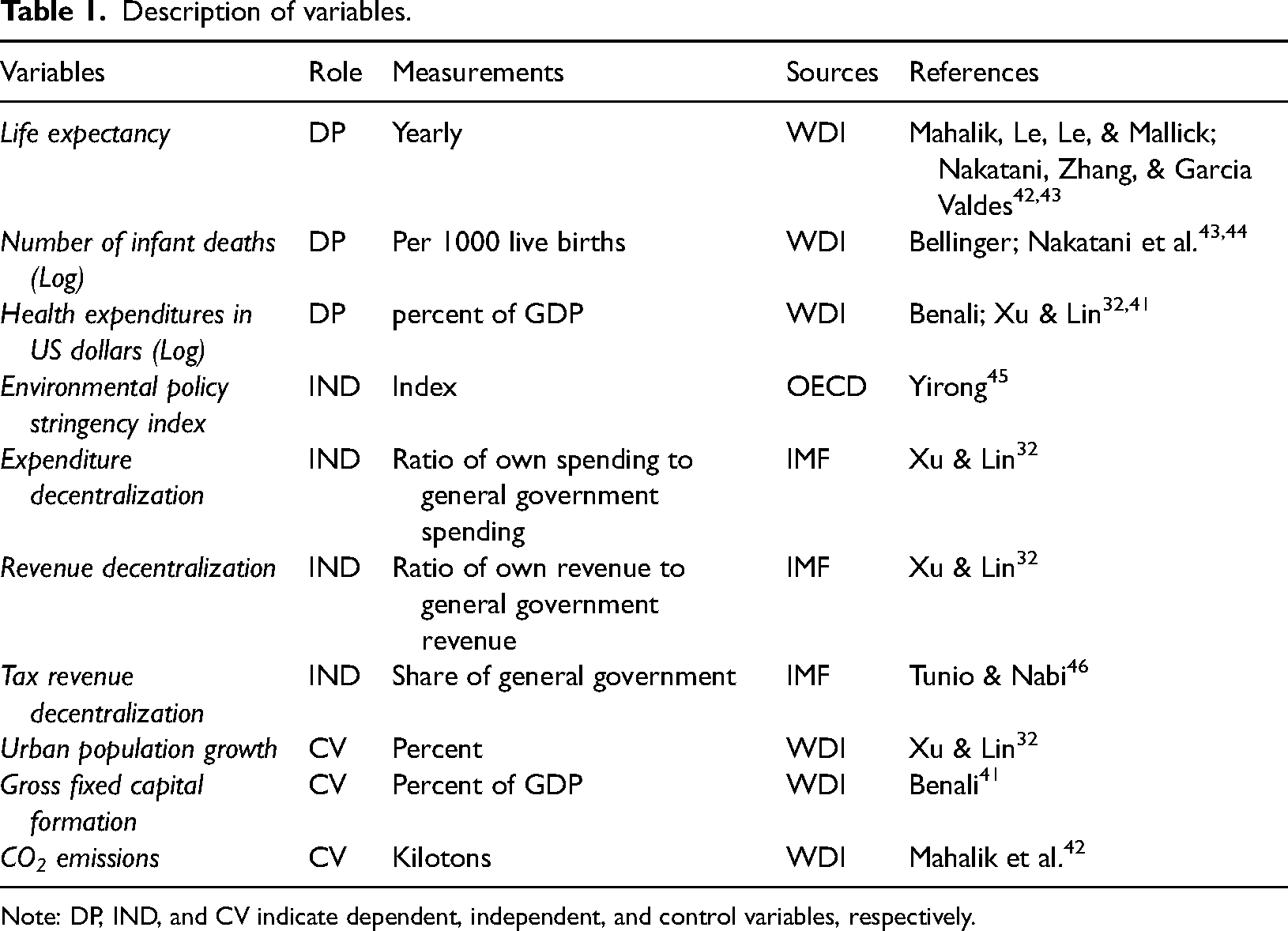
Note: DP, IND, and CV indicate dependent, independent, and control variables, respectively.
Results and discussion
Descriptive statistics
This section presents the study findings starting from descriptive statistics and data diagnostics to determine the correct type of estimation technique for our data. In descriptive statistics (Table 2), the mean values of all variables are positive. All factors are trending up. All variables, except urban population growth (minimum), have positive maximum–minimum ranges. Urban population growth readings ranged from negative 0.467% to positive 4.189%. The standard deviation, a measure of a variable's volatility across time, demonstrates that all variables are time varying or fluctuating.
Descriptive statistics.

Source: Author's calculations.
Normality tests
This study additionally verified each variable's normality using skewness and Kurtosis tests. Table 3 presents the empirical results of the normality test. The joint test of skewness and kurtosis and Jarque and Bera 49 offer significant estimates for all variables. This test accounts for skewness and excess Kurtosis. The null hypothesis showed the variable might be normally distributed since chi (2) values for all variables except urban population growth are above 0.05. The null hypothesis can be rejected. Hence, the distribution of the variable seems to be abnormal. Since most empirical estimates are limited in managing irregular data, the current work employed an efficient estimator that empirically evaluates long-run results by addressing variable abnormality.
Normality tests.
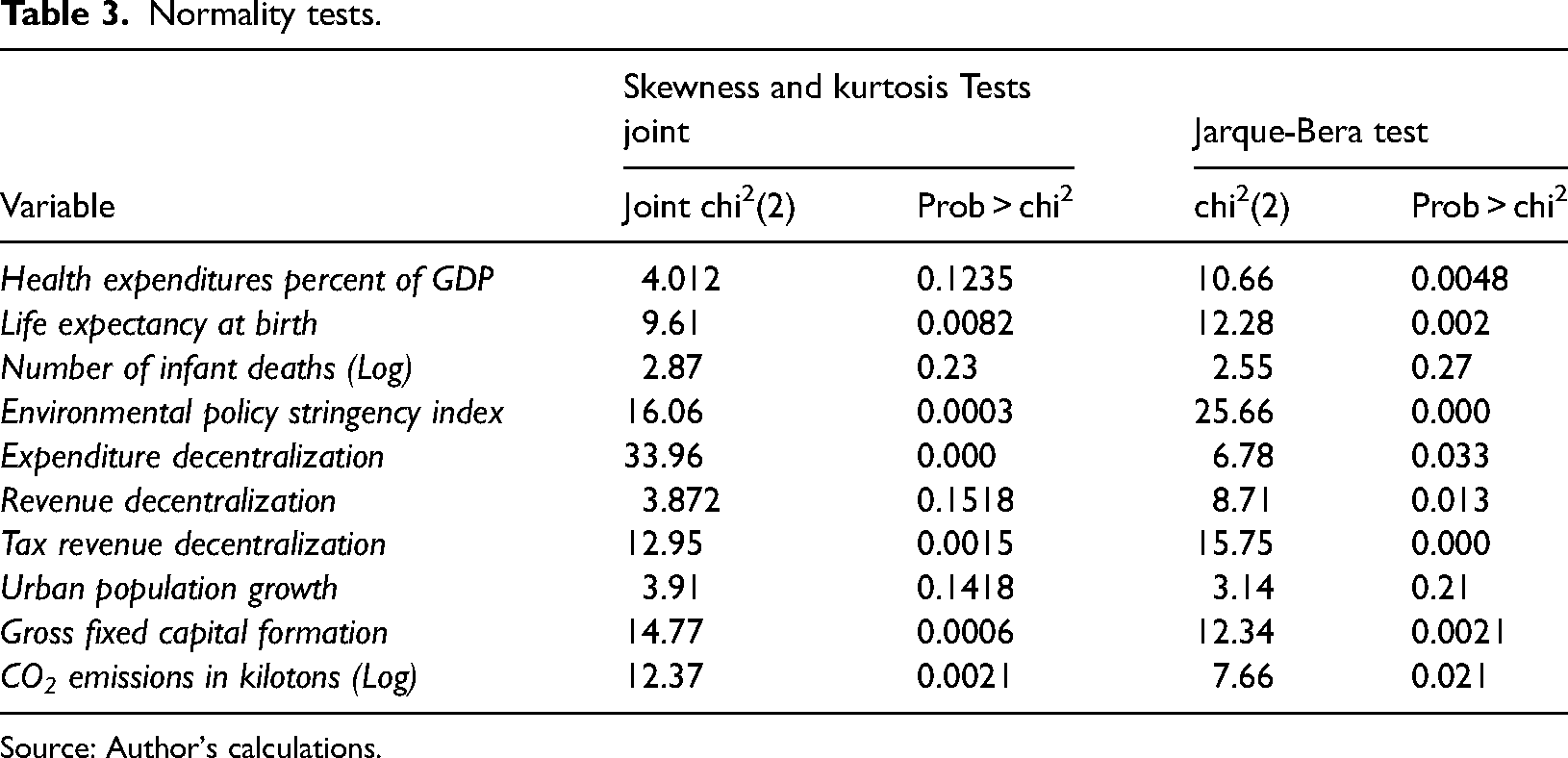
Source: Author's calculations.
Slope heterogeneity test
As noted before, a country depends on other countries for economic and non-economic reasons, resulting in similarities and differences in specific ways. Table 4 shows the findings of Pesaran and Yamagata 51 SCH test. Inefficient estimation may result from disregarding slope heterogeneity/homogeneity. It is necessary to analyze slope heterogeneity. Following the null hypothesis of homogeneous slopes, both SCH (Delta) and adjusted SCH (Delta Adjusted) are statistically significant. This shows that the null hypothesis can be rejected, and slope coefficients are heterogeneous.
Testing for slope heterogeneity.
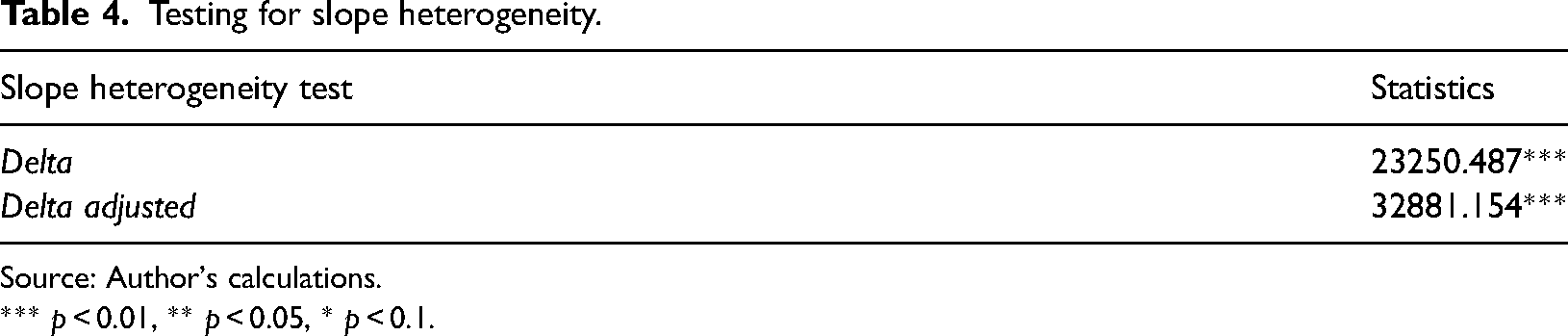
Source: Author's calculations.
*** p < 0.01, ** p < 0.05, * p < 0.1.
Cross-sectional dependence test
Next, as suggested by Campello et al., 53 cross-sectional dependency in panel data causes estimation bias. We have applied Pesaran 52 CD test (Table 5). All variables, except environmental policy stringency index and ED, are highly statistically significant, rejecting the null hypothesis of cross-sectional independence in life expectancy, number of infant deaths, RD, TRD, population growth, health expenditures, and gross fixed capital formation. These variables are cross-sectional dependent, illustrating that these variables of one country have a spillover effect on the variables of another. The null hypothesis of cross-sectional dependence for environmental policy stringency and ED cannot be rejected. Thus, these three variables do not have a spillover effect on other economies.
Cross-sectional dependence.
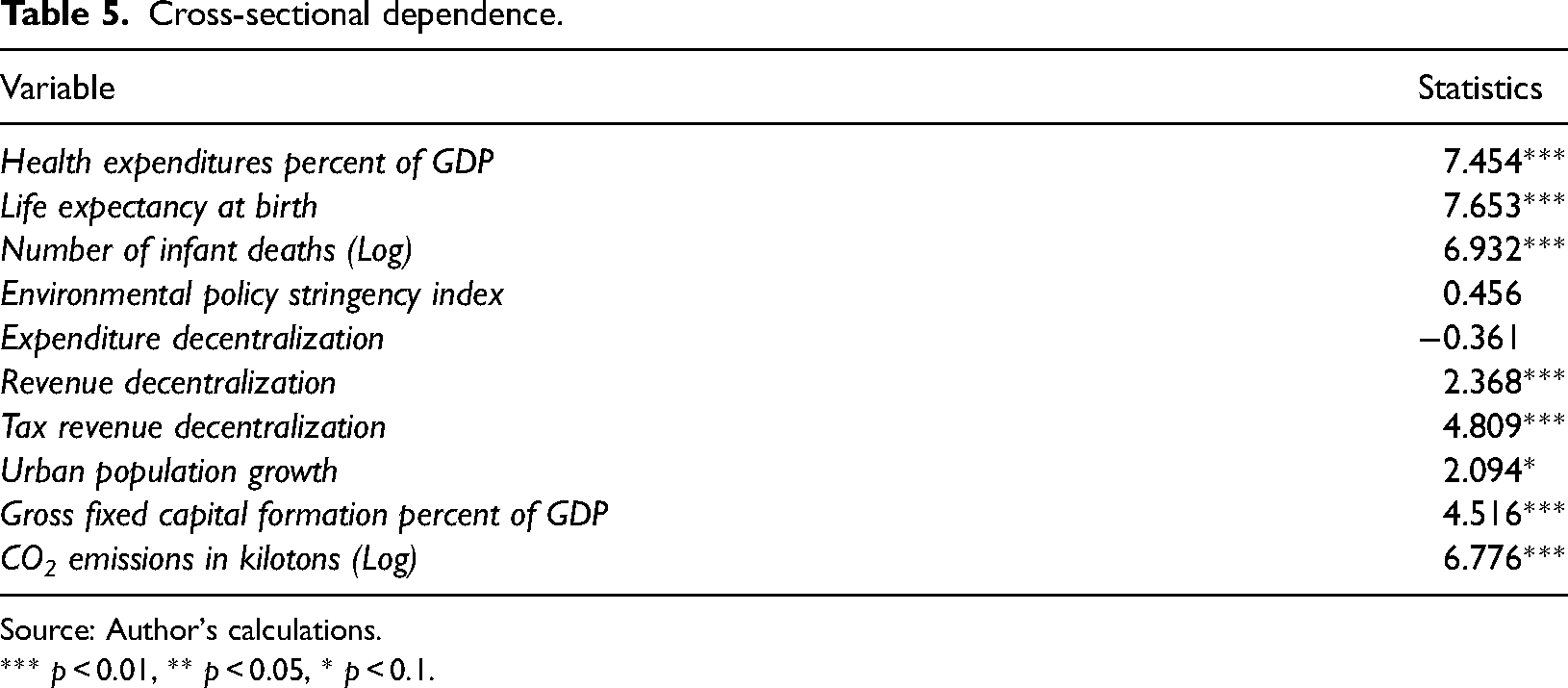
Source: Author's calculations.
*** p < 0.01, ** p < 0.05, * p < 0.1.
Unit root test
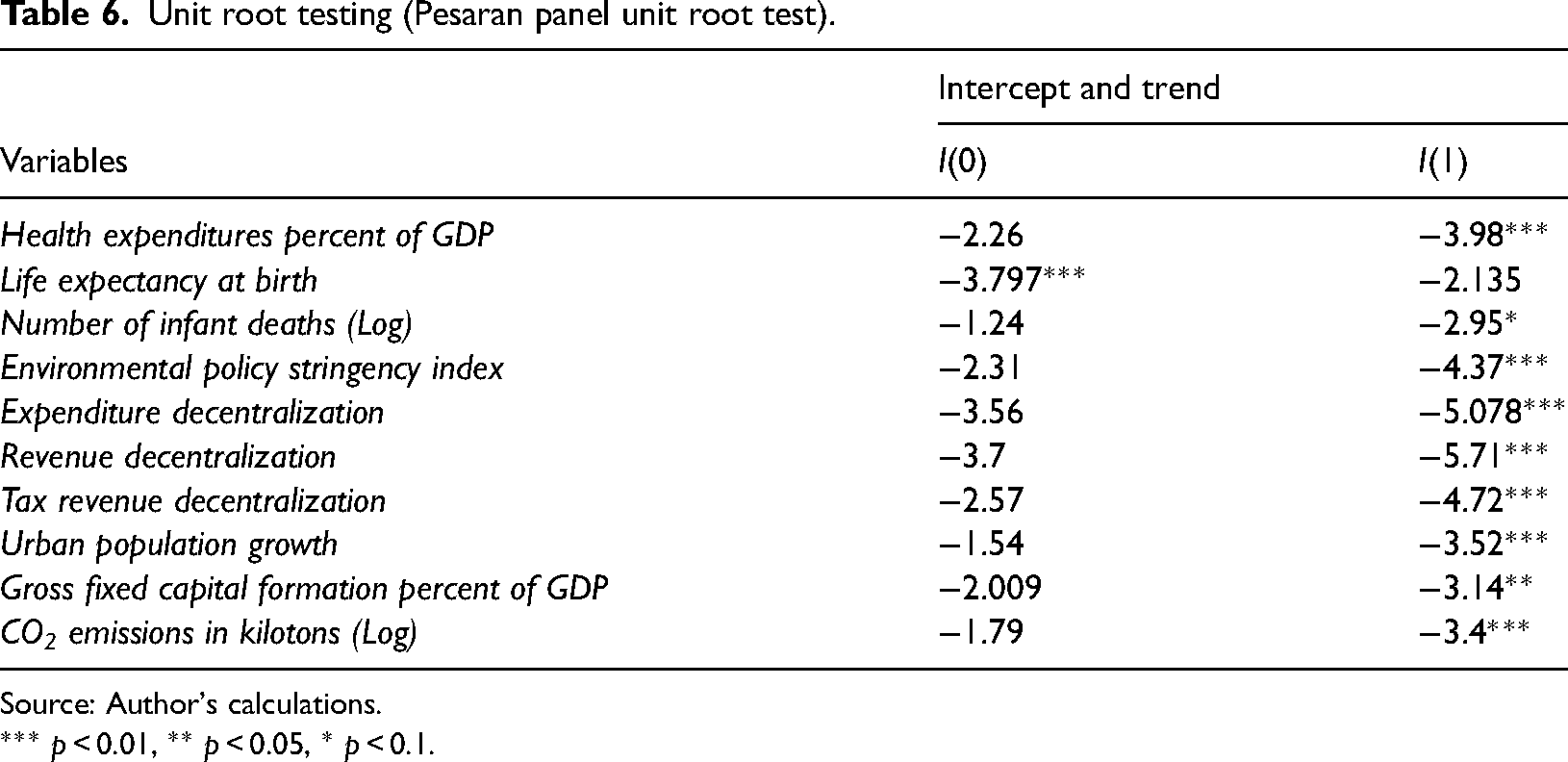
Since the variables revealed slope heterogeneity and cross-sectional dependence, this study used Pesaran 54 CIPS test, a second-generation unit root testing approach, and the empirical results are given in Table 6. Only life expectancy yields statistically significant estimates at I(0), rejecting the null hypothesis of a unit root in time variables. The remaining variables are non-stationary at level. This study evaluated stationarity at I(1), where these variables produce significant estimates that reject the unit root null hypothesis. All variables are stationary under mixed order of integration.
Unit root testing (Pesaran panel unit root test).
Source: Author's calculations.
*** p < 0.01, ** p < 0.05, * p < 0.1.
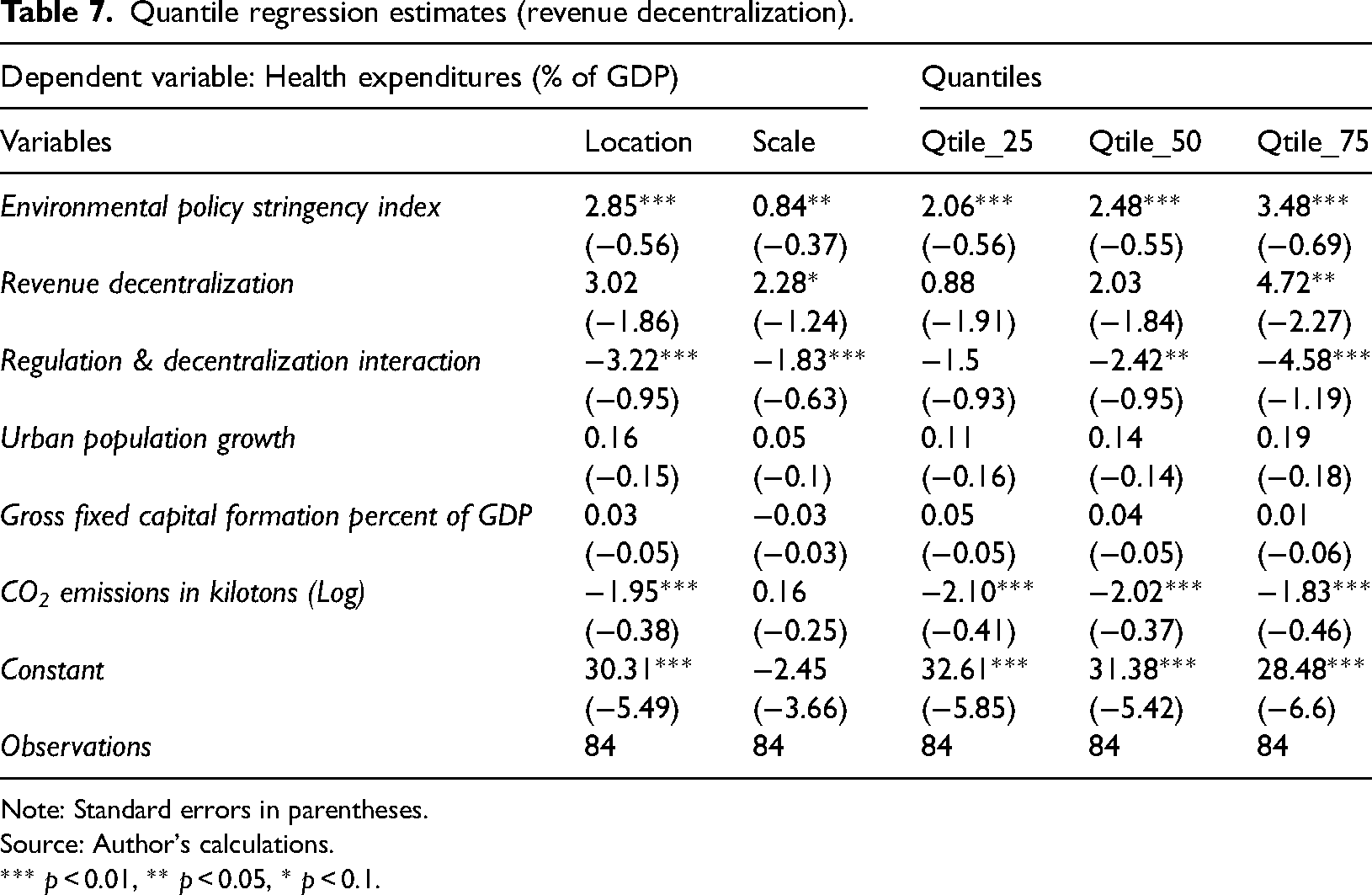
The Jarque and Bera 49 test found that the variables are not normally distributed. Therefore, we have used the MMQREG, which handles non-normal variables. Table 7 shows the approach's estimated results.
Quantile regression estimates (revenue decentralization).
Note: Standard errors in parentheses.
Source: Author's calculations.
*** p < 0.01, ** p < 0.05, * p < 0.1.
Method of moment quantile regression results
According to our estimations, ER and RD positively affect health expenditures. One unit increase in ER causes an increase in health expenditures by 2.06% in lower quantiles to 3.48% in upper quantiles. Statistically, these findings are significant at 1%. However, the combined impact of ER and RD negatively affects health expenditures. The finding indicates that the impact of each variable is getting larger with a higher quantile. In control variables, CO2 emissions’ impact on health expenditure is negative and significant: a 1% increase in CO2 emissions causes a 32.61% to 28.48% reduction in health expenditures across three quantiles (Qtile_25 to Qtile_75).
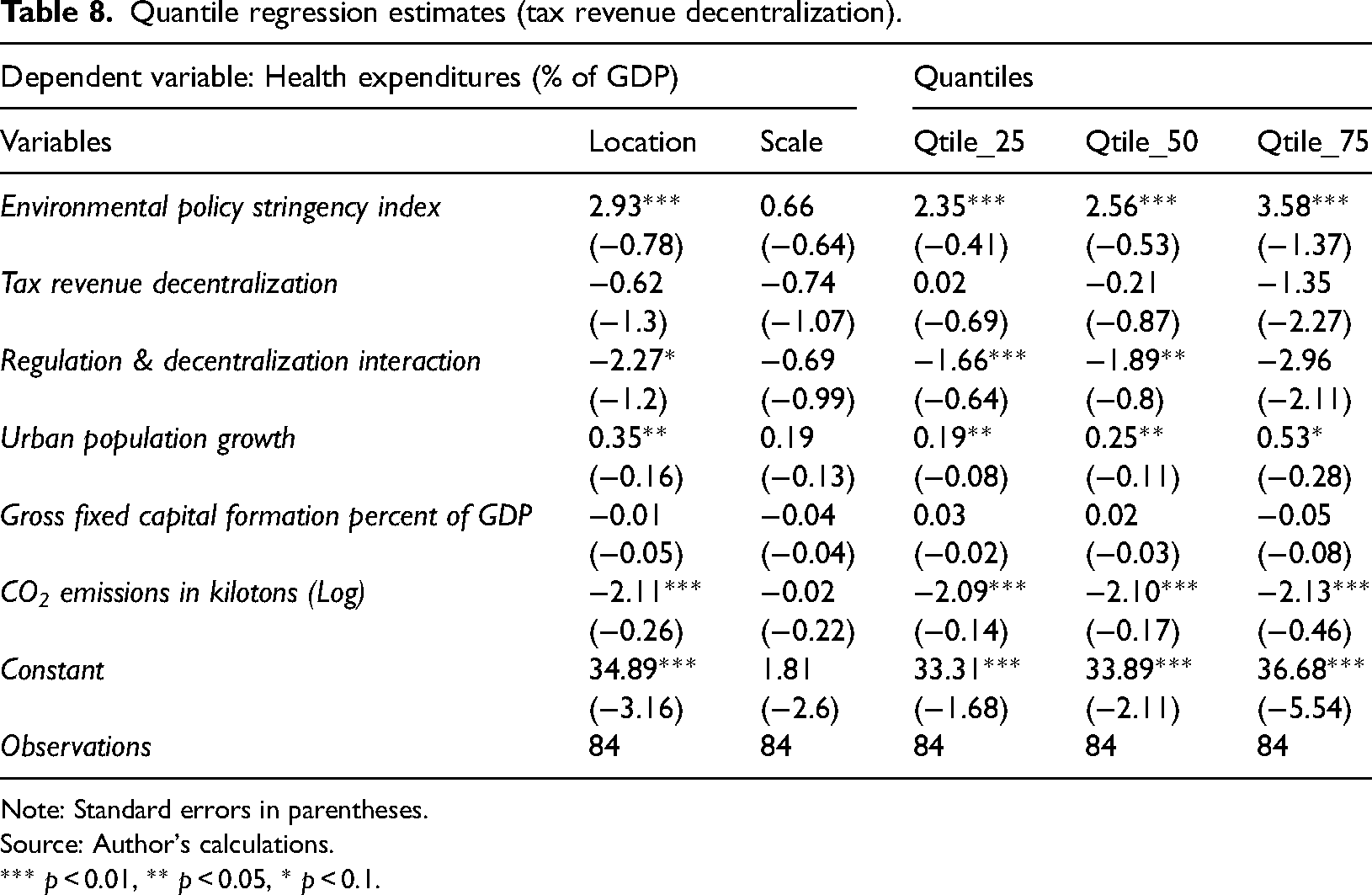
Table 8 includes the second FD proxy, TRD. Again, ER is positively correlated with health expenditures in BRICS economies. MMQREG's empirical estimation reveals that ER potentially impacts health expenditures as a 1 unit increase in the ER increases health expenditures by 2.35 and 3.58 in the lower to upper quantiles (Qtile_25, Qtile_ 75). Similar results are presented by Do et al. 18 and Greenstone and Hanna. 25 Statistically, these findings are significant at 1%. The combined impact of ER and TRD is statistically negative and significant in the lower and middle quantile. This situation presents the “race to the top” where governments are inclined to improve public services and environmental quality through increasing monetary autonomy after “voting by foot.” 36
Quantile regression estimates (tax revenue decentralization).
Note: Standard errors in parentheses.
Source: Author's calculations.
*** p < 0.01, ** p < 0.05, * p < 0.1.
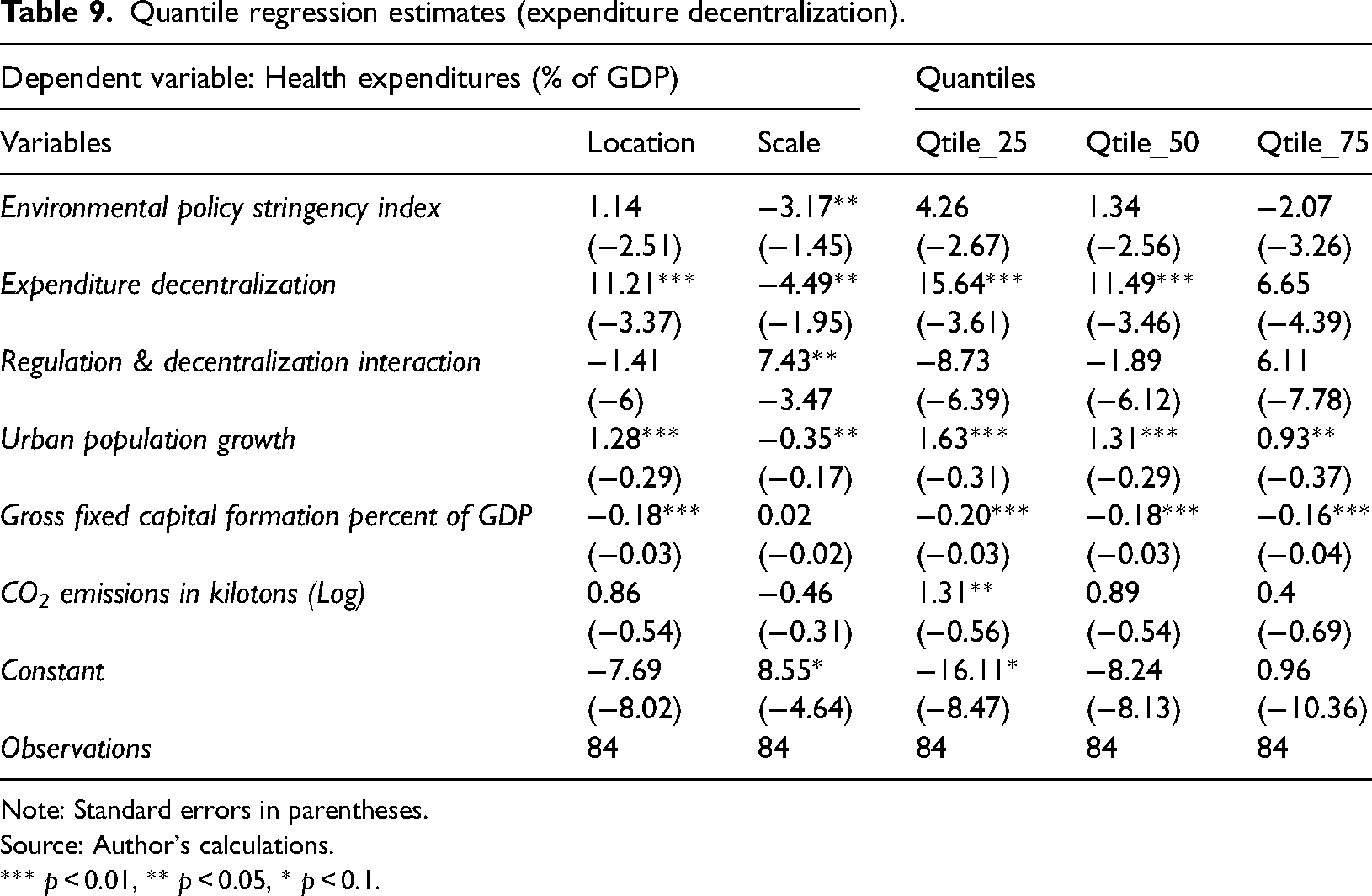
Table 9 includes the third proxy of FD, that is, ED. The ED is positively related to health expenditures. Such findings are consistent with Schwartz et al. 28 A 1 unit increase in ED increases health expenditures by 15.64%, 11.49%, and 6.65% in Qtile_25, Qtile_50, and Qtile_75, respectively. Lower to middle quantile estimates are more statistically significant (s). However, the lower to middle quantile indicates a comparatively lower impact of FD on health expenditures; decentralization may lower or worsen regional health expenditure due to a lack of resource transfer channels. 34 The results are significant at 1%, but the third (Qtile_75) quantile is insignificant. The impact of the interaction of ER and ED reveals an insignificant impact on health expenditures. All the control variables yield the expected signs.
Quantile regression estimates (expenditure decentralization).
Note: Standard errors in parentheses.
Source: Author's calculations.
*** p < 0.01, ** p < 0.05, * p < 0.1.
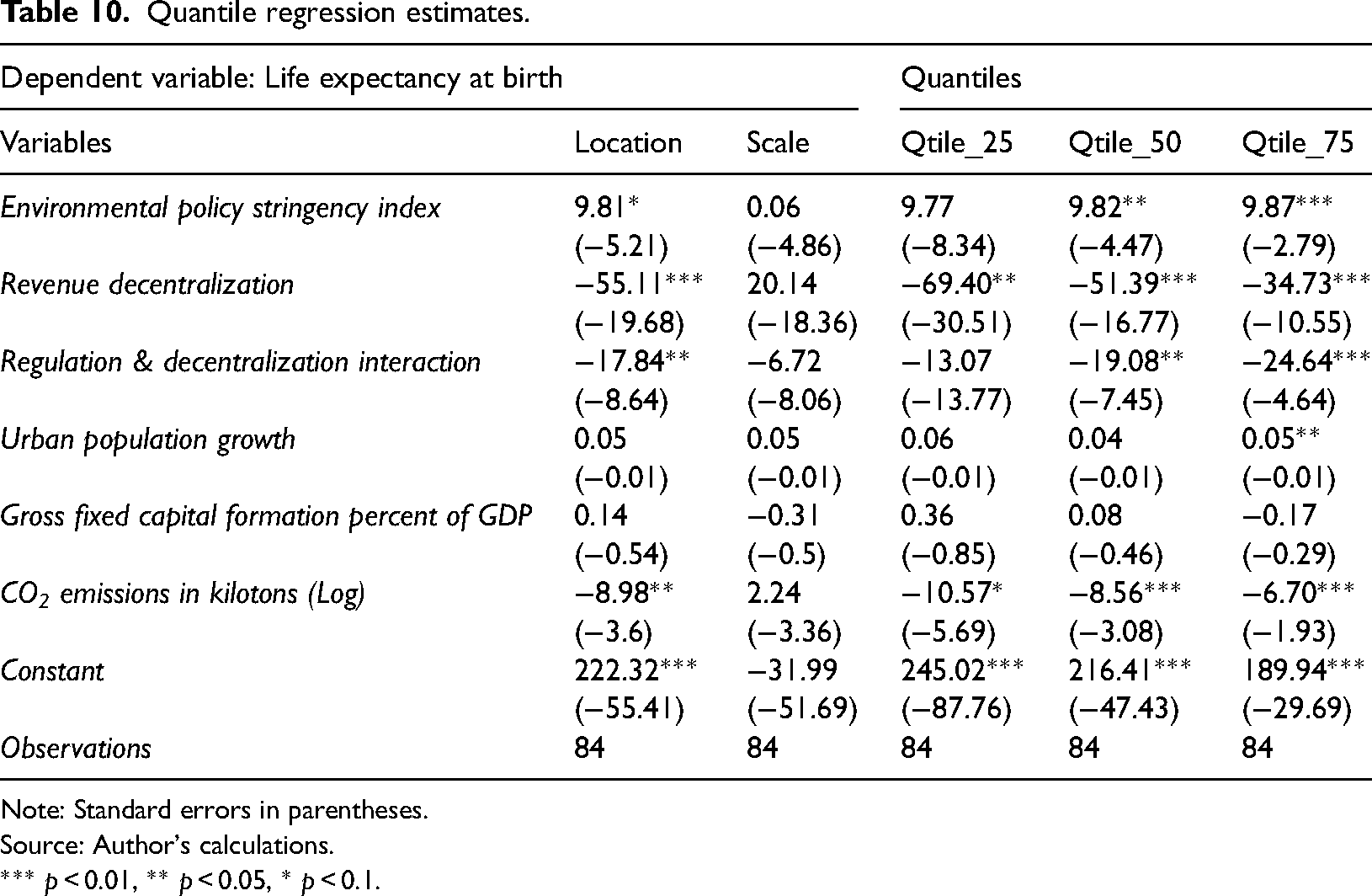
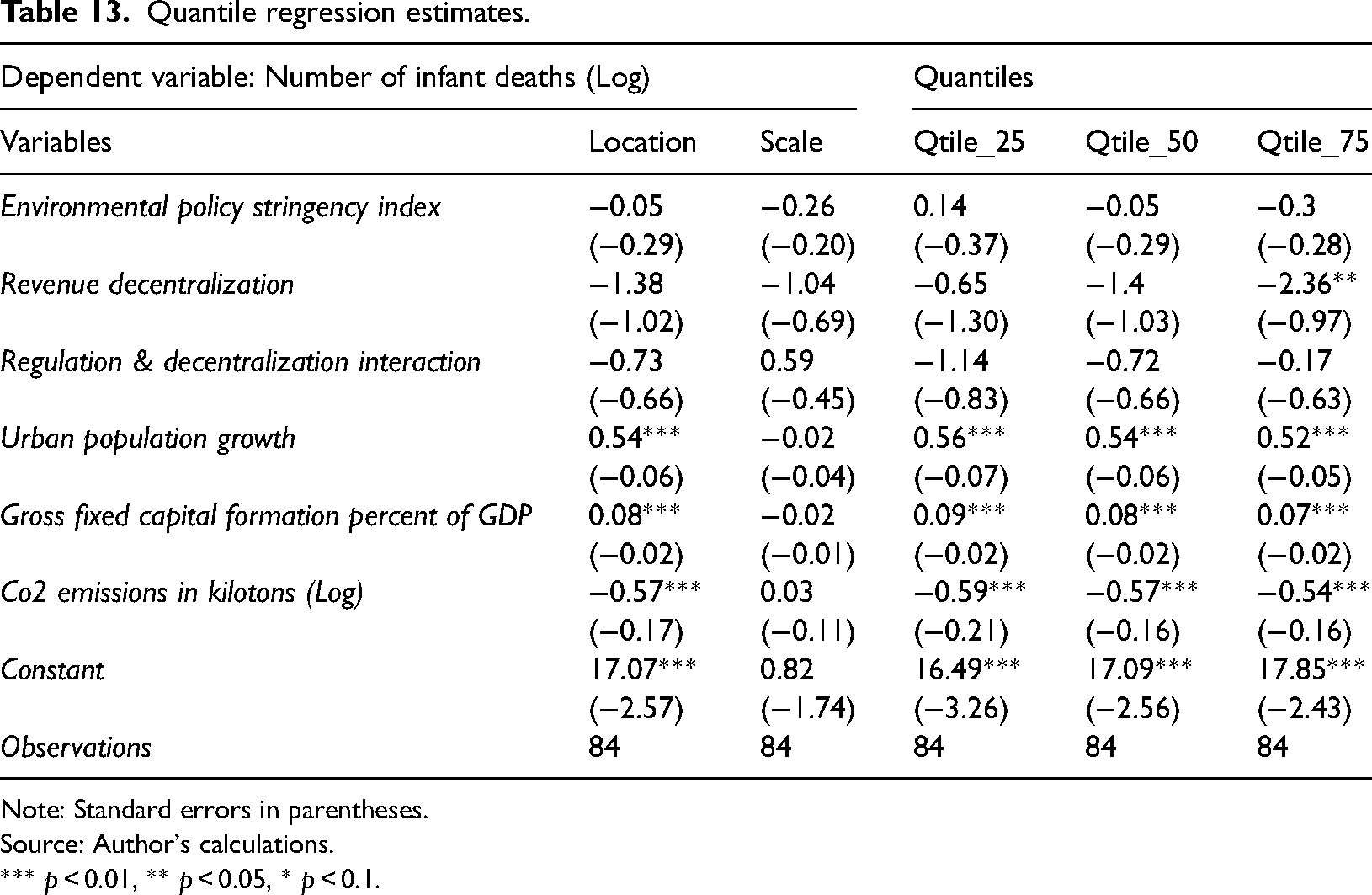
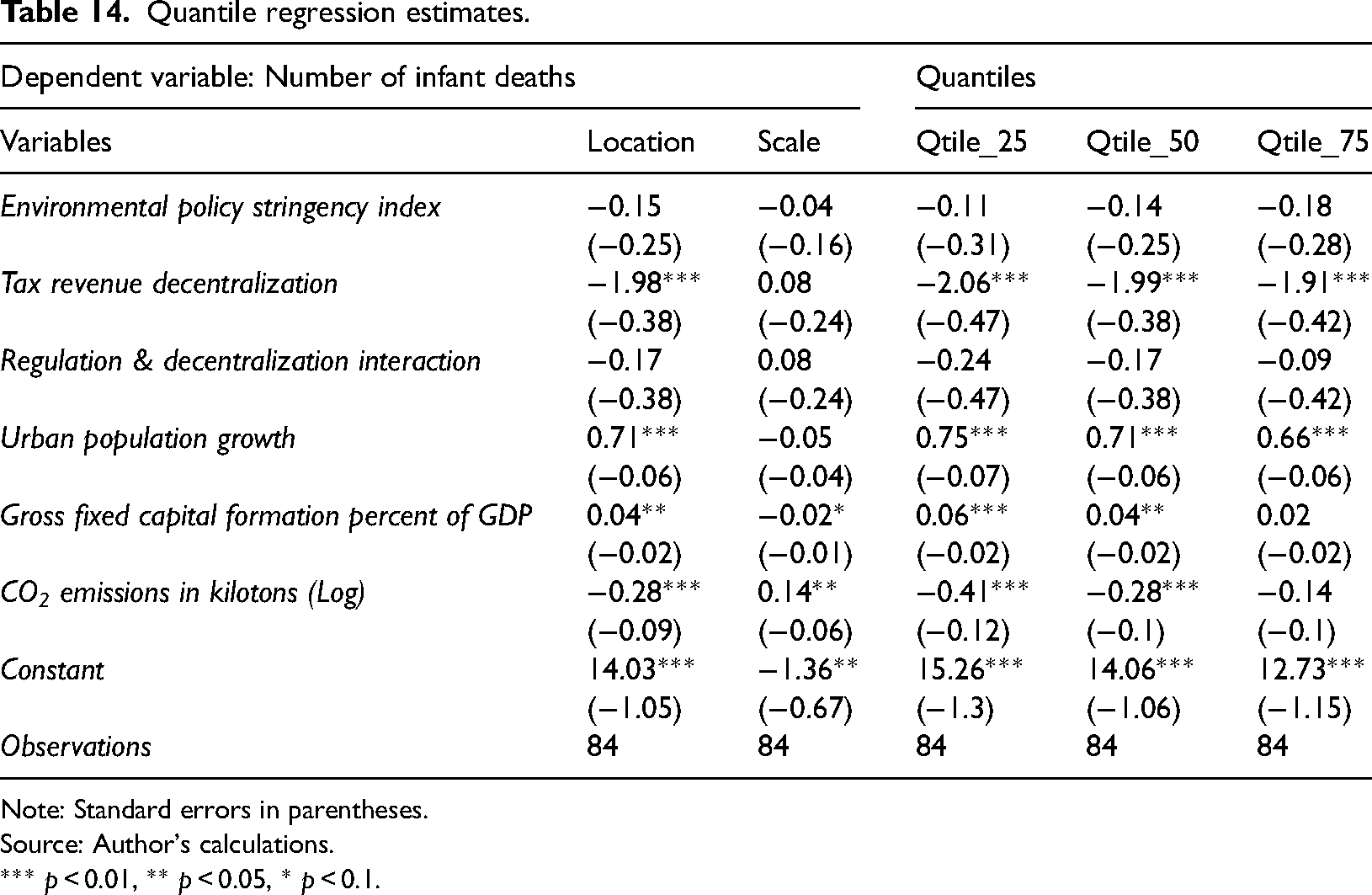
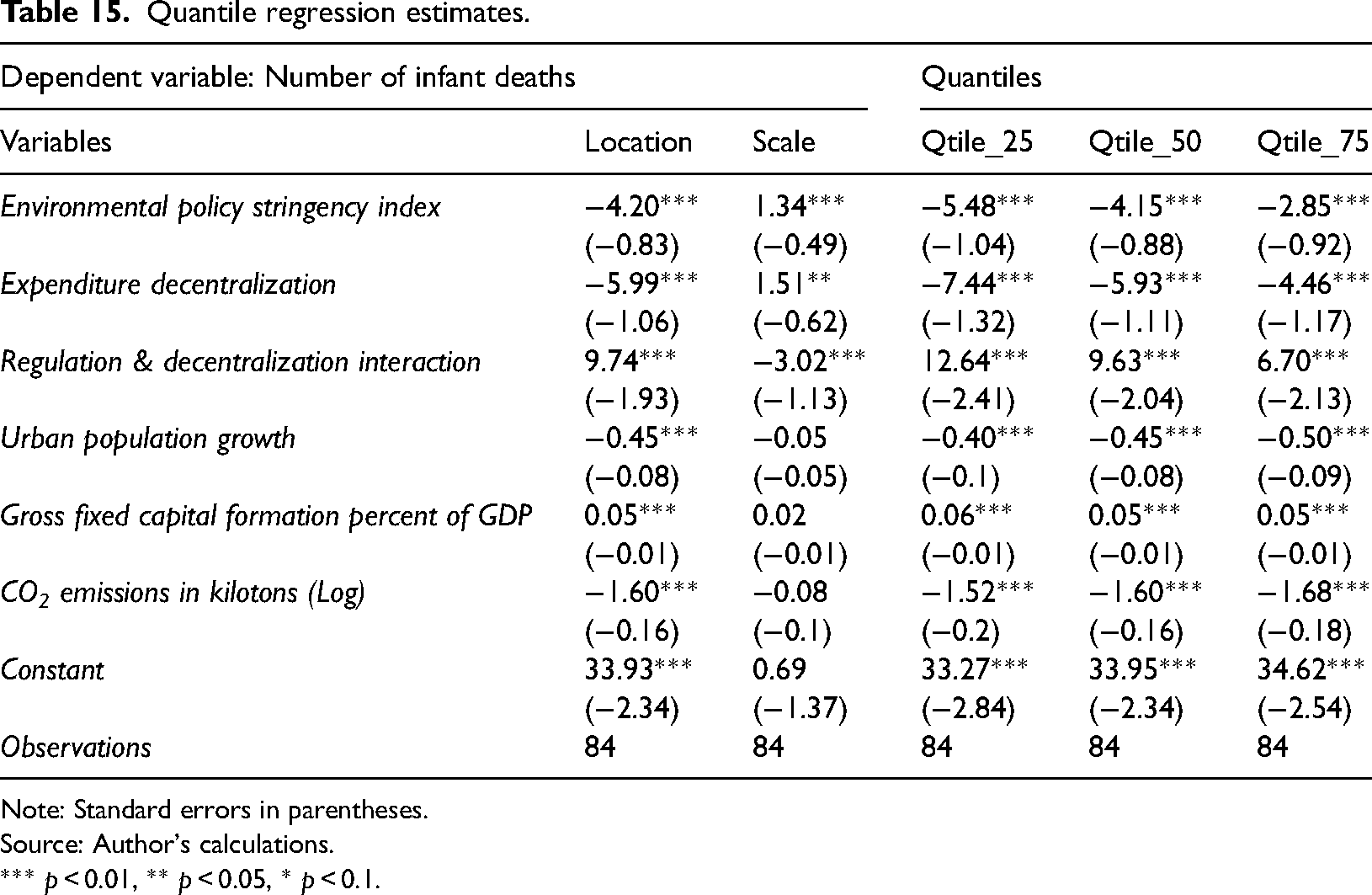
Tables 10 to 12 and 13 to 15 provide the estimated results of life expectancy and the number of infant deaths, respectively, under ER, three proxies of FD, and interaction terms of ER and specific proxy FD (tax revenue, revenue, and ED. In the life expectancy case, the impact of ER is higher with a higher quantile. The impact of RD is negative and significant but declining with higher quantile: 1 unit increase in RD reduces life expectancy by 69.40%, 51.39%, and 34.73% in Qtile_25, Qtile_50, and Qtile_75, respectively. The combined impact of ER and RD is negative and significant in the middle and upper quantile. Similarly, the impact of TRD is negative, significant, and declining from lower to upper quantile (50.97% to 39.50%).
Quantile regression estimates.
Note: Standard errors in parentheses.
Source: Author's calculations.
*** p < 0.01, ** p < 0.05, * p < 0.1.
Quantile regression estimates.

Note: Standard errors in parentheses.
Source: Author's Calculations
*** p < 0.01, ** p < 0.05, * p < 0.1.
Quantile regression estimates.

Note: Standard errors in parentheses.
Source: Author's Calculations
*** p < 0.01, ** p < 0.05, * p < 0.1.
Quantile regression estimates.
Note: Standard errors in parentheses.
Source: Author's calculations.
*** p < 0.01, ** p < 0.05, * p < 0.1.
Quantile regression estimates.
Note: Standard errors in parentheses.
Source: Author's calculations.
*** p < 0.01, ** p < 0.05, * p < 0.1.
Quantile regression estimates.
Note: Standard errors in parentheses.
Source: Author's calculations.
*** p < 0.01, ** p < 0.05, * p < 0.1.
The ED is negatively and significantly related to life expectancy; 1 unit increase in the expenditure's decentralization reduces life expectancy by 7.44%, 5.93%, and 4.46% in Qtile_25 Qtile_50, and Qtile_75, respectively. Lower to middle quantile estimates have a declining trend. Moreover, the combined impact of ER and expenditures decentralization is positive and significant. ER is connected negatively with life expectancy in the ED equation in BRICS economies. However, the results are promising if more regulations are placed with higher ED. The combined effect of regulations and ED is significantly positive. The finding implies that regulations or ED alone may worsen the health standards and policymakers need to strike a balance between the two.
Another finding from Tables 10 to 12 is that ED, along with better ER, is more encouraging than the total and TRD regarding health outcomes. Tables 10 and 11 show that the separate and joint impact of ER is insignificant, along with a strong negative impact of both types of RD on life expectancy. Furthermore, the separate and joint impact of both variables (FD and ER) tends to decrease, moving from lower to higher quantiles. A lower quantile indicates a country with a lower ER and FD level, whereas higher quantile represents the prevalence of a higher level of both indicators. Combined impact provides mixed results (positive and negative) in the case of life expectancy and indicates dual theories of FD.36,38 Similarly, ER and FD reduce the number of infant deaths in the case of the number of infant deaths.18,29,30
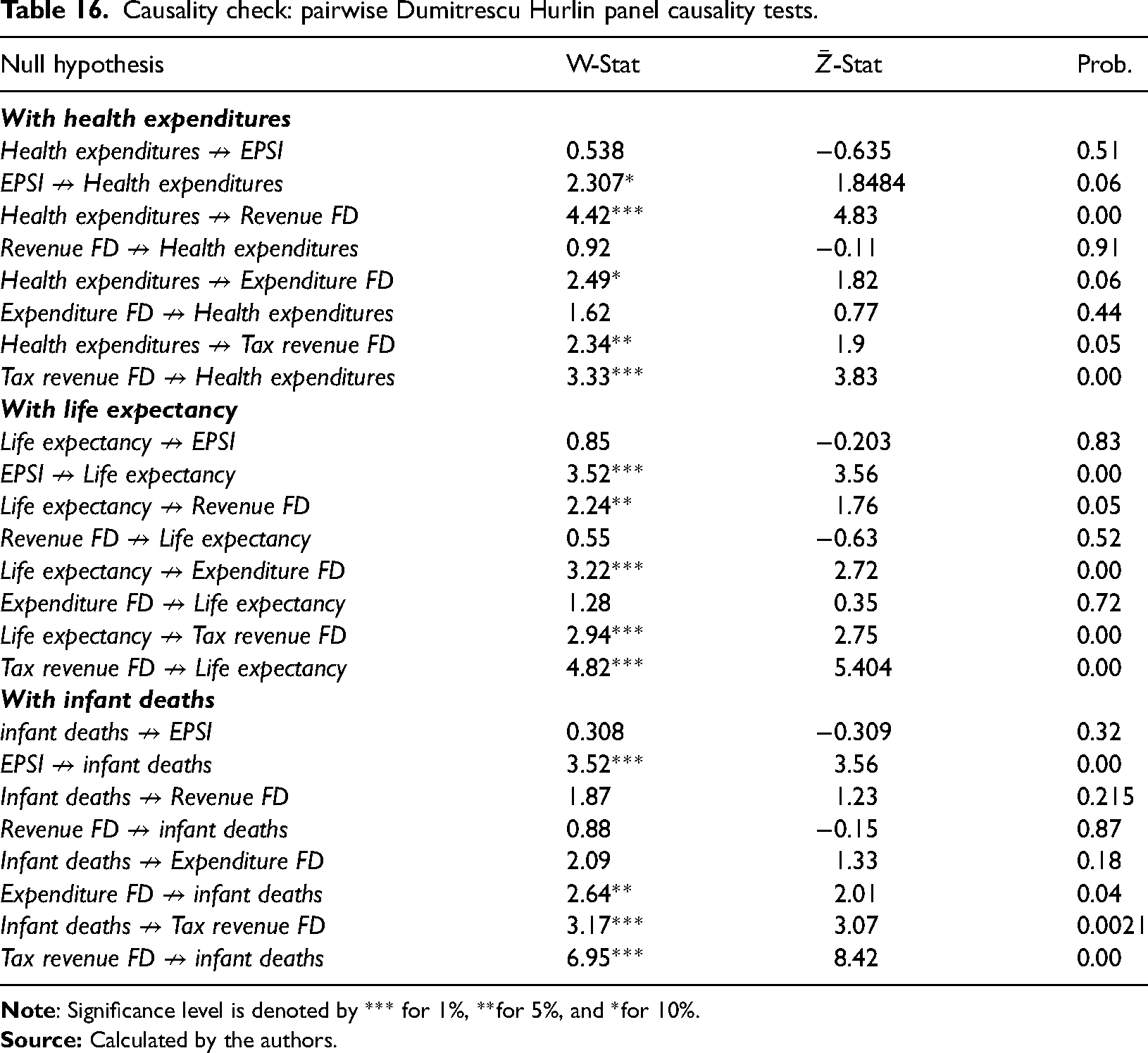
Pairwise Dumitrescu Hurlin panel causality tests
MMQREG gives empirical results for each scale, location, and quantile. However, estimating causality across variables is insufficient. Table 16 shows the empirical results of the Dumitrescu and Hurlin 59 Granger panel causality test. Bidirectional and unidirectional causal links exist between the research variables. In the health expenditure model, health expenditures do not substantially cause EPSI while EPSI granger causes health expenditures. There exists a unidirectional causality between health expenditures and EPSI. Similarly, unidirectional exists in the case of RD and ED. Only health expenditures substantially cause TRD and TRD granger causes health expenditures, which indicates a two-way causal link between these variables in BRCS nations. In the life expectancy model, all variables have unidirectional causality. Only life expectancy and TRD have bisectional causality. A similar line of causality is found in the case of the infant death model.
Causality check: pairwise Dumitrescu Hurlin panel causality tests.
Discussion
This study investigates the separate and combine impact of ER and FD in assessing health outcomes. In this study's initial regression analysis, the MMQREG model is considered. The statistical analysis is displayed in Tables 7 to 15. This study concludes based on the given results. (1) ER considerably affect health expenditures, increasing their impact in higher quantiles. ER increases life expectancy in higher quantiles for RD but decreases it for ED. Moreover, regulations reduce the number of infant deaths. High ER may increase health expenditures and improve access to health services, ultimately increasing life expectancy and reducing infant deaths. Such findings are consistent with the previous studies.7,18,23 (2) FD has a considerable positive impact in lower quantiles. Decentralization reduces life expectancy at birth, but the influence lessens in higher quantiles. Moreover, expenditure decentralizing minimizes infant deaths. FD increases health expenditures and reduces infant deaths. However, FD has negative impact on life expectancy. This dual impact can be explained in the light of two generations of FD theories. The first generation of decentralization theories based on classical theory of FD claims that local governments provide public goods more efficiently, boosting public welfare.15,61 These scholars felt that local governments understand local inhabitants’ preferences better than the central government, making them better positioned to provide public goods and services to their communities. The second generation of FD ideas, based on public choice theory, argue that the government does not maximize resident welfare32,62 and may even decrease public welfare, such as life expectancy. (3) Decentralizing tax revenue and environmental controls minimizes median health expenditures while minor ED. Revenue and regulation reduce life expectancy. When expenditures and decentralization combine, life expectancy is higher at lower quantiles in upper quantiles. The two policies’ combined effect is positive (i.e. it reduces infant deaths). However, the impact is stronger in lower quantiles. In a nutshell, the effects of decentralizing revenue and spending are different, with expenditure decentralizing alone and in combination with ER showing the most promise for improving health outcomes. In this scenario, governments are motivated to enhance public services and environmental quality by gaining financial autonomy following “voting by foot.” 36
Conclusion
The study is designed to test the impact of ER and FD on health outcomes in BRICS economies. We have found both policy measures’ significant and positive impact on the health indicators. However, the combined effect of these measures is significantly negative.
In the last 20 years, several emerging countries have embraced ER and decentralization. Decentralization is a powerful way to improve efficiency and justice in providing public goods such as health care. Still, the impact of ER on health is limited, and the combined influence of both rising trends in developing countries is undetermined. This study examines the effects of ER and FD on health outcomes, health expenditures, life expectancy, and the number of infant deaths. This study examines the BRCS economies from 2000 to 2020 using MMQREG requirements.
Since BRICS economies comprise emerging economies, the panel contains variations in data. Regarding this, data normality is examined, showing that the majority of variables have non-normal distributions, which may encourage the development of an efficient estimator for non-normal data. The current study is able to use a second-generation panel unit root test, which offers mixed-order data integration, due to heterogeneous slope coefficients and cross-sectional dependency. The empirical estimations of the MMQREG show that ER positively affect health indicators. The study found that ER affect higher-quantile health outcomes. ER positively affect health costs, life expectancy, and infant mortality. In most circumstances, higher quantiles have more impact. Total revenue and ED positively improve health outcomes, while TRD negatively affects them. Our analysis found that decentralization and environmental laws had a negative influence. Moreover, the Dumitrescu-Hurlin panel causality tests indicate the bidirectional causality of TRD with health expenditures, life expectancy, and infant deaths, while the remaining variables have unidirectional causality.
Policy recommendations
Based on empirical findings, the study suggests the following policies for the decision-makers. (i) The policy makers need to implement ER in order to improve the health standards of the public at large. (ii) Powers should be delegated to lower levels and degree of FD should be increased to bring in positive health outcomes. The central government should increase local government autonomy on revenues and expenditures, so that local governments may design policies well suited to their local conditions and may improve health standards. (iii) Even though both measures (ER and FD) favor health indicators, their combination worsens health outcomes. Hence keeping in mind this finding, it is crucial to balance these two policy measures to maximize the effectiveness for better health standards.
The negative impact of regulations and FD seems to be the result of the race to the bottom hypothesis. c ,11 In this regard, further research may focus on the specific limit and balance of ER and FD to improve health status.
Limitations of the study
The study suffered two important data limitations: (i) Due to the unavailability of FD data for India, the study was limited to four BRICS economies; (ii) Data on expenditures decentralization for China was unavailable. Hence, the estimations of expenditures decentralization do not include China. Therefore, further initiatives are needed to extend work by incorporating all BRICS economies on data availability and environmental policies.
Footnotes
Author contributions
Feng Wang: critical revision, incorporation of intellectual content. Seemab Gillani: literature search, data collection, data interpretation, drafting. Rabia Nazir: study design and concept, data analysis, data interpretation. Asif Razzaq: writing-review and editing.
Declaration of conflicting interests
The authors declared no potential conflicts of interest with respect to the research, authorship, and/or publication of this article.
Funding
The authors disclosed receipt of the following financial support for the research, authorship, and/or publication of this article: This work was supported by the General Project of National Philosophy and Social Sciences Foundation in 2022: Driving effects, potential impacts, and coordinating pathways of the forcing mechanism from China's “dual carbon” targets on its high-quality economic development (grant number: 22BJY127).

Notes
Appendix
Number of infant deaths in BRCS economies. A.Life expectancy in BRCS economies.
