



Abstract
Some fishery and environmental organizations criticize offshore wind farms affecting fishery livelihood and marine ecological biological environment. The problems offshore wind farm directly affect the fishing ground due to ocean currents, marine ecology, and the marine environment being changed. In addition, fishing operations may carelessly damage undersea offshore wind farm cables disrupting energy operations, many fishing activities are restricted within the offshore wind farm areas and marine ecological biological environment has been damaged by offshore wind farm. However, marine spatial planning could coordinate offshore wind farm stakeholders and conducts marine environmental impact assessments to identify suitable offshore wind farms. The purpose finds solutions for offshore wind farm in the fishery and marine ecological biological environment. The research questions are how to reduce offshore wind farm impact on fishery livelihood and marine ecological biological environment through marine spatial planning and marine environmental impact assessment in the Taiwan territorial waters. In online questionnaires of 404 respondents, 64.36% supported marine spatial planning site selection and marine environmental impact assessment could reduce offshore wind farm impact; 66.83% agreed offshore wind farm coexistence with multiple uses, increasing fishery and biodiversity; 58.17% agreed on public financial participation in offshore wind farm to increase social acceptance. The findings are consistent with previous research. However, interviewees challenged that multiple uses coexistence might affect some populations in the ecosystem and further investigations are required. Another, 50.50% agreed on updated regulations of marine spatial planning, marine environmental impact assessment, insurance, specific fund, feedback, and compensation of offshore wind farm that could improve fishery livelihood and marine ecological biological environment. Finally, based on the study results, the paper suggests that energy policy could open public financial participation in offshore wind farm increasing social acceptance, skill training influenced groups for employment, enhancing fishery livelihood, and protecting marine ecological biological environment.
Keywords
Introduction
According to The White Paper of Taiwan Energy Transition published in November 2020, the energy in Taiwan 98% is imported from foreign. The objectives of energy policy in Taiwan develop autonomous energy diversification to stabilize supply and safety with sustainability, economic development, and environmental protection. 1 There is international concern about extreme weather with the necessary transition from finite energy to renewable energy (RE). RE100 is led by the Climate Group in partnership with Carbon Disclosure Project and brings over 380 large ambitious businesses committed to 100% renewable electricity. Offshore wind farm (OWF) is RE and has several advantages, clean, no carbon emissions, inexhaustible, and the fastest-growing.
The European Union showed interest in marine spatial planning (MSP) at OWF, fishery, and marine activities for multiple uses. The Netherlands, Germany, and the UK demonstrated that MSP identified OWF exploration in the North Sea. 2 Germany implemented OWF with aquaculture and fisheries. 3 OWF has been offering clean energy diversification with marine aquaculture. 4 The considerable research, Michler-Cieluch et al. (2009), Bamlett (2018), Aryai et al. (2021), Schupp et al. (2021) devoted to OWF coexistence with fishery but experienced barriers of infrastructure in deep seabed, site selection, and financial support.
The first OWF Formosa 1 was put into use in 2017. The second Taipower 1 was in 2020 and the third Formosa 2 has been operating since 16 May 2023. OWF has been increasingly important for electricity production, creating local jobs and improving energy security. Unfortunately, some fishery and environmental organizations strongly criticize OWF for affecting fishery livelihood and marine ecological biological environment (MEBE). The problems OWF directly affect the fishing ground due to ocean currents, marine ecology, and the marine environment being changed. In addition, fishing operations may carelessly damage undersea OWF cables disrupting energy operations, many fishing activities are restricted within the OWF areas and MEBE has been damaged by OWF. However, MSP could coordinate OWF stakeholders and conducts marine environmental impact assessment (EIA) to identify suitable OWFs generating electricity. This could improve the energy supply, security, diversity, and local economics. 1 The purpose finds solutions for OWF at the fishery and MEBE. The research questions are how to reduce OWF impact on fishery livelihood and MEBE through MSP and marine EIA in the Taiwan territorial waters. Table 1 online questionnaires total of 404 respondents, 64.36% agreed MSP site selection for OWF multiple uses and marine EIA reduce the impact on the fishery and MEBE support previous research Quero Garcia et al., (2019); Gusatu et al., (2020). Moreover, 66.83% agreed that OWF coexistence with marine aquaculture, increasing fishery and biodiversity are consistent with literature reviews Bamlett (2018); Orsted (2021); Schupp et al. (2021); Aryai et al. (2021). However, some interviewees reported coexistence that might affect some marine populations in the original ecosystem. Table 2, 58.17% agreed on public financial participation in OWF to increase social acceptance is consistent with previous research Gusatu et al., (2020); Westra (2014). Another, 50.50% agreed on the regulations of MSP, marine EIA, insurance, feedback, specific fund, and compensation of OWF that could improve fishery livelihood and MEBE. Based on the study results, successful OWFs need more experience, investigation, data collection, updated regulations of MSP, marine EIA, insurance, and financial support. Additionally, the monitor committee should be organized and regularly examines the impact, and public hearings open attendance for residents, environmental organizations, and developers. Finally, the paper suggests that energy policy could open public financial participation in OWF increasing social acceptance, skill training influenced groups for employment in the long run, enhancing fishery livelihood, and protecting MEBE in the Taiwan territorial waters.
OWF generates clean energy. MSP sand marine EIA would reduce the impact

OWF: offshore wind farm; MEBE: marine ecological biological environment; MSP: marine spatial planning; EIA: environmental impact assessments.
Energy policy with the financial participation
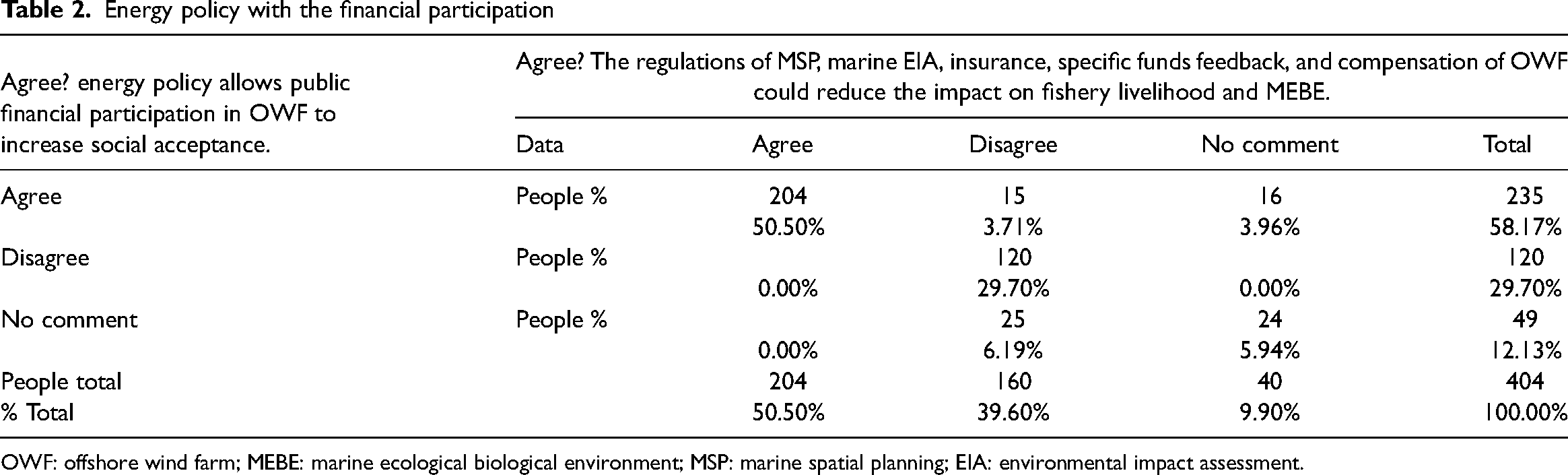
OWF: offshore wind farm; MEBE: marine ecological biological environment; MSP: marine spatial planning; EIA: environmental impact assessment.
Method
The defects of quantitative online questionnaires are no answers for the reason why but have the number to analyze the research questions in the statistic. The use of the qualitative interview as a data collection attempts to find some answers or the reasons for the research questions. Online questionnaires and semi-structured interviews were conducted from 26 April 2023 to 31 May 2023. Hence, the use of combined methods may increase the validity and reliability of the results. Online questionnaires, semi-structured interviews, and other sources of data collection were conducted as shown in Figure 1.

The method framework answers the question.
Online data collection of questionnaires
The contents of the questionnaires were data collected from literature reviews and designed to answer the research questions for statistics analysis. The process of data collection has been reading online previous research, searching related wording, content, academic experiments, and the official website for offshore wind energy, and multiple uses of OWF in English and Taiwanese languages. Such as YouTube, the Energy Policy of Executive Yuan, the Bureau of Energy, the Ministry of Economic Affairs Taiwan, Fisheries Research Institute (FRI), National Taiwan Ocean University (NTOU), RE, marine multiple uses, MSP, OWF with fishing, and marine aquaculture. Furthermore, FRI conducted experiments on marine aquaculture with OWF, solar panels, and photovoltaic aquaculture.
Criteria of the online questionnaires
The population of online questionnaires, all members of NTOU include students, teachers, professors, and administration about 9400 people in the year 2023. Based on a 95% confidence interval and 5% variance, at least 368 respondents are required. The questionnaire link and informed consent were posted on social media NTOU. The researcher positively called, texted, social media, and visited familiar, unfamiliar asking for online responses from classmates, students, teacher assistants, administrators, and professors of NTOU. The research process targets at least 15 respondents every day and asks them for propaganda to answer the questionnaire from 26 April 2023 to 31 May 2023.
Informed consent before answering the questionnaire
The research has no funding from anyone or parties, the author declares no conflict of interest. The informed consent of the study includes the title, background, purpose, procedure, voluntary participation, and consent of the study, in association with the questionnaire posted on social media of NTOU. It means that all respondents have been given full information about the study online informed consent and voluntarily do the questionnaire.
The criteria of participants in a semi-structured interview
The use of the interview as a data collection method allowed the interviewees to express their perspectives regarding the questions. However, some defects may potentially prevent the purpose. To improve the validity and reliability of the study, the interviewees may try to provide favorable answers during the interview even though the researcher reminded them that there was no right or wrong answer. The criteria of participants for the interaction semi-structured interview focused on the departments or institutes in NTOU related to the questions. Such as Environmental Biology and Fisheries Science; Aquaculture Department; Institute of Marine Biology; Institute of Marine Environment and Ecology; Institute of the Law of the Sea. Then, the study has been trying to ask target participants from the aforementioned departments or institutes to join face-to-face interviews.
Interviews questions
The interview was designed to answer the question. Based on the reply of the interviewees, the researcher keeps asking why till obtained the need for the study. Most importantly, the researcher does not agree, argue, influence, or challenge any views of the interviewees. The start question is what are your views about OWF affecting fishery livelihood and MEBE? And Why? How will you deal with these impacts? Question 2, What are your views about MSP site selection for OWF multiple uses and marine EIA reducing the impact on the fishery livelihood and MEBE? And Why?
Process of interviews
First, the researcher sent text messages in association with interview questions 1, 2, and the informed consent to the pseudonym Amy, Jack, John, and another total of 20 target participants from the target five departments or institutes in NTOU through the online social medium. Text messages invited target participants to the face-to-face interview estimation of 10 to 60 min. The refusal or no reply is acceptable for the researcher and does not influence the relationship if they have no intention to the interview. Then, the researcher called and invited them to interviews. Fortunately, all 20 participants replied with positive confirmation but no confirmation of informed consent with signature. Unfortunately, only nine pseudonyms Amy, John, Jack, Jane, Mike, Ann, Lily, Wang, and Alex joined the interviews from 26 April 2023 until 31 May 2023. All interviews were conducted in Mandarin and transcripts were in Mandarin and English. The three face-to-face interviews with recorded and six interviews with recording files were transmitted online through the social medium. The other 11 participants had no reply about interviews since they did positively confirm the interview.
The researcher sent text messages to Amy and was scheduled to interview her on Thursday 27 April 2023 at 18:00 in the classroom of the Fishery Building in NTOU. But the schedule was changed and conducted recording at 17:30 on 28 April 2023 in the 305 classrooms of Fishery Building, NTOU. The time, place, and date of the interview arrangement for other pseudonyms were similar to Amy proceeded with text messages on social media. All three face-to-face interviews signed the informed consent before the interviews were conducted and recorded. The informed consent had been informed and showed their acceptance before the other six interviewees sent recording files about the interview questions that were transmitted by social media.
Data analysis of the interview
The researcher conducted data analysis for semi-structured interview transcripts. Different researchers have different labeling, coding, connection, and interpretation resulting in different answers to the research questions. However, the key point is based on data collection and the researcher shall follow the systematic structure of research.
Other sources of data collection
The triangular methods improve the validity. Such as literature reviews, libraries, the websites of the United Nations, official administration, and academics; videos about OWF, marine aquaculture, fishery, and MEBE from social media are collected, transcripted, coded, and interpreted.
Results
OWF is a trend for clean energy. Formosa 1 was commercially commissioned 128MW in 2019. Taipower 1 operated in 2020. The Formosa 2 has been affected by coronavirus disease 2019 (COVID-19) and has been operating at Maoli since 16 May 2023. In addition, Formosa 3 at Changhua and Formosa 4 at Maoli will be commercially operated in 2025.
Other sources of data collection
MSP activates idle assets, conducts marine EIA, and coordinates stakeholders to identify 36 potential sites OWF in the Taiwan territorial waters. Moreover, marine aquaculture combines with artificial reefs to increase fishery and biodiversity as shown in Figure 2. Similarly, the Netherlands designed an initiative to support biodiversity in the North Sea. The research installed an artificial reef on the seabed to create a shelter and feeding ground for Atlantic cod and other large fish species. 5
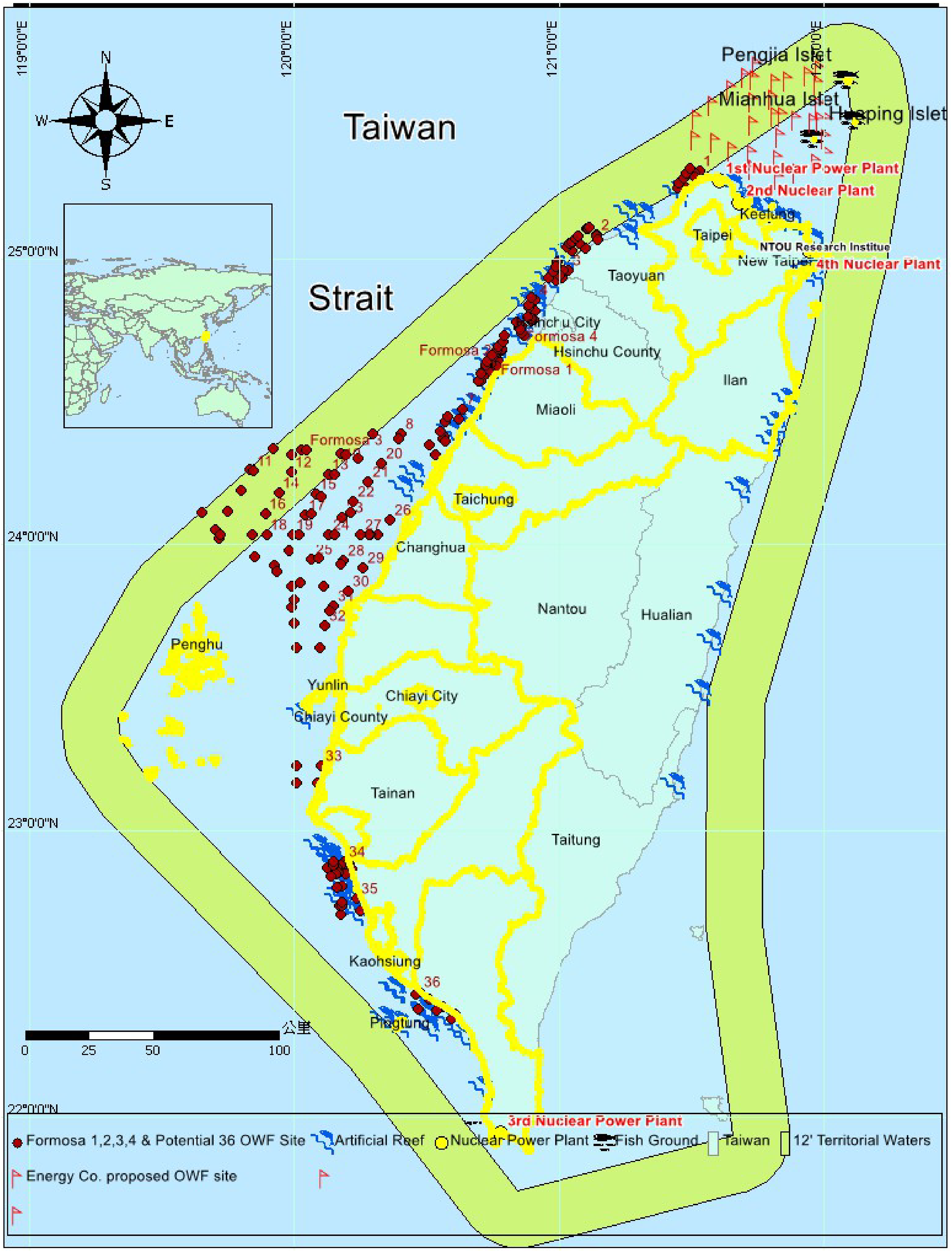
The NTOU Research Institute applied technologies with artificial reefs, farming fishery, and marine aquaculture. The Taiwan FRI bred seaweed and oysters with OWF Formosa 1 in 2019. In addition, the government promoted photovoltaic electricity coexistence with aquaculture at Penghu, Chiayi, Tainan, Kaohsiung, Pingtung, Changhua, and Yulin in Nov 2020. OWF: offshore wind farm; NTOU: National Taiwan Ocean University; FRI: Fisheries Research Institute.
(Figure 3) Taiwan about 70% of the total population is located in Taipei, New Taipei, and Keelung. Where high consumption of energy is demanded. A developer applied OWF to generate electricity nearby the fishing ground of Pengjia Islet, Pinnacle Island, and Mianhua Islet, Northeast Taiwan in 2020. Unfortunately, the application was rejected by the government in 2021 attributed to the main opposition from the Fishman's Association. However, the change to support OWF is expected. Since the fishery is diminishing due to overfishing and illegal fishing activities even with no OWF installation and operation.

The National Taiwan Ocean University (NTOU) Research Institute in Northeast Taiwan bred farming shellfish, and aquatic plants with artificial reefs in marine aquaculture.
Online questionnaires
According to Table 1, a total of 404 respondents volunteered to participate and answered the questionnaire from 26 April 2023 to 31 May 2023. As can be seen, 64.36% agree MSP site selection for OWF multiple use and marine EIA reduce the impact on the fishery livelihood and MEBE. This high percentage of EIA is especially alarming since MEBE is a basic element for enriching biodiversity. Another notable result is that 66.83% agree OWF coexists with marine aquaculture to increase fishery and biodiversity. The findings are consistent with previous research.
Based on Table 2, 58.17% agreed that energy policy may allow public financial participation in OWF. It is worthwhile to note that 50.50% agreed on the regulations of MSP, marine EIA, insurance, specific fund feedback, and compensation of OWF that could improve fishery livelihood and MEBE. The findings support previous research and indicate that successful OWF is based on MSP, marine EIA, and the mechanism of financial support. However, the monitor committee should be organized and examine the developments.
Semi-structured interviews
The online questionnaires showed the answer but did not know the reason. Thus, the researcher conducted face-to-face semi-structured interviews to examine the questionnaire finding. The main problem of OWF has many stakeholders, complex benefits involvements and the most important is site selection. (Table 3).
Total of nine interviewees from five target departments or institutes in National Taiwan Ocean University (NTOU)

Marine aquaculture in artificial reefs test for fish farming as problem-solving for the fishing decline. However, some interviewees pointed out that further investigations are required. (Table 4).
The transcript, labeling, coding, connection, and interpretation of the interview.

OWF: offshore wind farm; MEBE: marine ecological biological environment; MSP: marine spatial planning; EIA: environmental impact assessment; NTOU: National Taiwan Ocean University; FRI: Fisheries Research Institute.
Discussion
The regulations for RE amendment were passed by legislators on 29 May 2023 and the RE development zones are not limited to territorial waters. The OWF development in Taiwan has three strategies. The first is the Demonstration Incentive Program, a subsidy by the government to attract investments. Second Zone Applications for Planning OWF are identified by the government and open for developer application from 2018, a great chance of success with the financiers and licensing authorities. However, some developers did not pass the marine EIA. The third is Zonal Development.
Electricity generation from OWF has grown rapidly since the first commercial OWF, Vindeby, Denmark was commissioned in 1991 and discommissioned in 2017. 6 About 65% of European OWFs are located in the North Sea. Another 19% in the Irish Sea and 16% in the Baltic Sea. The opposition against OWF is related to culture, environment, commercial activity, political stance, location, and coastal uses. 7
The construction of OWF Formosa 2 has been affected by the COVID-19 pandemic attributed to quarantine segregation and medical treatment of employees, causing a broken supply chain of material and transportation, and was scheduled to operate in December 2022. However, the third OWF Formosa 2 was completed and has been operating since 16 May 2023. Moreover, OWF Formosa 3 at Changhua 2 GW and Formosa 4 at Miaoli 4.4 GW are estimated to run in 2025. The east coast of Taiwan is inappropriate for OWF installation due to the weak wind and the relatively steep bottom. 8
OWF coexists with marine aquaculture, facilitating restoration, and bringing the opportunity for a local ecosystem to protect the layer of stones more attractive for oysters. 9 The North Sea UK, Belgium, Netherlands, Demark, and Germany conducted OWF with mussel aquaculture. 10
Strategy 1 demonstration incentive program from 2013
The demonstration OWF program is coordinated by the government to gain experience and knowledge for the development of OWF as a source of RE, providing subsidies and attracting investment. The broad program areas are research institutes, enterprise economics, foundations, supporting structures, engineering, electrical infrastructure, grid integration, air current, turbulence, the environment, safety, and social acceptance. The construction serves as a project with new technology that can be proven in practice. The first OWF demonstration in Taiwan, Formosa 1 is 8 MW (MegaWatt) installed around 2–6 km from Chunan town, Miaoli coast. The underwater 15–30 m, area of 10.28 km2 was commercially commissioned on 28 April 2017 and 128 MW was completely constructed providing annual 128 thousand households electricity in December 2019. Formosa 1 has been creating employment and developing the related local supply chains of OWF.11,12 The second demonstration Taipower 109.2 MW commerced operation at Changhua, Fangyuan, 7.2–8.7 km, areas 9 square meters, constructed in March 2018 and completed for generating electricity on 31 August 2021, providing 90,000 households annually. Based on this platform, research continuously measures wind, waves, and currents to investigate the impact on fish, marine mammals, and other aquatic life.
Fishing coexistence
The fishery may have an economic cause, but other reasons might be important as well. Potential sites for OWF are always traditional fishing grounds such as the Taiwan Strait. Taiwan FRI raised seaweed in the OWF Formosa 1 areas in 2017 and conducted tests on trawlers and the marine EIA ecosystem of 36 potential sites in 2018. FRI has been trying to find ways for OWF coexistence with fishing for multiple uses and checking with the expertise of the UK and Netherlands about the North Sea experiences. 13
The combination of maritime activities has been explored and includes the reinstatement of fishing activities within, or near OWF. 3 The North Sea is the main area of OWF in Europe overlapping traditional fishing grounds. Europe countries have different regulations for OWF and fishing for multiple uses. For example, UK, fishing boats can not enter OWF areas when the foundation is installed, but away 50 m from the foundation is open for fishing operations. However, other Europe countries are no fishing zone but encourage marine aquaculture and habit restoration for multiple uses. 13 The UK encouraged OWF with fishing coexistence and reduced impacts on the marine environment. Germany prohibited the installation of new wind farms in the areas of the Natura 2000 Network of the economic exclusive zone. 2 Bamlett (2018), Quero Garcia et al., (2019) the Netherlands implemented a safety zone to avoid designating OWF in protected areas.
Mounting pressure from the fishery continuously challenges OWF. However, fishing synergy within OWF is always encouraged. Fishing within or around OWF has been increasing and becoming a major topic in stakeholder debates. 3 The UK Marine Policy committed to the socio-economic impacts of the OWF on fishing but considered encouraging coexistence. 10 Scotland and England allowed the fishing vessels’ navigation to pass fishing 500 m in a safety buffer zone of OWF. 14
Marine aquaculture
Marine aquaculture provided the growing demand for marine protein and the limited scope for expanding fishery harvests and presented opportunities to develop aquaculture harmony with economic, environmental, and social objectives. 15 The planning for OWF of ecosystem-based MSP applies to marine applications such as marine aquaculture locations or seabed mining. 16 In Figure 2, FRI-bred seaweed and oysters nearby OWF in 2017, and the richness of plankton and fish increments were found. Similar experiments of aquaculture were conducted at Miaoli, Penghu, and Changhua with the same results in 2019..17,18 FRI integrated with Scylla Serrata to establish a model of the energy transition with aquaculture. The incubation center was created for developments at Chiayi, Tainan, Kaohsiung, Pingtung, Changhua, and Yulin in 2020.11,19 Table 1 the results of OWF coexistence with marine aquaculture are consistence with previous studies Bamlett, 2018; Gusatu et al., 2020; Schupp et al., 2021; Aryai et al., 2021; Griffin et al., 2015. The aquaculture and the restoration of flat oyster beds in the wind parks of Belwind in the North Sea. Frames are used to attract oyster larvae and induce settlement such as algae and small animals. 9 The North Sea encouraged OWF combinations with aquaculture, however, fish aquaculture combinations were inappropriate for the Baltic Sea 10 due to different characteristics such as policy, weather, waves, currents, depth, seabed, sediments, and proximity to coast concerns for specific complex situations.
Remote sensors equipped aquaculture of multi-trophic with OWF at Changhua to explore offshore energy and changed traditional fishery to restore the habitat of white dolphins (Sousa chinensis ssp. Taiwanensis) at Taichung harbor in 2020.20,21 The three dimensional-printed seedling equipment was used in the traditional oyster farm of Changhua in 2020 and attached to a large number of oyster seedlings. This attached oyster could be peeled off artificially to produce a large number of single oyster seedlings and could be practiced in OWF breeding. 22
Operation and maintenance training for employment
The construction of OWF is followed by a period of management and maintenance. Not only must the wind turbines run smoothly, but the foundations and cable must also be inspected regularly and repaired when necessary. Operations include all activities related to the running of the installations at sea, from the monitoring of OWF to arranging the transportation of people and materials to the offshore installation, administrative and back-office activities. Maintenance includes the entire wind farm. OWF must be available at all times to produce electricity. The maintenance sector is developing rapidly. Skill training local fishermen, fishing boats, and coastal communities for employment is a good way to improve fishery livelihood and MEBE. OWF becomes an important project of energy sustainable development and has been developing the supply chain of energy localization 1 and economic growth to improve energy stability.
In the year 2019, Changhua Fishery Association (FA) suggested that the OWF developers offer specific funds for feedback, education, and skill training. The funds are exclusively used for the fish village, fisherman livelihood, ecosystem restoration, MEBE, and related insurance. All activities related to funds shall be approved by the local government. 23 Similarly, the Netherlands’ transition funds for process and technology demonstrated the importance of incentives and financial investment. 14
Strategy 2 zone application for planning in 2018
The government had bulletins notice of 36 potential sites of OWF in Taiwan Strait and developers can apply for development. The potential sites should be based on scientific data collection from marine EIA in the long run and MSP coordinates stakeholders. Figure 2, the government identified offshore distances from 0.2 to 50.3 KM, depth mean from 13 to 45.5 M, the areas from 20.8 to 131.1 KM2 for 36 potential sites. The areas avoid affecting the designation of the sea route, fishery, and MEBE habitat of white dolphins. 24 The first zone application Formosa 2 at Miaoli, is 4–10 km, area of 68.81 square meters, a total of 376 MW, and averts the habitat of White Dophine. It completed the installation and has been operating since 16 May 2023, annually providing 380 thousand households, and Formosa 2 is the third OWF in Taiwan.
MSP and marine EIA
Global position systems and geographic information systems assist marine EIA and MSP to identify OWF and avoid conflicts of traffic flow, MEBE, and high fishing intensity. 2 MSP integrated multi-functionality to achieve specific objectives, synergies contributed to reducing transboundary conflicts and showed OWF and mussel aquaculture.25–28
The government publishes a bulletin, a notice of sailing direction, and the buffer zone for the potential site of OWF in Changhua after marine EIA and MSP designated the sea route, traffic flow, precaution area, habitat protection of white dolphins, and reserved zone to reduce the impact on fishery and MEBE. For example, a total of 43 protection zones from the Fishery Agency, The Ocean Affairs Council, and the Marine Pollution Control Act to reduce the impact on fishery and MEBE. 29
The spatial and temporal distribution of ocean energy is crucial to inform MSP about the sustainable design of ocean infrastructure. 6 The North Sea surrounded by Norway, Demark, Germany, Netherlands, Belgium, and the UK conducted MSP to designate the sea route, safe zone, and floating OWF. Germany identified a potential site for OWF to protect natural resources and coordinated the development of offshore wind activity. 2 Near the planned Nordergründe wind farm, Germany integrated aquaculture facilities with blue mussels (Mytilus edulis). The coexistence showed that MSP increased by 7%–8% in spatial efficiency and 207%–230% in value compared to the independent operation of the wind farm.28,30
Multiple uses
In the North Belgian Sea, offshore mussel culture in OWF, the project of EDULIS produced mussels, and a wind park about 20 km from the coast revealed the connection of multi-purpose with OWF. 31 Schupp et al., (2021) local stakeholder perspectives from two case studies East Coast of Scotland and Germany's North Sea exclusive economic zones scoped the feasibility of multiple uses for OWF and fisheries. In both case study areas, the OWF industry showed little interest in multiuse. In contrast, the fishing sector was proactive toward multiple uses and acted as a driving force for development.
Multiple uses were popular in the Baltic Sea, Estonia, Finland, Denmark, Germany, Poland, and Eastern Atlantic Seas, Spain, Portugal, and France 10 to integrate environmental and economic synergies with offshore infrastructure and activities such as fishing, aquaculture, and MEBE protection.2,14
An energetic fish farm in the Mediterranean Sea developed offshore platforms for multi-use ocean space, energy extraction, and aquaculture coexistence. Such as Italy, Tunisia, Algeria, Spain, and Malta had been operating floating cages with fish farms for several years. 31
Balancing the profitability of energy production, MEBE, and biodiversity in OWF for multiple uses is needed. However, the coexistence and spillover effect from the foundation of OWF, investigating the impact on specific populations in the ecosystem is required. Moreover, learning experience from experienced experts for OWF coexistence with, marine aquaculture, and fishing for multiple uses. 32 The EIA committee will be organized to monitor the processing of OWF. It offers a platform for stakeholders to discuss the challenges and multiple uses in fishery sustainability That means the largest common denominator of multiple uses OWF can be studied and developed.
Artificial reefs
Figure 2 many artificial reefs were designed and installed technologies to improve fishing and marine aquaculture. Offshore oysters replaced the polluted oysters onshore. The richness of plankton, fish, and marine ecosystem was rehabilitated in Changhua, Miaoli, and Penghu in 2018. 33 A 4-year plan of OWF's multiple uses with marine resources was developed to investigate the effect of the new style in fishing, surrounding offshore wind infrastructures with marine aquaculture at Changhua in 2019. 17
Ecology and education are crucial for the realization of balanced and sustainable energy. Marine mammals, dolphins, seals, and porpoises are sensitive to underwater noise and may be disturbed or even suffer hearing damage caused by the process of driving the OWF foundation. 34 The movement of seals in the Germany North Sea wears global position systems and transmitters show seals like OWF. The seals appear to frequently spend time and hunt between the wind turbines. They swim from one wind farm to another because of the large amounts of fish in the sea. The stone around the wind turbine's foundation forms artificial reefs with shells, starfish, and sea anemones that fish are attracted to. These reefs can serve as a new hunting area for seals. 34 The OWF benefits by acting as artificial reef habitats, providing shelter, and reproduction grounds for fish, or by acting as fisheries no-take zones with possible spill-over effects,5,10,16 Giyrvebce et al., (2022). Various studies have shown an increase in biota around offshore foundation infrastructure as a habitat for marine biodiversity. It is rational to leave fixed offshore infrastructure in situ after decommissioning since purpose-built artificial reefs are installed globally to serve environmental recovery. 6
The stones are deposited on the seabed around the foundation of OWF to prevent the sand from washing away forming a reef a hard substrate where new life can thrive. Starfish and other organisms form beautiful underwater gardens that are attractive to fish, which can lead to local increasing biodiversity. Partly because of the ban on fishing at wind farms. They can be seen as a new nature reserve with more species of benthic organisms, which is also more attractive to fish and marine mammals. 34 The OWF foundations or cable rock as artificial reefs benefited crustacean fishery and established alternative fishing practices. 3 The cod reefs seem to serve as a refuge and the prohibition of fishing makes it a relatively safe place for them and feed on smaller fish and crabs to protect MEBE. 5
Strategy 3 zonal development in 2021
The government controls Zonal Development and aims to establish the industry supply chains for OWF. The approval of the application is based on the experience, capability of skill, finance, marine EIA, and related industries of the developer. The important features for OWF installation are the tidal environment, seasonal hydrological variability, population density, coastal infrastructure, and sedimentary environments. 31 The OWF Formosa 1 routinely holds marine EIA public hearings to monitor the influences and open attendance for residents, environmental organizations, and developers.
Public financial participation in OWF and shares benefits
The Danish population in general has a positive attitude toward wind energy. This is partly because many Danes have a direct financial interest in wind power. In 2008, the Danish energy policy was amended to allow the public to participate financially in wind power in the form of shares to increase social acceptance. 34
OWF energy creates meaningful jobs both during construction and operation for at least 20 years. OWF contributes to the fight against climate change and improves energy security. The supply chain of OWF has been developing local economics because constructed the foundation, built the transition pieces, wind turbines with the capacity of electricity, transformer station, vessel transported and installed wind turbine, design, assembly, and installation foundations, connecting the wind farm to the national power grid and transmitting electricity, shipyard, construction offshore accommodation for foundation maintenance technician, planning, delivering and laying the cable in the wind farm the insertion of the cables into foundation and wind turbine. OWF covers the entire chain, from design and construction to operation. OWF reduces dependence on imports, strengthening the security of supply.
Floating wind turbines
The bottom fixed structures of OWF are not economically feasible for depths over 50 m. 7 Floating wind turbines have been reducing the installation costs of OWF and offshore aquaculture has been moving deeper to exploit water resources and improve the utilization of marine space, 35 and mitigate the conflicts of coastal fishing and MEBE. Bamlett (2018) Portugal and France favored synergies in floating wind turbines and Scotland preferred fishing coexistence with OWF. The synergies generate electricity to reduce environmental degradation and increase multiple uses. Floating wind farms use anchors like a boat and are positioned much deeper. The worldwide first floating OWF, Hywind wind farm, Scotland was commissioned in 2017 and located in an average water depth of 110 m. Moreover, The Windfloat wind farm, Viana do Castelo, Portugal was anchored to the seabed at a water depth of 100 m in July 2020 and located 20 km offshore. In addition, France installed floating OWF at a water depth of 33 m in 2018. 7
The government identified OWF potential sites and target areas for analyzing floating OWF in the Taiwan territorial waters. Many countries with high energy requirements, such as Japan, Korea, and the US, these countries have cliffs and deep seas and floating wind turbines are necessary. In Japan, floating wind turbines are being done as an alternative to nuclear energy. The next step of OWF, floating wind turbines is underway. Many structures in the offshore oil and gas industry are being examined for application in the development of floating wind turbines.
Wind-Solar-Aquaculture system
Taiwan set up floating aquaculture to breed shellfish Perna Viridis at Miaoli OWF in May 2020 and many seedlings of Perna Viridis with shells were found in the cage. 22 Moreover, a potential site for the Wind-Solar-Aquaculture system in the South China Sea was deployed economically in intermediate, deep waters to use the ocean space and water resources effectively. 35 The floating system of wind-solar-aquaculture combined multiple megawatts of wind turbines and solar arrayed with steel cages of fish farms in the northwest South China Sea. Moreover, Norway offshore cages of fish farming employed a fixed-point mooring system for holding up to 10.140 m Atlantic salmon, three 60 kW windmills, and two diesel generators, and survived up to 10 m wave height.30,36 “The recent H2020 projects MARIBE and MUSES investigated the potential of a variety of different combinations of economic activities in co-location or integrated with platforms (Van den Burg et al., 2019; Bocci et al., 2019; Dalton et al., 2020)”. 31
Conclusion
OWF is one of the most economical ways for RE 100. Some people challenge MSP coordination, likely disguise. However, MSP identified OWF Formosa 1, Taipower 1, and Formosa 2 which have been operating in Taiwan. Based on the study results, the OWF foundation forms artificial reefs increasing fishery and biodiversity, and needs time to develop the spillover effect. However, multiple uses probably affect some populations in the ecosystem and further investigations are required. Another, updated regulations of MSP, marine EIA, public financial participation, and skill training influenced groups for OWF employment could reduce the impact on fishery livelihood and MEBE.
Footnotes
Declaration of conflicting interests
The author declared no potential conflicts of interest with respect to the research, authorship, and/or publication of this article.
Funding
The author received no financial support for the research, authorship, and/or publication of this article.
