




Abstract
This review article gives a comprehensive review of existing research on renewable solar photovoltaic (PV) nanogrid, which is described from small-scale power system with a single domain for reliability, control, and power quality (PQ) for electric vehicle (EV) charging. A primary feeder on the Microgrid is connected to a nanogrid test bed that includes PV as power source, a battery energy storage system (BESS), smart-inverter multiple and EV charging stations (EVCS). The control algorithms are graded on four metrics: (1) voltage profiles, (2) renewable penetration, (3) PV curtailed and (4) net power flows. To investigate the local power quality, a steady-state power flow model of the nano-grid is created. The control algorithms successfully employ the battery to shift the nano-grid peak load while limiting the nano-grid demand to set level. Furthermore, an increasing emphasis is being placed on commonly used strategies for addressing the characteristics of each renewable system. This review paper characterizes the dynamic operation of 4 distinct BESS control algorithms for solar EV charging nanogrid: (1) peak load shifting, (2) reduce peak period impact, (3) cap demand, and (4) photovoltaic capture. These control modes are executed and analyzed on real-world nano-grid site, and optimal BESS control modes are assessed in terms of (1) solar electric vehicle charging, (2) power quality, (3) grid net demand, (4) photovoltaic curtailment, and (5) solar penetration. Finally, the problems highlight research gaps, and discussions on future trends are critical for enhancing the general technology of the renewable solar photovoltaic nano-grid for EV charging.
Introduction
Recent analytical interest in changing the conventional paradigms of power generation has spurred by an environmental consideration and fuel constraints. Here, the microgrids and nano grids work with the entity that manages small-scale utility network area units, which can be seamlessly isolated from the electrical grid. 1 Each supply a way to incorporate distributed energy resources (DER) and renewable energy-based electric vehicles into a broad area network, 2 and the area unit plays a significant role during this effort. The relationship among transport electrification as well as renewable energy resources (RESs) includes great possible to counter fuel dependence, greenhouse gas (GHG) emissions, 3 solving the total edges of electrical quality. DER with topologies provides real power to native masses, reduces power losses within the native grid's transmission and distribution (T&D) systems, and provides auxiliary services, like voltage help via reactive energy injection. 4 Accumulated reliability and endurance are inherent in small-scale distributed systems, and most often included through power storage or backup power parts that make up the grid (i.e., giving a rigid supply of voltage and frequency), while the public grid network is linked, adding (to create a lot of dependable power supply methods for crucial masses). 5 The power in the bottom-up structure, balancing native power supply, demand directly, quickly, lower utility prices for network infrastructure, and reducing total consumer expenses. 6 Figure 1 represents the structure of the review work.

Structure of the review work.
Electricity generation and transports represent more than 60% of the world's energy demand. 7 Unusual vehicles technologies, like as EVs established to lessen the global dependency. Similarly, the RESs has evolved and used to relocate electricity generation depending on fossil fuels, decreasing greenhouse gas emissions like sulphur dioxide (SO2), nitrous oxides (NOx). Then, the transport combines the electricity sectors, EV as well as renewable energy is significantly reduces the possible global dependence.
There are varieties of barriers to renewable energy's maximum-scale integration into an electricity scheme. 8 RESs in the wind, solar are offered once wind is being processed or when the sun is shining a diversity of methods are evolved for managing the fluctuations of different time scales, these span warehousing, hundreds dispatch able (or demand response), and various generation capacities.9–13 Electric vehicles through the electrical grid association will hold all of those approaches. As a result, electric vehicles widespread adoption will show a significant parton integrating renewable energy into existing electric systems. 14
Objectives and contribution
The proposed method includes a comprehensive review of published research on renewable Solar PV nanogrid, which is explained from the perspective of a small-scale power system with a single domain for control, dependability, and power quality for electric vehicle charging.
The purpose of this review paper is to characterize the dynamic functioning of four distinct BESS control algorithms for solar EV charging nanogrid: (1) peak load shifting, (2) reduce peak period impact, (3) cap demand, and (4) photovoltaic capture.
These control modes are executed and analyzed on real-world nano-grid site, and optimal Battery Energy Storage System control modes are assessed in terms of (1) solar electric vehicle charging, (2) power quality, (3) grid net demand, (4) photovoltaic curtailment, and (5) solar penetration.
Configuration of electric vehicle
A driver, a propulsion system, and a model of the vehicle's dynamics are all included in the vehicle model. Instead of using the reference speed when in driver mode, the actual vehicle speed is input. The brake and accelerator pedal locations are generated by the driver's model. 15 Figure 2 depicts the structure of EV.

Structure of electric vehicle.
The impulse system receives commands for driver pedal positions and is executed by internal combustion engine (ICE), and electric motor (EM). The combined traction forces as internal combustion engine and electric motor are applied to the propulsion system and fed into vehicle dynamics model, which includes aerodynamic drag, traction, gravity force, and rolling resistance introduced by the road's slope. 16
Vehicle and energy sources
Here, an EV outlines the needs of vehicle during the part or entire driving power supply. Varieties of energy unit expertise area unit presently in utilize or beneath improvement as mentioned in. 17 The analysis contains aspects, like an energy utilization from grid to wheels, vehicle vary (connected to the aboard storage's physical properties), costs, sturdiness (particularly batteries). The article concludes that it is unimaginable to spot one possibility because the best option given the wide selection of aspects to think about and also the substantial uncertainties. 18 There is no clear-cut priority among these electrical and hybrid or hydrogen/fuel cell drive or inside these. In opposite side, the analyses additionally identify choices, from which an area unit is obviously not beneficial based on energy potency, e.g., H on burning engines or liquid.
Charging and grid connection
Electric vehicle will be re-energized as network through various exterior management measures, tagged from charging plans. Easy or free charging arrangement, the system within the vehicle recharging immediately starts booking because it is connected to the network, for example, 3 h. Nightly charging plans occur the course of night once electricity costs through the battery completely charged at morning. Sensible charging involves a few live intelligent management of the vehicle load during the network. 19 This can be a direct charge, during direct vehicle management, or an indirect charge by planning the vehicle to responding cost signals that indirect charging can be a better idea because it is probably a guide to acceptance of the client than direct external management. Table 1 shows that Solution Methods of EV.
Solution methods of EV.
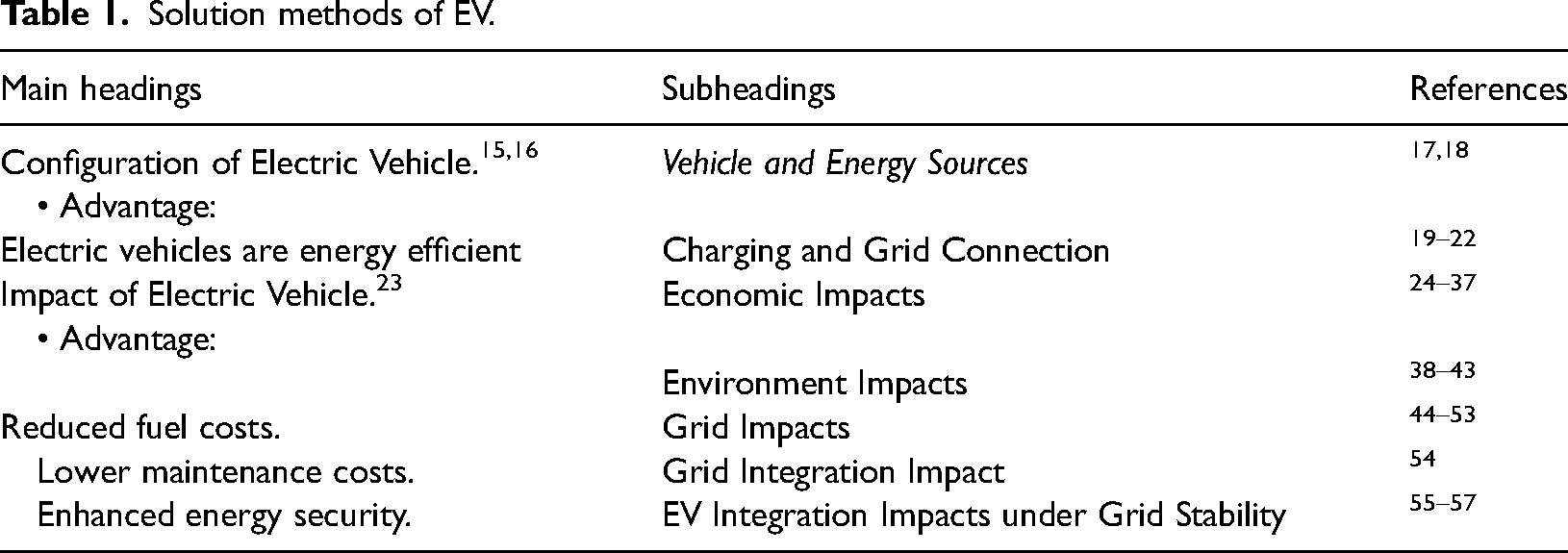
The idea is useful after a sensible charging vehicle, i.e., if the electricity is minimum value; the demand is low, if there is excess capacity or help another metric. The loading speed varied at intervals determined restrictions, the most important fundamental limit is the vehicle must completely charge. Here, a sensible charging approach is recommended to achieve the performance of battery, life that restores a political economic time frame of battery. The vehicle-to-grid (V2G) capable heating unit may store electricity, so reconnect with electrical grid. The V2G power stimulating thought is projected via the 1st. 20
The authors indicated the V2G may be accustomed for generating a profit of vehicle homeowners if the facility utilized in safe conditions giving valuable utility services with electrical grid. Such services incorporate regulation, rotation reserve, and provision of peak energy. In theory, power can be supplied as battery of BEV or PHEV under generator mode, or fuel cell vehicle (FCV)21,22 electric cells to recommend vehicle-to-building (V2B). The technology is nearer to feasible possibility V2B situation, the heating unit can provide demand management.
Impacts of electric vehicle
Clearly, it may be utilized to an extensive range of input parameters models; an evenly extensive range of output variables models may scale. Figure 3 represents the Impacts of Electric Vehicle.
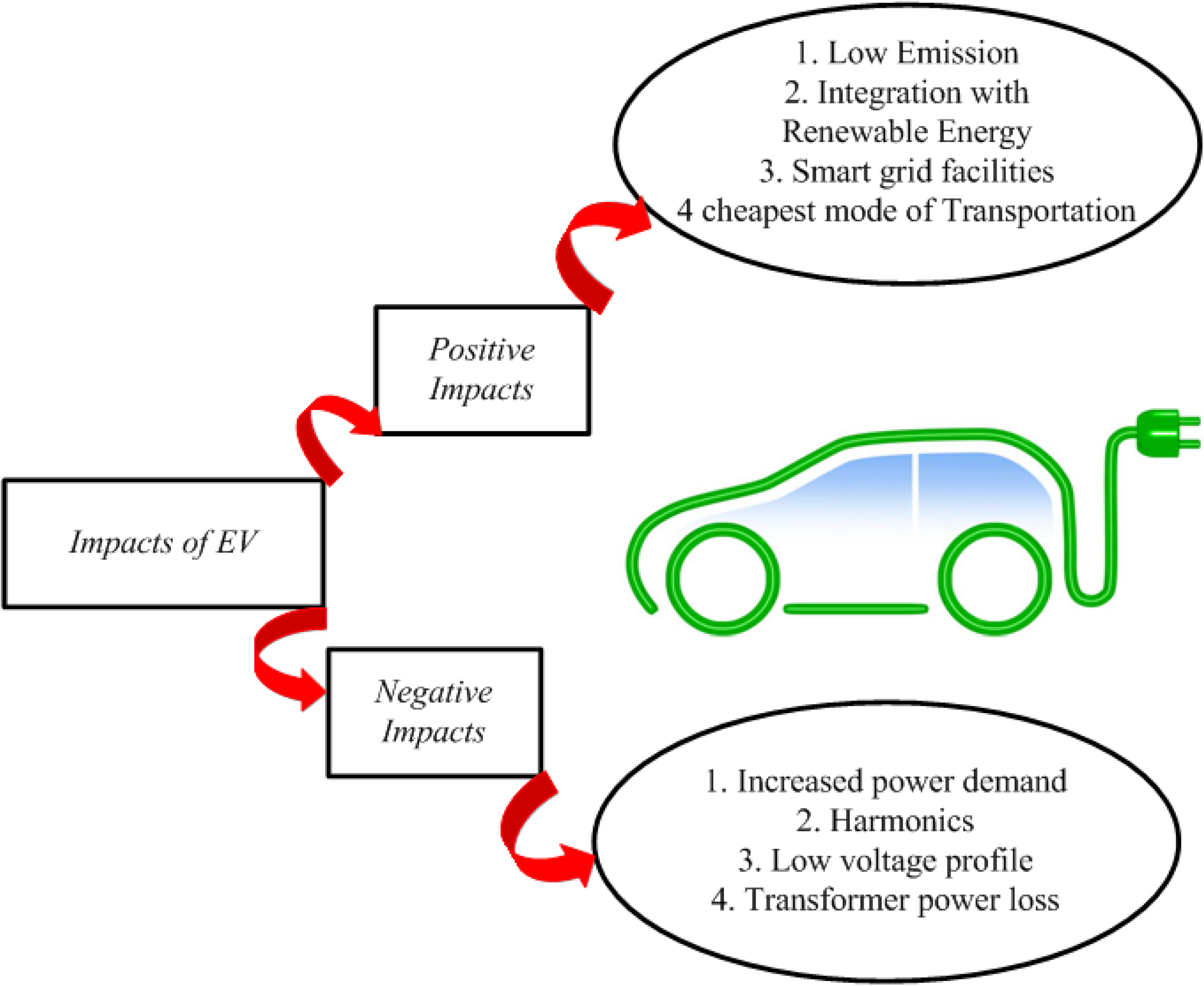
Impacts of electric vehicle.
The results of the model can be generally classified from economic, environment, network efficiency, and renewable energy.
Economic impacts
The economic impact of electric vehicles is measured squared and usually investigated as two conditions: the owner of a vehicle and electrical system. The political economy of the life cycle of electric vehicles is predictable to recover through increased battery technologies, and manufacture. Presently, the BEVs are much additional expensive than PHEVs, each price is higher than ancient ICEVs. 23 However, the fuel and operative prices of EVs square measure abundant not up to ICEVs, because of the high potency of an electrical motor. 24 The payback time of BEV, compared to less expensive ICEV, is at present 20 years; however, it must be reduced to 5 years by 2030. The same results are finding in, 26 whereas 27 estimate that the entire life cost of possession for the entire vehicle sorts can converge via 2030.
Their sing count of studies contains evaluated V2G economic feasibility contribution under numerous markets.28–31 Taking advantage of such studies annually ranges as loss of $ 300 each vehicle per annual at profit of more than $ 4600, and maximum profit range of $ 100 to 300. Ahead of all V2G and electric vehicle energy services area unit technologies that governments need to adopt, the question leftovers the best one for encouraging the participation of each client and company under these markets as political perspective. This is mentioned for the domestic market of Ontario, North America, in. 32
In common, adding electric vehicles with power grid can increase system prices based on accumulated fuel use, but the choice of charging forms really influences the result of system prices. 33 The system price on Denmark of $ 263/vehicle/year employing single charging system, if good cargo vehicles system price of $ 36/vehicle/yearly, a savings of $ 227/vehicle/year. Likewise, 34 finish that good load stores $ 200,000 per week likened to simple load on the future Illinois electric scheme through great proportion of wind power. 35 Calculated system savings of Pennsylvania-New Jersey-Maryland Interconnection (PJM), Midwest independent system operator (MISO) markets within US, and find that savings as off-season freight against unit area in peak hours extremely impressed by a regional generation mix. For the MISO, the savings of good unit of cargo area are less to the associated capacity of coal generation; more abundant unit of savings area completed on PJM from this market incorporates a great dependency on the most expensive peak gas plants. The Spanish electricity grid denotes the cost of electricity is decreased to an exact objective level of penetration of the work unit, on the other extreme that the cost will increase slightly. 36
Environment impacts
CO2 emissions are most usually measured output that is employed for assessing the environmental impacts of change in grid-powered steam electric vehicles. 37 Compute the mixing of electric power and transport sectors on the Kingdom of Denmark diminishes transport-related CO2 emissions by eighty-five. City and Kempton note the use of electric vehicles reduces CO2 emissions likened to ICEVs. Hadley 38 examines the electric vehicles’ introduction in Virginia in addition to a Carolinas within U.S.A. Wherever, the fuel is available it represents 2-thirds of total generating capacity, still below an easy charge plan, electric vehicles reduce CO2 emissions by approximately 100 percent likened to bottom box of gasoline vehicles. 39 Investigate a wind and thermal installation and find that CO2 emissions enlarge slightly below an easy charge approach, but diminish with good charging and V2G power. Electric vehicles were tested on three areas of China, and CO2 reductions occur below the entire eventualities. 40
There is a dialogue on what emission intensity (gCO2e/kWh) ought to be consumed with electricity employed through electric vehicles once they are charged. Most studies that use the common grid intensity to replicate the scenario during electric vehicles are extensively accepted daily profile demand. Different authors defend the marginal intensity’ utilize, 41 during the marginal producing unit are assign in electricity eV. Even studies using marginal pooling in multiple regions note a web carbon gain compared to using ICEV. 42 Because of maximum power of electric motor compared to interior combustion engine.
Grid impacts
Electric vehicles have an effect on the efficiency, the needed capacity of power grid, particularly if the vehicle charged for free. 43 It founds that peak masses can enlarge below a single load approach, requiring a greater investment under generation along with transmission capacity. Once vehicles utilize smart charging configuration, studies signify to electric vehicles level the charge, increase the use of base charge units, and do not need more capacity approximate 500,000 PHEVs should be presented in Ontario, a North American country, without negatively affecting the electricity grid. 44
Other impacts of electric vehicles under distribution grid accumulated step-down transformers, transmission bottlenecks and power quality problems, alternative technique aspects of unit area completely reviewed by.45,46 There are conflicting results as area unit on the electric vehicles impact in distribution networks.47–49 Alternative studies evolved distribution level tariff plans intended for preserve power quality, keep away from distribution congestion issues that should outcome as extensive adoption of electric vehicles.50,51 Assess the results of the work units at residential distribution transformer; the unit of results area is insignificant at minimum penetrations of electric vehicles, however, there is excessive wear of the instrumentation through the increase in number of vehicles. A study of Britain's distribution systems by 52 denotes the prime count of electric vehicles result in voltage restriction violations, electrical device overloads, and accumulated line losses. It recommends the grid reinforcements, integrated generation, and unit work load that forms of area unit management required to solidly integrate massive numbers of electric vehicles into distribution networks. Figure 4 explains control management of EV and its battery.

Control management of EV and its battery.
Impacts of grid integration of EV
Many efforts are being made to review the force of EV network integration. Reportable studies extensively research the impacts of electronic voltage network integration on power quality problems like voltage profile, harmonics, and power losses, 53 in addition to stability issues with the facility network. Furthermore, the great penetration of electron volts within electrical grid, the value of electricity is considerably compact. Several studies can be reported within the bibliography on the social science facet of energy.
EV integration impacts on grid stability
Here, the energy scheme stability refers to the power of an influence scheme to recover their stable state working situation when faced with disturbance. 54 Several blackouts are reportable thanks to the instability of the installation system portrays that significance of stability studies. As electric vehicles, while charging as grid appear non-linear masses through totally different characteristics as normal masses, they will put stress on installation system. Furthermore, uncertainties on association points of electrons volts, time, and amount of charge cause experiments forecasting a behavior of the novel charge. Thus, the huge range of electron volt loads would possibly cause issues regarding the stability of the electrical network. 55 Stability studies are subject only with transmission part of installation system. Though, the great diffusion of electric vehicles under distribution network. 56 Table 2 shows that Outline on EV integration in grid stability.
Outline on EV integration in grid stability.

Since, the characteristics of load will considerably impact installation stability, associate correct work unit load model is critical to review that system stability. 57 Different styles of work unit load model are considered under several analysis studies, for example, freelance of relentless power load (P) model working unit voltage, relentless Ohmic resistance load (Z) sample supplied to the relentless magnitude relation of input voltage to current are conferred on. 63 At distinction, a relentless current load (I) model of work unit conferred on. 64 In, 65 static charge model has developed the rapid charge of the work unit through associated alternative current (AC) - direct current (DC) rectifier in addition to DC-DC device to check the stability of the network.
Voltage stability impacts
The term voltage denotes an electrical network's ability to keep voltages on permissible voltage level on the entire buses. 66 It is named as fact, which the differences in load demand as well as features may considerably affect grid voltage stability. As EV charging characteristics significantly as conventional charging models (zero-inflated Poisson (ZIP) models), correct charging design is necessary to learn, investigate that exact force of EV integration. 58
Effects on frequency stability
The term frequency stability under context of an influencing system denotes the flexibility of the capacity system to keep their allowable frequency once a network disturbance prevails. 59 The power generation maintains the frequency of the network within the allowed limits. 60 Furthermore, uncertainties within the range of electron volt connections, and also the amount of graduated disconnection associated with the association will likely inflict a multiplied level of uncertainty. 61
Impacts on oscillatory stability
The term periodic stability on network generally denotes that flexibility of synchronous generators during a network to remain at temporal relation once the incidence of disturbance is based on flexibility of every synchronous machine within system to preserve/restore the balance among magnetic force and mechanic force. 62 Maximum-scale penetration of the work unit into the facility network is expected to affect that periodic stability of the network. Since, the load characteristics of the unit of work squared measure considerably completely dissimilar as traditional masses of constant resistivity, current, power (ZIP), it is necessary intimately design the masses of the unit of work to investigate its impacts under the periodic stability of the network.
EV integration impact on power quality
The EV impact of integration of heat unit in quality parameters of installation like voltage profile, imbalance voltage, power loss is mostly deliberate at present literature. The impact of heat unit's integration in network on the quality of installation depends on a charging characteristics of EVs, grid options as well as scope of electric vehicles. 67
EV integration impact on electricity market
Here, examines the EV integration impact in network in the process of electricity market. Through enlarge under the level of penetration of electric vehicles, investment on generation, demand, prices, and emissions can surely enlarge. Various studies presented on economic EV integration impacts in electricity markets.68,69 Next, the impacts of EV integration under load profile features, cost of energy, operating cost along with auxiliary service are suggested.
Impacts on operation cost
The energy market operative manages the generation sources, therefore, loads demand with direct operating prices. 70 The daily and temporary market managements bring about the balance of supply, demand; adequately incorporate renewable generations, the energy storage system. The combination of power units will affect operating prices through smart charging and discharging.
In, 71 a random model is evolved for the programming of thermal-wind power system under the eventualities of charging pattern of electric vehicles to diminish the operating prices of an influencing network. Simplex V2G services of energy trading are given in 72 the projected strategy will exploit profits and diminish the danger of energy trading under daily electricity markets.
EV charging load impact on power quality and power system
The distribution system's power quality is often measures based on the grid voltage. Based on essential frequency current flow, a voltage drop occurs on distribution line, though voltage profile leftovers sinusoidal. Though, while harmonic current flows with system, voltage drop that occurs on network impedance based on such harmonics implies non-sinusoidal on nature. In conclusion, the voltage arrived at common coupling point has basic voltage component, along with harmonic voltage. 73
Impact analysis of EV charging on voltage profile under different feeders
It consists of 2 kinds of feeders placed under a distribution lines. Here, radial feeders generally affected due to minimal voltage accessibility to the customers placed in end line. Furthermore, higher levels of penetration of RES on distribution side have exacerbated the voltage profile issue. Through, the light load condition, RES power at the Point of Common Coupling (PCC) should consequence under overvoltage condition. The profile of voltage is usually stiff at end, but descends to the feeder center. This conservative trouble is compounded through the beginning of EV and RES charging. 74
When, the penetration level of EVs maximizes, the increase in demand for charging based on the connection of huge count of electric vehicles should become very important. Also, the different functions of electric vehicles are linked to the public grid, dissimilar chargers (levels 1, 2, and 3) is utilized to charge electric vehicles. The nominal capacity’ impact of electric vehicles’ battery, charger utilized also influences the voltage profile and the demand for charging of public network. 75
Impacts of power quality analysis
Power quality is the capability of the power grid to supply a clean and sustainable source of energy through a sinusoidal waveform, free of noise in the normal limit of voltage and current harmonics. Harmonics and voltage drop/rise denote general power quality-related issues. Electric vehicle chargers are the components that cause these issues while linked to the grid. Electric vehicle not only gives their negative impacts, but it also contains a few positive impacts. 76
Increased power demand
The EV power demand (

Harmonics disturbance
Harmonics are power system disturbances. The EV charger is a non-linear load that generates harmonics when connected to the electricity system. Because the EV charger is typically connected to the power distribution network for charging, the cumulative impacts of harmonics might pose a hazard to the entire power system. Harmonics are defined as the increase in high frequency components of voltage and current as compared to the fundamental frequency. Harmonics alter the voltage and current waveforms, lowering power quality. Total harmonic distortion (THD) of current and voltage can be used to measure it.

Voltage disturbances
The voltage on distribution end is diminished, while multiple EV chargers are linked. The huge number of electric vehicles causes this issue. The variation of the voltage profile prior to link the EV charger subsequently connects the EV charger. The low voltage profile is a potentially dangerous issue caused by EV charging. Voltage stability is the ability of a power network to remain stable following a sudden increase or drop in load.
Transformer power loss
Clustered electric vehicle charging may be cause of transformer overload and thus increase energy loss. Harmonic current creates heating losses on transformer core, more maximizing the general power loss and decreasing. The widespread adoption of EVs places additional strain on distribution transformers and their life spans. Another issue is that the EV charging rate should be regulated per day, and charging stations should be kept as far away from the transformer as possible to reduce power loss. The harmonic current causes load losses in transformers, although harmonic voltage causes no-load loss.
Electric vehicle charging approaches
The parameters required to determine the initial value of the heat unit measure the capacity and battery size. A few necessary factors, such as affect on DNs, economic prices, the emission limits of EVs, mainly in terms of vehicle types, battery’ characteristics, the ways of charge and discharge and in addition, the frequency charging/recharging. The general power is often exaggerated by reducing battery size/weight. Once, the dimensions of the battery increase as safe levels the typical power requirements needed for the associated heat unit is increased. As a result, it raises a peak energy demand from maximal power electric vehicles charging. 78 Table 3 represents the Uncoordinated and Coordinated approach of charging.
Uncoordinated and coordinated approach of charging.
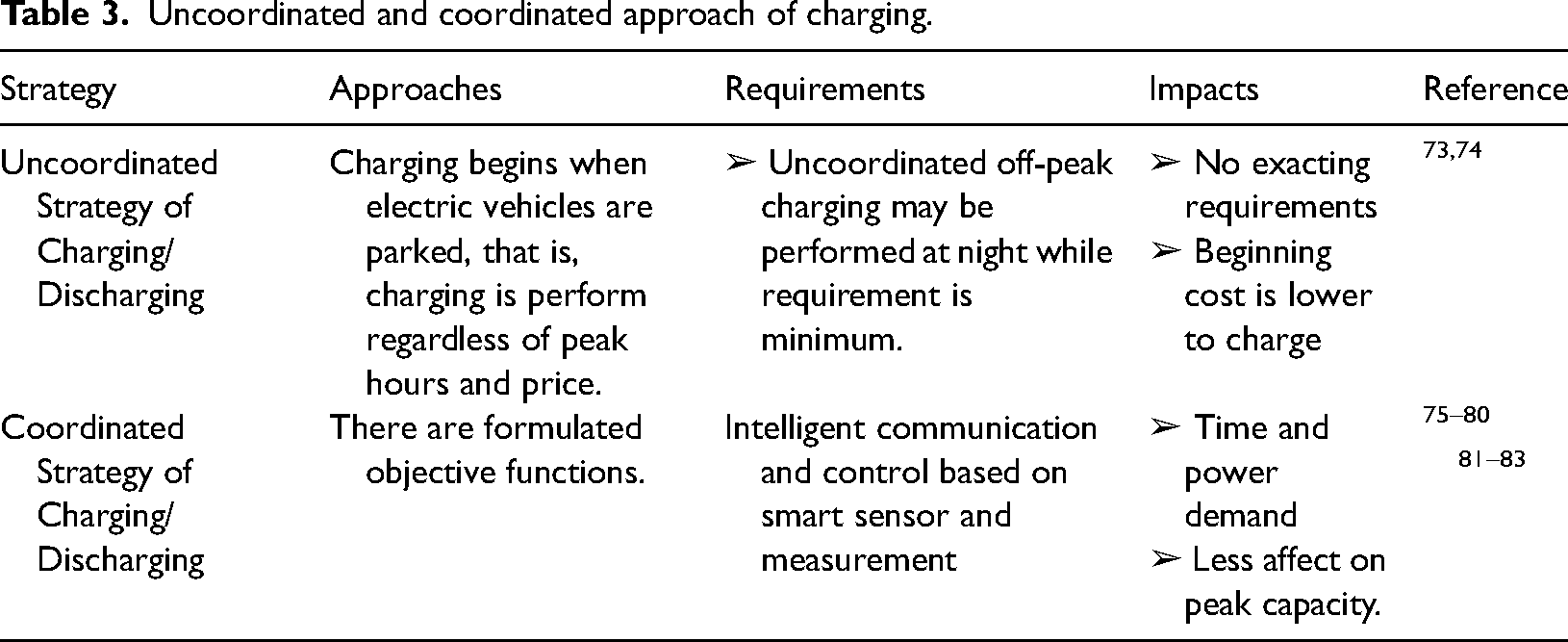
The main issue affecting DNs throughout the continuation of auto load is the load profile. The way in which charging of electric vehicles is produced as the supply network contains important impact on degree of voltage. As a consequence, it is required to verify that strategy and ways of charging management of those electric vehicles. To deem completely dissimilar ways of charging that direct charging time, electric vehicles’ frequency:
Controlled/ Coordinated Charging Non-Controlled/Un-coordinated Charging Delayed Charging Off-peak Charging
Here, the uncoordinated charge shows the electric vehicle batteries start charging when parked. No intelligent programming is completed during this loading style. It allows vehicle homeowners for charging its electric vehicles regardless of reception time.
79
The distribution system has important impact due to the levels of penetration of electric vehicles through uncoordinated charging. This loading approach tends to spread the load on the network distribution parameters, eg. Electric device and cable, and therefore diminishes that responsibility of network. Increased load on electrical devices through this loading style will cause a serious increase in transformer currents. To avoid major problems in the distribution system, the best charging schedule is integrated charging practice, with the associated EV ought to be charged in a particular time.
80
In nonexistence of a good charge, electric vehicles charge like other charge. Intelligent load/unload planning, that is, a coordinated variety of loads is executed for optimizing time and energy demand. Good charge/discharge reduce the daily value of electricity, voltage deviations, transformer surges, and line currents. This load is additionally applied to the main power levels.81–84 No violation of the technical restrictions of DN, whereas highest stage of penetration of electric vehicles in a well harmonized load. 85 Therefore, synchronized charging is capable and valuable approach of electric vehicle owners and the grid operator.86–88
It may gain straight coordination of loading/unloading by presenting sensitive measurement and intelligent management and communication. By conducting non-linear electricity evaluation in real time for charge/discharge, is obtain greater returns for grid operators.89–92
Delayed charging is the sort during home charging is completed, but EV charging is belated until a specified time. The off-peak charging method, which is complete reception, its show intelligence to optimize the charging, approaches. This result in better stability at foundation load and no more peak load under DN; therefore, no demand for any sweetener generating capacity.
Electric vehicle and renewable energy
The capability of EVs help to combine the RESs on prevailing installation is the most important transformative impact on electrical system. 93 The literature on this topic mostly focuses on wind and solar energy evaluation, and gaining more attention. Many articles focus on the impact of EVS on electrical systems along an excessive proportion of wind94–96 or carbon97–100 emissions, but they did not directly deal the integration of renewable energy.
Wind energy
In, 101 worldwide energy model is used to predict combination and impact of electric vehicles and V2G on the quantity as 2000–2100. It is realize the established renewable energy capability can increase 30–75% with V2G-capable electric vehicles because it has the capability to store intermittent energy.
In, 102 observe the combination of transportation and electrical power systems under Scandinavian nation by 2030 as angle of powerhouse investments. The combination of these two sectors during the employment of electric vehicles, leads to noteworthy raise under offshore wind generation capacity as well as lessen under gas combined cycle plants, biomass electricity plants along with wind generation capacity in Earth. In general, the increases on wind generation go beyond that full energy demand of transport sector.
Solar energy
PV power generation is the conversion of solar radiation into electrical energy through the use of the photo-electric effect. The photovoltaic system is known as the most ideal new energy due to its characteristics of reliability, safety, and pollution free, composed of, solar inverters, solar panels cables, other electrical accessories, etc. 103
The PV output is given by Equation (5).

One methodology to take benefit of Solar PV's direct battery charging should be mix it car parking area chargers, as mentioned above, the photovoltaic systems raised directly under vehicle from associated auxiliary power source named vehicle integrated photovoltaic (VIPV). 105 Solar cars dose not designed for commercial usage, but VIPV is utilized through existing electric with hybrid vehicles to increase power.
The EVS that has V2G system gives backup supply for renewable sources, eg. Wind, solar, it presents alternative energy production.106–108 If the energy produced by RES is extremely great, then to reactivate the equilibrium, centralized power plants would have to diminish assembly or reduce distributed generating units. The answer based on matching the generation and consumption given with electric vehicles is attained by charging with discharging the batteries. EVs can store surplus energy using renewable energy sources for needs to drive or give power to the grid once requirement is greater. 109 In, 110 it displayed the DNs with a good network installation that contain renewable energy sources lessen emissions along with store $3.58 vehicle per day.
Nanogrid
This is the power supply system of a single home/small building, and it is capability to connecting or disconnecting other power entities through the gateway. Figure 5 represents the Configurations of Nanogrid.

Configurations of nanogrid.
Local energy production drives local loads using energy storage and/or control systems. 111
Component structure of nanogrid
Local power production: A most options of nano grid are their capability to extend economic utilize of residential-size DG. Such structure has a combination of various RES, non-renewable energy sources. 112
At least one local load: Here, Local loads powered by local generation through the nano grid. 113 A few instances are loads like water heater, lighting, oven, television, and so on.
Energy storage: This is deemed as option in nano grid arrangement, but it generally suggest includes stability. The most suitable energy storage of nano-grids, based on its capacity and residential location.
Nanogrid Controller: This is not entirely necessary but is generally present nano-grid controller. The controller is described on more detail under the “Control of nano-networks”.
Types of electric vehicle
Electric vehicles will run on electric propulsion only or will have ICE operating on board. Having only batteries as a power supply constitutes that most important unit of work; however there are types of square measurements that will use different modes of power supply. These are called as HEVs. The Technical Committee of the International Electro technical Commission (Electric Road Vehicles) projected that victimization of vehicles or lot of forms of energy supply, storage or converters is often referred an HEV as long as at least one of each of those that are currently offered.
114
This definition allows getting many combinations for HEV, viz ICE with battery, battery with regulator, battery with capacitor, battery with cell, such battery and capacitor as EV assisted by ultra-capacitor and, therefore, those that have FCEV of battery and cell. Such terminologies became widely established according to these standard and electric vehicles as:
Battery EV (BEV) Hybrid EV (HEV) Plug-in Hybrid EV (PHEV) Fuel Cell EV (FCEV)
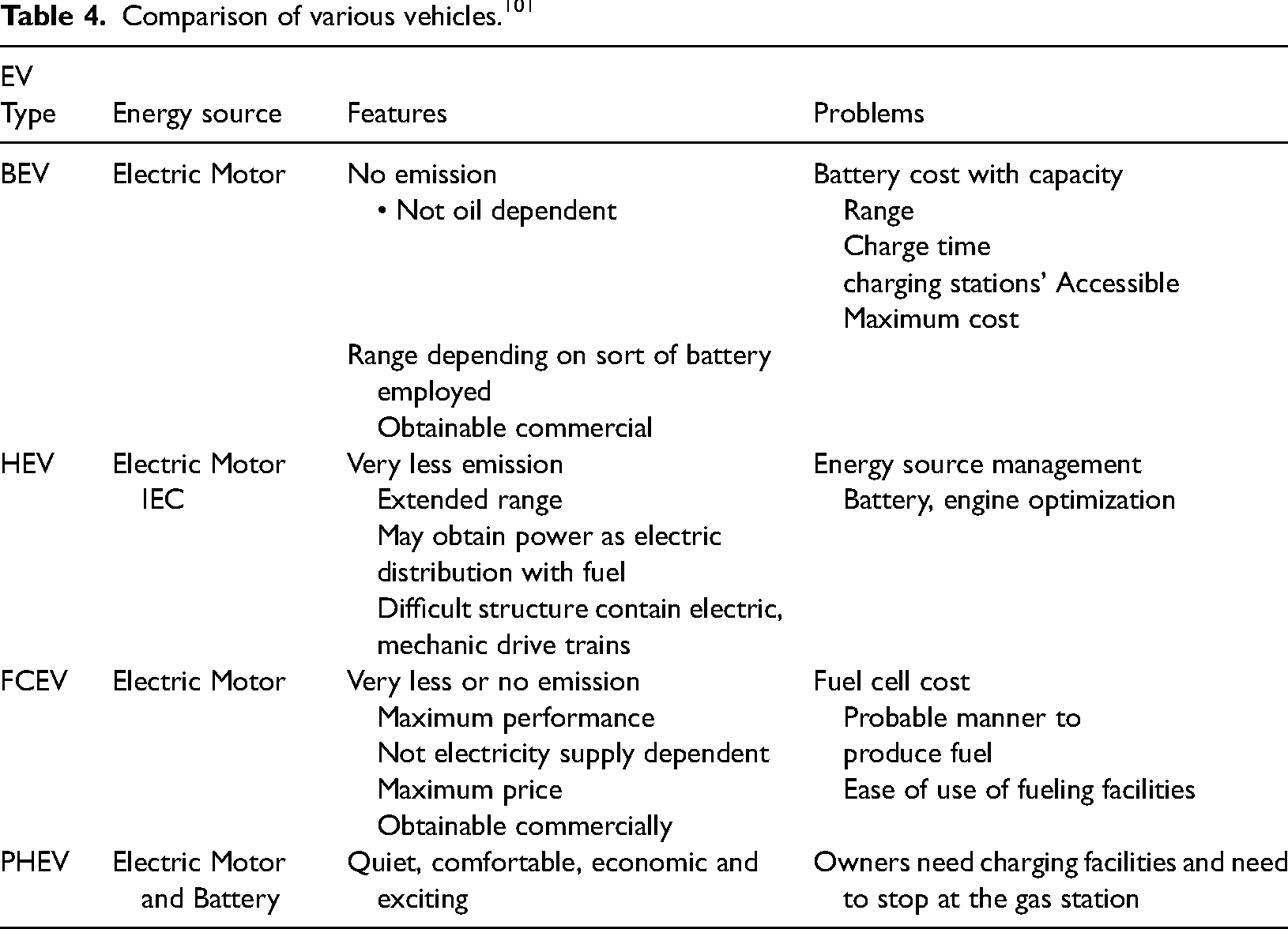
Here Table 4 explains the comparison of various vehicles.
Comparison of various vehicles. 101
Battery electric vehicle (BEV)
Electric vehicles have battery to power the drive train called BEVs. BEVs must rely exclusively on energy saved on its battery packs, thus, autonomy of these vehicles depending on battery capacity. 115
Hybrid electric vehicle (HEV)
To power the vehicle, HEVs utilize ICE with electric power train. HEV utilizes that electric propulsion system while power requirement is minimum.
Plug-In hybrid EV (PHEV)
PHEV considers increasing entire-electric range of HEVs. 116 Every ICE nursing associate uses a power train, as HEV, however the distinction among PHEV utilizes electric propulsion because it is the major propulsion, therefore vehicles need a much higher battery capacity to HEV. PHEVs begin “all-electric” mode, execute in electricity, then once the batteries measure the lower response level, ask ICE to supply lift or charge that battery pack.
Fuel cell electric vehicle (FCEV)
This is nothing but FCV, because these vehicles have fuel cells utilize chemical reactions providing electricity. 117 This chemical element is the FCV's fuel of choice to resist this reaction, which is generally referred to as “hydrogen electric cell vehicles. Figure 6 shows the Mechanisms of Fuel Cell EV.
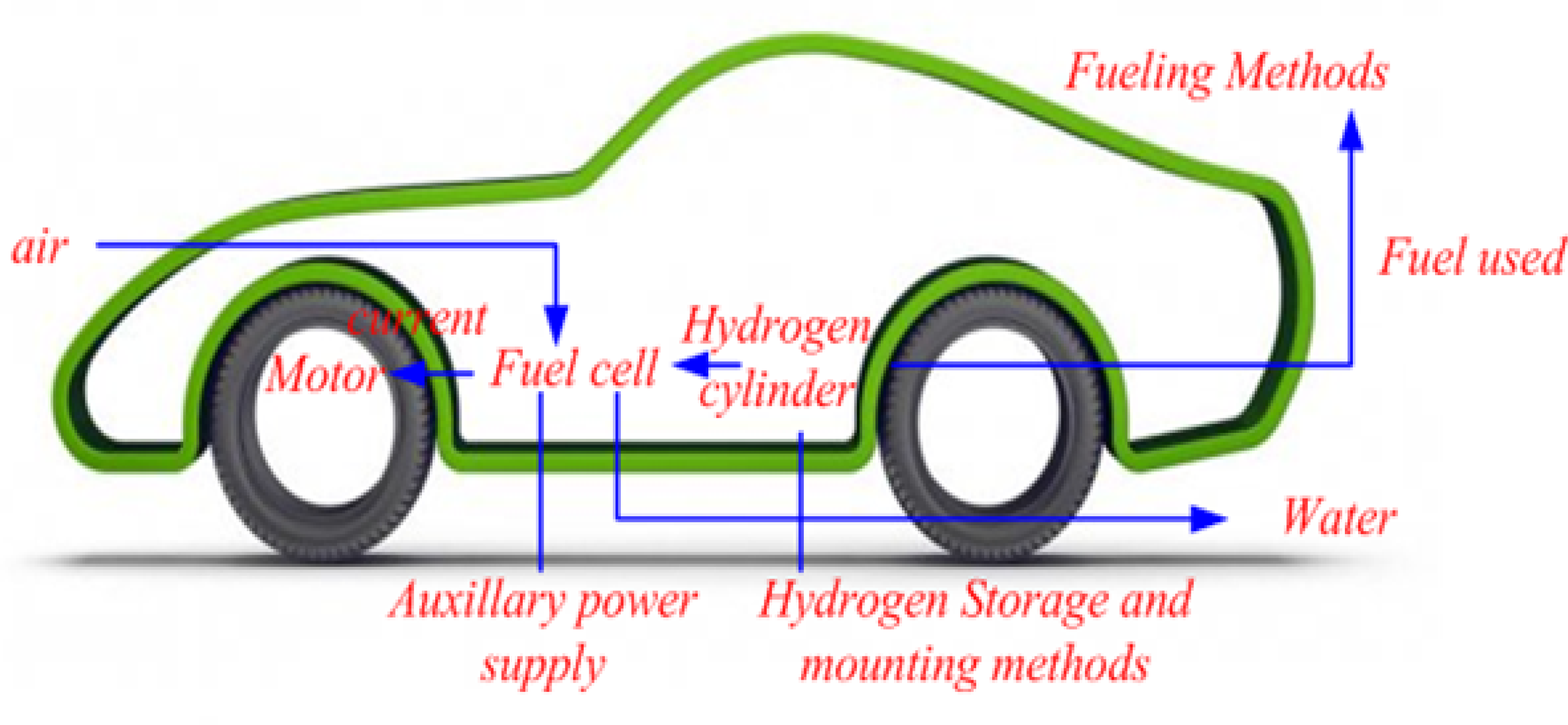
Mechanisms of fuel cell EV.
FCVs carry element under special air mass tanks, another element of efficient production system is oxygen, which obtains air drawn into the environment. The additional energy is saved under storage methods, such as batteries or super capacitors. 118
Hybrid electric vehicle setup
HEVs utilize electric propulsion system and ICE. Several ways may be configured to spin that wheels generate dissimilar configurations may be summarized into four groups.
119
Series hybrid Parallel hybrid Series-parallel hybrid Complex hybrid
Series hybrid
It makes it easy to create related HEVs. Here, the motor is only attached with wheels, motor is utilized to execute the generator that gives electric power. It is placed from associated energy unit that is helped by the associated generation of ICE. 120
Parallel hybrid
It links ICE, also the motor on parallel through wheels. Either one of each participates in the delivery of the skill. It is often thought of as an electrically assisted IC motor vehicle. The energy stores under these vehicles are often charged through electric motor through regenerative braking or ICE once it creates the necessary capacity to drive the wheels.
Series Parallel Hybrid: To mix the sequence configuration and parallel, a technique obtains an extra mechanic connection similar with series sort, or additional generator comparable with parallel. It gives benefits of every system, but it is extra expensive with complex despite everything. Problems are caused in train drive unit area due to the presence of the gear unit. 121
Complex hybrid
This system has an important distinction through the series-parallel system, i.e., it allows a duplex power flow, while the series-parallel system offers simple power flow. Nevertheless, using the advantage of current market terminologies, this pattern is indicated from the series-parallel system. However, the shortcomings of the value part of this technique are accepted by fewer vehicles while utilizing dual axle propulsion. 122
EV charging system: power quality problems
In chopper, the main electrical converter and DC electronic voltage charger are linked with standard DC connection. The direct association of electron volt with photovoltaic in DC is greater than AC association owing to the small range of energy conversion steps including higher power.123,124 The modern EV charging network contains several issues, which are solved on order to send qualitative energy on a constant basis. 125 This document discusses the various power quality issues because of electron volt charging system. The standard distributed electrical energy is scaled by two factors: the “continuity” of supply,” eminence” of voltage. The most important PQ problems are tabulated in Table 5126–138 and the Table 6 shows strategies for mitigating the impact of EV in PQ.
PQ problems, causes, results.

Strategies for mitigating the impact of electric vehicle in power quality.

Trends of EV charging technologies
For a much better, easier, and quicker electric vehicle charging experience, the charging technologies are constantly being improved. The key innovations are being made to reduce the main disadvantage a customer considers—charging time/experience—as the market for electric cars becomes more established in numerous countries. The following are the main technological advancements that may occur in the future,
Inductive charging – static charging
Two electromagnetically connected coils are the basis of the inductive charging theory. The primary coil is positioned on the surface of the road in a pad-like structure, which is connected to the electrical grid. The secondary coil is positioned on the car, ideally on the floor, away from the occupants in a secure location. Inside the charging station, the ac is rectified and converted to high-frequency ac power. Induction at the charging station transmits this high-frequency electricity to the electric vehicle side. The primary reason for using wireless charging in electric vehicles is to create less mess than the conductive charging because it doesn’t require a cable and is therefore more practical. Wireless communication can handle everything for self-driving cars; plug behavior is not necessary. Witricity Corporation, an American firm developing wireless charging technology that is just as effective as conductive chargers, expects to market wireless charged EVs and Plugin Hybrid EVs (PHEVs) during the next three to four years. The inconvenience of the thick cables and the requirement to remember to plug in is one of the main barriers to the widespread adoption of EVs. The goal of Witricity Corporation is to eliminate this cumbersome charging process from peoples’ daily lives and provide technology that doesn’t require any user input. Simply park your electric vehicle, and it will begin to charge. A major factor in the widespread adoption of electric vehicles is wireless charging. They also put a lot of effort into standardizing their technology so that it can be used by virtually all global automakers. By doing this, they made their technology more usable in the future.
Inductive charging – dynamic charging
The dynamic charging method is comparable to static inductive-charging that is another option for wirelessly charging a car. Through magnetic coupling, energy is transferred from the charger to the vehicle. The road is buried electric cable coils, which are used to supply power. The coils generate an electro-magnetic field from which the moving vehicles pick up and convert into electricity to power the cars. Low stand-in charging times are one of the benefits of inductive dynamic charging for customers. The battery size can be reduced because the battery pack can be charged frequently while traveling. The main obstacles to this technology are those that relate to power transfer effectiveness, as foreign objects in the road, abrasion of the road's surface, and changes in the coil structure inside the materials used to construct the road could affect the coil's features and lessen power transfer effectiveness. The battery size can be reduced because the battery pack can be charged frequently while traveling. The key obstacles to this technology are those that relate to power transfer effectiveness, as foreign objects in the road, abrasion of the road's surface, and changes in the coil structure inside the materials used to construct the road could affect the coil's features and lessen power transfer effectiveness. DEVC technology was developed as a result of research conducted at Qualcomm's Auckland site, where the concept had already been tried at a low speed. The project's original goal was to show how WEVC could be used for dynamic charging. Dynamic inductive charging technology is still in the experimental stage due to several obstacles in standardizing it. They are -
Different car sizes, power outputs, and ground clearances could result in less than ideal performance. Choosing a universal high-performance coil type for dynamic charging can be difficult. It is challenging to estimate the coil mis-alignment in real time for various car types. Thus, commercialization of this technology is still a long way off.
Battery swap technology
This technology functions by switching out the used battery and exchanging it with a fresh, fully charged battery, as the name would imply. It is necessary to drive into the battery swapping bay, where an automatic system will park the car, remove the old battery, and install a new, fully charged battery. The station then charges the depleted batteries so they can be deployed later. The advantage of battery swap technology is that it reduces range anxiety and is as quick and easy to do as filling up a tank. This technology appears to have many benefits, but gaining market acceptance would be very difficult for it for the following reasons in particular:
To practically implement this technology, a standardized battery would be needed from all automakers. Consumers might find it challenging to accept having to replace the vehicle's battery with one they don’t own. Battery health and usage patterns should be analyzed in a foolproof way. Every time a battery is switched, a new connection would need to be made and broken amid the battery and the vehicle. The customer's primary safety concern is that When a swap is made, the electrical connection between the battery and the vehicle deteriorates and wear down at the crucial link among the two components and, at worst, could result in a massive discharge.
China is the only country where the battery swap technology has achieved success because of the country's large EV market.
Smart charging
Utilizing electricity efficiently and effectively will be essential in the future as our lives become more and more heavily dependent on it, including EVs. Smart charging is a set of intelligent features that regulate the electric vehicle charging power to produce a flexible, sustainable, cost-effective, and efficient charging environment. Innovative technologies can assist us in managing our energy use more effectively and balancing the grid's load. Future electric charging systems are being established in order to maximize use and supply stored energy back to the grid by examining daily energy demand peaks and troughs. Innovative technologies can assist us in managing our energy use more effectively and balancing the grid's load. Future electric charging systems are being established in order to maximize use and supply stored energy back to the grid by examining daily energy demand peaks and troughs.
Conclusion
Innovative technologies can assist us in managing our energy use more effectively and balancing the grid's load. Future electric charging systems are being established in order to maximize use and supply stored energy back to the grid by analyzing the daily peaks and troughs in energy demand. This evaluation begins with a comprehensive examination of the implications of photovoltaic and electric vehicle grid integration on grid stability. This research makes it clear that significant penetration of PV systems and EVs individually may have a negative impact on the grid's stability and power quality because photovoltaic power sources are intermittent and electric vehicle load characteristics are unknown. However, these detrimental effects on power quality and grid stability may be mitigated by coordinating or combining photovoltaic system and electric vehicle operating methods. Large-scale EV load aggregators and PV systems are also regarded as strategic players in the future energy market due to their capacity and high penetration in energy economics. As a result of the transition from traditional synchronous generators and loads to a modern power grid, this heavily relies on non-synchronous renewable energy sources and controllable loads, a synchronous generator and load. To cope with the emergence of non-synchronous renewable energy (PV) sources and controllable (EV) loads, the modern power grid requires efficient and adequate ancillary services to preserve the gridreliability and harmonics. The use of classic compensators and limiters, such as synchronous capacitors, STATCOM, and SVC, can grow the complexity and cost of capital and operating costs. A thorough analysis of recent research on PV and EV, however, demonstrates that if grid-integrated PV and EV are coordinated with one another. Investments in the coordinated operation of the implementation of photovoltaic and electric vehicles could have long-term advantages for both consumers and operators. Profits include lower energy costs, less reliance on fossil fuel-related energy sources, and a reduction in greenhouse gas emissions. To contribute with better grid stability (voltage and frequency) and power quality, they can also be optimally controlled and coordinated among themselves.
Footnotes
Declaration of conflicting interests
The author(s) declared no potential conflicts of interest with respect to the research, authorship, and/or publication of this article.
Funding
The author(s) received no financial support for the research, authorship, and/or publication of this article
