



Abstract
CEO characteristics influence their strategic preferences, which are crucial for promoting corporate green innovation (GI). However, the influence and its mechanisms of CEO green experience (GreCEO) on GI of energy firms, especially when comparing different firm types holistically, remain understudied. This study used a moderated mediation model with fixed effects to examine the relationship between GreCEO and GI of energy firms, based on the unbalanced panel data of 821 listed Chinese energy firms during 2004–2021. We find that: (1) GreCEO positively affects energy firms’ GI. (2) Heterogeneity exists in the GI effect of GreCEO regarding business ownership and industry characteristics, and this effect is more prominent in non-state-owned energy firms and high-tech energy firms. (3) Green management (GM) and debt-to-asset ratio (DAR) partially mediate GreCEO's impact on GI of energy firms. (4) Renewable energy policy (REP) moderates the relationship between GreCEO and GI of energy firms, and its influencing mechanisms. In contrast to studies that focus on the direct effect of CEO characteristics on GI, this study identifies the potential influencing mechanisms through which GreCEO affects GI of energy firms. In addition, the moderation analysis reveals the boundary condition that GreCEO affects GI, enriching our understanding of GreCEO's effect on GI from the perspective of a firm's internal conditions and external policy environment. Regarding green development, CEOs’ early experience should be included in the management system and evaluation criteria of energy firms. The Chinese government should continue to implement the REP and accelerate energy firms’ green transition.
Keywords
Introduction
One possible cost of economic prosperity is the damage to environmental sustainability. 1 Environmental degradation and subsequent resource scarcity exert double pressure on economic development. 2 The Energy Information Administration (EIA) claims that we are experiencing the first global energy crisis, and its impact is unprecedented in scope and complexity. The supply-demand imbalance of traditional energy sources leads to severe energy shortages and generates massive greenhouse gases. 3 As the world's largest energy consumer, China has experienced a widening gap between energy supply and consumption, increasing its dependence on overseas energy sources.4,5 Given the growing domestic energy demand and potential challenges from international markets, the Chinese government is committed to energy transition to achieve the dual carbon target. 6 Green innovation (GI) in Chinese energy firms is a key research concern. 7
Energy firms’ innovation direction largely occurs at corporate leaders’ discretion. The managerial decision-making environment is complex, and the factors involved are often irrational and incomprehensible. CEOs will add personal factors such as perceptions, values, and experiences, to their decision-making. Thus, business behavior reflects CEO characteristics to a certain extent. 8 These characteristics ultimately determine enterprises’ strategic preferences. Green experiences increase CEOs’ environmental awareness and attention to sustainability issues, which influence firm performance and innovation strategy.9,10 However, the complex influencing mechanisms between CEO green experience (GreCEO) and energy firms’ GI remain unclear.
CEOs with green experience are more likely to apply green management (GM) techniques and methods to improve resource efficiency and environmental performance. 11 This tendency encourages employees to acquire environmental knowledge and skills, and enables the transfer of green knowledge into GI outputs. Moreover, researchers argue that well-funded firms prefer green R&D investment to improve long-term competitiveness. 12 However, massive capital requirements, high risks, and uncertain expected GI returns encourage CEOs to opt for equity financing and a lower debt-to-asset ratio (DAR). Stable solvency ensures energy firms’ GI sustainability.
Corporate GI is a public good. Participants make environmental efforts and contribute to social welfare at their own expense, benefit from their positive externalities. 13 To avoid market failures, it is essential to use the guiding role of macro-policies to increase the number of participants. Renewable energy policy (REP) is an effective signal to guide CEOs to engage in GI activities. CEOs with green experience are more sensitive to the external policy environment. Therefore, research is required to investigate the moderating effect of REP between GreCEO and energy firms’ GI.
GreCEO significantly affects GI. However, the mechanisms by which GreCEO affects energy firms’ GI are obscure. Whether macro-policies regulate them remains uncertain. To address these gaps, this study uses a moderated mediation model based on unbalanced panel data of 821 Chinese listed firms during 2004–2021 to investigate the relationship between GreCEO and energy firms’ GI, identify the mediating effects of GM and DAR, and examine the moderating effect of REP.
Our study contributes to the existing literature in three ways. First, it sheds light on how GreCEO positively affects GI from the perspective of energy firms, addressing an aspect that has been ignored in the previous GreCEO and GI literature. Few studies have explored energy firms’ GI behavior from the perspective of the internal corporate environment. In fact, corporate micro-governance 14 and financial conditions 15 significantly influence environmental quality and green development. Therefore, this study examines the energy industry and develops a mediating effect model 16 to clarify the influence channels of GreCEO on energy firms’ GI (i.e., GM and DAR). This knowledge enhances our understanding of the evolutionary mechanism of GreCEO on GI. Moreover, it involves an increasing number of studies on GI and promotes green development based on upper echelon theory. This study uses managerial initiatives to promote energy firms’ green transformation.
Second, this study illustrates REP's role as a moderator of the GreCEO-GI relationship, which is rarely discussed in existing studies. Existing studies have focused on the influence of energy policy on human development 17 and on sustainable business development. 18 In contrast to studies that use macro-policies as research objects, this study introduces REP as a moderator to clarify the boundary condition that GreCEO influences GI, facilitating the formulation of government policies to to incentivize corporate managers to develop GI strategies.
Third, this study conducts a comparative analysis of GI effect of GreCEO across different firms, thereby uncovering the nuances and specificities of different firm ownership and industry characteristics. It enhances our comprehension of the GI effects of CEO characteristics in heterogeneous firms. Therefore, this study provides a reference for managers to develop targeted development strategies, tailored to their specific contexts.
The rest of this paper is organized as follows. Section 2 reviews relevant literature and develops the hypotheses. Section 3 introduces the methods and data. Section 4 reports the baseline results, robustness, and heterogeneity tests. Section 5 further analyzes the influencing mechanism. Section 6 offers conclusions and policy implications.
Literature review and research hypotheses
Literature review
Carbon-based energy adversely impacts environmental sustainability. 19 Therefore, research on energy transition and green technological innovation is burgeoning. This study draws on two main strands of literature. The first strand concerns GI concepts and its driving factors. The second discusses the impact of CEO characteristics.
First, GI refers to technological innovation, such as renewable energy development and waste recycling, aimed at reducing pollution and saving energy. 20 GI improves energy efficiency and develops efficient and low-carbon alternatives. 21 Many studies have investigated objective factors influencing GI, such as government subsidies, energy policies, and environmental management.22–24 For example, Adebayo and Ullah 25 argue that to improve environmental quality, governments should encourage renewable energy development and technological innovation through green subsidies and improved financial stability. Yu et al. 26 investigate the effect of financial constraints on GI and find that green financial policy alleviates financial constraints and promotes corporate GI. Yan et al. 27 argue that city development policy promotes GI, upgrading industrial structure and green efficiency. Yang et al. 23 suggest that renewable energy policies promote GI; this effect is heterogeneous in countries with differing GI capacities. However, these objective perspectives ignore humanistic factors. Considering the upper echelon theory, 28 some studies identify CEO characteristics that influence corporate GI strategies, such as foreign experience, 29 staff turnover, 30 gender, 31 and hometown identity. 32 Moreover, some literature explores the effect of GreCEO on corporate environmental performance 10 ; however, its direct effect on energy firms’ GI, its influencing mechanisms, and boundary conditions remain unclear.
Second, based on the upper echelon theory, scholars state that CEOs strongly impact corporate strategy. Relevant studies examine firm performance, 33 cash management behavior, 34 and corporate risk-taking. 35 For example, Lee et al. 36 establish a negative correlation between CEO overconfidence and bank recognition of loan-loss provisions. Chen and Huang 35 find a positive correlation between CEO reputation and corporate risk-taking, particularly when the reputation is positive and external governance is restricted. Chen 37 argues that CEO polychronicity promotes innovation in firms with dynamic environments, larger sizes, and inferior performance, but reduces it in firms with less dynamic environments, smaller sizes, and superior performance. However, existing research has not paid enough attention to the GI effect of CEO characteristics. Therefore, there is a need to explain a different story, i.e., GI effect of GreCEO in Chinese energy firms, which has been ignored in previous literature and motivates our research.
In summary, existing studies have overlooked the mediating channels between GreCEO and GI, as well as the moderating impact of external policy on them. Therefore, this study employs a moderated mediation model to examine the mediating effect of GM and DAR, and the moderating role of REP. It will provide a reference for green development and energy transition from the perspective of CEO initiative and policy coordination.
Research hypotheses
GI is an important measure in the transition from fossil to renewable energy sources. 38 However, high risk and long-term return of R&D investments, as well as path dependency on traditional innovation, present significant challenges to GI. 39 Unlike traditional innovation, GI creates negative externalities in the R&D phase and positive externalities in the adoption and diffusion phases. 13 This increases the importance of CEOs’ awareness of green transition for energy firms. 29
According to upper echelon theory,
28
CEO early experiences influence their judgment and strategic choices.
30
CEOs’ environmental awareness is shaped through their environmental education and work experience. CEOs with green experience are concerned about environmental sustainability. They tend to combine commercial goals with social responsibility. Their actions steer energy firms’ innovation direction away from reliance on traditional technology.
40
In addition, CEOs with green experience are more likely to be informed about environment policies and to accurately predict policy directions.
41
These tendencies will reduce policy uncertainty risks, mitigate information asymmetry and create a first-mover advantage. Furthermore, green experience improves CEOs’ risk identification on GI projects, enhances investor confidence, and protects stakeholder interests. As a result, green R&D investment in energy firms will increase. Those energy firms that employ CEOs with green experience tend to engage in green R&D activities, thereby increasing GI level. Therefore, we present the first research hypothesis as follows. H1: GreCEO helps promote energy firms’ GI.
One possible mechanism through which GreCEO influences energy firms’ GI is corporate GM. GM refers to the process of allocating and utilizing the enterprises’ internal resources,
42
such as using eco-friendly materials, establishing an ecological governance system, introducing environmental education, and increasing green R&D investment, in order to achieve sustainability goals.
11
Corporate internal resources are central to generating and sustaining competitiveness. Enterprises primarily rely on internal resources to develop strategies and enhance competitiveness. CEOs with green experience will allocate more resources to GM to support green transformation.43,44 Therefore, GM facilitates green resources integration and improves GI. Thus, CEOs with green experience drive energy firms’ GI through GM. Therefore, we propose the following hypotheses: H2: GreCEO positively impacts energy firms’ GM.
H3: GM mediates the relationship between GreCEO and energy firms’ GI.
DAR is another mechanism through which GreCEO influences GI adoption. GI projects require long-term investments with high initial input, lagging returns, and high risks. According to the risk theory, R&D investments are associated with untested, unproven technological innovation.
45
Since a considerable portion of R&D investments are spent on human capital, energy firms face challenges in reducing their R&D expenditure without significant layoffs in skilled personnel. In addition, owing to asymmetric financial information and asset liquidity constraints, financing green R&D through debt is challenging. Since the issuance of the Green Credit Guidelines by the Chinese government, banks are restricted from lending to firms with higher environmental risks. High polluting energy firms face financing constraints. These issues create difficulties for energy firms to obtain debt financing that requires servicing at maturity.
46
Therefore, equity is better than debt financing for high-risk green R&D investments.
47
CEOs with green expertise will reduce DAR to mitigate green R&D debt risk. GreCEOs may lead energy firms to reduce debt and increase equity financing. Therefore, we propose the following hypotheses: H4: GreCEO negatively impacts the energy firms’ DAR.
H5: DAR mediates the relationship between GreCEO and energy firms’ GI.
REP is a government-proposed policy to increase investment in low-carbon technologies. CEOs’ innovation strategy choice depends on the trade-off between the “compliance cost” and the “innovation compensation” effects. REP guides CEOs with green experience to increase green R&D investment, thereby contributing to firms’ GI outputs. 48
The policy environment will inevitably affect GM and subsequent innovation decisions. 49 Energy firms are encouraged to monitor GM by REP benefits such as green subsidies and tax incentives. Therefore, under the guidance of REP, energy firms tend to allocate resources towards green R&D projects, thereby increasing the GI effect of GM.
Due to the imperfect financial systems in developing countries, Chinese energy firms are exposed to increased innovation risk, such as information asymmetry, moral hazard, and adverse selection, thereby making it difficult to raise debt. In addition, GI's positive externalities exist in renewable energy sector, which may cause the underinvestment of green R&D. However, REP sends positive signals to markets regarding renewable energy, thereby encouraging financial institutions to support GI projects.
7
To mitigate financial constraints, CEOs with green experience will make rational lending decisions and raise bank loans, leading to an increase in energy firms’ DAR. Hence, we propose the following hypotheses: H6: REP positively moderates the relationship between GreCEO and energy firms’ GI.
H7: REP positively moderates the relationship between GM and energy firms’ GI.
H8: REP negatively moderates the relationship between GreCEO and energy firms’ DAR.
Figure 1 shows the research models based on above hypotheses.

The influencing mechanism of CEO green experience on energy firms’ GI.
Material and methods
Variables selection
Dependent variable: green innovation (GI)
Distinguishing between traditional and green R&D investments is complex. Therefore, many studies use green patent applications as a GI proxy.50,51 This study separates the dependent variable into two indicators to test patent type heterogeneity in more depth and assess GI: green invention patent applications (GI_IP), and green utility model patent applications (GI_UMP). In addition, to retain zero patent observations and eliminate heteroskedasticity, we add 1 to the true value, converting it to a natural logarithm scale for estimation.
Core explanatory variable: CEO green experience (GreCEO)
Referring to Lu and Jiang, 9 we define environmental education and green-related work in CEOs’ resumes as CEO green experience. If the CEO has green experience, GreCEO is assigned a value of 1; otherwise, 0.
Mediating variables: green management (GM) and debt-to-asset ratio (DAR)
We introduce two mediating variables in our study. (1) GM: Referring to Xi and Zhao, 52 we assess GM using ISO14001 and ISO9001 certification, environmental management systems, education and training, and special actions. We sum these five indicators to obtain a composite score as a corporate GM proxy, with normalized values in the range [0, 1]. (2) DAR: Following Tevis et al., 53 we measure DAR using the total liabilities-to-assets ratio and use it to measure the firm solvency.
Moderating variable: renewable energy policy (REP)
Referring to Zhang and Kong 7 and using Python 3.9 software, we extract documents from the Legal Star website entitled “renewable energy”, “solar energy,” “wind energy” “hydro energy” “bio-energy” and “geothermal energy” and identify them as REP. Using the China Regional Economic Statistical Yearbook, we then identify when and where REP was implemented. If the city where firm i is located in year t has implemented the REP, the value is 1; otherwise, 0.
Control variables
To control for other possible influences, we introduce eight firm-level control variables. (1) Firm size (Size): Larger-scale firms have stable green R&D funding and generate a specific degree of technological dependence. It can be measured by the natural logarithm of a firm's total assets. 12 (2) Firm age (Age): Longer established firms have greater access to conduct GI projects. It is calculated using the natural logarithm of the number of years since the company was founded. (3) Operating capacity (ATO): Firms with better operating capacity will have higher investment efficiency and can better conduct GI activities. It is evaluated based on the ratio of operating income to average total assets. (4) Growth status (Growth): Firms with higher revenue can initiate more GI activities. 54 It is measured as the rate of increase in primary business revenue. (5) Fixed asset size (Fixed): Fixed assets are crucial for initiating GI activities. Their size is measured by the ratio of net fixed assets to total assets. (6) Board independence (Indep): Prior research has found that board independence is associated with corporate social responsibility (CSR). It can be measured by the ratio of independent to total directors. (7) Tobin's Q (TobinQ): Tobin's Q is an important indicator of corporate performance; it influences innovation strategies. 55 It can be measured by the ratio of market value to assets. (8) Institutional investor shareholding (Inst): Previous research reveals a non-linear relationship between institutional investor shareholding and corporate innovation. 56 It can be measured by the proportion of shares held by institutional investors of outstanding share capital.
Sample and data
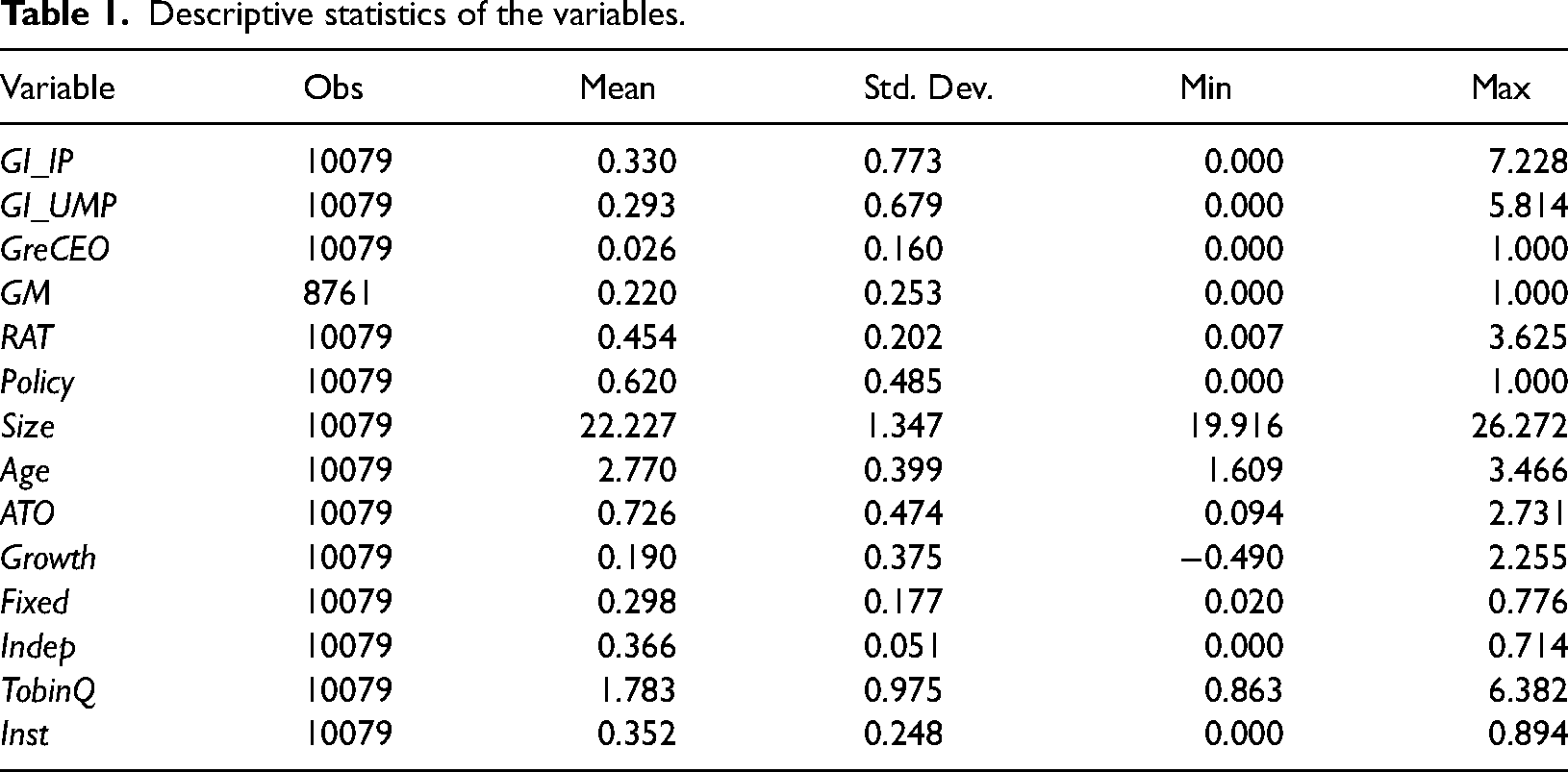
According to the 2012 Industry Classification Guidelines for Listed Firms issued by China Securities Regulatory Commission, this study classifies all A-share listed firms in the coal, petroleum, and natural gas extraction and processing industries and electricity, heat, and gas industries as energy firms. We obtained the unbalanced panel data for these firms in China from 2004 to 2021, with a sample of 10,079 energy firm observations, after excluding ST and *ST firms and winsorizing all continuous variables at the 1% quantile. The original firm-level and CEO profile data are obtained from the CSMAR database and the CNRDS database, respectively. The regional-level data are obtained from the China Regional Economic Statistical Yearbook. Table 1 presents the sample statistics.
Descriptive statistics of the variables.
Model specification
To test the effect of GreCEO on GI, we specify the following basic model:
What transmission channel exists between GreCEO and energy firms’ GI? To illuminate the influencing mechanism, we used Wen et al.'s
57
Bootstrap method to measure the mediating effect and construct models (2)–(3) as follows.

Furthermore, we introduce the moderating role of REP and construct the mixed model as follows.


Empirical results and analysis
Main results
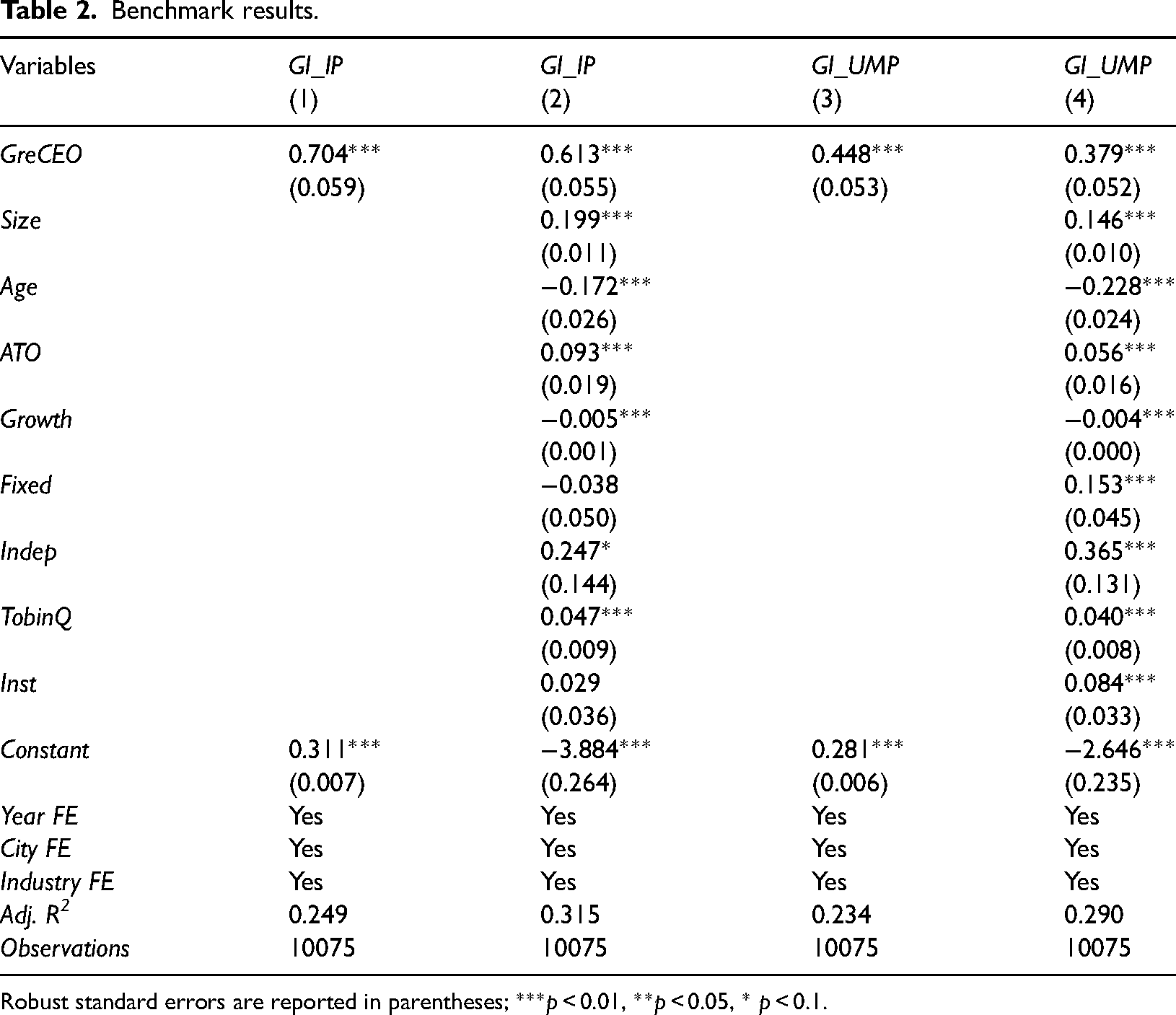
Table 2 reports the baseline estimate results for model (1). Columns (1) and (3) demonstrate the regression results without control variables using GI_IP and GI_UMP as explanatory variables, respectively. The results show that GreCEO significantly promotes GI. We again estimate to control for the variable series; Columns (2) and (4) present the results, which are similar to those without control variables. Compared with CEOs with no green experience, those with it improve GI_IP and GI_UMP by 61.3% and 37.9%, respectively. These findings confirm H1.
Benchmark results.
Robust standard errors are reported in parentheses; ***p < 0.01, **p < 0.05, * p < 0.1.
The coefficients of control variables Age and Growth in Table 2 are significantly negative, inconsistent with our expectations. This finding may corroborate the results of Jovanovic 58 and Pellegrino. 59 Upon entering an industry, firms must choose to emulate the operations and techniques of established firms to survive. Thus, entrants have higher GI motivation and fewer barriers. This trajectory depresses older firms’ innovative vigor. When growth is too rapid, firms spend considerable resources on marketing while scaling back R&D investments.
Endogenous analysis: instrument variable (IV) approach
Through social networks, CEOs in the same city in a given year learn from and compete with each other, fostering strong peer effects. Intuitively, it is difficult for one person to influence the surrounding environment in a society, which provides an opportunity to construct a proper instrument. 60 We measured the average value of GreCEO of neighboring listed firms within a city in a given year as an instrumental variable (IV), denoted IV.GreCEO.
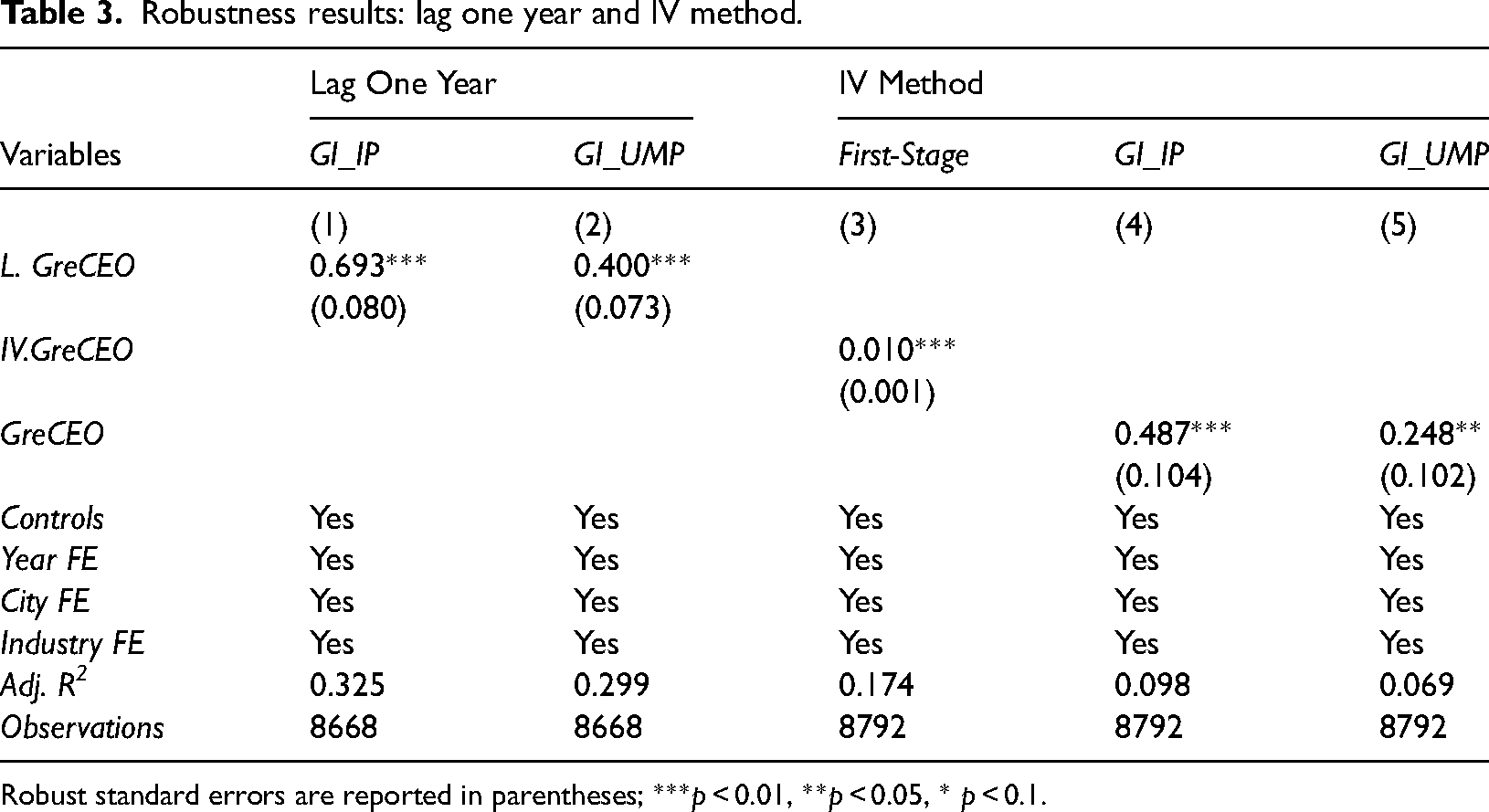
Columns (1)–(3) in Table 3 report the IV method estimation results. Column (1) displays the first stage estimation of the IV method, indicating that GreCEO significantly positively correlates with IV.GreCEO. The Cragg-Donald Wald F and Kleibergen-Paap Wald F statistics are 1149.52 and 176.41, respectively. Both robust F-values are well above the 10% significance level of the Stock-Yogo weak ID test (i.e., 16.38), negating the possibility of a weak IV. Columns (2) and (3) report the IV estimations for the effects of GreCEO on GI_IP and GI_UMP, respectively. The estimated coefficients are significantly positive, further enhancing the robustness of the main results.
Robustness results: lag one year and IV method.
Robust standard errors are reported in parentheses; ***p < 0.01, **p < 0.05, * p < 0.1.
Robustness tests
Lag one period
The current period explanatory variables and other omitted factors do not affect the previous period. Therefore, endogeneity is mitigated using GreCEO with a one-period lag. Columns (4) and (5) in Table 3 show the GreCEO with one-period lag results. The effects of GreCEO on GI_IP and GI_UMP are significantly positive, consistent with the results in Table 2.
Propensity score matching (PSM)
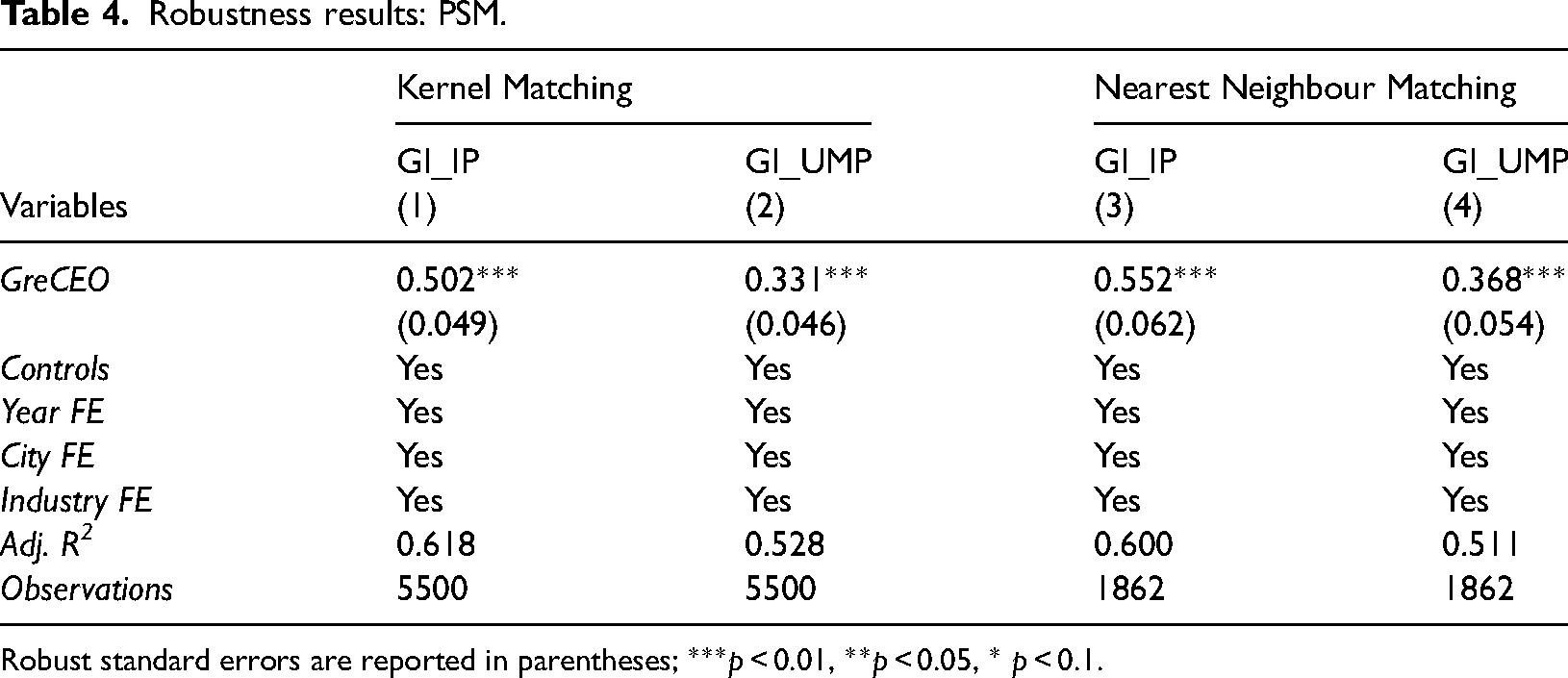
Unobservable factors may influence whether firms choose CEOs with green experience. Therefore, self-selection behavior leads to biased results. The propensity score matching (PSM) approach can mitigate self-selection bias by matching a sample with similar characteristics that influence GreCEO. Figure 2 illustrates the narrowed covariate standard deviations after kernel and nearest neighbor matching with caliper implying that the post-matching individual characteristics are less volatile. Table 4 reports the PSM method estimation results. Columns (1) and (2) display kernel matching. Columns (3) and (4) present nearest neighbor matching with caliper. The coefficients of GreCEO after two matches are all significantly positive, consistent with the main results.

Standardized bias across covariates before and after matching.
Robustness results: PSM.
Robust standard errors are reported in parentheses; ***p < 0.01, **p < 0.05, * p < 0.1.
Marginal treatment effect (MTE) framework
The IV and PSM methods primarily capture average treatment effects, i.e., local average treatment effect (LATE). However, multiple unobservable endowments exist among enterprises, commonly associated with individual treatment effects, resulting in heterogeneous self-selection. Individual treatment effects vary with a firm's willingness to choose CEOs with green experience. More importantly, a firm's unobservable endowments usually depend on whether or not the firm is treated (essential heterogeneity), 61 leading to the heterogeneity of hidden bias. To address hidden heterogeneous selection motivations, the MTE approach was used to illustrate the treatment effect distribution across firms alongside hidden heterogeneity by measuring the propensity score of firms to select CEOs with green experience.
MTEs are founded on the generalized Roy model as follows.


When μD (Z)>V, firms choose CEOs with green experience. Otherwise, firms choose CEOs without it. Hence, unobservable factors determine the extent of resistance to treatment. That is, firms’ higher unobservable gains will foster a higher level of treatment resistance. Firms with low resistance will be more prone to choose CEOs with green experience than those with high resistance. With conditional independence ((U0, U1, V) ┴ IV | X) and separability (E Uj | V, X .=E Uj | V.), the MTE is defined as follows.
Panels A and B of Figure 3 show the estimated MTE curves and their confidence intervals for GI_IP and GI_UMP, respectively. The downward sloping curve indicates that the higher the likelihood of a firm choosing CEOs with green experience (i.e., lower unobservable resistance to treatment), the more favorable it is for GI. Figure 4 illustrates the MTE compilers for those with LATE weights for GI_IP and GI_UMP, respectively. Figure 4 shows that the MTE curve adjusted by the LATE weights follows the same trend as the original MTE curve. It exhibits a smooth decrease with increasing unobservable treatment resistance. In addition, Figure 5 shows our segmented MTEs curves and potential outputs, which elaborate on the MTEs estimation and the difference between Y1 and Y0.

Estimated MTE curve.
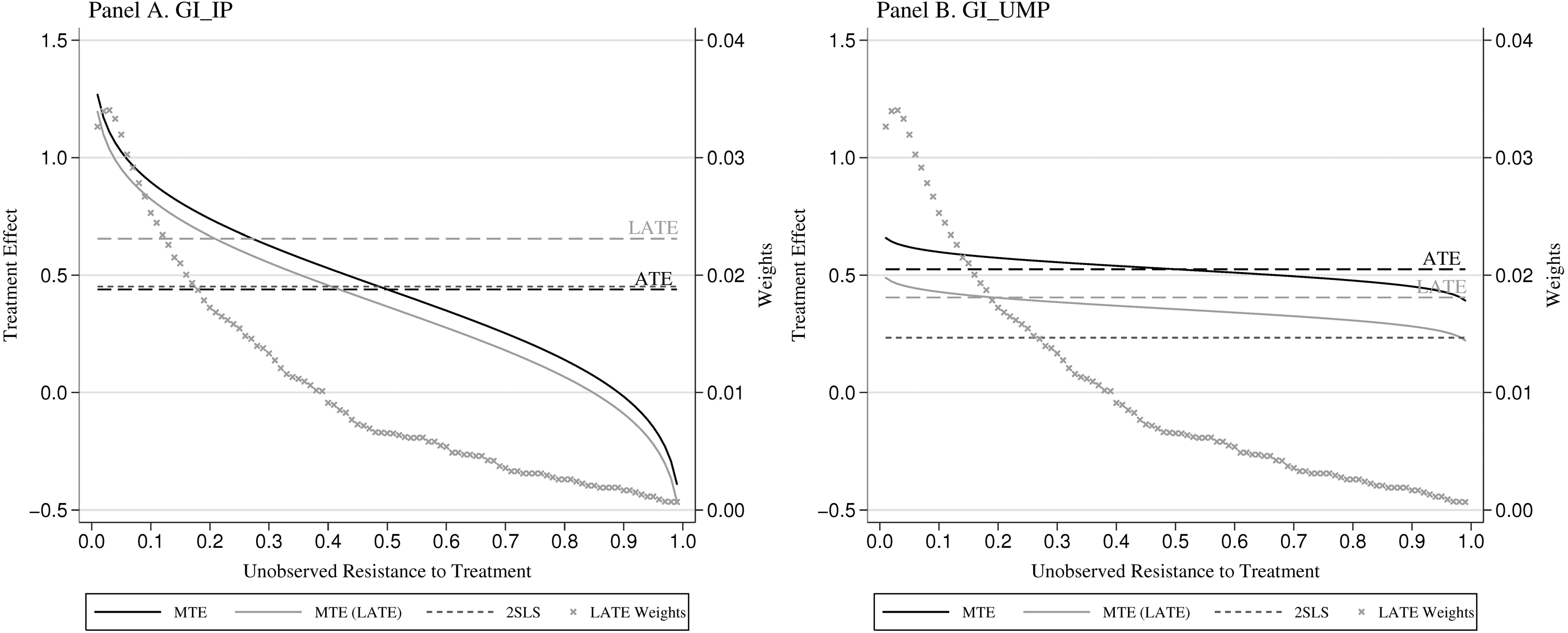
MTE for compliers with LATE weights.
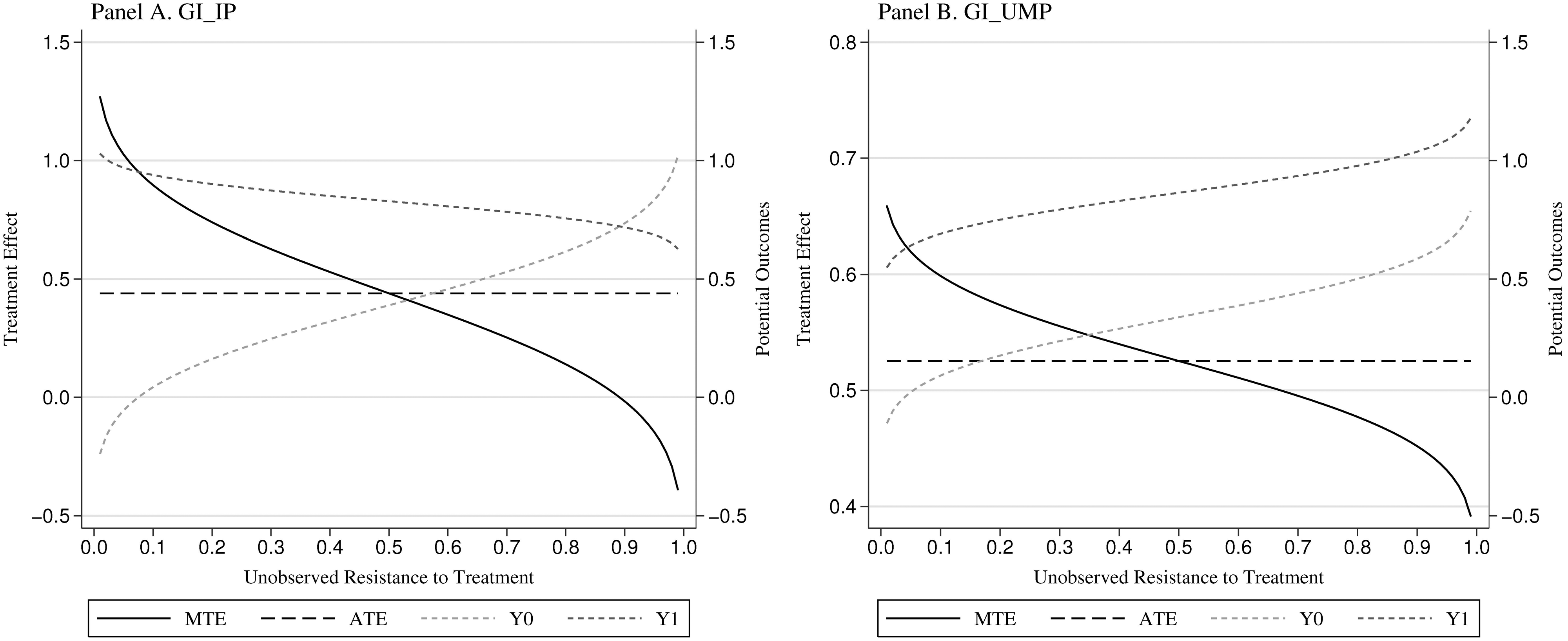
MTEs and potential outcomes.
Heterogeneity analysis
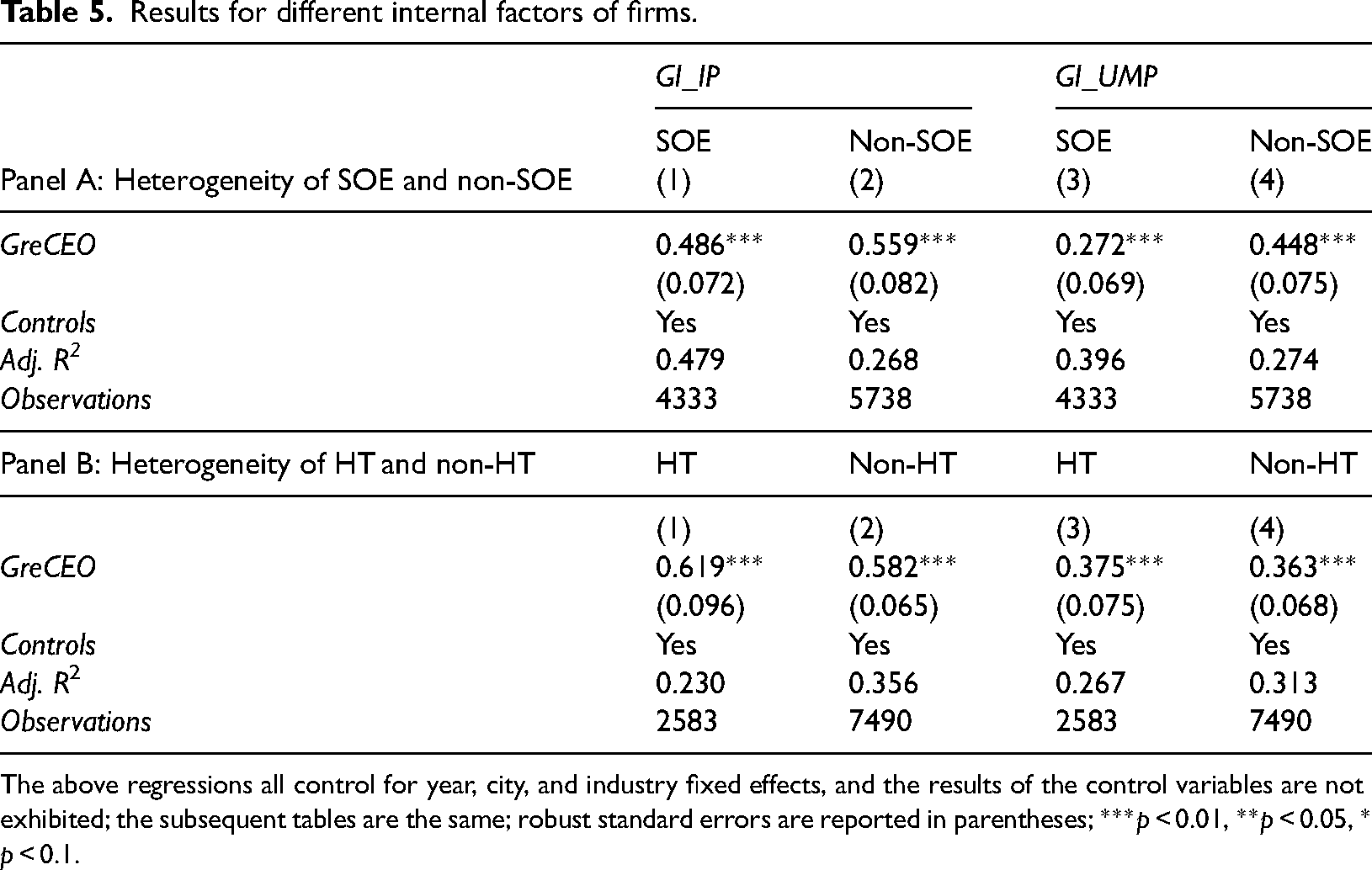
We have discussed GreCEO's robustness and positive impact on GI; however, these may vary with changes in the characteristics of energy firms. Therefore, we investigate the heterogeneity of GreCEO's effect on GI of two types of firms. Table 5 shows the results of heterogeneity induced by two factors: whether it is a state-owned enterprise (SOE) or a high-tech enterprise (HT). Columns (1)–(4) of Panel A in Table 5 show that GreCEO can substantially improve GI_IP and GI_UMP in SOEs and non-SOEs. However, the coefficients of GreCEO in SOEs are smaller than in non-SOEs. It can be explained that, CEOs of non-SOEs may have greater economic agency power than those of SOEs. They can appropriately utilize their personal attributes in firms’ innovation activities. 64 SOEs show a strong path dependence on production, lack innovation motivation, and tend to be satisfied with only the current practical technology, ignoring green invention patent innovation. 65 Specifically, innovation strategies in SOEs are more likely to be influenced by the government's green development philosophy and suffer from fewer financing constraints than non-SOEs. 66 Most SOEs can increase their investment for GI regardless of whether the CEOs have green experience. In contrast, CEOs with green experience in non-SOEs gain support from their stakeholders and significantly reduce financing constraints. These firms devote more resources to innovative activities. Therefore, there is not much potential room exists for CEOs with green experience to improve GI in SOEs. The GI effect of GreCEO is stronger in non-SOEs than in SOEs.
Results for different internal factors of firms.
The above regressions all control for year, city, and industry fixed effects, and the results of the control variables are not exhibited; the subsequent tables are the same; robust standard errors are reported in parentheses; ***p < 0.01, **p < 0.05, * p < 0.1.
In addition, Columns (1)–(4) of Panel B in Table 5 show significant positive effects of GreCEO on GI_IP and GI_UMP for HT and non-HT firms. In contrast, the coefficients of GreCEO in HT firms are larger than in non-HT. HT firms, which are more technology-dependent, may also be highly dependent on innovation resources, including CEOs’ GI experience. Faced with fierce market competition, CEOs of HT firms focus on technology R&D in their own expertise area, with a shorter overall cycle of iterative upgrading from product design to specialized production to marketing. 67 In particular, HT firms’ main strategic goal is R&D, and the GreCEO of HT energy firms promotes the rapid transformation of R&D results into GI. In contrast, CEOs of non-HT firms are less motivated to innovate in green technologies. Therefore, the effect of GreCEO on GI in HT firms is more prominent than in non-HT firms.
Further analysis
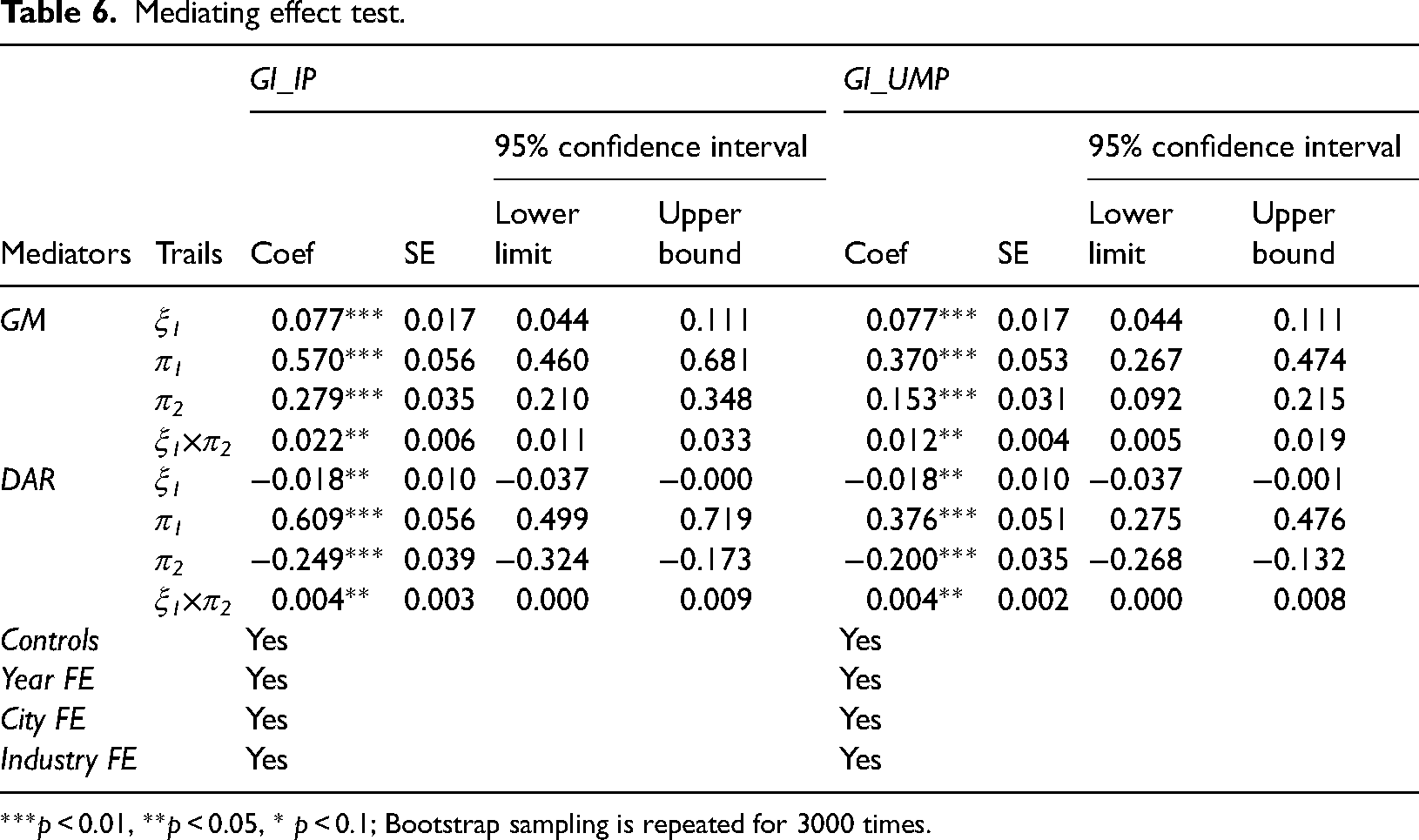
According to models (2)–(3), we measure the direct effect of GreCEO on GI and the mediating effect of GM and DAR between them. Table 6 displays the corresponding results. Concerning the mediating variable GM, the coefficients ξ1 of model (2) and π2 of model (3) are significantly positive, indicating that GM mediates the relationship between GreCEO and GI. The coefficient π1 of model (3) is significantly positive, indicating that the direct effect of GreCEO on energy firms’ GI is positive. Moreover, the signs of the coefficients of ξ1×π2 and β1 are the same, suggesting a partial mediating role of GM. These results confirm H2 and H3.
Mediating effect test.
***p < 0.01, **p < 0.05, * p < 0.1; Bootstrap sampling is repeated for 3000 times.
Regarding the mediating variable DAR, the coefficients ξ1 of model (2) and π2 of model (3) are significantly negative, indicating that GreCEO negatively affects DAR and DAR negatively affects GI. Thus DAR mediates the relationship between GreCEO and energy firms’ GI. The coefficient π1 in model (3) is significant and positive, supporting the direct effect of GreCEO on energy firms’ GI. Moreover, the signs of the coefficients of ξ1×π2 and β1 are the same, suggesting that DAR partially mediates the effect of GreCEO on energy firms’ GI. These results confirm H4 and H5.
According to models (4)–(6), we further investigate the moderating effect of REP. Table 7 presents the corresponding results. First, the coefficients of GreCEO and GreCEO × REP in Columns (1) and (2) are significantly positive, indicating that REP positively moderates the relationship between GreCEO and GI. Therefore, H6 is verified. Second, the coefficient of GreCEO in Column (3) is significantly positive, but the coefficient of GreCEO × REP in Column (3) is non-significant. Therefore, the moderating effect of REP fails between the nexus of GreCEO and GM. Third, the coefficients of GM in Columns (4) and (5) are non-significant, while the coefficients of GM × REP in Columns (4) and (5) are significantly positive, implying that REP positively moderates the relationship between GM and GI of energy firms. Therefore, H7 is supported. Fourth, the coefficient of GreCEO in Column (6) is significantly negative, but the coefficient of GreCEO × REP in Column (3) is significantly positive, implying that REP negatively moderates the relationship between GreCEO and DAR. Thus, H8 is confirmed. Finally, the coefficients of DAR in Columns (7) and (8) are significantly negative, but the coefficients of DAR × REP in Columns (7) and (8) are non-significant, indicating that REP fails to moderate the nexus between DAR and GI.
The results considering the mediating effect and the moderating effect.

Robust standard errors are reported in parentheses; ***p < 0.01, **p < 0.05, * p < 0.1.
Conclusion and policy implications
Currently, environmental protection and renewable energy utilization are recognized globally. GI is crucial for energy saving and carbon reduction by energy firms. This study investigates GreCEO's impact on energy firms’ GI and the influencing mechanisms using data from 821 energy-listed firms in China from 2004 to 2021. We conclude the following: (1) GreCEO significantly promotes energy firms’ GI. After robustness checks with lagged one-period core explanatory variables, IV, PSM, MTE, and sensitivity analysis of omitted variables, the main results still hold. (2) The impact of GreCEO on energy firms’ GI exhibits specific heterogeneity characteristics regarding firm ownership and industry characteristics. Specifically, the promotion GI effects are more prominent in non-SOEs and HT firms. (3) The influencing mechanisms test reveals that GM and DAR are the two underlying channels. The results confirm GreCEO's impact on energy firms’ GI is partially mediated by GM and DAR. (4) REP positively moderates the relationship between GreCEO and energy firms’ GI, as well as the relationship between GM and energy firms’ GI. However, it negatively moderates the relationship between GreCEO and energy firms’ DAR.
The above findings reveal that there is room for promoting energy firms’ GI regarding CEOs’ green awareness. In particular, only 2.6% of CEOs in energy firms had green experience from 2004 to 2021, with only 3.8% as of 2021. Thus, energy firms should improve CEOs’ GI awareness of environmental issues and strengthen their green education and training in sustainability. More significantly, this study has practical implications for energy firms and governments to improve GI. It provides a necessary reference for countries to achieve sustainable development goals as follows.
First, given the improvement impact of GreCEO on energy firms’ GI, directors should recruit senior managers with green experience to pursue green-oriented development. Energy firms should also engage in training programs for senior managers to spread environmental awareness. Energy firms should improve senior managers’ GI motivation and innovate the GM pattern. Second, the government should take into account heterogeneous firms when formulating policies, and encourage non-SOEs or HT firms to boost GI effects, and promote a sustainable society. Third, the GI activities of energy firms in developing countries are susceptible to funding limitations. It is therefore suggested that banks and financial institutions optimize the funding supply structure and provide inclusive credit services to alleviate the financial constraints of energy firms. In particular, governments should reduce the financing constraints that small and medium-sized energy enterprises face, and provide tax incentives and financial subsidies for GI activities. Fourth, the government should strength REP's signaling role in corporate GI decision-making and reinforce the cooperation between government and energy enterprises. When implementing REP, the government should track policy implementation effects and adjust their orientation to encourage enterprises to undertake GI. These recommendations are also suitable for similar economies.
Our study still has two primary limitations. First, due to limitations in the measurement of explained variable and core explanatory variables, (1) owing to the limitations of sample data acquisition, we only use whether CEOs have green experience to measure GreCEO. Therefore, accurately identifying the formation of GreCEO, such as its duration, is difficult. The measurement of GreCEO in our study assumed that green experience was homogeneous among CEOs. (2) As GI is a multidimensional construct, the GI_IP and GI_UMP, which constitute only one dimension of GI, may not accurately reflect the process of GI formation and significance. It is therefore challenging to accurately measure the actual GI level of energy firms.
Second, there are limitations to the mechanism analysis. We explore how GreCEO improves energy firms’ GI through two channels: GM and DAR. However, the existence of other channels, such as CEOs with green experience who may access financing assistance from stakeholders experienced in sustainable practices, is undeniable.
Based on these limitations, we propose the following two future perspectives. On the one hand, future studies should measure the duration of GreCEO. Moreover, it is better to assess their green awareness through questionnaire interviews in order to evaluate GreCEO more accurately. In addition, according to the dual innovation theory, innovation activities are divided into utilization and exploratory innovation. Further research on GI can be discussed in relation to this aspect. On the other hand, future research should further explore the influencing mechanisms of GreCEO on GI, such as external financing, equity governance structure, and green knowledge spillover. However, collecting relevant data will be challenging.
Footnotes
Declaration of conflicting interests
The authors declared no potential conflicts of interest with respect to the research, authorship, and/or publication of this article.
Funding
The authors disclosed receipt of the following financial support for the research, authorship, and/or publication of this article: This work was supported by the National Social Science Fund of China, (grant number 22BJL074).
