



Abstract
This study proposes a hybrid technique for optimal sizing and cost optimization of hybrid energy storage systems (HESS) integrated into electric vehicles (EVs). The proposed technique, SPOA-RBFNN, combines a student psychology-based optimization algorithm (SPOA) and a radial-basis function neural network (RBFNN). The study aims to minimize the overall cost of the HESS by evaluating two design variables: the super-capacitor (SC) and battery pack size. SPOA is employed to optimize the hybrid HESS design variables, ensuring efficient exploration of solution spaces. The RBFNN method is then used to predict the relationship between these design variables and the overall cost of the HESS in electric vehicles. The results show that the proposed technique is more effective than existing techniques, with an efficiency of 97.99039% compared to 82.137% for GA and 77.26589% for particle swarm optimization (PSO). This work offers a comprehensive and innovative approach to optimizing HESS sizing in EVs, connecting the gap between performance optimization and financial cost analysis.
Keywords
Introduction
Electric-vehicles (EVs) offer a sustainable and eco-friendly mode of transportation, but optimizing their performance and cost-efficiency depends on determining the ideal size of their hybrid-energy-storage-systems (HESS). While previous research has primarily focused on either HESS sizing or financial cost analysis, missing a comprehensive approach. The market for electric vehicles reached 3 million units in 2019 and is estimated to reach 27 million units by 2030. 1 The EV propulsion is employed environmentally friendly and energy-efficient transportation. Tooffer constant energy for long distance driving and high power capacity to allow high acceleration and regenerative braking, the energy storage system (ESS) in EVs must be built with a large energy capacity. One of the best choices in ESS in EV is batteries that are utilized for providing long-term driving energy but they are not satisfied the needs of short-term power load present in fast acceleration as well as regenerative braking deceleration. 2 The battery-only ESS is heavy weight and large volume, and they maintain high power loads. In contrast, other technologies with separate battery systems perform better in delivering high-power pulses than degradation. A potential solution to supplement the restrictions of batteries is to use super-capacitors as a 2nd energy storage device. The SC has the largest transient power capacity efficiency over the millions of full charging cycles, and the unloading battery breaks the power requirement from the battery. For improving the performance of a storage technology battery- SC-HESS is employed. The HESS has better performance in reducing energy consumption along with battery degradation. 3 Battery SC-HESS consists of DC/DC converter(s), battery, SC pack. Hence, sizing must be considered to solve the above problem, which involves the optimization problem. The main objectives in sizing are reducing energy consumption or storing degradation. 4 The multi-objective optimization (MOP) method analyzes the conflicts present in the HESS. 5 The MOP is utilized for sizing the EV passenger by using two objectives. These are mass and battery cycle lifetimes. The HESS sizing of EVs and MOPs involves optimizing battery health and HESS mass as financial costs.
Numerous earlier research works in literature were based on HESS in EV with various features and perspectives. Few of them were mentioned here.
A new investment approach for sizing a Super capacitor in a BESS for frequency regulation were presented by Baek et al. 6 These developments presented a hybrid operation strategy considering the BESS's lifespan. According to Zhu et al., 7 the performance constraints of batteries could be supplemented by using SCs as a second energy storage system alongside them. According to Bhatti et al., 8 the PSO method was used to determine the ideal PV array and energy storage unit (ESU) dimensions for a photovoltaic grid-tied charging system for electric vehicles (in an office setting). Using the multi-objective PSO algorithm, Sadeghi et al., 9 have presented the optimal resource sizing issue for the micro-grid in 2 modes with EV. The monte-carlo-simulation was used to model the erratic behaviour of the electric vehicle. Liu et al. 10 have designated sponge SC and design to increase the life span of solar-powered WSN nodes. The developed energy management (EM)system was enhanced over other conventional empirical-based approaches. Li et al. 11 have evaluated a technique called a new energy management system to enhance total economic PHEV with energy storage capacity of HESS. Huang et al. 12 have performed the dynamic programming to address the size optimization problem of battery/ultra-capacitor HESS on EVs to decrease the cost of electricity and battery degradation. Niu et al. 13 have illustrated the offline sizing system and online power management approach for semi-active hybrid battery system. Pisal and Vidyarthi 14 have explained that HESS-like batteries and SC were utilized to exploit energy management of EVs, with two purposes: (i) initially, the SC reference voltage can be decided with real-time charging dynamics, (ii) optimizing power flow by minimizing battery power magnitude variation and power loss. Ali et al. 15 have made other EVs into microgrid (MGs) parking lots were used in revenue-driven acquisition and flexibility upgrades through almost no additional capital expenditures. Jirdehi and Tabar 16 have presented the energy management of an integrated MG through charging stations and battery exchange under the crypto-currency miners and renewable resources. Veliz et al. 17 have clarified a new 3-stage solution method for home energy management difficulties that allow for network outages. Liu et al. 18 have introduced the conception of a feasible electricity fluctuation area to attain the consistent evaluation capacity for reserve declaration. He et al. 19 evaluated the research status and advancement of the three major components of this architecture, namely the “BEV platform, charging/swapping station, and real-time operation monitoring platform,” as well as their significant technical elements. The three key demonstration projects of the 2008 Beijing Olympic Games, the 2022 Beijing Winter Olympics, and the intelligent and linked autonomous battery electric bus project were examined to describe the applications of BEVs in China. Zhou et al. 20 have developed a unique transfer learning technique integrated with cycle life prediction technology. A novel cycle life prediction approach was based on feature extraction and deep learning technology was suggested, which delivers accurate cycle life prediction. The transfer learning method began with the development of an offline-based aging model to learn knowledge of the two-stage aging process. The Bayesian model migration technology was then used, with the expected cycle life as its prior knowledge, to forecast the aging trajectory successfully, and the uncertainty of the aging trajectory was assessed.
According to recent research, several studies have been developed on the EM system of HESS in electric vehicles. The use of conventional controllers in HESS can also lead to increased complexity in system design and implementation. Hence, novel techniques such as fuzzy logic control (FLC) and genetic algorithms (GA) were introduced for the energy management system of HEV. FLC is suitable for nonlinear systems and reduces mathematical complexity, but it can be challenging to set up rules. GA offers optimal solutions for specific applications but increases network complexity. The energy management of Hybrid ESS in the EVs was achieved using some optimization techniques. Therefore, additional support was needed to define the optimum solution to design the energy management system for hybrid ESS on EVs. The EM system of Hybrid ESS was achieved through an upgraded approach, and in the literature, most of the works did not ensure proficient results. Therefore, these limitations, as well as problems, have stimulated us to do this work.
Objectives and contribution
In the expansive landscape of Hybrid ESS within electric vehicles, earlier studies have made commendable strides, yet certain drawbacks persist in the existing literature. One notable limitation is the tendency to rely on conventional controllers, often resulting in heightened system complexity. Additionally, a common challenge lies in defining an optimal solution for the intricate design of energy management systems in hybrid EVs. In light of the prevailing challenges and research gaps in the field, this manuscript presents a pioneering approach for addressing the optimal sizing and financial cost optimization of Hybrid ESS integrated into EVs. The objectives and contribution of this paper is described as follows:
This study introduces an innovative hybrid technique for optimizing both the size and financial costs of super capacitors (SCs) HESS in electric vehicles (EVs). Unlike conventional methods that may contribute to increased system complexity, our approach integrates sensitivity analysis, providing a nuanced understanding of optimal sizing and financial considerations. The study employs a combined EM-sizing optimization structure based on the SPOA-RBFNN technique, categorizing HESS financial costs into four sub-costs, ensuring that all relevant financial factors are considered in the optimization process. A sensitivity analysis is conducted to determine the optimal Hybrid ESS size and financial cost, providing valuable insights into the trade-offs between HESS performance and cost. The proposed method achieves an efficiency of 97.99%, significantly outperforming existing techniques such as GA is 82.14% and PSO is 77.27%. This research not only fills critical gaps but also contributes to the methodology by demonstrating the superior performance of the SPOA-RBFNN hybrid approach. The efficiency rate achieved serves as a benchmark, enhancing the reliability of the proposed methodological advancements.
In summary, this investigation not only advances the academic understanding of HESS optimization but also provides practical solutions that can significantly impact the electric vehicle industry. By introducing a novel hybrid approach and thoroughly evaluating its performance, association the gap between theory and application, offering valuable insights and tackles for researchers, practitioners, and stakeholders in the field of electric vehicle technology. The rest of the manuscript is mentioned as follows: Section 2 explains system structure of proposed technique. Section 3 demonstrates sensitivity analysis of various factors and HESS sizing. Section 4 analyzes the impact of various factors and quantifies their relative importance. Section 5 depicts the proposed hybrid technique in the optimal sizing and overall cost reduction of HESS built in the EVs. Section 6 depicts the simulating results and discussion of the SPOA-RBFNN technique. Section 7 concluded the manuscript.
HESS system configuration
The Hybrid Energy Storage System has three configurations: semi-active, full-active, and passive, depending on the count and types of DC to DC converter usage. The semi-active HESS uses a single DC to DC converter, striking a balance between cost and functionality. It's effective and can be either SC/battery or battery/SC topology. Hence, these manuscripts mainly focused in SC/battery and battery/SC topology. Battery/SC can switch to SC/battery but can complicate EM and HESS sizing. At first, the battery-pack is attached to the bus, and an unlimited condition is present in the nominal SC pack voltage. In that case, the nominal battery pack voltage and the nominal bus voltage are the same. At the same time, the nominal SC pack voltage required in the battery/SC is the same as that required by the bus. Therefore, it is essential to employ a huge number of SCs to meet the nominal bus voltage, which tremendously raises the cost of SC. When the SC pack at SC/battery topology voltage differs in the wide range, when the bus manages the voltage deviation, the operating SC pack voltage at the battery/SC topology cannot differ too much. A broad voltage range causes a challenge for the motor and inverter. Consider minimal allowable SC pack voltage for every topology to detect the voltage range amid SC/battery and battery/SC topology. Thirdly, the SC pack useable energy ratio corresponds to the SC pack voltage range. Finally, it is considered that the maximal SC pack working power is greater than the battery pack. Therefore, the SC/battery DC/DC converter is greater than the battery/SC topology. The conversion of HESS from SC/battery to battery/SC improves the optimum SC pack size while keeping the battery pack size constant, lowering total system costs. 21
The battery degradation cost is a significant problem in this topology based on the SC pack and battery energy throughput for both topologies. The battery/SC configuration addresses this, offering higher usable energy capacity to boost SC pack energy throughput while maintaining battery power. The battery pack in this configuration is larger than in the SC/battery setup, ensuring sufficient energy for vehicle propulsion. However, the DC to DC converter connected to the battery pack in the battery/SC topology can result in additional energy losses. Therefore, huge energy throughput and higher battery degradation are achieved. Figure 1 portrays the configuration of the HESS system.
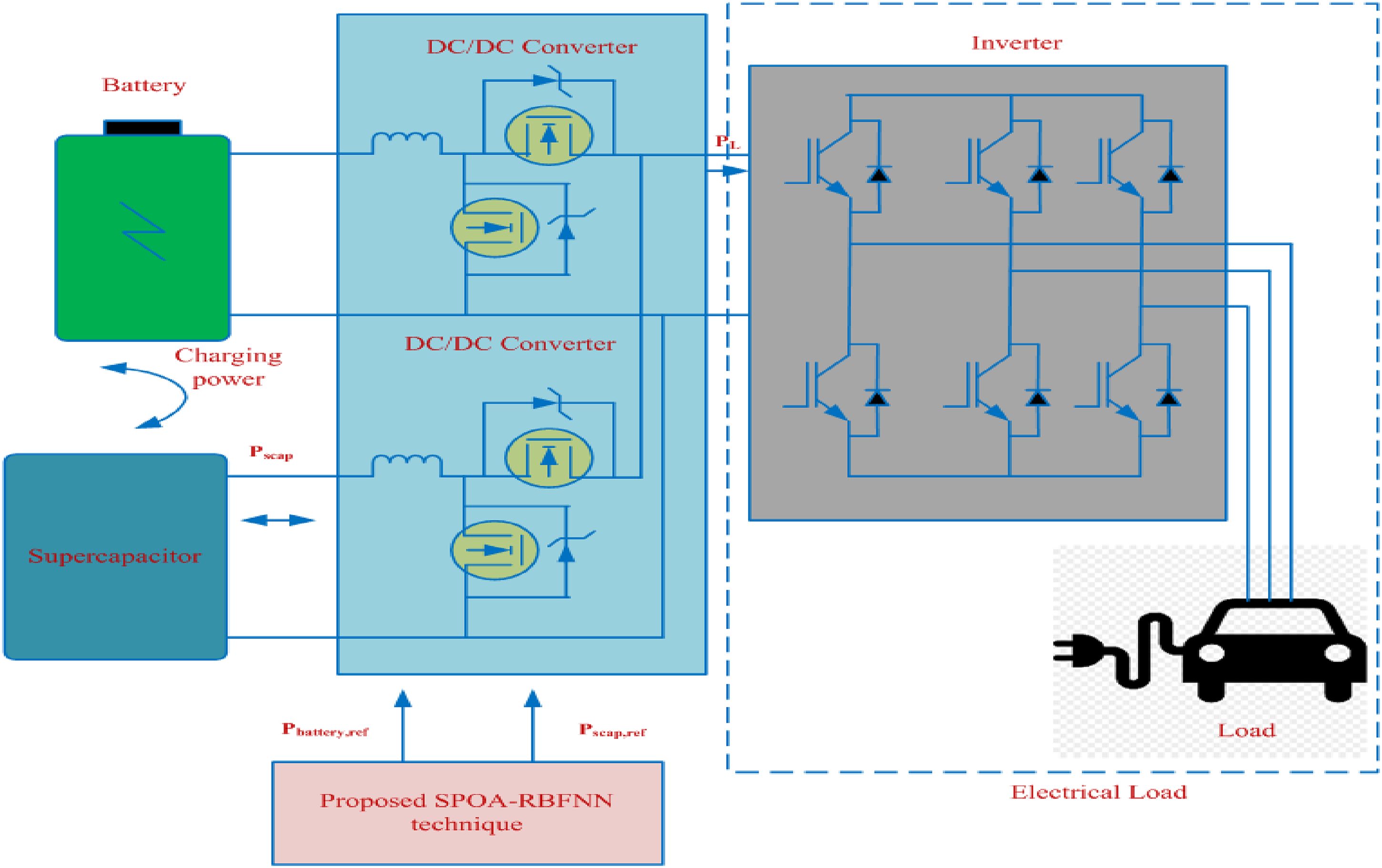
Configuration of the HESS system.
Sensitivity analysis of various factors and HESS sizing
In this manuscript, different types of sensitive factors that are very sensitive to the HESS sizing are defined, and the values of each factor are described.22,23
Driving cycle of vehicle
The longitudinal speed with time is defined as the driving cycle for the EV to follow and introduce the energy and power request to achieve HESS. UDDS, HWFET, and US06 are called standard driving cycles developed from real-time driving conditions. The standard driving cycle is used to check the equal fuel consumption and driving range of the EV. Consequently, these standard driving cycles are also utilized to investigate the driving cycle's impact on the HESS size. 24 Finding the more intense cycle among different cycles is difficult because they have different durations and numerous statistical characteristics. Introduces the intensity factor and determines the driving cycle intensity. One driving cycle is classified into a few microstrips, the intermediate between successful instants in which vehicle speed is 0. For example, In the USO6 cycle with 5 microstrips, energy demand and peak power for every microstrip are determined to feed the fuzzy logic algorithm. The fuzzy-logic method calculates the intensity factor, considering energy consumption and peak power. The intensity factor values of the HWFET, US06 and UDDS cycles are 0.257, 0.914, and 0.903, respectively, and prove that the UDDS cycle is the least intense. The driving-cycle increases the optimal overall cost if it is more intense. Therefore, the optimum battery pack size will remain constant to a minimum. 25 Driving a cycle with high peak power is always the reason for the net cost and the supercapacitor pack size. The combination of peak power and the energy consumption of the driving cycle influences Hybrid ESS size.
Driving range of vehicle
It is an important parameter utilized in vehicle design and is also called technical specification, which corresponds with the onboard battery pack energy capacity. The driving range was developed in a standard test procedure provided by the US Environmental Protection Agency (EPA). EPA utilizes three standard driving cycles to create the driving range that is officially approved. The longer driving range needs to design the battery pack with higher energy capacity that is achieved through arranging several parallel branches of the battery cell. The driving range is 426 km based on EPA but the range of common EVs is designed about 200 km. Recently, the driving range has improved due to the growth of newly energy storing technology and the EV design standards. Also, increasing the minimum permissible battery pack size and driving range improves the optimum battery pack size, potentially leading to battery degradation issues due to power sharing among parallel branches.
Nominal bus voltage
It is defined as an intermediate during mechanic drive train and electric energy storage, which is utilized to convey power along energy flows amid motor or inverter and HESS. The motor's nominal voltage is important to consider in the practical application. 26 The voltage transformation between HESS and the bus can be minimized by adjusting the battery pack's current to meet power demands and minimize resistance. Here, nominal bus voltage is needed to position some battery cells as parallel cells and serial branches. The battery degradation, as well as HESS energy consumption, is affected by resistance and current variations. Therefore, it is necessary to check the outcomes with the results. Therefore, the bus voltage is considered a sensitive and nominal bus voltage factor.
The optimum SC or battery pack size is not affected by the nominal bus voltage because there is no change in the energy or power request as the vehicle propulsion. However, the battery degradation cost is minimized, which leads to a reduction in overall cost. A larger bus voltage is necessary to achieve these benefits without significantly impacting cell current or variation.
Conversion efficiency of DC to DC
The ratio is described as the efficiency of DC to DC conversion during the output and input energy, and SCs are normally called energy-efficient storage. 5 The efficiency of SC depends on the DC to DC converter. Less conversion leads to huge energy loss and significantly raises the HESS energy consumption. SC energy depletion occurs due to the lower energy conversion. Therefore, the battery working is stimulated instead of the SC, and it causes battery degradation. Accordingly, DC to DC conversion efficiency variation corresponds to DC/DC converter current and input/output voltage. The HESS efficiency is set to determine the relation between DC to DC conversion effectiveness and Hybrid ESS size. It is proved that the efficiency increases an overall cost decline, which causes battery degradation and Hybrid ESS energy demand. The energy loss caused by DC/DC conversion is minimized along with maximizing the efficiency of DC-DC. Hence, energy consumption needs to meet the vehicle propulsion also reduced. The DC-DC converter is the development of throughput, which leads to the SC pack overworking by absorbing higher power and energy. It reduces the workload of the battery-pack. Therefore, the battery deterioration is minimized tremendously. Besides, many SCs are connected, which increases the purchasing cost of SC. The lower cost of battery deterioration and Hybrid ESS energy demand increases SC purchase costs.
Component price
The overall cost increases when the component price increases, and this paper mainly involves three types of Hybrid ESS components SC, battery, and DC to DC converter. Increasing battery cost leads to a tremendous rise in the general cost of the system, while battery degradation shows a high proportion of the overall cost. An increase in battery price causes an increase in optimal SC pack size. Increasing the SC or DC to DC converter price shows a slight increase in overall cost because the SC or the cost of purchasing the DC to DC converter shows 3% of the overall cost. In addition, the rise in SC purchase cost exceeds the reduction in the battery degradation, and it fails the SCs making at configured. Therefore, it shows no reason to affect the optimal supercapacitor capacitor size for the DC-DC converter.
Financial cost definition
The net financial cost of a hybrid ESS includes the preliminary setup to long-term cost till the vehicle's lifetime. The initial setup process is defined as the initial cost, including the money needed to buy all the HESS components. The long-term cost includes the money needed for the component replacement caused by the component deterioration and consumption of energy using Hybrid ESS processes. SC pack and DC to DC converter have a longer life cycle and do not need to be changed during the vehicle's lifetime since they only need to be purchased once, so there is no need for the cost of deterioration. However, the battery pack does not combine the cost of purchasing; it similarly integrates the cost of degradation since the lifecycle is smaller than the vehicle's lifetime. It needs to change several times over the vehicle's lifetime. The energy required for HESS operation and the equivalent energy cost of the vehicle lifetime are considered long-term costs. SC purchase cost is represented in the equation (1)








Impact degrees of diverse factors
This section describes the impact of diverse factors and calculates each sensitive factor's relative importance.
Impact degree quantification
A factor with a high impact degree quantifies the total non-zero sensitivity average, which is expressed in the following Equation (10). Here, n indicates the count of non-base case values. Since, the value set of the HESS topology and driving-cycle are not numeric values, they are not used directly in the Equation (9). The driving cycle intensity factor is evaluated by adapting SC pack capacity, which is the outstanding difference between different HESS topologies.


Comparative of the influence degrees of diverse factors
Driving has the highest impact degree and considers HESS's influences on the total cost. The drive cycle is the parameter model that defines the driving vehicle condition and represents the driving habit. The overall cost of HESS is minimized by the lower speed cruise and the mild acceleration, considered a less aggressive driving habit. Lower impact degrees contain battery cost, drive range, bus voltage, and Efficiency of DC-to-DC conversion ranging from 0.896 to 0.619. It has an average level of impact HESS on the overall cost. Battery degradation cost mainly occurs because of the small percentage of battery degradation. Reducing the battery price depends on economic battery manufacturing technology development. By altering the battery pack's design, the nominal bus voltage influences the total cost. Nevertheless, high bus voltage is better than minimizing the overall cost. By comparing these two aspects, increasing nominal bus voltage is preferable to lowering battery price. The driving range corresponds to the battery pack size. DC/DC conversion efficiency is vital for energy and SC pack efficiency. A special concern is that DC/DC conversion efficiency development is required to develop an efficient topology and power electronics. HESS topology has a low-cost impact, and SC costs are higher than batteries. Deploying SCs is more effective than reducing their size to minimize battery wear. SC purchase cost's impact on overall cost is estimated at 3%.
Components and modeling of the hybrid ESS
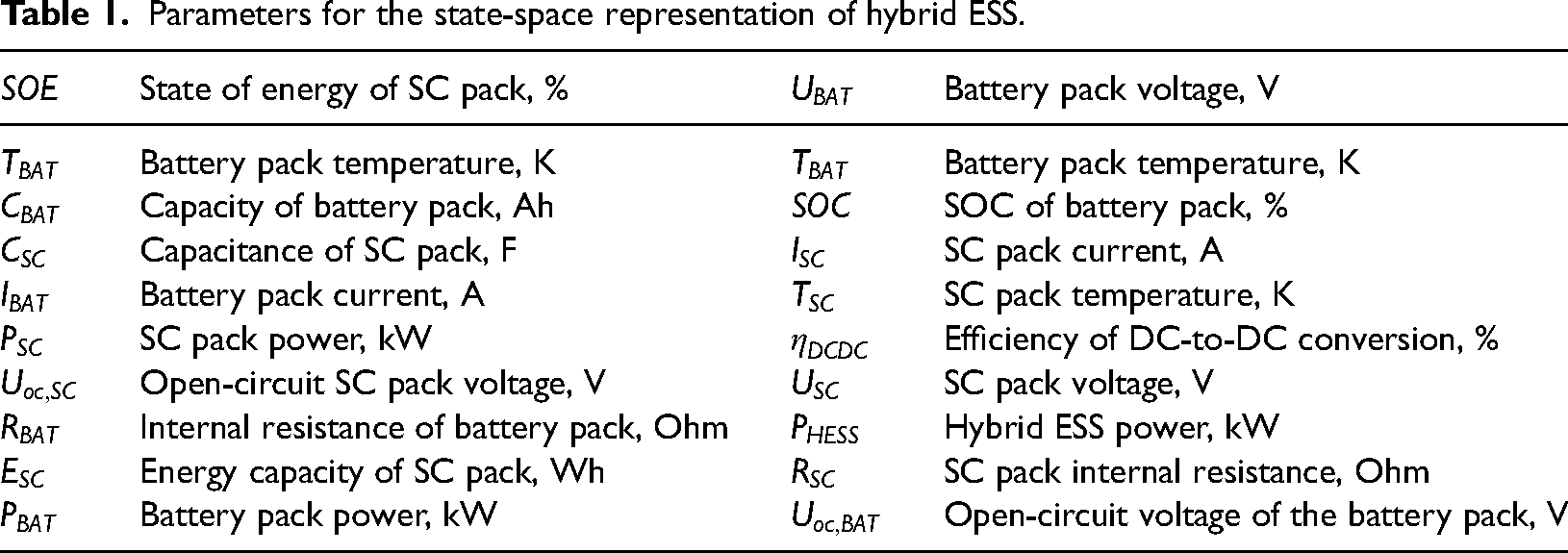
Parameters for the state-space representation of Hybrid ESS are specified in Table 1. This HESS system comprises a combination of three main components: a battery pack, a super capacitor pack, and a DC to DC converter. The battery and SC pack function as a charge reservoir and are defined by an analogous circuit, the properties of which vary in a piecewise linear fashion depending on temperature and charge state. These parameters are calculated using empirical data. An internal resistance and a voltage source in series with a capacitance constitute the battery and SC pack equivalent circuit. Furthermore, the effectiveness of the DC to DC converter is considered to account for power losses that occur while connecting the SC pack. The overall power of the Hybrid ESS system includes both the useable power exchanged with the SC pack and battery pack.






Parameters for the state-space representation of hybrid ESS.
Objective function
Feed the overall costs as an objective function. The total costs of Hybrid ESS over the lifetime of the vehicle can be satisfied as the goal function 
Proposed hybrid method
The optimal Sizing and minimizing of the financial cost of EV is achieved using a hybrid method called SPOA-RBFNN. The SPOA-RBFNN method is the combined execution of SPBOA and RBFNs. SPOA is a new metaheuristic optimizing algorithm based on student psychology, who is trying to give more effort to enhance their performance in the exam and raise their range to become an extraordinary student in the class. RBFNN is the artificial neural network that utilizes the radial basis functions as activation functions in mathematical modeling. The HESS SC and battery power management problem are effectively divided between the load demands. The Hybrid ESS has 2 sections: one is used to determine SC reference voltage, and another is used to improve power flow through HESS. To begin, the real-time load dynamics, the SC reference voltage, and motor parameters such as regenerative braking systems, vehicle dynamics, and driving circumstances are computed. Second, diminish battery power magnitude variation and power loss simultaneously. The SPOA is combined to create the feasible Hybrid ESS control signal datasets. Using the achieved SPOA dataset, the RBFNN is trained and predicts the optimum Hybrid ESS parameters. The proposed method also optimizes SC battery current magnitude, power, voltage, and current variations.
SPOA
SPOA is a student psychology-based optimization method. The students taking steps to develop their performance in their education are considered and compared with their classmates.27,28 These five important steps are present in the SPOA algorithm, which are given below;
The class room students are categorized into four types. They are; (a) good students, (b) best students, (c) average students, (d) students, who tries to enhance at random.
Best student
The best student in the class consistently earning the highest marks, must work harder than others in all subjects to maintain their position. Improvement of the best student is signified as
Good student
These students are driven by a strong interest in a particular subject, motivating them to put in extra effort. Their performance improves significantly in that subject, making them excel in it. The selection of such students is somewhat random due to differing psychological factors among students. To achieve the highest marks in exams, they must match or surpass the effort put in by the best student, as shown in equation (19). On the other hand, certain students must put more effort into their studies than average students and give effort equal to the effort given to the best student. Equation (20) represents these types of students.

Average student
In this category, the effort given to the student depends on the student's interest in the specific subject declared to them. The student shows average effort on the subject, meaning they are less interested in it. Therefore, they give average effort to that subject and give more effort in another subject. Hence, their overall performance will improve. These types of students are also called subject-wise average students. According to student psychology, the selection process for these types of students takes place randomly. The performance of these students is expressed as
Students who attempt to improve at random
This category of students differs from the above three types of students; here, particular students enhance their performance by themselves. Based on the subject, they give some effort to the subjects randomly. Their overall performance will improve when they give effort to the subject randomly. The performance of these students is represented as
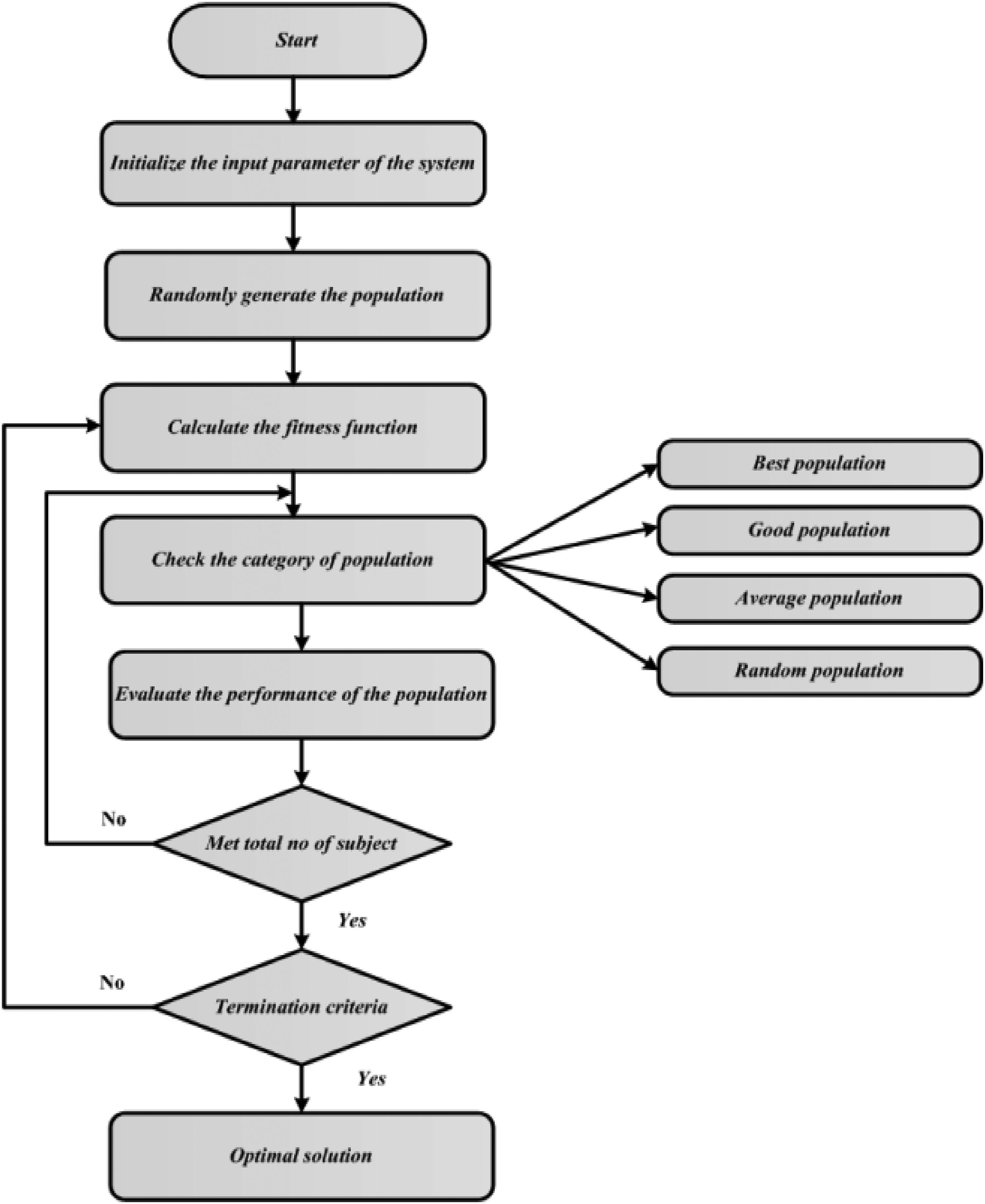
Flowchart of SPOA algorithm.
RBFNN
RBFNN is a part of ANN architecture, and a typical structure of the RBF network is illustrated in Figure 3. RBFNN are also called feed-forward-networks. It has an output layer, an input layer, and a hidden layer.
26
The input layer is used to normalize the input-variables to the hidden layer unit. Each hidden layer corresponding with the center vector executes a radial basis function using an equivalent number of input variables dimensionally. The latter provides a nonlinear connection between the input and hidden layer, and the output layer is connected with the hidden layer. The RBF network has benefits based on speed and efficiency because of its simple structure, which is better than other general architectures such as MLP networks. The RBF network training problem is generated with a group of input and output data, which is expressed as




An RBFN structure.
For each input instance, i = 1, 2… K. The radial basis functional network output for 

Result and discussion
The EV size and financial cost optimization are achieved through the hybrid technique called SPOA-RBFNN, which is analyzed using the MATLAB/Simulink platform. This section explains the analyses of various types of sensitive factors involved in the optimal sizing and depreciation of the financial cost of the EV. The data taken for the analysis is referred from references.22,23 Specification of battery and SC is depicted in Table 2.
Specification of super capacitor and battery.

Figure 4 illustrates the four sub-costs types: battery degradation cost, consumption cost, SC and converter purchase cost. In Figure 4(a) decreases the battery degradation cost by increasing the super capacitor pack size. Then, it maintains a stable value, which means that a small SC pack causes a significant loss in battery degradation. Figure 4(b) shows a slight rise in the hybrid ESS energy consumption cost. The purchasing cost of SC increases along with the supercapacitor pack size. Concurrently, the cost of purchasing a DC to DC converter drops dramatically. The overall cost shows the optimal value of 98 Wh. Figure 4 depicts the three cycles and the corresponding power requirements. It is challenging to determine which cycle is more intense than the other because of the variations in these cycles’ lengths and statistical characteristics.

Overall costs with SC pack size (a) Financial cost/ battery degradation (b) Consumption cost/ SC /converter purchase cost.
Figure 5 depicts the Battery and SC functioning power in the US06 driving cycle. It maintains the Hybrid ESS and energy management sizes at their ideal levels. The battery pack generally discharges, although its operating power is less than 50 kW. The supercapacitor pack functions as a power buffer, with a working output of 70 to 100kW.
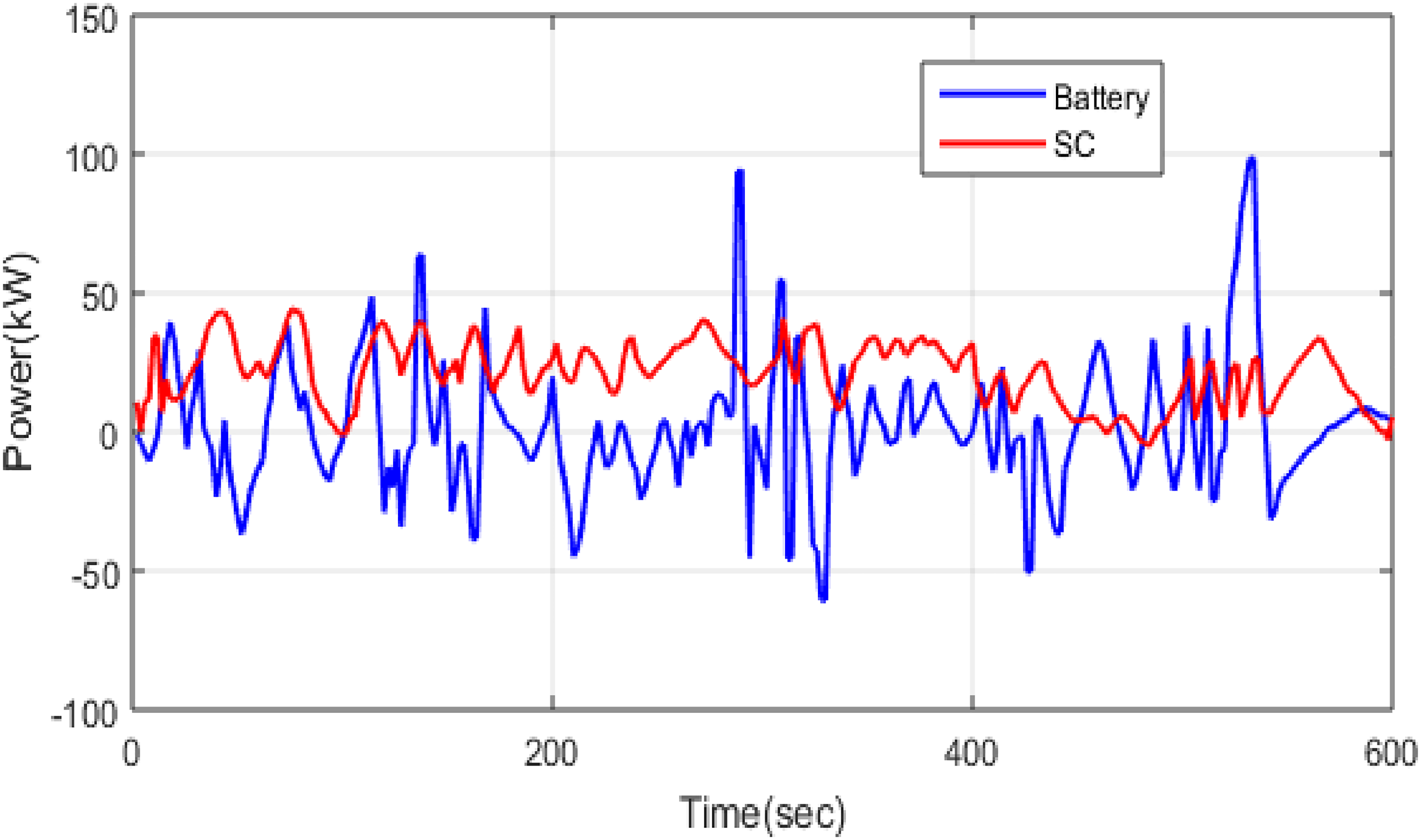
Battery and SC functioning power in US06 driving cycle.
Figure 6 portrays HWFET, UDDS along with the drive-cycles of US06 (a) vehicle-speed, (b) power-demands. The energy requirements and maximum power of each micro-trip are computed and utilized to power the proposed approach. The proposed method forecast the intensity factor of every micro-trip, and the maximal intensity factor of every micro-trip may be calculated using the intensity factor of the driving-cycle. The intensity-factors, like US06, UDDS and HWFET cycles are known by this method, which indicates that the US06-cycle contains high intensity for the electric vehicle and the UDDS cycle has the lowest intensity. Figure 7(a) and (b) show the analysis of optimal overall costs with driving cycle and SC and battery pack size and drive-cycle. Figure 7(a) proves that the driving cycle gets many intense and causes the optimal overall cost reaches the maximum value and proves that the US06 cycle is the maximal overall cost. Figure 7(b) shows that the optimum battery stays in the minimal allowable sizing and the optimum SC becomes increasingly large.
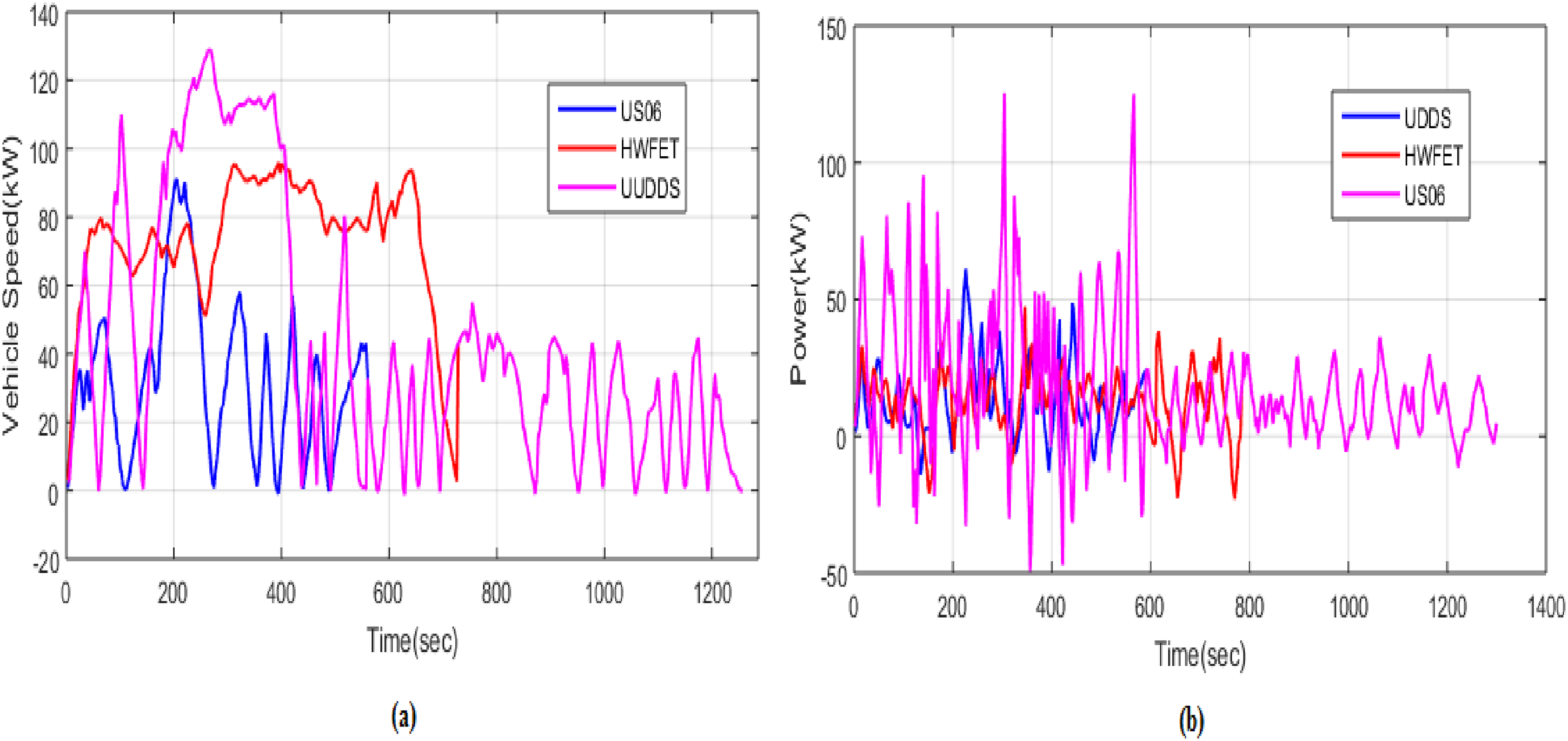
HWFET, UDDS along with the drive-cycles of US06 (a) vehicle-speed, (b) power-demands.

Analysis of (a) Optimal overall costs with driving cycle (b) super capacitor and battery pack size and driving-cycle.
Figures 8(a) and (b) show the energy demand analysis of the most intensive micro trip with drive cycle and peak power. Here, the US06 cycle consists of somewhat low energy demand but a maximum peak power value compared to the HWFET cycle. Maximum peak power on the US06 cycle produces huge costs and needs the super capacitor pack to be larger than the cycle of HWFET. The HWFET cycle contains low peak power, and it causes high energy demand while comparing the cycle of UDDS. Figure 9(a) and (b) display the analysis of optimal overall costs with driving range and battery and SC pack size with driving range. The result proves that increasing the driving range and the battery back size also rises, as shown in Figure 9(b). Figure 9(a) proves no change in the overall costs with a growing driving range.

Analysis of (a) energy demand of most exhaustive micro trip using driving cycle (b) peak power of most intensive micro trip.
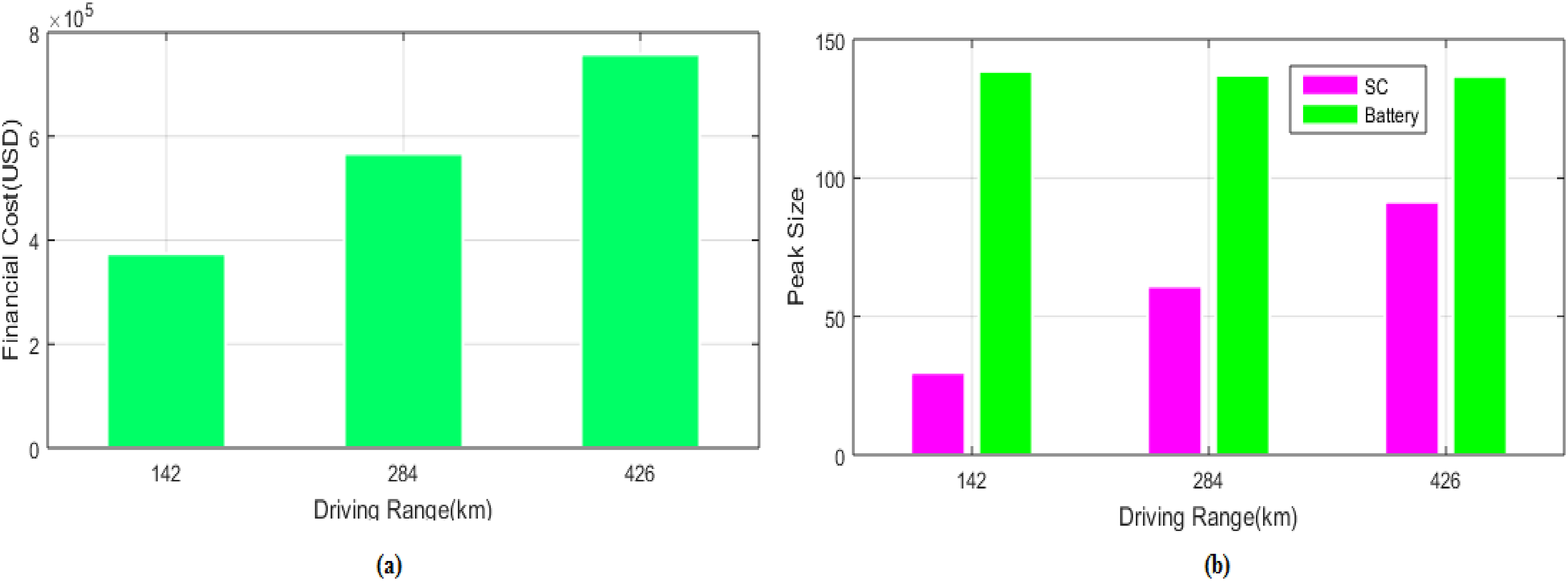
Analysis of (a) optimal overall costs with driving range (b) battery and SC pack size with driving range.
Figure 10(a) and (b) represent the analysis of battery cell and pack degradation. The result proves that it increases the optimum battery pack size and driving range, connecting many battery cells as parallel branches and removing a single battery cell. Figure 11(a) and (b) explain the analysis of optimal overall costs with HESS topology and battery and SC pack size. Also, the overall cost increases slightly when the optimum supercapacitor pack size emerges, and the useful SC power supply capability rises. Figure 12 depicts the HESS topology of (a) battery, (b) super capacitor pack energy throughputs after a single drive cycle. The result shows that the battery/SC energy throughput is larger than the SC/battery. However, the DC-DC converter is connected to the battery-pack in the topology of the battery/SC. Battery/SC topology battery pack produces high energy throughput and battery degradation.
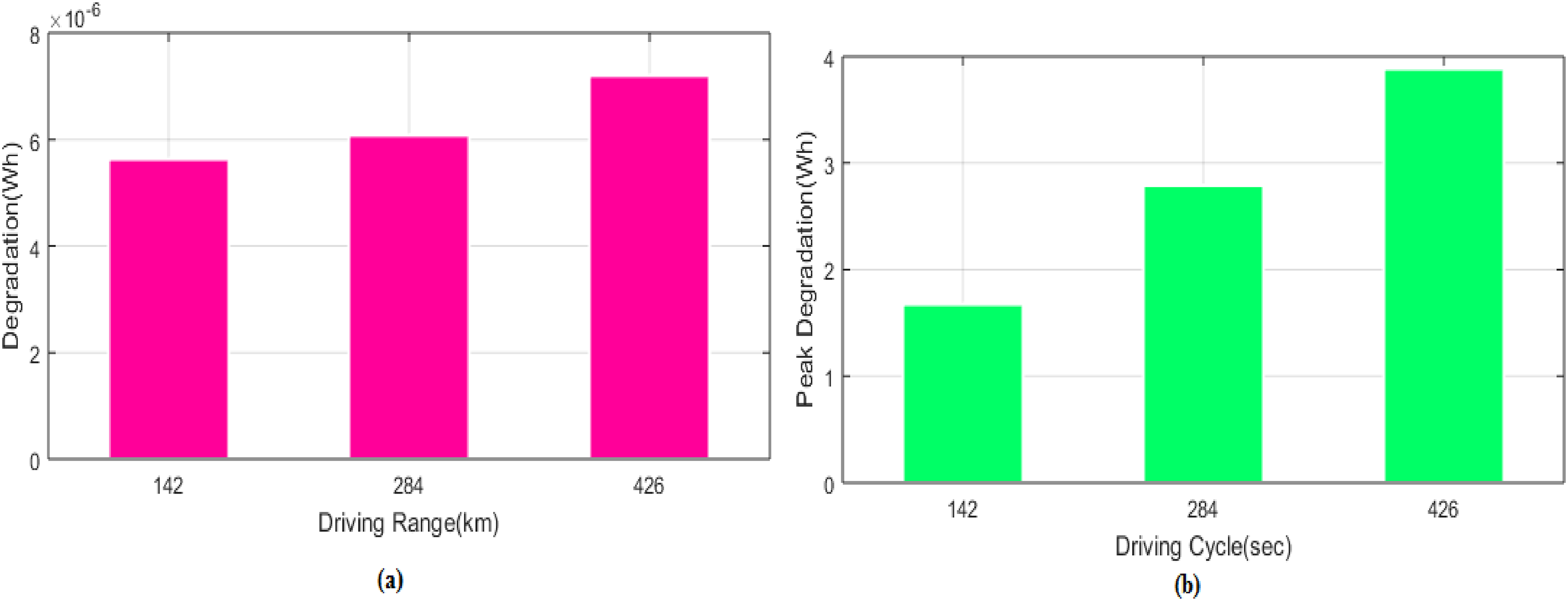
Analysis of (a) battery cell degradation (b) pack degradation.

Analysis of (a) optimal overall costs with HESS topology (b) battery and SC pack size with HESS topology.

HESS topology of (a) battery, (b) super capacitor pack energy throughputs after a single drive cycle.
Figure 13 describes the analysis of optimal overall cost with nominal bus voltage and battery and SC pack size with nominal bus voltage. Figure 13(a) shows that the increasing nominal voltage causes decreases in financial cost. Figure 13(b) proves that the nominal bus voltages do not impact the optimum battery or SC pack size. Figure 14(a) and (b) illustrate the battery cell current average with the usual bus voltage. The result shows that the high nominal bus voltage has little effect on average cell current, decreasing variation greatly.

Analysis of (a) optimal overall cost with nominal bus voltage (b) battery and SC pack size with nominal bus voltage.

Analysis (a) battery cell current average through nominal bus voltage (b) battery cell current using nominal bus voltage variation.
Figure 15(a) and (b) explain the analysis of optimal overall costs using DC/DC conversion efficiency and battery. The results represent that efficiency increases the overall costs reduces, as shown in Figure 15(a). Figure 16 describes the Analysis of (a) optimal general costs by Battery price (b) SC and battery pack size with Battery price. The result proves that the emerging battery price also raises the total cost, as depicted in Figure 16(a). The battery and supercapacitor pack size also rise with increasing battery price, as presented in Figure 16(b). Figure 17(a) and (b) depict the analysis of optimal overall costs with SC price and battery and SC pack size with SC price. The overall cost increases with emerging battery prices, as illustrated in Figure 17(a). The analysis of optimal overall costs with SC price using the proposed technique has the SC price for 5 to 25 USD/kWh hams a financial cost of 7.30385*104. The battery/SC pack size also increases with emerging battery prices, as shown in Figure 17(b).
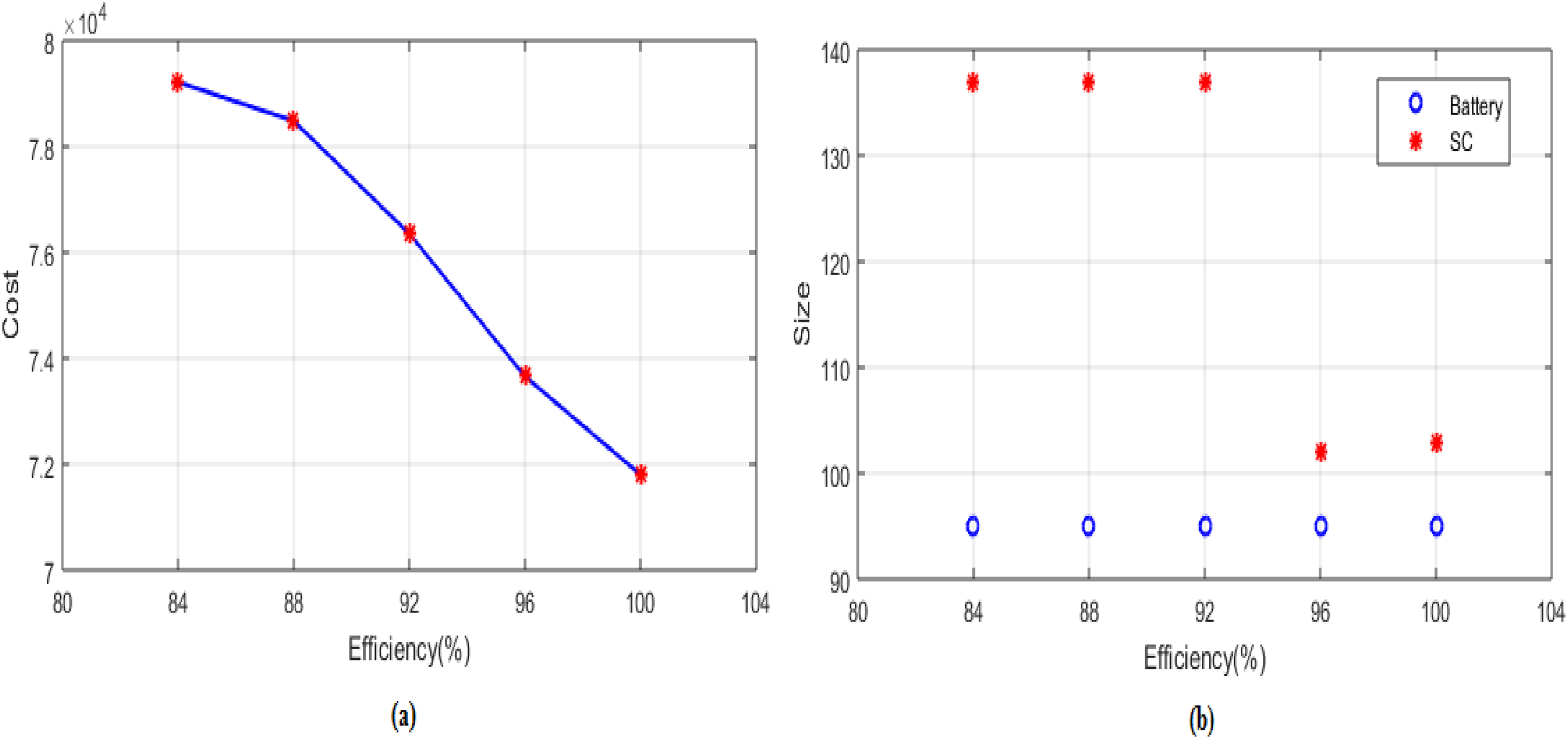
Analysis of (a) optimal overall cost (b) battery and SC pack size with DC/DC conversion efficiency.
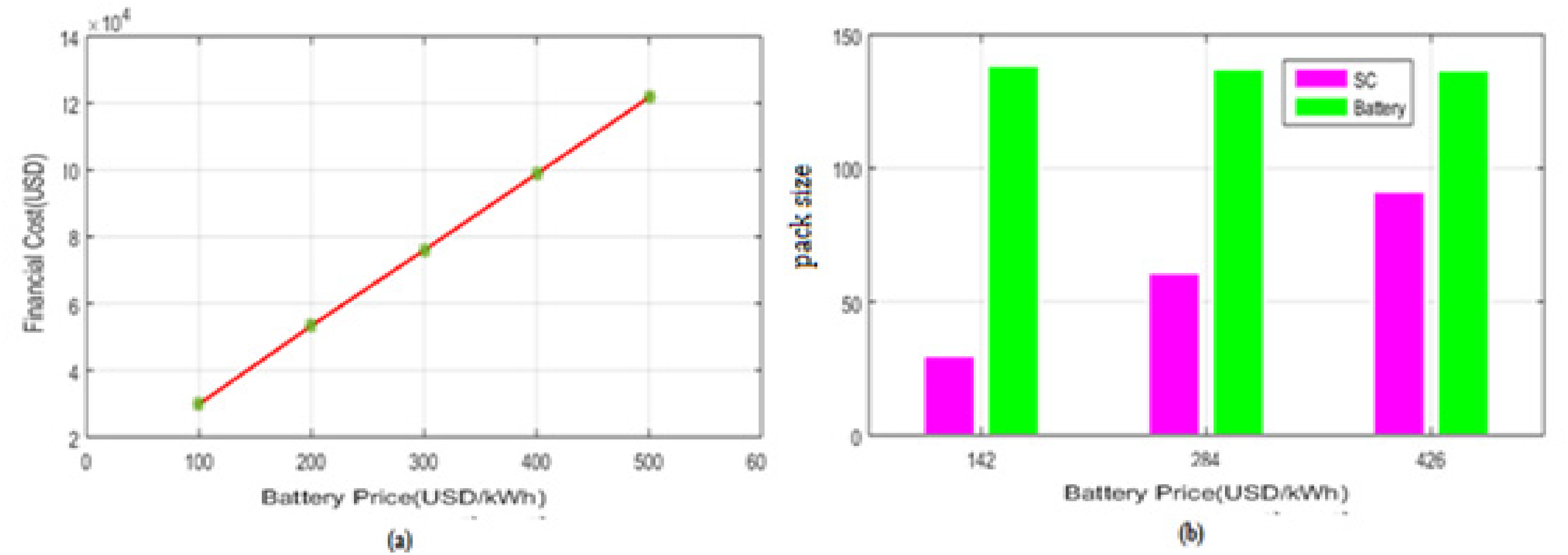
Analysis of (a) optimal general costs by Battery price (b) battery and SC pack size with Battery price.

Analysis of (a) optimal overall costs with SC price (b) battery and SC pack size with SC price.
Figures 18(a) and (b) show an analysis of the cost of purchasing supercapacitors and their relation to overall costs using supercapacitor prices. It shows that the SC price increases and the SC purchase cost rises. The proportion to increase the SC purchase cost with decreasing SC price. Figure 19(a) and (b) illustrate the analysis of optimal overall cost using DC to DC converter price and DC/DC converter price with Supercapacitors and battery pack size. Figure 19(a) signifies the DC/DC converter price value. Its price value increases but doesn’t impact the battery and SC pack size, which remains constant. The analysis of optimum total costs for the financial cost of 7.4244*104 has the dc to dc converter price achieves the value of 10 USD/kWh, 15 USD/kWh, 20 USD/kWh, 25 USD/kWh, and 30 USD/kWh. The analysis of battery pack size for pack size 92 has the DC-DC converter price achieves the value of 10 USD/kWh, 15 USD/kWh, 20 USD/kWh, 25 USD/kWh, and 30 USD/kWh. Battery and SC pack sizes are portrayed in Figure 19(b). The analysis of SC pack size for pack size 138 has the DC-DC converter price achieves the value of 10 USD/kWh, 15 USD/kWh, 20 USD/kWh, 25 USD/kWh, and 30 USD/kWh. Figure 20(a) and (b) illustrate the analysis of optimal overall cost with DC to DC converter purchase cost and their relation with general cost. Also, increasing the DC-DC converter price increases the proportion of the DC-to-DC converter purchase cost.

Analysis of (a) SC purchase cost with SC price (b) proportion to general cost.
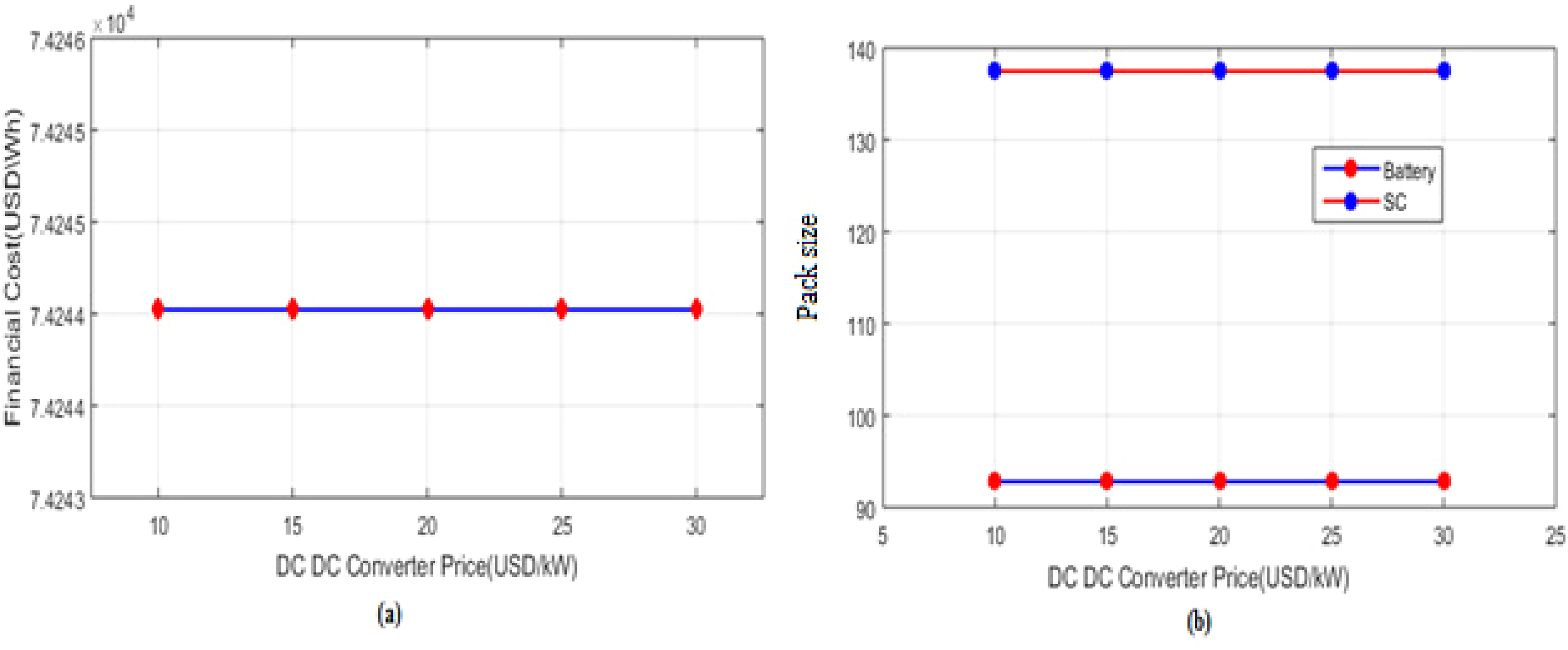
Analysis of (a) optimal overall cost (b) battery as well as SC pack size.
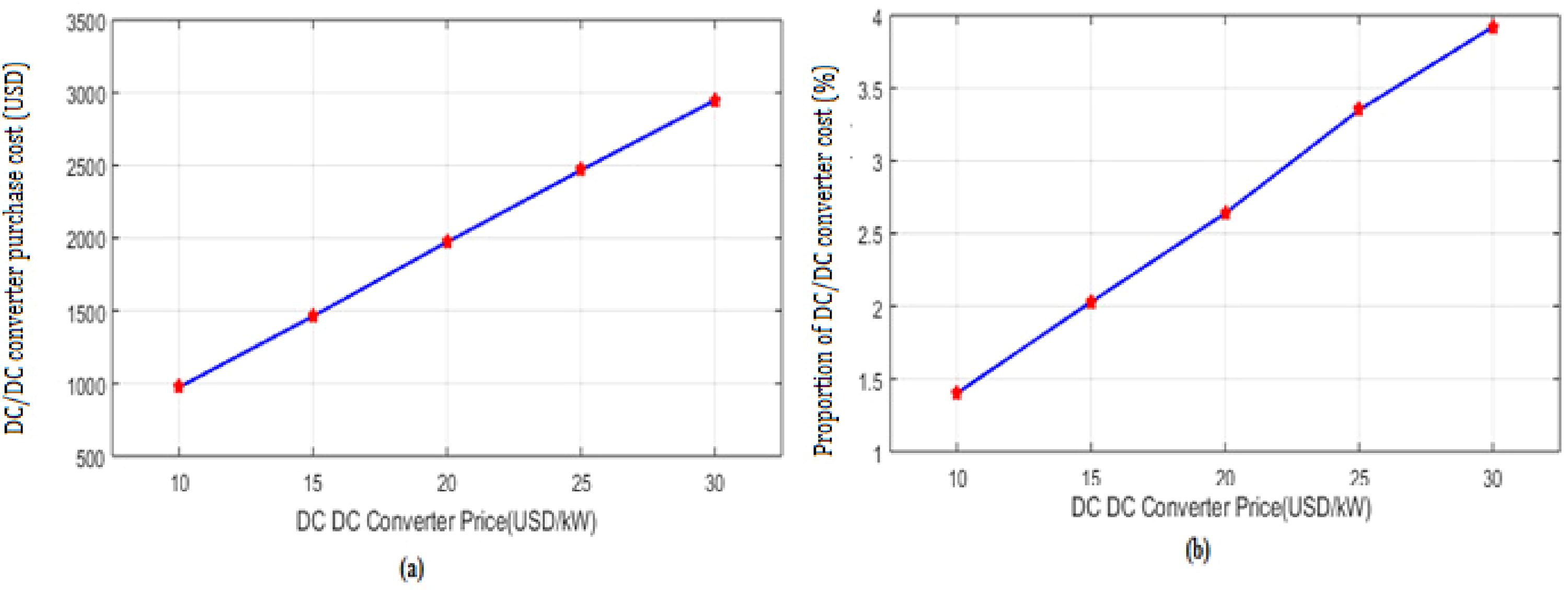
Analysis of (a) optimal overall cost (b) proportion to overall cost.
Figure 21 illustrates (a) energy losses with DC/DC conversion efficiency (b) DC/DC converter via energy throughput with DC/DC conversion. Figure 21(a) concludes that maximized efficiency value may result in less energy loss. The DC/DC converter is rises via energy throughput while raising efficiency.

(a) Energy losses with DC/DC (b) DC/DC converter via energy throughput via with DC/DC conversion.
Table 3 depicts the Choosing the right-sized samples for fitting and validating. It reports the model fitted on the whole existing sample and the results for five unrelated cut-off points:
Choosing the right-sized samples for fitting and validating.

First column: model fitted on entire existing data;
Second column: 80% of the data are present for a fitting sample;
Third column: 75% of the data are present for a fitting sample;
Fourth column: 70% of the data are present for a fitting sample;
Fifth column: 66% of the data are present for a fitting sample;
Sixth column: 50% of the data are present for a fitting sample;
Table 4 depicts the Efficiency comparison of proposed and existing techniques. It demonstrates that the variability of the model's estimations decreases with the amount of available data reserved for validation samples, whereas the calibration model's performance on validation samples worsens. The 75% cut-off point appears to be the best of five possible cut-off values. It gives us enough data to fit the model and provide reliable parameter estimates while having sufficient data to authenticate it. The existing systems, such as PSO GA, are selected. The efficiency comparison of proposed and existing techniques is portrayed in Table 4.
Efficiency comparison of proposed and existing techniques.

Conclusion
This work aimed to reduce the vehicle-lifetime costs of battery-super capacitor Hybrid ESS by creating a sizing issue with sensitivity analysis. This paper utilized the SPOA-RBFNN approach to reduce the vehicle's lifetime financial costs. The main objective of the proposed approach is the HESS measurement, which is considered as the general financial cost of HESS. The proposed technique analyzes the sub-costs and evaluates the optimizing structure to detect the optimum size of the hybrid energy storage system, which minimizes overall cost. The evaluation of the ideal hybrid ESS size and total costs with a range of factor values is examined. The proposed technique is analyzed using different sensitive factors. The effectiveness of DC-to-DC transformation and component price involved in optimal sizing and depreciation of the financial cost of the EV and different impact factors are quantified along with optimization. The proposed strategy is done in MATLAB and is evaluated for its performance with existing approaches. The proposed method provides low-cost, high efficiency compared to existing PSO and GA methods. The proposed method achieves an efficiency of 97.99%, significantly outperforming existing techniques such as GA is 82.14% and PSO is 77.27%. Existing techniques often rely on conventional controllers, leading to increased system complexity and reduced efficiency. The proposed approach, by formulating a sizing problem with sensitivity analysis, provides a more comprehensive understanding of the intricate design of energy management systems in hybrid EVs, a challenge overlooked by many studies. In summary, the proposed SPOA-RBFNN approach outperforms existing GA and PSO techniques by achieving higher efficiency, minimizing costs, and providing a more nuanced understanding of sensitivity to key factors. These improvements are substantiated by concrete numerical values and a rigorous performance comparison, highlighting the clear advantages of the proposed technique in optimizing battery-SC HESS for EVs.
Footnotes
Declaration of conflicting interests
The author(s) declared no potential conflicts of interest with respect to the research, authorship, and/or publication of this article.
Funding
The author(s) received no financial support for the research, authorship, and/or publication of this article.

Supplemental material
Supplemental material for this article is available online.