



Abstract
Adjusting industrial structure is the fundamental way of pollution control and environmental protection. Analyzing the PM2.5 pollution rebound effect of industrial structure adjustment based on heterogeneous technological progress and resource dependence is of great significance for in-depth and sustained pollution reduction. The results of combining the panel threshold regression model and the modified STIRPAT model on provincial panel data from 2008 to 2022 show that a 1% increase in structural upgrading results in a 0.4130% decrease in PM2.5 pollution; a 1% increase in structural rationalization results in a 0.0934% decrease in PM2.5 pollution. Resource dependence causes the PM2.5 pollution rebound effect of industrial structure adjustment; industrial structure upgrading with resource dependence has an insignificant increase effect on PM2.5 pollution, 1% increase of rationalization with resource dependence leads to a 2.8637% increase in PM2.5 pollution. As technology progresses, the increasing effect of industrial structure upgrading with resource dependence on pollution gradually weakens and finally transforms into a reduction effect; the reduction effect of industrial structure rationalization with resource dependence becomes an increasing effect causing the rebound to reappear and then turns to be a reduction effect again, show an invert “N.” Heterogeneous technological progress has the paradox impact mechanism on the pollution rebound; environmental protection technological progress can eliminate the pollution rebound, whereas energy-saving technological progress may cause a pollution rebound effect of industrial structure rationalization.
Keywords
Introduction
As the largest developing country, the long-run extensive economic development has given rise to increasingly prominent environmental pollution, especially PM2.5 pollution.1–3 PM2.5 pollution not only directly harms public health, but also adversely affects important sectors such as transportation and electricity, causing serious losses to the national economy. 4 Since the implementation of the Air Pollution Prevention and Control Action Plan (APPCAP) in 2013, PM2.5 pollution in China has been largely mitigated as a result of a series of stringent clean air actions in support of the APPCAP. However, heavy pollution weather has not yet been eliminated and has even picked up slightly in some areas of China.5,6 The 20th National Congress of the Communist Party of China (CPC) emphasized that China will deepen the prevention and control of environmental pollution, continue to fight for blue skies, and essentially eliminate heavy pollution weather. 7
Industrial structure adjustment (ISA) is a particularly important way of pollution control,8,9 and is regarded as an important driving force for promoting the coordinated development of the economy and ecological environment. 10 At present, the “three high” a industries and low value-added industries in China's industrial structure in China account for a considerable proportion. From the central to local governments, environmental regulations are being strengthened, and by formulating corresponding industrial policies, adjusting industrial structures to improve air quality. ISA can be measured by two dimensions: rationalization and upgrading.11,12 However, there exits PM2.5 rebound in the process of ISA (Figure 1). Industrial development is bound to use natural resources,13–15 which should be an imperative consideration in the process of ISA regarding reduction of carbon emissions.
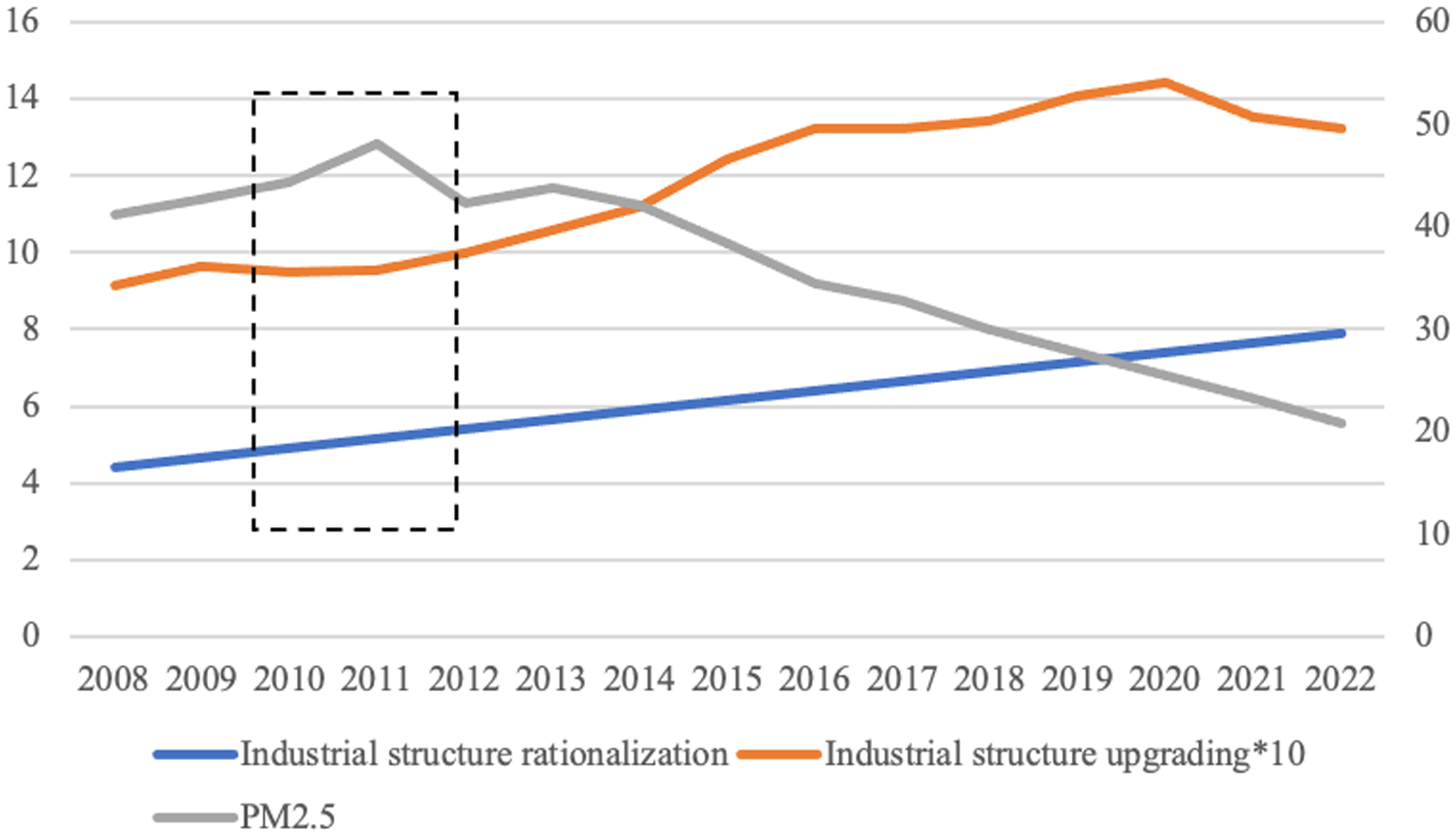
The relationship between ISA and PM2.5 pollution in China. c
Natural resources are well-known to constitute the basis for economic development,16,17 it may drive resource industries to easily become the leading local industries that other (usually resource-intensive) industries depend on which are usually high-emission industries. Many resource-rich countries plunged into an economic downturn at the end of the 20th century as a result, which is called the “resource curse.” b 18 Resource dependence may restrict the substantial results of ISA,19,20 thereby affecting the PM2.5 pollution emission reduction effect of the industrial structure, 21 which may lead to a rebound in PM2.5 pollution.
There are also success stories in countries such as Australia, Chile, and Norway showing that the “resource curse” is not a universal law. 22 The directions and speeds of ISA are different at different stages of technological development,21,23 which can weaken the distortion of resource dependence in relation to the effect of industrial structure on pollution reductions. According to the existing literature, technological progress has heterogeneous characteristics, which may also reduce production costs, causing the expansion of production activities in the process of ISA, thereby triggering more energy demand, and causing pollution to rebound.24–26
As the fundamental way of pollution control and environmental protection (Miao, 2012), it is essential to further transform economic development modes and adjust the industrial structure. However, there may be a rebound effect of pollution which may affect the substantial pollution reduction effect of the ISA, which is closely related to resource dependence degree, and the development stage of technology. In this regard, this research employs rigorous empirical study with the aim of the following questions: whether is there a distortion of resource dependence on the effects of industrial structure adjustment on PM2.5 pollution (EISAPP)? As technology progresses, how does the distortion caused by resource dependence change? What is the specific mechanism of ISA's PM2.5 pollution rebound effect when considering resource dependence and heterogeneous technological progress? The answers to these key questions are crucial to further enhancing the depth of pollution reduction through relevant policies in China.
The rest of the article is structured as follows: the “Literature review and hypothesis” section deals with three aspects; in the “Methodology and variables” section, methods and data used in the study are described; in the “Results and discussion” section, the influence of resource dependence and the influence of technological progress are described; the “Conclusions and policy implication” section concludes the article.
Literature review and hypothesis
This article is closely related to three research strands in the literature. The first strand is industrial structure and air pollution. The second strand is resource dependence. The last strand is technological progress. Therefore, the literature review here deals with three aspects.
The relationship between industrial structure adjustment and PM2.5 pollution
The research on the relationship between industrial structure and the environment comes from the composition effect proposed by Grossman and Krueger, 27 then there has been a growing body of literature targeting specific pollutants, such as SO2, soot, NOX, and their association with the industrial structure. Most scholars have found that changes in industrial structure play an important role in reducing emissions and improving environmental equality,28,29 Copeland and Taylor 30 found the industrial structure transformation had an impact on regional environmental pollution with the development of the economy by proposing a new decomposition equation. Then scholars further analyzed the relationship between industrial structure changes and pollution, most scholars thought the relationships were nonlinear31–33; Grossman 34 that the relationships between ISA and SO2 or soot-based environmental pollution show an inverted U-shaped trend. In terms of research methods, the literature used Kaye identity 35 or STRPAT model,36–38 applies the constructed single economic indicator as a proxy variable for the industry structure to verify the relationship between pollutants emissions and industrial structure. 39 Some scholars found that ISA can decrease PM2.5 pollution significantly, and the relationship is not linear.40–42 These studies focus more on exploring the relationship between industrial structure and PM2.5 pollution and do not explore the PM2.5 pollution rebound mechanism of ISA.
Industrial structure upgrading (ISU) refers to the transfer from agriculture-led to industry-led, and then to service-led,43,44 this shift restrains the further expansion of sectors with low productivity, and it can reduce PM2.5 pollution. Industrial structure rationalization (ISR) refers to the promotion of aggregation quality between industries and the improvement of resource utilization efficiency,12,20 thereby leading to the reduction of pollution. Hypothesis 1 is proposed:
The relationship between resource dependence and ISA
Many studies have empirically demonstrated that a large number of regions with abundant natural resources are trapped in the “resource curse”;45–48 for most countries and regions, having abundant resources hinders long-run economic growth rather than promotes it. This is because the regional natural resource can determine the local industrial structure.14,49,50 Hirschman 51 and Seers 52 had earlier proposed the impact of natural resources on regional industrial structure. Ran et al. 53 thought that natural resource dependence should be an imperative consideration that should be considered in industrial transformation. Under the inducement of resource dividends, the resource-based sectors can absorb capital, labor, and other limited production elements, resource-intensive industries show comparative advantages, 47 showing a lock-in effect, and the regions have more path dependence on industries with resource exploitation progressively, other industries shrink,54,55 weakening of sustainable development capabilities. The past literature focuses more on the impact of resource dependence on economic development mode or industrial structure, and few have further explored resource dependence's impact on “structural emissions.”
When the resource dependence degree is high, resources-based industries (usually high emissions industries) develop well, “resource curse” occurs. Resource dependence hinders the diversification of industries, distorting the pollution reduction effect, and the rebound effect appears. Therefore, Hypothesis 2 is proposed:
The relationship between technological progress and ISA
Technological progress is a key factor in transforming the resource curse into a resource blessing by changing the mode of economic development.56,57 Some scholars found that technological progress could improve the efficiency with which natural resources are utilized to affect industrial structure58,59 to achieve sustainable economic development. Some scholars have found significant differences in the directions and speeds of ISA in resource-rich regions at different stages of technological development, 20 it is tough to develop low-emission industries when the level of technological progress is low, and the primary industry may be promoted easily from labor- to capital- and technology-intensive with the development of technology.60–62 These studies focus more on the impact of technological progress on industrial structure, and there is no discussion about the impact of technological progress on industrial structure distortion effect caused by resource dependence, and little literature has further explored the “structural emissions” effects with resource dependence when technology develops.
Technological progress accelerates the upgrading of regional economies,11,63,64 and the distortion of resource dependence on industrial structure can be mitigated, thereby reducing PM2.5 pollution.
65
However technological progress may also increase energy demand,66,67 which can offset the decrease in energy intensity,
68
weakening the impact of industrial structure changes on pollution reduction. Therefore, Hypothesis 3 is proposed:
As mentioned by Huang et al.
69
and Li et al.,
70
technological progress could be divided into energy-saving technological progress (ES) and environmental protection technological progress (EP). ES helps to reduce energy consumption per unit of utility; however, it can make consumers and producers cost less to obtain the same amount of energy services, which may reduce economic pressure and lead to more consumption of energy,
71
which may result in pollution rebound. EP includes renewable energy technological progress, and other low-cost pollution control technological progress,72,73 containing the essential attributes of environmental protection and green development; during the process of ISA, pollution could be inevitably suppressed by efficient EP. Therefore, Hypotheses 4 and 5 are proposed:
Summary of current literature and the contribution of this study
The literature has made great advances regarding industrial structure, resource dependence, and technological progress; however, there are aspects requiring further study. First, while the existing literature has analyzed the effects of either resource dependence or technological progress on industrial structure, few studies have explored the two's impact on EISAPP and further combined the two to conduct a comprehensive analysis. Furthermore, there has been no comprehensive consideration of the rebound effect of PM2.5 pollution in the progress of ISA. In addition, the impact of scientific and technological progress on industrial structure is still controversial, there is no further analysis of the impact of heterogeneous technological progress on the PM2.5 pollution effect of industrial structure.
Thus, this paper attempts to integrate industrial structure and its effect on PM2.5 pollution, resource dependence, and heterogeneous technological progress into one analytical framework, providing a theoretical reference for further reducing pollution by adjusting industrial structure. This article first evaluates EISAPP using the modified STIRPAT model. Second, whether resource dependence can distort EISAPP is analyzed. Third, the threshold model and STIRPAT model are combined to examine whether heterogeneous technological progress could change the impact of resource dependence on EISAPP.
Methodology and data
In this section, the methods and data used in the study are described.
Model specification
The IPAT equation (holds that environmental impact (I) is the product of three factors: population (P), affluence (A), and technology (T) was originally proposed by Ehrlich and Holdren.
74
York et al.
75
proposed the STIRPAT (Stochastic Impacts by Regression on Population, Affluence, and Technology) model to overcome the limitation of the IPAT equation (e.g. it fails to measure the different effects of various factors on the environment), given by the stochastic form

The STRPAT model allows various factors to be appropriately improved or decomposed. This study draws on the STIRPAT model to construct a model for analyzing EISAPP from the perspective of resource dependence and heterogeneous technological progress; the PM2.5 concentration (PM—particulate matter with diameters that are generally 2.5 µm and smaller.) is taken as the object of environmental impact; ISU and ISR are used as technology variables; the population density is taken as the population scale variable. After taking the natural logarithm form, the modified model can be derived as follows:





In order to explore the impact of heterogeneous technological progress on EISAPP, ES, and EP are taken as the threshold values instead, respectively. Single-threshold model is depicted here (ISA is an abbreviation for either


Variables selection
PM2.5 pollution (PM)
The annual averaged PM2.5 concentration is taken as a proxy variable of PM2.5 pollution. The data is obtained from Dalhousie University Atmospheric Composition Analysis Group, Canada, and then captured by parsing the grid data using ArcGIS software. The units of PM2.5 concentration is μg/m3. This dataset has already been applied in several studies at both regional and national scales because it has the longest time series as well as the largest coverage.79,80
Industrial structure adjustment
The core explanatory variable of this study is ISA, there are two dimensions measuring structural changes in ISU and ISR.22,43
Industrial structure upgrading: According to the existing literature, service sector output values develop faster than industrial sector output values when the structure of the industrialization process advances, the paper uses tertiary industry's added value in comparison with secondary industry's added value as a measure of ISU.81,82 Industrial structure rationalization: To assess the degree of ISR, the reciprocal of the Theil index is used, according to Li et al., 2019, Shen and Lin, 2021.

Resource dependence (R)
Investments in the mining sector can be seen as a gauge of resource dependency because investment levels in the extractive industry depend entirely on the availability of resources. 83 But mining is not the only industry that depends on natural resources, and the same can be said for industries of farming, forestry, animal rearing, fishing, etc. The share of total whole-society fixed assets investment in agriculture, forestry, animal husbandry, fisheries, and extractive sectors are selected to achieve maximum accuracy in expressing the extent to which each region is reliant on resources.8,77
Technological progress (TP)
According to the previous literature, this article reflects the ratio of research and development (R&D) internal expenditure to GDP to measure technological progress.84–86 According to relevant literature, technological progress can be divided into EP and ES.
Environmental-protection technological progress: The level of EP relates to the ability it possesses to treat PM2.5 pollution that has been generated regarding economic development.87,88 This paper measures the efficacy of EP by PM2.5 pollution per GDP unit in each region.12,89,90 The efficacy of EP is higher as the value is lower. Energy-saving technological progress: ES results in increased output and intake of less energy.91,92 The efficacy of ES is measured by considering energy consumption per GDP.93,94 The efficacy of ES is higher as the value is lower.
Control variables
According to the STIRPAT model, economic development level and population scale, after taking the logarithms, are introduced into the model as the control variables.
Economic development level (GDP). According to Xing et al. 95 and Lin et al., 96 the gross domestic product per capita is applied to reflect the level of economic development.
Population scale (Pop). Considering that there are great differences in administrative division area and population scale between provinces, it is not scientifically comparable to directly use the absolute size indicator of population. According to Shao et al., 3 population density, that is, the number of people per unit area is used to represent the population scale.
Data sources
The original data on PM2.5 concentrations (denoted by the annual concentration) used in this article is freely available as a public good from the Dalhousie University Atmospheric Composition Analysis Group at a high spatial resolution of 1 km × 1 km, then these raster data is parsed into annual average PM2.5 concentration data for 30 provinces in China from 2008 to 2019 using ArcGIS software (Tibet, Hong Kong, Macau, and Taiwan are excluded).
In addition to the data on PM2.5 concentrations, the original data of other selected indicators are derived from the China Statistical Yearbook, Provincial Statistical Yearbook, EPS Database, and CNRDS Database, covering 30 provinces across China from 2009 to 2022 (Tibet, Hong Kong, Macau, and Taiwan are excluded).
Results and analysis
The influence of resource dependence on the PM2.5 effect of ISA
Panel data test
The stationarity and collinearity of the data should be tested first. The test results are shown in Table 1. The panel data passed the stationarity test indicates no multicollinearity between variables, the econometric models are used accurately.
Panel data test.
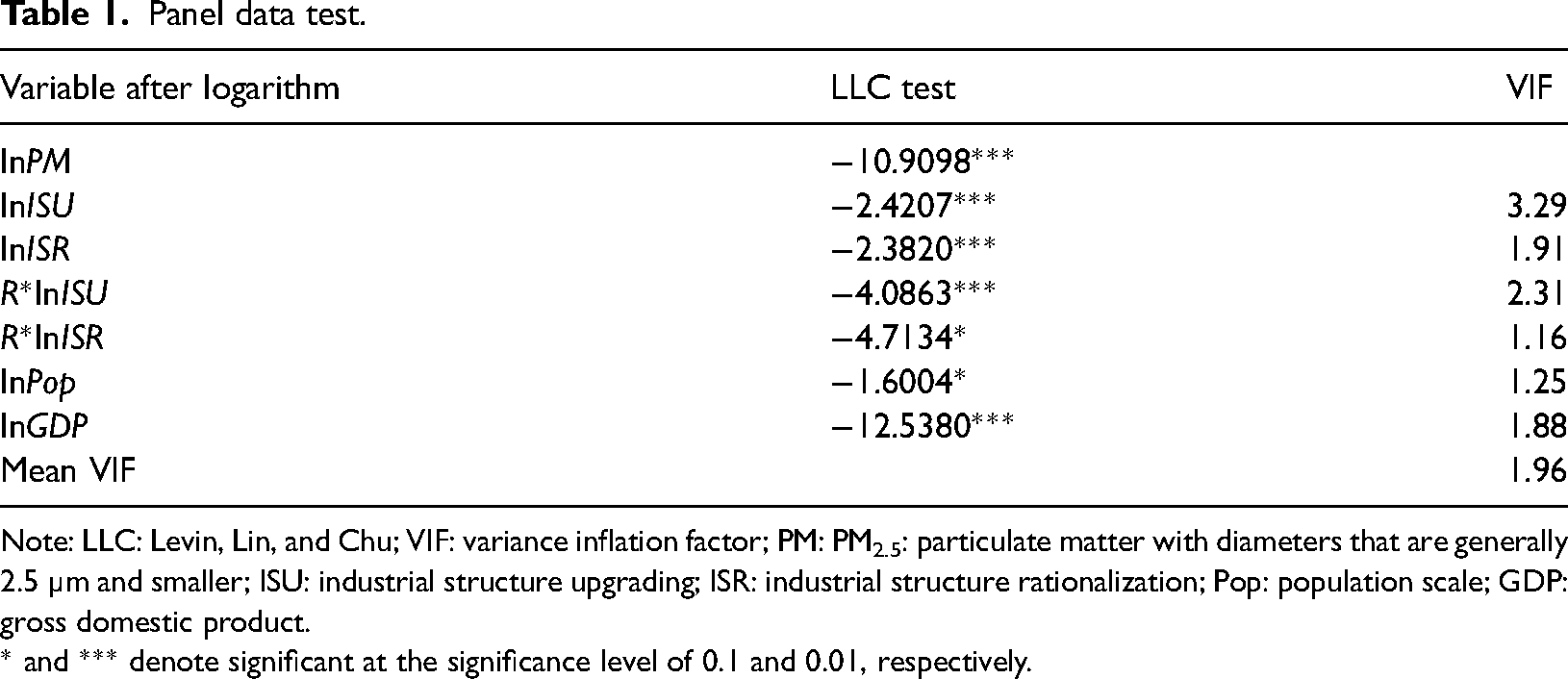
Note: LLC: Levin, Lin, and Chu; VIF: variance inflation factor; PM: PM2.5: particulate matter with diameters that are generally 2.5 µm and smaller; ISU: industrial structure upgrading; ISR: industrial structure rationalization; Pop: population scale; GDP: gross domestic product.
* and *** denote significant at the significance level of 0.1 and 0.01, respectively.
Basic panel model
Table 2 shows the benchmark model's estimated results. Results from Model 2 indicate that a 1% increase in ISU results in a 0.4130% decrease in PM2.5 pollution; a 1% increase in ISR results in a 0.0934% decrease in PM2.5 pollution. Both ISU and ISR can help to realize the PM2.5 pollution reduction. This result can be explained by the connotations of ISU and ISR. ISU emphasizes the evolution of industrial structure from low-level industries to high-level industries, such as the transformation of industries from labor-intensive to technology-intensive, and from pollution-intensive to green environment-intensive, which reduces pollution. 97 ISR emphasizes the coordination between various industries, and its purpose is to achieve a virtuous cycle of population resources and the environment. Optimizing the input–output structure can improve the coordination capabilities and correlation levels between various industries, thereby maximizing resource allocation efficiency and reducing the environmental pollution. 12 H1 is supported.
Regression results of the basic panel model.

Note: ISU: industrial structure upgrading; ISR: industrial structure rationalization; Pop: population scale; GDP: gross domestic product.
** and *** indicate significant at the significance level of 0.05 and 0.01, respectively.
With resource dependence (R) introduced as a cross-term into Model 3 and Model 4, the coefficient of ISU on pollution is 2.8637, as the level of ISU increases by 1%, PM2.5 pollution increases by 2.8637%; the coefficient of ISR changes into 0.6872 (insignificant). It shows that the resource dependence changes the pollution reduction effect of ISU into the pollution increase effect; meanwhile, it makes the reduction effect of ISR insignificant. More emphasis is placed on resource-based sectors when the local economy is more reliant on resources; human and material resources are confined to these particular businesses, resulting in a “crowding out” impact on some of the other industry sectors and the “resource curse,”98,99 which hinders the diversification of industries and affect the advancement of their industrial structure, thereby affecting EISAPP. H2 is supported.
The estimation results also show the population scale has an insignificantly increased effect on PM2.5 pollution, it can affect pollution through the scale effect and agglomeration effect.42,100 On the one hand, housing, appliances, and automobiles are all in great demand in densely populated places, meanwhile, the wind speed decreases as a result of the increased density of people living in close proximity, making it more difficult for pollutants to diffuse, all of these can increase the level of PM2.5 pollution in the air, that is the scale effect of the population 101 ; on the other hand, the increase in population density has agglomeration effects, improving the sharing rate of public transportation, resource use efficiency, sharing pollution control and emission reduction facilities to reduce pollution. 102 From the results, the scale effect clearly has the “upper hand,” while the positive externality of the agglomeration effect has not been fully exerted.
Economic development reduces pollution significantly. According to the classic EKC hypothesis, in the process of economic development, pollution first increases and then decreases, which proves that the inflection point of the “U” curve has been crossed at present.103,104
Influence of technological progress on EISAPP with resource dependence
In order to analyze the effects of technological progress on the PM2.5 pollution effect of industrial structure rationalization with resource dependence, this article uses technological progress as the threshold variable.
Influence of technological progress on PM2.5 pollution effect of industrial structure upgrading with resource dependence
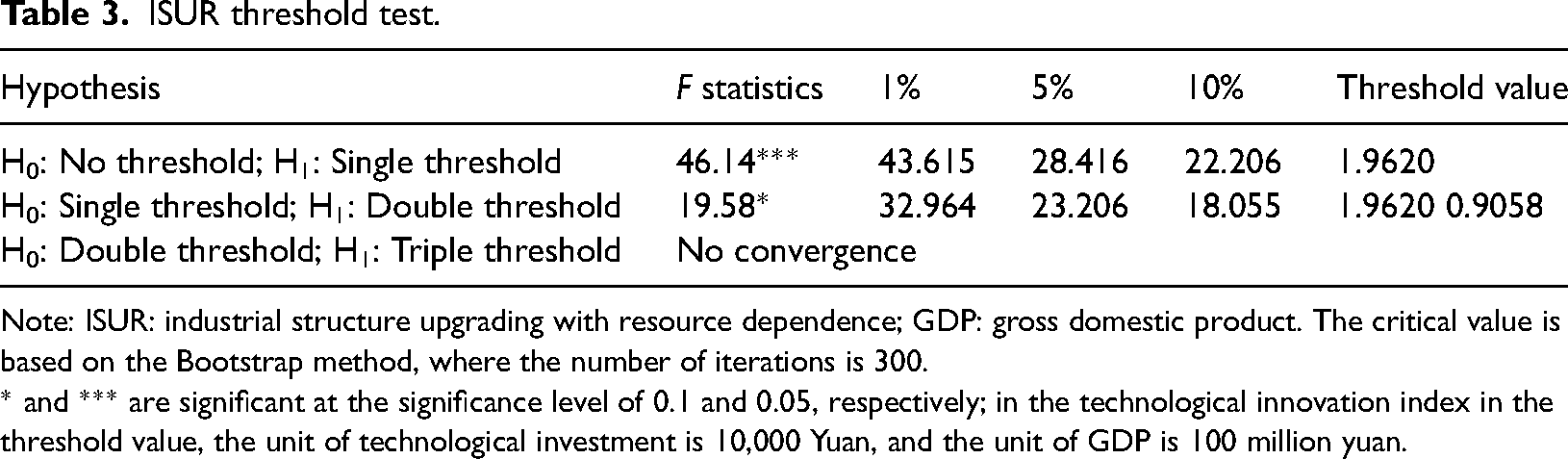
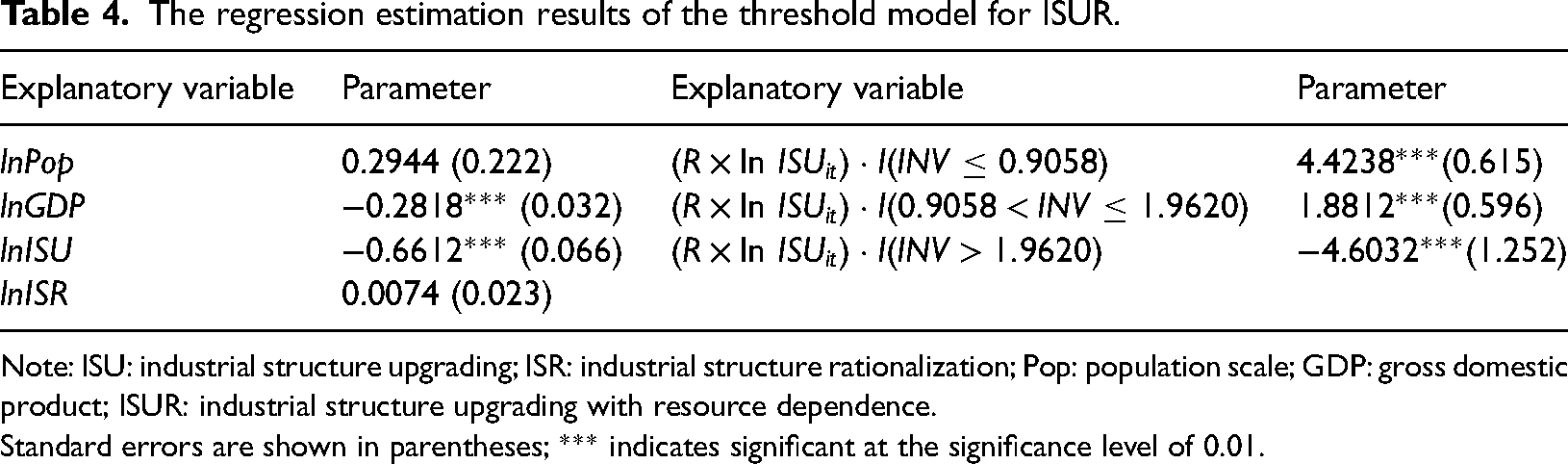
Panel threshold model taking technological progress as the threshold variable: The industrial structure upgrading with resource dependence (ISUR) has a double threshold effect on PM2.5 pollution as technology progresses (Table 3). Taking ISUR as the fundamental explanatory variable, 0.9058 is the value that serves as the first threshold, and the second threshold value is 1.9620 (Figure 2). As technology progresses, ISUR initially increases pollution, then the increasing effect weakens, and at last, ISUR can decrease pollution, showing the three-stage mechanism of PM2.5 pollution. When the value of the technological progress index is < 0.9058, the ISUR level rises by 1%, the pollution increases by 4.4238%; when the index of technological progress value is < 1.9620 and > 0.9058, and the PM2.5 pollution increases by 1.8812% for every 1% rise of ISUR level; when the value of technological progress is > 1.9620, the PM2.5 pollution decreases by 4.6032% with 1% rise of ISUR level (Table 4). When the technology development level is low, resource dependence distorts EISAPP obviously showing an increasing effect on pollution; the resource-based industrial structure compresses the development space of higher-productivity industries such as manufacturing and hinders the process of the industrial structure
105
; with the regional agglomeration of high-energy-consuming industries, the resulting industrial agglomeration effect has strengthened the “resource curse” to a certain extent and runs counter to environmental improvement.
106
When the technology progresses, the distortion effect of resource dependence on ISU begins to decrease and then shows a reduction effect on pollution, technological progress can improve energy efficiency and reduce the use of high-energy-consuming resources,
107
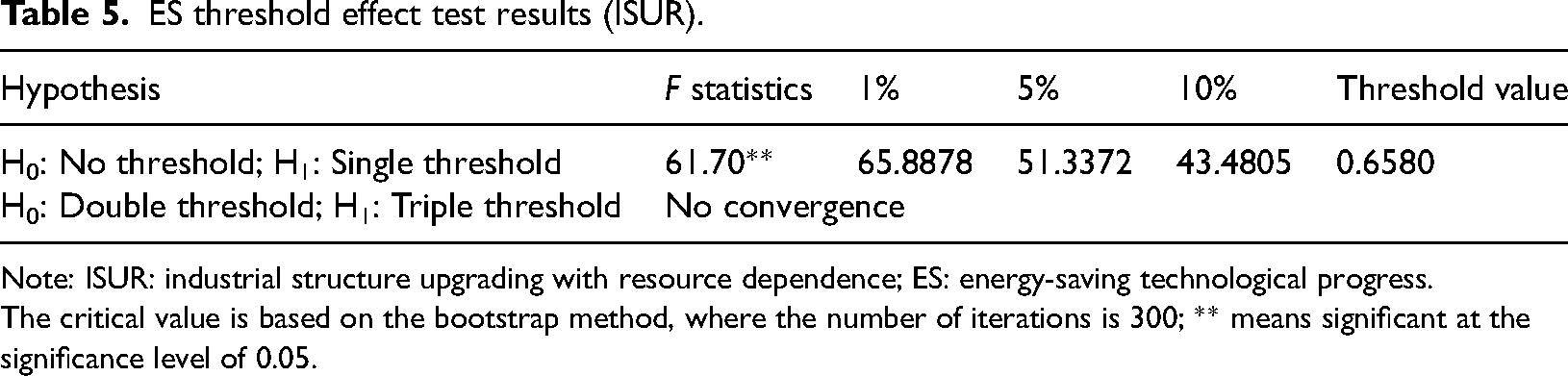
resource dependence's distorting effect is obviously not sufficiently offset in the second stage; when the technology reaches the third stage of development, the rebound effect disappears. Panel threshold model taking ES as the threshold variable: Table 5 and Figure 3 show that when ES is the threshold variable, a double threshold effect exists at the 10% level, with the threshold value of 0.6580. Table 6 shows the estimated parameters of the threshold model when ES is considered as the threshold variable. When the value of ES is > 0.6580, PM2.5 pollution increases by 3.575% when the level of ISU improves by 1%, when ES falls below 0.6580, the level of ISU improves by 1%, pollution decreases by 2.356%. The coefficient of ISUR affecting PM2.5 pollution changes from positive to negative with ES developing from the first stage to the second stage. During the early development stage of energy-saving technology, combined with resource dependence's distortion effect, ISUR has an increasing effect on pollution; as ES develops, the distortion effect of resource dependence is alleviated. At present, China's industrial structure transformation is mainly based on the development of new energy industries and high-end manufacturing to achieve green development transformation. ES is the driving force for the development of new energy industries and high-end manufacturing industries.
108
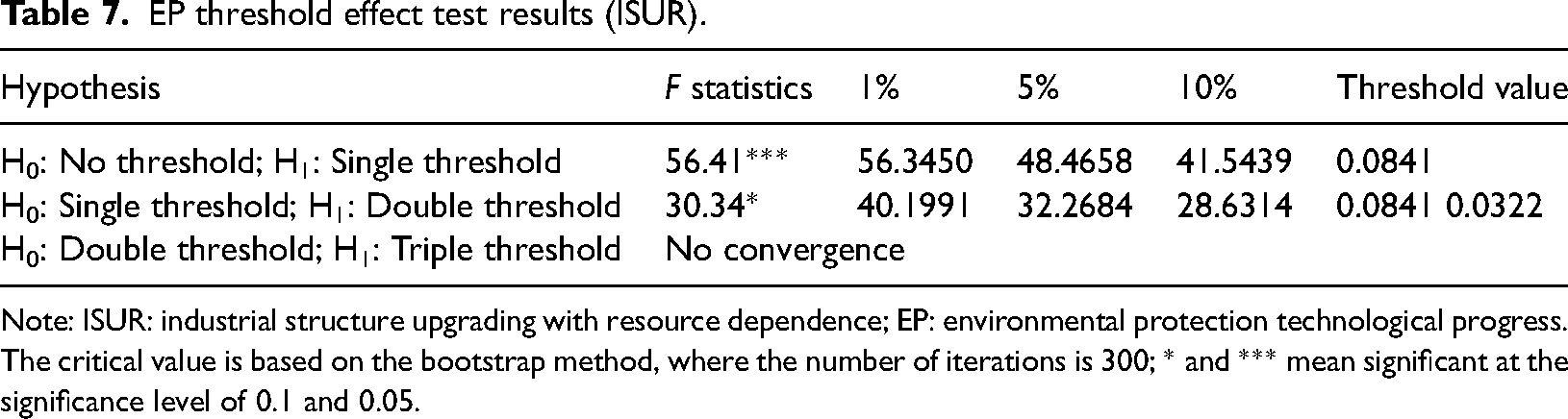
In this context, ES can reduce the impact of resource dependence on ISR; meanwhile, it actively improves the reduction effect of ISR on PM2.5 pollution. Panel threshold model taking EP as the threshold variable: Table 7 and Figure 4 demonstrate that when EP is the threshold variable, the panel threshold model has a double threshold effect, with threshold values of 0.0322 and 0.0841. The EP threshold model's parameter estimations are provided in Table 8. When EP is over 0.0841, a 3.5575% increase in PM2.5 pollution results from increasing ISUR by 1%; when EP is below 0.0841 and over 0.0322, a 1% rise in ISUR leads to a 2.0761% decrease of pollution; when EP is over 0.0322, 1% rise of ISUR leads to 57.3211% decrease of pollution. As environmental protection technologies progress from the first to the second stage and third stage, the distortion effect of resource dependence on ISU's PM2.5 pollution reduction effect is eliminated, and the reduction effect is further amplified. EP emphasizes the idea of minimal pollution during the process of industrial restructuring; as EP develops, low pollution and green concepts become popular,
109
expanding the pollution reduction effect of ISU.
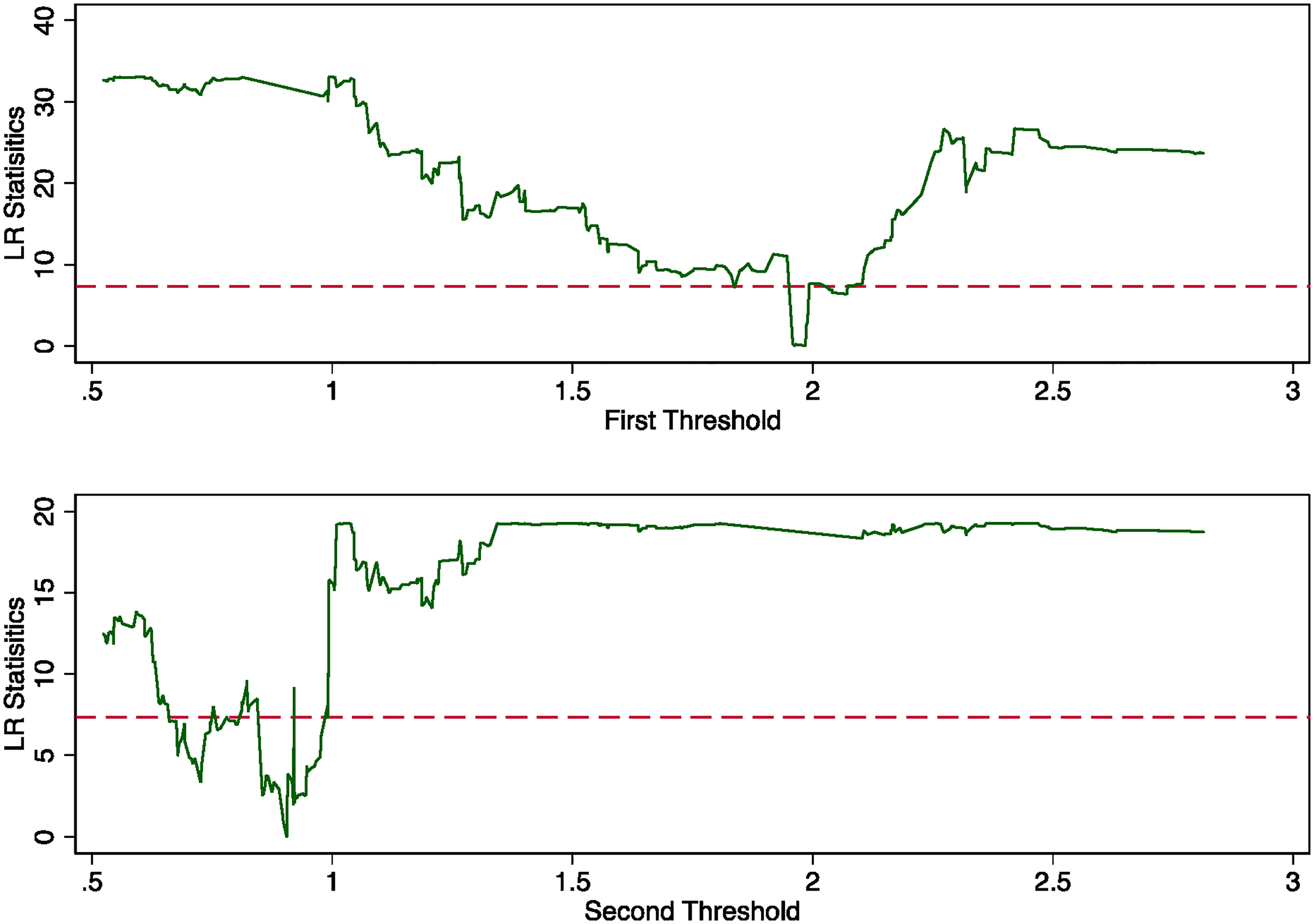
Estimated value of the threshold for industrial structure upgrading with resource dependence (ISUR).

Estimated ES threshold value (ISUR).
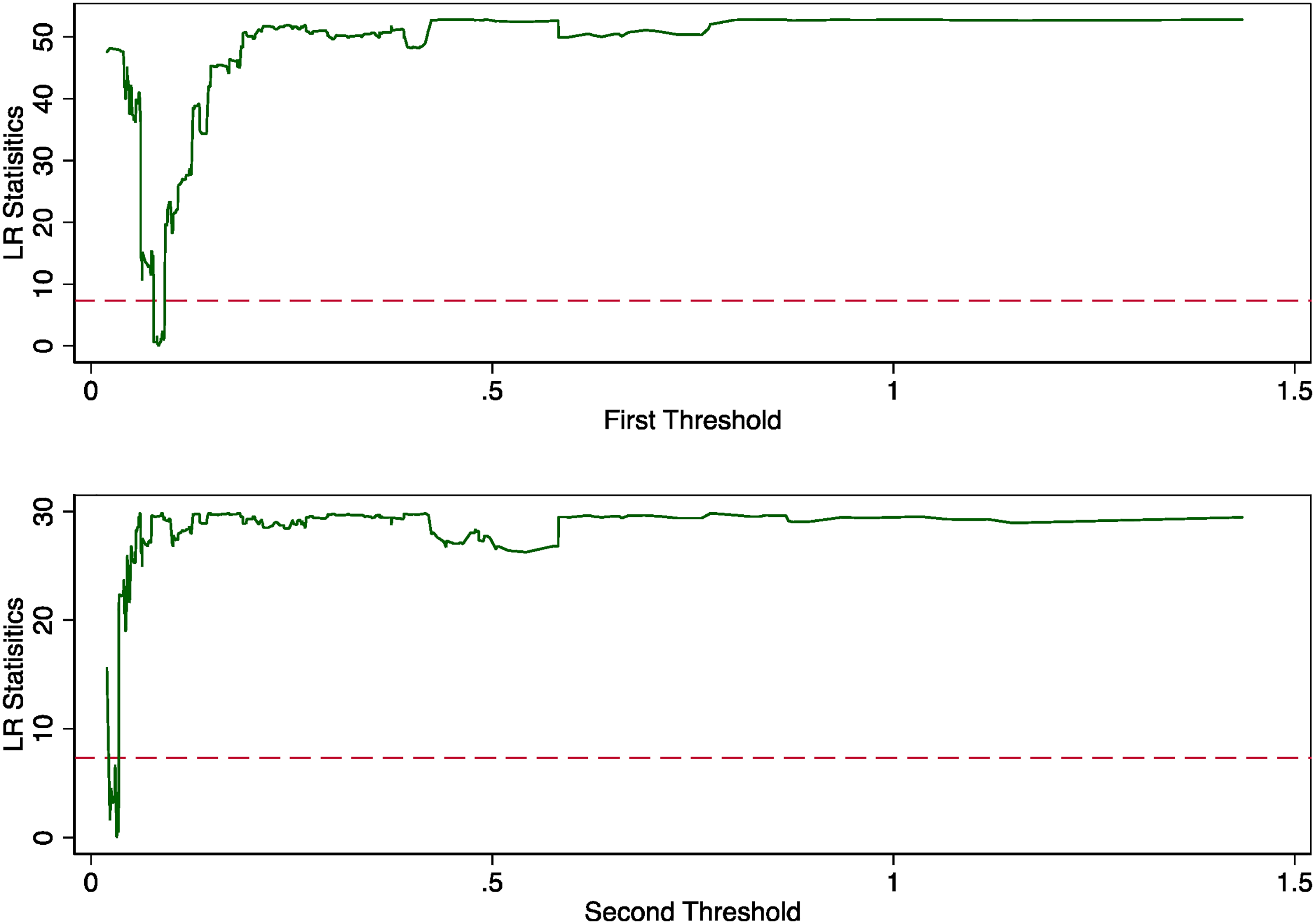
Estimated threshold value with EP as the threshold variable (ISUR).
ISUR threshold test.
Note: ISUR: industrial structure upgrading with resource dependence; GDP: gross domestic product. The critical value is based on the Bootstrap method, where the number of iterations is 300.
* and *** are significant at the significance level of 0.1 and 0.05, respectively; in the technological innovation index in the threshold value, the unit of technological investment is 10,000 Yuan, and the unit of GDP is 100 million yuan.
The regression estimation results of the threshold model for ISUR.
Note: ISU: industrial structure upgrading; ISR: industrial structure rationalization; Pop: population scale; GDP: gross domestic product; ISUR: industrial structure upgrading with resource dependence.
Standard errors are shown in parentheses; *** indicates significant at the significance level of 0.01.
ES threshold effect test results (ISUR).
Note: ISUR: industrial structure upgrading with resource dependence; ES: energy-saving technological progress.
The critical value is based on the bootstrap method, where the number of iterations is 300; ** means significant at the significance level of 0.05.
Regression estimation results of ES threshold model.

Note: ISU: industrial structure upgrading; ISR: industrial structure rationalization; Pop: population scale; GDP: gross domestic product; ES: energy-saving technological progress.
Standard errors are shown in parentheses; ** and *** indicate significance at the 0.05 and 0.01 significance levels, respectively.
EP threshold effect test results (ISUR).
Note: ISUR: industrial structure upgrading with resource dependence; EP: environmental protection technological progress.
The critical value is based on the bootstrap method, where the number of iterations is 300; * and *** mean significant at the significance level of 0.1 and 0.05.
Regression estimation results of EP threshold model (ISUR).

Note: ISU: industrial structure upgrading; ISR: industrial structure rationalization; Pop: population scale; GDP: gross domestic product; ISUR: industrial structure upgrading with resource dependence; EP: environmental protection technological progress.
Standard errors are shown in parentheses; *, **, and *** indicate significance at the 0.1, 0.05, and 0.01 significance levels, respectively.
Influence of technological progress on PM2.5 pollution effect of industrial structure rationalization with resource dependence
Panel threshold model taking technological progress as the threshold variable: The industrial structure rationalization with resource dependence (ISRR) has a double threshold effect on PM2.5 pollution as technology progresses (Table 9 and Figure 5), 0.6300 and 1.2300 are the values that constitute the thresholds. The results in Table 10 show that as technology develops, ISRR leads to a decrease, then to an increase, and a decrease in PM2.5 pollution. When the value of technological progress is < 0.6300, PM2.5 pollution is significantly reduced by 1.9642% with an increase of 1% of ISRR; when the level of technological progress is > 0.6300 and < 1.2300, PM2.5 pollution increases by 0.1832% in response to each 1% rise of ISRR; when the level of technological progress is > 1.2300, PM2.5 pollution decreases by 1.0708% in response to each 1% rise of ISRR. When the technological level is low, technological progress can counteract the distortion effect of resource dependence on ISR. As technology develops, ISRR's reduction effect on pollution has been reversed, resulting in a negligible rise in that pollution. ISR refers to the degree of industrial coordination and aggregation, which is manifested in the rational allocation of resource elements and the dynamic balance of resource elements (Zhu and Zhang et al., 2019). However, this reallocation of resources within the sector relaxes the factor constraints of economic development (Hartwig, 2012; Zhou and Song et al., 2020); as technology progresses, ISRs that use more energy to achieve growth may lead to a pollution rebound effect. Then, as technology progresses further, ISR improves the utilization efficiency of scarce resources, promotes consumption transformation, and thereby promotes sustainable development (Zhou and Song et al., 2020). Panel threshold model taking ES as the threshold variable: The rebound effect of ISRR on pollution in the process of technology development may be due to the distortion induced by ES, which needs further analysis. Replacements for technological progress (TP) are then made for ES. Table 11 and Figure 6 show that there is only one threshold effect with the threshold variable ES and the primary explanatory variable ISRR, which is significant at the 5% level with a threshold value of 0.1155. Taking ES for the threshold variable, the parameter estimation for the threshold model is displayed in Table 12. When ES is above 1.0429, ISRR increases by 1%, reducing pollution by 0.6994%; when ES is below 0.1155, ISRR increases by 1%, increasing PM2.5 pollution by 0.4478%. As ES develops, the reduction effect of ISRR on PM2.5 pollution turns out to be an increasing effect. In the early development stage of ES, the energy cost is lowered,
110
ISR optimizes allocation of resources, the distortion effect of resource dependence on ISR is mitigated; with the further development of ES, ISR allows resource elements to be used more efficiently, increasing energy consumption, and causing the pollution rebound effect (Table 13). Panel threshold model taking EP as the threshold variable: Table 12 and Figure 7 show the results that there is only a single threshold effect with the threshold variable EP, and the primary explanatory variable ISR with resource-dependent, the threshold value is 0.1895. Table 14 displays the parameter estimates when the threshold variable is EP. When EP is above 0.0823, ISRR has a significant increase effect on PM2.5 pollution; when EP is below 0.0823, the PM2.5 pollution decreases by 1.0569% with a 1% increase of ISRR. EP contains the essential attributes of environmental protection and green development,
90
which enables more attention to environmental issues when allocating resources in the process of ISR, thereby reducing pollution. In the first development stage of EP, the distortion effect of resource dependence on ISR has been substantially reduced. As EP progresses, the PM2.5 pollution reduction effect of ISR is improved significantly, offsetting the distortion effect of resource dependence.

Estimated value of the threshold for industrial structure rationalization with resource dependence (ISRR).

Threshold estimate with energy-saving technological progress (ES) as the threshold variable.
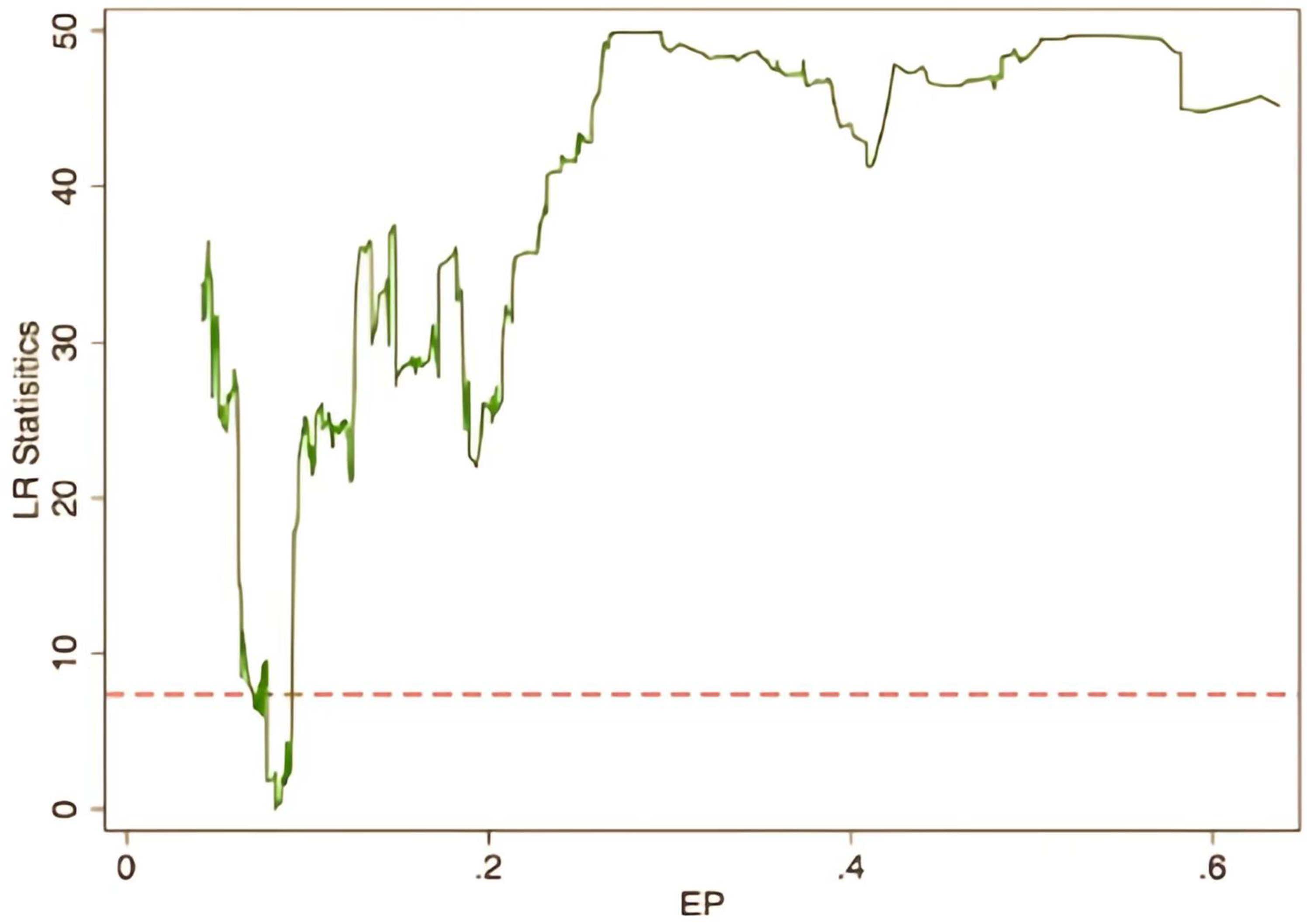
Threshold estimate with environmental protection technological progress (EP) as the threshold variable.
ISRR threshold test.
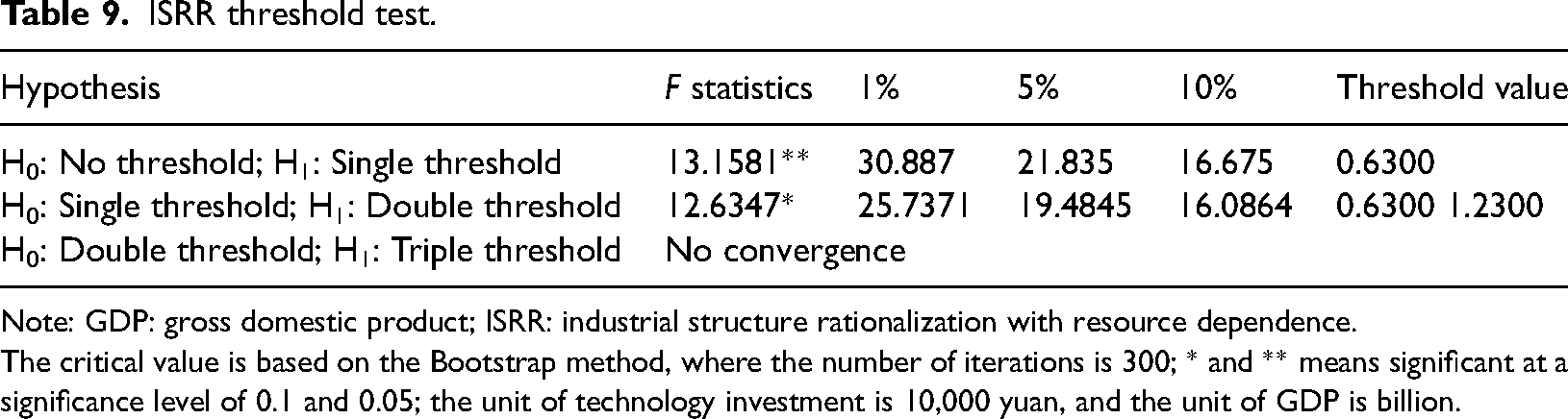
Note: GDP: gross domestic product; ISRR: industrial structure rationalization with resource dependence.
The critical value is based on the Bootstrap method, where the number of iterations is 300; * and ** means significant at a significance level of 0.1 and 0.05; the unit of technology investment is 10,000 yuan, and the unit of GDP is billion.
The regression estimation results of the threshold model for ISRR.
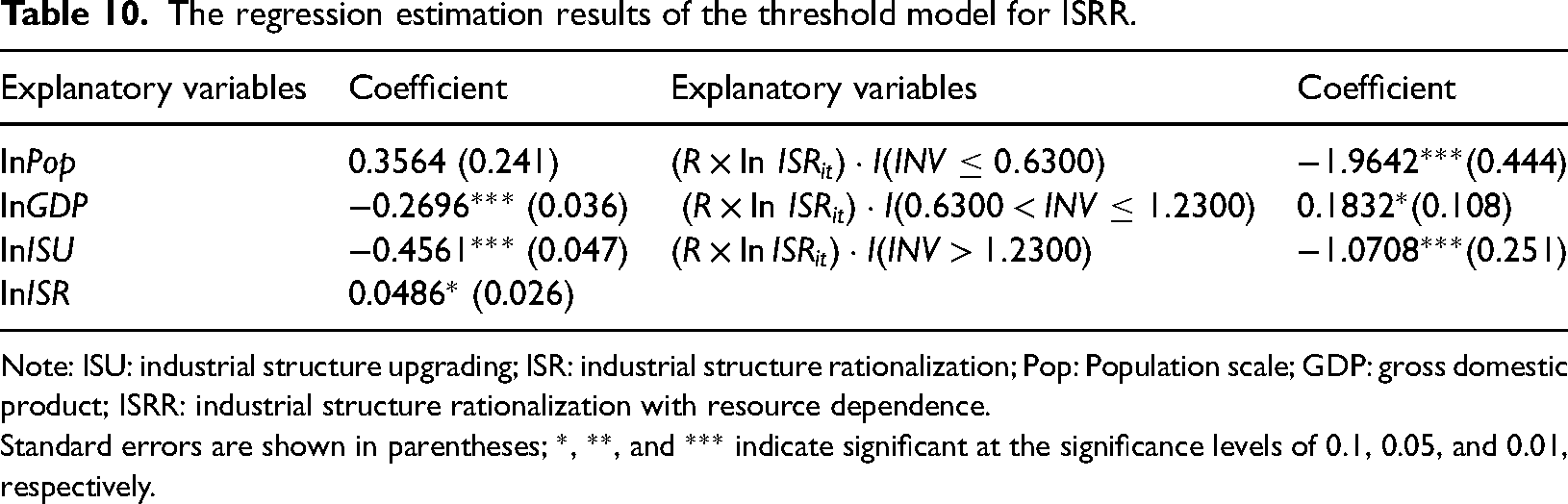
Note: ISU: industrial structure upgrading; ISR: industrial structure rationalization; Pop: Population scale; GDP: gross domestic product; ISRR: industrial structure rationalization with resource dependence.
Standard errors are shown in parentheses; *, **, and *** indicate significant at the significance levels of 0.1, 0.05, and 0.01, respectively.
Energy-saving technological progress (ES) threshold effect test results.

Note: The critical value is based on the bootstrap method, where the number of iterations is 300; ** means significant at the significance level of 0.05.
Regression estimation results of ES threshold model.
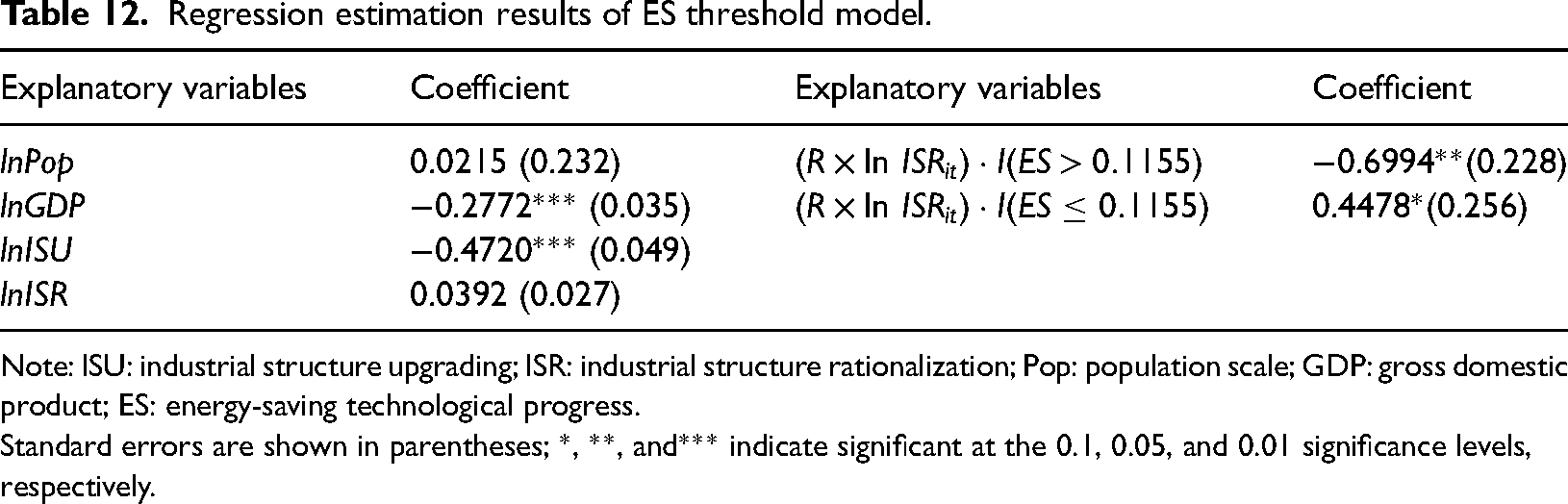
Note: ISU: industrial structure upgrading; ISR: industrial structure rationalization; Pop: population scale; GDP: gross domestic product; ES: energy-saving technological progress.
Standard errors are shown in parentheses; *, **, and*** indicate significant at the 0.1, 0.05, and 0.01 significance levels, respectively.
Environmental protection technological progress (EP) threshold effect test results.
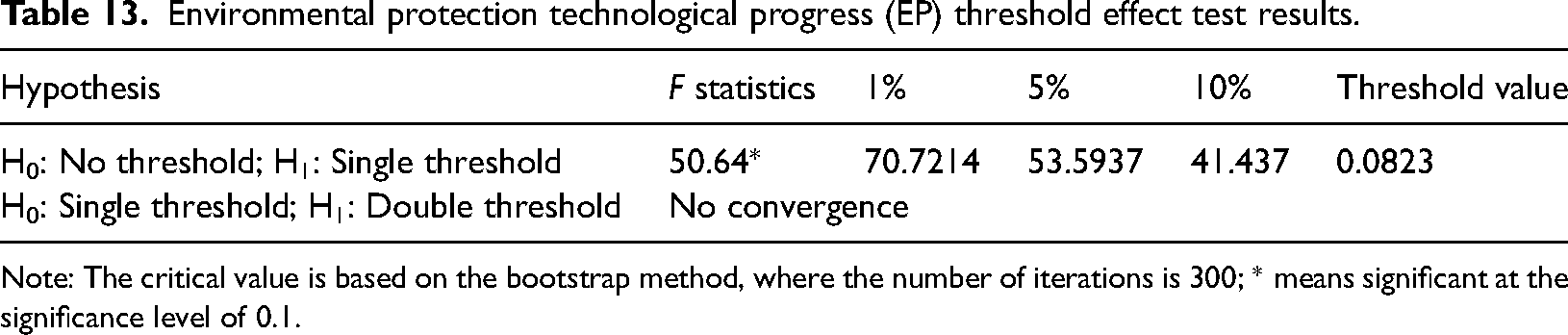
Note: The critical value is based on the bootstrap method, where the number of iterations is 300; * means significant at the significance level of 0.1.
EP threshold model regression estimation results.
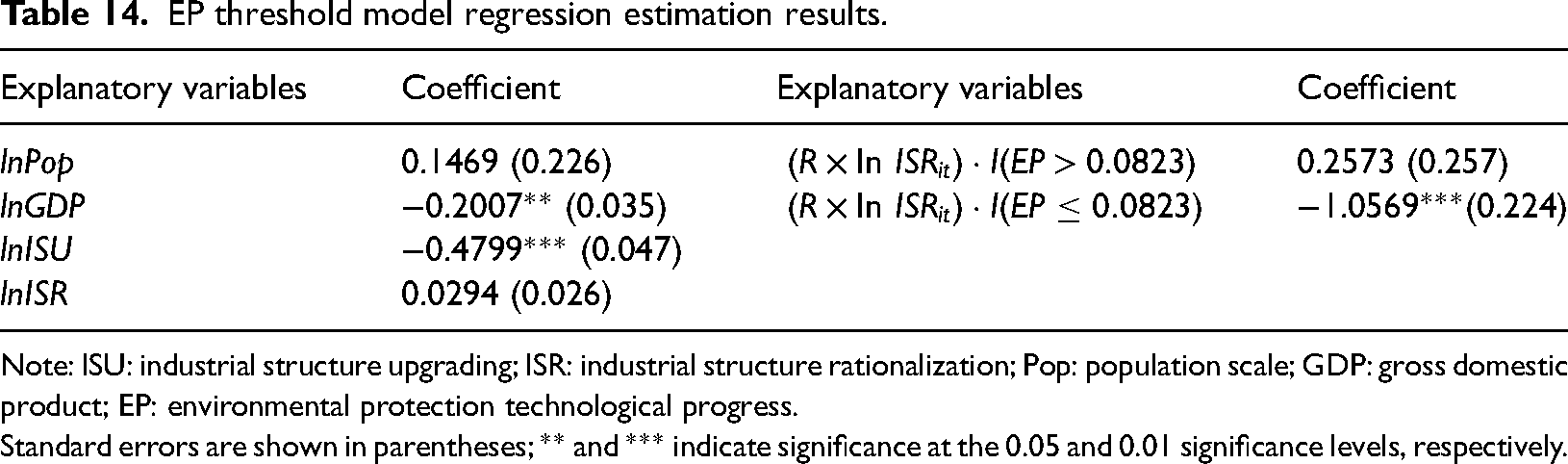
Note: ISU: industrial structure upgrading; ISR: industrial structure rationalization; Pop: population scale; GDP: gross domestic product; EP: environmental protection technological progress.
Standard errors are shown in parentheses; ** and *** indicate significance at the 0.05 and 0.01 significance levels, respectively.
Discussion
Despite the significance of ISA in order to cope with PM2.5 pollution, the understanding of PM2.5 pollution rebound in the process of ISA is still limited. To overcome this omission in the extant literature, and gain more insight into EISAPP, this study not only analyzed the distortion effect of resource dependence on EISAPP but also explored whether technological progress can eliminate the distortion and its mechanism based on heterogeneous characteristics (Figure 8).
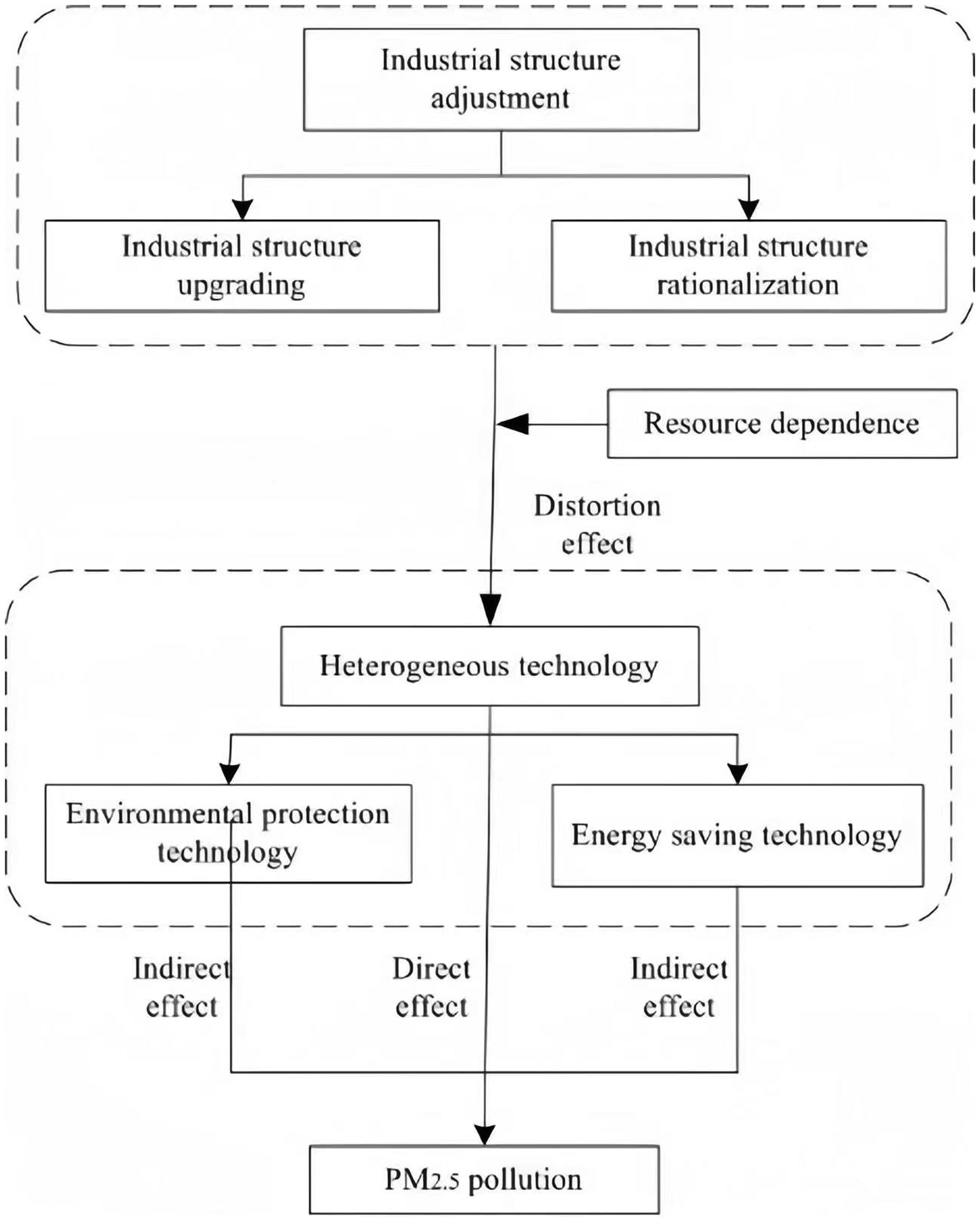
The mechanism of industrial structure adjustment (ISA), resource dependence, and technological.
Technological progress can reduce the distortion effect of resource dependence and promote the emission reduction effect of ISU. From the perspective of promotion methods, technological progress promotes factor innovation through the upgrading of production factors, and by changing the factor form and function of regional development methods, technological innovation is highly integrated into the process of ISU and becomes a decisive factor in economic growth. The reliance of economic development on resources has begun to weaken, causing these factors to recede and become part of the regional environment, externalities of resource dependence is reduced. 111 From the perspective of the promotion effect, technological innovation promotes the improvement of labor quality and capital expansion, improves the factor structure, and increases the marginal output level of production factors, 112 thereby reducing the relative input of traditional factors, that is, reducing resources dependence, and improving labor productivity. The regional economic growth model can be transformed into an innovation-driven one, promoting emerging industrial sectors, accelerating the transformation of traditional industries, and the reduction effect of ISU on PM2.5 pollution. This also verifies that technological innovation can help reduce resource dependence on economic development, corroborating. 113
The distortion effect of resource dependence on ISR can be eliminated in the early and late stages of technology development; the PM2.5 pollution rebound effect of ISRR appears in the middle stage; technological progress is the solution to the resource curse in the long term, 114 technological progress cause pollution rebound in the process of ISA in the short term. Concerning the rebound mechanism from the perspective of heterogeneous technological progress, in the early stage, EP and ES can both offset resource dependence's distortion effect and promote the reduction effect of ISR on PM2.5 pollution. In the middle stage, ES has entered the second stage of development, the industrial structure has a pollution-increasing effect combined with the distorting effect of resource dependence, and the pollution rebound effect appears; China Development and Reform Commission and the Ministry of Science and Technology of China completed the revision and release of the “China Energy-saving Technology Policy Outline” in 2007, focusing on planning the goals and development priorities of energy-saving in 2010, promoting the development of ES. In the third stage, EP has also entered the second stage, further weakening the distortion effect and offsetting the rebound effect brought by EP; the reduction effect of ISR reappears. H3, H4, and H5 are proved.
The progress of ES only causes the increasing effect of ISRR on pollution, which promotes the reduction effect of ISUR on pollution instead. ISU embodies the service orientation of the industrial structure; mainly manifested in two aspects; one is that new leading industries replace old leading industries, and the other is that advanced technologies replace traditional and backward technologies41,115; the development of ES can achieve scale economic development by promoting ISU and reduce pollution through energy conservation. However, ISR refers to the degree of industrial coordination and aggregation, which is manifested in the rational allocation of resource elements and the dynamic balance of resource elements12,116; the progress of ES may cause an increase in energy consumption or demand, affecting the balance of industrial sector elements, thereby causing the rebound effect of pollution in the process of ISR; in the early stage, it can offset the distortionary effect of resource dependence on the ISR, making ISRR have a pollution reduction effect; in the later stage, the emission reduction effect of ISRR changes to an emission increase effect, and pollution rebound reappears.
This article has three main contributions. First, this article describes EISAPP from ISU and ISR perspectives and explores the impact mechanism of resource dependence and technological progress on EISAPP accurately. Second, this article introduces resource dependence as a cross-term into the model to analyze its distorting effect on EISAPP, exploring the causes of pollution rebound during the process of ISA. Then, the threshold model and STIRPAT model are combined to examine whether technological progress could lower the impact of resource dependence on EISAPP or further expand the distorting effect of resource dependence on EISAPP. Finally, this study divides technological progress into ES and EP, analyzes the impact of heterogeneous technological progress on EISAPP distorted by resource dependence, and further analyzes the mechanism of PM2.5 pollution rebound generation. Third, this article combines the panel threshold model and the modified STIRPAT model to test whether technological progress can change the impact of resource dependence on the PM2.5 pollution effects of ISU and ISR; on this basis, this paper further explores the differences between the PM2.5 pollution effects of ISU and ISR caused by heterogeneous technological progress and clarifies the generation mechanism of pollution rebound during the ISA process.
Conclusions and policy implications
In recent years, many studies have explored the impact of industrial structure on PM2.5 pollution; however, pollution rebound occurs in the process of ISA. Thus far, little attention has been paid to this issue. Clarifying the relationship between ISA and PM2.5 pollution is an important scientific proposition in China's high-quality economic development stage in the new era. Based on panel data covering 30 provinces in China from 2008 to 2022, this article analyzes the paradoxical impact mechanism of heterogeneous technological progress and resource dependence on EISAPP, providing a theoretical reference for policy formulation in China's continued and in-depth fight to defend the blue sky. The corresponding results and policy implications are as follows.
Conclusions
This study has shown that both the promotion of ISU and ISR can effectively reduce PM2.5 pollution; a 1% increase in ISU results in a 0.4130% decrease in PM2.5 pollution; a 1% increase in ISR results in a 0.0934% decrease in PM2.5 pollution; ISU reduces pollution through the adjustment of a low-level structure based on labor-intensive industries to a high-level structure based on knowledge and technology-intensive industries; ISR reduces pollution by improving the allocation efficiency of resource factors between different industries.
Resource dependence changes the reduction effect of ISU on PM2.5 pollution into an increasing effect, a 1% increase of ISRR leads to a 2.8637% increase in PM2.5 pollution, and the emission reduction effect of ISR on PM2.5 pollution into an insignificant increase effect; this proves that resource dependence causes the PM2.5 pollution rebound effect of ISA by hindering industrial structure optimization.
Both ISUR and ISRR have a three-stage impact mechanism on PM2.5 pollution with technological progress; the increasing effect of ISUR on pollution gradually weakens and finally transforms into an emission reduction effect as technology progresses; ISRR has a decreasing effect on pollution in the first and the third stages of technology progresses, at the second stage of technology progresses, the decreasing effect becomes an increasing effect causing the rebound to reappear; although there is a rebound effect in the process of ISA as technology progresses, it eventually eliminates the distortion effect of resource dependence on EISAPP and promotes the pollution reduction effect of ISA; technological progress is the solution to the resource curse in the long term, technological progress cause pollution rebound in the process of ISA in the short term.
From the perspective of heterogeneous technological progress, EP has environmental protection attributes that can correct the distortion effect of resource dependence and further expand the pollution reduction effect of ISA, making ISUR and ISRR have significant reduction effects on PM2.5 pollution; ES can promote the development of new energy technologies, thereby promoting the ISU and offsetting the distorting effect of resource dependence on ISU, and transforming the increasing effect of ISRR to a reduction effect on PM2.5 pollution; although in the early stage, it can offset the distortionary effect of resource dependence on the ISR, making ISRR have a pollution reduction effect, in the later stage, the emission reduction effect of ISRR changes to an emission increase effect, and pollution rebound reappears.
Policy implications
As mentioned above, the local resource dependence level and technological progress degree should also be considered to deal with the pollution rebound caused by the ISA when adjusting the industrial structure to decrease PM2.5 pollution.
The government should pay more attention to the coordination of factor endowments and industrial structure, and promote the transfer of production factors from surplus sectors to deficient sectors, which can greatly improve resource allocation efficiency and resource utilization, avoid resource waste, and further promote the ISR. In addition, the government should promote industrial informatization and technology through industrial planning, industrial policies, and other means, and create more opportunities for cultivating strategic emerging industries and high-end service industries, thereby promoting the ISU, heavy pollution, high consumption, low-end industries with high emissions can be replaced by high-end industries with zero pollution, low consumption, and zero emissions, thereby reducing the impact of resource dependence and reducing PM2.5 pollution.
In order to deepen technological innovation reform, the government can improve the level of technological innovation by increasing innovation expenditures, increasing research and experimental development, cultivating technology R&D personnel, and building information exchange platforms. The government should govern the institutional obstacles that hinder technological innovation, optimize the innovation environment, release more innovation momentum, promote the transformation of development momentum from factor-driven to innovation-driven, and reduce the impact of resource dependence. In addition, it is necessary to encourage the development of innovative industries, provide technical support to other industries in related industrial chains, and encourage the formation of an efficient and beneficial cycle of competition and mutual assistance among various industrial sectors to jointly achieve technological innovation and further optimize the industrial structure.
The government should avoid “one size fits all” policies and promote technological progress and ISA according to local conditions. The research results of this paper show that technological progress is the solution to reduce the rebound effect of ISA with resource dependence. Each region must combine its own endowment advantages, analyze its own level of technological development, and rationally choose to formulate policies integrating the promotion of ISU and ISR to avoid the rebound effect. ES improves energy efficiency and reduces energy costs, but it also leads to more energy consumption and PM2.5 pollution in the process of ISR. In order to eliminate the rebound effect caused by ES, the government should adopt comprehensive measures such as price reform, policy subsidies, and total volume control. At the same time, the government should increase investment in EP research and introduce supporting policies, especially research on cleaner production technologies. In addition, the government should encourage companies to achieve re-innovation and consolidate emission reduction effects by introducing foreign technologies.
Footnotes
Declaration of conflicting interests
The authors declared no potential conflicts of interest with respect to the research, authorship, and/or publication of this article.
Funding
The author(s) disclosed receipt of the following financial support for the research, authorship, and/or publication of this article: This work was supported by the National Social Science Foundation Project of China, Chongqing Postgraduate Education and Teaching Reform Research Project (grant number 22CJY062, YJG233137).
