



Abstract
Consistent with the increasing awareness of environmental problems, countries have applied various measures to combat climate change by preventing environmental degradation of the environment. In this context, a set of measures in different areas and sectors have been taken. Although it is possible to consider each of them, instead, using a more comprehensive index, such as the Environmental Policy Stringency Index, can be appropriate in examining the effects of environmental measures in curbing emissions. Accordingly, this research examines the effect of Environmental Policy Stringency Index on sectoral carbon dioxide (CO2) emissions in the European Union Five countries (namely, Germany, Spain, France, United Kingdom, and Italy) by using data for the period 1990/Q2-2020/Q4, performing novel quantile-based approaches. The outcomes show that at higher quantiles, Environmental Policy Stringency Index provides (a) a decrease in building sector CO2 emissions in France, the United Kingdom, and Italy; (b) a decline in industrial combustion sector CO2 emissions in France and Italy; (c) a curb power sector CO2 emissions in Germany, Spain, and France; (d) a decrease in transport sector CO2 emission in Germany and France; (e) there are causalities from Environmental Policy Stringency Index to sectoral CO2 emissions across quantiles except for some ones; (f) the outcomes are verified as robust. The outcomes prove the differentiating effects of Environmental Policy Stringency Index across sectors under the empirical examinations, quantiles, and countries. Thus, the study discusses various policy endeavors, such as consideration of the varying structure of environmental measures, application of nonlinear approaches, and focusing on some sectors to go fast in curbing sectoral CO2 emissions.
Keywords
Introduction
All countries, societies, and people have been facing a critical climate-change problem that has been resulting from high environmental degradation. This negative progress requires all the related parties to take immediate action to combat climate change as well as climate-related problems. 1 In searching for potential solution ways, various factors have been taken into account.
In the literature, energy use and income have been determined as traditionally known effective factors by leading studies of Kraft and Kraft 2 and Grossman and Krueger, 3 respectively. In line with these pioneering studies, various studies have examined the effect of energy and income on environmental degradation in various countries (e.g.,.4–6 Also, later studies have considered some other factors, such as trade openness, geopolitical risk, natural resources rent, globalization, and political stability, in investigating the causes of environmental degradation (e.g.,.7–11 Also, some other studies have used both traditional and recently emerged factors, such as renewable energy, trade globalization, and technological innovation, in uncovering the progress of the environment. Hence, national and international initiatives have been trying to develop various solutions.
To combat climate change and environmental problems, various environmental regulations, such as environmental taxes and emission trading systems, have been put into effect to provide a slowing down by preserving the environment.12–15 Although each of these precautions is valuable, however, none of these can be influential in declining environmental degradation on their own. Therefore, instead of investigating the effect of each environmental regulation on the environment as in some recent studies (e.g.,16,17 a much more comprehensive indicator, which considers various environmental policies, is needed to make a comprehensive analysis of the environment. So, Environmental Policy Stringency Index (EPSI) can be used for this purpose. Botta and Koźluk 18 and Kruse et al. 19 explain the EPSI as “an index that calculates the stringency as the degree to which environmental policies put an explicit or implicit price on polluting or environmentally harmful behavior. It is constructed on the degree of stringency of 13 environmental policy instruments, primarily related to climate and air pollution. Also, it ranges from 0 (not stringent) to 6 (highest degree of stringency). Besides, it is a country-specific and internationally comparable measure of environmental policy stringency”. Hence, it can be argued that EPSI considers a variety of environmental policies taken to present the environment and curb emissions as well.
In the contemporary literature, a variety of recent studies have considered EPSI in examining the effectiveness of the precautions on the environment. Among all, some studies have focused on OECD countries (e.g.,14,20–22 whereas some studies have preferred to examine other country groups and countries, such as BRICS,23–25 China, 26 and highly polluted countries. 27 Some of these studies have defined the declining effect of EPSI on environmental degradation (e.g.,14,21,22 whereas some others have shown a contradicting or a mixed effect (e.g.,28–31) Based on these studies, the effect of EPSI on the environment is still not in a certain way. Hence, there is a gap that some countries and country groups are not examined and further research is needed from this point of view.
Among all countries, European Union Five (EU-5) countries have come to the force. That is why although they have achieved a decrease in total CO2 emissions over the years, they have caused 48.5% of total European CO2 emissions in 2022, 32 and they are developed countries that have been applying stringent environmental policies. Figure 1. demonstrates the changes in CO2 emissions at the sectoral level in EU-5 countries.

Development of sectoral CO2 emissions.
As Figure 1 presents, all EU-5 countries have achieved a significant decrease in total CO2 emissions. On the other hand, the degree of the decline varies according to each country as well as across the countries. However, it can be stated that EU-5 countries have still high CO2 emissions in total and some sectors (e.g., transport and power). In this context, there is a need to uncover whether the environmental measures applied are effective or not. It is also important to consider that there is no study in the literature that focuses on EU-5 countries to uncover the effect of EPSI on sectoral CO2 emissions as well.
Considering the research gap, the study searches for the answers to the following research questions: (a) how EPSI is effective on sectoral CO2 emission in EU-5 countries; (b) whether the EPSI effect differentiates in each sector and countries as well as over the quantiles; (c) whether the EPSI effect is at the causality level?; (d) does the power effect of EPSI and the causal effect from EPSI to sectoral CO2 emissions differ across quantiles, sectors, and countries? Hence, the study aims to analyze EU-5 countries comprehensively by considering the EPSI as the proxy of the stringent environmental policies and analyzing sectoral CO2 emissions. In doing so, the study applies novel quantile-based approaches (i.e., quantile-on-quantile regression (QQR) and Granger causality-in-quantiles (GCQ) as the base approach as well as quantile regression (QR) for the robustness for the period from 1990/Q2 to 2020/Q4. So, the study presents novel insights for EU-5 countries for the effect of EPSI on the main sectors.
This research adds some novelties to the present literature by extending the level of knowledge. Firstly, this study examines EU-5 countries altogether in uncovering the effect of EPSI on sectoral CO2 emissions. This is important because they cause almost half of the CO2 emissions in Europe. Also, they are developed countries and have been applying a variety of stringent environmental policies to preserve the environment. Secondly, the study makes a disaggregated level analysis by considering the main sectors (i.e., building, industrial combustion, power industry, and transport) in the economy based on their CO2-emitting share in the national CO2 emissions. The study includes the sectors that have higher than a 10% share in the total national CO2 emissions. Hence, the potential variations for the EPSI effect in the main sectors can be considered. Thirdly, the study presents a comprehensive analysis of the sectors and countries as well as quantiles by performing novel quantile-based approaches and using the most recent available data from 1990/Q2 and 2020/Q4. Hence, in the belief of the researchers, the study includes comprehensive theoretical and econometric content to achieve the aforementioned contributions to the literature.
In line with the IMRAD approach, the study continues with “Methods” section, “Empirical outcomes” section, and “Conclusion, policy endeavors, and further research” section.
Methods
Data
The data of EPSI is gathered from the Organization for Economic Co-operation and Development. 34 Also, data on sectoral CO2 emissions is collected from EDGAR. 33 After obtaining raw data, in line with the recent literature, the data are firstly transformed into quarterly data through the quadratic-sum approach, 35 and then logarithmic difference series are produced.6,36 Hence, the dataset used in the study is from 1990/Q2 and 2020/Q4. Table 1 explains the details of the variables included in the study.
Variables.
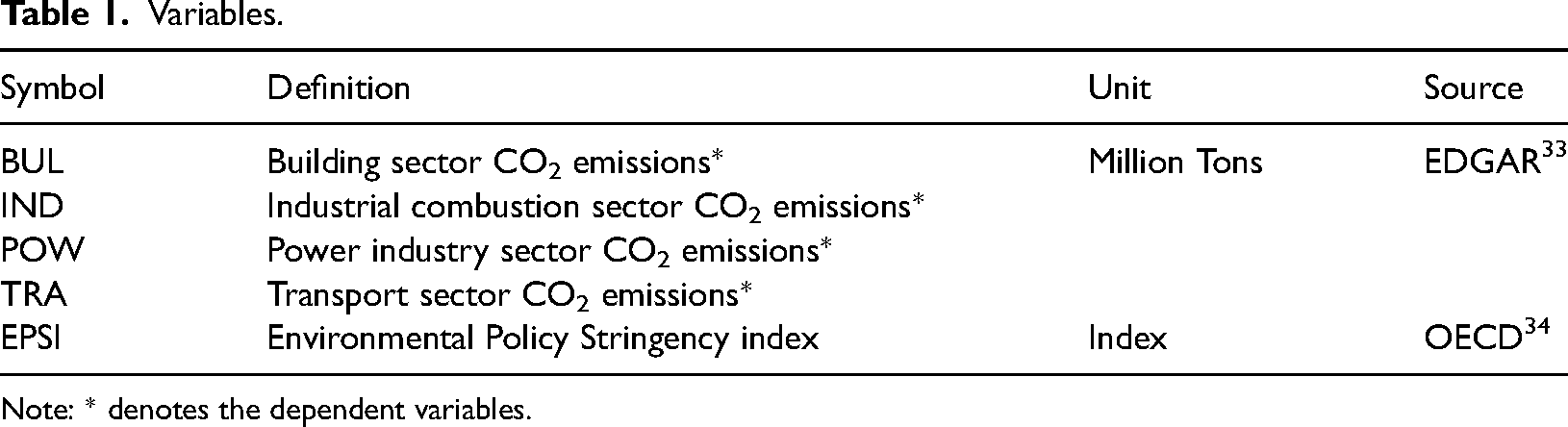
Note: * denotes the dependent variables.
Although there are many more sectors in economies, the study includes only four sectors (i.e., building, industrial combustion, power industry, and transport). Hence, the study does not include some small sectors (i.e., agriculture, fuel, process, and waste) that have lower than a 10% share in total national CO2 emissions. 33 The sectors considers in the study represents a 90.7%, 84.1%, 84.9%, 88.6%, and 88.8% of total national CO2 emissions in Germany, Spain, France, United Kingdom, and Italy, in order. 33
Empirical methodology
Figure 2 symbolizes the empirical methodology used for empirical investigation.

Empirical methodology.
In the first three stages, descriptive statistics of the variables as well as correlations between the variables are examined. Also, the Broock, Scheinkman, Dechert, and LeBaron nonlinearity test 37 is performed to control the nonlinearity structure of the variables. In the fourth stage, the QQR approach is used to uncover the effect of EPSI on sectoral CO2 emissions in each country over quantiles. 38 In the fifth stage, the GCQ approach 39 is performed to search for the causal effect of EPSI on sectoral CO2 emissions in each country over quantiles. At the final stage, the QR approach is used to control the robustness of the QQR outcomes. 40 Further information can be obtained from the original sources as well as recent studies (e.g.,.35,41
In this study, a variety of novel quantile-based approaches are used for empirical investigation. There are some causes for this selection. Firstly, the data used in the study has a mainly nonnormal distribution and nonlinear structure. In this way, nonlinear approaches instead of linear approaches should be used. Second, there may be differences among sectors and countries in terms of the EPSI effect on sectoral CO2 emissions. Third, there may also be variations in the EPSI effect on sectoral CO2 emissions over the quantiles. Therefore, by considering all these factors as well as recent literature (e.g.,42,43 the study prefers to apply the quantile-based approaches. Hence, the researchers are enabled to make a comprehensive econometric analysis by performing these approaches.
In performing novel quantile-based approaches, which enable researchers to consider tail-dependence, the study considers equations 1–4 for each country to make estimations:



Empirical outcomes
Fundamental statistics
Table 2 presents the fundamental statistics of the variables.
Descriptive statistics.
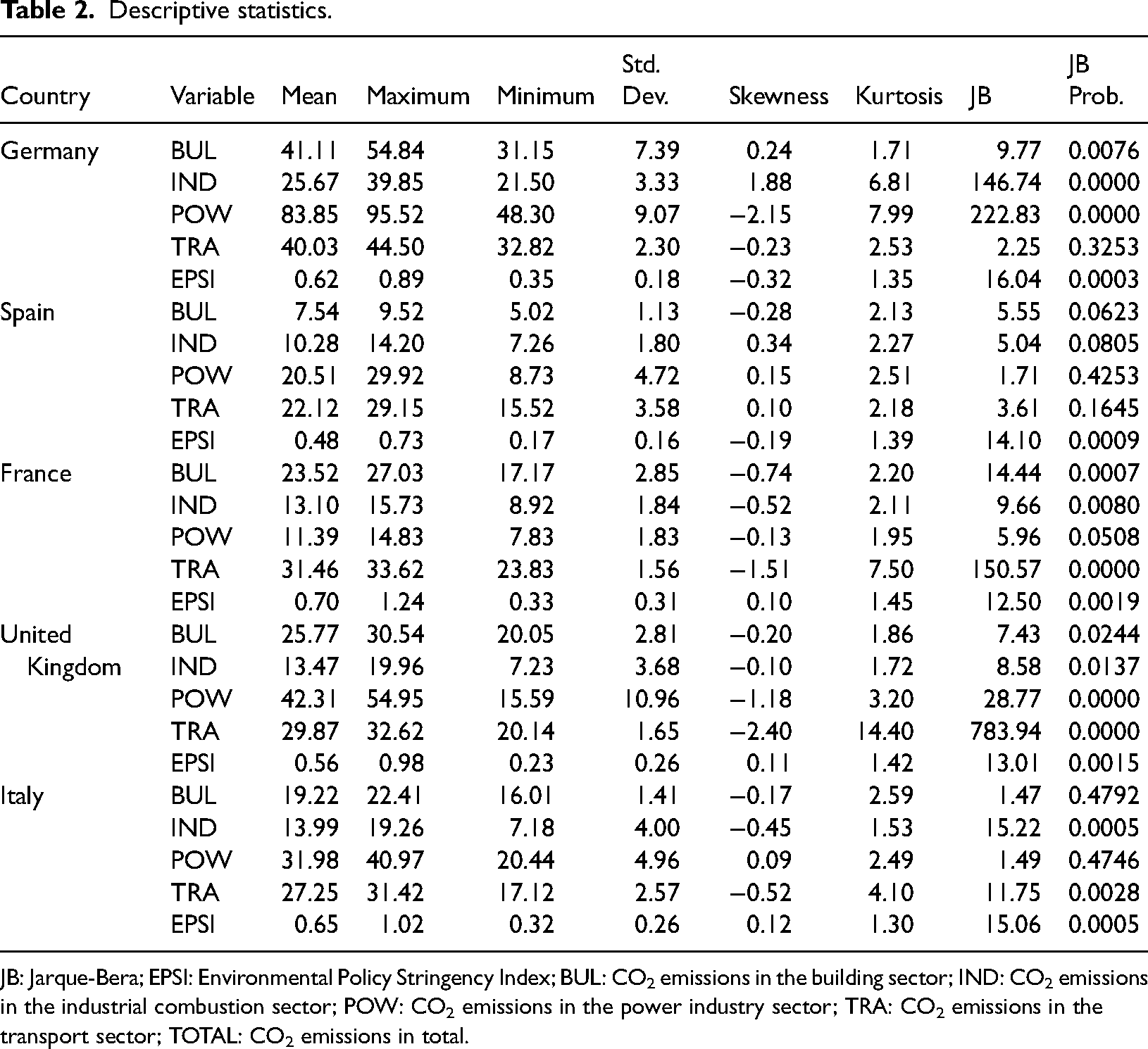
JB: Jarque-Bera; EPSI: Environmental Policy Stringency Index; BUL: CO2 emissions in the building sector; IND: CO2 emissions in the industrial combustion sector; POW: CO2 emissions in the power industry sector; TRA: CO2 emissions in the transport sector; TOTAL: CO2 emissions in total.
In Germany, the United Kingdom, and Italy, POW has the highest sectoral CO2 emissions. However, TRA has the highest sectoral CO2 emissions in Spain and France. Also, POW has the highest variation in all countries except for France, where BUL has the highest standard deviation. Besides, all variables in all countries have a nonnormal distribution, except for TRA in Germany, POW and TRA in Spain, and BUL and POW in Italy at a 90% significance level.
Moreover, the correlation coefficients between variables are presented in Table 3.
Correlation matrix.
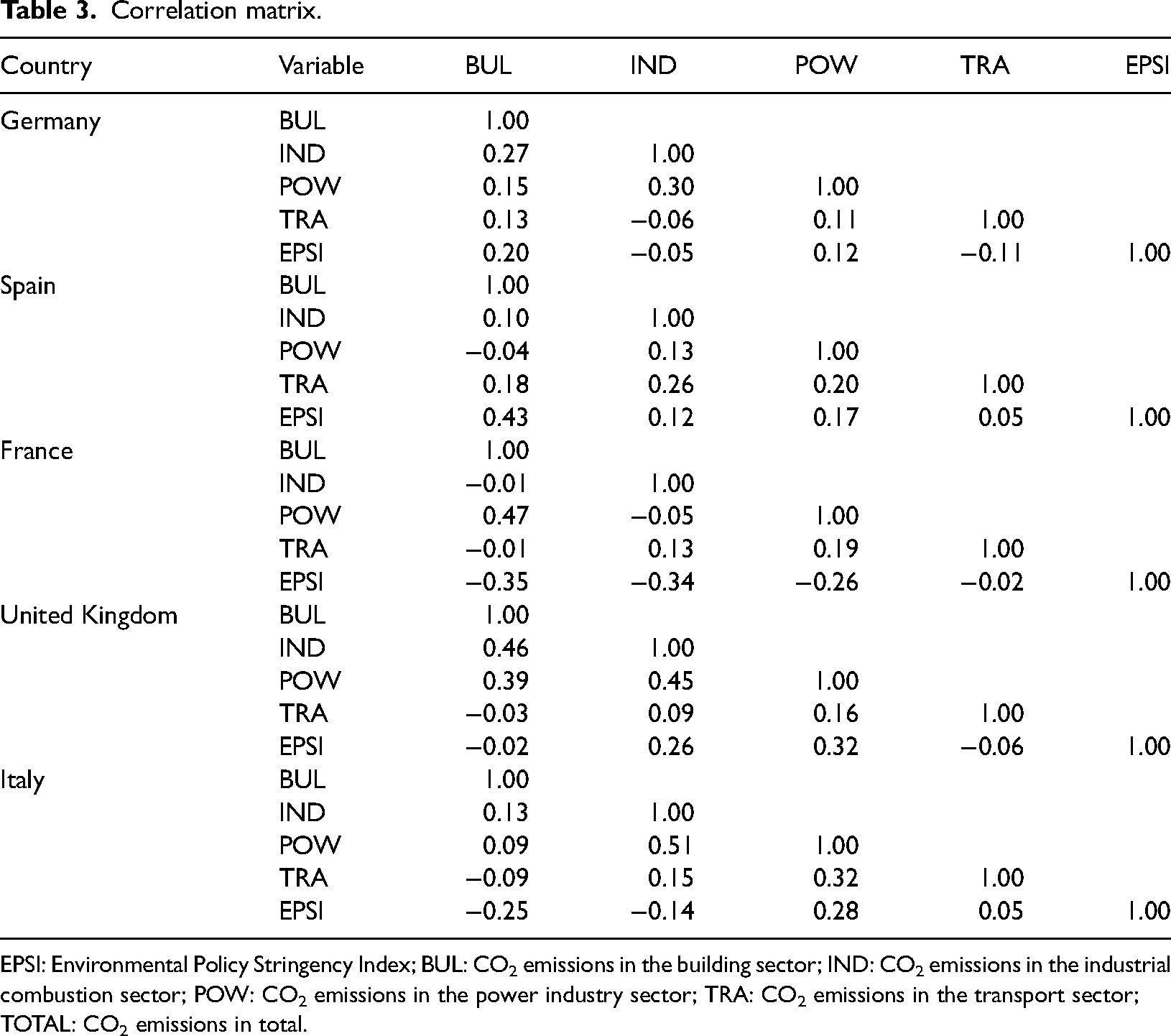
EPSI: Environmental Policy Stringency Index; BUL: CO2 emissions in the building sector; IND: CO2 emissions in the industrial combustion sector; POW: CO2 emissions in the power industry sector; TRA: CO2 emissions in the transport sector; TOTAL: CO2 emissions in total.
Based on Table 3, EPSI has a positive correlation with BUL in Germany and Spain, whereas there is a negative correlation in France, the United Kingdom, and Italy. Also, EPSI has a positive correlation with IND in Spain and the United Kingdom, whereas others are negative. Besides, EPSI has a only negative correlation in France. In addition, EPSI is positively correlated with TRA in Spain and Italy.
Furthermore, the nonlinearity of the variables is demonstrated in Table 4.
According to Table 4, almost all variables have a nonlinear structure at a 90% significance level except for BUL in Germany, the United Kingdom, and Italy, IND and POW in Spain, and BUL and POW in France.
Nonlinearity test outcomes.
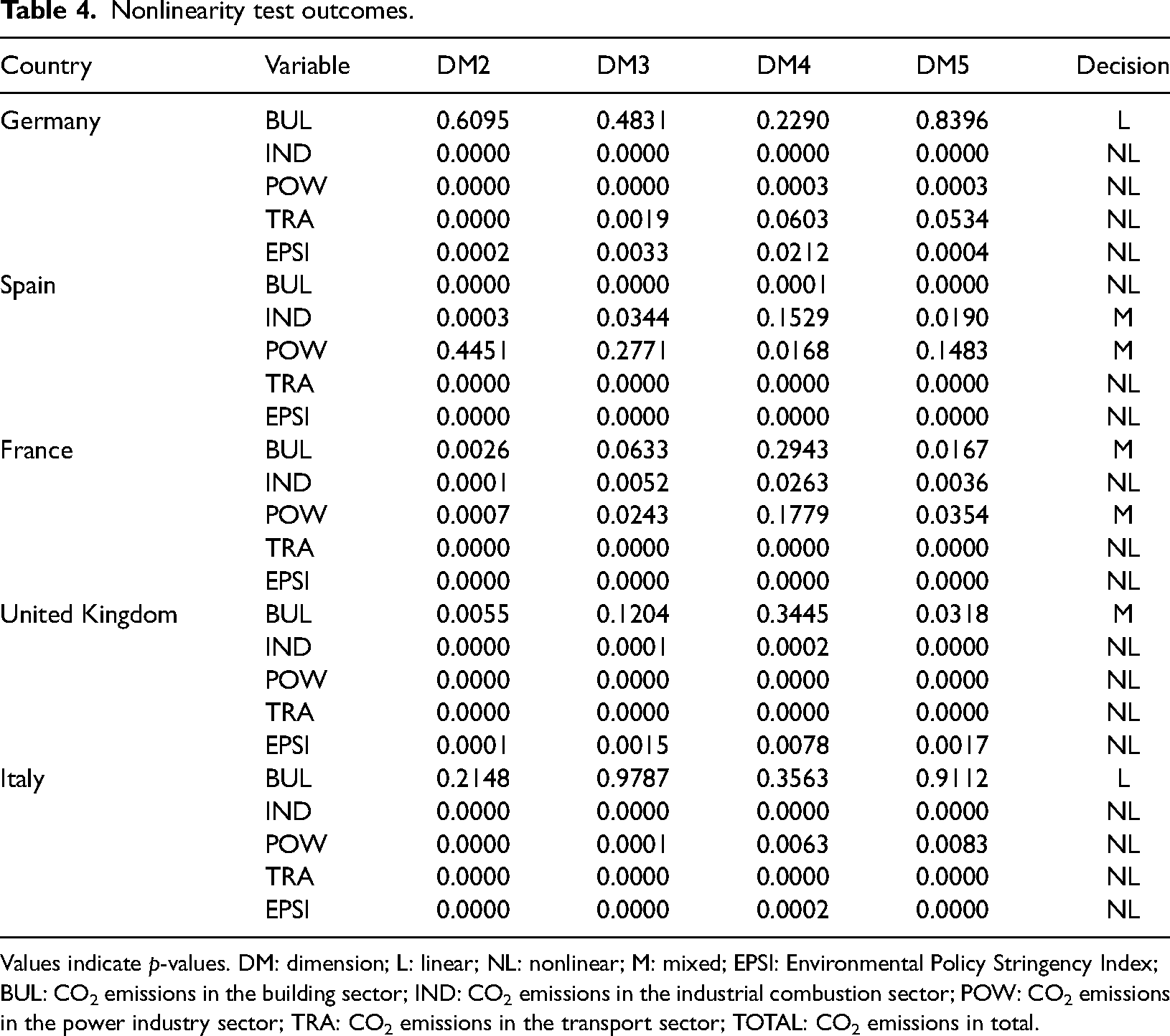
Values indicate p-values. DM: dimension; L: linear; NL: nonlinear; M: mixed; EPSI: Environmental Policy Stringency Index; BUL: CO2 emissions in the building sector; IND: CO2 emissions in the industrial combustion sector; POW: CO2 emissions in the power industry sector; TRA: CO2 emissions in the transport sector; TOTAL: CO2 emissions in total.
In summary, the outcomes of the fundamental statistics reveal that most of the variables do not have a normal distribution as well as do not follow a linear structure. Also, there is a significant standard deviation for some of the variables. By considering these preliminary statistics, the study performs novel quantile-based approaches that are in line with data characteristics. Hence, a comprehensive empirical investigation of the EPSI effect on sectoral CO2 emissions can be provided.
QQR outcomes
Following the examination of the fundamental statistics, the study applies the QQR approach to make a quantile-based empirical investigation of the EPSI effect on sectoral CO2 emission. In this context, Figure 3 presents the EPSI effect on BUL.

EPSI effect on BUL.
According to Figure 3, EPSI is completely inefficient in curbing BUL in Germany. This determination is consistent with the studies of Li et al., 31 who examine OECD countries. On the other hand, EPSI is fully effective in declining BUL in both France and Italy. This finding is also consistent with studies of Albulescu et al. 14 for OECD countries and Udeagha and Muchapondwa 24 for BRIC countries. Also, there is a mixed effect of EPSI in Spain and the United Kingdom across quantiles that vary. While EPSI has a decreasing (increasing) effect at lower (higher) quantiles in Spain (United Kingdom), the effect becomes reversed at the remaining quantiles. This is in line with the studies of Wolde-Rufael and Mulat-Weldemeskel 30 for seven developing countries. These outcomes show that EPSI has a certainly declining effect on BUL in France and Italy, whereas there is a need to take additional measures for the remaining countries to make environmental measures effective on BUL.
Also, Figure 4 presents the EPSI effect on IND.
According to Figure 4, EPSI is completely ineffective in declining IND in Spain and the United Kingdom. This determination is consistent with the studies of Wolde-Rufael and Mulat-Weldemeskel, 28 who examine selected emerging countries. On the other hand, EPSI is fully influential in curbing IND in both France and Italy. This finding is also consistent with studies of Wang et al. 20 for OECD countries and Sezgin et al. 23 for G7 countries. Also, there is a mixed effect of EPSI in Germany. While EPSI has a decreasing effect at lower quantiles, the effect becomes reversed at middle and higher quantiles. This is also consistent with the studies of Chu and Tran 21 for OECD countries. The outcomes present that EPSI has a completely curbing effect on IND in France and Italy, whereas the remaining countries should take new measures to make environmental measures efficient.
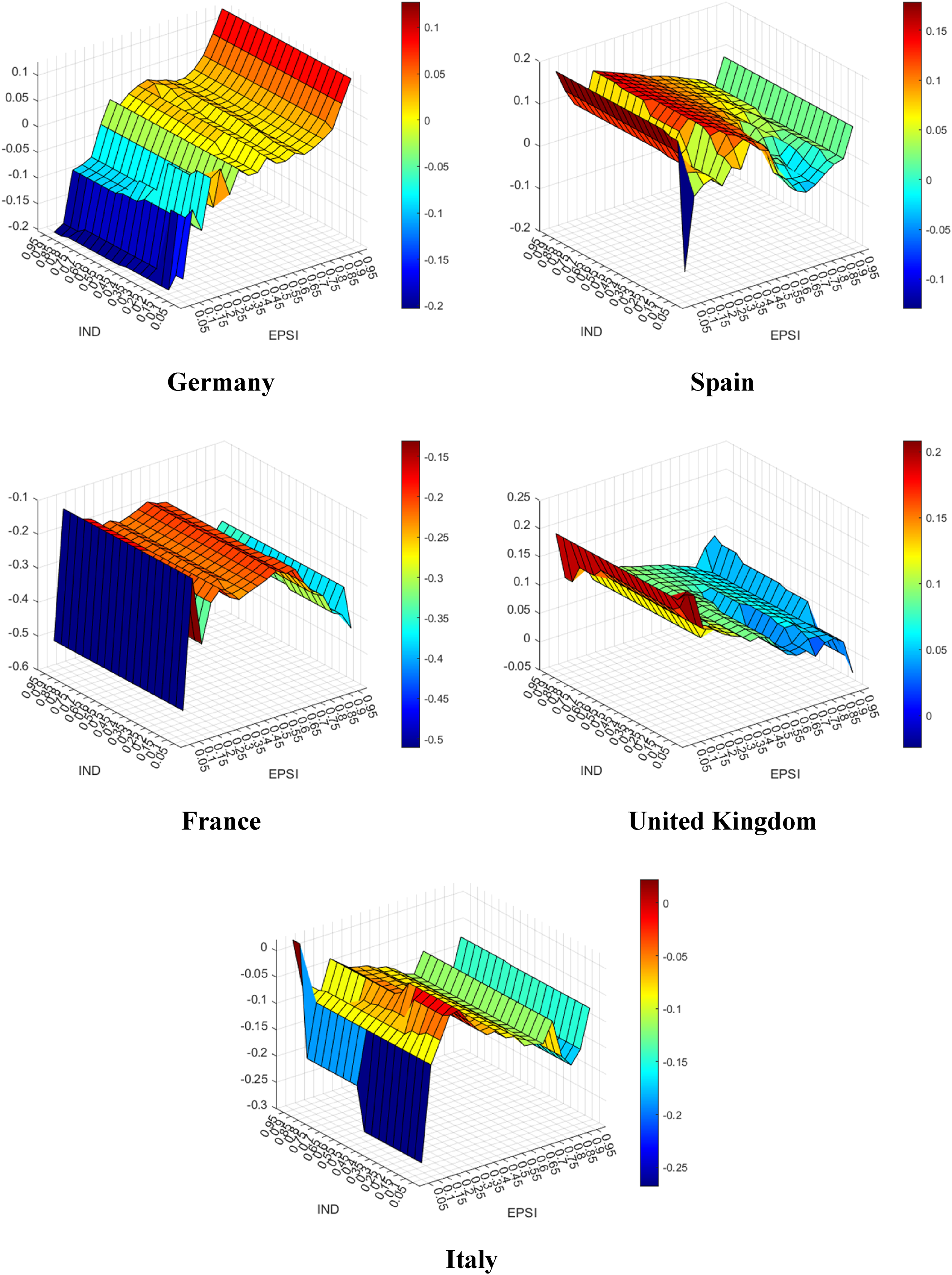
EPSI effect on IND.
Besides, Figure 5 presents the EPSI effect on POW.
Based on Figure 5, EPSI is not beneficial in decreasing POW in the United Kingdom and Italy. This determination is consistent with the studies of Li et al. (2023), who examine OECD countries. On the other hand, EPSI is fully beneficial to decrease POW in France. This finding is also similar to studies of Wang et al. 20 for OECD countries and Sezgin et al. 23 for G7 countries. Besides, there is a varying effect of EPSI in Germany and Spain. While EPSI has an increasing effect at lower quantiles, the effect becomes reversed at higher quantiles. This is also consistent with the studies of Chu and Tran 21 for OECD countries. The outcomes demonstrate that EPSI has a decreasing effect on POW in only France and the other EU-5 countries should re-structure their stringent environmental policies in this area to benefit from them.
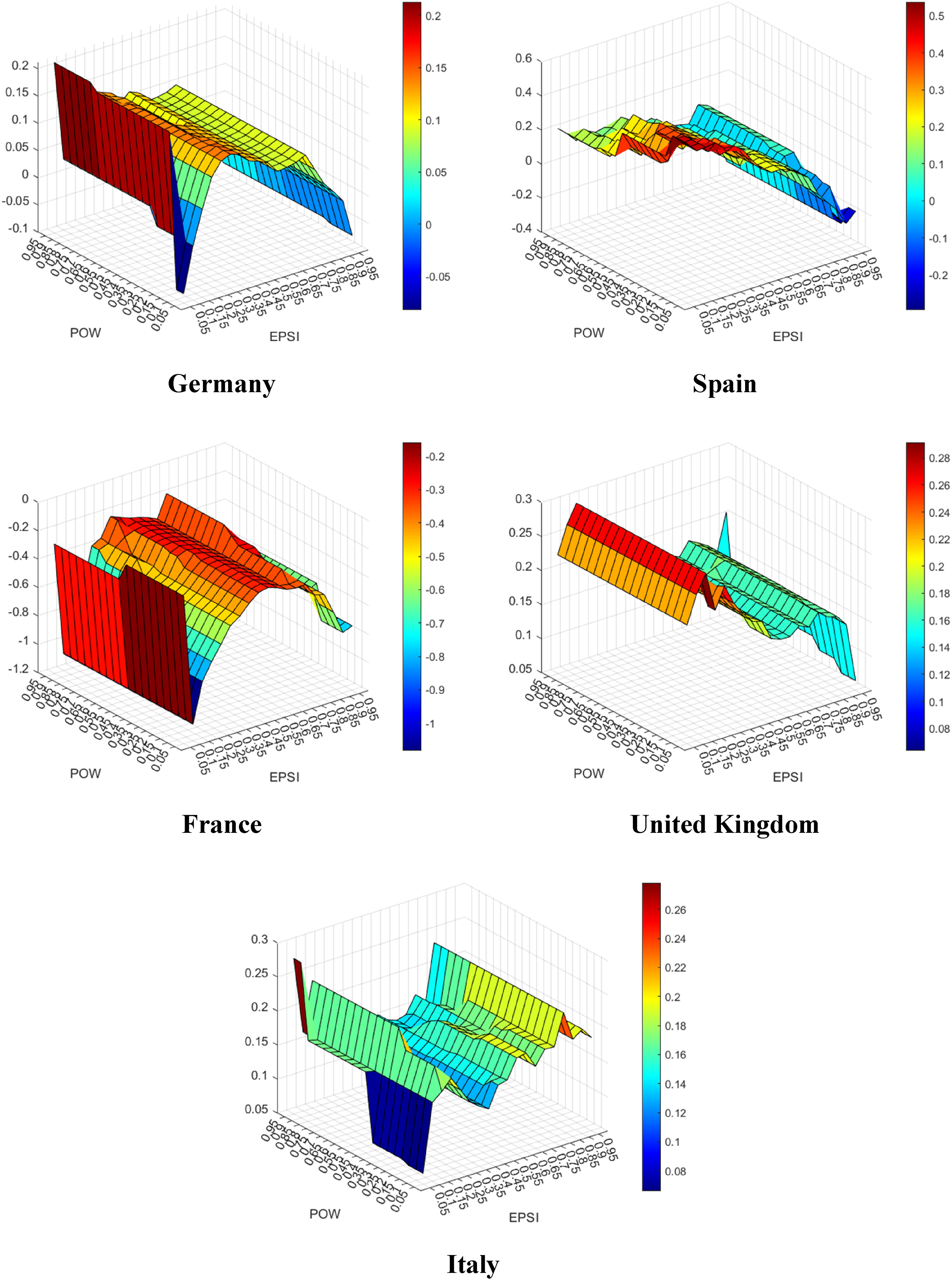
EPSI effect on POW.
Lastly, Figure 6 presents the EPSI effect on TRA.
According to Figure 6, EPSI has a varying effect on TRA in Germany and France. EPSI has a quantile-varying structure in these countries. This outcome is consistent with the studies of Chu and Tran 21 for OECD countries. On the other hand, EPSI is almost inefficient in Spain, the United Kingdom, and Italy. This determination is consistent with the studies of Li et al. (2023), who examine OECD countries. These outcomes reveal that at higher quantiles, EPSI has a curbing effect on TRA in Germany and France, whereas other countries have to take new measures.

EPSI effect on TRA.
GCQ outcomes
After examining the power effect of EPSI on sectoral CO2 emissions, the study performs the GCQ approach to uncover the causal effect across the quantiles. Table 5 presents the GCQ outcomes.
GCQ outcomes.

Numbers represent p-values. EPSI: Environmental Policy Stringency Index; GCQ: Granger causality-in-quantiles; BUL: CO2 emissions in the building sector; IND: CO2 emissions in the industrial combustion sector; POW: CO2 emissions in the power industry sector; TRA: CO2 emissions in the transport sector; TOTAL: CO2 emissions in total.
According to Table 5, EPSI has a quantile-differentiating causal effect on sectoral CO2 emissions in the countries. In Germany, EPSI has a causal effect on BUL across all quantiles except for some lower (0.05), middle (0.45–0.50), and higher (0.90–0.95) ones. Also, EPSI has a causal effect on IND across all quantiles except for some lower (0.20), middle (0.45, 0.50), and higher (0.95) ones. In addition, EPSI has a causal effect on POW across all quantiles except for some lower (0.05–0.10, 0.25), middle (0.45–0.65), and higher (0.75–0.85, 0.95) ones. Besides, EPSI has a causal effect on TRA across all quantiles except for some lower (0.05–0.20), middle (0.55), and higher (0.80–0.90) ones.
In Spain, EPSI has a causal effect on BUL across all quantiles except for some lower (0.05, 0.20–0.35), middle (0.50–0.75), and higher (0.85, 0.95) ones. Also, EPSI has a causal effect on IND across all quantiles except for some lower (0.25), middle (0.45–0.60), and higher (0.90–0.95) ones. In addition, EPSI has a causal effect on POW across all quantiles except for some lower (0.05, 0.25–0.35), middle (0.40–0.70), and higher (0.95) ones. Besides, EPSI has a causal effect on TRA across all quantiles except for some lower (0.05–0.25), middle (0.50–0.55), and higher (0.85–0.95) ones.
In France, EPSI has a causal effect on BUL across all quantiles except for some lower (0.05), middle (0.45–0.50), and higher (0.95) ones. Also, EPSI has a causal effect on IND across all quantiles except for some lower (0.10), middle (0.45–0.55), and higher (0.95) ones. In addition, EPSI has a causal effect on POW across all quantiles except for some lower (0.05–0.10), middle (0.45–0.60), and higher (0.90–0.95) ones. Besides, EPSI has a causal effect on TRA across all quantiles except for some lower (0.05, 0.20), middle (0.30–0.45), and higher (0.60–0.85) ones.
In the United Kingdom, EPSI has a causal effect on BUL across all quantiles except for some middle (0.50–0.55) and higher (0.95) ones. Also, EPSI has a causal effect on IND across all quantiles except for some lower (0.05) and middle (0.50–0.50) ones. In addition, EPSI has a causal effect on POW across all quantiles except for some lower (0.10), middle (0.35–0.65), and higher (0.85–0.95) ones. Besides, EPSI has a causal effect on TRA across all quantiles except for some lower (0.05–0.15), middle (0.50–0.60), and higher (0.95) ones.
In Italy, EPSI has a causal effect on BUL across all quantiles except for some lower (0.05–0.10), middle (0.45–0.50, 0.60), and higher (0.95) ones. Also, EPSI has a causal effect on IND across all quantiles except for some lower (0.05) and middle (0.50) ones. In addition, EPSI has a causal effect on POW across all quantiles except for some lower (0.05, 0.20–0.30), middle (0.40–0.70), and higher (0.80, 0.95) ones. Besides, EPSI has a causal effect on TRA across all quantiles except for some lower (0.05–0.20), middle (0.55), and higher (0.95) ones.
Overall, the GCQ outcomes show that EPSI has a causal effect on sectoral CO2 emissions over the quantiles, whereas the causal effect is not seen across some quantiles. This finding is mainly consistent with the studies of Sezgin et al. 23 for G7 and BRICS countries. This determination implies that although stringent environmental policies have a significant effect on sectoral CO2 emission, this strong connection has been lost at some sectors, quantiles, and sectors in different levels (i.e., quantiles). So, countries have to continuously monitor the effect of EPSI on sectoral CO2 emissions.
Robustness
As the last stage, the study applies the QR approach to control the robustness of the QQR outcomes. The outcomes of the comparison are detailed in Annex1–4 and Table 6 reports the comparison summary.
Correlations between QQR and QR approaches.
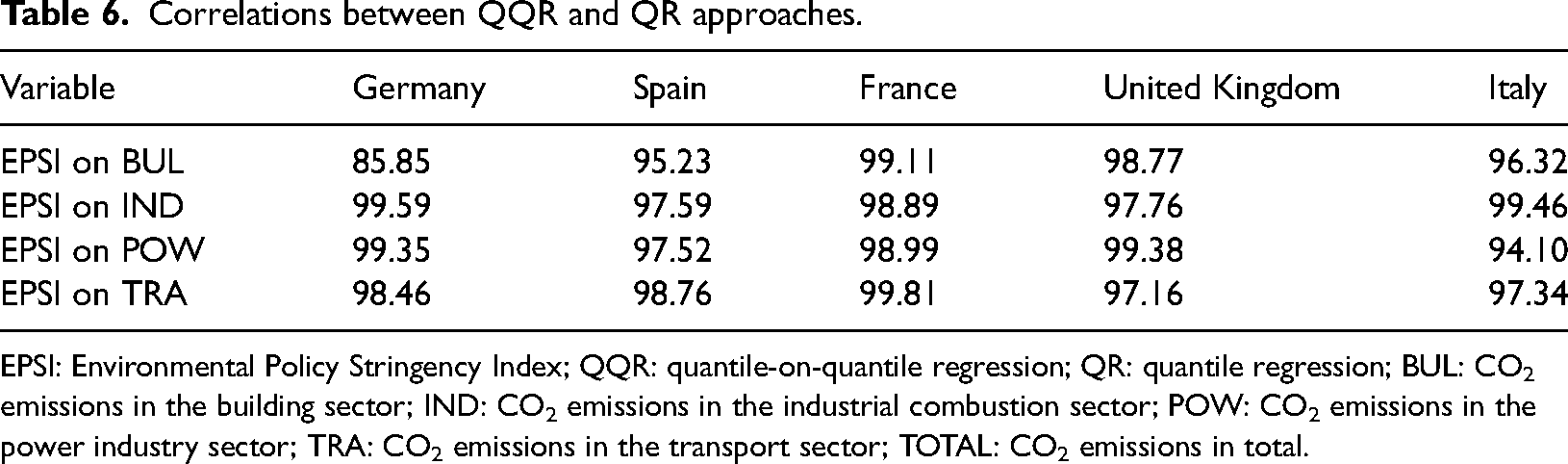
EPSI: Environmental Policy Stringency Index; QQR: quantile-on-quantile regression; QR: quantile regression; BUL: CO2 emissions in the building sector; IND: CO2 emissions in the industrial combustion sector; POW: CO2 emissions in the power industry sector; TRA: CO2 emissions in the transport sector; TOTAL: CO2 emissions in total.
According to Table 6, the outcomes of the both QQR and QR approaches are highly similar to each other. Specifically, the consistency between the two approaches is higher than 85% across the examination of the effect of EPSI on sectoral CO2 emissions. Therefore, it can be stated that the robustness of the outcomes is verified and the outcomes obtained can be used to discuss various policy endeavors for the countries under the empirical investigation.
Conclusion, policy endeavors, and further research
Conclusion
In addition to collaborative international initiatives, national efforts of countries have also been developing day by day. As a result of countries’ willingness to curb emissions, which is consistent with the declarations of the countries in this respect, a set of environmental measures have been applied and these kinds of measures have varied across countries. While each measure aims to have a curbing effect on the emissions, the use of a much more comprehensive indicator to measure the effectiveness of the environmental measures is needed. Thus, in line with the proposal of Botta and Koźluk 18 and Kruse et al., 19 recent research has been using the EPSI as the proxy for environmental measures. By considering this progress, this study handles also EPSI to uncover the environmental progress in EU-5 countries, which are developed countries, that have caused almost half of the CO2 emissions in Europe and have been applying different stringent environmental policies to preserve the environment. To do so, the study takes into account four main sectors and applies novel quantile-based approaches for the period 1990/Q2–2020/Q4 to make sector, country, and quantile-based investigations in examining the effect of EPSI on sectoral CO2 emissions.
Following a comprehensive approach, the study determines that at higher quantiles, EPSI decreases building sector CO2 emissions in France, the United Kingdom, and Italy. Also, EPSI declines industrial combustion sector CO2 emissions in France and Italy. Besides, EPSI curbs power sector CO2 emissions in Germany, Spain, and France. Moreover, EPSI decreases transport sector CO2 emissions in Germany and France. Furthermore, there are causalities from EPSI to sectoral CO2 emissions across quantiles except for someone, and the robustness of the outcomes is validated. Overall, the empirical outcomes of the study reveal the varying effects of EPSI across sectors, countries, and quantiles.
While the outcomes of the study are mainly in line with some studies for some sectors (e.g.,16,21; Li et al., 2023;,15,43 the outcomes differentiate for some other sectors, which some issues (e.g., consideration of EPSI as the proxy for environmental measures, using sector-based data, application of quantile-based approaches, ineffectiveness of the environmental measures applied) may cause such a difference. Also, the outcomes imply that although these developed countries have applied stringent environmental policies, the measures do not have the same effect on the sectors in these countries as well as across the same sector in countries and quantiles. Hence, while stringent environmental policies are beneficial in some sectors and countries, it is not valid for some other sectors and countries.
Among the countries included in the study, France is the leading country that can achieve a decrease in all sectoral CO2 emissions, whereas Germany (power and transport) and Italy (building and industrial combustion) can do this in two sectors, and the United Kingdom (building) and Spain (power) can do this in only one sector. Thus, France can be a lighthouse for the remaining countries considered as well as the rest of the world. That is why France has more stringent environmental policies in curbing sectoral CO2 emissions based on the empirical outcomes obtained. So, this study extends the current body of knowledge by presenting novel insights based on the comprehensive approach followed in this research.
Policy endeavors
By following up on a comprehensive empirical approach, the study presents novel insights. Based on the outcomes gathered, this study discusses various policy endeavors.
First, the study proves the nonlinear effect of EPSI on CO2 emissions across sectors, countries, and quantiles. So, this determination requires the policymakers of EU-5 countries to consider this fact in structuring their environmental policy mix. Hence, they can have the capability to re-arrange the environmental measures applied and benefit from environmental policy measures determined in such a right way. Also, in line with this determination, EU-5 countries should monitor the progress of the effect of EPSI on sectoral CO2 emissions in a continuous way instead of making it for certain periods, such as yearly or quarterly. In this way, policymakers can take corrective measures in the environmental policy mix to put them beneficially without causing a delay that can cause negative effects of the measures on the progress of environmental quality. Thus, the countries can achieve the benefits that are going to be expected by taking stringent environmental measures.
Second, the effect of EPSI on CO2 emissions differs across sectors and countries. While the EPSI effect is a decreasing one in some sectors, its effect is ineffective in curbing CO2 emissions in some others across the countries. Hence, it is clear that stringent environmental measures on sectoral CO2 emissions are beneficial for some sectors in some countries, whereas it is not valid for the remaining sectors and countries based on these findings, it can be argued that their policymakers should continue to apply stringent environmental measures, where they have a curbing effect on sectoral CO2 emissions, whereas it is beneficial for them to remove or re-structure stringent environmental measures, where they are inefficient in providing a decline on sectoral CO2 emissions.
Third, policymakers should consider that the EPSI effect on sectoral CO2 emissions has a mixed structure. In the sectors considered, the direction of the effect (increasing or decreasing) or power of the effect of the environmental measures differentiate across quantiles and countries. Accordingly, it is a must for policymakers to handle the sectoral CO2 emissions case by case rather than focusing on the total CO2 emissions of the countries. In this pay, countries can have the opportunity to rely on sustaining the stringent environmental measures, where they are beneficial, and to re-structure the stringent environmental measures, where they are inefficient, into a beneficial way by taking corrective actions on time.
In the case of country-based consideration, it is seen that the outcomes for the EPSI effect differentiate across sectors. In Germany, EPSI has an inefficient effect on curbing BUL, whereas EPSI has a curbing effect across lower quantiles of IND as well as higher quantiles of POW and TRA. This determination implies that Germany cannot have the opportunity to benefit from current stringent environmental policies in its current structure in declining BUL, whereas current stringent environmental policies enable Germany to curb CO2 emission in the remaining sectors (i.e., IND, POW, & TRA). Accordingly, Germany should continue to sustain current stringent environmental policies in curbing sectoral CO2 emissions, while there is a need to take additional measures for BUL. That is why there is no curbing impact of current stringent environmental policies in the building sector, which requires policymakers to think about the working public awareness as well as public support to preserve the environment by forcing citizens to change their current behavior in the building sector.
In Spain, EPSI has an inefficient effect on curbing BUL and IND, whereas EPSI has a declining effect across higher quantiles of POW and TRA. This finding implies that Spain cannot benefit from current stringent environmental policies in its current structure in decreasing BUL and IND, whereas current stringent environmental policies enable Spain to curb CO2 emission in the remaining sectors (i.e., POW & TRA). Accordingly, Spain should continue to sustain current stringent environmental policies in curbing some sectors (İ.e., POW and TRA), while there is a need to take additional measures for BUL and IND. That is why there is no decreasing impact of current stringent environmental policies in building and industrial combustion sectors, which requires policymakers to think about the working public awareness, public support, and eco-friendly activities in industrial combustion sector to preserve the environment by forcing citizens, companies, and producers to change their current approach in building and industrial combustion sectors.
In France, EPSI is fully efficient in declining sectoral emissions across the sectors considered. Hence, it can be suggested that France should continue to apply current stringent environmental policies. On the other hand, the outcomes present that the declining effect of stringent environmental policies is relatively lower in BUL and TRA. This requires France to focus on the sectors so that policymakers can make the stringent environmental policies much more beneficial in declining CO2 emissions in these sectors. In this context, France can focus on public support and awareness in BUL and more electrification in TRA to curb CO2 emissions further in these sectors.
In the United Kingdom, EPSI has an inefficient effect on curbing IND and POW, whereas EPSI has a decreasing effect on BUL and TRA. This outcome shows that while the United Kingdom enjoys current stringent environmental policies in BUL and TRA, it is not the case for IND and POW. So, the United Kingdom has to take new measures in these sectors, where current stringent environmental policies are not enough to make a curbing effect. In this context, policymakers should focus on stimulating eco-friendly activities in the industrial combustion sector as well as changing the behavior of power producers in enhancing further clean energy generation to curb POW.
In Italy, EPSI has a fully curbing effect on BUL and IND, whereas EPSI has a completely increasing effect on POW as well as an inefficient effect on curbing TRA. Hence, Italy should focus on POW and TRA. Therefore, Italy has to deal with POW and TRA to benefit from stringent environmental policies in curbing sectoral CO2 emissions. Accordingly, it can be suggested that Italy should focus on changing the behavior of power producers in enhancing further clean energy generation to curb POW and more electrification in TRA to curb CO2 emissions further in these sectors.
Overall outcomes reveal that France can fully benefit from current stringent environmental policies, whereas the case for the remaining countries varies across sectors, countries, and quantiles. Hence, each country should consider its own cases and take additional measures to make current stringent environmental policies either effective or more beneficial in curbing sectoral CO2 emissions.
Lastly, consideration of behaviors of the all related parties, such as citizens, companies, producers, and whole the society, is highly important in structuring environmental policies because these parties have a high effect on the application of environmental policies in the real world. Hence, the behavior of such parties can be directly effective in the success of environmental policies in curbing sectoral CO2 emissions.
Further research
This study applies a highly comprehensive empirical methodology to uncover the relationship between stringent environmental policies and sectoral CO2 emissions. However, this does not prevent researchers from being free from any research limitations that can be considered as further research areas in the coming periods.
First, this study examines EU-5 countries as examples of highly developed countries as well as green countries that have been applying stringent environmental policies for a long time. So, new studies can prefer to include many more green countries as well as developed and emerging countries for a comparative analysis.
Second, this study uses CO2 emissions as the indicator of emission. However, the use of this indicator neglects the supply side of the environment. Therefore, new studies can consider using recently emerged environmental indicators (e.g., ecological footprint, load capacity factor, carbon intensity) to consider various perspectives of the environment in uncovering the effect of stringent environmental policies.
Third, this study considers four main sectors (e.g., building, industrial combustion, power, and transport) by neglecting remaining (agriculture, fuel, process, and waste). Hence, new studies can focus on the sectors excluded in this research.
Fourth, this research analyzes by using low-frequency (i.e., quarterly) data and applying novel quantile-based methods. Accordingly, future studies can consider the use of much higher-frequency data as well as recently emerged econometric approaches, to include various perspectives, such as time and frequency-varying relationships, in empirical analyses. By considering such points, future research can be applied to a much broader extent.
Footnotes
Availability of data and materials
Data will be made available on request.
Authors’ contributions
The authors have contributed equally to this work. All authors read and approved the final manuscript.
Consent for publication
The authors are willing to permit the Journal to publish the article.
Declaration of conflicting interests
The authors declared no potential conflicts of interest with respect to the research, authorship, and/or publication of this article.
Funding
The authors received no financial support for the research, authorship, and/or publication of this article.
