



Abstract
The convergence of economic growth and environmental preservation has become a crucial objective for governments worldwide. As the digital economy helps transform industries, its carbon-reducing effect has been continuously validated. Technological innovation, policy support, and the promotion of trade openness are ways to encourage the greening of the digital economy. Currently, China is vigorously building a national e-commerce demonstration zone (EDZ). Hence, the main purpose of this study is to explore how e-commerce, as an important part of the digital economy, can help reduce carbon emissions (CE). Based on the panel data of 276 prefecture-level cities in China from 2007 to 2019, the empirical results obtained under the difference-in-difference model are that the establishment of EDZs can bring 0.0463 units of reduction in CE. The effect of suppressing CE is more significant for some regions located in the west, with larger city sizes and relatively scarce resource endowments. Distinguishing from the common paths of industrial structure, technological innovation, and optimal allocation of resources, this study also reveals the regulating role of economic openness in the mechanism analysis and finds that increasing foreign direct investment can effectively promote EDZs to reduce CE. The findings of this paper emphasize the practical significance of EDZs for energy saving and emission reduction, promoting green and high-quality development, and provide valuable references for managers and policy makers.
This is a visual representation of the abstract.
Introduction
The escalating threat of global warming has shifted global attention towards the urgent need to curb carbon emissions (CE) and bolster environmental preservation. Rapid economic development will lead to increased energy consumption and CE; environmental protection situation is becoming increasingly severe. The United Nations Environment Programme (UNEP) projects a continuous rise in global CE until 2030. To meet the challenges posed by global climate change, countries around the world are actively taking action to explore effective ways to reduce their carbon footprints. 1 In particular, the Chinese government has taken a series of measures to adjust its industrial structure (IS) and strengthen environmental regulation (ER) in an effort to reduce CE and improve environmental protection. Given this situation, committing to seek a virtuous path to achieve synergistic development of the economy and the environment is urgent.
While achieving low-carbon development, countries globally are also vigorously strengthening digital construction, and the digital economy promotes the optimization and upgrading of the economic system while possessing green advantages. Represented by Amazon in the United States, Alibaba in China, and Flipkart, the leader in India, many countries around the world regard e-commerce as an important field, improving the quality of life and enhancing competitiveness. In order to vigorously promote the development of e-commerce, China launched the creation of “e-commerce demonstration zones (EDZs)” in 2011, and 23 cities, including Beijing, were approved in the first round. In 2014 and 2017, 30 and 17 cities were approved, respectively, which rounds the number to 70 EDZs created in China. The efficient, convenient, and environmentally friendly features of e-commerce are conducive to achieving energy-saving and emission reduction goals. Statistics show that e-commerce transactions through platforms such as Taobao contributed to a reduction of over two million tons of carbon dioxide emissions in 2009. On average, e-commerce reduced carbon dioxide emissions by approximately 8214–10,187 tons per 100 million yuan of sales. E-commerce plays an important role in promoting ECO and also shows great potential in promoting dual-carbon construction.
Many scholars have tried to explore the relationship between e-commerce and green sustainable development from different perspectives, and studies have found that e-commerce has a significant impact on green production behavior,
2
carbon dioxide emissions,
3
and logistics and transportation emissions.
4
Of particular relevance to this study is the investigation into the relationship between e-commerce and CE. However, due to the different research methods and perspectives, two limitations are found in this type of research. First, consensus conclusion has not been drawn on the findings. Most studies advocate that e-commerce can reduce urban carbon dioxide emissions through such paths as optimizing resource allocation, promoting IS upgrading, and promoting technological innovation. Due to the complexity of e-commerce channel links, some scholars presume that the role of e-commerce in CE is uncertain by studying the environmental impact of the supply chain stage. In some EU countries, regions with high e-commerce activity instead have a larger carbon footprint and more serious environmental pollution.
5
Second, most of the existing studies are limited to discussing the impact of e-commerce on CE and lack a research perspective that incorporates social hotspots and policy contexts. Although some literature analyzes in detail the differences in the impact of e-commerce on CE in different regions and also considers multiple external factors in the impact process,
6
the future development prospects of e-commerce are not highlighted. E-commerce, as a modern form of business that is gaining popularity, is more relevant to the study of its impact on CE in conjunction with related policies. Under this research status, several issues should be considered in this paper:
Can the construction of EDZ as a policy vehicle for the promotion of e-commerce be effective in reducing CE? What are the regional differences in the effects of EDZ on CE? Are there other external factors involved in regulating the impact of EDZ on CE?
In order to assess the effect of EDZ on CE and the mechanism of action, this paper leverages 13 years of data (2007–2019) from 276 prefecture-level cities in China and conducts a detailed regression analysis through the difference-in-difference (DID) model and moderating effect. In contrast, the marginal contribution of this paper is mainly demonstrated through the following. (1) Innovation on research perspective. Different from the general study of e-commerce on CE, this paper materializes e-commerce to the policy impact of EDZ and explores the specific effects before and after the policy, which is more substantial in explaining the role of e-commerce in CE. (2) Innovation on research index. This paper adopts the cutting-edge top-down method based on nighttime lighting data to accurately measure the total amount of CE, replacing the traditional CE measurement method. This novel method of measuring carbon dioxide emissions addresses the shortcomings of incomplete data and inconsistent caliber. (3) Innovation on research path. In this paper, foreign direct investment (FDI) is added as a regulating variable to verify the indirect role played by trade openness in EDZ in affecting CE, filling the gap of a single path mechanism in the current research.
The remainder of the paper is organized as follows: Literature and mechanism analysis section reviews the literature, analyzes the impact mechanisms, and formulates the research hypotheses; Model and data section provides the detailed research design; Empirical analysis section accounts for the empirical analyses and their results; Robustness test section conducts a series of robustness tests; and Conclusions and policy implications section provides the research conclusions and policy implications.
Literature and mechanism analysis
The literature review section attempts to analyze the introductory questions at the theoretical level and to summarize the existing studies before proposing the corresponding research hypotheses. This is preceded by a literature review of the conceptual definitions, connotative features, and indicator measurements of e-commerce and CE, respectively.
Literature review
With the rapid progress of internet technology, “e-commerce,” an emerging product of the late twentieth century, has entered the twenty-first century with considerable potential. What exactly is e-commerce? How is it different from traditional business? A series of questions about the development of this field has generated a great deal of academic interest. 7 The first to call out the slogan “electronic commerce (EC)” was the American company IBM, whose data exchange and business activities were carried out in a digitalized electronic way. Some scholars suggest a broader sense and consider EC as an economic activity that relies on electronic devices. It utilizes the internet to connect customers, sellers and suppliers in a chain, and the business process is realized electronically. 8 Other scholars identify EC as a digital transaction activity carried out between various stakeholders. 9 The most recent definitions of EC in academia currently emphasize that it is an economic transaction rooted in information technology platforms and frequently occurring on the internet.10,11 The understanding of EC may vary depending on the researcher's professional background, research direction, and type of technology. Summarizing the views of many parties, this paper considers EC as a commercial business activity that is conducted with the backing of the internet, communication technologies, and other means.
E-commerce is a combination of business activities and information technology, and this unique kernel causes it to be different from traditional commerce. From the viewpoint of sales model, online channels provide a direct bridge between suppliers and consumers, and the retail link is circumvented; EC has structural differences with traditional commerce. 12 From the perspective of logistics and transportation, EC has a unique distribution model, and distribution methods such as self-managed logistics, third-party logistics, and logistics integration make the entire process simple and intelligent. 13 From the perspective of price competition, EC has more flexible operating costs, efficient electronic channels, and more advantages in the price game compared to traditional commerce. 14 Furthermore, EC has a range of green qualities that are worth emphasizing at a time when the focus is on sustainable development and the pursuit of global dual-carbon goals. Consumers enjoy home delivery, which holds great appeal for internet users. By ordering goods through online shopping platforms, consumers physically shop much less often, with a subsequent reduction in the carbon footprint caused by travel and transportation. 15 The last mile is no longer a bottleneck for online shopping, as courier and logistics companies coordinate their transportation routes to improve delivery efficiency. In addition, the need for physical stores is reduced and the storage of goods is centralized in warehouses due to lack of retail link. Reduced number of physical stores and online products’ efficient automated warehousing can help save a lot of power, effectively control energy consumption and reduce the impact on the environment. 16 In the process of EC distribution, the supply chain may also gradually reflect the friendly synergy of environmental protection. Increasing number of enterprises focus on green supply chains, use renewable raw materials to participate in production and packaging, realize efficient use of resources, and reduce waste and pollutant gas emissions. 17
Before analyzing in detail the causal relationship between e-commerce and CE, it is necessary to briefly discuss CE. Since the term “low carbon economy” was first introduced in the UK Energy White Paper in 2003, the issue of CE has received widespread attention. Reliable measurement of CE plays a very important role in solving environmental problems. 18 Currently, the knowledge gap in the research on CE emphasizes on the measurement and accounting of CE, and three main types of methods are used. First, the index decomposition analysis (IDA) model is applied to decompose the subsector industries and determine the factor indexes. Wang and Ang 19 used this method to quantify the CE pulled by international trade development. Second, the structural decomposition analysis (SDA) model is used to disaggregate the factors that cause changes in carbon dioxide emissions. Jiang et al. 20 decomposed the changes in global CE into six factors and assessed CE on the basis of SDA. Third, energy consumption and its corresponding CE factor are applied to calculate the total emissions. This is a common formulaic measurement method that calculates CE indirectly through the consumption of fuel combustion, such as coal and diesel, and extends it to a variety of consumption types other than energy consumption, summarizes the consumption data, and measures the carbon dioxide with the help of emission coefficients.21,22 In recent years, the nighttime light method, with its high resolution and long timeline, has distinguished itself from the above three categories as an innovative method for measuring CE. The essence of this method is to grasp the linear relationship between nighttime lighting and CE, which can take into account the economic characteristics of different cities, such as resource-based and industrialized cities, 23 and can also extend the measurement scale to prefecture-level cities and county-level city areas. 24 This method will be used in the subsequent measurement of CE indicators in this paper. Notably, in addition to the research on the measurement method, methods in inhibiting CE are also important topics of discussion. For example, Wahab 25 investigated the CE suppression effects of trade exports and technological innovation, and finds that both can improve environmental sustainability; Gu et al. 26 argued that upgrading and transforming the IS at the level of rationalization can effectively reduce CE; and Li et al. 27 suggested that eco-innovation is a major driving force for energy conservation and emission reduction. At a time when the world is fully committed to the cause of CE reduction, this kind of research has both academic value and practical significance.
Mechanism analysis and research hypothesis
The main objective of this study is to clarify the specific impacts of EDZ on CE, first analyzing their direct impacts. E-commerce is a core area for the development of the digital economy and possesses the most significant economic advantage of the digital industry, which is the powerful information and communication technology (ICT) capabilities. Currently, digital technology is an important driver to help the low-carbon transition, and the development of ICT can control energy consumption by reducing the demand for electricity, effectively curbing carbon dioxide from the manufacturing industry and bringing better environmental benefits while improving environmental sustainability.28,29 EDZs absorb this high-quality feature of e-commerce and play a leading role among regions, while EC promotes CE reduction with the help of internet and communication technology. In addition to internal features, the operation process of EC can also realize the synergistic effect of ECO and environmental protection. The two most central aspects of EC, production and logistics, can play an extremely strong role in carbon constraints. On the one hand, manufacturers implement carbon reduction strategies in the upstream of the supply chain to improve product processes and reduce resource wastage.
30
On the other hand, sellers tap efficient logistics and distribution methods in the downstream to reduce unnecessary transportation.
31
Manufacturers and retailers can also cooperate to form a dual-channel supply chain, utilizing combined products to effectively promote carbon reduction. In terms of energy consumption, EC optimizes packaging and transportation methods to improve reduction of energy consumption per unit of GDP compared to traditional trade channels, improving energy efficiency and thus reducing greenhouse gas output.
32
Taken together, the argument that EC can effectively reduce CE has been confirmed in a number of studies, and EDZ as the first pilot of e-commerce development, can maximize the green advantages of the EC industry. Based on this, this paper proposes:
The different conditions of the geographic environment, economic level, and resource endowment of a region are centrally reflected in the regional characteristics and development situation of the region. These urban soft strengths constrain the development of local EC. The policy effect of the pilot EDZ will produce different “chemical reactions” among the samples because of regional heterogeneity. The development of EC and the digital economy as a whole is quite demanding in terms of labor, capital, resource factors, and markets.
33
Beckers et al.
34
argued that the role of geographic differences must be acknowledged in the study of online shopping and that the number of online shoppers in some impoverished areas would be overestimated. This implies a significant gap in EC penetration between some remote western regions and developed regions. This gap may be addressed by implementing pilot policies, such as the establishment of demonstration zones, to mitigate geographical constraints. In addition to geographic factors, the scale of development of the city also has a certain link with EC. The more developed the society is, the higher the level of digital development. Large- and medium-sized cities tend to have high-level talent and technological strength, and use the internet more frequently than smaller cities with backward consumer attitudes and inadequate logistics systems.
35
Once urban restrictions distort the development of EC, the role of carbon reduction and emission reduction can hardly be highlighted, and large cities can better utilize the environmental advantages of EC by virtue of their mature operation and management capabilities, as well as modern technology. In addition, the coordination of resource elements should not be underestimated in driving the EC market. For some resource-oriented cities, the unique rich resources can lead to waste, while excessive energy inputs result in heightened carbon consumption. The emergence of EC circulation chain under these conditions exacerbates environmental pressures.
36
Resource advantage is a double-edged sword, and regions with a large number of resources in hand are less sensitive to the policy of building EDZ, and EC has a poor effect on curbing CE. By analyzing the influencing factors, this paper argues that the effectiveness of the implementation of the EDZ policy is not entirely consistent, and particular problems need to be analyzed specifically. Therefore, this paper puts forward the corresponding hypothesis:
The implementation of EDZ injects new energy into the standardized development of EC. Upgrading IS, promoting technological progress, and optimizing resource allocation are three common indirect impact mechanisms in the process of carbon reduction. In the path of IS, EC promotes the development of ICT, logistics, transportation, and other service industries, as well as increases the proportion of the tertiary industry. Oryani et al.
37
presumed that the change of IS will affect the complexity of the economy and that the problem of greenhouse gas emissions will be improved by controlling energy consumption. In the path of technological progress, EC carries out the promotion of new energy, enterprises focus on improving technological efficiency, and the research and development of green technology effectively suppresses CE.
38
In the path of resource factor allocation, EC helps the factors of production to be transferred from low-productivity to high-productivity sectors, leading to an improvement in the overall efficiency of resource allocation, which plays a better role in CE reduction.
39
This paper argues that EC also plays a positive role in expanding international markets, and in addition to the above three points, trade openness is also an external role that cannot be ignored. Internet development without boundaries provides a good pavement for the globalization of e-commerce market. After the EC pilot harvested a series of excellent results, many cities occupying the innovative heights of EC development began to further promote the construction of cross-border e-commerce. The operation process of cross-border e-commerce involves currency transactions between different countries, which is an important financial market activity.
40
As a new driving force for EC to promote the upgrading of IS, it assumes the technical responsibility for the globalization of EC trade, the most prominent manifestation of which is the accession of FDI. Analyzing the existing studies, we find that FDI can bring strong technological support to the EC industry, and technological spillover effectively reduces pollution per unit of enterprises output and greatly reduces the cost of carbon reduction. Foreign enterprises with mature low-carbon technologies embed their investments in the local industrial chain, effectively promoting local energy conservation and emission reduction.
41
This positive environmentally friendly effect is reinforced by the increased demand for FDI in EC. FDI acts as a catalyst to enhance the ultimate effect of EC in curbing CE. In order to test the conjecture of this pathway mechanism, this paper proposes a third hypothesis:
Model and data
EDZ are an important practice for China to explore the future development prospects of EC. Delving further into the impacts on CE in different regions, contingent upon participation in the pilot program, aligns with the principles of green development and serves as a crucial aspect in evaluating policy effectiveness. This section will provide a detailed description and measurement of the model variables used in the subsequent empirical analysis.
Econometric model construction
In this paper, the DID proposed by Heckman and Robb 42 is used to examine the net effect of policies and compare the CE before and after policies in e-commerce demonstration and non-demonstration zones. In the DID model, the interaction term is obtained by cross-multiplying the two dummy variables of policy and time, which effectively overcomes the “pseudo-correlation” phenomenon. Given the extended timeline of establishing EDZ, which includes three batches set up before and after, the time dummy variable is segmented based on the corresponding time when different cities were designated as demonstration zones.
For example, Beijing participated in the pilot program in 2011, the time dummy variable for the Beijing sample from 2011 onwards would be assigned to 1. Similarly, for Dalian, which joined the pilot program in 2017, the time dummy variable for the Dalian sample from 2017 onwards would be assigned a value of 1 and so forth. After determining the policy and time experimental group dummy variables, the two-way fixed effects DID model is constructed as follows:

In order to test the hypothesis, this paper also introduces the moderating effect model at the mechanism analysis. The new variables obtained from the interaction between the moderating variables and the independent variables can be used to judge the significance of the moderating effect, and the model is set as follows:

Variable measurement and data description
Explained variable
Carbon emissions (CE). The explained variable in this paper is the logarithmic value of CE in each region. The adopted measurement method is proposed by Meng et al., 43 which is expanded from the inter-provincial level to the prefecture-level city level through the top-down (top-down) value of the total nighttime light brightness. The specific measurement steps are as follows:
① Nighttime lights. In this paper, we select the total brightness values of nighttime lights in each province from 2007 to 2019 collected by two sets of satellites, DMSP (Defense Meteorological Satellite Program) and VIIRS (Visible Infrared Imaging Radiometer Suite), as well as perform the inter-image continuity correction.
② Estimation of the impact coefficient of nighttime lighting. Assuming that a positive linear relationship exists between CE and the total luminance value of nighttime lighting, the model is:

③ Carbon emissions. Using the impact coefficients measured at the inter-provincial level, a model of CE at the prefecture level is constructed:

Core explanatory variable
E-commerce demonstration zone (EDZ). EDZ is obtained from the interaction of a dummy variable for policy implementation, treat, and a dummy variable for time of implementation, year, with a value of either 0 or 1. 1 means that e-commerce demonstration activities have been carried out in that region in the same year, and 0 means that no EDZ has been constructed.
Control variables
Referring to existing studies, this paper chooses the following six control variables. (a) The level ECO, measured by the ratio of deposit and loan balances to GDP. The size of deposit and loan reflects the comprehensive economic level of the city and the affluence of the people. The excessive economic growth rate may cause excessive greenhouse gas emissions. 45 (b) The level of industrial structure (IS), measured by the ratio of value added of non-agricultural industries to GDP. The ratio of non-agricultural industries reflects the advanced IS, and the optimization and transformation of IS can accelerate carbon and emission reduction, which is an important means of solving environmental climate change. 46 (c) Human capital level (HC), measured by the logarithmic value of the ratio of education expenditure to the end-of-year household population. Improving education level can effectively enhance the awareness of the public in green environmental protection. 47 (d) Science and technology expenditure (ST), measured by the logarithmic value of the ratio of science expenditure to the year-end household population. The investment in ST and experimental development costs can reduce CE to a certain extent. 48 (e) Environmental Science and Technology Level (E-ST), measured using the logarithmic value of the total number of environmentally friendly vehicles in each prefecture. To achieve an effective reduction in CE, it is necessary to increase the expenditures and also to simultaneously improve technological innovation. 49 (f) Environmental regulation (ER), measured using the frequency of occurrence of environment-related terms in government work reports. ER as a starting point for environmental governance and more can help improve environmental pollution problems. 50
Data description and descriptive statistics
In order to meet the accuracy and completeness of the data, the panel data of 276 prefecture-level cities in China from 2007 to 2019 are screened for indicator measurement and empirical analysis. The data has been harmonized and price deflated with 2007 as the benchmark to ensure the comparability of the data. The data in this paper are all sourced from China Statistical Yearbook, China Urban Statistical Yearbook, and relevant statistical yearbooks of provinces as well as cities. Among them, the list of EDZ comes from the official websites of the Ministry of Commerce of the People's Republic of China and relevant local governments.
Table 1 reports descriptive statistics for each variable. Among them, a gap is observed between the maximum and minimum values of CE, and reduction of CE to narrow the extremes is crucial. The mean value of the core explanatory variable is only 0.1134, indicating that the number of EDZs is not yet large and is currently concentrated in small-scale pilots. The extremes and standard deviations of IS, HC, and ER are smaller, and the distributions are more centralized, implying that the difference in the regions of these three variables are not that much. However, ECO, ST, and E-ST show a different situation, with the distribution characteristic of “small mean value and big difference”, and the ECO level and scientific and technological innovation level of different cities are quite different; hence, the subsequent analysis of heterogeneity is necessary.
Descriptive statistics.
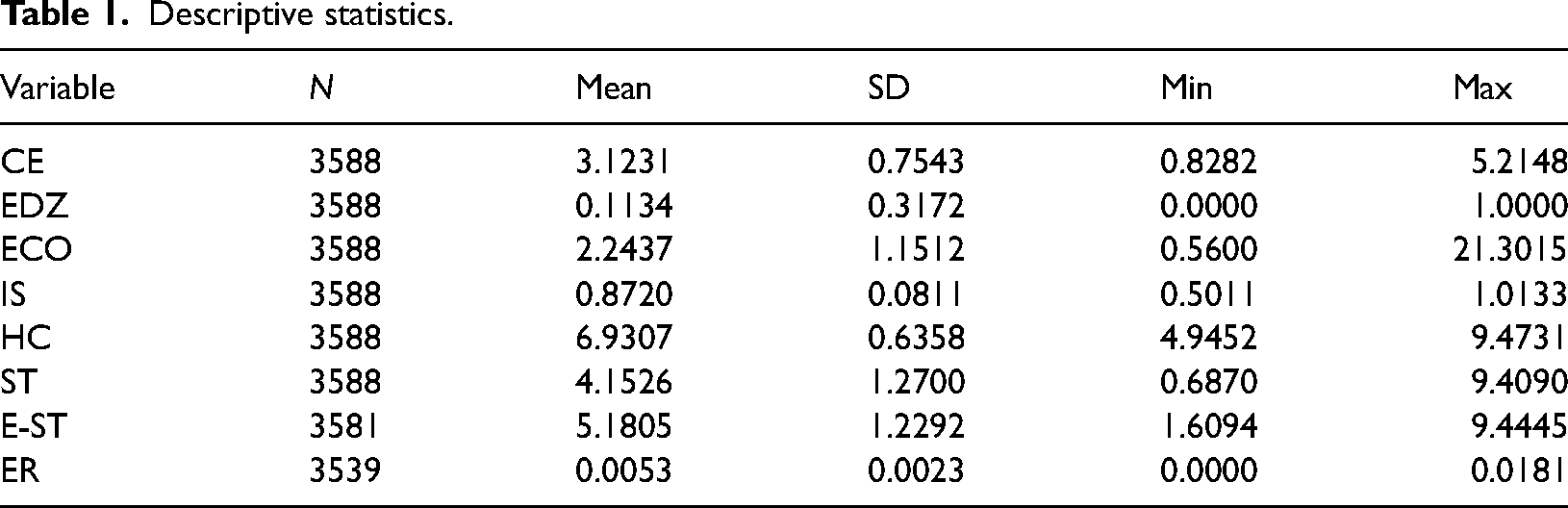
After descriptive statistics, this paper analyzes the correlation of the variables, and the results are shown in Table 2. A correlation is found between CE and EDZ, and it is significant at the 1% level. Observing the second column of the table, the correlation between the core explanatory variables and each control variable is significant; however, the absolute value of the coefficient is small, and the largest is 0.565, none of which exceeds 0.6, which eliminates the suspicion of multiple covariance to a certain extent for the subsequent empirical evidence.
Correlation coefficients.

Note: ***, ** and * mean significant at the level of 1%, 5% and 10%, respectively.
Empirical analysis
In addition to analyzing the impact of EDZ on CE from the theoretical level, testing the effect of the interaction between the two with the help of empirical models is necessary. This section will test each of the three hypotheses proposed in the literature review. On the basis of full-sample regression, the heterogeneity of regional policies is dissected from three perspectives, and the moderating effect is utilized to verify the indirect impact of external effects.
Benchmark empirical results
This paper uses the DID model with two-way fixed effects to explore the net effect between EDZ and CE, and the specific results are shown in Table 3. Column (2) adds control variables on the basis of column (1). The coefficients of the core explanatory variables of the regression results in both columns are negative, and both pass the significance test at 1% level, indicating that the construction of EDZ can indeed effectively reduce CE. The coefficient of EDZ in column (1) is −0.0545, and when a region realizes the leap from non-e-commerce demonstration zones to e-commerce demonstration zones, the CE of the city can be reduced by about 5.45%. After adding control variables such as ECO in column (2), the EDZ coefficient is −0.0463, and although the signs are consistent, the absolute value of the value is slightly reduced compared with column (1). This means that the level of ECO, IS, and scientific and technological strength will influence the effect of EDZ on CE. Moreover, cities need to consider their own comprehensive competitiveness and quality of development, to actively carry out help to e-commerce pilot activities. Taken together, the establishment of EDZ remains an important factor in reducing CE, and Hypothesis 1 is supported by measurement experience.
Benchmark regression.

Note: ***, ** and * mean significant at the level of 1%, 5% and 10%, respectively; the value of standard errors is in brackets.
Analyzing the benchmark regression in detail, we find that this finding is consistent with the results of Zhang et al.’s 51 study, who also concluded that EDZ is beneficial in suppressing emissions. At the peak of the development of digital economy, some leading cities that conduct EC pilots will take the lead in increasing green technology innovation and emphasizing energy consumption from production to distribution. These initiatives are an important path to directly promote carbon reduction and emission reduction, and also in line with the long-term trend of green development. In recent years, numerous environmental policies have been reported related to energy transformation and accelerating the realization of dual-carbon goals, and some of the cities participating in the creation of EDZ have also joined pilot activities such as new energy and CE trading systems, which will effectively promote a positive linkage between environmental policies. The EC related industries have set energy saving and emission reduction targets through the promotion of new energy sources, thus saving their own costs and enhancing productivity and industrial competitiveness, which is conducive to shaping a favorable business environment. With the support of policy promotion, economic agglomeration is guided, and pilot cities with mature operation and management can export favorable experiences for neighboring regions and improve the emission reduction performance of enterprises. 52 At the macro level, the vigorous construction of EDZ is highly consistent with the sustainable development goals.
Heterogeneity analysis
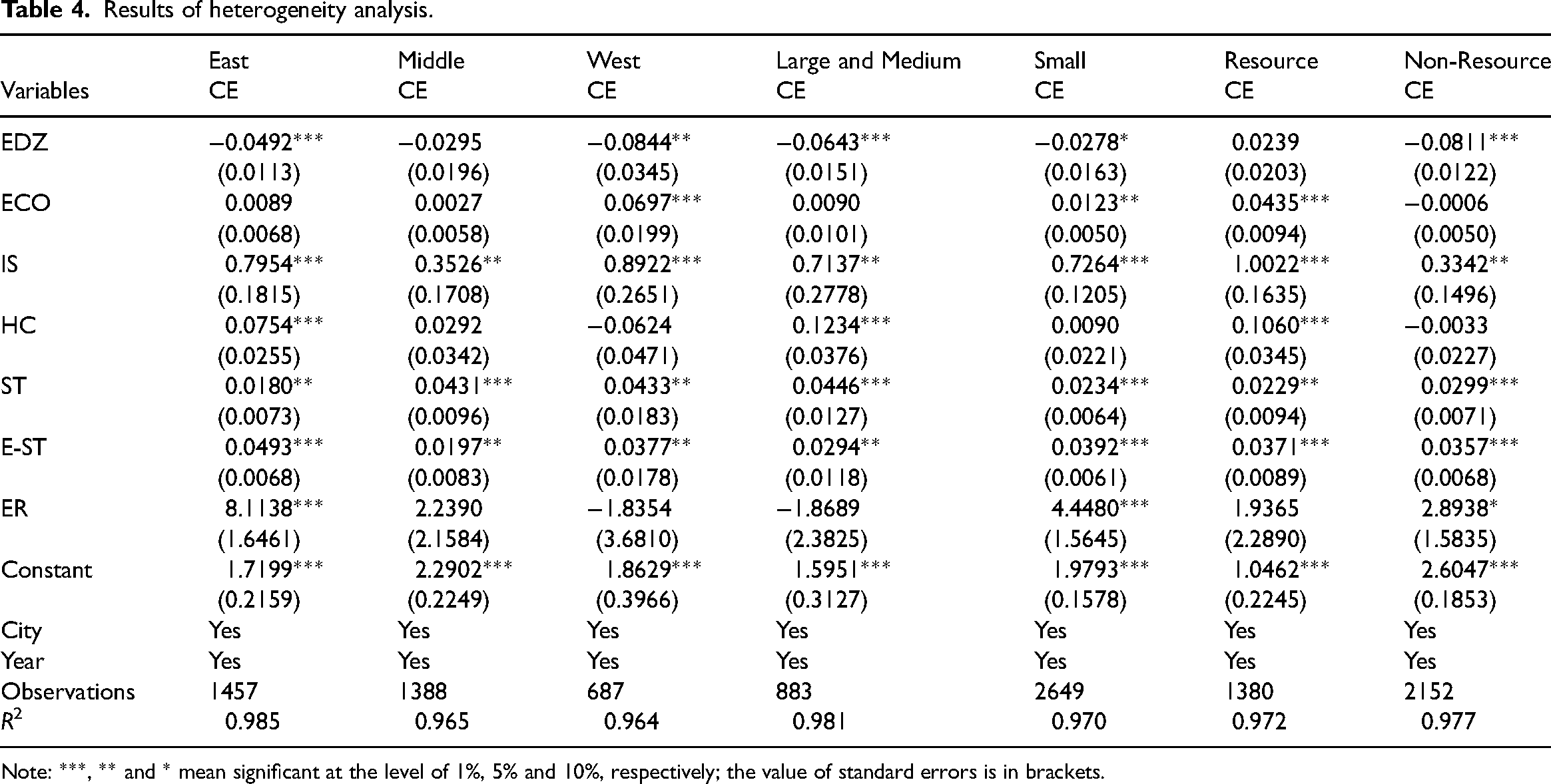
According to the research hypothesis of this paper, regional differences may occur in the effectiveness of carbon reduction in EDZ, which requires heterogeneity analysis under three perspectives, according to geographic location, city size, and type of resource endowment. Table 4 reports the specific grouping regression results.
(1) Geographic location. In this paper, 276 prefecture-level cities are divided into three categories: east, middle, and west. Columns East, Middle and West present the final results. Although all three columns of regression results show that EDZs inhibit CE, the effect of the impact is inconsistent across geographic location conditions. In terms of significance, the explanatory variables in the central region are not statistically significant; however, the coefficients of the explanatory variables in the east and west pass the test at 1% and 5% significance levels. The regression coefficients of the east, middle, and west are −0.0492, −0.0295 and −0.0844, respectively. Although regional differences are found, the essence of the role of EDZ in the reduction of CE in each region remains unchanged. Among them, we focus on the absolute value of the regression coefficient in the western region, which is larger than that in the east and center, a result that is consistent with the findings of Ji et al..
53
This reflects the fact that the policy effect of EDZ in reducing pollution is more apparent in some less developed western regions compared to eastern and central cities. For the east-middle region, geographic location is its natural advantage. In coastal areas with convenient transportation, a leading position in opening up and a rapid pace of ECO, the establishment of EDZ does not bring a significant marginal effect. Although it will reduce CE, the effect is slightly less pronounced compared to the western region. The terrain of the western region is mainly mountainous, plateau and basin, and more. In the process of EC circulation, the inconvenience of transportation can easily hinder the logistics and limit the development.
Results of heterogeneity analysis.
Note: ***, ** and * mean significant at the level of 1%, 5% and 10%, respectively; the value of standard errors is in brackets.
By setting up pilot cities to support and increase investment in transportation, human and financial resources, and technological innovation, the western region will benefit with more dividends, accelerate green development, and reduce CE. The establishment of EDZ for carbon and emission reduction is mainly reflected in the western region, which is also in line with China's desire to reduce the economic disparity between the eastern and western regions and to realize the common prosperity of the country's vision.
(2) City size. Seventy large- and medium-sized cities are categorized based on criteria such as overall city strength, infrastructure, and potential for future development. Columns Large and Medium and Small report the regression results for each of the 70 large- and medium-sized cities and small cities. Regardless of whether they are large- or medium-sized cities, the effect of EDZ on CE is suppressed, and all cities reached the significance level of 10% and above. However, the absolute value of the regression coefficient of EDZs is 0.0643 when considering 70 large- and medium-sized cities. Implementing the policy in these cities can reduce carbon dioxide by approximately 6.43%, which is larger than the absolute value of the coefficient of 0.0278 for small cities, and also exceeds the average of the regression of the baseline of Table 3, which is 0.0463. Most of these 70 large- and medium-sized cities are the capitals of the provinces, the new first-tier cities, and other developed cities. The absolute superiority of their own economy, education, talent, information and other market factors can enable these cities to establish a complete response system both quickly and well after being hit by the policy pilot, optimize resource allocation, upgrade scientific and technological innovation capacity, and improve the level of EC development to reduce the emission of greenhouse gases and other pollutants.
54
In general, large- and medium-sized cities have strong support for the pilot EDZ, perfect e-commerce development, and more prominent effect on reducing CE. (3) Resource endowment. Differences in resource endowments, such as labor, capital, and energy, are also important factors that constrain the green development of a city. The process of EC operation is highly associated with resources, and this paper also carries out the exploration of heterogeneity under different resource endowment conditions. From the regression results in column Resource and column Non Resource, the CE of non-resource cities is strongly suppressed with a coefficient of −0.0811. However, the sign of the regression coefficient of resource cities is positive, and the EDZ in these areas will rather increase the CE. Hence, this paper analyzes that the cost of all kinds of resources tends to be lower in regions with richer resource endowment, and energy waste is more serious, which will directly lead to the surge of CE. A “resource-curse” dilemma is found in resource-oriented cities because they tend to be resource dependent. The construction of EDZ does not effectively promote energy saving and emission reduction, but rather accelerates the consumption of energy resources, which is also confirmed by the results of Bai et al..
55
On the contrary, the establishment of EDZ in non-resource cities is akin to “sending charcoal in the snow.” In regions with a relatively small proportion of resource factors, the policy dividend promotes advancements in science and technology, technological innovation, and various types of resources to improve the efficiency of the use of resources, thereby achieving emission reduction goals. Consequently, EDZs in non-resource cities have yielded better results on the path to low-carbon development compared to resource-rich cities.
Collectively, the three heterogeneity analyses reveal that differences in the impact and extent of EDZ on reducing CE depend on geographic location, city size, and resource elements. This partially verifies Hypothesis 2, indicating that the effect of EDZ on CE is not uniform across all cities.
Mechanism analysis
The process of reducing CE in EDZ will also be affected by many external factors. To further explore the indirect effect brought about by trade openness, this paper introduces FDI as a regulating variable and establishes a regulating effect model. The variable FDI chooses the ratio of the actual utilization of foreign capital to GDP in the current year to be measured. The specific regression results are shown in Table 5. Observing the core explanatory variables first, all of them reached statistical significance at the 1% level with or without control variables. The sign of the coefficient is negative and the absolute value is not much different from the baseline regression, which means that the main role of EDZ in suppressing CE in the moderating effect remains unchanged. Next, we checked the interaction term of the two columns of results. The coefficient of the interaction term in column (1) is −0.8539, and the coefficient becomes −1.1499 after adding control variables. The interaction term has the same sign as the coefficient of the core explanatory variables and passes the test of significance, which suggests that the addition of FDI indirectly enhances the main effect of EDZ to reduce carbon dioxide emissions. Increasing the intensity of FDI will promote the development of EC to a certain extent, which will consequently inhibit CE more prominently, which is a favorable influence path for environmental protection, verifying Hypothesis 3.
Moderating effects of FDI.

Note: ***, ** and * mean significant at the level of 1%, 5% and 10%, respectively; the value of standard errors is in brackets.
Analyzing the internal logic, this paper argues that three reasons exist. First, the EDZ has led to the derivation of cross-border e-commerce, and this new form of foreign trade has strongly contributed to the increase in FDI. Some foreign enterprises subject to strict ER have introduced mature and excellent green business concepts and verified the “pollution halo hypothesis” in the long run, effectively reducing CE and accelerating the realization of the “double carbon target”. 56 Second, the increase in FDI inflows will also stimulate self-competitiveness. E-commerce enterprises carry out technological innovation, continuously overflowing green and clean technology, reducing energy consumption, thus eliminating high-pollution and high-energy-consumption sectors, and ultimately pulling green and low-carbon development. 57 FDI plays an important reinforcing role in the process of EDZ affecting CE. Third, FDI can lead to the entry of environmental protection enterprises. Some EC environmental enterprises take on the social responsibility of popularizing green consumption, and increased investment will help them to publicize and promote, interact with local communities and environmental organizations to promote each other, and support EC demonstration policies while getting positive feedback from multiple parties, indirectly enhancing CE reduction effects.
Robustness test
This chapter will test the robustness of the empirical analysis in three ways. In addition to the verification of ex ante trends, the impact of the construction of EDZ on CE will be analyzed through a placebo test and PSM-DID regression.
Parallel trend test
An important prerequisite for the assessment of policy effects using the DID is that the parallel trend hypothesis holds. If no policy shock exists, the experimental and control groups should show the same trend of change before and after the treatment, and the difference is presented only after the policy shock. In this paper, the policy year of the EDZ is chosen as the base period, and the corresponding before and after periods are generated for every one-year interval. Figure 1 plots the confidence intervals covering Before2 to After2. The results in the figure reveal that the two periods to the left of Current are the pre-policy implementation periods, and the confidence intervals apparently contain the coefficient 0, i.e., no significant difference exists between the experimental group and the control group in the Before period, and they possess the same ex ante trend. Starting from Current, the regression coefficients in the After period are significantly different from 0, and the entire confidence interval is in the range of coefficients less than 0, which is no longer consistent with the change of coefficients in the base period before. This means that after being affected by the policy, a timely effect difference is produced between the experimental and the control group, and the EDZ policy has a significant inhibiting effect on CE.
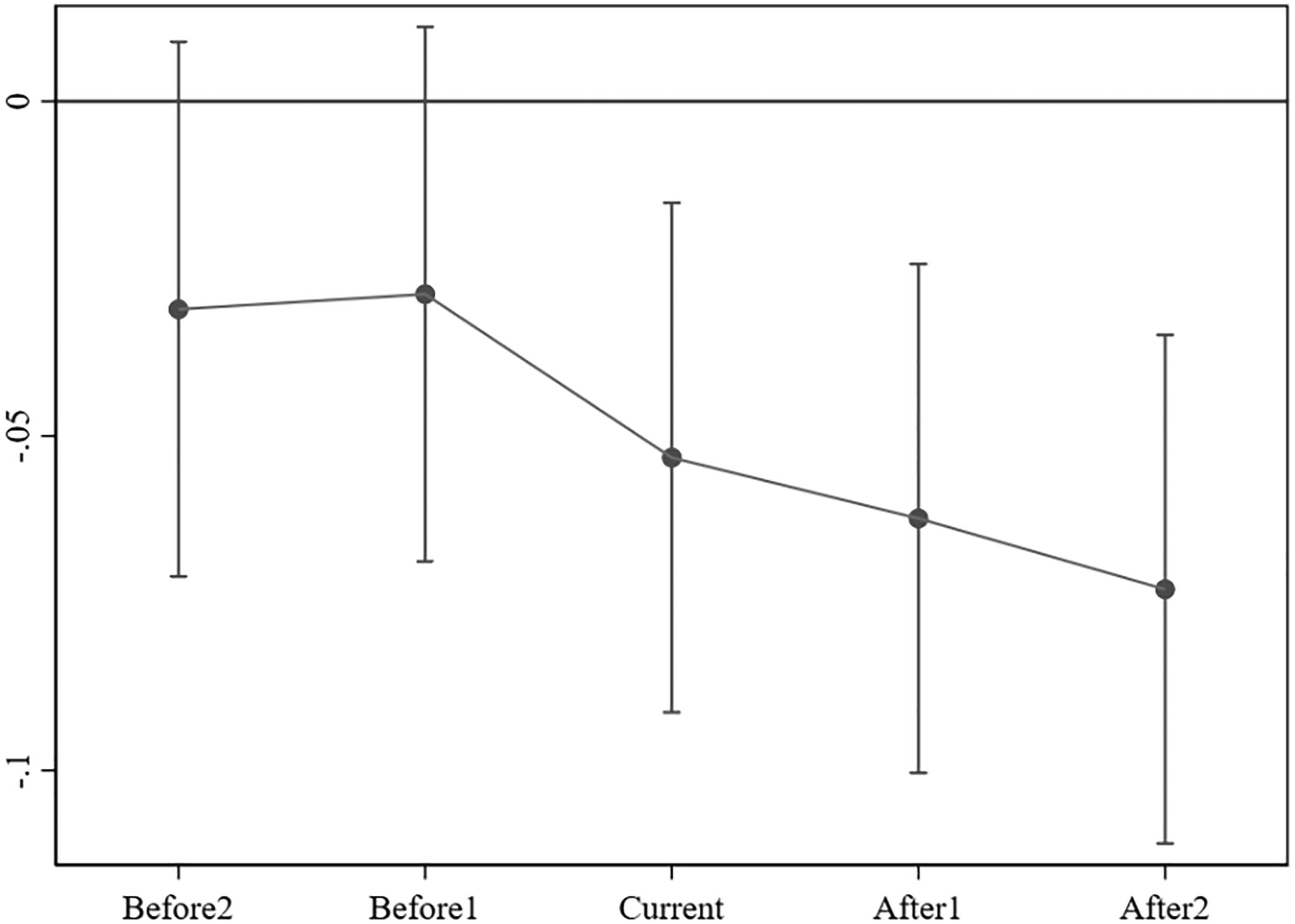
Parallel trend test diagram.
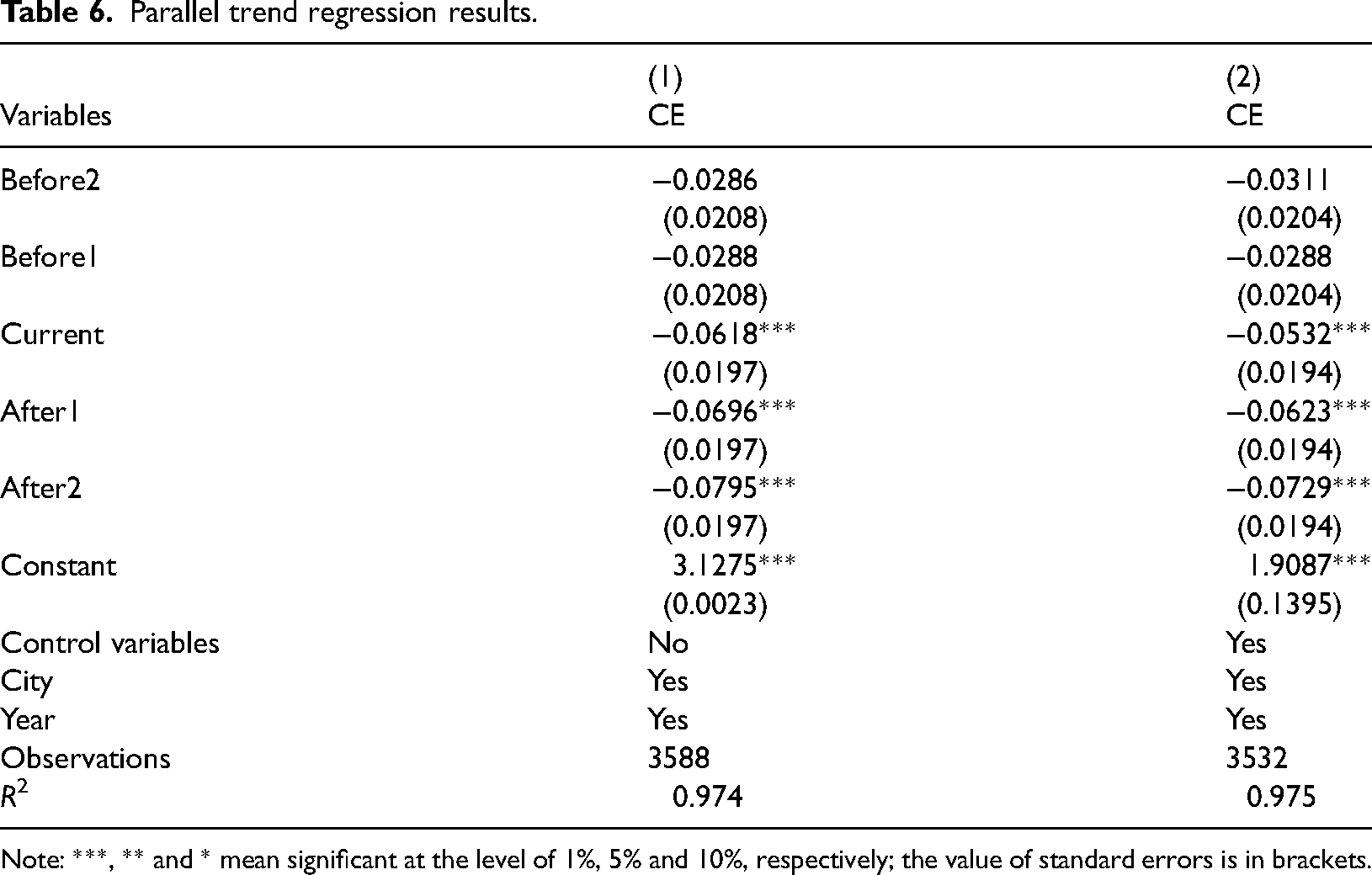
In addition to the confidence interval plots, Table 6 reports the results of the corresponding regressions with the control variables added in the second column. The estimated coefficients before Current in both columns of the regression are negative; however, neither passes significance, and the estimated coefficients at the start of Current are significantly negative at the 1% level. The coefficient changes from −0.0532 to −0.0729 in the period of policy shock after adding the control variable, with a tendency to increase gradually in absolute value. This indicates that the pilot regions show the difference from the non-pilot regions after being subjected to the policy shock, and also the CE reduction effect of the pilot regions gradually increases with time. This is consistent with the graphical results of the confidence intervals, and combined with the graphical synthesis, the parallel trend hypothesis of this paper is verified.
Parallel trend regression results.
Note: ***, ** and * mean significant at the level of 1%, 5% and 10%, respectively; the value of standard errors is in brackets.
Placebo test
In order to exclude the influence of omitted variables and other random factors on the results of the study, this paper uses a placebo test by extracting interaction terms. Its logic is to observe the significance of regression results by fictionalizing the experimental group. When the regression results of the fictitious sample are not significant, the changes produced by the dependent variable can be considered to be due to policy shocks. In contrast to previous placebo tests presenting regression models, this paper reports sample estimation results and corresponding parameter distribution plots. Table 7 presents the results of one-sided regressions of the regression coefficients for 500 samples. Beta is the estimated coefficient, T is its observed value, the first row represents the lower one-sided case, and the second row represents the upper one-sided. C refers to the number of times the coefficients on the other side of the scale are present in each case, N is the total number of samples, and CI stands for confidence intervals at the 95% level. The fact that the upper one-side in Table 7 contains all samples means that no values fall on the left side of the regression coefficients and a p-value of 1 indicates that the random sampling results are not significant, a good indication that such effects do not occur under non-policy factors.
Sampling estimation of regression coefficients.

Figure 2 plots the distribution of the corresponding parameters. (a) and (b) show the distributions of the regression coefficients and T-values, both of which obey normal distributions, with 0 as the mean on the left and right sides of the distribution. (c) shows the distribution of the p-value, which is centered around 0.5, much larger than 0.1, which is sufficient to reject the original hypothesis. (d) shows a combined plot of the regression coefficients and p-values, with the dashed line representing a p-value of .1, and the vast majority of the p-value points fall above .1, consistent with the p-value distribution. Combined with the table and graph together, the effect of placebo test on the dependent variable is not significant; once the policy changes, the extracted dummy interaction term does not have an effect on CE and does not achieve the current CE reduction result. Based on this, the credibility of the placebo test in this paper is verified and meets the test expectations.
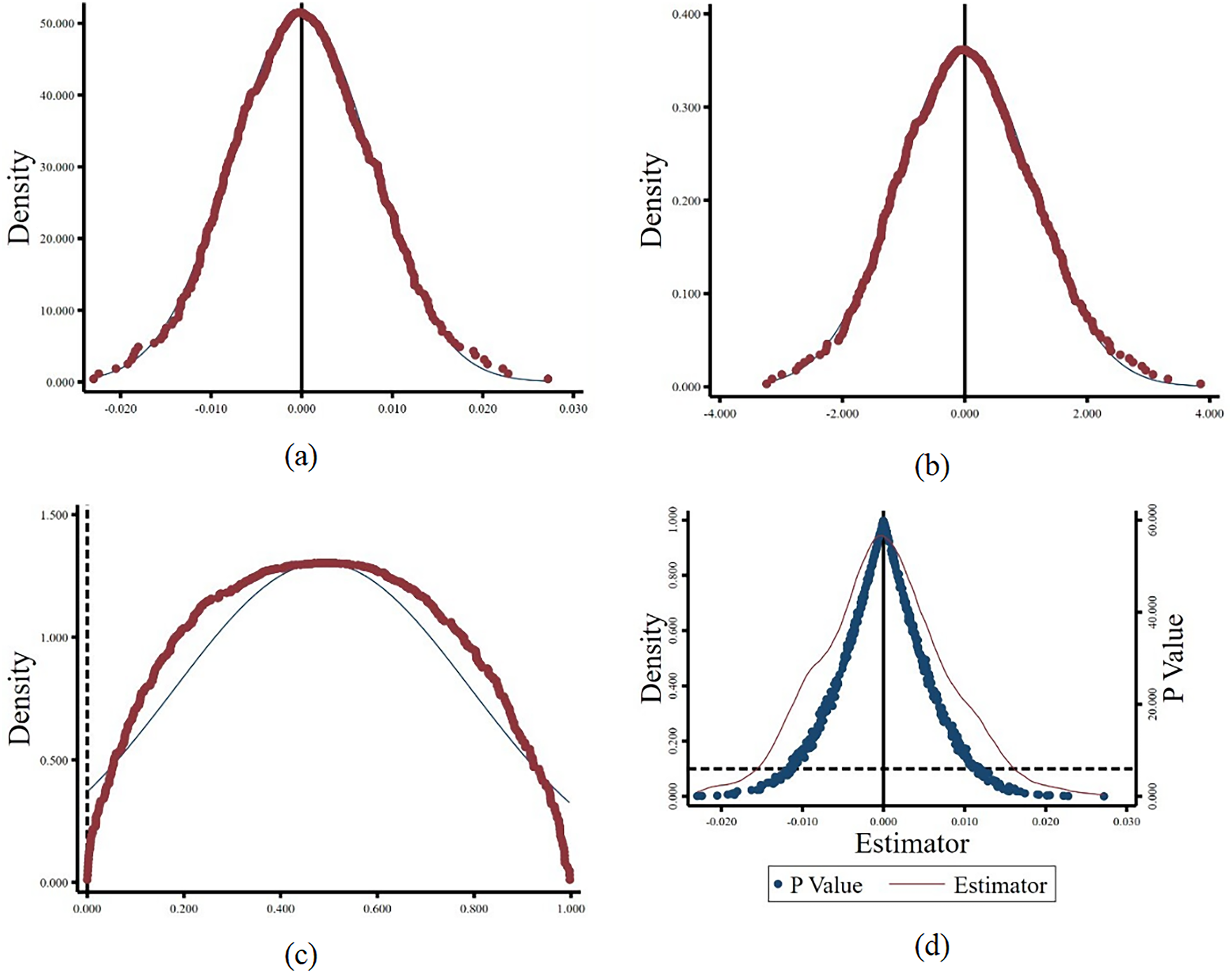
Placebo test distribution. (a) Regression coefficient distribution. (b) T-value distribution. (c) p-value distribution. (d) Regression coefficient and p-value.
Propensity score matching in DID (PSM-DID)
Considering that the existence of some unobservable factors in the perturbation term will generate endogeneity problems and cause bias in the estimation of the effect of EDZ in reducing CE, this paper chooses the propensity score matching (PSM) followed by PSM-DID to support the robustness test again. Firstly, a logit model is established to weaken the self-selection model, and 1-to-1 nearest neighbor matching is used, and the kernel density map before and after matching is shown in Figure 3. The red curve in the figure is the control group, and the blue curve is the treatment group. The treatment and control groups before matching are nearly parallel and an obvious gap can be observed; however, after matching the lower left curves are close to intersecting, and the two groups are somewhat closer. This represents that the data characteristics of the two groups of samples are close after matching, and the matching effect is better.
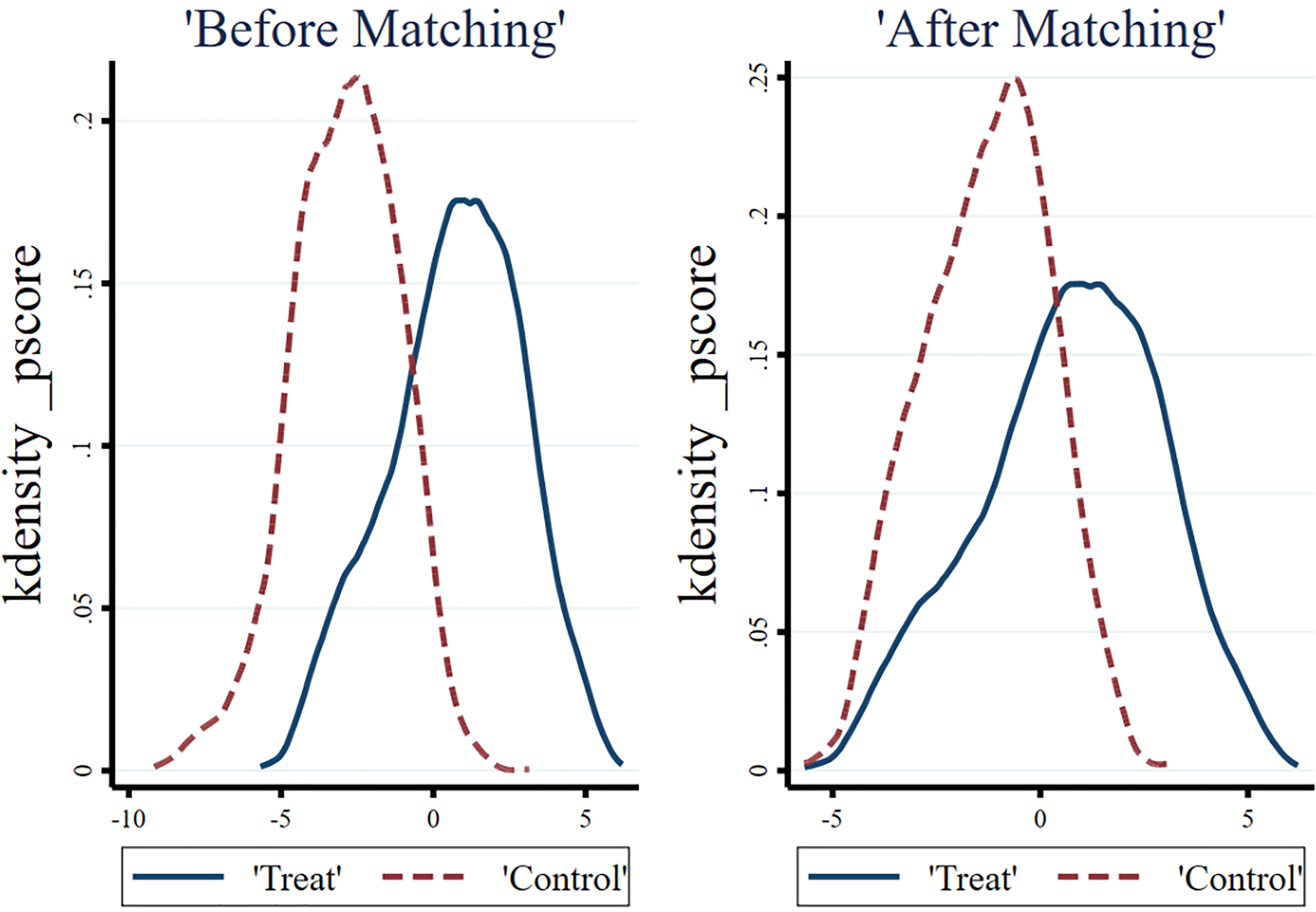
Kernel density map.
The matched data are again subjected to DID regression, and the results are shown in Table 8. The regression coefficients of EDZ with and without control variables added pass the significance test at the 1% level, the sign is negative, and the coefficients do not differ much in absolute value from those of the baseline regression; hence, the robustness of the empirical analysis is again verified. This result also suggests that, after PSM of the sample data, the EDZ still exerts an inhibitory effect on CE. The spread of green management concepts through the pilot policy, the enhancement of own technological innovation capabilities of enterprises, and the continuous reduction of resource and energy waste in the circulation of EC help build a low-carbon and efficient business ecosystem.
PSM-DID regression.
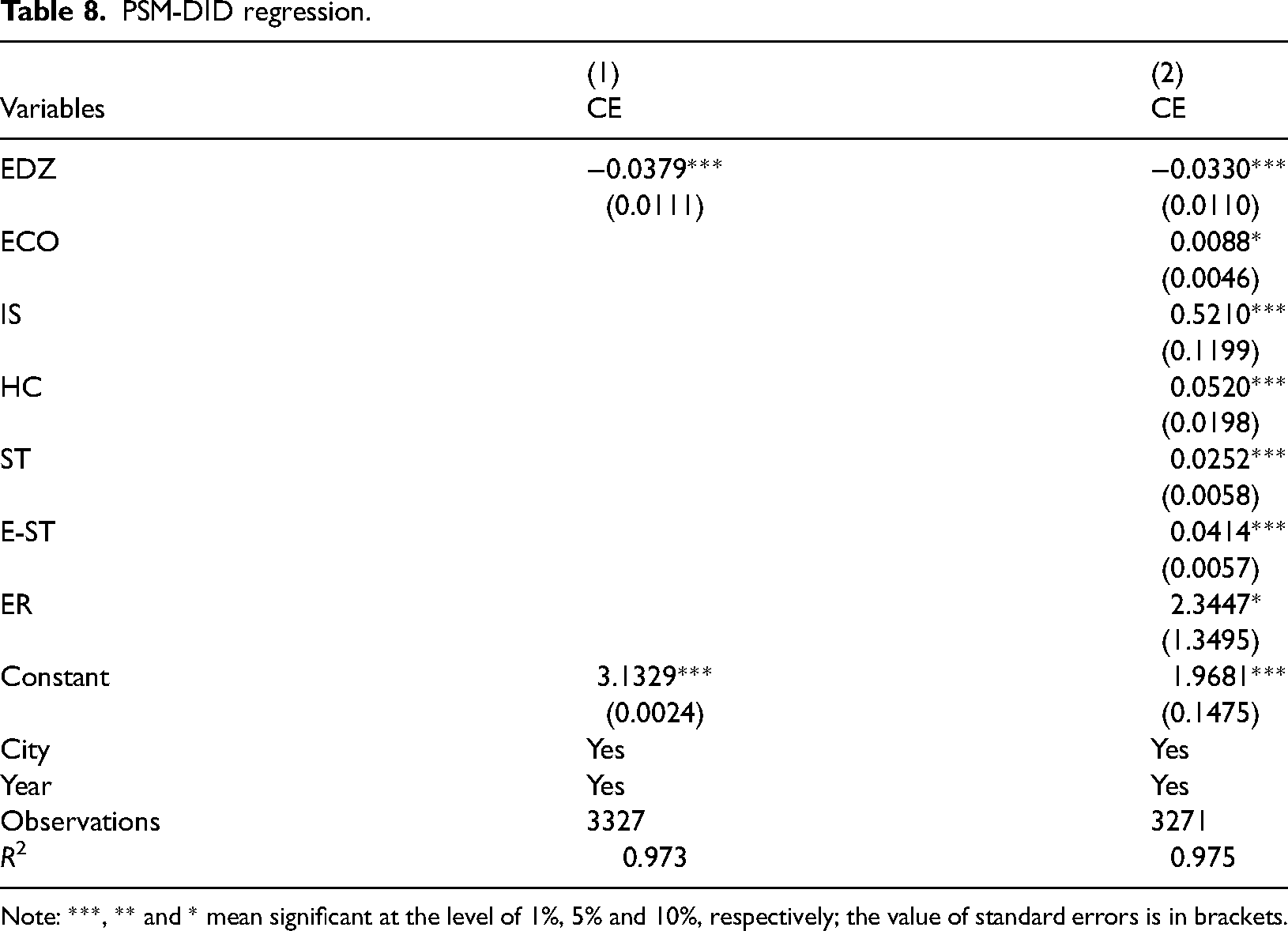
Note: ***, ** and * mean significant at the level of 1%, 5% and 10%, respectively; the value of standard errors is in brackets.
Instrumental variable
To address the endogeneity issue, robustness is verified again with the help of two-stage least squares estimation (2SLS). The instrumental variable chosen in this paper is the number of temples in each region. Since this variable is cross-sectional, the paper constructs the logarithmic value of the cross-multiplication term of the number of temples with the time variable for replacement. Table 9 reports the regression results with column (1) showing the first stage. It can be seen that the instrumental variable coefficients are significant and positive at the 1% level. The F-value is 27.7, which passes the weak instrumental variable test and justifies the choice of this instrumental variable. Column (2) presents the regression result of the second stage, the p-value of the LM statistic is 0.0000, which rejects the original hypothesis of “insufficient identification of instrumental variables”, and the value of the Wald F statistic is 27.695, which is greater than the critical value of the weak identification test at the 10% level. The regression coefficient for EDZ is −0.308, significant at the 1% level, which is consistent with the benchmark regression.
2SLS regression.
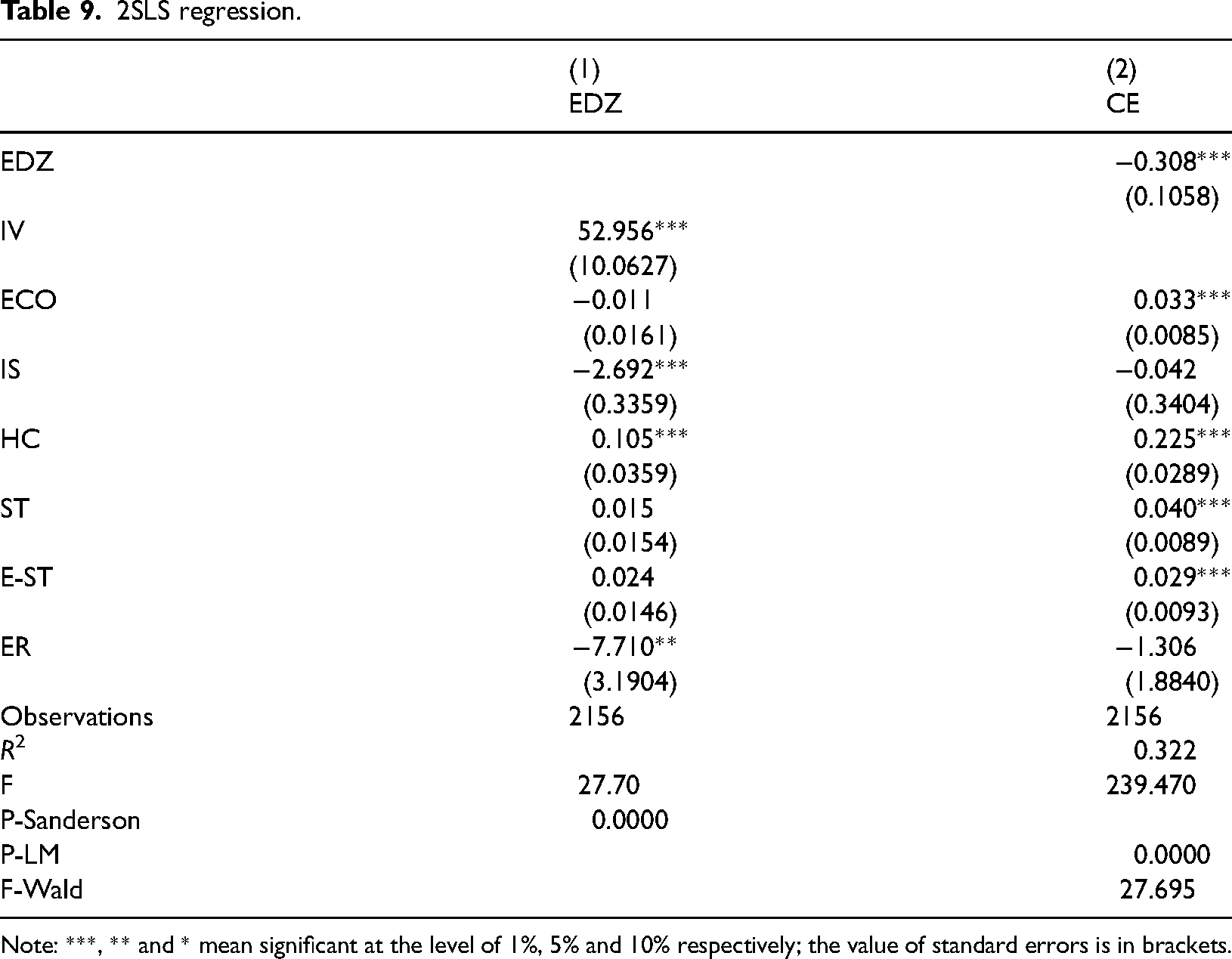
Note: ***, ** and * mean significant at the level of 1%, 5% and 10% respectively; the value of standard errors is in brackets.
Conclusions and policy implications
E-commerce, as an emerging business model to support the modernized economic system, is specifically critical for its development to be in line with the green and high-quality development trend. This paper utilizes the panel data of 276 regions from 2007 to 2019 and, with the help of the DID model, deeply explores the impact of EDZ on carbon dioxide emissions. The main conclusions of the study are as follows: (1) EDZs have a significant inhibitory effect on CE, which can effectively reduce approximately 4.63% of greenhouse gases. The nature of the EDZ to reduce CE remains unchanged under the three robustness tests of parallel trend, placebo test and PSM-DID. This conclusion is a good support for the future development of the EC industry, which is a win-win initiative for the digital economy and green and high-quality development. (2) The EDZ has effect differences in different regions. The carbon reduction effect is more prominent in the western region, large- and medium-sized cities, and non-resource cities. The degree of suppression of CE is greater than the full-sample benchmark regression, and heterogeneous results enhance the applicability of the study and reflect the development space for localization. (3) The mechanism analysis revealed that FDI is an indirect path to promote EDZ to reduce CE. The results of the interaction term regression indicate that FDI can play a moderating role of isotropic reinforcement. Compared with most studies on the industry and technology level, this is a validation of trade opening channels.
From empirical test results, the effects and impact mechanisms of the EDZ on CE are found to be complex and dynamic. The following policy recommendations are proposed:
First, e-commerce demonstrations and pilot projects should be vigorously promoted to accelerate CE reduction. Although the EDZ can inhibit CE to a certain extent, EC green development in the process of the production chain is still facing formidable challenges, such as packaging, logistics and distribution, and consumer shopping as well as other aspects of the waste of energy consumption. The government should increase financial support, implement favorable tax policies, and clarify pilot objectives. A comprehensive approach, starting from multiple fronts, is necessary to ensure the success of both initial and subsequent trials, enabling more cities to participate in the development of EC. Promoting the pilot is conducive to foster fair competition among cities and enterprises. On this basis, we will continue to advance innovative technologies and disseminate emerging green innovative technologies, reduce unnecessary resource consumption, and commit ourselves to utilizing the strengths of EC in every aspect of the business process, thereby fostering an environmentally sustainable EC landscape from a multi-dimensional perspective. Simultaneously, as we aim to promote EC on a large scale, the government should ensure robust top-level design and prioritize infrastructure development. Building a strong development platform is crucial to help the EC industry navigate market opportunities and challenges, drive CE reductions and achieve green high-quality development.
Secondly, understanding the characteristics of each city, seeking common ground while preserving differences, and adapting to local conditions are important. Different cities impact CE differently due to their geographical location, city size, and resource endowment. A generalized approach to CE reduction in EC is not scientifically sound. National governments should identify regional challenges and allocate resources rationally. By strengthening inter-regional EC linkages, we can leverage the benefits of an agglomerated economy. This approach will enable the formulation of macro-consistent and micro-appropriate policies, improving the accuracy and effectiveness of implementation. All regions should fully utilize its strengths, consider its specific conditions, and actively explore and develop tailored plans. As a strategy to balance ECO and environmental protection, the EC industry has a promising future, gradually progressing towards mobility and localization. Rural, township, and other areas have become keys to the battlegrounds for the expansion of EC channels. Governments in small- and medium-sized urban areas should focus on the operation and management of this industry and provide necessary social support. Building a synergistic mechanism of EC development and carbon reduction is both a theoretical guideline and a practical necessity.
Thirdly, better coordination and cooperation between EC and other scientific, technological, and commercial activities can achieve the carbon reduction effect of “1 + 1 > 2.” This study verifies the moderating effect of FDI on the process of reducing CE in EDZs. Marketization, technological innovation, and the industrial restructuring all indirectly influence this process. Beyond the single promotion of EC, enhancing its integration with other scientific and technological economic activities is more effective. Developing cross-border e-commerce, internet supply chains, logistics services, and other derivative industries can complement and reinforce the role of EC in promoting energy saving and emission reduction. Specifically, the government can strengthen the construction of cross-border e-commerce service and trade zones in some regions, reduce tariffs and other trade barriers, and promote the vigorous development of the EC industry.
Footnotes
Abbreviations
Acknowledgments
The authors thank the National Natural Science Foundation of China (grant numbers 72303001, 71934001, 41771568, and 71533004); the National Key Research and Development Program of China (grant number 2016YFA0602500); the Strategic Priority Research Program of Chinese Academy of Sciences (grant number: XDA23070400); the Scientific Research Project of the Anhui University of Finance and Economics (grant number: ACKYC22028); humanities and social science research projects in universities in Anhui Province (grant number: SK2021A0223); and the Graduate Innovation Program of the Anhui University of Finance and Economics (ACYC2022576).
Declaration of conflicting interests
The authors declared no potential conflicts of interest with respect to the research, authorship, and/or publication of this article.
Funding
The authors disclosed receipt of the following financial support for the research, authorship, and/or publication of this article: This work was supported by the Humanities and social science research projects in universities in Anhui Province, the Scientific Research Project of the Anhui University of Finance and Economics, the Graduate Innovation Program of the Anhui University of Finance and Economics, the National Key Research and Development Program of China, the National Natural Science Foundation of China, the Strategic Priority Research Program of the Chinese Academy of Sciences (grant numbers SK2021A0223, ACKYC22028, ACYC2022576, 2016YFA0602500, 41771568, 71533004, 71934001, 72303001, and XDA23070400).
