



Abstract
Energy-saving is one of the important energy policies of governments around the world. The energy service company (ESCO) came into being in response to the energy-saving policy. For ESCOs to thrive, from the perspective of risk management, it is crucial to diversify the risks of ESCOs through insurance. Through interviews with insurance companies and ESCOs, it was found that there is a feasibility of introducing energy insurance (EI) in Taiwan. EI can be categorized as energy-saving insurance or energy efficiency insurance (EEI), and at this stage, EEI is the mainstay of EI development in Taiwan.
Keywords
Introduction
The energy service company (ESCO)1–4 has a wide range of activities, and the “energy-saving” business is one of the most important activities of the ESCO. Without proper insurance support, the “energy-saving” business is not immune to the many risks faced in the process of operation. Energy-saving insurance (ESI) or energy efficiency insurance (EEI) 5 discussed in this study are insurance commodities with “energy-saving service” business as the “subject matter insured,”6 which are collectively referred to as energy insurance (EI) in this study.
The Taiwan ESCO industry is an emerging industry and faces several issues that need to be addressed. In terms of risk management, “energy-saving service” is the main business of the ESCOs in Taiwan, and certainly requires appropriate EI to diversify the business risks. Therefore, it is important to understand the current situation of EI in the Taiwanese ESCO in the face of the demand for such insurance. In addition, the motivation for this study is to explore the appropriate EI system for the ESCO industry in Taiwan, taking into account the emerging international EI products.
Insurance is a form of risk management that transfers risk. Depending on the “subject matter insured” (the insurance target), insurance can be divided into personal insurance and property insurance. EI for “energy-saving services” in the ESCO industry is liability insurance (a type of property insurance, as detailed below) in nature, whether it is ESI or EEI. However, both ESI and EEI are emerging liability insurance products, and ESI has been successfully tested in Latin American countries and EEI has been tested in the United Kingdom.4 However, are EI (ESI or EEI) suitable for the ESCOs in Taiwan? There is still a need for discussion and this is the main problem discussed in this study.
In Taiwan, there are few studies on the EI of ESCOs, which shows that this is a research gap, and this study is quite novel. However, transferring the liability for compensation that should be borne by the insured (ESCO) to the insurer (insurance company) is undoubtedly an excellent hedge. Thus, the focus of this study is on whether EI (especially EEI) is suitable for ESCOs in Taiwan. The market for EI for ESCOs in Taiwan is still to be developed, and there is great potential for future development! Therefore, this study analyses EI as a way to diversify the risks of the ESCOs, the novelty and importance of which cannot be overstated!
Literature review
Energy service company industry
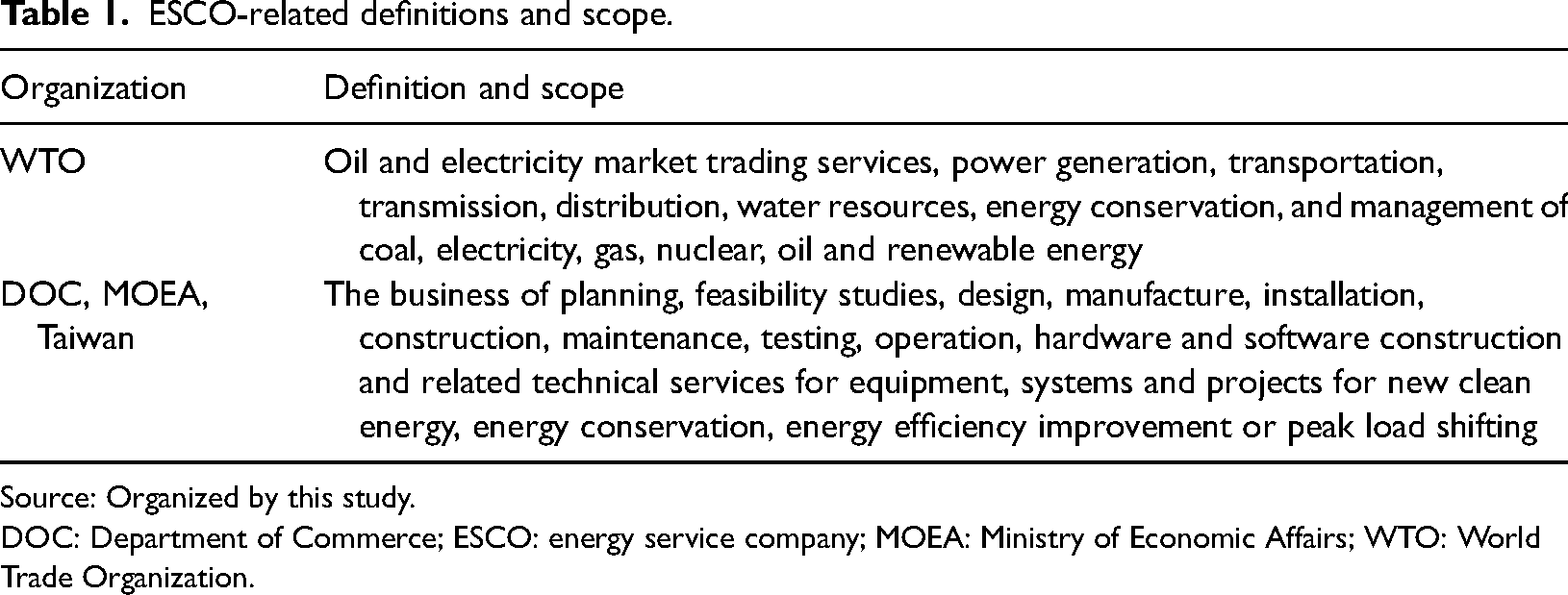
The World Trade Organization (WTO) and the Department of Commerce (DOC) of the Ministry of Economic Affairs (MOEA) of Taiwan have slightly different definitions of ESCOs (see Table 1 for details).
ESCO-related definitions and scope.
Source: Organized by this study.
DOC: Department of Commerce; ESCO: energy service company; MOEA: Ministry of Economic Affairs; WTO: World Trade Organization.
Although the WTO and the DOC, MOEA of Taiwan have different definitions of ESCOs, they are basically within the scope of energy conservation and energy management. Therefore, ESCOs should be integrated; performance-based companies engaged in the development, installation, and financing of projects focused on improving energy efficiency or reducing the load on customer-owned or operated facilities.7–12
Risk management in the ESCO industry
Risk and risk management
Identifying risk is a pre-requisite for successful risk management. Risk is the objective uncertainty of the occurrence of future events, which varies with uncertainty rather than the degree of contingency. 13 Uncertainty and risk are presented as distinct elements but share a common characteristic, which is the lack of absolute certainty in both uncertainty and risk.14,15 Risk is an uncertainty that, if it occurs, may affect one or more objectives.
Hillson 16 further states that risk is a factor of uncertainty. If a risk occurs, it will have a positive impact (opportunity) or a negative impact (threat) on the achievement of objectives, and these impacts are due to both positive and negative changes arising from the risk. However, risk and uncertainty17–19 are different, and effective risk identification (i.e. a clear distinction between risk and nonrisk) is an essential prerequisite for a successful risk management process.
In short, “risk” implies future uncertainty about deviation from the expected outcome,
20
which includes:
the “uncertainty” of whether the damage happened; the “uncertainty” of when the damage happened; the “uncertainty” as to whether the result happened; the “uncertainty” about whether the loss happened.
Risk management refers to the management process of minimizing avoidable risks, costs, and damages. The process of risk management is divided into three items in order: risk identification (the process of determining and categorizing risk events), risk assessment (the process of identifying the magnitude of risk that may arise from a risk event), and risk control (the adoption of measures to reduce risk to an acceptable level). 21 The process can be illustrated in Figure 1.

Taiwan ESCO industry output value chart. Source: Organized by this study. ESCO: energy service company.
Risk management strategies can be divided into four categories: risk avoidance, risk reduction, risk transfer, and risk afford,
22
which are briefly described as risk avoidance, risk reduction, risk transfer, and Risk-taking.
Risk Management of ESCO Industry
The main risks that ESCOs may encounter vary. Freudmann 23 identifies eight main types of risks for ESCOs: financial risk, business/strategic risk, construction and testing risk, operational risk, environmental risk, political/regulatory risk, market risk, and weather-related risk. This study analyses the various risks faced by the ESCO industry at each stage of development, construction, and operation, as listed in Table 2.
Main risks in each stage of ESCO.

Source: Freudmann 23 ; organized by this study.
ESCO: energy service company.
EI is one of the many risk management approaches that can be used to address the risks that an ESCO may encounter.24–27 For example, the Energy Savings Warranty (ESW) was developed by Hannover Re (an international reinsurance company) and Energi Insurance Services (Peabody, MA) as an EI product for ESCOs. 28 ESCOs have overcome this common barrier through risk transfer contracts and EI.29–32
ESCO's EI
There are two main types of EI products, ESI and EEI,
5
which are briefly described below:
ESI
ESI is based on savings guarantees. 33 The energy-savings guarantee is a guarantee provided by the ESCO that it shall achieve its guaranteed energy-savings, and if the ESCO fails to achieve its guaranteed energy-savings, the ESCO will be responsible for the “compensation” (it is “compensation for loss,” not “indemnification for damage”) for the “shortfall” (i.e. the guaranteed energy-savings “minus” the actual energy-savings) if the ESCO does not achieve the guaranteed energy-savings.29,30 The “compensation liability” of the ESCO is the subject of the ESI insurance. In other words, the insurer of the ESI is responsible for the “compensation” (insurance claim) when the “compensation liability” arises.
The Danish Energy Agency pioneered ESI in 2014 and has since worked with Green Finance for Latin America and the Caribbean to expand the ESI concept to Latin America on a pilot basis. 34 Currently, the Inter-American Development Bank is promoting the ESI model in Argentina, El Salvador, Chile, Brazil, Nicaragua, Paraguay, and Peru. In pioneering countries such as Colombia and Mexico, ESI has helped the healthcare and hospitality industries to reduce energy consumption and the environmental impact of their economic activities. 35
By purchasing an ESI, energy users are guaranteed a financial return on their minimum energy savings, and when the ESCO fails to achieve its guaranteed energy-saving target, the insurance company (the insurer) compensates the energy user (the insured) with a certain amount of insurance money, which in turn helps to encourage energy-saving. The insurer can receive premium income from the policy after assessing the risk.
36
In this way, a win-win-win situation can be achieved for the ESCOs, energy users, and the insurance industry, as shown in Figure 2.
EEI

The energy-saving guarantee model (ESI). Source: Organized by this study.
The main difference between the operating models of EEI and ESI is that the insured changes from an energy consumer to an ESCO, and the scope of coverage is broader, with equipment damage, business interruption, and asset performance. 4 Observing the EEI model, the scope of its insurance is the system as the insured object, rather than the single equipment as the insured object, 5 that is, EEI refers to building energy-saving, including heating and cooling air conditioning, lighting, air treatment, control system upgrades, thermal insulation improvements, solar panels, water-saving measures, etc. as a whole are the underwriting objects. At the same time, the insurance period of this type of ESCO service is usually more than 5 years, and even as long as 10 years, the insurance period is longer, and the target is not limited to small- and medium-sized enterprises (SMEs).5,37 Regarding the EEI model with ESCO as the insured, it can be illustrated in Figure 3.

The energy efficiency guarantee model (EEI). Source: Organized by this study.
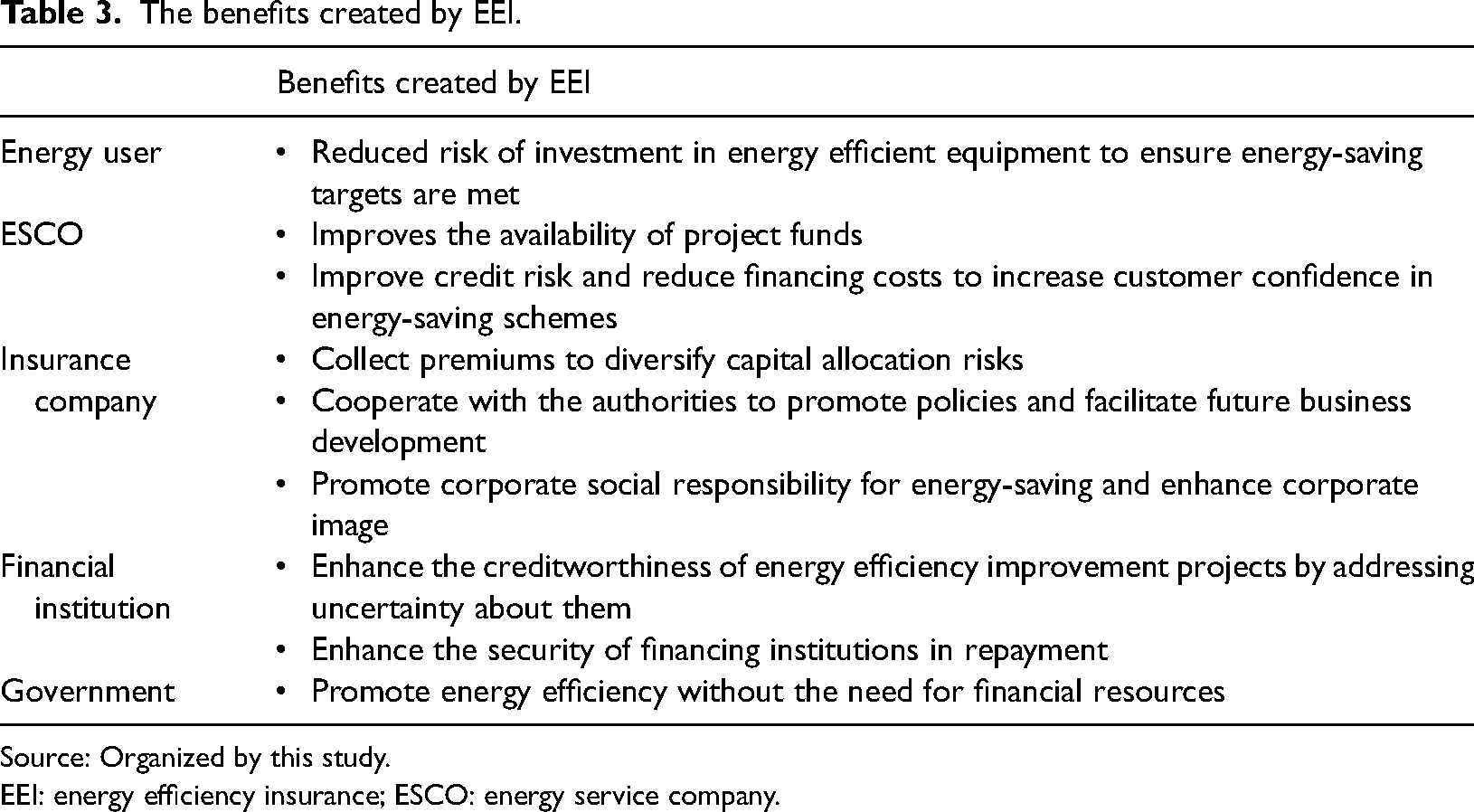
From the above examples, it is clear that EEI does create benefits for energy users, ESCOs, insurers, financiers, and governments (see Table 3 for details).
Comparison of ESI and EEI
The benefits created by EEI.
Source: Organized by this study.
EEI: energy efficiency insurance; ESCO: energy service company.
In summary, ESI and EEI combine insurance with the ESCO business model, allowing banks and energy users to transfer the potential financial risk. Through the implementation of ESI and EEI, the risk of energy-saving investments by energy users can be effectively reduced, the willingness of energy users to improve energy efficiency can be increased, and the possibility for financial institutions to provide loans for energy efficiency improvement-related energy-saving projects can be facilitated, giving ESCOs more business opportunities to accelerate the promotion of energy-saving. A comparison of the ESI and EEI insurance systems is shown in Table 4.
Comparison of ESI and EEI insurance systems.

Source: Chou et al. 4 ; organized by this study.
EEI: energy efficiency insurance; ESI: energy-saving insurance.
EI in Taiwan
According to Article 13 (1) of the Insurance Act of Taiwan, insurance can be divided into Non-life Insurance and Insurance of the Person. Property insurance refers to insurance with the tangible or intangible property as the “subject matter insured,” 6 including fire insurance, marine insurance, land and air insurance, liability insurance, guarantee insurance, and other insurance approved by the competent authorities (as stipulated in Article 2 of the Insurance Act). Life insurance is defined as insurance with life and body as the “subject matter insured,” 6 including life insurance, health insurance, injury insurance, and annuity insurance (as stipulated in Article 3 of the Insurance Act) (see Table 5 for details).
Insurance under the Insurance Act of Taiwan.

Source: Article 13 (1) of the Insurance Act of Taiwan; organized by this study.
EI is an insurance that takes the compensation liability borne by the insured as the “subject matter insured.” In other words, in the event of an “insured event,” in the case of ESI, where “energy-saving (compensation) liability” is the “subject matter insured,” or EEI, where “energy efficiency (compensation) liability” is the “subject matter insured,” the liability that should have been borne by the insured will be transferred to the insurer. It follows that ESI and EEI are not life insurance, but property insurance. 4 However, ESI and EEI are not fire insurance, marine insurance, land and air insurance, or warranty insurance in property insurance. Therefore, ESI and EEI are “subject matter insured” based on the compensation liability of the ESCO (insured) to the energy consumer (third party), and they belong to liability insurance in property insurance.4,6
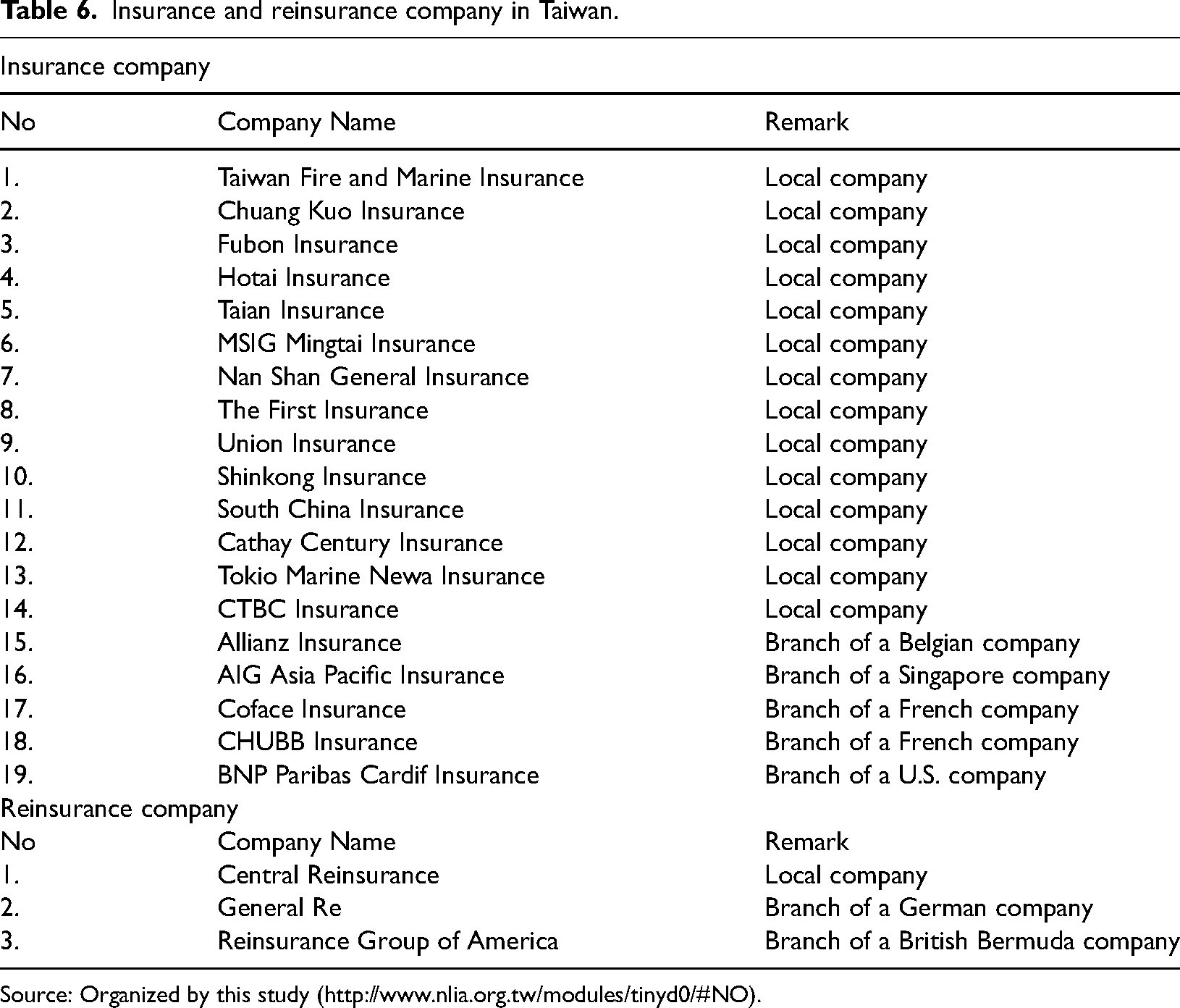
In Taiwan, there are 22 insurance companies (including reinsurers) that underwrite liability insurance (see Table 6 for details).
Insurance and reinsurance company in Taiwan.
Source: Organized by this study (http://www.nlia.org.tw/modules/tinyd0/#NO).
The study found that only Shinkong Insurance Company (28 December 2022) and Taian Insurance Company (23 March 2023) have introduced EI products, and both of them are EEI (see Table 7), and EEI will provide energy users with more risk-averse options. 38
Information on EEI products in Taiwan.

Source: Organized by this study.
EEI: energy efficiency insurance.
After Shinkong Insurance and Taian Insurance introduce EEI products, which are energy services insurance products, will insurance for energy services develop smoothly in Taiwan? It is not entirely clear. Therefore, the following is an analysis of the feasibility of introducing ESI and EEI in Taiwan, with the hope that it will help to introduce energy services insurance in Taiwan.
Research methodology
There are two important approaches to social science research, namely the qualitative and quantitative approaches. According to Bernard 39 qualitative research is suitable for understanding “why” and “how,” whereas quantitative research is suitable for understanding “what” and “how often.” In this study, literature analysis, secondary data research, comparative research, interviewing (mail and person interviews), and coding methods were used.
Documentary analysis method
Documentary research is research involving the analysis of documents.40–42 This study adopts the qualitative method of literature analysis. In this study, the relevant literature (including books, journals, master's and doctoral theses, research reports, conference materials, web information, etc.) was reviewed and analyzed as reference materials for this study.
Secondary data research method
Secondary research is a research method that uses data collected by others.42,43 The secondary data used in this study are mainly “external secondary data” including statistics of government agencies and nongovernmental organizations, industry reports, survey reports, research reports of trade associations, associations, societies, media, academic institutions, marketing research institutions, etc.
Comparative research method
Comparison is an indispensable technique of analytic scholarship.42,44 The process of comparative research is usually divided into four stages: Description, Interpretation, Juxtaposition, and Comparison. In this way, the similarities and differences between the compared themes can be understood, explained and conclusions drawn.
Interview method
The interview method is a commonly used method for collecting information. 42 This study uses the mail interviewing method and the personnel interview method (personal interviewing). Personnel interviews can be divided into three types: structured interviews, unstructured interviews, and semistructured interviews. 45 This study chose to adopt the semistructured interview method.
Coding method
Coding is one of the significant steps taken during analysis to organize and make sense of textual data.42,46 The first step in coding is to read through the interview verbatim and mark up any potentially useful information in open coding. Secondly, try to sort the relevant codes (card sorting), start to construct the classification and correlation between these codes, and extract useful code fragments to become closed codes (closed coding). 47 Then, we further examine the relationship between closed codes, construct correlations and structures, and find out the themes (themes) contained in these codes.
The research flow chart of this study is shown in Figure 4.

Research flow chart. Source: Organized by this study.
Study design and implementation
Basic data collection
This study first collected basic background information on EI in Taiwan using literature analysis and secondary research methods to gain a preliminary understanding of the development of EI in Taiwan, then distinguished between the types of EI (ESI and EEI) and analyzed the similarities and differences between the types of EI (ESI and EEI) using comparative research methods. After collecting the basic background information and analyzing the types of EI, interviews were conducted with insurance practitioners and ESCOs in Taiwan (including mail interviews and personnel interviews).
Mail interviews
In Taiwan, there are 22 insurers (including reinsurers) that underwrite liability insurance (see Table 6 for details). Only Shinkong Insurance Company and Taian Insurance Company offer EI products, and both of them are “energy-saving performance insurance” (see Table 7). As “energy efficiency insurance” is based on “performance” (efficiency), it should be classified as EEI, and this will give energy users more risk-averse options. 38
Personnel interviews
This study adopted a semistructured interviewing approach for the implementation of the interviews. First of all, the study established “detailed” written interview data, and constructed the correlation and structure between the codes through qualitative coding. For the coding of this study, “B1.2” is used as an example, where “B” denotes respondent B, “1” denotes response to the first question (Q1), and “2” denotes the second paragraph of the conversation. The coding diagram is illustrated in Figure 5.

The coding diagram. Source: Organized by this study.
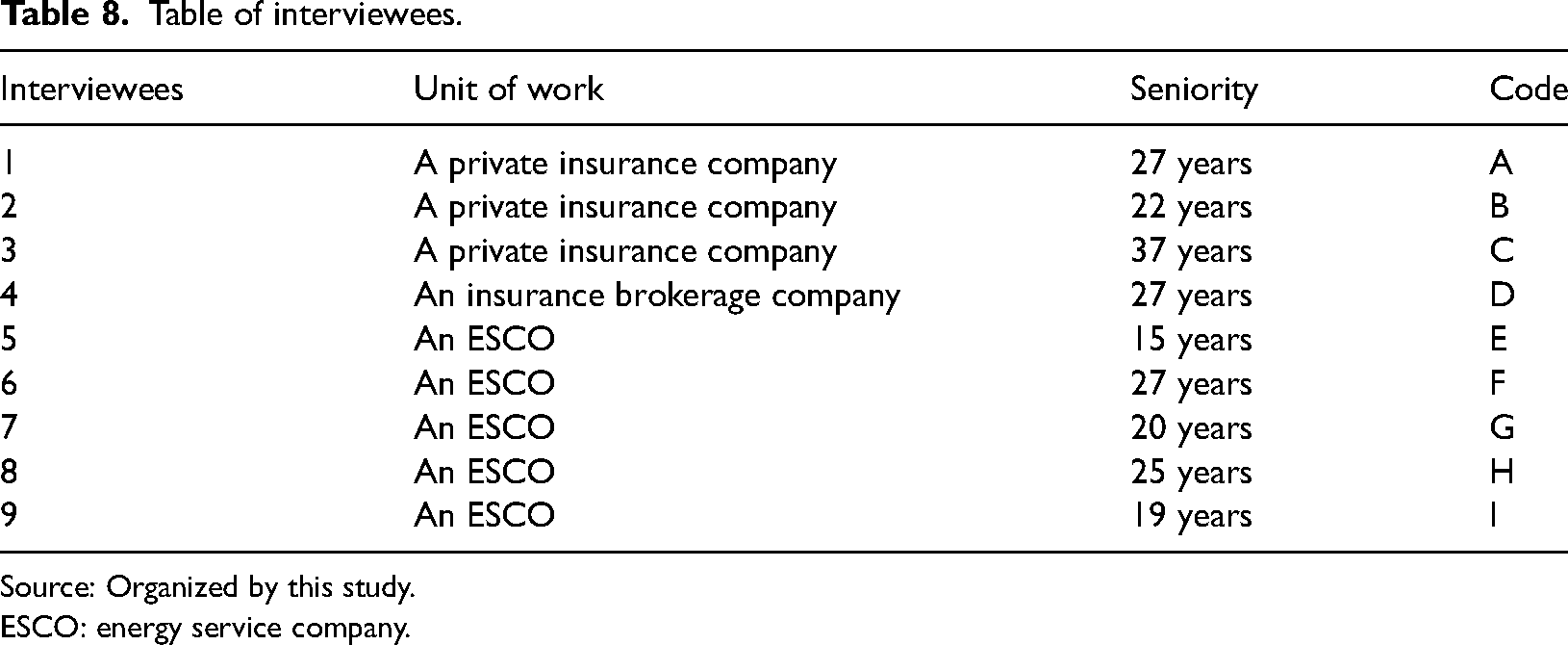
A total of nine interviewees were interviewed for this study, of whom four were Taiwanese insurance practitioners and five were ESCOs, as listed in Table 8.
Table of interviewees.
Source: Organized by this study.
ESCO: energy service company.
According to the interview consent form signed by the nine interviewees, this interview will not be reviewed by the Research Ethics Committee.
Interviews with Insurers In this study, four Taiwanese insurance practitioners (i.e. Codes A, B, C, and D) were interviewed and the main content of the interview questions can be summarized as follows: Q1: What are the insurance products that your company offers to the ESCO industry? Q2: What are the risk factors that your company takes into account when underwriting ESCO insurance products? Q3: Does your company wish to underwrite performance guarantee insurance in the future? Types of insurance currently available Insurance products that can be offered by the insurance industry. Source: Organized by this study. Table 9 shows that the types of insurance that insurers can currently underwrite are broadly construction and decoration insurance, third-party liability insurance, property damage insurance, business interruption insurance, and product liability insurance. However, some insurance companies do not cover delay insurance, accounts receivable insurance, and performance guarantee insurance.
In addition to performance guarantee insurance, construction, and installation insurance, third-party liability insurance, property damage insurance, business interruption insurance, and product liability insurance are all currently available to ESCOs from domestic insurers. (A1.1) EEI underwriting factors explored The respondents agreed that these factors are indeed essential basic underwriting factors that should be considered for future performance guarantee insurance, but performance guarantee insurance is after all a new form of insurance and its underwriting is highly subjective.
Guarantee maximums The maximum amount of the guarantee is the most important issue as it relates to the amount of insurance coverage and the excess, which is the risk that the insurer must bear.
The maximum amount of guaranteed energy savings involves the issue of the sum insured, which represents the maximum liability and risk for the insurer, and must take into account factors such as the excess, which is a major issue in underwriting. (B2.1) Energy-saving services Energy-saving services represent an important factor in terms of the level of risk involved, the period of insurance, and so on, and therefore have an impact on the overall insurance coverage, especially in terms of energy efficiency.
If you are implementing an energy-saving project, the more guarantees you provide, the greater the risk. (A2.2) The period of guaranteed energy-savings The length of the energy-saving guarantee period is also an important factor, as the longer the period of coverage, the greater the risk to the insurer and therefore a factor that cannot be ignored.
The period represents the time the insurer has to bear the risk and is, therefore, a very important factor, the longer the period, the greater the risk. (D2.2) Future willingness to underwrite performance guarantee insurance Since performance guarantee insurance policies will appear in Taiwan in 2022 (e.g. Code C is underwriting performance guarantee insurance), its “supply-demand” is still unclear. During the interview, we found that the insurance industry is open-minded about the future of underwriting performance guarantee insurance.
We would consider doing this business in the future if the opportunity arose, but it would take time to understand what it entails. We don't have an effective policy in Taiwan yet and we don't have the experience to ask for anything. (A3.2) Summary After interview the insurers, the following validation results can be obtained from this study:
As far as ESCO-related insurance is concerned, the insurance industry is very willing to underwrite policies that meet the criteria (including performance guarantee insurance). The insurance industry is taking a wait-and-see attitude as relevant policies are relatively rare at present. However, the insurance industry is positive about the future of underwriting performance guarantee insurance. The most important underwriting factors are the maximum amount of energy-savings guaranteed, energy-saving services, and the period of guaranteed energy-savings.

Interviews with ESCOs
In this study, five Taiwanese ESCOs (i.e., Codes E, F, G, H, and I) were interviewed and the main content of the interview questions can be summarized as follows: Q4: What are the main risks faced by your company about the ESCO industry? Please rank them. Q5: If your company has insurance needs, what are the most important types of insurance you need? Please explain the reasons for this. Risks to the ESCO industry Ranking the risks to the ESCOs. Source: Organized by this study. ESCO: energy service company.
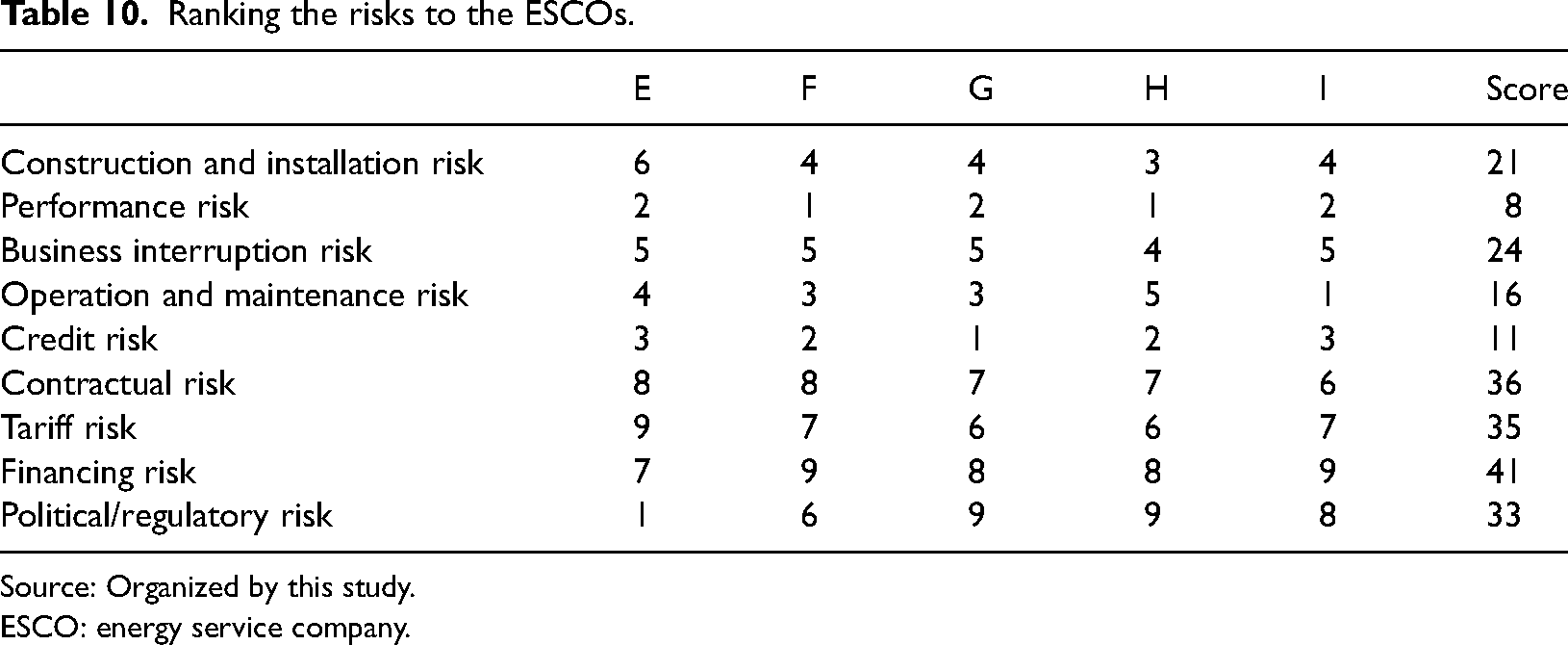
The risk factors for the ESCO industry can be ranked as follows (lower ranking points indicate higher risk): 1. performance risk (ranking points: 8); 2. credit risk (ranking points: 11); 3. operation and maintenance risk (ranking points: 16); 4. construction and installation risk (ranking points: 21); 5. business interruption risk (ranking points: 24); 6. political/regulatory risk (ranking points: 33); 7. tariff risk (ranking points: 35); 8. contractual risk (ranking points: 36); 9. /(ranking points: 33); 10. electricity price risk (ranking points: 35); 11. contractual risk (ranking points: 36); and 12. financing risk (ranking points: 41).
Classification by level of risk
Categorize these risk factors by degree:
High risk:
High risk (i.e. those with a ranking score of 15 or less), performance risk, and credit risk on the ESCO industry's risk factors.
I think the biggest risk for all ESCOs is performance risk. (F5.2) The main risk that worries me is the risk of owner failure, i.e., accounts receivable risk, which covers many of the risks of ESCOs. (G5.5) Moderate risk:
On the risk factor for the ESCO industry, those with medium risk (i.e. those with a ranking score of 16–30) are operation and maintenance risk, construction and installation risk, and business interruption risk.
At present, the ESCO owner is fully responsible for any damage that occurs during the contract period. (I5.4) The installation risks we encounter, such as the new system we install not being able to connect to the landlord's old system, are then the responsibility of the landlord. (H5.1) Regarding business interruptions, the fact is that ESCOs now have their safeguards in place so that the interruptions do not last long. (H5.3) Low risk:
Among the risk factors for the ESCO industry, those with low risk (i.e. those with a ranking score of 31 to 45) are political/regulatory risk, tariff risk, contract risk, and financing risk.
If the government does not establish proper regulations, it will hurt the ESCO industry very much because, without rules of the game, many unscrupulous operators will come in. (E5.9) Tariffs are not risky, even if some manufacturers have a contract, they only guarantee to save a few dollars per unit of electricity, so the tariffs will not be affected by any change. (G5.7) I don't think contractual risk is a risk because contracts are now becoming more mature and there is a set of contractual standards in place, but there are still problems with information asymmetry. (I5.6) In Taiwan, although financing is an issue, most banks will lend money and the bankers in Taiwan look at the availability of collateral for financing. (E5.8)
Summary
After interview the ESCOs, the following validation results can be obtained from this study:
The greatest risks for ESCOs are performance risk, and credit risk, followed by operation and maintenance risk, business interruption risk, and construction and installation risk. The political/regulatory risk is ranked lower because the current regulations and policies are not yet well-developed enough to recognize it as a risk. In terms of insurance needs, most ESCO owners would like insurance companies to provide performance insurance and accounts receivable insurance. In addition, property damage and business interruption insurance are also desired.
Feasibility of introducing EI in Taiwan
Supply and demand for EI
Supply side
Regarding the insurance industry (including insurers and reinsurers) that underwrite liability insurance in Taiwan, none of the insurers underwrite EI (including ESI and EEI), except Shinkong Insurance Company and Taian Insurance Company (see Table 7), which have introduced EI. This shows that the insurance industry in Taiwan is still skeptical about underwriting EI, and their skepticism is probably due to their lack of understanding of EI and therefore they have been holding a wait-and-see attitude.
There are currently many insurance products that can be offered by insurers other than EI, such as property insurance for energy-efficient equipment (which is other property insurance). As there are existing stereotyping standard insurance policies for equipment, insurers will be happy to underwrite any policy that is in place. However, in the case of EI (liability insurance), insurers are unable to write EI policies without the existence of the relevant stereotyping standard insurance policy, 48 so is there any EI stereotyping standard insurance policy approved by the competent authority? It is important to know whether the insurance company can underwrite EI (liability insurance).
Demand side
Due to the lack of understanding of insurance, ESCOs in Taiwan are unable to diversify (transfer) the risks they face through insurance. Insurance can indeed help ESCOs to diversify (transfer) their risks and ESCOs would like to have a mechanism for EI, but due to the lack of understanding of insurance products, they are unable to plan their insurance properly, thus forcing them to keep their risks to themselves and unable to diversify (transfer). Therefore, in terms of insurance demand, although ESCOs are willing to purchase insurance, they do not know which insurance products to purchase to spread (transfer) risks.
At present, there are very few insurance products that insurance companies can provide EI in Taiwan (only the aforementioned “Energy-Saving Performance Insurance” by Shinkong Insurance Company and Taian Insurance Company, see Table 7), and with very few insurance products available in the insurance market, it is difficult to balance the “supply-demand.” Therefore, it is good to see the launch of EEI by Shinkong Insurance Company and Taian Insurance Company in December 2022 and March 2023, respectively. Perhaps these two companies will be able to drive the launch of EI products in Taiwan and create a vibrant EI market.
Feasibility of introducing EI
Based on the above discussion, the following is an analysis of the feasibility of introducing ESI and EEI into Taiwan from environmental and legal perspectives.
Environmental aspects In terms of the environmental aspect, in the case of overseas ESI or EEI, the service sector is mainly covered for lighting systems and water heating systems, while the industrial sector is covered for cooling and heating equipment, boiler systems, and engine systems, which shows that the implementation of overseas ESI or EEI is highly similar to that of Taiwan's industrial sector in terms of the leading energy-consuming equipment.
4
Therefore, against the backdrop of Taiwan's ongoing efforts to promote energy conservation and improve energy efficiency, it is feasible to introduce ESI or EEI into Taiwan, drawing on the precedent of overseas ESI or EEI. Legal aspects
At the legal aspects, domestic laws and regulations related to EI (ESI or EEI) include the Insurance Act, the Executive Yuan's Green Finance Action Plan, and the Code of Practice for Pre-sales Procedures of Insurance Products. Is a failure to achieve the expected energy-savings or energy efficiency damage in the sense of the “principle of indemnity”?4,49–51 There is no doubt about it. Therefore, the legalization of EI (ESI or EEI) should be further developed.
Suggestions for introduction
Reference to existing agricultural insurance models
To marketize EI, it is suggested that the agricultural insurance model could be used to introduce EI. Taiwan's agricultural insurance started with a demonstration policy in 2015, and after frequent communication between the Council of Agriculture, the Association of Industrial Insurance, and the industrial insurance industry, agricultural insurance was formally incorporated into the law in 2019. This approach has indeed met the needs of the government, the insurance industry, and farmers, and is worth learning from.52,53
Promoting energy conservation or energy efficiency is in line with Taiwan's current policy guidelines. Although insurance regulations still restrict the commercialization of EI, reference can be made to the implementation of agricultural insurance, and interministerial communication between the Bureau of Energy (BOE, the energy authority) of the Ministry of Economic Affairs and the Bureau of Insurance (BOI, the insurance authority), Financial Supervisory Commission (FSC) can enable the EI system to operate in the Taiwanese market and establish a model that matches users, ESCOs, financing institutions, and the insurance industry, thereby encouraging the insurance industry to develop or introduce This will encourage the insurance industry to develop or introduce suitable insurance products.
Schedule Planning
As mentioned above, EI is indeed feasible for Taiwan. Therefore, this article divides the process of importing EI into three phases and proposes a strategy for Taiwan's importation.
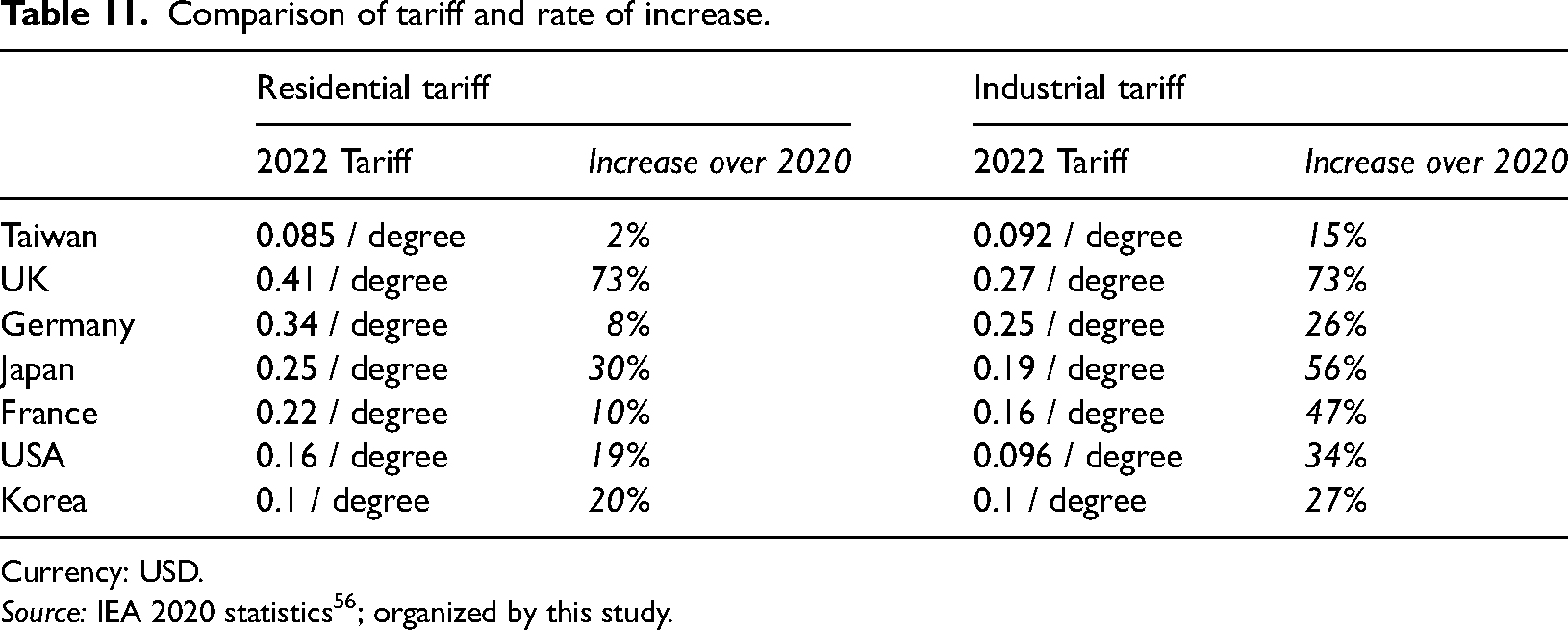
Phase 1 The most important task in the first phase is to sell insurance products in the market. It is suggested that BOE, MOEA, and the National Association of Industrial Insurers should first develop the contents of ESI and EEI, to establish a risk model that meets the needs of the industry. EI, which is a new type of insurance, may not be easy to pass the audit standards of the BOI, FSC, but it may be possible to launch a demonstration policy in order to have a chance of passing the audit. Finally, given the lack of EI in Taiwan, potential market demand for EI will emerge after the introduction of EI. Phase 2 After the introduction of EI, energy users or ESCOs can be asked to submit EI policies when financial institutions provide project financing, to increase the willingness of financial institutions to provide project financing. ESCOs can also increase the amount of financing through the submission of EI policies, and use financial leverage to expand the scale of the energy-saving market. As most ESCOs in Taiwan are SMEs,4,54,55 the small size of the energy-saving market will not be conducive to the development of the EI model. Therefore, appropriate consolidation to expand the energy-saving market is the right way forward. Phase 3 According to the IEA 2020 statistics, Taiwan's residential electricity tariff is the fourth lowest globally, while the industrial tariff is the sixth lowest (see Table 11 for details).
56
With low electricity tariffs and limited annual electricity savings, energy users have no incentive to replace energy-saving equipment and implement energy-saving projects, which is not conducive to the development of an energy-saving market. Therefore, rationalization of energy prices is the key to solving the problem of low energy efficiency market size.
Comparison of tariff and rate of increase.
Currency: USD.
Source: IEA 2020 statistics 56 ; organized by this study.
In addition, although EI can be used as financial aid for energy saving policies, achieving energy-savings or improving energy efficiency is the most fundamental policy objective. Therefore, in formulating the phase III strategy for the introduction of EI, apart from assessing the financial viability, “achieving energy efficiency” 57 should be the highest criterion for implementation.
Table 12 summarizes the work items and contents of the various stages of the promotion of EI as a proposal for the promotion of EI.
EI promotion proposal.

Source: Chou et al. 4 ; organized by this study.
EI: energy insurance; EEI: energy efficiency insurance; ESI: energy-saving insurance; ESCO: energy service company; FSC: Financial Supervisory Commission.
Conclusions and recommendations
Conclusions
In general, as EI (i.e. ESI or EEI) is already available overseas and there are ESI policy or EEI policies, there are no technical difficulties in ensuring the relevant types of insurance, but the key to whether EI (ESI or EEI) can be implemented in Taiwan is:
Is EI compliant with Taiwan's Insurance Acts? Is there an actual demand in the EI market? How to assess the energy-saving benefits of EI and the basis of claims?
Firstly, about the experience of promoting agricultural insurance, it is suggested that demonstration ESI policies and EEI policies can be launched for large energy users or ESCOs first, and the contents of the policies can be adjusted through the empirical experience of the energy users who have entered the market first, and through adequate communication between the government, ESCOs, and energy users to meet the actual needs.
Secondly, Taiwan's regulatory restrictions on EI need to be amended through interministerial consultations, and international experience in implementing EI should be taken into account to break through the current legal framework and introduce EI (ESI and EEI) products that better meet the industry's expectations without affecting the financial risks and financial integrity of the insurance industry.
In addition, to assess the energy efficiency and the basis of claims, from the technical point of view, reference can be made to the benchmarks of energy audits and energy-saving technology counseling conducted in the past by various sectors, and the relevant energy efficiency assessment can be conducted by an impartial third-party certification body, and the EI experience of energy users or ESCOs can be used to set a reasonable basis for claims.
Lastly, Taiwan's previous energy-saving subsidies were mostly based on individual equipment, but the international community has already adopted the EI system to strengthen the overall system energy-saving and energy efficiency improvement business through innovative financial mechanisms.
In the light of the foregoing, preliminary conclusions can be drawn from this study:
EI does not contravene the requirements of Taiwan's insurance laws. There should be a real demand for EI in Taiwan. As to how to evaluate the energy saving benefits of EI and the basis of claims, it is still to be explored in subsequent studies.
Recommendations
Based on the above conclusions, this study makes the following recommendations as a reference for the development of EI in Taiwan.
More communication between the ESCO and the insurance Insurance is very important to the development of the ESCO industry. However, the reason why Taiwanese ESCOs do not take out insurance is not that they do not need it, but because they do not understand what insurance products are and what risks they can really help to diversify (transfer), and insurance companies are not completely without supply to the ESCO industry. EI-related products should be developed for ESCOs related EI is a new blue ocean. At present, the only EI policies in Taiwan are those of Shinkong Insurance Company and Taian Insurance Company (i.e. Table 6), so it is impossible to explore the real supply and demand side of EI. Therefore, we should develop EI-related products for ESCOs in the future to meet the actual demand. Government should support the legislation (or amendment) of EI The US and Danish ESCOs have flourished because of the support of their governments in terms of regulations and policies. Since EI can help the development of the ESCO industry, the Taiwan government, based on the position of supporting the development of the ESCO industry, should promote EI legislation (amendment) as soon as possible.
Footnotes
Declaration of conflicting interests
The author(s) declared no potential conflicts of interest with respect to the research, authorship, and/or publication of this article.
Funding
The author(s) received no financial support for the research, authorship, and/or publication of this article.
