



Abstract
A critical challenge in the power sector of the massive deployment of variable renewable energy such as solar photovoltaics and wind power, and a large increase in overall electricity demand as more end uses are electrified. Grid-scale energy storage, the most widely used technology is pumped-storage hydropower (PSH), will be essential to manage the impact on the power grid and handle the hourly and seasonal variations in renewable electricity output while keeping grids stable and reliable. This study used the panel threshold regression model to examine the threshold effect of the proportion of energy storage for the development of renewable energy. The energy import dependence and energy market concentration are also both taken into account in the model. The empirical results show that when the amount of PSH is below/above the threshold, its β coefficient shows the opposing results of positive/negative correlation, respectively. It is increasingly important to focus on the power system operations in the planning models integrating variable renewables, the power system planning models are conducted to future power structure scenarios, and need to provide the rolling wave planning models with increasing variable renewables.
Keywords
Introduction
Toward net-zero emissions trend, renewable energy will become the main source of energy supply for power systems. Electricity generation from resources can be described as dispatchable or nondispatchable, the most significant current and foreseeable change in the electricity sector is the rapid substitution of variable renewable energy (VRE) such as wind and solar energy for fossil fuels in electricity generation. Energy storage can play in decarbonizing the power sector in a cost-effective manner. Increased penetration of VRE generation makes storage more attractive because VRE generation is intermittent. Grid energy storage systems are one of the most important solutions in major countries around the world, as they can stabilize and smooth out fluctuations in power system, reduce deviations from energy predictions, solve problems with local voltage and frequency instability control, and improve energy reliability. The initial application of pumped storage hydropower (PSH) is the major type of grid energy storage in the world which occurred in the late nineteenth century in Europe. PSH was called the world's water battery, provide support for the stable operation of the power. PSH currently accounts for over 94% of installed global energy storage capacity, and over 96% of energy stored in grid scale applications.
The use of renewable energy for power generation will highly increase in the future. However, renewable energy power generation is limited by the uncertainty of renewable resources, which is easy to cause an imbalance between power supply and demand. In order to eliminate the impact of renewable energy generators on the power system, the development of energy storage systems is most important. PSH is very popular because of its large capacity and low cost. The output of solar photovoltaics (PV) increases significantly during the day, when thermal power generators need to reduce loads or decouple and shut down; however, during the evening hours, the units must increase power generation to supply the load gap when needed. Thus, thermal power generators must maintain a certain percentage of output during the day when the solar PV output is still large. Excess energy the units produce during the day can be used to pump water into an upper reservoir for storage; that water can then be discharged into the lower reservoir through a turbine to produce energy for use during the second peak load period at night (or whenever the system needs it). In response to sudden increases/decreases in intermittent output of renewable energy, PSH stabilizes the instantaneous load of the system and reduces the load-down, start-up, and shut-down of thermal power generators. It provides auxiliary service functions such as frequency regulation, voltage regulation, and emergency rescue for the power system; it also has the function of maintaining the stability of system dispatching.
The development of renewable energy has benefitted from national resource endowment. Besides the line of research, this study differs in that it uses 21 years of data (2001–2021) from EU countries as the subject of its research. In addition to exploring energy import dependence, it also analyzes the relevance of influence of energy market concentration and energy storage (specifically PSH) on the development of renewable energy. This study explored through the historical data in the European Statistical System (ESS) prior to 2021, mainly focusing on PSH (i.e. electricity for pumped storage); while for battery energy storage systems (BESS), which are a recent development, there is a lack of long-term historical statistical data. Roughly 94% of the world's energy storage is in PSH. Based on the level of completeness and consistency of data from EU countries, uses PSH as the energy storage variable and attempts to uncover the influence on the development of renewable energy and identify significant threshold values by exploring the impact of different thresholds of PSH on electricity grid usage. These threshold values may be provide an important references for policy in the future.
The study uses the panel threshold regression (PTR) model proposed by Hansen, 1 examined the impact of energy import dependence, energy market concentration, and the threshold effect of energy storage power generation on the development of renewable energy. As many countries around the world are moving toward net zero goal, energy storage has become one of the important strategy, and this has the dual effects of carbon reduction and stabilizing the power supply.
Background of research and literature review
According to the International Energy Agency (IEA), green power transformation divide into six phases, with phases defined according to the proportion to the total of VRE. VRE at phase 4 is at 26% to 50%, which only Ireland, Denmark, and South Australia have reached thus far. And no country has yet met the conditions for the phases 5 and 6. The power system will be affected by significant fluctuations in intermittent output of renewable energy. The proportion of renewable energy generation is increasing yearly, making changes in the power market supply and demand both rapid and uncertain. Thus it is necessary to rely on market mechanisms to provide fair and equitable incentives to encourage more flexible and resilient resources to participate in the energy market. These include such resources as demand response, energy storage systems, and decentralized green power, which can increase the diversity and sources of stakeholders, just like a virtual power plant that operates with large-scale coordination, interaction, and cooperation.
EU plan to be climate neutral by 2050, looks to use a majority (more than 80%) of renewable energy in its energy mix. It will also use forward-looking technologies such as energy derived from hydrogen and carbon capture and storage to promote the net-zero transformation of the power system. And by using such legislation as the Renewable Energy Directive and Net-Zero Industry Act, it will establish the regulatory systems required for the development of zero-carbon energy and net-zero industries. Such systems have become benchmarks that other countries may follow; that is why this study focuses on EU countries as the subject of its research.
While country's energy import dependence is high. Improving energy independence, diversified development, and combination of low carbon and environmental friendliness have become the main thrust of the government's energy transition, especially in the promotion of energy supply, energy storage, and energy conservation models. Variability in renewable energy sources may create new challenges for power system operations. In addressing the global trend for carbon reduction, energy departments in various countries have increased the proportion of renewable energy. However, the intermittent availability of renewable energy means that it also has the characteristic of unstable power generation. Variation between cloudy days and hot sunny days causes short-term changes in solar PV output, and short-term climate effects also affect the stability of the power system. This phenomenon is also known as the “duck curve.” Thus, the question becomes how one can take into account both green energy development opportunities and power system stability. Net-zero power system will need to introduce more flexible resources to deal with the challenges faced by the power system. As a solution to this, energy storage has gradually come to the attention of many countries.
As countries around the world pursue the net-zero trend, the challenges brought about by maximizing renewable energy in the power system have become a recent topic of concern. Energy storage has also been given attention by various countries along with the development of renewable energy. In particular how energy storage can smooth out the intermittence of renewable energy (such as solar PV), and thus increase efficiency and enhance the stability of power systems. Therefore, the main purpose of this study is to explore ways to ensure the stability and security of power supply, while also reaching carbon reduction goals in the transition to net zero. This study thus uses the amount of renewable energy connected to the grid as the dependent variable to explore the impact on renewable energy of energy import dependence, the energy market environment (i.e. market concentration), and energy storage.
The EU plays a leading role in the global trend for carbon reduction. The European Commission proposed a draft Net-Zero Industry Act (NZIA) on 16 March 2023 to expand the manufacturing of clean technologies in the EU and provide support for the EU's preparation to transition to clean energy. 2 The draft covers eight strategic net-zero technologies, including: (1) solar photovoltaic and solar thermal; (2) onshore wind and offshore renewables; (3) batteries and storage; (4) heat pumps and geothermal energy; (5) electrolyzers and fuel cells; (6) sustainable biogas/ biomethane; (7) carbon capture and storage; and (8) grid technologies. In addition, the act also states that it will support other net-zero emission technologies to varying degrees, including: sustainable alternative fuel technologies, advanced technologies to produce energy from nuclear processes (with minimal waste), small modular reactors, and best-in-class fuels.
According to the IEA and Wood Mackenzie, although there is mature development of renewable energy in the EU, energy storage in the EU may become a major challenge to the development of renewable energy in the EU if it cannot be planned and deployed in advance along with the development of renewable energy. Thus, on 19 July 2023, the European Parliament officially passed its EU electricity market design reform, which will encourage the grid to introduce more resource flexibility requirements, such as energy storage, demand response resources, and other distributed energy sources. According to estimates from the European Commission, renewable energy is expected to account for 69% of its total by 2030 and 80% by 2050. The European Commission proposed an energy storage proposal in March 2023, in which it provided energy storage regulations, a complete market framework, and a blueprint for future development. The EU estimates that the demand for flexible resources in the power system will grow from 11% by 2021 to 24% by 2030 and 30% by 2050. It is also estimated that when renewable energy accounts for more than 74% of the entire power system capacity in the EU, the demand for flexible resources will show significant growth. Energy storage will grow from the 60 GW of 2022 (mainly PSH) to 200 and 600 GW by 2030 and 2050, respectively. The daily demand for flexible resources is 2.52 TWh/day, 14.6 TWh/week, and 41.8 TWh/month. The European Commission is aware of the importance of energy storage, and it plays a role in promoting the deployment and integration of renewable energy and flexible resources in the power system (see Figures 1 and 2). And in the direction of reducing barriers to energy storage promotion, it proposed in March 2023 that EU countries carry out certain key actions:
assess financing gaps for the relevant energy storage technologies; identify actions necessary to remove barriers to the deployment of demand response and behind-the-meter storage; establish cost-effective processes, such as competitive bidding systems and suitably designed capacity mechanisms; accelerate the deployment of storage facilities and other flexibility tools in islands; publish detailed data on the energy market to facilitate investment decisions on new energy storage facilities; and support of research and innovation.

Proportion of power generation technology in the power system in the European Union, Germany, and Italy in 2022. Source: European Union. 2

Proportion of flexible resources in European Union. Source: European Union. 2
This study primarily explores the relationship between PSH and renewable energy. The Taiwan Institute of Economic Research (2017) studied the optimal planning of PSH power units and showed that PSH power units are diverse and flexible, and can provide large-scale dynamic and nondynamic control services; and when compared with other energy storage technologies, they have larger energy storage capacity and lower operating costs, as well as a sufficient ability to provide control services within a larger time range, allowing them to cope with intermittent changes in large-scale renewable energy. When renewable energy penetrates into the power system in large quantities, the frequency and other such characteristics of the power system will inevitably change due to renewable energy's uncertainty and intermittency. These changes often bring about otherwise unknown problems, such as operating reserve requirements, system inertia, and flexibility.
In dealing with the characteristics of large-scale intermittency, uncontrollability, and difficulty in prediction, PSH indeed plays an important function and role in power system. In addition to formulating regulations and establishing market mechanisms, we also refer to international practices to reduce market obstacles to energy storage and demand response. The US Federal Energy Regulatory Commission (FERC) passed Order No. 841 in February 2018, an order which eliminates market-regulation barriers for energy storage resources to participate in capacity, energy, and ancillary services. The minimum scale requirement should be set below 100 kW to achieve fair competition and effectively dispatch small-scale energy storage resources. Order No. 2222 passed on 17 September 2020, establishing a market mechanism to provide reasonable incentives and encourage participation of diversified resource investment in the market. In addition, regard to optimal sizing of energy system, Arabkoohsar et al. 3 examined the optimal sizing of the district heating systems by multiobjective genetic algorithm model. The optimal design covering technical, economic, and environmental objectives.
This study focus on the power system operations in the planning models integrating variable renewables. Deng and Lv 4 screened out 34 studies of power system planning considering increasing variable renewable energy, and the study results show that it is increasingly important to focus on the short-term system operations in the planning models integrating variable renewables, especially the constraints of flexible generation, interregional transmission as well as energy storage and demand side response. Rinaldi et al. 5 found that the storage plays an important role in minimizing the total cost and in satisfying the distribution capacity constraints.
Pumped storage hydropower promotion methods in EU
PSH is indeed one of the important development strategies for the transition of the power system into using low-carbon electricity. This study summarizes PSH promotion methods used in countries in the EU. As a pioneer in energy transition, the EU actively promotes clean energy and a carbon-neutral economy. The EU passed its Clean Energy Package in 2019, which includes Directives 2019/944 and 2018/2001, significantly opening up distributed energy resources to participate in the wholesale electricity market and ancillary service markets in EU countries. 2 Provides a market investment structure suitable for renewable energy, low-carbon technologies, and flexible resources (such as demand response and energy storage). Directive 2018/2001/EU promotes the use of renewable energy, and sets a goal of at least 32% renewable energy by 2030 for its member states. In addition, a number of measures have been deployed to encourage the establishment of energy storage systems, such as removing regulatory barriers and establishing a clear legal framework. In addition, the EU has also funded a number of PSH research and innovation projects, such as hybrid and offshore PSH systems, to improve the efficiency, flexibility, and environmental performance of PSH systems.
To achieve the goal of net-zero carbon emissions, large-scale investment in renewable energy, low-carbon technologies (such as nuclear energy), and flexible resources (such as PSH, energy storage, etc.) are required. This also includes user-level investment needs, which help achieve end-use electrification and develop decentralized resources. Therefore, a well-defined and appropriate investment structure needs to be established to support large investments, as well as promote financing and long-term contract signing.
In response to the growing development of intermittent renewable energy, the EU announced in May 2017 a plan to install a new variable-speed PSH plant (eStorage) in the EU, with a capacity of approximately 2300 GW, approximately 7 times the size of the existing PSH plants in the EU at the time. The eStorage project is concentrated mainly in 15 countries in the EU. In particular, having abundant hydropower resources, Norway has installed capacity of approximately 1250 GW, more than half of the planned capacity. The core of the e-Storage project is to promote the upgrading and conversion of the original fixed-speed PSH plants in EU member countries into variable-speed PSH plants, which would be in the form of demonstration sites. During upgrading, information and communications technology, and smart grid management solutions were also introduced. About 75% of the existing fixed-speed PSH plants have been upgraded to variable-speed PSH plants. After upgrades, the efficiency and flexibility of the existing power plants are increased, and PSH units in EU countries can also be monitored and managed. The EU solves the intermittency problem with renewable energy by promoting the e-Storage project: when renewable energy generates excess power, water is pumped to the upper reservoir for later reconversion into usable energy. In addition, the new e-Storage plan can perform frequency adjustments during pumping mode, which can increase the flexibility of power system operation, improve efficiency, and avoid the 8-to-10-year cost and environmental impacts from the construction of a power plant.
PSH and power systems
PSH accounts for about 90% of the global grid energy storage system. Hydropower and PSH helped Europe survive the large-scale power outage that occurred in 2021. In the context of the global net-zero reduction of fossil fuel power generation, PSH plants can convert excess energy generated during off-peak hours into kinetic energy, use that energy to pump water from reservoirs at lower levels to those at higher levels, and thereby store electricity in the form of potential energy. When more electricity is needed during peak hours, the water can then be released from the higher level reservoir to flow through a turbine to the lower level reservoir to form rotational kinetic energy, which then drives a generator to generate electricity. The reservoir with the smaller water storage capacity (either the lower or higher reservoir) determines the amount of water that can be transferred in one cycle. Variable-speed pumped-storage units have several advantages over conventional fixed-speed pumped-storage units, including: greater adjustment flexibility and higher operating efficiency during power generation operation mode; a minimum output 20% to 30% lower than conventional pumped-storage units; an optimized operating mode that increases turbine efficiency and lifespan; a pumping mode that can also provide system frequency modulation services; more flexible voltage adjustment capability; and when a system short-circuit occurs, the benefits of PSH to the power system can be explained from the aspects of real power regulation and virtual power regulation by improving the transient stability of the system and reducing the impact from the intermittency of renewable energy. Real power adjustment can be further divided into frequency control, operating reserve, transient state stability, and steady state stability; virtual power adjustment can be further divided into voltage control and voltage stability. However, PSH still has its shortcomings and limitations. For example, (1) there is energy loss in the conversion of pumped storage to power generation, and in general the conversion efficiency is about 70% to 80%; (2) project construction is quite long, taking at least 8 to 10 years; (3) environmental conflicts may hinder the development of power plants; (4) suitable sites for power plants are usually located in remote mountainous areas, far away from peak load centers, meaning that a large investment is required in transmission equipment, and there is also a considerable line loss in the long-distance transmission of energy.
Cost and environmental impact of PSH generation
In terms of cost, Zakeri and Syri 6 found that the annualized life cycle cost of PSH generation is about half of the battery cost. On the other hand, regarding the environmental benefits of PSH plants, in a life cycle assessment of PSH plants in the United States conducted by Timothy, 7 it was found that the global warming potential of PSH plants is 58 to 530 g CO2e/kWh, which is environmentally friendly compared to other energy storage technologies (see Figure 3).

GWP of various energy storage types. Source: Timothy., 7 GWP: global warming potential.
Considering current domestic regulations, there is no regulatory positioning for emerging power resources such as energy storage and energy aggregators in Taiwan. Although energy storage can currently participate in the ancillary services market, or cooperate with the power generation industry, self-use power generation equipment installers, and demand response providers to jointly reserve capacity market transactions, energy storage is not well-defined or positioned in the Electricity Act or Renewable Energy Development Act, and so energy storage is currently unable to participate in electric energy transactions in the form of transfer, direct supply, or wholesale. Thus, it is suggested that Taiwan can consider giving emerging power resources (such as energy storage, EV operators, and power aggregators) regulatory positioning and relaxing their participation in energy market transaction models or behaviors, which would help facilitate more power system resilience.
Methodology
This study adopts the PTR model proposed by Hansen. 1 The definitions of variables are explained below.
Definitions of variables
The variables used in this study include the amount of renewable energy connected to the grid and the PSH generation amount, which use natural logarithms. The units for energy import dependence and energy market concentration are in percentages, so their original values are used. i indicates the The amount of renewable energy connected to the grid Energy import dependence Energy market concentration PSH amount
Panel threshold regression model
Tang 8 proposed the threshold autoregression (TAR) model, which is often used in nonlinear time series models for many economic and financial topics. TAR uses the threshold variable to determine the locations of the breakpoints of the interval, and uses the observed values of the threshold variable to estimate the appropriate threshold value. This approach avoids biases caused by subjective decision making. Chan 9 found that when there is a threshold effect and it is fixed, the least squares estimator of the threshold will be superconsistent. Therefore, the derived asymptotic distribution is sensitive to the influence of the nuisance parameter, which leads to nonstandardized distribution of conventional test statistics and is thus not suitable for statistical inference.
To solve this problem, Hansen 1 suggested using the bootstrap method to obtain the asymptotic distribution of test statistics, thereby allowing for one to test whether the threshold effect exists for a model. The bootstrap method, initially introduced by Efron 10 is a very general resampling procedure for estimating the distributions of statistics based on independent observations. The bootstrap is one of the most characteristic type of resampling method for estimating sampling distributions. The method means that one available sample gives rise to many others by resampling, and uses computer-generated pseudo-random numbers. So, the same situation might give similar but possibly different results, the results are conditional on observed data, not based on large sample approximations, and provide less biased and consistent results.
Considering that it is difficult to estimate nonlinear relationships using the conventional least squares method, Hansen 1 suggested using a two-stage linear least squares method to set, estimate, and verify the threshold model for longitudinal and cross-sectional data. In the first stage, the threshold value is set, and the sum of square errors (SSE) is obtained through the least squares method. In the second stage, the SSE obtained in the first stage is used to infer the corresponding estimated threshold value. Finally, this estimated threshold value is used to calculate the regression coefficient of each interval, and also to determine whether there is a threshold effect. Under the null hypothesis, there is no threshold effect; under the alternative hypothesis, there is a threshold effect, and the results are analyzed.
This study uses the amount of renewable energy connected to the grid as the dependent variable; the independent variables are energy import dependence, energy market concentration, and PSH generation amount (the threshold variable). Using panel data that combines cross-section and time series, we built a panel threshold regression model based on Hansen 1 to test whether the panel data has a threshold effect and to explore the impact of each variable on the dependent variable, that is, the amount of the renewable energy connected to the grid.
Single threshold estimation
The single-threshold panel threshold regression model is set as follows:

In the above formula, the subscripts i and

Given the first threshold value, use the ordinary least squares model to calculate the minimized residual sum of squares

Using Hansen's
1
panel threshold regression model test method, a null hypothesis is assumed that no threshold effect exists under linear constraints. To test whether the threshold effect exists, we test the null hypothesis

In the formula above,


The critical value of the confidence interval is

Double thresholds estimation
Extending the single-threshold panel threshold regression model from formula (1), the panel threshold regression model with double thresholds is set as follows:

The F statistic and the maximum likelihood value of the double-threshold panel threshold regression model are, respectively,



The critical values of the confidence interval are, respectively,
Triple thresholds estimation
Extending the double-threshold panel threshold regression model from formula (8), the panel threshold regression model with triple thresholds is set as follows:

The F statistic and the maximum likelihood value of the three-threshold panel threshold regression model are, respectively,




The critical values of the confidence interval are, respectively,
Empirical results and discussion
We examine 21 years of data (2001– 2021) from 36 EU countries, the data source being the European Statistical Database (ESS). Variables include the amount of renewable energy connected to the grid, energy import dependence, energy market concentration, and PSH. Taking the 21-year average, we see that Germany and Norway use the largest amount of renewable energy in the power grid. The energy import dependences of Denmark and Norway are negative, meaning that they do not need to import energy from other countries, but are 100% energy exporters. As for energy market concentration, about 52% of countries have market concentrations >50%; and PSH generation is relatively well developed in Germany and France (see Table 1 and Figures 4–6).

The amount of renewable energy connected to the grid and energy import dependence in the European Union.

The amount of renewable energy connected to the grid and energy market concentration in the European Union.

The amount of renewable energy connected to the grid and PSH generation in the EU. EU: European Union; PSH: pumped-storage hydropower.
Basic descriptive statistics for the sample.
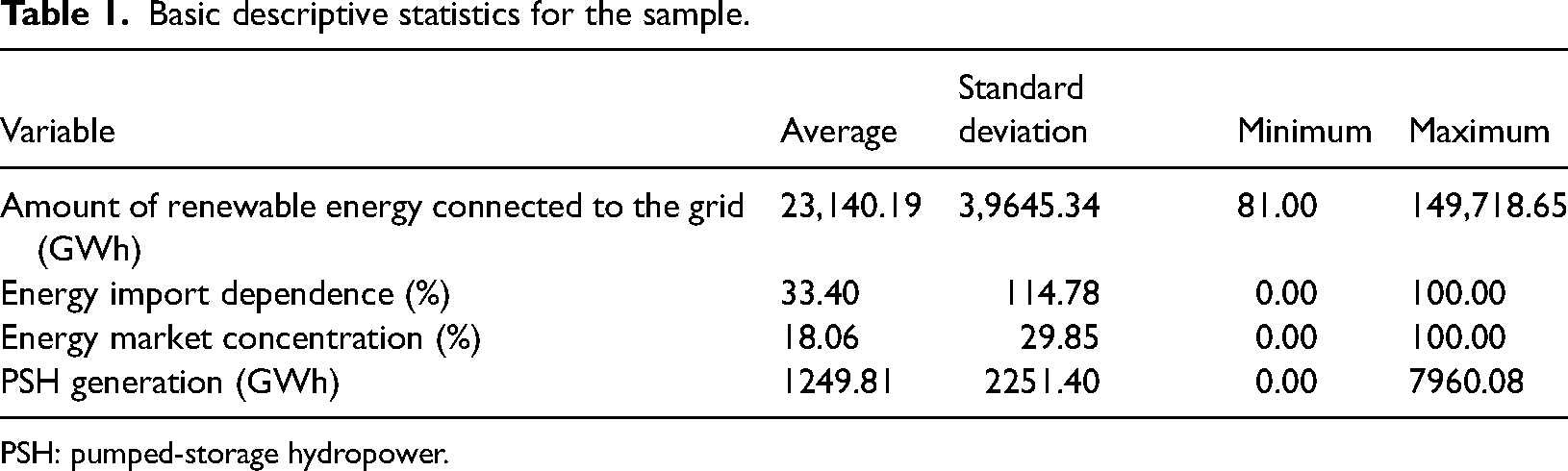
PSH: pumped-storage hydropower.
Greene
11
proposed that the linear correlation variance inflation factor (VIF) be used to test the degree of collinearity overlap between independent variables. The VIF of the independent variables of the samples in this study is lower than 10, which means that there is less of an issue of collinearity among the independent variables. Table 2 lists the empirical results of the panel data regression model. The F test reached the 1% level of significance, indicating that the fixed effect model is a better fit. The energy import dependence
Empirical results of panel data regression model.

Note: A fixed effect model is a better choice for model adaptation.
*** Test statistic reaches a 1% level of significance.
**Test statistic reached a 5% level of significance.
(.) indicates standard error.
PSH: pumped-storage hydropower.
Table 3 shows the panel threshold regression model test, where
Panel threshold regression model test.

Note: **F statistic reaches the 5% level of significance.
Policy implications
This study explored the impact of three independent variables, namely energy import dependence, energy market concentration, and PSH, on renewable energy. The empirical analysis results show that the estimated value of energy import dependence (β1) is 0.0325, which shows positive correlation with renewable energy development, and the t-statistic reached a 1% level of significance, implying that EU countries are working to ensure power stability and supply security, and that they will also actively promote the development of renewable energy to ensure national energy security.
Energy market concentration (β2) has an estimated value of 0.0296; and its t-statistic reached a 1% level of significance. When the energy market becomes more concentrated, power companies can exert resource integration synergies and economies of scale to promote large-scale renewable energy projects, which will have a positive effect on renewable energy.
β3 and β4 are the estimated coefficients of PSH below and above the threshold, and their values are 0.1943 and −0.5818. Their t-statistics are 1% and 10% levels of significance. This study found that there is a single threshold for PSH and renewable energy connected to the grid. When PSH is lower than this threshold, the two are positively correlated, but when exceeding this threshold, they show a negative correlation. When PSH is below the threshold, and when intermittent renewable energy increases significantly, it will have a huge impact on the conventional power system. In addition to two-way power flow affecting power quality and system protections, rapid changes in renewable energy output will also affect the overall balance in supply and demand, posing a challenge to system dispatch. This causes problems such as the duck curve and a second peak in the power system. Thus, it is necessary to provide the system with sufficient inertia and auxiliary services at the right times to avoid power outages and other such situations. From an economic perspective, renewable energy and PSH play a complementary role in energy production. When PSH generation exceeds the threshold value, PSH generation and renewable energy are negatively correlated. That is to say, when there is more PSH, it may even be replaceable with renewable energy generation; in other words there is the economic concept of substitutes in production. On the other hand, when the development of PSH exceeds a certain threshold level, the peak-shaving and valley-filling function of the power system reaches a certain limit. As for policy implications for the promotion and deployment of energy storage, it is not the case that the more installed, the better; rather that one ought to consider the national power system and the proportion of renewable energy at different stages, and the power system dispatch should be used for efficient resource allocation.
Conclusion and recommendations
This study adopts the panel threshold regression model from Hansen, 1 using 21 years of cross-section and time-series data to explore the impacts of energy import dependence, energy market concentration, and PSH on the amount of renewable energy connected to the grid. The empirical results show the higher the dependence on energy imports, the higher the relative power generation from renewable energy. This is also in line with the reasoning of a country actively promoting the installation of renewable energy in order to improve energy security. In addition, this study also found that when the energy market concentration of a country is higher, it is positively related to the development of renewable energy, implying that power companies integrate resources to promote large-scale renewable energy installation, which is conducive to the development of renewable energy and gives positive results. As compared to previous studies, this study offers more original findings, that is, through empirical simulation results, we found that PSH is statistically significant when set as a threshold variable, and that there is a single threshold effect.
When the amount of PSH is below/above the threshold, its β coefficient shows the opposing results of positive/negative correlation, respectively, implying that when the amount of energy storage reaches a certain threshold level, the peak-shaving and valley-filling functions of the power system reach a certain limit. This study found that the threshold for PSH is 9,527 GWh, accounting for approximately 41% of the EU's average renewable energy connected to the grid. In other words, more energy storage is not necessarily better; rather, overall system planning must be carried out in conjunction with the proportion of renewable energy generation and the dispatching capabilities of the overall power system. In Taiwan, PSH accounted for 12.8% of the overall renewable energy generation in 2022. In terms of policy implications, PSH can continue to be promoted through policy tools in Taiwan. Overall, it is advisable and even necessary to consider the situation of renewable energy and power systems each year so as to make the most efficient allocation of resources.
Based on the EU statistical data for 2022, the EU primarily used PSH as energy storage generate electricity. Considering that BESS will be quite well developed in the future, vehicle-to-grid, and electrification, based on the renewable energy grid connection goals at different stages, the deployment planning of corresponding energy storage facilities is worthy of continued study and discussion.
The study still has further analytical work in the future, the costs and benefits of various policy instruments also need to be carried out. Moreover, identifying country-specific policy priorities on the basis of a cross-country analysis and understanding of what is good practice from EU countries help to promote international arrangements that are conducive to achieve the sustainable net-zero goals in both developed and developing countries.
Supplemental Material
sj-xlsx-1-eae-10.1177_0958305X251343067 - Supplemental material for An empirical analysis of optimal energy storage system capacity for renewable energy supply: A case study of the European Union
Supplemental material, sj-xlsx-1-eae-10.1177_0958305X251343067 for An empirical analysis of optimal energy storage system capacity for renewable energy supply: A case study of the European Union by Kung-Mien Ma and Chien-Ming Lee in Energy & Environment
Supplemental Material
sj-xlsx-2-eae-10.1177_0958305X251343067 - Supplemental material for An empirical analysis of optimal energy storage system capacity for renewable energy supply: A case study of the European Union
Supplemental material, sj-xlsx-2-eae-10.1177_0958305X251343067 for An empirical analysis of optimal energy storage system capacity for renewable energy supply: A case study of the European Union by Kung-Mien Ma and Chien-Ming Lee in Energy & Environment
Footnotes
Declaration of conflicting interests
The author(s) declared no potential conflicts of interest with respect to the research, authorship, and/or publication of this article.
Funding
The author(s) received no financial support for the research, authorship, and/or publication of this article.

Supplemental material
Supplemental material for this article is available online.
Notes
References
Supplementary Material
Please find the following supplemental material available below.
For Open Access articles published under a Creative Commons License, all supplemental material carries the same license as the article it is associated with.
For non-Open Access articles published, all supplemental material carries a non-exclusive license, and permission requests for re-use of supplemental material or any part of supplemental material shall be sent directly to the copyright owner as specified in the copyright notice associated with the article.
