



Abstract
Metal-organic frameworks (MOFs) represent a class of materials characterized by metal ions coordinated with organic linkers, resulting in highly porous and adaptable microstructures. Their remarkable efficacy in ion exchange processes enables them to exhibit outstanding energy and power density capabilities. This study investigates the critical role of organic ligands Pyridine-2,6-dicarboxylic acid (H2PDC) and 5-Nitroisophthalic acid (5-NIP) in enhancing the electrochemical energy storage performance of pristine Cobalt-based MOFs (Co-MOFs). The sonochemically synthesized Co-H2PDC demonstrates a specific capacity of 1673.05 C/g at a scan rate of 2 mV/s and 1194.704 C/g at a current density of 2.8 A/g. Owing to its superior performance, a hybrid device was fabricated as Co-H2PDC//AC. The electrochemical performance of the hybrid device was evaluated using a two-electrode configuration. The Co-H2PDC//AC configuration achieved an impressive energy density of 82.18 Wh/kg and a power density of 4250 W/kg while maintaining 79% stability over 5000 consecutive galvanostatic charge-discharge cycles. Furthermore, the device's performance was further evaluated using simulation techniques to assess diffusive and capacitive contributions. The integration of MOFs as battery-type electrode materials paves the way for advanced energy storage devices.
Keywords
Introduction
Energy utilization is escalating daily, for which natural resources such as fossil fuels are burned to meet those demands.1–4 This excessive use of surplus fuels not only diminishes our natural resources, but its use is also setting a very deep spot on our environment that will look very clear soon. The scientific community warns that the environmental consequences of burning fossil fuels will be severe, underscoring the urgent need to transition to sustainable and eco-friendly energy alternatives. 5 Consequently, it is imperative to prioritize the development and adoption of sustainable and environmentally friendly energy alternatives. It has been witnessed in the past few decades scientists have explored more sustainable ways such as solar, hydro, wind, and tidal power to produce energy.6,7 However, there are instances when their cyclic nature hinders these energy sources from continuously providing enough power per need. 8 Therefore, it is very important to look for more reliable and efficient forms of energy production and storage so that there is a continuous supply of energy throughout the day.9,10
Batteries along with capacitors are the two primary devices which are used for charge storage, and they are suitable for most energy applications.11–13 Batteries display high energy density and that is because of the continuous faradic reactions on its electrodes. However, it is a very tough task to extract high power from the battery as a result its use is limited to such devices which require less power and a continuous flow of energy to operate.14–16 In parallel to batteries electrochemical capacitors which are also known by a term called supercapacitors can solve the problem as they can show high power as well as it shows a promising longer cyclic lifecycle, but in this case, there is a need for higher energy than the supercapacitors fall way behind the batteries.17–19 Therefore, there lies an unequivocal need for a system that possesses all the positive properties of a capacitor and a battery. This conjugation of capacitors and batteries results in the formation of a system termed a ‘Supercapattery’ which has the capability to hoist the efficiency along with the output of the energy storage devices as it has high power as well as energy density.20,21
Several electrode materials have been extensively analyzed for so many years and they have shown a promising behavior in storing the charge. However, certain physical and chemical elements prevent the material from showing its full strength, and therefore scientists strive for more innovative and efficient solutions.22–24 As, for example, electric double-layer capacitors (EDLCs) show powerful capacitance when the charge partition occurs at the electrode-electrolyte boundary.25,26 This shows that the greater the surface area the greater the capacitance. Hence, many porous materials having higher surface area such as carbon-containing elevated levels of porosity have been in EDLCs to enhance their performance, but still, these materials are not stable either chemically or physically.27,28 Metal oxides, phosphides, sulfides, and several other resources have been considerably studied and are installed as electrodes in batteries and pseudocapacitors. However, their susceptibility to high volumetric straining and low charge kinetics hinders the electrochemical performance of the device.29–31 Therefore, it is imperative to produce new materials which possess highly porous structures so that they are capable of meeting the demand for state-of-the-art energy storage applications to be able to address the challenging adverse effects. 32
MOFs, which are denoted by the acronym metal-organic frameworks (MOFs), have served as a prominent replacement in energy storage materials corresponding to their capability as electrode materials.32–35 Being related to a two or three-dimensional organic-metal hybrid unit cell structure made of an oxide node or metal cation and organic ligand connecting them. This unique mixed-breed structure dispenses the possibility to embody different storage procedures, for instance, pseudo-capacitance, double-layer capacitance, and redox behavior, which is an adopted mechanism for high-power density devices and energy.36,37 The intrinsic properties of a MOF such as larger surface area, and elevated porosity along crystal morphology could be modified to meet the desired requirements.38,39 In short, MOFs serve as a fundamental part of a supercapacitor and contribute greatly to its performance. The structurally excellent and rich pore-forming ability of MOFs can easily be optimized by tuning the density of metal nodes and bonds, thus producing a diverse range of features.40,41 The reaction rate can be increased by electron transfer and ion diffusion which are improved by the MOFs as short diffusion lengths are provided by them. In general, the microporous structure produces an elevated amount of redox-active zones for the higher efficiency of the supercapacitor. It has been reported in the literature that MOFs possess an outstanding charge storage nature which proves that they can play a vital role as electrode material in many energy storage devices.42–46
Pyridine-2,6-dicarboxylic acid (H2PDC), due to its interesting and unique characteristics is considered as an important ligand in MOFs domain. 47 H2 PDC is known for its ability to make many coordination nodes because of the presence of two carboxylic acid groups (-COOH) that are separated by a phenylene group (-C6H4-) which can be either completely or partially oxidized. That is why H2PDC acts as a bidentate ligand, which means that it can make bonds with metal ions through two coordination sites. 48 H2PDC has the ability to donate or accept electrons which contribute to the production of hydrogen bonds. The presence of rigid phenylene as a backbone helps in achieving stable MOF structures. 49 Similarly, 5-Nitroisophthalic acid (5-NIP) is also a fascinating organic ligand which is also used in the preparation of different MOFs. 50 5-NIP has the ability to donate a proton (H+ ion) and also strives to form coordination bonds with various metal ions. The 5-NIP linker participates in building the framework structures and also alters pore size, surface area, and other useful properties. 51
Herein, the effect of different organic linkers on the electrochemical response of Co was extensively studied. The sonochemical approach was employed to synthesize the Co-based H2PDC and 5-NIP MOFs. X-ray diffraction (XRD) along with scanning electron microscopy (SEM) techniques were used to inquire about the structural anatomy and surface topography of the prepared composition. Fourier transform infrared spectroscopy (FTIR) analysis was carried out to find the chemical bounds of the synthesized samples. To examine the electrochemical characteristics of both the prepared compositions a three-electrode assembly setup was used. Later on, a hybrid supercapacitor was constructed by using the efficient MOF composition (Co-H2PDC) as a positive terminal and activated carbon (AC) as a negative electrode. The device showed exceptional energy and power density along with significant durability after 5000 charge-discharge cycles. From this more extensive analysis of both Co-5NIP and Co-H2PDC, it can be concluded that Co-H2PDC has numerous opportunities to be further functionalized in advanced energy storage technologies.
Experimental details
Chemicals
For the preparation of the desired MOF, the cobalt(II) chloride hexahydrate (CoCl₂·6H₂O)salt was procured from Sigma Aldrich, while the desired ligands H2PDC and 5-NIP acid were purchased from Alfa Aesar. The chemicals i.e., CoCl2.6H2O, H2PDC, 5-NIP, Poly(vinylidene fluoride) (PVDF), Acetylene black, AC, and N-methyl-2-pyrrolidone (NMP) utilized in all the tests described in this paper were of laboratory grade purity and did not demand any supplementary decontamination or purification steps.
Synthesis of the desired MOF
The desired Co-MOF was synthesized by using the probsonication technique. 52 Figure 1 shows the processes from which the materials have been goon through. To prepare 0.4 molar solution, CoCl2.6H2O was taken in an amount of 0.712 g and 10 ml DI water in a beaker to synthesize Co-H2PDC. The beaker was then put on a magnetic stirrer to achieve a perfect diluted solution. The prepared diluted solution of CoCl2.6H2O undergoes through sonication process. The H2PDC linker solution of the amount of 0.5 g in 10 ml DI water was added dropwise to the CoCl2.6H2O solution. The solution received sound waves of energy of 900 KJ with an amplitude of 20% while the sonication process continued for 50 min each keeping the solution at room temperature. Then the synthesized solution was taken for a cleaning process in which the prepared materials were washed by using DI water, methanol, acetone, and ethanol. The desired MOFs were obtained by drying the washed materials at a temperature of 80 °C for 8 h in an oven. A similar approach was used for the preparation of Co-5NIP MOF. All the precursors were taken of the same amount and all the treatments were carried out in the same manner as conducted during preparation of Co-H2PDC.
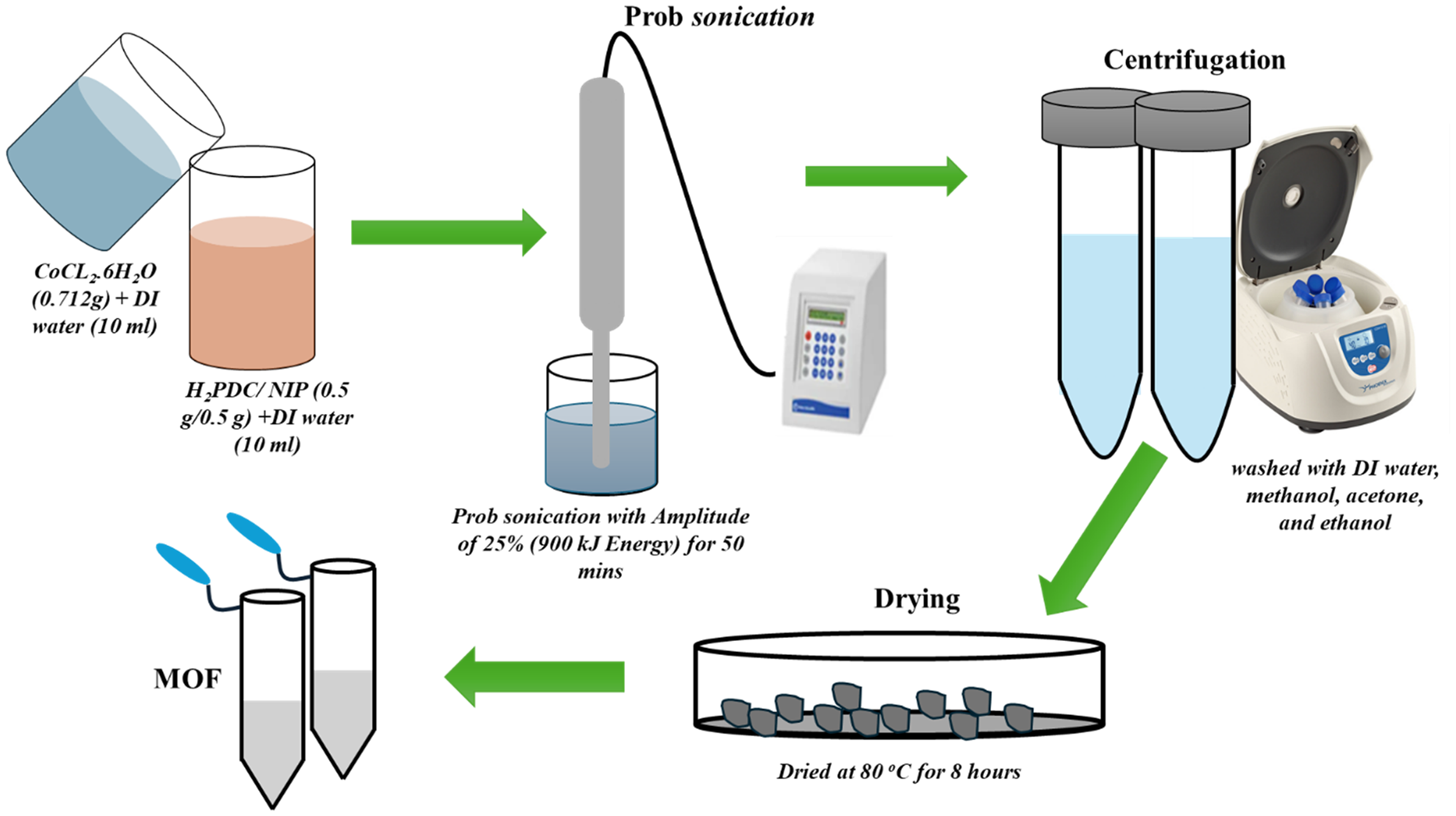
Schematic representation of the synthesis of Co-based metal-organic framework (MOF) using a sonochemical approach.
Electrode preparation
For electrode preparation, nickel foam (NF) underwent a cleaning procedure involving sequential rinses with a diluted solution of hydrochloric acid (HCl: H2O = 1:10), ethanol, and acetone. After the washing process, the NF was then kept in an electric oven to dry it. Simultaneously, a slurry was prepared and stirred for 8 continuous hours, containing 80 wt% of the active material, additionally, 10 wt% of acetylene black was also added along with 10 wt% of PVDF binder and NMP. The prepared suspension was then deposited over the dried NF and kept for drying at 80 °C in an oven for 8 continuous hours. Furthermore, mass balancing is a crucial and necessary step to maximize the electrochemical performance of hybrid devices. The mass balancing methodology in this study was implemented using the subsequent calculation method.53,54

Herein the m+ and m− show the quantity of the material to be deposited on both the anodic and cathodic terminals. Cs represents the specific capacitance that belongs to the negative electrode, the operating voltage range is represented by ΔV. QS displays the specific capacity owned by the active material. By applying the provided equation, a mass ratio of around 3:1 was established for the negative (AC) and positive (Co-MOF) electrodes, respectively.
Electrochemical analysis
The prepared electrodes of Co-H2PDC and Co-5NIP MOFs were then taken to evaluate their electrochemical performances. Both electrodes were tested using many electrochemical techniques such as cyclic voltammetry (CV), galvanostatic charge-discharge (GCD), and electrochemical impedance spectroscopy (EIS). All these tests were conducted in 1 molar electrolytic medium of potassium hydroxide (KOH). The Gamry potentiostate ref 3000 was used for conducting these examinations. Initially, all these tests of both electrodes were conducted in three-electrode assembly setups (Figure 2(a)). Hg/HgO was used as reference and Platinum wire was used as counter electrode. The CV evaluation was executed for both electrodes at a potential window of 0–700 mV at various scan rates ranging from 2 to 60 mV/s. Additionally, GCD analyses were conducted at various current densities to find out the charge-discharge functionality of the prepared compositions. For the CV and GCD analysis, the potential windows were kept constant at 0–0.7 and 0–0.55 V, respectively. Additionally, the EIS approach was used to find out the electrical conductivity of the synthesized samples at a selected frequency range of 0.1–100 kHz. Among the two electrodes, the best-performing and most efficient one was then examined in a two-electrode assembly (Figure 2(b)). The voltage ranges for full-cell assembly were kept at 1.6 V for both the GCD and CV analysis. Furthermore, the exposure of the hybrid device to continuous 5000 GCD cycles resulted in finding its cyclic durability. In CV analysis, the Qs of the Co-H2PDC and Co-5NIP MOF were determined by using the equation.53,55

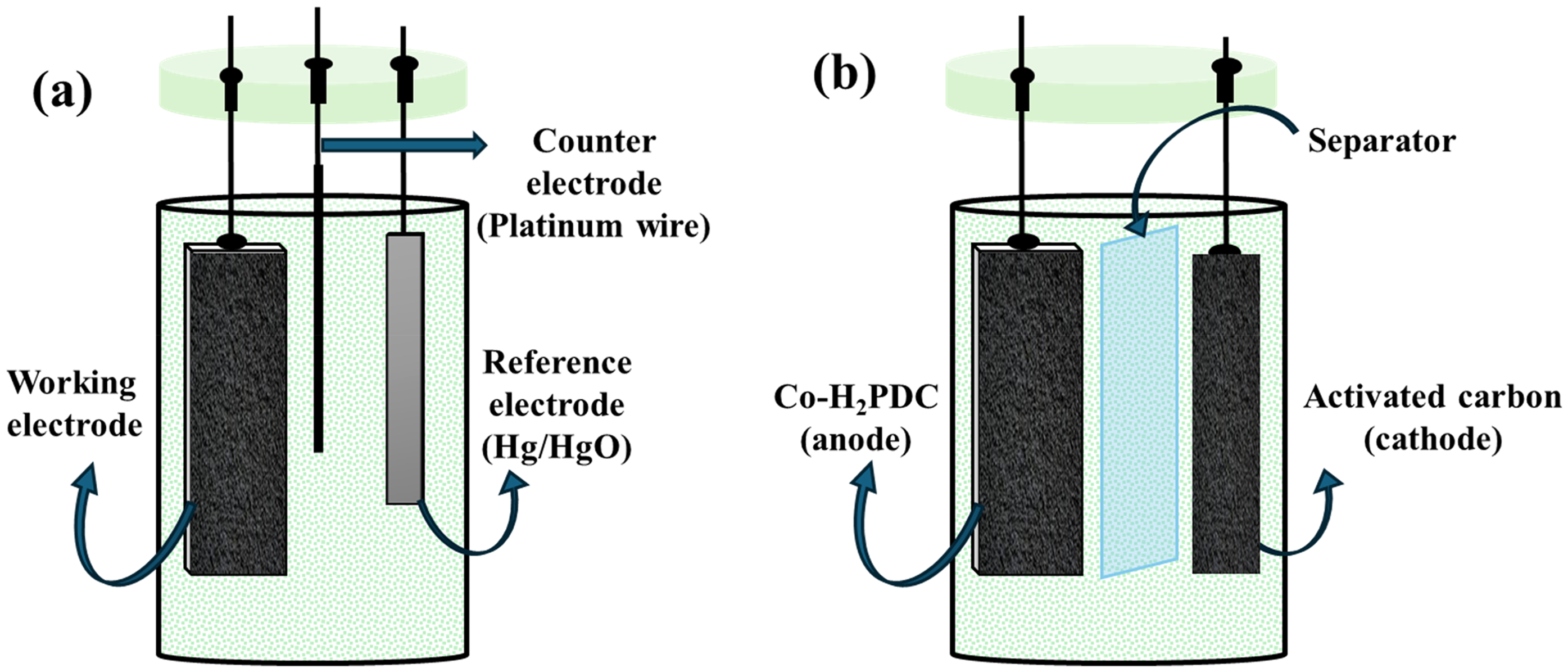
Schematic depiction of the electrochemical analysis system: (a) Three-electrode configuration and (b) two-electrode configuration.
In the given equation the “m” represents the mass deposited on the electrode while Qs is termed as the specific capacity and is measured in C g−1. The term ∫ I × VdV identifies the area under the curve for each CV graph and
Results and discussion
Structural analysis
The prepared compositions of the Co-MOF were taken for studying its morphology and surface topography. Both MOFs of cobalt were used in powdered form. Meanwhile, AXRD-LPD system was used to gain insight into the crystal structure of the designed sample. Figure 3(a) shows that at 2θ of 11.5°, 14.9°, 16.8°, 19.3°, 21.5°, 24.3°, 28.0°, 29.2°, 30.1°, 32.7°, 37.0°, and 40.9° the Co-H2PDC MOF displays significant intensity peaks with crystal planes of (011), (002), (012), (112), (022), (113), (123), (004), (004), (133), (224), and (125).56,57 While in the case of Co-5NIP MOF the peaks were observed at 18.4°, 27.1°, 29.4°, 31.9°, 32.8°, 35.4°, 37.2°, 38.9°, 59.8°, 62.3°, and 66.8°, which corresponds to (112), (023), (004), (033), (133), (233), (005), (115), (056), (018), (057), respectively. 58 These intensive peaks at specific angles define crystal plans from which the X-rays get bounced back, this advocates that the as-prepared compositions have a well-defined crystal structure.
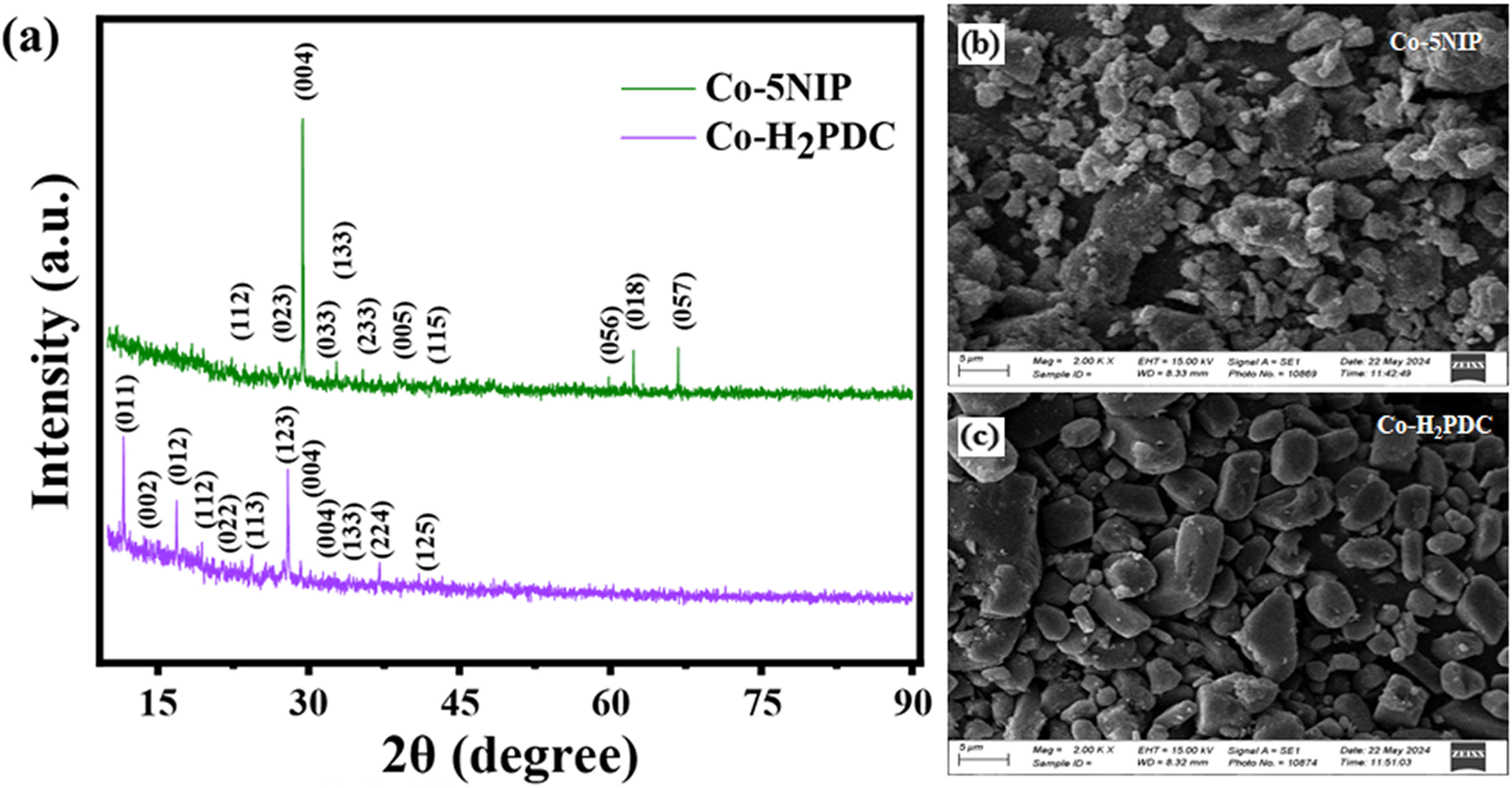
(a) XRD pattern of Co-5NIP and Co-H2PDC, (b, c) SEM micrographs of Co-5NIP and Co-H2PDC. XRD: X-ray diffraction; 5-NIP: 5-Nitroisophthalic acid; H2PDC: pyridine-2,6-dicarboxylic acid; SEM: scanning electron microscopy.
Carl Zeiss EVO 15 was used to examine microstructural analysis, elemental composition, and color mapping of the provided samples. In the present study, SEM was used for the morphological realization and the topological analysis and characterization of Co-H2PDC and Co-5NIP MOFs. Figure 3(b) and (c) displays the representative SEM images of the as-prepared Co MOFs. The results show that the Co-5NIP has hollow-shaped particles having uniform size. This has led to an increase in internal space, which offers many contact points of the structure for the reactions but decreases the diffusion distance for electrons and ions. 53 It also limits changes in structure during the electrochemical processes and thus possesses the most preferential electrochemical properties of the two. Co-H2PDC MOF has a significantly different morphology, and it has a spherical structure containing well-distributed active sites. This gives a morphology that is the most favorable to redox reactions and charge transferred specific capacity which comes with improved specific capacitance. Both the compositions have the right dimensional orientation as well as scale to represent the shape of these MOFs.
The FTIR spectra of the synthesized compositions is shown in Figure 4. The FTIR spectrum shows an absorption peak near 3360 cm−1 for Co-5NIP and 3703 cm−1 for Co-H2PDC refers to the vibrations of the hydroxyl ions (OH-) which validates the presence of water molecules. 59 The strong absorption peaks occurring in 1720–1500 cm−1 (for Co-5NIP) and 1500–1870 cm−1 (for Co-H2PDC) represent the characteristic vibrations of the attached carboxyl groups. These regions show the deprotonation of the carboxyl groups meaning that the carboxyl groups have lost a proton and resulted in the formation of the conjugate base.60,61 Absorption near the 1300–1400 cm−1 region refers to the stretching vibrations of the aromatic double-bonded carbon atoms (C = C) of the phenyl group within the Co-5NIP MOF. Multiple absorptions within the 1300–1000 cm−1 region in the FTIR spectra of the Co-H2PDC can be visualized, which particularly refers to the stretching of Carbon attached to Nitrogen (C-N) and Carbon attached to Hydrogen (C-H). 62 The absorption peak at 891 cm−1 refers to the bending of the sp2 hybridized C-H bond within the aromatic ring of the Co-H2PDC MOF composition.
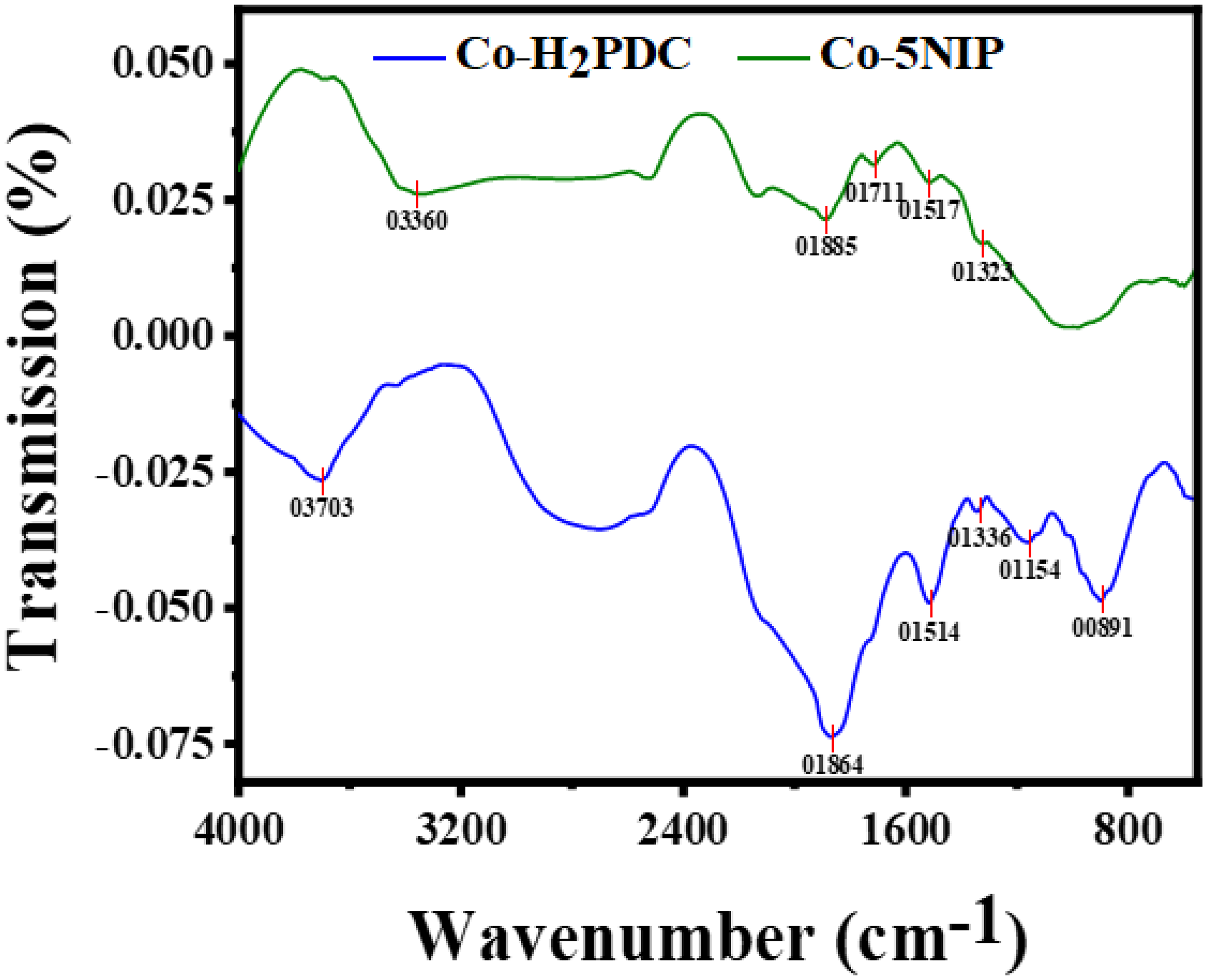
FTIR pattern of Co-5NIP and Co-H2PDC. FTIR: Fourier transform infrared spectroscopy; 5-NIP: 5-Nitroisophthalic acid; H2PDC: pyridine-2,6-dicarboxylic acid.
Figure 5(a)–(h) displays the color area mapping of the prepared compositions. It can be seen from the images that the overall distribution of the key element in the prepared composition of Co-H2PDC has a specified orientation, and all the components (oxygen, carbon, nitrogen, and cobalt) are evenly distributed over the entire surface. This uniform distribution of the required elements provides uniform geometry for the reaction of electrolyte ions and electrons. This uniform orientation results in the elevation of the charge storage property for the prepared MOF. In the case of Co-5NIP, most of the elements are not uniformly distributed, which as a result leads to the creation of empty spaces. As a result, the diffusion of the electrolyte ions and electrons is limited, which in turn leads to a lowering of the charge storage capacity of the material. 63
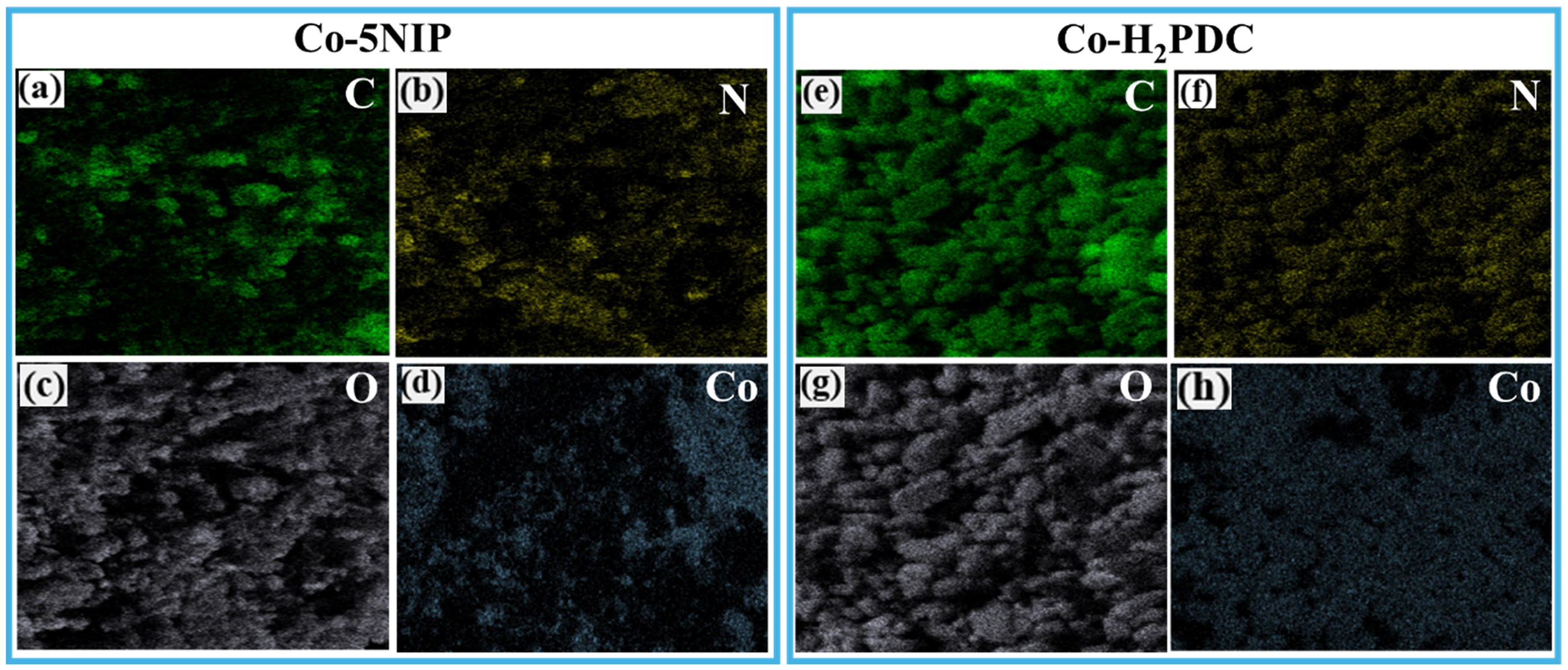
(a–d) Elemental mapping of carbon, nitrogen, oxygen, and cobalt in Co-5NIP, (e-h) elemental mapping of carbon, nitrogen, oxygen, and cobalt in Co-H2PDC. 5-NIP: 5-Nitroisophthalic acid; H2PDC: pyridine-2,6-dicarboxylic acid.
Electrochemical analysis
CV analysis
The Co-MOF as-synthesized compositions were first characterized using electrochemical measurements using a three-electrode setup. Co-5NIP and Co-H2PDC MOFs were first evaluated through cyclic voltammograms where they were tested at multiple scan rates of 2–60 mV/s in the potential range of 0–0.7 V. From the two compositions, pseudocapacitive behavior was observed due to the appearance of several redox peaks across the voltage range which are clearly visible in the graphs (Figure 6(a) and (b)). The CV profile shows that Co-H2PDC composition has a higher area under the CV profile in comparison to Co-5NIP composition. The calculated specific capacity of Co-H2PDC electrode is 1673.05, 1007.8, 724.06, 435.68, 187.31, 113.085, 83.82, 60.25, 46.25 C/g at a scan rate of 2, 4, 6, 10, 20, 30, 40, 50, and 60 mV/s, respectively. While the Co-5NIP composition portrayed a specific capacity of value 1245.76, 980.12, 797.67, 592.02, 344.15, 221.02, 154.70, 115.61, and 91.22 C/g at a scan rate of 2, 4,6, 10, 20, 30, 40, 50, and 60 mV/s, respectively. H2PDC being a bi-dentate in nature having two carboxyl groups in its structure attaches two metals in its structure which increases the conductivity and facilitates the ion transfer. On the other side, the 5NIP has one carboxyl group in its structure meaning that it can attach a single metal to its structure. However, the presence of the amino group in its structure results in improving its stability and rate capability. The metal attached to the carboxyl groups captures the electron from the electrolyte ions which travels into the carboxyl groups resulting in the effective capturing of the ions. The Co-H2PDC due to two metals in its inner core offers high conductivity and improved capacity values while the Co-5NIP offers better rate capability in comparison to the other composition. Figure 6(c) displays a comparison of the CV characteristics of both materials at 2 mV/s. These rising tall spikes that are experienced during both the forward and reverse cycles of the capacitive-type oscillating trends suggest the presence of redox (Faradaic oxidation and reduction) reactions.
64
This is evidenced by noticeable peaks in the CV figures representing the reversible Faradaic processes that happen inside the compositions throughout the cathodic and anodic phases. The corresponding behavior can be attributed to the following reversible electrochemical reactions in equations (2) and (3):


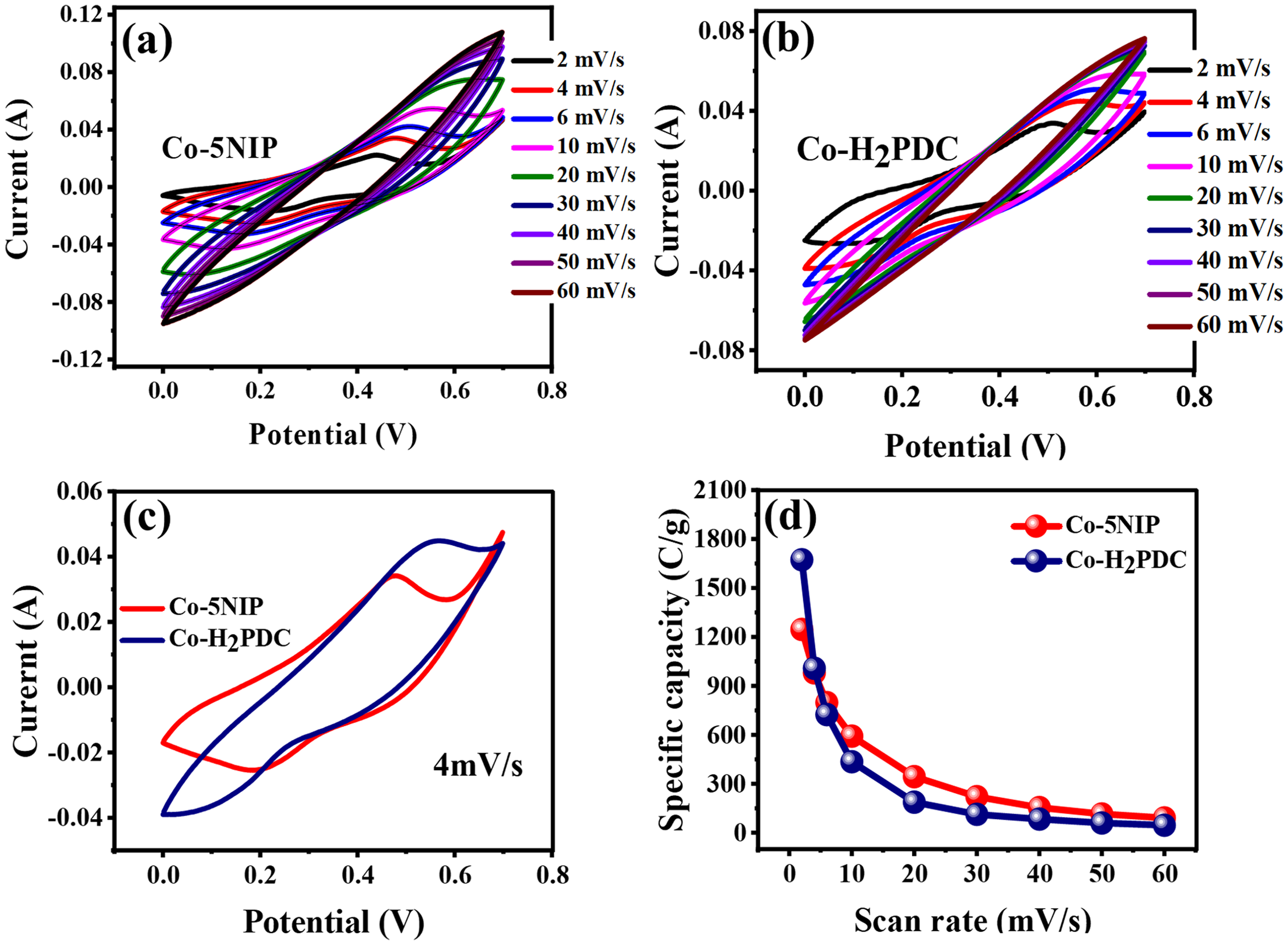
(a) CV analysis of Co-5NIP; (b) CV analysis of Co-H2PDC; (c) comparative CV profiles of both materials at a scan rate of 4 mV/s, (d) plot of the calculated capacities of both electrodes (Co-5NIP and Co-H2PDC) based on CV measurements. 5-NIP: 5-Nitroisophthalic acid; H2PDC: pyridine-2,6-dicarboxylic acid; CV: cyclic voltammetry.
The surface redox phenomena and the insertion/removal of hydroxyl groups across the architecture of both prepared compositions may cause the redox peaks to be seen.65,66 As the matching peaks migrate towards high and low potential, the space between them increases with greater scanning potentials. However, it does not make any claims regarding the electrode's enhanced specific capacity at high scan rate values. Peak widening is a common feature of the behavior of EDLCs, and peak currents grow with scan speeds greater than 2 mV/s. This behavior may be related to the short time it takes for ions to intercalate.67–69 Figure 6(d) portrays the calaculated specific capacity of the both Co-MOFs at several scan rates, which shows superior specific capacity value of Co-H2PDC than Co-5NIP. To put it simply, the ion exchange mechanism is the cause of redox reactions across the electrode/electrolyte interface. Accelerated kinetics causes the ion exchange rate to slow down at high scanning speeds, potentially resulting in more than ions or may lead to the deficiency of the ions in the electrolytic medium that interacts with the electrode on which active material is deposited. 70 Furthermore, given their redox-active nature, the metal core along with the organic linker may be accountable for the distinctive levels of oxidation as well as reduction found in the pseudo-sort of CV spectra. 71 The uniformity in the redox peaks of the characterized compositions provides evidence that the reactions occurring are completely reversible at all the tested scan rate values.
GCD analysis
To acquire a better knowledge of the electrochemical properties of the synthesized MOF compositions, a different methodology known as galvanometric charge-discharge was used. The charging and discharging evaluations were conducted through various current densities, and the discharge time for desirable materials was calculated to provide useful information about their total charge storage-specific capacity. Figure 7(a) and (b) depict the GCD trends for the two electrode materials. The GCD analysis shows that Co-H2PDC can store more charges as it shows a specific capacity of 1227.5, 1223.66, 1208.43, 1194.7, 1146.78, 1101.8, 1069.2, 948.7, 812.4, and 691.6 C/g for a particular current value of 2.5, 2.6, 2.7, 2.8, 3, 3.5, 4, 5, 6, and 7 A/g, respectively. While the Co-5NIP shows specific capacity of the value of 651.51, 635.626, 632.66, 613.8, 547.96, 543.9, 493.6, 413.7, 372, and 304.99 C/g at a current density of 1.8, 1.9, 2, 2.2, 2.8, 3, 4, 5, 6, and 7 A/g. The plateaus in GCD profiles of Co-H2PDC and Co-5NIP MOFs reflect redox processes, analogous to the pattern observed in the CV profiles, which shows a similar trend. The linearity of currents at a specific range in the charging process implies that the system's capacitive properties are the main current contributors. Beyond that threshold, plateaus form, and the current spreads or diffuses. Figure 7(c) shows the GCD comparison of both electrodes at fixed current density of 2.8 A/g. The discharge patterns also exhibit harmonious plateaus, stating the outstanding response reversibility of the used electrode. This states that the Co-H2PDC has a better performance in terms of their Qs (1194.704 C/g) as compared to Co-5NIP (547.96 C/g) at 2.8 A/g (Figure 7(d)). The subsequent formula was used to evaluate Qs from GCD trends.72,73

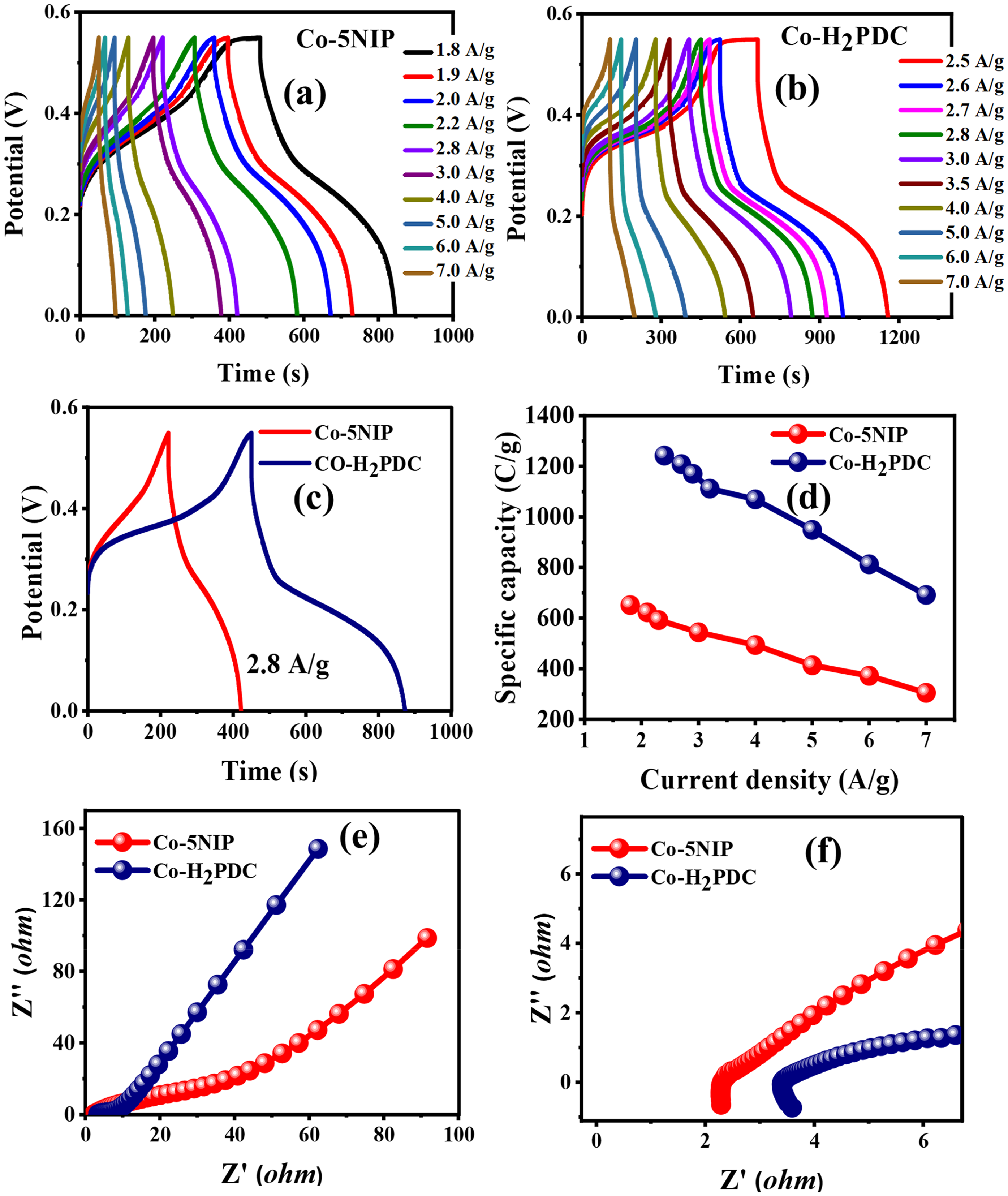
(a) GCD curves of Co-5NIP, (b) GCD curves of Co-H2PDC, (c) comparative GCD profiles of both materials at 2.8 A/g, (d) plot of the calculated capacities from GCD measurements for both electrodes (Co-5NIP and Co-H2PDC), (e) EIS plot of both electrodes, (f) zoomed image of the EIS plot. GCD: galvanostatic charge-discharge; EIS: electrochemical impedance spectroscopy; 5-NIP: 5-Nitroisophthalic acid; H2PDC: pyridine-2,6-dicarboxylic acid.
EIS analysis
To assess the electrochemical conductivity of Co-H2PDC and Co-5NIP MOFs, an EIS study was performed. The EIS studies were limited to a frequency range of 0.1 Hz to 100 kHz. Figure 7(e) shows the Nyquist trend in EIS spectra for the two as-synthesized materials. The equivalent series resistance (ESR) for Co-H2PDC is 2.289 Ω and for Co-5NIP is 3.592 Ω (Figure 7(f)). This includes the resistance offered by the working electrode, surface resistance, as well as ion diffusion resistance via the electrolyte. Co-H2PDC, because of the presence of two Cobalt metal nodes in its structure, offers less ESR value in comparison to the Co-5NIP. The occurrence of two metal nodes in Co-H2PDC increases the conductivity, which lowers the resistance offered by the ions, while in the case of Co-5NIP the presence of a single metal in its structure results in lower conductivity and high resistance offered to the electrolyte ions, respectively. The cross-section of a semicircle in the elevated-frequency section of an impedance plot can be used to calculate charge transfer resistance (Rct). The Co-H2PDC MOF has a low Rct, as it possesses a negligible semicircular area in its Nyquist profile than Co-5NIP. The Warburg resistance indicates redox behavior through diffusion of electrolyte ion (OH−) into electrode material. The vertical line of the Co-H2PDC MOF is more parallel to the y-axis in the lower-frequency sections which clearly shows that it has smaller Warburg resistance lines than Co-5NIP. This indicates electrolyte ion diffusion and reflects the samples pseudocapacitive behavior. 74 The Co-5NIP MOF shows higher resistance to the ions as they try to defuse in. This suggests improved ion diffusion in the Co-H2PDC MOF sample over Co-5NIP MOF. The EIS plot shows that the Co-H2PDC results in improved diffusion of the electrolyte ions into its structure in comparison to the other meaning that it offers a higher surface area, and a greater number of active sites in comparison to the Co-5NIP composition. This enhanced ion diffusion efficiency in Co-5NIP as well as Co-H2PDC MOF is a significant advantage for its possible application as a battery-grade material in Supercapattery applications. The outstanding performance of both MOFs makes it an attractive choice for the fabrication of electrodes in these applications.
Full-cell assembly (hybrid device)
The Co-H2PDC MOF demonstrated outstanding behavior, leading to the creation of a full-cell assembly (hybrid device) with the best-performing sample being incorporated as the positive terminal and AC being employed as the negative terminal. The electrochemical characterizations performed with CV. To conduct voltammetric evaluations, an optimal voltage window of 0–1.7 V was chosen.75,76 Figure 8(a) shows the CV plot of the newly constructed hybrid device at different scan rate values, spanning from 2 to 100 mV/s. The CV patterns of Co-H2PDC MOF//AC configuration show that the device combines battery and EDLC properties. Even when checked at high-scanning potentials, the constructed device stays consistent owing to the availability of an EDLC-type response, as witnessed by the symmetrical appearance of cyclic curves.77,78 The occurrence of the slight redox behavior in the CV spectrum witnesses the hybrid nature of the device. These findings show that Co-H2PDC MOF has a higher rate-specific capacity. The CV profiles almost retain their unique forms even at larger sweeping potentials. Even in two-electrode assembly, the device showed superior properties. As shown in Figure 8(b), the device holds a specific capacity of 513.30, 478.21, 427.28, 355.82, 191.70, 85.67, 53.83, 40.587, 33.134, 28.40, 25.062, 22.602, 20.5699, and 18.93 C/g at a scan rate of 2, 3, 4, 5, 10, 20, 30, 40, 50, 60, 70, 80, 90, and 100 mV/s.
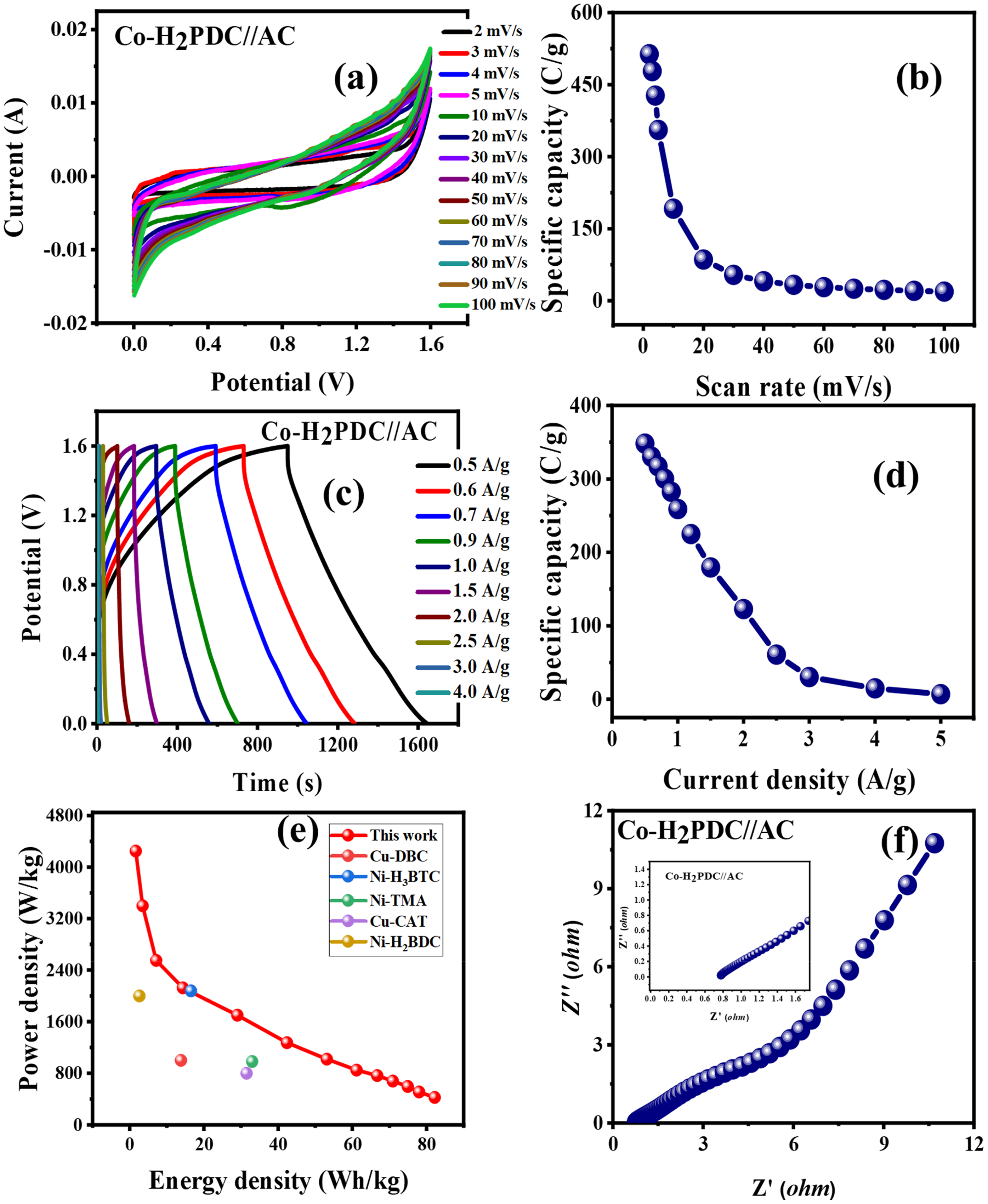
(a) CV curve of the hybrid (Co-H2PDC//AC) device, (b) specific capacity plot derived from CV measurements, (c) GCD curves of the hybrid device, (d) specific capacity values obtained from GCD measurements, (e) ragone plot illustrating the relationship between energy density and power density of the Co-H2PDC//AC device, (f) EIS plot of the Co-H2PDC//AC device. CV: cyclic voltammetry; GCD: galvanostatic charge-discharge; EIS: electrochemical impedance spectroscopy; H2PDC: pyridine-2,6-dicarboxylic acid.
A GCD approach has been used to evaluate the relevance of the supercapacitor device in real-time. Charging/discharging tests were conducted at current densities ranging from 0.5 to 4.0 A/g with a voltage limit of 0–1.6 V, as depicted in Figure 8(c).79,80 The reduced potential range is used to safeguard the electrode components from deterioration while also ensuring the device's cyclic stability by avoiding overcharging/discharging.81,82 According to the GCD assessment predictions, discharge time decreases as current density increases. At 0.5 A/g, the maximum discharge time occurs. The GCD measurements are significant in measuring the overall specific capacity of the Co-H2PDC//AC device. The highest achieved capacities by the formulated device are 348.075 C/g at a current density value of 0.5 A/g (Figure 8(d)). As current densities increase, the device's Qs decreases. The reduced performance is most likely owing to the little time allowed for the electrode and intercalation processes to participate in a comprehensive and complete chemical reaction.
83
Specific energy (Es) along with power (Ps) are important metrics to consider while evaluating hybrid behaviour of the energy storage devices.84,85 The energy as well as power densities of the Co-H2PDC//AC hybrid were estimated using the given formulae.53,86,87


The Co-H2PDC //AC hybrid device demonstrated the maximum energy density of 82.184 Wh/kg at a current density value of 0.5 A/g and a phenomenal power density of 4250 W/kg at 4.0 A/g of current density (Figure 8(e)). EIS measurements were conducted before the stability test to evaluate the electrical conduction characteristics of the device within a frequency range of 0.1 Hz–100 kHz. The Nyquist plot illustrating the EIS results is presented in Figure 8(f). The inset highlights the high-frequency region, where the ESR of Co-H2PDC//AC was determined to be 0.7762 Ω. Additionally, the charge transfer resistance (Rct) is represented by the semicircle in the Nyquist plot. In this case, the nearly absent semicircle indicates a minimal Rct value. Furthermore, the inclined line in the low-frequency region reflects the ion diffusion length, suggesting that the device facilitates a higher ion diffusion rate, which enhances its charge storage capability, overall performance, and efficiency. The assembled hybrid device was also tested for continuous cyclability, which is a critical criterion for all forms of energy storage methods. After 5000 consecutive GCD cycles, the hybrid device maintained around 79% of its initial primary specific capacity at 4.0 A/g, as seen in Figure 9(a). This highlights the supercapacitor device's outstanding longevity, as well as its effective use as a clean and green energy storage technology. This work was further compared with the previously reported literature such as Ni-H2BDC (31.5 with 800 W/kg), Co-H3BTC (24.4 with 4290 W/kg), Cu-DBC (13.8 with 1000 W/kg), Ni-H3BTC (16.5 with 2078 W/kg), Ni-TMA (33 with 983 W/kg), Cu-CAT (2.6 with 2000 W/kg).88–93
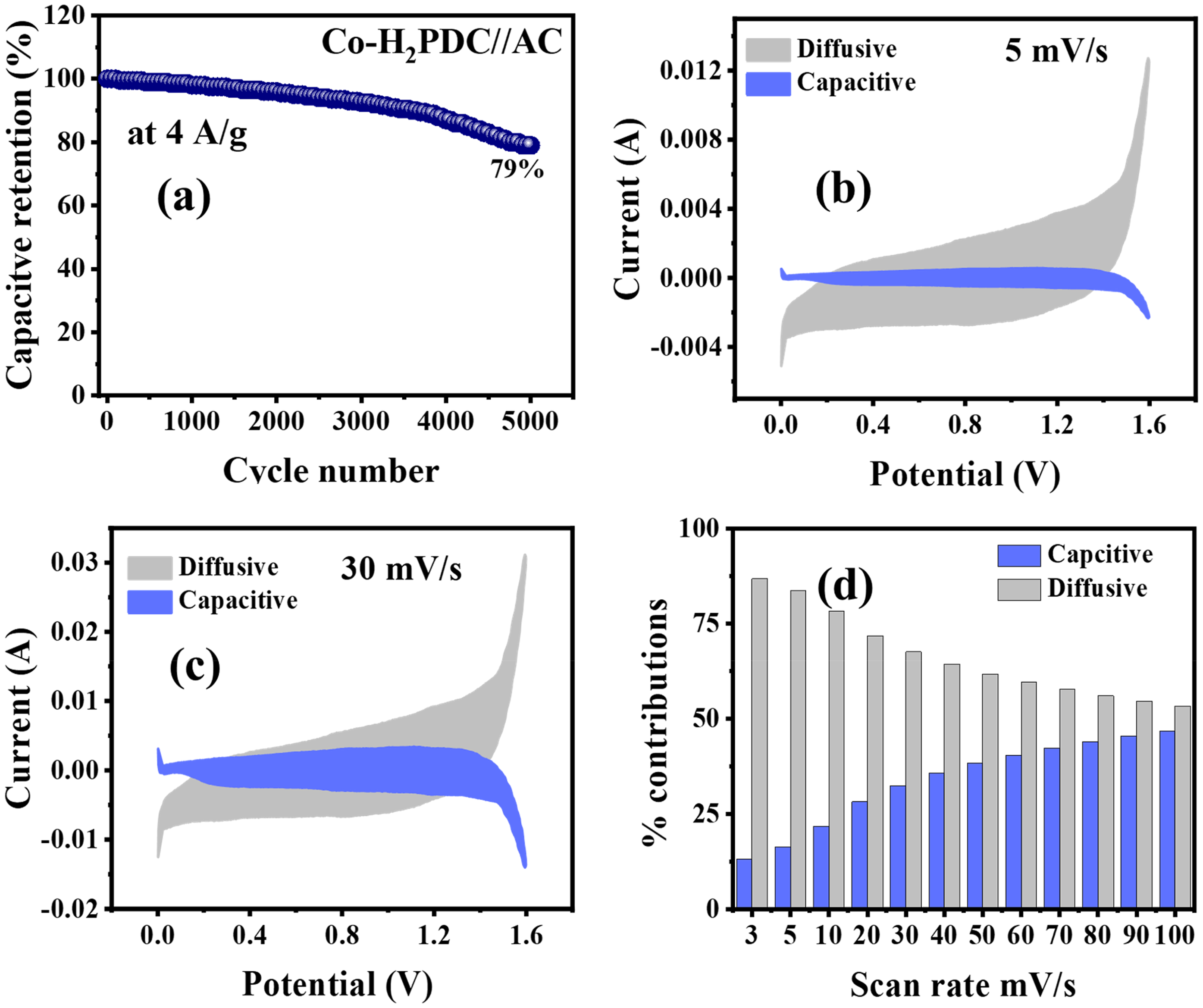
(a) Stability profile of the Co-H2PDC/AC device, (b, c) Capacitive and diffusive contribution analysis at a scan rate of 5 and 30 mV/s, respectively. (d) Percentage contribution of capacitive and diffusive processes at various scan rates. H2PDC: pyridine-2,6-dicarboxylic acid; AC: activated carbon.
Table 1 portrays a comparison of the already prepared MOFs that are reported in the literature with the devices prepared in this study. From the reported table it can be seen that different methods such as hydrothermal, solvothermal, microwave, etc. were utilized for the preparation of these compositions. In this study, a sonochemical synthesis route for the preparation of the desired MOF was utilized. This technique allows us to use sound waves which can be tuned up to 900 KJ of energy. This technique led to the production of almost circularly oriented geometries. These highly energetic sound waves helped in achieving the formation of the desired MOFs which portrayed exceptional capacitive values. The results obtained provide evidence for its outstanding electrochemical behavior which was observed during the testing time. Thus, it can be said that the use of a sonochemical approach can lead to the achievement of better electrochemical evaluations for an MOF, or any other family of materials which are used or prepared for their potential use in electrochemical fields.104–106 This study proves that organic linkers which are the core material define the behavior of MOF but the synthesis root is also of great importance and that also plays a critical role in defining the output of the prepared compositions when used for electrochemical use.
Comparison of electrochemical performance of current work with reported literature.
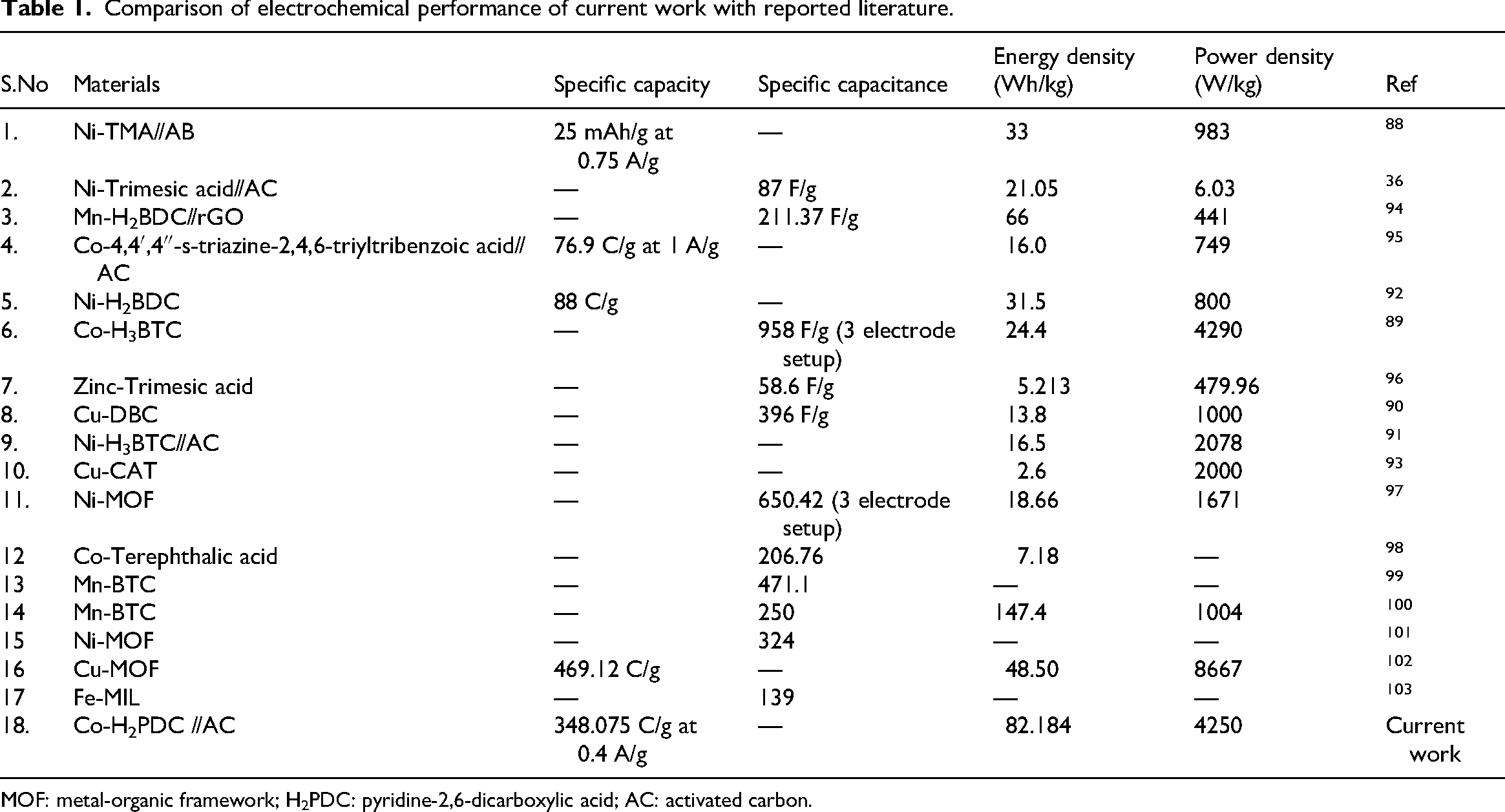
MOF: metal-organic framework; H2PDC: pyridine-2,6-dicarboxylic acid; AC: activated carbon.
Furthermore, the cooperative character of the device was confirmed utilizing the simulation approach, implemented based on Dunn's model, to the results acquired. In particular, a typical hybrid system, containing capacitive (AC) and battery-type (Co-MOF) electrodes, should work on both Faradic and non-Faradic principles.107,108 Therefore, the current obtained as a result of cyclic voltammograms contains contributions of both capacitive and diffusive components. The dominant contribution of diffusion to the device at low scan rates can be primarily explained by the effect of a battery-grade electrode. This is because, at low scan rates, the electrolyte ions can get adequate time to effectively engage in the redox processes, thus increasing the diffusive component. However, as the scan rates increase the diffusive contribution becomes progressively less significant. At high scan rates, the ions in the electrolyte do not have enough time to experience the redox process, so the diffusive mechanism contributes less. On the other hand, the capacitive electrode contributes more at high scan rates because it is faster in responding to changes in potential. However, capacitive and diffusive contributions to the performance of the device are well demonstrated in this change. More specifically, when the scan rate of the tests is 5 mV/s, the diffusive contribution can cover 83.6% of the total specific capacity, and at 30 mV/s the diffusive contribution was noted to be of the value of 67.53% (Figure 9(b) and (c)). The bar chart in Figure 9(d) shows the calculated capacitive and diffusive responsive at several scan rates (2–100 mV/s). This suggests that even at high scan rates, the diffusive mechanism continues to have a significant contribution to the working of this device.
The results provide evidence that the Co-H2PDC //AC device possesses a superior specific capacity, high power, and relatively high energy density which makes it suitable for modern energy storage uses. Thus, both the synergistic effect of the two different electrodes i.e., Co-H2PDC and AC improves the electrochemical characteristic of Co-H2PDC //AC device. To overcome the low energy density, which is inherent in AC, Co-H2PDC is employed, and the AC electrode is used to enhance the power of the device. However, these two components are closely related when it comes to the energy storage mechanism that results in the overall improvement in performance and life expectancy. Based on these promising characteristics, Co-H2PDC //AC device presents the best solution for present-day energy storage systems with more emphasis on power in addition to dependability.
Conclusions
Co-MOFs were synthesized via ultrasound-assisted chemical (sonochemical) technique using H2PDC and 5NIP as organic ligands. The SEM, XRD, and FTIR were carried out to find out the structural morphologies of the prepared compositions. A three-electrode setup was used to find the electrochemical analysis of the synthesized compositions. Prior to being incorporated as a battery grade terminal/ positive terminal in a supercapattery representative device, both the electrodes underwent electrochemical testing comprising of CV, GCD, and EIS analysis. The results obtained showed that the Co-H2PDC MOF displayed better performance as compared to Co-5NIP MOF. The Co-H2PDC. The most promising electrode, which is Co-H2PDC was then incorporated with AC in a two-electrode setup which resulted in the formation of real device. The Co-H2PDC//AC displayed the utmost specific capacity of 513.30 C/g at 2 mV/s and 348.075 C/g as observed from CV as well as GCD testing. A hybrid/supercapattery device was then constructed which reflected a power density of 4250 W/kg and energy density of value 82.18 Wh Kg−1. The device was then tested for 5000 continuous GCD cycles from which it was noted that after 5000 rotations of charging and discharging, the hybrid device maintained around 79% of its initial primary specific capacity. Overall, the showcasing of superior electrochemical characteristics of the Co-H2PDC as a battery-type electrode material makes it a strong contender for its potential use in energy storage applications.
Footnotes

Funding
The authors received no financial support for the research, authorship, and/or publication of this article.
Declaration of conflicting interests
The authors declared no potential conflicts of interest with respect to the research, authorship, and/or publication of this article.
Data availability statement
All the experimental data relevant to this study are already part of the main manuscript.