



Abstract
Although education is generally considered to be an important part of the welfare state, it is largely absent in the comparative welfare state literature. This article tries to fill this void by applying the central concepts of welfare state analysis of decommodification and stratification, as proposed by Esping-Andersen, to the field of higher education. The article tests whether there are systematic differences in higher education policies across 19 developed western countries that are usually categorized in a social democratic, a liberal or a conservative welfare regime. Based on a secondary analysis of the available literature and cross-country statistics, we construct indices for decommodification and for stratification in higher education. The countries studied cluster in three groups that correspond roughly with the classical categorization. The countries in these clusters do not, however, meet all expectations regarding the level of decommodification and stratification. We conclude that countries belonging to the social democratic regime follow the principles of the prototypical social-democratic welfare regime well with respect to higher education. However, the higher education systems in liberal and conservative countries only share some of the characteristics of a prototypical conservative or liberal welfare state. We conclude that including higher education in comparative welfare states analysis might result in a less clear-cut categorization of welfare regimes than when the analysis is restricted to social protection and labour market policies.
Introduction
In 1791, against the backdrop of the French Revolution, the British philosopher, Thomas Paine, formulated in The Rights of Man probably the first proposal for what would now be called a welfare state: ‘Civil government does not consist in executions; but in making that provision for the instruction of youth, and the support of age, as to exclude, as much as possible profligacy from the one and despair from the other’ (Paine, 2006 [1791]: 9).
It is noteworthy that Paine explicitly mentioned ‘the instruction of youth’ as a part of government’s responsibility. One and a half centuries later, T.H. Marshall, in his famous essay on ‘Citizenship and Social Class’, defined social rights as:
the whole range, from the right to a modicum of economic welfare and security to the right to share to the full in the social heritage and live to the life of a civilized being according to the standards prevailing in the society. The institutions most closely connected with this are the educational system and the social services. (Marshall, 2006 [1950]: 30)
Thus, right from the start, education was explicitly mentioned in the academic literature as part of the welfare state. Nevertheless, in later, more refined analyses of the welfare state educational policy has been largely absent. Comparative welfare state research has brought up various theories and typologies based on a rather narrow definition of the welfare state, including social security arrangements, pensions and labour market policies, but excluding education. Although training of the labour force may be included as part of active labour market policies, the regular public school system is absent. Brown (2001) notes: ‘The idea of public education as a form of welfare or entitlement remains curiously absent from public policy analysis in the social sciences, even though it is a critical component of state legitimacy and of credentialing systems’ (Brown, 2001: 29)
This article tries to fill this void in comparative welfare state research by applying the general principles of welfare state theory as developed by Esping-Andersen (1990) to the field of higher education. We focus on higher education because we expect the differences between the welfare state regimes that Esping-Andersen distinguishes to leave their mark most clearly on tertiary education, since primary and secondary education are rather uniformly organized in most European countries (Iversen and Stephensen, 2008). Access to primary and secondary education is considered a basic right in most countries, whereas the right to higher education is not so clear and might therefore be subject to more differentiation across countries.
The general question we try to answer is: Can higher education institutions be categorized along the same dimensions as Esping-Andersen discerns for the welfare state in general and do higher education institutions in different countries correspond with his welfare state regimes?
This question breaks down into a theoretical part and an empirical part. The theoretical question is whether the dimensions of decommodification and stratification, which are central to Esping-Andersen’s typology of welfare regimes, can be applied to the field of higher education. The empirical question is whether the higher education institutions in developed western countries that can be categorized as liberal, conservative and social democratic welfare regimes, are organized according to the basic principles of these regimes.
The article is structured as follows. In the next section we give a brief introduction to the three welfare state regimes of Esping-Andersen. The third section applies the general concepts of Esping-Andersen’s welfare state theory to the field of higher education. This results in three hypotheses on the higher education system in countries belonging to different welfare regimes (the fourth section). The next section explains the empirical method of this study, followed by a comparison of the characteristics of the higher education systems of 19 welfare states on the dimensions of decommodification and stratification. In the final section we conclude that the concepts of decommodification and stratification can indeed be applied to higher education, but that the classification of higher education systems only partially corresponds with the characteristic features of a social democratic, a conservative and a liberal welfare regime, respectively.
Esping-Andersen’s welfare state regimes
As with most of the comparative welfare state literature of the past two decades, this article starts from the welfare state typology proposed by Esping-Andersen (1990) in his seminal book The Three Worlds of Welfare Capitalism. According to Esping-Andersen:
The concept of welfare state regimes denotes the institutional arrangements, rules and understandings that guide and shape concurrent social policy decisions, expenditure developments, problem definitions, and even the respond-and-demand structure of citizens and welfare consumers. The existence of policy regimes reflects the circumstance that short-term policies, reforms, debates, and decision making take place within frameworks of historical institutionalization that differ qualitatively between countries. (Esping-Andersen, 1990: 80)
Esping-Andersen identifies three different welfare regime types: a liberal regime, a conservative regime and a social democratic regime. In the liberal regime:
means-tested assistance, modest universal transfers or modest social-insurance plans predominate. … In this model, the progress of social reform has been severely circumscribed by traditional, liberal work-ethic norms: it is one where the limits of welfare equal the marginal propensity to opt for welfare instead of work. Entitlement rules are therefore strict. (Esping-Andersen, 1990: 167)
In the conservative or corporatist regime, ‘[w]hat predominated was the preservation of status differentials; rights, therefore, were attached to class and status. … But the corporatist regimes are also typically shaped by the Church, and hence strongly committed to the preservation of traditional family hood’ (Esping-Andersen, 1990: 168). Finally, in the social-democratic regime,
the principles of universalism and de-commodification of social rights were extended also to the new middle classes. … the social democrats pursued a welfare state that would promote an equality of the highest standards. … This model crowds out the market, and consequently constructs an essentially universal solidarity in favour of the welfare state. All benefit; all are dependent; and all will presumably feel obliged to pay. (Esping-Andersen, 1990: 169)
Esping-Andersen grounds his typology on two key concepts: decommodification and stratification. Decommodification refers to the extent to which commodities are not exclusively exchanged on market principles, while stratification refers to the (status) hierarchy produced by welfare state policies. Liberal welfare regimes are characterized by a low level of decommodification and a high level of stratification, social-democratic regimes have a high level of decommodification and a low level of stratification and conservative regimes combine a moderately high level of decommodification with a high level of stratification.
Decommodification and stratification in higher education
Esping-Andersen (1990) applied the concepts of decommodification and stratification to the fields of social security and pension schemes only. In this section, we examine whether these central concepts of Esping-Andersen’s welfare state analysis can also be applied to higher education policies. We construct indicators for the access to and the structure of higher education institutions to measure decommodification and stratification in a way similar to Esping-Andersen’s.
Decommodification in higher education
According to Esping-Andersen, decommodification occurs when ‘a (social) service is rendered as a matter of right, and when a person can maintain a livelihood without reliance on the market’ (Esping-Andersen, 1990: 22). With respect to the measurement of decommodification in social policy, Esping-Andersen states:
This potential can clearly not be captured solely by social expenditure levels, but requires analysis of the rules and standards that pertain to actual welfare programs. … a program can be seen to harbour greater decommodification potential if its access is easy, and its rights to an adequate standard of living are guaranteed regardless of previous employment record, performance, needs-test, or financial contribution. (Esping-Andersen, 1990: 47)
Parallel to this, social expenditure on higher education can be taken as the first indicator to measure the decommodification of higher education arrangements. Apart from public spending on higher education as a percentage of gross domestic product (GDP), the share of public spending in total expenditure will be added as an indicator for decommodification, since it gives additional information on the weight of public responsibility for higher education relative to private responsibility. Esping-Andersen uses the ratio of public versus private spending as an indicator for the level of decommodification of pension policies.
With respect to the rules and restrictions on entitlements, Esping-Andersen uses three indicators: eligibility, income replacement and range of entitlements. With respect to higher education, eligibility can be interpreted as access. Thus, a natural indicator of the accessibility of a higher education system is the percentage of the relevant population enrolled in a higher education programme. However, we can also focus on the formal restrictions on enrolment. Access to a higher education institution is restricted by two factors, namely competence and tuition fees. Since the competence requirements for enrolment into a higher education institute are inherent to higher education as such, they will probably not differ much between countries. Therefore, they will be left out of our analysis. More important from the perspective of welfare state comparison are tuition fees, which pose a financial threshold to entering higher education and thereby limit access to this welfare programme. The level of tuition fees will therefore be the second indicator for the accessibility of higher education.
Another element suggested by Esping-Andersen is the level of income replacement. The higher a social benefit compared with average earnings (the replacement rate), the higher the rate of decommodification. In analogy, the eligibility and generosity of student loans and grants affect people’s ability to pay the tuition fee and enrol into higher education (St. John and Noell, 1989). Thus, the level of student loans or grants, issued by the government in order to allow students to get a higher education without being dependent on a market income, will be the final indicator of decommodification.
Stratification in higher education
Stratification deals with the extent to which social hierarchy is promoted by social policy. Welfare state policies directly and indirectly affect social order and different welfare state regimes do so differently (Esping-Andersen, 1990). Esping-Andersen distinguishes several dimensions of the stratifying potential of social security arrangements, such as corporatism, etatism and universalism.
Education plays a crucial role in the social stratification of any modern society. Occupational attainment is generally considered to be one of the most important elements of social stratification. Since education influences occupational opportunities to a great extent, education itself is also an important contributor to social stratification (Kerckhoff, 2001). According to Kerckhoff (2001), three characteristics of educational systems determine their capacity to structure the allocation of students on the labour market: stratification, vocational specificity and standardization. These characteristics are discussed below.
Stratification
In educational research the term stratification is often used to describe the different levels of school curricula in secondary education (Kerckhoff, 2001). Kerckhoff (2001) illustrates this with the example of the highly stratified system of Germany, which has three high school levels: Hauptschule, Realschule and Gymnasium. According to Kerckhoff (2001) stratification in the British system is similar to the German system, with various types of schools in secondary education. In France students can choose a technical or general secondary education.
Stratification also refers to the way in which education systems provide different levels of access to higher education (Kerckhoff, 2001). The German and British secondary education systems award a variety of credentials of which only one or two provide access to higher education. In France students completing either type of secondary school are awarded with the qualification Baccalauréat, which provides immediate access to higher education (Kerckhoff, 2001). As a result the French system is less stratifying.
In other words, the term stratification refers to the hierarchy of the different pathways in the education systems. While the literature so far has focused mainly on stratification in secondary education systems, stratification can also be expected to be important in higher education systems (Alba and Lavin, 1981).
Thus, the first indicator for stratification will be the number of tracks in higher education institutions. Tracks refer to various educational paths across and within higher education institutions that are associated with different educational and occupational life chances (Alba and Lavin, 1980). While this dimension is simply called stratification in education sociology, we will refer to it as differentiation in order not to confuse it with Esping-Andersen’s more general concept of stratification.
Vocational specificity
The second institutional characteristic in which educational systems may differ, according to Kerckhoff (2001), is vocational specificity: the degree to which a system focuses on general or specific knowledge and skill attainment to prepare for a particular vocation. Highly stratified systems tend to put much value on vocational specificity (Müller and Shavit, cited in Kerckhoff, 2001).
Based on the degree of differentiation, three types of higher education systems can be distinguished: a unified system, a binary system and a diversified system. In a unified system, there is only one kind of institution that provides general tertiary education. A unified system is rare in modern societies: only Italy and the Czech Republic qualify as such unified systems (Shavit et al., 2007).
Diversified educational systems are composed of ‘a mix of institutions that are stratified by prestige, resources, and selectivity both of faculty and students’ (Shavit et al., 2007: 5). Usually, all institutions offer both vocational and general academic courses, which means that there is only little vocational specificity in the higher education system.
However, in some systems the difference between the first-tier and the second-tier institutions lies in the fact that the second-tier institutions provide a vocational focused education opposed to the first-tier institutions that deal with academic education only. These systems are called binary systems and have high vocational specificity.
Thus, unified and diversified higher education systems will be considered to have low vocational specificity and binary systems a high level of vocational specificity.
Standardization
A third characteristic of educational systems relates to the variation in the quality of educational institutions. These institutions may differ in variables such as budgets, curricula and examination standards and in the degree to which they meet nationwide standards (Kerckhoff, 2001). Standardization means that there is little variation in the quality of schools and universities. This is directly linked to the centralization of education in a country: the more centralized, the higher the level of standardization of the educational system.
The third indicator for the stratification of educational systems is therefore the lack of standardization in the system. We distinguish between three levels of standardization of educational policy. First, standardization is low when institutions have a large amount of autonomy in deciding on budgets, examinations and curricula. When the decision making on these matters takes place at a regional governmental level, standardization is considered to be intermediate. The level of standardization is highest when the national government determines the budgets, the curricula and the standards of examinations for all higher education institutions in the country.
Three worlds of educational arrangements?
Based on different combinations of decommodification and stratification, Esping-Andersen distinguishes three ideal-typical welfare regimes. If higher education is an integral part of a welfare regime, we would expect the same combinations with regard to our indicators for decommodification and stratification of higher education. Thus, we formulate the following hypotheses with respect to higher education in the three welfare regimes.
Higher education in a liberal welfare regime
A liberal welfare regime is characterized by low decommodification and high stratification. Typical elements are means-tested social assistance, modest flat-rate universal transfers, benefits targeted on low-income groups and primacy of the market (Esping-Andersen, 1990: 26).
With respect to the decommodification and stratification of higher education we hypothesize similar outcomes. A basic level of educational provision is expected to be arranged by the government; other provision is largely left to the market and therefore, while total expenditure on higher education is expected to be low, the share of private expenditure will probably be high. Tuition fees differ according to the market, student loans are minimal and needs-tested and are probably heavily dependent on private aid.
The minimal role of the government leads to little standardization, resulting in large quality differences between higher education institutions. The dualism in liberal societies will become clear in the hierarchy of educational tracks. However, we do not expect a high level of vocational specificity.
Higher education in a conservative welfare regime
In a conservative regime decommodification is moderate and stratification high. Conservative regimes strive to keep up traditional status positions in order to maintain social integration. A conservative welfare regime is characterized by benefits based on occupational status, support of traditional family structures and rights attached to class and status.
With respect to higher education we hypothesize that tuition fees are low and government spending is relatively high. Student loans and grants are expected to be moderate, since the family should be the first helping party. Moreover, high vocational specificity, standardization and strong hierarchy are expected in order to preserve status differences.
Higher education in a social democratic welfare regime
A social democratic welfare regime is characterized by high decommodification and low stratification. The market is crowded out by the state; full employment and equality of the highest standards are important goals. Social democratic policies aim to emancipate people from market dependency and to realize individual independence.
In the field of higher education we therefore expect a generous system of student grants and loans, while tuition fees are kept low. Public expenditure will be high and the share of private expenditure low. In view of the strong emphasis on solidarity and equality in social democratic welfare regimes, we expect universal entitlements, strong standardization, and low vocational specificity and hierarchy.
Methods, operationalization and data
To test the hypotheses formulated in the previous section, a descriptive comparative research is carried out in which we use both qualitative and quantitative data. The qualitative data are derived from comparative studies and reports on higher education systems by international organizations (that is, the EU and the Organisation for Economic Co-operation and Development (OECD)) and by academic scholars. These studies provide information on rules and regulations applying to higher education and the structure of higher education institutions, which is essential for the analysis of stratification. To test our hypotheses on decommodification we use quantitative data on government and private spending, tuition fees, financial aid to students and enrolment in higher education, which are retrieved from the statistical databases of the EU and the OECD.
Our analysis includes all countries that were part of Esping-Andersen’s (1990) original research, with the exception of Japan. Furthermore, we have included Spain and Portugal to get a broader range of Mediterranean countries. This makes a total of 19 countries. We group these countries in the three welfare regime types as defined by Esping-Andersen. However, since the original classification of Esping-Andersen contained some ambiguities with respect to the classification of particular countries, we base ourselves on the overview of welfare state typologies by Arts and Gelissen (2002). Taking the common denominator of the various studies that categorize welfare states, we will include Australia, Canada, Ireland, New Zealand, the UK and the USA in the group of liberal welfare states, Austria, Belgium, France, Germany, Italy, the Netherlands, Portugal, Spain and Switzerland in the group of conservative welfare states, and Denmark, Finland, Norway and Sweden in the group of social democratic welfare states. Since several scholars have suggested that Italy, Portugal and Spain (together with Greece, which is excluded from our analysis due to a lack of data) constitute a separate Mediterranean welfare regime, we have also calculated average scores for the conservative group excluding these three countries.
Measuring decommodification
In the previous section we introduced five indicators for decommodification. These indicators will be measured as follows:
public expenditure on higher education as a percentage of GDP in 2007 (source: Organisation for Economic Co-operation and Development, 2010)
the share of public expenditure in total expenditure on higher education in 2007 (source: Organisation for Economic Co-operation and Development, 2010)
enrolment: number of student enrolled in tertiary education as a percentage of the population aged 18–25 years in 2007 (source: Eurostat (http://ec.europe.eu/eurostat))
the average level of tuition fees charged by higher education institutions weighted for public and private fees and enrolment, in euros (source: EC, 2007/2008; 2008/09A, 2008/09B 1 )
student loan/grant system: ratio of total expenditure on financial support to students by the government as a percentage of GDP and the student population as a percentage of the total population in 2007, i.e., the average amount of loans and grants per student as a percentage of GDP per capita (source: Organisation for Economic Co-operation and Development, 2010; Eurostat (http://ec.europe.eu/eurostat)).
Measuring stratification
The three indicators we use for the concept of stratification are:
differentiation: the number of tracks in higher education institutions 2
vocational specificity: high in case of a binary system and low in a unified or diversified system
standardization: the extent to which uniform rules and regulations are issued by the central government. This indicator is formulated as the lack of standardization, therefore cases of institutional autonomy are awarded a high score and cases of centralization receive a high score. Systems of regional decentralization are awarded middle score.
Information on these indicators is derived from several education policy studies. General policy reports are published by the Center for Higher Education Policy Studies (CHEPS) (Kaulish and Huisman, 2007; Deen, 2007; Leisyte, 2007) and Eurydice, the Network on Education Systems and Policies in Europe facilitated by the European Commission (2006–9). More specific studies are those by Kogan et al. (2000) and Shavit et al. (2007).
Based on the scores of each country on these indicators, we will also calculate an overall index for decommodification and for stratification. Since the indicators for decommodification are measured in different units, we convert these to a standardized Z-score 3 for each indicator and calculate the overall index for decommodification as the mean of these Z-scores. 4
The qualitative and diverse nature of the data on stratification forces us to take a different approach to compute a stratification index. Each indicator is converted to a quantitative measure that ranges from zero for the lowest level of stratification among this sample of countries to one for the highest level. For the indicator of differentiation this means that two tracks will be converted to a score of 0 and a system with six tracks will get a score of 1. Three, four and five tracks correspond to scores of 0.25, 0.5 and 0.75, respectively. With respect to vocational specificity, countries with a diversified or unified higher education system receive a score of 0 and countries with a binary higher education system receive a score of 1. For standardization we differentiate between three levels: centralization (score 1), regional differentiation (score 0.5) and institutional autonomy (score 0). The overall index for stratification is the average score on the three indicators and, thus, ranges from 0 to 1.
Decommodification and stratification in higher education systems
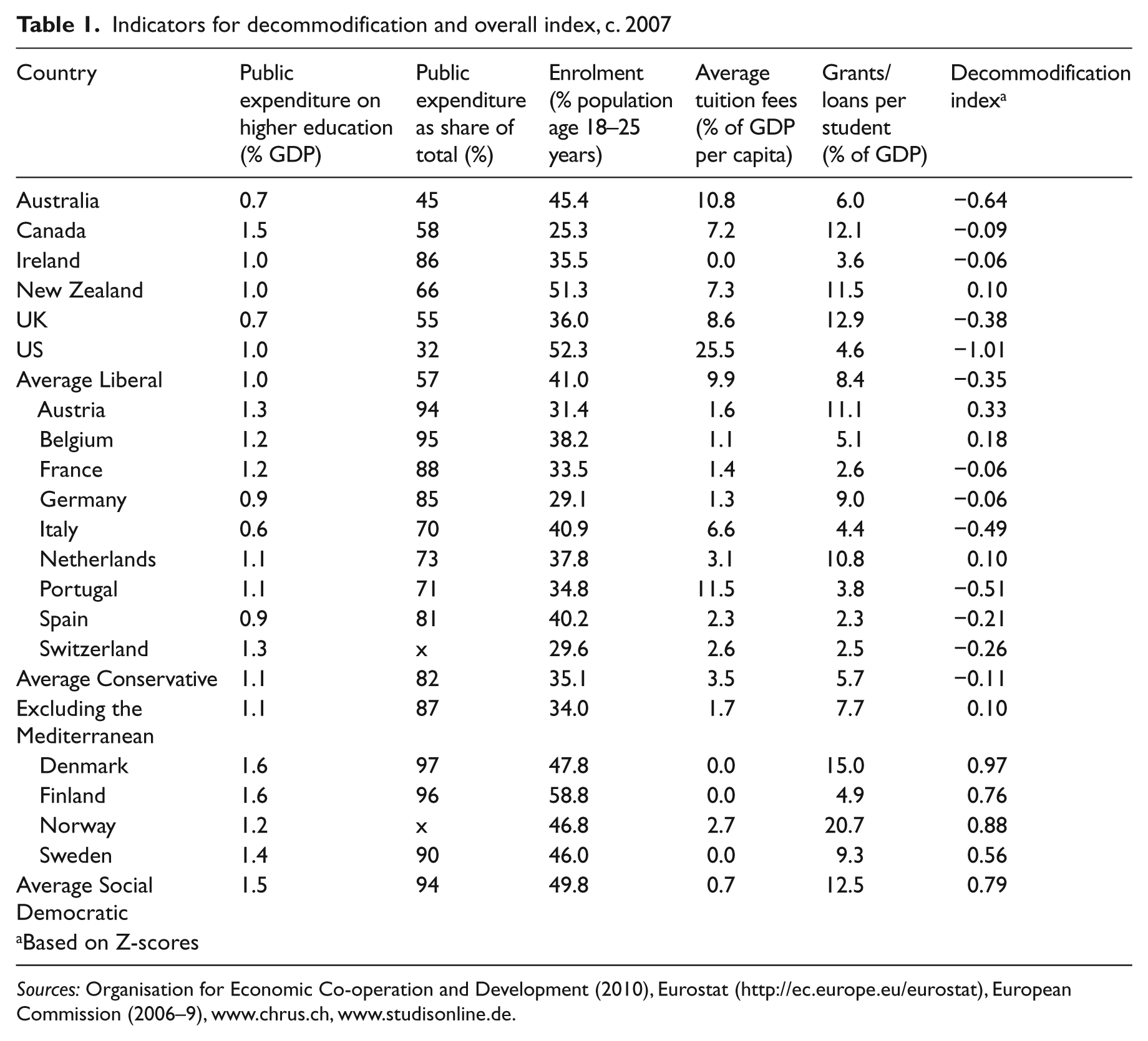
Table 1 shows the scores of the 19 welfare states on the indicators for decommodification of the higher education systems. Public expenditures on higher education vary between 0.6% in Italy and 1.6% in Denmark and Finland. As expected, expenditures are, on average, the highest in the social democratic welfare states. Contrary to what we expected, there is no systematic difference in public expenditure between the conservative and the liberal welfare states. On average, both groups of welfare states spend two-thirds of what the social democratic countries spend. However, there is a considerable difference between the conservative and the liberal countries as far as private expenditure is concerned. In the liberal countries, public expenditure is not much bigger than private expenditure, but in the conservative countries public expenditure is more than four times as big as private expenditure. In the social democratic countries private expenditure on higher education is almost negligible.
Indicators for decommodification and overall index, c. 2007
Based on Z-scores
A third indicator for decommodification is the enrolment into higher education, calculated as the number of students as a percentage of the population aged 18–25 years. As expected, enrolment rates are the highest in the social democratic countries, where almost half of the eligible population is enrolled. In the liberal countries the enrolment rate is considerably lower, but still higher than in the conservative countries, which have the lowest enrolment rates on average.
Enrolment may be influenced by both the tuition fees that students have to pay and the grants and loans they receive. As expected, tuition fees are the highest in the liberal countries and the lowest in the social democratic countries. However, the possible negative effect of high tuition fees in the liberal countries is largely offset by the high per capita amount of grants and loans awarded to students. In the conservative countries the grants and loans are lower than in the liberal countries, although still higher than the average tuition fee in these countries. In the social democratic countries, by far the highest average loans and grants are assigned to students.
If we take the average of the normalized scores on these five indicators, the social democratic countries stand out as the most decommodified with respect to higher education. Their mean score is the highest on all indicators. The difference between the mean score on the decommodification index of the liberal and of the conservative welfare states is relatively small. However, if we exclude the Mediterranean countries from the conservative group, their mean decommodification index rises considerably and is then almost midway between the liberal and the social democratic group.
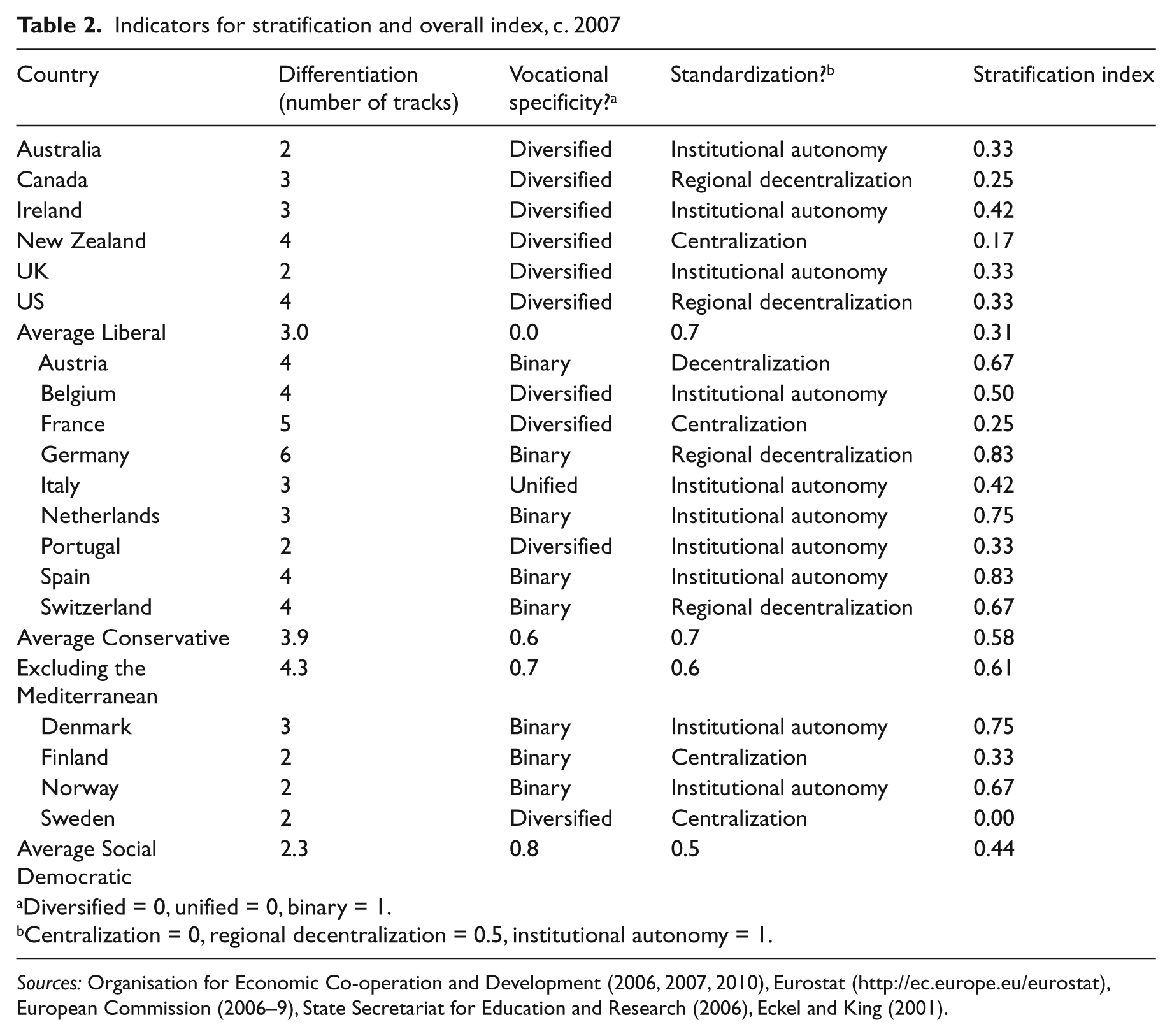
In Table 2 the results with respect to the stratification of higher education institutions are summarized. Regarding differentiation, the number of different tracks in higher education is generally the largest in the conservative countries and the lowest in the social democratic countries, as would be expected. With respect to vocational specificity, however, the liberal countries score the lowest: they all have a diversified system with no separate institutions for vocational education. Half of the conservative and most of the social democratic countries have a binary system and, thus, high vocational specificity. Regarding standardization, only four countries have a fully centralized system of higher education, two of which are social democratic countries. However, the other two social democratic countries, Denmark and Norway, have institutional autonomy and, thus, little standardization. This also applies to half of the liberal countries and half of the conservative countries. In the remaining countries authority is decentralized to the regional level, resulting in a moderate level of standardization.
Indicators for stratification and overall index, c. 2007
Diversified = 0, unified = 0, binary = 1.
Centralization = 0, regional decentralization = 0.5, institutional autonomy = 1.
If we combine the three indicators for stratification, the liberal countries turn out to have, on average, the least stratified system of higher education. This is mainly due to the fact that they have no separate vocational institutes. The social democratic higher education systems are, on average, somewhat more stratified. But here the variation is very large. Sweden has the lowest score on the stratification index, while the Danish and Norwegian systems are among the most stratified. Not unexpectedly, the conservative welfare states, which put a lot of emphasis on maintaining status differentials, have the most stratified higher education systems, although France and Portugal are exceptions.
Figure 1 shows the scores of the 19 countries on both the overall decommodification index and the stratification index. Three clusters of countries can be distinguished. 5 The group of Nordic countries stands out from the other countries because of their high level of decommodification. This is what could be expected from these social democratic countries. However, on the dimension of stratification they differ strongly, ranging from very low (Sweden) to very high (Denmark). Consequently, they cannot be distinguished from the other countries on this second dimension. The other two groups of countries are similar with respect to the level of decommodification, which is considerably lower than in the social democratic countries, but they are clearly distinct on the dimension of stratification. Most conservative countries score significantly higher on this dimension than the liberal countries. However, France, Italy and Portugal appear to be more similar to the liberal countries than to the other conservative countries. Finally, Belgium is the odd man out, placed in between the three groups. As far as higher education is concerned, Belgium appears to be a hybrid welfare state.
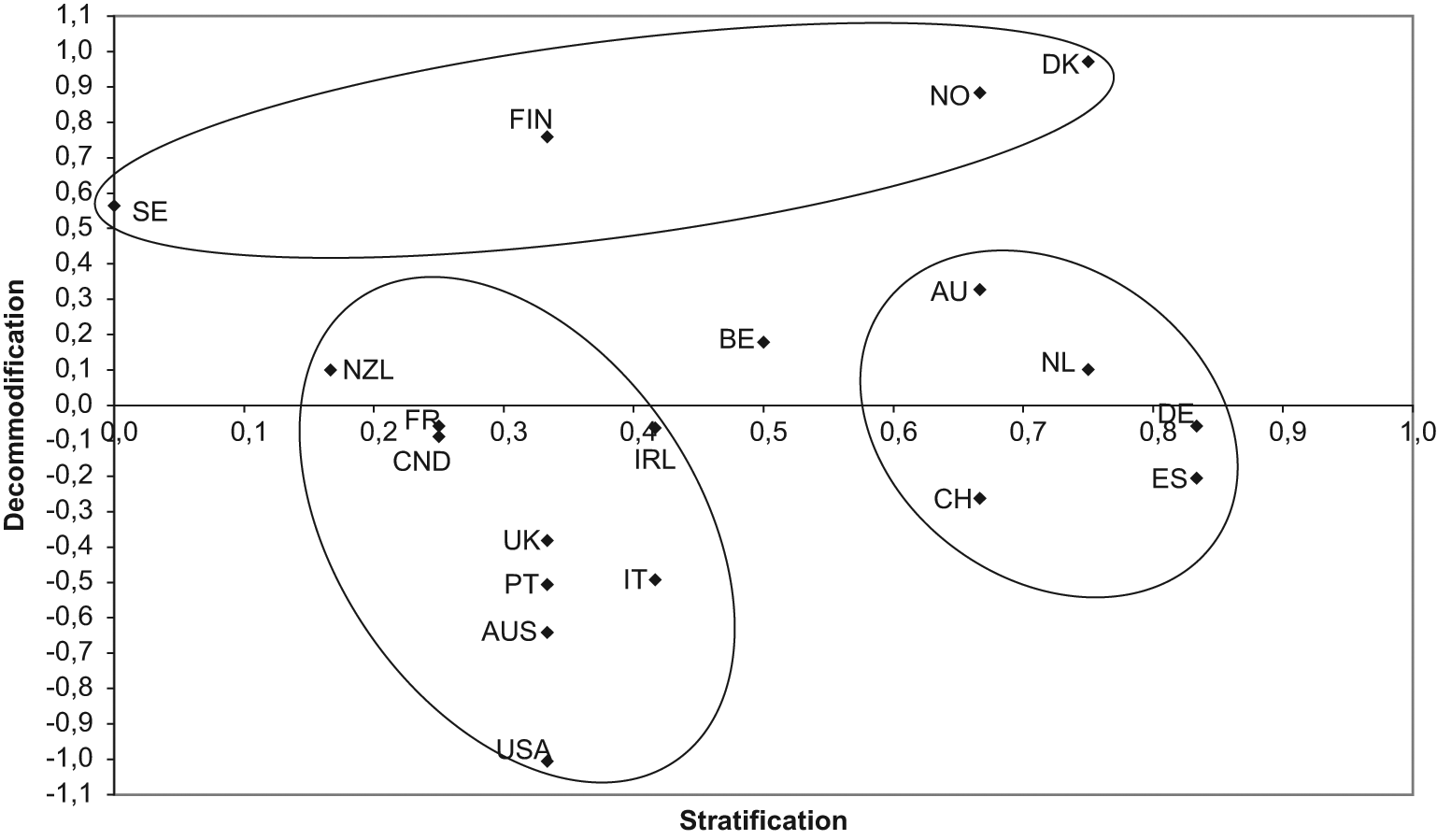
Classification of higher education systems.
Conclusion and discussion
In this article we ventured into a rather neglected area of comparative welfare state research: higher education policies. We aimed to assess whether the concepts used to compare welfare states in general can be applied to the field of higher education. We then investigated whether the characteristics of the higher education systems in countries belonging to different welfare regimes correspond to the typical features of these regimes.
First, we showed that Esping-Andersen’s well-known concepts of decommodification and stratification can indeed be applied to higher education. Decommodification refers to government spending on and the access to higher education. The concept of stratification was applied to the internal structure and organization of the higher education system. We defined five indicators for decommodification and three indicators for stratification, and aggregated these into two overall indices.
Next, we tested our approach empirically by collecting data on the higher education system in 19 developed western countries belonging to different welfare regimes. We expected the higher education systems in the social democratic welfare states to have a high level of decommodification and a low level of stratification, the higher education system in the liberal countries to show low decommodification and moderately high stratification, and the conservative higher education systems to be moderately decommodifying and strongly stratifying.
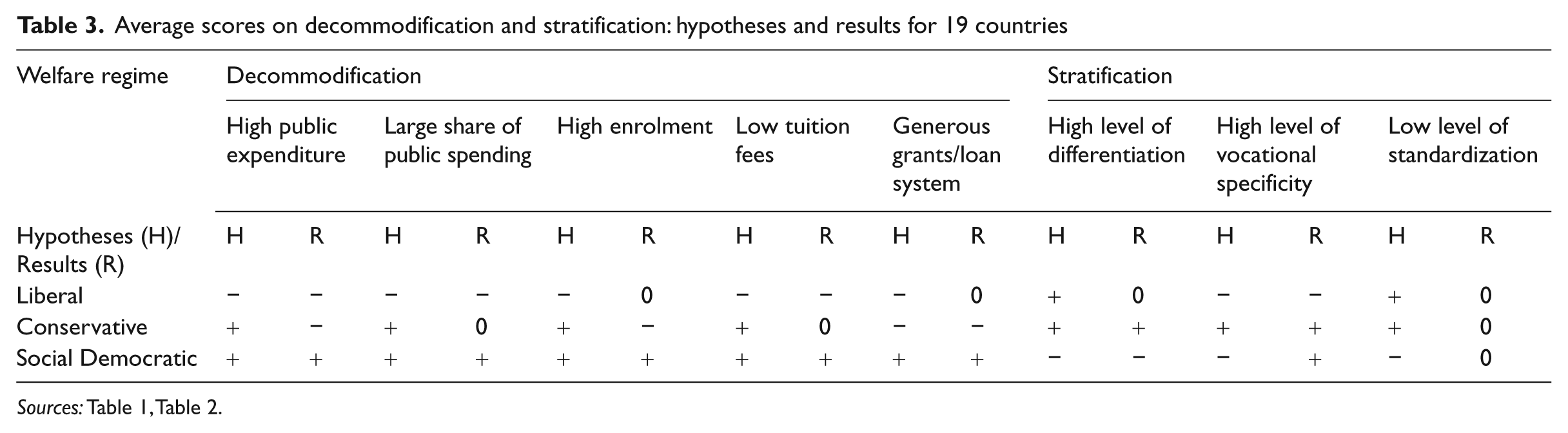
Table 3 compares the expected scores and the actual average scores of the three countries on the eight indicators of decommodification and stratification. The regime that scores highest on each indicator is marked by a+, the regime that scores lowest by a− and the regime inbetween by a 0. Table 3 clearly shows that not all expectations are borne out by the empirical results. The outcomes for the liberal countries only confirm the expectations of a low (share of) public spending, high tuition fees and a low level of vocational specificity. For the conservative welfare regime only the rather scant student grants and loans and the high level of differentiation and vocational specificity confirm the hypotheses. The social democratic countries meet the expectations best. These countries’ higher education systems are characterized by a high (share of) public expenditure, high enrolment rates, low tuition fees, generous grants and loans, and a low level of differentiation. Aggregating the separate indicators into two overall indices shows that the social democratic countries stand out for their high level of decommodification, while the conservative countries are distinguished by their high level of stratification. These two results correspond with the characteristic features of these welfare regimes in the typology of Esping-Andersen. However, the moderately high level of stratification of the social democratic higher education institutions and the rather low decommodification of the conservative higher education systems are inconsistent with Esping-Andersen’s typology. Moreover, the low stratification in the liberal countries is at odds with their characterization by Esping-Andersen.
Average scores on decommodification and stratification: hypotheses and results for 19 countries
We conclude that it is indeed possible to include higher education systems in both the theoretical and the empirical classification of welfare regimes by Esping-Andersen. Since there is broad agreement in the academic literature that education should be considered as part of the welfare state, there are no convincing arguments to exclude (higher) education from welfare state research any longer. However, our empirical analysis has shown that it is not self-evident that higher education systems correspond with the characterization of welfare states based on the usual components, such as social security, pensions and labour market policies. Nevertheless, combining the dimensions of decommodification and stratification of higher education we, too, find three clusters of countries, which roughly correspond to the ‘classical’ categorization of social democratic, liberal and conservative welfare regimes, respectively. Yet, France, Italy and Portugal appear to belong to the liberal cluster, while the Belgian system of higher education has a hybrid character.
Finally, we want to point out two limitations of our research that may be overcome in future studies. First, higher education policy was treated in isolation from other policies. We have thus ignored possible interactions between policy areas. Consequently, we could not analyse the outcomes of higher education policy, such as the labour market position of graduates, since these outcomes are strongly influenced by other areas of the welfare state, such as labour market policies. A second limitation is that our study focused on institutional differences in higher education systems at one point in time and thus assumes the stability of educational systems over time. Future research may establish to what extent higher education systems have changed over time and whether this has resulted in shifts in decommodification and stratification.