




Abstract
The aim of this article is to analyse the nature and significance of the recent European Union (EU) poverty and social exclusion target, which has become part of the EU’s new 10-year strategy, known as ‘Europe 2020’. It situates this analysis in the politics of social policy, at both transnational and national levels. The agreement on the target proved to be momentous and also contentious for the key actors involved – the Member States, the European Commission, the European Parliament – all of which were forced to change their position at some stage of the negotiations. The agreed target – to lift at least 20 million people out of poverty and social exclusion by 2020 – is ambitious and novel in an EU context. The analysis undertaken here underlines its specificity and some weaknesses. First, the target was the result of a political opportunity seized upon by a number of pro-social policy actors (some in the European Commission, the Parliament, certain Member States as well as non-governmental organizations), rather than an agreement to further Europeanize social policy. Second, the target is a compromise in that it is constituted quite diversely in terms of whether it will succeed by addressing income poverty, severe material deprivation and/or household joblessness. Third, the target allows much leeway in response by the Member States, in terms of both which definition they will use and what level of ambition they set for their target. As such, the target risks both incoherence as an approach to social policy and ineffectiveness in terms of precipitating significant action by the Member States to address poverty and social exclusion.
Social policy has always had to fight its corner in the European Union (EU). With the Lisbon Strategy in 2000, it looked like it had at last achieved a firm foothold in EU policy. But when a centre-right-dominated European Commission and Council relaunched the strategy in 2005 (known as Lisbon II), the blueprint shifted from one in which social cohesion sat alongside economic growth and job creation to one where economic growth and job growth creation lead automatically to social cohesion. During the formulation of a successor to the Lisbon Strategy in 2009 and early 2010, the very strong neo-liberal political constellations and discourses in the EU gave little cause for optimism to those who wished to see a deepening of Social Europe. Furthermore, the financial crisis and subsequent sovereign debt crisis made for a political environment in which financial stability and fiscal sustainability dominated the political agenda. Yet, by the summer of 2010, Europe 2020 had been approved by the Council with the headline target to ‘lift at least 20 million people out of the risk of poverty and exclusion’ by 2020 (OJ, 2010) – the first quantitative social target in the history of the EU. This was an unlikely and unexpected outcome, which, at first glance anyway, suggests a deepening Europeanization of social policy.
This article holds that the poverty and social exclusion target is revealing of the fundamental conflicts around social policy and the model of capitalism to be promoted in the EU. Arguments about poverty are not about some arcane metric but go to the heart of political disagreement in Europe. Conceptually, the article suggests that the target has to be interrogated with respect to the political and institutional make-up of decision-making at EU and national levels and as a social policy instrument with political connotations. The argument developed focuses centrally on the politics of EU social policy, viewing it as a complicated mix of EU-level and national interests, which is influenced especially by how EU-level proposals or developments interact with the prevailing national models of social policy and the politics associated with them. We suggest that although it is ambitious – spelling a reduction of 16.7% in the target population over the next decade (Atkinson et al., 2010) – the agreement of the poverty and social exclusion target does not signify deeper integration of Social Europe. This is true in two senses. First, the agreement on the target was a result of political opportunism, when a political opening was successfully exploited by supporters of Social Europe. Second, as a substantive measure the target is internally complicated and constructed in a manner that is likely to continue the pattern of à-la-carte take-up of EU social policy ideas and initiatives by Member States. Both lines of analysis indicate continuity with social policy developments during the Lisbon Strategy, especially the second, more neo-liberal, phase of it from 2005 onwards.
The article is organized in three main parts. The first section provides a theoretical lens in which to understand integration within the EU social policy field. We construct a modified version of Stone Sweet and Sandholtz’s (1997, 1998) ‘supranational governance’ approach to account for the integration dynamics of EU social policy. We argue that EU negotiations are conducted within a transnational political space, and that transnational actors are capable of exerting their influence. The two sections that follow are empirical in nature. To identify the political and institutional calibre of the poverty and social exclusion target, the second part traces its origins and details the negotiations that surrounded it. The third part is concerned with the substantive content of the target and its social policy context at a national level. It considers the political meaning and significance of the target in terms of both the nature of the poverty-related challenges existing in Member States and their social policy models. A brief concluding section summarizes our review of the target. The empirical material informing the article is drawn from a range of sources. In the first instance, the article rests on analyses of official documents produced by the various EU institutions, as well as existing sources concerning poverty and exclusion and the dynamics of EU social policy making. A second very important source is 15 semi-structured interviews undertaken with officials in the EU institutions (Commission, Parliament and Permanent Representations) in late 2010 (see the list at the end of the article). The interviews were undertaken to provide an insight into country positions and the negotiation process that would otherwise be difficult to obtain.
The supranational governance of EU social policy
In theorizing the process of integration within Social Europe, two observations about EU social policy are critical. First, its development is fitful: periods of intense activity are followed by times when social policy is to all intents and purposes dormant (Daly, 2008). Broadly speaking, in the last 40 years there have been only three periods of intense activity: the early 1970s, the Delors era and the Lisbon Strategy (Atkinson et al., 2002; Leibfried and Pierson, 1995). A key enabling factor of such ‘punctuated moments’ has been the coalescence of political constellations in the EU to favour integration within the social field. That is, the political positions of the Commission, the Member States in the Council and the European Parliament all converged to favour the development of EU social policy – whether formally or informally. A second notable feature is that the EU suffers from a ‘constitutional asymmetry between policies promoting market efficiencies and policies promoting social protection and equality’ (Scharpf, 2002: 645). Hence, Member States have considerably more autonomy in social policy relative to other policy domains. With such opposing forces for and against integration, how are we to theorize the latest process of European integration within the social field?
Our theoretical point of departure rejects the liberal intergovernmentalist position that there is no EU-level political space capable of driving the EU and limiting the sovereign power of the Member States (Moravcsik, 1998; Moravcsik and Schimmelfennig, 2009). Rather, in line with the thinking of numerous other scholars (for example, Hix, 2005; Hooghe and Marks, 1999; Leibfried and Pierson, 1995), we argue that the EU features the characteristics of an emergent transnational political space and that the EU institutions and actors can, and do, have an impact upon the European integration process, albeit varying between policy fields. We anchor our analysis within the supranational governance approach to European integration and, along with Stone Sweet and Sandholtz (1997, 1998), consider intergovernmental negotiations to be a specific mode of decision-making within the EU policy-making process.
The supranational governance perspective is helpful in proposing a continuum of institutional positioning for policy from intergovernmentalism to supranationalism. As depicted by Stone Sweet and Sandholtz (1997: 304–5), the continuum frames the movement from intergovernmental to supranational governance in terms of three related dimensions: EU rules – both legal and less formal; EU organizations – institutions that produce, execute and (re)interpret EU rules; and transnational actors – actors on the pan-European stage (including in the case of social policy non-governmental organizations (NGOs) and academics) who engage in EU exchanges and influence policy-making processes at the European level. For any given policy area or process, movement along the continuum measures the presence and intensity of each of the factors or agents. Towards the supranational pole, the influence of EU institutions and transnational actors (Commission, European Court of Justice, Parliament and non-governmental actors) on policy-making processes and outcomes increases at the expense of the Member State governments and their domestic actors, and vice versa for the intergovernmental pole. Taken together, the three dimensions are constitutive of supranational politics. A change in one of the three elements (rules, institutions, transnational society) creates conditions that effect a change in the position of the other two (Stone Sweet and Sandholtz, 1997: 306–9).
Where is Social Europe to be situated with respect to the supranational governance framework? On the face of it, and certainly compared with the internal market (the case study par excellence of European integration and the foundation for Stone Sweet’s and Sandholtz’s typology), developments suggest that Social Europe tends to be considerably more intergovernmental. 2 Comparing supranational governance in EU social policy with that of the internal market, for example, we find the following: the Acquis Communautaire is less developed and extensive; the EU institutions have less supranational autonomy; and transnational society is less developed and less influential. However, we wish to suggest that the social policy domain is not purely intergovernmental and to demonstrate that EU actors can and do have an influence on the process of integration. Developments in EU social policy around the forging of the Lisbon Strategy in 2000 serve as example: progress can be attributed to the large majority of centre-left governments in power in the Member States in the period when it was being negotiated; the entrepreneurship and vigour of the Portuguese presidency; the left-leaning position of the Prodi Commission; support from the Parliament; and the lobbying of NGOs. We suggest that integration within Social Europe is, therefore, situated somewhere around the centre of the supranational governance continuum. At this point on the continuum, supranational actors may often be the source of successful policy innovation, but the Member States remain in the driving seat of the integration process and can significantly determine outcomes and even block progress.
While the role of transnational exchange (that is, cross-border transactions usually associated with trade and generating a momentum among both national and transnational actors for EU level coordination to reduce the associated costs of cross-border trade and/or to resolve disputes) is central to the original supranational governance approach to understanding why European integration occurs, the example of the Lisbon Strategy points to the centrality of the political dynamics within a policy area, both at the EU and Member State levels. In short, politics matters in furthering the understanding of the origins, formation and potential impact of a particular policy. We therefore modify the supranational governance continuum to incorporate the politics of European integration for the case study of Social Europe (Figure 1). What factors are at play in the to-ing and fro-ing in the social policy sphere? The semi- sovereign nature of EU social policy creates a considerable scope of influence for the Member States. This is especially the case in the situation of relative ‘voluntarism’, which has been put in place by developments under the Lisbon process (Armstrong, 2010; Zeitlin, 2009). There is an added layer of complexity by virtue of the variety of welfare state models represented by the 27 Member States, each with its particular traditions, solutions, policy mixes and, ultimately, different norms and values about what constitutes a good society (Arts and Gelissen, 2002; Ebbinghaus and Manow, 2006; Esping-Andersen, 1990; Ferrera, 2005). Agreement regarding EU social policy proves both politically and practically difficult in a union with welfare states as diverse as the Liberal and Scandinavian models, for example. During EU social policy negotiations, Member States predominantly concern themselves with ‘goodness-of-fit’ of a proposed policy with their domestic situation so as to avoid high adaptational costs in their domestic setting, as well as negative political consequences (Börzel, 2002).
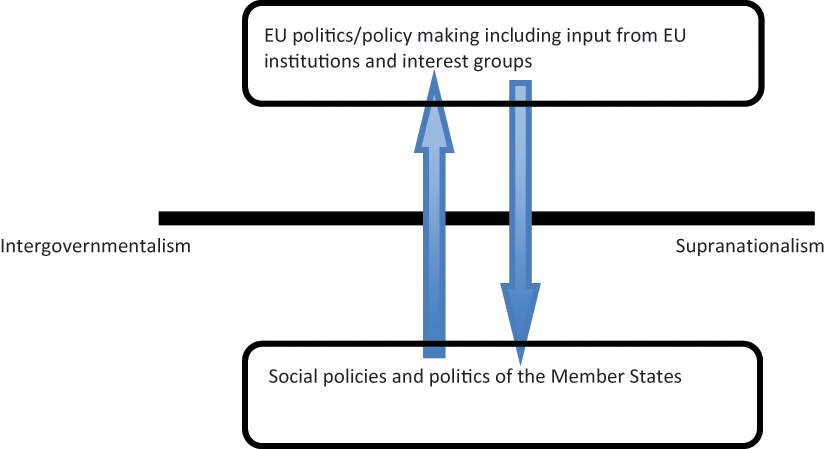
The dynamics of EU social policy.
What is the significance of this for the analysis of the poverty and social exclusion target of Europe 2020? First, within Social Europe the Member States have a considerable amount of autonomy to influence EU policy, but the potential influence of EU-level actors is also strong. Second, given this, any integration momentum is likely to be circumstantial and the product of political opportunism, thereby jeopardizing a deepening of Europeanization in Social Europe. Third, agreed policy is likely to feature a range of social policy perspectives and will be normatively diverse. These three aspects are critical to any assessment of the significance of the poverty and social exclusion target.
The emergence of the target
Within the EU institutions in 2009, there were general expectations that the European Commission would come up with new ideas to replace the Lisbon Strategy (interviews: Commission 1, Commission 2, Commission 3, Commission 4). The Commission’s review of the Lisbon Strategy argued that any successor required a streamlined and simplified set of aims, with a stronger governance mechanism. This was their opening position on the guiding principles to form the basis of Europe 2020 (European Commission, 2009, 2010a,b). The release of the Commission’s public consultation revealed that its philosophical position on Social Europe for Europe 2020 was identical to that of Lisbon II: progress in social exclusion and poverty reduction was to follow from success in economic growth and job creation (European Commission, 2009: 7). However, this had clearly changed by the time the first draft proposal of Europe 2020 was released on 3 March 2010, as it included the headline target to reduce poverty within the EU by 25% by 2020 (European Commission, 2010a: 5). The Commission proposed that the calculation of poverty should be done via one single measure of ‘at risk of poverty’ (that is, people living on less than 60% of the national median equivalized income). The target was to be supported by one of the seven flagship initiatives to encourage progress on the guidelines. This was the ‘European Platform against Poverty’, which would have the task of raising awareness of people experiencing poverty and social exclusion, and transforming and strengthening ‘the Open Method of Coordination on social exclusion and social protection into a platform for cooperation, peer review and exchange of good practice’ (European Commission, 2010a: 19).
Why did the Commission change its position? We suggest that this had a number of roots. It was, first, significantly influenced by the politics surrounding the re-election of José Manuel Barroso and his new Commission in the second half of 2009 (interviews: Commission 1, Commission 5). Although the Council appoints the President of the Commission, this appointment and those of the individual cabinet members requires an absolute majority vote in favour from the Parliament. During the election of the first Barroso Commission, the Parliament had delayed the ratification of the Commission and blocked several Commissioner appointees. Between 2004 and 2009, the relationship between the Commission and Parliament over Social Europe had become strained. Not only did the Parliament point to a lack of progress within Social Europe during the period, but, when EU social policy was negotiated, the Parliament was largely ignored or sidelined. 3
Against this background, Barroso appeared to shift and offer some concessions favouring developments within Social Europe. He not only promised the Parliament that he would push for an agreement on the revision of the Working Time Directive but, before the Parliamentary vote for his re-election on 16 September 2009, he argued for ‘a much stronger focus on the social dimension in Europe at all levels of the decision-making process’. 4 To representatives in the Parliament, Barroso’s speech and the subsequent insertion of the poverty target within Europe 2020 was his attempt to appease the different interests, given that the European People’s Party called for a greener social market economy, and that the Socialists and Democrats wanted the fight against poverty to be explicit within the Strategy (European Commission, 2010c: 11–12; interviews: Member of European Parliament (MEP 1, MEP 2, MEP 3)). Furthermore, in the run-up to Parliament’s approval of the Commission, the European Anti-Poverty Network (EAPN) spent the summer of 2009 lobbying both the Parliament and Barroso, calling for a strong commitment ‘to make a decisive impact on the eradication of poverty’. 5 The EAPN’s actions included open letters to both the Commission and the Parliament, position papers, cross-party committee meetings in the Parliament and a publicity campaign under the banner of ‘A New Vision: An EU we can trust’ (EAPN, 2009).
A second and very significant factor in the Commission’s change of heart was the influence exerted by a small group of Member States in the Council which called for a strengthening of the social component in Europe 2020. The position papers of Austria, Belgium, Cyprus, France, Italy, Portugal and Spain all argued that the achievement of the internal market should not be considered as an end in itself. Rather, progress in economic growth and jobs should go hand in hand with the preservation and strengthening of the European social model. These seven Member States lobbied the Commission for the inclusion of a social component to Europe 2020 (interview: Commission 3), and Spain used its strategic position as President of the Council of the EU in the first half of 2010 to put Social Europe on the agenda, with respect to both Europe 2020 and to the broader process of European integration (Spanish Presidency, 2010). This group of Member States also highlighted the progress and importance of the Social Protection Committee. A further source of support for this position came from the new President of the European Council, Herman Van Rompuy, who had been given the specific task of formulating Europe 2020 and who was himself committed to a strong social dimension. He argued that governments should adhere to a limited number of guidelines (five), of which a specific target should be set to reduce poverty (interviews: Perm Rep 2, Commission 1).
The poverty target proposed within Europe 2020 caused something of a storm within the Council, and an opposing grouping of Member States emerged. Included here were Sweden, some of the new Member States, and the UK and Ireland. In attempting to water down or remove the target, they raised the issue of the EU’s legal competence in the area of social inclusion and social protection, and wondered in particular whether there could be a poverty target within a set of guidelines that were to be on employment. Sweden took a strong position on job creation as the primary tool for tackling social exclusion (interview: Perm Rep 3) and held fast to it throughout the negotiations. The Swedish position favoured reducing poverty via an increase in employment. This reflects the Swedish political economy, which provides comparatively high levels of public services based on high rates of female employment, which tends to crowd out low-paid service sector jobs (and poverty traps) (Esping-Andersen, 1990; Steinmo, 2003). The other opposing Member States – several of the new Member States, along with the UK and Ireland – marshalled a different set of arguments. A problem pointed out by these Member States focused on measurement and reliance on relative income – if real income in the economy increases, but income distribution remains constant, the rate of relative poverty also remains constant. Evidence from neo-liberal political economies (such as the UK), with a large low-paid and low-skilled service sector, demonstrates that under such conditions, employment participation does not automatically lead to a reduction in poverty (Hills, 2004; Kenworthy, 2008). Rather, employment in the low-paid service sector can encounter poverty traps. Within several of the new Member States, the argument against benefit dependency had gained ground during the transition process (King, 2007; King and Sznajder, 2006). Furthermore, new Member States were mindful of the financial costs to them of measures agreed at the EU level, and pointed to the instability of the Mediterranean countries and the Eurozone crisis as an example of excessive government spending and its consequences (interviews: Perm Rep 3, 5 and 7).
The two groupings of opposing Member States agreed on two aspects of the debate. First, they shared the view that the use of one signal indicator to measure poverty demonstrated that the Commission had given little thought to the issue, and in the interviews carried out for this article the view was expressed that it had been inserted during last- minute preparations to appease ‘social lovers’ (interview: Perm Rep 6). Since 2000, the EU has developed quite a complex and diverse set of indicators associated with the Open Method of Coordination in Social Protection and Social Inclusion, thereby recognizing Member State social policy diversity and allowing Member States some flexibility in conceiving of the issues involved (Daly, 2010). The question then was ‘Why depart from this practice and adopt a undimensional approach?’ Second, the two groupings also shared concerns about the poverty target as part of the governance mechanism of Europe 2020. In its draft proposal, the Commission argued that Europe 2020 required ‘a strong governance framework that harnesses the instruments at its disposal to ensure timely and effective implementation’ (European Commission, 2010a: 27). The Commission was to be responsible for country surveillance and could issue country-specific recommendations for the broad economic policy guidelines (under Article 121.2) and employment guidelines (under Article 148). While no reference was made in the Commission’s draft to country-specific recommendations being issued for the poverty target, Member States shared a concern about the possibility of such a ‘top-down imposition’ on the part of the Commission (interview: Perm Rep 6).
At the European Council meeting on 26 March 2010, these divisions were dominant, and Member States proved unable to reach an agreement on the poverty target. Against a backdrop of lobbying by the transnational social NGOs (particularly the EAPN), the Member States agreed a willingness to tackle poverty and social exclusion, but the existence of a target, its definition and constituent elements proved hugely contentious. Without such broader support within the EU’s political space, the poverty target may have disappeared from Europe 2020 altogether – central to its maintenance was the commitment of Van Rompuy and Barroso, the energy of the Spanish presidency and the support provided by the committed Member States as well as strong engagement on the part of the social NGOs.
During the following months, the Spanish EU presidency worked alongside the Commission to address the fears and objections of the opposing group of Member States. Bilateral meetings were held between the Commission and the Member States to produce a target and a mode of measurement that would gain broad support in the Council (interview: Perm Rep 1). The existence of a diverse set of indicators and the achievements of the Social Protection Committee and its indicators subgroup proved to be particularly valuable at this stage of the negotiations. The progress that had been made under the Lisbon Strategy on the various definitions of and indicators for poverty and social exclusion played a key role in enabling the diverse groups of Member States to agree on an EU definition of poverty suitable to and acceptable in their domestic setting. What mattered above all, though, was that during the bilateral negotiations there emerged what might be called a ‘gentlemen’s agreement’ on country-specific recommendations, whereby Member States were reassured that the poverty target within Europe 2020 would not feature country-specific recommendations but would act as a ‘guideline’ (interview: Sec-Gen 2).
As a compromise, the Spanish presidency dropped the Commission’s proposal of having one measure and, following the work of the Social Protection Committee and its indicators’ subgroup on the methodological implications of target setting (Social Protection Committee, 2010), offered three alternatives: (1) at risk of poverty – that is, people living on less than 60% of the national median equivalized income; (2) severe material deprivation – that is, people who experience at least four out of nine defined constituents of deprivation; and (3) people living in jobless households – that is, the population defined in relation to zero or very low work intensity in their households during the income reference period. The seven Member States that supported the Commission’s initial proposal argued that the inclusion of a ‘jobless household’ definition would create an empty target. They pointed to the evidence from neo-liberal economies whereby having a job does not guarantee poverty alleviation. Nevertheless, on 17–18 June 2010, the efforts of the Spanish presidency and the Commission paid off and the Member States agreed to ‘lift at least 20 million people out of the risk of poverty and exclusion’ (European Council, 2010: 12). The agreed target consists of lowering by 20 million the number of people who are at risk of poverty and/or severely deprived and/or living in ‘jobless households’. The extension to more indicators also meant a substantial increase in the target population – from 80 to 120 million. In responding to the target, it was agreed that Member States would be able to choose one, both or a union of all three of the indicators. They could also suggest their own indicator(s), although, if they chose to do so, they would need to demonstrate the link between their selection and the EU target.
The agreement on an EU target for poverty and social exclusion was therefore the result of a political opportunity created by the particular political conditions surrounding the formation of Europe 2020. How is the target to be interpreted in the context of national welfare states and Member States’ proclivities to take on particular elements of it?
The poverty and social exclusion target in the context of Member State social policy
To identify its meaning and significance, the target has to be assessed from a number of different angles. One is to consider it technically, that is in terms of how it is constituted. A second approach is to examine it as a response to the poverty and other challenges facing the EU as a whole and the Member States individually.
The EU poverty and social exclusion target is notable in several respects. Two things about it especially stand out. First, it is an overall target for the EU, set in terms of the prevalence of poverty and social exclusion in the EU as a whole (the numbers to be reduced by 20 million over 10 years). It represents a particular choice over a range of alternatives. Among the latter are, for example, a common Member State-level target, different targets for each Member State, the aggregation of national targets upwards to the EU level and Member States being asked to emulate the best performing countries or indeed to work in subgroups sharing a target (Armstrong, 2010; Atkinson et al., 2004). It is global in another sense as well. For each of the three components, the threshold is a global one and, in the case of deprivation, both the cut-off point (four or more) and actual items are fixed at EU level. This suggests the emergence of a European norm or benchmark to which Member States should approximate and signifies a deepening EU commitment and influence. When it is looked at more closely, however, the benchmark is revealed as an umbrella under which very different positions can be lodged.
As mentioned, the target is an amalgam of three dimensions. Each of the dimensions is drawn from a different perspective. The first – being below a 60% cut-off of national median equivalized income – is the classic relative poverty measure based on disposable income from whatever source. It is one of the most long-standing primary indicators agreed under the Lisbon social process, in place virtually since day one (Daly, 2010). The second component of the target – being without at least four items out of a nine-item list of ‘deprivations’ – is meant to pick up on lifestyle and access to the customary standard and style of living. 6 This genuflects in the direction of social exclusion, a concept with multiple meanings and applications that has proved difficult to get agreement on within the Lisbon social process, despite the Commission’s promotion of it since the 1980s (Armstrong, 2010; Guio, 2009). The third dimension links into joblessness as a feature of households – being a 0- to 59-year-old member of a household where the working-aged adults worked for less than 20% of their total work-time potential during the income reference period. 7 The proximate origins of this are in a measure of joblessness, which was among the initial set of indicators agreed for the social Open Method of Coordination in 2001 in an effort to measure economic activity.
The three-element target has been offered as a form of a menu from which Member States can choose their preferred measure. Probing this in more detail further reveals the political and social policy foundations of and possible reasons for a broad approach.
Even though the target gives equal weight to each of the three dimensions, the underlying phenomena are quite different in terms of their intensity and scale within and across Member States. Of the three, income poverty is the biggest challenge with some 80 million people in the EU falling below the 60% income threshold in 2008 (Social Protection Committee, 2011: 11). Severe material deprivation is the second greatest of the three challenges, affecting some 40 million of the EU’s citizens, while some 34 million Europeans live in so-called jobless households. The overlap between the three is far from perfect – some 6.7 million people experience all three situations and 80 million people experience only one of the three conditions. Key questions arising, then, are ‘Why not poverty alone as the key benchmark?’ and ‘Why these three?’. There are a number of aspects to this.
One answer to the first question is that poverty is a contested concept, and one with a compromised history as a focus of EU social policy engagement. In the 1970s and 1980s, the EU funded a number of term-limited poverty programmes in the Member States which were designed mainly as ‘knowledge-generating activities’ about anti-poverty strategies and activities (Bauer, 2002; Marlier et al., 2007). The programmes took this form mainly because the legal and political mandate for EU action in this field was very constrained, and in fact a fourth programme was blocked on legal grounds. While the legal mandate has now been extended, poverty is a concept with limited political appeal, not least because it has proved extremely resistant to policies to counter it. Also, and this is especially important in the context of the EU, poverty resonates differently across social policy models. It is, for example, too minimalistic for both the Scandinavian and continental European countries which conceive of their social policy models in more expansive, social protection and solidaristic terms. Poverty has more resonance in the Liberal and the Mediterranean welfare state models. Here, however, as in the eastern and central European countries, it rests on shifting sands and depends upon the government in power. Given the current political constellation in many Member States and the compromises achieved under the Lisbon Strategy, which established a multi-dimensional approach to the subject of poverty and social exclusion, a strategic attack on income poverty alone would not run.
Deprivation on its own would be an even more unlikely indicator or target, for a number of reasons. First, it is a relative newcomer in the social policy constellation at a national and even EU level, and Member States remain to be convinced about its legitimacy and utility as a flagship concept for social policy. It took 9 years of debate and contestation before countries could agree on a set of deprivation indicators under the Lisbon Strategy, for example. Second, within the context of the EU, material deprivation is itself a compromise on the social exclusion focus of the Lisbon Strategy and its relationship either to poverty or to the design of social policy has never been legitimated. This turns the spotlight on joblessness – what functions does it serve as an indicator?
The term itself – and at the moment it remains a term rather than a concept – is relatively new, and is in origin a concern that emerged first in the neo- liberal countries in the 1990s (especially Australia and New Zealand). The problematization of jobless households is driven by the possibility that joblessness may be a characteristic of particular types of families, the values they hold, the behaviours in which they engage (especially as parents) and the apparent corrosive effects of worklessness on people and their families, children especially. In this sense it is a cultural term, a comment on micro (individual) behaviour magnified to a more meso (household and family) level. It links closely to the activation thrust of contemporary social policy and gives some security to those who fear that a focus on income poverty alone would lead automatically to redistributive policies. The concept also has other resonances and roots, however, and is larger than unemployment or worklessness. As a comment on labour market developments, it picks up on the possibility of growing polarization of labour markets, especially as regards having a job at all and the quality of that job (Gregg and Wadsworth, 1998; Kenworthy, 2008). ‘Jobless households’ is therefore another one of those elastic terms which cover a range of potential ‘problems’, and appeal, if not across the entire political spectrum, then at least to more than one constituency within the EU. It is novel as a measure of social functioning and as a constituent of a poverty target.
The answer to the second question – ‘Why these three?’ – is becoming much clearer. Thinking of it from the perspective of the incentives for Member States, the three dimensions together pick up on and appeal to both regional variation and political preference across the EU. All of the three components are marked by variation regionally, and every Member State is challenged by at least one of them (Table 1). Income poverty is primarily a challenge for the newer Member States and the Mediterranean countries – Latvia, Romania, Bulgaria, Lithuania, Estonia, Greece, Spain, Italy, Poland, Portugal – as well as the UK. Severe material deprivation is worst in the eastern European countries, especially Bulgaria, Hungary, Latvia and Romania (where in excess of 20% of the population lacks four or more items on the deprivation list). So, these countries face the greatest challenge in meeting an income poverty and/or severe deprivation threshold. For them, though, especially the new Member States, the jobless households threshold is far less problematic than in countries like Ireland and the UK, where having a job or not has become integral to welfare and inequality. Other countries marked by this kind of polarization are Belgium and Germany, and, to a lesser extent, the Scandinavian nations. So, if we approach the agreement on the poverty and social exclusion target from the perspective of Member States treating it in a ‘creaming’ fashion [in Walker’s terms (2010: 210) where targets are chosen to maximize outcomes], then all of the Member States would favour not just a diverse target but particular components to be included and/or downgraded. This remains the case even if we attribute a committed (rather than self-interested) motivation to Member States in that they would want to ensure that their biggest challenge would be targeted.
Share of people at risk of poverty, in severe material deprivation and living in households with low work intensity in the EU Member States, 2009

Source: Social Protection Committee (2011), Tables A3, A4 and A5.
There is another view of targets as well, however. Some see progress in the fact of a target. This draws from a hard politics/law school of thinking, whereby the stronger the demands and the sanctions, the more likely a strong outcome. This was always a source of criticism of the ‘soft’ Open Method of Coordination on the social side during Lisbon – the EU had no instruments (and no will) to force or compel a positive response from Member States (Chalmers and Lodge, 2003). There is also the fact that the Commission has history here, having sought to impose targets at the Lisbon Council in 2000 and also at the Barcelona Spring Council of 2002 (European Commission, 2000, 2002). The Commission tends to view targets as a form of performance measurement. On this and other counts, however, we submit that the poverty and social exclusion target has signature weaknesses.
According to Walker (2010: 217), targets need adequately to reflect two tiers of policy logic. The first concerns the mechanisms by means of which national policies address the social problems underlying the targets. In this regard, the target is based on an additive or cumulative measure that takes no account of the trade-offs between the three chosen dimensions, and not only does its composition increase the risk of distortion and the ease of gaming (Walker, 2010: 215), but its success very much depends on the extent to which Member States direct their policies towards households where the targets overlap (Atkinson et al., 2010: 129). The second criterion relates to the mechanisms through which it is intended that the introduction of targets will influence the priorities of Member State policies and aggregate cumulatively to guarantee that the EU headline targets are met. This was not clear at the time that the target was agreed, and in fact so much of the negotiation was taken up with trying to get agreement on the substance of the target that the matter of how Member States would ‘download’ it did not receive the attention it might have. In both respects the target has significant weaknesses. One outcome is becoming clear already: Member States have submitted their targets (as of September 2011) and there is a gap of at least 5 million with the aimed-for 20 million. 8 Meeting the target looks remote when viewed through this lens.
Conclusion
The poverty and social exclusion target, a part of the social policy content of Europe 2020, is revealing about the state of social policy in the EU. Analyses of the negotiations around the insertion of the poverty and social exclusion target in Europe 2020 suggest that it was highly contentious and that the politics surrounding it were complicated. What we have demonstrated is that the target is a product of timing, opportunism and political bargaining on all sides. It is the result of the supportive stance of a small group of Member States in the Council together with a very active Spanish presidency, the Commission’s commitment to come up with a successor to the Lisbon Strategy, the forging of Europe 2020 coinciding with the election of the second Barroso Commission and the position taken by the Parliament (as a defender of Social Europe), and strong lobbying by a small group of transnational NGOs. While it is novel in an EU context to have a target for poverty and social exclusion, and the target itself has significant innovative elements, it would be difficult to claim that it signifies a significant strengthening of the EU’s commitment to Social Europe overall.
The poverty and social exclusion target is best seen as another relatively unique EU compromise. With it, Member States are given a choice about which level to set their targets at and also which indicator(s) to pick as target indicator(s). Hence, they can either ‘cream’ and pick the easiest target or they can choose the most meaningful one. So, while in some senses a target is a ‘hard’ instrument, the poverty and social exclusion target has been softened in key respects. The pressures built into the process are limited: peer pressure but not country-specific recommendations (which are technically possible under the treaty but were largely forsworn by the Commission as part of the trading for the target), NGO lobbying and monitoring by the Commission. The target is dependent on these to have any real chance of succeeding.
One of the main political lessons driven home by the 10 years of Lisbon, even if it was never explicitly stated, was that Member States’ differential social policy structures and the politics arising from these need to be recognized in any attempt to bring about change by Brussels. In today’s EU environment, flexibility is therefore key to any EU social policy development, and the new target is no exception to this. The voluntaristic nature of the target continues a pattern established under the Open Method of Co-ordination during the Lisbon years whereby Member States selectively respond to EU developments. The new target can be considered an institutionalization of this selectivity, and the negotiations around the target underline the lesson of how the fate of proposals or developments is crucially influenced by how they fit with the prevailing national models of social policy and the politics associated with them. Furthermore, the poverty and social exclusion target takes forward many of the unresolved tensions in the Lisbon Strategy (and in earlier forms of EU engagement with social policy). These tensions relate not just to matters of governance and struggles for power, but also to opposing social philosophies. The target – covering as it does income poverty, severe material deprivation and jobless households – draws from different normative perspectives and represents a very uncertain compromise between those countries which prefer redistributive policies to address the situation of Europe’s most vulnerable and those which emphasize a job as the route out of poverty and social exclusion.
This paper suggests that conceiving EU social policy within a supranational governance framework developed by Stone Sweet and Sandholtz (1997, 1998) is both appropriate and accurate in understanding the governance of EU social policy. However, rather than simply treating the process of European integration as a function of transnational exchange, we modified the framework to include the political dynamics within a policy area. While the concept of transnational exchange is useful to understanding the lack of integration within EU social policy compared with the single market, we aimed to underline the inherently political nature of the EU social policy domain and the influence and impact of transnational actors and institutions. In short, politics matters in furthering understanding of the origins, formation and potential impact of a social policy. The negotiations for the poverty and social exclusion target – the latest iteration of EU social policy – suggest that social policy is situated mid-way on a continuum between intergovernmentalism and supranationalism. At this particular point on the continuum, transnational actors are capable of having an impact upon EU negotiations. While the Member States remain in the driving seat of such negotiations, transnational actors can and do exert an ‘agenda-setting’ influence and the maintaining of issues on the negotiation table. Without the presence and activities of such actors at the EU level – with respect to both Europe 2020 and the Lisbon Strategy – it remains questionable as to whether the poverty and social exclusion target would have emerged. This points to the significance of transnational actors within the construction of Social Europe and is further evidence of an emerging transnational political space surrounding EU social policy. Future analysis of EU negotiations in social policy should consider the contributions made by both supranational institutions and transnational actors and not just the governments of the Member States.
Given that the negotiation of the poverty and social exclusion target was hugely divisive and that its agreement is not necessarily the result of any long-term commitment to EU social policy, it may struggle to either survive or be significant over the next decade. The evidence available at this stage does not bode well – the targets set for themselves by the individual Member States cumulate to between 12 and 15 million (rather than the 20 million aimed for by the EU). Furthermore, the divisions that existed over the tackling of poverty and social exclusion, with respect to both whether and how the EU should involve itself in the policy area and the contrasting normative visions of poverty and social exclusion in the Member States, highlight the difficulties still posed by a deepening of European integration in social policy.
Footnotes
Funding
This research received no specific grant from any funding agency in the public, commercial or not-for-profit sectors.
List of interviews
Commission 1: Interview with representative from the European Commission, November 2010.
Commission 2: Interview with representative from the European Commission, December 2010.
Commission 3: Interview with representative from the European Commission, December 2010.
Commission 4: Interview with representative from the European Commission, November 2010.
Commission 5: Interview with representative from the European Commission, November 2010.
Perm Rep 1: Interview with representative from a Permanent Representation of the Member States to the EU, November 2010.
Perm Rep 2: Interview with representative from a Permanent Representation of the Member States to the EU, November 2010.
Perm Rep 3: Interview with representative from a Permanent Representation of the Member States to the EU, November 2010.
Perm Rep 4: Interview with representative from a Permanent Representation of the Member States to the EU, November 2010.
Perm Rep 5: Interview with representative from a Permanent Representation of the Member States to the EU, December 2010.
Perm Rep 6: Interview with representative from a Permanent Representation of the Member States to the EU, December 2010.
Perm Rep 7: Interview with representative from a Permanent Representation of the Member States to the EU, December 2010.
MEP 1: Interview with Member of the European Parliament, December 2010.
MEP 2: Interview with Member of the European Parliament, December 2010.
MEP 3: Interview with Member of the European Parliament, December 2010.
1.
We thank the two referees and the journal’s editors for their comments and insights, which were most helpful.