



Abstract
Street-level bureaucrats have been given an increasing role in the implementation of policies aimed at the poor. The article analyses: (1) how social workers in the Nordic countries explain the causes of poverty and whether there are variations between countries in social workers’ perceptions; and (2) the nature of the impact, if any, of various individual- and municipal-level factors on social workers’ perceptions of the causes of poverty. Survey data gathered from social workers in four countries are analysed and combined with data from the municipalities in which the respondents work. The results illustrate that social workers display a surprisingly large variation in perceptions: there are differences between countries and also differences related to individual-level factors, while municipality-level factors do not appear to influence the perceptions of social workers in an obvious way.
Public service workers, especially so-called street-level bureaucrats (see Lipsky, 1980), are important actors influencing the legitimacy of welfare policies among the general public, and in particular among the clients of the welfare state, since bureaucrats may exercise considerable discretion in the implementation of welfare policies (for example, Prottas, 1979; Handler, 1986; Keiser, 1999).
In this implementation process, it has been argued that professional norms, beliefs and attitudes play a large role in how street-level bureaucrats use their discretion (Keiser, 1999) and how they put citizens in different categories and thus determine which citizens are entitled to benefits and which are not (for example, Handler, 2003). Research within an American context did find a relationship between bureaucrats’ perceptions of poverty and welfare and their organizational responses to service provision (Reingold and Liu, 2009). In addition, normative views of street-level bureaucrats can also be assumed to influence the way in which they treat their clients. The perception by citizens of their treatment by welfare system officials has, in turn, been shown also to have an impact on their attitudes towards the welfare state (Kumlin, 2007). Thus, a study of the views of street-level bureaucrats within the welfare sector can be considered of interest from a general social policy perspective.
There are, however, surprisingly few broader empirical studies focusing on street-level bureaucrats’ normative views on the welfare state and its clients. Thus, this article aims at contributing to the knowledge of street-level bureaucrats and their welfare attitudes by focusing on the views of one group of Nordic street-level bureaucrats, that is, social workers, and on one important target group within social services, namely, the poor.
When it comes to the perceptions of social workers of the causes of poverty, the Nordic countries seem to represent an interesting case. In comparison with most welfare states, the countries belonging to the Nordic welfare state model are usually regarded as having based their general social policy solutions to a higher degree on the very same principles that are also often regarded as constituting a part of the universal normative foundations of professional social work: that is, on the idea that deprivation and poverty are first and foremost the result of structural conditions and not of, for instance, a lack of individual thrift, and that such phenomena can, and should, be alleviated by the state on behalf of the groups in question (Weiss-Gal et al., 2009; Blomberg et al., 2010). This has resulted in a system in which the ‘personal social services’ and benefits of last resort in the Nordic countries, which are administered by social workers, and which are directed at the least advantaged groups in society for which other services and benefits are not providing sufficient support, also constitute an integrated part of the broader public social policy system that aims at reducing individual social risks as well as social inequalities in society.
In this setting, most professional social workers are employed by the public sector and are, thereby, expected to act first and foremost as public civil servants implementing the overlapping (traditional) ideals of the Nordic model, and of social work. This might lead one to expect very uniform perceptions of poverty among social workers working in countries that stress the importance of structural/social explanations of poverty.
Thus, a Nordic comparison will help to clarify whether it is factors related to such general normative and institutional circumstances that are decisive for social workers’ perceptions of the poor, or whether, instead, it seems as if other types of factor shape the perceptions of these street-level bureaucrats. Such knowledge is thought to be of wider international interest, especially since policies aimed at various groups of poor, often implemented by social workers and other street-level bureaucrats, are on the increase internationally (Jewell, 2007).
In this article, we study not only possible between-country variations, but also within-country variations in terms of social workers’ opinions on the causes of poverty. We use survey data gathered from professional social workers in four Nordic countries, including information on individual-level factors such as work tasks, education and work experience, which we combine with data on circumstances at the macro-level, in this case from the municipalities in which the respondents work, in order to analyse empirically the impact of different kinds of factors for social workers’ perceptions of poverty.
Cross-national differences in explanations of poverty
In order to measure Nordic social workers’ adherence to structural explanations of poverty, as well as the prevalence of possible alternative perceptions, various theoretical distinctions can be used. One classical method of approaching the various explanations of poverty is to divide them into three categories, namely: (1) structural explanations that focus on external societal and economic factors; (2) individualistic explanations that emphasize the characteristics and actions of the poor themselves; and (3) fatalistic explanations that place the responsibility for poverty on bad luck and fate (Feather, 1974; Lepianka, 2007; Niemelä, 2008). This categorization has been criticized for being too crude, even though it has gained empirical support in studies using, for example, factor analyses (Lepianka, 2007; Lepianka et al., 2009). Additional categories, used mostly in national studies on social work, have focused on cultural explanations, stressing factors such as intergenerational welfare dependency and anti-work attitudes (Cozzarelli et al., 2001; Bullock, 2004), or psychological explanations, for example, mental problems and a lack of interpersonal abilities (Weiss, 2003; Weiss-Gal et al., 2009).
We have chosen van Oorschot and Halman’s (2000) refinement of the first-mentioned categorization, since it has been used in previous international, comparative opinion studies (see below). Thus, we are able to compare national patterns of perceptions among the general population with the patterns among social workers. This categorization also seems relevant in a Nordic context, in which factors such as dependency cultures, for instance, have not played a central role in the debate on poverty or poverty related policies.
Van Oorschot and Halman (2000) distinguish between four types of explanation, or reason, namely: (1) individual blame; (2) individual fate; (3) social blame; and (4) social fate. The two ‘blame’ categories here seek to identify two different forces that can be held responsible for the existence of poverty. The ‘individual blame’ type of explanation stresses factors related to the laziness and weak moral character of the poor, while, according to the ‘social blame’ explanation, the reason for poverty is, instead, to be found in the discrimination and stigmatization of the poor by more powerful societal groups. In this category, the poor are considered victims, while ruling elites as well as societies at large, in which inequalities are accepted, are the ones responsible for the existence of poverty. In contrast to the two ‘blame’ categories, no actors are considered responsible in the two ‘fate’ categories. Instead, poverty is considered either a consequence of random bad luck and misfortune among those who are poor, or as the result of ‘natural’ social processes, such as, for instance, those related to business cycles in a market economy.
Comparative studies on this issue among the general public have mainly deployed an institutionalist approach: here, it is assumed that institutional variations in different welfare state models create different perceptions of poverty (van Oorschot and Halman, 2000; Larsen, 2006). Results have, however, been contradictory, possibly due to the use of different dependent variables measuring poverty perceptions. Larsen (2006) studied popular support for the individual blame explanation only, and found clear differences between different welfare state models: in the Anglo-Saxon welfare state model, people did blame the poor themselves, while individual blame explanations were supported to a lesser extent in the Nordic countries. Perceptions in the Continental European welfare model could be placed in-between the views expressed in the Nordic and Anglo-Saxon models (see also Kallio and Niemelä, 2010). However, van Oorschot and Halman (2000), using the same categories as the present study, did not find that differences in attitude followed the grouping of countries by different welfare state models.
Especially interesting, from the point of view of our research, are findings from some further studies, both comparative and national, that indicate that there seem to be fairly large differences in the perceptions of poverty between the general populations of the individual Nordic countries: the Danes often seem to explain poverty in terms of social fate (while ‘social blame’ is not favoured), while social blame seems to stand out as the single most common explanation in Sweden and Norway. In Finland, again, individualistic explanations seem to be more commonly favoured in comparison with the other Nordic countries, although the ‘social blame’ explanation remains the one most commonly embraced in Finland too (van Oorschot and Halman, 2000; Niemelä, 2008; Lepianka et al., 2010). These differences have been difficult to interpret in terms of the institutional differences between the countries. Thus, such nation-specific differences, possibly reflecting differences in national histories and the cultural values and beliefs that co-exist with the common goals and structures of their fairly similar welfare states, might then also be presumed to affect the perceptions of professional social workers to some extent.
On the other hand, some existing quantitative studies on social workers’ perceptions conducted in the liberal welfare regime countries of Israel, the USA and Great Britain have found that even in this cultural and institutional setting social workers (and social work students) often support social/structural explanations of poverty (Rehner et al., 1997; Weiss et al., 2002; Bullock, 2004; Woodcock and Dixon, 2005; Reingold and Liu, 2009) and seem to do so to a greater extent than the general population in these countries. However, in these studies social workers also display within-group variations in perceptions.
With reference to the above, our first hypothesis is as follows:
H1: Social workers in the countries belonging to the Nordic welfare state model will mainly support social blame explanations for poverty. Simultaneously, there will be some cross-country differences along the lines of the findings regarding the general populations.
A homogenous professional group?
A shared educational background, ethical guidelines and core professional values have been assumed to influence the perceptions and attitudes of social workers. Therefore, one might expect that the professional identity and the professional ‘ideological climate’ at large would result in certain commonly accepted ways of explaining social problems (Weiss-Gal and Gal, 2007) and, thus, also rather homogeneous perceptions of poverty, regardless of variations in (other) individual or societal circumstances. In a Nordic setting, where both (traditional) policy goals and professional values stress social/structural explanations of poverty, one might therefore expect very uniform perceptions concordant with that explanation.
There are, however, theoretical assumptions regarding the role of the profession that do not necessarily result in similar conclusions. As Weiss-Gal and Gal (2007) mention, professionalization, as well as the socioeconomic status of social workers, might also lead to fairly unanimous, but substantially different, views concerning the poor. Assumptions concerned with the so-called ‘negative consequences’ of professionalization can, on the one hand, be based on the idea that professional recognition, prestige and authority requires social workers to identify themselves with political/societal elites, thereby resulting in their alienation from their client groups’ situations, preferences and wishes (Weiss-Gal and Gal, 2007). As elsewhere, there are indications of a weakening of the dominance of social/structural explanations of poverty, especially among societal elites in the Nordic countries (Kananen, 2010). A third kind of assumption is related to the fact that social workers are well educated, have a fairly large degree of autonomy in their work and reasonable remuneration; these are attributes typical of the middle classes (Weiss-Gal and Gal, 2007), which is a perspective concordant with traditional assumptions concerning self-interest in attitudinal research (Svallfors, 1991; Kangas, 1997).
There are also views that highlight possible reasons for differences in perceptions and attitudes among social workers instead of similarities. Again, it is possible to identify factors both more and less closely related to the profession: one line of reasoning is concerned with aspects of gender. Some studies have found that when perceptions of poverty are concerned, ideological and value-based determinants are essential: women value social equality, solidarity and communality more than do men (see, for example, Arts and Gelissen, 2001). Earlier studies among social workers outside Nordic countries have shown that men tend to favour individualistic explanations to a greater extent than do women, while women, instead, tend to favour structural and fatalistic explanations (Sun, 2001).
Effects related to education, such as secondary socialization, have further been assumed to affect social workers’ views (Cryns, 1977). Some US studies have also concluded that the amount of social work education affects social workers’ views on poverty: those who have a master’s degree in social work are more likely to embrace structural attributions of poverty than those who have bachelor’s degrees, who more often seem to favour individualistic explanations (Rehner et al., 1997; Reingold and Liu, 2009).
Further, it has been assumed that social workers with longer work experience are more inclined to support social/structural explanations. This may be due to the acquisition of professional skills and/or an increased knowledge of various social phenomena (Jones, 1994). Work experience might also mirror temporal changes in the welfare system. Since the 1990s there have been cutbacks and reforms in the Nordic countries within the personal welfare services, resulting in harsher policies towards the most disadvantaged groups (Sunesson et al., 1998; Johansson and Hvinden, 2007). Thus, social workers with a shorter work experience might have been socialized to a greater extent to these ‘new ideas’ than those with a longer experience.
Finally, it has been assumed that personal interaction increases the feeling of identification with the poor, thus decreasing the likelihood of supporting individualistic explanations. According to existing research, greater exposure to social problems such as homelessness increases the likelihood of attributing it to structural causes, and decreases attributions to individual causes. It seems as if ‘exposure’ encourages the development of positive emotions and empathy and decreases the adherence to individualistic explanations of social problems (Lee et al., 1992; Lee et al., 2004; however, see Rehner et al., 1997). Thus, the nature of the work involved might be of importance for social workers’ attitude formation.
On the basis of these considerations, we further expect that:
H2: Notwithstanding the assumptions in hypothesis 1, female social workers, the most highly educated, those with more work experience and those exposed the most to the poor will more often than others support social blame explanations for poverty.
The impact of the local context
In the Nordic welfare state model there are built-in potential tensions between national policy goals stressing the universality of and equal access to services and the relatively (politically and financially) autonomous position of Nordic municipalities, in which these goals are implemented through organizing and providing services, including social assistance. These have traditionally often been neglected in social policy research. They have, however, slowly attracted increasing attention and studies have shown that municipal services, including services for the poor and unemployed, vary considerably (Sunesson et al., 1998; Blomberg and Kroll, 1999; Johansson Sevä, 2009).
It seems reasonable to believe that attitudes are also affected by differences in local contexts through processes of secondary socialization within local organizations and/or local political discourses (Fording et al., 2007). The political context, or ‘climate’, of the municipality might, for example, be of importance for attitude formation among social workers, most of whom are employed by municipalities. One would expect such factors to be especially important in municipalities where one political party or one side of the ideological spectrum is dominant. The formal and informal rules, instructions, and so on, guiding, or even steering, social services might also look very different in ‘ideologically’ (and, as a consequence, possibly also institutionally) different municipalities (Blomberg and Kroll, 1999; Johansson Sevä, 2009). Previous Swedish empirical studies have shown that citizens’ attitudes are influenced by the local political context: in a conservative local political context, citizens display more individualistic welfare attitudes when controlling for respondents’ own ideological orientations (Johansson Sevä, 2009).
The composition and prevalence of, and possible increase in, social problems (such as unemployment or the number of social assistance recipients) are other factors that might be of importance for social workers’ attitudes. Theoretically, one could assume that social workers working in municipalities with high unemployment and a large number of social assistance recipients are more likely to endorse social/structural rather than individualistic poverty explanations because, among other things, the groups mentioned cannot as easily be regarded as deviant individuals (for similar approaches concerning public opinion, see Gallie and Paugam, 2002; Lepianka, 2007).
The few existing studies do indicate that the prevalence of local social problems affect the welfare attitudes of municipal inhabitants; in municipalities with high levels of social problems, people tend to have a less individualistic view of welfare policies (Johansson Sevä, 2009; also Blomberg and Kroll, 1999). Concerning social workers, the impact of the local context could even be stronger since this group is directly involved in working with such matters in a local context.
On the basis of this discussion, the following additional hypothesis can be formulated:
H3: Social workers from municipalities with a left-wing political majority and from municipalities with greater social problems will more often support social blame explanations for poverty.
Data and methods
Data
In our analysis we use data from four nationwide surveys among professional social workers in four Nordic countries: Sweden, Finland, Norway and Denmark. The data were collected in the autumn of 2007 in Sweden and Finland. In Norway and Denmark, the survey was conducted in the spring of 2008. All Finnish social workers who were both trade union members of the Union of Professional Social Workers (Talentia) and who had an email address (about 70 percent of the members) were sent an electronic questionnaire. The effective sample size was 2078, and 1299 respondents filled in the questionnaire, giving a response rate of 63 percent. In Sweden, the electronic questionnaires were sent to randomly chosen members (with email) of Akademikerförbundet SSR, with the effective sample size being 4600. The questionnaires were answered by 2809 respondents (response rate 61 percent). In Norway and Denmark, questionnaires were sent by post to 1200 randomly chosen members of the Norwegian Union of Social Educators and Social Workers and 1200 randomly chosen members of the Danish Association of Social Workers, as it was not technically possible to conduct the survey electronically. The questionnaires were answered by 703 respondents in Norway (response rate 59 percent) and 743 in Denmark (response rate 62 percent). These particular trade unions organize the majority of professional social workers in their respective countries. 1 The data include 783 municipalities, of which 83 are in Denmark, 244 in Finland, 193 in Norway and 263 in Sweden. The number of cases within municipalities varies greatly: Denmark n=1–142; Finland n=1–160; Norway n=1–70; and Sweden n=1–206.
Dependent variables
As dependent variables we have used one version of the operationalization of the model by van Oorschot and Halman (2000) discussed above. The model contains four different statements naming different reasons for people living in poverty, with the exact phrasing being: ‘People in this country live in poverty’:
‘because they are unlucky’
‘because of laziness and lack of willpower’
‘because of injustice in our society’
‘because it is an inevitable part of modern progress’.
The category of ‘the unlucky’ has been taken to represent the individual fate dimension, ‘laziness’ to represent the individual blame dimension, ‘injustice’ to measure social blame and ‘progress’ to indicate perceptions of social fate in van Oorschot and Halman’s (2000) model. The responses are grouped into three categories: (1) those who disagreed with the statement (strongly disagreed, disagreed); (2) those who neither disagreed nor agreed with the statement; and (3) those who agreed with the statement (strongly agreed or agreed). 2 We did this in order to avoid the problems created by some small cell sizes. The statements have been used previously in many international survey questionnaires among the general public. However, our respondents were not asked to choose the explanation(s) they considered to be the most important, as in many previous studies. Instead, respondents were asked separately to state whether they agreed or disagreed with each type of explanation. This is a rather new way of measuring poverty in comparative research. We ran the models for each outcome separately.
Independent variables
The independent variables used are on two levels, namely, the individual and the municipal level, respectively. At the individual level, we are interested in how gender, educational background, the length of social work experience and work tasks (employment sector, working in social assistance services, in child welfare services, or as a manager, respectively) are attached to the respondent’s perceptions of the causes of poverty. We also use the respondent’s country as an independent variable at the individual level, since the use of only four countries does not allow them to be included in the analysis as macro-level factors.
Because of, among other things, the availability of comparable data at the municipal level, we have included the following variables at the municipal level: the political climate in the municipality (measuring the strength of parties belonging to the leftist bloc), the unemployment rate, and the share of the population receiving social assistance in the municipality in which the social worker’s job is situated. Detailed information about municipal- and individual-level indicators is presented in the Appendix in Tables A1 and A2.
Analyses
We begin our empirical analysis by looking at the results of the descriptive analysis. However, the main method used is multilevel ordinal logistic regression analysis, which allows for the inclusion of independent variables at two levels (in this article, the individual and the municipal level).
Ordinal logistic regression is suitable in situations where a dependent variable is categorical and when its scale is ordinal. The odds ratios for each outcome are assumed to be independent of the category of the dependent variable and the odds are assumed to be constant for all of them. Thus, rather than acquiring separate estimates for each group within the dependent variable, as in the case of multinomial logistic regression, we only acquire one set of estimates for the independent variables, similar to a logistic regression model. In order to achieve this, we nonetheless need to estimate the overall chances of agreeing in a certain way with the statement in question. These estimates are reported as thresholds in our tables. The odds ratios show the relative chances of displaying a certain level of agreement with a statement rather than a lower one. Thus, for example, in the first model in Table 2, the likelihood of men either agreeing or being undecided, as opposed to disagreeing with the statement, as well as agreeing as opposed to either being undecided or disagreeing, respectively, is 1.4 times greater than the likelihood of women doing so (Long and Freese, 2005.)
As stated above, we applied ordered logistic regression within the context of a multilevel model framework, grouping our data according to municipalities. Compared with traditional multivariate analyses, multilevel methods give more exact standard errors, confidence intervals and significance tests (Hox, 2002). Missing cases were also included in the analyses using multiple imputation (fifteen imputation rounds) (Royston, 2004; Reiter and Raghunathan, 2007; von Hippel, 2009). This, however, did not change the results. The only cases that were left out of our analyses were cases in which information about municipality was missing.
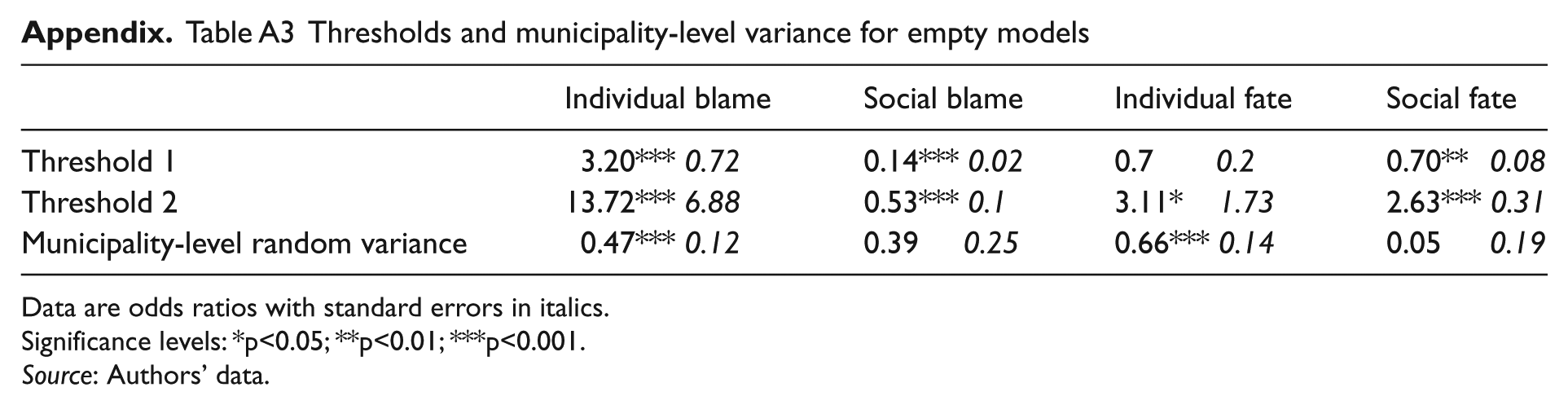
The multilevel models will be presented in one table (Table 2), which includes odds ratios and the statistical significances of the independent variables and the variances between municipalities. Analyses are carried out as follows: the first models (Model I) show the effects of individual- and municipal-level independent variables, while in the second models (Model II) the effects of the country variable are also standardized. 3 The empty models are presented in Appendix Table A3 and they show that there is municipal variation concerning the individual blame and individual fate explanations. In the models it is taken into account that the data is clustered by country, even though it is not included as a level of variance of its own. Thus, when computing standard errors (figures in italics in Table 2), the data clustered by country have been taken into consideration.
Results
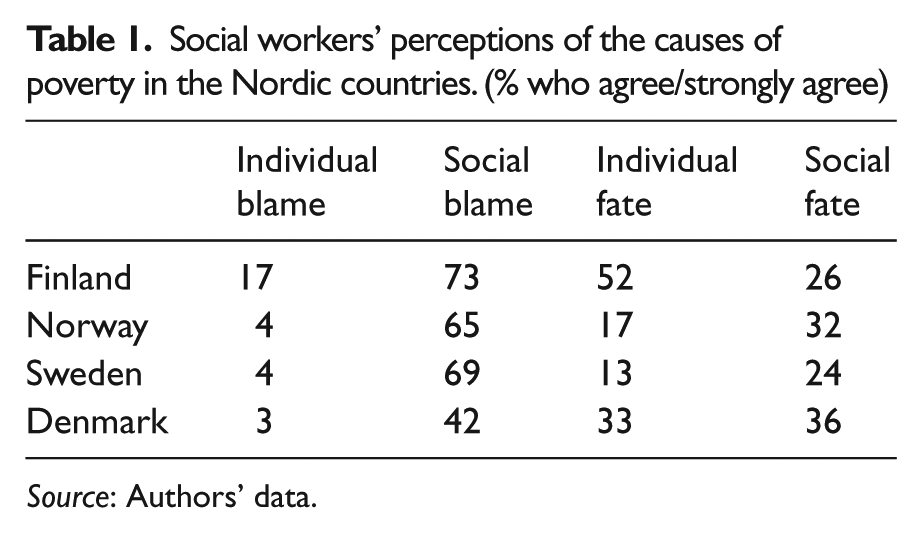
Turning to the results, we begin by looking at how social workers in the individual Nordic countries perceive the causes of poverty. As can been seen in Table 1, there is some variation between the four Nordic countries. ‘Social blame’ is indeed the most popular explanation in all the countries studied, but Denmark stands out as the deviant case. Here, only about 40 percent of the social workers support this explanation while the figures for Finland, Sweden and Norway are between 65 and 73 percent.
Social workers’ perceptions of the causes of poverty in the Nordic countries. (% who agree/strongly agree)
Source: Authors’ data.
All four explanations of poverty are fairly commonly embraced by the Finnish respondents. They differ the most in relation to other respondents regarding the popularity of the two individual explanations (individual blame, individual fate), where their support is clearly higher than it is in the other countries studied.
The Danish respondents, in turn, support fatalistic explanations almost to the same degree as they support the social blame explanation and, thus, in ‘relative terms’, Danish social workers display a more fatalistic way of thinking compared with social workers in the other Nordic countries. The perceptions of Swedish and Norwegian social workers seem to be rather similar: ‘social blame’ explanations of poverty are clearly the ones favoured, while other poverty explanations do not enjoy the same degree of support as in Finland or Denmark.
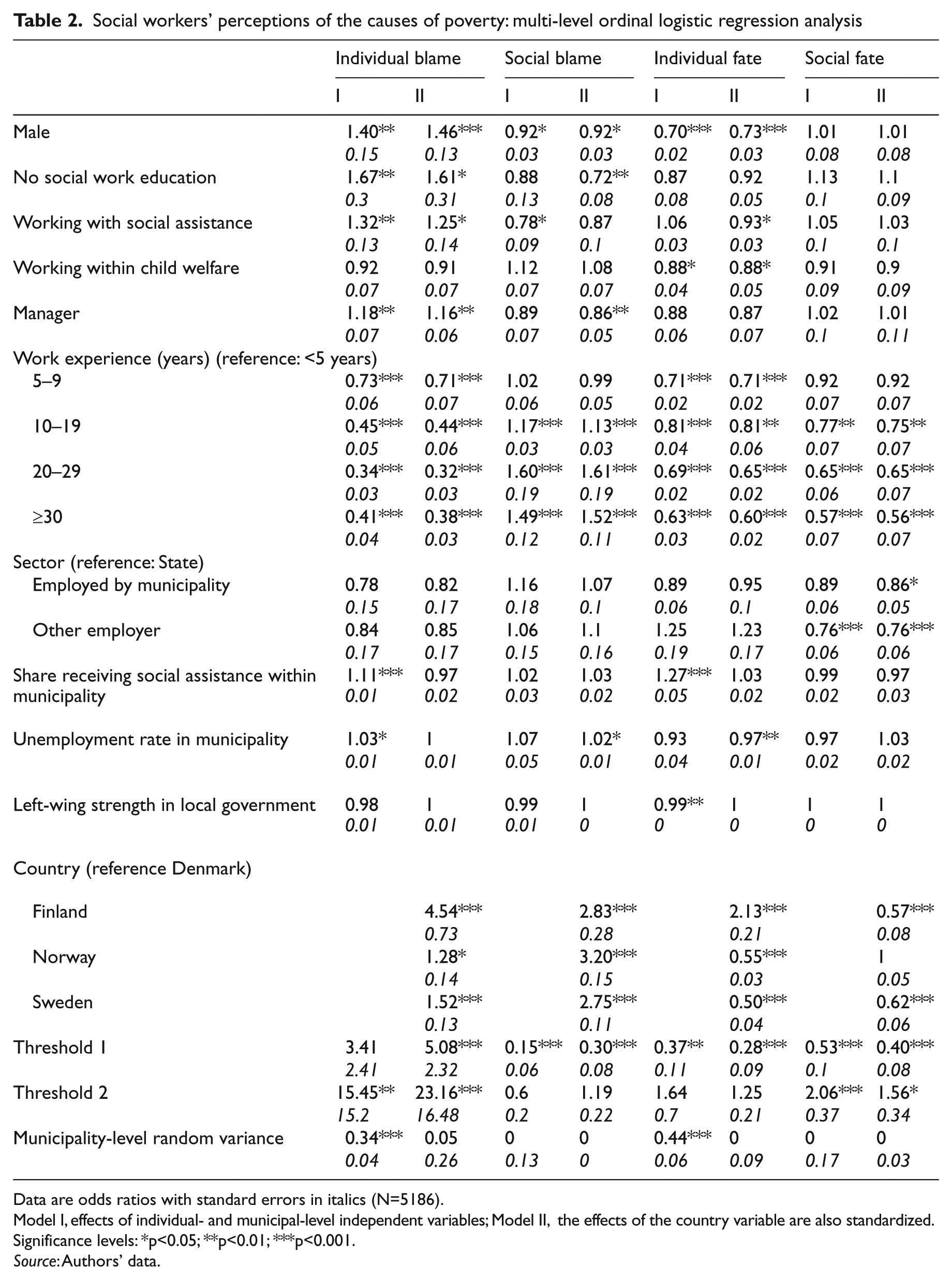
After a general descriptive presentation of social workers’ perceptions of poverty, we will now turn to possible differences in perceptions among social workers due to differing individual characteristics (see Table 2). According to the results, the amount of personal work experience in social work is of major importance for perceptions of poverty: respondents with shorter work experience are more inclined to support ‘individual blame’, ‘individual fate’ and ‘social fate’ explanations, and less inclined to support ‘social blame’ explanations than social workers with longer work experience.
Social workers’ perceptions of the causes of poverty: multi-level ordinal logistic regression analysis
Data are odds ratios with standard errors in italics (N=5186).
Model I, effects of individual- and municipal-level independent variables; Model II, the effects of the country variable are also standardized.
Significance levels: *p<0.05; **p<0.01; ***p<0.001.
Source: Authors’ data.
In addition, ‘education’ seems to be of importance for attitude differences: respondents without a degree in social work are more inclined to support individual blame explanations and less inclined to support social blame explanations than are respondents with a degree. However, ‘education’ is of no importance for the support for fatalistic explanations. Furthermore, men are more inclined to agree with individual blame explanations, but less inclined to support individual fate and social blame explanations than are women.
Social workers who are working directly with social assistance are more inclined to support individual blame explanations and less inclined to support social blame and individual fate explanations than are other social workers. Those who are working in child welfare support the individual fate explanation category less than other social workers. Results indicate also that having a managerial position has some importance for poverty attitudes: those who occupy managerial positions support the individual blame explanation more and the social blame option less than those who are not in managerial positions. Employment sector, in turn, is not of major importance for poverty perceptions, although there are some minor points of significance that are hard to interpret.
According to the results, it seems that most of the significances of municipal-level factors disappear when the impact of the country variable is standardized. Contrary to our assumption, the variance between municipalities mainly seems to be the result of variance across countries (since, for example, the share of social assistance recipients varies substantially between countries) and, thus, the impact of municipal-level variables measuring the strength of left-wing parties in local government and the share of social assistance recipients is minor. 4 The results for the variable measuring the unemployment rate in the individual municipalities, however, indicate that in those municipalities where the unemployment rate is high, social workers support social blame explanations to a greater extent and individual fate explanations to a lesser extent than social workers from municipalities with lower unemployment rates. The results for the country variable follow the same pattern as that already described in connection with the results presented in Table 1.
Discussion
As we expected (see hypothesis 1), the most commonly perceived reasons for poverty among Nordic social workers are connected to ‘social blame’. Despite this fact, however, Nordic social workers display a surprisingly large variety of and variation in perceptions: there are great differences between countries, but also within countries.
Norway and, above all, Sweden seem to be the countries in which social/structural conditions are most commonly perceived as the reason for poverty, to judge from the strong support for the social blame explanation, combined with minor support for other explanations. Finnish social workers, in turn, support several poverty explanations, and, in comparison with the other Nordic countries, individual (blame and fate) explanations enjoy rather widespread support in this country. Views on poverty vary the most among Danish social workers, as shown by the fact that none of the poverty explanations enjoys very widespread support. However, in comparison with other Nordic social workers, the Danes could perhaps be best described as ‘fatalistic’. Thus, as expected, the findings seem to follow the pattern found in previous national and comparative studies among the general populations in the Nordic countries (van Oorschot and Halman, 2000; Larsen, 2006). However, an explanation for these national differences remains elusive: previous comparative studies have not offered any explanations, and our results do not provide any additional hints as to these national variations either.
Concerning the impact of individual-level determinants on perceptions, the results on the importance of work experience 5 and gender confirm our assumptions (hypothesis 2).
As expected, ‘education’, too, seems to be of importance for perceptions among social workers: respondents without a degree in social work are more inclined to support ‘individual blame’ and less inclined to support ‘social blame’ explanations than do respondents with a degree. Whether this is an effect of the nature of Nordic social work education programmes and their curricula, or whether social work students possess their perceptions about society already before taking part in social work education (and that this, in fact, explains their choice of education) is, of course, hard to estimate. On the basis of previous international research, however, it seems that both processes might be at work here (Weiss et al., 2005). Yet, the results are interesting in terms of the argument about de-professionalization. It has been shown that at least in the English-speaking world there has been a growth of para-professional employment compared with professional employment in various social service occupations (Healy and Meagher, 2004: 244–246). A rather similar trend is also obvious within the Nordic countries, where case officers without a degree in social work have increased within social services. Further, in some Nordic countries, particularly in Finland, there is a serious shortage of qualified social workers, and as a result people lacking a formal degree in social work are allowed to serve as substitute social workers. The consequences of these changes have, however, gained rather little attention in the academic and public debate about the future of (Nordic) welfare policies. On the basis of the results from our study, showing quite substantial attitude differences between different ‘educational groups’, it seems reasonable to assume that citizens’ experience of welfare policies might be dependent on, for example, ongoing de-or re-professionalization processes in our societies.
We also expected that exposure to the poor would result in a greater likelihood for social workers supporting social blame explanations. Here, our results are somewhat contradictory and the explanations need to be refined by further research: those in managerial positions (who are thus less exposed to the poor) are, as was expected, less inclined to support social blame explanations than other social workers. The same, however, also goes for those working with the poor the most, that is, those working with tasks related to social assistance. Since the changes within Nordic social work towards increased sanctions in case of non-compliance with various obligations (arguably a strategy related to attributing problems to individual causes) seem to have been the most pronounced regarding groups (such as long-term and/or young unemployed) often receiving social assistance (see for example, van Aerschot, 2011), this might also contribute to explaining the results.
In contrast to individual-level variables, municipal-level factors related to the respondent’s working environment in a broader sense are of modest importance for social workers’ perceptions of poverty, and, thus, our third hypothesis was not confirmed. Neither structural nor political differences between municipalities seem to affect social workers’ perceptions of poverty, although such differences might be quite substantial. How should such a lack of ‘contextual effects’ be interpreted? In population studies, such differences have been thought, and have also sometimes been found, to be of importance for the fairly abstract sort of questions that we have used. One explanation would be that the ‘internal differences’ within the countries are still not great enough in relation to the effect of general ‘systemic’ values on the one hand and those (unknown) factors that lie behind the national differences in the perceptions of poverty on the other.
Our study illustrates that even in the comparably similar Nordic countries, dominated as they are by a ‘social/structural’ view of poverty, street-level bureaucrats’ perceptions may vary considerably. If, as assumed above, these normative views influence how street-level bureaucrats use their discretion, considerable variation in the implementation of the general policy goals in individual cases could be expected. Thus, our results highlight one challenge for all social policy programmes based on individual need assessment, regardless of the general model characteristics of the welfare system.
Footnotes
Appendix
Thresholds and municipality-level variance for empty models
| Individual blame | Social blame | Individual fate | Social fate | |
|---|---|---|---|---|
| Threshold 1 | 3.20*** 0.72 | 0.14*** 0.02 | 0.7 0.2 | 0.70** 0.08 |
| Threshold 2 | 13.72*** 6.88 | 0.53*** 0.1 | 3.11* 1.73 | 2.63*** 0.31 |
| Municipality-level random variance | 0.47*** 0.12 | 0.39 0.25 | 0.66*** 0.14 | 0.05 0.19 |
Data are odds ratios with standard errors in italics.
Significance levels: *p<0.05; **p<0.01; ***p<0.001.
Source: Authors’ data.