




Abstract
This article explores the impact of the European Union (EU) on homelessness policy-making. Homelessness policy has undoubtedly been influenced at different levels, but the main framework for working on homelessness at the EU level in a targeted way over the last 10 years has been the social Open Method of Coordination (OMC). The article examines the emergence, through the social OMC, of the foundations of of an EU homelessness policy by looking at key mechanisms through which homelessness emerged on the EU agenda, and the first signs of EU impact on homelessness policy dynamics. The interconnection between local actions, national measures and the EU policy arena on homelessness is increasingly evident, to the extent that the EU is now in a position to support Member States to address homelessness.
Introduction
Europe’s monetary and fiscal policies are intrinsically linked to Europe’s economic recovery, and despite actions taken in both fields over the last 5 years, unemployment in the Eurozone was at a record high of 12 percent in June 2013 (Eurostat, 2013). The latest Eurostat estimates show that the number of Europeans at risk of poverty or social exclusion increased by 7.4 million between 2008 and 2012, and that 125 million people in EU28 are currently at risk of poverty or social exclusion (European Commission (EC), 2014). The EC’s 2013 Annual Growth Survey states, ‘After several years of weak growth, the crisis is having severe social consequences. Welfare systems cushioned some of the effects at first but the impact is now being felt across the board’ (EC, 2012a: 1). The latest reports of the European Federation of National Organisations Working with Homeless People (FEANTSA) 1 confirm this – whereas there are no official Eurostat estimates on homelessness, 2012 FEANTSA trend data show substantial increases in homelessness in most EU countries (in 15 countries over the last 1–5 years), with an increasing number of women, youth, families and migrants experiencing homelessness. Transitional homelessness is affecting a greater part of the EU population as vulnerabilities are increasing. Homelessness, understood as covering a variety of living situations in the European Typology of Homelessness and Housing Exclusion (ETHOS; rooflessness, houselessness, insecure housing, inadequate housing), is being addressed through targeted social investments in many countries as part of efforts to reach the EU poverty target to lift 20 million people out of poverty by 2020 (FEANTSA, 2012a). In February 2013, the EC published homelessness policy guidelines in the Social Investment Package in order to guide Member States. Moreover, a group of EU countries is developing informal cooperation on homelessness linked to the EU’s social policy agenda (currently the social Open Method of Coordination or ‘OMC’) – under the Irish Presidency of the EU, 23 countries agreed six key principles on homelessness to inform EU policy (Council, 2013). There is no official EU homelessness policy at the time of writing, yet evidence shows that the foundations of such a policy are now in place, mainly as a result of soft policy instruments of the social OMC, to allow EU countries to cooperate closely in this field. This article takes a closer look at these foundations, namely, by examining, on the one hand, the emergence of homelessness as an EU policy issue, and, on the other hand, highlighting the first signs of EU impact on homelessness policy dynamics. The article then concludes with a brief assessment of the specificities of a potential EU homelessness policy. The sources for evidencing these developments are a combination of existing OMC research; key EU, national and local policy documents; interviews with different EU stakeholders; and finally, my participation in various meetings of the social OMC process, including the Indicators Sub-Group, the Social Protection Committee (SPC), peer reviews on homelessness, key meetings and conferences.
Emergence of homelessness as an EU policy issue
EU social objectives were agreed in 2000 to promote voluntary EU cooperation and benchmarking of national policies through an OMC (social OMC), aiming not to harmonize but to coordinate national social policies. The common objectives in the social OMC were never quantitative targets as such, but rather policy priorities that provided a framework for Member States to address the multiple aspects of poverty in an integrated way. The first set of common objectives agreed in 2000 included a reference to preventing life crises that can lead to becoming homeless, as well as the need to provide access for all to decent and sanitary housing (Council, 2000). This was a first sign that Europe was willing to support transnational cooperation in the field of homelessness. While the EU triggered certain policy dynamics on homelessness on national social agendas, agenda-setting in the social OMC has also been a bottom-up process whereby countries seek to keep their priorities high on the EU agenda. The emerging key social inclusion priorities were highlighted with the publication of regular Joint Reports, adopted by both the Commission and the Council. Existing evidence illustrates that the issue of homelessness emerged as a priority through four main OMC channels: the national reporting mechanism, the development of EU indicators, EU stakeholder events and EU presidencies.
As the social OMC progressively became known among national homelessness policy-makers, they started to recognize the added value of EU intervention (mainly political and financial support for expertise and knowledge building to effectively address social challenges) and were keen to keep homelessness on the EU agenda as a key priority. The fact that homelessness policy-makers were not all in social affairs ministries (the main contact point for the social OMC 2 ), but also in health ministries (Greece, The Netherlands) or housing and local government ministries (United Kingdom, Ireland, Finland), means that competition between ministries for formal access to the EU arena probably also provided incentives for pushing homelessness on the EU social inclusion agenda. Moreover, the key EU policy priorities were gaining in importance as a social inclusion OMC tool given that the original common objectives were considerably watered down when the social inclusion process was merged with pensions and health in 2006 – in fact, the reference to homelessness was dropped in the new common objectives (EC, 2005). The biennial national reporting on inclusion policies clearly became a channel for priority and agenda-setting, with national authorities and non-governmental organizations (NGOs) using the national reports 3 to highlight trends and request EU support for transnational cooperation in specific fields like homelessness (Spinnewijn, 2009). Most national authorities organized stakeholder consultations to gather data on key social challenges, and these consultations were mostly attended by FEANTSA national members. Although the national reports in question were not used for policy implementation, there were conscious decisions from national homelessness platforms of NGOs to invest time in ensuring that the national reports had references to existing homelessness actions. Following the launch of the Europe2020 strategy in 2010, the national reporting on social inclusion in the OMC has steadily declined and has been integrated in the National Reform Programmes (NRP). More than 10 countries highlighted measures to tackle homelessness in the 2013 NRPs (FEANTSA, 2013); however, stakeholder consultations are no longer systematic, especially as these NRPs involve a number of ministries (economic, financial, employment, social), which requires a whole consultation process in itself. 4
Over the years, consensus was reached on homelessness/housing exclusion as a key priority in the social OMC (Barcevičius et al., 2014; Daly, 2012; Joint Report, 2010; SPC, 2012). Consensus, however, has not yet led to the benchmarking of policies and measurement of progress, not least because no common homelessness definition and indicators have officially been agreed. Nevertheless, transnational exchanges between practitioners on homelessness and housing exclusion rapidly developed a common policy language, which saw the emergence of the ETHOS (EC, 2006) developed by FEANTSA researchers and NGOs, which is based on four European conceptual categories of homelessness, operationalized differently according to the (sub-)national context. A real need from the ground for a sound starting point for effective European policy cooperation in the social OMC was the key driver for developing this typology, which has now become a reference for homelessness policy-making helping practitioners in different EU countries understand the dynamics of homelessness (CC, 2010; EC, 2013b; Edgar et al., 2007). The ETHOS is broadly accepted in a number of countries (Denmark, Germany, Finland, France, Sweden, United Kingdom), and many countries in Europe use it as a reference even if they choose to adopt more restrictive definitions for practical policy purposes (Austria, Belgium, Czech Republic, Greece, Hungary, Ireland, Italy, Luxembourg, Poland, Portugal) (Busch-Geertsema, 2010; Frazer and Marlier, 2009). The typology was formally recognized in the Social Investment Package and was integrated in the European Parliament (EP) response to the EC’s proposal for a Fund for European Aid to the Most Deprived (EP, 2013) – both examples that are telling of the current consensus on homelessness definitions at EU level. ETHOS has been used in various European documents and meetings on homelessness to compare homelessness across EU countries (Baptista, 2013; Dol and Haffner, 2010; Eurocities, 2008), and has even influenced thinking beyond Europe (Statistics New Zealand, 2009). No common EU indicators on homelessness have yet been adopted, however. The commonly agreed indicators for benchmarking policies and practices in the social OMC are developed by a sub-group of the SPC, which built European definitions of the indicators based on approaches across EU countries. The indicators are currently available in the Eurostat database. The list covers different dimensions of poverty, including various housing dimensions (severe housing deprivation, overcrowding, affordability), but they do not directly cover homelessness (Atkinson and Marlier, 2010; EC, 2011; Rybkowska and Schneider, 2011) mainly due to methodological reasons. Since collecting data on homelessness cannot easily go through traditional EU-Statistics on Income and Living Conditions (EU-SILC) household surveys (the main source of data for the common indicators), a different methodology is required, namely, using retrospective modules in SILC or going through services in contact with homeless households. While this does delay progress on cross-country comparisons, this actually stimulated much debate and therefore kept homelessness high on the OMC indicator agenda, with a comparative European study financed by the EC in 2007 that built on national methodologies to formulate recommendations for an EU methodology, followed by the funding of a transnational project from 2008 to 2009 to improve homelessness measurement at national level (Mutual Progress on Homelessness through Advancing and Strengthening Information Systems (MPHASIS)). While monitoring progress in homelessness reduction within countries is possible based on national data, an EU homelessness policy could not currently be based on peer pressure and cross-country comparisons. However, this may change in the future with the results of the 2011 EU population and housing census that also counted homeless households in all EU countries, and might provide a first official Eurostat figure of homelessness in Europe (EC, 2013a).
There are no common indicators to benchmark homelessness policies, but the realities of homelessness have still come to the fore in the EU political arena, not least through EU stakeholder events. From 2002 to 2010, the EC and EU Presidency hosted annual European Round Tables and annual Meetings of People Experiencing Poverty (with 200 plus participants at each event), which became important places to influence the EU agenda. European networks tried to get their priorities on the programmes as the events often led to political conclusions that were sent to the Council. Nearly every year of the last decade, the Round Tables put the theme of homelessness on the programmes, bringing together practitioners from ministries, NGOs, local authorities, academia, other EU bodies (Parliament, Committee of the Regions, Economic and Social Committee) and, increasingly, people experiencing homelessness. The same can be said for the annual meeting of people experiencing poverty – even though participation of people experiencing homelessness has been understandably more challenging, the Danish Presidency of the EU made addressing homelessness a priority theme for the 2012 meeting. As Europe’s role became clearer to local stakeholders and practitioners tackling homelessness on a daily basis, they were more open to involvement in European events on social inclusion, despite being far away from their local realities. These events enabled practitioners to link their work to EU social policy developments, but also to confront or benchmark their local work on homelessness with other realities. This possibly contributed to increased EP pressure on the EC from 2008 onwards, to support their local constituencies in tackling homelessness, culminating in calls for an EU homelessness strategy in 2011 and 2014 (EP, 2008, 2011, 2014).
European events organized by the 6-month rotating EU presidencies were also channels for integrating national priorities in the European social OMC process: the Finnish EU presidency organized a housing rights conference in 2006; the French EU presidency focused on homelessness in the informal Housing Ministers meeting in 2008; the Belgian EU presidency organized a European Consensus Conference (CC) on homelessness in 2010, which brought together key experts to address six key questions on homelessness policy at EU level (e.g. EU definition, key policy approaches, the role of the EU) (CC, 2010); and the Danish EU presidency chose to focus on homelessness and housing rights at the 2012 Annual Meeting of People Experiencing Poverty. The French government organized a European workshop on homelessness (although not within its EU Presidency) in 2012 where it called for an EU homelessness strategy with a strong focus on housing-led approaches (France, 2012). Finally, the most recent indication of bottom-up pressure on the EU agenda is the Irish Presidency European round table of ministers responsible for homelessness in March 2013, which was a first, and which agreed on six key principles to inform EU policy. The EC was present at most of, if not all, these events, and the last Irish Presidency event was attended by Commissioner Laszlo Andor. Apart from funding the FEANTSA network, the EC gradually became receptive to homelessness as an emerging issue that required EU support. It made homelessness the focus of the SPC’s thematic work in 2009 which organized a first general European mapping of policies, definitions and statistics on homelessness. Following this, it financially supported the European CC on homelessness in 2010. The Social Investment Package published by the EC in February 2013 has now placed homelessness firmly on the EU agenda, calling on Member States to implement homelessness strategies through the NRPs in order to contribute to reaching the 2020 poverty reduction target. Unlike the year 2000 common objectives where homelessness was mentioned in a few sentences, the Social Investment Package includes an entire document with policy guidelines to reduce homelessness (EC, 2013b).This political momentum and recent mainstreaming of homelessness policy in Europe2020 is probably partly driven by the difficult economic context and the need to address the social consequences of austerity, but the guidance from the EC builds on expertise and consensus built over the last 10 years through the social OMC in relation to homelessness and public policy.
Evidence of EU impact on homelessness policy dynamics
Homelessness policy is influenced from many directions, but there is already some empirical evidence that the EU has had an impact through the social OMC, namely, driving more strategic thinking to address homelessness, influencing policy discourse and even leading to some convergence of national policies. The findings in this section are exploratory and causality still needs to be confirmed, but the aim is to launch a first reflection on the issue.
Homelessness gradually emerged as a key issue in the national reports on social inclusion policies submitted every 2 years to the EC (FEANTSA, 2005; Spinnewijn, 2009):
There has been a clear change in the importance attached to homelessness and housing in the different EU Member States as indicated in the reports produced by the European Commission over the past five years: from homelessness and housing as urgent policy issues for some Member States (1st Joint Inclusion Report 2001), for most Member States (2nd Joint Inclusion report 2004), for all new Member States (Report on NAPsIncl of new Member States 2005), to homelessness as one of the six key priorities for all 25 Member States (1st Joint Report Social Protection & Social Inclusion 2005). (FEANTSA, 2005: 5)
In their 2011 position on the future of the OMC, the SPC acknowledged that the impact of the OMC on policy thinking, discourse and agendas was ‘varied, but overall indisputable. There are many instances in literally all Member States when the OMC has triggered, or at least contributed, to policy reassessments, public discourses, and actors’ agendas. Prominent examples include (child) poverty, homelessness, long-term care and pension reform’ (SPC, 2011: 2).
Frazer et al. (2010) summarize well the impact of the Social OMC common objectives as having
raised the awareness in many Member States (particularly through the NAPs/inclusion) of the need for a more strategic approach based on more comprehensive and integrated policies; it has helped highlight the need to focus on prevention as well as on alleviation of problems. (p. 130)
Hence, the OMC common objectives can be seen as factors inducing policy practitioners to reflect on the place and nature of homelessness policy in wider government (social) policies, in cooperation with their European counterparts. Only few EU countries had a formal national homelessness policy before the launch of the social OMC – most actions aimed merely to contain homelessness by funding a wide range of NGO service providers without any clear policy objectives. Today, many countries are trying to significantly reduce homelessness, by funding services within clear policy frameworks underpinned by strategic objectives such as phasing out hostel accommodation and replacing it with long-term housing solutions (Finland), providing suitable support interventions for homeless people (The Netherlands), a legal right to settled accommodation for all unintentionally homeless households (Scotland), reducing length of stay in emergency accommodation to less than 6 months (Ireland) (Busch-Geertsema et al., 2010; FEANTSA, 2012a). There are now more than 10 countries with a national or regional strategy (Table 1) and countries making serious steps towards a strategy (Belgium-Flanders, Bulgaria, Italy, Poland, Spain). In other countries, reducing homelessness is a priority but is being addressed through decentralized anti-poverty strategies, which include objectives such as access to services and housing for vulnerable groups (Austria, Belgium, Germany, Italy, Spain) or the reorganization of services towards individualized support systems (Croatia, Malta, Poland) (FEANTSA, 2013). A good indication that the social OMC has had an impact is the multiplication of national or regional homelessness strategies and programmes over the last decade (Busch-Geertsema et al., 2010; FEANTSA, 2013), as highlighted in Table 1.
The launch of national and regional homelessness strategies in Europe.
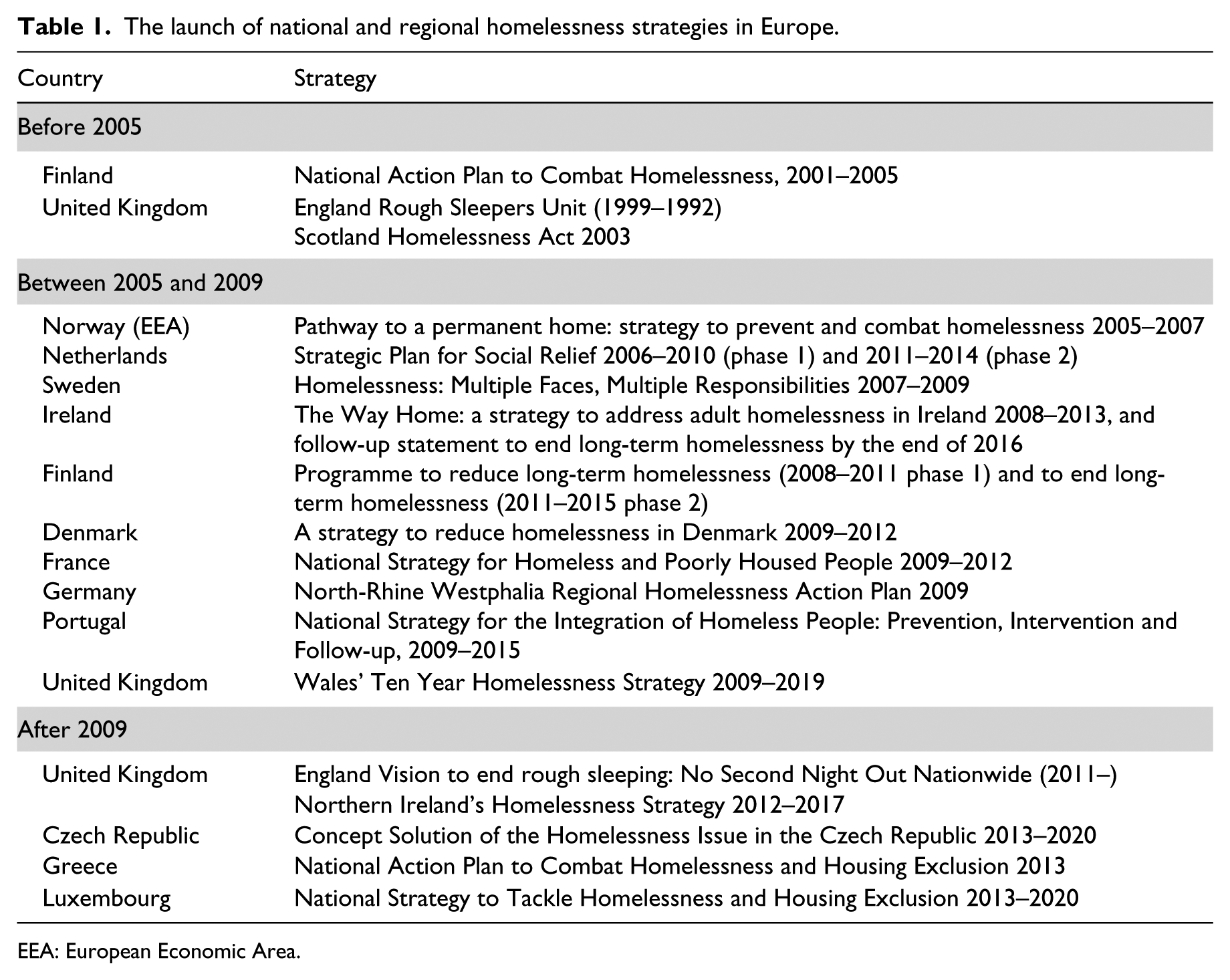
EEA: European Economic Area.
There may be some causality between the launch of the ETHOS typology in 2005, and the development of nine national or regional strategies (10 with Norway) between 2005 and 2009. Some evidence of EU influence on homelessness policy discourse and research frameworks is available in social science literature, evaluations and official documents. The impact of the social OMC on homeless policy in Denmark has been examined in some detail, showing that the social OMC has influenced thinking not only at the national level in developing a homelessness strategy (Public Policy and Management Institute (PPMI), 2011: 9), but also at the local level with the use of ETHOS by municipalities to frame their homelessness strategies (De La Porte, 2014). The ETHOS typology seems especially to be referred to as a starting point for policy thinking on homelessness. This is the case in Portugal according to an official assessment of the Portuguese Strategy referring to
One of the most striking elements of the Portuguese Strategy [being] the important role that EU-level initiatives have played in its development. Thus the focus on homelessness in the Social OMC seems to have been very helpful, and several tools developed by FEANTSA (such as the ETHOS definition) have been used in the process of Strategy development and implementation. (Fitzpatrick, 2010: 21)
The Irish homelessness strategy 2008–2013 was framed in a European context by explicitly referring to ETHOS to ensure awareness of groups at risk of homelessness (Department of Environment, 2008: 15–16). It seems that ETHOS is also used in research in different forms. A few examples would include: as a basis for conducting surveys as in Sweden where it was used as a starting point for developing the 2005 national mapping of homelessness (Socialstyrelsen, 2005), in Greece where it has contributed to reflections on how to define homelessness (Stamatis, 2012), or as a reference for assessing homelessness in the Czech Republic (Lux and Mikeszova, 2013).
National homelessness strategies developed over the last 10 years are generally based on national research and surveys on the causes of homelessness, and are therefore very specific to the different countries. There are, however, clear similarities in the general policy objectives of strategies that show some first signs of convergence of homelessness policies in Europe. Policy objectives and targets include the following: eliminating the need to sleep rough (Denmark, Ireland, Portugal, United Kingdom), reducing length of stay in temporary accommodation (Denmark, Ireland, Sweden), improving the quality of services (Czech Republic, France, Ireland, Malta, Poland), prevention of homelessness (Czech Republic, Denmark, Finland, Ireland, Luxembourg, The Netherlands, Norway, Portugal, Sweden, United Kingdom), providing access to housing (Czech Republic, Finland, France, Ireland, Luxembourg, The Netherlands, Norway, Sweden, United Kingdom) and testing or implementing Housing First (Austria, Belgium, Denmark, Finland, France, Luxembourg, The Netherlands, Sweden) (EC, 2013b; FEANTSA, 2012b, 2013).
Drivers of such convergence require further examination, but participation of homelessness policy-makers in the EU social inclusion peer-review programme between 2004 and 2010 may have contributed to such dynamics. Homelessness has been the subject of eight peer reviews since the start of the programme in 2004 (Curry, 2012). Peer reviews are a classic mutual learning instrument of any OMC used in EU policy (Laffan and Shaw, 2005; Lange and Alexiadou, 2010; Sabato, 2012; Tholoniat, 2010) – an instrument which takes a policy as a starting point for European peer exchanges. These peer reviews most likely induced forms of policy transfer, especially in countries with no prior official homelessness policy. For instance, Danish social policy-makers attended five peer reviews on homelessness between 2006 and 2010, with the aim of collecting information in the area of homelessness ‘for which little knowledge and no strategy existed previously’ (De La Porte, 2014). The French national action plan on inadequate housing (launched in 2004) was peer reviewed in 2007 by EU countries, and the review synthesis report refers to previous peer reviews on homelessness in the United Kingdom, Denmark and Norway. Even if the French peer review was on the theme of inadequate housing (not homelessness), this indicates some continuity and links between EU peer reviews on homelessness-related areas (Dandolova, 2007). Two years later, France published a new plan, this time explicitly on ‘homeless and poorly housed people’ (see Table 1). Whereas the EU cannot have a direct impact on homeless policy through peer reviews, the decision to facilitate mutual influencing through peer exchanges does seem to contribute to building a European policy language and European networks of practitioners. Similarly, the setting up of transnational projects on homelessness between 2008 and 2013 5 can be considered an extension of the dynamics found in single peer-review meetings, since practitioners work closely for up to 2 years in these projects. An indication of the potential impact and multiplier effects of a transnational project at sub-national level is the participation of the municipality of Ghent in Housing First Europe (a project involving 10 European cities from 2011 to 2013), which led to the setting up of Housing First Belgium in 2013, testing innovative approaches in five Belgian cities.
Conclusion: The specificities of an EU homelessness policy
Homelessness is a local phenomenon yet the connections with the EU level are increasingly evident. Political agendas at EU and (sub-)national levels are mutually influencing one another. The use of EU typologies and mutual learning across countries is creating a common EU language on homelessness and leading to first signs of policy impact and convergence. Homelessness policy-makers and practitioners often look to Europe for inspiration and support. The links between local and EU level homelessness initiatives will now also be strengthened through the new EU cohesion funds (2014–2020), namely, the European Social Fund for projects promoting active inclusion of homeless people and the European Regional Development Fund for projects to improve social, health and housing infrastructure. In addition, the Fund for European Aid to the Most Deprived should become a source of funding to deal with social emergencies and, namely, promote the use of starter packs to help people transition out of homelessness and into permanent forms of accommodation (EC, 2012b).
Homelessness policy is a fairly new policy area in most EU countries (having mostly emerged over the last decade, except for a minority of countries), where efforts are being made to de-institutionalize solutions to homelessness, to normalize housing conditions for homeless people and to individualize support (Busch-Geertsema, 2013). Many countries are taking action to change service structures and undertake reforms or experimentations to find sustainable and lasting solutions to homelessness. In such a context, it seems a strategic EU policy on homelessness could provide important support to these countries. The evidence highlighted in this article shows how the social OMC has contributed to paving the way for such an EU policy, and should therefore probably remain the main framework for countries to work together in the specific field of homelessness, not least to situate such action in a wider integrated anti-poverty strategy.
There could one day be enough political support to develop OMC in different social policy areas, but consensus needs to be reached by all 28 Member States for that to happen. As expertise in sub-policy fields of poverty and social exclusion develops (e.g. on homelessness, child poverty, active inclusion), the social OMC may have to adapt and integrate ‘sub-layers’ in order to support policy clusters of countries motivated to engage in reinforced cooperation in these specific areas through a governance structure with clear objectives and strategic actions. This would allow the social OMC to respond to new emerging needs, like the urgent need to address the social consequences of austerity measures. Addressing homelessness is a political priority for many Member States, but not for all 28 Member States. Should this prevent a cluster of countries from moving towards an EU homelessness policy?
The potential of integrating policy clusters in current EU social policy governance structures (SPC, Indicators Sub-Group, European Platform against Poverty and so on) could be further explored, maybe finding inspiration in other EU fields with similar requests for reinforced cooperation to tackle specific emerging issues. 6 Comparisons could also be made between Europe and Canada, where the potential of an OMC on homelessness for practitioners is being considered (Doberstein, 2011; Townsend, 2013). However, any further assessments would, however, have to be carried out within a wider policy context – the established social OMC process is changing as social policy is mainstreamed in Europe2020, an economic process that requires Member States to report on progress towards the EU 2020 poverty target. The annual NRPs are therefore becoming the main reports to the EC on measures to reduce homelessness. This is effectively linking homelessness policy to the wider EU economic and employment policy frameworks that are more binding than the social OMC, with country-specific recommendations issued annually to Member States to direct their policy decisions. It would be useful to assess how an EU homelessness policy can evolve in this new framework, and whether Europe2020 can genuinely mitigate the negative impact of austerity on citizens experiencing homelessness.
Footnotes
Author’s Note
The author was paid by FEANTSA/European Commission for various policy responsibilities. This article was written outside the FEANTSA responsibilities.
Funding
This research received no specific grant from any funding agency in the public, commercial or not-for-profit sectors.